The Genetics of Endophenotypes of Neurofunction to Understand
Schizophrenia (GENUS) consortium: A collaborative cognitive and
neuroimaging genetics project
Gabriëlla A.M. Blokland
a,b,c,d, Elisabetta C. del Re
c,e,f, Raquelle I. Mesholam-Gately
c,g, Jorge Jovicich
h,
Joey W. Trampush
i,j,k,l, Matcheri S. Keshavan
c,g,m, Lynn E. DeLisi
c,e, James T.R. Walters
n, Jessica A. Turner
o,p,
Anil K. Malhotra
i,j,k, Todd Lencz
i,j,k, Martha E. Shenton
c,e,f,q, Aristotle N. Voineskos
r,s, Dan Rujescu
t,u,
Ina Giegling
t, René S. Kahn
v, Joshua L. Roffman
b,c,w, Daphne J. Holt
b,c,w, Stefan Ehrlich
c,w,x, Zora Kikinis
c,f,
Paola Dazzan
y,z, Robin M. Murray
y,z, Marta Di Forti
y,z, Jimmy Lee
aa, Kang Sim
aa, Max Lam
aa,
Rick P.F. Wolthusen
c,w,x, Sonja M.C. de Zwarte
v, Esther Walton
v, Donna Cosgrove
ab, Sinead Kelly
ac,ad,
Nasim Maleki
b,c,w, Lisa Osiecki
a, Marco M. Picchioni
y,z, Elvira Bramon
y,z,ae, Manuela Russo
y,z,
Anthony S. David
y,z, Valeria Mondelli
y,z, Antje A.T.S. Reinders
y,z, M. Aurora Falcone
y,z, Annette M. Hartmann
t,
Bettina Konte
t, Derek W. Morris
af, Michael Gill
ac, Aiden P. Corvin
ac, Wiepke Cahn
v, New Fei Ho
aa,
Jian Jun Liu
ag, Richard S.E. Keefe
ah, Randy L. Gollub
b,c,w, Dara S. Manoach
b,c,w, Vince D. Calhoun
o,ai,
S. Charles Schulz
aj, Scott R. Sponheim
aj, Donald C. Goff
c,ak, Stephen L. Buka
al, Sara Cherkerzian
am,
Heidi W. Thermenos
b,c,g, Marek Kubicki
c,f,q,w, Paul G. Nestor
c,e,an, Erin W. Dickie
r, Evangelos Vassos
y,z,
Simone Ciufolini
y,z, Tiago Reis Marques
y,z, Nicolas A. Crossley
y,z, Shaun M. Purcell
c,d,ao,ap,
Jordan W. Smoller
a,b,c,d, Neeltje E.M. van Haren
v, Timothea Toulopoulou
y,aq,ar, Gary Donohoe
ac,af,
Jill M. Goldstein
b,c,am,am, Larry J. Seidman
b,c,g,†, Robert W. McCarley
c,e,†, Tracey L. Petryshen
a,b,c,d,⁎
aPsychiatric and Neurodevelopmental Genetics Unit, Center for Genomic Medicine, Massachusetts General Hospital, Boston, MA, United StatesbDepartment of Psychiatry, Massachusetts General Hospital, Boston, MA, United States c
Department of Psychiatry, Harvard Medical School, Boston, MA, United States
d
Stanley Center for Psychiatric Research, Broad Institute of MIT and Harvard, Cambridge, MA, United States
e
Department of Psychiatry, Veterans Affairs Boston Healthcare System, Brockton, MA, United States
f
Psychiatry Neuroimaging Laboratory, Department of Psychiatry, Brigham and Women's Hospital, Boston, MA, United States
gMassachusetts Mental Health Center Public Psychiatry Division, Beth Israel Deaconess Medical Center, Boston, MA, United States hCenter for Mind/Brain Sciences (CiMEC), University of Trento, Trento, Italy
i
Center for Psychiatric Neuroscience, The Feinstein Institute for Medical Research, Division of Northwell Health, Manhasset, NY, United States
j
Division of Psychiatry Research, The Zucker Hillside Hospital, Division of Northwell Health, Glen Oaks, NY, United States
k
Hofstra Northwell School of Medicine, Departments of Psychiatry and Molecular Medicine, Hempstead, NY, United States
l
BrainWorkup, LLC, Los Angeles, CA, United States
m
University of Pittsburgh Medical Center, Pittsburgh, PA, United States
nDepartment of Psychological Medicine, Cardiff University, Cardiff, United Kingdom oThe Mind Research Network, Albuquerque, NM, United States
p
Department of Psychology and Neuroscience Institute, Georgia State University, GA, United States
q
Department of Radiology, Brigham and Women's Hospital, Harvard Medical School, Boston, MA, United States
r
Kimel Family Translational Imaging Genetics Laboratory, Research Imaging Centre, Campbell Family Mental Health Institute, Centre for Addiction and Mental Health, Department of Psychiatry, Faculty of Medicine, University of Toronto, Toronto, ON, Canada
s
Department of Psychiatry and Institute of Medical Science, University of Toronto, Toronto, ON, Canada
tDepartment of Psychiatry, Psychotherapy and Psychosomatics, University of Halle-Wittenberg, Halle, an der Saale, Germany uDepartment of Psychiatry, Ludwig Maximilians University, Munich, Germany
v
Brain Centre Rudolf Magnus, Department of Psychiatry, University Medical Centre Utrecht, Utrecht, The Netherlands
w
MGH/HST Athinoula A. Martinos Center for Biomedical Imaging, Massachusetts General Hospital, Charlestown, MA, United States
x
Division of Psychological & Social Medicine and Developmental Neurosciences, Faculty of Medicine, Technische Universität Dresden, Dresden, Germany
y
Institute of Psychiatry, Psychology, and Neuroscience, King's College London, London, United Kingdom
z
National Institute for Health Research (NIHR) Mental Health Biomedical Research Centre at South London and Maudsley NHS Foundation Trust, London, United Kingdom
aaInstitute of Mental Health, Woodbridge Hospital, Singapore
Schizophrenia Research 195 (2018) 306–317
⁎ Corresponding author at: Psychiatric and Neurodevelopmental Genetics Unit, Center for Genomic Medicine, Massachusetts General Hospital, 185 Cambridge Street, Boston, MA 02114, United States.
E-mail address:[email protected](T.L. Petryshen).
† Deceased
https://doi.org/10.1016/j.schres.2017.09.024
0920-9964/© 2017 Elsevier B.V. All rights reserved.
Contents lists available at
ScienceDirect
Schizophrenia Research
ab
The Cognitive Genetics and Cognitive Therapy Group, Department of Psychology, National University of Ireland, Galway, Ireland
ac
Neuropsychiatric Genetics Research Group, Department of Psychiatry, Institute of Molecular Medicine, Trinity College Dublin, Dublin, Ireland
ad
Laboratory of NeuroImaging, Keck School of Medicine, University of Southern California, Los Angeles, CA, United States
ae
Mental Health Neuroscience Research Department, UCL Division of Psychiatry, University College London, United Kingdom
af
Cognitive Genetics and Cognitive Therapy Group, Neuroimaging and Cognitive Genomics (NICOG) Centre and NCBES Galway Neuroscience Centre, School of Psychology and Discipline of Biochemistry, National University of Ireland, Galway, Ireland
ag
Genome Institute, Singapore
ah
Department of Psychiatry and Behavioral Sciences, Duke University Medical Center, Durham, NC, United States
ai
Department of Electrical and Computer Engineering, University of New Mexico, Albuquerque, NM, United States
aj
Department of Psychiatry, University of Minnesota, Minneapolis, MN, United States
ak
Nathan S. Kline Institute for Psychiatric Research, Department of Psychiatry, New York University Langone Medical Center, New York, NY, United States
alDepartment of Epidemiology, Brown University, Providence, RI, United States
amDepartment of Medicine, Division of Women's Health, Brigham and Women's Hospital, Harvard Medical School, Boston, MA, United States an
Laboratory of Applied Neuropsychology, University of Massachusetts, Boston, MA, United States
ao
Department of Psychiatry, Brigham and Women's Hospital, Boston, MA, United States
ap
Division of Psychiatric Genomics, Departments of Psychiatry and Genetics and Genomic Sciences, Icahn School of Medicine at Mount Sinai, New York, NY, United States
aq
Department of Psychology, Bilkent University, Bilkent, Ankara, Turkey
ar
Department of Psychology, The University of Hong Kong, Pokfulam, Hong Kong, SAR, China
a b s t r a c t
a r t i c l e i n f o
Article history: Received 15 June 2017
Received in revised form 15 September 2017 Accepted 20 September 2017
Available online 3 October 2017
Background: Schizophrenia has a large genetic component, and the pathways from genes to illness manifestation are beginning to be identified. The Genetics of Endophenotypes of Neurofunction to Understand Schizophrenia (GENUS) Consortium aims to clarify the role of genetic variation in brain abnormalities underlying schizophrenia. This article describes the GENUS Consortium sample collection.
Methods: We identified existing samples collected for schizophrenia studies consisting of patients, controls, and/ or individuals at familial high-risk (FHR) for schizophrenia. Samples had single nucleotide polymorphism (SNP) array data or genomic DNA, clinical and demographic data, and neuropsychological and/or brain magnetic reso-nance imaging (MRI) data. Data were subjected to quality control procedures at a central site.
Results: Sixteen research groups contributed data from 5199 psychosis patients, 4877 controls, and 725 FHR in-dividuals. All participants have relevant demographic data and all patients have relevant clinical data. The sex ratio is 56.5% male and 43.5% female. Significant differences exist between diagnostic groups for premorbid and current IQ (both pb 1 × 10⁻¹⁰). Data from a diversity of neuropsychological tests are available for 92% of par-ticipants, and 30% have structural MRI scans (half also have diffusion-weighted MRI scans). SNP data are available for 76% of participants. The ancestry composition is 70% European, 20% East Asian, 7% African, and 3% other. Conclusions: The Consortium is investigating the genetic contribution to brain phenotypes in a schizophrenia sample collection ofN10,000 participants. The breadth of data across clinical, genetic, neuropsychological, and MRI modalities provides an important opportunity for elucidating the genetic basis of neural processes underly-ing schizophrenia.
© 2017 Elsevier B.V. All rights reserved.
Keywords: Schizophrenia Neuropsychology Cognition Neuroimaging MRI Genetics
1. Introduction
Clinical presentation of schizophrenia varies among individuals, but
in general is characterized by positive (hallucinations, delusions),
nega-tive (social withdrawal), and disorganization symptoms, cogninega-tive
im-pairments, altered brain structure and function, and severe de
ficits in
global and social functioning. There is a generalized cognitive
impair-ment, as well as speci
fic deficits across cognitive domains including
pro-cessing speed, attention, working memory, verbal memory, and
executive functioning, that are present as early as the pre-morbid
state during childhood and persist through chronic stages of illness
(
Lewandowski et al., 2011
). There is consistent evidence from
schizo-phrenia neuroimaging studies for ventricular enlargement, reduced
gray matter volume of cortical and subcortical brain regions, and
re-duced white matter volume and fractional anisotropy of predominantly
fronto-temporal tracts (
Bora et al., 2011; Haijma et al., 2013; Shenton et
al., 2001; van Erp et al., 2016
). Unaffected relatives of schizophrenia
pa-tients exhibit milder cognitive de
ficits and brain structural
abnormali-ties (
Boos et al., 2007; Keshavan et al., 2010; Thermenos et al., 2013
),
suggesting these abnormalities are risk factors for the disorder rather
than secondary effects. The molecular mechanisms underlying these
brain abnormalities are only beginning to be unraveled, which has
hin-dered the identi
fication of rational targets for developing better
treatments.
A practical approach for elucidating the disease biology is identifying
genes that confer risk and characterizing their function within the brain.
It is long known that schizophrenia has a large genetic component, with
heritability between 64 and 81% (
Lichtenstein et al., 2009; Sullivan et al.,
2003
). Genome-wide association studies (GWAS) of schizophrenia
case/control datasets by the Psychiatric Genomics Consortium (PGC)
have identi
fied over 100 chromosomal loci that have genome-wide
sig-ni
ficant evidence for association (
PGC Schizophrenia Working Group,
2014
). GWAS results indicate that schizophrenia is a polygenic disorder,
for which thousands of common genetic variants with modest
individ-ual effects act in aggregate to increase disease liability (
Psychosis
Endophenotypes International Consortium et al., 2014; Purcell et al.,
2009; Ripke et al., 2013
). Rare variants further contribute to
schizophre-nia liability (
CNV and Schizophrenia Working Groups of the Psychiatric
Genomics Consortium; Psychosis Endophenotypes International
Consortium, 2017; Malhotra and Sebat, 2012
).
A promising approach to translate these genetic
findings into an
un-derstanding of the neural processes involved in schizophrenia is to
eval-uate their relevance to disease endophenotypes (
Gottesman and Gould,
2003
). In this context, cognitive measures have a moderate to high
her-itability (h
2= 0.2
–0.7) (
Seidman et al., 2015; Stone and Seidman,
2016
), while volumetric and diffusion brain measures are highly
herita-ble (h
2= 0.6
–0.8) (
Blokland et al., 2012, 2017
). Common genetic
vari-ation (based on SNPs) explains a substantial proportion of this
heritability, estimated at h
2= 0.3
–0.4 for cognitive (
Hatzimanolis et
al., 2015; Robinson et al., 2015
) and brain volume phenotypes (
Ge et
al., 2015
). Moderate to high genetic correlations between schizophrenia
and cognitive and brain structural phenotypes (r
g= 0.5
–0.8) suggest a
307 G.A.M. Blokland et al. / Schizophrenia Research 195 (2018) 306–317
partially shared genetic etiology (
Blokland et al., 2017; Bohlken et al.,
2016; Lee et al., 2016
). Indeed, polygenic risk for schizophrenia is
signif-icantly associated with prefrontal inef
ficiency during working memory
performance in patients and controls (
Walton et al., 2013a; Walton et
al., 2013b
), as well as lower cognitive performance among healthy
pop-ulations (
Germine et al., 2016; Hubbard et al., 2016; Lencz et al., 2014;
Liebers et al., 2016
) and schizophrenia patients (
Martin et al., 2015
).
Speci
fic genetic risk variants have also been associated with altered
cog-nition and brain structure among patients (
Donohoe et al., 2010, 2013;
Lencz et al., 2010; Martin et al., 2015; Wassink et al., 2012; Yeo et al.,
2014
) although some studies are negative (
van Scheltinga et al.,
2013
), possibly due to the use of small samples that are prone to
incon-sistent results. Analyses of large, well-phenotyped samples consisting of
both psychosis patients and control individuals will be important for
clarifying the role of genetic risk variants in brain abnormalities relevant
to illness.
With this in mind, the GENUS Consortium aims to improve
knowl-edge of the contribution of genetic variation to schizophrenia brain
ab-normalities by investigating relevant brain traits in a large,
comprehensively phenotyped sample collection. The GENUS
Consor-tium draws upon the efforts of sixteen research groups that have
previ-ously collected samples consisting of psychosis patients (predominantly
schizophrenia), unaffected controls, and/or unaffected familial high-risk
(FHR) individuals assessed for neuropsychological function and/or
brain structure, all of which have genome-wide SNP data or genomic
DNA. Assembly of these samples into one harmonized collection
sub-stantially increases the statistical power compared to the individual
samples alone. The large, well-phenotyped GENUS sample collection
provides a prime opportunity to investigate the genetic basis of brain
abnormalities in psychosis in order to gain insight into the underlying
neural mechanisms. The purpose of this article is to describe the design,
composition, and data components of the sample collection, while
sub-sequent articles will focus on data analyses.
2. Methods
2.1. Collection of samples
Research groups that had previously collected samples for the
pur-pose of schizophrenia studies were identi
fied from the psychiatric
ge-netics community and publications. Criteria for inclusion were:
availability of SNP genotype data or genomic DNA, as well as
demo-graphic, neuropsychological and/or magnetic resonance imaging
(MRI) data, and, for patients, clinical data.
2.2. Informed consent and ethics approval
The lead principal investigator for each sample veri
fied approval
from their institutional ethics committee for sharing human subject
data. All research participants provided written informed consent (or
legal guardian consent and subject assent). Ethics approval for the
GENUS Consortium study at the central site was obtained from the
Part-ners Healthcare (USA) Institutional Review Board. All data were
anonymized prior to transfer to the central site.
2.3. Clinical and demographic data
For demographic data, all research groups had collected data on age
at recruitment, sex, and education level, and most groups had also
col-lected data on socioeconomic status and handedness. Clinical data
were available for patients and, for some samples, FHR individuals. All
site-speci
fic clinical variables were renamed according to a common
variable naming convention. Raw data underwent quality control
anal-yses at the central site for expected value ranges and outliers. To enable
comparison across sites, we computed basic descriptives (means and
standard deviations for quantitative variables; frequency tables for
categorical variables) and plotted histograms to check for unexpected
differences in data distributions. Antipsychotic medication dosages,
both current and lifetime, where available, were converted to
chlor-promazine equivalents based on published dosage equivalence
esti-mates (
Gardner et al., 2010; Woods, 2003
).
2.4. Neuropsychological data
The speci
fic neuropsychological tests ranged across samples,
al-though all research groups administered tests within the Measurement
and Treatment Research to Improve Cognition in Schizophrenia
(MATRICS) consensus cognitive battery (
Nuechterlein et al., 2008
) or
tests with similar design and scoring. We therefore focused on MATRICS
tests and tests that measure similar cognitive constructs as the MATRICS
tests. Additionally, we included visuospatial ability and verbal ability
tests, as most groups administered these tests. All site-speci
fic test
var-iables were renamed according to a common variable naming
conven-tion. The raw data from each test were checked for errors by
calculating descriptive statistics and visualizing data distributions for
each study sample. Premorbid IQ was estimated from reading tests (or
vocabulary if reading tests were not available), and current IQ from
Wechsler Adult Intelligence Scale (WAIS) subtests (see Supplementary
Materials).
2.5. Neuroimaging data
For those research groups that acquired MRI scans, we required 1.5
or 3 Tesla
field strength, and availability of control scans in order to
nor-malize the imaging data. We imposed no restrictions on the scanner
vendor or model. As an initial assessment of quality, a subset of 12
scans from each sample (3 male patients, 3 female patients, 3 male
con-trols, 3 female controls) were visually inspected for consistent artifacts
using 3DSlicer (
http://www.slicer.org
;
Fedorov et al., 2012
), including
partial brain coverage, wrap-around and motion artifacts, and gross
signal/contrast inhomogeneity. Further quality control analyses were
carried out upon receipt of the full dataset and will be described
elsewhere.
2.6. SNP genotype data
Each research group provided raw SNP array genotype data, when
available, or genomic DNA extracted from whole blood, buffy coat or
sa-liva (
≥2 ng/μL) that we genotyped on the Illumina Infinium PsychArray.
Although most participants had self-reported ancestry information, we
assigned ancestry by merging genotype call data from each sample with
the 1000 Genomes Reference Panel (
Sudmant et al., 2015; The 1000
Genomes Project Consortium et al., 2015
), and applying
multidimen-sional scaling using Plink software (
Purcell et al., 2007
) to extract
ances-try principal components. Model-based clustering (R function
‘Mclust’)
was applied to classify participants into ancestral populations as de
fined
by the 1000 Genomes Reference Panel. Basic quality control analyses of
raw genotype data consisted of removing unplaced SNPs and
con
firming consistency between reported sex and X chromosome
genotype.
2.7. Statistical analyses
Quantitative demographic data from patient, control, and FHR
groups were compared using ANOVA. Chi-square tests compared the
relative proportions of males/females, ancestral populations, and
hand-edness across groups. For all statistical tests, an uncorrected alpha of
0.05 was applied.
3. Results
3.1. Central data management
Sixteen research groups contributed data from 19 samples
consisting of 5199 patients, 4877 controls, and 725 FHR participants
(unaffected relatives of psychosis patients), totaling 10,801 participants.
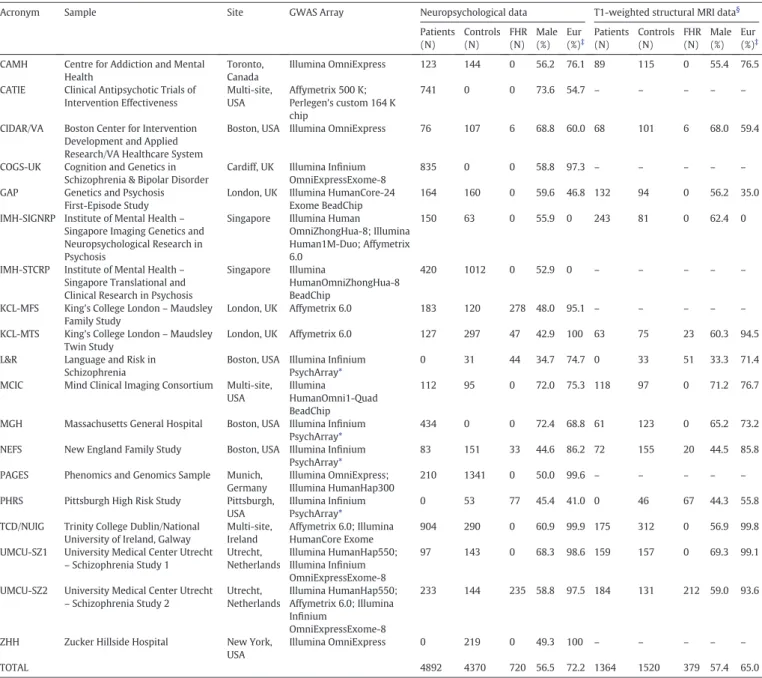
Table 1
lists the data from each sample that was provided to the central
site (Massachusetts General Hospital). Details for each data modality
are provided in the sections below. Each research group provided the
central site with detailed sample information (see Supplementary
Ma-terials), including recruitment (source, target diagnosis, illness stage
[e.g.
first-episode sample]), inclusion/exclusion criteria (ranges of age,
IQ, and years of education; substance and medication use, MRI
contrain-dications), and data modalities, which the central site reviewed and
obtained clari
fication as necessary. Some samples have been previously
contributed to other research consortia or the data made available in
re-positories (see Supplementary Materials).
3.2. Demographic and clinical characteristics of samples
Table 2
shows the demographic and clinical characteristics of the 19
samples. The patient diagnoses consist of 76.4% schizophrenia, 8.9%
schizoaffective disorder (SAD), 1.8% schizophreniform disorder (SPD),
6.5% bipolar disorder with psychosis (BD), and 6.3% other psychoses.
Fourteen samples consist of controls and patients with a range of
ill-ness durations, except for one sample (GAP) consists of only
first-epi-sode patients and controls. Four of these 14 samples also contain FHR
individuals. Two samples consist of FHR and controls, two samples
con-sist of only patients, and one sample concon-sists of only controls. Given the
Table 1
Description of the GENUS Consortium Sample Collection.#
Acronym Sample Site GWAS Array Neuropsychological data T1-weighted structural MRI data§
Patients (N) Controls (N) FHR (N) Male (%) Eur (%)‡ Patients (N) Controls (N) FHR (N) Male (%) Eur (%)‡
CAMH Centre for Addiction and Mental Health
Toronto, Canada
Illumina OmniExpress 123 144 0 56.2 76.1 89 115 0 55.4 76.5
CATIE Clinical Antipsychotic Trials of Intervention Effectiveness Multi-site, USA Affymetrix 500 K; Perlegen's custom 164 K chip 741 0 0 73.6 54.7 – – – – –
CIDAR/VA Boston Center for Intervention Development and Applied Research/VA Healthcare System
Boston, USA Illumina OmniExpress 76 107 6 68.8 60.0 68 101 6 68.0 59.4
COGS-UK Cognition and Genetics in Schizophrenia & Bipolar Disorder
Cardiff, UK Illumina Infinium OmniExpressExome-8
835 0 0 58.8 97.3 – – – – –
GAP Genetics and Psychosis First-Episode Study
London, UK Illumina HumanCore-24 Exome BeadChip
164 160 0 59.6 46.8 132 94 0 56.2 35.0
IMH-SIGNRP Institute of Mental Health– Singapore Imaging Genetics and Neuropsychological Research in Psychosis
Singapore Illumina Human OmniZhongHua-8; Illumina Human1M-Duo; Affymetrix 6.0
150 63 0 55.9 0 243 81 0 62.4 0
IMH-STCRP Institute of Mental Health– Singapore Translational and Clinical Research in Psychosis
Singapore Illumina
HumanOmniZhongHua-8 BeadChip
420 1012 0 52.9 0 – – – – –
KCL-MFS King's College London– Maudsley Family Study
London, UK Affymetrix 6.0 183 120 278 48.0 95.1 – – – – – KCL-MTS King's College London– Maudsley
Twin Study
London, UK Affymetrix 6.0 127 297 47 42.9 100 63 75 23 60.3 94.5
L&R Language and Risk in Schizophrenia
Boston, USA Illumina Infinium PsychArray*
0 31 44 34.7 74.7 0 33 51 33.3 71.4
MCIC Mind Clinical Imaging Consortium Multi-site, USA
Illumina
HumanOmni1-Quad BeadChip
112 95 0 72.0 75.3 118 97 0 71.2 76.7
MGH Massachusetts General Hospital Boston, USA Illumina Infinium PsychArray*
434 0 0 72.4 68.8 61 123 0 65.2 73.2
NEFS New England Family Study Boston, USA Illumina Infinium PsychArray*
83 151 33 44.6 86.2 72 155 20 44.5 85.8
PAGES Phenomics and Genomics Sample Munich, Germany
Illumina OmniExpress; Illumina HumanHap300
210 1341 0 50.0 99.6 – – – – – PHRS Pittsburgh High Risk Study Pittsburgh,
USA
Illumina Infinium PsychArray*
0 53 77 45.4 41.0 0 46 67 44.3 55.8
TCD/NUIG Trinity College Dublin/National University of Ireland, Galway
Multi-site, Ireland
Affymetrix 6.0; Illumina HumanCore Exome
904 290 0 60.9 99.9 175 312 0 56.9 99.8
UMCU-SZ1 University Medical Center Utrecht – Schizophrenia Study 1 Utrecht, Netherlands Illumina HumanHap550; Illumina Infinium OmniExpressExome-8 97 143 0 68.3 98.6 159 157 0 69.3 99.1
UMCU-SZ2 University Medical Center Utrecht – Schizophrenia Study 2 Utrecht, Netherlands Illumina HumanHap550; Affymetrix 6.0; Illumina Infinium OmniExpressExome-8 233 144 235 58.8 97.5 184 131 212 59.0 93.6
ZHH Zucker Hillside Hospital New York, USA
Illumina OmniExpress 0 219 0 49.3 100 – – – – –
TOTAL 4892 4370 720 56.5 72.2 1364 1520 379 57.4 65.0
Eur = European-derived ancestry; FHR = familial high-risk.
# Data in this table are based on the total GENUS sample collection; data for the subset with genotype data are provided in Supplementary Table 1. §
All samples with T1 MRI scans also have diffusion-weighted MRI scans except the PHRS, UMCU-SZ1, and UMCU-SZ2 samples.
‡ Population ancestry determined from genetic data (where available) or self-report.
⁎ Samples genotyped at the central GENUS site.
309 G.A.M. Blokland et al. / Schizophrenia Research 195 (2018) 306–317
range of illness duration (
b1–58 years) and the inclusion of FHR
partic-ipants, the sample collection has a wide age range (8
–86 years). The sex
composition is 56.5% male and 43.5% female. There are signi
ficant
differ-ences between the patient, control, and FHR groups in age (younger
FHR), sex ratio (more male patients), years of education (fewer in
pa-tients), and ancestral population (all p
b 1 × 10
−10;
Table 2
), but not
in handedness. These differences must be adjusted in analyses, or
matched subsets selected.
The most common clinical data across the samples are the Positive
and Negative Syndrome Scale (PANSS; 54.7% of patients) (
Kay et al.,
1987; Peralta and Cuesta, 1994
), Scale for the Assessment of Negative
Symptoms (SANS) (
Andreasen, 1983
) and Scale for the Assessment of
Positive Symptoms (SAPS) (
Andreasen, 1984
) (29.5% of patients), and
Global Assessment of Functioning (GAF; 33.9% of patients) (
American
Psychiatric Association, 2000
).
Current or lifetime average dose of antipsychotic medication
(chlor-promazine equivalents) (
Gardner et al., 2010; Woods, 2003
) is available
for 63.8% or 27.6% of patients, respectively, and 21.2% of patients have
both dosage estimates. Dosages are similar to other clinical samples
(
Eum et al., 2017; van Erp et al., 2016
), suggesting that this patient
col-lection is representative of and generalizable to the clinical population.
3.3. Neuropsychological measures
All 19 samples have neuropsychological data from 4892 patients
(75.6% schizophrenia, 9.4% SAD, 1.7% SPD, 6.8% BD, 6.5% other
psycho-sis), 4370 controls, and 720 FHR individuals (9982 participants or
92.4% of sample;
Table 1
). The most common tests administered across
the samples are shown in
Table 3
, with highest overlap across samples
for Digit Symbol Coding, Verbal Fluency, and Word List Learning.
Table 2
Clinical and demographic characteristics of the GENUS Consortium Sample Collection.#
Patients Controls Familial High Risk Statistic df p N Mean ± SD (Range) N Mean ± SD
(Range) N Mean ± SD (Range) Age (years) 5197 39.3 ± 12.2 (13–82) 4877 39.2 ± 15.8 (8–86) 725 34.9 ± 16.0 (10–85) F = 31.2 2, 10,796 b1 × 10−10 Education Level (years) 4697 12.3 ± 2.6 (1–24) 4031 13.3 ± 2.6 (4–26) 721 13.1 ± 3.2 (3–24) F =
163.4 2, 9446 b1 × 10−10 Premorbid IQ 3145 97.1 ± 15.5 (44–145) 1393 107.6 ± 10.7 (62–145) 83 105.1 ± 16.0 (45–134) F = 263.4 2, 4618 b1 × 10−10 Current IQ 1889 93.8 ± 18.1 (47–155) 2779 113.4 ± 14.9 (67–161) 602 105.1 ± 15.6 (58–152) F = 817.8 2, 5267 b1 × 10−10
Illness Duration (years) 4165 15.1 ± 11.6 (b1–58) – – – – – – –
Age at Onset (years) 4124 23.8 ± 8.6 (1–71) – – – – – – –
Global Assessment of Functioning 1764 59.8 ± 15.9 (11–100)
– – – – – – –
PANSS Positive symptoms 2916 16.3 ± 7.3 (7–47) – – – – – – –
PANSS Negative Symptoms 2912 16.7 ± 7.1 (7–43) – – – – – – –
PANSS General Symptoms 2919 32.0 ± 11.8 (0–93) – – – – – – –
SAPS Positive Symptoms 1533 7.9 ± 12.3 (0–121) – – – – – – –
SANS Negative Symptoms 983 23.6 ± 20.1 (0–103) – – – – – – –
Antipsychotic dose– current CPZEQ 3315 384.2 ± 406.6 (0–5000)
– – – – – – –
Antipsychotic dose– lifetime average CPZEQ
1433 338.3 ± 365.1 (0–3125)
– – – – – – –
N % N % N %
Sex (male/female; % male) 3417/1781 65.7 2419/2458 49.6 317/408 43.7 χ2
= 322.9
2 b1 × 10−10 Antipsychotic medication exposure
Atypical 2100 49.1 – – – – – – –
Typical 411 9.6 – – – – – – –
Both Typical and Atypical 544 12.7 – – – – – – –
Naïve/None 474 11.1 – – – – – – – Unknown Class 324 7.6 – – – – – – – No information 422 9.9 – – – – – – – Diagnosis Schizophrenia 3973 76.4 – – – – – – – Schizoaffective Disorder 465 8.9 – – – – – – – Schizophreniform Disorder 93 1.8 – – – – – – – Bipolar Psychosis 338 6.5 – – – – – – – Other Psychosis 204 3.9 – – – – – – –
Psychosis Unknown Type 126 2.4 – – – – – – –
Ancestral Population χ2 = 567.6 12 b1 × 10−10 European 3686 71.2 3396 69.7 632 87.2 – – – East Asian 697 13.5 1117 22.9 3 0.4 – – – African 510 9.9 152 3.1 57 7.9 – – –
American (Predominantly Latino) 140 2.7 30 0.6 3 0.4 – – –
South Asian 50 1.0 35 0.7 7 1.0 – – – Mixed 28 0.5 11 0.2 10 1.4 – – – No information 68 1.3 135 2.8 13 1.8 Handedness (right/other; % right-handed) 2322/260 89.9 2378/252 90.4 609/59 91.2 χ2= 1.0 2 0.60
CPZEQ = chlorpromazine 100 mg equivalent; df = degrees of freedom; PANSS = Positive and Negative Syndrome Scale; SANS = Scale for the Assessment of Negative Symptoms; SAPS = Scale for the Assessment of Positive Symptoms; SD = Standard Deviation.
#Data in this table are based on the total GENUS sample collection; data for the subset with genotype data are provided in Supplementary Table 2.
Table 3
Core neuropsychological tests available for GENUS Consortium samples.#
Attention/Processing Speed Attention/Vigilance Working Memory– verbal Working Memory– non-verbal Verbal Learning & Memory
Sample Digit Symbol
Coding
TMT-A* Verbal Fluency CPT-IP* Other Letter-Number
Span
Other Spatial Span Other Word List
Learning
Story Recall Other
CAMH RBANS x RBANS Semantic/COWAT UMD* RBANS Digit Span RBANS RBANS
CATIE Category Instances/COWAT x UMD* SDRT HVLT
CIDAR-VA BACS* x MCCB* x ACPT UMD* WMS-III* HVLT-R* WMS-III or CMS
COGS-UK BACS* x MCCB* x UMD* WMS-III* HVLT-R*
GAP WAIS-III x Semantic/COWAT WAIS-III Digit Span WMS-III* CANTAB
SWM
WMS-III
IMH-SIGNRP BACS* BACS Category
Instances/COWAT
BACS Digit Sequencing BACS
IMH-STCRP BACS* BACS
Category Instances
x BACS Digit Sequencing BACS
KCL-MFS WAIS-R x CANTAB RVIP WAIS-R/WMS-R Digit Span/Arithmetic CANTAB SWM WMS-R WMS-R VerbPA
KCL-MTS WAIS-III-UK x Semantic/COWAT CANTAB
RVIP WAIS-III-UK WAIS-III-UK Digit Span/Arithmetic WMS-R-UK VisMem Span CANTAB SWM WMS-R-UK WMS-R-UK VerbPA
L&R BACS* x MCCB* x ACPT UMD* WMS-III* HVLT-R* WMS-III
MCIC x D-KEFS Semantic/Phonemic WAIS-III HVLT-R* WMS-III
MGH WAIS-III Semantic/COWAT x WAIS-III WAIS-III Digit
Span/Arithmetic
CVLT
NEFS WAIS-R COWAT ACPT WAIS-R Digit Span CVLT or CVLT-II WMS-R or
WMS-III
PAGES WAIS-R-DE x Semantic/Phonemic 3–7 CPT WAIS-R-DE
Digit Span/Arithmetic
n-back VLMT WMS-R-DE WMS-R-DE
VerbPA PHRS MAE Semantic/Phonemic x A-X CPT Cogtest SWM Cogtest
TCD/NUIG x COWAT x 1–9 CPT WMS-III CANTAB
SWM /n-back CVLT-SF WMS-III UMCU-SZ1 MAE Semantic/Phonemic H-Q CPT CVLT-I-NL
UMCU-SZ2 WAIS-III-NL H-Q CPT WAIS-III-NL Arithmetic AVLT
ZHH BACS* x MCCB*/COWAT x UMD* WAIS-R Digit Span WMS-III* n-back HVLT-R*
N patients 3488 1549 3956 2337 703 2895 1866 1097 1644 3488 1452 388
N controls 3535 1116 2826 1410 1025 1080 3248 610 904 2519 1017 705
N FHR 396 196 280 119 381 79 347 76 89 384 82 177
N total 7419 2861 7062 3866 2109 4054 5461 1783 2637 6391 2551 1270
(continued on next page)
31 1 G. A. M. Bl ok la n d et al ./ Sch iz op hr en ia Re se ar ch 1 95 (20 1 8) 3 0 6– 31 7
Visual Learning & Memory Reasoning/Problem Solving Visuo-spatial Ability Verbal Ability
Sample BVMT-R* Other TMT-B WCST Other Block Design Other Vocabulary Other
CAMH RBANS Figure Recall x Stroop RBANS JOLO/Figure Copy
CATIE 64-C WISC-III Mazes
CIDAR-VA BVMT-R* 64-C NAB Mazes* WASI WASI D-KEFS Proverbs
COGS-UK BVMT-R* NAB Mazes*
GAP WMS-III VisRep x CANTAB SOC WAIS-III WAIS-III MR WAIS-III INF
IMH-SIGNRP BACS TOL
IMH-STCRP 64-P BACS TOL WASI MR/Benton JOLO
KCL-MFS WMS-R VisRep x CANTAB IDED WAIS-R WAIS-R OA/PA/PC WAIS-R WAIS-R COM/INF/SIM
KCL-MTS WMS-R-UK VisRep/VisPA x CANTAB IDED WAIS-III-UK WAIS-III-UK OA/PA/PC WAIS-III-UK WAIS-III-UK COM/INF/SIM
L&R BVMT-R* 64-C NAB Mazes* WASI WASI D-KEFS Proverbs
MCIC BVRT/WMS-III Faces x TOL WAIS-III WAIS-III WAIS-III SIM
MGH 128-C/64-C WAIS-III WAIS-III MR/OA/PA/PC WAIS-III WAIS-III COM/INF/SIM
NEFS WMS-III Faces/Rey CFT Recall 128-P Stroop WAIS-R WAIS-R PA/Rey CFT Copy WAIS-R WAIS-R COM/INF; RAN
PAGES WMS-R-DE FigMem/VisRep/VisPA x 128-C TOL-DE WAIS-R-DE WAIS-R-DE OA/PA/PC WAIS-R-DE WAIS-R-DE COM/INF/SIM
PHRS CNB VOLT 128-P Cogtest Go-No-Go
TCD/NUIG WMS-III Faces/CANTAB PAL x CANTAB IDED/SART WAIS-III-R-UK WAIS-III-R-UK MR WAIS-III-R-UK WAIS-III-R-UK SIM
UMCU-SZ1 Stroop WAIS-III-R-NL WAIS-III-R-NL PA WAIS-III-R-NL WAIS-III-R-NL COM
UMCU-SZ2 NAB Mazes*/RST WAIS-III-NL WAIS-III-NL INF
ZHH BVMT-R* x 128-P NAB Mazes*/Stroop
N patients 897 1604 836 1376 3555 2260 1615 1754 2048
N controls 328 1628 1408 835 2781 2744 3131 2425 2617
N FHR 48 317 145 134 350 522 33 285 567
N total 1273 3549 2389 2345 6686 5526 4779 4464 5232
128-P, 128-C = 128-card paper, computerized version; 64-P, 64-C = 64-card paper, computerized version; ACPT = Auditory CPT; AVLT = Auditory Verbal Learning Test; BACS = Brief Assessment of Cognition in Schizophrenia; BVMT-R = Brief Visuospatial Memory Test-Revised; BVRT = Benton Visual Retention Test; CANTAB = Cambridge Neuropsychological Test Automated Battery; CFT = Complex Figure Test; CMS = Children's Memory Scale; CNB = Computerized Neurocognitive Battery; COWAT = Controlled Oral Word Association Test; CPT(−IP) = Continuous Performance Test (Identical Pairs); CVLT(−SF) = California Verbal Learning Test (Short Form); DE = German version; D-KEFS = Delis–Kaplan Executive Function System; FigMem = Figural Memory; HVLT = Hopkins Verbal Learning Test; IDED = Intra-Extra Dimensional Set Shifting; JOLO = Judgment of Line Orientation; MAE = Multilingual Aphasia Examination; MCCB = MATRICS Consensus Cognitive Battery; NAB = Neuropsychological Assessment Battery; NL = Dutch version; PAL = Paired Associates Learning; RAN = Rapid Automatized Naming; RBANS = Repeatable Battery for the Assessment of Neuropsychological Status; RST = Response Shifting Task; RVIP = Rapid Visual Information Processing; SART = Sustained Attention to Response Task; SDRT = Spatial Delayed Response Task; SOC = Stockings of Cambridge; SWM = Spatial Working Memory; TOL = Tower of London; TMT-A, B = Trail Making Test Part A, B; UK = British version; UMD = University of Maryland; VerbPA = Verbal Paired Associates; VisMemSpan = Visual Memory Span; VisPA = Visual Paired Associates; VisRep = Visual Reproduction; VLMT = Verbal Learn-ing and Memory Test; VLT = Verbaler Lern Test; VOLT = Visual Object LearnLearn-ing Test; WAIS = Wechsler Adult Intelligence Scale (Subtests: COM = Comprehension; INF = Information; MR = Matrix ReasonLearn-ing; OA = Object Assembly; PA = Picture Arrangement; PC = Picture Completion; SIM = Similarities); WASI = Wechsler Abbreviated Scale of Intelligence; WCST = Wisconsin Card Sorting Test; WISC = Wechsler Intelligence Scale for Children; WMS = Wechsler Memory Scale.
#
References for all neuropsychological tests are provided in the Supplemental Materials. Data in this table are based on the total GENUS sample collection (genotyped plus ungenotyped). ⁎ MATRICS test. Table 3 (continued) 31 2 G. A. M. Bl ok la n d et al ./ Sch iz op hr en ia Re se ar ch 1 95 (20 1 8) 3 0 6– 31 7
Supplementary Table 3 provides detailed information on the speci
fic
tests and number of participants. There are substantial differences in
the mean premorbid IQ and mean current IQ between diagnostic
groups (both p
b 1 × 10
−10;
Table 2
). The mean premorbid and
cur-rent IQ of controls and FHR individuals are higher than the
popula-tion mean of 100, as previously reported by other psychosis studies
(
Hill et al., 2013; Seidman et al., 2015
). However, the difference of
~ 10 IQ points between the GENUS patients and controls is consistent
with the literature (
Khandaker et al., 2011; Woodberry et al., 2008
).
Among the controls, current IQ is notably higher than premorbid IQ.
The high current IQ is predominantly driven by samples that used
few (2
–4) WAIS subtests, which may overestimate current IQ
com-pared to samples that used many subtests (i.e., full-scale IQ)
(
Axelrod, 2002
). The higher current IQ may also be due to a ceiling
effect, where the reading tests used to estimate premorbid IQ have
a lower maximum score (~ 130) than WAIS subtests used to estimate
current IQ (maximum 160).
3.4. Neuroimaging data
Thirteen samples have T1-weighted structural MRI scans from 1364
patients (74.4% schizophrenia, 7.9% SAD, 3.8% SPD, 5.3% BD, 8.6% other
psychosis), 1520 controls, 379 FHR individuals (3263 participants or
30% of sample;
Table 1
). Quality evaluation of a subset of scans from
each sample discounted systematic gross errors and indicated that all
datasets are high quality. In addition to the T1-weighted acquisitions, 10
samples have diffusion-weighted MRI scans from 1931 participants, and
9 samples have T2-weighted structural scans from 1821 participants.
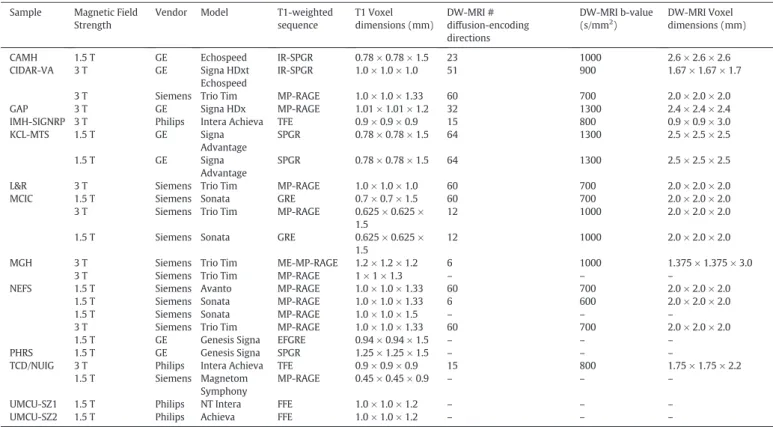
Table 4
lists the scanners and primary scan parameters for each sample.
Full scan acquisition parameters are provided in the Supplementary
Materials.
3.5. SNP genotype data
As detailed in the Supplementary Materials, 15 of the 19 samples
had previously acquired raw SNP genotype data from 7478 participants
(69.2%). For 10 samples, only a proportion of participants had been
ge-notyped. Four of the 19 samples had genomic DNA from 978
partici-pants (9.1%), of which 947 (8.8%) participartici-pants had suf
ficient DNA
quality and quantity for genotyping on the Illumina In
finium
PsychArray at the central site.
Table 1
lists the SNP arrays used for
each sample. Supplementary Table 1 lists the number of genotyped
par-ticipants in each sample and Supplementary Table 2 provides the
demo-graphic and clinical characteristics. Of the total 8425 participants with
genotype data, 164 participants were excluded during quality control
analyses due to low (
b98%) genotype call rate, resulting in 8261
partic-ipants with genotype data suitable for imputation (4099 patients, 3851
controls, 306 FHR). Further quality control and imputation procedures
will be described elsewhere. The mean call rate across the cleaned
dataset is 99.8% (range 99.3%
–99.9%). The sample collection has 80%
power to detect a genetic variant that explains 0.5% of the variance of
a phenotype at a genome-wide signi
ficant alpha = 5 × 10
−8.
The ancestry breakdown based on genotype data is 70.2% European
(2835 patients, 2703 controls, 264 FHR), 19.5% East Asian (624 patients,
982 controls, 1 FHR), 7.3% African (454 patients, 111 controls, 35 FHR),
2.0% American (predominantly Latino; 138 patients, 28 controls, 3 FHR),
and 1.0% other ancestry (53 patients, 27 controls, 3 FHR).
4. Discussion
This article provides a general description of the GENUS Consortium
and its sample collection, which is the largest known dataset of
psycho-sis patients, controls, and FHR individuals with data spanning genetics,
clinical, cognitive and, for a subset, structural MRI and diffusion imaging.
Table 4
MRI scan parameters for GENUS Consortium samples. Sample Magnetic Field
Strength
Vendor Model T1-weighted sequence T1 Voxel dimensions (mm) DW-MRI # diffusion-encoding directions DW-MRI b-value (s/mm2 ) DW-MRI Voxel dimensions (mm)
CAMH 1.5 T GE Echospeed IR-SPGR 0.78 × 0.78 × 1.5 23 1000 2.6 × 2.6 × 2.6 CIDAR-VA 3 T GE Signa HDxt
Echospeed
IR-SPGR 1.0 × 1.0 × 1.0 51 900 1.67 × 1.67 × 1.7
3 T Siemens Trio Tim MP-RAGE 1.0 × 1.0 × 1.33 60 700 2.0 × 2.0 × 2.0 GAP 3 T GE Signa HDx MP-RAGE 1.01 × 1.01 × 1.2 32 1300 2.4 × 2.4 × 2.4 IMH-SIGNRP 3 T Philips Intera Achieva TFE 0.9 × 0.9 × 0.9 15 800 0.9 × 0.9 × 3.0 KCL-MTS 1.5 T GE Signa Advantage SPGR 0.78 × 0.78 × 1.5 64 1300 2.5 × 2.5 × 2.5 1.5 T GE Signa Advantage SPGR 0.78 × 0.78 × 1.5 64 1300 2.5 × 2.5 × 2.5
L&R 3 T Siemens Trio Tim MP-RAGE 1.0 × 1.0 × 1.0 60 700 2.0 × 2.0 × 2.0 MCIC 1.5 T Siemens Sonata GRE 0.7 × 0.7 × 1.5 60 700 2.0 × 2.0 × 2.0
3 T Siemens Trio Tim MP-RAGE 0.625 × 0.625 × 1.5
12 1000 2.0 × 2.0 × 2.0
1.5 T Siemens Sonata GRE 0.625 × 0.625 × 1.5
12 1000 2.0 × 2.0 × 2.0
MGH 3 T Siemens Trio Tim ME-MP-RAGE 1.2 × 1.2 × 1.2 6 1000 1.375 × 1.375 × 3.0
3 T Siemens Trio Tim MP-RAGE 1 × 1 × 1.3 – – –
NEFS 1.5 T Siemens Avanto MP-RAGE 1.0 × 1.0 × 1.33 60 700 2.0 × 2.0 × 2.0 1.5 T Siemens Sonata MP-RAGE 1.0 × 1.0 × 1.33 6 600 2.0 × 2.0 × 2.0
1.5 T Siemens Sonata MP-RAGE 1.0 × 1.0 × 1.5 – – –
3 T Siemens Trio Tim MP-RAGE 1.0 × 1.0 × 1.33 60 700 2.0 × 2.0 × 2.0
1.5 T GE Genesis Signa EFGRE 0.94 × 0.94 × 1.5 – – –
PHRS 1.5 T GE Genesis Signa SPGR 1.25 × 1.25 × 1.5 – – –
TCD/NUIG 3 T Philips Intera Achieva TFE 0.9 × 0.9 × 0.9 15 800 1.75 × 1.75 × 2.2 1.5 T Siemens Magnetom
Symphony
MP-RAGE 0.45 × 0.45 × 0.9 – – –
UMCU-SZ1 1.5 T Philips NT Intera FFE 1.0 × 1.0 × 1.2 – – –
UMCU-SZ2 1.5 T Philips Achieva FFE 1.0 × 1.0 × 1.2 – – –
DW-MRI = Diffusion-Weighted MRI; EFGRE = Enhanced Fast Gradient Echo; FFE = Fast Field Echo; GE = General Electric; GRE = Gradient Recalled Echo; (IR-)SPGR = (Inversion Recovery) Spoiled Gradient Recalled; (ME-)MP-RAGE = (Multi-Echo) Magnetization Prepared Rapid Acquisition Gradient Echo; TFE = Turbo Field Echo.
313 G.A.M. Blokland et al. / Schizophrenia Research 195 (2018) 306–317
This dataset enables large-scale investigations of brain-based
pheno-types. Due to data sharing restrictions of many of the individual
sam-ples, the full dataset is currently only available to external researchers
through collaboration with GENUS Consortium members. The extent
of data and large size of the GENUS dataset, as well as the breadth of
ex-pertise of the GENUS Consortium members, provide a host of
opportu-nities for analyses. For example, examining sex differences in
disease-related phenotypes is an important but often overlooked aspect of
psy-chiatric studies (
Goldstein et al., 2013
) that can be addressed with this
large, well-phenotyped sample collection.
The GENUS Consortium differs in several aspects from other
large-scale efforts investigating the genetic architecture of cognition and
neu-roanatomy relevant to psychosis (e.g., COGENT, ENIGMA, B-SNIP, Brain
Genomics Superstruct Project, Philadelphia Neurodevelopmental
Co-hort) (
Franke et al., 2016; Germine et al., 2016; Holmes et al., 2015;
Lee et al., 2016; Lencz et al., 2014; Tamminga et al., 2013
). A key
differ-ence is that many other studies do not have data for both cognition and
brain structure modalities from the same participants. Bridging multiple
brain phenotype modalities, as in the GENUS sample collection, is
im-portant for heterogeneous disorders such as schizophrenia that are
de-fined by diverse symptoms and abnormalities whose relationships are
mostly unknown. Another difference is the GENUS subject-level data
are stored at the central site, allowing for stringent quality control and
site comparability analyses, and the option for mega-analyses across
the entire dataset, whereas some other studies are limited to
meta-anal-ysis of results generated by each site separately.
A major strength of the GENUS sample collection is the existence of
extensive data across patients, controls, and FHR individuals that enable
analyses of genetic effects in multiple diagnostic groups. While
informa-tive genetic
findings are emerging from large healthy cohorts, this is
cur-rently lacking in psychosis cohorts, and it remains unclear whether
genetic factors in
fluencing brain structure and function in healthy cohorts
have the same effect in psychiatric patients. The GENUS Consortium
anal-yses will initially focus on relating schizophrenia genetic risk variants
identi
fied by prior GWAS with the cognitive and brain structural
pheno-types available in this sample collection. While the ENIGMA Consortium
did not detect signi
ficant effects of schizophrenia genetic risk variants
on subcortical volumes in mixed diagnosis and healthy individuals
(
Franke et al., 2016
), a study of cortical thickness and surface area
report-ed that a substantial proportion (30
–45%) of the heritability is explained
by schizophrenia genetic risk variants (
Lee et al., 2016
). This suggests
that some brain structural measures may be more genetically related to
schizophrenia than others, or that genetic relationships differ in diseased
and healthy brain. In addition, GWAS of cognitive performance and brain
regional volumes have detected novel genetic associations (
Adams et al.,
2016; Davies et al., 2015; Hibar et al., 2015; Trampush et al., 2017
) that
could be further investigated in the GENUS sample collection.
Regarding genetic analyses, the GENUS sample collection is best suited
for characterizing SNPs, polygenic factors, and pathways identi
fied by
GWAS, such as the PGC GWAS mega-analyses (
PGC Schizophrenia
Working Group, 2014
), for effects on brain-based phenotypes, or
replicat-ing
findings from other genetic studies of cognition or brain structure.
Due to the small effect sizes of common genetic variants, our dataset is
not well powered for GWAS discovery. SNP-based heritability approaches
(e.g., GCTA) require approximately 4000 subjects for 80% power to
esti-mate heritability as low as 20% (
Visscher et al., 2014
), a reasonable
as-sumption for cognitive and brain volume traits (
Franke et al., 2016;
Trampush et al., 2017
); therefore, some of our phenotypes (e.g.
letter-number span tests, WAIS Digit Symbol Coding) are suitable for this
ap-proach. Rare variant association studies require enormous samples for
ad-equate statistical power (
Auer and Lettre, 2015; Zuk et al., 2014
),
therefore our dataset is not suf
ficient on its own for such analyses. The
availability of multiple phenotypes enables a breadth of analyses, with
the caveat that signi
ficance thresholds must be adjusted for multiple
test-ing, although accounting for correlations between phenotypes and other
data reduction methods could allow for more lenient thresholds. The
statistical power of our dataset could also be maximized by merging
phe-notypes into one phenotype, such as Spearman's
‘g’, in which data from
many neuropsychological tests are used to derive a single measure of
gen-eral cognitive ability (
Spearman, 1904
).
There are considerable challenges to combining data acquired by
many research groups. The heterogeneity in the data collected and the
protocols used by each group requires careful harmonization of the
data to maximize comparability between the samples and minimize
confounds. Our harmonization approaches will be described in greater
detail in subsequent data-based articles. Brie
fly, we are applying
methods that use controls from each sample to standardize the data
(i.e., generate Z scores), as has been reported for neuropsychological
data (
Toulopoulou et al., 2010
) and structural MRI data (
Segall et al.,
2009; Wilke et al., 2014
). Further, variability in multi-site imaging
data due to different scanner models and
field strengths, acquisition
protocols, and image segmentation methods (
Han et al., 2006
) can be
minimized by processing all scans using a consistent segmentation
rou-tine, which enables detection of subtle effects (
Fennema-Notestine et
al., 2007
), including gray matter loss in schizophrenia datasets (
Segall
et al., 2009
). Regarding clinical data, positive and negative symptom
data can be converted between the PANSS and SANS/SAPS, the most
common clinical scales in our dataset, using regression-based equations
(
van Erp et al., 2014
). As for the limited medication dosage information
of our dataset, this can be addressed partially by con
firming findings
from the full cohort in the subset with medication data to rule out
med-ication confounds. We are harmonizing the genotype data from various
SNP arrays by imputing genotypes based on a reference panel to
gener-ate a common set of SNPs across all samples, an accepted approach in
the
field (
PGC Schizophrenia Working Group, 2014
). Although
hetero-geneous data collected by multiple sites is not ideal, the large volume
of available legacy data with deep phenotypic and genotype
informa-tion warrants maximizing its use by generating one merged dataset
that has far greater statistical power than the individual samples.
In summary, the GENUS Consortium sample collection is a valuable
resource that builds upon previous efforts by individual research groups
and complements other psychosis datasets. This high-powered sample
collection integrates measures of brain structure, cognition, and
genet-ics for studying the biological basis of psychosis through original
analy-ses and collaborative replication studies. There will be the opportunity
for multiple publications from these data, including articles focusing
on harmonization and genetic analyses of the cognitive data and
imag-ing data, and publications that incorporate multi-modal data. The rich
phenotypic data are expected to provide new insights into neural
func-tions that are disrupted in psychosis.
Contributors
Dr. Blokland, Dr. del Re, and Dr. Petryshen drafted the manuscript. Dr. Blokland per-formed the statistical analyses. Dr. Petryshen designed the collaborative project. All other authors participated in aspects of the study design (both within and across sites), in-cluding subject recruitment and data collection. All authors were responsible for reviewing, editing, and approving thefinal version of the manuscript.
Role of funding source
The sponsor (the National Institutes of Health) had no role in the design and conduct of the study; collection, analysis, and interpretation of data by the GENUS Consortium; and preparation, review, or approval of the manuscript. The content of this article is solely the responsibility of the authors and does not necessarily represent the official views of the National Institutes of Health.
Conflict of interest
All authors declare that they have no conflicts of interest with respect to this study.
Acknowledgements
We are grateful for the support of all study staff and participants. Acknowledgements for each sample are provided in the Supplementary Materials. Data processing and analy-ses (of the legacy data) at the central site was supported by the National Institute of Men-tal Health (NIMH) of the National Institutes of Health (NIH) grant number R01MH092380 to T.L.P. supporting the Genetics of Endophenotypes of Neurofunction to Understand Schizophrenia (GENUS) Consortium, and NIMH grant R21MH109819 to E.D.R. 314 G.A.M. Blokland et al. / Schizophrenia Research 195 (2018) 306–317
Appendix A. Supplementary data
Supplementary data to this article can be found online at
https://doi.
org/10.1016/j.schres.2017.09.024
.
References
Adams, H.H., Hibar, D.P., Chouraki, V., Stein, J.L., Nyquist, P.A., Renteria, M.E., Trompet, S., Arias-Vasquez, A., Seshadri, S., Desrivieres, S., Beecham, A.H., Jahanshad, N., Wittfeld, K., Van der Lee, S.J., Abramovic, L., Alhusaini, S., Amin, N., Andersson, M., Arfanakis, K., Aribisala, B.S., Armstrong, N.J., Athanasiu, L., Axelsson, T., Beiser, A., Bernard, M., Bis, J.C., Blanken, L.M., Blanton, S.H., Bohlken, M.M., Boks, M.P., Bralten, J., Brickman, A.M., Carmichael, O., Chakravarty, M.M., Chauhan, G., Chen, Q., Ching, C.R., Cuellar-Partida, G., Braber, A.D., Doan, N.T., Ehrlich, S., Filippi, I., Ge, T., Giddaluru, S., Goldman, A.L., Gottesman, R.F., Greven, C.U., Grimm, O., Griswold, M.E., Guadalupe, T., Hass, J., Haukvik, U.K., Hilal, S., Hofer, E., Hoehn, D., Holmes, A.J., Hoogman, M., Janowitz, D., Jia, T., Kasperaviciute, D., Kim, S., Klein, M., Kraemer, B., Lee, P.H., Liao, J., Liewald, D.C., Lopez, L.M., Luciano, M., Macare, C., Marquand, A., Matarin, M., Mather, K.A., Mattheisen, M., Mazoyer, B., McKay, D.R., McWhirter, R., Milaneschi, Y., Mirza-Schreiber, N., Muetzel, R.L., Maniega, S.M., Nho, K., Nugent, A.C., Loohuis, L.M., Oosterlaan, J., Papmeyer, M., Pappa, I., Pirpamer, L., Pudas, S., Putz, B., Rajan, K.B., Ramasamy, A., Richards, J.S., Risacher, S.L., Roiz-Santianez, R., Rommelse, N., Rose, E.J., Royle, N.A., Rundek, T., Samann, P.G., Satizabal, C.L., Schmaal, L., Schork, A.J., Shen, L., Shin, J., Shumskaya, E., Smith, A.V., Sprooten, E., Strike, L.T., Teumer, A., Thomson, R., Tordesillas-Gutierrez, D., Toro, R., Trabzuni, D., Vaidya, D., Van der Grond, J., Van der Meer, D., Van Donkelaar, M.M., Van Eijk, K.R., Van Erp, T.G., Van Rooij, D., Walton, E., Westlye, L.T., Whelan, C.D., Windham, B.G., Winkler, A.M., Woldehawariat, G., Wolf, C., Wolfers, T., Xu, B., Yanek, L.R., Yang, J., Zijdenbos, A., Zwiers, M.P., Agartz, I., Aggarwal, N.T., Almasy, L., Ames, D., Amouyel, P., Andreassen, O.A., Arepalli, S., Assareh, A.A., Barral, S., Bastin, M.E., Becker, D.M., Becker, J.T., Bennett, D.A., Blangero, J., van Bokhoven, H., Boomsma, D.I., Brodaty, H., Brouwer, R.M., Brunner, H.G., Buckner, R.L., Buitelaar, J.K., Bulayeva, K.B., Cahn, W., Calhoun, V.D., Cannon, D.M., Cavalleri, G.L., Chen, C., Cheng, C.Y., Cichon, S., Cookson, M.R., Corvin, A., Crespo-Facorro, B., Curran, J.E., Czisch, M., Dale, A.M., Davies, G.E., De Geus, E.J., De Jager, P.L., de Zubicaray, G.I., Delanty, N., Depondt, C., DeStefano, A.L., Dillman, A., Djurovic, S., Donohoe, G., Drevets, W.C., Duggirala, R., Dyer, T.D., Erk, S., Espeseth, T., Evans, D.A., Fedko, I.O., Fernandez, G., Ferrucci, L., Fisher, S.E., Fleischman, D.A., Ford, I., Foroud, T.M., Fox, P.T., Francks, C., Fukunaga, M., Gibbs, J.R., Glahn, D.C., Gollub, R.L., Goring, H.H., Grabe, H.J., Green, R.C., Gruber, O., Gudnason, V., Guelfi, S., Hansell, N.K., Hardy, J., Hartman, C.A., Hashimoto, R., Hegenscheid, K., Heinz, A., Le Hellard, S., Hernandez, D.G., Heslenfeld, D.J., Ho, B.C., Hoekstra, P.J., Hoffmann, W., Hofman, A., Holsboer, F., Homuth, G., Hosten, N., Hottenga, J.J., Pol, H.E., Ikeda, M., Ikram, M.K., Jack Jr., C.R., Jenkinson, M., Johnson, R., Jonsson, E.G., Jukema, J.W., Kahn, R.S., Kanai, R., Kloszewska, I., Knopman, D.S., Kochunov, P., Kwok, J.B., Lawrie, S.M., Lemaitre, H., Liu, X., Longo, D.L., Longstreth Jr., W.T., Lopez, O.L., Lovestone, S., Martinez, O., Martinot, J.L., Mattay, V.S., McDonald, C., McIntosh, A.M., McMahon, K.L., McMahon, F.J., Mecocci, P., Melle, I., Meyer-Lindenberg, A., Mohnke, S., Montgomery, G.W., Morris, D.W., Mosley, T.H., Muhleisen, T.W., Muller-Myhsok, B., Nalls, M.A., Nauck, M., Nichols, T.E., Niessen, W.J., Nothen, M.M., Nyberg, L., Ohi, K., Olvera, R.L., Ophoff, R.A., Pandolfo, M., Paus, T., Pausova, Z., Penninx, B.W., Pike, G.B., Potkin, S.G., Psaty, B.M., Reppermund, S., Rietschel, M., Roffman, J.L., Romanczuk-Seiferth, N., Rotter, J.I., Ryten, M., Sacco, R.L., Sachdev, P.S., Saykin, A.J., Schmidt, R., Schofield, P.R., Sigurdsson, S., Simmons, A., Singleton, A., Sisodiya, S.M., Smith, C., Smoller, J.W., Soininen, H., Srikanth, V., Steen, V.M., Stott, D.J., Sussmann, J.E., Thalamuthu, A., Tiemeier, H., Toga, A.W., Traynor, B.J., Troncoso, J., Turner, J.A., Tzourio, C., Uitterlinden, A.G., Hernandez, M.C., Van der Brug, M., Van der Lugt, A., Van der Wee, N.J., Van Duijn, C.M., Van Haren, N.E., Van, T.E.D., Van Tol, M.J., Vardarajan, B.N., Veltman, D.J., Vernooij, M.W., Volzke, H., Walter, H., Wardlaw, J.M., Wassink, T.H., Weale, M.E., Weinberger, D.R., Weiner, M.W., Wen, W., Westman, E., White, T., Wong, T.Y., Wright, C.B., Zielke, H.R., Zonderman, A.B., Deary, I.J., DeCarli, C., Schmidt, H., Martin, N.G., De Craen, A.J., Wright, M.J., Launer, L.J., Schumann, G., Fornage, M., Franke, B., Debette, S., Medland, S.E., Ikram, M.A., Thompson, P.M., 2016.Novel genetic loci underlying human intracranial volume identified through genome-wide association. Nat. Neurosci. 19 (12), 1569–1582.
American Psychiatric Association, 2000.Diagnostic and Statistical Manual of Mental Dis-orders, Fourth Edition, Text Revision (DSM-IV-TR). American Psychiatric Press Inc., Washington, DC.
Andreasen, N.C., 1983.Scale for the Assessment of Negative Symptoms (SANS). University of Iowa, Iowa City.
Andreasen, N.C., 1984.Scale for the Assessment of Positive Symptoms (SAPS). University of Iowa, Iowa City.
Auer, P.L., Lettre, G., 2015.Rare variant association studies: Considerations, challenges and opportunities. Genome Med. 7 (1), 16.
Axelrod, B.N., 2002.Validity of the Wechsler Abbreviated Scale of Intelligence and other very short forms of estimating intellectual functioning. Assessment 9 (1), 17–23.
Blokland, G.A.M., de Zubicaray, G.I., McMahon, K.L., Wright, M.J., 2012.Genetic and environ-mental influences on neuroimaging phenotypes: A meta-analytical perspective on twin imaging studies. Twin Res. Hum. Genet. Off. J. Int. Soc. Twin Stud. 15 (3), 351–371.
Blokland, G.A.M., Mesholam-Gately, R.I., Toulopoulou, T., del Re, E.C., Lam, M., DeLisi, L.E., Donohoe, G., Walters, J.T.R., GENUS Consortium, Seidman, L.J., Petryshen, T.P., 2017.
Heritability of neuropsychological measures in schizophrenia and non-psychiatric populations: A systematic review and meta-analysis. Schizophr. Bull. 43 (4), 788–800.
Bohlken, M.M., Brouwer, R.M., Mandl, R.C., Kahn, R.S., Hulshoff Pol, H.E., 2016.Genetic var-iation in schizophrenia liability is shared with intellectual ability and brain structure. Schizophr. Bull. 42 (5), 1167–1175.
Boos, H.B., Aleman, A., Cahn, W., Hulshoff Pol, H.E., Kahn, R.S., 2007.Brain volumes in rel-atives of patients with schizophrenia: A meta-analysis. Arch. Gen. Psychiatry 64 (3), 297–304.
Bora, E., Fornito, A., Radua, J., Walterfang, M., Seal, M., Wood, S.J., Yucel, M., Velakoulis, D., Pantelis, C., 2011.Neuroanatomical abnormalities in schizophrenia: A multimodal voxelwise meta-analysis and meta-regression analysis. Schizophr. Res. 127 (1–3), 46–57.
CNV and Schizophrenia Working Groups of the Psychiatric Genomics Consortium; Psychosis Endophenotypes International Consortium, 2017.Contribution of copy number variants to schizophrenia from a genome-wide study of 41,321 subjects. Nat. Genet. 49 (1), 27–35.
Davies, G., Armstrong, N., Bis, J.C., Bressler, J., Chouraki, V., Giddaluru, S., Hofer, E., Ibrahim-Verbaas, C.A., Kirin, M., Lahti, J., van der Lee, S.J., Le Hellard, S., Liu, T., Marioni, R.E., Oldmeadow, C., Postmus, I., Smith, A.V., Smith, J.A., Thalamuthu, A., Thomson, R., Vitart, V., Wang, J., Yu, L., Zgaga, L., Zhao, W., Boxall, R., Harris, S.E., Hill, W.D., Liewald, D.C., Luciano, M., Adams, H., Ames, D., Amin, N., Amouyel, P., Assareh, A.A., Au, R., Becker, J.T., Beiser, A., Berr, C., Bertram, L., Boerwinkle, E., Buckley, B.M., Campbell, H., Corley, J., De Jager, P.L., Dufouil, C., Eriksson, J.G., Espeseth, T., Faul, J.D., Ford, I., Generation, S., Gottesman, R.F., Griswold, M.E., Gudnason, V., Harris, T.B., Heiss, G., Hofman, A., Holliday, E.G., Huffman, J., Kardia, S.L., Kochan, N., Knopman, D.S., Kwok, J.B., Lambert, J.C., Lee, T., Li, G., Li, S.C., Loitfelder, M., Lopez, O.L., Lundervold, A.J., Lundqvist, A., Mather, K.A., Mirza, S.S., Nyberg, L., Oostra, B.A., Palotie, A., Papenberg, G., Pattie, A., Petrovic, K., Polasek, O., Psaty, B.M., Redmond, P., Reppermund, S., Rotter, J.I., Schmidt, H., Schuur, M., Schofield, P.W., Scott, R.J., Steen, V.M., Stott, D.J., van Swieten, J.C., Taylor, K.D., Trollor, J., Trompet, S., Uitterlinden, A.G., Weinstein, G., Widen, E., Windham, B.G., Jukema, J.W., Wright, A.F., Wright, M.J., Yang, Q., Amieva, H., Attia, J.R., Bennett, D.A., Brodaty, H., de Craen, A.J., Hayward, C., Ikram, M.A., Lindenberger, U., Nilsson, L.G., Porteous, D.J., Raikkonen, K., Reinvang, I., Rudan, I., Sachdev, P.S., Schmidt, R., Schofield, P.R., Srikanth, V., Starr, J.M., Turner, S.T., Weir, D.R., Wilson, J.F., van Duijn, C., Launer, L., Fitzpatrick, A.L., Seshadri, S., Mosley Jr., T.H., Deary, I.J., 2015.Genetic contributions to variation in general cognitive function: A meta-analysis of genome-wide associa-tion studies in the CHARGE consortium (N = 53949). Mol. Psychiatry 20 (2), 183–192.
Donohoe, G., Morris, D.W., Corvin, A., 2010.The psychosis susceptibility gene ZNF804A: Associations, functions, and phenotypes. Schizophr. Bull. 36 (5), 904–909.
Donohoe, G., Walters, J., Hargreaves, A., Rose, E.J., Morris, D.W., Fahey, C., Bellini, S., Cummins, E., Giegling, I., Hartmann, A.M., Moller, H.J., Muglia, P., Owen, M.J., Gill, M., O'Donovan, M.C., Tropea, D., Rujescu, D., Corvin, A., 2013.Neuropsychological ef-fects of the CSMD1 genome-wide associated schizophrenia risk variant rs10503253. Genes Brain Behav. 12 (2), 203–209.
Eum, S., Hill, S.K., Rubin, L.H., Carnahan, R.M., Reilly, J.L., Ivleva, E.I., Keedy, S.K., Tamminga, C.A., Pearlson, G.D., Clementz, B.A., Gershon, E.S., Keshavan, M.S., Keefe, R.S., Sweeney, J.A., Bishop, J.R., 2017. Cognitive burden of anticholinergic medications in psychotic disorders. Schizophr. Res.https://doi.org/10.1016/j.schres.2017.03.034(Epub ahead of print).
Fedorov, A., Beichel, R., Kalpathy-Cramer, J., Finet, J., Fillion-Robin, J.C., Pujol, S., Bauer, C., Jennings, D., Fennessy, F., Sonka, M., Buatti, J., Aylward, S., Miller, J.V., Pieper, S., Kikinis, R., 2012.3D Slicer as an image computing platform for the Quantitative Imag-ing Network. Magn. Reson. ImagImag-ing 30 (9), 1323–1341.
Fennema-Notestine, C., Gamst, A.C., Quinn, B.T., Pacheco, J., Jernigan, T.L., Thal, L., Buckner, R., Killiany, R., Blacker, D., Dale, A.M., Fischl, B., Dickerson, B., Gollub, R.L., 2007. Feasi-bility of multi-site clinical structural neuroimaging studies of aging using legacy data. Neuroinformatics 5 (4), 235–245.
Franke, B., Stein, J.L., Ripke, S., Anttila, V., Hibar, D.P., van Hulzen, K.J., Arias-Vasquez, A., Smoller, J.W., Nichols, T.E., Neale, M.C., McIntosh, A.M., Lee, P., McMahon, F.J., Meyer-Lindenberg, A., Mattheisen, M., Andreassen, O.A., Gruber, O., Sachdev, P.S., Roiz-Santianez, R., Saykin, A.J., Ehrlich, S., Mather, K.A., Turner, J.A., Schwarz, E., Thalamuthu, A., Yao, Y., Ho, Y.Y., Martin, N.G., Wright, M.J., Schizophrenia Working Group of the Psychiatric Genomics Consortium, Psychosis Endophenotypes International Consortium, Wellcome Trust Case Control Consortium, ENIGMA Consortium, O'Donovan, M.C., Thompson, P.M., Neale, B.M., Medland, S.E., Sullivan, P.F., 2016.Genetic influences on schizophrenia and subcortical brain volumes: Large-scale proof of concept. Nat. Neurosci. 19 (3), 420–431.
Gardner, D.M., Murphy, A.L., O'Donnell, H., Centorrino, F., Baldessarini, R.J., 2010. Interna-tional consensus study of antipsychotic dosing. Am. J. Psychiatry 167 (6), 686–693.
Ge, T., Nichols, T.E., Lee, P.H., Holmes, A.J., Roffman, J.L., Buckner, R.L., Sabuncu, M.R., Smoller, J.W., 2015. Massively expedited genome-wide heritability analysis (MEGHA). Proc. Natl. Acad. Sci. U. S. A. 112 (8), 2479–2484.
Germine, L., Robinson, E.B., Smoller, J.W., Calkins, M.E., Moore, T.M., Hakonarson, H., Daly, M.J., Lee, P.H., Holmes, A.J., Buckner, R.L., Gur, R.C., Gur, R.E., 2016.Association be-tween polygenic risk for schizophrenia, neurocognition and social cognition across development. Transl. Psychiatry 6 (10), e924.
Goldstein, J.M., Cherkerzian, S., Tsuang, M.T., Petryshen, T.L., 2013.Sex differences in the genetic risk for schizophrenia: History of the evidence for sex-specific and sex-de-pendent effects. Am. J. Med. Genet. B Neuropsychiatr. Genet. 162B (7), 698–710.
Gottesman, I.I., Gould, T.D., 2003.The endophenotype concept in psychiatry: Etymology and strategic intentions. Am. J. Psychiatry 160 (4), 636–645.
Haijma, S.V., Van Haren, N., Cahn, W., Koolschijn, P.C., Hulshoff Pol, H.E., Kahn, R.S., 2013.
Brain volumes in schizophrenia: A meta-analysis in over 18,000 subjects. Schizophr. Bull. 39 (5), 1129–1138.
Han, X., Jovicich, J., Salat, D., van der Kouwe, A., Quinn, B., Czanner, S., Busa, E., Pacheco, J., Albert, M., Killiany, R., Maguire, P., Rosas, D., Makris, N., Dale, A., Dickerson, B., Fischl, 315 G.A.M. Blokland et al. / Schizophrenia Research 195 (2018) 306–317