IMPROVING OF RENEWABLE ENERGY SUPPORT POLICY AND A PERFORMANCE ANALYSIS OF A GRID-CONNECTED 1 MWP PV POWER PLANT IN KONYA
1Nurettin ÇETİNKAYA
1Selcuk University, Department of Electrical-Electronics Engineering, Campus, Selcuklu, Konya, TURKEY 1[email protected]
(Geliş/Received: 30.11.2016; Kabul/Accepted in Revised Form: 13.03.2017)
ABSTRACT: Ever increasing energy needs in today's world no longer corresponds to the continuous
production of new solutions are required. Supporting renewable energy sources has been required to remedy this need. Renewable energy support for the world-wide accepted feed-in tariff (FiT) policy is being used effectively. FiT support policies, structure and application vary between countries. In this study a new support model is proposed. The most important aim of this model is to obtain highest benefit for both the government and the investors. The proposed flexible pricing model is depending on a country's economic status, the energy market and energy production plants technical data. Efficiency increasing of the photovoltaic (PV) systems and reduction of the costs has increased the choice of renewable energy. Thanks to the spread of environmentally friendly solutions and production, load flow problems in electric power systems can be solved and losses can be reduced. There are many areas in Konya to establish solar power plant. In this study a performance analysis of the 1 MW grid-connected PV power plants which was founded in Konya was conducted. In addition, proposals have been made for investors and legislators for more efficient and less costly energy production.
Key Words: Cost analysis, Energy market, Renewable energy support, Solar energy.
Yenilenebilir Enerji Destek Politikası Geliştirilmesi ve Konya’da Bulunan Şebekeye Bağlı 1 MWp Güneş Enerjisi Santralinin Performans Analizi
ÖZ: Dünya’da hızla artan enerji ihtiyacının karşılanması için sürekli üretim yapabilen yeni çözümlerin
bulunması gereklidir. Bu ihtiyacı karşılamanın yollarından biri de yenilenebilir enerji kaynaklarının desteklenmesidir. Dünya genelinde uygulanan yenilenebilir enerji desteği, tarife destekleme politikası olarak etkin ve yaygın bir şekilde kullanılmaktadır. Tarife destekleme politikalarının yapıları ülkeden ülkeye değişiklik göstermektedir. Bu çalışmada yeni bir destek modeli önerilmektedir. Önerilen yeni modelin en önemli amacı hem yatırımcıların hem de devletin kazancını arttırmaktır. Önerilen değişken fiyatlandırma modeli ülkenin ekonomik durumuna, enerji piyasasının durumuna ve yeni kurulan yenilenebilir santralin teknik verilerine bağlıdır. Güneş enerji sistemlerindeki verimliliğin artması ve kurulum maliyetlerinin aşağı düşmesi yenilenebilir enerjiye yönelimi arttırmıştır. Çevre dostu çözümlerin ve üretimlerin yaygınlaşması sayesinde elektrik sistemlerinde yaşanan yük akışı problemleri çözülebilir ve güç kayıpları azaltılabilir. Konya’da güneş enerjisi santrali kurulabilecek birçok alan bulunmaktadır. Bu çalışmada şebekeye bağlı olan 1MWp gücündeki bir güneş enerjisi santralinin performans analizi de yapılmıştır. Buna ilaveten daha verimli ve daha düşük maliyetli enerji üretebilmek için yatırımcılar ve yeni çıkacak yönetmelikler için önemli önerilerde bulunulmuştur.
Anahtar Kelimeler: Maliyet analizi, Enerji piyasası, Yenilenebilir enerji desteği, Güneş enerjisi.
INTRODUCTION
Today, energy is the number one problem on the world and also will be in the future. That's why it's very important that economic energy production and use. One of the latest methods applied by governments in order to obtain electrical energy economically is to support of energy production. One of the most effective support models is Feed-in tariff (FiT). FiT was applied in US and Germany in 1978 and 1990, respectively (CEER, 2012). FiT for most of the world's countries rapidly increased is a renewable energy support model. This support policy needs to improve the applicability for cleaner world (Palmer et al., 2005; Stokes, 2013). In the last decade, the generation of electricity from solar energy, thanks to the support policy has become quite common. The FiT policy has proven to be one of the most effective mechanisms that encourage the deployment of solar power. In this way renewable energy production and research and development activities in the field is supported. Until today, continuous increase in the inverter and the panel efficiency is thanks to this supports.
Many countries and scientists conduct many researches for a cleaner and more economic energy sources (Oğuz et al., 2014; Gokgoz and Atmaca, 2012; Ding et al., 2010). Scientists also research costs of renewable energy sources and support policies for greener world (Haasa et al., 2004; Dincer, 2011; Benli, 2013).
The main principle of FiT policies is to offer guaranteed prices for fixed periods of time for electricity produced from renewable energy sources (RES) (Couture et al., 2010). FiTs can significantly reduce the risks of investing in renewable energy technologies and thus create conditions conductive to rapid market growth (Lipp, 2007; IEA, 2008). However, installation costs will not go down as quickly. A number of different FiT designs expose investors to uncertain market prices (Pablo, 2012). These structures, and potential augmentations, may allow for apportionment of market uncertainty. A guaranteed price floor may be enforced to reduce investors’ exposure to low market prices, with potential investors receiving the benefit should the market price exceed the guaranteed floor. The Irish Renewable Energy Feed-in Tariff (REFIT) is designed in this way (Ireland, 2006). Globally, more than 40 countries have adopted some type of FiT system in order to take advantage of their solar potential. The installed renewable power capacity has increased considerably in many of the countries after the introduction of FiT policy (EPIA, 2011).
The FiTs are guaranteed for a reasonably long period of time in order to ensure security of the investment for investors and operators (Mendonca, 2007). The FiT term is commonly determined such that income is guaranteed over the lifetime of the system, i.e. at least 10-15 years. Different support price and electrical market researches have also been studied before (Topkaya, 2012; Somasekhar et al., 2014; Chang et al., 2013; Gozen, 2014).
Support policies, primarily evaluated in three different situations: FiT, Feed-in Premiums (FiP) and Tradable Green Certificates (TGC). FiT provide a defined payment to investors for the Amount of kWh generated over a certain number of years (10 up to 30 years). This tariff system, rather than technical requirements are regulated by many political future plans. FiP provide a fixed or variable premium payment above the wholesale electricity market price. Operators and investors have encourages to adjust their production to price changes, but this also implies higher risk premiums. TGC Quota system that obliges suppliers to source an increasing amount of their electricity from RES. Investors now also face the TGC market risk (Leonardo, 2012).
In market-independent FiT policies, the first and most basic option is to determine a fixed, minimum price at which the electricity generated from RES will be bought for a contracted period of time. The electricity market regulator, keep up the prices fixed for the duration of the contract, irrespective of the retail price of electricity. This support method should be applied only to the small renewable systems.
The alternative FiT policy option is the fixed price model with full or partial inflation adjustment. Inflation adjustments guard renewable energy investors against a decline in the real value of project revenues by tracking changes in the broader economy. Partial FiT policy is more risky than the fixed FiT policy. Partial FiT should be applied to medium-sized renewable systems.
Another policy model considered is the spot market gap model. In this model, the actual FiT payment is occurred of the gap between the spot market price and the required FiT price. As a result, the total payment is a fixed price consisting of the sum of the spot market price and the variable FiT premium, when combined, create the total FiT payment. Mostly hourly pricing policies are applied when purchasing energy. If the support price is higher than the hourly rate, the subsidy will be made.
RENEWABLE SUPPORT POLICY APPLIED IN TURKEY
Turkey is one of the fastest growing economies on the world with economic recovery. Turkey’s annual primary energy consumption has increased by about 7% in last decade. Turkey has an annual electricity consumption of 264 TWh with a nearly 78,7 million people in 2015. It is estimated that the energy consumption in 2023 and in 2035, 400 TWh and 500 TWh, respectively (TETC, 2016). Rapidly increasing energy needs requires making efforts to reduce production costs down. Another way to ensure the energy needs is also supported in different ways in which renewable plant investment. Depending on the type and amount of support to the future of the electricity market are directed. Renewable resources should be correct guidance and should be supported for the correct use of the existing capacity. Moreover, the wind power plants provide the largest contribution to renewable sources more than the solar power plants. Most of the resources used to generate electricity are hydraulic, coal and natural gas. The share of renewable energy sources is quite low.
Turkey faces large barriers to grid connectivity and electricity transmission from renewable energy sources such as wind and solar power. This will likely be the major constraint to large-scale solar PV development as well as the domestic market expands. Turkey's distribution grid capacity currently lags behind the peak-hour supply of electricity generated by renewable. Because renewable sources have accounted for only about 6% of total electricity generation, there has been little incentive for grid companies to invest in innovation.
There are some failures in policy enforcement. For example, the Renewable Energy Law stipulates that distribution utilities have to buy all of the electricity generated from renewable sources. However in some cases wind power producers have faced significant difficulties in connecting to the grid and obtaining a government-approved price.
The challenges facing Turkey's solar PV industry are even bigger than those facing the wind industry, because they originate largely from the demand side. Turkey has yet to establish an official national renewable energy industry association to effectively coordinate industry development and to bridge the industry and policy-making process in a formal way. The true potential of renewable energy should be provided with the right support and the right technology.
The potential of renewable energy sources in Turkey was estimated by the General Directorate of Renewable Energy managed by Republic of Turkey Ministry of Energy and Natural Resources (MENR). Turkey has six different renewable and usable economic sources, namely hydro, wind, geothermal, solar, biomass and biogas, respectively. While the wind energy potential is 48 GW, geothermal energy potential is around 32 GW. Until 2023, Turkey aims to achieve at least 30% of electricity production obtained from renewable energy sources (Caynak, 2012). At the end of 2023, 3000 MW installed capacity of solar power plants are planned to be obtained.
Turkey has a high potential for solar energy due to its advantageous geographical position. Many studies for the map of the solar energy potential in Turkey have been made. Solar Potential: It was determined that Turkey’s average period of sunlight is 2.640 hours per year (7,2 hours per day). The average annual radiation force amounts to 1.311 kWh/m²-year (3,6 kWh/m²-per day). The solar energy potential is calculated as 380 billion kWh/year (EIE, 2016).
Turkey supports that the renewable energy power plants to meet the electricity needs. Therefore The law on Electricity Production from Renewable Energy Sources (No. 6094, Official Newspaper: 8 January 2011, No.27809) was put into effect (Resmî Gazete, 2011). Turkish renewable FiT is guaranteed for 10 years at the same price while European renewable FiTs are generally guaranteed for a longer period, i.e.
20 years or more. Turkish solar industry calculates the return period as ten years if solar FiT is about 18$cent/kWh. Therefore, 10 years duration seems to be insufficient to pay back solar investments with a FiT of 13,3 $cent/kWh. But now, it can be said that; payback times are down for unit costs are also reduced (Cetinkaya, 2015).
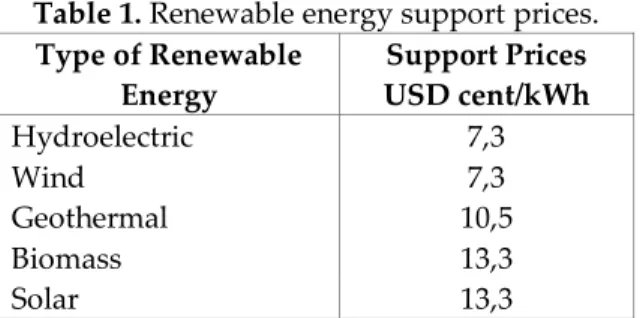
The fixed ten-year guarantee of purchase price prevent the rapid fall. The decreasing amounts of the price support for the ten-year period allow electricity market balancing. Especially after the fifth year, the price must be reduced on a regular basis. In this way, the investor deal with the installation and the operation for the payback time is below five years. Renewable energy support prices applied in Turkey is given in Table 1 (Resmî Gazete, 2011) below.
Table 1. Renewable energy support prices. Type of Renewable Energy Support Prices USD cent/kWh Hydroelectric 7,3 Wind 7,3 Geothermal 10,5 Biomass 13,3 Solar 13,3
A new regulation came into force for the determination of the contribution of domestic production in the installation of solar plants (Regulation no: 29752 date: June 24, 2016) (Resmî Gazete, 2016). According to this regulation in order to calculate the amount of additional local contribution the formula (1) should be used.
[∑ ( )] (1) Where DCEP is domestic contribution extra price (USDcent/kWh); MCR is material contribution ratio; DCFP is domestic contribution full price (USDcent/kWh); n is number of pieces in material.
If some parts of renewable energy plants are domestic manufacturing, support prices will increase. Domestic production support is available for the first five years. In fact, all kinds of support can be limited as five years to force the investors to be more conscious. In this way, the costs of renewable energy investments can be pull down. Technically all the parts are important for a power plant. But the first, PV panels and the inverters play the most important role for solar power plants.
Average sales prices in the daytime hours for Solar PV, and 24-hour average sales prices for wind can be used to calculate support prices. The hourly price application can be used for the other types of power plants because of amount of the power production can be adjusted. If the hourly price application for the renewable power plants is made the priority guarantee of purchase should be applied. The average hourly prices should pay to operators who accept the support prices. In this way, the balance of the price in all over the grid will be preserved.
Investments directed by the government by the showing the place or location are more accurate, efficient, and equitable. Recycle time; not included in the cost of land and included in the cost of land is about 7 and 10 years, respectively. In this study the land fee: $35/m2 has been recognized. This price may be more variable by location.
The aim of this study is to ensure that different FiT/kWh supports are given to the different plants. Because all economic benefits and environmental impacts of renewable power plants are not the same.
The Potential of Solar Power in Konya
Konya province is one of the most suitable solar PV fields in Turkey with the appropriate temperature and low humidity. The most important problem of land suitable for agriculture in Konya
is used for PV power plants. Firstly, a macro plan must be done by the government to solve this problem. Secondly, the declaration of eligible land can be more articulate in detail. Location, capacity and name of the power transformers that can be linked to renewable power plants are advertised in the present application.
Konya is an very important area with a monthly average radiation of 130,45 kWh/m2 and an average temperature of 12,25 °C along with an annual average sunshine duration of 2876 h. Climate data are used in the forecasting of the total annual energy that can be produced. Especially PvGiS (JRC, 2016) use of this data is one of the most effective examples. The efficiency of the systems except the solar panels is taken as 0,9249. The angle of the panels is selected as 30 which are most appropriate for Konya province. The highest electricity that can be produced in one year is forecasted as 1650 MWh. The real value of energy produced at the PV power plant is 1567 MWh. It is clear that the actual values are very close to forecasted values. The difference between actual data and forecasted data is determined as %5. One of the biggest factors in the occurrence of this difference, especially this year is sudden changes in the weather conditions.
1 MW Solar PV System Design for Konya
A Supervisory Control and Data Acquisition (SCADA) center is established in the Konya organized industrial region for the monitoring of the electrical power grid. At the same time, remote control like opening and closing operations can be performed in this SCADA center. Also SCADA center is used for monitoring of the solar power plant.
The general structure of the solar power plant in Konya is shown in Figure 1. 4200 pcs total power 1008 kW solar panel is used. AC inverters total output power is designed as 850 kW. Connection to the power grid is made through a Star/Delta transformer. The overall efficiency of solar power plant is about 84%.
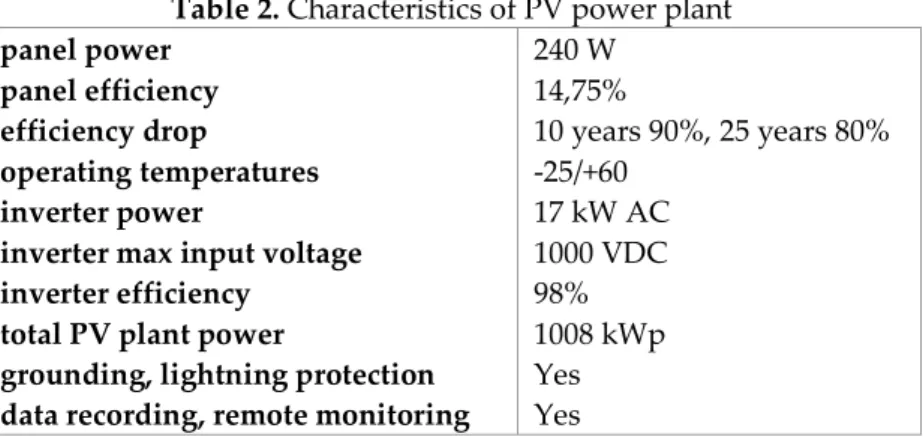
The important characteristics of 1 MW solar PV power plant are shown in Table 2. The most important values of the feasibility study are panel efficiency, efficiency drop and many unspoken inverter prices. Inverter prices constitute approximately 18% of the total power plant cost.
Table 2. Characteristics of PV power plant
panel power 240 W
panel efficiency 14,75%
efficiency drop 10 years 90%, 25 years 80%
operating temperatures -25/+60
inverter power 17 kW AC
inverter max input voltage 1000 VDC
inverter efficiency 98%
total PV plant power 1008 kWp
grounding, lightning protection Yes
data recording, remote monitoring Yes
The data received from solar radiation measuring device and energy analyzer of the power plant as shown in Figure 2 is saved hourly basis. Actually this curve shows how well the system is working in the winter months. In this way, the power system production curve can be evaluated together with the solar radiation. If the energy production cannot be done, the sources of failure should be reviewed.
Figure 1. General structure of the solar power plant
Figure 2. Active power and solar radiations curves
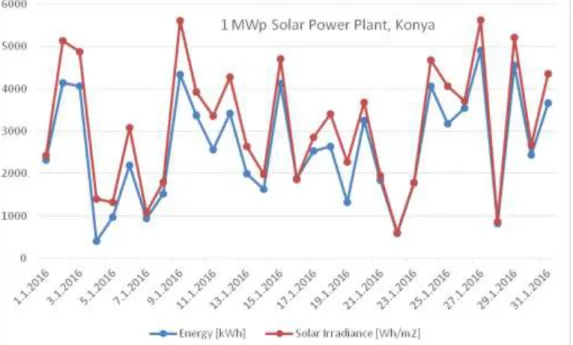
Daily energy production and solar irradiance for January 2016 are shown together in Figure 3. Approximately 82000 kWh was produced in a month (January 2016). The system performance ratio is calculated as 81,5%. The average daily solar irradiance is determined as 3135,13 Wh/m2. Thus, it is proven that the solar system is capable of producing acceptable amounts in cold weather.
PROPOSED RENEWABLE ENERGY SUPPORT ALGORITHM
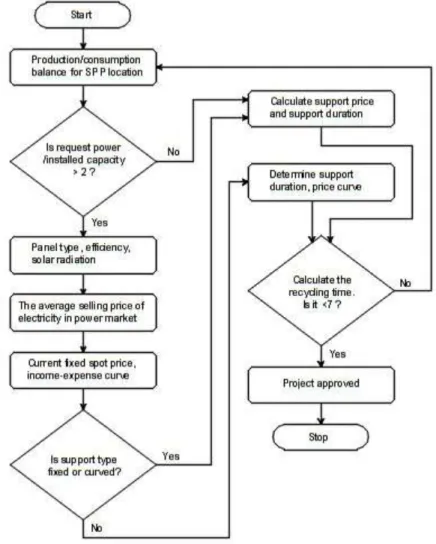
The main objective of the proposed model; according to the benefits of different renewable energy sources in the power system is to provide support price different amount. This allows all investors to design the plants in an optimum way to get more support; they follow better the operation of the plant. Thus, the efficiency of the power system is increased. A novel FiT support price algorithm is proposed in this study. The information about technical data of the power plant and the production/consumption balance of the power grid is taken at the start of the algorithm. According to the power plant's technical data benefit/cost ratio is calculated. Support type, fixed or flexible, is decided. The support mechanism now provides a flexible FiT which is calculated according to an algorithm based on economic situation and technical data of the RES. The flowchart of the proposed model is shown in Figure 4.
Figure 4. Flowchart of the proposed model
According to the proposed algorithm, the evaluation of the solar system is performed as follows. The power system production/consumption balance in place of power plant must be known especially for directing investment to areas where production is minimal. If this ratio is below 0,5, the support coefficient is regarded as 1. If this ratio is above 1, the support coefficient is taken as 0,5. In this way if production is greater than consumption in the region where the plant will be built, the system reduces the support rate by half. If production/consumption ratio is between 0,5 and 1 for to find support ratio, inverse ratio is applied. Thus priority in the areas where energy production is less will be recognized. Another goal of this model is aimed to provide investors primarily to produce for their own needs.
If power demand/capacity ratio is smaller than 2, the support coefficient is taken as 1, and then support duration and price are determined. If this ratio is greater than 2, panel efficiency, type, solar radiation, selling price of electricity, current fixed price and income-expense curve are evaluated to determine support coefficient and duration. The coefficient of the usefulness of the power plant is determined using this data. According to the coefficient of usefulness, the support type and duration are determined. If recycling time calculated is less than 7 years the project will be supported. Otherwise, algorithm is directed to 2. step for the new project entry. As a result, according to the proposed algorithm price support for power plants as 100% is determined for power plants capacity not exceeding need twice in an area that production less than consumption. If the proposed algorithm is presented to users in real terms in a web page, investors can evaluate before the actual application. In this way, the proposed algorithm can be used more effectively for energy efficiency, economical operation, power system security and right investment.
FEASIBILITY ANALYSIS
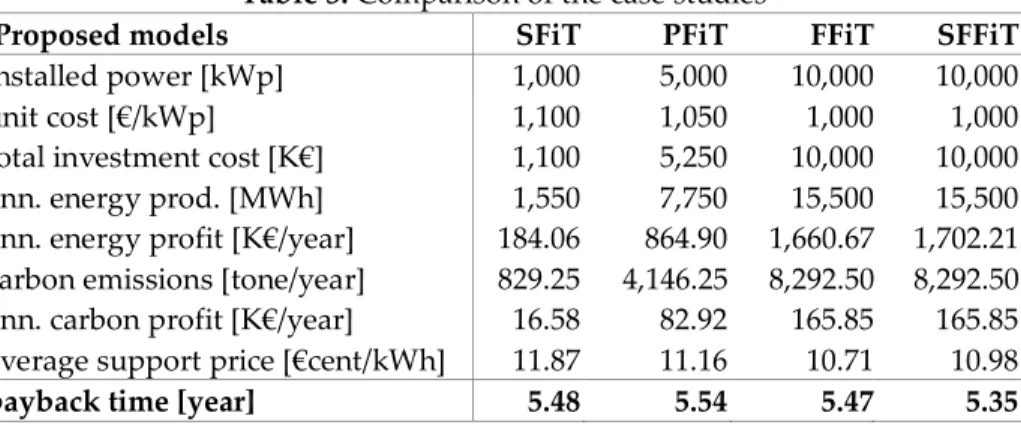
The economic feasibility study summarizing the four different cases is shown in Table 3. Comparisons have been made in the financial structure of all plants considered the same. In this paper, the feasibility studies were performed for Konya province. The investors are interested in this province due to sunshine durations and vastness of the land. RES power increases installation costs are reduced. The energy production of the RES is proportional to plants powers. Annual energy production is calculated using PVGIS (JRC, 2016). Annual energy production varies between 1500-1650 MWh depending on the angle of placement of the solar panel. It has been considered to be the same efficiency and operate under the same conditions. The average support prices are calculated by the proposed algorithm. This study proposed a new FiT model that can be applied to the support policy. This model has been named as semi fixed semi flexible FiT (SFFiT) that can be apply for all of RES. Full flexible FiT (FFiT) support policies should apply only to high power RES (≥10MW). Standard FiT (SFiT) should be apply for low power RES (≤ 1MW). Partial FiT (PFiT) should be apply for middle power RES (1MW< RES < 10MW). The proposed SFFiT model includes SFiT, PFiT and FFiT models. Even though the less support price is given, payback time is shorter for SFFiT support model. Thus, both the state as well as the investors would have won more. PFiT support can be considered as the worst case. In this case, the payback time is the maximum. Support price is higher than FFiT and SFFiT cases even though it is not the lowest risk. According to Table 3 it is seen that the proposed SFFiT model can be used for all plant power. The carbon support has been taken into consideration for all cases. In the calculations, the carbon emission for Turkey is assumed as 0,535 [kg/kWh] and the profit obtained from a ton of carbon is 20 €. €/$ parity is taken as 1,12. Annual income/expense chart for 1 MW solar power plant may vary according to the investors overall income/expense plan. Investors usually targets own plants to pay their debt with their income. Payment balance is varying according to the size of the investors’ financial status.
Table 3. Comparison of the case studies
Proposed models SFiT PFiT FFiT SFFiT
installed power [kWp] 1,000 5,000 10,000 10,000
unit cost *€/kWp+ 1,100 1,050 1,000 1,000
total investment cost *K€+ 1,100 5,250 10,000 10,000
ann. energy prod. [MWh] 1,550 7,750 15,500 15,500
ann. energy profit *K€/year+ 184.06 864.90 1,660.67 1,702.21 carbon emissions [tone/year] 829.25 4,146.25 8,292.50 8,292.50 ann. carbon profit *K€/year+ 16.58 82.92 165.85 165.85 average support price *€cent/kWh+ 11.87 11.16 10.71 10.98
CONCLUSION
It is clear that the support time for renewable energy for Turkey is sufficient. In this study, the proposed model seems to be more appropriate because the economic feasibility time is less than the other support models. FiT support time in all countries definitely should not exceed 10 years. Fixed price support policies for the installed capacity over 1 MW power plants should be abandoned definitely. Large investors should develop appropriate management and investment policies to market requirements. Especially in very large renewable energy power plants (>10 MW) like other power plants can be operated with day-ahead pricing. Part-time flexible and part-time fixed structured support policies should be developed and implemented. In this study, a support model (SFFiT) proposed to improve the electrical market conditions. Turkey should continue the renewable energy support policies for to reach year 2023 or year 2030 targets. The renewable energy support should not only be done in time and cost, but also the renewable power production system efficiency must also be added into the support policies. That will accelerate the transition to more efficient and more economic renewable power systems. In this way, more informed investors and operators will earn more.
Turkey’s transmission system is mostly regional in functionality, and could benefit from improved connectivity across region if renewable resources in remote areas are to be more fully harnessed. The cost of developing the transmission system will be great. But surely the power system should be strengthened and the voltage level should be increased. The new regulations are required for building integration of solar renewable energy systems. The types of constraints, principles of using and installation requirements necessarily must be defined. Feed-in tariffs, quotas, priority dispatch, technical standards, mandatory connection and purchase should be decided at the beginning of the renewable project. However the government also faces a few challenges such as the integration problem of renewable power into the grid, and low operation efficiency during implementation.
The following recommendations are suggested for the regulation which will be removed in the future for renewable energy production, sales and distribution.
Over the next five to ten years, Turkey plans to construct several giga watts wind power plants and generate a large amount of grid-connected solar PV. It will be very difficult to connect large amount of this renewable power to the electricity distribution grid, particularly at peak hours without smart-grid technology. The Turkish Government should begin planning how to deploy smart-grid technology to maximize renewable energy connection to the distribution grid.
A road-map should establish for renewable energy investors. A detailed feasibility study and income expense report for renewable project application should be requested necessarily.
Fixed price supports should not to exceed seven years. If the renewable energy support duration is determined as ten years, price support should be reduced gradually necessarily.
The researcher, investors, operators, the power system management and the legislators should work together for cleaner and more economical RES.
ACKNOWLEDGE
The author is grateful for the technical support provided by Konya Organized Industrial Zone Directorate.
REFERENCES
Benli, H., 2013, “Potential of Renewable Energy in Electrical Energy Production and Sustainable Energy Development of Turkey: Performance and Policies”, Renewable Energy, Vol. 50, pp. 33-46. Caynak, S., “Renewable Energy Strategy of Turkey”, ICCI 2012 18. International Energy & Environment
CEER, “Implications of Non-harmonised Renewable Support Schemes”, Council of European Energy Regulators, 18 June 2012.
Cetinkaya, N., 2015, “A New Financial Model and Economic Feasibility of Grid-Connected Power Plants for the Future of Renewable Energy in Turkey”, International Journal of Electrical Energy, Vol. 3(2), pp. 110-114.
Chang, M.C., Hu, J.L., Han, T.F., 2013, “An Analysis of a Feed-in Tariff in Taiwans Electricity Market”, International Journal of Electrical Power & Energy Systems, Vol. 44(1), pp. 916-920.
Couture, T., Gagnon, Y., 2010, “An Analysis of Feed-In Tariff Remuneration Models: Implications for Renewable Energy Investment”, Energy Policy, Vol. 38(2), pp. 955-965.
Dincer, F., 2011, “The analysis on Photovoltaic Electricity Generation Status, Potential and Policies Of The Leading Countries in Solar Energy”, Renewable and Sustainable Energy Reviews, Vol. 15, pp. 713-720.
Ding, J., Somani, A., “A Long-term Investment Planning Model for mixed Energy Infrastructure Integrated with Renewable Energy”, Green Technologies Conf. IEEE, Grapevine, TX, USA, pp. 1-10, 15-16 April 2010.
EIE, 2016, http://www.eie.gov.tr/MyCalculator/Default.aspx [15.03.2016]
EPIA (European Photovoltaic Industry Association), Greenpeace, 2011, “Solar Photovoltaic Electricity Empowering The World”, Solar generation 6 full report.
Gokgoz, F., Atmaca, M.E., 2012, “Financial Optimization in The Turkish Electricity Market: Markowitz’s Mean-variance Approach”, Renewable and Sustainable Energy Reviews, Vol. 16, pp. 357-368. Gözen, M., 2014, “Renewable Energy Support Mechanism in Turkey: Financial Analysis and
Recommendations to Policymakers”, International Journal of Energy Economics and Policy, Vol. 4(2), pp. 274-287.
Haasa, R., Eichhammer, W., Huber, C., Langniss, O., Lorenzoni, A., Madlener, R., Menanteau, P., Morthorst, P.E., Martins, A., Oniszk, A., Schleich, J., Smith, A., Vass, Z., Verbruggen, A., 2004, “How to Promote Renewable Energy Systems Successfully and Effectively”, Energy Policy, Vol. 32, pp. 833-839.
IEA (International Energy Agency), 2008, Deploying Renewables: Principles for Effective Policies, Paris, 978-92-64-04220-9.
Ireland (Department of Communications, Energy and Natural Resources), 2006, Renewable Energy Feed-in Tariff: Terms and Conditions, May1, 2006. http://www.dcenr.gov.ie/NR/rdonlyres/ E260E316-B65A-4FDC-92F0-9F623BA18B55/0/REFITtermsandconditionsV2.doc [01.02.2016] JRC (Joint Research Centre), IET (Institute for Energy and Transport), 2016, http://re.jrc.ec. europa.eu/
pvgis/apps4/pvest.php [15.03.2016]
Leonardo, M., “Renewable Energy: Support Mechanisms Analysis”, FSR Summer School on Regulation of Energy Utilities, Florence, 28 June 2012.
Lipp, J., 2007, “Lessons for Effective Renewable Electricity Policy from Denmark, Germany and the United Kingdom”, Energy Policy, Vol. 35(11), pp. 5481-5495.
Mendonca, M., 2007, Feed-in-tariffs: Accelerating the Deployment of Renewable Energy, Routledge, UK, ISBN: 9781844074662.
Oğuz, F., Akkemik, K.A., Göksal, K., 2014, “Can Law Impose Competition? A Critical Discussion and Evidence from The Turkish Electricity Generation Market”, Renewable and Sustainable Energy Reviews, Vol. 30, pp. 381-387.
Pablo, D.R., 2012, “The Dynamic Efficiency of Feed-in Tariffs: The Impact of Different Design Elements”, Energy Policy, Vol. 41, pp. 139-151.
Palmer, K., Burtraw, D., 2005, “Cost-effectiveness of Renewable Electricity Policies”, Energy Economics, Vol. 27, pp. 873-894.
Resmî Gazete, 2011, http://www.resmigazete.gov.tr/eskiler/2011/01/20110108-3.htm [15.03.2016] Resmî Gazete, 2016, http://www.resmigazete.gov.tr/eskiler/2016/06/20160624-1.htm [30.07.2016]
Somasekhar, G., Bharathi, G., GirijaEureka, M., 2014, “Marketing Methodology of Solar PV Power Packs”, Journal of Economics and Finance, Special Issue Vol.1, pp. 38-43.
Stokes, L.C., 2013, “The Politics of Renewable Energy Policies: The Case of Feed-in Tariffs in Ontario, Canada”, Energy Policy, Vol. 56, pp. 490-500.
TETC, Turkish Electricity Transmission Company, 2016, http://www.teias.gov.tr/YukTevziRaporlari. aspx [15.03.2016]
Topkaya, S.O., 2012, “A Discussion on Recent Developments in Turkey’s Emerging Solar Power Market”, Renewable and Sustainable Energy Reviews, Vol. 16, pp. 3754-3765.