THE EFFECT OF MATERNAL MENTAL STATE TALK ON PRESCHOOL CHILDREN’S THEORY OF MIND ABILITIES
A Master’s Thesis
by
BAHAR BOZBIYIK
Department of Psychology
İhsan Doğramacı Bilkent University Ankara May 2016 A R BO ZBIYIK PRESC H OOL CHILDREN ’S TH EO RY OF MIND ABI L ITIES Bilkent University 201 6
To my mother, Ayşe Bozbıyık and
my father, Mehmet Bozbıyık
for nursing me with infinite affection and love and their companionship for success in my life
THE EFFECT OF MATERNAL MENTAL STATE TALK ON PRESCHOOL CHILDREN’S THEORY OF MIND ABILITIES
The Graduate School of Economics and Social Sciences of
İhsan Doğramacı Bilkent University
by
BAHAR BOZBIYIK
In Partial Fulfillment of the Requirements for the Degree of MASTER OF ARTS IN PSYCHOLOGY
THE DEPATMENT OF PSYCHOLOGY
İHSAN DOĞRAMACI BİLKENT UNIVERSITY ANKARA
ABSTRACT
THE EFFECT OF MATERNAL MENTAL STATE TALK ON PRESCHOOL CHILDREN’S THEORY OF MIND ABILITIES
Bozbıyık, Bahar
MA. Department of Psychology Supervisor: Asst. Prof. Dr. Hande Ilgaz
May 2016
This study investigates the relation between maternal mental state expressions during story book reading and 3- to 5-year-old Turkish speaking children’s theory of mind (ToM) abilities. Thirty-two children completed ToM, executive functions, and standardized language tasks. Following these, parents read a wordless picture book to their children. Mothers’ mental state languages were coded in 3 levels of structural complexity: the word, the morphological, and the clause levels. At the word level we coded for the frequency and the diversity of mental state words (i.e., perception, physiological states, motivation/intention, desire, affect, cognitive, contrastive). At the morphological level we coded for modality for volitional wishes (-se, -sa) and modality for volitional suggestions (-e, -a). Mental state words with their subcategories were coded in accordance with their referents: (1) the child, the mother, or others (MSW-CMO) (2) story characters (MSW-SC). At the sentence level we coded for mental state causal explanations under two categories: (1) Explicit explanations and (2) Implicit Explanations. Results revealed that mothers’ total MSW was related to children’s ToM after controlling for strong predictors. Additionally, frequency of total MSW-CMO, cognitive-CMO, perception-CMO, perception-SC, and total perception word uses were correlated with children’s ToM. Furthermore,
while cognitive words positively predicted children’ ToM, explanations for cognitive words negatively predicted children’s ToM. In line with correlational results that emphasize the role of perception words, an analysis that investigated the effects of perception, cognitive, and contrastive words found that the aggregate frequency of these categories predicted children’ ToM. Lastly, only mothers’ cognitive-CMO predicted children’s ToM.
Key words: Mental State Words, Story Book Reading, Theory of Mind, Turkish Language
ÖZET
ANNELERİN KULLANDIKLARI ZİHİNSEL DURUM İFADELERİNİN ANAOKUL ÇAĞI ÇOCUKLARININ ZİHİN KURAMI BECERİLERİNE
ETKİSİ
Bozbıyık, Bahar
Yüksek Lisans, Psikoloji Bölümü Tez Yöneticisi: Yrd. Doç Dr. Hande Ilgaz
Mayıs, 2016
Bu çalışmada annelerin yazısız hikâye kitap okurken kullandıkları zihinsel durum ifadelerinin 3 ila 5 yaşları arasındaki çocukların zihin kuramı becerilerine olan etkisi, Türk örnekleminde incelenmektir. Otuz-iki çocuğa zihin kuramı seti, standartlaştırılmış kelime ölçekleri ve boyutsal kart sınıflandırma ölçeği uygulanmıştır. Akabinde, annelerden resimli, yazısız kitabı çocuklara anlatması istenmiştir. Annelerin kullandıkları zihinsel durum ifadeleri 3 yapısal karmaşıklık seviyesinde kodlanmıştır: kelime seviyesi, ek seviyesi ve cümle seviyesi. Kelime seviyesinde, sıklık ve çeşitlilik bazında zihinsel durum kelimeleri (örn., algısal, fizyolojik durum, istek, güdü/niyet, duygu, bilişsel ve karşıtsal) kodlanmıştır. Ek seviyesinde, dilek kipleri (-se, -sa) ve istek kipleri (-e, -a) kodlanmıştır. Yedi alt kategoriye ayrılan zihinsel durum ifadeleri hitap özelliklerine göre çocuğa, anneye veya başkalarına hitaben ve hikâye karakterlerine hitaben olmak üzere ikiye ayrılmıştır. Cümle seviyesinde ise zihinsel durum kelimelerini açıklayıcı cümleler belirgin açıklayıcılar ve dolaylı açıklayıcılar olmak üzere 2 kategoride kodlanmıştır. Bulgular annelerin kullandıkları zihinsel durum kelimelerinin kontrol değişkenleri kontrol edildiğinde zihin kuramı becerileriyle anlamlı ilişkiler olduğunu göstermiştir. Çocuğa, anneye veya başkalarına hitaben kullanılan zihinsel durum kelimeleri, bilişsel ve algısal kelimeler, hikaye karakterlerine hitaben kullanılan algısal kelimeler ve
toplam algısal kelimeler zihin kuramı becerileriyle anlamlı ilişki içindedir. Bunların yanında, bilişsel kelimelerin zihin kuramını artı yönde yordadığı, bilişsel kelimeleri açıklayan cümlelerin ise zihin kuramı becerilerini eksi yönde yordadığı bulunmuştur. Algısal kelimelerin zihinsel durum ifadeleri ile ilişkisi göz önünde bulundurularak algısal, bilişsel ve karşıtsal kelimelerin aralarındaki ilişkiyi incelemek için yapılan analizler bu kelimelerin toplamlarının zihin kuramı becerilerini yordadığı bulunmuştur. Son olarak, annelerin çocuğa, kendine veya başkalarına hitaben kullandıkları bilişsel kelimelerin çocukların zihin kuramı becerilerini yordadığı bulunmuştur.
Anahtar kelimeler: Hikâye Kitabı Okuma, Türk Dili, Zihin Kuramı, Zihinsel Durum İfadeleri
ACKNOWLEDGEMENTS
First and foremost, I would like to express my gratitude to my dear supervisor, Dr. Hande Ilgaz. Her support and guidance for reading and research have increased my intellectual interest about socio-cognitive development and enabled me to become a critical thinker. Her deep knowledge and way of teaching have strengthened me against difficulties throughout my graduate school experience and thesis process. I would have never completed this thesis without her invaluable contributions and patience.
I am also especially grateful to my senior thesis supervisor, Dr. Saime Tek for leading me to the graduate school and, in particular, to the subject of socio-cognitive development. Without her trust and support, I would have never reached my current level.
I am very thankful to Dr. Jedediah Wilfred Papas Allen. Not only his lectures have enhanced my way of thinking but also his different point of view and detailed feedbacks have contributed to the improvement of this study. I am also grateful to Dr. Annette Hohenberger for her valuable suggestions and
comments on this study. I also want to express my thanks to Dr. Ali Turan Görgülü for not sparing his detailed knowledge about Turkish language from the research team.
I would like to thank the members of Bil-Ge Lab at Bilkent University for their help and support. I would also like to thank the research assistants in the lab especially to Nihan Keşir, Elif Sabit, Tilbe Erel, Beril Aydemir, and Gizem Türköz for their precious contributions to the coding of the study for reliability and to Laura Nammer for her substantial contribution to coding and
transcriptions. I want to thank Refia Tezer, Şeda Zaim, Beyza Alımcı, İpek Özkaya, Ayça Başcı, İdil Alaftar for their help in data collection and
transcription. I am especially thankful to Eda Cengiz for her fundamental contributions in the data collection process. I am also greatly thankful for the participant children and their mothers for their invaluable contributions to the study.
I am very thankful to my friends, Esra Elibüyük for her encouragement and positive energy and Cansu Yılmaz and Merve alabak for their support. I also would like to thank my dear friends Nur Çöllü and Selin Yıkılmaz for their warm friendship and support.
I would like to express my love and gratitude to my parents for their unfailing emotional and financial support. I am also very thankful to my grandparents for their love and support. Without their infinite encouragement and guidelines, this study would have never become complete. I am very grateful to my brother, Atıl Bozbıyık for his endless love, patience and friendship.
Lastly, I would especially thank to my boyfriend, Eren Şahin for his emotional support and patience. Without his strength in every obstacle that I faced, it would be very difficult to overcome this process.
TABLE OF CONTENTS
ABSTRACT……….iii
ÖZET……….v
ACKNOWLEDGEMENTS………....vii
TABLE OF CONTENTS………...ix
LIST OF TABLES………..xiv
CHAPTER I: INTRODUCTION
………...……….……1 1.1 Theory of Mind………...………...21.1.1 Theories of “theory of mind”………...…5
1.1.1.1 Modularity theory……….………...5
1.1.1.2 Theory theory………...……….…...6
1.1.1.3 Simulation theory…………...………...8
1.1.1.4 Socio-cultural theory………...10
1.1.1.5 The role of language as conceptualized by different theory of mind theories………...11
1.2 Mental State Language……….13
1.2.1 Discourse with family members and children’s mental state understanding………...……...………13
1.2.2 Family discourse during book reading………...14
1.3 The Current Study………19
CHAPTER II: METHOD………22
2.1 Participants………...22
2.2 Materials………..24
2.2.1 Background information………24
2.2.1.1 Demographic form………..24
2.2.2 Theory of mind measure………24
2.2.2.1 Theory of mind battery………...24
2.2.2.1.1 Diverse desire………..25
2.2.2.1.2 Diverse belief………..25
2.2.2.1.3 Knowledge access………25
2.2.2.1.4 Explicit false belief………..26
2.2.2.1.5 Content false belief………..26
2.2.2.1.6 Apparent-real emotion……….27
2.2.3 Executive function measure………...27
2.2.3.1 Dimensional card sort task (Zelazo, 2006)……..27
2.2.3.1.1 Color rule……….28
2.2.3.1.1 Shape rule………28
2.2.4 Language assessment………...……….28
2.2.4.1 Turkish receptive and expressive language test (TIFALDI)………...………..28
2.2.4.1.1 Receptive language test………29
2.2.4.1.2 Expressive language test………..29
2.2.5 Wordless picture book………...30
2.3 Procedure……….30
2.4 Language Coding……….31
2.4.1 The word level………...……31
2.4.1.1 Perception words………32 2.4.1.2 Physiological words ………...32 2.4.1.3 Desire words………...32 2.4.1.4 Motivational words……….33 2.4.1.5 Affect words………...33 2.4.1.6 Cognitive words………..33 2.4.1.7 Contrastives………34
2.4.2 Coding for diversity………...…35
2.4.4 The level of clause……….37
2.4.5 Mothers’ language complexity………..37
2.5 Reliability……….37
CAHPTER III: RESULTS……….40
3.1 Do Mothers’ Talk with Their Children Show Differences Based on Their Children’s Age and Gender?...41
3.2 Do Children’s Theory of Mind Performance Show Differences by Age and Gender?...43
3.3 Is There a Relation between ToM-Total and Potential Control Variables (Children’s Age, Language and Executive Function)?...45
3.3.1 Bivariate correlation………...45
3.4 Is There a Relation between the Frequency of Mothers’ Mental State Use and Children’s Theory of Mind?...46
3.4.1 Is there a relation between the frequency of total mental state subcategories and ToM?...48
3.4.2 Does the reference of the MSW matter? Is there a relation between the frequency of mental state words about the mother, child or others (MSW-CMO) and ToM?...50
3.4.3 Does the reference of the MSW matter? Is there a relation between the frequency of mental state words about the story characters (MSW-SC) and ToM?...51
3.5 Are There Different Patterns of Mental State Word Use that Underlie Mothers’ Storytelling Discourse?...51
3.6 Does the Diversity of Mothers’ Talk with Their Children Show Differences Based on Their Children’s Age?...53
3.7 Is There a Relation between the Diversity of Mother’s MSW and Children’s ToM?...55
3.7.1 Are there any interrelation between mothers’ diversity of total mental state word usage?...55
3.7.2 Are there relations between word diversity in MSW subcategories in mother’s discourse that reference the child, the mother or others and children’s ToM?...57 3.7.3 Are there relations between word diversity in MSW
subcategories in mother’s discourse that reference the story characters and children’s ToM?...58 3.8 Do Mothers’ Use of Mental State Explanations Show Differences
Based on Their Children’s Age?...58 3.9 Is There a Relation between Mothers’ Use of Total Causal
Explanations and Children’s ToM?...60 3.9.1 Does the content of the mental state explanation matter?
Investigating the relation between mothers’ causal explanations that belong to different mental state categories and children’s theory of mind performance?...61 3.9.2 Does the use of causal connectors matter? Investigating the relation between use of explicit causal explanations and theory of mind………..62 3.9.3 Does the absence of the causal connector matter?
Investigating the relation between the use of implicit causal explanations and theory of mind………62 3.10 Does Mothers’ Use of Cognitive Mental State Words and Cognitive Explanations Predict Children’s ToM?...63 3.11 Do the Different Patterns of Mental State Word Usage that Underlie Mother’s Storytelling Predict Children’s ToM?...65 3.12 Does the Reference of Mothers’ Mental State Language (Reference to The Child, The Mother or Others vs. The Story Characters) Predict Children’s Theory of Mind?...65 CHAPTER IV: DISCUSSION………..68
4.1 The Relation between Theory of Mind and Potential Control Variables (Children’s Age, Language and Executive
Function)………....73
4.2 The Relation between the Frequency of Mental State Words and Theory of Mind Abilities……….73
4.3 The Relation between the Diversity of Mental State Words and Theory of Mind Abilities……….79
4.4 The Relation between Causal Explanations for Mental State Words and Theory of Mind Abilities………...…80
4.5 Limitations………...…85
4.5.1 Assessment tasks-theory of mind battery………...…86
4.5.2 Procedural-effect of the context……….87
4.5.3 Design………88
4.6 Future Directions………..89
4.7 Conclusion………...90
REFERENCES………..92
APPENDICES A: DEMOGRAPHIC FORM FOR PARENTS………..………100
LIST OF TABLES
1. Child and Mother Demographics by Age and Gender………..23
2. Explicit and Implicit Explanations among the Subcategories of MSW ………...38
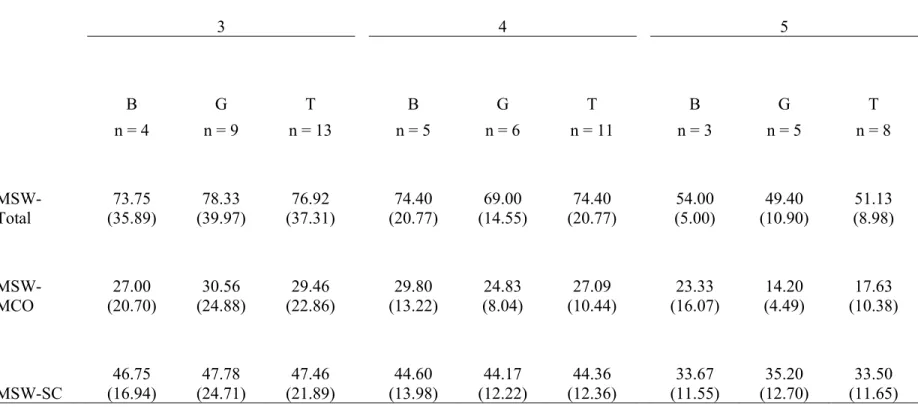
3. Mean and Standard Deviations of Mothers’ talk by Age and Gender..42
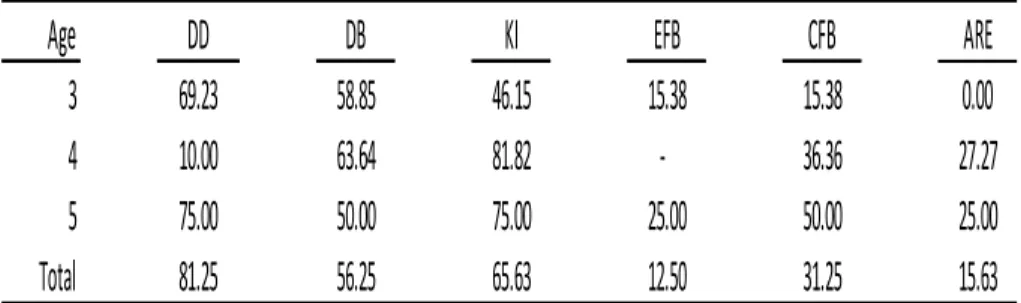
4. Percentage of Children that Passed ToM Tasks by Age………...43
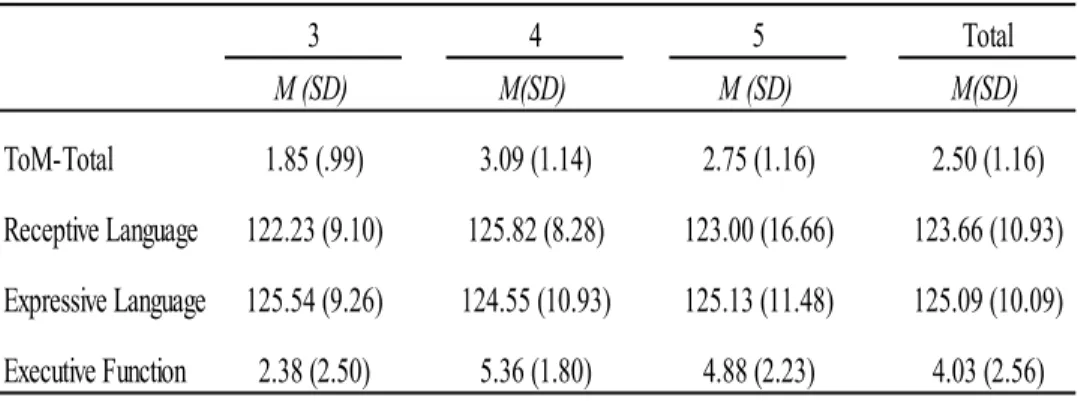
5. Descriptive Statistics of the Control Variables……….46
6. Correlations and Partial Correlations across Frequency of Mental State Words and ToM-Total………...46
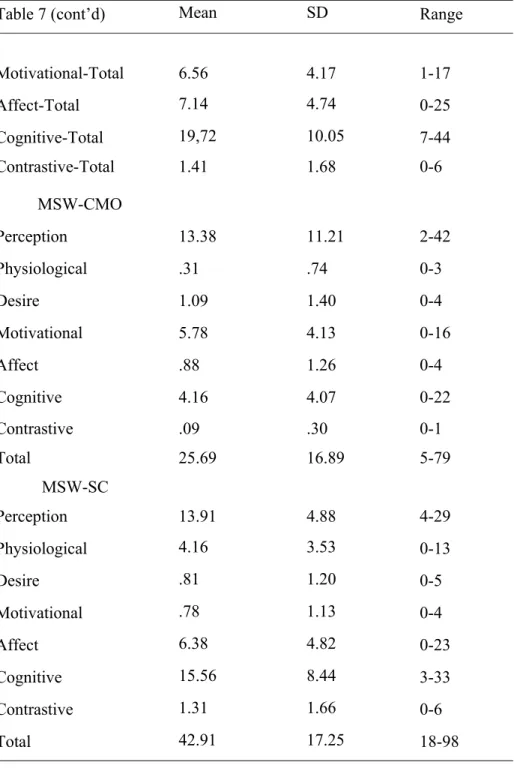
7. Descriptive Statistics of Frequency of Mothers’ MSW……….48
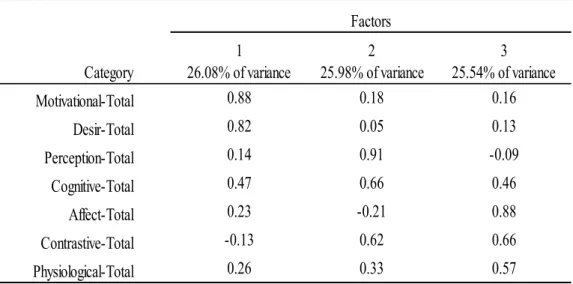
8. Factor Analysis for Mothers’ Use of Mental State Words………53
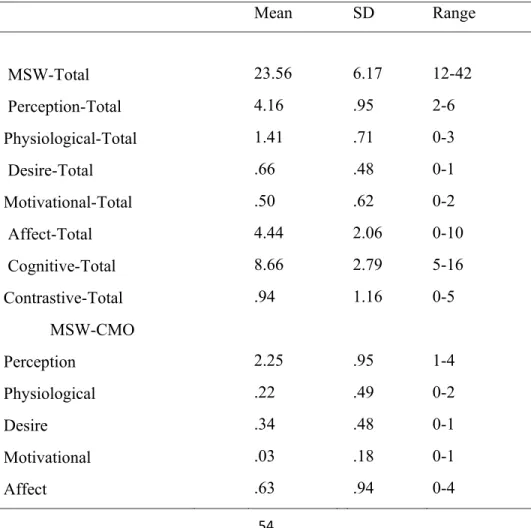
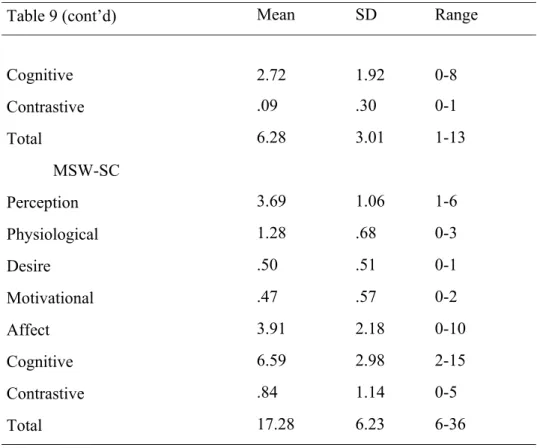
9. Descriptive Statistics of Diversity of Mothers’ MSW………..54
10. Bivariate Correlations and Partial Correlations across Diversity of Mental State Words and ToM-Total………..56
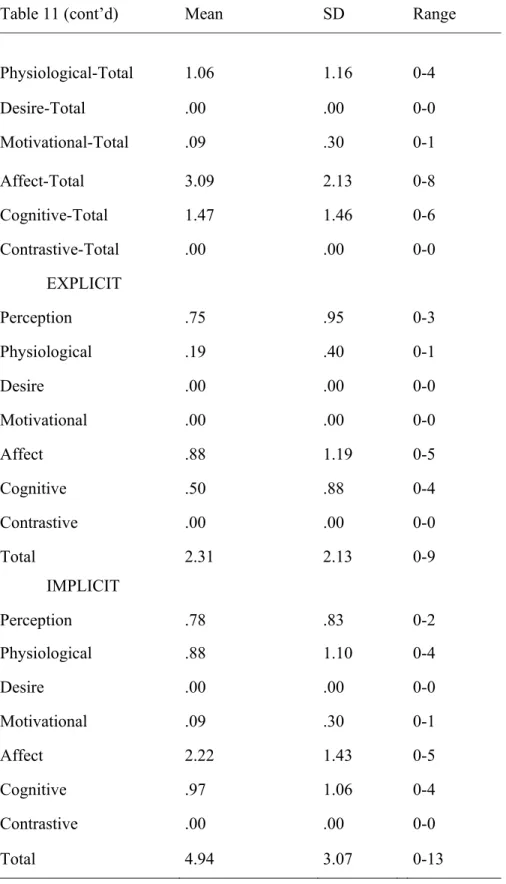
11. Descriptive Statistics of MSW Causal Explanations……….58
12. Bivariate Correlations and Partial Correlations across Causal Explanations and ToM-Total……….60
13. Summary of Regression Statistics Predicting Children’s ToM Performance by Mothers’ Use of Total Cognitive MSW and Cognitive Explanations………..64
14. Summary of Regression Statistics Predicting Children’s ToM Performance by Mothers’ Use of Total Cognitive MSW and Cognitive Explanations………...66
15. Summary of Regression Statistics Predicting Children’s ToM Performance by Mothers’ Use of Cognitive-MCO and Cognitive-SC ………...67
CHAPTER 1
INTRODUCTION
Language development permeates the development of children’s cognitive, and socio-cognitive abilities (Catts, Fey, Zhang, & Tomblin, 1999; Meacham, Vukelich, Han, & Buell, 2014; Piasta et al., 2012; Zucker, Justice, Piasta, and Kaderavek, 2010). Through social interactions, children come to appreciate the mental world of self and others (e.g., Ruffman, Slade, & Crowe, 2002; Symons, Peterson, Slaughter, Roche, & Doyle, 2005). Research has shown that there is cross-sectional and longitudinal relations between the quality of parental talk and children’s theory of mind abilities (Ruffman et al., 2002; Symons et al., 2005; Adrian, Clemente, & Villanueva, 2007). One of the major factor that has been investigated for maternal talk in relation to children’s theory of mind abilities is mothers’ use of mental state words in different contexts. Mental state words are defined as words that describe the mental world of individuals (Ruffman et al., 2002; Symons, 2004). These could be words that related to self and others’ thoughts, feelings, desires, intentions, and emotions.
Certain everyday language contexts have been found to elicit mental state talk from parent-child dyads. Shared book reading is a privileged context that facilitates the use of mental state talk about mothers and children that both reference one and another and also third persons’ (the story characters’) minds. Symons et al. (2005) have shown that mothers’ use of mental state language about story characters while telling a story was correlated with children’s theory of mind abilities (Experiment 1). Importantly, these finding were
(2007) showed that mothers’ use of cognitive state terms with their 3-year-old and 6-year-old children was correlated with their children’s theory of mind abilities one year later.
In the current study we aim to investigate whether there is a relationship between Turkish mothers’ mental state language and their children’s theory of mind abilities during a shared bookreading activity. This study will allow us to investigate mothers’ mental state language both in terms of frequency of mental state language, but also in terms of its diversity. In addition, we aim to analyze the unique effects of mental state talk in this context to children’s theory of mind development while controlling for the effects of age, language and executive functioning. Accordingly, this study will provide an opportunity to investigate whether the relations found for mental state discourse in English speaking and Spanish-speaking mother-child dyads are also observed in Turkish speaking mother-child dyads. Given that no study has investigated this question with Turkish-speaking dyads, a secondary aim and contribution of this study will be to create and implement a comprehensive coding scheme of mental state language in Turkish that focuses on morphological and lexical units that demarcate mental state concepts.
In the following sections, the development of theory of mind ability in young children, the role of mothers’ mental state language on this socio-cognitive ability, and previous literature about the relation between mental state language and theory of mind development in book reading context will be discussed. 1.1 Theory of Mind
In the past three decades, a vast body of research has focused on theory of mind development (see for reviews, Flavell, 2004; Miller, 2012; Wellman, Cross & Watson, 2001). Theory of mind is a socio-cognitive ability that entails understanding one’s own and others’ mental states such as emotion, desire, and belief (e.g., Jenkins, Turrell, Kogushi, Lollis, & Ross, 2003;
Wellman, 1990; Wellman & Estes, 1986). An important development in children’s theory of mind ability appears between the three and five years of age (Wellman & Liu, 2004; Miller, 2012). Around four and a half years of age, children gain the insight that people’s actions are based on their emotions, desires and beliefs, that different people can hold different emotions, desire and beliefs, and that false beliefs lead to actions that do not correspond to the real state of affairs (e.g., Jenkins et al., 2003; Wellman, 1990; Wellman & Liu, 2004).
The large body of research that has focused on theory of mind includes
scholars from different disciplines with various questions. While some scholars are interested in explaining uniquely human ways of thinking about the social world (Premack & Woordruff, 1978; Tomasello, 2001); others have
investigated the relationship between theory of mind performance and other critical social and cognitive abilities such as executive functioning, attention, memory, impulse control (Perner & Lang, 1999), language (e.g., DeVillers, 2005), school readiness (Astington & Pelletier, 2005), positive social skills (Watson, Nixon, Wilson & Capage, 1999), and moral reasoning (Baird & Astington, 2004).
The term theory of mind was first defined by Premack and Woodruff (1978) as the ability to attribute mental states to self and others. They conducted a comparative study on chimpanzees in order to investigate the difference between how human and nonhuman primates perceived social situations. More specifically, they focused on whether chimpanzees have theory of mind abilities. The authors had a chimpanzee named Sarah watch videotapes
showing humans who were faced with problems such as reaching for food that is out of reach or trying to escape from a locked cage. Sarah was later
presented with two photographs, one of which depicted the solution to the problem. Sarah seemed to have no difficulty in choosing the solution to the problem such that she picked a key for the locked actor and chose a stick for the inaccessible banana. Premack and Woodruff interpreted Sarah consistent preferences for the correct photographs as evidence for her ability to attribute
mental states to the actor in the videos. According to the authors, Sarah could appreciate the motivation of the actor given the problem, and chose the best solution for the actor’s problem. Therefore, they concluded that chimpanzees and other nonhuman primates have the ability to reason about other’s mental perspective.
In response to Premack and Woodruff’s claims, some researchers argued that one could pass this video task without having to read others’ minds by solely focusing on the problem and its consequences. These researchers proposed that sufficient evidence for a theory of mind interpretation was only possible through tests that measure false belief understanding (e.g., Dennett, 1978). False belief tasks, also termed first-order theory of mind tasks, are based on two basic assessment procedures (Miller, 2012). Wimmer and Perner (1983) devised a paradigm, unexpected transfer task or the unexpected location task, that entailed children to predict a character’s behavior based on that character’s false belief about the location of an object. In this task, the child observes the location of an object while in the presence of another person (or puppet). When the other person leaves, the child watches the object being transferred to a new location. This sets up a condition in which the child knows the current location of the object and may or may not also knows that the absent person is not aware of the new location. Theory of mind is assessed by asking the child where the other person would search for the item when he comes back (Wimmer & Perner, 1983). To pass the task, the child take the perspective of the other person and reason about that person’s behavior based on this false belief such that person should search on wrong place due to his or her false belief. Importantly, the task entails reasoning about someone’s false reality while having access to the correct state of affairs (Miller, 2012).
Another commonly used false belief task is unexpected contents task or unexpected identity task (Perner, Leekham, & Wimmer, 1987). In this task, children are given a specific familiar container such as a crayon box which contains an unexpected content (e.g., a pen or a coin). Children are asked to guess the contents of the container. Afterwards, children are shown the
unexpected contents. Then, children are asked to judge what another person who has not seen inside the container would expect to find in the container. This task requires that children appreciate that others; may hold false belief due to their previous experience, and their belief may be different than the current state of affairs.
Children between the ages of three and five begin to succeed on these tasks (Miller, 2012). However, generally children younger than four years old perform poorly, making systematic errors where they assume that others’ will think in line with themselves (i.e., with reality). A meta-analysis that included more than 4000 children across 178 studies showed this developmental transition persisted despite variations in the task or culture (Wellman & Liu, 2004). In general three year old children tend to fail these tasks, four year old children show a mixture of failure and success, and five year olds tend to successfully complete the task. Thus by five years of age children have reached first order false belief understanding which is a major milestone for theory of mind development (Wellman & Liu, 2004; Miller, 2012).
1.1.1 Theories of “theory of mind”
Several theories have been proposed to explain the emergence of children’s theory of mind abilities. These theories make assumptions about the processes by which children attain an understanding of others’ mental states (e.g., desires, emotions, beliefs) and false beliefs. They vary according to the importance they place on children’s language environments and how children benefit from these language environments.
1.1.1.1 Modularity theory
This approach builds on Fodor’s (1983) conslusion that perceptual level processes are modular and that aspects of cognition are specialized for specific domains (Hermer & Spelke, 1996). Leslie has adapted and extended this idea to children’s theory of mind, starting with children’s ability to represent an object or event in more than one way. Based on his analysis of pretense, Leslie (1987) proposed that understanding of the mind is an innate ability and argued
that children are born with a special brain mechanism which enables them to have metarepresantations. Within the cognitive module that handles theory of mind processing, Leslie proposed further specialized submodules (e.g., Theory of Mind Mechanism- ToMM) that processes and represents mental states. Leslie argued that ToMM is in place by the time children start representing one object as another as manifested by pretense. According to this view, pretense involves copying of a primary representation into a metarepresentational context. This ability is referred to as decoupling (Leslie, 1987). For example, when children take a banana to their ear and say “hello”, they copy the representation of a telephone onto the primary representation of the banana. This process allows for representing an object or an event with two separate meaning and is called metarepresentation. The ability to create
metarepresentations first occurs with the ability to engage in pretend play at around two years of age and at the age of three to four this ability is manifested in the ability to attribute mental states to others (Leslie, 1987 cited in Leekam & Perner, 1991).
Support for the modularity account of theory of mind development comes primarily from studies done with children with autism (Leslie & Thasis, 1992; Baron-Cohen, 1989b). Baron-Cohen, Leslie, and Frith, (1985) have compared the performance of children with autism and children with Down syndrome. Both of these groups had a mean age of 11 years. These groups were compared to a group of typically developing preschoolers. The results showed that performance of children with autism lagged behind the other two groups, who showed similar performance. According to this theory, language input may serve as a “triggering” for the development of theory of mind. The necessary component is maturational in origin. Consequently, the delay that children with autism show in theory of mind development have been taken as evidence to suggest that theory of mind processing is carried out by an innate mechanism in the mind that children with autism lack (Leslie, 1991)
This framework is philosophically developed by Adam Morton (1980) and claims that understanding of mind occurs in a theory-like manner (Carpendale & Lewis, 2006). This theory states that through social interactions individuals develop theories about the mental world (Wellman & Gelman, 1992). Research that investigated the theory theory account of socio-cognitive development in children gained momentum in the 1990s (Wellman, 1990). It was argued that children begin to understand the mind through the process of theory
construction and revision (Gopnik & Wellman, 1994). This account provides a three-pronged definitional criteria for the term “theory”: (1) theory has
coherence, it is not a collection of isolated facts, (2) a theory makes ontological distinctions and commitments reflecting the contrast between objects in the physical world and mental entities in the mind, and (3) it gives a causal explanatory framework that combines different constituent elements mental state domains (Wellman, 1990).
Adults can easily differentiate physical events from mental states. However, children gradually appreciate the difference between perceptually accessible events and mental states (Carpendale & Lewis, 2006). Wellman (1990) argued that there are two essential milestones in the development of theory of mind: understanding desires and understanding beliefs. Desires constitute the foundation for motivation. Understanding desires entails appreciating that an individuals’ behavior is governed by their desires. According to Wellman (1990), around two years of age children become desire psychologist (i.e., they develop theories about other’s behavior by understanding their desires). For example, one may wish to be at a beachside on a warm sunny day, in the middle of a cold winter day. In other words, desires have no truth value. In contrast, beliefs may be wrong. For example, lack of access to new
information, may render one’s beliefs incorrect. To illustrate, a person who believes that the ice cream vendor is situated at a particular street corner, may be surprised to find that the vendor has moved and is no longer there.
According to Wellman (1990), at age four, children come to distinguish beliefs from desires, so their understanding of mind becomes more complex.
Support for the theory theory account of theory of mind development comes from studies involving naturalistic talk. Bartsch and Wellman (1995) observed 10 children’s development of desire and belief understanding (6 boys and 4 girls) from 2- to 5- years of age through their natural talk in everyday settings. They revealed that children used consistently more desire verbs than belief verbs. This remained the same both for all children and for each child
individually. Until 2 ½ years of age children exclusively used desire verbs, but no belief verbs were observed. After 2 ½ years of age, the amount of belief words increased and then became equal with desire verbs. Around 4- years of age, belief words exceeded desire verbs. The other support for this account comes from a meta-analytic study investigating a possible rank-ordering of different theory of mind tasks. Wellman and Liu (2004) demonstrated that children first show understanding of other’s desires before they understand other’s beliefs. To sum up, naturalistic talk studies and a meta-analysis for a theory of mind scale have been taken as a evidence for theory of mind competence being theory like in nature. Further, through social interactions children become desire psychologist first and develop theories about desires and then at around four, they started to differentiate desires from beliefs. For the theory theorist language provides children with opportunities to learn mental state concepts. For instance, Astington (2001) proposed that mental state terms are a way to develop theory of mind abilities such that through acquiring the meaning of words like “think” or “know” children are able to gain access to the concepts of belief. Children build on these concepts through experience in social interactions, developing expectations and revising these expectation in the light of real life experience.
1.1.1.3 Simulation theory
This approach argues that the primary cognitive ability behind children’s theory of mind reasoning is imagination. Imagination allows children to take the perspectives of others. This process is dependent on children’s ability to view others as similar to self (i.e., “like me approach”) and predict how they would feel, what they would desire or believe, if they found themselves in the
same situation. The approach has been studied by both philosophers (e.g., Heal, 1986; Goldman, 1989 cited in Carpendale & Lewis, 2006) and by
developmental psychologists (e.g., Harris, 2000; Tomasello, 2001).
According to Harris (1992), there are four stages that explain how and when children learn to use mental simulations. During the first year of life, infants show their simulation ability by synchronizing their activities with others (i.e., imitation). Next, at the end of the first year, children initiate actions to affect another person’s current attitude which is the second step. The third step occurs around three years of age where children begin to anticipate other people’s actions based on their mental states. In step four, children attain the ability to simulate the perspective of another person whose beliefs do not correspond with reality as in false belief tasks (Harris, 1992).
While most theories of socio-cognitive development (e.g., sociocultural theory, theory theory) argue that simulation may be play a factor in children’s
understanding of self and others’ mental states (e.g., Tomasello, 2001), direct empirical tests that lends support to this account are scarce. One example may be Bradmetz and Schneider’s (1999) work on young children’s understanding of story characters feelings as different from those of the child as the listener of the story. Through a series of experiments, Bradmetz and Schneider have shown that young children confuse their own point of view with that of the character. For example, young children consistently assert that Little Red Riding Hood, upon entering the grandmother’s house, will be scared. However, at this point in the story Little Red Riding Hood does not yet know that it will be the wolf (and not the grandmother) that she will encounter. This consistent theory of mind mistake, not unlike the ones children make in the Maxi task, may support the idea that children merge with the character, and fail to maintain two simultaneous representations (one for self and one for other). A supporting argument comes from García Pérez, Hobson, and Lee (2008) who show that shifting between different perspectives is the key difficulty for children with autism.
Simulation theory assumes that perspective taking is afforded by social interactions. These interactions are invariably characterized by rich linguistic exchanges. Conversations where two people hold different opinions, pretend play where players construals of reality differ, bookreadings where the teller, listener and the characters have different mental realities all important language contexts that are hypothesized to promote children’s theory of mind
development.
1.1.1.4 Socio-cultural theory
Katherine Nelson (1996; 2005) suggested that theory of mind ability develops through shared symbolic practices such as cultural/societal belief systems, narratives, and metaphors. In this view, the child enters a world of minds and is socialized into thinking about others’ mental states. This is in stark contrast to other theories that view the child as engaging in solitary theoretical reflections. Moreover, from Bruner’s perspective, culture has an important effect on children’s understanding of mind because they learn mental states within cultural frameworks. Scholars that emphasize the critical role of culture, language, and conversation with others for children’s developing
understanding of mind, propose that these contexts provide the child with different points of view (e.g., Astington & Baird, 2005; Harris, 1996; Nelson, 2005). Astington and Baird (2005) underscored the constitutive role for social interactions on children’s theory of mind abilities. They stated that social interactions form a foundation for language development which enables children to comprehend the mental states of others. Harris (1996) argued that social interaction in the form of conversation, pretend play and shared bookreading provides children with opportunities to learn and improve their perspective-taking abilities. According to Harris, in these types of social interactions children acquire the necessary exposure to other people’s desires, beliefs, and intentions in meaningful contexts. Nelson (2005) proposed that not only face to face interactions, but also understanding the ideas of community and morality, customs and cultural conventions facilitate children’s theory of mind development. This understanding is only conveyed through language
during interactions with social agents and the culture such as reflecting on knowledge, imaginative constructions, reminiscing with parents and others, explanations of events and actions as well as cognitive functions.
1.1.1.5 The role of language as conceptualized by different theory of mind theories
Three of the major theories discussed (i.e., theory theory, simulation theory, socio-cultural theory) construe language as necessary and central to theory of mind development. Theory theorists suggest that sequencing of the theory of mind abilities which show a progression from understanding desires around 2- years of age to understanding beliefs at around four years of age. They assert that language input such as uses of desire and beliefs words have instrumental role on this development. Thus for the theory theorists, language serves an instrumental role to support children’s construction of theories about the mind through social interactions and language. The developmental sequence thus plays a significant role, manifesting the stages through children’s theory building about the mind (Wellman, 2010).
The simulation theory (Harris, 1995) clearly places emphasis on language as a platform through which children experience different perspectives. In this view, conversations, pretend play, and narrative activities help the child to recognize and to take different perspectives. Simulation as a process has been accepted as a viable mechanism by both theory theory and socio-cultural theory. Hence, any evidence that points to perspective-taking through language could be interpreted to support either theory theory or socio-cultural theory. Socio cultural theory view the role of language embedded in social interactions as constitutive of theory of mind development. Socio cultural theorists propose that children come to understand other people’s mental states through social interactions surrounded by language input within a cultural framework. It is important to note that cultural variations in the sequencing of theory of mind that are supported by culture specific way of talking about the mind may be indicative of evidence for socio-cultural theory. Another important point would be to highlight the dynamic and social nature of theory of mind development.
The child, according to the socio-culturalists, is never alone, but is always scaffolded by adults in his or her quest to understand the mind. It would thus be expected that true evidence for socio-cultural theory would entail a dynamic relation between adults’ talk about the mind and children’s understandings. The fourth theory (i.e., modularity theory) attributes a triggering function to language where language activates the theory of mind modules that are innate and unfold according to a specified timetable (Leslie, 1994). Such modular accounts struggle with explaining the observed sequence of theory of mind development where children first come to understand desires and emotions and then they start to understand beliefs and finally, false beliefs. Wellman (2010), has used this criticism and asked why theory of mind modules were not
triggered by language input such that children come to process all mental states around the same time.
The current study focuses on the relations between environmental language input and children’s theory of mind. Given that participating children were 3- to 5-years of age, a modularist account should not see value in seeking these relations. However, theory theory, simulation theory and socio-cultural theory would all expect relations between mothers’ mental state language and children’s theory of mind. Theory theorists would claim that children who are exposed to mental state language would learn mental state concepts better which would in turn improve children’s theory of mind. Simulation theorists would assert that children who are exposed to mental state language would get more practice in perspective taking which in turn would increase their theory of mind performance. Finally, socio-cultural theorists would assert that children who are immersed in interactions that are rich in mental talk would gain an understanding of the mind as it exists situated in the child’s culture. They would thus learn their culture’s way of conceptualizing the mind which in turn would increase their theory of mind performance. The study will establish a first step with Turkish speaking children as to whether their theory of mind understanding is at all influenced by their mothers’ mental state language. If the hypothesized relations exist, future studies that are specifically design to
test theories of theory of mind development would use fine-tuned designs to disentangle among alternative explanations.
1.2 Mental State Language
Mental state language involves words that describe the mental world of individuals (e.g., Jenkins et al., 2003; Ruffman et al., 2002). These could be words that are about thoughts, feelings, desires, intentions, and emotions. Research on mental state talk has traditionally focused on three main
categories: cognitive, desire, and emotion states. Cognitive state words include think, know, believe, forget, remember, understand, and wonder which can refer to beliefs and other mental events related to mind, imagination, and metacognition. Desire state words involve want, wish, desire, and prefer which represent the meaning of someone’s desire for something. Emotion state words reflect direct and indirect feelings towards objects, events, individuals or situations and include terms such as happy, sad, angry, and hurt (Symons, 2004). In addition to these categories, Bretherton and Beeghly (1982) emphasized the importance of perception words (e.g., to look, to see)
especially for younger children. They created a comprehensive coding scheme which included 6 sub-categories (i.e., perception, physiological, affect,
volition, cognition, and obligations).
Children’s understanding and use of mental state language is widely used as an indication of theory of mind development (e.g., Ruffman, et al., 2002; Adriàn et al., 2007; Symons et al., 2005). Preliminary studies demonstrated that discourse in perspectivally rich contexts such as conversations between children and family members or peers (e.g., Brown & Dunn, 1992; Jenkins et al., 2003) and during book reading (e.g., Sabbagh & Callanan, 1998) promote children’s acquisition of mental state talk.
1.2.1 Discourse with family members and children’s mental state understanding
Longitudinal studies have indicated that children’s mental state talk was related to the amount of talk about mental states that they hear at home during family
conversations (Brown & Dunn, 1992). For example, children’s talk about cognitive mental states were found to be associated with maternal use of cognitive state language during home observations (Jenkins et al., 2003). Brown and Dunn (1992) showed that the nature of the conversation partner plays a role in children’s learning and using of mental state talk. They focused on children’s emotion talk with their siblings and their mothers. Children were observed at their homes when they were 33 months olds (time 1) and again when they were 47 months old (time 2). This study revealed that 47 month-old children talked more about others’ emotions when they were talking with their siblings as compared to when they were talking with their mothers. This is possibly due to the differences in the nature of the relationship children have with different family members. Children have reciprocal relationships with their siblings based on shared interest, and equal status. Yet they have “complementarity interaction” with their mothers which is characterized by asymmetrical power and caretaking relations. The reciprocal relationship with siblings help children to take perspective more easily than they can with their mothers even though siblings’ talk is characterized by a focus on the self, whereas mothers’ talk is focused more on their children’s emotional state (Brown & Dunn, 1992).
Furthermore, Jenkins et al.’s (2003) longitudinal study explored the effect of family interactions during home observation on 2-year-old’s younger siblings’ and 4-year-old’s older siblings’ ability to talk about the mind. Children were tested two times, with two years in between testing sessions. Results indicated that 4-year-old children with an older sibling were exposed to more cognitive state talk than children without an older sibling. Importantly, early exposure to cognitive and desire states predicted children’s talk about mental states two years later above and beyond the effects of concurrent mental state talk. While these studies did not include a theory of mind assessment, ability to talk about mental states was seen as a transitional pathway for theory of mind
understanding (Symons, 2004).
Book reading is a common context that facilitates interactions between parents and their children. Previous studies have explored the role of maternal talk during book reading on young children’s theory of mind development both concurrently (Symons et al., 2005; Racine, Carpandale, and Turnbull, 2007; Peterson & Slaughter, 2003; Slaughter, Peterson, & Mackintosh, 2007) and longitudinally (Ruffman et al., 2002; Adriàn et al., 2007). Symons et al. (2005) investigated the relation between mental state language and 5- to 7- year old children’s performance on different false belief tasks (i.e., unexpected identity and unexpected content tasks, a change of location task, and an emotional false belief task). They invited participants (90 % of those were mothers) to the lab and analyzed not only the effect of parental mental state words but also children’s mental state words as well as the composite score of these two on children’s performance on different false belief tasks. They focused
specifically on mental state language about the story characters and did not distinguish between the subtypes of mental state words. The results revealed that only the composite score comprised of the total number of character mental state words of the parent and the child was correlated with children’s theory of mind abilities.
A similar study that focused exclusively on parental (89.74% of those were mothers) use of emotion words in book reading. In this study, Racine and colleagues (2007) investigated 3- to 5- year-old children’s theory of mind abilities in relation to the child’s and their parents’ use of emotion words across two levels of complexity: (1) emotion talk based on beliefs of the story
characters (Belief-Dependent Emotion Talk) and (2) emotion talk based on real situations of the story characters (Non-Belief-Dependent Emotion Talk). Children and their mothers read a book that included emotional content. Bookreadings took place either at the laboratory or at the participants’ home. The authors assessed children’s false belief understanding by using a change of location false belief task and an unexpected content task and they assessed children’s emotion understanding by using an affective perspective taking task. Their analyses demonstrated that, after controlling for children’s age, all emotion words used by the child and the mother, belief-dependent talk about
emotions predicted children’s false belief understanding. In addition non-belief dependent talk predicted children’s emotion understanding after controlling for children’s age. They concluded that children’s understanding of beliefs and emotions were interrelated with talk about different aspects of the
psychological world.
Talk about mental content is not limited to use of words. Mothers also
frequently explain the basis of mental states by describing why a person might feel sad in a particular situation, or why someone acted in a way that is
incongruent with reality based on his false belief. Peterson and Slaughter (2003) investigated the relation between maternal mental state explanations and 4- to 5- year-old children’s theory of mind abilities. They assessed children’s theory of mind abilities using the “Maxi” change of location task at the children’s preschool. Mothers’ mental state explanations were tested by using a self-report questionnaire, the Maternal Mental State Input Inventory (MMSII). This questionnaire provided 12 vignettes describing social situations and asked mothers to select their preference on the basis of their choice of interactions with their children from 4 different choices for each of the vignettes. One of the four choices included explanation of mental states. The authors found that maternal choices for mental state word explanations were correlated with children’s theory of mind abilities. This remained significant after controlling for children’s age and verbal ability.
The research reviewed so far examined either mental state words or mental state explanations, and did not adopt a comprehensive focus that included both mental state words and explanations. Slaughter and colleagues (2007) adopted a comprehensive coding scheme that looked at both mental state words and explanations and sought to elucidate their relation to 3-year-old children’s theory of mind abilities. Children completed a change of location false belief task. Mother-child dyads shared a storybook either at home or in the preschool setting. Slaughter and colleagues coded maternal contrastives (false belief endings between mothers’ thought and reality about the story) and mental state words with subcategories (i.e., cognitive, affect, and perception words) and
mental state explanations of these subcategories. Their results indicated that contrastives and mothers’ cognitive explanations were correlated with children’s theory of mind abilities both in bivariate correlation and partial correlations when controlled for children’s age and mother’s verbosity. They did not find this relation for affect explanations and perception explanations as well as affect and perception words.
These studies provided some evidence for concurrent relations between
mothers’ language and children’s theory of mind abilities. However, in order to argue that mothers’ language promotes theory of mind, longitudinal studies are necessary. Two longitudinal studies provide support for such a relation
(Ruffman et al., 2002; Adriàn et al., 2007). Ruffman et al. (2002) investigated the effect of maternal mental state language on 3- to 4-year old children’s theory of mind development during picture telling interactions. The pictures were chosen to elicit mental state talk. Mothers were asked to talk about these pictures in the same way they would if they were reading a story book. Children were tested three times, with 5 months in between the first and the second testing sessions and with a year in between the second and the third testing sessions. Across the three time points, children were administered theory of mind measures that increased in complexity; Time 1: change of location, desire-emotion, and emotion situation tasks; Time 2: change of location, unexpected content, desire-emotion, and desire-action tasks; Time 3: false-belief transfer, translocation justification, false-belief contents other, contents other justification, false-belief contents self, desire-action, and wicked desires. Mothers’ use of both mental state words with its sub-categories (i.e., desire, emotion, modulation of assertion, think and know and other mental state words) and non-mental state words (i.e., descriptions, elaborations, causal talk, factual talk, links to child life, don’t know, physical states, orienting utterances, repetitions of other, and self-repetitions) were coded as well as composite score of mental state words and non-mental state words. The authors did not discuss cross-sectional relations within time points since they were interested in longitudinal relations. They found that maternal modulations of assertions, think and know, and other mental state categories at time 1 were correlated
with children’s theory of mind development at time 2 and maternal modulations of assertions, think and know at time 2 were correlated with children’s theory of mind development at time 3. They also found some longitudinal relations with non-mental state talk. Noteworthy for the focus of the current study, causal talk at time 1 was correlated with children’s theory of mind development at time 2 and there was a trend between time 1 and time 3. Additionally, they found that a maternal composite score of mental state words was correlated with children’s later theory-of-mind understanding after
controlling for potential predictors (i.e., children's own use of mental state language, their earlier theory-of-mind understanding, their language ability, their age, mothers' education, and other types of mother utterances).
A comprehensive analysis of mental state talk should include not only the use of mental state words and mental state explanations but also should focus on who the mental states are referring to. This matters for those frameworks that place special emphasis on bookreading as a privileged context that elicit mothers and children to focus on third persons’ (i.e., story characters) mental perspective (e.g., Nelson, 2005). Addressing this issue, Adriàn et al. (2007) focused exclusively on maternal cognitive state words in their investigation of 3- to 5- year-old Spanish-speaking children’s theory of mind development and its relation to book reading discourse. Importantly, this investigation sought to determine whether bookreading discourse predicted children’s theory of mind over time. Children were tested at two time points, with a year in between testing sessions and were presented different theory of mind measures. At Time 1 children completed change of location and unexpected contents tasks. At Time 2 they completed white lie, irony, deception, and certainty tasks.
Maternal cognitive state language was coded at three levels. First, they grouped cognitive verbs in three categories: “to know”, “to think”, and other cognitive verbs. At the second level they coded according to the referent of the mental state verbs: the child, the story characters, and mothers and others. At the third level, the discourse functions of the verbs were grouped in three categories: questions, explanations, and other functions. The authors found that mothers’ use of total cognitive state verbs was correlated with children’s theory of mind
abilities both concurrently and longitudinally. These correlations remained significant after controlling for children’s age, verbal ability, and maternal education at time 1 and verbal ability, maternal education, and children’s age at time 2. The results also revealed cross-sectional relations between cognitive state verbs that referenced the children and children’s theory of mind abilities after controlling children’s age, verbal ability, and maternal education at Time 1. Interestingly, they found marginal cross-sectional relation between maternal cognitive state verbs that referenced the story characters and children’s theory of mind abilities after controlling for children’s age, verbal ability, and maternal education at Time 1. However, they did not observe any relation between maternal cognitive state language that referenced the mother or others, and theory of mind abilities. Their results regarding mental state explanations showed only cross-sectional relations between maternal cognitive explanations and children’s theory of mind abilities after controlling for children’s age, verbal ability, and maternal education at Time 1. These results were also observed longitudinally, between time 1 and time 2 even when controlling for children’s theory of mind understanding, age, verbal ability, and maternal education. Of particular relevance for the current study, they found a relation between cognitive words that referenced the child as well as cognitive words that referenced the story characters at time 1 and children’s theory of mind performance at time 2 when children’s theory of mind understanding, age, verbal ability, and maternal education at time 1 and children’s age time 2 were accounted for.
1.3 The Current Study
To sum up, these previous studies have investigated the different aspects of mental state language (e.g., different subcategories and words vs explanations) and demonstrated concurrent and longitudinal relations between children’s theory of mind abilities on English and Spanish speaking children. The current study aimed to fill a twofold gap in existing research.
To the best of our knowledge, this study is going to be the first to explore the relation between maternal mental state talk and Turkish speaking children’s
theory of mind abilities. In order to provide a deeper understanding of the potential relations between Turkish mothers’ bookreading language and children’s theory of mind, the present study employed an extensive language analysis that focused not only on the words that mothers used, but also the referents of those words (i.e., mother, child and others vs. story characters). Additionally, we coded for causal explanations involving mental state content. While we expected similar results to previous literature, we should note that cultural variation in mental state language and its relation to theory of mind was considered as a possibility. However, given that this study explored an under-researched issue with a Turkish sample, the quality of cultural variation was not clearly identified.
Second, while cultural differences may affect generalizability of the previous results on the present findings, linguistic differences may also elicit different findings. Given the scarcity of research in this area, we had to adapt and develop mental state language coding schemes for Turkish. Due to its morpho-syntactic structure, the Turkish language has unique characteristics in terms of mental state talk (Ilgaz, Allen, & Bozbıyık, 2015) which we took into
consideration when adapting the coding scales that have been widely used with English speaking children. The study conducted by Ilgaz Allen, and Bozbıyık (2015) investigated whether narrative context and oral story telling effect 3- to 5- year-old Turkish speaking children’s use of mental state language. This Turkish data revealed that some contrastives like “meğerse”, “sandı”, “hani”, and “halbuki” carry mental state information (Ilgaz, Allen, & Bozbıyık, 2015-SRCD) . Furthermore, there are some morphological structures concerning modality for volitional wishes (-se, -sa) and modality for volitional suggestions (-e, -a) in Turkish that are expressed using words in other languages (to want, to desire). However, Turkish speaking people can express their wishes and suggestions with these morphological structures. Therefore, the present coding scheme included these unique characteristics in order be inclusive of all mental state information in Turkish maternal talk. Accordingly, in the current study, modality for volitional wishes and volitional suggestions, contrastives that
elucidate the difference between two states of reality as well as traditionally coded mental state words, were included.
The aim of the present study is to investigate the relationship between maternal mental state language and 3-, 4-, and 5- year-old Turkish preschoolers’ theory of mind abilities in a shared book reading activity. Indeed it may be more appropriate to label the shared book reading activity as a story telling activity. That is because we provided mothers with a wordless picture book in order not to influence the nature of their mental state language usage with the words in a book. However, we opted to call this a book reading activity since in essence it asks for the mothers to narrate a story using the book and groups the current study along with other studies that have used similar narrative-elicitation paradigms.
It was hypothesized that (1) mother’s use of total mental state words and total cognitive words would be related to children’s theory of mind abilities after controlling for children’s age, children’s receptive and expressive language abilities, and executive functions. It was expected that (2) mothers’ use of explanations for mental state words and explanations for cognitive mental state words would be related to children’s theory of mind abilities after controlling for children’s age, children’s receptive and expressive language abilities, and executive functions. It was hypothesized that (3) mothers’ use of cognitive mental state words and explanations for cognitive mental state words would predict children’s theory of mind abilities when controlling for children’s age, their receptive and expressive language abilities, and executive functions. It was also expected that (4) cognitive mental state words that reference the story characters would predict children’s theory of mind abilities after controlling for children’s age, their receptive and expressive language abilities, and executive functions.
22
CHAPTER II
METHOD
2.1 Participants
Thirty two Turkish-speaking mothers and their children participated in the study. Children’s age ranged from 3 to 5 (M = 3.84, SD = .81) years of age. Mothers’ age ranged from 27 to 50 years (M = 36.72, SD = 4.83). Mothers’ education ranged from elementary school to PhD education. Overall, mothers were highly educated with 84.36% having a university degree (See Table 1 for child and mother demographics). Mothers’ also had high MLU scores relative to their children’s age (Miller & Chapman, 1981). MLU scores were similar for both boy and girls and for all ages. Parents and children were recruited through advertisements sent to the employees of the Bilkent Holding Group as well as to parents from Bilkent University’s Alumni Association. Due to the
recruitment strategy, children came from families belonging to middle socioeconomic status backgrounds. Children’ parents signed an informed consent form that was approved by the Bilkent Ethics Committee. Upon the completion of the study children received a set of crayons, a coloring book, a t-shirt with the Bilkent Developmental Lab Logo and stickers. The parents received a DVD recording of their interaction with their children in the lab.
23
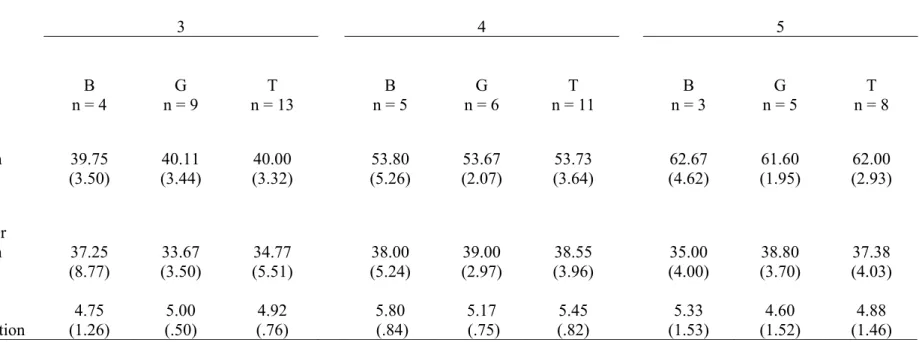
Table 1. Child and Mother Demographics by Age and Gender
3 4 5 B G T B G T B G T n = 4 n = 9 n = 13 n = 5 n = 6 n = 11 n = 3 n = 5 n = 8 Child Age in month 39.75 (3.50) 40.11 (3.44) 40.00 (3.32) 53.80 (5.26) 53.67 (2.07) 53.73 (3.64) 62.67 (4.62) 61.60 (1.95) 62.00 (2.93) Mother Age in years 37.25 (8.77) 33.67 (3.50) 34.77 (5.51) 38.00 (5.24) 39.00 (2.97) 38.55 (3.96) 35.00 (4.00) 38.80 (3.70) 37.38 (4.03) Education (1.26) 4.75 (.50) 5.00 (.76) 4.92 (.84) 5.80 (.75) 5.17 (.82) 5.45 (1.53) 5.33 (1.52) 4.60 (1.46) 4.88
Note: Values in parentheses are standard deviations. Mothers’ education was coded as: (1) illiterate, (2) elementary school, (3) junior high, (4) high, (5) university, (6) MA, (7) PhD, (8) others
24
2.2 Materials
2.2.1 Background information 2.2.1.1 Demographic form
This form included questions related to parents’ age, education, child’s birthdate, number of children living in the household and family income (See Appendix A).
2.2.1.2 Book reading habits survey
This is a short survey conducted by Ilgaz & Aksu-Koç (2005) that asks parents about children’s exposure to oral and written narratives in the home setting (See Appendix B). We should note that although we asked mothers to fill out the book habits survey, it did not include any questions about how familiar they are to make a story from pictures. Mothers’ answers to the survey mostly tend to represent their familiarization to make a story from pictures, asking a specific question for that would be better for deeper understanding of their habits about making a story utilizing from pictures.
2.2.2 Theory of mind measure 2.2.2.1 Theory of mind battery
This indicates a set of 6 theory of mind tasks (i.e., diverse desires, diverse beliefs, knowledge access, explicit false belief, contents false belief and appearance-reality emotion). The scale was developed by Wellman and Liu (2004) and adapted into Turkish by Özoran (2009). The scale has been used extensively with both English and non-English speaking children
(e.g.,Shahaeian, Peterson, Slaughter, & Wellman, 2011; Meins, Fernyhough, Arnott, Leekam, & Rosnay, 2013). The scale was adapted to Turkish by Özoran (2009). In order to keep the cognitive load of the test equal across tasks, all tasks were administered with picture props. In all these tasks, children
25
were presented with gender-matched drawings of children and supplementary pictures to explain the scenario.
2.2.2.1.1 Diverse desire
This task assesses children’s ability to understand a desire that is different from their own and their ability to predict an individual’s behaviors based on their desire. The experimenter first shows two pictures: a cookie and a carrot. Next, the child is asked which one his or her favorite. Then, the experimenter shows the picture of a gender-matched character and tells the child that this
character’s favorite food is different than that of the child. The test question states that the character in the picture is hungry and can only have one of the food items. The child’s task is to pick one of the food items for the character. In order to get 1 point the child must choose the food item that the character is reported to like.
2.2.2.1.2 Diverse belief
This task assesses children’s ability to understand a belief that is different from their own and their ability to predict an individual’s behavior based on the belief. The experimenter shows the child a different gender-matched character and states that the character is searching for his or her cat. There are two possible places that the cat may be: under the car or inside the bushes. Pictures depicting a car and bushes are presented. First, the child is asked tell his or her own belief about the location of the cat. The experimenter tells the child that the character believes the cat to be in the hiding spot not chosen by the child. The child is then asked to tell where the protagonist will look for the cat depending on his or her belief. In order to get 1 point the child must choose the location that the character believes the cat to be.
2.2.2.1.3 Knowledge access
This task assesses children’s ability to understand that seeing leads to knowing and the consequent appreciation that someone who has not seen inside a box
26
will not have knowledge about the contents of it. The experimenter shows the child a nondescript box and asks to guess what is inside the box. After the child makes a guess, the experimenter opens the box to reveal a little dog figurine. The experimenter then shows the child a gender-matched picture of a character and states that the character has not seen what is inside the box. Following this statement, experimenter asks the child two questions: 1. Does the protagonist know the inside of the box? and 2. Did the protagonist see the inside of the box? In order to get 1 point the child must give correct responses to both questions (i.e., “no” to both questions).
2.2.2.1.4 Explicit false belief
This task will assess children’s ability to predict a individual’s behavior based on their belief which contrasts reality. The experimenter introduces a new gender-matched character and states that the character is looking for his or her gloves. Following this, the experimenter shows two pictures of possible places the gloves might be found: a bag and a closet. The experimenter states that the gloves are actually in the bag, but that the character mistakenly believes that the gloves are in the closet. The child is then asked two questions: 1.Where will the protagonist search for the gloves?, 2.Where is the actual location of the gloves? In order to get 1 point the child must give correct responses to both questions (“in the cupboard” and “in the bag” respectively).
2.2.2.1.5 Content false belief
This task assesses children’s ability to appreciate that others may have false beliefs based on the suggestive appearance on an object. In this task, the experimenter shows the child a familiar box (i.e., ‘bonibon’ candy box), and asks what the child thinks is inside the box. After the child answers this question, the experimenter shows that the box contains a crayon. Following this, the experimenter introduces a different gender-matched character and states that the character did not look inside the box. Then the child is asked two questions: 1. What does the character think is inside the box?, 2. Did the