Original Article
Peripheral Block Education and Level of Competency: A Survey of
Turkish Anesthesiologists
Onur Selvi
1, Serkan Tulgar
1, Özgur Senturk
1, Zafer Taş
3, Halil Cihan Köse
2, Deniz İlhan Topçu
4,
Zeliha Özer
11Department of Anesthesiology and Reanimaton, Maltepe Univerity School of Medicine, İstanbul, Turkey 2Department of Anesthesiology, Maltepe Govermental Hospital, İstanbul, Turkey
3Department of Anesthesiology, Medicum Hospital, Antalya, Turkey
4Department of Biochemistry, Ankara Başkent University Hospital, Ankara, Turkey
ORCID iDs of the authors: O.S. 0000-0003-4503-9462; S.T. 0000-0003-1996-7505; Ö.S. 0000-0002-7776-109X; Z.T. 0000-0002-5676-0274; H.C.K. 0000-0003-1550-348X; D.İ.T. 0000-0002-1219-6368; Z.Ö. 0000-0002-2956-6513.
BACKGROUND/AIMS
Presently, in Turkey, there is no work being conducted on the period of regional anesthesia education, and there are no statistics available on the frequency with the administration of basic extremity blocks.The present survey was conducted on anesthesia doctors throughout Turkey to explorethe personal knowledge and competency of the participants. Simultaneously, this survey aimed to evaluate the infor-mation sources for regional anesthesia training in Turkey.
MATERIAL and METHODS
The present study surveyed 377 anesthesia doctors in March 2017 through a questionnaire formulated on the Delphi platform. The vol-untary participants were recruited from professional organizations, hospital portals, and Turkey’s anesthesia departments. Descriptive analyses were conducted for statistical evaluation.
RESULTS
Of the total participants, 3.2% were professors, 3.2% were associate professor doctors, 7.4% were assistant professors, 64.5% were specialist doctors, and 21.8% were residents. In the segment concerning skill and information level self-evaluation for blocks, the most commonly performedact was infraclavicular block (26.8%). With regard to their “information source,” 40% of the participants chose “from my colleagues” for upper extremity blocks. The specialist training was the least popular information source for ultrasound-guided inter-scalene block, while the digital visual information sources were often consulted for the same.
CONCLUSION
Various sources have been identified as the source of information as much as the specialty training, more so in some blocks. A significant majority of the participants avoided block applications. In the future, it would be useful to collect data on a more comprehensive national scale to overcome the limitations of the present issue.
Keywords: Nerve block, anesthesiology, internet, education INTRODUCTION
The techniques applied in regional anesthesia are increasingly becoming importance with each passing day, compound-ing the need for regional anesthetics traincompound-ing in Turkey and across the world (1). While it requires a certain level of manual dexterity, the safe and successful application of these techniques is correlated to the ability to access information on their correct application. However, proficiency in certain techniques in this field cannot be guaranteed by relaying on informa-tion alone. Such proficiency can only be obtained and consolidated by repeated performance, that is, by performing the procedures a certain number of times in clinic settings (2).
Anesthesia education combines anatomy, physiology, pharmacology, clinical evaluation, experience, knowledge, and manual dexterity into one unified field (3). As with every other type of contemporary education, this filed has also been Corresponding Author: Onur Selvi
E-mail: [email protected] Accepted: 05.04.2020Received: 05.02.2020
Cite this article as: Selvi O, Tulgar S, Senturk Ö, Taş Z, Köse HC, Topçu Dİ, et al. Peripheral Block Education and Level of Competency: A Survey of Turkish Anesthesiologists. Cyprus J Med Sci 2020; 5(4): 299-304.
implicated with a rise in the use of digital and virtual models for training in anesthesia (4). Beyond the standard source books, expert guidance, and experiences shared with contemporaries, modern anesthesia education employs digital models compris-ing video-based visual applications. Several universities and officially recognized institutes have invested in preparing vid-eos and materials on regional anesthesia in order to meet this particular need (5).
National guidelines have been prepared for the delivery of re-gional anesthesia training to students during their profession-al medicprofession-al training in Turkey. In this field, the instruction period continues beyond professional training, with regular courses, cadaver studies, conferences, and peer group discussions. To the best of our knowledge, no work has yet been conducted in relation to this period of anesthesia education in our country. Furthermore, there are no statistics on the frequency with which anesthesia physicians are involved in administering basic low-er and upplow-er extremity blocks in Turkey, nor are thlow-ere any data available currently relating to the types of blocks and the skill levels involved.
This study conducted a survey of 377 anesthesia doctors spread across Turkey with the aim of exploring the personal knowledge and skill level of these physicians with regard to the basic re-gional anesthesia techniques conducted routinely in their clinic. Simultaneously, we intended to discover the rate at which these blocks were performed and the types of platforms used as in-formation sources for regional anesthesia training in Turkey. MATERIAL and METHODS
The target audience of the study was voluntary Turkish anes-thesia and reanimation physicians who agreed to participate in the study. For this reason, the Local Ethics Committee did waived off approval by the Clinical Research Regulation, and emphasized that the identity information from the participants was reserved. In addition, on the survey entrance page, each participant had to agree on giving permission to obtain results of the survey published in order to participate in the survey. The present study surveyed 377 anesthesia doctors working in Turkey between March 1 to 31, 2017 using a questionnaire for-mulated based on the Delphi platform. The participants were recruited on a voluntary basis from professional organizations,
hospital portals, and the Department Heads of Turkey’s anes-thesia departments, who were contacted with a request for vol-unteering by filling out an online questionnaire form.
The first three questions on the questionnaire requested the institution in which the clinician works (such as the university hospital, training and research hospital, state hospital, private hospital), the clinician’s academic status (whether professor, as-sociate professor, assistant professor, specialist, resident physi-cian), and their professional experience in years (<5 years, 5–10, 11–20, ≥21 years).
The second and third sections of the questionnaire investigated the information sources and the levels and the skill level of each participant in relation to both ultrasound-guided and conven-tional peripheral nerve stimulator for the upper extremity bra-chial plexus blocks. The following statements were presented as options for information and skill level: “I often carry out this procedure–I have adequate information and skill level for this kind of block,” “I rarely carry out this procedure–I have adequate information and skill level for this kind of block,” “I do NOT carry out this procedure–although I have adequate information and skill for this kind of block,” “I have information about this kind of block, but I am not sufficiently skilled to carry it out on my own,” and “I do not have sufficient information or skill for this kind of block.” The options regarding information sources were as fol-lows: “specialist training”, “regional anesthesia courses”, “source books, guides and journals”, “from my colleagues,” “internet vid-eos” (e.g., New York School of Regional Anesthesia-NYSORA, YouTube®). The blocks mentioned included interscalene block, supraclavicular block, infraclavicular block, and axillary block. The fourth section of the questionnaire dealt with femoral, sciat-ic, popliteal, and obturator nerve blocks, both ultrasound-guid-ed and through the use of conventional peripheral nerve stim-ulator, and adopted similar questioning pattern to establish the information level, sources, and skill level of the participants. This exclusive online survey could be accessed via a link sent to the participants who could only fill the form single time so as to produce the required results for statistical analysis.
Statistical Analysis
Data cleaning and analysis were performed using R 3.6.1. De-scriptive statistics was applied to present quantitative descrip-tions of the data. For statistical analysis, the frequency distribu-tions were calculated for all items of the questionnaire. The data regarding frequency distributions was considered as percent-ages in the plots.
RESULTS
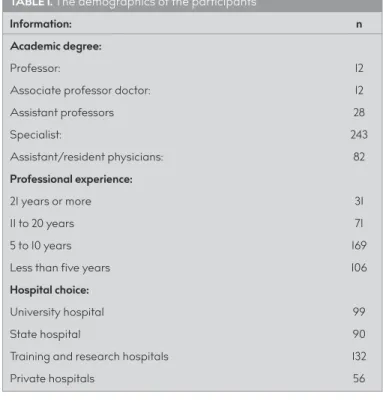
The survey was completed by 377 people. Of the participants, 3.2% were professors, 3.2% were associate professor doctors, 7.4% were assistant professors, 64.5% were specialist doctors, and 21.8% were assistant/resident physicians. On the question about professional experience, 8.2% stated ≥21 years, 18.8% stat-ed 11-20 years, 44% statstat-ed 5–10 years, and 28% statstat-ed <5 years of professional working experience. Of these, 26.3% currently worked at university hospitals, 23.9% worked at state hospi-tals, 35% worked at training and research hospihospi-tals, and 14.9% worked at private hospitals (Table 1).
Main Points:
• This study exhibits the first survey outcomes regarding regional anesthesia education and statistics on the fre-quency with the administration of basic extremity blocks in Turkey.
• According to the results of this survey almost one-third of all participants who had some information on a block nevertheless stated that they lacked the requisite skill level to conduct it in a clinical environment.
• There is no clear framework for delivery training of re-gional anesthesia in Turkey.
• Internet-based information sources regarding regional blocks have gained popularity among Turkish anesthe-siologists.
In the segment concerning skill and information level self-eval-uation for the upper extremity blocks, the most commonly performed block was the infraclavicular block accompanied by ultrasound (26.8%). The least performed block was the su-praclavicular block with nerve stimulator (9%). Of the lower extremity blocks, the most common one was
ultrasound-guid-ed femoral block, while the least performultrasound-guid-ed was the obturator block (Figure 1).
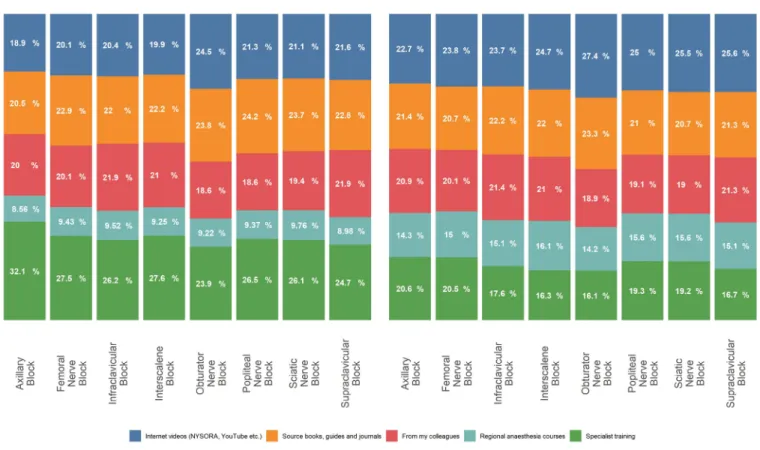
With regard to the training period, 40% of the participants opted for “from my colleagues” as their “information source” for the upper extremity blocks; this rate reduced to 30% for the low-er extremity blocks. For specialist training, the most commonly given information source was the execution of axillary blocks with a nerve stimulator (58.6%). The least popular choice for specialist training information source was ultrasound-guided interscalene block (30%) and obturator block (24%). Information obtained through the designated courses was most common-ly associated with ultrasound-guided interscalene blocks and most rarely with nerve stimulator obturator blocks. In terms of the digital visual information sources (such as Nysora and You-Tube), these were often consulted for ultrasound-guided inter-scalene blocks and least consulted as an information source for nerve stimulator axillary blocks and femoral blocks (Figure 2). For all blocks, the source books and guides were stated as infor-mation sources at a rate of 33-40%.
DISCUSSION
Based on the results of the present study, the most prevalent peripheral blocks administered in Turkey were ultrasound-guid-ed upper extremity blocks. Furthermore, this study revealultrasound-guid-ed an increase in the use of internet-based digital sources as the in-formation source for this type of block. Other than a study by Gürkan et al., no information has been obtained on the use of peripheral blocks previously in Turkey. Moreover, there are no
FIGURE 1. Self-evaluation for level of skill / information and application frequency for upper and lower extremity blocks
PNS: Peripheric nerve stimulator USG: Ultrasound-guided
TABLE 1. The demographics of the participants
Information: n Academic degree:
Professor: 12
Associate professor doctor: 12
Assistant professors 28 Specialist: 243 Assistant/resident physicians: 82 Professional experience: 21 years or more 31 11 to 20 years 71 5 to 10 years 169
Less than five years 106
Hospital choice:
University hospital 99
State hospital 90
Training and research hospitals 132
data available on the information sources used in regional an-esthesia training, which makes the present study one of its first kind in Turkey.
The study conducted by Gürkan et al. (6) identified that periph-eral blocks accounted for only 12% of all regional anesthesia procedures. In the present study, while 30% of all anesthetists performed USG upper extremity blocks, this rate dropped to ap-proximately 25% for the lower extremity blocks. Thus, there was a preference in all types of blocks for the ultrasound-guided form over the nerve stimulator form of the procedure. In Turkey, more specifically, the fact that ultrasound has become the norm for blocks leads one to believe that they may not be carried out without ultrasound. This tendency toward applying ultrasound is particularly pronounced for interscalene and infraclavicular blocks, a result that ties in with the global data on these prefer-ences (7). The popularity of the upper extremity blocks has been correlated with the enhanced effectiveness and safety that is associated with the use of ultrasound (8). Among anesthesia training centers, it was found that the success rate of ultra-sound-guided blocks was higher than that of nerve stimulator, and this success rate has been reported to be almost as high as 97% (9). In short, it can be fairly stated that the rising popularity of conducting peripheral blocks with ultrasound is closely relat-ed to the increasrelat-ed efficacy and safety accompanirelat-ed with the use of ultrasound use.
With an average of 25% of all participants stating the lack of information on the upper extremity blocks, this rate increased to 38% for the lower extremity blocks and even approached 50%
for obturator nerve blocks. According to the regional anesthesia “fellowship” training and acute pain treatment guides, candi-dates should learn 24 types of block to gain expertise; however, this number is not sufficient for real expertise (10). Not only does expert training in Turkey insufficient to meet the minimum rec-ommended requirement for the number of types of block taught, there is no clear framework for delivery this type of training. For example, a past study noted that expert training required 45 at-tempts at epidural anesthetic and 60 at spinal anesthetic, with a success rate of 90% (11). Moreover, individual differences could also stretch the standards one way or the other. For instance, another study found that, while some candidates could reach the required proficiency with a 90% success rate over 57 intuba-tion attempts, other candidates reported failing to achieve even 80% success rate after 100 attempts (2). Thus, all candidates should be subjected to personal evaluation and be provided requisite exposure to both conceptual and practical information during the regional anesthetic training program. Medical proce-dures should be taught via simulations recorded with advanced video-recording devices, and giving feedback on the recorded attempts of students has been shown to increase the success of the training outcome (12). Developing procedure-specific met-rics and using proficiency-based progression training may also bring improvement in the patient outcomes for complex medical interventions (13).
Due to the practice of various curricula within the field of an-esthesia and the varying programs for different types of spe-cialism, physicians emerge from specialist training with different knowledge sets with regards to the use of techniques of
region-FIGURE 2. Information sources for learning regional regional block techniques
al anesthetics. When questioned on the survey in regard to the information sources for block procedures, anesthetists stated that they received information from other colleagues. Reaching a rate of 40% for certain blocks, this rate of receiving help and in-formation from colleagues continued after professional training had been completed. It can be inferred from these results that this type of information source is particularly valuable for anes-thetists who come from an unusual educational background or for whom an information gap could be quickly bridged with the help of input from colleagues.
Alongside clinical knowledge, ambidexterity, hand-eye coor-dination, the ability to interpret sonographic visualizations, and the ability to think in three dimensions are all necessary for regional anesthesia procedures. For this purpose, before operating on actual patients, regional anesthesia training uti-lizes multimedia technologies, simulation systems, and cadav-er studies for practical training purpose (14). Once proficiency had been obtained through training, the measurement of an anesthetist’s capability could also present a problem. Unfor-tunately, despite the invasive nature of anesthesia, the mea-surement and evaluation of medical candidates’ technical suitability for the successful performance of these procedures continues to lag (15). No data is available on the contents or evaluation criteria for the regional anesthesia components of advanced anesthesia training in Turkey. According to the pres-ent survey, advanced training was considered as the informa-tion source at a level of approximately 50% for some blocks, while this rate was lower for more general courses. However, the same survey revealed that, about one-third of all partici-pants who had some information on a block nevertheless stat-ed that they lackstat-ed the requisite skill level to perform it. This outcome indicates that the regional anesthetic training offered within advanced training courses is insufficient for clinical pro-ficiency. When teaching procedures that require motor skills within an adult education environment, the behavioral steps of the learning process should be monitored. In this way, didactic instruction can be considered through observation and motor planning performed by the posterior parietal cortex at an early “informational” level of the candidate’s training. At the second “associative” level, memory is laid down in relation to the pro-cedure being learned, and, at the third “autonomous” level, the student is finally able to conduct the required set of motor skills in an accurate and automatic manner (9). According to educa-tional experts, despite the fact that several doctors are aware of what needs to be taught, very few know how it should be taught (16).For this reason, even if the training does provide ad-vanced candidates encouragement in performing block proce-dures, the lack of suitable training staff, the absence of appro-priate supervision, and the fact that some instructors are not sufficiently in command of their own proficiency level suggests that individuals undergoing regional anesthesia training may not reach the level of autonomous proficiency.
Internet technologies, interactive training applications, online courses, and digital visual sources have taken anesthesia train-ing to a new level. More than one-third of all participants in the survey stated that they had benefited from these types of sources for all types of blocks, and, for certain blocks, nearly half of the respondents used such technologies as information and training sources. The ability to rely upon these digital sources
and the question about who is preparing the content is import-ant from the point of view of patient safety (17). For example, the majority of publicly available videos on YouTube concerning re-gional anesthetics have been found to be inadequate from the perspective of content and safety. The videos produced by insti-tutes and universities, on the other hand, tend to be more trust-worthy (5). In this case, it seems sensible to consult video guides published by designated foundations and associations both during an advanced training program and beyond it. Similarly, professionally produced training videos in the Turkish language is expected to fill the gap that currently exists for advanced an-esthesia training courses and beyond in Turkey. On this point, the content of videos produced by associations and university foun-dations that take on this role is improving (18).
The present study is based on a survey conducted on a volun-tary basis. As the participant selection was not a randomized process, the results obtained may not be applicable to the more general situation of Turkish regional anesthesia procedures across the board. Doctors working in the same clinic or hospi-tal can sometimes display a common approach that may be an obstacle for the homogeneity of the study in its entirety. Thus, as there have been no other studies in this area in the literature, the present study outcomes may still constitute a valuable contribu-tion to the research in this field.
In conclusion, the results of this study indicate that various infor-mation sources, including internet-based visual data, have been identified as the source of information as much as the specialty training. In some of the blocks, their importance overweighs the traditional specialty training. This finding proves that the trend in the education of the regional anesthesia has been gradually changing in Turkey as in the rest of the world. According to the outcome of this study, a significant majority of the participants avoided block applications. In order to overcome such problems and having a national roadmap to improve the regional anes-thesia education in Turkey, it would be useful to collect the data on a more comprehensive national scale.
Ethics Committee Approval: N/A Informed Consent: N/A
Peer-review: Externally peer-reviewed.
Author contributions: Concept - O.S., S.T.; Design - O.S., S.T., D.İ.T.;
Super-vision - Z.Ö.; Resource - Ö.Ş., H.C.K.; Materials - Z.T., Ö.Ş.; Data Collec-tion and/or Processing - D.İ.T., S.T.; Analysis and/or InterpretaCollec-tion - S.T.; Literature Search - O.S.; Writing - O.S.; Critical Reviews - Z.Ö.
Conflict of Interest: Authors have no conflicts of interest to declare. Financial Disclosure: The authors declared that this study has received
no financial support.
REFERENCES
1. Tulgar S, Ahiskalioglu A, Thomas DT, Gurkan Y. Should erector spi-nae plane block applications be standardized or should we revise nomenclature? Reg Anesth Pain Med 202; 45(4): 318-9. [Crossref]
2. Sainsbury JE, Telgarsky B, Parotto M, Niazi A, Wong DT, Cooper RM. The effect of verbal and video feedback on learning direct laryn-goscopy among novice laryngoscopists: a randomized pilot study. Can J Anaesth 2017; 64: 252-9. [Crossref]
3. Mathis S, Schlafer O, Abram J, Kreutziger J, Paal P, Wenzel V. Anes-thesia for medical students: A brief guide to practical anesAnes-thesia in adults with a web-based video illustration. Anaesthesist 2016; 65: 929-9.
4. DelSignore LA, Wolbrink TA, Zurakowski D, Burns JP. Test-Enhanced E-Learning Strategies in Postgraduate Medical Education: A Ran-domized Cohort Study. J Med Internet Res 2016; 18(11): e299. [Crossref]
5. Selvi O, Tulgar S, Senturk O, Topcu DI, Ozer Z. YouTube as an infor-mationalsource for brachial plexus blocks: evaluation of content and educational value.Rev Bras Anestesiol. 2019; 69: 168-76. [Crossref]
6. Gurkan Y, Kus A, Aksu C, Ohtaroğlu C, Solak M, Toker K. Değişken akımlar ve Türkiye’de rejyonal anestezi uygulamaları. AĞRI 2014; 26(3): 131-7. [Crossref]
7. Barrington MJ, Uda Y. Did ultrasound fulfill the promise of safety in regional anesthesia? Curr Opin Anaesthesiol 2018; 31(5): 649-5.
[Crossref]
8. Nadeau MJ, Lévesque S, Dion N. Ultrasound-guided regional anesthe-sia for upper limb surgery. Can J Anaesth 2013; 60(3): 304-20. [Crossref]
9. Slater RJ, Castanelli DJ, Barrington MJ. Learning and teaching mo-tor skills in regional anesthesia: a different perspective. Reg Anesth Pain Med 2014; 39(3): 230-9. [Crossref]
10. Regional Anesthesiology and Acute Pain Medicine Fellowship Di-rectors Group. Guidelines for fellowship training in regional anes-thesiology and acute pain medicine: third edition, 2014. Reg Anesth Pain Med 2015; 40: 213-7.
11. Kopacz DJ, Neal JM, Pollock JE. The regionalanesthesia “learning curve”. What is the minimum number of epidural and spinal blocks to reach consistency? Reg Anesth 1996; 21(3): 182-90.
12. Shorten G, Dempsey E, Kallidaikurichi Srinivasan K. Wearable Re-cording Devices for Surgical Training. JAMA Surg 2017; 152(5): 507-8.
[Crossref]
13. Srinivasan KK, Gallagher A, O’Brien N, Sudir V, Barrett N, O’Con-nor R, et al. Proficiency-based progression training: an ‘end to end’ model for decreasing error applied to achievement of effective epidural analgesia during labour: a randomised control study. BMJ Open 2018; 8(10): e020099. [Crossref]
14. Chen XX, Trivedi V, AlSaflan AA, Todd SC, Tricco AC, McCartney CJL, et al. Ultrasound-Guided Regional Anesthesia Simulation Training: A Systematic Review. Reg Anesth Pain Med 2017; 42(6): 741-50.
15. Smith HM, Kopp SL, Johnson RL, Long TR, Cerhan JH, Hebl JR. Looking into learning: visuospatial and psychomotor predictors of ultrasound-guided procedural performance. Reg Anesth Pain Med 2012; 37(4): 441-7. [Crossref]
16. Smith HM, Kopp SL, Jacob AK, Torsher LC, Hebl JR. Designing and implementing a comprehensive learner-centered region-alanesthesia curriculum. Reg Anesth Pain Med 2009; 34(2): 88-94.
[Crossref]
17. De Cassai A, Correale C, Sandei L, Ban I, Selvi O, Tulgar S. Quality of Erector Spinae Plane Block Educational Videos on a Popular Vid-eo-sharing Platform. Cureus 2019; 11(3): e4204. [Crossref]
18. Tulgar S, Selvi O, Serifsoy TE, Senturk O, Ozer Z. YouTube as an information source of spinal anesthesia, epidural anesthesia and combined spinal and epidural anesthesia. Rev Bras Anestesiol 2017; 67(5): 493-9. [Crossref]