MULTIPLE SHOOT REGENERATION OF Ceratophyllum
demersum L. ON AGAR SOLIDIFIED AND LIQUID MEDIUMS
Mehmet Karatas, Muhammad Aasim* and Muhammet Dogan
Department of Biology, Kamil Ozdag Faculty of Science, Karamanoglu Mehmetbey University, Yunus Emre Campus, 70200 Karaman, Turkey
ABSTRACT
Coontail or hornwort (Ceratophyllum demersum L.) is a submergent aquatic macrophyte from Ceratophyllaceae family that has been widely used to remove heavy metals (photoremediation) and for pollution monitoring (biomonitor) in the aquatic environment. Besides that, it is used as aquatic plant and as a source of food for some livestock and poultry. Shoot tips, 1st and 2nd nodal explants of C. demersum were cultured on agar solidified or liquid MS medium supplemented with 0.05-0.80 mg/L BA. Multiple shoot regeneration without callus induction was recorded on both agar solidified and liquid culture media. However, earlier shoot induction and more mean number of shoots per explant with longer shoots were recorded on liquid culture medium compared to solidified medium. Maximum shoot regeneration frequency from all explants on both culture mediums was obtained at 0.05 mg/L BA. Comparing explant types, 2nd nodal meristem explants gave
more number of shoots per explants (16.75 and 204.33 from solid and liquid culture medium), respectively. In vitro regenerated plantlets were successfully acclimatized in aquariums, and plants can be easily acclimatized at slight acidic to slight alkaline pH levels.
KEYWORDS:
Agar solidified, aquatic, liquid, shoot regeneration
1. INTRODUCTION
Aquatic plants are the natural elements of water envi-ronment that produce oxygen and organic matters, and they supply protection, feeding and breeding environment for other aquatic organisms [1]. Some aquatic plants are used for the purpose of phytoremediation because they remove nutrients and heavy metals from water environment [2-4]. Additionally, they are used for monitoring pollution (biomonitor) in the aquatic environment [5, 6].
Coontail or hornwort (Ceratophyllum demersum L.) is a submergent aquatic macrophyte belonging to Cerato-phyllaceae family [7, 8]. The plant has been widely used * Corresponding author
to remove heavy metals (photoremediation) [9-12], and for pollution monitoring (biomonitor) [13, 14] in the aquatic environment. C. demersum is also one of the popular plants in aquatic industry [15, 16] due to tolerating a wide range of aquatic conditions [17]. It also provides an excellent living environment for shelter to fish and aquatic organisms [7, 18]. It is also used as a source of food for some live-stock, poultry [19], and fish [20].
C. demersum is a traditional medicine plant that has been used in the treatment of ulcer, diarrhoea, dysentery, wounds, fever, burning sensation, haemorrhoids or piles, intrinsic haemorrhages, hyperdipsia, epistaxis and haemate-mesis. Additionally, glycosides, flavonoids, alkaloids, ster-oids and tannins have been isolated from the methanolic and aqueous extracts of C. demersum [21]. Furthermore, other important chemical compounds, such as tricin-7-O-D-glucoside, naringenin-7-O-D-tricin-7-O-D-glucoside, esculetin, β-sitosterol, 7α-hydroxyl-β-β-sitosterol, 7α-methoxyl-β-sitosterol and palmitic acid have also been isolated from C. demer-sum [22].
There is no report available on in vitro propagation of C. demersum, an important medicinal aquatic plant that can also be used for photoremediation and biomonitoring of water pollution.
2. MATERIALS AND METHODS
The plants of C. demersum were obtained from a lo-cal aquarium of Karaman province in Turkey. After taxo-nomic studies, 3-5 cm long twigs containing 5-6 nodes with attached leaves were washed under tap water for 15 min. Surface sterilization was performed with 10 % H2O2
for 7 min, followed by rinsing thrice with sterilized dis-tilled water, under continuous stirring for 5 min each. After sterilization, leaves were detached from twigs and shoot meristem, 1st and 2nd nodal meristem explants were
isolated under sterile conditions and cultured on MS [23] medium devoid of growth variants for 2 weeks to obtain contamination-free explants. Thereafter, explants were cultured on MS medium supplemented with 3% sucrose and 0.05, 0.10, 0.20, 0.40 and 0.80 mg/L BA (Table 1) in Magenta GA7 vessels solidified with 0.65% agar or with-out agar (liquid culture).
The experiment was run in triplicate with the pH of all media adjusted to 5.8±1 before autoclaving (118 kPa atmospheric pressure, 120 °C for 21 min). All cultures were incubated under 16-h light photoperiod (1500 lux) using white LEDs (Light Emitting Diodes) lights. The data for both experiments (agar solidified and liquid cul-ture) were recorded for 8 weeks of culturing.
The regenerated shoots were acclimatized in jars con-taining water at variable pHs of 4.0-10.0 [24], and then left open for acclimatization in a growth room at 23 °C with 16-h light photoperiod for 30 days. Thereafter, plants were transferred to aquariums for further acclimatization.
Each treatment contained 8 explants and was repli-cated 6 times (8 x 6 = 48 explants), and repeated twice. Statistical analysis was performed as one-way ANOVA using SPSS17 for Windows, and post hoc tests were per-formed using Duncan`s test. Data given in percentages were subjected to arcsine transformation [25] before sta-tistical analysis.
3. RESULTS
Shoot meristem, 1st and 2nd nodal meristem explants
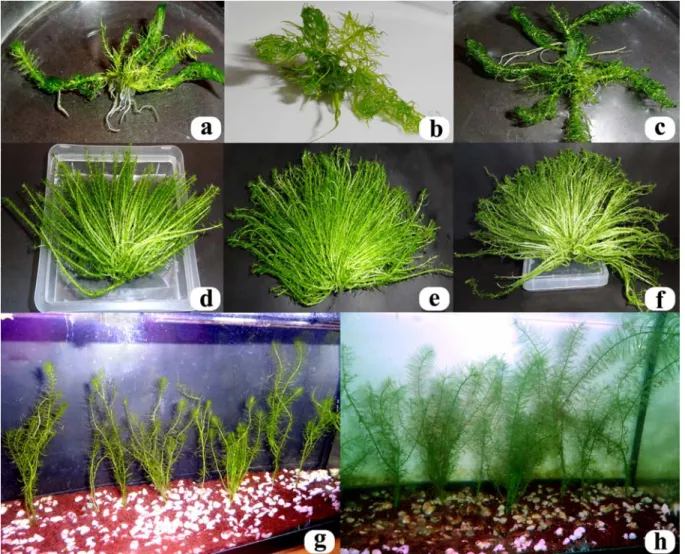
were cultured on agar solidified and liquid culture mediums containing different concentrations of N 6-benzyladenine (BA; 0.05-0.80 mg/L). All explants were also cultured on MS medium without BA as control experiment. No callus formation was recorded on all explants in both solidified and liquid culture medium (Figs. 1 a, b, and c). Shoot regeneration in agar solidified medium was observed after 2 weeks of culture, followed by multiple shoot regenera-tion after 4 weeks of culture. On the other hand, shoot induction from liquid started within one week and after two weeks of culture, multiple shoot regeneration was recorded. Comparing explants, shoot induction from shoot meristem explant was earlier compared to other nodal meristems, irrespective of culture medium. Data regarding frequency of shoot regeneration (%), mean number of shoots per explants and mean shoot length of both experiments were recorded after 8 weeks of culturing (Figs. 1 d, e, and f).
FIGURE 1 - In vitro shoot regeneration and acclimatization of C. demersum: (a) shoot tip, (b) 1st, (c) 2nd nodal segment, after 4 weeks of culturing, and (d) shoot tip, (e) 1st, (f) 2nd nodal segment after 8 weeks of culturing, acclimatized plant in aquariums after (g) 4 weeks and (h) 8 weeks.
Shoot regeneration frequency on agar-solidified me-dium was found statistically insignificant, and was re-corded to be 91.67-100.00 % from shoot meristem ex-plants and 75.00-100.00 % from both 1st and 2nd nodal
meristem explants. 100 % shoot regeneration frequency from all explants was observed on MS medium supple-mented with 0.05 mg/L BA whereas, on MS medium devoid of growth variants, it was recorded to be 91.67 % for shoot tips and 1st nodal segments but 75.00 % for 2nd
nodal segments (Table 1). On the other hand, statistically significant effects of BA concentrations were observed on shoot regeneration frequency of liquid culture medium. Shoot regeneration frequency of shoot meristem, 1st and
2nd nodal meristem explants ranged between 65-100%,
60-90% and 25-90%, respectively on MS liquid medium. Maximum shoot regeneration frequency for all explants was recorded on MS medium containing 0.05 mg/L BA. In general, further increase in BA concentration resulted in decreased shoot regeneration frequency for all explants. However, the decline in shoot regeneration was more prominent on 2nd nodal meristem explants compared to
other explants used in the experiment. Comparing shoot regeneration frequency of explants, shoot meristem had more shoot regeneration compared to other explants on all culture mediums. Shoot regeneration frequency on MS medium was recorded to be 83.33-91.67 % and 55.00-100.00 % on agar-solidified culture medium and liquid culture medium, respectively (Table 1).
Mean numbers of shoots per explant from both cul-ture media were found to be statistically significant. Rela-tively more numbers of shoots per explants were recorded on liquid culture medium compared to agar-solidified medium. Mean number of shoots per explant obtained
from agar-solidified medium ranged between 2.66-11.41, 4.92-11.95 and 5.75-16.75 from shoot meristem, 1st and
2nd nodal meristem explants, respectively, and 1.36-1.75
per explant on MS-solidified medium. Maximum num-bers of shoots per explant were scored on 0.80 mg/L BA whereas minimum numbers of shoots per explant were recorded on 0.05 mg/L BA-containing medium (Table 2). Shoots per explants increased with increase in BA con-centrations, irrespective of explant type. Comparing ex-plant type, 2nd nodal meristem explants generated more
numbers of shoots per explants compared to shoot meris-tem and 1st nodal meristem, irrespective of BA
concentra-tion. Liquid culture medium also showed the similar re-sponse to mean numbers of shoots per explants. However, average number of shoots per explant was relatively too high compared to agar-solidified medium. Mean numbers of shoots per explant were recorded to be 40.87-169.07, 47.55-109.43 and 52.88-204.33 from shoot meristem, 1st
and 2nd nodal meristem explants, respectively (Table 2).
1.50-2.20 shoots per explant were recorded from MS liquid medium. Likewise agar-solidified medium, mean number of shoots per explant also decreased with increase in BA concentration. Similarly, irrespective of BA con-centration in the culture medium, 2nd nodal meristem
explants gave more numbers of shoots per explants com-pared to shoot meristem and 1st nodal meristem.
Data on mean shoot length showed that relatively longer shoots were obtained from MS liquid medium compared to MS media containing BA concentrations on solidified culture medium. Mean shoot length of shoot meristem, 1st and 2nd nodal meristem explants were
re-corded as 0.43-1.94 cm, 0.38-1.97 cm and 0.42-2.44 cm, respectively (Table 3). Increase of BA concentration re-
TABLE 1 - Shoot regeneration frequency of C. demersum from agar solidified medium and liquid medium containing BA.
Agar solidified culture medium Liquid culture medium
BA (mg/L)
Shoot tip 1st nodal meristem 2nd nodal meristem Shoot tip 1st nodal meristem 2nd nodal meristem
0.05 100.00ns 100.00 ns 100.00 ns 100.00a 90.00a 90.00a
0.10 100.00 100.00 91.67 90.00a 75.00abc 75.00ab
0.20 100.00 100.00 100.00 65.00b 80.00ab 65.00abc
0.40 91.67 100.00 100.00 90.00a 60.00c 40.00bc
0.80 91.67 75.00 75.00 80.00ab 70.00bc 25.00c
MSO 91.67 91.67 83.33 100.00a 75.00abc 55.00abc
Means followed by different small letters within columns are significantly different using Duncan p<0.01.
TABLE 2 - Mean number of shoots per explant of C. demersum from agar solidified medium and liquid medium containing BA.
Agar solidified culture medium Liquid culture medium
BA (mg/L) Shoot tip 1st nodal meristem 2nd nodal meristem Shoot tip 1st nodal meristem 2nd nodal meristem
0.05 2.66bc 4.92bc 5.75cd 40.87d 47.55b 52.88e 0.10 5.00abc 6.08b 6.61c 89.16c 95.13a 85.25d 0.20 8.50ab 11.17a 11.47b 143.97b 102.67a 146.50c 0.40 9.44a 11.50a 12.25ab 157.43ab 106.47a 204.33a 0.80 11.41a 11.95a 16.75a 169.07a 109.43a 170.11b MSO 1.36c 1.58c 1.75e 1.50e 2.17c 2.20f
TABLE 3 - Mean shoot length of C. demersum from agar solidified medium and liquid medium containing BA.
Agar solidified culture medium Liquid culture medium
BA (mg/L) Shoot tip 1st nodal meristem 2nd nodal meristem Shoot tip 1st nodal meristem 2nd nodal meristem
0.05 1.94b 1.97b 2.44ab 2.91c 2.89d 2.96cd 0.10 1.38b 1.78b 2.28bc 3.56c 5.02ab 4.02bc 0.20 1.35b 0.90bc 1.75c 5.72a 5.65a 6.38a 0.40 0.44c 0.62c 0.52d 3.97bc 3.98c 4.52b 0.80 0.43c 0.38c 0.42d 3.08c 2.18d 1.77d MSO 3.34a 4.00a 2.97a 5.26ab 4.33bc 3.15bcd
Means followed by different small letters within columns are significantly different using Duncan p<0.01.
sulted in decreased shoot length, and BA concentrations >0.40 mg/L resulted in stunted shoots. Maximum shoot length was recorded on MS medium supplemented with 0.05 mg/L BA. Contrarily, liquid culture exerted different response to mean shoot length of all explants compared to solidified medium. Relatively longer shoots were recorded from all explants, irrespective of BA concentrations. Maximum shoot lengths from all explants were scored on MS medium supplemented with 0.20 mg/L BA, followed by decreased shoot length. However, these shoots were enough longer with minimum shoot length (1.77 cm) was obtained from 2nd nodal meristem explant. Mean shoot
lengths ranged between 2.91-5.72 cm, 2.18-5.65 cm and 1.77-6.38 cm, recorded from shoot meristem, 1st and 2nd
nodal meristem explants, respectively (Table 3).
C. demersum is a non-rooted plant in natural condi-tions. However, rhizoid formation was also recorded on regenerated shoots both in agar-solidified and liquid me-diums at variable frequency, irrespective of explant type (data not shown). Rhizoid formation was prominent on shoots obtained from MS medium without BA in both solidified and liquid culture media. Rhizoid induction on liquid culture medium was recorded only on MS medium supplemented with 0-0.40 mg/L BA. Contrarily, 1st and
2nd nodal meristem explants induced rhizoids at variable
frequency on all culture media (data not shown). For ac-climatization, in vitro regenerated shoots with and without rhizoids were transferred to jars containing water with pH values of 4.0-10.0, in order to find out the best pH for plant growth and development in aquariums. Results showed that plants did not gain length at pH 4.0, followed by pH 5.0. On the other hand, pH 10.0 also resulted in less shoot growth whereas pH 7.0 was found optimum for shoot growth, followed by pH values of 8.0 and 9.0. Thereafter, shoots with or without rhizoids were successfully trans-ferred to aquariums (Fig. 1 g), and 100 % survival rate was recorded after 8 weeks (Fig. 1 h).
4. DISCUSSION
The study presents the efficient multiple shoot regen-ration of the important medicinal plant C. demersum cul-tured on 0.05-0.80 mg/L BA containing media. Multiple shoot regeneration from shoot meristem and nodal meris-tems has been reported in other aquatic plants like Mentha
viridis [26], Stevia rebaudiana [27], Vitex negundo [28], and Marsdenia brunoniana [29]. Experiments were per-formed in two different media, agar-solidified and liquid culture medium. Results showed the clear effects of culture media on shoot regeneration behavior as early regeneration was recorded on liquid culture medium compared to solidi-fied medium. This might be due to the active uptake of plant hormones by C. demersum which like to live in aquatic conditions. Contrarily, Şumlu [30] reported death of shoot meristem, 1st and 2nd nodal meristem explants, 1st and
2nd internodal segments of Rotala macrandra on MS liquid
medium containing 0.25 mg/L BAP -0.50 mg/L NAA and 0.50 mg/L BAP – 0.50 mg/L NAA, after 4 weeks of cul-turing.
Results further showed that BA concentrations failed to induce callus induction and led to organogenesis in both culture mediums. Contrarily, callus induction was reported at basal ends of nodal segments cultured on dif-ferent concentrations of BA, kinetin and 2-iP [31], inter-nodal and leaf explants of B. monnieri cultured on various concentrations of BA-NAA [24]. The difference in the results might be due to the presence of NAA in the culture medium, and difference of plant and explant type used in the experiments. Results on shoot regeneration frequency showed that agar-solidified medium was more responsive to BA concentration than liquid culture medium, irrespec-tive of explant type in line with the findings of Shahzad et al. [32] in Veronica anagallis-aquatica, who also reported more shoot regeneration frequency from agar-solidified media with regard to liquid ones. Contrarily, liquid culture was reported to be more better than agar-solidified medium for shoot regeneration frequency of Nothapodytes mimmo-nia [31], Alocasia amazonica [33] and Bacopa monnieri [34].
Results also showed that shoot meristem explant was more responsive than other explants, possibly due to age and presence of more numbers of young and active divid-ing cells in the meristem, in line with [35]. Maximum shoot regeneration at low concentration of BA for all explants showed the efficiency of explants to BA concentrations. However, increased BA concentration had reducing ef-fects on shoot regeneration frequency of all explants ac-cording to findings of Hassan and Roy [36], who also reported decreased shoot regeneration frequency from shoot apex and nodal segments of Gloriosa superba L. cultured at 2.0 and 2.5 mg/L BA. Similarly, Dandin and
Murthy [31] achieved maximum shoot regeneration (83 %) on 1-µM BA-containing medium whereas Gnanaraj et al. [37] reported increased shoot regeneration frequency with increased BA concentration in Alternanthera sessili.
Results further showed that the negative effect was spe-cific to explant type, and 2nd nodal explants were affected
more compared to other explants. Shoot meristem explants were more efficient than all other explants on all culture media. Öztürk [38] cultured shoot meristem, 1st nodal
seg-ment, leaf and petiol explants of Hygrophila difformis on TDZ-NAA-supplemented medium and obtained a maxi-mum number of 52.63 shoots per explant, and more long-er shoots (5.63 cm) from 1st nodal segments.
Results on mean number of shoots showed that liquid culture medium was far better (10 to 20-fold more shoots) than agar-solidified medium. Dandin and Murthy [31] cultured nodal explants of N. nimmoniana on liquid MS and semi-solid MS medium supplemented with 1, 2, 5 and 10 µM BAP, Kin and 2-iP, and got a maximum of 165.9 shoots per explant from liquid MS medium containing 2 µM BAP. Results further illustrated that mean number of shoots per explant increased with increase in BA concen-trations, in line with Jo et al. [33] in Alocasia amazonica. Contrarily, Sharma et al. [39] reported negative effects of increased BA concentration on shoots per explant of B. monnieri. Gnanaraj et al. [37] reported a maximum num-ber of shoots from shoot meristem explants of A. sessilis on MS medium containing 0.20 mg/L BA. Karatas et al. [24] also obtained maximum number of shoots at 0.25 mg/L BA-0.25 mg/l NAA from internodal segments and leaf explant of B. monnieri. Results further illustrated that all explants required relatively higher concentrations of BA for more shoot regeneration, irrespective of explant and culture medium type, according to results of Jo et a., [33]. Results on mean shoot length also showed that agar-solidified medium hindered the shoot length compared to liquid medium, irrespective of explant type and BA con-centrations. Increase of BA also caused the regeneration of stunted shoots which was more obvious at BA concen-trations >0.40 mg/L on agar-solidified medium, contra-dictory to Vijaykumar et al. [40], who reported an in-crease in shoot length with an inin-crease in BA and TDZ concentration in the culture medium using the leaf explant of B. monnieri. On the other hand, longer shoots were recorded on liquid medium with an optimum of 0.20 mg/L BA-containing medium. Hung et al. [41] cultured shoot meristems of Wasabia japonica on liquid MS, ½ MS and ¼ MS containing 0.5 µM BAP, and observed maximum longer shoots of 34.7±0.8 cm from MS medium, followed by 27.0±0.8 cm from ½ MS medium.
Irrespective of non-rooted plants in natural aquatic conditions, rhizoid formations on regenerated shoots sup-posed to be due to the presence of micro and macro ele-ments, BA concentration, or explant type. Results further showed that rhizoid formation was specific to explant type and culture media. Acclimatization results showed that plants can be successfully acclimatized at natural to slightly
alkaline pH levels. Highly acidic or alkaline pH levels hindered the plant growth, as also observed by Karatas et al. [24], who reported limited shoot length of B. monnieri at pH 4.0 and 10.0. Successful acclimatization of both shoots with or without rhizoids in aquariums showed the ability of regenerated plants to be transferred directly to aquariums from lab conditions. Similarly, successful ac-climatization of in vitro regenerated aquatic plants had been reported for R. macrandra [30], Veronica anagallis-aquatica [32], A. sessilis [37], Nymphoides indica [42], Cryptocoryne wendtii and Cryptocoryne beckettii [43], B. monnieri [44] and Hygrophila polysperma[45]
Establishment of in vitro regeneration and acclimati-zation protocol of C. demersum provides an alternative way of propagation which can be applied to different biotechno-logical tools. This protocol also provides the availability of plants to be used for photoremediation and as bio-indicator, along with the extraction of medicinally important com-pounds from this important aquatic plant.
ACKNOWLEDGMENT
The authors acknowledge the financial assistance by the Karamanoğlu Mehmetbey University through the Scientific Research Project commission (BAP) for fund-ing project number 32-M-12.
The authors have declared no conflict of interest.
REFERENCES
[1] Cirik, Ş., Cirik, S. and Conk-Dalay, M. (2011). Su Bitkileri II (İçsu Bitkilerinin Biyolojisi, Ekolojisi, Yetiştirme Teknik-leri). Ege Üniversitesi, Su Ürünleri Fakültesi Yayınları, İz-mir, pp 58.
[2] Ravera, O. (2001). Monitoring of the aquatic environment by species accumulator of pollutants: A review, -In: Ravera, O. (Eds.), Scientific and legal aspects of biological monitoring in freshwater. Journal of Limnology, 60, 63-78.
[3] Rai, P.K. (2009). Heavy metal phytoremediation from aquatic ecosystems with special reference to macrophytes. Critical Re-views in Environmental Science and Technology 39, 697-753. [4] Singh, D., Tiwari, A. and Gupta, R. (2012). Phytoremediation
of lead from wastewater using aquatic plants. Journal of Ag-ricultural Science and Technology, 8, 1-11.
[5] Garg, P. and Chandra, P. (1993). The duckweed Wolffia glo-bosa as an indicator of heavy metal pollution: sensitivity to Cr and Cd. Environmental Monitoring and Assessment, 89-95. [6] Zurayk, R., Sukkariyah, B. and Baalbaki, R. (2001). Common
hydrophytes as bioindicators of nickel, chromium and cad-mium pollution. Water, Air, & Soil Pollution, 127, 373-388. [7] Arber, A. (2010). Water Plants, A Study of Aquatic
Angio-sperms. Cambridge University Press, New York, U.S., 84 pp. [8] Seçmen, Ö. and Leblebici, E. (1997). Türkiye Sulak Alan
Bitkileri ve Bitki Örtüsü. Ege Üniversitesi Fen Fakültesi Yayınları, İzmir, 159 pp.
[9] Saygıdeğer, S. and Doğan, M. (2004). Lead and cadmium ac-cumulation and toxicity in the presence of EDTA in Lemna minor L. and Ceratophyllum demersum L. Bulletin of Envi-ronmental Contamination and Toxicology, 73, 182-189. [10] Pourkhabbaz, A.R., Pourkhabbaz, H.R., Khazaei, T.,
Behravesh, S. and Ebrahimpour, M. (2011). Assessment of heavy metal accumulation in Anzali wetland, Iran, using a submerged aquatic plant, Ceratophyllum demersum. African Journal of Aquatic Science, 36, 261-265.
[11] Abdallah, M.A.M. (2012). Phytoremediation of heavy metals from aqueous solutions by two aquatic macrophytes, Cerato-phyllum demersum and Lemna gibba L. Environmental Technology, 33, 1609-1614.
[12] Fawzy, M.A., Sayed Badr, N., Khati, A. and El-Kassem, A.A. (2012). Heavy metal biomonitoring and phy-toremediation potentialities of aquatic macrophytes in River Nile. Environmental Monitoring and Assessment, 184(3), 1753-1771.
[13] Marchese, M., Gagneten, A.M., Parma, M.J. and Pavé, P.J. (2008). Accumulation and elimination of chromium by fresh-water species exposed to spiked sediments. Archives of Envi-ronmental Contamination and Toxicology, 55(4), 603–609. [14] Park, S., Kang, D., Kim, Y., Lee, A.M., Chung, Y. and Sung,
K. (2011). Biosorption and growth inhibition of wetland plants in water contaminated with a mixture of arsenic and heavy metals. Engineering in Life Sciences, 11, 84-93. [15] Hyldgaard, B. and Brix, H. (2012). Intraspecies differences in
phenotypic plasticity: Invasive versus non-invasive popula-tions of Ceratophyllum demersum. Aquatic Botany, 97, 49-56.
[16] Rahman, A.H.M.M., Rafiul Islam, A.K.M., Naderuzzaman, A.T.M., Hossain, M.D. and Afza, R. (2007). Studies on the aquatic angiosperms of the Rajshahi University campus. Re-search Journal of Agriculture and Biological Sciences, 3, 474-480.
[17] Anonymous, Ceratophyllum demersum, (2013). (http://www.floridaaquatic.com/aquarium_plant_ceratophyllu m_demersum.html)
[18] Bhat, S.U., Ahmad Dar, G., Sofi, A.H., Ahmad Dar, N. and Pandit, A.K. (2012). Macroinvertebrate community assossi-ciations on three different macrophytic species in manasbal lake. Research Journal of Environmental Sciences, 6, 62-76. [19] Anonymous, Supplementary and Complete Feeds (2013).
(http://www.fao.org/docrep/field/003/T8389E/T8389E03.htm). [20] Kitaya, Y., Okayama, T., Murakami, K. and Takeuchi, T. (2003). Effects of CO2 concentration and light intensity on
photosynthesis of a rootless submerged plant, Ceratophyllum demersum L., used for aquatic food production in bioregen-erative life support systems. Advances in Space Research, 31, 1743-1749.
[21] Taranhalli, A.D., Kadam, A.M., Karale, S.S. and Warke, Y.B. (2011). Evaluation of antidiarrhoeal and wound healing potentials of Ceratophyllum demersum Linn. whole plant in rats. Latin American Journal of Pharmacy, 30, 297-303. [22] Xiao-Li, L., Ying, Q., Xian-Min, Z., Bo-Lin, M. and
Ming-Hua, Q. (2007). Chemical constituents from Ceratophyllum demersum (Ceratophyllaceae). Acta Botanica Yunnanica, 29, 263-264.
[23] Murashige, T. and Skoog, F. (1962). A Revised medium for rapid growth and bioassays with tobacco tissue cultures. Physiologia Plantarum, 15, 473-497.
[24] Karatas, M., Aasım, M., Dogan, M. and Khawar, K.M. (2013). Adventitious shoot regeneration of the medicinal aquatic plant water hyssop (Bacopa monnieri L. Pennell) us-ing different internode. Archives of Biological Sciences, 65(1), 297-303.
[25] Snedecor, G.W. and Cochran, W.G. (1997). Statistical Meth-ods. The Iowa State University Press, Iowa, USA.
[26] Raja, H.D. and Arockiasamy, D.I. (2008). In vitro Propaga-tion of Mentha viridis L. from nodal and shoot tip explants. Plant Tissue Culture and Biotechnology, 18, 1-6.
[27] Janarthanam, B., Gopalakrishnan, M., Lakshmi Sai, G. and Sekar, T. (2009). Plant regeneration from leaf derived callus of Stevia rebaudiana Bertoni. Plant Tissue Culture and Bio-technology, 19, 133-141.
[28] Islam, S.A.M.N., Banik, H., Alam, S., Tarek, M. and Rah-man, M. (2009). In vitro propagation of Holarrhena anti-dysenterica Wall., Wedelia chinensis (Osb.) Merr. and Wood-fordia fruticosa (L.) Kurz. Plant Tissue Culture and Biotech-nology, 19, 253-255.
[29] Ugraiah, A., Karuppusamy, S. and Pullaiah, T. (2010). Mi-cropropagation of Marsdenia brunoniana Wight & Arn. A rare antidiabetic plant. Plant Tissue Culture and Biotechnol-ogy, 20, 7-12..
[30] Şumlu, Ş. (2009). In vitro Micropropagation and genetic transformation of aquarium plant Rotala macrandra. Ph. D. Thesis, University of Ankara, Graduate School of Natural and Applied Sciences, Ankara.
[31] Dandin, V.S. and Murthy, H.N. (2012). Enhanced, In Vitro multiplication of Nothapodytes nimmoniana Graham using semisolid and liquid cultures and estimation of camptothecin in the regenerated plants. Acta Physiologiae Plantarum, 34, 1381-1386.
[32] Shahzad, A., Parveen, S. and Fatema, M. (2011). Develop-ment of a regeneration system via nodal segDevelop-ment culture in Veronica anagallis-aquatica L.- An Amphibious medicinal plant. Journal of Plant Interactions, 6, 61-68.
[33] Jo, U.A., Murthy, H.N., Hahn, E.J. and Paek, K.Y. (2008). Micropropagation of Alocasia amazonica using semisolid and liquid cultures. In Vitro Cellular & Developmental Biol-ogy – Plant, 44, 26-32.
[34] Praveen, N., Naik, P.M., Manohar, S.H., Nayeem, A. and Murthy, H.N. (2009). In vitro regeneration of Brahmi shoots using semisolid and liquid cultures and quantitative analysis of bacoside a. Acta Physiologiae Plantarum, 31, 723-728. [35] Celiktas, N., Can, E., Hatipoglu, R. and Avci, S. (2006).
So-matic embryogenesis, callus production, and plantlet growth in sainfoin (Onobrychis viciifolia Scop.). New Zealand Jour-nal of Agricultural Research, 49, 383-388.
[36] Hassan, A.K.M.S. and Roy, S.K. (2005). Micropropagation of Gloriosa superba L. through high frequency shoot prolif-eration. Plant Tissue Culture & Biotechnology, 15, 67-74. [37] Gnanaraj, W.E., Marimuthu, J., Subramanian, K.M. and
Nal-lyan, S. (2011). Micropropagation of Alternanthera sessilis (L.) using shoot tip and nodal segments. Iranian Journal of Biotechnology, 9, 206-212.
[38] Öztürk, M. (2008). In vitro propagation of aquarium plants Hygrophila difformis and Microsorium pteropus. Ph. D. The-sis, University of Ankara, Biotechnology Institute, Ankara. [39] Sharma, N., Satsangi, R., Pandey, R. and Devi, S.V. (2007).
In vitro clonal propagation and medium term conservation of Brahmi [Bacopa monnieri (L) Wettst]. Journal of Plant Bio-chemistry and Biotechnology, 16, 139-143.
[40] Vijayakumar, M., Vijayakumar, R. and Stephen, R. (2010). In vitro propagation of Bacopa monnieri L. - a multipurpose medicinal plant. Indian Journal of Science and Technology, 3, 781-786.
[41] Hung, C.D., Johnson, K. and Torpy, F. (2006). Liquid culture for efficient micropropagation of Wasabia japonica (Miq.) Matsumura. In Vitro Cellular & Developmental Biology - Plant, 42, 548-552.
[42] Jenks, M.A., Kane, M.E., Dennis, B. and McConnell, D.B. (2000). Shoot organogenesis from petiole explants in the aquatic plant Nymphoides indica. Plant Cell, Tissue and Or-gan Culture, 63, 1-8.
[43] Stanly, C., Bhatt, A. and Keng, C.L. (2011). An efficient In Vitro plantlet regeneration of Cryptocoryne wendtii and Cryptocoryne becketti through shoot tip culture. Acta Physi-ologiae Plantarum, 33, 619-624.
[44] Banerjee, M. and Shrivastava, S. (2008). An improved proto-col for in vitro multiplication of Bacopa monnieri (L.). World Journal of Microbiology and Biotechnology, 24, 1355-1359. [45] Karataş, M., Aasim, M., Çınar, A. and Dogan, M. (2013).
Adventi,tous shoot regeneration from leaf explant of dwarf hygro (Hygrophila polysperma (Roxb.) T. Anderson). The Scientific World Journal,
DOI:http://dx.doi.org/10.1155/2013/680425 Received: June 05, 2013 Accepted: September 05, 2013 CORRESPONDING AUTHOR Muhammad Aasim Department of Biology
Kamil Ozdag Faculty of Science Karamanoglu Mehmetbey University Yunus Emre Campus
70200 Karaman TURKEY
Phone: +90 338 226 2151/3826 E-mail: [email protected]