Sleep disturbances in patients with
lung cancer in Turkey
doi • 10.5578/tt.67689
Tuberk Toraks 2018;66(4):297-303
Geliş Tarihi/Received: 12.10.2018 • Kabul Ediliş Tarihi/Accepted: 19.11.2018
KLİNİK Ç
ALIŞMA
RESEARCH
AR
TICLE
Yılmaz BüLBüL1 Tevfik ÖzLü1 Sibel ArINÇ2Berna AKINcI ÖzYüreK3 Hülya GüNBATAr4 Ayşegül ŞeNTürK3 Ayşe BAHAdIr5 Melike ÖzÇeLİK6 Ufuk YILMAz7 Makbule Ö. AKBAY2 Leyla SAğLAM8 Talat KILIÇ9 Gamze KIrKIL10 Neslihan ÖzÇeLİK1 dursun ALİzoroğLU7 Serap ArGUN BArIŞ11 durdu M. YAvŞAN12 Hadice S. ŞeN13 Serdar BerK14 Murat AcAT15 Gülfidan ÇAKMAK16 Perran F. YUMUK17 Yavuz Selim İNTePe18 ümran TorU19 Sibel ÖKTeM AYIK20 İlknur BAŞYİğİT11 Sibel ÖzKUrT21 Levent c. MUTLU22
1Department of Chest Diseases, Farabi Hospital, Faculty of Medicine,
Karadeniz Technical University, Trabzon, Turkey
1 Karadeniz Teknik Üniversitesi Tıp Fakültesi Farabi Hastanesi,
Göğüs Hastalıkları Anabilim Dalı, Trabzon, Türkiye
2 Clinic of Chest Diseases, Istanbul Sureyyapasa Chest Diseases and
Chest Surgery Training and Research Hospital, Istanbul, Turkey
2 İstanbul Süreyyapaşa Göğüs Hastalıkları ve Göğüs Cerrrahisi Eğitim ve
Araştırma Hastanesi, Göğüs Hastalıkları Kliniği, İstanbul, Türkiye
3Clinic of Chest Diseases, Ankara Ataturk Chest Diseases and Chest Surgery
Training and Research Hospital, Ankara, Turkey
3 Ankara Atatürk Göğüs Hastalıkları ve Göğüs Cerrahisi Eğitim ve Araştırma
Hastanesi, Göğüs Hastalıkları Kliniği, Ankara, Türkiye
4 Department of Chest Diseases, Faculty of Medicine, Yuzuncu Yil University,
Van, Turkey
4 Yüzüncü Yıl Üniversitesi Tıp Fakültesi, Göğüs Hastalıkları Anabilim Dalı,
Van, Türkiye
5Clinic of Chest Diseases, Istanbul Yedikule Chest Diseases and Chest Surgery
Training and Research Hospital, Istanbul, Turkey
5 İstanbul Yedikule Göğüs Hastalıkları ve Göğüs Cerrahisi Eğitim ve Araştırma
Hastanesi, Göğüs Hastalıkları Kliniği, İstanbul, Türkiye
6 Division of Medical Oncology, Istanbul Lutfi Kırdar Kartal Training and
Research Hospital, Istanbul, Turkey
6 İstanbul Dr. Lütfi Kırdar Kartal Eğitim ve Araştırma Hastanesi, Tıbbi Onkoloji
Bölümü, İstanbul, Türkiye
7Clinic of Chest Diseases, Izmir Dr. Suat Seren Chest Diseases and Chest
Surgery Training and Research Hospital, Izmir, Turkey
7 İzmir Dr. Suat Seren Göğüs Hastalıkları ve Cerrahisi Eğitim ve Araştırma
Hastanesi, Göğüs Hastalıkları Kliniği, İstanbul, Türkiye
8Department of Chest Diseases, Faculty of Medicine, Ataturk University,
Erzurum, Turkey
8 Atatürk Üniversitesi Tıp Fakültesi, Göğüs Hastalıkları Anabilim Dalı,
Erzurum, Türkiye
Dr. Yılmaz BÜLBÜL
Karadeniz Teknik Üniversitesi Tıp Fakültesi Farabi Hastanesi, Göğüs Hastalıkları Anabilim Dalı, TRABZON - TÜRKİYE e-mail: [email protected]
9 Department of Chest Diseases, Turgut Ozal Medical Center, Inonu University,
Malatya, Turkey
9 İnönü Üniversitesi Turgut Özal Tıp Merkezi, Göğüs Hastalıkları Anabilim Dalı,
Malatya, Türkiye
10Department of Chest Diseases, Faculty of Medicine, Fırat University,
Elazig, Turkey
10Fırat Üniversitesi Tıp Fakültesi, Göğüs Hastalıkları Anabilim Dalı,
Elazığ, Türkiye
11 Department of Chest Diseases, Faculty of Medicine, Kocaeli University,
Kocaeli, Turkey
11 Kocaeli Üniversitesi Tıp Fakültesi, Göğüs Hastalıkları Anabilim Dalı,
Kocaeli, Türkiye
12Department of Chest Diseases, Faculty of Medicine, Necmettin Erbakan
University, Konya, Turkey
12 Necmettin Erbakan Üniversitesi Tıp Fakültesi, Göğüs Hastalıkları Anabilim
Dalı, Konya, Türkiye
13 Department of Chest Diseases, Faculty of Medicine, Dicle University,
Diyarbakır, Turkey
13 Dicle Üniversitesi Tıp Fakültesi, Göğüs Hastalıkları Anabilim Dalı,
Diyarbakır, Türkiye
14Department of Chest Diseases, Faculty of Medicine, Cumhuriyet University,
Sivas, Turkey
14 Cumhuriyet Üniversitesi Tıp Fakültesi, Göğüs Hastalıkları Anabilim Dalı,
Sivas, Türkiye
15Department of Chest Diseases, Faculty of Medicine, Karabuk University,
Karabuk, Turkey
15 Karabük Üniversitesi Tıp Fakültesi, Göğüs Hastalıkları Anabilim Dalı,
Karabük, Türkiye
16 Clinic of Chest Diseases, Istanbul Haseki Training and Research Hospital,
Istanbul, Turkey
16 İstanbul Haseki Eğitim ve Araştırma Hastanesi, Göğüs Hastalıkları Kliniği,
İstanbul, Türkiye
17Division of Medical Oncology, Faculty of Medicine, Marmara University,
Istanbul, Turkey
17 Marmara Üniversitesi Tıp Fakültesi, Tıbbi Onkoloji Bölümü, İstanbul, Türkiye 18 Department of Chest Diseases, Faculty of Medicine Bozok University,
Yozgat, Turkey
18 Bozok Üniversitesi Tıp Fakültesi, Göğüs Hastalıkları Anabilim Dalı,
Yozgat, Türkiye
19Department of Chest Diseases, Faculty of Medicine, Dumlupinar University,
Kutahya, Turkey
19 Dumlupınar Üniversitesi Tıp Fakültesi, Göğüs Hastalıkları Anabilim Dalı,
Kütahya, Türkiye
20Department of Chest Diseases, Faculty of Medicine, Izmir Katip Celebi
University, Izmir, Turkey
20 İzmir Katip Çelebi Üniversitesi Tıp Fakültesi, Göğüs Hastalıkları Anabilim
Dalı, İzmir, Türkiye
21 Department of Chest Diseases, Faculty of Medicine, Pamukkale University,
Denizli, Turkey
21Pamukkale Üniversitesi Tıp Fakültesi, Göğüs Hastalıkları Anabilim Dalı,
Denizli, Türkiye
22Department of Chest Diseases, Faculty of Medicine, Namık Kemal
University, Tekirdag, Turkey
22 Namık Kemal Üniversitesi Tıp Fakültesi, Göğüs Hastalıkları Anabilim Dalı,
Tekirdağ, Türkiye
23Department of Chest Diseases, Faculty of Medicine, Bolu Abant Izzet Baysal
University, Bolu, Turkey
23 Bolu Abant İzzet Baysal Üniversitesi Tıp Fakültesi, Göğüs Hastalıkları
Anabilim Dalı, Bolu, Türkiye
zehra YAŞAr23 Hıdır eSMe24 Mehmet M. eroL25 Özlem orUÇ2 Yurdanur erdoğAN3 Selvi ASKer4 Arife ULAŞ26 Serhat eroL7 Buğra KerGeT8
Ahmet emin erBAYcU7 Turgut TeKe12
Mehmet BeŞİroğLU17 Hüseyin cAN27
Ayşe dALLI20 Fahrettin TALAY23
SUMMArY
Sleep disturbances in patients with lung cancer in Turkey
Introduction: Sleep quality is known to be associated with the distressing symptoms of cancer. The purpose of this study was to
analyze the impact of cancer symptoms on insomnia and the prevalence of sleep-related problems reported by the patients with lung cancer in Turkey.
Materials and Methods: Assesment of Palliative Care in Lung Cancer in Turkey (ASPECT) study, a prospective multicenter study
conducted in Turkey with the participation of 26 centers and included all patients with lung cancer, was re-evaluated in terms of sleep problems, insomnia and possible association with the cancer symptoms. Demographic characteristics of patients and information about disease were recorded for each patient by physicians via face-to-face interviews, and using hospital records. Patients who have difficulty initiating or maintaining sleep (DIMS) is associated with daytime sleepiness/fatigue were diagnosed as having insomnia. Daytime sleepiness, fatigue and lung cancer symptoms were recorded and graded using the Edmonton Symptom Assessment Scale.
results: Among 1245 cases, 48.4% reported DIMS, 60.8% reported daytime sleepiness and 82.1% reported fatigue. The prevalence
of insomnia was 44.7%. Female gender, patients with stage 3-4 disease, patients with metastases, with comorbidities, and with weight loss > 5 kg had higher rates of insomnia. Also, patients with insomnia had significantly higher rates of pain, nausea, dyspnea, and anxiety. Multivariate logistic regression analysis showed that patients with moderate to severe pain and dyspnea and severe anxiety had 2-3 times higher rates of insomnia.
conclusion: In conclusion, our results showed a clear association between sleep disturbances and cancer symptoms. Because of that,
adequate symptom control is essential to maintain sleep quality in patients with lung cancer.
Key words: Lung cancer; sleep disturbance; insomnia; symptom; pain; dyspnea ÖzeT
Türkiye’de akciğer kanseri hastalarında uyku bozuklukları
Giriş: Uyku kalitesinin, kanser semptomlarının şiddetiyle ilişkili olduğu bilinmektedir. Bu çalışmada, Türkiye’de akciğer kanseri
hasta-larında uyku ile ilişkili sorunların prevalansı ve kanser semptomlarının insomnia üzerine etkisinin araştırılması amaçlandı.
Materyal ve Metod: Türkiye’de 26 merkezin katılımıyla gerçekleştirilen, akciğer kanserli olguların dahil edildiği çok merkezli bir
çalış-ma olan ASPECT çalışçalış-ması verileri, bu hastalarda görülen uyku sorunları, insomni ve bunların kanser semptomları ile ilişkisi yönüyle yeniden değerlendirildi. Hastaların demografik özellikleri ve hastalıkları hakkında bilgi, hasta ile yüz yüze görüşülerek ve hastane kayıtları aracılığıyla derlendi. Uykuyu başlatma ve sürdürme zorluğu (DIMS) ile gündüz artmış uyku hali veya yorgunluk tanımlayan olgular insomni olarak değerlendirildi. Gündüz uyku hali, yorgunluk ve akciğer kanseri semptomları Edmonton Semptom Değerlendirme Skalası kullanılarak kaydedildi.
Bulgular: Katılan 1245 olgunun, %48.4’ünde DIMS, %60.8’inde gündüz uyku hali ve %82.1’inde yorgunluk mevcuttu. Insomni
prevalansı %44.7 olarak bulundu. Kadın cinsiyet, evre 3-4 hastalık, metastatik hastalık, komorbid hastalıklar ve kilo kaybı > 5 kg olan olgularda insomnia oranı anlamlı olarak daha yüksekti. Diğer yandan insomnisi olan hastalarda ağrı, bulantı, dispne ve anksiyete semptomları anlamlı düzeyde yüksek bulundu. Multivariate lojistik regresyon analizi, orta ileri şiddetli ağrısı ve dispnesi olan, ayrıca ciddi anksiyetesi olan hastalarda insomni sıklığının 2-3 kat fazla olduğunu ortaya koydu.
Sonuç: Çalışmamız, kanser semptomları ile uyku kalitesi arasında yakın bir ilişki olduğunu ortaya koymuştur. Bu nedenle, akciğer kanserli
hastalarda kaliteli bir uyku için, kanser semptomların yeterince kontrol edilmesi gereklidir.
Anahtar kelimeler: Akciğer kanseri; uyku bozukluğu; insomni; semptom; ağrı; dispne
24Clinic of Thoracic Surgery, Meram Training and Research Hospital,
Konya, Turkey
24 Meram Eğitim ve Araştırma Hastanesi, Göğüs Cerrahisi Kliniği,
Konya, Türkiye
25Department of Thoracic Surgery, Faculty of Medicine, Uludag University,
Bursa, Turkey
25 Uludağ Üniversitesi Tıp Fakültesi, Göğüs Cerrahisi Anabilim Dalı,
Bursa, Türkiye
26Clinic of Medical Oncology, Atatürk Education and Research Hospital,
Ankara, Turkey
26 Atatürk Eğitim ve Araştırma Hastanesi, Medikal Onkoloji Kliniği,
Ankara, Türkiye
27Department of Family Medicine, Faculty of Medicine, Izmir Katip Celebi
University, Izmir, Turkey
27 İzmir Katip Çelebi Üniversitesi Tıp Fakültesi, Aile Hekimliği Anabilim Dalı,
INTrodUcTIoN
Sleep disturbances, such as difficulty falling asleep and maintaining sleep, early awakening, and excessive daytime sleepiness, are common in patients with cancer. Of the cancer patients, 30-75% report sleep problems, which is a rate about two times as high as in the general population (1). Specifically, in patients with lung cancer, 52% of newly diagnosed lung cancer patients were found to have insomnia (2). Sleep quality is known to be associated with the distressing symptoms of cancer (3). Inadequately controlled or uncontrolled cancer symptoms lead to disturbed and fragmented sleep which may contribute to poor quality of life and mood disorders, particularly depression (1).
Several studies have reported that there is a high prevalence of uncontrolled symptoms in patients with lung cancer (4,5). In a previous study, we have also shown that palliative treatment of lung cancer symptoms are mostly inadequate, and large number of patients continue to suffer from uncontrolled symptoms and unmet needs (6). Despite exiting data on association of sleep quality and symptoms in other cancer types, few studies, with limited number of patients, focused on this issue in lung cancer. We re-evaluated the results of this study to analyze the impact of cancer symptoms on insomnia and the prevalence of sleep-related problems reported by the patients with lung cancer in Turkey.
MATerIALS and MeTHodS Study design
Assessment of Palliative Care in Lung Cancer in Turkey (ASPECT) study is a prospective multicenter study con-ducted in Turkey (between March 2014-September 2014) with the participation of 26 centers, including all patients with lung cancer, who agreed to participate in the study (6). The study was approved by the local ethics committee and written informed consent was obtained from all patients. The results of ASPECT study were re-evaluated in terms of sleep disturbances and possible association with the cancer symptoms.
Patients and Setting
The study included all consecutive patients with lung cancer, whom disease was objectively confirmed his-topathologically. Demographic characteristics of patients and information about disease were recorded for each patient by physicians via face-to-face inter-views, and using hospital records.
Patients were questioned regarding whether or not they had difficulty initiating or maintaining sleep (DIMS): “Do you frequently have difficulty in falling asleep at night or waking up frequently during the night or getting back to sleep after waking during the night?” Patients with DIMS also expressed subjective reasons for DIMS as open ended questions. Daytime sleepiness, fatigue and lung cancer symptoms were recorded and graded using the Edmonton Symptom Assessment Scale (ESAS) (7). The ESAS symptom scores were categorized by severity as follows: none= 0; mild= 1-3; moderate= 4-6; and severe= 7-10. Patients who have DIMS and associated daytime sleepiness/ fatigue were diagnosed as having insomnia.
Statistical Analysis
Data analysis was performed using SPSS software (Version 13.01; SPSS Inc., Chicago, IL, USA). The chi-kare test was used to compare categorical variables. The parametric Student t-test was used for comparing mean or median values of normally distributed data, and the nonparametric Mann-Whitney U test was used to compare data that was not normally distributed. Demography and the symptoms that were potential predictors of insomnia were analyzed using logistic regression and multivariate logistic regression analysis was used as a stepwise descending method from predictive factors with a significance ≤ 0.05 in the univariate analysis.
reSULTS
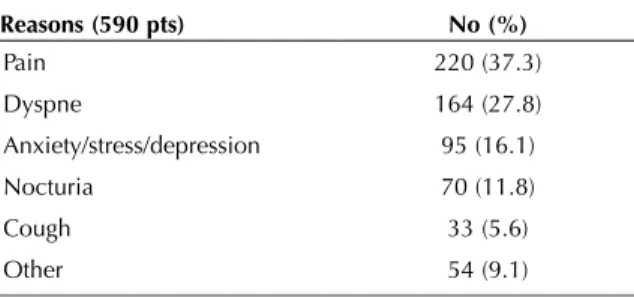
Among 1245 cases (88.7% man) included, 48.4% (590/1218 pts) reported DIMS, 60.8% (742/1221 pts) reported daytime sleepiness and 82.1% (1002/1220) reported fatigue. The most frequent subjective reasons, reported by the patients, for DIMS were pain and dys-pnea (Table 1).
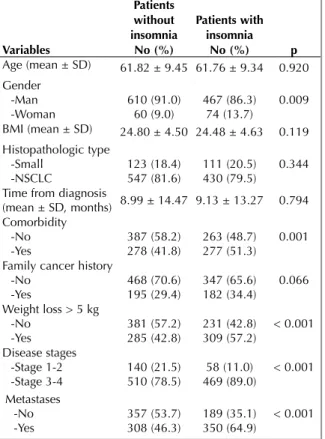
The prevalence of patients with insomnia was 44.7% (541/1211 pts). Among demographic parameters,
Table 1. Subjective reasons for difficulty initiating or
maintaining sleep cited by the patients with lung cancer
reasons (590 pts) No (%) Pain 220 (37.3) Dyspne 164 (27.8) Anxiety/stress/depression 95 (16.1) Nocturia 70 (11.8) Cough 33 (5.6) Other 54 (9.1)
female patients, patients with stage 3 and 4 disease, patients with metastases, with comorbidities, and with weight loss more than 5 kg had higher rates of insom-nia (Table 2). Also, lung cancer symptoms were clearly associated with insomnia. Patients with insomnia had significantly higher rates of pain, nausea, dyspnea, and anxiety (Table 3). Multivariate logistic regression anal-ysis showed a clear association between insomnia and symptoms: pain, dyspnea and anxiety. Especially patients with moderate to severe pain and dyspnea and severe anxiety had 2 to 3 times higher rates of insomnia (Table 4).
dIScUSSIoN
Insomnia is a sleep disorder characterized by repeated difficulty initiating sleep, difficulty maintaining sleep, or waking up to early which results in daytime impair-ment despite adequate time and opportunity for sleep (8). Estimations of the insomnia prevalence depend on the criteria used to define insomnia; however a gener-al consensus has developed from population-based studies that approximately 6-10% of patients have insomnia (9). The results of this study showed that a
Table 3. Distribution of symptoms according to the patients
with/without insomnia Symptoms Patients without insomnia No (%) Patients with insomnia No (%) p Pain -No -Yes 295 (44.0%)375 (56.0%) 122 (22.6%)417 (77.4%) < 0.001 Nausea -No -Yes 418 (62.5%) 251 (37.5%) 244 (45.3%) 295 (54.7%) < 0.001 Dyspnea -No -Yes 272 (40.7%)397 (59.3%) 100 (18.9%)439 (81.4%) < 0.001 Depression -No -Yes 405 (60.5%) 264 (39.5%) 186 (34.5%) 353 (65.5%) < 0.001 Anxiety -No -Yes 358 (53.4%)312 (46.6%) 154 (28.6%)385 (71.4%) < 0.001
Table 4. Multivariate logistic regression analysis of
demography and symptoms predicting insomnia
variables* or 95.0% cI p Gender 1.273 0.829 - 1.954 0.270 comorbidity 1.176 0.897 - 1.542 0.239 Weight loss > 5 kg 1.301 0.989 - 1.710 0.060 Stage 3-4 disease 1.311 0.852 - 2.018 0.218 Metastasis 1.319 0.966 - 1.802 0.081 Pain REF Mild Moderate Severe 0.904 2.520 3.354 0.628 - 1.303 1.732 - 3.666 2.207 - 5.098 0.589 < 0.001 < 0.001 Nausea REF Mild Moderate Severe 0.980 1.245 1.622 0.688 - 1.397 0.827 - 1.873 0.968 - 2.717 0.913 0.294 0.066 dyspne REF Mild Moderate Severe 1.354 2.060 2.888 0.929 - 1.974 1.402 - 3.028 1.921 - 4.341 0.115 < 0.001 < 0.001 depression REF Mild Moderate Severe 1.081 1.286 1.597 0.686 - 1.704 0.748 - 2.213 0.838 - 3.045 0.737 0.363 0.155 Anxiety REF Mild Moderate Severe 0.979 1.115 2.145 0.624 - 1.534 0.659 - 1.888 1.174 - 3.920 0.925 0.685 0.013 * Only variables, derived from predictive factors with a significance ≤ 0.05 in the univariate analysis, were included.
Table 2. Demographic parameters according to the patients
with/without insomnia variables Patients without insomnia No (%) Patients with insomnia No (%) p Age (mean ± SD) 61.82 ± 9.45 61.76 ± 9.34 0.920 Gender -Man -Woman 610 (91.0)60 (9.0) 467 (86.3)74 (13.7) 0.009 BMI (mean ± SD) 24.80 ± 4.50 24.48 ± 4.63 0.119 Histopathologic type -Small -NSCLC 123 (18.4)547 (81.6) 111 (20.5)430 (79.5) 0.344 Time from diagnosis
(mean ± SD, months) 8.99 ± 14.47 9.13 ± 13.27 0.794 Comorbidity
-No
-Yes 387 (58.2)278 (41.8) 263 (48.7)277 (51.3) 0.001 Family cancer history
-No -Yes 468 (70.6) 195 (29.4) 347 (65.6) 182 (34.4) 0.066 Weight loss > 5 kg -No -Yes 381 (57.2)285 (42.8) 231 (42.8)309 (57.2) < 0.001 Disease stages -Stage 1-2 -Stage 3-4 140 (21.5) 510 (78.5) 58 (11.0) 469 (89.0) < 0.001 Metastases -No -Yes 357 (53.7)308 (46.3) 189 (35.1)350 (64.9) < 0.001
significant percentage of patients with lung cancer had poor sleep quality; insomnia (44.7%), daytime sleepiness (60.8%) and fatigue (82.1%). Ginsburg et al. reported similar results of insomnia in (52%) newly diagnosed lung cancer patients (2). Also, the prevalence of insomnia was reported to be as 31% among women patients with lung cancer (10). Chen at al. reported that about half of all lung cancer patients, receiving chemotherapy, were poor sleepers (11).
In current study, we found a significant correlation between insomnia and some demographic parame-ters. Female gender, patients with stage 3 and 4 dis-ease, with metastases, with comorbidities, and patients with weight loss more than 5 kg had higher rates of insomnia. Again, we found that patients with insomnia had significantly higher rates of pain, nau-sea, dyspnea, and anxiety/depression. However, multivariate logistic regression analysis showed that only moderate to severe pain and dyspnea, and severe anxiety were the parameters predicting insom-nia among lung cancer patients. Pain, dyspnea and anxiety/depression were also the most frequent sub-jective reasons of DIMS as reported by the patients. The relationship between sleep quality and the dis-tressing symptoms of cancer is not surprising and several studies showed that some demographic parameters (including patients’ gender, age, previous sleep history, cancer stage) and symptoms (due to cancer, chemotherapy and radiotherapy) were asso-ciated with the sleep problems in general cancer patients (3,12-14). The association between sleep quality and the lung cancer symptoms has also been studied in a few studies and they emphasized a rela-tionship between sleep quality and pain, vomiting, fatigue and dyspnea and cough (11,15,16). Despite we found significantly higher rates of nausea in patients with insomnia, logistic regression analysis failed to show this association. On contrary, Akyüz at al. reported a significant correlation between sleep quality and nausea and fatigue (15). The difference between both studies might be associated with limit-ed number of patients in the study by Akyüz et al. (15). Despite we found a relation between insomnia and distressing cancer symptoms, it is a complex process and each of these symptoms can aggravate the others, for example; unresolved symptoms, such as pain, dyspnea, fatigue etc. can lead to depression, anxiety and impaired quality of life which in turn can cause sleep disturbances and insomnia.
This study has some limitations. First of all, the results of this study primarily based on self-reported sleep disturbances with no objective measures, such as polysomnography or actigraphy. Second, we did not evaluate the effect of medications and treatment on sleep. Finally diagnosis of insomnia limited to those with DIMS and daytime sleepiness and fatigue. However in addition to daytime sleepiness and fatigue, other parameters leading daytime impair-ment such as attention/concentration/memory impairment, mood disturbance or irritability, motiva-tion/energy reduction etc. were not questioned (8). Because of that, the rate of insomnia in this study might be a little bit higher than we found.
We concluded that high percentage of patients with lung cancer suffer from sleep disturbances, such as insomnia, daytime sleepiness and fatigue. Sleep dis-turbances in lung cancer patients were associated with cancer symptoms and especially pain, dyspnea and anxiety. Because there was a clear association between sleep disturbances and cancer symptoms, adequate symptom control is essential to maintain sleep quality in patients with lung cancer. We also conclude that, patients with lung cancer should be routinely evaluated for cancer symptoms: pain, dys-pnea, and anxiety to restore sleep problems.
reFereNceS
1. Sonia Ancoli-Israel. Sleep disturbances in cancer: a review. Sleep Med Res 2015;6:45-9.
2. Ginsburg ML, Quirt C, Ginsburg AD, MacKillop WJ. Psychiatric illness and psychosocial concerns of patients with newly diagnosed lung cancer. CMAJ 1995;152:701-8. 3. McMillan SC, Tofthagen C, Morgan MA. Relationships
among pain, sleep disturbances, and depressive symptoms in outpatients from a comprehensive cancer center. Oncol Nurs For 2008;35:603-11.
4. Muers MF, Round CE. Palliation of symptoms in non-small cell lung cancer: a study by the Yorkshire Regional Cancer Organization thoracic group. Thorax 1993;48:339-43. 5. Di Maio M, Gridelli C, Gallo C, Manzione L, Brancaccio L,
Barbera S, et al. Prevalence and management of pain in Italian patients with advanced non-small-cell lung cancer. Br J Cancer 2004;90:2288-96.
6. Bülbül Y, Ozlu T, Arinc S, Ozyurek BA, Gunbatar H, Senturk A, et al. Assessment of palliative care in lung cancer in Turkey. Med Princ Pract 2017;26:50-6. 7. Bruera E, Kuehn N, Miller MJ, Selmser P, Macmillon K. The
Edmonton Symptom Assessment System (ESAS): a simple method for the assessment of palliative care patients. J Palliat Care 1991;7:6-9.
8. American Academy of Sleep Medicine. International classification of sleep disorders. 3rd ed. IL: American Academy of Sleep Medicine, 2014.
9. Roth T. Insomnia: definition, prevalence, etiology, and consequences. J Clin Sleep Med 2007;3(Suppl 5):S7-10. 10. Sarna L. Correlates of symptom distress in women with
lung cancer. Cancer Pract 1993;1:21-8.
11. Chen ML, Yu CT, Yang CH. Sleep disturbances and quality of life in lung cancer patients undergoing chemotherapy. Lung Cancer 2008;62:391-400.
12. O’Donnell JF. Insomnia in cancer patients. Clin Cornerstone 2004;6(Suppl 1):S6-14.
13. Berger AM, Parker KP, Young-McCaughan S, Mallory GA, Barsevick AM, Beck SL, et al. Sleep wake disturbances in people with cancer and their caregivers: state of the science. Oncol Nurs Forum 2005;32:E98-126.
14. Mystakidou K, Parpa E, Tsilika E, Gennatas C, Galanos A, Vlahos L. How is sleep quality affected by the psychological and symptom distress of advanced cancer patients? Palliat Med 2009;23:46-53.
15. Akyuz RG, Ugur O, Elcigil A. Sleep quality in lung cancer patients. Asian Pacific J Cancer Prev 2013;14:2909-13. 16. Gooneratne NS, Dean GE, Rogers AE, Nkwuo JE, Coyne
JC, Kaiser LR. Sleep and quality of life in long-term lung cancer survivors. Lung Cancer 2007;58:403-10.