DEMOGRAPHIC STRUCTURE AND SETTLEMENT PATTERNS OF
NORTH-EASTERN BULGARIA:
A CASE STUDY ON NİĞBOLU SANDJAK (1479-1483)
A Master’s Thesis
By
NURAY OCAKLI
DEPARTMENT OF HISTORY
BILKENT UNIVERSITY
ANKARA
JULY 2006
DEMOGRAPHIC STRUCTURE AND SETTLEMENT PATTERNS OF
NORTH-EASTERN BULGARIA:
A CASE STUDY ON NİĞBOLU SANDJAK (1479-1483)
The Institute of Economic and Social Sciences
of
Bilkent University
By
NURAY OCAKLI
In Partial Fullfillment of the Requirements for the Degree of
MASTER OF ARTS
in
THE DEPARTMENT OF HISTORY
BILKENT UNIVERSITY
ANKARA
July 2006
I certify that I have read this thesis and have found that it is fully adequate, in scope and in quality, as a thesis for the degree of Master of Arts in History.
Prof. Dr. Halil İnalcık Supervisor
I certify that I have read this thesis and have found that it is fully adequate, in scope and in quality, as a thesis for the degree of Master of Arts in History.
Asst. Prof. Dr. Evgeny Radushev Examining Comitee Member
I certify that I have read this thesis and have found that it is fully adequate, in scope and in quality, as a thesis for the degree of Master of Arts in History.
Asst. Prof. Dr. Hasan Ünal Examining Comitee Member
Approval of the Institute of Economic and Social Sciences Prof. Dr. Erdal Erel
ABSTRACT
DEMOGRAPHIC STRUCTURE AND SETTLEMENT PATTERNS
OF NORTH-EASTERN BULGARIA:
A CASE STUDY ON NİĞBOLU SANDJAK
(1479-1483)
Nuray Ocaklı
M.A., Department of History Supervisor: Halil İnalcık
June 2006
This thesis examines demographic structure and settlement patterns of Niğbolu Sandjak in the the last two decades of the fifteenth century. Seen through the data provided by the Ottoman tax and population censuses (tahrir defterleri), the research shows the demographic movements of native Christians in the sandjak and new settlers coming from the Asia Minor. The thesis examines the presence of Turkic people in the region from 5th century to the end of the 15th century. Based on the two 15th century icmâl defters of Niğbolu Sandjak, this study focuses on recovery of pre-Ottoman settlemets and establishment of new Turkish settlements. Also this study criticizes the catastroph theory of Hristo Gandev who developed one of the leading demographic theories of Marxist Balkan historiography. The information we get from the icmâl defters does not consistant with Gandev’s Catastrophy Theory. Following the conquest of the region, neither a quick Turkification nor a mass-Islamization was happened in the sandjak but
the secure and peacefull environment provided the infrastructure of these Islamizationa and Turkification processes for the sixteenth century.
Keywords: Niğbolu, demography, settlement, icmâl defterleri, Catastrophe Theory,
ÖZET
KUZEY-DOĞU BULGARISTAN’IN DEMOGRAFİK YAPISI VE
YERLEŞİM DÜZENİ:
NİĞBOLU SACAĞI
(1479-1483)
Nuray Ocaklı
Yüksek Lisans Tarih Bölümü Tez Danışmanı:Halil İnalcık
Haziran 2006
Bu çalışma 15.yy’ın sonunda Niğbolu Sancağı’ndaki demografik yapıyı ve yerleşim düzenini incelemektedir. Araştırmamız bölgedeki Türkleşme ve İslamlaşma sürecinin başlangıcı sayılan bu dönemde, Osmanlı tımar kayıtlarını içeren iki icmâl defterinden elde edilen bilgiler işiğinda, bölgede beşinci yüzyıla kadar giden Türk varlığından başlayarak onbeşinci yüzyılın sonunda Osmanlı öncesi yerleşimlerin fetihten sonra nasıl tekrar canlandığı ve yeni Türk yerleşimlerinin nasıl olustuğu üzerinde yoğunlaşmakta, sancakta yaşayan yerli Hristiyan halkın nüfus hareketlerini ve Anadolu’dan bölgeye göçen Türklerin durumunu incelemektedir. Aynı zamanda bu çalışma Marksist Balkan historiografisinin önde gelen teorisyenlerinden Hristo Gandev’in Katastrof teorisini eleştirmektedir.İncelenen icmâl defterleri göstermektedir ki bölgenin fethini izleyen dönemde ne ani bir Türkleşme ne de toplu bir İslamlaşma görülmüstür. Fetih sonrasında
bölgede sağlanan istikrar ve güven ortamı on altıncı yüzyılda ivme kazanacak olan bu süreclere zemin hazırlamıstır.
Anahtar Kelimeler: Niğbolu, demografi, yerleşim, icmâl defterleri, Katastrof Teorisi,
ACKNOWLEDGEMENTS
Thanks to God for everything giving me to start and complete this study. I am gratefull to a number of people for their assistance and support in different stages of this study. Working with Professor İnalcık who is the dean of Ottoman studies has been a dream for me since the beginning of my graduate years in Bilkent University. I would like to thank Professor İnalcık whom I am very indepted for supervising the thesis and for letting me take benefit from his deep knowledge of Ottoman History. Then, I wish to thank Professor Radushev who thought me defterology, siyakat and Ottoman Balkans and he helped me in each stage of my study. Also I am very gratefull to all of the professors in the department who shared their knowledge with us. Also I would like to thank to professor Hasan Ünal to read my thesis and be one of the examining comitee member in my defense.
Finally special thanks must go to my family, my beloved husband Sait and my litte son Mehmet Berke. Without your constant support, love, cheer and smile, it would be impossible to deal with the hard times and complete this study.
TABLE OF CONTENTS
TITLE PAGE...i
APPROVAL PAGE...ii
ABSTRACT...iii
ÖZET...iv
ACKNOWLEDGEMENTS...v
TABLE OF CONTENTS...vi
FIGURES...vii
CHAPTER ONE: INTRODUCTION...1
CHAPTER TWO: DEMOGRAPHIC HISTORY OF
NORTH-EASTERN
BULGARIA
2.1. Pre-Ottoman Turkish Settlement in North-Eastern Bulgaria
2.1.1.
Bulgars...15
2.1.2.
Kumans,
Uz,
Pecheneks, Tatars...19
2.1.3.
Gagauzes...25
CHAPTER THREE:
OTTOMAN RULE IN THE BALKANS
3.1. Pre-Ottoman Political Conditions...32
3.2. Pre-Ottoman Demographic Conditions
and Settlement Policies in the Region...35
3.3. Ottoman Conquest...39
3.4. Turkish Setlement and the New Administrative
System in the Ottoman Balkans...46
CHAPTER FOUR:
SETTLEMENT AND POPULATION IN THE OTTOMAN
VILAYET OF NIĞBOLU...58
4.1. Ottoman Sandjak of Niğbolu...61
4.2. Ottoman Social, Economic, and Military
System in the Sandjak...64
CHAPTER FIVE:
POPULATION AND SETTLEMNTS IN
THE EARLIEST OTTOMAN REGISTERS OF
THE NIĞBOLU SANDJAK...72
5.1. Bulgarian Historiography and Catastrophe
Theory...73
5.2. Settlement and Population in the Sandjak:
A General Look to the Registers...82
5.3. Population of Town, Village and
Mezraa Settlements...90
5.4. Timars in the Registers...101
5.5.
Yörüks...110
5.6.
Villages...110
5.7.
Bogomils...114
CONCLUSION...117
BIBLIOGRAPHY...119
APPENDIX A:
Glossory...127
APPENDIX B:
Map1: Lofça and İvraca Kazas...131
APPENDIX C:
Map 2: Tırnovi-Şumnu-Çernovi...132
APPENDIX D
List of Mezraas:...133
APPENDIX E:
Table of Demographic and Financial data of Villages...134
APPENDIX F:
LIST OF FIGURES
FIGURE 1: Population Trend in Niğbolu (1479-1483)...79
FIGURE 2: Muslims and Christians in Niğbolu...80
FIGURE 3: Profile of Town Population………81
FIGURE 4: Town Population in Total Population………….82
FIGURE 5: Village Population in Total Population………..84
FIGURE 6: Profile of Mixed Village Population…………...85
FIGURE 7: Pure Turkish Settlements………86
FIGURE 8: Population Profile of Pure Turkish Population…87
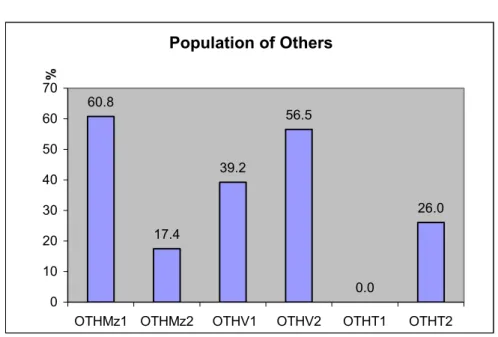
FIGURE 9: Population of Others………91
TABLE 1: Deportations from the Sandjak………...98
CHAPTER ONE
INTRODUCTION
Ottomans considered the Balkan region in the south of the Danube as the area of their sovereignity since the reign of the Bayezid I. Successors of the Bayezid I kept the Danube as the northern border of the Ottoman lands in the Balkans. Murad II was clearly following this notion when he obtained the commitment from Hungarians not to cross the Danube in the treaty he made with them in 1444.1 In the reign of Murad I (1362-89), the lands of the Ottoman Balkans emerged as a separate military and administrative region under the rule of a Beylerbeyi. Mass immigration and settlement of Turks, especially nomads, to the newly conquered Balkan lands occurred especially in the 14th century but the
immigration wave gained acceleration during the Timur’s occupation of Anatolia in the 15th century. North-Eastern Bulgaria, especially fortresses along the south shore of the Danube played an important role in the struggeles between the Christian world and the Ottoman state until the fall of Hungary. After the
conquest, In the 15th century, these depopulated and uncultivated lands were repopulated by Anatolian yörüks who migrated voluntarily or were deported. Also native Christians came back to their old settlements during the peace period after the Ottoman conquest.
Post-conquest demographic trends in the Ottoman Balkans can be followed in Ottoman tax-registers (tahrir defterleri). These registers serving as both military and administrative apparatus of the Ottoman state are mufassal (detailed) and icmâl (summary) registers. These are valuable sources for demographic researches to get an idea about the demographic composition as well as being a good source of information for economic and social history of a geographic area.2 On the other hand using these tax-surveys as a source of demographic studies requires to be considered the deficiencies of the registers because these defters were kept specifically to determine and meet the needs of the timar system. They generally do not include detailed information about reaya (subject people) having special status and privillages, reaya of pious endowments, and different members of military class. For this reason researchers should
2 Ottoman tax-surveys has been used to examine various aspects of the Ottoman history but the
earliest Ottoman tax-survey in the Ottoman Archaives published by Halil İnalcık first in 1954 was the prominent study and leading guide for the reaserchers on how these registers should be used. See, Halil İnalcık, Hicrî 835 Tarihli Sûret-i Defter-i Arvanid (Ankara: TTK,1987). Also Ö. L. Barkan published many important studies on Ottoman tax-surveys and his publications are still very valuable for reaserchers studying on the tax-surveys. See, Barkan “ Tarihi Demografi Araştırmaları ve Osmanli Tarihi” Türkiyat Mecmuası 10 (1951-1953): 1-26. Barkan, “Research on the Otoman Fiscal Surveys “, in M.A. Cook (ed.), Studies in the Economic History of the Middle East (London, 1970).
combine the information in these tax-surveys with other archieval sources.3 The other important problem that a demographic reasercher working with Ottoman tax registers faces is that these registers were kept for tax purposes. The measure of taxable unit in the Ottoman system was not individual but hane (household), which makes difficult to determine the precious demographic situation and changing trends through years in settlemts. Size of hane in the Empire varied region to region. The main reasons of these variations were different geographic conditions, and culture social structure, and culture in these regions. Different life styles such as nomadic, semi- sedentary or sedentary life have very determinant effects on family size. On the other hand, geographic conditions such as mountainous or plain lands and climatical conditions such as cold or warm wheather conditions are the other determinants of the family size as well as life
3 For the problems in the use of the registers as a source and methodological problems can be
faced while interpreting the data in the surveys see, Heat, W. Lowry Ottoman Tahrir Defteri As a Source for Social and Economic Histor: Pitfals and Limitations in Heat W. Lowry, Studies in Defterology: Ottoman Society in the Fifteenth and Sixteenth Centuries (Istanbul; Isis Press 1992), 3-18. For more discussions about use of the defters as a source of economic, social and demographic history see, Mehmet Öz, “Tahrir Defterlerinin Osmanlı Araştirmalarında Kullanılması Hakkında Bazı Görüşler”, Vakıflar Dergisi, 12 (1991): 229-239; Kemal Çiçek, “Osmanlı tahrir Defterlerinin Kullanımında Görülen Bazı Problemler ve Method Arayışları”, Türk Dünyası Araştırmaları 97 (1995): 93-111; Bruce McGowan, “Food Supply and Taxation on the Middle Danube”, Archivum Ottomanicum 1 (1969): 139-196.
style. For this reason demographical information given in these surveys would rather consider as rough data giving approximate number of taxable population and changing demographic trends in a region and in a period of time.
During the Soviet era, a nationalist historiography was dominated the Bulgarian view of the Ottoman history. Marxist historians interpreted the documents in the Bulgarian Archive with an ideological point of view. After the fall of USSR in 1992, the door for more objective and comprehensive studies was opened. The corporation made between Başbakanlık Osmanlı Arşivi (BOA) and Oriental Department of Bulgarian National Library (ODBNL) “St. Cyril and Methodius” in Sofia gave reaserchers the chance to make more comprehensive studies about Ottoman Bulgaria. On the other hand, contrary to the Balkan historiography in the soviet era, some Turkish hisatorians made qualified studies on economic and social history of the Ottoman Balkans during 1950s. Turkish historians such as Barkan and Gökbilgin published their studies during 1950s about demographic trends in the Balkans during the classical age.4 These works of Barkan and Gökbilgin are still important secondary sources for studies on the
4 During the Soviet era, a nationalist historiography was dominated the Bulgarian view of the
Ottoman history. The documents in the Bulgarian Archive interpreted with an ideological manner by the nationalist historians. More objective and comprehensive studies have been started to be made after academic environment was freed from Soviet ideologiy and authority. The corporation made between Başbakanlik Osmanlı Arşivi (BOA) and Oriental Department of Bulagarian National Library (ODBNL) “Sts Cyril and Methodius” in Sofia after 1992 gave reaserchers to make more comprehensive studies about Ottoman Bulgaria. On the other hand during 1950s, Barkan and Gökbilgin made important contributions to the literature of Balkan demography during the classical age of the Ottoman Empire. Ö. L. Barkan, “Osmanlı İmparatorluğunda Bir İskân ve Kolonizasyon Metodu Olarak Sürgünler”, İstanbul Üniversitesi İktisat Fakültesi Mecmuası 11 (1949-1950): 524-269; İÜİFM 13 (1951-1952), pp.56-79; İÜİFM 15 (1953-1954), pp. 209-257. Also the books of Tayyib Gökbilgin examined the demographic trends in the Ottoman Balkans in detail. M. Tayyib Gökbilgin, XV. ve XVI. Asırlarda Edirne ve Paşa Livası: Vakiflar, Mülkler, Mukataalar, (İstanbul: Üçler Matbaası, 1952);Gökbilgin, Rumeli’de Yörükler, Tatarlar ve Evlâd-ı Fâtihân (İstanbul: Osman Yalçın Matbaası, 1957).
Ottoman Balkans. Also on demographic history of the Ottoman Bulgaria, valuable studies of Machiel Kiel that he used various Ottoman archives made important contributions to the literature of demographic history in the Ottoman Balkans.5
While using the Ottoman tax registers as sources of demography and settlement patters, some researhers uses quantitative tecniques to deal with weaknesses of this soueces. For instance, to obtain an approximate population data from the hane numbers in these registes, researchers use some population multipliers for different parts of the Empire. To get an idea about the changes in Turkish-Muslim and native-Christian population in the 15th century, this study uses a population multiplier that is an approximate average that previous studies founded out for Anatolia and the Balkans.6 An estimation based on the average size of 15th century Balkan hane is not approriate for such a study because considering a large number of nomads immigrants, family size of Muslim-Turks would be expected to be larger than 15th century native hane in the sandjak.
Ottoman conquest of Bulgarian lands started in the reign of Murad I7. After the conquest of Edirne in the spring of 13618 udj beg Evrenos conquered the İpsala (Kypsela) castle in 1362 and raids to the Western Balkans were started. After the death of Orkhan Bey, Murad appointed Lala Şahin as beylerbeyi on the
5 Kiel, M.,“The Türbe of Sarı Saltık at Babadag- Dobruja“, Güney Doğu Avrupa Araştırmaları
Dergisi, 6-7, 1978, pp. 205-225; Kiel, “Anatolia Transplanted? Patterns of demographic, Religious and Ethnic Changes in the District of Tozluk 1479-1873”, Anatolica, XVII, 1991, pp. 1-30; Kiel, “ Tatar Pazarcık: A Turkish Town Iin the Heart of Bulgaria, Some Brief Remarks on its Demographic Development 1485-1874”, X. Türk Tarih Kongresi, Ankara: 22-26 Eylül 1986, Kongreye Sunulan Bildiriler, Vol. 5 (Ankara: TTK, 1994), 2567-2581.
6 For the studies finding out approximate size for a typical hane for Anatolia and the Balkans see,
footnotes 177-181.
7 İnalcık, “ I.Murad”, Türkiye Diyanet Vakfı İslâm Ansiklopedisi (DİA), (İstanbul). 8 See, İnalcık , “Edirne’nin Fethi” in Edirne Armağanı(Ankara: TTK, 1964), 189-196.
udj begs and went to the Ottoman capital Bursa to sit on the throne. Lala Şahin captured Eski Zagra and Filibe. In 1366, Sultan Murad went to the Trace in order to protect Ottoman lands in the Balkans and make new conquests. IN the same year, Filibe became the udj center of Lala Şahin who started the raids on the direction of Sanakov and İhtiman. Tzar of Bulgaria Alexander made an allience with Ottomans because Byzantine emperor wanted to capture the Bulgarian castles Sozopol, Mesembria, Anchialos. Amadeo making an agreement with the Bulgarian Tsar Alexandr captured these castles and gave them to the Byzantine emperor, which ended the agreement between the Ottomans and Bulgaria in 1366 and Bulgarian lands were opened for the Ottoman invasion. The Sultan begun his conquests in spring of 1368 and he firstly captured Aydos (Ateôs) and Karin-Ovası (Karnobad) because these fortresses were at strategic locations in the passes on the Balkan mountains. Then Murad I conquered Sozopol, Pınar-Hisar, Kırk-Kilise and Vize. These successes caused anxious in Byzantine and the emperor Yuannis V went to Rome in 1369 so as to ask the pope for a crusade against the Ottomans.9 On the other hand Ottomans continued conquests and in 1368-69 Kara Timurtaş Beg captured Kızilağaç-Yenicesi (Elhovo) and Yanbolu (Yamboli). Lala Şahin with his army captured Samakov and İhtiman and way of Sofia was opened to the Ottomans. In 1370, Lala Şahin won the Sarıyar battle and the people living in Rila mountain region accepted to obey the Ottoman rule. After the Sırp-Sındığı
9 Halecki, O., Un Emperor de Byzance à Rome, Varshova (1930), pp. 169-212 cited by İnalcık, “ I.
war in 1371, Turkish dominance started in the region.10 Inwinter 1372, Byzantine became one of the vassals of the Ottomans.11 According to Ottoman chronicles12, in June 1373, Çandarlı Hayreddin Pasha and the Sultan were in Rumelia. Sultan Murad stayed in Edirne and he gave order to Hayreddin and Evrenos to make raids on Western Trace. He captured Buri (Pôros), Iskeçe (Xanthi), Kavala (Hristopolis) and Marulya (Maronia, Avret-Hisari). In 1375-76, Sultan Murad went on a campaign on Bulgarian Tsar Shishman and the tsar accepted Ottoman suzerainty.13 Kavala anasd Serez were captured in 1383 and Serez became udj center. Turkish raiders were making raids on Serbian lands in 1381. Serbian prince Lazar in Kruşevać got his daughter to marry to Bulgarian Tsar Shishman and made an alliance with him against the Ottomans. When Lazar rebelled, Bulgarian Tsar of Vidin, Sarac Stratsimir, and ruler of Köstendil, Constantin Deyanović was loyal to the Sultan Murad and they joined the campaign on Lazar but Bulgarian Tsar Shishman and ruler of Dobrudja, Dobrotić disobeyed the order of the Sultan. Ali Pasha and Timurtaş Beg went on Bulgaria and Dobrudja. Ali Pasha came to Shumen and made the city military center of his raid. Shishman escaped from the Ottomans and moved his center from Silistre to Tirnovo and from Tirnovo to Nikopol.14
10 Jirecek, Geschichte der Bulgaren, Prague (1876), pp.439, cited by İnalcık, “ I. Murad”, DIA, p.
9.
11 İnalcık, Halil, “I. Murad”, DIA, p. 9.
12 İdrîs, 9. Dâstân; Sa’deddin I, 90-92 cited by İnalcık “ I. Murad” DIA. 13 Ibid., 93-94.
Against the Ottoman conquests, Europe disturbed and Pope was worried about the possibility of fall of Constantinople. Also important ports in northern Agean Sea and Adriatic Sea wanted Venice to be their guarantor against the Ottoman threat.15 Avlonya in Albania accepted Venice’s guaranty. These developments was going to result Hungaria-Venice alliance and 1396 crusade and Niğbolu War.16 On the other hand, in 1391 Mircea, with the support of Sigismond, conquered Silistra and Dobrudja and succesfully raided on the akindjis of Karin-ovası.17 In 1393, Bayezid I took Tirnovo and Dobrudja and Silistre were subjugated but Nikopol was still an important fortification of the vassal Bulgarian State. Bulgarian king Shishman appealed to Sigismond, which caused a new campaign of the Ottomans on the Balkans. Bayezid I invaded Transilvania and made the battle of Arges against Mircea in 1395.According to a document discovered by Professor İnalcık18 after the Arges battle Bayezid I came to the fortresses of Nikopol, which was ruling by the Bulgarian lord Shishman who was one of the vassals of the Ottomans paying tribute. When the Sultan asked him to send ships Shishman fetched and behided the Ottomans.
Niğbolu is the fortress famous with the battle fought between the Ottomans and the Crusaders on 25 September 1396. Victory of the Ottomans in the battle brought the vassalage of Wallachia that was a strategical ally of the
15 See Setton, K., M., The Papacy and the Levant 1204-1571, I-III, Philedelphia (1976)
cited by İnalcık, “ I. Murad”, DIA, p.16.
16 Ibid.
17 For detailed information on conquest of Bulgaria see İnalcık,“Bulgaria”, EI.
18 Sthis document is in Topkapı Sarayı Archives, Istanbul, no. 6374. For more information and a
western Christian world against the Ottomans. A relatively long peace period in the region after the battle gave the Ottomans enough time to establish Ottoman military, fiscal and administrational system in the these lands. Also the strategical importance of Niğbolu as one of the sandjak on the border periphery continued during the later centuries. For this reason, besides the need of Tukish population on the loosely populated lands of the sandjak as the basis of the Ottoman’s permanency, establishment of Ottoman military, fiscal, and administrational system in the region was crucially important for the purpose.
Ottoman archives in Istanbul and Sofia offer us a unique opportunity to reach the earliest Ottoman tax registers and to analyze the processes of repopulation, recovery, settling and system building in these lands. These icmâl (summary) registers of Niğbolu Sandjak are dated 147919 and 148320. Fromthese registers we learn about timars, timariots, names of villages, status of reaya (such as Muslim, Christian, hane, mücerred, bive, yörük etc.) and tax revenues, which indicates that these are icmâl registers written by using the data in a mufassals. The short time period between these tahrirs help us to examine and reveal the quick and significant changes, alterations, and recovery in settlement and population of the the region. Although there are some Byzantine practicas (detailed population and tax statistics) for the other regions of the Balkans21, the
19 ODNBL., Or. Abt., Signature OAK., 45/ 29. 20 ODBNL., Or., Abt., Signature Hk., 12/9.
21 Two of the Byzantine practicas, first published by Dölger in 1949,Dölger, F., Seches
earliest written sources of the Niğbolu region are the two Ottoman Niğbolu icmâls. The first register is dated 1479 and it is in St. St. Cyril and Methoius National Library, in Sofia.22 This survey is registered in the late years of Sultan Mehmed the Conqueror’s reign and the defter consists of 60 pages but beginig and end parts of the defter are missing. There is 19 zeamets and 220 timars are registered in the defter. We don’t know the information about why the tahrir was made, names of the officials making the tahrir and the kanunname of the sandjak ordering the special problems and cases of the sandjak in the missing beginning part. Also the end part including records of wakfs (pious endowments) in the sandjak is also missing. Although these missing parts limit our examination, we can reach some other sources that can supply in the necessary formation about kanunname and pious endowments in the sandjak. The oldest kanunnames of the sandjak is dated the reign of the Sultan Suleyman I transcribed by Ö.L.Barkan23 and the information about the endowments in the sandjak is given in detailed by İ.H. Ayverdi.24 The second register that the study examines is again an icmâl register whose beginning part and the end part is missing as well. Although this defter is not dated, the paper of the register and its writing style indicates that the defter is written early 1480s.25 Especially when we consider the hand-writing of used by Heath Lowery to determine the average size of the Radilovo’s size of household in 1316 and 1341. For more information see, H., Lowery, Continuity and Change in Late Byzantine and Early Otoman Society, ed. Bryer and Lowry.
22 ODNLB, Or., Abt., Signatur OAK., 45/29.
23 See, Barkan, Ö., L., XV ve XVIinci asırlarda Osmanlı İmparatorluğunda zirai ekonominin
Hukuki ve Mali Esasları. Cilt 1: Kanunlar (İstanbul: Bürhaneddin Matbaasi 1943).
24 Ayverdi, I., H., Avrupa’da Osmanlı Mimari Eserleri : Bulgaristan, Yunanistan,
Arnavutluk, (İstanbul: İstanbul Fetih Cemiyeti, 1982).
the kâtib, we can see that it is very similar to a register written in the early years of the sultan Bayezid II’s reign dated beginning of the 1480s.26 The other reason led researchers to think such a close date to the 1479 register is that names of many timariots and household numbers of some villages are the same with in the 1479 defter’s registers. All these indicate the date of the tahrir as early 1480s.27 For these reasons, while we are examining the second register, we assume the date of the tahrir as 1483. These defters gave us information about names of timariots, number of soldiers that the timariots have to train, names of the villages and mezraas given as timar, the number of Muslim, Christian, yörük, and other households living in the sandjak and timar revenues reserved for the timariots. In addition the number of tax payer hane (household), mücerred (unmarried man), and bive (widows) were registered in the defters.Besides these, we see some der-kenars near the registers of some villages. These are explanations about any change or renewal in timar holders or status of these villages. In addition, these der-kenars are wrıtten so as to underline a specific feature the villages and mezraas such as hâlî (uninhabited), cultivated by yörüks or given as timar to be populated. Also in these registers, we see some other notes explaining that inhabitants of some villages were registered in a village but they were living in another settlement or some settlements that were derbend villages protecting a mountain pass or a trade road.
26 The catalog number of the register in the BOA is TTD 20.
27 For more information about the defter and its features see, Kovachev, R., Verzeichnis Des
These registers were first examined by the Bulgarian historian Hristo Gandev and the data and its interpretations have created discussions since 1970s. In 1972, Hristo Gandev published his book examining the two earliest Niğbolu icmâl defters in Sofia. Gandev’s analysis provide some theoretical contributions to the Marxist Balkan Historical view and theories that have been discussed by other Balkan historians. In this study, we can find a chance to compare Gandev’s Catastroph Theory with the data in the earliest icmals of the sandjak. While we are examining settlements of the sandjak, firstly we are going to consider the demographic trends and settlement patterns of Christian and Muslim inhabitants in the region. For this reason this study is going to compare the villages registered in both defters.On the other hand, while we are examining the mezraas in the two icmâl registers, mezraas which were not hâlî are taken into consideration but some times a few other mezraas having no settlers are going to examine because these mezraas became villages or populous settlements in later periods. The matter of mezraa with its many aspects is going to analysis in my further studies on the region. For this reason, in this study it is going to be limited the analysis with demographic issues of the mezraa discussion.
This study follows acronological order to examine Turkish presence in the region. For this reason after the introduction, chapter two examnes pre-Ottoman Turkish inhabitants. The chapter focuses on the Turcic people coming from steppe region to the north-east Bulgaria The chapter three considers pre-Ottoman conditions, process of conquest, and establishment of Ottoman settlements,
institutions and, system the Balkans. The chapter four examines Niğbolu sandjak as one of the strategic sandjak on the Ottoman borderland along the south shore of the Danube and the establishment process of Ottoman military, fiscal, agricultural and administrative system in the region is analised . The last chapter evaluates the the two Ottoman icmâls dated 1479 and 1483, as sources of social history of the 15th century Niğbolu sandjak. This chapter examines the changing demographic trends, composition of the population, and settlement patterns in the short period between the registers and criticizes the previous studies made on these icmal registers of Niğbolu.
CHAPTER TWO
DEMOGRAPHIC HISTORY OF NORTH-EASTERN BULGARIA
Northeastern Bulgaria with the foothills and low mountain ridges to the north of the Balkan Mountains constituted the historical hearth of the Second Bulgarian Kingdom (1185-1279). This region, including along the coast of Black Sea, had been a passage during the invasions of Turco-Mongol peoples such as Huns, Avars, Proto-Bulgars, Pechenegs, Kumans, Tatar- Kipchaks during the period between 5th and 13th centuries. Permanent settlements of these peoples had formed the foundations of Turkic presence in pre-Ottoman times in the region. The cultural, religious and administrative effects of the pre-Ottoman Turkic settlements in the north-eastern Bulgaria are seen in Ottoman registers, achieve sources and various chronicles. In this chapter, I am going to explain the processes of Turkish settlements in the region. Firstly we are going to examine pre-Ottoman Turkic presence in Bulgaria and secondly early Ottoman settlement in northeastern Bulgaria such as dervishes, yürüks, deportation and colonization in the north-easterm Bulgaria.
2.1. Pre-Ottoman Turkish Settlements in Northeastern Bulgaria
2.1.1 Bulgars
After the disintegration of the Western Hun confederation, some of the tribes breaking away from the confederation migrated towards the west. Byzantine historians Rhetor, Priscos and Suidas recorded that the tribes, passing through the north of the Blacksea, settled on the steppes stretching between the branches of Danube and Volga.28 Other tribes followed the way of these tribes and the migration wave continued occasionally. Arriving of the proto-Bulgars is thought to be in one of these waves of migration from the north.
The original country of the Bulgars was in Kuban region in the Caucasus and it is named as “Great Bulgaria” in the chronicles of Theophanes and Nicephorus. For the first time, Johannes Antioch in the year 481 A.D. mentioned the name of “Bulgars”.29 Besides the Byzantine sources, Islamic travelers stated the name of Bulgars and Bulgarian tribes. Barsula, Ishkil (or Askil) and Bulkar are the three main groups named in Ibn Rusta and his epigones. Also Ibn Fadlan mentions, apart from Askil, the tribe of Suwar and a group or a large clan, called al-Barandjar as a Bulgarian tribe.30
28
Menges,K., H., The Turkic language and people:An introduction to Turkic Studies,Wiesbaden (1968), p.19 cited by Tekin, T., Tuna Bulgarları ve Dilleri(Ankara: Türk Dil Kurumu Yayınları, 1987), p.1.
29 Müller, frag. Hist. Graec. Iv. 619 cited by Hrbek, I., Bulgar, EI WebCD ed., Brill Academic
Publishers 2003.
As a result of the westward move of Khazars, a number of the Bulgar tribes left their new land lying between Don and Dynyester Rivers and migrated to Bessarabia. After a time, these tribes started to make raids on the Dobrudja. These raids on the city was important in the fact that ever since the downfall of the classical civilizations, Dobrudja has been a borderland between the settled empires of the early middle ages and the hosts of nomad peoples pouring in from the East.31 At the end of 670s A.D., Bulgars commanded by Khan Isperukh, occupied the Dobrudja and the border disappeared. After the defeat of the Byzantine army sent by the emperor Konstantin IV, raids of the Bulgars continued until the sign of a peace treaty between the Byzantine and the Bulgars.32 After the treaty, Bulgars, as a military aristocratic elite, founded a state ruling the south-Slavonic tribes and became a powerful rival against the Byzantine Empire in the Balkans.
Despite the ethnically dominant character of Slavs in the new Bulgar state, the Bulgar ruling elite governed the state for the following centuries. After the first khan Isperukh, his son Terveel came to the reign. Terveel played an important role in the controversies on Byzantine throne. Byzantine Justinyanus II, dethroned and deported in 697, asked for help from Tervel in 705 AD. Army of Terveel and Justinyanus II occupied Constantinople and the emperor enthroned for a second time.33 In addition to the strategic alliance between the emperor and the khan, Bulgars obtained new military successes, which put the new state in a
31 For the importance of Dobrudja, see Kiel (1978). 32 Feher (1984),p. 45.
dominant position against Byzantine. In the reign of khan Terveel, according to the treaty made with the emperor, Byzantine would have paid a yearly tax called haraç to the Bulgarian state.34 During the following hundred years the Bulgarian Kingdom continuously expanded. After these conquests and expansion, Christian subjects of the state significantly increased, which made an unavoidable Byzantine attack possible and probable over the Bulgarian state. In order to preclude such an attack, Boris I accepted the Orthodox Christianity as a religion of the state in 865. Independence of Bulgarian church was bearing a great importance for the future of the state. In order to convince Byzantine religious authority to this issue Boris started some negotiatons with Pope.35 As a result of menace of the Boris, in return of becoming Orthodox Christian, Byzantine accepted the independence of the Bulgarian church. The conversion of Bulgarians to Christianity had far-reaching consequences for the history of the peninsula because the Byzantine church and the Byzantine understanding of the state shaped not only the Bulgarian state but also the states that emerged subsequently in the Balkans.36 Expansion of the Bulgarian kingdom continued and in the reign of Symeon (893-927), the son of Boris I, Bulgarian Kingdom became a state expanding on the the lands stretching in between Adriatic Sea in the west and Agean Sea in the south and Danube in the north.
After the death of Symeon, serious internal and external problems destroyed the social and political structure of the Bulgarian state. While
34 Todorov (1979), p. 15-16. 35 Feher (1984),p. 56.
empowered feudal aristocracy struggling for being autonomous, having the help and support of the Byzantine Empire, Serbians became independent. Also the birth of the sect called Bogomil 37 and its spread between subject people revealed the uneasiness in the society. Besides the internal problems, a new wave of migration from the steppes weakened the Bulgarians’ control and dominance on the lands of the state. In 972, the Byzantine emperor Johannes Tzimiskes I conquered the capital city of the Bulgarian state and at the end of 1018, the first Bulgarian state became one of the provinces of the Byzantine Empire.
During 150 years long Byzantine domination, Pečeneks and Kumans from the Russian steppes invaded the Bulgarian lands. These two tribal communities gave a few dynasty and played role in the rebirth of the second Bulgarian Khanate as a kingdom.38 At the end of the eleventh century, Tatars of Golden Horde Khanate founded in the Russian steppes invaded Bulgarian lands. Ottomans in the last quarter of the twelfth century concurred and settled in these lands. During the next five hundred years, these lands became a part of the Ottoman Balkans.
37 Bogomil means the person who loves the God. Followers of the sect believe that people can talk
to the God without an intermediary, the priest. They were accusing the rulers with being cruel towards their subjects. (see Todorov (1979), p. 25-26). Birth of Bogomilism, reasons behind spread of the heresy, and beliefs of the sect aare going to be discussed in the section dedicated to pre-Ottoman situation of the Niğbolu region and siyuation of the sect and its followers is going to be examine, while examining the information in the Ottoman registers of 1479 and 1483.
38 In 1185, the two Bulgarian feudal aristocrats Assen and Peter brothers carried out a rebellion
against the Byzantine Empire and the emperor Ishak Angelos II, as a result of the unsuccessful campaigns on rebellions, signed a peace treaty with Bulgars in 1187 and recognized the setting up the second Bulgarian State. After Assen and Peter, Koloyan reining the state established an alliance with Papacy in Rome, which gave the first important result in 1204 when the pope Innocence III declared him as the king of Bulgaria.However his alliance with Rome did not go further because of the Crusades. Crusaders and Balkan feudal aristocracy struggled for supremacy and power in the Balkan provinces of the Byzantine Empire and Bulgarian Kingdom took part on the side of the Balkan aristocracy. For further information see Todorov (1979), p.29-33; Acaroğlu (1986).
2.1.2. Kumans, Uz, Pecheneks, Tatars
After the Bulgarians, the raids of Turkic tribes from Eurasian steppes to the north eastern Bulgaria continued for centuries. Pecheneks (440/1048), Uz (456/1064) and Kumans (484/1091) came and settled in the area. Especially, Kumans played an important political role in history of the region until the Ottomans came. According to the Russian turcolog Gluboski, Turkic tribes followed the two ways towards Europe. One of these is starting from Central Asia and passing through Russan steppes. These tribes following the first way kept their tribal names such as Pecheneks, Uz, Tatars, and Kumans in where they settled after migration. The second way followed by the Turkic tribes is going from the south. This way was passing through Iran and Anatolia and was arriving to Europe. These tribes going along the second way are generally called Oguz. These Oguz tribes took the name of their leader when they established states and reigned as dynasties such as Seljuks and Ottomans.39
Islamic sources gave one of the earliest information about Pecheneks (Badjanaks). One of these Islamic sources is the book of Ibn Rusta (İbn Rosteh), Kitab al-A’laq al-Nafisa written between the years 290-300/903-913. He mentions that Pecheneks the eastern neighbor of Hungarians appeared with the name of al-Madjghariyya were a powerful Turkish tribal community. Hungarians living in the plains lying between the Don and the Lower Danube were under the pressure
39 For further information see Glubovski (1884) cited by Manof (1939), p.8-9 and Ülküsal
of their neighbor Pecheneks and therefore, they had to migrate to the basin of Carpathians in 889-892. From his book, we learn that Pecheneks still inhabited on the plains located east of the Don River at the end of the ninth century and they were powerful and populous enough to expel others on their way.40 After the migration of Hungarians, bitter struggles happened between these tribes and they divided into two groups. One of those was under the command of Tirah and the second one was under the leadership of Kegenes. The second group of the tribes was defeated by tribes under the command of Tirah and retrogrades towards Danube41 and they inhabited southern Moldavia. Coming of Pecheneks to the Balkans was nearly three hundred and fifty years later from the Bulgars. As it is mentioned in Byzantine sources, as a result of the treaty made between the Byzantine Empire and Pecheneks in 1048, Kegenes accepted the Byzantine protection and took a position in the Byzantine administrative system. In the following years, Kegenes was given the title, voyvoda (prince). Afterwards majority of the tribes under his command accepted Christianity and they were settled around Dobruja.42 The other group of Pecheneks under the command of Tirah, passed the Danube and invaded Byzantine lands but after the sent of the imperial army, they were defeated and taken under the Byzantine rule.43 Their leader Tirah was converted to Christianity in Constantinople.44 Pecheneks were
40 Gy. Káldy Nagy, Magjar Madjaristan, EI WebCD Ed., Brill Academic Publishers 2003. 41 See Manof (1939), p. 9-10-11.
42 Miletiç, L.,”Peridiçesko Spisanie” (Mevkut Risale), sene VII, kitap 32, Sredets (1890) cited by
Manof (1939), p.10.
43 İreçek (1876), p. 575 cited by Manof (1939), p. Manof (1939), p.10. 44 Miletiç (1905), kitap XXXII- XXXIII, s. 212, cited by Manof (1939), p. 10.
not different than other tribal communities in the steppes of Western Eurasia. They were consisting of nomadic tribes. Pecheneks did not found a state or any other form of political unity until they settled and were absorbed by other Turkish or non-Turkish communities.
The other Turkic tribal communities coming to the northeastern regions of the Balkan Peninsula are Uzs and Kumans. Some historians claim that Kumans and Uzs are the group of tribes belonging to the same community.45 Kumans in the middle of the eleventh century founded a state in the region between Volga and Danube. As a result of Kumans’ invasions and pressures leading to the westward migration of Uz tribes, Uzs passed the Danube and settled around north of Dobruja, Deliorman and Black Sea region. Invasions of Uz or Oguz tribes started in the second half of the 11th century. Although they defeated the troops consisting of Bulgars and Rumanians, they could not be long lived in the Balkans. A number of these tribes became subjects of the Byzantine Empire but rest of them went back to the steppes and lived along the Russian border.46 In 1224, following the defeat of the Russian-Kuman army by Mogol troops, these Uz tribes living along the Russian border had to pass the Danube and settled in around Dobruja where other Turkic peoples had inhabited for a long time.47 A number of Christianized Uz tribes preferred to live along the shore of the Black Sea, especially in Mahgalya, Kavarna, Varna, and Silistre. On the other hand, Kumans defeated by Mongols settled in the Byzantine territory especially in Trace and
45 İreçek (1886), p. 286 cited by Manof (1939), p.8-9. 46 Ülküsal (1940), p. 30-31.
Macedonia.48 According to some historians, the Kumans in the Balkans were mostly Christianized, and, mingled with the native Wallachs and Slavs, and they continued to play the role of a ruling military class in these communities.49 Also during the Mongol invasion in 1238, Kumans continued to move towards the west.50 These Kumans of the steppe region who were under the Mongol rule adopted Islam and they established local aristocracy and ruling dynasties of the region under the name of Tatar.51 In addition, we see that in seventeenth century, inhabitants of this region were still known as Uzs. The Ottoman traveler Evliya Celebi, in this century, called the northeastern region of the Ottoman-Balkans, namely Rumelia, as “Uz Eyaleti” (the province of Uz).52
In the thirteenth century, the other Turkic group of people coming from the steppes to the northeastern region of the Balkans is Tatars. Colonization of the new tribes from north of the Blacksea began in the thirteenth century. During the reign of the Batu who is the grandson of the Cingiz Khan, conquest of the Kipchak steppes were completed in 1236. Four years later, Mongol-Tatar army captured the city of Kiev and Mongol-Tatar attacks reached to central Europe in 1243. Then Batu turned back to the steppes and founded the Golden Horde Khanate. The land of the Khanate was extending to Serbia in the south and
48 see Ülküsal (1940), p. 16-17; Manof (1939), p. 11-12.
49 Rásonyi-Nagy (1927), 68-96; Nikov, (1937) cited by İnalcık, “Dobruja”, EI WebCD add.
(2003).
50 Spuler, B., Die Goldene Horde , Leipzig 1945, 19-20 cited by ibid. 51 For further information see, Ibid.
Carpathian Mountains in the north including the shores of Danube.53 Also an original Turkish account of Yazijiogli Ali gives us valuable information about the Anatolian Turks came and settled in Dobrudja in mid 1260s.54 Most of these Turks came under the command of their religious leader Sari Saltuk were were nomads and they formed two or three towns and 30-40 oba (clans).55 Abu’l Fida also note that majority of the population of Sakdji (Isacca) was Muslims, which he reffered to them rather than the Tatars settled under Nogay.56 According to Yazidjioglu Ali, these Turks emigrated to Anatolia because Bulgarian princes gained power and occupied a large part of the Rumelia. On the other hand, these Turks remained were Christianised. However in the travel account of Ibn-i Battuta57 the town Baba Saltuk (later Baba-dagh) was reported as an important Turkish Town in 1330s..
Although we have not any original document kept in the time of Golden Horde about the colonization movements and settlements of Tatars in the Balkans, Ottoman tahrir registers inform us about the pre-Ottoman Turcic presence in the region. A wakf register transcribed by Barkan is a good example indicating the Tatar colorizations in the Mongolic era. According to this register, the karye (village), Arpuz Ata which is also known as Tatarlar around Edirne had been wakf since Cingiz Khan. In the reign of Mehmed the Conquerer this karye had been
53
Cahen, G., Les Mongols Dans Les Balkans, Revenue Historique, 1924, p.55-59 cited by Ekrem (1983) p.160.
54 Wittek, “Yazijioglu ‘Ali on the Christian Turks of Dobruja”, in BSOAS, xiv (1952), 639-68 55 Ibid., p. 648.
56 Géographie, ed. Reinaud and de Slane, Paris 1840, 34, cited by Ibid.
given as timar but the sucessor of the Sultan Mehmed the conquerer.58 Also Arab travelers give us valuable information about the Tatar settlements in north-east Balkans, especially around Dobruja. The Arab historian Abdul Fida, in his book Takvim-i Al Buldan, noted that the majority of the settlers of Tulcha around Dobruja were Tatars. In addition, other Arab travelers Rukn al-Din ve İbn Khaldun wrote about the Nogays were living the northern Dobruja.59 The other Arab traveler Ibn Battuta visited the Dobruja region between the years 1331-1335 says that the city of Babadag was under the rule of the Tatar Khan. The Arab traveler Ibn Battuta was in the capital city of the Golden Horde Khanate, Saray, in 1333. He joined a caravan accompanied a Byzantine princess who was the wife of a prince of the Golden Horde going to Constantinople. The caravan passing through steppe of Kipchak followed the way of Dobruja and Bulgarian lands. İbn Battuta notes that the country from Itil (Volga) River to the town of Baba Saltuk was the lands of the Tatars. Between the town of Baba Saltuk and the first Byzantine fortress Yanbolu, he traveled during eighteen days through the land which is unsettled and desperately drought.60
58 Barkan (1949-50) p. 543.
“Karye-i Arpuz Ata
Vakf-ı Arpuz Ata Cengiz Han zamanından berü vakf imiş vakf-ı evladlık üzere tasarruf olunurken timara verilmiş imiş. Şimdiki halde padişahımız Sultan Bayezid Han halledallahu sultanehu giru mülkiyetini ve vakfiyetini mukarrer dutub tevki-i şerif irzani kılmış. Haliya Hatun Polad ve Sitti ve Şahi nam hatunlar giru nesli olmağın vakf-ı evladlık olmak üzere tasarruf ideler.” ( Başvekâlet Arşivi, Defter no: 818).
59 About the Arab travellers and their books, see, W. de Tiesenhausen, Recueil de Materiaux
Relatifs à L’Historie de la Hoade d’Or I, Extraits des Ouvrages Arabes, St. Petersbourg, 1884, s. 92-93 cited by Ekrem (1983) p.1601.
2.1.3. Gagauzes
In the northeastern part of the peninsula, Gagaues are one of the various ethnic groups of the region. They are speaking a dialect of the Anatolian Turkish but their religion, Orthodox Christianity, distincts them from other Turkish groups in the region. Since middle of the fourteenth century, the homeland of the Gagaueses was mainly the steppes stretching between the lower Danube and the Black Sea, from the delta southward as far as the foothills of the Emine Dagh (the easternmost chain of the Balkan range) and the city of Dobruja called by the name of the Bulgarian prince Dobrotitsa.61 In the city base, they were living in the
southern and middle Dobruja, from Varna and Kaliakra towards Silistre on the Danube.62 On the other hand, Gagauess were living as relatively small groups in other cities and provinces of the north-east region of the Balkan Peninsula such as Prevadi (Provadia), Şumnu (Shumen), Razgrad, Tutrakan, and the region from Danube to Edirne.63
Historians have discussed the origin of Gagaues and a number of hypotheses have been developed in order to clarify this issue. One of the hypothesis is that Gagaues are the probably the descendents of Uzs well known to the Russian chronicles namely Black Caps (Karakalpaks) adopted Orthodox Christianity under the Russian rule in the eleventh century. On the other hand, Bulgarian scholars consider the Gagaues as the descendents of the Proto-Bulgars
61 Wittek (1952), p. 639. 62 Ibid.
turkicized in the Ottoman period but they kept their religion as Orthodox Christianity.64 Some other scholars claim that Gagaues are Anatolian Seldjuks who had migrated to Dobruja under the Ottoman rule and they were Christianized under the influence of the surrounding religious environment.65 The last but the most probable hypothesis is the one which regards the Gagaues as descendents of Anatolian Seldjuks came to Byzantine territory under the command of their sultan, Izz al-Din’s Kay Ka’us as refugees. According to Wittek, the name Gagaues came from the name of their leader Sultan İzz al-Din Kay Ka’us. 66 Under the rule of the Byzantine Empire, these Anatolian Seldjuks were Christianized but they kept their language, culture, and traditions.
The discussions on the origin of the Gagauess are nearly ended after Paul Wittek’s assertion of a comparative study of the original Turkish account of Yazijioghlu Ali written in the pre- Ottoman period, in 1423 with the Byzantine sources.67 According to Wittek, after the publication of T. Kowalski’s careful analysis of the Gagaues Turkish, it is proved that the Gagaues Turkish essentially has southern, in other word Anatolian characteristics, which made the previous hypotheses on the origin of Gagaues invalid68. Wittek completely rejects the hypothesis that the Gagauess are Anatolian Turks who had immigrated into Dobruja under the Ottoman rule and been subsequently Christianized there under the influence of the surrounding population. Such a gradual apostasy from Islam
64 Zajaczkowski, W., “Gagauzes”, EI Web ed. 65 See, Wittek (1952), p. 659.
66 Wittek (1952), 668. 67 Wittek (1952), p. 639-68.
is not possible under the sultan’s rule. For this reason he concludes that the conversion must be in the pre-Ottoman period, before the end of the fourteenth century. In addition, Wittek also rejects the hypothesis that the Gagaues are Bulgarian, Greek or Wallachian Christians adopted Turkish language under the Ottoman rule. According to him, it seems very unlikely because of the xamples indicating opposite cases in the Balkans. Spread of Islam among the Balkan peoples is combined with retention of the native language such as Muslim Bulgarians (Pomaks), the Bosnian Muslims speaking Serbo-Croat, and the Muslim Albanians.69
On the light of the achieve sources, linguistic studies and his comparative study on Yazijioghlu Ali and Byzantine sources, Wittek concludes that the ancestors of the Gagauess migrated from Anatolia in the pre-Ottoman times. The account of Yazijioghlu Ali tells the story after the re-capture of Costatinople by Michael VIII Palaeologos from the Franks in 1261. According to the account, the sultan Izz al-Din’s Kay Ka’us II ruling the western part of the Anatolian Seljuks sultanate felt himself threatened by both this brother Rukneddin ruling the eastern half of the sultanate and the Mongol protectors. He, his family and his household left Anatolia with of his navy. This account relates the Seljuk troops had come with their sultan Izz al-Din’s Kay Ka’us II and their help to the emperor in his Balkan campaigns. Then the account tells about these Seljuk troops, namely Tourkopouloi, settled Karvuna (later named as Dobruja) and coming of the
nomadic tribes that they belonging to. These tribes, with their religious leader Sari Saltuk, were coming from Anatolia to Dobruja where Tourkopouloi were settled on the Byzantine border in 1263-64. 70 After the coming of these tribes in the region, two or three Muslim towns were set up containing 30- 40 Muslim – nomadic oba (clans) in Dobruja. 71 The function of these Turks, in the border, was to be shield against the any attack could come from the north. Emperor’s assignment of Izz al-Din’s Kay Ka’us and his followers to Dobruja was very practical solution for providing a protection for the north border of the empire where almost no-man’s land between the Golden Horde Khanate, the Bulgarian State and the Byzantine Empire.72 Also in the region generally known as “Karvana Land”73 many Turkish tribes supplying soldier to the Byzantine army, were living but they could not be taken under the control of the Empire. The emperor Mihail VIII Paleologos enfeoffed the sultan of the Seljuks İzz al-Din’s Kay Ka’us as the leader of these Turkic peoples including Christan Turks in the Karvuna region where İzz al-Din’s Kay Ka’us founded an independent Oguz state whose religious authority was the exach in Karvuna dependent to the Patriarch in Constantinople.
According to the account of Yazijioghlu, after some time, the emperor feared from the Turkish tribes come together under the roof of the Oghuz state
70 See Wittek (1952), p. 659 ; P. Wittek also deals with the account in his article Wittek (1934) and
more fully in Wittek (1948).
71 Wittek (1952), p.648.
72 See İnalcık, Dobruja, EI WebCD ed., Brill Academic Publishers 2003.
73 We learned the name of the region as “ Kavarna “ from the document that Arsen II gave the to
founded by İzz al-Din’s Kay Ka’us. The Emperor sent the imperial army to be killed and imprisoned their leaders. Although the army was partially successful in killing or imprisoning some of the tribal leader, İzz al-Din Kay Ka’us with two of his sons were liberated and brought to Crimea by the Khan of the Golden Horde, Berke Khan. The Muslim subject of the sultan İzz al-Din’s Kay Ka’us living in Dobruja was also taken under the protection of the Muslim khans of the Golden Horde, Berke and then his successor Noghay. The Muslims of Dobruja were transferred to the steppes with their religious leader Sari Saltuk. However, according to Gregoras, a number of the Turkish soldier coming from Anatolia with İzz al-Din Kay Ka’us stayed in Kavarna region were baptized and enrolled in the Byzantine army.74 On the other hand, two of the sultan’s sons with their mother who was the relative of the Byzantine emperor were received land with a feudal position and deported to Verria (Karaferye) in Macedonia. One of the Seljuk princes stayed in Verria and the other one went to Constantinople. According to Yazijioghlu, after going of the Sultan to Crimea Turks who were still Muslims are said to immigrate to Quarasi in Anatolia. On the other hand, the Turks of Dobruja having already been Christianized joined to the son of the Sultan İzz al-Din Kay Ka’us deported to Verria. It astonishes that contrary to his followers Christianized in Dobruja, the son of the Sultan İzz al-Din’s Kay Ka’us died as Muslim and his grandsons were not Christianized until the coming of the
basileus to Salonica.75 Also Yazijioghlu adds this note that when the Sultan Bayezid I, concurred Verria in 1385, he see that the grandsons of the Seljuk dynasty still were living there. Bayezid I deported them from Verria to Zikhne in eastern Macedonia. The eldest son of the family, Lizaqos was enfeoffed as subashi, which was incredible to obtain such a position for a Christian.76 In addition during the reign of the sultan Bayezid I, Lizaqos renewed their diploma of timar and he was exempted from pay poll-tax.77 These Christian Turks were still in Zikhne until the end of the Ottoman Empire.78
On the other hand, Muslim Turks under the protection of Berke Khan came back to Dobruja with their leader Sari Saltuk in 1280s. Until his death at the beginning of 1300s, Sari Saltuk was the head of the Turks in Dobruja. After Sari Saltuk, Muslims of Dobruja returned to Anatolia because of the harassment of the Bulgars princes in 1307-11 79 and these Christian Turks stayed in Dobruja. The Turkish tribes remained in Dobruja elected Balik as their chief and established a despotate in Dobruja. After Balik, his brother Dobrotic reined the Oghuz state (1357-1386). Since his reign, the name of the region “Karvuna Land” called Dobruja or “Dobrotic Land”.80 The last ruler of the Oghuz state before the Ottoman conquest was Yanko (or Ivanco). Yanko could not be successful against
75 See Wittek (1952), P. 660. 76 Ibid., p. 450 and 461.
77 Wittek (1952), p. 650; Kiel (1978), p. 207-208.
78 For further information about the Turkish- speaking Christians in Macedonia see Wittek(1934) 79 Wittek (1952), p. 651 cited by İnalcık, H., Rumeli, EI WebCD ed.
the Sultan Bayezid I and the Christian Oghuz state became one of the Ottoman suzerains in the Balkans in 1398. 81
Since the independent Oghuz state in Dobruja, these Turks and Turkic peoples were under the religious authority of the Patriarch in Constantinople, which was not changed during the Ottoman rule in the region. Just after the conquest of Constantinople, the Ottomans recognized the Patriarch as the religious authority of the Orthodox Christians without discriminating nationality. On that view, the Gagaues must be recognized as one of the Christian communities dependent to the Patriarch. There is evidence relevant to which from the year 1652 concerning the decision of the Patriarch to give authority over all towns and villages to the local bishop instead of to the exarch in Karvuna.82
81 Dobrucenska Biblioteka, no:1, p. 35, Sofya cited by Manof (1939), p. 25; Zajaczkowski, W.,
“Gagaues”, EI WebCD Ed., 2003; İrechek, Istoria na Bulgarite, p. 410 cited by Manof (1939), p. 26.
CHAPTER THREE
OTTOMAN RULE IN THE BALKANS
3.1. Pre-Ottoman Political Conditions
The first stage of the Ottoman conquest and settlement in the Balkans is a gradual process, for which the political developments in the region prepared the appropriate conditions. Political and administrative structure of the Balkan Peninsula in the second half of the 14th century contained a number of small feudal states that emerged as a result of the declining Byzantine authority. In the northeastern region of the peninsula, the lands of today’s Bulgarian and Rumenian Dobruja, an independent Christian principality emerged and played an important role until the Ottoman conquest. The founders of the state were Turkish-speaking Christians whose descendents were the Anatolian Turkish colonists came under the command of the fugitive Seldjuk Sultan Izz al-Din’s Kayka’us in 1261. The first ruler of the principality known was Balik. After Balik, the name of Dobrotic who was the son or brother of Balik and son of Dobrotic, Ivanko, mentioned as rulers of the principality. As a result of the empowerment process of the local dynasties against the weakening Byzantine authority, the state became independent in the region included most of the Black Sea coast, a part of its barely inhabited and waterless steppe hinterland, later known as Dobruja, and the towns of Varna, Kavarna, and Kaliakra, as well as a string of castles of Kozyak and
Emona.83 In 1371, Tsar Ivan Alexander was died. His sons Ivan Shishman and Sratsimir split the Tsardom of Tirnovo. As Ivan Shishman kept the larger part of the lands, Sratsimir set himself as the ruler of Vidin independent from his brother. In the reign of the Sultan Murad I, Byzantine Empire, both Vidin and Tirnovo Tsadom and many Serbian lords in Macedonia became the vassals of the Ottoman State.84 Just after the death of Ivan Alxander, Ottoman army defeated the Serbian army in the battle of “Maritsa”in Trace. The Ottoman Sultan Murad wasmarried to the sister of Ivan Shishman, Tamara, which was expected to strengthen the alliance between the Ottomans and the divided Bulgarian Tsardom but after the defeat of the Battle of Plotnik against the Serbians, Bulgarians took part on the side of the Christian coalition formed by the local lords under leadership of the Serbian king Lazar and did not response to the Ottoman Sultan who called Bulgarian vassals to support him. In the winter of the year 1388/89 the Sultan organized a march on the Bulgarian vassals under the command of the grand vezir Candarli Ali Pasha to conquer the lands of his vassals breaking the alliance. These political developments prepared the conditions of the Ottoman conquests of the region.
On the other hand, the other important development in the region was the emergence and quick spread of a new heresy, Bogomilism, which widely accepted by local people who preferred doctrine of the heresy to Christianity that they saw as the cultural and religious tool of the Byzantine dominance in the region.
83 Kiel, (1994), p. 166-167.
According to Obolensky85 new heretical movements appeared in the middle of the tenth century in Bulgaria. There were two sources of the new sectarian emergence and they were the teaching of Paulicians–Massalians spreading uncoordinatedly in the Bulgarian lands and spread of pagan culture and beliefs of Slavic culture. Obolensky defines Bogomilism as the outcome of the fusion between these dualistic heresies and the Slavization in the region. The earliest evidence of the religious transformation in the region is a letter written by Teophylect, the patriarch of Constantinople to Peter, the king of Bulgaria. 86 Although the letter was not dated, it is thought that the letter could be written in the period 940-950. In the text, King Peter informing the patriarch about the new heresy in Bulgaria defines it as “Manichaeism mixed with Paulicianism” 87 and asked his guidance to deal with. In the reign of Peter, Bogomilism is first taught in Bulgaria by the priest Bogomil. This information is confirmed by a 13th century Bulgarian Document, the “Synodicon of the Tsar Boril” 88 Bogomilism found many supporters in Bulgaria. One of the reasons behind this support was the strong opposition of Bulgars against Christianity that they perceived as the symbol of the cultural and religious domination of Byzantine on the Bulgarian Khanate and as a serious danger for their freedom. The other reason behind the stubborn resistance of Bulgarians to be Christianized was that they tried to keep their traditional
85 Obolensky, Dimitri (1972), p. 111.
86 An English translation of the letter was published by V.N. Sharenkoff in his book A Study of
Manrehaeism in Bulgaria, New York (1927), pp. 63-65 cited by ibid 112.
87 Ibid.
88 This document was published by J. A. Ilič in his book Die Bogomilen in Ihrer Geschtlichen
beliefs, such as shaman religious rituals as the symbol of their distinctive culture, to protect themselves from assimilation against Christian Byzantine and pagan Slavic culture. For this reson, Ottoman rule welcomed by local people and Ottomans did not face any serious public resistance in the region.89
When we consider the political conditions of the pre-ottoman Balkans in the 14th century, we see that local authorities replaced the Byzantine dominance in the region and the handover the ruling power. Sometimes these local dynasties, too, divided as in Bulgarian case. For this reason, Ottoman expansion towards the west did not faced with any strong opposition in the region. In provinces, the feudal lords and local dynasties ruling these feudal states became the holders of the large military and monastic estates by increasing their tax exemptions and various privileges in expense of the Byzantine authority. The unavoidable result of this process was the creation of various independent local regimes in the region. Also the other result of this change in the concentration of the power from central to local was the increase in tax and labor burden on the peasants.
3.2. Pre-Ottoman Demographic Conditions and Settlement
Policies in the Region
These lands known as Bulgaria of Danubian Basin including the three frontier sanjaks: Silistre, Niğbolu (Nikopol), and Vidin. As in pre-Ottoman period, this frontier-region exposed invasions and attacks coming from the north. Dobruja and Deliorman (Mad-forest) regions had already been inhabited by Turks majority
89 The case of Cyprus is a good example for the attitude of local people against the Ottoman rule.
of who had been Christianized. When the Ottomans conquered these lands, Greeks along the shore of Blacksea, Bulgars in the inner side of the region, and a group of christianized Anatolian Turks coming under the command of the sultan of Anatolian Seldjuks İzz al-Din’s Kayka’us were living there. Also, other groups of Turks and Turkic peoples coming from the steppes of the north such as Kumans, Uzs, Pecheneks, and Tatars were inhabited in the region. Before the Ottoman conquest, a small number of households were living in Dobruja. During the century following the Tatar invasion, political conditions had not been stable, until the 13th century when Dobruja became the Tatar land. Although the region was a strategic borderland, security problems and continuous exposure of the invasions made the settlement structure in the region very loose. The region had been started to colonize by Anatolians before the conquest. Especially dervishes of heterodox Islamic sects and their followers had settled in the western Dobruja known as Deliorman.
Before the Ottoman conquest, as one of the methods of conquest, Ottomans gave the way to colonizing derwishes and to be established many religious pious endowments such as tekkes and zaviyes in the reagion. Many of these zaviyes were founded on uninhabbited lands and they played important roles in opening these lands for settlement. They were derwishes who were members of mystical religious orders and carrying out missionary activities and holy war (djihat). According to Barkan90, the main function of zaviyes was to organize the