DOI: 10.5897/JMPR12.1233
ISSN 1996-0875 ©2013 Academic Journals http://www.academicjournals.org/JMPR
Journal of Medicinal Plants Research
Full Length Research Paper
Essential oil compounds of three Centaurea L. taxa
from Turkey and their chemotaxonomy
Omer Kilic
Bingol University, Technical Science Vocational College, 12100, Bingol, Turkey. Accepted 9 May, 2013
The essential oil of three Centaurea L. taxa from Turkey (Centaurea iberica Trev. ex Spreng.- Centaurea solstitialis L. subsp. solstitialis and Centaurea virgata Lam.) which were collected in the same habitat, have been studied. As a result, thirty nine, forty and forty two components were identified representing 90.8, 91.6 and 92.5% of the oil, respectively. Germacrene D (20.3%), caryophyllene oxide (10.7%), β-caryophyllene (10.5%), β-eudesmol (15.5%), bicyclogermacrene (14.2%), spathulenol (11.3%), and germacrene D (21.4%), β-caryophyllene (16.5%), caryophyllene oxide (9.5%) were detected as the main compounds of C. iberica, C. solstitialis subsp. solstitialis and C. virgata, respectively.
Key words: Centaurea, essential oil, germacrene D, caryophyllene oxide, chemotaxonomy.
INTRODUCTION
The genus Centaurea L. (Asteraceae) is represented by a very large number of species, distributed in particular in southwest, central and east of the Turkey. Furthermore Centaurea is a polymorphous genus and comprises 400 to 700 species of annual, biennial and perennial grassy plants, rarely dwarf shrubs predominantly distributed in Europe and Asia (Bancheva and Greilhuber, 2006). Centaurea is represented in Turkey with 179 native species out of which which 109 of are endemic (Davis, 1988; Guner et al., 2000), and it is the richest genera in terms of endemic species with the rate of 61.6%, and these are herbaceous perennial herbs grown in mountain slopes and dry lands distributed mainly in Eastern part of Turkey.
The aerial parts of the plant are known as peygamber cicegi, zerdali dikeni, coban kaldiran, timur dikeni in Turkey (Baytop, 1999). Centaurea represented in Turkey with 34 sect. Centaurea iberica, Centaurea solstitialis subsp. solstitialis and Centaurea virgata belongs to section Calcitrapa DC., Mesocentron (Cass.) DC and Acrolophus (Cass.) DC, respectively. These species are
distributedmainlyinEasternAnatolia.Theyareherbaceous perennial herbs grown in mountain slopes and dry lands (Wagenitz, 1975). Taxonomically, Centaurea is very difficult and needs further studies, mainly by using modern cytological and chemical techniques. The unnatural circumscription of Centaurea is a very old problem (Wagenitz, 1975) that arises from the large morphological, karyological and palynological diversity (Garcia-Jacas et al., 2001). The principal problems that should be solved are: some sections could be treated as genera, the exact delimitation of many species of some sections should be clarified (Davis, 1988).
Previous chemical studies on the genus Centaurea seem to indicate that the sesquiterpene lactones are the most characteristic constituents and systematically impor-tant (Nowak et al., 1994). Other secondary metabolites present in plants of this genus include triterpenes(Flamini et al., 2002), steroids (Dumlu and Gurkan, 2006), hydro-carbons, polyacetylenes (Tesevic etal., 2003), flavonoids (Salan and Oksuz, 1999), anthocyanins (Takeda et al., 2005), lignans (Celik et al., 2006) and alkaloids (Shoeb et
al., 2006). Many species of the genus Centaurea have long been used in traditional medicine to cure various ailments and also many members of the genus are reported to be used in Anatolian folk medicine (Sezik et al., 2001). Volatile constituent studies are available in the literature on Centaurea species: Centaurea thessala subsp. drakiensis, Centaurea zuccariniana, Centaurea spruneri, Centaurea raphanina subsp. mixta and Centaurea pelia (Lazari et al., 2000), Centaurea calcitrapa and C. solstitialis (Binder et al., 1990), Centaurea balsamita Lam. (Bagci and Hayta., 2012), Centaurea calcitrapa, Centaurea gloriosa and Centaurea moschata (Kustrak and Radic, 1985), Centaurea pseudoscabiosa subsp. pseudoscabiosa and Centaurea hadimensis (Flamini et al., 2002), Centaurea behen L. (Hayta et al., 2012) and Centaurea kotschyi (Boiss. & Heldr.) Hayek var. kotschyi and Centaurea kotschyi (Boiss. & Heldr.) Hayek var. decumbens Wagenitz (Ertugrul et al., 2003). Chemical compositions of the members of Centaurea were also reported by some studies (Dural et al., 2003).
The high endemism ratio (61.6 %) shows that Turkey is one of the gene centers of the Centaurea. The research in herbal medicine has increased in developing countries as a way to rescue ancient traditions and as an alter-native solution to health problems in cities. Therefore, with the increasing acceptance of traditional medicine as an alternative form of health care, the screening of plants for active compounds has become very important. Various biological activities of the members Centaurea were reported elsewhere; cytogenetic (Radic et al., 2005), antimicrobial (Kose et al., 2007), antifungal (Koukoulitsa et al., 2005), antiulcerogenic activities (Yesilada et al., 1999), antioxidant properties (Severino et al., 2007), antiviral (Rusak et al., 1997), antiplasmodial (Medjroubi et al., 2005), antiprotozoal (Karamenderes et al., 2006), anti-colon cancer (Shoeb et al., 2006) and cytotoxic activity (Medjroubi et al., 2005). Furthermore, aerial parts of several Centaurea species are used in folk medicine as an antidiarrhoeic, antipyretic, diuretic, choleretic, antiinflammatory and antibacterial (Kargioglu et al., 2010). For example Centaurea pulchella Ledeb., Centaurea drabifolia Sm. and C. solstitialis were reported in Turkish folk medicinal use to treat abcesses, hemorrhoids, peptic ulcers and the common cold (Sezik et al., 2001).
This paper deals with the essential oil composition of three Centaurea taxa from Turkey: C. iberica, C. solstitialis subsp. solstitialis and C. virgata. We have chosen three taxa growing in the same habitat and with similar ecological needs to evaluate if the pedoclimatic conditions could influence the essential oil composition leading to chemical convergence. And also the aim of the present study is to provide chemical data that might be helpful in chemotaxonomy and to determined qualitative and quantitative essential oil profiles of three Centaurea taxa.
MATERIALS AND METHODS
Plant harvesting and analysis of gas exchange
Plant materials (C. İberica, C. solstitialis subsp. Solstitialis, C. virgata) were collected from the same locality on 5 August, 2011 in Kovancilar province, road side, at an altitude of 1350 to 1500 m, in Elazig/Turkey by O. Kilic. Plant materials were identified with volume five of Flora of Turkey and East Aegean Islands (Wagenitz, 1975). The collected number of samples are 3350, 3351, 3352, respectively.
The extraction of dried aerial part of five grams powder of plant samples were carried out by a (HS-SPME) headspace solid phase microextraction method using a divinylbenzene/carboxen/ polydimethylsiloxane (DVB/CAR/PDMS) fiber, with 50/30 lm film thickness (Supelco, Bellafonte, PA, USA); before the analysis the fiber was preconditioned in the injection port of the gas chromatography (GC) as indicated by the manufacturer. For each sample, 5 g of plant samples, previously homogenized, were weighed into a 40 ml vial; the vial was equipped with a ‘‘mininert’’ valve (Supelco, Bellafonte, PA, USA). The vial was kept at 35°C with continuous internal stirring and the sample was left to equilibrate for 30 min; then, the SPME fiber was exposed for 40 min to the headspace while maintaining the sample at 35°C. After sampling, the SPME fiber was introduced into the GC injector, and was left for 3 min to allow the analytes thermal desorption. In order to optimize the technique, the effects of various parameters, such as sample volume, sample headspace volume, sample heating temperature and extraction time were studied on the extraction efficiency as previously reported by Verzera et al. (2004).
A Varian 3800 gas chromatograph directly interfaced with a Varian 2000 ion trap mass spectrometer (Varian Spa, Milan, Italy) was used with ınjector temperature, 260°C; injection mode, splitless; column, 60 m, CP-Wax 52 CB 0.25 mm i.d., 0.25 lm film thickness (Chrompack Italy s.r.l., Milan, Italy). The oven temperature was programmed as follows: 45°C held for 5 min, then increased to 80°C at a rate of 10°C/min, and to 240°C at 2°C/min. The carrier gas was helium, used at a constant pressure of 10 psi; the transfer line temperature, 250°C; the ionisation mode, electron impact (EI); acquisition range, 40 to 200 m/z; scan rate, 1 us-1. The compounds were identified using the NIST (National Institute of Standards and Technology) library (NIST/EPA/NIH Mass Spectra Library, version 1.7, USA), mass spectral library and verified by the retention indices which were calculated as described by Van den Dool and Kratz (1963). The relative amounts were calculated on the basis of peak-area ratios.
RESULTS
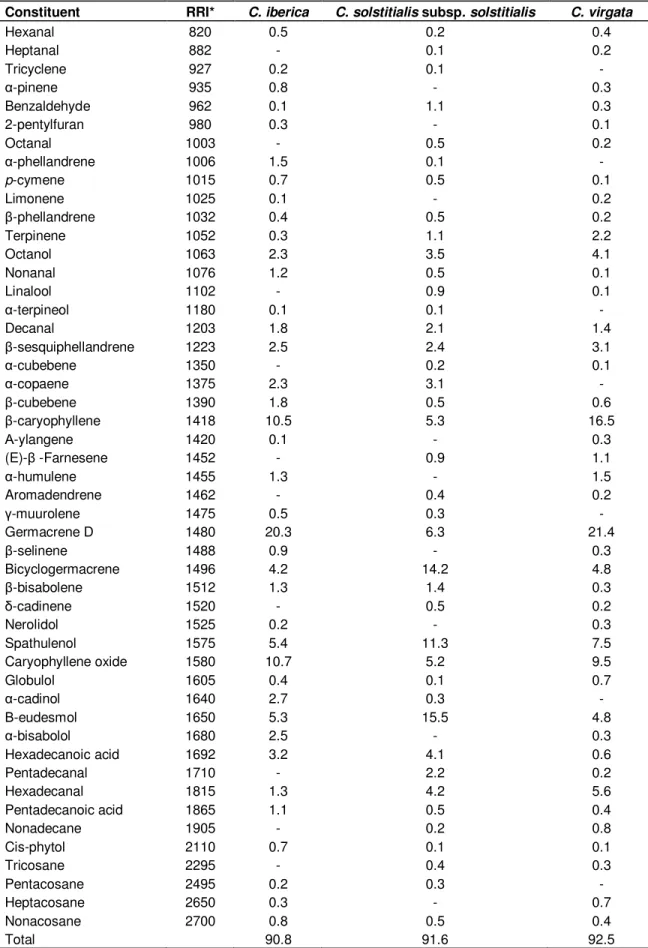
The chemical composition of the essential oil of dried aerial parts of C. iberica, C. solstitialis subsp. solstitialis and C. virgata were analyzed by HS-SPME/GC-MS (Headspace Solid Phase Microextraction Method) extraction technique combined with the GC-MS (Gas chromatography–mass spectrometry) system. The yield of oils are ca. 0.30, 0.35 and 0.40 ml/100 g, respectively. Thirty nine, forty and forty two compounds were identified in C. iberica, C. solstitialis subsp. solstitialis and C. Virgata, respectively, accounting from 90.8, 91.6 and 92.5% of the whole oil. Germacrene D (20.3%), caryophyllene oxide (10.7%) and β-caryophyllene (10.5%), β-eudesmol (15.5%), bicyclogermacrene (14.2%)andspathulenol(11.3%),germacreneD(21.4%),
(21.4%), β-caryophyllene (16.5%) and caryophyllene oxide (9.5%) were detected as the main compounds of C. iberica, C. solstitialis subsp. solstitialis and C. virgata, respectively.
The identified components of studied Centaurea taxa are listed in Table 1. The table also includes their re-tention indices and the percentage composition. And the main constituents of Centaurea taxa from literature and studied taxa are listed in Table 2. In both cases, chemical composition consisted of complex mixtures of different substances, with sesquiterpenes as the dominating constituents.
DISCUSSION
Composition of the three Centaurea species resulted poor in monoterpenes. The essential oil of three taxa were characterized, either numerically or quantitatively by sesquiterpenes. Among these, the main ones were germacrene D followed by caryophyllene oxide, β-caryophyllene, spathulenol and β-eudesmol (Tables 1 and 2). Among the sesquiterpenes, germacrene D was detected as one of the major compound in C. iberica (20.3%) and in C. virgata (10.2%) (Table 1). Similarly, germacrene D was found as a major compound of the essential oils of C. pseudoscabiosa subsp. pseudoscabiosa and C. hadimensis (Flamini et al., 2002), C. mucronifera and C. chrysantha (Dural et al., 2003), C. kotschyi var. kotschyi and C. kotschyi var. decumbens (Ertugrul et al., 2003), C. cineraria subsp. umbrosa (Senatore et al., 2003), C. drabifolia Sm. subsp. detonsa (Bornm.) Wagenitz (Zengin et al., 2012) and ten Centaurea species (Flamini et al., 2006).
In the composition of C. aucheri (DC.) Wagenitz., germacrene D was observed to be lower in our study (Asadipour et al., 2005). Furthermore, germacrene D (21.6%) was determined as the principal component of Gundelia tournefortii var. armata Freyn. and Sint. which belongs to Asteraceae like Centaurea (Bagci et al., 2010). Whereas, germacrene D (3.3 to 1.7 to 0.2%) resulted in very low amounts in study pattern of C. armena Boiss. (Yayli et al., 2005), C. euxina Velen. (Rosselli et al., 2009) and C. napifolia L. (Senatore et al., 2003), respectively. On the other hand, this compound has not been found in C. sessilis Willd. (Yayli et al., 2005).
In this study, caryophyllene oxide (25.2%), β-eudesmol (12.5%), and germacrene D (10.2%) were the main com-pounds of C. saligna (K.Koch) Wagenitz and germacrene D (27.4%), β-caryophyllene (19.3%), β-eudesmol (7.7%), and caryophyllene oxide (6.2%) were the main compounds of C. kurdica Reichardt from Turkey.
Caryophyllene oxide was found as principal constituents of C. iberica (10.7%) and in C. virgata (9.5%) (Table 1). Like our results, this compound also has been detected as a principal constituent in C. chrysantha
(9.5%) (Dural et al., 2003), C. euxina (6.2%) (Rosselli et al., 2009), C. helenioides (18.2%) (Yayli et al., 2009), C. amanicola Hub.-Mor. (12.0%), C. consanguinea DC. (7.3%) and in C. ptosimopappa (4.3%) Hayek. (Formisano et al., 2008). On the other hand, this compound was not a principal constituent in C. cuneifolia Sibth. (Rosselli et al., 2009) and was of low amounts in C. pseudoscabiosa subsp. pseudoscabiosa Boiss. et Buhse (4.4%), C. hadimensis Wagenitz (3.1%) (Flamini et al., 2002) and in C. solstitialis subsp. solstitialis (5.2%) (Table 1). β-Eudesmol was of high percentage in C. solstitialis subsp. solstitialis, C. cariensis subsp. niveo-tomentosa (Ugur et al., 2010), C. cuneifolia (Rosselli et al., 2009) and C. mucronifera (Dural et al., 2003). It is interesting that this compound has not been detected in C. chrysantha (Dural et al., 2003), C. pseudoscabiosa subsp. pseudoscabiosa and C. hadimensis (Flamini et al., 2002). Hexadecanoic acid was the most abundant component of C. aladagensis Wagenitz (Kose et al., 2007), C. luschaniana, C. tossiensis, C. wagenitzii (Kose et al., 2008), C. saligna (Altintas et al., 2009), C. paphlagonica (Kose et al., 2009) from Turkey, three Centaurea taxa from Italy (Senatore et al., 2008) and C. eryngioides Lam., C. iberica Trev. var. hermonis Boiss. Lam. from Lebanon (Senatore et al., 2005). Whereas in our study, hexadecanoic acid was determined in low percentages in three Centaurea taxa (Table 1).
The main differences between under studied samples are high percentages of bicyclogermacrene (14.2%), β-eudesmol (15.5%) and spathulenol (11.3%) detected only in C. solstitialis subsp. solstitialis (Table 1). β-Caryophyllene was detected as the main compound in the essential oil of C. iberica (10.5%), C. virgata (9.5%) (Table 1), C. pseudoscabiosa (8.1%), C. hadimensis subsp. pseudoscabiosa (9.8%) (Flamini et al., 2002), C. kotschyi var. kotschyi (12.1%), C. kotschyi var. decumbens (11.2%) (Ertugrul et al., 2003) and in Anthemis cretica subsp. pontica (20.26%) (Asteraceae) (Kilic et al., 2011). Whereas β-caryophyllene was not determined in the essential oil of C. cuneifolia and C. euxina (Rosselli et al., 2009). Moreover, β-caryophyllene has been reported to be of low percentages in volatile constituents of Tripleurospermum parviflorum (Willd.) Pobed (3.2%) (Asteraceae) essential oil from Turkey (Kilic and Bagci, 2012) and in C. solstitialis subsp. solstitialis (5.3%) (Table 1).
Spathulenol was detected as a major compound in C. cuneifolia (6.3%) and C. euxina (10.8%) (Rosselli et al., 2009). It is interesting that spathulenol was not detected in C. napifolia and detected in trace amounts in C. cineraria (Senatore et al., 2003). Antimicrobial activity of germacrene D (Mishra et al., 2011), antibacterial properties of caryophyllene oxide (Ulubelen et al., 1994), pharmaceutical use of β-caryophyllene have been revealed previously.
Sesquiterpenes are the main class and among these include β-caryophyllene, germacrene D,
Table 1. Identified components of Centaurea taxa (%).
Constituent RRI* C. iberica C. solstitialis subsp. solstitialis C. virgata
Hexanal 820 0.5 0.2 0.4 Heptanal 882 - 0.1 0.2 Tricyclene 927 0.2 0.1 - α-pinene 935 0.8 - 0.3 Benzaldehyde 962 0.1 1.1 0.3 2-pentylfuran 980 0.3 - 0.1 Octanal 1003 - 0.5 0.2 α-phellandrene 1006 1.5 0.1 - p-cymene 1015 0.7 0.5 0.1 Limonene 1025 0.1 - 0.2 β-phellandrene 1032 0.4 0.5 0.2 Terpinene 1052 0.3 1.1 2.2 Octanol 1063 2.3 3.5 4.1 Nonanal 1076 1.2 0.5 0.1 Linalool 1102 - 0.9 0.1 α-terpineol 1180 0.1 0.1 - Decanal 1203 1.8 2.1 1.4 β-sesquiphellandrene 1223 2.5 2.4 3.1 α-cubebene 1350 - 0.2 0.1 α-copaene 1375 2.3 3.1 - β-cubebene 1390 1.8 0.5 0.6 β-caryophyllene 1418 10.5 5.3 16.5 Α-ylangene 1420 0.1 - 0.3 (E)-β -Farnesene 1452 - 0.9 1.1 α-humulene 1455 1.3 - 1.5 Aromadendrene 1462 - 0.4 0.2 γ-muurolene 1475 0.5 0.3 - Germacrene D 1480 20.3 6.3 21.4 β-selinene 1488 0.9 - 0.3 Bicyclogermacrene 1496 4.2 14.2 4.8 β-bisabolene 1512 1.3 1.4 0.3 δ-cadinene 1520 - 0.5 0.2 Nerolidol 1525 0.2 - 0.3 Spathulenol 1575 5.4 11.3 7.5 Caryophyllene oxide 1580 10.7 5.2 9.5 Globulol 1605 0.4 0.1 0.7 α-cadinol 1640 2.7 0.3 - Β-eudesmol 1650 5.3 15.5 4.8 α-bisabolol 1680 2.5 - 0.3 Hexadecanoic acid 1692 3.2 4.1 0.6 Pentadecanal 1710 - 2.2 0.2 Hexadecanal 1815 1.3 4.2 5.6 Pentadecanoic acid 1865 1.1 0.5 0.4 Nonadecane 1905 - 0.2 0.8 Cis-phytol 2110 0.7 0.1 0.1 Tricosane 2295 - 0.4 0.3 Pentacosane 2495 0.2 0.3 - Heptacosane 2650 0.3 - 0.7 Nonacosane 2700 0.8 0.5 0.4 Total 90.8 91.6 92.5
Table 2. Main constituents of Centaurea taxa from literature and studied samples (%). Main constituent 1 2 3 4 5 6 7 8 9 10 11 12 13 14 15 16 17 18 19 20 β-caryophyllene 8.1 9.8 11.2 12.1 0.7 0.9 6.0 1.0 4.3 1.3 5.4 7.3 4.2 - - 8.6 2.8 10.5 5.3 16.5 Germacrene D 36.0 44.3 29.4 44.2 - - - - 61.0 - 3.3 29.3 27.4 - 1.7 22.0 0.2 20.3 6.3 21.4 Bicyclogermacrene 4.2 7.9 4.1 5.5 - - - - 7.2 - - 4.8 5.4 - - 1.7 - 4.2 14.2 4.8 Caryophyllene oxide 4.1 3.1 1.9 3.0 7.8 6.2 10.3 0.3 - 10.0 4.7 5.2 9.5 2.9 6.2 3.2 - 10.7 5.2 9.5 Hexadecanoic acid - - - - 7.4 6.5 6.7 0.1 - - - 17.6 20.3 - - 3.2 4.1 0.6 B-eudesmol - - 1.9 - - - 5.6 2.9 - 12.4 19.3 17.4 - 0.8 - 1.2 - - 5.3 15.5 4.8 Spathulenol - - - - 3.8 4.2 3.9 0.9 - 4.9 3.9 1.5 3.8 6.3 10.8 - - 5.4 11.3 7.5
1. C. pseudoscabiosa subsp. pseudoscabiosa and 2. C. hadimensis (Flamini et al., 2002). 3. C. kotschyi var. decumbens and 4. C. kotschyi var. kotschyi (Ertugrul et al., 2003).
5. C. thessala subsp. drakiensis and 6. C. zuccariniana (Lazari et al., 2000). 7. C. raphanina subsp. mixta and 8. C. spruneri (Lazari et al., 1999). 9. C. solstitialis (Binder et al., 1990). 10. C.
sessilis and 11. C. armena (Yayli et al., 2005). 12. C. mucronifera and 13. C. chrysantha (Dural et al., 2003). 14. C. cuneifolia and 15. C. euxina (Rosselli et al., 2009). 16. C. cineraria
subsp.umbrosa and 17. C. napifolia (Senatore et al., 2003). 18. C. iberica, 19. C. solstitialis subsp. solstitialis and 20. C. virgata (studied samples).
bicyclogermacrene, caryophyllene oxide, followed by β-eudesmol and spathulenol (Table 2). Two fatty acids were present in all taxa 9.9% with hexadecanoic acid being the most abundant (4.1%) in C. solstitialis subsp. solstitialis followed by pentadecanoic acid with low percentanges in all taxa (Table 1). C. pseudoscabiosa subsp. pseudoscabiosa, C. hadimensis, C. kotschyi var. decumbens, C. kotschyi var. kotschyi, C. solstitialis, C. mucronifera, C. chrysantha and C.
cineraria subsp. umbrosa contained high
concentrations of germacrene D (36.0, 44.3, 29.4, 44.2, 61.0, 29.3, 27.4 and 22.0%, respectively) and β-caryophyllene (8.1, 9.8, 11.2, 12.1, 4.3, 7.3, 4.2 and 8.6%, respectively). C. thessala subsp. drakiensis, C. zuccariniana, C. raphanina subsp. mixta, C. spruneri, C. sessilis and C. cuneifolia were characterized by their being free of germacrene D. Furthermore, C. armena, C. euxina and C napifolia were characterized by their lower content of germacrene D (3.3, 1.7 and 0.2%, respectively); C. cuneifolia and C. euxina showed a very different chemical behavior from all the other species, producing high amounts of hexadecanoic acid (17.6 to 20.3%) and spathulenol (6.3 to 1 0.8%), followed by no
percentages of β-caryophyllene and bicyclogermacrene (Table 2).
Conclusion
These species synthesized many similar compounds in their essential oils that could be justified by the similar ecological conditions of their habitat (biochemical convergence). However, taking into account the differences referred to some constituents, also the taxonomic distance of these species could be confirmed by our chemical data. The comparison between the two taxa evidenced a similarity, at least with reference to the presence of the main constituents: in fact germacrene D, caryophyllene oxide and β-caryophyllene were among the principal ones in both studied taxa. Also, the percentages of β- spathulenol and β-eudesmol were comparable. The only differences between the three taxa were substantially due to bicyclogermacrene which was found only in high percentages in C. solstitialis subsp. solstitialis (14.2%) (Table 1). It is possible to say that C.iberica showed germacrene D/caryophyllene oxide/ β-caryophyllene, C.
solstitialis subsp. solstitialis comprised
β-eudesmol/bicyclogermacrene/spathulenol and C.
virgata germacrene D/β-caryophyllene/
caryophyllene oxide chemotype in Eastern Anatolian region of Turkey. Some of the Centaurea species showed different type of essential oil, like germacrene D in C. mucronifera and C. chrysantha (Dural et al., 2003), β-eudesmol in C. sessilis and C. armena (Yayli et al., 2005), β-eudesmol/hexadecanoic acid in C. cuneifolia (Rosselli et al., 2009) and hexadecanoic acid/spathulenol chemotype in C. euxina (Rosselli et al., 2009). Besides, chemical composition of the essential oil of Centaurea taxa showed differences, similarities and different qualitative and quantitative profiles. These differences could be due to the local, climatic and seasonal factors (Perry et al., 1999).
REFERENCES
Altıntas A, Kose YB, Kandemır A, Demırcı B, Baser KHC (2009). Composition of the essential oil of Centaurea
saligna. Chem. Nat. Comp. 45:276-277.
Asadıpour A, Mehrabani M, Nafaji LM. (2005). Volatile oil composition of Centaurea aucheri (Dc.) Wagenitz. Daru-J. Pharm. 13:160-164.
Bagci E, Hayta S (2012). Composition of the essential oil of Centaurea
balsamita L. (Asteraceae) from Turkey.” The Second Int. Symposium
on the Biology of Rare and Endemic Plant Species, April 24-27, Fethiye-Muğla, Turkey.
Bagci E, Hayta S, Kilic O, Kocak A (2010). Essential Oils of Two Varieties of Gundelia tournefortii L. (Asteraceae) from Turkey. Asian J. Chem. 22:6239-6244.
Bancheva S, Greilhuber J (2006). Genome size in Bulgarian Centaurea spp. (Asteraceae). Plant Syst. Evol. 257:95-117.
Baytop T (1999). Turkiye’de Bitkiler ile Tedavi (Gecmiste ve Bugun). Nobel Tip Kitabevleri, Istanbul. P 316.
Binder RG, Turner CE, Flath RA (1990). Comparison of yellow starthistle volatiles from different plant parts. J. Agric. Food Chem. 38:764-767.
Celik S, Rosselli S, Maggio AM, Raccuglia RA, Uysal I, Kisiel W, Michalska K, Bruno M (2006). Guaianolides and lignans from the aerial parts of Centaurea ptosimopappa. Biochem. Syst. Ecol. 34:349-352.
Davis PH (1975). Flora of Turkey and The East Aegean Islands. Edinburgh University Press, Edinburgh. 5:465-585.
Dumlu MU, Gurkan E (2006). A new active compound from Centaurea species. ZnC 61:44-46.
Dural H, Bagci Y, Ertugrul K, Demırelma H, Flamini G, Luıgı Cioni P, Morelli I (2003). Essential oil composition of two endemic Centaurea species from Turkey, Centaurea mucronifera and Centaurea
chrysantha, collected in the same habitat. Biochem. Syst. Ecol. 31:
1417-1425.
Ertugrul K, Dural H, Tugay O, Flamini G, Cioni PL, Morelli I (2003). Essential oils from flowers of Centaurea kotschyi var. kotschyi and C.
kotschyi var. decumbens from Turkey. Flav. Frag. J. 18:95-97.
Flamini G, Ertugrul K, Cioni PL, Morelli I, Dural H, Bagci Y (2002). Volatile constituents of two endemic Centaurea species from Turkey:
C. pseudoscabiosa subsp. pseudoscabiosa and C. hadimensis.
Biochem. Syst. Ecol. 30:953-959.
Flamini G, Tebano M, Cioni PL, Bagci Y, Dural H, Ertugrul K, Savran A (2006). A multivariate stastical approach to Centaurea classification using essential oil composition data of some species from Turkey. Plant Syst. Evol. 261: 217-228.
Formisano C, Rigano D, Senatore F, Çelik S, Bruno M, Rosselli S (2008). Volatile constituents of aerial parts of three endemic
Centaurea species from Turkey: Centaurea amanicola Hub.-Mor., Centaurea consanguinea DC. and Centaurea ptosimopappa Hayek
and their antibacterial activities. Nat. Prod. Res. 22:833-839.
Garcia-Jacas N, Susanna A, Garnatje T, Vilatersana R (2001). Generic delimitation and phylogeny of the subtribe Centaureinae (Asteraceae): a combined nuclear and chloroplast DNA analysis. Annals Bot. 87:503–515.
Guner A, Ozhatay N, Ekim T, Baser KHC (2000). Flora of Turkey and the East Aegean Islands. Edinburgh University Press, Edinburgh. P 11.
Hayta S, Bagci E, Kilic O (2012). Composition of the essential oil of
Centaurea behen L. (Asteraceae) from Turkey. The Second Int.
Symp on the Biology of Rare and Endemic Plant Species April 24-27, Fethiye-Muğla, Turkey. pp. 41-42.
Karamenderes C, Khan S, Tekwani BL, Jacob MR, Khan IA (2006). Antiprotozoal and antimicrobial activities of Centaurea L. species growing in Turkey. Pharm. Biol. 44:534–539.
Kargioglu M, Cenkci S, Serteser A, Konuk M, Vural G (2010). Traditional uses of wild plants in the middle Aegean region of Turkey. Hum. Ecol. 38:429-450.
Kilic O, Bagci E (2012). Chemical Composition of Essential Oil of
Tripleurospermum parviflorum (Willd.) Pobed (Asteraceae) from
Turkey. Asian J. Chem. 24:1319-1321.
Kilic O, Kocak A, Bagci E (2011). Composition of the Volatile Oils of Two Anthemis L. taxa from Turkey. ZnC 66:535-540.
Kose YB, Altintas A, Demirci B, Celik S, Baser KHC (2009). Composition of the essential oil of endemic Centaurea paphlagonica (Bornm) Wagenitz from Turkey. Asian J. Chem. 21:1719-1724. Kose YB, Demirci B, Baser KHC, Yucel E (2008). Composition of the
essential oil of three endemic Centaurea species from Turkey. J. Essent. Oil Res. 20:335-338.
Kose YB, Iscan G, Demirci B, Baser KHC, Celik S (2007). Antimicrobial
activity of the essential oil of Centaurea aladagensis. Fitoterapia 78:253-254.
Koukoulitsa C, Geromichalos GD, Skaltsa H (2005). VolSurf analysis of pharmacokinetic properties for several antifungal sesquiterpene lactones isolated from Greek Centaurea sp. J. Computer-Aided Molecular Design. 19:617–623.
Kustrak D, Radıc J (1985). Pharmacobotanical studies of Centaurea
gloriosa var. multiflora Radic. J. Pharm. Acta Helv. 60:260-268.
Lazari DM, Skaltsa HD Conrstantinidis T (2000). Volatile constituents of
Centaurea pelia DC., C. thessala Hausskn. subsp. drakiensis (Freyn
and Sint) Georg. and C. zuccariniana DC. from Greece. Flav. Fragr. J. 14:415-418.
Medjroubi K, Benayache F, Bermejo J (2005). Sesquiterpene lactones from Centaurea musimomum. Antiplasmodial and cytotoxic activities. Fitoterapia 76:744–746.
Mishra D, Joshi S, Sah s, Dev A, Bisht G (2011). Chemical composition and antimicrobial activity of the Essentials oil of Senecio rufinervis DC. (2011). Indian J. Nat. Prod. Res. 2:44-47.
Nowak G, Drozdz B, Holub M (1994). Sesquiterpene lactones of the Cardueae, subtribe Centaureinae. In: Hind, D.J.N., Beentje, H.J. (Eds.), Compositae: Systematics. Int. Compositae Conf. Kew. 1:219-227.
Perry NB, Anderson RE, Brennan NJ, Douglas MH, Heaney AJ, Mcgimpsey JA, Smallfield BM (1999). Essential oils from Dalmatian sage (Salvia officinalis L.): variations among individuals, plant parts, seasons, and sites. Food Chem. 47:2048-2054.
Rosselli S, Bruno M, Maggio A, Angela RR, Bancheva S, Senatore F, Formisano C (2009). Essential oils from the aerial parts of Centaurea
cuneifolia Sibth. and Sm. and C. euxina Velen., two species growing
wild in Bulgaria. Biochem. Syst. Ecol. 37:426-431.
Rusak G, Krajacic M, Plese N (1997). Inhibition of tomato bushy stunt virus infection using a quercetagetin flavonoid isolated from
Centaurea rupestris L. Antiviral Res. 36:125–129.
Salan U, Oksuz S (1999). Chemical constituents of C. cuneifolia. Turk. J. Chem. 23:15-20.
Senatore F, Apostolides AN, Bruno M (2005). Volatile components of
Centaurea eryngioides Lam. and Centaurea iberica Trev. var. hermonis Boiss. Lam., two Asteraceae growing wild in Lebanon. Nat.
Prod. Res. 19:749-754
Senatore F, Formisano C, Rao A, Bellone G, Bruno M (2008). Volatile components from flower-heads of Centaurea nicaeensis All., C.
parlatoris Helder and C. solstitialis L. ssp. schouwii (DC.) Dosta´ l
growing wild in southern Italy and their biological activity. Nat. Prod. Res. 22:825-832.
Senatore F, Rigano D, De fusco R, Bruno M (2003). Volatile components of Centaurea cineraria L. subsp. umbrosa (Lacaita) Pign. and Centaurea napifolia L. (Asteraceae), two species growing wild in Sicily. Flav. Frag. J. 18:248-251.
Severino JF, Stich K, Soja G (2007). Ozone stress and antioxidant substances in Trifolium repens and Centaurea jacea leaves. Environ. Pollut. 146:707–714.
Sezik E, Yesilada E, Honda G, Takaishi Y, Takeda Y, Tanaka T (2001). Traditional medicine in Turkey X. Folk medicine in Central Anatolia. J. Ethnopharmacol. 75:95-115.
Shoeb M, Macmanus SM, Jaspars M, Trevidu J, Nahar L, Kong-Thoo L, Sarker SD (2006). Montamine, a unique dimeric indole alkaloid, from the seeds of Centaurea montana and its in vitro cytotoxic activity against the CaCO2 colon cancer cells. Tetrahedron 62:1172-1177. Takeda K, Osakabe A, Saito S, Furuyama D, Tomita A, Kojima Y,
Yamadera M, Sakuta M (2005). Components of protocyanin, a blue pigment from the blue flowers of Centaurea cyanus. Phytochemistry 66:1607-1613.
Tesevic V, Milosavljevic S, Vajs V, Janackovic P, Popsavin M (2003). Dithiophenes and other constituents of roots of Centaurea nicolai. Biochem. Syst. Ecol. 31:89-90.
Ugur A, Sarac N, Ceylan O, Duru ME (2010). Antimicrobial activity and chemical composition of endemic Centaurea cariensis subsp.
niveo-tomentosa. Nat. Prod. Res. 24:861-872.
Ulubelen A, Topcu G, Eris C, Sonmez U, Kartal M, Kurucu S, Bozok-Johansson C (1994). Terpenoids evaluation of the antimicrobial activities of essential from Salvia sclarea. Phytochem. 36:971-974. Van Den Dool H, Kratz PD (1963). A generalization of the retention
index system including linear temperature programmed gas–liquid partition chromatography. J.Chromatogr. 11:463-471.
Verzera A, Zino M, Condurso C, Romeo V, Zappala M (2004). Solid-phase microextraction and gas chromatography/mass spectrometry for the rapid characterisation of semi-hard cheeses. Anal. Bioanal. Chem. 380:930-936.
Wagenitz G (1975). Centaurea L. (Asteraceae). In: Davis PH (Ed.), Flora of Turkey and the East Aegean Island. Edinburgh University Press, Edinburgh. 5:465-585.
Yayli N, Yasar A, Gulec C, Usta A, Kolayli S, Coskuncelebi K, Karaoglu S (2005). Composition and antimicrobial activity of essential oils from
Centaurea sessilis and Centaurea armena. Phytochemistry
66:1741-1745.
Yayli N, Yaşar A, Yayli N, Albay C, Aşamaz Y, Coskuncelebi K, and Karaoglu Ş (2009). Chemical composition and antimicrobial activity of essential oils from Centaurea appendicigera and Centaurea
helenioides. Pharmacol. Biol. 47:7-12.
Yesilada E, Sezik E, Honda G, Takaishi Y, Takeda Y, Tanaka T (1999). Traditional Medicine in Turkey IX: Folk Medicine in Northwest Anatolia. J. Ethnopharmacol. 64:195-210.
Zengin G, Aktumsek A, Guler GO, Cakmak YS, Kan Y (2012). Composition of essential oil and antioxidant capacity of Centaurea
drabifolia Sm. subsp. detonsa (Bornm.) Wagenitz, endemic to