Procedia - Social and Behavioral Sciences 174 ( 2015 ) 2647 – 2652
Available online at www.sciencedirect.com
ScienceDirect
1877-0428 Published by Elsevier Ltd. This is an open access article under the CC BY-NC-ND license (http://creativecommons.org/licenses/by-nc-nd/4.0/).
Peer-review under responsibility of the Sakarya University doi: 10.1016/j.sbspro.2015.01.947
* Corresponding author. Tel.: +00 -000-0000-0000 E-mail address: [email protected]
INTE 2014
The formation of knowledge and its active utilization in practices of
public relations in organisations
Veysel Çakmak
a, Ercan Aktan
b, Mahmut Mert Aslan
cAhmet Köse
d a Aksaray University, Ortakoy Vocational Schoolb Aksaray University, Vocational School of Social Sciences, Aksaray c Selcuk University, School of Foreign Languages, Konya
d Anadolu University, Bachelor Student, Eskişehir
Abstract
Knowledge is the basic communication means of human being. It has reached today’s world as the most important and influential means of communication although a part of it disappeared and another part was stored in a way and transferred from one generation to another through out the history. In the meantime, the drastic role of technology in forming and spreading the knowledge should never be ignored.
Public relations is an activity of a variety of recognition and publicity. If we take it in a broader way, we can say that it expresses the total of researches to know the target groups better so as to realise its purposes and also its all activities and applications in the direction of objectives of the organisation in order to introduce and advertise it to the whole public opinion.
The experts of public relations have to prepare plenty of information and also documentaries which are subject to them. They are constantly shared with the rest of the world on the web page of the organisation. As it is known, web sites and social network have become inevitable parts of all sorts of institutions nowadays.
In this work, we are going to investigate the notion of information management and obtained information with regard to this issue is going to be displayed at full length in the interest of internal corporate and usual corporate relations.
In this context, the relationships among information management, Internet and public relations are going to be brought up and their efficient utilization is going to be researched in terms of the organisation.
Formation, handling and especially share of information in business enterprises have no doubt great effects on its transparency, image and openness to the target groups. This situation introduces a positive effect in the process of the publicity of enterprise itself.In this study, we are going to dwell particularly upon the formation, handling, storage and distribution of information in terms of in-house (intra-company) and external public relations. In this context, a vocational school of a university which is worth to be examined from this angle is going to be taken on as a sample.
1.Public Relations (PR)
Public relations (PR) on which there have been lots of definitions is basically an activity of publicity. Peltekoğlu who is one of the leading PR specialists in Turkey defines it as “a strategic communication means” which is realised or set up between the organisation and its target groups whose level of importance varies according to the consumers, distributors or employees of the organisations. It carries out the task of helping the organisations realise their purposes (Peltekoğlu, 2004;6). Public relations is a function and communication of the management. So it is also a way of influencing the public opinion. According to Buda ve Budak (1998: 8), it is a total of activities of a person or an organisation which aims to establish relations with the other people or organisations so as to make relations, to sustain and develope the available relations on the purpose of getting some interests. “Interest” that is mentioned here is rather different from the “material interest” that is used in the field of advertisement and propaganda. It will probably turn out to be a material interest in the long term. However, it is not the main target of public relations. The organisations which has made an “institutional image” in a long time will no doubt take many advantages of that image.
The applications of public relations can be mentioned in all places where there is a discrimination between the managers and employees or sellers and buyers because public relations which in essense depends on the organisational output is naturally an an efford of organisation which tries to regulate that order and controls the related environmental factors at the same time. Taking the inevitable organisation-environment relations into consideration, public relations can be seen as an instinctive and natural activity in every place where the organisaiton exists (Kazancı, 2009; 39). But it is often mixed with the other similar notions because of its inter-relational nature and multi-dimentional structure. Those similar notions are usually “advertisement”, “publicity”, “propaganda”, “human relations”, “communication”, “image” and so forth…
To specify where the activities should be directed to and which technics and strategies should be used in those areas are accepted as the keys to success in public relations. The target groups should be known and the organisation should introduce and advertise itself very well (Budak ve Budak, 1998: 149).
To know and determine in which areas the activities of public relations should be concentrated and which methods and means should be used to execute them will undoubtedly effect the level of success of the activity of public relations to a large extent. If the target group is known very well in the process of communication, the most convenient technics and means to be used can be modified and applied easily. Otherwise, all the efforts might be of no use. The activities to be carried out in that direction are divided into two categories: The first category contains a variety of recognising methods in public relations like citizens’ personal applications, the relations with the representative persons and groups, recognising through the technics of surveys, meetings, browsing the mass media, face to face relations with the public, referendum and public opinion researches. The second one contains face to face relations, the art of public speaking, plausibility, talking on the phone; printed media such as newspapers, magazines, brochures and manuals, notices, placards, rosettes, stamps, letters, annuals and books; audio-visual means such as radio, television, films, internet, intranet and other visual means; and the other means such as competitions, exhibitions, fairs, festivals, conferences, symposiums, seminars, organisation tours, panels, openings, anniversaries, welcome ceremonies, photographs, and sponsorships (Yavuz, 2006: 25-55).
As to computers, they are used as one of the means of both recognition and publicity. Those contains almost all means of communication.
As everybody knows, one of the productions of computer technology is the Internet. It is impossible to stay away from the computer technology and the Internet for the individuals of information society. Serious efforts have been made in order to advance and expand the use of the Internet in the areas like education, culture, health, public services, legislation and justice not only in the world but also in our country. People can actively and directly take part in the process of producing and sharing the information over the Internet so as to satisfy themselves and to put forward to their own ideas (Selvi, 2012: 208).
2. Information Management
Information management is a total of theories and applications rendering production, depiction, evaluation, development and distribution of intellectual resources of the organisation within the framework of a specific plan. The information should be formed through activities or else it is not going to have a purpose and value. Those
activities bring forward the necessity of knowing what sort of information should be used to run the businesses within the organisation. The information at issue may directly be the information of running that is needed in every level of developing work and actions of the organisation or to put it in another way, it may be the information of management needed to control and develop the activities. Most of those kind of information are formed in the documents which organisations have produced in the process of activities. Therefore, those first-hand documents are the most important institutional resources of organisations. From time to time, they can also be a part of the national archives just since they include institutional information. In other words, they are not only the actual memory of the organisations, but also the nation’s memory in later centuries (Özdemirci, 2001; 180).
Besides, all the organisations and institutions form the information producing documents within the framework of recognition and publicity while they are running their businesses. Information in question which were produced for the in and out of corporation take their places in the archives as the memory of the organisations and institutions. However, they make a great contribution to the memory of the country.
The answer of the question “Who produces the information?” can be “all employees”, especially the ones who can be defined as the “information workers” who intensively deal with the information. Most of them are white collar workers for instance medium and high level managers, researchers, instruction providers and appliers (Çapar; 2005: 50).
Not only the activities and means of recognising and publicity but also formation and sharing of the information in the organisations are carried out by the specialists of public relations. In addition to that, they are responsible for doing the researches that the organisation itself need. They produce a great many of information while they are doing these businesses and all those information and documents are saved in their Internet sites as a part of their corporate identity.
Information management can be probed in the basic processes below: They are production, development, classification, protection, transmission, share, utilization and evaluation of the available information. Those basic processes demonstrate that information management operates in an unbelievably vast area in effect (Yalçınkaya, 2011: 158).
The main purpose of knowledge management is to reflect and inform the business about the scientific and technological innovation around the business with the conceptual development. To be informed in time about innovation and change has a great importance for educational institutions that produces and shares information. (Celep ve Çetin; 2003; 31)Following innovations and discoveries is the task of educational institutions .Schools that are incorporating with researchers can continue to play leader and interchanging roles as long as they follow innovations and changes in the community.
3.Formation of Information and Public Relations
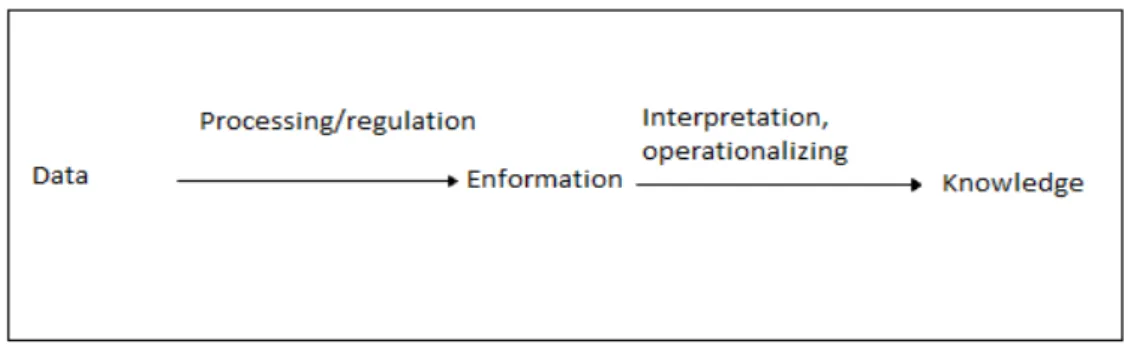
Formation of information is related to data and knowledge. Informtion consists of objective realities regarding the facts and they are not made connected with one another yet. Data is the saving of the operations in an unconstructed form in accordance with purpoeses of the organisation. Data which are considered as not unassimiliated the uncommented observations and uncultivated facts is saved by the technological systems in the modern organisations. For instance, 710x370 A41 is a datum, but it may mean nothing for most of the people. Whereas, information that was not put in an order may also be identified as the data. It has got a meaning for only the person who is relevant with it. Information which has got a much richer content than data is usually a written, oral or visual message (Barutçugil, 2002:57).
Güçlü and Sotirofski (2006: 354) developed a table which tells about the relationship among data, information and konowledge.
Figure 1: Formation of Information
Reference: Güçlü ve Sotirofski (2006: 354)
All those stages can be seen clearly when it is looked at the applications of public relations. When the example of brochure is taken in hand;
There are identifying sorts of data. After they are classified, ordered and added pictures, they turn into the brochures.
Brochures are short term and printed communicative means which consists of six or more pages and distributed to a target group for a particular purpose a certain time ago. The basic steps to follow to prepare a brochure are stated below:
-The purpose should be identified openly.
-A notion around the purpose should be developed. -The content should be determined before.
-Information which will be given, formative features which will be designed, visual materials which will be used and also colour and white space should be identified.
-It should be printed in a way that it can be increased when it is necessary. -It should be distributed (Peltekoğlu, 2004:247).
If the subject in taken in hand in terms of archives and public relations, it can be said that the public opinion perceive the archive recources as very important documents forasmuch as they are the evidence of great importance for the persons, organisations or nations. Besides, it should not be forgotten that the public relations provides with the value that the archives and the employees of it deserve. There are a wide range of means in public relations to introduce and advertise the institutions of archives to the public opinion, their vocations to the intra-company employees and their archives to the country and the whole world. However, the archivists should not ignore the measureable benefits and advantages brought by the mass media. Advertisement equivalents which are rendered by the reflections of mass media have been utilized for a long time (Ataman, 2006: 221).
The public relations which can not be ignored on account of its advantages in today’s contemporary societies have moved up to a higher position nowadays than it was in the industrial and modern societies. One of the reasons of that escalation is the fact that people and organisations have needed much more exchange of information then ever before. People may be exposed to uncountable messages from different places in information societies which keeps on developing the information means and technics. Because this case causes the problems of not being understood enough and being misunderstood in terms of both of the resource and the receiver, some unwanted effects comes out unavoidably. The only way of understanding the demands of target groups and explaining itself to them by preventing those sorts of negative effects at the same time is definitely the public relations (Canöz, 2008: 357).
In this study, knowledge management of an educational institution was investigated in accordance with the public relations activities.
In this survey, document analysis method was used. According to Yıldırım and Şimşek (2005;187); the public, private record collection or of the analysis of written materials containing information about case or cases have to be investigated and examined in a systematic way at the first step. Movies, videos and photos may be used in document analysis. In addition, using qualitative data collection methods such as observation and interviews can
contribute to the validity of the research.
In this study, knowledge management of an educational institution was investigated in accordance with the public relations activities. In this context, as a public institution, the University of Aksaray Ortaköy Vocational School was selected. There are 1,350 students and 40 academic and administrative staff at institution. Institution was examined in terms information management and public relations. At the end of study, documents that has been created by the institution as a public relations agency method were included in the study. Letters that are written by public institutions to individuals and organizations is called as "official letter”. Besides ; student document , report, notices ,board decisions are documents created in public institutions.
In the Yağmurlu’s study (2010), public relations communication tools are divided into two as recognition and promotion. These are written-tools , social-cultural tools and audio- visual tools.
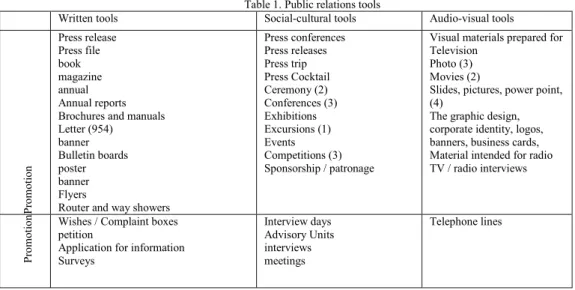
In this study, according to Yağmurlu’s study (2010) Aksaray University ,Ortaköy ,Vocational High School was examined with considering in recognition of public relations as in Table 1.
Table 1. Public relations tools
Written tools Social-cultural tools Audio-visual tools
Pro m ot io n Press release Press file book magazine annual Annual reports Brochures and manuals Letter (954) banner Bulletin boards poster banner Flyers
Router and way showers
Press conferences Press releases Press trip Press Cocktail Ceremony (2) Conferences (3) Exhibitions Excursions (1) Events Competitions (3) Sponsorship / patronage
Visual materials prepared for Television
Photo (3) Movies (2)
Slides, pictures, power point, (4)
The graphic design, corporate identity, logos, banners, business cards, Material intended for radio TV / radio interviews
Pro
m
ot
io
n Wishes / Complaint boxes petition
Application for information Surveys Interview days Advisory Units interviews meetings Telephone lines Reference: Yağmurlu, 2010.
The information and documents created in Vocational School were examined in terms of public relations At the end of review ; letters that belong to 2013 are the most important information-"as official texts" .According to Table 1; in order to perform in-house and inter-agency communication 954 texts has been written in this year. Two ceremony , three conferences ,one trip and three contests were made as socio-cultural tools at the institution. On the other hand, three photo presentation that identifies the institution, two film screenings and four-slide presentation are done as audio-visual tools.
4.Result
Corporate design and corporate identity consists almost visual element such as in-house publications, visual aids, architectural and decorative events, printed papers for external target audience , brochures, posters, announcements on billboards, clothes, attired tools, architecture and product-based visual design, corporate symbols. In addition, reports of corporate communications, annuals, advertising, publicity and the key elements of press, can be added to visual aids. (Sezgin, 2008).From social-cultural and audio-visual communication tools information about introduction of the institution is given.
When official texts that are created mostly at institutions are examined, the name of institution ,the official emblem of the institution and communication address of institution are seen in this document .
In terms of public relations, this communication tool reveals corporative identity of institution .
public relations activities were created in 2013. In addition to this, such as ceremonies, conferences, festivals and competitions and social - cultural activities are limited, and photos, movies and slide presentation have been found to exceed an average of 3 as well as.
According to this condition, It was identified that in the framework of information management that is developed public relations practices in social-cultural activities and audio-visual communication vehicles is very weak, in addition to this; except letters writing vehicles are inadequate.
Introduction and definition tools used in PR are required more intensive and efficient use for successful knowledge management and public relations activities
For a healthier conducting with the relationship between audiences and institutions transferring the message means of communication with the relevant stakeholders is very important.
From this point; Ortaköy Vocational School for different target audience , producing different knowledge context
And introducing this knowledge with using tools efficiently to reach the desired segments would be appropriate
References
Ataman, B. K. (2006), Bilgi Yönetimi Akademik Yaklaşımlar Kitabından, Bölüm, Editör, Berat Bir Bayraktar, Arşivler ve Halkla İlişkiler, Beta Yayınları,
Barutçugil, İ. (2002), Bilgi Yönetimi, Kariyer Yayıncılık İletişim, İstanbul. Budak, G. Budak, G. (1998), Halkla İlişkiler Davranışsal Bir Yaklaşım, İzmir.
Canöz, K. (2008), Bilgi Toplumu ve Halkla İlişkiler, Halkla İlişkiler, Editörler: Ahmet Kalender, Mehmet Fidan Onikinci Bölüm, Tablet Yayınevi, Konya.
Celep, C. Çetin B. (2003) Bilgi Yönetimi, Örgütlerde Bilgi Paylaşım Kültürü Yaratma, Anı Yayıncılık, Ankara.
Çapar, B. (2005), Bilgi: Yönetimi, Üretimi ve Pazarlaması, ÜNAK'05: Bilgi Hizmetlerinin Organizasyonu ve Pazarlanması, www.unak.org.tr, Erişim Tarihi:25.07.2912.
Güçlü, N. Sotirofski, K. (2006), “Bilgi Yönetimi”, Türk Eğitim Bilimleri Dergisi, Güz 4(4), 351-371. Kazancı, M. (2009), Kamuda ve Özel Kesimde Halkla İlişkiler, Turhan Kitabevi, Ankara.
Koç H., Tarhan Öztoprak M., (2003), Yazışma Teknikleri Örnekler ve Uygulamalar, Seçkin Yayınevi, Ankara.
Özdemirci, F. (2001), Belge Üretimi ve Kurumsal Bilgi Yönetimi, 21.Yüzyıla Girerken Enformasyon Olgusu Sempozyumu: Bildiriler (19-20 Nisan 2001: Hatay), Ankara: Türk Kütüphaneciler Derneği, 179-186.
Peltekoğlu, F. B. (2004), Halkla İlişkiler Nedir?, Beta Basın Yayın Dağıtım, İstanbul.
Sezgin M K. (2008) “İletişim Biçimi ve Ortamı Olarak Görsel Kimlik”, Selçuk Üniversitesi, İletişim Fakültesi Akademik Dergisi, Cilt: 5, Sayı : 2, S. 61-67, Konya.
Selvi, Ö. (2012), Bilgi Toplumu, Bilgi Yönetimi ve Halkla İlişkiler, Gümüşhane Üniversitesi, İletişim Fakültesi Elektronik Dergisi, Sayı: 3, Gümüşhane.
Yağmurlu A. (2010) E-Halkla ilişkiler ve Bakanlık Uygulamaları, Selçuk Üniversitesi İletişim Fakültesi Dergisi, Cilt: 6, Sayı: 2, S. 62-80, Konya.
Yalçınkaya, Y. (2011), Bilgi Yönetimi ve Sanal Organizasyonlar: Bir Uygulama Örneği, Marmara Üniversitesi, Sosyal Bilimler Enstitüsü, İletişim Bilimleri Anabilimdalı, Yayımlanmamış Yüksek Lisans Tezi,