GLOBES in the GLOBE
Önder KARAGÖZLÜ
1 AbstractThis article argues that regionalism arises from safety concerns and power motives and it has a core of political polarization at the global level. Thesis of the article clarifies itself by showing how the economic dimension of globalization is used as a tool of regionalism. Economic integration which targets to increase trade volumes, stimulate economy and multiply the prosperity of people serves the man’s safety motives much more than it does the economic interests; it is a tool of region-alism, so it is a tool for providing security and achieving power. European Union as a representative of the highest level in economic integration today is very clear model of this trio: economic region-safety region-power region. So, the globes are regions here and the globe is the world.
Keywords: Regionalism, Globalization, Economic Integration, European Un-ion.
Dünyadaki Bölgeler Özet
Bu makale, bölgeselciliğin güvenlik kaygıları ve güç motivasyonlarından doğ-duğunu ve küresel seviyede bir siyasi kutuplaşmanın özünü içerisinde taşıdığını iddia etmektedir. Makale, küreselleşmenin ekonomik boyutunun, bölgeselciliğin bir aracı olarak kullanıldığını göstererek kendi tezini belirginleştiriyor. Ekonomiyi canlandırmayı, ticareti ve insanların zenginliğini arttırmayı hedefleyen ekonomik bütünleşme, insanoğlunun iktisadi çıkarlarına hizmet ettiğinden daha fazla, onun güvenlik dürtülerine hizmet etmektedir; ekonomik entegrasyon, bölgeselciliğin ve dolayısıyla güvenlik sağlama ve güç elde etmenin bir aracı olarak kullanılmaktadır. Ekonomik bütünleşmelerin bugün en yüksek seviyesini temsil eden Avrupa Birliği, iktisadi bölge-güvenlik bölgesi-güç bölgesi triyosunun çok açık bir modelidir. Ça-lışmada küreler bölgeleri, küre ise dünyayı sembolize etmektedir.
Phd Candidate, Ankara University Department of European Union and International
Eco-nomic Relations.
1 This paper was presented first at Bilkent University International Relations Graduate
Anahtar Kelimeler: Bölgeselcilik, Küreselleşme, Ekonomik Bütünleşme, Avru-pa Birliği.
Introduction
Neither globalisation nor regionalism is new in world history. As a globe, world has been globalizing since the beginning, just the speed and colours change. Regionalism one of the outcomes of globalization is where economic integration stands in the centre of its framework. When the eco-nomic integration had been discovered as an attractive way and method of uniting the parts and becoming “united” against the threats, regionalism ap-peared by wearing the clothes of free trade and common market. Today’s regions have not been completed yet, they need to be solidified with some common interests against some common threats. It is likely that tomorrow’s regions will be new forms of yesterday’s empires.
This work’s main method is determining and distinguishing the aims and the tools in regionalism process. According to this, economic integration is determined as the fundamental tool to ensure the aim of economic pros-perity. While economic prosperity is a first stage aim, it is also the tool of the main goal of establishing a safety region and then having and using power in the global game. Additionally, the paper emphasises that the aims are emerg-ing from the human nature and the tools can work owemerg-ing to it.
The paper has planned to express itself in three main sections. First sec-tion introduces the case by setting up a connecsec-tion between the facts of glob-alisation and regionalism. Following section is an answer to the question of how it became. It uses the model of Europe and European Union to analyse the regionalism. Third section examines the theory of economic integration to see how it effects and legitimates the regional based economic integra-tions. And the conclusion section tries to make a small speculation on the future by asking what is next.
Globalisation, Regions and Regionalism
One of the clearest features of the contemporary global era is that it has a “regional flavour.”2 So, what is region, the root of “regional”?
Definition of region -as an international space- basically determined by geographic features, a group of countries located in a same geographic area.3
2 Mark Beeson, “Re-thinking Regionalism: Europe and East Asia in Comparative Historical
Perspective.” Oceanic Conference on International Studies, Canberra July 14-16, 2004, p.1.
3 Edward D. Mansfield and Helen V. Milner. “The New Wave of Regionalism.”
But the concept is larger than it; it refers to territorial, political, economic, functional space and the space of all social interactions. “It is also an institu-tional system, either in the form of a regional government or as a group of institutions operating on a territory.”4 As it is seen from the dimensions of it, a region depends on various concepts those are related with the geographic space. Despite the lack of geographic qualifications to describe region, it is not fully independent from the geography,5 contrarily the fact of geography is one of the sources of region’s other characteristics.
Sharing a common geography may cause a few facts such as having a common culture, common concerns etc. Also it provides proximity that fa-cilitates trade relations between the countries. Since the beginning of 1990s some alterations in international economy have occurred as the results of developments in technology and so the communication, transportation and especially international trade and manufacturing.
While technology in the global era provides new ways for the relations, it also accelerates the movement to facilitate to connect. The role of techno-logical developments today is a bit different from the industrialization age. Its determination ability today is not only because of inventing new manu-facturing techniques; today its role is mostly being a catalyst in the economic relations by transportation and communication facilities. As the interactions and relations between societies are becoming independent from the space6, economic relations are also becoming independent from the national spaces by the help of technological progress.
Some theories about the mentioned transformation and of changing global system explain the globalism in the capitalist processes which is dif-ferent from the national states system. The process is driven by transnational capital and production, transnational capitalist class and transnational states7.
An ‘epochal shift’ has taken place with the transition from a world economy to a global economy. In earlier epochs, each country developed a
4 Michael Keating, “Is there a regional level of government in Europe?” translation Uttam
Bharthare. Regions and Regionalism in Europe. ed. Michael Keating. Cheltenham: Edward Elgar Publishing, 2004, p.568.
5 The criteria of applying EU to be a member state may provide a viewpoint about this matter:
to be a “European state” is stipulated in The Treaty on European Union article 49 for becom-ing a member of EU.
6 Anthony Giddens, “Modernliğin Küreselleşmesi.” Küresel Dönüşümler. translation
Mehmet Celil Çelebi. ed. David Held and Anthony McGrew. Ankara: Phoenix Yayınevi, 2008, p.81.
7 Leslie Sklair, 2000, 2002; William I. Robinson, 2007, “Theories of Globalization”,
http://www.deu.edu.tr/userweb/timucin.yalcinkaya/Theories%20of%20Globalization.pdf (11.05.2014), p.130.
national economy that was linked to others through trade and finances in an integrated international market. The new transnational stage of world capi-talism involves the globalization of the production process itself, which breaks down and functionally integrates what were previously national cir-cuits into new global circir-cuits of production and accumulation.8
Such explanations are always remarkable as long as it is remembered that national states are still the major players in the game and all social phe-nomenon has natural roots.
After the developments as mentioned above, international trade had much more complex composition. 21st century trade is consisting of “trade-investment-service nexus”9 which needs complex rules according to its com-plex character. It was clearly noted that the barriers in front of the interna-tional trade are not the tradiinterna-tional customs barriers, there are also barriers behind the borders like competition policy, intellectual property, movement of capital, investment rules etc. Insufficiency of traditional theory of foreign trade to understand and explain the new international trade composition is eliminated by a deeper discipline which can be stated as an explanation of 21st regionalism. 21st regionalism is set by deep regional trade agreements to remove not only customs barriers but also behind-the-border barriers.10 The new political economy in regionalism (so the new regionalism11) is not about reaching new markets; it is about crossing the borders to set up a trade-investment-service connection.
It is considered that there are four regionalism waves in the history. First wave was in the second half of the 19th century as a result of industrial revolution. It is mostly reminded with German Zollverein.12 Second episode was the interwar period where some trade arrangements formed to consoli-date “the empires of major powers”. The third wave of regionalism occurred after the World War II, states continued to organize foreign trade on a
8 Robinson, Ibid.
9 It expresses that international trade is not the trading of final goods and services between the
countries anymore. In today’s world economy there is a trade and production chain that links are separated in different countries. It is not just about the manufacturing links in the produc-tion process of a single good, also about the linkages between foreign trade, foreign invest-ment and foreign service sector (See Richard Baldwin, “21st Century Regionalism: Filling the gap between 21st century trade and 20th century trade rules”, WTO Economic Research and Statistics Division, Staff Working Paper ERSD-2011-08).
10 See Baldwin, Ibid.
11 New regionalism can be defined with the change in deepness and comprehension of free
trade agreements has been made especially since 1990s.
gional basis. When the Cold War ended, the last wave of regionalism has started to be seen with some new features in an uncertain condition of post-Cold War. The most distinctive feature of new regionalism is that trade ar-rangements include some regulations to maintain economic and political reforms in prospective members. One other difference in new regionalism from the prior ones is that new trade agreements facilitate the members’ participation in the world economy.13 It means the regional based trade agreements do not provide an obstacle to the global trade; in fact new re-gionalism increases the world trade volumes as GATT/WTO14 targets. All these features of new regionalism can be characterized by the facts of politi-cal economy of neoliberalism which is mostly conducted by USA, but it must also be remembered that the new regionalist liberalism is formed by regional agreements in regional levels not in the global level. There is a mu-tation of neoliberalism caused by the physical, economic and political de-terminatives; this mutation points out a natural role of “region” in interna-tional relations. And lastly, the authentic condition15 of post-Cold War must be recognized as the other feature of new regionalism.
The movement accelerated and then the distance shrank, so importance of the physical proximity started to decrease, but it doesn’t mean regions are independent of geographic proximity now. Although there is an explosion of free trade agreements between the countries and regions without the deter-mination of geographic factors, all deep integration attempts are still regional based. So, what happened when the “distance has died”? 16 The spread of regional integration attempts and the new regionalism are outcomes of glob-alization. What we define with technology and liberal economy based quali-fications in international relations is just globalization. Globalization is a process of increasing the connections between national territories and re-gionalism seems it is (or it will) a phase of globalization. While the move-ment is getting faster, the distance is shortening and the regions are widen-ing; that is what happens with globalization. Acceleration and increasing of communication and of transportation, economic relations and all social in-teractions between old regions has started to create new ones as globalized regions in a globalizing world. Old region is the land of national state; new region is an integration area of the national states.
13 For the waves of regionalism, see Mansfield and Milner, op.cit., P.595-601.
14 GATT (General Agreement on Tariffs and Trade) was in force between 1948 and 1995;
WTO (World Trade Organization) took its place in 1995.
15 This authentic condition implies the new structure of global international relations after the
bipolar structure of the Cold War era. For the concept of “structure” in international relations, see Kenneth Waltz and structural realism.
A similarity can be established between regions under the national state authority and the regions under the dominations of globalization; protecting and promoting regional interests against the global authority.17 Globalising world produce the wide regions which is not the regions under the national state autonomies, this time some features draw a new profile, a region where the national states under the autonomy of it. Of course this is not the case for all regional cooperation projects, but for example European Union; while it represents the highest level of regional based economic integrations, it also represents the supranational structure of a regional governing. There is a formula here: deep integration equals high supranational structure.
The Model: Europe
Economic integration is one of the most functional18 inventions in capi-talist era which has the talent of determining internal and external relations. If we search for the logic in economic integration, we’ll face human charac-ter. The theory had been told by Adam Smith by introducing the famous character homo economicus.
It is not from the benevolence of the butcher the brewer, or the baker that we expect our dinner, but from their regard to their own interest. We address ourselves, not to their humanity, but to their self-love, and never talk to them of our own necessities, but of their advantages.19
Adam Smith’s words above present two main proposals: first, the hu-man behaviour that based on our self-interested character maintains the so-cial life in a harmony. Second, it tells us that our economic motives are the strongest reason of an integrated human life. That “motive” is the fascinating tool of economic integrations; natural reason was discovered as a political tool of states. If the liberal market is a “big social invention”,20 using man-kind’s economic motives to generate a social and political unity was a big political invention which builds a safety and a power region.
Method was applied successfully in 19th century in the region of King Wilhelm and Bismarck: Zollverein. It was a customs union between
17 About the regional interests at the base of regions, see Frans Schrijver, Regionalism after
Regionalisation, Amsterdam: Amsterdam University Press, 2006, p.21.
18 It may be useful to see the theories of “functionalism”.
19 Adam Smith, An Inquiry into The Nature and Causes of The Wealth of Nations, 2005,
http://www2.hn.psu.edu/faculty/jmanis/adam-smith/wealth-nations.pdf (09.05.2014), p.19.
20 See Robert L. Heilbroner, The Worldly Philosophers, Fifth print, New York: Simon and
ed small German states. The idea that German states should establish a cus-toms union was suggested by economist Friedrich List in 1819.21 In 1834 customs union was established to stimulate trade and economy and also to reach a political union which was constituted on the logic of economic de-pendence.
Although German society has existed on the Europe map for centuries, a German state did not exist until 187022. Establishing a German state was an accomplishment of economic integration. It was a “major breakthrough for economic unification within Germany.” A successful project, because it came to a conclusion of political unification with the empire in 1871. “Tradi-tionally, academic literature saw therefore the Zollverein as a precursor to political unification and interpreted this customs union as a political tool created by Prussia to exert power over other German states”.23
Europe is the homeland of using economic motives to generate a unity. The most successful integration project has been achieved in Europe. Today, it is European Union (EU) which inspires the other regional integrations in the world. Jean Monnet, one of the intellectual and political founders of in-tegrated Europe and of EU, had shown economic integration for Europe’s prosperity in 1943: “The countries of Europe are too small to give their peo-ples the prosperity […] they need wider markets.”24 But it was an idea much more than an economic prosperity goal; it was a peace project as EU intro-duces itself today.
The European Union is set up with the aim of ending the frequent and bloody wars between neighbours, which culminated in the Second World War. As of 1950, the European Coal and Steel Community begins to unite European countries economically and politically in order to secure lasting peace. The six founders are Belgium, France, Germany, Italy, Luxembourg and the Netherlands. The 1950s are dominated by a cold war between east and west. Protests in Hungary against the Communist regime are put down by Soviet tanks in 1956; while the following year, 1957, the Soviet Union
21 Coşkun Üçok, Siyasal Tarih, 2. Baskı. Ankara: Ankara Üniversitesi Hukuk Fakültesi
Yayınları, 1978, p.131.
22 Derek W. Urwin, Regions and Regionalism in Europe, ed. Michael Keating. Cheltenham:
Edward Elgar Publishing, 2004, p.43.
23 Florian Ploeckl, “The Zollverein and the Formation of a Customs Union.” University of
Oxford Discussion Papers in Economic and Social History, 2010, http://www.nuff.ox.ac.uk/economics/history/Paper84/ploeckl84.pdf (11.05.2014), p.2.
24 Richard Baldwin and Charles Wyplosz, The Economics of European Integration, 4th
takes the lead in the space race, when it launches the first man-made space satellite, Sputnik 1. Also in 1957, the Treaty of Rome creates the European Economic Community (EEC), or ‘Common Market’.25
The summarized story of EU until the Treaty of Rome in 1957 implies two safety matters; accommodating peace especially between fiery enemies France and Germany in Europe and building a security bloc against the So-viet threat. Founding of European Coal and Steel Community and EEC are obviously seen a project of establishing a safety region. In 2004 EU had experienced its biggest enlargement with the old members of East Block (Centre and Eastern Europe Countries)26. The enlargement was mostly relat-ed with the Europe’s safety.
European Commission describes the EU’s enlargement policy as ex-tending the European values and standards to maintain the Europe’s safety: “Enlargement serves the interests of Member States as well as acceding countries. It makes Europe a safer and more prosperous place, in particular through its promotion of democracy and fundamental freedoms, the rule of law and the single market.”27 Beside the enlargement, the common values of EU such as democracy and single market are the tools of EU’s soft power for security and for being a global power. The speech of the former EU Commissioner for Enlargement Olli Rehn indicates the tools, methods and aim:
The EU has relied primarily on soft power, pursuing its objectives by influence rather than by force. Enlargement policy is the EU's most im-portant soft power tool. The power of attraction exerted by the EU has acted as an incentive for stability and democracy in Central and Eastern Europe. This process is now continuing in the Western Balkans and Turkey. All EU countries benefit from having neighbours that are stable democracies and functioning market economies.28
The present commissioner emphasises the role of EU as a global player: “The EU’s enlargement policy makes Europe a safer and a more stable
25 European Union, “The history of the European Union.”
http://europa.eu/about-eu/eu-history/index_en.htm (10.05.2014).
26 These countries are Czech Republic, Estonia, Cyprus, Latvia, Lithuania, Hungary, Malta,
Poland, Slovenia and Slovakia.
27 European Commission, “The European Union explained: Enlargement”, 2013,
http://europa.eu/pol/pdf/flipbook/en/enlargement_en.pdf (11.05.2014), p.3.
28 Olli Rehn, “The EU – from civilian power to premier league security policy player?”, 2008,
place; it allows us to grow stronger and to promote our values, and enables us to assume our role as a global player on the world stage.”29
The EU’s mentality on regional economic integration is that a regional integration can be successful if certain economic and non-economic precon-ditions are fulfilled. Those conprecon-ditions are structural stability, rule of law, good governance and macroeconomic and monetary stability. Because of this mentality (also method), EU makes effort to constitute a supranational principle instead of intergovernmental method in its decision-making pro-cess.30 Of course the supranational approach needs to be supported by politi-cal cooperation, indeed politipoliti-cal integration. European Union, as it laid the foundations of EEC on the economic dependence and prosperity it also had deepened political integration by the economic integration. EU still has not reached a political integration at an ideal level because of disagreements31 between the national states which is also in contradiction to supranational dimension of EU nevertheless EU could have achieved the economic and
monetary union.32 As of 2014 EU is a 28 membered regional union which is the biggest economic bloc and one of the most effective global powers in world politics.
There are also other economic integrations such as ASEAN, NAFTA, COMESA, ANDEAN, MERCOSUR, SAARC etc. Following map shows the regions of economic integrations.
29 Stefan Füle, Euroepan Commission, “The European Union explained: Enlargement”, 2013,
http://europa.eu/pol/pdf/flipbook/en/enlargement_en.pdf (11.05.2014) .
30 Walter Kennes, 1997, 27-28. “The European Union and Regionalism in Developing
Coun-tries”, European Commission and World Bank Seminar on Regionalism and Develop-ment, Brussels, 2 June 1997, p.27-28.
31 Since its inception, EU has witnessed many disagreements or conflicts in its deepening and
widening process. For example the controversies on the structure of EU governing which arises from intergovermentalist and supranationalist approaches; or conflicts on EU budget agreements. This controversial character of EU is also why it couldn’t achieve a completely harmonized fiscal policy between the members and why it was not good at overcoming the economic crises.
32 Economic and Monetary Union (EMU) -mostly accepted as the last stage of economic
integration- in EU states a single market with a single currency (Euro), a single monetary policy and a structure to coordinate fiscal policies under a supranational institutional frame-work. EMU has 18 EU members with the last participant Latvia in 2014. For detailed infor-mation about EMU see Baldwin and Wyplosz, op.cit. or see Belgin Akçay, “Ekonomik ve Parasal Birlik”, Avrupa Birliği: Tarihçe, Teoriler, Kurumlar ve Politikalar, ed. Belgin Akçay & İlke Göçmen, Ankara, Seçkin Yayıncılık, 2012.
Map 1: Regions of Economic Integrations Source:
http://en.wikipedia.org/wiki/File:Regional_Organizations_Map.png#filelinks (11.05.2014)
Regionalism and Economic Theory
All political and economic policies or projects need scientific theories to have their legitimacy. The idea exists in the core of regional economic integration is the theory of liberal economics which says simply, free market is the master of economy and international trade is good for all. This doc-trine is as old as the classic liberals like Adam Smith and David Ricardo, but it is not an expired one. It is the base of the marginal revolution in economic theory and the other forms of neoclassic doctrine which is the dominant the-ory of all modern markets. The thethe-ory works better from the smallest market toward the biggest one, from national market to a regional or the global mar-ket.
The literature which builds the theory of economic integration (as a separate scientific area) has been developing by discussing on the attempts of economic integrations in the world; it is possible to say that the theory followed the reality with the explanations and discussions. It first became a separate scientific subject with Jacop Viner’s pioneering work The Customs
Union Issue in 1950.33 Viner’s economic integration analysis is based on the benefits and costs of customs unions. Although he has shown the possible negative results as “trade diversion” of a customs union because of the
33 Alfred Tovias, “A survey of the theory of economic integration.” Journal of European
tectiveness against the third sides, “trade creation” ability of customs unions had been also theorised by his work.34
Then “The General Theory of Second Best”35 in 1956, it was shown that if the optimal solution (perfect competition market) for the economy cannot be achieved, there is a second best situation like customs union. To-day’s regional economic integrations are considered as second best theory, while the first one reminds a utopia.
Bela Balassa published The Theory of Economic Integration in 1961. His farsighted book36 was defining the economic integration as a process that begins at the stage of free trade area, then reach a customs union and the absolute integration with economic and monetary union in the single mar-ket.37 Today, the theory can clearly be seen as a practise experienced by Eu-ropean Union. The book makes its analysis on the attempts of economic integration after the Second World War and while Balassa emphasises the political objectives in economic integrations, he also argues the role of polit-ical factors in deepening and succession of economic integration.38 His work was also important because it has shown the dynamic effects of economic integration which counted the time factor in the economic integration analy-sis and applied the economies of scale to the integration analyanaly-sis. So it could be acknowledged in a scientific way that says integrating and participating will be good for all.
Since 1965 theories of economic integration has researched on the prob-lems of impact of integration agreements on terms of trade, effects of scale economies and imperfect competition, extension of customs union theory to the other forms of integration, presence of uncertainty and of non-tariff bar-riers (NTB)39.40
Since the economic relations got liberalised much more by the guidance of 1980s neoliberal paradigm41 and policies, the “market of economic
34 See Jacob Viner, The Customs Union Issue. London: Stevens & Sons Limited, 1950, p.41-45. 35 See Richard George Lipsey and Kelvin Lancaster, “The General Theory of Second Best.”
The Review of Economic Studies, Vol. 24, No. 1. (1956 - 1957), p. 11-32.
36 For a review of Balassa’s work, see Andre Sapir, “European Integration at the Crossroads:
A Review Essay on the 50th Anniversary of Bela Balassa’s Theory of Economic Integration.” Journal of Economic Literature, 2011, 49:4, 1200–1229.
37 Bela Balassa, The Theory of Economic Integration. Homewood, Illinois: Richard D.
Irwin, Inc., 1961, p.2.
38 Balassa, Ibid., p.6-7.
39 Non-tariff barriers here expresses the “behind the border barriers” which are different from
the traditional customs barriers (see the first section).
40 Tovias, op.cit., p.10.
41 Another important change in economic literature is that the Monetarist approach had taken
eco-gration agreements” turned to a “spaghetti bowl”42 today and the dynamics of regionalist economic relations have occupied bigger space in related liter-ature. The strongest key concept in the four major research subjects men-tioned above is non-tariff barriers to understand recent increase of free trade agreements (FTA) which had tendency to be transformed into the “deep and comprehensive free trade agreements.”43 Deepness and comprehensiveness implies the arrangements to remove trade and investment barriers which are behind the border. And of course NTB associates the single market idea because of their cross-border character.
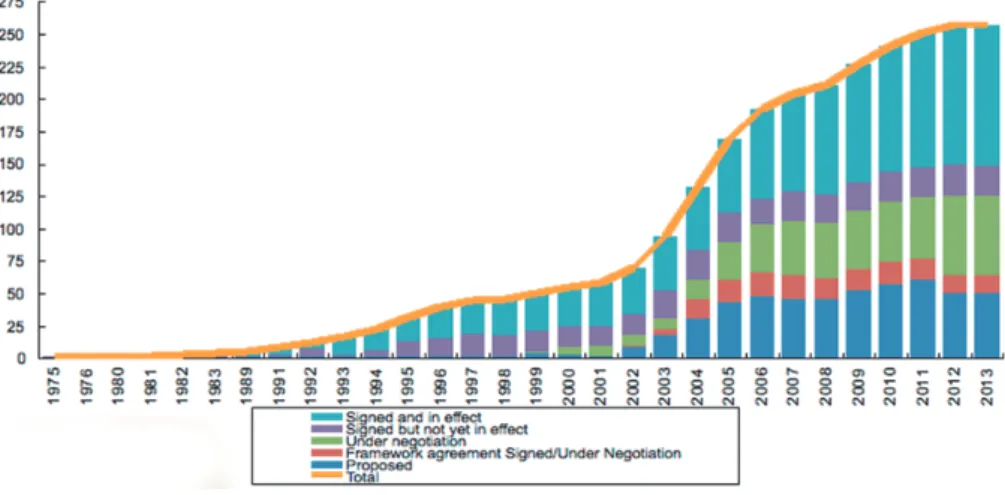
Following figure shows how free trade agreements have been increasing since the late of 1980s.
Figure 1: Number of FTAs in years.
Source: http://forumblog.org/2013/05/can-free-trade-agreements-support-factory-asia/ (10.05.2014).
nomics lost its predominance position after the 1974 oil shock and stagflation. Monetarist view which argues the efficiency of monetarist policies instead of fiscal policies had a deter-minative role in establishing of the EU’s monetary union. Perhaps, if the Monetarist econom-ics didn’t be effective in the theory, monetary union in Europe would be late.
42 See Scott L. Baier, et al., “The New Regionalism: Causes and Consequences.”, 2007,
http://www10.iadb.org/intal/intalcdi/integracion_comercio/i_INTAL_I&T_26_2007_Baier_B ergstrand_Egger.pdf (23.03.2014).
43 See for example the recent free trade agreements of EU. One of them is between EU and
A theory explains the increasing of regional based trade liberalisations by the economic dominance: domino theory of regionalism. This theory relies on the logic of Jacob Viner’s “creation” and “diversion” concepts in trade.
That is, idiosyncratic incidents of regionalism triggered a multiplier ef-fect that knocked down bilateral import barriers like a row of dominos. That basic idea is simple. Forming a preferential trade area, or deepening an existing one, produces trade and investment diversion. This diversion gener-ates new political economy forces in nonparticipating nations. … The pres-sure increases with the size of the trade bloc, yet bloc size depends upon how many nations join. Clearly, then, a single incidence of regionalism may trig-ger several rounds of membership requests from nations that were previous-ly happy as non-members. If the trade bloc is open to expansion, regionalism may spread like wildfire. If the enlargement “burn-path” is barred, the new political economy flames may find vent in preferential arrangements among excluded nations.44
The explanation above is about the economic dimension of regional in-tegrations and it’s called as not “regionalism” but “regionalisation”. In the literature there is a distinction between regionalism and regionalisation ac-cording to the economic and political factors or characteristics of regional economic integrations. According to this approach, while regionalisation refers to unintended and uncoordinated activities and relations of economic units, regionalism is a political process driven by the states. 45 But, this paper considers both regionalisation and regionalism as a same process and two dimensions which generates each other’s existence. Like almost all social events, there are some natural facts and some coordinated (maybe artificial) consequences in regionalism.46 Actually, what facts and features bring out the regionalisation here are belong to the globalization.
In recent years regionalism has become the most popular form of trade liberalization. However, some economists who are concerned with the dis-tortions from the discriminatory policies inherent to these arrangements have doubts, there is no clear evidence in economic analysis that regionalism un-dermines the international trade and prosperity.47 On the contrary, empirical
44 Richard E. Baldwin, “The Causes of Regionalism.”, 1997, http://time.dufe.edu.cn/
jingjiwencong/waiwenziliao1/causes.pdf (27.02.2014), p.877-878.
45 See Beeson, op.cit., p.3.
46 We can also describe the regionalism as a consequence of coordinating and managing the
natural economic facts of regionalisation.
47 This is one of the major subjects debated in the literature; see for ex. Baldwin, 1997 and
analyses indicate that trade creation is the norm not trade diversion is.48 It can be said that economic theory and most of economists49 are supporters of the economic integrations and regionalism.
Conclusion
If we reduce the scale of world history, we’ll see there are two situa-tions follow each other on a circle. In the first situation, world is dominated by the empires; this implies a stable condition and looks like a physics theo-ry suggests that poles are necessatheo-ry for the balance and stability. In the sec-ond situation, world in a scattered position is dominated by the uncertainty (or sometimes chaos). According to this, it is possible to consider post-War II era was the empires period and the following period post-Cold War is uncertainty and the next period will be empires’ era again.
One other physics rule; when blocks are demolished, dispersion and movement occur and the area of relations broadens. We also define the age, we stand in, is the age of “relations”. The contemporary type of “relation” has some qualifications such as communicative, international, economic and negotiative. These qualitative facts are shaped by two main inputs; first is the situation of integration; second is the technology.
Although it is seen that economic globalization which is catalysed by technological developments increased the volume of international economic relations between the states and regions, it is likely that confrontational “self-interested” states will cut the linkages by polarization again because of the sovereignty motives and the security concerns. It may be expected such an economic environment where common markets in the regions, but con-servative policies against the foreign side.50 The question is how can it be while the nations and regions are dependent each other by almost vital eco-nomic linkages for the present? Answer is that the domination motive is
48 Caroline Freund and Emanuel Ornelas, “Regional Trade Agreements”, The World Bank
Policy Research Working Paper 5314, 2010, p.41.
49 An indirect outcome of that liberal market doctrine is the dominant theoretical approach in
economics is that the most economists are the supporters of trade liberalization and economic integration. And since it is empirically proved that today’s regionalism ensures the liberaliza-tion of internaliberaliza-tional trade, regionalism is also supported by most of economists as it is sup-ported by WTO today.
50 While a regional integration is built on the common interests of its members, it also serves
the self-interests of individual states. It is a trade-off relationship between national states and the regional union; or a relationship between self-interest area and common interest area. When a regional union deepens and strengthens its integration, the common interest area will also turn to a self-interest area.
always stronger than the motive of economic prosperity in the life of states. And the security concerns are stronger than economic concerns, too.51
Regional integration is based on the “common interests”52 and naturally it needs some common threats; stronger threats create stronger walls. Eco-nomic regions are in the transition state as a liquid form for now; they need to be solidified by common threats. Globalization whom key concepts are movement and velocity cannot take the world to a common borderless area or a common single market. Because the human character stands in the source of social organization and human is “rational”, human is “economi-cus”; this is what will cause conflict and separation.53
REFERENCES
Adam Smith, An Inquiry into The Nature and Causes of The Wealth of Nations, 2005, http://www2.hn.psu.edu/faculty/jmanis/adam-smith/wealth-nations.pdf (09.05.2014).
Alfred Tovias, “A survey of the theory of economic integration.” Journal of Euro-pean Integration, XV, no. 1, 1991.
Andre Sapir, “European Integration at the Crossroads: A Review Essay on the 50th Anniversary of Bela Balassa’s Theory of Economic Integration.” Journal of Economic Literature, 2011, 49:4, 1200–1229.
Anthony Giddens, “Modernliğin Küreselleşmesi.” Küresel Dönüşümler. translation Mehmet Celil Çelebi. ed. David Held and Anthony McGrew. Ankara: Phoenix Yayınevi, 2008.
Bela Balassa, The Theory of Economic Integration. Homewood, Illinois: Richard D. Irwin, Inc., 1961.
Belgin Akçay, “Ekonomik ve Parasal Birlik”, Avrupa Birliği: Tarihçe, Teoriler, Kurumlar ve Politikalar, ed. Belgin Akçay & İlke Göçmen, Ankara, Seçkin Yayıncılık, 2012.
Caroline Freund and Emanuel Ornelas, “Regional Trade Agreements”, The World Bank Policy Research Working Paper 5314, 2010.
51 See the recent Russia and West (EU and USA) tension (related to Ukraine issue) and its
outcomes: how the security and sovereignty matters tend to get ahead of the economic or energy dependence between Russia and EU.
52 For example, EU identifies the concepts of “security”, “full employment in the economy”,
“being a global actor” as the common interests of its members. Expression of “common inter-est” is mentioned many times in the founding treaties of EU.
Coşkun Üçok, Siyasal Tarih, 2. Baskı. Ankara: Ankara Üniversitesi Hukuk Fakültesi Yayınları, 1978.
Derek W. Urwin, Regions and Regionalism in Europe, ed. Michael Keating. Chel-tenham: Edward Elgar Publishing, 2004.
Edward D. Mansfield and Helen V. Milner. “The New Wave of Regionalism.” In-ternational Organization. Vol. 53, No. 3 (Summer, 1999), 589-627.
European Commission, “The European Union explained: Enlargement”, 2013, http://europa.eu/pol/pdf/flipbook/en/enlargement_en.pdf (11.05.2014).
European Union, “The history of the European Union.” http://europa.eu/about-eu/eu-history/index_en.htm (10.05.2014).
Florian Ploeckl, “The Zollverein and the Formation of a Customs Union.” Universi-ty of Oxford Discussion Papers in Economic and Social History, 2010, http://www.nuff.ox.ac.uk/economics/history/Paper84/ploeckl84.pdf
(11.05.2014).
Frans Schrijver, Regionalism after Regionalisation, Amsterdam: Amsterdam Uni-versity Press, 2006.
Jacob Viner, The Customs Union Issue. London: Stevens & Sons Limited, 1950. William I. Robinson, 2007, “Theories of Globalization”,
http://www.deu.edu.tr/userweb/timucin.yalcinkaya/Theories%20of%20Globali zation.pdf (11.05.2014).
Mark Beeson, “Re-thinking Regionalism: Europe and East Asia in Comparative Historical Perspective.” Oceanic Conference on International Studies, Can-berra July 14-16, 2004.
Michael Keating, “Is there a regional level of government in Europe?” translation Uttam Bharthare. Regions and Regionalism in Europe. ed. Michael Keating. Cheltenham: Edward Elgar Publishing, 2004.
Olli Rehn, “The EU – from civilian power to premier league security policy play-er?”, 2008, http://europa.eu/rapid/press-release_SPEECH-08-399_en.htm (11.05.2014).
Richard Baldwin and Charles Wyplosz, The Economics of European Integration, 4th Edition, London: McGraw-Hill Education, 2012.
Richard Baldwin, “21st Century Regionalism: Filling the gap between 21st century trade and 20th century trade rules”, WTO Economic Research and Statistics Division, Staff Working Paper ERSD-2011-08.
Richard E. Baldwin, “The Causes of Regionalism.”, 1997, http://time.dufe.edu.cn/jingjiwencong/waiwenziliao1/causes.pdf (27.02.2014).
Richard George Lipsey and Kelvin Lancaster, “The General Theory of Second Best.” The Review of Economic Studies, Vol. 24, No. 1. (1956 - 1957). Robert L. Heilbroner, The Worldly Philosophers, Fifth print, New York: Simon
and Schuster, 1961.
Scott L. Baier, et al., “The New Regionalism: Causes and Consequences.”, 2007, http://www10.iadb.org/intal/intalcdi/integracion_comercio/i_INTAL_I&T_26_ 2007_Baier_Bergstrand_Egger.pdf (23.03.2014).
Stefan Füle, Euroepan Commission, “The European Union explained: Enlarge-ment”, 2013, http://europa.eu/pol/pdf/flipbook/en/enlargement_en.pdf (11.05.2014).
Walter Kennes, 1997, 27-28. “The European Union and Regionalism in Developing Countries”, European Commission and World Bank Seminar on Regional-ism and Development, Brussels, 2 June 1997.