An Exploration of Students’ Misconceptions about the
Concept ‘Classification of Animals’ at Secondary Level and
Effectiveness of Inquiry Method for Conceptual Change
Anjum NAZ
Abida NASREEN
ABSTRACT. Research has provided overwhelming evidence that
children enter in science classroom with ideas they have formed in making sense of the world around them. Children observe world with curiosity which help them to construct their initial ideas (Anderson, Reynolds, Schallert & Goetz, 1977). These ideas of the child are called pre-existing knowledge which serves as a podium from which learners understand their world (Dole & Sinatra’s 1998). Similarly the children have multiple experiences of different phenomena like push, pull, throw or pull (Driver, Squires, Rushworth & Wood-Robinson, 1994). The children’s observation, ideas and experiences collectively make their preconceptions. This study was an attempt to find out misconceptions of biology students at secondary level (Wiser & Amin, 2002). It is a well known fact that students enter in science classroom with many misconceptions (Yensin 2004). This research was aimed to identify and rectify the misconceptions of students, about selected concept of biology e.g. classification of animals. The nature of the research study was exploratory. A well established technique ‘Interview about Instances’ (IAI) was used to explore conceptions and misconceptions of the students. Twenty instance cards (twenty for selected biology concept) were developed to present examples and non - examples of particular concepts in the form of diagram, line diagrams and pictures. Interviews were audio-taped with the permission of respondents and transcribed with the help of experts. A wide variety of misconceptions were found in the responses of the students therefore keeping in view the misconceptions of
Assist. Prof., University of Sargodha, Department of Education, Sargodha, Pakistan.
E-mail: [email protected]
Assist. Prof. Dr. University of Punjab, Institute of Education and Research, Lahore, Pakistan. E-mail: [email protected]
students inquiry sessions were planned. Whole sample of the study was randomly divided into two groups’ i.e. Group A & Group B. Group B participated in inquiry sessions while group A was kept outside. Researcher facilitated the inquiry sessions. Students planned activities and explored the concepts. Afterwards, the same instance cards were shown to both groups A & B. IAIs were conducted, recorded, transcribed and coded. The responses of students were divided into major and minor categories. The frequencies and percentages of responses given by students in pre and post session interviews were calculated and compared. In a result three categories of responses emerged such as scientific responses, misconceptions and generalizations. Moreover, to establish the effectiveness of inquiry approach as a conceptual change instructional strategy the percentages and frequencies of the responses of Group A. & B. in post session were also compared. The improvement in scientific responses and correctness of misconceptions was observed in the responses give n by group B in post session interviews. This research study concluded that students had misconceptions in very basic biological concepts. The misconceptions found were very dynamic in nature. The misconceptions of students can be addressed with appropriate conceptual change instructional strategy such as inquiry approach.
Keywords: Misconceptions, Inquiry Method, Conceptual Understanding, conceptual Change & conceptual change Instructional Strategy.
INTRODUCTION
Scientific literacy is seen as the capacity to identify questions and to draw evidence-based conclusion in order to understand and help making decisions about the natural world. Brown (1994) states that even the very little child of 3-4 years also has thoughts and his creative thinking helps him to understand the outside world; the old concept of child being a blank slate is over now. One of the key element of science teaching is making explanations and classifying concepts of science. Concepts are the construction blocks for the structure of knowledge. Student’s concepts display their interpretations of objects and events in the material world. Students have concepts in their minds nearly about everything which they see hear and observe during all ages. Experts have continuously made efforts to identify and take in hand ideas of students and found these ideas contradictory with the ideas of scientists called as misconceptions.
Research has provided overwhelming evidence that children enter in science lesson with ideas they have formed in making sense of the world around them. They have conceptions and experiences of different phenomena like push, pull, throw or pull (Driver & Squires, 1991). While, the idea, notions or understandings about a specific topic or subject that students possess prior to prescribe instruction are considered preconceptions (Posner, Strike, Hewson & Gertzog, 1982). When science is taught to school pupils, it is taught as if the children had no prior experiences, relative to the topic being studied, but research proved this assumption wrong. Children come to school, already hold beliefs about how things happen, and have expectations based on their past experiences which allow them to predict future events. When a concept is taught, some students still keep hold of their old ideas and beliefs although they were taught by the same teacher and were bear to the same learning environment (Ausubel, 1980). A child’s view and understanding of word-meanings are built-in built-into conceptual structures, which provide a sensible and articulate understanding of the world from the child’s point of view (Osborne & Gilbert, 1980). Children hold ideas that were developed before and during their early school years, and the teacher and/or the textbook may composite these ideas (Alsop, 2003). It is possible that children develop corresponding but mutually contradictory explanations of scientific concepts—one for use in school and one for use in the “real world” (Brown 1994). The preconceptions that students bring with them to science education courses can exercise powerful influence on what they learn and recognize as valid knowledge (Fensham,
Gunstone & White, 1994). There is sufficient evidence to indicate that many of these ideas made by students before prescribed teaching differ from the accepted scientific ideas. There is varying terminology used to describe children’s ideas. Brown (1994) called them as ‘alternative ideas’, ‘children’s ideas’, and ‘children’s science’. Braund (1991) used the term ‘misconceptions’ and ‘misunderstanding’. Misconceptions are everywhere, and so are the resources and information to discover and correct those. Cross age studies reveal a fact that misconceptions are very persistent across the age range of 11-14 (Braund, 1991). The science behind the concepts and experiences isn’t always intrinsically obvious and often is misinterpreted even by very intellectual people. So, the students are not wrong for the forming misconceptions and erroneous explanations based upon what pupils read or see. It may also be noted that these prior concepts or knowledge could drastically influence classroom teaching. Munson & Bruce (1994) exposed a fact that characteristics of classroom environment and instructional strategies help a greater fraction of students in a class to achieve conceptual understanding. Consequently, it can be concluded that all kinds of misconceptions justify more detailed analysis because of its occurrence among students and because of the latent for inaccurate communication in instructional setting that it build in educational perspective.
There are different approaches for addressing misconceptions of students. One approach which explains the behavior pattern of students is known as behaviorism while the other one provides assistance to understand human thought process is known as cognitive psychology. Now for the last three decades, there is another area of action which has focused on student’s understanding of scientific ideas. This area of activist is known as constructivism (Alzate, Tamayo & Puig, 2007). Although it has implications for the classroom, constructivism is not about teaching strategies, nor is it about designing curriculum. Rather, it is one theory or one philosophy about how an individual learn (Davis, 2001).
To help students develop broader conceptions about scientific phenomena, the students must continue through cognitive processes that cause them to face and alter their existing conceptions (Dantonio & Beisenherz, 2001). The conceptual change theory describes a process whereby human beings may alter or dump existing conceptions, which are more widely supported by empirical evidence (Posner, Hewson, & Gertzog, 1982). Using conceptual change based teaching strategies in the classroom presents opportunities for the exchange of beliefs and sharing of knowledge between students and teachers (Gagne, 1970). Conceptual change process occurs in four stages, which
individuals need to, progress for altering their thinking. A. Dissatisfaction; students must be dissatisfied with their on hand conceptions. B. Intelligibility, the ideas must be coherent (rational) C. Plausibility, the new idea must be attractive than the old concept. D. Fruitfulness, new concept must be found suitable and useful for problem solving (Posner et al, 1982, Vosniadou, 2005).
Experiences, which students have in conceptual change based learning environment, would offer opportunities to them to compare new and alternative conceptions with their existing beliefs (Vosniadou, 2001, 2002). Conceptual change based instructional strategies can play a central role in helping students to comprehend and accept scientific concepts (Yensen, 2004).
Statement of the Problem
This is the most important need of the science teacher that they should be responsive of the conceptions of their students about the scientific phenomena (Dantonio & Beisenherz, 2001), because these conceptions of students provide detailed impending of the thoughts of the students. Identification of students’ misconceptions will also provide assistance to select appropriate teaching method. If misconceptions of the students will not be exchanged into correct conceptions the learning of the students will not be fruitful and worthwhile. This research study was an investigation of existing misconceptions that conflict with currently accepted scientific concepts in students studying biology at secondary level. The specific biology concepts selected for this purpose were ‘classification of animals’, 'photosynthesis’ and ‘green house effect’ from the text book of secondary classes. In second part of this study an instructional strategy based on inquiry approach was applied in the science classroom to address the existing misconceptions of students. The purpose of second part of the study was to investigate whether or not inquiry method is an effective strategy for addressing misconceptions.
Research Objectives
The objectives of this study were to (i) investigate existing misconceptions of students in biological concept i.e. ‘classification of animals’, (ii) to establish effectiveness of conceptual change instructional strategy i.e. inquiry method, in changing the misconceptions.
This study will lead to answers of the following questions; Whether or not students have misconceptions about the biological concept such as classification
of animals? Either the misconceptions of students about the classification of animals be identified? Is inquiry method proved to be an effective strategy to address the misconceptions of students?
METHODOLOGY The nature of this research study is qualitative. Sample of the Study
Researcher with the consultation of experts set criteria to choose the sample of the study. Students studying at secondary level and who have selected biology as an elective subject were selected as sample of the study. In total eighty students, were randomly selected from the two public schools, of district Sargodha. Researcher randomly divided the sample of study in two groups, Group A and Group B.
Research Design
This study was comprised of two phases, in the first phase; researcher identified the misconceptions of students by using the specialized technique of investigation such as interview About Instances (IAI) (Osborne, 2003). IAI technique was developed by Osborne and Gillbert (1979) and it was first used by them and their colleagues to investigate students’ understanding of many concepts e.g. work electric current, light, friction, force and energy. Watts & Alsop (1997) had described that the IAI approach consists of dyadic interviews where the intent of interview is to show the stimulus cards. The cards depicted the stimulation, which the pupil necessitates to classify as pattern and non pattern of a concept.
First the relevant concepts were identified from the literature in order to focus the interviews on the important concepts. Keeping in view the important dimensions of the concept, instances were developed and printed on the paper. Semi-structured interviews were conducted with students. The interview was about the biology concept, “classification of the animals” into two major groups, vertebrates and invertebrates. Twenty instances (pictures of animals) were shown to the students and questions were asked about the animals. Students were asked to classify the animal as a vertebrate or an invertebrate. Instances were the examples and non-examples of the concept, shown to students in a
pre-set sequence and questions were asked. The responses of the students were recorded with their prior permission. The mean time of each interview was one hour.
In the second phase of the study, keeping in view the misconceptions of students, researcher planned and implemented inquiry sessions of teaching based on inquiry method for investigation of the concept ‘classification of animals’ with all students of group B. Each session last for five hours and five sessions were completed in five days. As constructivist theory offered an attractive package for addressing misconceptions of the students so inquiry lessons and activities based on the constructivism theory were planned with the consultation of experts in the field. By using lesson plans researcher assigned inquiry tasks to students. During the sessions researcher used learner centered approach and act as the facilitator in the classroom. According to Osborne and Gilbert (1979) Inquiry method has considerable potential for a variety of reasons;
1. It enables the students’ views to be explored without comparison against external criteria.
2. It is applicable over a wide range and it is non-threatening to students. 3. It appears to be more penetrating as asking for a definition
4. It has advantage over written examination for two reasons i.e. students can ask question about the questions asked (e.g. it is intentionally ambiguous) and the interviewer can query responses or reasons for the sake of more understanding (Osborne et. al. 2003).
Second phase of the study was concerned to find out the effectiveness of inquiry approach as conceptual change strategy. While the students of group A attended the traditional classroom with their regular teacher who used teacher centered approach and delivered lectures for explaining the concept of the classification of animals.
After ten days of inquiry sessions IAI was conducted with both groups A & B. The responses of the interviewees were audio tapped and then transcribed with the help of the experts. The transcribed interviews were read and the essential issues reported were annotated. The collected data was transcribed, coded and then analyzed to find out the emerging themes. For the very purpose of phenomenological analysis (explicitation) researchers transcribed key words, phrases and statements to consolidate the emerging themes. The systematic procedure of transforming the data through interpretations was followed. Before extracting the concluding thought to restructure the inner world of experiences of the respondents, bracketing, phenomenological reduction, delineating and clustering of units of meaning, summarizing
(Groenwald, 2004) of each interview was cautiously done. On the basis of information collected from these sources and strategies, the trends in the misconceptions of the students were found and reported about the selected concept. Content analysis
FINDINGS The responses of the students were as follows: Kangaroo
Kangaroo is a vertebrate animal and 33 out of 40 students in pre-session interviews recognized it as a vertebrate. The semi scientific reasons quoted by the 19 students were, ‘it’s big, it can run fast and its shape depicts presence of a
vertebral column. Misconceptions were also found in the responses of the
students like they quoted following misconceptions while describing the reason to identify the animals as a vertebrate, it can sit, I guessed from the mouth, it has
a neck etc. Some students gave generalized reason when asked about the
rationale to identify the animal, at the same time seven students quoted that they made a guess to identify the animal while 21 students gave no reason except to quote the words ‘I know it is vertebrate as my teacher told me once’. In post session interviews students improved the misconceptions about the animal and 40 students recognized the animal as vertebrate and students gave scientific reason for identification.
Earth Worm
Earth worm is an invertebrate and 44 students identified the animal as an invertebrate but they failed to give scientific reason for their response. Most of the student told that they knew as they have touched the animal and found no vertebral column. While 12 the student made a guess. In post session interview improvement in the scientific reasoning was observed and students quoted scientific reason. It depicts the fact that students have fewer misconceptions about the animals for which they have first -hand experience.
Bat
It is a vertebrate animal but most of the students in pre-session interview 19 students failed to identify it. They quoted many misconceptions for this instance like ‘it can fly, it has wings and it is soft’. It was found that the students who have first- hand experience with the animal were also not aware about the presence of vertebral column. In post session interview improvement was found and 35 students recognized it as vertebrate and quoted scientific reason. Moreover students avoid generalized, vague and ambiguous answers in post session.
Cockroach
It is an invertebrate. of the student, were familiar about the fact that it didn’t have vertebral column but 27 quoted misconceptions while describing the reason for identification like ‘it has no neck, it run fast, it has small legs’ etc. In post session interview 26 students quoted scientific answers like ‘it has hard
body outside’ etc. Many students have a first-hand experience with the animal
so they quoted their observations during the interview e.g. 38 students quoted they have killed it once or twice.
Butterfly
It is an invertebrate and students were very confident to classify it as an invertebrate but they didn’t quote scientific answer. In pre session 29 students identified butterfly accurately, 18 students quoted that ‘the shape of the butterfly
helps me to classify it as an invertebrate. While in post session 36 of the
students identified it as an invertebrate. The misconceptions quoted were based on their personal experience like ‘it can fly so it is an invertebrate’, and ‘it has
soft body’ etc. In post-session interviews an obvious improvement was seen that
all 40 students classified it as an insect. Star Fish
In pre session 29 of the students failed to classify it as an invertebrate. They told that the five arms of the fish are starched due to the presence of vertebral column. The other misconceptions found were ‘it is hard like vertebrate and its
animal was provided to the student in inquiry session which rectifies the misconception about the star fish that ‘it is hard so improvement in the scientific reasoning capability was seen in post session responses. Nearly 38 students quoted the characteristic ‘movement’ to classify the star fish.
Squirrel
It is a small vertebrate. The student failed to classify it as a vertebrate only 14 students accurately classify the organism because of the fact ‘it is small’. Student’s responses were non-scientific and fuzzy. Misconceptions about the animal were, ‘It lives on trees, it is very small so vertebral column is not needed,
and it has flexible body’. In post-session 38 students correctly recognized the
animal as vertebrate and tried to give scientific reason as ‘it has soft body
(endoskeleton) and it moves fast.
Tortoise
It is a vertebrate animal but most of the students were not able to identify it as a vertebrate such as 22 students classified it as an invertebrate. The major misconception quoted for this animal was ‘it has big hard structure on their
body’, ‘the animal inside is soft one’. Moreover 36 students quoted that it is an
invertebrate because ‘it moves very slowly’. Even the first hand experience with the animal didn’t helped student to rectify their misconceptions. In the inquiry session they observed the internal Skelton of the animal. So in post-session 38 were able to identify it as a vertebrate animal.
Scorpion
It is an insect but students classify it as a vertebrate animal. In the pre session interviews 27 student told that its structure is very similar to the vertebrate animals, ‘it has hard body, and its movement is very fast’ so it is vertebrate. The presence of a stiff and hard tail with impressions of joints on it confused 23 students as they quoted its structure depict the vertebral column. Students who had an encounter with it succeeded to identify it as a vertebrate. Some improvement in scientific reasons was also seen in the responses given during the post- session interviews. Students (34) convinced to declare it as an insect.
Dolphin
It is a vertebrate marine animal. In pre session 25students classify it as a vertebrate but they elaborated their answers and told that it had no vertebral column but thorns. Students’ responses unveiled the fact that students were not able to understand the basic structure and origin of vertebral column. On further questioning 17 students told that ‘the body of the fish is flexible so vertebral
column is absent’. While in inquiry session the origin of vertebral column
discussed it helped them to replace their misconceptions. As in post session 33 students recognized it as a vertebrate and quoted semi-scientific reasons.
Snake
It is classified as a vertebrate animal but 34 students classified it as an invertebrate. The reasons told were ‘it has flexible body; it has no limbs, and its
resemblance with the earth worm’. Students (34 out of total 40) gave very
ambiguous scientific reason to classify it as a vertebrate. As the internal structure of the animal was observed students at once replace their misconceptions and 38 students in post-session classified it as a vertebrate with scientific reason. The generalized statements were also been replaced with the correct one.
Sea Urchin
It is an invertebrate and 38 of the students in pre and post session classified it as an invertebrate. In pre- session students gave no scientific answers but in post session they quoted the structure and shape of the animal as a reason to classify it as an invertebrate. In pre-session the obvious reason to classify sea urchin as an invertebrate was the size of the animal. Some students (15) have a misconception that ‘all small animals are invertebrates. But five students in the pre-session interview declared it as a plant. In the post session students quoted a scientific reason such as presence of soft body and small size.
Turkey
It is a vertebrate. Most of the students have not seen it before but even then they classified it as a vertebrate. The reason 23 quoted was ‘its resemblance with
size, structure and shape of the body. Misconceptions found were also associated to the structure of the body as eight students considered it as an invertebrate because ‘it has a round body. Improvement in scientific reasoning was observed in post session interviews because 36 students identified the presence of a vertebral column in the organism.
Octopus
It is an invertebrate marine organism. In pre-session 21 students recognized the organism as an invertebrate but none of them gave any scientific reason. The misconceptions found about the organism were, ‘it can stand upright, it is big
and its shape depicts the presence of a vertebral column’. The 14 students have
no encounter with the organism so they quoted more misconceptions. In the post interview session after watching the video clips they replaced their misconceptions and 29 students identified organism as a vertebrate and gave scientific reasons.
Penguin
It is a vertebrate. Most of the students (34) recognized the organism and gave semi-scientific reason. They quoted, ‘it is big’, ‘it can stand upright’ and
‘its body structure depicts the presence of vertebral column’. Misconceptions
found were ‘I guessed from the mouth, and ‘it has no limb’. In the post interview session the percentages of correct answer were improved a lot. As 38 students have a conception that big organism are a vertebrate so they didn’t hesitate to classify it as a vertebrate organism.
Sea Anemone
It is an invertebrate organism. Most of the students (33) in pre-session recognized it as an invertebrate due to the size. The misconceptions found were
‘it has round body and shape’. Students were not sensitive about the actual class
of the organism and they made a guess. As they have not seen the organism before so they hesitated to quote the reason. Some students (13) felt very hard to consider it as an animal. In post interview session students gave scientific answer and 37 students classified the organism as an invertebrate.
Lizard
It is a vertebrate. All students observed it but only 21 students were able to classify it as a vertebrate. The misconceptions found were due to the first hand experience of the students with the organism. One students (case no; 25) quoted
‘I have killed it many times but never found any sort of vertebral column in it’.
The one very particular misconception found in the students was that they consider a vertebral column as a stiff, hard, big and joint less part of the body. Therefore, most of the times 24 students failed to observe the same in a most organisms. For a reason they could not find a vertebral column in a lizard. After having the correct conception of vertebral column 35 students were able to found the same in a lizard.
Jelly Fish
It is a marine invertebrate organism. It has a transparent and soft body therefore most of the students (23) correctly identified the organism as an invertebrate. Misconceptions were found when they were asked to give a reason to justify their answer. The major misconception found was ‘it has no mouth and
a neck so it is an invertebrate’. While in post-session interviews 38 students
gave semi-scientific reasons such as ‘it is boneless’ etc. Sparrow
It is a vertebrate. In a pre session interviews of the students classified it as a vertebrate but gave no scientific reason. The misconceptions found were, it
can fly and it has limbs. The one major misconception found was ‘vertebrate has limbs and neck’. In post session interviews 32 students quoted scientific
answer to classify the sparrow as a vertebrate with a reason, that it need an articulation during flight and its shape depicts the presence of a vertebral column.
Giraffe
It is a big vertebrate animal. All 40 students recognized it as a vertebrate due to its big size. The reason quoted for the recognition unveiled their misconceptions about the vertebrate animals, for instance they told ‘it has long
responses such as ‘I knew it and I have read in a book’. In post session interviews 39 students quoted scientific reasons to classify the animal as a vertebrate. They described the presence of prominent feature of vertebrates in the giraffe such as a neck and an elongated body.
DISCUSSION
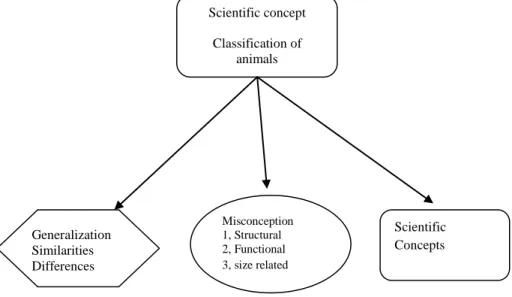
The concept of the ‘classification of the animals’ was not clear to the students therefore more than fifty five misconceptions were identified in pre-session interviews. Multiple responses were received on examples and non-examples of the scientific concept ‘invertebrate and vertebrate’. All responses given by the students were divided into three major categories, scientific responses, misconceptions and generalizations. Keeping in view the nature of scientific responses and idea presented in between the lines the responses were further consolidated into sub categories.
Figure 1. Categories of responses of the students about classification of the
animals
There are three major categories of responses which can further be divided into sub categories e.g. generalizations based on similarities and
Misconception 1, Structural 2, Functional 3, size related Scientific concept Classification of animals Scientific Concepts Generalization Similarities Differences
generalizations based on differences. Similarly the second category of responses w a s f u r t h e r divided into three sub categories i.e. (a) the misconception based on the structure of the organism (b) the misconceptions based on the functions of the different parts of the body of the organism and (c) the misconceptions which are stated by the students due to the size of the organism or animal. The dotted line between the three categories depicts the weak relationship between the responses while the length of the line denotes the possibility of the conversion of one category in to the other. The sequence of the responses i.e. generalizations, misconceptions and scientific concepts depict that the students initially have generalizations about the organism but when specifically questioned about the one they may depict misconceptions and further investigation lead them to the scientific concept.
Students had no difficulty to classify big animal examples as vertebrae and with scientific reasons. The size, structure and height of the animals were kept in view as student quoted “yes giraffe has vertebral column because its
size is too big and without vertebral column it would pile up into the ground”
(case no 23) similarly another student quoted “Kangaroo is big it can stand
upright so it must has vertebral column”.(case no 9) another quoted the size
and height of the big animals “ Penguin, oh it can stand like human beings and
Kangaroo can sit like human being so both can be categorized as vertebrate animals. (Case no 2). Although in their statements students are describing
the true characteristics of vertebrate animals but these are not sufficient to identify the class of animals under discussion. The statement of the students’ answers displayed the misconceptions possess by them as one mentioned “animals with vertebral column can run fast but Tortoise moves very slowly.
So it cannot be classified as a vertebrate (Case no 13). Most of the students
mentioned the structure of animals while telling the reason of identification of animal as vertebrate” I saw a movie about animals the big, vertebrate and fast
moving animals had a particular shape of body ”. (Case no 17). Many students
considered fast animals as vertebrate although small insects can also move fast.
Articulation of the big animals were also be observed in some responses of the students as students had a difficulty in classifying the small animals into vertebrate class as one mentioned “Squirrel, it is small, it is soft so I think it cannot be a vertebrae” (case no 54).
The snake considered to be a most problematic example of vertebrates (Martin, 1998) for the students, majority of them classified it as an invertebrate
“snake is very flexible it is invertebrate” (case no 78), students illustrate misconceptions in classifying the snake “ vertebrates has limbs snake does not has limbs so it must be classified as an invertebrate” (case no 20), “ snake
can’t stand upright, if it has vertebral column then it would feel difficulty in scrolling on the branches of the tree but it does not feel any difficulty” (case
no 15). Similarly the Tortoise was also be classified as an invertebrate due to the presence of hood on it, one student mentioned “ Tortoise has a hood on the
body and that is not the vertebral column, the actual animal under the hood is very soft, I have seen it many times”(case no 41). Lizard was also be
classified as an invertebrate. Students quoted their first hand experiences, when they killed it as one student quoted” I have killed it and I found no vertebral column inside its body it has a very soft body”. The major misconception found in all misinterpreted example was the unawareness of the students about the internal structure of the animal. Three basic characteristics mentioned in the actual scientific definitions, presence of notochord, metamorphosis in early stages of life were not quoted by any student. This research study unveils the fact that students have misconceptions and these can be changed or replaced by using an appropriate strategy. The researcher planned inquiry sessions and assigned topics to the groups about the concepts under study and found that students have an ability to plan and conduct inquiry after receiving some orientation. The conceptual difference and improvement was noticed in the understanding of students in post and pre sessions of interviews on the same instances. One student commented on the sparrow
“Sparrow is small flying bird if it has vertebral column how it can fly so high vertebral column may increase the weight of it” while in post interview
session he quoted “sparrow has vertebral column because it provides the
support to its wings so she flies” . This discussion concludes with the answers
of three research questions of the study; (a). the answer of the first research question is that students have misconceptions (b). Students have misconceptions about the concept classification of animals (c). Misconceptions can be changed and replaced by using an appropriate conceptual change strategy as used in this study was an inquiry approach.
CONCLUSION AND IMPLICATIONS
Post session interview responses suggested that the inquiry session positively impacted on the content of the children’s knowledge in group B,
enabling them to describe and explain the phenomena in more scientific terms. Although each group showed an improvement, it was only in the group B where satisfactorily significant conceptual changes were observed in relation to how to describe the phenomena. In the responses by the interviewees to the instance cards after the inquiry session, the number of concepts those described in scientific terms increased. The general trend of the scientific responses was also improved. Overall improvement in understanding was confirmed both by discussions during the inquiry sessions and by interview-about –instances responses into the extent and precision of the students knowledge. This amounted to the replacement of existing, less scientifically relevant knowledge (misconceptions) with more scientifically relevant information. For example if we compare the pre and post session interview responses of the group B we can observed that in the pre-session students mentioned only one or two reasons for their answers but in the post session they mentioned more than one reasons and argue upon them. A number of statements can be made based on the findings of this research study about general features of students’ biological reasoning. Many psychologists claimed that advancement in learning science depends on the growing knowledge base and development of content independent forms of reasoning (Leach & Driver et al 1996). The comparative significance of these two factors was a subject of debate upon the conceptual change in biological concepts. Learning biology (in terms of the manifestation of a separate realm of theorizing) mounting from an instinctive psychology of human actions and behaviors (Carey,1985). This concerned a process of radical restructuring so the concepts used by the students before and after detailed investigation are different. Carey (1985) contemplate the fact that all students have similar cognitive skills the differences in their conceptions and misconceptions can be accounted for in terms of differences in their content specific knowledge schemas. Learning science generally and biology particularly can be described in terms of a series of changes of concepts within and between ontological categories. Conceptual change in biology can also be explained in terms of epistemological changes. Kuhn (1970) has explained that in the process of conceptual change students accept only those conceptions for which they have knowledge base. In early stages of conceptual change they didn’t’ separate the theory from the argument but in later stages of conceptual change they make this separation and were therefore able to think about a theory as well as think with it.
Recommendations
The major findings and conclusions of the study guided the researcher to derive following recommendations;
i.
The teachers should allocate time to explore misconceptions of the students prior to teach new concept of science generally and biology particularly. Moreover they should review literature and identify the techniques to address the misconceptions of students, because of an established fact that misconceptions can be changed or at least replaced with scientific conceptions.ii.
The teachers should discourage the generalized statements of the students as an answer of the question and train them to observe the scientific aspects of the phenomena.REFERENCES
Alsop, S. & Hicks, K. (2003). Teaching Science. New Delhi, Vinod Vashistha publishing co.
Alzate, O. E., Tamayo & Puig, N. S. (2007). High-school students' conceptual evolution of the respiration concept from the perspective of giere's cognitive science model. InternationalJournal of Science Education, 29(2), 215-248. Anderson, R. C., Reynolds, R. E., Schallert, D. L., & Goetz, E. T. (1977).
Frameworks for the comprehension of discourse. American Educational Research Journal, 14(4), 376-381.
Ausubel, D., Sullivan, E. V. & Ives, S. W. (1980). Theory and problems of child
development (3rd ed). New York: Gune & Stratton.
Braund, M. (1991). Children’s ideas in classifying animals. Journal of Biological
Education, 25(2).
Brown, A.L. (1994). The advancement of learning. Educational Researcher, 23(8), 4-12. Dole and Sinatra, (1998). Cognitive Reconstruction of Knowledge Model. Pintrich. Educational Psychologist, 40(2), 107 - 115.
Driver, R., Squires, A., Rushworth, P. and Wood-Robinson, V. (1994). Making Sense
ofSecondary Science. Research into Children's Ideas. London: Routledge.
Dantonio, M. & Beisenherz, P.C. (2001). Learning to Question, Questioning to Learn. Boston: Allyn and Bacons. Davis, J. (2001). Conceptual Change. In M. Orey (Ed.), Emerging perspectives on learning, teaching and technology. Available
Website: Date of Retrival. 28-01-05.
Gilbert, j. K. & Watts, D. M. (1983). ‘Concepts, misconceptions and alternative conceptions: changing perspectives in science education’, Studies in Science
Education, 10(1), 61-98.
Gagne, R. M., Holt, R., & Winston, G. R. M. (1970). The conditions of learning (2nd ed.). London.
Groenwald, T. (2004). A phenomenological research design illustrated. International
Journal
of Qualitative methods. 3 (1), article 4.
Munson, B. Bruce, H. (1994). Ecological misconceptions. Journal of Environmental
Education, 25(5).
Posner, G. J., Strike, K. A., Hewson, P. W., & Gertzog, W. A. (1985). Accommodation of a scientific conception: Toward a theory of conceptual change. Science Education, 66(2), 211-227.
Osborne & Gilbert, (1980). Learning in science project. New Zealand: University of Waikato Press.
Osborne, R. J. & Freyberg, P.S. (1985). Learning in Science: The implications of
children’s science. London: Heinemann.
Osborne, R. J. & Wittrock, M. C. (1983) Learning science: a generative process, Science
Education, 67(4), 489-508.
Osborne, R.j. & Freyberg, P. S. (1991). El aprendizaje de las ciencias. Madrid, Spain: Morata.
Osborne, R.J. & Wittrock, M. (1985).The generative learning model and its implications for science education. Studies in Science Education, 12, 59-87.
Vosniadou, S. (1994). Capturing and modeling the process of conceptual change.
Learning and Instruction, 4, 45-69.
Vosniadou, S. & Ioannides, C. (1998). From conceptual development to science education: a psychological point of view. International Journal of Science
Education, 20(100), 1213-1230.
Vosniadou, S. (2002). On the nature of naïve physics. In M. Limon & L. Mason (Eds.), Reconsidering conceptual change. Issues in theory and practice. Dordrecht, The Netherlands: Kluwer Academic Publishers.
Vosniadou, S. (2002). Reconsidering conceptual change: Issues in theory and practice on the nature of naive physics. In M. Limon & L. Mason (Eds.), Dordrecht: Kluwer.
Vosniadou, S. (2003) Exploring the relationship between conceptual change and intentional learning. In G.M. Sinatra and P.R. Pintrich (eds) Intentional
Conceptual Change, 377-406.
Vosniadou, S., Skopeliti, I. & Ikospentaki, K. (2005). Reconsidering the role of artifacts in reasoning: Children’s understanding of the globe as a model of the Earth. Learning and instruction, 15, 333-351.
Wiser, M., & Amin, T. (2001). “Is heat hot?” Inducing conceptual change by integrating everyday and scientific perspectives on thermal phenomena. Learning
and Instruction, 11, 331-355.
Wiser, M., & Amin, T. G. (2002). Computer-based interactions for conceptual change
in Science. In M. Limon & L. Mason (Eds.).
Yensen, j. (2004). Strategies for Learning - from Concept Maps to Learning Objects and Books to Wooks. http://www.langara.bc.ca/vnc/ojni.htm :Date of retrieval, 24-11-2004.