RECLAMATION OF USED LUBRICATING OILS
USING MAGNETIC NANOPARTICLES AND
CAUSTIC SODA
A THESIS
SUBMITTED TO THE DEPARTMENT OF MATERIALS SCIENCE AND ENGINEERING AND THE GRADUATE SCHOOL OF ENGINEERING AND
SCIENCE OF BILKENT UNIVERSITY
IN PARTIAL FULFILLMENT OF THE REQUIREMENTS FOR
THE DEGREE OF
MASTER OF SCIENCE
IN
MATERIALS SCIENCE AND NANOTECHNOLOGY
By
Timur Ashirov
June 2017
RECLAMATION OF USED LUBRICATING OILS USING MAGNETIC NANOPARTICLES AND CAUSTIC SODA
By Timur Ashirov
June 2017
We certify that we have read this thesis and that in our opinion it is fully adequate, in scope and quality, as a thesis for the degree of Master of Science.
________________________________________________
Hasan Tarık Baytekin (Advisor)
________________________________________________
Yunus Emre Türkmen
________________________________________________
Akın Akdağ
Approved for the Graduation School of Engineering and Science:
________________________________________________
Ezhan Karaşan
ABSTRACT
RECLAMATION OF USED LUBRICATING OILS
USING MAGNETIC NANOPARTICLES AND
CAUSTIC SODA
Timur AshirovM. S. in Materials Science and Nanotechnology
Advisor: H. Tarık Baytekin
June 2017
Oils are one of the mostly used lubricants in industry. Chemical oxidation, however, causes depletion of additive materials i.e. antioxidants in lubricants and their usage life time shortens. This causes varnish and sludge problems and leaves behind tons of used oil that loses its functionality. It is reported that more than 600 tons of lubricating oil can be reclaimed from 1000 tons of used oil. One of the reclamation methods is caustic extraction, and has been known for more than 3 decades. Although caustic extraction has a very high potential because of its economic considerations, this method is not fully understood due to lack of research. We have revealed that opposite to the common belief, oxidized oils (used oils) have ester groups in contrary to carboxylic acids. Magnetic nanoparticles (Fe3O4) can be used as a catalyst for hydrolysis of
various esters. We have investigated the effect and mechanism of caustic extraction in combination with magnetic iron oxide nanoparticles. Using sodium hydroxide, breaks ester bonds by forming carboxylate salts and alcohols. These carboxylate salts are transferred into water and can be removed by water. Formed alcohol groups can be trapped by drying agents like MgSO4. Further purification of reclaimed oils can be
achieved using hexane or similar low molecular weight and inexpensive solvents. According to our results, properties of recovered base oils mostly compete with petroleum based and ester-based synthetic base oil properties.
Keywords: Used lubricants, used oil, magnetic nanoparticles, caustic extraction, oil reclamation
ÖZET
KULLANILMIŞ KAYGANLAŞTIRICI YAĞLARIN
MANYETİK NANOPARÇACIKLAR VE KOSTİK
SODA KULLANILARAK GERİ KAZANILMASI
Timur AshirovMalzeme Bilimleri ve Nanoteknoloji, Yüksek Lisans Advisor: H. Tarık Baytekin
Haziran, 2017
Yağlar, endüstride en çok kullanılan kayganlaştırıcılardan biridir. Fakat, kimyasal oksitlenme katkı maddelerinin tükenmesine, yani kayganlaştırıcılarda antioksidanların bitmesine ve kullanım ömrünün azalmasına neden olmaktadır. Bu, cilalanma ve tortu oluşumu gibi sorunlara neden olmaktadır ve geriye tonlarca kullanılmış ve işlevini kaybetmiş yağ kalmaktadır. 1000 ton kullanılan yağdan 600 tondan fazla yağın geri kazanılabileceği bildirilmiştir. Geri kazanma yöntemlerinden birisi de kostik ekstraksiyonudur ve bu yöntem 30 yıldan uzun süredir bilinmektedir. Ekonomik nedenlerle kostik ekstraksiyon çok yüksek bir potansiyele sahip olmasına rağmen, bu yöntem araştırmaların yetersizliği nedeniyle tam olarak anlaşılamamıştır. Bu çalışmamızda, yaygın düşüncenin aksine oksitlenmiş baz yağlarda (kullanılmış yağ) karboksilik asit yerine ester oluşturduğunu keşfettik. Manyetik nanoparçacıkların (Fe3O4), çeşitli esterlerin hidrolizi için katalizör olarak kullanıldığı bilinmektedir.
Kostik ekstraksiyon işleminde manyetik demir oksit nanoparçacıkları kullanımının etkisini ve mekanizmasını araştırdık. Sodyum hidroksit kullanılması ester bağlarını karboksil tuzları ve alkoller oluşturarak parçalamaktadır. Bu karboksil tuzları suda çözünebilir ve su içinde karıştırılarak uzaklaştırılabilmektedir. Oluşan alkol grupları, MgSO4 gibi su tutucu maddelerle uzaklaştırılabilmekte olup, geri kazanılan yağlar
hekzan veya benzer ucuz ekstraksiyon solventleri kullanılarak daha fazla arıtılabilmektedir. Sonuçlarımıza göre, geri kazanılan baz yağlarının özellikleri çoğunlukla petrol bazlı ve ester bazlı sentetik baz yağların özellikleri ile rekabet edebilir durumdadır.
Anahtar sözcükler: Kullanılmış kayganlaştırıcılar, kullanılmış yağlar, manyetik nanoparçacıklar, kostik ekstraksiyon, yağların geri kazanılması
Acknowledgement
We have been working hard up to this moment in order to finish this thesis, I want to thank my advisor Prof. Dr. H. Tarık Baytekin for his guidance and motivation during this period. This idea and phenomenon was discovered in together with him.
Beyond this I thankfully appreciate Yunus Emre Türkmen and Akın Akdağ from thesis judgements committee for their positive and helpful judgements and criticism.
I have benefited from all possibilities of Baytekin Research Group, I wish thanking former and present members of this research group. They provided my peacefully working environment and help during research time.
I want to thank especially Assist. Prof. Yunus Emre Türkmen for his suggestions and help during NMR studies.
Also, I want to thank my dearest friend Muammer Yaman for his helps.
In addition to this, I want to thank Bilkent University National Nanotechnology Research Center (UNAM) staff and facility. I have learned a lot and benefited from all possible opportunities in UNAM.
I want to dedicate this dissertation to my fiancé Tutku Bedük, her mother Oya Bedük, her father İlhan Bedük, her sister Duygu Bedük and rest of her family for their support, respect, love, patience and care during my whole Masters Studies years.
Table of Contents
1 Introduction ... 1
1.1 Tribological Contacts ... 2
1.2 Tribological Contacts Types ... 2
1.3 Friction ... 4
1.4 Wear ... 6
1.5 Tribological lubrication ... 7
1.6 Organization of thesis ... 8
2 Base Oil Lubricants ... 10
2.1 Classification of Base Oils ... 12
2.2 Refining of Base Oils ... 14
2.3 Base Oils Derived from Crude Oil ... 16
2.3.1 Gas-to-Liquid Base Oils...16
2.3.2 Paraffinic Base Oils ...17
2.3.3 Naphthenic Base Oils ...17
2.3.4 White Oils ...18
2.3.5 Very High Viscosity Index Base Oils ...18
2.3.6 Polyalphaolefins ...18
2.3.7 Re-refined Base Oils ...19
2.4 Base oils naming ... 19
2.5 SN 150 Base Oil ... 20
3 Engine Oil Lubricants ... 22
3.1 Additives ... 22
3.1.1 Surface active additives ...23
3.1.3 Zinc dialkyl dithio phophate (ZDDP) ...28
3.2 Grades and standards of engine oil lubricants ... 30
3.2.1 Castrol Power 1 4T 10W-40 motorcycle oil ...31
3.3 Characterization methods of engine oils ... 32
3.3.1 Lubricant base oils and additive characterization methods ...32
3.3.2 Characterization of ZDDP on surfaces ...35
3.4 Oxidation of lubricants ... 37
4 Materials & Methods ... 40
4.1 Chemicals used ... 40
4.2 Procedures ... 41
4.2.1 Oxidation of SN150 base oil ...41
4.2.2 Oxidation of Castrol Power 1 4T 10w-40 motorcycle oil ...43
4.2.3 Preparation of magnetic iron oxide nanoparticles ...44
4.2.4 Characterization of Magnetic nanoparticles ...44
4.2.5 Reclamation of oxidized oils ...47
4.2.6 Preparation of standard titration solutions for determination of total acid and base numbers ...48
4.2.7 Titration of samples ...48
4.3 Analytical techniques ... 48
4.3.1 Infrared spectroscopy ...49
4.3.2 NMR spectroscopy ...50
4.3.3 Scanning Electron Microscope ...50
4.3.4 Zeta Sizer ...50
5 Results & Discussion ... 51
5.1 Results with magnetic nanoparticles in combination with radical initiators ... 51
5.2 Experiments in combination with caustic soda ... 55
5.2.2 After separation of reusable oil ...59
5.2.3 Reaction times ...64
5.3 NMR studies of oil ... 65
5.3.1 NMR spectrum of SN150...65
5.3.2 Changes after oxidation of oil ...66
5.3.3 Changes after caustic treatment ...67
5.3.4 Comparison with Real Used Engine Oil ...71
5.4 Titration results ... 74
5.5 Yields of reclamation ... 76
5.6 Summary of this work... 77
6 Conclusion ... 79
6.1 Advantages of our method ... 79
6.2 Oil oxidation: Carboxylic acids or Esters ... 81
6.3 Other reclamation methods ... 81
7 References ... 1 Appendices.……….………….9 Appendix A………..……….9 Appendix B………..……10 Appendix C………..…………11 Appendix D………..………...12 Appendix E………..………13 Appendix F………..………14 Appendix G………..…...…15
List of Tables
Table 2.1 Some physical and chemical properties of hydrocarbons found in base oils
[1]. ...11
Table 2.2 Description of base oil categorization according to API and ATIEL [8]. ..12
Table 2.3 Origins and classifications of common base oils [9]. ...14
Table 2.4 Relative amounts of elements in typical crude oil [9]. ...15
Table 2.5 Effect of crude oil refining [9]. ...16
Table 2.6 Characteristics and properties of Group I SN 150 Base oil [21]. ...21
Table 3.1 Typical lubricating properties of Castrol Power 1 4T 10W-40 motorcycle oil [44]. ...32
Table 3.2 Assignment of carbonyl peaks identified in IR spectrum given in ...38
Table 4.1 Carbonyl peak areas of oils with respect to oxidation time. ...42
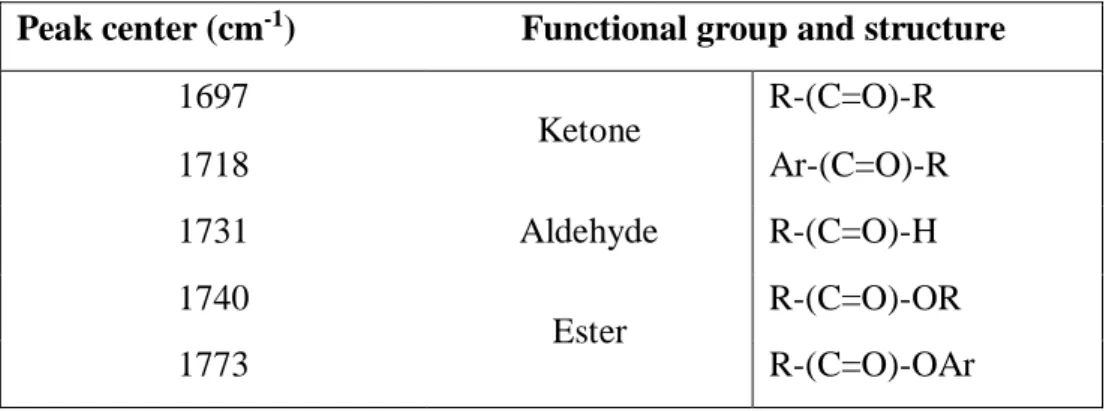
Table 4.2 Typical IR absorption peaks of different carbonyl moieties []. ...49
Table 5.1 Relative peak areas of IR carbonyl region of oil samples given in Figure 5.15. ...64
Table 5.2 Assignment of 1H NMR peaks of untreated SN150. ...66
Table 5.3 Assignment of 1H NMR regions changed after oxidation of SN150 BO. ..67
Table 5.4 Assignment of peaks for 1H NMR spectrum of untreated bottom phase that was obtained after the reclamation process where the used oil was treated with only NaOH at 150 °C. ...69
Table 5.5 Assignment of peaks for 1H NMR spectrum of bottom phase of reclamation process with NaOH only at 150 °C after neutralization with hydrochloric acid, HCl. ...71
Table 5.6 Titration results of untreated, oxidized, used, neutralized and rewashed oil. ...75
Table 5.7 TAN of oxidized base oil and neutralized base oil samples. ...76
Table 5.8 Weight and percentage yields of reclamation processes at different conditions. ...77
List of Figures
Figure 1.1 Subcategories of Tribology: Friction, Lubrication and Wear [1]. ... 1 Figure 1.2 Tribological contact observed in macroscale and in microscale [1]. ... 2 Figure 1.3 Types of tribological contacts categorized according to contact area type
[1]. ... 3 Figure 1.4 Types of tribological contacts according to surface type [1]... 3 Figure 1.5 Smoothening of rough contact surfaces with increasing of rubbing time
[1]. ... 4 Figure 1.6 Stribeck curve of lubrication regimes [3]. ... 6 Figure 2.1 Origin and production route of base oil lubricants (PAO-polyalphaolefins) [9]. ...13 Figure 2.2 Left: production amounts of different base oil types, Right: production
amounts worldwide with respect to regions [9]. ...14 Figure 2.3 Schematics of crude oil refining process [10-12]. ...15 Figure 2.4 Chemical structure of PAO6 (top) and PAO2 (bottom) [1]. ...19 Figure 3.1 Types of automotive engine oil additives according to their functions [1].
...23 Figure 3.2 Chemical structure of all forms of ZDDP additive [36]...29 Figure 3.3 ZDDP antiwear film formation on the surface of metal bearing. Adapted
from ref 40. ...30 Figure 3.4 Mechanism of tribofilm formation on metal surface. Adapted from ref 41.
...30 Figure 3.5 A typical ATR-IR spectrum of Castrol Power 1 4T 10w-40 engine oil. ..33 Figure 3.6 ZDDP monitoring by time using 31P NMR spectroscopy. Taken from ref.
52. ...34 Figure 3.7 SEM images of ZDDP layer after a) 24 hours b) 48 hours c) 72 hours of
growth time. Taken from ref. 55. ...35 Figure 3.8 Real-time AFM images of ZDDP growth monitoring. Adapted from ref.
Figure 3.9 SLIM images of real-time tribofilm growth monitoring on steel sphere surface. Taken from ref. 62. ...37 Figure 3.10 Color changes of lubricating oil during degradation (oxidation) [66]. ...39 Figure 3.11 IR carbonyl (C=O) absorption region of SN150 base oil oxidized at 200
°C at 1atm for 17 hours in a round bottomed flask (rbf). ...39 Figure 4.1 IR spectra of SN150 base oil oxidized in PARR 4838 series reactor for 4
hours. ...42 Figure 4.2 IR spectra of Castrol Power 1 4T 10w-40 engine oil heated at 170 °C for
different times. Inset right: magnified IR region of ZDDP additive. Inset left: magnified IR region of PMA based viscosity modifier. ...43 Figure 4.3 IR spectra of untreated Fe oxide and after reaction with used oil. ...45 Figure 4.4 EDX spectra of untreated Fe oxide np (top) and after reaction with used
oils. ...46 Figure 4.5 (A), (B) SEM images of synthesized magnetic nanoparticles, (C)-Zeta
Sizer measurement result of synthesized magnetic nanoparticles. ...47 Figure 4.6 Bruker ALPHA Platinum ATR single reflection diamond based ATR
spectrometer that was used in this study. Taken from ref #72. ...50 Figure 5.1 IR spectra of untreated and oxidized SN150 base oil in a flask, in a vial
and in the PARR model 4838 reactor. ... 52 Figure 5.2 Mechanism of radical formation from AIBN [77]. ...53 Figure 5.3 IR spectra of reaction of oxidized SN150 base oil (BO) with magnetic np.
...54 Figure 5.4 IR spectra of reaction of oxidized SN150 base oil (BO) with ferrocene. .54 Figure 5.5 IR spectra of reaction of oxidized SN150 BO with Fe3O4 in presence of
AIBN as a radical initiator. ...55 Figure 5.6 IR spectra of reaction of oxidized base oil with NaOH in presence of
magnetic nanoparticles at 120 °C...56 Figure 5.7 IR spectra of reaction of oxidized base oil with NaOH only at 120 °C. ...57 Figure 5.8 IR spectra of reaction of oxidized base oil with NaOH in presence of
magnetic np at 150 °C. ...57 Figure 5.9 IR spectra for comparing effect of magnetic np presence for reclamation
process at 120 °C. ...58 Figure 5.10 IR spectra for comparing reaction with NaOH in presence of Fe3O4 at
Figure 5.11 Colors observed for reclaimed oil: 1-BO oxidized at 200 °C for 17 hours, 2-Reclaimed oil (treated with NaOH in the presence of Fe3O4 at 120 °C), 3-
Reclaimed oil (treated with NaOH only at 120 °C), 4- Reclaimed oil (treated with NaOH in presence of Fe3O4 at 150 °C), 5- Reclaimed oil (treated with
NaOH only at 150 °C), 6-Untreated N150 base oil. ...61
Figure 5.12 IR spectra of separated oil (2), that is treated with NaOH in presence of Fe3O4 nps at 120 °C (top phase), prior to treatment with MgSO4 and untreated SN1150 base oil (3)...61
Figure 5.13 IR spectra of separated oil (2), that is treated with NaOH in presence of Fe3O4 np at 150 °C (top phase), after treatment with MgSO4 and untreated SN1150 base oil (3). ...62
Figure 5.14 IR spectrum of bottom aqueous phase after reaction with NaOH in presence of Fe3O4 np at 120 °C, after separation. ...62
Figure 5.15 IR spectra of oil samples after reclamation at different conditions. ...63
Figure 5.16 Typical 1H NMR spectrum of untreated SN150 Base oil. Inset: magnified region for observing other regions...65
Figure 5.17 Stacked 1H NMR spectra of untreated and oxidized base oil. ...67
Figure 5.18 1H NMR spectra of oil reclaimed using NaOH at 150 °C. ...68
Figure 5.19 1H NMR spectrum of untreated bottom phase. ...69
Figure 5.20 1H NMR of bottom aqueous phase after neutralization with HCl. ...71
Figure 5.21 IR spectra of untreated Castrol Power 1 4T 10w-40 engine oil, used engine oil and oxidized base oil. Insets show magnified regions of: O-H stretching region (left), C=O stretching region (middle), S=O IR absorption region (right). ...72
Figure 5.22 1H NMR spectra of unknown used oil, untreated Castrol Power 1 4T 10w-40 EO and untreated SN150 BO. ...73
Figure 5.23 Chemical structure of PMA based additive; a) polymer, b) monomer [31]. ...74
Chapter 1
1 Introduction
Tribology is the field of science that focuses on surface interactions that are in motion relative to each other. Major three parts covered by tribology are friction, lubrication and wear. Detailed scheme of tribology subject is described in Figure 1.1 [1]. The word “tribology” is Greek origin and means rubbing (Greek: tribos) [2]. Although these three parts are covered under the same roof they are totally different in mechanism of approach. Friction and wear are two correlated subjects and can be studied separately. Lubrication is an auxiliary field of tribology for friction and wear. These two can be studied in presence of lubrication or without lubricant. Tribology is one of the fundamental sciences in nature. Examples are from sliding of soap in a wet hand and toe sliding on an ice up to perfectly lubricated mechanisms. Machinery, automotive, hydraulics etc. almost all the industry is based on rubbing of surfaces. Reducing friction between these two surfaces will make machinery more energy efficient and save millions of kilowatts of energy. In the same manner reducing wear will give prolonged lifetime for moving parts producing less waste.
Figure 1.1 Subcategories of Tribology: Friction, Lubrication and Wear [1]. Tribology Friction Viscous Friction Dry Friction Lubrication Boundary Lubrication Mixed Lubrication Full Film Lubrication Wear Adhesive Wear Corrosive Wear Abrasive Wear Erosive Wear Fretting Wear Surface Fatigue
1.1 Tribological Contacts
When two surfaces or interfaces are rubbing relatively to each other it is called tribological contact. It can be defined with conditions of contact like: load, pressure, velocity, hardness, type of motion, humidity, temperature, surface roughness etc. In microscale or nanoscale surfaces are not rough and there is always a contact between these surfaces (Figure 1.2) [1]. Due to high strains during the microscale contact chemical bonds are broken and heat is produced. By time passage, these contacts break totally and fail to function. Due to this fact, contacts should be investigated both in nano and mesoscales. In industrial applications, due to toughness and hardness considerations, steel is the main material of fabrication. That is why many asperity contacts studies are based on steel-steel interaction. Other surfaces that are studied: polymers, yellow metal (brass) and ceramics etc.
1.2 Tribological Contacts Types
Tribology is the science that should be studied well in both nano and macroscales. Macroscale studies involve surface studies and the factors that affect friction is area of contact, while in microscale or in smaller scale, chemical and physical interactions start to take role. Macroscale investigations can be divided and categorized according to contact area and type of contact. Contact area can be in various forms depending on contact surface, they are basically divided in three categories: distributed contact,
line contact and point contact. As it can be understood from their names; distributed
contact is two surfaces i.e. planes rubbing each other and the contact weight, load friction is distributed evenly to whole contact area. Line and point contact is the type of contact where cylinder or sphere is rolling on a surface. In the case of cylinder, contact is line and in case of sphere, contact is point (Figure 1.3) [1].
Figure 1.2 Tribological contact observed in macroscale and in microscale [1].
In three cases the main changing factor is area of contact. These three types of contact can be classified in to two types according to surface types. Distributed contact is said
to be conformal contact, as they have same curvature. In other words, the contact area has same curvature for both contacting objects. During line and point contacts area and surfaces have different curvature, and they are called nonconformal contacts (Figure 1.4).
Figure 1.3 Types of tribological contacts categorized according to contact area type [1].
Distributed contacts occur in cylinders where cylinder wall and piston rub each other and have same curvature, in the same time they show conformal tribological contact. Balls in bearings show point contact and these two have different motion and show nonconformal contact. There are many other examples can be given in contact classification types.
When focusing on microscale level local interactions become important and chemical/physical changes on these local interactions start taking a role. If lubricant is being used, all interactions with lubricants should be considered. Rubbing surfaces are not rough as we said before, and during abrasion process surfaces become rough and bond breaking cause surfaces to be rough (Figure 1.5) [1]. Lubricants keep surfaces coming into contact with each other and at the same time dissolve broken particles and wash away. This is why in every lubricating system a filter is used to recapture particles. Local interactions are hard to study to nonuniformity of surface. Local micro surfaces can get very hot due to processes such as bond breaking and formation of new bonds. Increased time of interaction on the surface yields a uniform topography and by the time, machinery starts to operate without further breakages of wear. These factors mainly depend on load applied, because of low load or absence of load surfaces may not interact and wear level is not high. While increasing load leads to chemical reactions on the surface and local deformations due to temperature increase, even moving parts may break due to weakening.
Figure 1.5 Smoothening of rough contact surfaces with increasing of rubbing time [1].
1.3 Friction
Friction can be explained as a resistant force for moving. When two surfaces are in contact, they have an interaction, that can be physical or chemical. These interactions are the main causes for friction. Friction can be divided into two classes: static and
dynamic. Static friction is type of friction when contacting surface are at rest i.e. no
motion and it transfers to dynamic when surfaces start to move. Friction is also categorized according to lubricant type used, if liquid lubricant is used it is called
viscous friction and if there is not it is called dry friction. Friction is defined by friction
coefficient which can be determined by the ratio of friction force to normal force (1). Friction is a vectoral quantity.
Normal force is defined by load applied and gravitational force. Normal force is always perpendicular to direction of motion, but the direction of gravitational force is always down. Friction coefficient can be calculated by knowing applied force and weight of object. Sometimes in tribological experiments, additional load is added to weight of object, in these cases weight of object can be neglected if comparably very small to applied load. In this case, simply by dividing applied force to load, friction coefficient can be calculated. This rule applies for dry friction coefficient calculations, for viscous friction i.e. lubricant is being used, shear stress of lubricant τ should be considered. Shear stress τ is determined by lubricant properties and depends on viscosity, velocity of movement and range.
Lubricants added decrease friction coefficient, and thus friction. Lubricated friction can be described by formation of thin film on the surface. Lubrication regime describes ratio of film thickness to surface roughness: boundary lubrication, mixed
lubrication and full-film lubrication (Figure 1.6) [3]. Lubrication regime is derived
from mechanical interaction of solid lubricating surfaces.
• Boundary lubrication: this the lubrication regime where surfaces are in hard contact and surface interactions are at highest level and friction is high. This regime can be defined by high friction and low speed.
• Mixed lubrication: in this regime surfaces are separated a little bit by lubricant. Interaction occurs partially on specific sites due to asperity contacts. This regime is between boundary lubrication and hydrodynamic regime.
• Full-film lubrication: in this regime surfaces are far enough to remove all surface interactions. Friction coefficient is lowest in this regime, but increases with increasing of speed. Lubricants carry additives that form thin film on the lubricated surfaces, that’s why it is called full-film lubrication regime.
Figure 1.6 Stribeck curve of lubrication regimes [3].
1.4 Wear
Wear is removal of surface materials due to interaction between the surfaces. Microscale of wear is braking of bonds due to interaction with other surfaces. Wear depends on lubrication regime, lubricating parameters, operating conditions and environment. Wear types can be categorized into many classes, but these five are major classes of wear: adhesive wear, abrasive wear, surface fatigue, fretting wear and erosive wear.
• Abrasive wear: this type of wear occurs between interaction of hard material with softer material. Roughness on the surface of hard material makes scratches on the surface of soft material. According to number of bodies that takes place in action can be categorized to two-body or three-body interaction.
• Adhesive wear: this type of wear is mainly occurs due to high temperature and high pressure operating conditions. Surfaces melts and chemical reactions start, even weld into together.
• Surface fatigue: this type of wear occurs in cycling contacts. During cycling, due to failure of parts cycling surfaces starts to slide. Surface is deformed because of this sliding.
• Fretting wear: this type of wear occurs in case of small vibrations between rubbing surfaces. This cause local interactions on the surface and cause wear.
• Erosive wear: this type of wear occurs when small particles smash the surface and cause deformations by removing some materials from the surface.
• Other types of wear are corrosive wear that occurs because of chemical reaction on the surface. This can be caused by solvent, surfaces etc. This type of wear also called tribochemical wear or tribocorrosion.
1.5 Tribological lubrication
Lubricants are added both, to reduce friction and wear. But lubricants should be chosen according to the mechanical parts, operating conditions, operating environment etc. Choosing wrong lubricant causes lubrication failure and raise of both friction and wear. During rubbing process, two parts get heated and chemical bonds cleavage on the surfaces start [1]. By time, these parts become broken or unusable. Lubricant’s main usage aim is to prolong the lifetime of moving parts by providing flow that removes broken particles from and at the same time they provide cooling effect. However, they are not good coolants and that is why in many lubricating systems cooling liquid is also flown. Many lubricants contain additives that prevent oxidation of oil and form a thin layer of film on the rubbing surfaces which is called as tribofilm. Other minor functions of lubricants can be categorized into following:
• Reduction of noise and vibrations.
• Prevent corrosion by blocking water and corrosive materials. • Transferring power.
• Separation of moving parts from each other.
Lubricants are good for reduction of noise and vibrations mainly due to separation of moving parts. When moving parts touch each other, they produce noise and unwanted
vibrations, adding lubricant will separate these surfaces and thus reduce noise and vibrations. Water and other unwanted substances may increase wear rate by causing corrosive wear on surface, lubricants prevent this by removing and capturing corrosive molecules. Lubricants are one of the mostly used liquids for transferring power, for example in hydraulic systems. Due to their high viscosity, they are good power transfers and widely being applied in hydrodynamic mechanisms.
Lubricants can be divided into three categories with respect to their physical state:
liquid lubricants, semi-solid lubricants, solid and dry lubricants. Liquid lubricant will
be covered separately in next chapter in detail.
• Solid and dry lubricants: Solid lubricants can also be used for lubrication purposes [4]. They can be used when operating conditions, mechanical parts or other parameters does not allow liquid lubrication. Mostly used solid lubricants are: molybdenum disulfide, Teflon (PTFE), graphite etc. They can be used in combination with liquid lubricants, or sometimes additionally to reduce friction. Mainly they are used as a coating for reducing friction on surfaces.
• Semi-liquid lubricants: These types of lubricants can be utilized when liquid lubricants cannot be used. One of the well-known semi-solid lubricant is
grease, they are used in many lubricating areas [5]. They are base oils
composed of 5-30% with thickening material i.e. polymers, clays, soap etc.
1.6 Organization of thesis
In this thesis work, we will present reclamation of used lubricating oil using caustic soda (sodium hydroxide) and magnetic iron oxide nanoparticles. We have focused our work on engine oils and base oils mainly. Brief explanations for lubricants is given in this chapter and the organization of thesis will be as follows:
• Chapter 1: Short description of tribology and lubrication relation of lubrication with tribology. Types and classes of lubricants used, purposes and reason for lubrication needs are also briefly explained.
• Chapter 2: Base oil lubricants, their types, usage and production routes, their characteristics, especially base oil SN150 that was used in current study will be discussed in detail.
• Chapter 3: Additives for final oil formulation, types of additives used, purposes of usage, their depletion and especially additives used in engine oils, specifically Castrol Power 1 4T 10w-40 engine oil is focused. Also, oxidation mechanism of oils is described in detail.
• Chapter 4: Materials and Methods used for preparation of samples, chemicals that are used, procedures and instruments and analytical techniques etc. will be covered in detail.
• Chapter 5: Results on the spectroscopic measurements data, discussions that were done for the observations in the current study are presented.
Chapter 2
2 Base Oil Lubricants
Base oils, sometimes referred as base fluids are crude oils that become usable after the addition of additives. Base oils consist of hydrocarbons and there are variety of base oils. Hydrocarbons according to their type of bonds can be saturated or
unsaturated. Saturated hydrocarbons obey to formula of CnH2n+2 and they are
hydrogen saturated unlike unsaturated hydrocarbons i.e. they contain double or triple bonds in their structures. General hydrocarbons found in base oils are naphthenes, paraffins and aromatics. These hydrocarbons can be straight, chained, cyclic or unsaturated. Base oil properties depend on type of these hydrocarbons found in. Type and chemistry of hydrocarbons found in base oils also determine the lubricating properties. General test that base oils are subjected: viscosity index and viscosity,
polarity, volatility, oxidation stability etc.
• Viscosity and viscosity index: they are determined by length of hydrocarbon chain. Long chains result in high viscosity and short chains result in low viscosity base oils. Viscosity index of base oils, depend on thermal properties of hydrocarbons in. Viscosity of long chain hydrocarbons do not alter much with respect to temperature, and due to this they can be used in many high temperature applications. Presence of rings and branching in hydrocarbon structure enhances cold flow characteristics and at the same time prevent wax formation [6].
• Polarity: it is determined by ability to dissolve additives and interaction with surfaces. Generally, base oils are nonpolar due to long and branched hydrocarbon chains. Polarity, effects base oil properties like: air release, adsorption to surface, demulsification and foaming.
• Volatility: it is determined by amount of low molecular weight hydrocarbons in base oil. These low hydrocarbons evaporate at high temperatures and leave behind viscous base fluid. Engine or machinery oil operates at high temperatures [7], that is why volatility should be maintained before formulating final lubricating machinery oil. Because, these evaporated hydrocarbons can form deposits on moving parts.
• Oxidation stability is factor that shows resistance to chemical oxidation. Base oils that are operated at high temperatures [7] and subjected to oxidation process i.e. molecular oxygen starts to react with hydrocarbons. Detailed mechanism of lubricating oil oxidation is discussed in Chapter 3. Unsaturated hydrocarbons are more reactive towards oxygen, in other words, base oils containing unsaturated hydrocarbons can be oxidized easier. Oxidation stability shows at what temperature base fluid starts to be oxidized.
Base oil that will be used for production of final engine oil should be chosen according to above-mentioned parameters. Base fluid containing suitable ratio of paraffinic, aromatic and naphthenic hydrocarbons should be chosen. Table 2.1 summarizes some physical and chemical properties of hydrocarbons found in base oils [1].
Properties Paraffinic Naphthenic Aromatic
Viscosity index High Low Low
Density Low Low High
Pour point High Low Low
Volatility Low Medium Low
Flash point High Low Low/medium
Oxidation stability High High Low
Thermal stability Low Low/medium High
Toxicity Low Low Medium
Elastomer compatibility Shrink Swell Swell
Table 2.1 Some physical and chemical properties of hydrocarbons found in base oils [1].
2.1 Classification of Base Oils
Base oils are classified according to their usage purpose within common terminology. Base oil lubricants are mostly used in automotive industry. Engine oils are subjected to physical and chemical tests by Original equipment manufacturers (OEMs) prior to market release. OEMs have approval tests for engine oils, that oils should pass before market introduction. Base oils used in automotive industry are categorized into groups I, II, III, IV and V [8]. These categorization and descriptions are done by American Petroleum Institute (API) and Association Technique de l’Industrie Europeenne des Lubrifiants (ATIEL). Description of these groups is summarized in Table 2.2 [8] (VI stands for Viscosity Index). Group V includes all other base oils that cannot be categorized into other groups. They are not suitable for usage in engine oil applications. This classification is based on amount of hydrocarbons and sulfur content.
Group Description
I Saturated hydrocarbons < 90%, sulfur > 0.03%, 80 ≤ VI ≤ 120 II Saturated hydrocarbons ≥ 90%, sulfur ≤ 0.03%, 80 ≤ VI < 120 III Saturated hydrocarbons ≥ 90%, sulfur ≤ 0.03%, VI ≥ 120 IV PAOs (Polyalphaolefins)
V All others, but groups I, II, III and IV: e.g. naphthenics, synthetic and natural esters
Table 2.2 Description of base oil categorization according to API and ATIEL [8].
Base oils have other classification types according to their origin and production route. Many base oils used in industrial and automotive application are produced from petroleum. But, there are also lubricants or so called bio-lubricants that produced from vegetables or animal origin. Recent years due to increasing of environmental issues biodegradable lubricants have attracted reasonable attention. Gas to liquid (GTL) lubricants are produced from natural gas and coal. These mentioned lubricants, or environmentally adapted lubricants (EALs) are given in detail in Figure 2.1 [9].
Figure 2.1 Origin and production route of base oil lubricants (PAO-polyalphaolefins) [9].
Lubricant categorization according to API and ATIEL are also shown in Figure 2.1. Generally, group numbers are not used as a base oil names, rather common names shown in Figure 2.1 are used. Common names of oils and their group belongings are summarized in Table 2.3 [9] (VHVI stands for very high viscosity index).
These lubricating base oils are produced worldwide and properties of base oils change due to hydrocarbon content and amount of sulfur of that region. As base oils are derived from petroleum, their properties depend on the petroleum properties of that region. Production amounts of base oils and production across the world is given in Figure 2.2 [9]. Most commonly produced base oils belong to Group I and Group II, and relatively small amount belong to Group III. They are used almost in every part of industry, especially in automotive and jet engine oils production. One of the biggest manufacturers of base oils is United States, second is Europe, continues with Korea and Japan. China is also one of the biggest manufacturer of base oils, minor producers of base oil are Middle East and some parts of Africa, and South America. South Asia and Australia together produce considerable amount of base oil annually.
Natural gas or coal Fischer-Tropsch synthesis GTL Crude oil Refining Mineral oil Paraffinic Naphthenic Hydro-treating White oil VHVI Petrochemical industry PAO Alcohol
Plant & animal
origin Refining
Fatty acids Synthetic esters
Figure 2.2 Left: production amounts of different base oil types, Right: production amounts worldwide with respect to regions [9].
API group Description Origin Common name
I Paraffinic Crude oil Mineral oil
I Re-refined Used oil Re-refined
II Paraffinic Crude oil Mineral oil
II Re-refined Used oil Re-refined
II White oil Crude oil White oil
III VHVIs Crude oil Synthetic fluid
III GTLs Natural gas (or coal) GTLs
IV PAOs Crude oil Synthetic fluid
V Naphthenic Crude oil Mineral oil
V Vegetable oil Vegetable oil Vegetable oil
V Synthetic esters Vegetable oil and crude oil Ester
Table 2.3 Origins and classifications of common base oils [9].
2.2 Refining of Base Oils
Base oils produced from crude oil are formed by the result of process, named as
refining. Initially crude oil contains hydrocarbon and low amount of sulfur, oxygen,
nitrogen, metals and salts [9]. Relative amounts of elemental content in crude oil is given in Table 2.4 [9]. Crude oil needs to be refined in order to produce base oil with suitable lubrication properties. During refining process, desirable substances are kept and unwanted elements and molecules are removed. Sulfur is among desirable
Component Percent weight Carbon 83-87 Hydrogen 11-14 Sulfur 0-3 Nitrogen 0-1 Oxygen 0-0.5
Metals and salts 0-0.2
Table 2.4 Relative amounts of elements in typical crude oil [9].
Refining process begins with atmospheric pressure distillation. At this step crude oil is heated and oil components are separated according to their boiling points. Low molecular mass components are collected on top of tower and heavy molecules stay in bottom. Detailed scheme of refining process is shown in Figure 2.3 [10-12].
Figure 2.3 Schematics of crude oil refining process [10-12].
Low molecular weight molecules are collected constantly by distillation and further purified for production of various fuels. These fuels can be: gasoline, gases, kerosene, naphtha and light gas oil. Products left in the bottom are transferred to vacuum distillation tower and highly volatile aromatic hydrocarbons are removed in this part. Thick base oil remains after vacuum distillation process [9, 11, 12]. In this thick layer, waxes and asphaltenes are present and they are removed by solvent extraction, cooling to lower temperatures where wax crystallize [13]. Presence of wax will affect viscosity
of base oil, and wax crystallizes at high temperatures and causes failure in lubrication. At final stage, hydro-refining is applied to obtain desired oxidation stability and color. Often, directly hydro-finishing is applied, where cracking happens. Trace elements, sulfur and nitrogen are also removed in order to sustain gas emission levels. Sulfur acts as a natural antioxidant, but nitrogen catalyzes oxidation and it needs to be removed. After all of these steps, physical and chemical properties of crude oil change. Detailed change in properties of crude oil is summarized in Table 2.5 [9]. Final engine oil properties are adjusted by using additives and they will be covered in Chapter 4 in detail.
Property Deasphalting Dewaxing Hydro-refining Viscosity Decrease Increase No change Viscosity index Increase Decrease No change
Density Decrease Increase Decrease
Pour point Increase Decrease Increase Flash point No change No change No change Oxidation stability Improve No change Improve Additive response Improve No change Improve
Color Improve Improve Improve
Table 2.5 Effect of crude oil refining [9].
2.3 Base Oils Derived from Crude Oil
In this section, base oils derived from crude oil that are shown in Figure 2.1 will be discussed in detail. As seen from the figure, crude oil based base oils are: GTL, paraffinic, naphthenic, white oil, VHVI base fluids and PAOs. Also, re-refined base oil will be discussed. These names are used according to their hydrocarbon and sulfur content along with synthesis method.
2.3.1 Gas-to-Liquid Base Oils
Due to hardness to obtain petroleum based mineral oils, gas-to-liquid oils were invented. GTL is expensive due to difficulties in manufacturing. They were considered as an alternative for petroleum based fuels. They are produced according to Fisher-Tropsch (F-T) process by reaction of natural gas or coal with oxygen. This
procedure consists of three main steps: syngas production, its conversion and hydrotreatment. The chemical reaction pathways are shown below:
2 CH4 + O2 2 CO + 4 H2 (2)
n CO + 2n H2 (CH2)n + n H2O (3)
Hydrocarbon chains are produced in the end of the reactions. These hydrocarbon chains can be in various size and due to process, they do not contain aromatics, metals, olefins, sulfur and nitrogen. Their physical properties are identical with VHVI and PAO, they have suitable clod flow characteristics and low volatility. They are categorized as a synthetic base oil and belong to group III base oils according to API [14-16].
2.3.2 Paraffinic Base Oils
Paraffinic base oils, as it is understood from name, 45-60% consist of paraffinic hydrocarbons [1]. Due to small amount of aromatic hydrocarbon content their color is slightly yellow. During refining process, their viscosity increases and their color becomes denser. These paraffinic base oils are one of the mostly used lubricants in industry, due to suitable lubricating properties and good additive solvability. Another reason for their wide usage is stability temperature of 150 °C with oxygen presence and 200 °C without oxygen. Their physical properties at low temperatures are excellent and can be improved by using additives. When we look to Stribek curve (Figure 1.6), they can be used from boundary to full-film lubrication regime. Most of paraffinic oils are utilized in automotive industry as an engine and transmission oil, and in other industrial applications [9].
2.3.3 Naphthenic Base Oils
Naphthenic base fluids contain 65-75% naphthenic and 25-35% paraffinic hydrocarbon units. They make about 10% of petroleum oils. Their color is same with paraffinic oils, but they can be light yellow due to low amount of aromatic hydrocarbons. Their physical properties are same with paraffinic base fluids; thus, they are also good lubricants and have good additive response. They are used to increase additives solvability of other lubricating oils. Despite having good lubricating properties, they have indigent VI, which makes them unusable in high temperature applications [9]. One of good properties of these oils is that they do not contain wax;
thus, they have wonderful pour point characteristics. They are generally utilized in jet turbine, hydraulic and metal applications [11].
2.3.4 White Oils
Final step of refining process produces white oils that contains mixture of paraffinic and naphthenic hydrocarbons. They are purified well and contain lowest amount of aromatic hydrocarbons, sulfur and nitrogen. Therefore, they are colorless and named as white oils. Rather than paraffinic and naphthenic oils they are used in food, cosmetics applications, pharmaceutical i.e. areas where sanitation legal requirements are high. Due to production route, they are relatively high-priced and used only in specific operations [9].
2.3.5 Very High Viscosity Index Base Oils
Hydroisomerisation happens due to cracking step during hydrotreating, and changes chemical structure of molecules making them more branched. In the end of this step, very high viscosity index (VHVI) base oils are produced. Main composition of VHVI oils is paraffinic, sometimes small amount of naphthenic hydrocarbons present. They have very high viscosity; thus, good oxidation stability and low volatility. When compared to group I and II base oils, their cold flow characteristics are better. They are called as synthetic base oils and generally used in new type of engines [9, 17].
2.3.6 Polyalphaolefins
PAOs are only chemically synthesized base oils, they are produced from linear chain paraffin hydrocarbons. Chemical structure of final product can be controlled easily and base oils with good mass dispersion can be obtained. Physical properties of PAOs can be arranged accordingly. One of their drawbacks is their additive response. To overcome this problem, they are mixed with ester or naphthenic base fluids. PAOs are more valuable compared to mineral base oils, due to their extraordinary properties. Their oxidation resistance is better, viscosity is high and volatility is low. Because of being expensive they are utilized in transmission and cold start engines (0W-xx), as they have superior low temperature characteristics [9, 18]. Chemical formula of some PAOs are given in Figure 2.4 [1].
Figure 2.4 Chemical structure of PAO6 (top) and PAO2 (bottom) [1].
2.3.7 Re-refined Base Oils
According to EU Waste Directive, petroleum derived base oils or industrial lubricants must be re-refined instead of being burned [19]. Additives inside lubricants deplete by usage time and oxidation (degradation) of lubricating oil becomes inevitable. Beyond that, due to usage process, lubricants become contaminated with water and other particles. Lubricant after fulfilling its life needs to be changed. However, waste oils can be re-refined by moisture and contaminants removal. As a result of this process, superior quality base oils can be obtained. Re-refining cycle resembles crude oil refining process, first water is removed in distillation tower, second distillation is applied to remove volatile components like fuel and other organics, final step is used to extract base oils by using conventional solvents, and in the same way particles are removed. Re-refining is becoming more important due to oil spills around the world. It was reported that from every 1000 tons of used oil at least 600 tons can be reclaimed [20].
2.4 Base oils naming
Naming of base oils is made according to their physical properties, API groups and additives inside. Group I base oil are called as SN and their respective viscosity at 100 °F (37.78 °C) in Saybolt seconds units is used. Here S stands for solvent because solvent extraction step and N means neutral because of neutralization after acid washing step. Group I base oil also can be Bright Stock (BS), that means bright fluorescence because of heavy aromatic hydrocarbons is observed. Common group I base oils names: SN150, SN650, SN500 etc.
Group II base oils are referred as Neutral, they are indicated by their viscosity at 100 °F (37.78 °C) in Saybolt seconds units. Also group II base oils are named by their kinematic viscosity (KV) at 100 °C in cst units. Examples of group II base oil names: 100 N, 150 N, 600 N or Group II 4, Group II 6 etc.
Re-refined base oils are also named as Group I and Group II base oils, sometimes “Re-refined” is added in front of name and they are differentiated according to their kinematic viscosity at 100 °C in cst units.
Other group oils are named according to their kinematic viscosity at 100 °C in cst units, group III base oil are named according to their oil type, generally they are referred as VHVI and group IV as PAOs. Examples of group III and IV base oil names: VHVI 4, VHVI 6, PAO 6, PAO 10, Group V 5, Group V 10 and etc.
2.5 SN 150 Base Oil
We used Group I SN 150 Bright Stock base oil in our experiments. This is most common base oil used for lubricant manufacturing. SN 150 is 90% saturated base oil, it is produced commonly by solvent refining and by KOH neutralization. Its properties depend on the production region and production process, but its sulfur content is maximum 0.3 % and VI is between 80-90 [21]. Physical and chemical properties of SN 150 base oil are given in Table 2.6 [21].
Oil property SN 150 specification
Kinematic viscosity, mm2/sec (cSt) at:
100 °F 100 °C
27 – 31
4.5 – 5.5
Viscosity index 90
Acid index, mg KOH/1g oil Not normalized
Ash % 0.005 Water content, ppm 100 Flash point, °C 195 Pour point °C 1.09 – 1.04 1.04 – 1.09 Minus 15 Minus 10 Sulfur content % 0.3
Polycyclic aromatic hydrocarbons (PAH) % 3
Appearance Homogeneous clear fluid
Specific gravity at 15 °C, kg/m3 0.87
Chapter 3
3 Engine Oil Lubricants
Base oils prior to usage are adjusted with various additives in order to satisfy international standards. Final lubricating product is named as engine oil, motor oil or lubricant. Primary functions of motor oils are to reduce friction and inhibit wear; minor activity is to remove sludge formed, prevent corrosion and finally cooling the motor [22]. Engine oils are used in internal combustion motors. Thus, they can go to very high temperatures about 160 °C in case of gasoline powered engines and to 315 °C for diesel engines [22]. As we said before, engine oils are formulated from base oils, lubricating properties and physical properties of base oils are not sufficient. Base oils can be oxidized easily at high temperatures. For preventing this, antioxidant additives are commonly used. Antioxidant additives are chosen according to application of the final motor oil. There are many other additives used during formulation such as viscosity modifiers, surfactants, friction modifiers, antiwear, extreme additives etc.
3.1 Additives
Additives used in automotive engine oil are classified according to their function and acting mechanism. Types of additives according to their chemical and physical functions in automotive oil are given in Figure 3.1 [1]. When taking into consideration automotive internal combustion engine, all of the reactions and interactions happen in the solid/liquid and liquid/liquid interfaces. Moving parts are solid and lubricant is liquid, oxygen is gas, lubrication occurs between these parts. Surface additives act on these interfaces and bulk additives act inside oil i.e. liquid/liquid interface.
Figure 3.1 Types of automotive engine oil additives according to their functions [1].
3.1.1 Surface active additives
Surface additives act, interact at solid/liquid interface decrease friction and prevent solid moving parts from wear and corrosion. Their general mechanism of action is based on forming films on solid surfaces. This film can form by adsorption to surface both physically and chemically. Due to this, they are referred as film forming additives. Because of high working temperature and presence of pressurized air, metal surfaces form oxides. These oxides can bind some air and water molecules, function of surface active additives is to remove these water and air molecules by interacting with this oxide layer [23]. These types of additives are: antiwear additives, corrosion
inhibitors, EPAs (extreme pressure additives), friction modifiers.
• Antiwear additives: this type of additives as understood from the name are used to reduce wear in moving parts. Wear reduces lifetime of moving parts and aim of antiwear additives is to endure lifetime of engine components. They are used about 1-3% during engine oil formulation and activated at high temperatures [24-26]. They react with the surface and form chemical bonds (chemisorption). Because of strong interaction with steel surface, elements like sulfur, phosphorus, nitrogen that are chosen. Among all, phosphorus is the best candidate by providing longest lifetime to moving motor parts. One of the
Additive Function Surface active Soild/Liquid interface i.e. adsoprtion Chemical effect Physical effect Liquid/Liquid or liquid/gas interface Physical effect Bulk active Physical effect Chemical effect
mostly used antiwear additive is ZDDP (zinc dialkyldithiophosphate), it functions as an antioxidant at the same time. ZDDP will be discussed in next section in detail. Because of environmental issues new type of antiwear materials like Teflon (PTFE), graphene, DLC etc are being discovered [25-27].
• Corrosion inhibitors: corrosion occurs due to acids and sulfur compounds, which form because of oil oxidation. Based on their interaction mechanisms corrosion inhibitors used are neutralizers or film forming additives. The last ones are used frequently. Their mechanism is same with antiwear additives, they form protective layer on surface of metal via chemical or physical binding (adsorption). There are two types of corrosion; electrochemical and chemical corrosion. Difference is, in electrochemical corrosion electrolytes facilitate corrosion, while in chemical there is no electrolytes. In steel parts, due to high temperatures and oxidation reactions electrolytes form [28]. Additives that prevent corrosion form layer on metal surface and preserve reaching of water and oxygen to the activated surface. Some corrosion inhibitors used are: phosphates, carboxylic acids, basic&neutral sulfonates and amines.
• Extreme Pressure Additives: these additives are used for prevention of shuffling and corrosion of parts in case of high localized pressure. Their principle is same with corrosion and antiwear additives, formation of layer that protects from wear and decreases friction. They are used in massively weighted gears that move slowly but with high torque [26, 29]. There are two types of EPA; mild and strong. They are differentiated by activation temperature, mild is activated in lower temperatures and strong EPA needs high activation temperatures. Film formation occurs on the surface of moving parts, and it becomes polar because of hydrocarbon chains breaking at extreme pressure. Here also, elements that have high binding coefficient to iron are chosen. These elements make chemical bonds with iron and after removal of hydrocarbon moiety only thick layer of iron salts remain.
• Friction modifiers: friction modifier additives are needed to change friction during mixed lubrication regime during tribological contact (Figure 1.6). They
increasing of temperature. This can be prevented by using more amount of additive. Generally, about 1% of this additive is used during formulation. They can both reduce friction and control the friction, it is added in motor oils for reducing and in transmission oils for adjusting the friction [24, 28]. They have similar mechanism to other surface additives; formation of film on the surface. They are made from fatty acids, esters, amides, alcohols i.e. they contain long apolar hydrocarbon chains and oxygen or nitrogen containing functional groups. Acidic groups bind better than amines and alcohols. Hydrocarbon chain length also plays significant role in lubrication; long chains decrease friction better, while smaller chains can result in corrosion issues [24].
All of the additives mentioned above were functional on solid/liquid interface. They form films on the surface of the engine parts and prevent corrosion, wear, friction etc. But there are other group of additives that act in liquid/liquid or liquid/gas phase;
defoamers, demilsufiers and emulsifiers.
• Defoamers: foams are formed during air entrance into lubricating oil, air encapsulates into base oil and foams form. These foams are stable due to pressure equality of air inside and lubricating layer outside. Defoamers have polar ends and they interact with air, which destabilize foams. After reaching desired thickness foams explode. They are used for increasing lubricant dispersity and prevention of air entering and foam formation [29]. Polymethacrylates and silicone oils are among most commonly used defoamers. They are added in very low amounts.
• Demulsifiers: oil is also used as a coolant, but its cooling properties are poor and water is used as a main cooling agent. During these applications water can mix oil, and increase corrosion. Emulsifiers and demulsifiers are used for adjusting water amount in lubricant. Demulsifiers contain polar hydrophilic molecules that have hydrophilic elements (oxygen, sulfur, phosphorus and nitrogen) and trap water. They are made from high molecular weight polymers and contain about 5-50% of polyethylene oxide [1].
• Emulsifiers: they are similar materials to demulsifiers and their aim is to separate water from oil interface. They contain same elemental groups as
demilsufiers, and reduce water droplet sizes be reducing surface tension of water droplets. Demulsifiers are used together with emulsifiers and demulsifiers are more active.
3.1.2 Bulk additives
Additives that were mentioned in previous part were functional at solid and liquid surfaces. Here, we will discuss additives that are added for improving oil properties itself. Some of these additives act physically (viscosity modifiers, dispersants, pour
point depressants) and others act in chemical way (antioxidants, detergents). These
additives will be discussed in detail.
• Viscosity modifiers: Viscosity of base oil can operate within certain narrow range, needing seasonal change, as outside temperature changes from high positive values to negative [29-31]. Viscosity modifiers are chosen according to their low reactivity with oil and other additives, ability to increase fuel economy. Viscosity modifiers are chosen from long chain high molecular weight polymers. At low temperatures, these polymers stay in enlaced form and by increasing temperature they became linear; thus, they increase viscosity of base oil. Appropriate viscosity modifier should be chosen according to application of oil, operating temperature, needed viscosity grade etc. Commonly used viscosity modifiers are made from olefin copolymers (OCP), polyisobutylene (PIB) i.e. olefin polymers or polymethacrylates (PMA) i.e. ester polymers.
PMAs are one of most commonly used viscosity modifier additives, they easily mix with wide range of base oils and they have good thermal properties. However, their viscosity range is low compared to PIBs and OCPs, thus they are used in small viscosity range grade oil. Being ester based, PMAs have good oxidation stabilities. But, one of drawbacks is high manufacturing costs. Due to this, they are used in small quantity applications like in automotive engine lubricating oils [31]. OCPs are hydrocarbon based polymers with elementary chemical structure. Their thermal properties are good, and they are cheap. But, they are needed to be used with pour point dispersants [30]. PIBs are one of the initially discovered viscosity modifiers, they are made from butadiene and have rather simple chemistry. Their thermal
• Dispersants: These additives are added in order to remove and disperse sludge, soot and deposits formed. They clean moving parts by removing sludge on surface of moving parts. By removing insoluble components, they also adjust viscosity of lubricating oil. They have polar groups that attach to the surface of sludge and insoluble components, dispersant functions are same with surface additives. By attaching to sludge, they prevent agglomerates formation due of their bulk structure [28, 32]. Commonly used dispersants contain polyisobutene as a long hydrocarbon chain and succinimide as a polar moiety. Mainly, they are polymers with moderate molecular weight.
• Pour point depressants: During cold seasons, i.e. at low temperature, viscosity of base oils increase. After some point, base oil becomes cloudy and liquid starts to crystallize. Pour point depressants prevent this crystallization by dissolving or binding the wax. In this way, they prevent crystallization of liquid base oil [29, 32]. They have similar structures to viscosity modifiers and are composed of polymethacrylate or naphthalene polymers. But, they do not have long chains, they are rather branched and bulker. They are more effective in small polymer or monomer form rather than in polymer forms. They are used in motor oils, transmissions fluids, gear lubricants and in hydraulic applications fluids [29, 31].
Previously mentioned additives are added in order to modify physical properties of base fluids, they do not interact chemically. For adjusting chemical properties of base lubricants chemically active additives are added. They are antioxidants and
detergents.
• Antioxidants: Lubricating engine oils operate at high temperatures and in presence of oxygen they start to be oxidized. Oxidation of lubricating oils is very complex procedure and it will be discussed in incoming chapter. In presence of oxygen, following chain reaction starts [33]:
R-H + O2 ROOH RO· + ·OH / R· + ·OOH (rate determining step) (4)
R· + O2 ROO· ROO· + RH ROOH + R· (5)
Auto oxidation of base oil is favorable process (reactions 4-6). Antioxidants terminate the reaction with trapping free radicals [33]:
RO· + AH ROH + A· / R· + AH RH + A· (7)
A· + A· AA / R· + A· RA (8)
This is simple representation of antioxidant functioning. In other words, antioxidants are radical scavengers i.e. they trap radicals and prevent further reaction. They can be amine based, phenolic and sulfur-phosphorus based like ZDDP [29, 34]. ZDDP will be discussed in next section in detail.
• Detergents: They are basic molecules with long hydrocarbon chain. They react with acidic groups formed during oxidation of base oil. Their secondary function is to prevent further oxidation. Total number of detergents in lubricating oil is called as total base number (TBN), it is used as a sign for routine oil changes [29, 35]. They contain metal ions that neutralize acidic groups. According to their basicity they are divided into neutral and overbased detergents. Neutral detergents have same function as corrosion inhibitors and antiwear additives, they keep the metal parts surface clean. But, overbased detergents have metals that react with acidic groups and neutralize them. Generally, calcium and magnesium ions are used as a basic moiety. Salts can be phenates, sulfonates, salicylates. Among these first and third acts as an antioxidant and can be manufactured very cheaply. However, they are not basic as sulfonates [35].
3.1.3 Zinc dialkyl dithio phophate (ZDDP)
ZDDP is one of the mostly used automotive engine oil additive. It is both an antiwear and antioxidant additive. It contains zinc bonded to dithiophosphoric acid. Depending on pH of the medium it can be in monomer, dimer, tetramer and polymer forms. Chemical structures of all forms of ZDDP are given in Figure 3.2 [36]. The R group in the structure determines antiwear properties. There are various types of ZDDP depending on R group moiety. They are one of the mostly added additive in lubricants with 2-15% [37]. They are produced by reaction of P2S5 with alcohol and reaction of
P2S5 + 4 ROH → 2 (RO)2PS2H + H2S (9)
2 (RO)2PS2H + ZnO → Zn[(S2P(OR)2]2 + H2O (10)
It was discovered during 1940s and still being used in various types of motor oils [39].
Figure 3.2 Chemical structure of all forms of ZDDP additive [36].
ZDDP acts as an antiwear additive by forming thin film on metal surface, which is named as tribofilm. During high temperatures, ZDDP degrades by forming ZnO and sulfur containing groups. These sulfur containing groups are chemisorbed onto iron surface (Figure 3.3) [40]. Tribofilm prevents metal parts rubbing each other and prevent scuffing. Detailed mechanism of film formation happens according to Figure 3.4 [41]. This film renews itself, and it is not stable at very high temperatures.
Tribofilm formation is a chemical process and high temperature is required in this process. Films that are formed at lower temperatures are not stable and the film is only physisorbed onto the surfaces. After heating to high temperatures, degradation of ZDDP starts and chemical reaction between iron and sulfur in ZDDP leads to formation of tribolayer. In absence of heat, however, ZDDP degradation is almost negligible, degradation happens only during high temperatures that exceed 150 °C. During even higher temperatures degradation of ZDDP increases exponentially [42, 43]. After depletion of ZDDP in lubricant, base oil starts to oxidize and tribofilm
formation is not promoted any longer. Tribofilm formed on the surface is removed by effect of heat and this is the time for oil change. The main factor for ZDDP degradation and lubricant oxidation is mainly the high engine operation temperature. Reducing temperature to lower degrees would increase lifetime of both ZDDP and lubricants.
Figure 3.3 ZDDP antiwear film formation on the surface of metal bearing. Adapted from ref 40.
Figure 3.4 Mechanism of tribofilm formation on metal surface. Adapted from ref 41.
3.2 Grades and standards of engine oil lubricants
Final lubricating motor oils are classified according to their viscosity range. This numeration classification was brought to life by Society of Automotive Engineers
![Figure 1.3 Types of tribological contacts categorized according to contact area type [1]](https://thumb-eu.123doks.com/thumbv2/9libnet/5987217.125638/15.892.268.680.252.654/figure-types-tribological-contacts-categorized-according-contact-area.webp)
![Figure 2.1 Origin and production route of base oil lubricants (PAO-polyalphaolefins) [9]](https://thumb-eu.123doks.com/thumbv2/9libnet/5987217.125638/25.892.213.784.104.526/figure-origin-production-route-base-lubricants-pao-polyalphaolefins.webp)
![Figure 2.2 Left: production amounts of different base oil types, Right: production amounts worldwide with respect to regions [9]](https://thumb-eu.123doks.com/thumbv2/9libnet/5987217.125638/26.892.177.782.122.851/figure-production-amounts-different-production-amounts-worldwide-respect.webp)
![Figure 3.1 Types of automotive engine oil additives according to their functions [1].](https://thumb-eu.123doks.com/thumbv2/9libnet/5987217.125638/35.892.177.769.128.468/figure-types-automotive-engine-oil-additives-according-functions.webp)