Original Article
Is there a difference between two different skin disinfection methods in
cardiac surgery in terms of isolated pathogens?
Murat Günday1, Atilla Orhan2, Hale Turan3 , Muslu Kazım Körez4
1 Departments of Cardiovascular Surgery, Baskent University Konya Training and Research Center, Konya, Turkey 2 Departments of Cardiovascular Surgery, Farabi Hospital, Konya, Turkey
3 Departments of Infectious Diseases, Baskent University Konya Training and Research Center, Konya, Turkey 4 Departments of Statistics, Selçuk University, Konya, Turkey
Abstract
Introduction: In this study, our aim was to prospectively compare the different methods of patient disinfections with scrubbing + iodine + alcohol, and the povidone iodine d
isinfection method, which can be described as classical, in terms of the pathogens isolated on skin and during early postoperative complications. Methodology: Eighty patients undergoing cardiac surgery were included in the study. The patients were divided into two groups: group 1 (n = 48) patients who underwent scrub, iodine, followed by skin disinfection with alcohol, and group 2 (n = 32) who were treated with povidone iodine three times. The samples were immediately sent to the microbiology laboratory. Specimens from the wounds were incubated under aerobic and anaerobic conditions, and isolates were identified using standard microbiological techniques.
Results: In samples taken after disinfection in group 1, significantly less reproduction was observed compared to group 2 (p = 0.001). There was no difference in postoperative complications between the two groups except for pleural effusion (p = 0.040). S. epidermidis was the most frequently isolated pathogen in both groups.
Conclusion: We did not find a study which compares scrub + alcohol + iodine and povidone iodine in our literature review. We think that our study is original in this respect. We can conclude that skin disinfection with scrub + alcohol + iodine was superior to using only povidone iodine in terms of the pathogens isolated afterwards from the wound.
Key words: cardiac surgery; wound infection; povidone iodine; alcohol. J Infect Dev Ctries 2020; 14(6):647-653. doi:10.3855/jidc.12459
(Received 24 January 2020 – Accepted 01 June 2020)
Copyright © 2020 Günday et al. This is an open-access article distributed under the Creative Commons Attribution License, which permits unrestricted use, distribution, and reproduction in any medium, provided the original work is properly cited.
Introduction
The incidence of postoperative sternal wound infection after open heart surgery is reported to range from 0.8-16%, but the average is 2% [1,2]. It is a rare complication that has a very high mortality [3]. The pathogens most often detected are Staphylococcus
aureus and S. epidermidis species, which can be found
as normal flora of the skin [4]. Hand hygiene, antibiotic prophylaxis, surgical technique and postoperative wound care have been reported to be effective for the prevention of sternum infection [5]. Perhaps the most important of these factors is pre-surgical skin hygiene and disinfection. The aim is to reduce the number of microorganisms on the skin before surgery, thus preventing subsequent infection. Solutions such as iodine, chlorhexidine, povidone iodine and scrub are already used for pre-surgical disinfection. In cardiac surgery, disinfection is achieved in multiple centers by cleaning the operation site with povidone iodine 3
times. In contrast, in our clinic, we use the gradual scrub-iodine-alcohol method for skin disinfection and we find very little wound infection or related complications. We could not find reports of studies on this subject in the literature, therefore, we aimed to compare the two different methods for skin disinfection in cardiac surgery in terms of the pathogens isolated and of early postoperative adverse events (first 30 days).
Methodology
Eighty patients undergoing cardiac surgery were included in the study. The patients were divided into two groups: group 1, (n = 48) patients who underwent scrub and iodine followed by skin disinfection with alcohol, and group 2, (n = 32) who were treated only with povidone iodine three times. Each patient was randomly assigned to group 1 or group 2. In both groups, microbiological swab samples were taken from the skin tissue on the sternum at different stages of
surgery. For group 1, the samples were taken twice, after staining with scrub + iodine + alcohol, and after the skin was closed at the end of the operation, each time from the skin tissue on the sternum. In group 2, the first sample was taken where skin was stained with povidone iodine three times before the operation, and the second sample was taken from the skin on the sternum at the end of the operation. The samples were immediately sent to the microbiology laboratory. Incubation of wound specimens was done under aerobic and anaerobic conditions, and identification of isolates was done using standard microbiological techniques. The two groups were compared in terms of pathogens isolated from the cultures and of adverse events including wound site infection that developed during the first 30 days post-surgery.
All patients underwent a detailed anamnesis and physical examination in the preoperative period. Routine measures were hemogram, urea, creatinine, alanine aminotransferase, aspartate aminotransferase, sodium, potassium, and C-reactive protein, as well as chest X-ray and ECG.
Patients with a history of iodine allergy, patients with infection at the operation site, patients undergoing redo cardiac surgery, and patients undergoing emergency surgery were excluded from the study. Hospital patient files and the hospital computer registry system was used to gather data. None of the patients in our study were bathed with povidone iodine or chlorhexidine before the surgery.
All steps were conducted in accordance with the Helsinki Declaration criteria. Informed consent forms were obtained from each patient.
Cardiac Surgery
The surgeons were randomized to operate in one or the other of the two groups.
On-pump Surgery
Patients were opened by median sternotomy under general anesthesia. Left internal mammary artery (LIMA) and saphenous vein grafts were prepared by the same team. Right internal mammary artery (RIMA) was not removed in any patient. Then, cannulation was performed with standard aorta-atrial two-stage cannula and cardiopulmonary bypass was started when ACT value reached 480 seconds;the patients were cooled to 28 °C. Myocardial protection was achieved with crystalloid cardioplegia repeated every 20 minutes. Cardioplegia was given antegrade at 20 minute intervals. First right coronary artery and/or posterior descending branch, then circumflex coronary artery
system, and finally left anterior descending coronary artery (LAD) and diagonal artery were bypassed. LIMA was preferred for LAD in all patients. Proximal anastomoses were performed to the ascending aorta under the side clamp. Cardiopulmonary bypass was terminated after considering the hemodynamic parameters. The sternum was closed according to the skin and subcutaneous anatomy.
Off-pump Surgery
Median sternotomy was performed under general anesthesia. The same surgical team prepared LIMA and saphenous vein grafts. RIMA was not removed in any patient. The heart and pericardium were suspended with sling sutures. Octopus III (Medtronic Inc, Minneapolis, MN, USA) was used to stabilize the anastomosis site. For distal anastomosis, an intracoronary shunt (Clearview intracoronary shunt, Medtronic Inc., USA) was placed after the arteriotomy. Anastomosis was first bypassed to the LAD artery , then to the diagonal artery, then to the right coronary artery and finally to the circumflex coronary artery. Proximal anastomoses were anastomosed to the ascending aorta.
Intensive care follow-up
The patients were kept in the intensive care unit for 1 or 2 days. ECG, invasive arterial pressure, temperature, saturation, urine output, tube drainage and blood gas were monitored. Routine prophylactic 3 g/day cefazolin (Mustafa Nevzat, Istanbul, Turkey) was administered. Antihypertensive, antiaggregant and antianginal drugs were adjusted according to the patient's hemodynamics.
Wound Infection Criteria for diagnosis
Descriptions of infections were allocated among three groups: 1) superficial tissue infection, 2) deep wound infection including muscle and fascia, 3) organ or bone tissues infection, also known as mediastinitis [6,7]. Localized swelling, erythema, discharge and sternal distance were the criteria for infection. Surgical site infections do not include diathermy burns or stitch abscesses.
Statistical Analyses
All statistical analyses were performed using R 3.6.0 (www.r-project.com). Student t-test or Mann-Whitney-U test were applied for continuous variables and Chi-square or Fisher Exact test for categorical data. The Kolmogorov-Smirnov test was used to determine whether the continuous variables fit the normal distribution before comparison. Categorical variables
data were summarized through counts (n) and percentages (%), Continuous variables were expressed as mean ± standard deviation or median (interquartile range). A p < 0.05 was considered statistically significant.
Results
All disinfection regimens were well tolerated: none of the disinfection regimens resulted in skin irritation or allergic reactions. There was a statistically significant difference between the two groups among EuroSCORE, diabetes mellitus and chronic obstructive pulmonary disease patients (p = 0.005, 0.021, 0.004, respectively) (Table 1). There was no difference between preoperative CRP (mg/L) and leukocyte (K/µL) values. However, there was a difference between postoperative day 0 leukocyte (K/µL), postoperative day 0 CRP (mg/L) and postoperative 3rd
day leukocyte (K/µL), postoperative 3rd day CRP
(mg/L) respectively (p = 0.001, < 0.001, 0.004, 0.016)
Operative and postoperative data showed a difference between operation time (hours) and period of hospitalization (days) (p < 0.001, < 0.001, respectively) (Table 2).
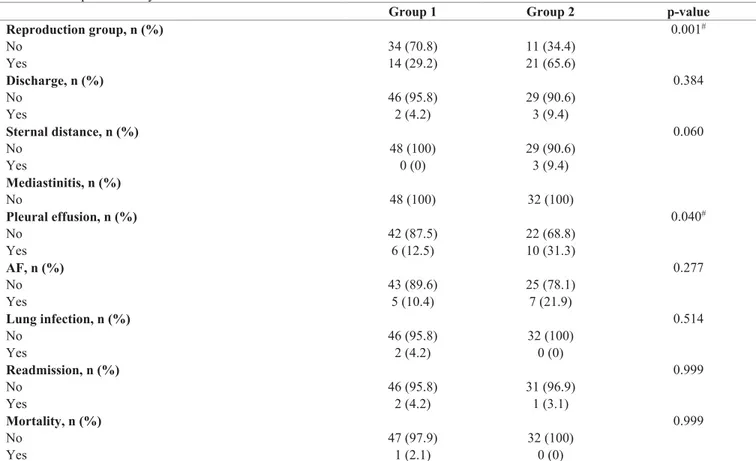
In addition, what we consider the most important finding in our research is that the number of patients with reproduction in the swab culture was found to be less in group 1 compared to group 2 (p = 0.001). As a postoperative complication, only pleural effusion was found to differ between the two groups (p = 0.040). There were no other differences in terms of complications (Table 3).
The types of surgery performed for both groups are shown in detail in Table 4. One patient in group 1 underwent tubular graft interposition for type 1 aortic dissection and one patient in group 2 underwent tubular graft interposition due to ascending aortic aneurysm. In addition, 1 patient in group 1 underwent a Benthall operation for ascending aortic aneurysm (Table 4). Table 1. Demographic differences between two treatment groups.
Demographic variables Group 1 Group 2 p-value
EuroSCORE 3 (2 – 5) 1.5 (0 – 3) 0.005† Age (years) 62.31 ± 10.65 58 ± 11.54 0.090 Sex, n (%) 0.999 Male 35 (72.9) 23 (71.9) Female 13 (27.1) 9 (28.1) HT, n (%) 0.149 No 11 (22.9) 13 (40.6) Yes 37 (77.1) 19 (59.4) HL, n (%) 0.814 No 29 (60.4) 21 (65.6) Yes 19 (39.6) 11 (34.4) DM, n (%) 0.021# No 23 (47.9) 24 (75) Yes 25 (52.1) 8 (25)
Preoperative left ventricular EF (%) 57 (48.75 – 60) 60 (40 – 60) 0.601
Smoking, n (%) 0.552 No 27 (56.2) 15 (46.9) Yes 21 (43.7) 17 (53.1) COPD, n (%) 0.004# No 38 (79.2) 32 (100) Yes 10 (20.8) 0 (0) CRF, n (%) 0.514 No 46 (95.8) 32 (100) Yes 2 (4.2) 0 (0)
Peripheral artery patient, n (%) 0.646
No 45 (93.7) 31 (96.9)
Yes 3 (6.2) 1 (3.1)
Carotid stenosis, n (%) 0.400
No 48 (100) 31 (96.9)
Yes 0 (0) 1 (3.1)
Values were described as mean ± standard deviation, median (interquartile range) or counts (n) and percentages (%), as appropriate; ns: not significant; p < 0.05 was considered statistically significant; † Mann Whitney-U test; # Chi Square or Fisher Exact test. Abbreviations: HT: hypertension; HL: hyperlipidemia;
Table 2. Operative and postoperative data.
Group 1 Group 2 p-value
Number of anastomoses 3.14 ±1.27 3.07 ± 0.89 0.807 X-clemp (hrs) 51.04 ± 30.04 53.83 ± 24.20 0.677 CPB time (hrs) 99.11 ± 43.29 88.48 ± 32.24 0.261 Operation duration (hrs) 295.33 ± 41.92 175.78 ± 32.18 < 0.001ǂ Off-pump technique, n (%) 0.982 No 42 (87.5) 28 (90.3) Yes 6 (12.5) 3 (9.7)
Length of stay in the ICU (days) 2.27 ± 0.68 2.13 ± 0.42 0.238 Length of hospitalization (days) 8.81 ± 4.42 6.22 ± 1.01 < 0.001ǂ
Values were described as mean ± standard deviation or counts (n) and percentages (%), as appropriate; ns: not significant; p < 0.05 was considered statistically significant; ǂ student t test. Abbreviations: hrs: hours; CPB: cardiopulmonary bypass; ICU: intensive care unit.
Table 3. Postoperative early adverse events.
Group 1 Group 2 p-value
Reproduction group, n (%) 0.001# No 34 (70.8) 11 (34.4) Yes 14 (29.2) 21 (65.6) Discharge, n (%) 0.384 No 46 (95.8) 29 (90.6) Yes 2 (4.2) 3 (9.4) Sternal distance, n (%) 0.060 No 48 (100) 29 (90.6) Yes 0 (0) 3 (9.4) Mediastinitis, n (%) No 48 (100) 32 (100) Pleural effusion, n (%) 0.040# No 42 (87.5) 22 (68.8) Yes 6 (12.5) 10 (31.3) AF, n (%) 0.277 No 43 (89.6) 25 (78.1) Yes 5 (10.4) 7 (21.9) Lung infection, n (%) 0.514 No 46 (95.8) 32 (100) Yes 2 (4.2) 0 (0) Readmission, n (%) 0.999 No 46 (95.8) 31 (96.9) Yes 2 (4.2) 1 (3.1) Mortality, n (%) 0.999 No 47 (97.9) 32 (100) Yes 1 (2.1) 0 (0)
Values were described as counts (n) and percentages (%), as appropriate; ns: not significant; p < 0.05 was considered statistically significant; # Chi-square test.
Abbreviations: AF: atrial fibrillation.
Table 4. Types of operation.
Operation type Group 1 Group 2
CABG 45 26 Off-pump 6 0 On-pump 39 26 MVR 0 3 AVR 1 0 AVR+MVR 0 2
Ascending aortic tubular graft implantation 1 1
Benthall operation 1 0
Total 48 32
Reproductive pathogen types are shown in Table 5. We found that the same pathogen was produced in all stages or in some cases in one stage, regardless of the stage of growth in the group. Therefore, the stage of reproduction of the pathogen was not further considered.
Discussion
In reviewing the literature, we did not find a study which compares scrub + alcohol + iodine to povidone iodine. Our study is original in this respect. In addition, significantly less reproduction was observed in samples taken after disinfection in group 1 (scrub + iodine+ alcohol) compared to the group 2 (povidone iodine only) (p = 0.001). There was no difference in postoperative complications between the two groups except for pleural effusion (p = 0.040). S. epidermidis was the most frequently isolated pathogen in both groups.
Human skin and mucous membranes contain a complex and heterogeneous combination of microorganisms called the flora. The most important microorganisms of skin flora include coagulase negative staphylococci (CNS). A relationship has been reported between CNS and implantation of a foreign body (such as a heart valve or orthopedic prostheses) in the body [8]. This is an extremely important issue, because the effects of skin disinfection methods on the development of infection after surgery has been neglected by many people for years. The highest rate of CNS infections is with S. epidermidis [9-13].
To summarize the risk factors in surgical site infections: 1-Patient characteristics: patient's history of diabetes, smoking, steroid use, malnutrition, prolonged preoperative hospital stays, nasal preoperative colonization of S. aureus, perioperative transfusion. 2 - Operative factors: I-Preoperative: preoperative antiseptic shower or bath, shaving of the hair around the surgical site, preoperative preparation of the skin with antiseptic skin disinfectants containing chlorhexidine gluconate and povidone iodine in the incision area. II-Intraoperative Factors: ventilation, sterilization of surgical instruments, surgical clothing and drapes,
asepsis and surgical technique. III- Surgical feature : factors such as postoperative wound care and postoperative hospital stay are important [14]. Despite recent advances in perioperative care, surgical site infection remains an important problem in cardiac surgery due to increases in-hospital mortality and morbidity and in cost. Cardiac surgery has been found to increase the likelihood of developing sternal wound infection, due to the complex procedures involved [15]. The use of antibiotics in the prevention of wound infection in cardiac surgery is performed prophylactically, although the effectiveness of the cleaned operating room conditions is not known. Disinfection is the process of destroying or inactivating pathogenic organisms. Chemical disinfection is used for preoperative patients and various substances have been developed for this purpose. Iodine, first introduced by Bernard Courtois in 1811, is the oldest antiseptic substance and has been used to disinfect patients before surgical intervention for a long time [16]. However, because of its skin irritating properties and its coloring the skin to a very dark color, alternatives like aqueous or alcohol-dissolved preparations have been developed. An aqueous or alcoholic solution containing 10% iodine is known as povidone iodine. The 7.5% solution is called scrub. The main mechanism of action of iodine and its solutions in various ratios is that microorganisms penetrate cell membranes and break down proteins, nucleotides and fatty acids in the cytoplasmic membrane and cytoplasm. Due to its excellent penetration and poor reactivity with protein components (i-functions), iodine easily enters the skin where it forms a solid solution. Povidone iodine is a water soluble complex that is used to disinfect the surface of the skin. It has a long-term antiseptic effect against a broad spectrum of microbes such as gram-positive and gram-negative bacteria, including protozoa and yeasts [17]. One of the most important side effects may be thyroid dysfunction due to iodine overdose [18]. Another substance is chlorhexidine gluconate, which is used for both hand antiseptic and patient cleaning in recent years. The combination with chlorhexidine-alcohol has recently been studied Table 5. Types of reproducing pathogens.
Reproducing pathogens Group 1 Group 2
S. epidermidis 11 16 S. aureus 0 3 Non-hemolytic streptococci 0 1 Corynebacterium species 0 1 Diphtheroid bacillus 2 0 Total 13 21
intensively. It binds to the skin with high affinity, has high antibacterial activity and has longer residual effects. However, it is more expensive than many disinfectants and is associated with allergic reactions [19].
It is possible to come across studies comparing the substances used as disinfectants in literature for various surgeries. No matter how much the skin is cleansed, it is not possible to destroy the microorganisms on it. In skin disinfection, there is still no material or method that is recognized by everyone as ‘the best skin disinfectant’ or ‘best skin disinfection method’. Although there are studies comparing chlorhexidine and povidone iodine used as disinfectants, little is known about which might be superior. In a meta-analysis of 8 studies involving 5031 patients comparing chlorhexidine and povidone iodine, it was found that chlorhexidine was significantly superior in preventing postoperative surgical wound infection [20]. Darouiche
et al. studied 849 patients, and reported that
chlorhexidine – alcohol as a preoperative disinfectant was superior to povidone iodine alone in preventing surgical wound infection [21]. Preoperatively applying chlorhexidine – alcohol before Cesarean skin preparation does not decrease the frequency of surgical-site infection compared to povidone–iodine, according to a contemporary randomized controlled study on 932 patients [22]. In a single center study of 3209 patients undergoing general surgery, Swenson and colleagues investigated the application of iodine in aqueous solution with chlorhexidine–alcohol (ChloraPrep®; Cardinal Health, Dublin, Ohio, USA) and iodine– alcohol (DuraPrep ™; 3M, Maplewood, Minnesota, USA). According to their results, surgical-site infection rates were respectively 6.4, 7.1 and 3.9 per cent., implying that iodine–alcohol was better for the prevention of surgical-site infection [23]. Again, in a recent systematic review, it was unclear which antiseptics are superior to others [24].
Another important point is that for the studies on chlorhexidine and povidone iodine, the effect of alcohol was ignored. However, alcohol is known to have a disinfectant effect on its own. In other words, it was seen that chlorhexidine-alcohol formulations showed differences in infection rates when compared to aqueous-based or alcohol-based iodine solutions [25]. Another proof of this statement is from a study by Raja
et al. on 728 patients, where 10% povidone iodine and
30% industrial methyl alcohol solution were compared to 2% chlorhexidine gluconate in 70% isopropanol formulation as disinfectant in coronary artery bypass
surgery to prevent superficial and deep infections. The effects of the two were found to be similar [26].
However, we did not find any studies in the literature on whether there is a difference in reproduction in patients undergoing cardiac surgery, comparing those with iodine + alcohol solutions versus those with only water-based iodine solution. In addition, we did not find any association with postoperative complications in the literature. In our study, finding less bacterial growth in cultures from group 1 may have been due to a positive interaction of iodine-containing disinfectants with alcohol.
Conclusions
One of the most feared complications after open heart surgery is unexpectedly losing the patient after mediastinitis and infection at the wound site. Such complications are important because of their undesirable results such as mortality, morbidity, long hospital stay, and increased cost [7]. We set out to find an answer to how much of this could be prevented during the disinfection phase, which is the beginning of surgery. We prospectively compared the difference between scrub + iodine + alcohol, which is a different patient staining method to povidone iodine, the classical method for disinfection, in terms of pathogens isolated from the skin. There was a difference between the two methods in terms of reproduction in swab samples taken over the sternum. Using the different staining methods, which could be seen as a small detail, we found that the amount of pathogen produced in the sternal surgical field could be significantly reduced.
Limitations of the study
We could not fully determine the mechanism to explain the difference between the two treatment groups. Depending on the disinfectant effect of alcohol on its own or the difference in the absorption of iodine, reproduction may be different between the two groups. Despite it being a prospective study, the number of patients was small. Disinfectant products are often mixed with alcohol or water, which may make it difficult to draw general conclusions about the active ingredient. In our study, the fact that alcohol was used in only one group could be a confounding factor. Therefore, large, well conducted randomized controlled trials with consistent protocols comparing disinfectant agents in the same solution (water/alcohol) are needed. In addition, we did not compare iodine with chlorhexidine. Perhaps a study involving chlorhexidine could determine the most appropriate disinfection method in cardiac surgery. Another factor that was
missing in our study was the presence of nasal carriage in terms of preoperative staphylococci and no prophylaxis was performed.
References
1. Wong ES (1996) Surgical site infections. In: Mayhall CG, editor. Hospital Epidemiology and Infection Control. Baltimore, MD: Williams & Wilkins; 154-175.
2. Ståhle E, Tammelin A, Bergström R, Hambræus A, Nyström SO, Hansson HE (1997) Sternal wound complications— incidence, microbiology and risk factors. Eur J Cardiothorac Surg 11: 1146-1153.
3. Loop FD, Lytle BW, Cosgrove DM, Mahfood S, McHenry MC, Goormastic M, Stewart RW, Golding LA, Taylor PC (1990) J. Maxwell Chamberlain memorial paper. Sternal wound complications after isolated coronary artery bypass grafting: early and late mortality, morbidity and cost of care. Ann Thorac Surg 49: 179-187.
4. Rodriguez-Hernandez MJ, de Alarcon A, Cisneros JM, Moreno- Maqueda I, Marrero-Calvo S, Leal R, Camacho P, Montes R, Pachón J (1997) Suppurative mediastinitis after open-heart surgery: a comparison between cases caused by Gram-negative rods and by Gram-positive cocci. Clin Microbiol Infect 3: 523-530.
5. Gardlund B (2007) Postoperative surgical site infections in cardiac surgery - an overview of preventive measures. APMIS 115: 989–995.
6. Mangram AJ, Horan TC, Pearson ML, Silver LC, Jarvis WR (1999) The hospital infection control practices advisory committee. Guideline for prevention of surgical site infection, 1999. Infect Control Hosp Epidemiol 20: 250-278; quiz 279-280.
7. Mangram AJ, Horan TC, Pearson ML, Silver LC, Jarvis WR (1999) Guideline for prevention of surgical site infection, 1999. Centers for Disease Control and Prevention (CDC) Hospital Infection Control Practices Advisory Committee. Am J Infect Control 27: 97-132; quiz 133-4; discussion 96. 8. Otto M (2009) Staphylococcus epidermidis - the ‘accidental’
pathogen. Nat Rev Microbiol 7: 555–567.
9. Grasmick AE, Naito N, Bruckner DA (1983) Clinical comparison of the AutoMicrobic System Gram-Positive Identification Card, API Staph-ldent, and conventional methods in the identification of coagulase-negative Staphylococcus spp. J Clin Microbiol 18: 1323-1328. 10. Eng RH, Wang C, Person A, Kiehn TE, Armstrong D (1982).
Species identification of coagulase-negative staphylococcal isolates from blood cultures. J Clin Microbiol 15: 439-442. 11. Kleeman KT, Bannerman TL, Kloos WE (1993). Species
distribution of coagulase-negative staphylococcal isolates at a community hospital and implications for selection of staphylococcal identification procedures. J Clin Microbiol 31: 1318-1321.
12. Rogers KL, Fey PD, Rupp ME (2009). Coagulase-negative staphylococcal infections. Infect Dis Clin North Am 23: 73– 98.
13. Uckay I, Pittet D, Vaudaux P, Sax H, Lew D, Waldvogel F (2009) Foreign body infections due to Staphylococcus epidermidis. Ann Med 41: 109–119.
14. Manduz Ş, Katrancıoğlu N, Doğan K (2002) Prophylactic antibiotic usage in cardiovascular surgery. C. Ü. Tıp Fakültesi Dergisi 24: 225 –229. [Article in Turkish]
15. Milano CA, Kesler K, Archibald N, Sexton DJ, Jones RH (1995). Mediastinitis after coronary artery bypass graft surgery. Risk factors and long-term survival. Circulation 92: 2245-2251.
16. Çam S, Ereeş FS, Hiçsönmez Ü (2008). Radioactive iodine and protection in the nuclear emergency. TAF Prev Med Bull 7: 449-454.
17. Furudate S, Nishimaki T, Muto T (1997) 125I uptake competiting with iodine absorption by the thyroid gland following povidone-iodine skin application. Exp Anim 46: 197-202.
18. Dela Cruz F, Brown DH, Leikin JB, Franklin C, Hryhorczuk DO (1987) Iodine absorption after topical administration. West J Med 146: 43-45.
19. Lim KS, Kam PCA (2008) Chlorhexidine – pharmacology and clinical applications. Anaesth Intensive Care 36: 502–512. 20. Noorani A, Rabey N, Walsh SR, Davies RJ (2010) Systematic
review and meta-analysis of preoperative antisepsis with chlorhexidine versus povidone-iodine in clean-contaminated surgery. Br J Surg 97: 1614-1620.
21. Darouiche RO, Wall MJ Jr, Itani KM, Otterson MF, Webb AL, Carrick MM, Miller HJ, Awad SS, Crosby CT, Mosier MC, Alsharif A, Berger DH (2010) Chlorhexidine–alcohol versus povidone – iodine for surgical-site antisepsis. N Engl J Med 362: 18-26.
22. Springel EH, Wang XY, Sarfoh VM, Stetzer BP, Weight SA, Mercer BM (2017) A randomized open-label controlled trial of chlorhexidine-alcohol vs povidone-iodine for cesarean antisepsis: the CAPICA trial. Am J Obstet Gynecol 217: 463.e1–463.e8.
23. Swenson BR, Hedrick TL, Metzger R, Bonatti H, Pruett TL, Sawyer RG (2009) Effects of preoperative skin preparation on postoperative wound infection rates: a prospective study of 3 skin preparation protocols. Infect Control Hosp Epidemiol 30: 964–971.
24. Kamel C, McGahan L, Polisena J, Mierzwinski-Urban M, Embil JM (2012) Preoperative skin antiseptic preparations for preventing surgical site infections: A systematic review. Infect Control Hosp Epidemiol 33: 608–617.
25. Maiwald M, Chan ES (2012) The forgotten role of alcohol: a systematic review and meta-analysis of the clinical efficacy and perceived role of chlorhexidine in skin antisepsis. PLoS One 7: e44277.
26. Raja SG, Rochon M, Mullins C, Morais C, Kourliouros A, Wishart E, De Souza A, Bhudia S (2018) Impact of choice of skin preparation solution in cardiac surgery on rate of surgical site infection: a propensity score matched analysis. J Infect Prev 19: 16-21.
Corresponding author
Murat Günday, M.D.
Afyonkarahisar Health Sciences University, Faculty of Medicine, Department of Cardiovascular Surgery, Zafer Health Complex F Block. Dortyol district. 2078 Street, No: 3 03030 Afyonkarahisar, Turkey.
Tel: 90 (272) 246 33 35
E-mail: [email protected]