See discussions, stats, and author profiles for this publication at: https://www.researchgate.net/publication/228826966
Adaptability and stability of new soybean cultivars under double cropped
conditions of Turkey
Article in African journal of agricultural research · August 2011
CITATIONS 3
READS 92
3 authors, including:
Some of the authors of this publication are also working on these related projects:
THE EFFECTS OF HIGH TEMPERATURE AT THE GROWING PERIOD ON YIELD AND YIELD COMPONENTS OF SOYBEAN [Glycine max (L.) Merr] VARIETIESView project
Breedin of Peanut variety, Breeding of Soybean varietyView project Halis Arioglu Cukurova University 49 PUBLICATIONS 341 CITATIONS SEE PROFILE Cemal Kurt Cukurova University 37 PUBLICATIONS 121 CITATIONS SEE PROFILE
All content following this page was uploaded by Cemal Kurt on 30 October 2014. The user has requested enhancement of the downloaded file.
Full Length Research Paper
Adaptability and stability of new soybean cultivars
under double cropped conditions of Turkey
Leyla Gulluoglu
1*, Halis Arioglu
2and
Cemal Kurt
21
Vocacional School of Ceyhan, Cukurova University, Adana, Turkey.
2
Department of Field Crops, Faculty of Agriculture, Cukurova University, Adana, Turkey.
Accepted 11 May, 2011
A two-year field study was conducted at six distinct locations of Turkey, Adana, Antalya, and Diyarbakır to determine yield performance and yield stability of new soybean cultivar candidates for double cropping systems. The standard cultivars were A 3935, Umut 2002, Nazlıcan and Turksoy. The newly developed soybean cultivars Ataem 6, Ataem 7, 1530, 527, SxW11, SxW-7, SxW-3 and Nova were tested over five locations in the Mediterranean and Southeastern Anatolia regions for double cropping systems. Experimental design was randomized complete block with three replications. Comparison of cultivar means in the double cropping system, A 3935 had the highest seed yield with 3313 kg/ha followed by Umut 2002, Nazlican and Turksoy. According to results obtained, specially the bi value, cultivars A3935, SxW-7, and Ataem 7 were found more stable cultivars for the double cropping systems. Key words: Soybean, seed yield, yield stability, cultivar release.
INTRODUCTION
Soybean (Glycine max L.) is an important component of crop production in Turkey since 1985, although planting area has fallen across the years. The area sown to soybean in Turkey has fluctuated greatly 15,000 ha to over 100,000 ha (FAO, 2008), because of the cost of production, and market prices of soybean. Soybean can be practiced as main or double crop after wheat. Although Turkey has a great soybean production potential, soybean is exported for oil and feed production (FAO, 2006).
Soybean has 13 maturity groups in ascending order of maturity from the earliest (group 000) to latest (Group X) maturity (Morse et al., 1949; Singh and Hymowitz,1999) which allows for a wide range of latitudinal growth area.
Compared with full season soybean cropping systems, yield reduction is a major concern in double cropped soybean production systems (Boerma and Ashley, 1982; Board and Hall, 1984; Arslan et al., 2006). In late planted soybean, seed yield reduction was attributed to shorter day length (Board and Hall, 1984; Board and Settimi, 1986), decreased period from emergence to R5, (Fehr and Caviness, 1977; Kane et al., 1997), little vegetative
*Corresponding author. E-mail: [email protected]. Tel: 0322 338 6448.
growth for optimum yield (Egli et al., 1987), reduced plant height and lower height to the lowest pod that increases harvest lost (Quattara and Weaver, 1995). In wheat-soybean double cropping system, seed yield could be increased by cultivar selection and applied cultural practices.
Growth and development of soybeans in different maturity groups are greatly influenced by uncontrolled climatic factors (Lal et al., 1999; Egli and Bruening, 1992; Vera-Diaz et al., 2008). Delayed planting generally shifts reproductive growth into less favorable conditions with shorter days and lower radiation and temperature (Egli and Bruening, 2000). The objective of this study was to evaluate the yield potential and to investigate yield and its components for stability and adaptability of new soybean cultivar candidates and determine traits associated with seed yield allowing more profitable soybean production.
MATERIALS AND METHODS
Data reported in this paper were taken friendly from a multi-location cultivar-testing program being conducted by The Ministry of Agriculture, Variety Registration and Seed Certification Center, Ankara. Field studies were conducted during two cropping seasons of 2004 to 2005 at six distinct provinces of Turkey, Adana, Antalya and Diyarbakir. These locations represent the main agro-ecologies for soybean production in Turkey. Four standard cultivars (A3935,
Gulluoglu et al. 3321
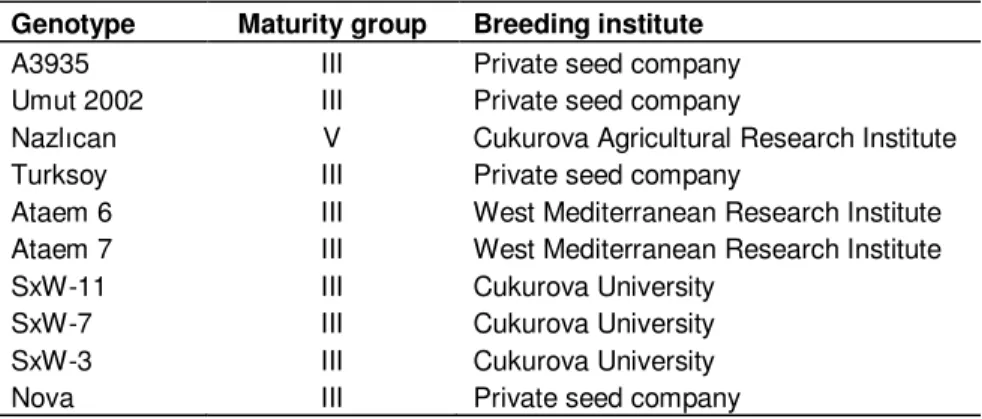
Table 1. List of 10 soybean genotypes, their maturity groups and breeding institutes.
Genotype Maturity group Breeding institute
A3935 III Private seed company
Umut 2002 III Private seed company
Nazlıcan V Cukurova Agricultural Research Institute
Turksoy III Private seed company
Ataem 6 III West Mediterranean Research Institute
Ataem 7 III West Mediterranean Research Institute
SxW-11 III Cukurova University
SxW-7 III Cukurova University
SxW-3 III Cukurova University
Nova III Private seed company
Umut 2002, Nazlican and Turksoy) and eight new cultivar candidates (Ataem 6, Ataem 7, 1530, 527, SxW11, SxW-7, SxW-3 and Nova) were tested over three locations in the Mediterranean, and Southeastern Anatolia regions for 2 years. SxW11, SxW-7 and SxW-3 were developed by the Cukurova University, Ataem 6 and Ataem 7 were developed by West Mediterranean Research Institute and Nazlıcan was developed by the Cukurova Agricultural Research Institute. The other tested cultivars were developed by the private seed companies (Table 1).
The experimental design at each location was a randomized complete block with three replications. Seeds of the selected soybean cultivars and cultivar candidates were planted at a rate of 25 seeds per m row on as main and double crop in 2004 to 2005. The experimental design was a randomized complete block with three replications in both years. Plots consisted of four 6 m rows, planted 0.65 m apart, that were end-trimmed to final length of 5 m prior to harvest of the centre two rows. In both years, seed germination and plant emergence were enhanced by applying light sprinkler irrigation. Flood irrigation was applied every 15 days after emergence. Based on soil analysis and local recommendations, nitrogen and phosphorus fertilizer was applied prior to planting at a rate of 25 kg ha-1 each. Trifluralin was applied at the rate of 1200 g ha-1 pre-sowing to control annual weeds. Later, the emergence of
weeds was controlled with hoe or rotovator in each year.
In general, the soil in these areas was clay loam, slightly alkaline (pH = 7.2 to 8.0), rich in potassium (527 to 1100 kg ha-1), medium in phosphorus (22 to 142 kg ha-1) and containing 1.1 to 2.4% organic
matter. Adana-Balcali, Antalya, Adana-Dogankent and Diyarbakir have a typical Mediterranean climate. Typical Mediterranean climate is characterized with mild and wet winter and spring seasons; and hot and dry summers. Precipitation patterns are similar, but winters are generally cooler in the Mediterranean-type climate. Long-term average total precipitation varied from 496 to 1068 mm/year. Long-term average annual temperature of the locations was 16.4°C, with yearly average temperatures ranging from 13.5 to 18.7°C, and with the highest temperature recorded exceeding 40°C in most of them. The average winter temperature varied from 3.2 to 10.9°C between locations, with unusual drops observed in some years (Table 2). Ten plants were harvested at maturity from the first and fourth rows of each plot for measuring plant height, the lowest pod height, number of pods per plant and seed yield.
Measured plant parameters data were averaged across years and subjected to analysis of variance according to the GLM procedure in the Statistical Analysis System software package (SAS Institute, 1996). Fisher’s protected least significance difference (LSD) at type I error of 0.05 and simple correlations were obtained with the ANOVA procedure and the MANOVA option. The statistics used to assess the stability and adaptability of genotypical
characters were cultivar mean square (Si²), genotypical co-efficient of variation (CVị%) as used by Francis and Kennenberg (1987),
interaction variance (δi 2) as suggested by Shukla (1972), regression co efficient (b1) as suggested by Eberhart and Russell (1966), deviation from regression mean square (δi²) and coefficient of determination (Ri²). The cultivar is considered stable if bi value is equal or close to 1.00 (Eberhart and Russell 1966), Soybean cultivars possessing bi value > 1.00 show adaptability in high yielding environments and genotypes having bi values < 1.00 exhibit adaptability in low yielding environments (Finlay and Wilkinson, 1963).
RESULTS AND DISCUSSION
Breeders rate cultivars that have stable responses across environments and frequently use stability analysis to examine genotype x environment interactions (Eberhart et al., 1966; Heinrich et al., 1983). We used stability analysis to determine cultivar performance in main cropping system under a wide range of environmental conditions. Weather variables (rainfall, temperature, relative humidity) at the locations used for the evaluation of soybean cultivars varied across locations and seasons. The results of the cropping experiments indicated significant yield differences among cultivars. The highest and the lowest seed yield was obtained from Nazlican (4225 kg/ha) and Nova (3108 kg/ha) in 2004 while cultivar Ataem 7 had the highest (3602 kg/ha) and A3935 had the lowest (2726 kg/ha) seed yield in Adana (Dogankent 2004, 2005) while SxW-11 had the highest seed yield in Adana-Balcali in both years (Table 3). When Antalya location was considered, cultivar Turksoy and Nazlican had the highest and Nova and SxW-7 had the lowest seed yield in 2004 to 2005, respectively.
However, at Diyarbakir location, SxW-11 and Turksoy had the highest seed yield in 2004 to 2005, respectively. Cultivar Ataem 6 had the lowest seed in both years. When the mean of three locations were considered the highest seed yield (3613 kg/ha) was obtained from cultivar Turksoy and the lowest (3170 kg/ha) was obtained from cultivar Ataem 6 in 2004. Cultivar Ataem 7 had the highest (3243 kg/ha) and cultivar A3935 had the
Table 2. Average climatic traits of locations under Turkey conditions.
Location Latitude Longitude Altitude
(m) Prec. a (mm). Temp. b (°C) W. Temp. c(°C) H. Temp.d(°C) L. Temp.e(°C) Adana 36° 59´ N 35° 18´ E 20 647 18.7 10.2 45.6 -11.2 Antalya 36° 53´ N 30° 42´ E 42 1068 18.7 10.9 44.6 -4.6 Diyarbakir 37° 55´ N 40° 12´ E 660 496 15.9 3.2 46.2 -24.2 Dogankent 36° 48´ N 35° 15´ E 12 774 18.3 10.0 40.8 -10.2 a
Total precipitation. b Annual average temperature. c Average winter temperature for the December–February period. d Highest temperature recorded. e Lowest temperature recorded.
Table 3. Seed yield (kg/ha) for cultivars grown at Adana-Dogankent, Adana-Balcalıntalya, Antalya and Diyarbakir in double cropping system
in 2004 and 2005.
Cultivar
Seed yield (kg/ha)
Mean Location
Adana-Dogankent Adana-Balcali Antalya Diyarbakir
2004 2005 2004 2005 2004 2005 2004 2005 2004 2005 A3935 3583 2726 264.5 267.5 3763 2726 3724 2692 3425 2704 Umut 2002 3946 2915 293.9 362.3 3723 2915 3276 2752 3471 3051 Nazlıcan 4225 3491 212.9 268.9 4156 3491 2725 2013 3309 2921 Turksoy 3940 3255 278.1 289.6 4426 3255 3305 3370 3613 3194 Ataem 6 3485 3281 262.6 241.1 3961 3281 2610 1982 3170 2738 Ataem 7 3178 3602 271.8 312.6 3992 3602 3458 2645 3336 3243 SxW-11 3537 2864 319.4 369.9 3853 2864 3784 2315 3592 2935 SxW-7 3657 2636 282.5 312.6 4030 2636 3830 2655 3585 2763 SxW-3 3791 2855 283.5 355.1 3796 2855 2911 2692 3333 2938 Nova 3108 --- 287.9 --- 3615 --- 3342 --- 3236 --- CV (%) 11.1 14.6 5.5 6.6 8.1 12.2 14.8 17.4 11.8 15.9 LSD 0.05 581 857 218 306 476 550 724 660 254 333
lowest (2704 kg/ha) seed yield in 2005. Flowering date varied between 22 to 40 days after planting in Adana, 35 to 42 days after planting in Antalya and 32 to 45 days after planting in Diyarbakir in the 2004 to 2005 cropping seasons (Table 4). The harvest maturity dates of the tested soybean cultivars varied between 85 to 129 days after planting in Adana and Antalya locations. Compared with Antalya, the tested cultivars had the harvest maturity almost 35 days early. The earlier maturity was attributed the ongoing air conditions in both locations. Our findings for flowering and maturity dates were consistent with the finding of Arslan et al. (2005).
The lowest pod height is an important plant parameter to reduce harvest loss, especially in wheat soybean double cropping systems. Pods too close to the soil surface increase harvest losses since some combine harvester heads are unable to pick up the lowest pods. Double-cropped soybean is subject to greater harvest losses due to lower pod height (Grabau and Pfeiffer, 1989). The height of the first pod varied between 13.4
and 22 cm in Adana. The lowest and the highest values were obtained from Ataem 6 and Nova in 2004 to 2005 (Table 4). However, the height of the first pod values in Antalya was lower than Adana. The height of the first pod values in Diyarbakir were between Adana and Antalya. The plant height values varied between 104 to 129 cm in 2004 and 92 to 123 cm in 2005 in Adana location (Table 5). Compared with Adana, the cultivars grown in Antalya had similar plant height in 2004, but the lower plant heights were obtained in 2005. Plant heights in Diyarbakir were lower than the plant heights of Adana and Antalya.
The number of pod bearing nodes (fertile node) is one of the yield-determining factors for soybean production. Cultivar SxW-7 and 1530 had the highest pod number/plant with 68 pod/plant and Ataem 6 had the lowest pod number/plant in 2004 in Adana (Table 5). However, in the second year, SxW-3 had the highest and Nazlican had the lowest pod number/plant in 2005. Pod number/plant values in Antalya and Diyarbakir locations were lower than Adana location in both years. When
Gulluoglu et al. 3323
Table 4. Flowering date, maturity date and the height of the first pod (cm) for cultivars grown at Adana-Dogankent, Adana-Balcalıntalya, Antalya and Diyarbakir in double
cropping system in 2004 and 2005.
Cultivar
Flowering date Maturity date The height of the first pod (cm)
Adana Antalya Diyarbakir Adana Antalya Adana Antalya Diyarbakir
2004 2005 2004 2005 2004 2005 2004 2005 2004 2005 2004 2005 2004 2005 2004 2005 A3935 24 22 35 40 30 34 85 90 120 120 17. 6 21 13.0 11 12.1 10 Umut 2002 27 27 35 41 34 36 87 92 120 117 19.8 21 18.5 12 19.5 15 Nazlıcan 30 31 39 42 37 37 95 105 120 129 21.0 20 15.5 10 13.4 9 Turksoy 27 24 36 40 33 35 89 98 120 123 16.6 20 14.0 17 17.0 13 Ataem 6 27 24 37 41 35 33 87 92 120 124 20.8 22 17.5 16 17.1 9 Ataem 7 27 33 36 40 32 33 89 101 120 126 17.6 17 14.0 10 21.4 10 SxW-11 23 24 35 40 32 34 86 96 120 117 21.7 21 16.5 11 15.5 11 SxW-7 23 24 35 39 32 32 84 95 120 120 18.6 19 12.3 13 14.6 10 SxW-3 26 23 35 38 37 33 88 98 120 117 19.3 19 14.8 12 13.0 11 Nova 23 -- 35 -- 37 -- 84 -- 120 -- 13.4 --- 11.3 --- 10.6 --- CV (%) 2.10 3.20 3.45 2.95 3.10 3.21 5.86 2.11 -- 3.34 2.10 4.45 2.45 2.20 2.35 2.86 LSD 0.05 0.94 0.42 1.02 3.57 0.96 2.43 28.8 11.57 --- 2.43 0.82 2.19 1.56 2.19 1.52 1.32
lodging scores were compared some of the cultivars grown in Adana and Diyarbakir in 2004 tended to lodge (Table 5). However, in the second year of the study the lodging score of the tested cultivars was same.
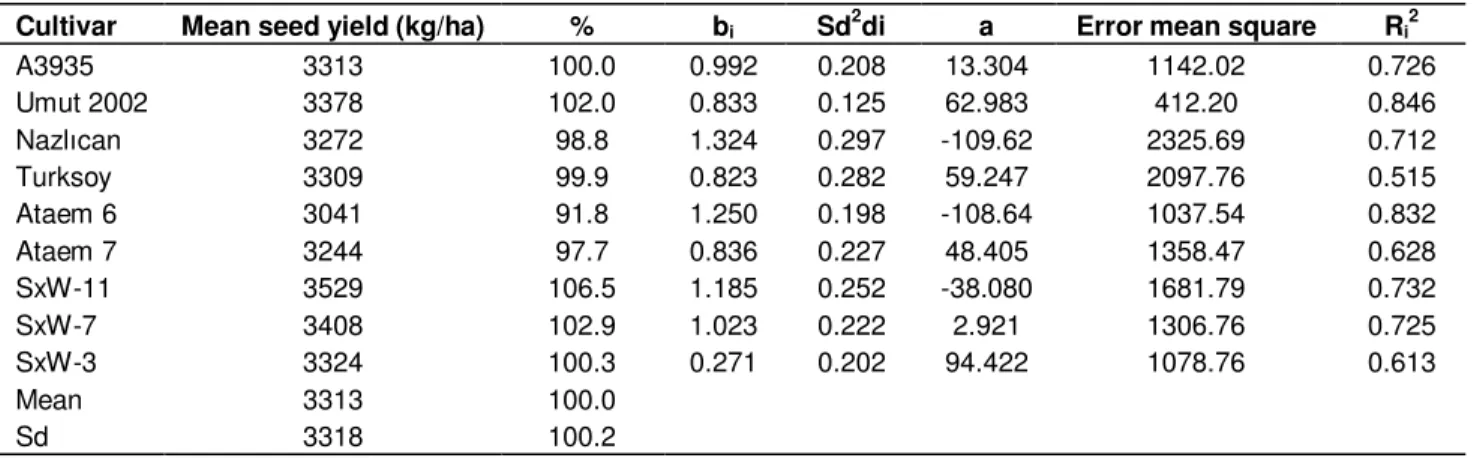
The genotype is considered more stable, that has bi value equal or very close to 1.00 and minimizes rest of the statistics except Ri² which ranges from zero to 1.00 and its high value determines the stability of a genotype (Petersen, 1989). Cultivars showed different yield response from one environment to another and also climatic data changed over locations in the current study. The regression coefficient of cultivars A3935, Umut 2002, Turksoy, Ataem 7, 11 and
SxW-7 for seed yield was non-significant (bi = 1.0) and
had a small deviation from regression (s2 di), and
thus possessed fair stability (Table 6). Genotypes with high mean yield, a regression coefficient
equal to the unity (bi = 1) and small deviations
from regression (s2di = 0) are considered stable
(Finlay and Wilkinson, 1963; Eberhart and Russell, 1966).
Accordingly, cultivars A3935, SxW-7, and Ataem 7 were the most stable for seed yield because their regression coefficients were almost equal to unity and they had lower deviations from
regression. Their Ri
2
values (Pinthus, 1973) were as high as 72, 83, 73 and 72%, respectively, conforming their stability. In contrast, cultivars A3935, Nazlican, SxW11 and Ataem 6 had regression coefficients greater than one, and so were regarded as sensitive to environmental changes. Our results are in a good agreement with the findings of Yothasiri et al. (2000) and Primomo et al. (2002) that cultivars with higher stability or good adaptability in a wide range of environment were found for seed yield. When new information on yield performance, yield stability, the ability of specific and/or general adaptations
are need to recommend them to the growers. cultivars are proposed for cultivar release,
Conclusion
The results presented in this paper have given an idea of the relative stability of new soybean cultivar candidates under three different environ-ments for double cropping. When new cultivars are proposed for cultivar release, information on yield performance, yield stability, the ability of specific and/or general adaptations are need to recommend them to the growers. Comparison of cultivar means for double cropping systems, A 3935 had the highest seed yield with 3313 kg/ha followed by Umut 002, Nazlican and Turksoy.
According to the bi value, cultivars A3935, SxW-7,
and Ataem 7 were found more stable cultivars for the double cropping. Our results provide useful
Table 5. Plant height (cm), pod number/plant, lodging (1-5) for cultivars grown at Adana-Dogankent, Adana-Balcalıntalya, Antalya and Diyarbakir in double cropping system in 2004 and 2005.
Cultivar
Plant height (cm) Pod number/plant Lodging (1-5)
Adana Antalya Diyarbakir Adana Antalya Diyarbakir Adana Antalya Diyarbakir
2004 2005 2004 2005 2004 2005 2004 2005 2004 2005 2004 2005 2004 2005 2004 2005 2004 2005 A3935 104 92 91 78 82 76 54 88 54 54 37 35 3 1 1 1 1 - Umut 2002 106 115 122 92 106 93 53 74 57 47 34 42 2 1 1 1 3 - Nazlıcan 115 111 115 85 89 70 56 67 46 68 40 63 3 1 1 1 1 - Turksoy 135 118 123 98 113 101 74 78 65 49 35 41 4 1 2 1 3 - Ataem 6 106 111 105 91 85 72 47 81 64 55 37 79 1 1 1 1 1 - Ataem 7 129 119 122 93 109 90 58 70 66 63 30 59 3 1 1 1 2 - SxW-11 117 116 105 84 95 77 76 83 60 49 38 46 1 1 1 1 1 - SxW-7 113 123 110 91 110 88 68 83 65 53 41 50 1 1 1 1 1 - SxW-3 120 123 113 86 88 93 54 99 55 52 42 42 2 1 1 1 1 - Nova 113 --- 104 -- 86 -- 60 -- 59 -- 35 -- 1 - 1 - 1 - 435 ---- 116 --- 82 --- 98 --- 86 --- 63 --- 50 -- 1 -- 1 -- - CV (%) 4.87 2.35 5.32 6.19 5.25 2.36 3.11 2.35 2.45 5.30 6.10 -- -- -- -- -- -- LSD 0.05 6.65 3.17 17.3 1.22 8.21 5.25 4.23 4.25 2.14 2.40 2.26 -- -- -- -- -- --
Table 6. Stability parameters for seed yield of double cropped soybean cultivars.
Cultivar Mean seed yield (kg/ha) % bi Sd2di a Error mean square Ri2
A3935 3313 100.0 0.992 0.208 13.304 1142.02 0.726 Umut 2002 3378 102.0 0.833 0.125 62.983 412.20 0.846 Nazlıcan 3272 98.8 1.324 0.297 -109.62 2325.69 0.712 Turksoy 3309 99.9 0.823 0.282 59.247 2097.76 0.515 Ataem 6 3041 91.8 1.250 0.198 -108.64 1037.54 0.832 Ataem 7 3244 97.7 0.836 0.227 48.405 1358.47 0.628 SxW-11 3529 106.5 1.185 0.252 -38.080 1681.79 0.732 SxW-7 3408 102.9 1.023 0.222 2.921 1306.76 0.725 SxW-3 3324 100.3 0.271 0.202 94.422 1078.76 0.613 Mean 3313 100.0 Sd 3318 100.2
information to aid the choice of soybean cultivars for double cropping areas of Turkey.
REFERENCES
Arslan M, Iser N, Caliskan S (2006). Effects of cultivar maturity on growth and yield of double cropped soybean. Acta Agr. Scand. B-S. P., 56: 39-46.
Board JE, Hall W (1984). Premature Flowering in Soybean Yield Reductions at Nonoptimal Planting Dates as Influenced by Temperature and Photoperiod. Agron. J., 76: 700-704.
Board JE, Settimi JR (1986). Photoperiod effect before and after flowering on branch development in determinate soybean. Agron. J., 78: 995-1102.
Boerma HR, Ashley AS (1982). Irrigation, row spacing, and genotype effects on late and ultra-late planted soybeans. Agron. J., 74:
995-/998.
Eberhart SA, Russell WA (1966). Stability parameters for comparing varieties. Crop Sci., 6: 36-40.
Egli DB, Guffy RD, Heitholt JJ (1987). Factors associated with reduced yields of delayed plantings of soybean. J. Agron. Crop Sci., 159: 176-185.
Egli DB, Bruening W (1992). Planting date and soybean yield: evaluation of environmental effects with a crop simulation model: SOYGRO, Agr. For. Meteorol., 62: 19-29.
Egli DB, Bruening WP (2000). Potential of early maturing soybean cultivars in late planting. Agron. J., 92: 532-537.
Grabau LJ, Pfeiffer TW (1989). Stubble losses of Kentucky soybeans. Agronomy Notes. University of Kentucky, 22: 2.
Fehr WR, Caviness CE (1977). Stages of soybean development. Iowa Agric. Exp. Stn. Spec. Rep., p. 80.
Gulluoglu et al. 3325
Finlay KW, Wilkinson GN (1963). The analysis of adaptation in a plant breeding programme. Aus. J. Agric. Res., (14): 742- 754
Heinrich GM, Francis CA, Eastin JD (1983). Stability of grain sorghum yield components across diverse environments. Crop Sci., 23: 209-212.
Kane MV, Steele CC, Grabau LJ (1997b). Early maturing cropping system: growth development and yield. Agron. J., 89: 454-458. Lal M, Singh KK, Srinivasan G, Rathore LS, Naidu D. Tripathi CN
(1999). Growth and yield responses of soybean in Madhya Pradesh, India to climate variability and change. Agr. For. Meteorol., 93: 53-70. Morse WJ, Cartter JL, Williams LF (1949). Soybeans: culture and
varieties. U.S. Dep. Agric. Farmers’ Bull., 1520: 1-38.
Ouattara S, Weaver DB (1995). Effects of growth habit on yield components of late planted soybean. Crop Sci., 35: 378-411. Primomo VS, Falk DE, Ablett GR, Taner JW, Rajcan I (2002). Genotype
x environment interactions, stability, and agronomic performance of soybean with altered fatty acid profiles. Crop Sci., 42: 37-44.
Shukla GK (1972). Some statistical aspects of partitioning genotypes environmental components of variability. Heredity, 29: 237-245. Singh RJ, Hymowitz T (1999). Soybean genetic resources and crop
improvement Genome, 42: 605-616
Vera-Diaz MC, Kaufmann RK, Nepstad DC and Schlesinger P (2008). An interdisciplinary model of soybean yield in the Amazon Basin: The climatic, edaphic, and economic determinants. Ecol. Econ., 65: 420-431
Yothasiri A, Somwang T, Amnuay Y, Teera S (2000). Stability of soybean genotypes in Central Plain Thailand. Kasetsart J. Nat. Sci., 34: 315-322.
View publication stats View publication stats