KADİR HAS UNIVERSITY
GRADUATE SCHOOL OF SOCIAL SCIENCES INTERNATIONAL RELATIONS DISCIPLINE AREA
THE RISE OF CHINA’S POWER: THE LIMITS OF
NEOREALISM AND NEOLIBERALISM
FIRAT AVCI
SUPERVISOR: PROF DR., SİNEM AKGÜL AÇIKMEŞE
MASTER’S THESIS
THE RISE OF CHINA’S POWER: THE LIMITS OF
NEOREALISM AND NEOLIBERALISM
FIRAT AVCI
SUPERVISOR: PROF. DR., SİNEM AKGÜL AÇIKMEŞE
MASTER’S THESIS
Submitted to the Graduate School of Social Sciences of Kadir Has University in partial fulfillment of the requirements for the degree of Master’s in the Discipline Area of International Relations under the Program of International Relations.
i
TABLE OF CONTENTS
ABSTRACT………... ...ii ÖZET... ...iii LIST OF TABLES...iv LIST OF ABBREVIATIONS...v INTRODUCTION...11. POWER IN INTERNATIONAL RELATIONS: REALIST AND LI BERAL EXPLANATIONS...6
1.1 Definitions of Power………...6
1.2 Realist Views on Power……….……….….11
1.2.1 The Concept of Power in Defensive Realism………...…..….14
1.2.2 The Concept of Power in Offensive Realism………...….15
1.3 Liberal Views on Power……….…..19
2. UNPEACEFUL RISE OF CHINA’S POWER: NEOREALIST EXPLANATIONS AND MEARSHEIMER’S CONTRIBUTIONS………...…….25
2.1 Nature of the System and China……….…….26
2.2 State-Centric System and China……….……….29
2.3 Military Power of China……….……….30
2.4 Intentions of China……….………..33
2.5 China’s Goal of Survival………...……….34
2.6 R a t i o n a l i t y o f C h i n a … … … 3 5 2.7 Polarity and the China………..……….36
2.8 Realist Critique of Ikenberry’s View on China’s Rise………..…………39
2.9 Limits of Mearsheimer’s Explanations of Rise of China’s Power…………..………..41
3. PEACEFUL RISE OF CHINA’S POWER: NEOLIBE RAL EXPLANATIONS AND IKENBERRY’S CONTRIBUTION………..………. 47
3.1 Complex Interdependency………... 48
3.2 Multilateralism or Unilateralism………. .51
3.3 Ikenberry’s Liberal World Order………. 52
3.4 Liberal World Order and One Belt One Road Initiative………..54
3.5 Ikenberry’s Perspective on Military Power of China………..56
3.6 The Future of the Liberal World Order and China………..59
3.7 Liberal Critique of Neorealist Arguments on the Rise of China……...……….61
3.8 A Limits of Ikenberry’s Peaceful Rise of China’s Power………..…….62
CONCLUSION……….………..68
ii
ABSTRACT
AVCI, FIRAT, THE RISE OF CHINA’S POWER: THE LIMITS OF NEOREALISM AND NEOLIBERALISM, MASTER’S THESIS, ISTANBUL, 2018
The rise of China is one of today’s main concerns for the future of the World order. There are different interpretations of China’s rise. The aim of this thesis is to explain the power direction of the rise of China; from the universal comparative perspectives of neorealism and neoliberalism, with a specific discussion on the divergent approaches of John Joseph Mearsheimer representing the neorealist camp and Gilford John Ikenberry representing the neoliberal camp. The main research question is as follows: “In what ways Mearsheimer’s and Ikenberry’s ideas are helpful or fail to understand the rise of China, and is there a better way to analyse China’s power direction?” In this context, this study will provide a clearer and more balanced picture of China’s power by uncovering strengths and weaknesses of both camps.
Keywords: Rise of China, Rising Power, China, Offensive Realism, Liberal World Order,
iii
ÖZET
AVCI, FIRAT, YÜKSELEN ÇİN’İN GÜCÜ: YENİ GERÇEKÇİLİĞİN VE YENİ LİBERALLİĞİN SINIRLARI,YÜKSEK LİSANS TEZİ, ISTANBUL, 2018
Çin’in yükselişi geleceğin dünya düzeni hakkındaki en önemli sorulardan birini oluşturmaktadır. Çin’in yükselişi hakkında farklı görüşler mevcuttur. Bu tezin amacı, yükselen Çin’in güç yönünü yeni-gerçekçi ve yeni-liberal akımların evrensel varsayımları üzerinden karşılaştırmalı olarak okumaktır. Tezde John Joseph Mearsheimer tarafından temsil edilen yeni-gerçekçilik ve Gilford John Ikenberry tarafından temsil dilen yeni-liberalizm görüşleri üzerinde özellikle durulmuştur. Tezin araştırma konusu, “Mearsheimer ve Ikenberry’nin teorileri hangi açılardan Çin’in yükselişini anlatmada yetersiz kalmıştır; Çin’in şu anki pozisyonunu daha doğru anlatacak bir yaklaşım var mıdır?” sorusunu takiben ortaya çıkmaktadır. Bu bağlamda, çalışma Çin’in gücüne dair net ve dengeli bir çerçeve çizme amacını iki farklı teori okullarının güçlü ve zayıf yanlarını belirterek gerçekleştirilmiştir.
Anahtar kelimeler: Çin’in Yükselişi, Yükselen Güç, Çin, Saldırgan Gerçekçilik, Liberal
dünya düzeni, Çin’in barışçıl yükselişi, Çin’in barışçıl olmayan yükselişi, Mearsheimer, Ikenberry.
iv
LIST OF TABLES
Map 2.1 Disputed Claims in the South China Sea 27
Map 2.2 Senkaku/Diayou Islands 28
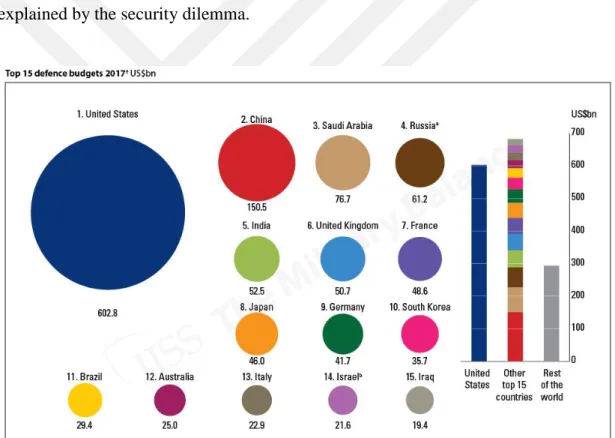
Figure 2.3 Top 15 Defence Budgets of 2017 30
Map 2.4 Chinese Overseas Military Depots and Civil Ports 35
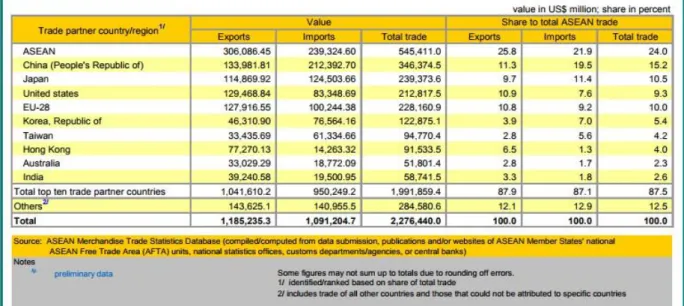
Table 3.1 ASEAN States’ Top Trade Partners 48
Map 3.2 One Belt One Road Initiative Projects 55
Figure 3.3 China’s Military Spending Compared to the World 57
Map 3.4 US Forces Commanders’ Areas of Responsibility 58
v
LIST OF ABBREVIATIONS
ADB AIIB ASEAN BP BRICS CCWAEC CPC CPEC CSO ECS EIA EUAsian Development Bank
Asian Infrastructure Investment Bank
Association of Southeast Asian Nations
British Petroleum
Brazil Russia India China South Africa
China Central-West-Asia Economic Corridor
Communist Party of China
China-Pakistan Economic Corridor
Shanghai Cooperation Organisation
East China Sea
The US Energy Information Administration
European Union FDI GATT GDP G-7 G-20
Foreign Direct Investment
General Agreement on Tariffs and Trade
Gross Domestic Product
Group of Seven
Group of Twenty
ICBM Intercontinental Ballistic Missiles
IISS
IMF
IR
International Institute for Strategic Studies
International Monetary Fund
vi
MAD Mutual Assured Destruction
MSR
NAFTA
NATO
Maritime Silk Road Initiative
North American Free Trade Agreement
North Atlantic Treaty Organization
NGO Non-Governmental Organizations
NDP
NDPG
New Development Bank (of BRICS Countries)
National Defense Program Guideline (of Japan)
NPE
OBOR
Normative European Union
One Belt One Road Initiative
PLA People Liberation Army (China)
PLAN People Liberation Army Navy (China)
RCEP Regional Comprehensive Partnership Agreement
RMB
SCS
UK
Renminbi (Official Currency of China)
South China Sea
United Kingdom UN UNCLOS US WTO United Nations
United Nations Convention on the Law of the Sea
United States of America
1
INTRODUCTION
“Let China sleep, for when she wakes she will shake the world” – this is how Napoleon Bonaparte, the French Emperor, described China in the 19th century (Stone Fish, 2016, Foreign Policy). China has always been a source of concern amongst world powers at different times, and most recently the end of the Cold War has resurfaced these concerns. After defeating its Soviet rival, the US has started to seek a unipolar security order and re-evaluated possible threats to it.1 The US saw China as a rival or challenge only after early years of the post-Cold war era, when there was an illusion that no challenger could emerge due to the wellbeing of the liberal order, which included security arrangements of NATO and the UN Security Council as well as international economic institutions such as the Bretton Woods System including the World Trade Organisation (WTO), International Money Fund (IMF) and regional organisations in Asia-Pacific including, but not limited to Asian Development Bank (ADB).
The 9/11 shook the liberal system and marked the beginning of the War on Terror in the Middle East, which meant that concerns about a rising China were overshadowed. Yet this period lasted only until the 2008 economic crisis when the US economy stagnated while China proved its robustness and saw economic improvement (Mengzhi, 2009; Nye, 2010).2
The aim of this thesis is to explain the power direction of the rise of China from the universal comparative perspectives of neorealism and neoliberalism, with a specific discussion on the divergent approaches of John J. Mearsheimer representing the neorealist camp and John G. Ikenberry representing the neoliberal camp.3 Both scholars give particular attention to the rise of China and write extensively on this topic. Accordingly, Ikenberry and Mearsheimer are highly influential in analysing China’s
1 This is however debatable. Neorealists like Mearsheimer (2014) never accepted that US have the chance to be the only super-power in a unipolar world.
2 “The financial crisis cost the U.S. an estimated $648 billion due to slower economic growth, as measured by the difference between the Congressional Budget Office (CBO) economic forecast made in September 2008…5.5 million more American jobs were lost due to slower economic growth during the financial crisis. (The Pew Charitable Trust, 2010)
3
Neorealist assumptions are based on Mearsheimer’s arguments as well as ideas from Waltz to Morgenthau (1946), which have also fed into Mearsheimer’s (2006, 2014) view on the rise of China. The paper will continue to similarly assess Ikenberry’s (2005, 2008, 2011, 2017) view, which is to some extent influenced by Keohane’s (1985, 2011), Joseph Nye Jr.’s (2010, 2011) assumptions.
2
rise, as epitomised in the volume of quotations attributed to them in scholarly works on China. Both scholars wrote about potential future outcomes of the rise of China, from their theoretical perspectives. Moreover, since the aim of this thesis is to understand the direction of China towards becoming a peaceful or an aggressive power, it would be appropriate to discuss the views of Ikenberry who believes that China will rise peacefully due to the liberal international order (Ikenberry, 2006, 2008, 2011a, 2011b, 2014b, 2017, 2018a) and the perceptions of Mearsheimer who argues that China will become aggressive when finalizing its ascendancy due to the anarchic nature of international politics (Mearsheimer, 2001, 2014, 2016a, 2016b).4
Some scholars claim that the rise of China will happen peacefully (Ikenberry, 2011; Johnston, 2003; Nye, 1997; Ross and Feng, 2008), which means that China will integrate into the world economy, preventing international power struggles. On the contrary, realists claim that China’s rise will not proceed peacefully (Mearsheimer, 2001; Brzezinski and Mearsheimer, 2005; Kagan, 2005). Mearsheimer draws an analogy between the rise of China and Germany’s rise in the interwar era. According to this his view, China will become aggressive when it has sufficient economic and political power, following Germany’s example. On the contrary, Nye Jr. (2015) argues that due to its economic and political capabilities, China is not going to be a rival for the US in near future. According to Nye;
China does not have enough military capability compared to the US in all areas –even defence or power projection in their own region. Economically this is also impossible because China is lacking know-how industries compared with the US and is only strong in the production sector while simply copying the relevant technology. Furthermore, China is an energy dependent country, thus making any confrontation or rivalry economically unsustainable. (Nye, 2015)
4
John Mearsheimer’s books and articles titled False Promise of International Institutions (1994), Tragedy of Power Politics (2001), The Case for Offshore Balancing (2016a), Benign Hegemony (2016b). John Ikenberry’s books and articles titles Liberal Order and Imperial Ambition: Essays on American Power and International Order (2006), The Rise of China and the Future of the West: Can the Liberal System Survive?(2008), America’s Challenge: The rise of China and the Future of Liberal International Order (2011a), The Future of the Liberal World Order: Internationalism after America (2011b), The Rise of China and the Future of the Liberal World Order (2014b), The Plot Against American Foreign Policy: Can the Liberal Order Survive (2017), Why the Liberal World Order will Survive? (2018).
3
This work will focus on answering the following question: In what ways Mearsheimer’s and Ikenberry’s ideas fail to explain the rise of China, its current political and economic status, and is there a better way to analyse China’s position? In order to answer this question, it aims to understand why China is not active in world affairs, and why Mearsheimer’s and Ikenberry’s explanations in isolation from each other are ill-suited to provide a comprehensive explanation. It will not provide a typical focus on the pessimistic view of Mearsheimer on China’s unpeaceful rise, but will also attempt to counterbalance it by giving due attention to China’s contribution and integration into global economy since China is actively engaged in trade in every region, as well as tries to project soft power in several regions especially including South East Asia. Moreover, its diplomatic relations are open to all countries and several agreements are in force.
The other perspective is mostly related with Ikenberry’s view of China’s peaceful rise. This is also problematic for several reasons. China, despite of all of its positive diplomatic and economic efforts is acting assertively in South China Sea according to its capabilities. China is also actively engaged in territorial disputes and still does not recognize Taiwan as a sovereign state. In other words, China and the USA are already finding themselves in a power struggle in South East Asia despite economic ties.
This research is aims at to analysing today’s China through a multipolar lense and will argues that China is currently in its own isolationist period similar to the US in the 19th Century and early 20th Century. China is aiming to create its own sphere of influence in the Asia-Pacific, but its reluctance in world affairs is parallel to the US non-interventionist policy in the Old World (mainland Europe). On the other hand, China is quite aggressive or at least active in Asia Pacific like the US in South America. China also pressures it’s their neighbours via trade wars or territorial claims.
The other perspective is mostly related with Ikenberry’s view of China’s peaceful rise. This is also problematic for several reasons. China, despite of all of its positive diplomatic and economic efforts is acting assertively in South China Sea according to its capabilities. China is also actively engaged in territorial disputes and still does not recognize Taiwan as a sovereign state. In other words, China and the USA are already finding themselves in a power struggle in South East Asia despite economic ties.
4
Overall, this thesis argues that China is a rising power and an important actor in the multipolar world. Furthermore, China is becoming a significant actor inside the economic and political system constructed by status quo powers such as US and major European countries. China will not rise peacefully; neither will it become a revisionist state like Germany. Firstly, China’s domestic (regions like Tibet, Xianyang, huge number of poor people in the West China and low level of democracy) and international struggles (One China policy, territorial disputes) will prevent its peaceful rise. Secondly, China is too interdependent with the free market in order to become a revisionist state like Germany in the interwar years. ‘The rise of China’ as a security threat is an overrated statement as China’s rise is not exclusive or out of line with the rise of recently developing countries such as China, India, and Russia.
In this context, the first chapter will focus on what ‘power’ is and how it is perceived by neorealist and neoliberal scholars. It is important to analyse the concept of power, owing to its significance in helping to understand regional hegemony, world politics and most importantly the rise of China’s power. The source of hegemony relies on power in both theoretical schools, but the way they describe what power is provides crucial distinctions in their approaches to China. The definition of power will provide a broader perspective in understanding China’s intentions, actions and the goal of being the regional hegemon in the South East Asia. Chapter two will explore neorealist assumptions in greater detail, especially Mearsheimer’s ideas coined as offensive realism. There are a number of neorealist scholars who theorize the rise of China, however for the purpose of this study, only offensive realism (rather than defensive realism) will be explored. Offensive realists portrayed pessimistic future predictions in relation to China’s position in the world, namely they predict a rise of China at an expense of security. Then, the limits of Mearsheimer’s explanations will analyse under the counter-arguments to his unpeaceful rise of China assumption. Mearsheimer’s assumption will be tested by looking at Ikenberry’s view of China’s peaceful rise in the third chapter. His arguments are founded on the concepts of complex interdependency and liberal world order. His optimistic approach relies on powerful liberal institutions and their role in providing a multilateral world order. In such scenario, China cannot rise turbulently and challenge this liberal world order, due to its dependence on the benefits of the order itself. That is, any challenge can damage China’s economic
5
prosperity and trade-led economy. Ikenberry’s claims over peaceful rise of China’s power will challenge with counter-arguments to fulfil the thesis aim.
6
CHAPTER 1
POWER IN INTERNATIONAL RELATIONS: REALIST AND
LIBERAL EXPLANATIONS
Power is one of the most contested concepts in International Relations. Throughout the history of IR (International Relations), this notion features in many academic debates and between different theoretical camps. This chapter focuses on is the definition of power, and how it is conceptualized in International Relations. The chapter emphasizes the distinction between positive and negative power, that is – power as military capabilities and power as influence. In this context, this chapter is about the focus on realist and liberal definitions of power and their importance in the theoretical debates. Accordingly, power is explained using the realist lens, which includes the ideas of realists such as Hans Morgenthau, Kenneth Waltz and John Mearsheimer and through the liberal approaches of Robert Keohane, Joseph Nye and John Ikenberry.
1.1 DEFINITIONS OF POWER
“So long as there is politics among sovereign states, there will be estimation of power” (Jones, 1954, p. 439). As stated in this quote, the concept of power takes central role in International Relations. Finnemore and Goldstein (2013, p. 5) suggests that it “has always been at the core of our discipline.”
According to Grayson Kirk (et. al. Baldwin, 2016, p. 92) “during the 1920s the study of international relations was composed mostly of courses on international law, diplomatic history, international economics, and international organization.” “Power” as a term had negative connotations during the interwar years. When one refers to power, it usually signified aggressive military power because of the heritage of the World War I (Baldwin, 2016, p. 92). Power evoked state aggression, while the world was promoting liberal ideas. Idealism embodied in the Woodrow Wilson’s Fourteen Points was on the rise in the interwar years. In those years, due to association of power with aggression,
7
the concept of power was not used by International Relations scholars due to liberal trends in world politics.
Throughout 1930s, power began to be described as an analytical concept in International Relations. The first approach was defining international politics as “struggle for power”. “In 1933, Nicholas J. Spykman delivered a paper at the Fifth Conference of Teachers of International Law entitled “Methods of Approach to the Study of International Relations,” which described international political relations as a struggle for power”(Baldwin, 2016, p. 92).
Just before the publication of one the most influential of Morgenthau’s (1948) books titled Politics Among Nations: The Struggle for Power and Peace there was a consensus about power and that international politics should be the centre of this new field. “Morgenthau asserted the centrality of power as a foreign policy goal and as a concept for understanding international politics” (Baldwin, 2016, p. 96). Morgenthau centered his book on power, by describing it, analysing and searching for its elements.
Power as a concept was rarely disputed due to publications of Edward Hallett Carr (1939), Frederick L. Schuman (1933), Nicholas J. Spykman (1942), Frederick S. Dunn (1949), Arnold Wolfers (1951), Grayson Kirk (1947) and Hans J. Morgenthau (1948). Only Richard C. Synder (1955) criticised the centrality of power in the field. His criticism was aimed at Morgenthau’s claims on power. Synder claims that Morgenthau’s ideas on power is over inclusive. Putting power in center with the help of claims like “lust for power” decreases the explanatory power of the term “power”. If everything will explain with single term, this only damages explanatory impact of “power”. According to Snyder “power is not subject to any rigorous analysis as a concept” and because of too many definitions “the power concept comes close to being meaningless”. Synder argues that power concept is too inclusive, it is uneasy to distinguish what power is.
Baldwin (2016) cites Dennis Gartland Sullivan (1963) focused on different textbooks on defining power in his doctoral dissertation found the same common problematic. His main findings were that, firstly, there is a “failure to rigorously clarify the concept of power”; (2) a tendency to confuse definition with theory by “a subtle substitution of the determinants [i.e., elements] of power for power”; (3) a failure to understand the
8
difference between power as a relational concept and the relative power of countries…” (Baldwin, 2016, p. 100). The concept of power has several dimensions and meanings. Power can be defined as influence, or attribute, or identity or relationship, or mechanism or all.
One meaning of power is influence. For example, K. J. Holsti (1964), describes power as influence in three different forms. The first meaning is essentially a means to an end, whereby states pursue policies and utilize resources in achieving their goals. Second form of power is the basic capabilities, which an actor uses or mobilizes in his efforts to influence the behaviour of others. This includes every source of country A’s capabilities in influencing country B’s towards her own will or goal. Thirdly, Holsti (1964) describes power as the relationship between A and B. Their communication and interaction is a power relation. “Power as an influence is the ability to get another actor to do what it would not otherwise have done or not to do what it would otherwise have done” (Dahl, 1970 et. al. Brown and Ainley, 2009, p. 93). “Power is a relationship – it is the ability that people or groups or states have to exercise influence on others.”(Brown and Ainley, 2009, p. 82) Relationship defines similar ideas that see power as an influence. But this approach specifically narrows the communications and bargaining process of states. “the notion of power as a quantifiable mass is giving way to the concept of power as a behavioural relationship” (Sprout H. and Sprout M, 1951).
Because of the similarity between human nature and state reactions, just as humans, states have lust for power and achieving hegemony in world order. They are always looking for more power. Because of that nature of states, Morgenthau (1948) puts power in the heart of every relation between states and he also gives attention to influence as an aspect of power. In other words, “when we speak of power, we mean man’s control over the minds and actions of other men. Political power is psychological relation between those who exercise it and those over whom it is exercised” (Thompson, K. W., & Morgenthau, H. J., 1967, p. 33).
Morgenthau stresses that there are differences between power and influence, For him, influence does not guarantee power as one always needs to have legitimacy or credibility for power projection. One can influence his superiors for certain time, but this will not provide a complete rule over them. A state can have influence in another
9
country, however it does not guarantee total power over that given country. For instance recognition of Palestine in the United Nations (UN) would not decrease the power of Israel.. One time victory in power struggles will not give permanent advantage over their superior rival states. Main measurement of power is your capabilities rather than unusual victories. You can only influence them for a certain time. This is true for state-to-state relations as well. For example, small countries like Chile can influence the US at certain points but everyone knows that the US with its superior military and diplomatic capability has greater ability to influence.
“Power is also an attribute – it is something that people or groups or states possess or have access to, have at hand to deploy in the world” (Brown and Ainley, 2009, p. 92). As an attribute, it means all sorts of capabilities of a state for succeeding any goal, these attributes include military forces, raw materials, population. Material capabilities were mostly under the monopoly of realism which is powerful nations who have the most military power and capabilities against their rivals. E. H. Carr (1946, p. 109) refers to “the supreme importance of the military instrument,” to “every act of the state, in its power aspect,” as “directed to war,” and to military strength as “a recognized standard of political values.” Capabilities are the main tool that make one state powerful in that way of definition. State power is related how your means/attributes are, and the capabilities that you have.
According to Brown and Ainley (2009) another dimension is seen as structure. If one country has enough power to influence the other one, then this country is powerful in according to this approach. The power part of a relationship, however, is not a separate unit that can be manipulated in isolation from the rest of the relationship (Organski, 1958, p. 105). The second one focuses on structure. This is mostly related with structural realist approach which means that conjecture can give roles to states, and in that situation, states take their parts in world politics.
Power is also seen as mechanism in the case of “Balance of Power”. Since the Thucydides term used to describe relations of city states in Peloponnesian War and it’s still the concern of today’s theorists like Inis L. Claude (1989), Richard Little (2007), Stephen M. Walt (1987), Kenneth Waltz (1979), William M. Moul (1989), Daniel H. Nexon (2009). It works for certain aim, in the case of ‘Balance of Power’ the logic is
10
balancing each other. Any states who is balancing in this regard creating this balance of power level of international politics. This mechanism can be described as power.
The concept of power is also explained in different dimensions like empirical and normative. Morgenthau understood empirical power as the ability to dominate others, whereas normative power implied the intention to wilfully act together to contribute to the creation of a life-world (Morgenthau, 2012). In his understanding, empirical power is much more related to his famous concept “lust for power” of states. States are willing to gain as much power as they can have.The drive to prove oneself, was predominantly empirically traceable in the form of the animus dominandi, “the desire for power” (1946), which literally means lust for domination among people (Morgenthau, 2012).
Morgenthau was not the only scholar thinking about normative power. Carr divided power in three different groups, namely - military power, civilian power and power over opinion. Carr also added that propaganda is one of the most important tools for this new form of power. Galtung was describing elements of normative power as ‘ideological power” or “the power of ideas” (Galtung, 1973, p. 33). François Duchene portrayed the EU as idée force (Duchene, 1973). Today the EU is considered as a normative power and debates are still ongoing. For example, Manners coined the concept of Normative Power Europe (NPE) and explained the term as the “ability to shape conceptions of “normal” in international relations” (Manners, 2002, p. 239). Human rights, democracy and rule of law are promoted by European countries and the US to developing parts of the world, and this is another embodiment of normative power politics. In this way, Morgenthau distinguishes power in two different senses. One is positive power, which is understood by normative power. From this perspective, it is absurd “[t]o say that a political action has no moral purpose”, in other words, “political action can be defined as an attempt to realize moral values through the medium of politics, that is, power” (Morgenthau, 1962, p. 110). Empirical power is described as a negative power, which directly relates to his ideas about human nature and state commonalities. Just like humans, states are always searching for more power.
11
1.2 REALIST VIEWS ON POWER
In the realist school of thought, power was seen only as military means for a long time. But several wars like US-Vietnam War and any other unpredictable incidents discredit this monopoly. Militarily powerful US could not defeat a small state like Vietnam. Power was then described in a different perspective alongside the military capability and strategy, conjecture and institutions.
Morgenthau claimed that “International politics, like all politics, is struggle for power, power is always the immediate aim” (Thompson, K. W., & Morgenthau, H. J., 1967, p. 31). Because of the similarity between human nature and state interactions, just as humans, states have lust for power and achieving hegemony in world order. They are always looking for more power. According to Morgenthau, power is the human control over other humans’ minds and actions (Morgenthau, 1948). It is political because exercise of power it taking place in the relations between political authorities or between public and policy makers (Tanrısever, 2009).
In general, from realist perspective power struggle creates balance of power in the long run. Because it is impossible to keep power forever, so this condition creates balance between powerful states (Tanrısever, 2009). For realists, power is valuable and functional for creating and maintaining the status quo according to status quo powers which are rejoice/enjoys the power balance in the international system.
When Morgenthau (1948) described power with its elements, he added that a state can only be a great power with all of those elements in place. First element is geography. Territory is an unwavering element of power because territorial changes are less likely or not frequent. A state can change its geography only by occupation, secession or unification with another state. This means the territory itself will expand or shrink, but not change. Geographical component used to be more important previously, according to Morgenthau (1948). The United States geographic location provided security for any rival attack thanks to two huge oceans and friendly neighbours and it created peaceful environment to accumulate its power.
Soviet Union or currently Russia survived from enemy attacks or total control due to the sheer amount of territory. In Morgenthau’s words, “this enormous land mass dwarfed
12
the territory conquered by foreign invaders in comparison with what still remained to be conquered” (1948).
The second element, as identified by Morgenthau, is natural resources – both food which ensures life and raw materials like oil, gas, iron and coal. According to Morgenthau, self-sufficient nations are more secure than others, they can keep themselves safe, can survive longer in war times, and also it deters invasion. Yet the importance of raw materials has changed. Coal and iron was important for every nation in the nineteenth century, thus giving Great Britain more significance until oil appeared as one of the key resource after World War I. Then new lands such as the Arabian Peninsula started to become more valuable due to their rich oil reserves. But in our era, oil has the same destiny as coal and with increase of technology and development of new forms of energy resources, oil is likely to lose its value in our times and thus diminish the power and influence of states that rely on it.
Industrial capacity is another component of national power, which is highly related to raw materials. Production requires raw materials, yet resources alone are not enough to secure a state’s power in production. As Morgenthau (1948, p. 108) states,
“India follows the United States and Soviet Union closely as a depository of coal and iron. But despite these riches in raw materials without which no nation can attain first rank in modern times, India cannot be classified today as a first-rate power. It has no productive capacity, especially for finished products.” (Morgenthau, 1948, 108)
As expected from a realist perspective, military capability is essential for being powerful. Morgenthau sees military force as a tool for act in international politics. “Military preparedness requires a military establishment capable of supporting the foreign policies pursued” (Morgenthau, 1948, p. 110). He gave great importance on military power and amongst it listed tanks, submarines, coordination of land, air and naval forces and nuclear weapons. Of course, tanks and submarines are not brand new technologies today, but he is pointing at military technology innovations and quality and quantity of armed forces.
Population is another important component of national power. It also determines military resource. A state with enough manpower can project power in its region or
13
even abroad. Morgenthau also underlines that, population itself does not mean power – population without technology and resources has little weight.
Intangible elements of power include national character and national morale. National character described by Morgenthau as “certain qualities of intellect and character [that] occur more frequently and are more highly valued in one nation than in another” (Morgenthau 1985, p. 147). Morgenthau lists certain national characters such as British individualism, German discipline, American individual initiative, gift for improvisation. He also points at certain examples such as the German High Command’s misjudgement of Americans’ will of joining the First World War. “The American cannot swim and they cannot fly, the Americans will never come” (Morgenthau, 1948, p. 123).
“More elusive and less stable, but no less important than all, is what we propose to call national morale” (Morgenthau, 1948, p. 124). According to Morgenthau, national morale is the degree of determination which a nation supports the foreign policies of its government in peace or war. Quality of national morale depends on the quality of the government, Morgenthau adds. This morale can break up or dissolve but it is all related with people’s content in their government. National morale can also be in test in war times.
Finally, but most importantly, the most unstable component is ‘quality of diplomacy’. It is the most import one, since it combines those [natural resources, population, geography, etc.] different factors into an integrated whole, gives them direction and weight, and awakens their slumbering potentialities by giving them the breath of actual power” (Morgenthau, 1948, p. 129).
Neorealism appeared as a systematization of mostly Morgenthau’s assumptions with several distinctions. Kenneth Waltz’s arguments opened a new door for realism and his theoretical assumptions focused on the structure rather than sole actor (it is states as opposed to Morgenthau) In his theory, the aim was showing the importance of distribution of the capabilities. “Different kinds of capabilities cannot be measured separately; he simply asserts it” (Baldwin, 2016, p. 131).
14
Rather than using force as last resort option like Morgenthau declared, Waltz had different idea about power as a force. “In international politics force serves, not only as the ultima ratio, but also as the first and constant one” (Waltz, 1979, p. 186).
In his attack on relational concept of power Waltz briefly described the reason of failure in the following way,
“We are misled by the pragmatically formed and technologically influenced American definition of power— a definition that equates power with control. Power is then measured by the ability to get people to do what one wants them to do when otherwise they would not do it” (Waltz, 1979, p. 191-92).
“Stephen M. Walt (2002, p. 222) asserted that “the concept of power is central to realist theory”; yet he conceded that “there is still little agreement on how it should be conceived” and concluded his essay with the admission that “the core concept of power is not well conceptualized” As argued by Walt and others, the concept of power has been defined in various ways by different realist scholars in different camps.
1.2.1 The Concept of Power in Defensive Realism
For defensive realists, the centrality of power is the same importance like classical realists. “As in the past, competitive arming and, more generally, power politics are in large part due to an international system of conflicting ends among men and states” (Waltz, K. 1967, p. 279). Defensive realists claim that states seek power until they feel safe. After that point, they will act according to international order and become in favour of the status quo. “One important continuity in world politics must be emphasized: force remains as useful and important in international politics as ever, and more pervasive in peacetime than before” (Waltz, K. 1967, p. 280). Kenneth Waltz is not ignoring the importance of power and its spread into every relationship between states. But his point, maximization of power should be the aim until to reach balance of power between rival states.
As the most significant representative of defensive realism, Waltz (1986) notes that “the belief that states do or should try to maximize power is quite widespread among
15
realists” (i.e. Waltz, 1986, p. 334). For Waltz, achieving balance of power between states is a state’s main goal for securing itself and status quo, not power maximization like Morgenthau and Mearsheimer assert.
Waltz focused on material capabilities, as well as John Mearsheimer (2014) who pointed the same items about scoring the capabilities of states which are all related each other: “states are not placed in the top rank because they excel in one way or another. Their rank depends on how they score on all of the following items: size of population and territory, resource endowment, economic capability, military strength, political stability and competence” (Waltz, 1979, p. 131).
1.2.2 The Concept of Power in Offensive Realism
John Mearsheimer is the key influencer and a best-known representative of neo-realist thought, who devoted considerable volume of his works to the rise of China. Unlike Morgenthau, Mearsheimer explains power relations in such a way that exercising power is different in two camps of the realist thought. In his view, power comes from the basic needs of states such as survival. “I do not adopt Morgenthau's claim that states invariably behave aggressively because they have a will to power hardwired into them. Instead, I assume that the principal motive behind great power behaviour is survival” (Mearsheimer, 2001, p. 54). There are reasons why state survival may be the principle motive of great powers. Firstly, the international system is anarchic. “In general, neorealists see anarchy as placing more severe constraints on state behaviour than do liberals” (Baldwin, 1993). Mearsheimer also suggest that due to the anarchic nature of the international system, there is no world police to discipline and resolve conflicts between actors. Because of an absence of a world government, governments want to secure themselves only by being a hegemon. States can never be certain about other states' intentions (Mearsheimer, 2001).
Secondly, states are the key actors in international politics. Mearsheimer respects states in international relations. Due to anarchic nature of international politics, states are responsible for their acts and self-help system is valid only in turmoil and possible
16
conflict between states. They need to take care of their interests. Because of this self-help system states have to be powerful, and power accumulation is one of the important state’s goals. In regard to Mearsheimer’s explanation, states are the focus of power maximization, instead of international institutions.
Thirdly, states have military capabilities. Like Morgenthau and Waltz, Mearsheimer is also accepting that military power is the main source of the power. Yet as Baldwin (2016) finds, Mearsheimer assigns military power greater importance than the aforementioned scholars, in fact Mearsheimer (in Baldwin, 2016) argues that “in international politics…a state’s effective power is ultimately a function of its military forces... The balance of power is largely synonymous with the balance of military power” (Baldwin, 2016). He also underlines that state power can be measured by military capabilities, therefore a state that has the ability to project power. For example, for the USA, that have population and wealth supported by cutting edge technology and know-how being a hegemon is a reality. According to Mearsheimer, the US first gained its hegemon status in North and South America. There were no challenger in its proximity and oceans secured US land from any attacks. That’s why the UK and the US have never been conquered by a foreign power. On the other hand, the US is pursuing various policies in the South East Asia region. Instead of policing the world, the United States encourages other countries to take the lead in checking rising powers, intervening only when necessary (Mearsheimer, J. J., & Walt, S. M., 2016). Mearsheimer maintains that the US is following a realist policy, which will give the US certain power due to using its resources efficiently.
Intentions of states can never be clear, thus creating uncertainties and mistrust. “Realists would argue that states cannot be sure about the future costs and efficacy of war, and they cannot be certain about the future interests and goals of their partners” (Joseph M. Grieco, 1993, p. 548). In other words, such uncertainty puts states in a constant state of mutual suspicion. This uncertainty is another motivator of power maximization according to Mearsheimer’s theory, because states can only feel safe if they are powerful enough against their competitors.
Fourthly, state survival is the main purpose of any states. “The logic is here straightforward: the more powerful a state is relative to its competitors, the less likely its
17
survival will be at risk” (Mearsheimer, 2001). Moreover, Mearsheimer’s theory sees that accumulating power is the optimum option to keep states safe or keep them united against the threats that offensive realism theory pointed out.
“Consequently, states pay close attention to how power is distributed among them, and they make a special effort to maximize their share of world power. Specifically, they look for opportunities to alter the balance of power by acquiring additional increments of power at the expense of potential rivals” (Elman, C. and Jensen, M. eds., 2014, p.181).
States have zero-sum relations with each other. If one state harms another, then the other state will be better off confronting it. In that nature of political world, every state should gain as much power as it can – this phenomenon is described by Mearsheimer (2014), whereby military and economic power is achieved through latent power, where “latent power refers to the socio-economic ingredients that go into building military power; it is largely based on state’s wealth and the overall size of its population”. The hunger for power never ends for states, this is the reason why offensive realism suggests state survival should be the ultimate goal. “In other words, countries can increase their prospects for survival through actively balancing against powerful rivals” (Mearsheimer, 2014).
Last, but not least, states are rational actors. “They are aware of their external environment and they think strategically about how to survive in it” (Mearsheimer, 2003, p. 31). States are also calculating their mid and long term goals and the effects of their decisions and are also aware that the other states are doing the same. Waiting for the right time to act, not acting before becoming powerful enough are the state goals regarding to this assumption. As a result states are accumulating its power secretly and take an action when the time is right.
About Dahl’s relational concept of power, whereby just like Waltz, Mearsheimer is also ignoring this assumption. “Power exists only when a state exercises control or influence, and therefore it can be measured only after the outcome is determined” (Mearsheimer, 2001, p. 57).
“Many writers— Schuman in 1933, Spykman in 1942, Morgenthau in 1948, Mearsheimer in 2001, and others— have posited power as the goal of states and described international politics as a struggle for power” (Baldwin, 2016, p. 104).
18
“Mearsheimer does not identify the international system that emerged after the Cold War in unipolar terms. On the contrary, the theory presupposes that unipolarity is incompatible with a regionalized approach to international politics” (Little, 2007, p. 216). Unlike Fukuyama’s ideas, Mearsheimer ignored the liberal victory after the Cold War and thus rejected unipolarity. For this reason, his focus on research is based on regional balances of power and excludes the prospect of world hegemony or an assumption that there can be the same regional hegemon in a number of regions simultaneously. Another of his assumption is focusing on multipolarity of the South East Asia region and the world itself. “In particular he [Mearsheimer] accepts that war is more likely in a multipolar system than in a bipolar system” (Little, 2007, p. 224). It was possible to predict the actions of great powers in the Cold War. Both sides were controlling their conflicts via proxy wars, not hot conflicts. “It is tempting to argue that it is clear from twentieth-century European history that bipolarity is more peaceful than multipolarity” (Mearsheimer, 2013, p. 84). Mearsheimer pointed that there were two world wars in the first half of the 20th century, yet in the bipolar Cold War there were no large wars.
Those were the reasons why states are taking care of power politics and trying to achieve hegemony. Mearsheimer's interpretation of power is somewhat different. “What is power? It is important to distinguish between potential and actual power. A state's potential power is based on the size of its population and the level of its wealth. These two assets are the main building blocks of military power. Wealthy rivals with large populations can usually build formidable military forces. A state's actual power is embedded mainly in its army and the air and naval forces that directly support it” (Mearsheimer, 2001, p. 43). The wealthy nations without a huge population such as Sweden and Switzerland are not powerful according to this way of thinking. They are rich nations but they don’t have huge population, thus lacking enough power projection capability such as the power of territory, which is a crucial component of a powerful state according to Mearsheimer. Alternatively, Pakistan – a country with huge population but shrinking economy is a good case study, whereby without economic strength highly populated countries are unable to exercise power even in their regional hemisphere.
19
All above justifications make Mearsheimer expect the rise of China in an unpeaceful way. If China’s economic growth maintains its increase in an efficient way – in line to increase economic power of the country, then China will turn into an aggressive revisionist power. This will create conditions, characteristic to great power politics, under which survival will become China’s key aim and following the assumption of offensive realist tradition, China will have to challenge the United States in the Asia-Pacific in order to become a regional hegemon, thus ensuring its survival.
1.3 LIBERAL VIEWS ON POWER
“Liberalism holds that human nature is basically good and that people can improve their moral and material conditions, thus making societal progress—including lasting peace—possible” (Mingst and Arreguin-Toft, 2017, p. 83). Unlike Morgenthau’s claim of lust for power where he was explaining human nature, liberals have a totally opposite take on what human nature is like. It does not however mean that realism creates a war-hungry theory and liberals are peace-lovers. Moravcsik defines liberalism as a “liberal theory [that] is a paradigmatic alternative theoretically distinct from, empirically at least coequal with, and in certain respects analytically more fundamental than, existing paradigms such as realism, institutionalism, or constructivism” (Moravcsik, 2008, p. 235). He tries to explain that liberalism has a broad view of the economy, rights of individuals and importance of institutions and collectivity, rather than narrowing relations to struggle for power.
According to one of the distinguish liberalism influencer Baron de Montesquieu, individuals are not guilty of bad decisions, but society creates war like conditions. He stated that “Different nations ought in time of peace to do one another all the good they can, and in time of war as little harm as possible, without prejudicing their real interests” (Montesquieu, 1989, p. 6). According to liberal view, human beings are rational actors and can decide what is in their favours and what is not.
Liberalism features individualistic approach and is focusing on human nature, yet neoliberalism is focusing on international relations on system level rather than
20
individuals/states level on economic relations, and due to those transactions “complex interdependency” term appears as a way of understanding state relations.
Unlike the human nature component of liberal understanding, interdependence is one of the most crucial aspects of neoliberal assumptions on state interactions. “Liberal theorists believe that free trade and commerce create interdependencies among states, thus raising the cost of war and reducing its likelihood” (Mingst, Arreguin-Toft, 2017, p. 84). As Keohane and Nye claim, “it is asymmetries in dependence that are most likely to provide sources of influence for actors in their dealings with one another” (Keohane, 1977, p. 10-11).
The role of international institutions as strongly underlined by one camp of the neoliberals, i.e. the liberal institutionalists such as Robert Keohane. Liberals, since Kant’s “pacific union” or “pacific federation” and after Wilson’s “League of Nations”, emphasize the importance of international institutions. Neoliberals seek to explain why states are still cooperating under the anarchic nature of the world. For example, Robert Axelrod and Robert O. Keohane seek to explain this through prisoner’s dilemma.5 “Rational players understand they can maximize their expected benefit by cooperating, and over time, cooperation becomes their preferred or dominant strategy.
Throughout history liberalism reshaped, embedded with different ideas from politics to economics to individualism. “Neoliberalism —like realism and constructivism— is not a logically coherent theory but rather a loosely related set of ideas criticizing the neorealist (and realist) treatment of actor designation, institutions, cooperation, international anarchy, the hierarchy of state goals, the role of power in international politics, and/or some combination of these topics” (Baldwin, 2016, p. 155).
Liberals, on the other hand, explain power relations from a different focus. “Power…can be thought of as the ability of an actor to get others to do something they otherwise would not do (and at an acceptable cost to the actor)” (Keohane, 1977, p. 11). According to Nye and Keohane (2012) power is a “concept of asymmetrical interdependence as a power source”. Albert Hirschman’s (1945) book titled National
5 For more information about the prisoner’s dilemma, See Axelrod, R. and Hamilton, W.D., 1981. The evolution of cooperation. science, 211(4489), pp.1390-1396.
21
Power and the Structure of Foreign Trade and Kenneth Waltz’s The Myth of National Interdependence (Kindleberger, 1970) share the same assumption.
As opposed to realist arguments Keohane and Nye (1977), explain why power relations are not narrowed to states as sole actors, force is the main tool and not only hard politics are the only concern for states for their survival.
Firstly, there are multiple channels of governmental relations, like formal governmental ties and informal non-governmental ties (NGOs, multinational companies). Interstate relations are the normal channels assumed by realists. Transgovernmental applies when we relax the realist assumption that states act coherently as units; transnational applies when we relax the assumption that states are the only units (Keohane, R. O., & Nye, J. S., 1977). States are not the only actors anymore, and thus not the only focus of interstate relations. With complex interdependency, liberals are challenging the dominance of realist thought. Transgovernmental companies create a connection with governments and became one of the factors that affect relations of those countries, and specifically power relations.
Secondly, the agenda of states is more diverse than what realists think. Absence of hierarchy among issues means, among other things, that military security does not consistently dominate the agenda (Keohane, R. O., & Nye, J. S., 1977) (Devlet ve Ötesi[State and Beyond], Eralp, 2009). Today’s political agenda not only includes hard politics such as military, security issues, but there is a blurred line between domestic and foreign policies of states. Most of the times, domestic politics concern changed the foreign policy preferences and decisions. Hard politics are not the only agenda of states, economic ties, international investments, credit notes provided by international corporations shape power relations among states.
Thirdly, military force is not used by governments towards other governments within the region, or on the issues, when complex interdependence prevails (Keohane, R. O., & Nye, J. S., 1977, p. 20-21). For a realist, power is measured by military capabilities, but liberals ignore this assumption. Many economic problems that affect a state’s foreign policy cannot be solved by military power alone. Even when looking at structures of state foreign ministries, we find distinguished personnel who are experts on economy and trade relations. “The importance of military force has been exaggerated; the role of
22
non-military forms of power has been underestimated; and the field of international relations has been impoverished by its insulation from studies of power in other realms” (Baldwin, 2016, p. 285).
Despite this, liberals still understood that, using force is still a one of the option for states for achieving their goals. But also in the condition of complex interdependency, weaker states have the ability to use international organisations and transnational actors to their advantage as leverage against strong states. Palestine, US and Israel had struggled over the status of Jerusalem for so long. US President Donald Trump recognized Jerusalem as Israel’s capital and proposed to move US Embassy to Jerusalem from Tel Aviv. Despite all the threats from the US side (Trump declared that US can cut the funds to UN) a resolution was passed in the United Nations General Assembly, where 128 countries voted in favour of Palestine, but only 9 countries voted in favour of the US decision (Deutsche Welle, Top Stories, 21 December 2017).
In his book titled Liberal Order and Imperial Ambition John Ikenberry states that multilateralism “involves the coordination of relations among three or more states according to a set of rules or principles” (2007). At the same time Keohane sees multiple reasons for rising importance of multilateralism via international institutions.
“Institutions perform the functions of reducing uncertainty and the costs of carrying out transactions for their members; … International institutions that succeed in establishing relatively clear rules, which provide standards for judgment of behaviour, and in stabilizing expectations, thus reducing uncertainty” (Keohane, 1990).
The other important point Keohane (1990) rises is that the more interdependent states become, the higher opportunity costs of policy discoordination are. Specifically in the Asian region, there is a different way of institutionalisation. Relations are established on bilateral agreements rather than multilateral approach. Some trilateral agreements are also in place – like the one between South Korea, Japan and China, but most of the state’s interactions are determined by bilateral agreements. Even though South Korea initiated this trilateral agreement, it did so for reducing uncertainty and increasing its bargaining power, as Keohane declares. To reduce higher opportunity cost, South Korea is main motivator of this trilateral agreement, which have problems with China at the same time.
23
Ikenberry came up with a different idea which we can count towards the liberal front. The American hegemonic order was not simply a unipolar directorship. There was a sort of hierarchically organized through a “concert” of liberal democracies. Different states within the order had different roles and responsibilities, and the order itself was tied together with strategic bargains and understandings about leadership and collaboration (Ikenberry, G. J., and Lim, 2014). Ikenberry explains power by describing what order is. He had pointed out three main factors that determine order: First one is configuration of power. A leading state or group of states can only create and lead an international order if it or they have material capabilities to coerce and entice other states into the order (Ikenberry, G. J., 2014). The second one is the legitimacy of primary actor in world politics. This state had some kind of normative will to influence other nations. Supporting democracy, human rights, rule of laws are examples of those normative goals. Third one is functionality for other states. This order should provide some positive outcomes for other states too. If every state has some role in that system, this provides long life for both system and primary actor or actors of the system. He also underlies the importance of consensus between states. The relations between states within this order are not based on a balance-of-power logic or even overtly marked by anarchy-driven power politics. “Bargains, institutions, and deeply intertwined political and economic relations give the American-led order its shape and character” (Ikenberry, G. J., 2012b, 36).
He is also against of the anarchic nature of international politics. “Power is explained in a different form. In effect, the anarchy problematic misses two features of the American-led international order — hierarchy and democratic community” (Ikenberry, G. J., 2012b, p. 37). In his understandings, international politics is under hierarchical order. Every state has a unique role in their relations with each other.
Ikenberry also describes two effective orders that influenced power politics. One is Westphalian system that is still effective in world politics. The great powers compete, cooperate, and balance each other within a wider framework of rules and norms (Ikenberry, G. J., 2014). This system promotes state sovereignty, underlines the equal rights between states. The other is associated with the liberal ascendency, where liberal democratic states have risen up in power, exercise influence and engage in repeated efforts to build international order (Ikenberry, G. J., 2014). Ikenberry believed that,
24
these liberal values, functionality provided to other countries and consensus among the powerful nations keep this system still working.
Based on liberal assumptions of power, main aim of the states are keeping liberal world order long lasting via economic transactions or more liberal states in the system as Nye and Keohane (1977, 2012) stated according to complex interdependency theory. To protect liberal world order, states are focusing on power to sustain this order as a result of liberal world order. States like China cannot disrupt due power concentration secured by USA, Canada and western states like Germany, France and their allies Japan, Australia as Ikenberry stated (2011, 2012a, 2012b, 2017, 2018). Without power, states are unable to sustain free economy, fair relations and reciprocity in diplomacy between states. Owing to power maximization aims of states, they are securing this liberal order. This is one of the major difference between realists and liberals.
In conclusion; as above sections demonstrated, power has a variety of conceptualizations by different schools IR thought, particularly among realists and liberals. Liberals showed power as a liberal ascendancy, institutions and consensus. If the dominant power wishes to maintain its predominant position, then it should act with strategic restraint so as to prevent the emergence of potential rivals. (Barnett, M., & Duvall, R., 2004) Neorealists understand hegemony simply as domination that is achieved on the basis of coercive military power in the hands of powerful states (Barnett, M., & Duvall, R., 2004). More specifically in the comparative arguments of Mearsheimer and Ikenberry as ardent representatives of respective schools. Based on their assumptions, this thesis underlines that the rise of power of a given actore would be considered as aggressive/unpeaceful/hegemonic/revisionist as Mearsheimer suggests or peaceful/non-aggressive/order-based as Ikenberry argues.
25
CHAPTER 2
UNPEACEFUL RISE OF CHINA’S POWER: OFFENSIVE
REALIST EXPLANATIONS AND MEARSHEIMER’S
CONTRIBUTIONS
In this chapter we will look at pessimist realists who ultimately see China as a danger. According to Mearsheimer, China’s rise will be unpeaceful, because the desire to survive or to be safe will force China to play great power politics, be aggressive in its region and try to take the US out of Asia-Pacific. Mearsheimer’s ideas are shaped by offensive realism and he insists that the power of China cannot rise peacefully. Mearsheimer believes that China is a revisionist state (Little, 2007), it will therefore, due to its need to survive, in one way or another will seek to become a region hegemon in an attempt to counter influence of its competitors – namely US, Japan and/or Russia.6 “From the perspective of offensive realism, all states are revisionist or potential revisionist because they seek regional hegemony in order to survive in an international anarchy” (Jung and Lee, 2017, p. 89). To prove his point, he looks back at historical examples such as the relationship between the United States and the British Empire in the 19th Century and rising Germany and European Powers early 20th Century. Similarly to analogy between Germany and status quo European powers, China is expected to be a future revisionist power in the region.
Mearsheimer’s best known book titled Tragedy of Great Power Politics had a huge impact on Asia Pacific’s politics mostly due to depicting China as a real competitor or even a rival. He argues that “if China continues ascendancy, it will look to make a bid for regional hegemony in East Asia, much as the US did in the Western Hemisphere in the nineteenth century” (Elman and Jensen 2014, p. 464). As stated in the theory, instead of seeking to become world hegemon due to associated costs and risk, states
6
Revisionist state means, a state who wants to change current order in other words changes the status quo. Late unification of Germany and Italy put them in a backward position both economically and politically. The great Powers already subordinated the weak states as their colonies or imperialistic agendas.
26
look to secure themselves by becoming a regional hegemon.7 Regional hegemony can give a state enough security and space for manoeuvre in other regions as well. While seeking to become regional hegemons, they may also seek “to prevent great powers in other geographical regions from duplicating their feet” (Mearsheimer, 2014, p. 41). In other words, they may look suspiciously towards those who may prove to be their peer competitors. They have certain goals that keep their regional hegemony safe and stable. In this context, China should first emerge as a regional power against its regional challengers like Russia, Japan and even India, and then seek to challenge the US military, politically as well as its influence over the world. But China does not want to create overreaction or suspicion towards itself. Mearsheimer claims that China will not start becoming aggressive before getting its power full force.
In this context, the rest of the chapter will focus on the offensive realist assumptions on power and Mearsheimer’s contributions to understanding the type and direction of the power of China. Nature of the system will be the first step to understand state’s major role in world politics due to anarchic nature of the world. Later, as another determinant of power, China’s military power will be analysed. Power is the optimum tool for compete against indeterminate intentions of states. After that, this chapter will focus on why states are certain upon survival as a sole aim. Furthermore, chapter will look at why states act rationally in their decisions inside this power struggle in the multipolar world. Realist critiques over liberalism will be presented alongside the Mearsheimer’s ideas and finally as one of the main argument of this thesis will be analyse which is the limits of Mearsheimer’s explanations called “Unpeaceful Rise of China”.
2.1 NATURE OF THE SYSTEM AND CHINA
The assumption of anarchy, the lack of world government, is helpful in understanding the territorial disputes between China and many other states like China, Taiwan,
7 According to Mearsheimer, World hegemony is not possible because no power can rule all over the world, even the United States couldn’t achieved this after the early years following the end of the Cold War.