Kriz Dergisi 18 (3): 9-17
ABSTRACT
Objective: The aim of this study was to investigate psychiatric morbidities and disabilities due to physical and psychological problems among patients with Leprosy. Method: The study was conducted among all patients with Leprosy in the inpatient units of all the Leprosy hospitals in Turkey between March-June 2001. A total number of 65 inpatients with Leprosy were included in the study. The patients were assessed by the Composite Diagnostic Interview- Primary Health Care Version (CIDI-PHCV) and the Brief Disability Questionnaire (BDQ), and a Sociodemographic and Clinical Information Form (SCI). Risk factors such as age, gender, lenght of hospital stay, having active disease, duration of illness, having visible and non-visible deformities, comorbidities, and disabilities for psychiatric disorders were also evaluated in the study. It was the first use of CIDI-PHCV to investigate psychiatric morbidity in patients with Leprosy.
Results: The leading diagnostic distribution of the subjects according to ICD-10
criteria were current depressive episode (12%), generalized anxiety disorder (12%), persistent somatoform pain disorder (12%) and recurrent brief depressive episode (9%). When disability was evaluated for each diagnostic group of psychiatric disorders individually, only the difference between the disability scores of the patients with and without current depressive episode in accordance with ICD-10 was found to be significant (p=0.04).
Conclusion: Rate of depression seen among patients with Leprosy was similar to general society and lower than other chronic diseases. But, anxiety disorder was more frequent in patients with Leprosy when compared to general population. The patients had moderate loss of functionality. By considering very low socioeconomic status of hospitalized patients with Leprosy in Turkey, psychiatric support should be positioned as a part of social rehabilitation system.
Key Words: Leprosy, psychiatric morbidity, disability, psychosocial problems
Psychiatric Disorders and Disabilities among Leprosy
Patients in Turkey
Vesile Şentürk* Afşin Sağduyu**
* Doç.Dr., Ankara Üniversitesi Psikiyatri Anabilim Dalı Öğretim Üyesi;Ankara
**Doç. Dr. Başkent Üniversitesi Psikiyatri Anabilim Dalı Öğretim Üyesi,İzmir
Türkiye’de Leprası olan Hastalarda Psikiyatrik Morbidite ve Yetiyitimi
ÖZET
Amaç: Bu çalışmanın amacı Leprası olan hastalarda fiziksel ve psikolojik sorunlar nedeni ile oluşan psikiyatrik hastalıkları ve yetiyitimini araştırmaktır.
Yöntem: Bu çalışma Türkiye’de bulunan tüm Lepra hastanelerinde Mart-Haziran 2001 döneminde yatarak tedavi gören Lepra hastaları ile yürütülmüştür. Bu çalışmaya 65 hasta dahil edimiştir. Değerlendirmede kullanılan ölçekler; Yapılandırılmış Tanısal Görüşme-Birinci Basamak Versiyonu, Kısa Yetiyitimi Anketi, Sosyodemografik ve Klinik Bilgi Anketleridir. Yaş, cinsiyet, hastanede kalış süresi, hastalığın aktif döneminde olmak, hastalık süresi, görünen ve görünmeyen deformitelerin varlığı, eşhastalıklar ve psikiayrik hastalıklar nedeni ile oluşan yetiyitimi gibi risk faktörleri de araştırılmıştır. Bu çalışma Leprası olan hastalarda psikiyatrik morbiditenin araştırılmasında ilk kez yapılandırılmış klinik görüşme anketinin kullanılması nedeni ile özellik taşımaktadır.
Bulgular: ICD-10 tanı kriterlerine göre şimdiki depresif epizod (%12), yaygın aksiyete bozukluğu (%12) ve inatçı somatoform ağrı bozukluğu (%12) ve yineleyici kısa depresif epizod (%9) en sık görülen ruhsal hastalıklardı. Ruhsal hastalıklarda yetiyitiminin değerlendirildiği analizlerde yalnızca şimdiki depresif epizodu olan ve olmayan hastalar arasında yetiyimi istatistiksel olarak anlamlı farklı bulundu (p=0.04). Tartışma: Leprası olan yatan hastalarda depresyon görülme oranları genel toplumla benzerlik gösterirken diğer kronik hastalıklara oranla daha düşük bulunmuştur. Ancak yaygın anksiyete bozukluğu genel topluma oranla daha yüksek saptanmıştır. Hastalarda orta düzeyde işlevsellik kaybı olduğu tesbit edilmiştir. Hastaların çok düşük olan sosyoekonomik düzeyleri de dikkate alındığında psikiyatrik desteğin sosyal rehabilitasyonun bir parçası olarak düzenlenmesi gerekli görünmektedir.
Anahtar sözcükler: Lepra, psikiyatrik morbidite, yetiyitimi, psikososyal problemler
INTRODUCTION
A conservative estimate is that Leprosy affects 11-16 million people worldwide (Olivier 1987, Scott 2000), and in Turkey there were 3319 patients with Leprosy according to 1991 registry of Ministry of Health, Republic of Turkey (Özbesler 1993), and 2590 patients in 2003 according to Leprosy Research Center of Istanbul University data. Leprosy remains as a worlwide public health problem, especially in the tropics.
Year 2000 was proposed by WHO as a target to eliminate Leprosy. But, it has soon been understood that this target was unreachable. Because, in 1999, India had 600.000, and Brazil had 44.000 (Marlowe and Lockwood 2001) new Leprosy cases.
There are very few studies that investigated the degree and the pattern of psychiatric disturbances among Leprosy patients. In a study from South India, 94 patients were evaluated, the prevelance of psychiatric disorders was found to be around 10% and depressive reaction was the most common disorder (Kumar and Verghese 1980). Diagnosis of Leprosy is noted to increase the anxiety of subjects (Shale 2000). Olivier has (1987) studied psychiatric aspects of hospitalized Leprosy patients at Carville. Eigthyone patients were investigated and a large proportion of patients (%46) were classified as major affective disorder. Yazıcı et al. (1984) have investigated the prevalence of psychiatric symptoms and their relations with sociodemographic variables in Leprosy groups in Ankara, İstanbul and Elazığ hospitals. Psychiatric disorder prevalence was found to be 25% in inpatients and 20% in outpatients. Soykan et al. (1991) have examined psychiatric disorders in 26 hospitalized leprosy patients and found that 65 % of them were clinically depressed.
The prevalences of psychiatric morbidities among Leprosy patients were reported to be
more common compared to the normal population, similar to other chronic diseases (Kumar and Verghese 1980, Soykan et al 1991). In another chronic dermatological disease, psoriasis, patients reported significantly higher degrees of depression than the controls (Devrimci-Ozguven et al 1999).
The incidence of leprosy was almost controlled in last decades compared to the previous centuries in Turkey. However, the morbidities and/or disabilities caused by Leprosy may lead to psychological problems. These problems may differ in various countries based on cultural differences, and occasionally resulting with stigmatization.
The aim of this study was to investigate psychiatric morbidities and disabilities due to physical and psychological problems in all inpatient departments of Leprosy centers in Turkey by using the Composite Diagnostic Interview- Primary Health Care Version (CIDI-PHCV) and the Brief Disability Questionnaire (BDQ). To our knowledge this is the first use of this structured survey among Leprosy patients. By using this survey, we have been able to determine psychiatric morbidity rates better and have compared psychiatric morbidities of Leprosy with other chronic physical diseases.
METHODS
Subjects and study population
The study was conducted among all Leprosy patients diagnosed and treated between March and June of 2001 in the inpatient units of the Elazığ Skin-Venereal-Leprosy Hospital, the Skin-Venereal-Leprosy Research Center of İstanbul University and the Leprosy Center of Ankara University Medical School. These centers represent the total inpatient clinics for Leprosy in Turkey; thus, this study covers a total number of hospitalized leprosy patients in Turkey at a certain period. We have preferred to work with hospitalized patients. Because, they were thought to have more psychiatric problems and have more disabilities compared to outpatients. Three patients with severe cognitive dysfunction
(dementia), one patient who could not speak Turkish, and five patients who were not willing to participate in the study were excluded.
Study population
Forty-one patients from Elazığ Skin-Venereal-Leprosy Hospital, 18 patients from the Leprosy Research Center of İstanbul University, and 6 patients from the Leprosy Center of Ankara University Medical School were included. The mean age was 56 years (between 21 and 77) and 52% of the patients were over 60 years of age. Seventy-two percent were males, 46% were married, 32% were never married, and 22% were either widowed or separated/divorced. Fifty-seven percent of the patients had no children. Fifty-four percent of the patients were hospitalized for more than 10 years. The illiteracy rate was 65% and only 5% of the patients were educated more than the compulsory primary school. Seventeen percent of the patients were actively working, and 9% of the patients had never worked in their life. Twenty-nine percent of the patients had no income other than support provided by the Leprosy institutions, and the remaining 71% had income of lower than the minimum wage in Turkey. Healthcare expenses of the leprosy patients are covered by the Ministry of Health in Turkey. Forty-six percent of the patients had family history of Leprosy.
Study instruments
All patients were assessed with three research instruments; the Sociodemographic and Clinical Information Form (SCI), the CIDI-PHCV and the Brief Disability Questionnaire (BDQ).
The CIDI-PHCV is a structured diagnostic test, and was developed by the World Health Organization (Robins et al 1988). Its primary health care version was translated into Turkish, and its test-retest reliability was performed in Turkey (Rezaki et al 1995). It has sections on sociodemographic characteristics, somatoform disorders, neurasthenia, anxiety and depressive disorders, cognitive dysfunction, and alcohol use disorders. Every item was
scored between 1 and 6, and psychiatric diagnoses according to the ICD-10 and the DSM-III R were generated by a diagnostic algorythm programme.
The SCI was developed after a pilot study which was conducted among five Leprosy patients from the inpatient unit of the Leprosy Center of Ankara University Medical School. This was a questionnaire composed of 66 items investigating sociodemographic characteristics such as age, gender, education, working and socioeconomic status, clinical characteristics of Leprosy such as first sign of Leprosy, application to a physician after the first symptoms, time-period from the first symptom to the beginning of treatment, lenght of hospital stay, having active disease, duration of illness, use of anti-leprosy drugs, having visible and non-visible deformities, comorbidities, and disabilities (Sentürk 2002, Senturk and Sagduyu 2004).
The BDQ was developed by World Health Organization to assess physical and social disabilities of the patients within the last month. The BDQ is based on disability questions of Short Form General Health Survey (Stewart et al 1989). This research instrument was used in Medical Outcomes Study (Tarlov et al 1989) in USA, and consisted of 11 questions. Each item of the BDQ has three choices scored between 0-2 and their sum gives the total BDQ score. Between 0-4, total BDQ score shows no disability, 5-7 mild disability, 8-12 moderate, 13 and over shows severe disability. The Turkish version of the BDQ test was assessed in 1995 (Kaplan 1995).
A pilot study was conducted among five Leprosy patients, who were hospitalized at the Leprosy Center of Ankara University Medical School. All of the research instruments were applied by the first author of the study who had appropriate training and experience in using these instruments. Application of the instruments took approximately one hour, and all of them were applied in a single session.
Statistical Analysis
The chi-square test was used to compare differences between categorical variables.
Student’s t-test was used to compare mean scores of two groups and the Kruskal Wallis test was used to compare mean scores of more than two groups. The logistic regression analysis was performed to predict the psychiatric morbidities and disabilities. The following variables were included to the multivariate model; application to a physician after the first symptoms, time passed from the first symptom to the beginning of the treatment, lenght of hospital stay, having active disease, anti-leprosy drug use, having visible and non-visible deformities, age, gender, education, socioeconomic status, duration of illness, comorbidities, and having disability. Backward selection was performed. The software SPSS was used to perform the statistical analysis, and the p value was set as <0.05.
RESULTS
Clinical Characteristics of Leprosy Mycobacterium leprae was detected in 9% of the cases during the certain period of this study, and 17% of them were receiving anti-leprosy therapy. Forty percent of the patients had their first clinical symptom at their upper extremities. Ninety-three percent of them had visible physical deformities, and 49% of them had severe deformities, such as blindness, amputated fingers, and nasal deformities. Twenty-five percent of the patients had received therapy within a year after the first symptom, 39% within 1-5 years, and 28% more than 5 years.
Thirty-two percent of the patients had accompanying chronic diseases such as hypertension, diabetes mellitus and arthritis.
Psychiatric Disorders
Twenty-three percent of the patients had a cognitive disorder. Distribution of psychiatric disorders of the patients with Leprosy in accordance with ICD-10 criteria was shown in Table-1. There were at least one current and lifetime psychiatric disorder in 27% and 20% of patients, respectively.
Functions that may predict at least one current psychiatric disorder for the patients with Leprosy such as socio-demographic
characteristics, contact with physician following the first symptom, start of treatment, length of treatment, being in an active disease period, existence of deformity, other accompanying chronic diseases and disabilities have all been evaluated with regression analysis. It has been concluded that, none of these variables increased the risk of having at least one current psychiatric disorder for the patients with Leprosy.
Characteristics of disabilities
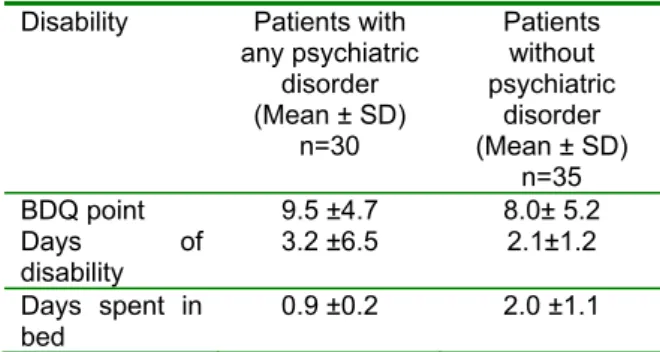
Mean disability score for all patients included in the study was 8.5 + 5.1. Total BDQ scores for patients with or without a current psychiatric disorder in accordance with ICD-10, days of disability and days spent in bed are shown in Table 2.
No significant differences between mean scores for groups of patients with or without psychiatric disorders were detected. The disability scores were evaluated for each diagnostic group of psychiatric disorders, and only the difference between mean disability scores of the patients diagnosed with and without current depressive episode was found to be significant (p=0.04) (Table 2)
No statistically significant difference regarding median BDQ scores, days of disability and days spent in bed for the patients with and without accompanying other physical chronic disease were found (Table 3).
Median BDQ scores, days of disability and days spent in bed of the patients with chronic physical disease and/or psychiatric disorder were presented in Table 4. The highest disability scores and days of disability medians were found only in the patient group of psychiatric disorder and the highest days spent in bed was found in the patient group having both chronic physical disease and psychiatric disorder. The variables of patients with Leprosy, such as physical deformity, whether the disease is active, hospitalization period, socio-demographic characteristics, at least one accompanying psychiatric disorder and presence of other chronic diseases that
may predict disability at medium/severe level for patients diagnosed as leprosy were examined with logistic regression analysis and it was determined that none of them had any predictive effect on disability.
DISCUSSION
In our study, the majority of the patients were old, male (72%), living with their families, illiterate, and had a very low income. A similar old mean age was reported in previous studies (Olivier 1987; Soykan 1991). The dominance of older patients could be related to the long prodromal periods up to 10 years, and may also be related to delay in the diagnosis and the treatment. The rate of female gender among our patients was low. Impact of disease on either gender may be different because of biological, social or cultural reasons. However, it was suggested that, a certain proportion of women couldn’t be diagnosed, because of their less accessibility to the health-care facilities due to socio-cultural reasons (Çakıner at al 1993; Grand 1997; Shale 2000). All the patients had a very low income, and the Leprosy also worsened this status, because of the disability as a consequence of not only the motor dysfunction but also the psychiatric morbidities. These findings were also similar to the previous reports on this subject (Price 1983, Yazıcı et al 1984; Soykan et al 1991, Çakıner et al 1993). A high percentage of married patients and of those living with their families might reflect a positive attitude in our society in terms of the perception of chronic illnesses. Also, positive attitude to ill person may cause low ratio of psychiatric morbidity among leprosy patients in Turkey.
Bharath et al (1997) have reported that the prevalence of psychiatric morbidity among Leprosy patients was 12.2% and depressive neurosis was the most common diagnosis. Verma and colleagues (1994) have reported that 76% of Leprosy patients had psychiatric
Table 1. Psychiatric Disorders of the Patients with Leprosy according to ICD-10 Diagnosis of psychiatric disorder (%) N Current Depressive episode 12 (8) Recurrent brief depressive disorder 9 (6) Generalized anxiety disorder 12 (8) Persistent somatoform pain disorder 12 (8)
At least one psychiatric
disorder 27 (17)
Lifetime
Depressive episode 15 (10)
Dysthymia 12 (8)
At least one psychiatric
disorder 20 (13)
Table 2. Disabilities of the patients with or without psychiatric disorder according to ICD-10
Disability Patients with
any psychiatric disorder (Mean ± SD) n=30 Patients without psychiatric disorder (Mean ± SD) n=35 BDQ point 9.5 ±4.7 8.0± 5.2 Days of disability 3.2 ±6.5 2.1±1.2 Days spent in bed 0.9 ±0.2 2.0 ±1.1
(Student t test results)
Table 3. Disability scores of the patients by Diagnostic Groups of Psychiatric Disorders
according to ICD-10 criteria
Depres sive episode Generali zed anxiety disorder Recurre nt brief depress ive episode Persiste nt somatof orm pain disorder Numb er 8 8 6 8 BDQ score 45.6* 38.9 36.0 29.8 Days of disabil ity 36.4 41.1 35.8 32.6 Days spent in bed 29.3 37.6 31.4 30.1
*p=0.043 (Mann Whitney U test results)
Table 4. Disability scores of the patients by having Chronic Physical Disease and/or
Psychiatric Disorder No chronic physical disease or psychiat ric disorder Only chroni c physic al diseas e Only psychiat ric disorder Both chronic physical disease and psychiat ric disorder Numbe r 27 16 17 5 BDQ score 29.3 35.3 37.4 30.7 Days of disabili ty 29.2 31.9 38.5 31.3 Days spent in the bed 30.9 36.2 31.8 37.8
(Kruskal Wallis H test results)
illnesses; 55% of them had neurotic depression and 21% anxiety neurosis. In our study, the prevalence of psychiatric morbidity was found to be 27%. The most common psychiatric disorders were depressive episode (12%), generalized anxiety disorder (12%) and persistent somatoform pain disorder (12%). When diagnosis of lifetime psychiatric disorders are concerned, depressive disorders are highly noticeable. The rate of lifetime depressive disorder in our study was 12% (Table1). This ratio was similar to the findings of Bharat and colleagues (1997). However; it was lower than the findings of studies reported
from Turkey (Yazici 1984; Soykan 1991) and some other countries (Verma et al 1994, Marlowe and Lockwood 2001). These differences may be explained with lack of standard diagnostic systems and reliable diagnostic tools. Sampling method problems in such studies may be the cause of these unpredictable results. In other studies about Leprosy patients, depression and anxiety disorders were reported, whereas somatoform pain disorders were not. In this group of patients, the biologic pain could be misdiagnosed as persistent somatoform pain disorder. Somatoform pain may also be due to the expression of depression in our culture.
In a report of World Health Organization (1995), the rate of psychiatric disorders among outpatients who were applied to primary health care centers was reported as 24%. Parallel to this result, in our study one-fourth of the patients had at least one psychiatric disorder according to ICD-10. Our study and the study of WHO were based on completely structured clinical interview survey form, which has the advantage of comparing with other studies. By using this instrument the interview bias was limited particularly in the detection of the diagnoses.
Leprosy carries fear and stigma and increases anxiety. In our study, anxiety disorder was higher than normal population as expected. Mean disability score for all patients included in our study was 8.5 + 5.1. This result was suggested that the patients had moderate disabilities when compared to Kaplan’s (1995) study, and the presence of psychiatric disorders did not worsen their disabilities. When examined individually, a higher level of disability was seen in patients with depressive episodes. However, the variables such as physical deformity, the disease activity, the duration of hospitalization period, socio-demographic characteristics, having an at least one accompanying psychiatric disorder and the presence of other chronic diseases had no predictive effect on medium/high level of disability in our patients.
Kumar and colleagues (1980) have reported that the patients who were sick for a long period and had physical deformities were inclined to psychiatric disturbances. Verma et al (1994) have also reported that the single, unemployed patients and those with low socioeconomic status and physical deformities suffer significantly more often of psychiatric symptoms. In our study, the disabilities were not found to be associated with the presence of comorbid psychiatric disorder. This finding was contrary to the results reported in WHO report (1995). In WHO report, the disabilities were stated to be higher in patients with isolated psychiatric disorders than the patients with chronic physical illnesses. This discrepancy could be explained by the presence of preventive Leprosy institutions in Turkey and the social support provided by the families. The rehabilitation system for the Leprosy patients in Turkey could be beneficial for social and psychological problems of the patients, and these institutions are actively working since 1919. In the current health system, the patients could stay for very long periods in the hospital environment. In our study, 54% of the patients were found to be hospitalized for more than 10 years, so that their health problems including psychiatric morbidities had been covered by the Leprosy centers which are supported by the goverment. Percentages of being married and living in safe family environments of the patients included in this study were higher than the patient groups of previous studies (Elissen 1991, Scott 2000, Gokhale 2001). This result may also help to explain similar psychiatric disorder rates of Leprosy patients and the general population.
This is the first study in which the structured interview scale (CIDI) was used and all the inpatient Leprosy departments of Turkey are included. Besides, all the hospitalized Leprosy patients from all Leprosy centers in Turkey were covered in the study. It was one of the major advantages of this study. However, the inpatient population was rather homogenous in terms of their social and economic characteristics. Therefore, no
significant variation was detected that could predict the presence of psychiatric disorder. Other limitations of this study are lack of a control group and lack of the evaluation of anxiety and depression severities.
In conclusion, the prevalence of psychiatric disorders among patients with Leprosy was similar to general population but less than other chronic diseases. In our study, we did not aim take a population based control group in terms of psychiatric diseases. When diseases were individually compared, it was seen that; the rate of depression was similar to general population, while primarily generalized anxiety disorder was much more frequently seen in Leprosy patients. Although the prevalence of depression in Leprosy patients was found to be similar to general population, depression was the main factor limiting their functionality. These patients were not isolated and living either with the family or institution in good social relations and support in Turkey. However, by considering the low socioeconomic status of inpatient Leprosy patients, psychiatric support should be positioned as a part of the social rehabilitation system.
Acknowledgement
We thank to Nihal Kundakçı, professor of Dermatology for her kind support in preparation of the survey form, and to get the permission for interviews and to reach three Leprosy centers.
REFERENCES
Bharath S, Shamasundar C, Raghuram R ve ark (1997) Psychiatric morbidity in leprosy and psoriasis—a comparative study. Indian J Lepr Oct-Dec, 69(4); 341-6.
Çakıner T, Yüksel A, Soydan M (1993) Women and leprosy In Turkey. Indian J Lepr 65 (1): 59-67. Gokhale SD (2001) Social/Ecoomic rehabilitation.
Int J of Leprosy 69(2) suppl : 42-51.
Grand A (1997) Women and leprosy: a review. Lep Rev 68: 203-211.
Elissen MCCA (1991) Beliefs of leprosy patients about their illness. Trop. Geogr. Med. 43: 379-382.
Kaplan I (1995)Mental disorders and disability in a primary health care clinic in semi-rural area. Turk Psikiyatri Derg 6(3):169-179.
Kumar JHR, Verghese A (1980) Psychiatric disturbances among leprosy patients; an epidemiological study. Int J Leprosy 48 (4) 431-434.
Marlowe SN, Lockwood DN (2001) Update on leprosy. Hosp Med. 62 (8) 471-6.
Olivier RH (1987) Psychiatric aspects of Hansen’s disease (Leprosy). J Clin Psychiatry 48: 477-479.
Özbesler Ö (1993) Lepra (cüzzam) hastalarının sosyal psikolojik ve ekonomik sorunlarının sosyal hizmet açısından değerlendirilmesi. Hacettepe Üniversitesi Sosyal Bilimler Enstitüsü (Ankara). Yüksek lisans tezi s35. Price JE (1983) A study of leprosy patients with
deformities, and the implications for the treatment of all leprosy patients. Lepr Rev 54: 129-137.
Rezaki M, Kaplan İ, Üçok GÖ ve ark. (1995) Temel sağlık hizmetlerinde ruhsal sorunlar üzerine bir alan araştırması [A field study on mental problems at the primary care]. Turk Psikiyatri Derg [Turkish Journal of Psychiatry] 6(1): 3-11 Robins LN, Wing J, Wittchen HU (1988) The
Composite International Diagnostic Interview. Arch Gen Psychiatry 45: 1069-1077.
Scott J (2000) The psychosocial needs of leprosy patients. Lepr Rev 71, 486-491.
Sentürk V (2002) Psychiatric disorders and disability among leprosy patients. Unpublished thesis, Baskent Universities Schools of Medicine, Ankara, Turkey.
Senturk V, Sagduyu A (2004) Psychiatric disorders and disability among leprosy patients; a review. Turk Psikiyatri Derg [Turkish Journal of Psychiatry] Fall;15(3):236-43.
Shale MJH (2000) Women with leprosy a women with leprosy is in double jeoprdy. Lepr Rev 71: 5-17.
Sharma P, Kar HK, Beena KR et al (1996) Disabilities in multibacillery leprosy patients: befor, during and after multidrug therapy. Indian J Lepr 68(2): 127-136 .
Soykan A, Kundakçı N, Erdem C (1991) Psychiatric disturbances in leprosy patients. Lepr. Mec 22: 229-238.
Stewart AL, Hays RD, Ware JE Jr (1988) The MOS short-form general health survey. Reliability and validity in a patient population. Med Care Jul;26(7):724-35.
Tarlov AR, Ware JE Jr, Greenfield S ve ark (1989) The Medical Outcomes Study. An application of methods for monitoring the results of medical care. JAMA Aug 18;262(7): 925-30. Verma KK, Gautam S (1994) Psychiatric morbidity
in displaced leprosy patients. Indian J Lepr Jul-Sep; 66(3):339-43.
Yazıcı O, Şatır F, Oto R ve ark. (1984) Lepralı Hastalarda Ruhsal Bozukluklar Üzerine Bir Araştırma [An investigation on mental disorders among leprosy patients]. D. Ü.T. F. Dergisi [Journal Dicle University] 11 (3-4): 131-139.