T.C.
ISTANBUL AYDIN UNIVERSITY INSTITUTE OF GRADUATE STUDIES
TRANSLANGUAGING AMONG ARAB STUDENTS ACQUIRING TURKISH AS A SECOND LANGUAGE
THESIS
Anwar JANID BARADI
Department of English Language and Literature English Language and Literature
T.C.
ISTANBUL AYDIN UNIVERSITY INSTITUTE OF GRADUATE STUDIES
TRANSLANGUAGING AMONG ARAB STUDENTS ACQUIRING TURKISH AS A SECOND LANGUAGE
THESIS
Anwar JANID BARADI (Y1612.020056)
Department of English Language and Literature English Language and Literature
Thesis advisor|: Prof. Dr. Turkay BULUT
DECLARATION
I hereby declare that all information in this thesis document has been obtained and presented in accordance with academic rules and ethical conduct. I also declare that, as required by these rules and conduct, I have fully cited and referenced all material and results, which are not original to this thesis.
FOREWORD
My heartfelt gratitude goes to my supervisor and head of department Assoc.Prof Dr. Turkay BULUT for all the precious support, patience, and encouragement she has granted me while writing my thesis. In addition, her feedback could both motivate me and put me on the right path.
The door to Prof. BULUT office was always open whenever I ran into a trouble spot or had a question. She consistently allowed this paper to be my own work but steered me in the right direction whenever she thought I needed it. I would like also to thank Istanbul Aydin University and its library for providing me with an access to all the books and articles that I needed to finish this work. My sincere thanks go to my parents who sacrificed everything for me to be a successful person and helped me with the smallest details in my life. Furthermore, I am thankful to all my doctors and teachers at Istanbul Aydin University, the participants of this study, all my friends, as well as every person contributed to my success.
TABLE OF CONTENT
Page
FOREWORD ... iv
TABLE OF CONTENT ... v
ABBREVIATIONS ... vii
LIST OF FIGURES ... viii
LIST OF TABLES ... ix
ABSTRACT ... x
ÖZET ... 1
1. INTRODUCTION ... 1
1.1 Background of the study ... 1
1.2 Statement of the Problem ... 2
1.3 Purpose of the Study and Research Questions ... 3
1.4 Significance of the study ... 4
1.4.1 Operational definitions ... 5
2. LITERATURE REVIEW ... 6
2.1 Introduction ... 6
2.2 History and Mechanism of Translanguaging ... 6
2.3 Monolingual Teachers' Orientation to Bilingual Students ... 11
2.4 Main Differences between translanguaging and code-switching: ... 13
2.5 The Internal/External Distinction of Translanguaging ... 16
2.6 Providing Space for Translanguagers: ... 17
2.7 Bilingual Brains Dealing With Two Languages ... 20
2.8 Bilingual Brains Dealing With Two Cultures ... 22
2.9 The production of L2 sounds affected by L1 articulators: ... 24
3. METHODOLOGY ... 27
3.1 Introduction ... 27
3.2 Research Design ... 27
3.3 Participants of the Study ... 28
3.4 Data Collection Instrument ... 29
3.4.1 The survey instrument ... 29
3.4.2 The focus group interview instrument ... 30
3.5 Data Collection Operational Steps ... 32
4. FINDINGS AND DISCUSSIONS ... 34
4.1 Introduction ... 34
4.2 Findings on code-mixing as a phenomenon of translanguaging: ... 34
4.3 Findings on the translanguaging facilitated but confused by similarity between both languages ... 40
4.4 Findings on Recontextualization as a translanguaging strategy: ... 44
4.5 Findings from Focus Group Interview ... 46
5. CONCLUSIONS ... 53
5.1 Introduction ... 53
5.3 Conclusions ... 53
5.4 Limitations of the Study ... 55
5.5 Suggestions for Further Study ... 55
REFERENCES ... 56
APPENDIX ... 60
ABBREVIATIONS
L1 : First Language L2 : Second Language
PICTES : A Project for supporting the integration of Syrian children into Turkish education system.
SPSS : Statistical Package for Social Sciences
TÖMER : is the Turkish language placement test that foreign learners of Turkish language submit in order to have a certain level of Proficiency
LIST OF FIGURES
Page Figure 4.1: Turkish-Arabic Cognates Facilitate Translanguaging Practice ... 40 Figure 4.2: Turkish-Arabic Cognates Confuse Translanguaging Practice ... 41
LIST OF TABLES
Page
Table 2.1: Main Differences between Code-switching and Translanguaging ... 15
Table 3.1: Gender Distribution of the Participants. ... 28
Table 3.2: Age Distribution of the Participants. ... 29
Table 4.1: The Participants' Attitudes towards Turkish Languaging ... 35
Table 4.2: The Participants' Tackling of Translated Literature ... 36
Table 4.3: The Participants' views of Translanguaging & Code-switching: ... 38
Table 4.4: Examples of Turkish-Arabic Cognates ... 42
Table 4.5: Turkish-Arabic structural differences (starting with object)... 43
Table 4.6: Turkish-Arabic structural differences (starting with subject) ... 43
TRANSLANGUAGING AMONG ARAB STUDENTS ACQUIRING TURKISH AS A SECOND LANGUAGE
ABSTRACT
The purpose of this research was to investigate how Arab students acquire Turkish language at the TÖMER center of Istanbul Aydin University. This research identified Turkish-Arabic translanguaging practices, and the attitudes of the participants were reported and supported by examples. The study engaged 38 participants with ages ranging between 19- 26. The focus of the research was centered on the fact that so many students encounter mispronunciation and misunderstanding problems because of the similarity between Turkish and Arabic vocabularies and pronunciations. For this reason, we worked on answering the following research questions:
1. What is the prevalent way that TÖMER students follow in order to practice translanguaging?
2. To which extent do the students practice the Turkish-Arabic translanguaging technique?
3. What kind of translanguaging obstacles do the students encounter?
4. Are Translanguaging and code-switching practiced both at once during the class?
In order to collect the data, the participants were asked to fill in a survey comprising several language-relevant questions. The survey questions solicited general information about the participants, questioned their speaking difficulties, and then probed their aptitude for the encountered obstacles when communicating in Turkish. A focus group interview was the second instrument in collecting the required information where students had the opportunity to discuss and express their ideas verbally and offer more detailed and descriptive attitudes towards the translanguaging practice. The interview supported the researcher to reach very concise responses about the developed questions of the survey. The findings indicated that students' translanguaging has turned to be a kind of code-mixing between Turkish and Arabic. Moreover, it was deduced that translanguaging was facilitated but confused by the similarity between both languages; facilitated when using cognates but confused when using false cognates, and thus, many students were resorting to the strategy of recontextualization. The students recontextualized difficult and vague rules of grammar as well as newly-learned expressions in a way that would fit their understandings of the Turkish context in order to be able to use these structures in the future.
Key Words: Translanguaging, second language acquisition, code-switching, bilingualism, multilingualism
TÜRKÇEYİ İKİNCİ DİL OLARAK EDİNEN ARAP ÖĞRENCİLER ARASINDA DİL GEÇİŞİ
ÖZET
Bu çalışmanın amacı, İstanbul Aydın Üniversitesi'nin TÖMER merkezinde Arap öğrencilerin nasıl Türkçe öğrendiklerini bulmaktı. Bu çalışmada Türkçe-Arapça dil alaşımı uygulamaları ve katılımcıların tutumları örneklerle belirlenmiştir. Çalışmaya 19-26 yaş arası 38 katılımcı dahil edildi. Çalışmanın odak noktası, birçok öğrencinin Türkçe ve Arapça sözlükler ile telaffuzlar arasındaki benzerlikler nedeniyle yazım hataları ve telaffuz hataları ile karşılaşmalarıydı. Bu nedenle, aşağıdaki araştırma sorularının cevabı üzerinde çalıştık:
1. TÖMER öğrencileri dil alaşımı pratiğini hangi ortak yoldan takip ediyorlar?
2. Öğrenciler Türkçe-Arapça dil alaşımı tekniğini ne ölçüde uyguluyorlar? 3. Öğrencilerin dil alaşımında engeller nelerdir?
4. Dil alaşımı ve kod değiştirme tek bir dilde mi çalışıyor?
Veri toplamak için katılımcılar çeşitli dil soruları içeren bir anket doldurdular. Anket zamanı katılımcılar hakkında genel bilgi istenerek, konuşma sorunları sorgulandı ve daha sonra Türkçe iletişim kurma çalışmalarındaki engelleri tespit etme yeteneklerini ortaya çıkardı. Grup toplantısı görüşmesi, öğrencilerin fikirlerini sözlü olarak tartışma ve ifade etme, dil alaşımı pratiğine daha ayrıntılı ve tanımlayıcı bir tutum sunma fırsatı buldukları gerekli bilgileri toplamanın ikinci aracıydı. Mülakatlar araştırmacının geliştirilen anket soruları hakkında çok kısa cevaplar almasına yardımcı oldu. Elde edilen veriler, öğrencilerin dil alaşımında bir tür karıştırma kodu haline geldiğini göstermektedir. Sonuçlar, öğrenciler arasındaki çevirinin Türkçe ve Arapça arasında bir çeşit karıştırma kodu haline geldiğini gösterdi.
Ayrıca, dil alaşımının kolaylaştırıldığı, ancak her iki dil arasındaki benzerlikler tarafından karıştırıldığı sonucuna varılmıştır; ilgili dilleri kullanırken kolaylaştırılır, ancak yanlış ilgili dilleri kullanırken karışır ve böylece birçok öğrenci yeniden bağlamsallaştırma stratejisine başvurur. Öğrenciler, karmaşık ve belirsiz dilbilgisi kurallarını ve yeni öğrenilen ifadeleri, bu yapıları gelecekte kullanabilmeleri için Türk bağlamını anlamalarına uygun bir şekilde yeniden yarattılar.
Anahtar Kelimeler: Dil Alaşımı, İkinci Dil Edinimi, Kod Değişimi, İki Dillilik, Çok Dillilik
1. INTRODUCTION
This part includes the background of the study, statement of the Problem, purpose of the study, research questions, and significance of the study as well as operational definitions
1.1 Background of the study
Communication is a complex function in which languages play a significant role. Throughout human being history, languages have been developed from signs and gestures into complex set of sounds, syntax and semantic, yet tens of thousands have been created. Languages are illustrated as indicator of society's development. There has been a reliable relationship between the level of progression of a society and the complexity and advancement of its language. As languages are a vital, yet essential means of communication among people, and in our era of fast and vast technological development, people can reach each other and communicate more easily. This communication requires people to learn and speak other’s languages. For people who are living in a country that does not speak their mother tongue, learning that country language will be a target not only for commination but also for building relationships; the aimed relationships vary from academic, marriage to work, etc. All of this participate in more social cohesion between the host community and the migrants or residents. The strategic placement of Turkey in the international business map has granted it a fast-developing economy and an increasing exposure to other cultures. Recently, Turkey has welcomed a huge number of visitors, tourists and migrants from all around the world in general and neighboring Arab countries in specific.
Turkish language is considered as a phonetic language where people pronounce words exactly as they are written, which makes it an easy language to learn on the part of foreigners (Süzer, 2010). In the last few decades, and on the part of
language learning, it was important for second/foreign language (hereafter L2) learners to forget all about their mother tongue (hereafter L1) and focus only on L2. However, in the last ten years, there has been a strong movement to put the L1 and L2 together in a productive technique called "translanguaging": “the ability of multilingual speakers to shuttle between languages, treating the diverse languages that form their repertoire as an integrated system” (Canagarajah, 2011, p.401). Translanguaging is the use of one's full linguistic repertoire, a way of teaching pedagogy that allows children to read in one language and discuss or write in another, even if teachers do not know the L1 of their students. The main purpose of employing this technique is using all accessible linguistic resources to make meaning (Garcia & Lin, 2016). As Garcia puts forward, translanguaging is not solely a technique or social practice but also a linguistic theory that poses a competence shaped through social recurring interaction and negotiation and this kind of socialization of multilinguals arises competences through their contacting practices.
Learners of language in Turkey usually seek quality courses at universities and high institutes for teaching Turkish (Süzer, 2010), and one of the most famous targeted courses is TÖMER, which is named after its exam name that refers to the academic discipline which students take after passing several stages of complete courses of Turkish language learning (Kocaman, Yıldız, & Kamaz, 2018).
This research was conducted on a group of Arab students of intermediate level taking TÖMER course at Istanbul Aydin University, and while they were acquiring Turkish as their second or third language, they were exposed to several challenges and difficulties. The researcher's main interest was centered on how these students dealt with the processing of Turkish as a second language, and how well they were able to switch between Arabic and Turkish in the same session, which is referred to as Arabic-Turkish translanguaging.
1.2 Statement of the Problem
There is a great need to investigate the input-output process of Arab students’ acquisition of Turkish, alongside the technique they use in order to translanguage between Turkish and Arabic languages within the class. There is
also a need to highlight the difference between code-switching and translanguaging and identify whether both of them take place in language classes at TOMER centers. The importance of illuminating students' translanguaging technique is accompanied by the significance of identifying a few language barriers that so many students are not able to overcome, according to some teachers of Turkish language. Since students at early stages of learning might not have developed an autonomous learning technique, they might not be able to understand the process by which they receive input of L2 codes but understand them in their L1 and then produce the outcome codes again in L2. Sometimes students produce a kind of mixed sentence between Turkish and Arabic to compensate for unknown vocabularies so they might resort to speak and write in the simplest way according to them. For this reason, how to tackle processes of students' translanguaging requires full knowledge by their teachers who will be guided only by the kind of research that would contribute to a greater consideration of the status of students.
1.3 Purpose of the Study and Research Questions
The current research aimed to participate in drawing a clear picture, pacing more paved ways to other research in the field of translanguaging. This study's objective is also to assess both the prevalence and efficiency of translanguaging practices within classroom discourses at TÖMER centers because they provide academic yet multinational and multi-cultural atmosphere where Turkish L2 learners come from different countries and languages, and especially Arabs whose mother tongue is Arabic; as Arabs practicing translanguage are the subject of this research.
To help achieving the objective of the research, the following questions had been developed to frame this study:
• What is the prevalent way that TÖMER students follow in order to practice translanguaging?
• To which extent do the students practice the Turkish-Arabic translanguaging technique?
• Are Translanguaging and code-switching practiced both at once during the class?
1.4 Significance of the study
The most recent data and statistics conducted, until by November 2019, by United Nations High Commissioner of Refugees UNHCR, Turkey hosts 3,691,333 Syrians. The Syrians living in Turkey spread all over Turkish cities. Many other Arab nationalities live in Turkey as well. The problems that Arab students encountered while learning to read and write in Turkish still keep priority to overcome since no real solutions exist to address these problems in literature (Şengül, 2015).
It is known for all second language teachers whose L1 is Arabic or who teach Arabian students that Arabic language is different in terms of letters, calligraphy and grammar from Latin-originated languages. Moreover, there are some Turkish words with Arabic origin and similar pronunciations; sometimes these friends might be an advantage for their learning process, but mostly they are false friends and lead the Arabic learners of Turkish to encounter misspelling and mispronunciation.
Most of the Arabs are learning Turkish for studying and working purposes. They are learning Turkish through two approaches: first, formally in schools as pupils or university students; second, informally during their work in diverse professions and environments. Both types of Turkish language learners depend on Arabic as their L1 to build their linguistic competency in Turkish. Throughout their learning, they depend to a reasonable degree on the technique of Translanguaging. By translanguaging, Arabs who are learning Turkish make utmost benefit of Turkish-Arabic related vocabularies. it is important to mention that so many Turkish vocabulary are imported from Formal Arabic, while so many of informal/slang Arabic vocabulary are imported from Turkish due to intercultural and historical relation between Turks and Arabs. Thus, Arab learners of Turkish prefer translanguaging to produce formal, informal and slang language outputs that serve them best in understating meaning, social contexts and culture references.
Moreover, the process by which students unconsciously understand language, try to generate their ideas, produce their words in a mixed outcome language is referred to as Translanguaging. This kind of technique or practice has a limited number of studies regarding Arab students acquiring Turkish as a second language, apart from the fact that many people confuse the term Translanguaging with code-switching, so this study is an attempt to clarify the main differences between both of the techniques.
1.4.1 Operational definitions
Translanguaging: the psychological process by which students receive the input of second language, understand language codes in in their mother tongue, and then produce them in the target language.
Code-switching: The conversation practice by which speakers shuttle between two or more languages for specific purposes.
TÖMER: is the Turkish language placement test that foreign learners of Turkish language submit in order to have a certain level of Proficiency, and the test is prepared according to "Common European Framework of Reference for Languages." The abbreviation TÖMER stands for Türkçe Öğretim Merkezi in the expression "Türkçe Öğretimi Uygulama ve Araştırma Merkezi"
Turkish as a second language: the research is chiefly concerned about studying cases of Turkish as the second language after Arabic, being the participants' mother tongue; however, in some cases Turkish might be the third language after Arabic-Kurdish bilingualism.
2. LITERATURE REVIEW
2.1 Introduction
This part includes history and mechanism of translanguaging, monolingual Teachers' orientation to bilingual students, providing space for translanguagers, the internal/external distinction of translanguaging, the main differences between translanguaging and code-switching, and bilingual brains dealing with two languages.
2.2 History and Mechanism of Translanguaging
In 1994, Cen Williams was the first to introduce the term Translanguaging in order to refer to the educational practice applied at classes in which students were asked to make replacement between English and Welsh for the purpose of strengthening and reinforcing both receptive and productive skills of these two languages (Canagarajah, 2011).
All studies refer that ‘Translanguaging’ was organically coined in Welsh. Translanguaging, ‘trawsieithu’ in Welsh, was first used after translated into 'Translinguifying', after that as a result of a discussion between Cen Willimas and Colin Baker, the term ‘Translanguaging’ had been adopted by linguists. ‘Translanguaging’ is presented and concluded as a pedagogical practice and process that is used intentionally to change both the inputs and outputs.
The notion of translanguaging was developed against the background of the historical separation of Welsh and English (Canagarajah, 2011). From the 1990s, the popularity of translanguaging in education started growing internationally, mainly spurred on by a growing view of bilingualism being an advantage, rather than a disadvantage. Initially, the focus was set on bilinguals, and particularly on the function of translanguaging to assist learners in accessing different linguistic features of two languages in order to mediate complex cognitive processes. More recently, the focus has shifted to
multilingual contexts, and the simultaneous use of more than two languages for both or either content and language teaching and learning (Makalela 2016, P.201).
Lopez, Turkan and Guzman-Orth (2017) discuss that translanguaging goes past conventional ideas of bilingualism. It forms a strong assertive suggestion for the second language learning and teaching. The translanguaging's strong assertive is based on heteroglossic conceptualization of bilingualism; the term ‘translanguaging’ refers to a student’s ability to adaptably make most benefits of using interchangeably between languages accessible and available to use. According to Makalela, the rapid and vast widespread of globalization that has been including and impacting individuals, who live inside country or ones who live in different countries. It has enabled them access data and information which has resulted that now we have more multi-diverse contexts sociolinguistic. Therefore, languages cannot be chained into allocated time or specific space; in fact, they overlap and affect each other.
Makalela continues explaining in the same regard that many researches and articles conducted by Garcia (2009), Makoni and Pennycook (2007) show that past ideas and attitudes toward steady diglossia and additive bilingualism are not yet supported or popular worldwide. That is because there is a tendency of separatization for languages. Moreover, that is typically the place where the idea of translanguaging can be suitably put in for basic to compound multilingual experiences that the speakers can operate many languages and use their inputs and outputs.
According to Makalela (2019), we understand that traditionally there is a stable perspective when dealing with a language that it undoubtedly has limitations and borders. Those borders and limitations force speakers of a specific language to be separate from other languages. In the 21st century there is a consistent resistance to conventional systems and ideas and working to change them; therefore, translanguaging, although is still under many debates about its nature if to be considered a theory, practice or pedagogy, or to a large extent has an advantage weighing other different models.
According to Garcia and Wei, translanguaging alludes to the use of a language as a more energetic repertoire. Actually, it is not chained, limited, framed nor characterized in a social and political manner. Because translanguaging greatly shift the focus on real operating of a language, it essentially goes past the named languages such as Chinese, English, or French (Wei, 2017; Otheguy, García, & Reid, 2018). However, and alternatively, it grants benefits to language speakers as a semiotic framework of having a system of signs and different models that together make up the speaker’s create their own communicative repertoire. Furthermore, that repertoire is not necessarily and continuously framed under inflexible birders of a given language which its system, syntax, semantics is formed by that language speakers, lexicons, and schools. As an essential sociolinguistic hypothesis, translanguaging has had the foremost application in language instruction, particularly within the instruction of language-minoritized understudies and in bilingual instruction, and progressively in remote language courses or programs. It is contended that the hypothetical operators of translanguaging may have the capacity and potential to convert the way a language expert see, utilize, and instruct dialect, education, and other subjects.
Additionally, Wei states that translanguaging has been connected and put into practice to pedagogy, on daily and regular social connections, different types of communication, linguistic field, visual art, music, and transgender issues. There is significant perplexity as to whether Translanguaging may well be an all-encompassing term for differing multilingual and multimodal applications, and if it may be adopted shifting away many terms such as code switching, code-mixing, code-meshing, and crossing. It too appears to be competition some other popular terms such as polylanguaging, polylingual languaging, multilanguaging, heteroglossia, cross breed dialect hones, translingual hone, adaptable bilingualism, and metrolingualism, for academic discourse space. To Wei, these days translanguaging has been presenting a challenge to us, linguists. The translanguaging encounter our traditional ideas and thoughts about separation of languages. It makes us reconsider the divisions between first language (L1) and second language (L2) versus (or Lx) or in the same manner the native language/speaker versus nonnative language/speaker; it provides
more connections between existing language learning studies that is focusing on bilingualism and multilingualism. It is valuable for us to remember that the reason behind making efforts to learning a language or more is to achieve some levels of bilingualism or multilingualism instead of removing the language we already know from our knowledge and substitute it with the one we are learning. However, genuine bilingual and multilingual language operators and their way of using and utilizing languages in real-life social circumstances are seldom utilized as a performance in L2 and extra language instructing and learning. However, it is often an idealized, monolingual, so-called L1 native speaker that's utilized as the standard and the target of learning. There is a genuine absent link between our information about both, first bilingual and multilingual language users and the methods they practice, and second and L2 and additional language teaching and learning.
Translanguaging is considered now to know the activity when one language is operated and applied within the language a speaker or learner is aiming to know. That will support increasing a speaker/learner’s ability to understand and operate in both languages.
Being among the effective scholars who excelled in bilingualism, Baker (2011) noticed how the ‘translanguaging’ practice assisted students generate understandings and knowledge in both languages. "To read and discuss a topic in one language, and then to write about it in another language, means that the subject matter has to be processed and digested" Baker explained (Baker, 2011, p.289). He also highlighted four educational advantages of translanguaging: it improves a deeper and fuller understanding of the subject matter, helps the development of the weaker language, simplifies home-school links and cooperation, and last helps the blending of fluent speakers with beginners.
Garcia thinks of ‘translanguaging’ as a strategy that helps bilinguals make meaning, gain understanding and knowledge, shape their experiences in addition to making sense of their bilingual worlds through the daily use of two or more languages. According to Garcia, translanguaging is a powerful mechanism to build understandings, to include others, and to facilitate communications through language learning groups (Garcia, 2009). She also manifested that "Translanguaging as a sociolinguistic and psycholinguistic theory has much to
offer to our understandings of the languaging of bilinguals because it privileges bilingual performances and not just monolingual ones." In Beaujour's 1989 point of view, what is mingled or produced according to bilinguals is not only linguistic systems but also cultural, social, interactional, historical, and personal scripts which shape networks and new realities that are expressed in their brains.
According to Garcia (2009), from linguistic or non-linguistic points of view, the limitation or negative evaluation of translanguaging practice of bilinguals results in an unreliable assessment of their language skills. It is unfair to assign bilingual students to work out math problems or find out the main idea of a text using only the legitimized school language; we are rather asking them to use aspects of only one of the languages they know. It would be more justice to let them employ all of the languages involved in their repertoire in order to demonstrate their full knowledge and prove their abilities. Expecting them to perform perfectly and fluently as monolinguals is an imbalanced evaluation because when they think they draw only from less than half of their entire repertoire; unlike monolinguals who utilize their full repertoire in thinking. Negative correspondences and education drawbacks have proved that bilinguals and multilinguals could pass by psychological troubles and pedagogical distresses when they feel incapable to achieve their language assignments. Translanguaging has proved to offer several benefits on educational as well as social levels. It does not have only practical but also political implications to elevate the usage as well as the condition of a person’s mother tongue against the background of extra languages through any educational system. Translanguaging practice is able to accelerate the second and third languages learning. When it comes to preserving minoritized endangered languages in some countries where bilingualism and multilingualism are not supported yet by governments, translanguaging can be the remedy and source for natural language acquisition; through the work of Garcia (2009) and Baker (2003), this method of learning language was advanced and spread. Bilinguals' performances and use of various linguistic features or different modes of languages are described as viewed as mastering independent languages so that communicative potentials are maximized, this is what Garcia (2009) had come
up with in a further research. When students do the translanguaging process, they might use a word in their mother language instead of the word they do not know in the target language to complete their sentences. This was known as ‘gap-filling’ Genesee, Nicoladis, & Paradis (1995). Bilingual teachers in the last decades used to recommend learning several languages one after another in order to prevent language mixing worrying that would cause students' focus solely on one language.
2.3 Monolingual Teachers' Orientation to Bilingual Students
From neurolinguistics point of view, one of the most fundamental notions of translanguaging is that "bilinguals are not two monolinguals in one person" (Grosjean, 1992). In other words, their performances in one language or another should not be matched to that of monolinguals, considering that they are expected to leverage less than half of their whole repertoire, so this make bilinguals take an unequal position. Canagarajah maintains, "Competence does not consist of separate competences for each language, but a multicompetence that functions symbiotically for the different languages in one's repertoire," (Canagarajah, 2011, p.3).
While growing older, bilingual students will find themselves increasingly dealing with monolinguals, specifically during their future jobs. Since translanguaging strengthens the practices of the fluid language of bilingual students into efficient learning and inspires them to acknowledge its uses, features, and aims, schools should obviously start to develop critical metalinguistic awareness of bilingual students besides the students’ ability to inhibit some features of the language on the right times (Garcia, 2009). Teachers, in turn, have got to help their students evaluate their ability of using their whole repertoire of language features. Thus, teachers should not be relying on evaluating the performances of bilingual students by only using one characteristic of their language traits as being valid performances and that includes not comparing any of these performances to monolingual students in that language.
According to Canagarajah (2011), the teacher of translanguagers has to be the kind of co-learner in order to minimize the distance among them. Moreover, it is
important for teachers to learn from them rather than to impose their own views because translanguaging students bring from their communities a great amount of knowledge that is valuable for themselves and others.
When asked about how teachers would manage translanguaging if they do not know the minority language of bilinguals, Garcia asserted that any leading teacher is able to achieve the safe atmosphere of languaging during the class even if they are monolinguals. Teachers can provide texts in the target language, for instance, and group students according to their home language in order to discuss general meaning or find out keywords, do exercises in their mother tongue language, and then reflect upon them in the target language. A co-learner teacher will provide students with all required materials to help them make deeper meaning even if they do not know the background languages of their students. Moreover, allowing students to collaborate through group thinking in accordance with their home language would build up their abilities to transcend the barriers of using the legitimized language and think openly and freely about the subject matter.
Garcia (2009) asserts that schools must have the positive effect in directing students. Schools have to utilize the language practices of bilinguals to understand deeply, as well as to teach them to recognize when to use what features of languages and for what purposes. The alteration between two or three languages could result sometimes in mixing among linguistic codes; however, the time meta-linguistic awareness is established, bilinguals will automatically realize when to suppress unnecessary language features involved in the repertoire.
According to Canagarajah (2011), translanguaging is occurring naturally within language classes that proscribe mixing multiple languages and could be described as a normal phenomenon that takes place behind the back of language teachers, irrespectively whether they know the minority languages of their students or not. That is to say, even monolingual teachers can orient their students using the minimal pedagogical sources and materials in order to leverage the minority languages of bilinguals. In this way, language teachers are responsible to develop students' competences and performances within the class by forgetting to ignore their marginalized languages. Rather, their background
languages support them with abundant interlingual as well as intercultural awareness towards learning a second and maybe third language. This sharing of background language will make the bilinguals and multilinguals confident about their identity and will provide them with empowering strategies for more creative language learning.
In his article about addressing the rhetorical writings of a translanguaging Saudi Arabian student, Canagarajah (2011) posits the idea of code-meshing where she begins writing literature in Arabic and continues in English. Throughout her writings, she utilizes multisensory emotional expressions and visual effective writings such as writing "I dooon't want to" reflecting on her feelings in order to capture the attention of her readers. She uses many poetical expressions as they are in Arabic, and then, as a kind of clarification, she paraphrases them in English but refuses to translate them literally in order not to spoil the meaning of the poem assuring that it will be injustice to translate such meaningful poetry in only a couple of lines.
Canagarajah (2011) focuses much on the role of teacher in motivating and demotivating translanguagers. He affirms that teachers have to apply excessive drilling on contexts including tasks about both languages of the bilinguals in order to increase their repertoire. Translanguagers come from varying backgrounds, and this is advantageous for teachers to learn from them as well as guide them into more constructive languaging practices. As Canagarajah concludes, since bilinguals bring with them a diversity of cultural and epistemological knowledge, teachers have better accompany them in their learning journal rather than impose their correcting attitudes negatively.
2.4 Main Differences between translanguaging and code-switching:
Translanguaging should also be distinguished from code switching, even to those scholars who consider it as a linguistic skill; code switching is based on the monoglossic view that bilinguals have two disconnected linguistic systems. However, translanguaging posits the linguistic behavior of bilinguals as being always heteroglossic, functional, reacting not to two monolingualisms in one but to one unified linguistic system (Garcia, 2009). In order to differentiate between translanguaging and code-switching, Garcia draws the attentions on the
idea that code-switching is an external view of the actions of bilinguals while translanguaging is the internal view of the bilinguals themselves though it could appear the same practiced strategy for the surrounding interlocutors. The actions can be identical from an external social viewpoint, from a point of view which does not doubt why there are hierarchies of named languages or the connection between language and influence of authority.
Many researchers have cited that translanguaging is unlike code-switching in several aspects. They consider code-switching as the operation of shuttling between two languages, while translanguaging is all about the speakers’ structure that innovates the complete language repertoire. In particular, translanguaging is a complicated procedure of digressive practice where bilinguals know what they are saying while making words in both languages, and thus translanguaging is considered as present controllable knowledge.
However, what can be noticed are different situations when bilingual speakers alternate between two or more languages, which rely on the aim and environment of the communications. The main characteristic of the code-switching operation is that it is leveraged according to the target of conversation. Generally, code-switching is thought as linguistically categorical capacity, only used when needed and in certain circumstances. There is a distinction in researching these areas of bilingual development as code-switching looking for language interference and transfer; whereas, translanguaging analyzes how bi/multilingual speakers are participants in their linguistic practice.
The most significant thing that includes code-switching is its methodical planning order used in the classroom. Garcia (2009) meditates that code-switching should be in charge of, which means controlled precisely in the classroom, as it improves cognitive proficiencies of understanding any content material by involving the concept of isolating languages. Translanguaging expresses even more, since it focuses on learning both languages simultaneously without isolating. Briefly, the main differences between code-switching and translanguaging can be summarized as in the following table:
Table 2.1: Main Differences between code-switching and translanguaging
Code-switching Translanguaging
Concept Alternation between 2 or more languages that are considered separate
A meaning-making process /An academic technique
Language Is a system governed by grammatical rules
Is a multilingual, multimodal resource Ability Linguistically incompetent Linguistically competent Focus On separation of languages On learning both languages
at the same time
In an extreme comparison between translanguaging and code-switching, according to Garcia, no matter how the bilingual is proficient in using both languages, code-switching masterfully is never equalized to translanguaging since individuals are switching between two separate linguistic systems, but translanguagers are working hard to understand the codes of both languages. In code-switching, the two separate language systems are not drawn by linguists; rather, they are assigned by political and cultural boundaries. Linguists do not interfere when languages are named; they can only elaborate on phonemes, morphemes, nouns, verbs, syntactic structures, and the like. In other words, linguists can only elaborate on named national languages, but they cannot name any new language that was not named beforehand.
Translanguaging adopts the view of person from the inside of the speaker; it focuses only on the existing definitions of linguistic and grammatical structures. The named languages take the view from outside the speaker; it offers a classification based on external definitions arising from political, sociocultural or national frameworks.
2.5 The Internal/External Distinction of Translanguaging
In describing the language practices of bilinguals, the internal/external distinction made in translanguaging theory is so essential. From an external point of view, which supports socially constructed linguistic divisions, when bilinguals choose and activate characteristics that do not account for named language groups, it indicates that they are using two independent codes to contact or they are code switching. Nonetheless, from an internal perspective, the dynamic and elastic use of language by bilinguals is considered to go beyond the socially constructed limits of named languages and is thus called translanguaging (Garcia, 2009). Code switching was suggested as a method that could be encompassed by translanguaging, while the two ideas are found to be mental at odds in later works as code switching preserves intact named language categories.
Translanguaging theory overlooks named language categories and takes up an internal point of view to characterize the languaging of learners who are considered to be bilinguals or multilinguals. Translanguaging resists ideologies that regard specific languages as outstanding to others and the language practices of monolinguals as outstanding to those considered to speak with linguistic resources. Translanguaging philosophy acknowledges that all people - including those who perceive society as monolinguals and those regarded as bilingual or multilingual - have one linguistic repertoire, acquired by effective social experiences, and from whom they choose and adapt features to make sense in context. At the same time, translanguaging theory emphasizes that the bilingual's linguistic repertoire contains elements from what culture would see as more than one named language (Garcia, 2009).
As shown by the use of terms such as monolinguals and bilinguals in translanguaging academic work, this concept continues to recognize the external, social interest of terms that reify languages. In this way, translanguage theory embodies the principle that, while named languages and conventional language ideologies are socially constructed, they still have material effects. Modern conceptualizations about language around purity of speech and oral hygiene have become entangled with philosophies linked to race, class, and
sexual supremacy to support imperialist initiatives carried out throughout time and the world (Canagarajah, 2011).
Nowadays, in addition to their class status and other social indicators, the influence of popular language ideologies is associated with and strengthens the ethnic state of speakers. Translanguaging philosophy deals with this pressure, with the ultimate goal of disconnecting socially constructed linguistic divisions and understanding the real contextual consequences of these classes as well. Nowadays, children who grow up as simultaneous bilinguals will discern very early that communication features can be used to interact in different contexts throughout their language repertoire. From an outside social point of view, the learner may speak X or Y language, but from the student's point of view, what he or she has in mind is one language repertoire. The translanguaging theory suggests that bilinguals have a range of language characteristics which they tend to use in compliance with social norms. When national schools impose teaching only the state language, which is used by the elite of that society, this means that only the elite children will have the advantage of dealing with the language features assessed by final tests and national examinations (Garcia, 2009).
On the other hand, bilingual students' repertoire is richer and full of mingled language features, but they are penalized for not being elite children, and they are minoritized for belonging to racial or ethnic groups. These cases are among the circumstances, which result in undesirable consequences because assessments on the named languages level will work then against the bilinguals' repertoire.
2.6 Providing Space for Translanguagers:
In one of Yuvayapan's (2019) studies, there are many studies which show that in school settings translanguaging appear to a great extent. In fact, it happens as a natural phenomenon. Most of these studies have concluded that translanguaging is not provided nor facilitated by teachers with the use of pedagogical techniques or strategies. All translanguaging occurring in classes is made unrequested. It is a matter of fact that in several of those conducted studies it is
noted that translanguaging cases happen secretively that the teacher cannot see in the classes that prohibit language blending.
To Yuvayapan (2019), translanguaging as system application and usage of L1 in learning a foreign language is now widespread adopted and used to develop foreign language teaching techniques and strategies. In her research on translanguaging, she provides an evidence that the adoption of translanguaging in teaching will increase learners’ competence in L2. In the research, she aimed to explore EFL teachers’ perceptions while they are teaching in classes. As a result of her study, Yuvayapan concluded that apparently when the EFL teachers were teaching, their practices had not met their expectations in a few specific situations.
The researchers found that most of the participants had felt and thought, while studying English language, the use of Turkish language played a significant role to support students who have low proficient; therefore, the use of Turkish in the class was encouraged.
However, avoiding Turkish had been sensed to raise and assist classmates during lesson activities. That was done to make clarification and support sorting out problems that are not linked to the content despite the fact half of the students assured that such instances occurred, yet they were important.
Within more dynamic circumstances and class sets, students are given a secure and safe atmosphere to use their multilingual by their teachers. The latter aim is to support learners utilize their multilingual; teachers as well support the students and the whole process and outcome is used in learning asset.
It should always be considered that the one who will provide the space for translanguaging students is only the teacher, where s/he is to show them that he is following, engaging and encouraging them in order to remove all language barriers. Canagarajah (2011) asserts that it is important for teachers to provide safe spaces in classrooms and schools for students to practice translanguaging, in order to activate their multilingual repertoire. Teachers have to show their student that they are involved in facilitating the input and output process of their learners.
Moreover, during lessons, it is a typical performance for learners to look for space and time to fully comprehend and consequently find equivalents of the codes of input language and compare them with the codes of their mother tongue language. The teacher plays a fundamental role in providing this space for students' translanguaging, such as slowing down while reading or speaking in the target language. Teachers might not notice the operation whereby students are finding equivalent; this might "occur surreptitiously behind the backs of the teachers in classes that proscribe language mixing," even (Canagarajah, 2011, p. 401). Thus, the students' mission is to invest these opportunities and use provided spaces properly and attentively.
Teachers should understand that, according to Canagarajah, “What may appear as grammatical deviations or idiomatic novelties are explained as a positive case of transfer from the other languages in one's repertoire rather than a negative case of interference. It is also important to mention that Canagarajah clarified that most of the studies on multilingual classroom communication have not considered dis-cursive and rhetorical issues. They have largely interpreted the types of language mixing and social negotiations to demonstrate communication functionality and metalinguistic competence.
This study sheds the light on the right and the benefits of students of L2 to not only use translanguaging but also to have room and supporting environment by teachers to develop their own learning strategies that are based on their ability as multilinguals which still an aim of many language learners. Many language students around the world aim to be bilinguals or multilinguals
The study also has been conducted to show that the four skills, receptive: listening and reading, productive: writing and speaking, can be used by bilinguals and multilinguals students on the basis of translanguaging. The listening skill is utilized among students themselves, by decoding language data heard into their L1 to make deeper understanding. The reading skill is facilitated by students through internal translating by their lexical for better comprehension. Furthermore, the writing skill is developed by students through bringing phrases, clauses, sentences, proverbs, sayings, and stories from their L1 and find their matches in L2, which support those translanguagers to provide richer writings, more accessible meanings.
Multi-nationality, multilingual classrooms, are blesses where a higher opportunity of culture diversity will be shown but also civil dialogues might be practiced, and that is all because of the translanguaging. Canagarajah supports this idea by illustrating that there are good reasons why we should develop teaching practices from the strategies learners themselves use. Multilingual students bring from their homes and communities funds of knowledge that are valuable for themselves and others.
2.7 Bilingual Brains Dealing With Two Languages
There are variations related to the process of learning a new language or more in the brain. Some of these changes include cognitive abilities, which are located in the external of the linguistic system such as the ability to ignore unconnected information when adjusting tasks. Other changes between monolinguals and bilinguals include the interaction of two linguistic systems: activating them at the same time on one hand and using each language in different context on the other hand. Otherwise, the consequence will involve learning two languages along with their grammars, vocabularies...etc. instead of learning only one. Eventually these variations arise from the bilinguals' intensive cognitive training during their lifetimes according to speediness and flexibility they can switch from one language to another.
What is more important is how many languages the brain is dealing with, in case there were two languages which one developed first and which one later. The existence of these languages at the same time is also advantageous in the sense that the proficiency achieved in each language and how regularly the brain uses them, or switches from one language to another, will allow the person to measure and distinguish if one language dominates the other or not (Garcia, 2009).
A pioneer researcher on bilingualism François Grosjean, in his 1989 article warned that the bilingual is not two monolinguals in one person. He asserted this by projecting some discoveries on bilingualism neurobiology which revealed that the bilingual person has a unitary linguistic repertoire. A person who knows more than one language and has the ability of using them efficiently for communication is regarded as a bilingual without even reaching native-like
command in both languages. Therefore, we can embrace Grosjean saying that bilingualism is the regular use of two languages in their everyday lives (Grosjean, 1992).
People who can speak more than one language must have the knowledge of both phonological and morphosyntactic systems of these languages, and thus, they should know that a certain meaning has (at least) two different words linked to it such as an Arab speaker who knows Turkish as well must know that the word (kapı) in Turkish (i.e. door) matches with the meaning of the word (بﺎﺑ) in Arabic.
In order for bilinguals to control when to use one language or another easily, they are obligated to employ a way of neurocognitive control method. This is what we call a symmetrical switching cost, a name of counterintuitive effect, which takes place while switching from one language to another (Grosjean & Li, 2013). That is to say, it is "harder" changing from the language you know less to the language you know more than changing from the language you know more to the language you know less. Thus, the native language is activated when the bilingual has to use the weak language; this is how researchers explain it. If low proficient bilinguals want to speak in the dominant native language, they will need to undo the inhibition applied to their native language words. On the contrary, switching from the strong native language to the weaker non-native language does not demand undoing this strong inhibition; whereas, the weaker language words do not need to be strongly inhibited. The same group of researchers have revealed, too, that early and highly proficient bilinguals use different methods for language control (Grosjean & Li 2013).
According to Garcia (2009), it is not reasonable to evaluate bilingual students according to monolingual approaches relying on the standardized named language version. In this way, translanguaging provides a pedagogically different alternative, which focuses on the idiolect and uses the full repertoire of individual learners, and it proposes the opportunity for extending and liberating the linguistic and semiotic tools of language learners. That is to say, new techniques were introduced in order to leverage the competences of bilingual students and strengthen their weaker languages. These techniques are drawn on two languages level, including all kinds of practices and supporting tests.
In his article, Wei (2017) states that multilinguals and bilinguals do not think "unilingually" even when they are in a monolingual mode because their repertoire is still preoccupied by aspects of other named languages, and the representations of human language in the brains proves that it is impossible for the human brain to be divided to many different languages. That is to say, bilingual's translanguaging practices involve using the full linguistic repertoire, which is the "idiolect", irrespectively to political, cultural and social language names and labels. Translanguagers think beyond the boundaries of named languages although they are aware of the political existence of these idealized boundaries. The multilingual individuals have an ability to utilize the structural features of the languages they know.
Li (2017) asserts on the idea that educating bilinguals with full-diversified pedagogical practices is the ideal way to provide them a space for translanguaging. Moreover, since the human knowledge of languages cannot be separated from the knowledge of human relations along with social, emotional interactions, the translanguaging practices transcend boundaries and endeavor to achieve effective communications among bilinguals and multilinguals. He concludes that translanguaging adopts an epistemological theory that sees language as "multilingual," "multisensory," "multisemiotic," as well as "multimodal" resource that humans utilize for communication purposes. Li argues that since translanguagers know that there is a close and strong relationship between the identity of a language and the nation-state, they, although altering between varieties of languages, should not forget to maintain their language and thus maintain their social entities.
2.8 Bilingual Brains Dealing With Two Cultures
Students recognize the value of language much better when they compare and contrast between their own culture and the learned one; at least they must be aware and familiar to the culture and the traditions of the country they live in. The expression ‘learning a culture’ includes ideas, beliefs, knowledge, and values, which present the way of life of the target community.
Today, culture in a foreign language is certainly more than teaching literature. It has made inroads into applied linguistics and foreign language education
domains. Attitudes, social values, and cultural elements are integrated with the communicative process to improve the efficiency of foreign language conquest. Late studies have concentrated on the continuous connection between foreign language teaching and target culture teaching. If cultures are not taught along with languages, students will remain strangers and unfamiliar with the real aspects of the target language. As long as culture and language cannot be separated, then culture must be taught while teaching a target language for acquainting foreign students with the national and cultural elements of the native country.
Ellis (1985) declared that students who are interested in the cultural and social life of the native country have the ability to learn a foreign language better than those who have little interest. Thus, teacher support should be given to such students, which will qualify them to gain the necessary cultural knowledge. Jiang (2000) implies the impossibility of teaching the target language without teaching the target culture. Students will be exposed to an empty frame of language if they are not taught the target country’s cultural aspects. Teaching culture in classrooms of foreign languages has a fundamental role in the course. It is a recognized fact that language teaching and culture are restricted and through international communications, students require cultural and social awareness.
In foreign language teaching, cultural transmission most commonly takes place through course books. Televisions, newspapers, teachers, literature, the internet, movies and other additional resources also are main resources of cultural transmission.
Previous studies agree that the course books used in foreign language teaching should include the target languages culture in the most appropriate technique in order to provide genuine texts related to the native culture .
Within the range of this study, the cultures notion has been tested, particularly from the foreign language teaching perspective. Within this context, the significance of cultural transmission in foreign language teaching, cultural transmission through course books, and the proficiencies, which this procedure provides to students, have been given in detail. Recently, it was widely spread to teach a foreign language with its respective culture. In our Turkish language
classes, since teachers need to preserve our students’ interest in the lesson, “culture is one of the best means of motivation for students and provides authentic settings for students to better comprehend the nature of a given language" (Şengül, 2014 p. 325).
The cultural transmission necessity in foreign language teaching is an unquestionable fact as long as students will not only better understand their own culture but also will learn to be fair towards foreign cultures by means of the cultural values that they earn during the language learning process.
Until now, course books that equally concentrate on all language skills and contain daily life conditions meet the students’ needs, encourage them to study Turkish and provide a functional teaching environment.
2.9 The production of L2 sounds affected by L1 articulators
:
Pronunciation is defined as overall movements of the speech organs during the production of the sounds in the language, spoken words, and the voicing of the sounds based on articulation movements (BSTS / Grammar Terminology Dictionary, 2003).
When learning a foreign language, one of the most important goals is to learn, understand, and master the sounds of the target language. The scientific field that is about and linked to that topic is known as phonetics or phonology which analyze people using sounds in a language. Therefore, sounds are essential elements of any language, and also appropriate pronunciation is vital to achieve full understating and decrease degrees and chances of misunderstanding. Thus, phonetics is considered a priority in learning foreign languages.
After conducting a case study about Arab-origin students who are studying Turkish, Tayşi (2018) indicates that while learning a language, mastering vocabulary and understanding structures are essential, having the ability to initiate and making verbal or written communication with language native speakers of the target language by using those learnt vocabulary and structures. To Tayşi, to speak a language means understating what and which vocabulary and structures and how to apply them in a specific social occasion; that is so-called communicative proficiency. It is also possible, according to the
researcher, to indicate that being present in a foreign country highly contributes to raising the level by using the target language.
In their investigation of read speech of Arabic students learning Turkish as a second language, Dermana, Bardakçı & Öztürk, (2017) maintained how Tuncel (2015) made a report showing that the main concern among foreigners in regard to learning Turkish language was speaking anxiety. That is considered often a very important disadvantage. Moreover, it is reported that leading reason behind this concern is the errors of pronunciation. Pronunciation is considered a serious issue in the instruction of Turkish as a foreign language (Dermana, Bardakçı & Öztürk, 2017). Because there are many vocabularies in Turkish that are formed by similar sounds, for instance, (kar, ker, kır, kir, kor, kör, kur, kür), L2 learners' mispronunciation is causing misunderstanding of a word or expression by native speakers, as stated by some students. Furthermore, the leading problem in the instruction of Turkish as a foreign language is the instruction of the language with accurate pronunciation (Dermana, Bardakçı & Öztürk, 2017). Since it is essential to learn Turkish systematically as a foreign language, the matter of pronunciation of students who are native Arabic became important due to the immigration of about 3 million Syrians to Turkey after the civil war. This is in addition to the integration of about 400.000 students who need education into the Turkish education system within the scope of PICTES Project (PICTES, 2018). It is worth mentioning that the struggle with pronunciation problem does not lie in the sounds themselves; rather, the articulators of native Arab students are not used to the pronunciation of Turkish vowel sounds. In this respect, Kadizade's (2015) study identified the Turkish sounds that Arabic learners encounter obstacles with and presented different recommendations on how to find a solution for these problems .
Many students informed that they encountered troubles in producing vowels and specific sound pronunciation in Turkish that do not have equivalents in Arabic. In one study (Şengül, 2014), it was concluded that the learners experienced problems in articulating and writing the (a, e, I, I, o, ö, u, ü, c, ç, ğ, I, ş, y) letters/sounds in Turkish. Generally, it was established that the students confused the back and front articulation of these sounds. Sülükçü (2018),
confirmed that students faced obstacles in pronouncing the following sounds in Turkish alphabet: (ç, e, g, ğ, h, I, j, k, l, o, ö, p, r, s, ş, t, ü, v, z).
He also found that the educational level of students before learning Turkish was not much effective regarding the sounds’ pronunciation, and speaking other foreign languages besides Turkish decreased the number of sounds that students have to learn and the gender factor had no effect on pronunciation of the sounds.
3. METHODOLOGY
3.1 Introduction
This chapter sheds light on the methodology of the current research. It presents the research design, the participants as well as the procedures used in data collection and analysis.
3.2 Research Design
This current study aimed at exploring the process by which students do translanguage between Turkish and Arabic at an academic center of language teaching. The study was designed as a survey-based research in addition to a focus-group interview. Throughout the survey, the students were asked some questions related to the obstacles they suffer when trying to generate ideas, interact within the class, and perform activities in Turkish. The answers of the participants have given the opportunity to measure and allocate the findings by linking them with the preceding studies, attempting to figure out several implications about the occurring translanguaging among the learners during the language class. Moreover, making interviews with a certain number of students provided this research with all missing information that could not be explained by "yes, no" questions. Further explanations supported by the students on the translanguaging practice have narrowed any occurring gap between the research questions and the answers of the survey. After analyzing the survey, the interviews allowed the respondents to discuss and express their ideas verbally and make them feel more comfortable as well as raise the issues that had been considered by the interviewer. Throughout the interviews, the participants were probed in order to obtain the richest and the most in-depth information possible. As a result, throughout the study, mixed methods used in order to collect and analyze the gathered data. Diverse mixtures of both qualitative and quantitative tools are adopted for information collection and for analyzing (Dornyei, 2007, p.24).
3.3 Participants of the Study
This study was conducted at İstanbul Aydın University, İstanbul, Turkey in the 2018-2019 academic-year. Thirty-eight is the total number of all the individuals participated of the current research; they are studying Turkish Language Preparation (TOMER), which precedes the first-year study of bachelor’s degree. The participants were studying B1 level of Turkish Language, which is considered as the third level after A1 and A2 levels|. Purposive sampling strategy was used when choosing the participants of the study. In this sampling technique, participants are defined as “members of a particular group who are purposefully sought after.” (Palys, 2008, p. 697). These words have two indications. Firstly, the targeted group should be specified within the scheduled studies of TOMER centers. Secondly, within this group of people, the participants are selected on the purpose of their nationality, which is Arab origin having Arabic as their mother tongue.
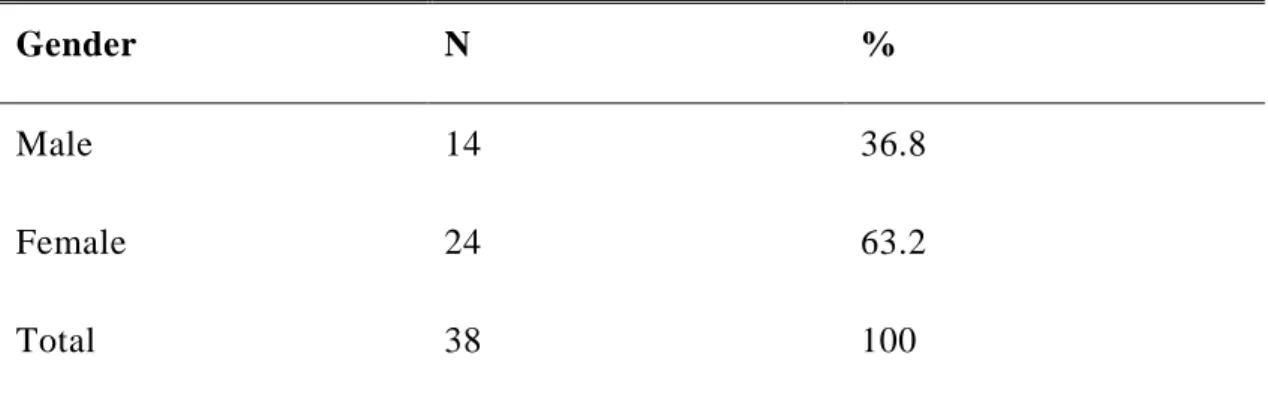
Table 3.1: Gender Distribution of the Participants.
Gender N %
Male 14 36.8
Female 24 63.2
Total 38 100
As shown in Table 3.1, the total number of the participants was 38. Twenty-four of them were females and 14 of them were males.
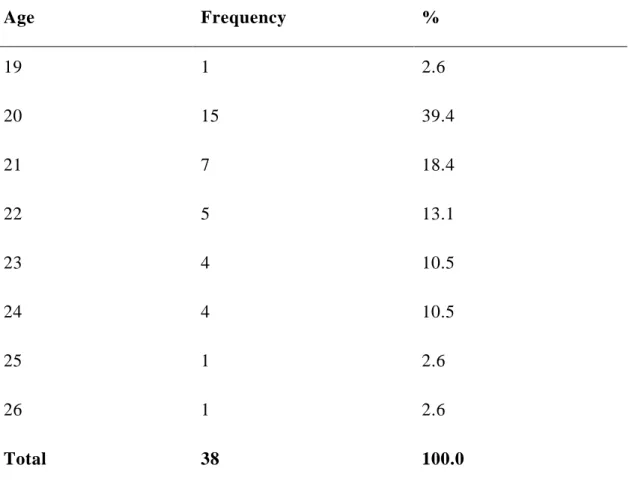
Table 3.2 presents the age distribution of the students who took part in the study. As for the participants age, almost half of the students at the time of completing the questionnaire was 20. While 7 (%18.4) of the participants were 21, 5 of them (%13.1) were at the age of 22. There was a total of 8 students whose ages ranged from 23 (4 participants) to 24 (4 participants). Only one participant was 19. Ten of the participants' ages were above 23 years. One of them was aged 25 while the other 26. The median age was 21 with a range of (19-26).
Table 3.2: Age Distribution of the Participants. Age Frequency % 19 1 2.6 20 15 39.4 21 7 18.4 22 5 13.1 23 4 10.5 24 4 10.5 25 1 2.6 26 1 2.6 Total 38 100.0
3.4 Data Collection Instrument
The information and data of this research was gathered through survey instrument that had been developed by the researcher in addition to a focus group interview.
3.4.1 The survey instrument
The survey involves two sections. The first section includes three questions to collect demographic data about the participants of the study. These questions focus on the participants' age, gender, and their level of study at TOMER center. The aim of the second section of the survey is to discover the answers to the main queries of the research. In order for the researcher to help the students answer the questions interestingly, the questions are not so prolonged, and the response options are either "yes" or "no". The essence questions of the survey investigated the way by which students practice translanguaging, and how much they are aware about the use of this practice (see Appendix 1).