T.C.
ISTANBUL AYDIN UNIVERSITY INSTITUTE OF SOCIAL SCIENCES
THE EFFECT OF PRODUCT’S COLOR AND FABRIC QUALITY ON BRAND PREFERENCE: A STUDY IN FASHION RETAILERS IN TURKEY
M.Sc. THESIS
Kamala AKBAROVA (Y1412.130064)
Department of Business Administration Business Management Program
Thesis Supervisor: Asst. Prof. Dr. Ilkay KARADUMAN
DECLARATION
I hereby declare that this thesis entitled „The Effect of Product‟s Color and Fabric Quality on Brand Preference: A Study in Fashion Retailers in Turkey‟ has been obtained and presented in accordance with academic rules and ethical conduct. I also declare that, as required by these rules and conduct, I have fully cited and referenced all material and results, which are not original to this thesis. ( / /2017).
Dedication. Although there are many persons whom have had a positive impact in my life,
I am sure there is one who affected my life much more than the others and this adorable lady is my Mother, my soulmate.
FOREWORD
I would like to acknowledge the help of my thesis supervisor Ilkay KARADUMAN in every step of thesis research. In addition my warm thanks and regards to Nurgün KOMġUOĞLU YILMAZ and Farid HUSEYNOV for their supports in research period. I am thankful to all the teachers and friends who‟s names I did not mentioned here.
Thank you all for your assistance, care and guide in my life.
TABLE OF CONTENT
Page
FOREWORD ... v
TABLE OF CONTENT ... vi
LIST OF TABLES ... viii
LIST OF FIGURES ... ix ÖZET ... x ABSTRACT ... xi 1 INTRODUCTION ... 1 2 LITERATURE REVIEW ... 3 2.1 Color In Marketing ... 3
2.1.1 Сolor as а Major Fасtor... 3
2.1.2 Сolor and its associations ... 4
2.1.3 Influence of Color ... 8
2.1.4 Color Reactions ... 14
2.1.5 Color in advertisements... 17
2.2 Fabric Production Quality ... 21
2.2.1 Evolution of Fabric Quality ... 21
2.2.2 Stage of Development ... 25
2.2.3 Future Fashion ... 28
2.2.4 Influence of Materials ... 28
2.2.5 Quality Indicators ... 29
2.2.6 Turkish Textiles ... 32
2.3 Brand Preference And Its Components ... 34
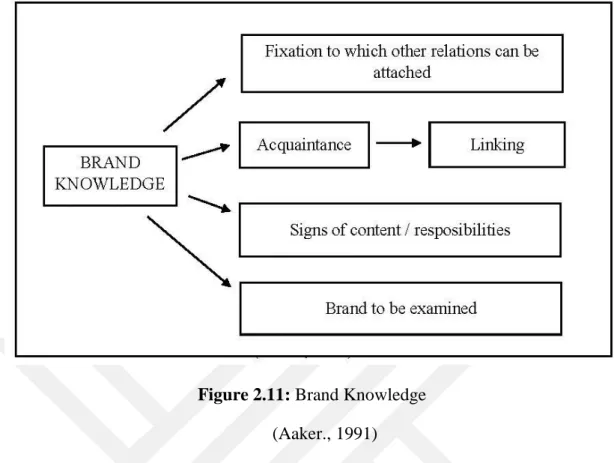
2.3.1 Brand Knowledge... 35
2.3.2 Brand Elements ... 37
2.3.3 Brand Awareness Stages ... 38
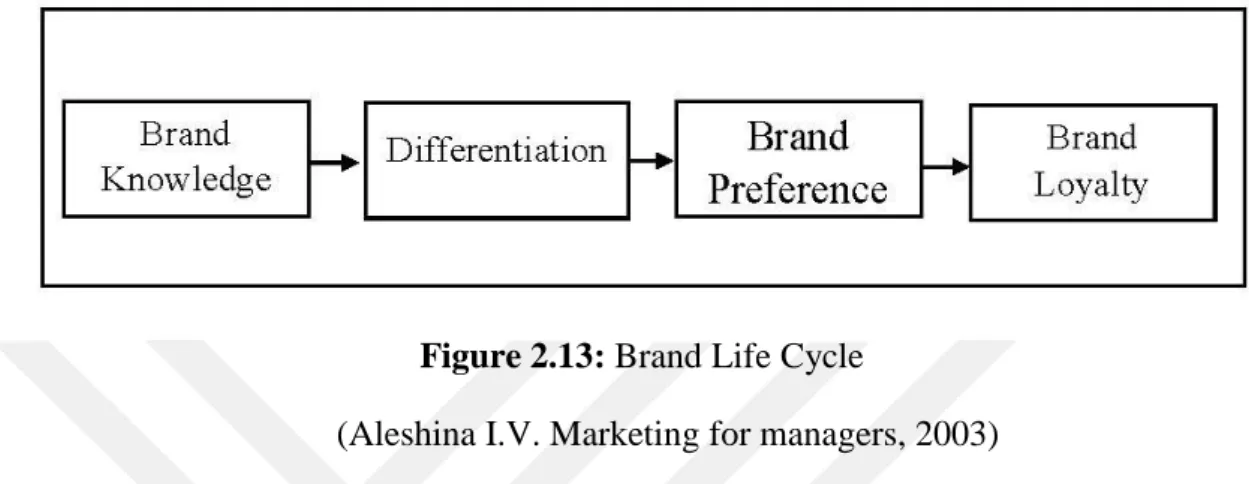
2.3.4 Brand Life Cycle ... 41
2.3.5 Consumer Behaviour ... 43
2.3.6 Types of Brands ... 45
2.3.7 New Brand Creation ... 47
2.3.8 The Role of Social Media in Brand Life ... 51
2.3.9 Fashion Retailers in Turkey ... 53
3 RESEARCH METHODOLOGY AND FINDINGS ... 57
3.1 Research Methodology ... 57
3.1.1 Aim and Objectives ... 57
3.1.2 Data Collection... 58
3.1.3 Hypothesis ... 59
3.2 Research Findings ... 60
3.2.1 Demographic Characteristics of the Responses ... 61
3.2.2 Responses to the General Questions ... 64
3.2.3 Responses regarding Hypothesis ... 67
REFERENCES ... 76 RESUME ... 81
LIST OF TABLES
Page
Table 3.1: List of the Questions ... 60
Table 3.2: Age ... 61
Table 3.3: Marital Status ... 62
Table 3.4: Educational Degree ... 63
Table 3.5: Favorite Color ... 64
Table 3.6: Preferred type of shopping ... 66
Table 3.7: Responses regarding Hypothesis1 ... 67
Table 3.8: Responses regarding Hypothesis2 ... 68
Table 3.9: Responses regarding Hypothesis3 ... 69
Table 3.10: Responses regarding Hypothesis4 ... 70
Table 3.11: Responses regarding Hypothesis5 ... 71
Table 3.12: Responses regarding Hypothesis6 ... 72
LIST OF FIGURES
Page
Figure 2.1: Importance of Color ... 4
Figure 2.2: Color Pallete ... 5
Figure 2.3: Bright Warm Colors ... 6
Figure 2.4: Cold Bright Colors ... 7
Figure 2.5: Dark Cold Colors ... 7
Figure 2.6: Warm Dark Colors ... 7
Figure 2.7: Neutral Colors ... 8
Figure 2.8: Influence of color on the target audience ... 9
Figure 2.9: U shaped connection between arousal and color wavelength ... 15
Figure 2.10: U shaped integration Arousal vs. Evaluation ... 16
Figure 2.11: Brand Knowledge ... 36
Figure 2.12: Brand Awareness stages ... 39
Figure 2.13: Brand Life Cycle ... 41
Figure 3.1: Age ... 62
Figure 3.2: Marital Status ... 63
Figure 3.3: Educational Degree ... 64
Figure 3.4: Favorite Color ... 65
ÜRÜNÜN RENGİNİN VE KUMAŞ KALİTESİNİN MARKA BİLGİSİ ÜZERİNE ETKİSİ: TÜRKİYE'DE MODA PERAKENDECİLERİNE BİR
ÇALIŞMA
ÖZET
ÇalıĢma, renklerin ve kumaĢ kalitesinin tüketici marka bilinci üzerindeki etkisini araĢtırıyor. Ürün rengi ve kalitesi, alıĢveriĢ yapan kiĢilerle iletiĢimde önemli bir rol oynamaktadır ve bir ilgi yaratabilir ve onları satın alma yönünde motive edebilir. Ġstanbul'un nüfusu her yıl büyüyor. Çok güçlü bir satın alma gücüne sahip en çeĢitli tüketici grubudur. Pazarlamacılar ihtiyaçlarını anlamak için harika bir fırsat yaratıyor. KuĢkusuz, renk ve kumaĢ kalitesi önemli bir rol oynamaktadır ve Türk müĢterilerinin moda markası seçimlerini etkileyen büyük bir özelliğe sahiptir. Bu araĢtırmada, alıcıların marka farkındalığına dayalı ürünlerin farklı renk ve kumaĢ kalitesinin etkisi gösterilmektedir.
Moda markası Ģirketleri amaçlarını açıklığa kavuĢturmalı ve ürünlerinin tasarımını kalite ve renk açısından hazırlamalıdır.
Anahtar Kelimeler: Ürünün Rengi ve Kalitesi, Marka Bilinci, Pazarlama, Tüketici Davranışı.
THE EFFECT OF PRODUCT’S COLOR AND FABRIC QUALITY ON BRAND KNOWLEDGE: A STUDY IN FASHION RETAILERS IN TURKEY
ABSTRACT
The study will investigate the effect of colors and fabric quality on consumer brand awareness. Product color and quality plays a significant role in communicating with shoppers and can cause an interest and motivate them toward purchasing.
The population of Istanbul is growing each year. They are the most various group of consumers with a very strong purchasing power. It creates a great opportunity for marketers to understand their needs. Undoubtedly, color and fabric quality play an important role and have a great feature that affects Turkish customers‟ fashion brand choices. That research presents the impact of different colors and fabric quality of products based on buyers brand awareness.
Fashion brand companies need to clarify their aims and prepare their products design with respect to quality and color.
Keywords: Product Color and Quality, Brand Awareness, Marketing, Consumer Behavior.
1 INTRODUCTION
As the population grows and fashion brands expand the requirements and needs of consumers are also growing day by day. Purchasers in Turkey tend to follow the fashion; they want to spend more on popular brand products. Potential consumers waste most of their free time surfing the web and for marketers it is the simplest way to reach them through electronic mass media (Carter, 2011). The lifestyle of potential customers is different in comparison to different parts of Turkey. Shoppers in big cities like Istanbul, Ankara, Izmir are closer to European teens when it comes to fashion brand choice. Geographical and social conditions influence purchasers differently.
Marketers must understand consumer‟s behavior of purchase and what affects their decisions of purchase. There is a need for thin emotional connection between fashion brand products and customer‟s purchasing behavior. However, the mission of this research is to investigate the brand knowledge of Turkish customers and how they are affected by color and fabric quality of the products. The term "brand recognition" describes the ability of potential buyers to recall or recognize a popular brand in the selection or direct purchase of a product. It also includes the ability of consumers to quickly and easily identify a brand by individual characteristics.
To increase the brand awareness the marketing process should be agitated first of all due to the directly affection of the trades of products and services by the consumer‟s brand awareness. The rivaleness of goods and durable prospects of the brand expansion are connected with the popularity of the brand.
Now, the key to the success of entrepreneurial activity is the correct development of the process of managing and promoting the products (product or service) and brands to the market (internal and external). One of the main reasons for the development of the brand is its impartial financial assessment, since the big difference between the market capitalization and the net price of
tangible assets is explained by the price of intangible assets, one of which is a trademark.
Every year, an unlimited number of new products appear on the market, most of which are represented by trademarks, counted in tens or even hundreds. New segments of the market are quickly filled with products that are not sufficiently different in their own essence. The product is placed in a motivated sector. A rapidly growing number of proposals and a slowly increasing demand lead to a fragmentation of the market, concentration of the main ad vertising efforts in certain areas and segmentation of consumers, the division of products into price categories. This significantly simplifies the process of forming the consumer market, but until it is carried out in one commodity group and in one market , also in one price and consumer sector.
Each manufacturer tries to draw the attention of consumers to the consumer characteristics of its own product, why it uses various methods of advertising communications: advertising, demand stimulation, individual s ales and the formation of a public presentation.
But, the process of advertising communications becomes more and more saturated and global, in connection with which the advertising information about the product is perceived by the consumer as fragmented an d not giving the ability to reveal its advantages. Disparate and rapidly growing advertising communications irritate the buyer, and the communicative quality of advertising is reduced.
2 LITERATURE REVIEW
2.1 Color In Marketing 2.1.1 Сolor as а Major Fасtor
There were determined five dimensions of color in one of the researches by Funk & Ndubisi (2006); significance of the color, attitude towards color, attractiveness of the color, normative color, and preferences of the color. In a study named “Impact of color on marketing” (Satyendra Singh, 2006) revealed that up to 90% of findings made about the products can be based on color. Color of a brand can create positive or negative picture of the product and it can influence genders differently (Grossman and Wisenblit, 1999; Singh, 2006). Results from additional study such as “The Interactive Effects of Colors” (Paul A. Bottomley, John R. Doyle, 2006) revealed that connection between brand and its color depends on perceived accordance of the color that is used for specific product. Our brains are more likely to gravitate towards directly recognizable brands. It is all about emotional and memorable support of trust and confidence to the brand (Carter, 2011).
The color of the final product is a part of the target image and communication, and the right choice of color for your product can certainly help create the right image and emotions (Grossman, and Wisenblit 1999; Aslam, 2006). The issue of color selection would recommend taking the time at the initial stage of developing a new product, service or brand.
Color is important for any product or service: it plays an important role in the design of the products of mass demand (as it can provide a measure of visibility and differentiation on the shelf in a store); and the right choice of color can help companies build trust and right positive attitude in new customers.
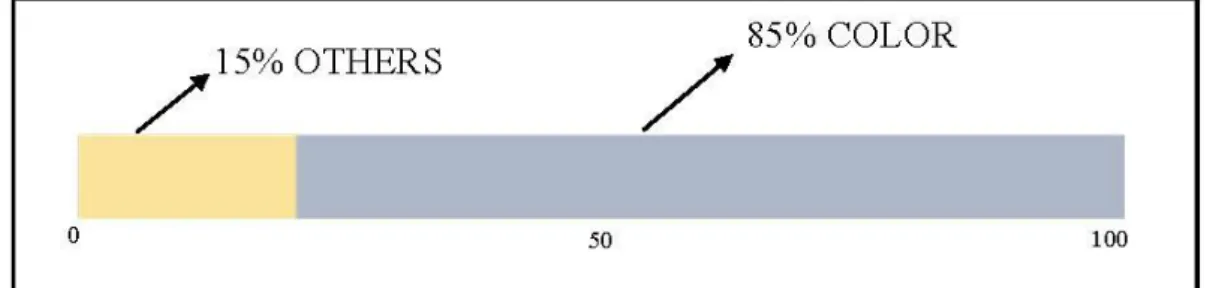
85% of respondents indicate color as the main reason for buying a particular product.
Figure 2.1: Importance of Color
(http://lpgenerator.ru/blog/2013/08/07/85-pokupatelej-delayut-svoj-vybor-na-osnove-cveta/)
The list of factors that influence the choice of customers, the visual component is leading – as it is a determining factor in the purchase refers to 93% of respondents. 6% of respondents are oriented to product texture and 1% - the sound or smell. Of course, the last three factors (texture, sound, smell) are not available to online store consumers (under the sound we mean the smartphone signal quality, for example, or the quality of the portable stereo devices).
Color increases brand awareness by 80%, which has a direct impact on consumer confidence. (based on blog.kissmetrics.com materials, 2013)
There is no ideal or perfect color scheme. As well as no universal color or palette for a specific fashion brand. To support the message of bra nds there is a meaning of colors (color associations). More information about colors inflences the decision-making process with a great effect. (Paula Kaminska, 2014)
Through different colors marketers can check the reactions of customers and motivate them to a specific bahaviour.
2.1.2 Сolor and its associations
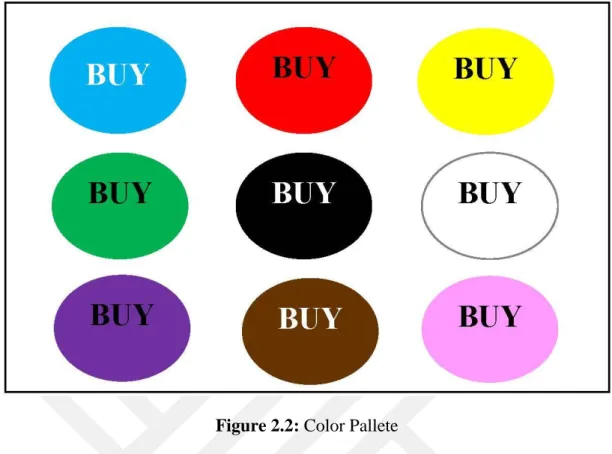
Neurology Specialist at REEM Neuropsychiatric Center Dr. Mehmet Yavuz explained in one article (http://www.turkiyegazetesi.com.tr/yasam/158916.aspx, 2014) how some colors influence human psychology in general.
Figure 2.2: Color Pallete
Blue color – is the color of loyalty, trust and security. If you will wear blue for a job interview, for instance, it will provide you success and acceptance.
Considered as the best color for web design and creates an impression of trust and security, used by financial institutions and insurance agencies, banks, etc. Red color – is the color of love and passion. It is a dominant color. Red colored clothes can put you in a free energetic mode of motion. Those who prefer red are addicted to power.
Considered as a "vibrant color", increases heart rate, used to create the effect of urgency, and often used in sales;
Yellow color – is the color of energy. Yellow gives a feeling of brightness and warmth when used in small quantities. Those who prefer yellow likes to be free and independent.
Stable connection with youth and optimism; used to grab attention of window shoppers;
Green color – is the calming color. It relax and has a natural effect on the nervous system. Those who prefer green knows how to value themselves.
Associated with health, most naturally perceived by the human eye, used to create the effect of rest and relaxation;
White and Black colors – are serious colors. Black is the controversial color. Too many people prefer black color in clothing. Some people wear black to look serious. White is the pure color. It is a symbol of cleanliness and innocence. That is why doctors and nurses wear white to be sterile. In general, it is better to wear white in summer; it gives a refreshing and cool feel.
Powerful and elegant colors of luxury goods (designer clothes, cars with a high price category, and so on.);
Purple color – is the color of nobility. It is a symbol of a luxury life, wealth and elegance. Some people like to use purple color mostly in décor.
Considered as "soothing, calm color", used in advertising for beauty or anti -aging cosmetic products, for example.
Brown color – is the color of nature. It provides a natural, relaxed and open atmosphere. Brown is generally the favorite color of males.
Pink color gives a calming effect. It is generally the favorite color of females. Romantic and feminine color, used in campaigns to market products to women and young girls.
All palette colors are identified in specific shade groups. These shade groups
have specific names. Some of examples below.
(https://www.blurgroup.com/blogs/group/the-impact-of-colour-in-advertising-marketing-and-design/)
Ecru, orange, yellow, pink, red and other close colors. In general all of these colors bring lots of energy. Colors of this shade group make objects seem visually larger.
Figure 2.4: Cold Bright Colors
Lavender, silver, azure and similar. These kind of colors are the symbol of freshness and health. Actually, such cold but bright colors are an advantageous colors for business websites and specially for medicine websites and production.
Figure 2.5: Dark Cold Colors
Navy, blue, turquoise, green, violet are permanency and character symbols. Colors like these suit hardworking persons with a very huge ambitious.
Gold, purple, brown give a wave of tradition, classics. These colors suites well in a luxury desing for rich and young. Colors combined with warm dark shades give a sign of modernity.
Figure 2.7: Neutral Colors
White, grey, black and other shades of this group help to bring relief. Actually these kind of colors have no messages they are just supporting their nearby. Their role is to complement. These colors look universal in combinations with bright or dark shades for instance.
2.1.3 Influence of Color
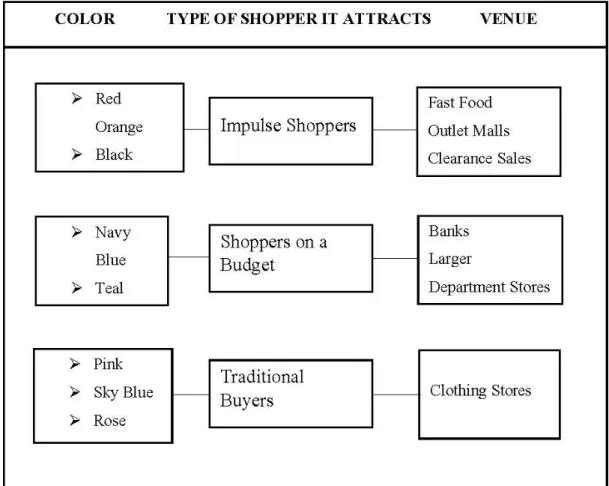
Influence of color on the target audience also correlates with 3 conventional consumer groups, separated by a behavioral pattern: impulsive buyers (Impulse Shoppers), economical („budget‟) customers (Shoppers on a Budget) and the so
-called “traditional buyers” (Traditional Buyers).
(http://lpgenerator.ru/blog/2013/08/07/85-pokupatelej-delayut-svoj-vybor-na-osnove-cveta/)
The trigger to the conversion action for impulsive consumers often are red, orange, black and royal blue (Royal Blue) color. These colors provoke impulsive shoppers to purchase fast food or take part in sales. “Budget” buyers tend to obey the “orders”, shades of blue (Navy Blue, “the blue of the sea”) and other “sea” colors - blue-green (Teal). Two of these “quiet” noble colors work well on the websites of banks or large retail networks. “Traditional buyers” are vulnerable by shades of pink (Pink, Rose) and sky-blue flowers, commonly used in online apparel selling shops design.
(https://blog.kissmetrics.com/color-psychology-video/?utm_source=feedburner&utm_medium=feed&utm_campaign=Feed%3A +KISSmetrics+%28KISSmetrics+Marketing+Blog%29)
Figure 2.8: Influence of color on the target audience
(http://lpgenerator.ru/blog/2013/08/07/85-pokupatelej-delayut-svoj-vybor-na-osnove-cveta/)
Not long ago, a number of studies were conducted by psychologists (Ayzenberg, 1999), which explained how advertising color plays an important role when potential buyer is going to make an opinion about the product. There are several statistics which show how color affects ads:
- Potential buyer influenced by the color enhance the probabilities of familiarization with the product details by 60%;
- A proper mix of the colors increases the chances of commercial to be seen among potential purchasers by 38%;
- Positive attitude towards the promoted product can even be raised by right choice of the color with a probability of 22%.
The color scheme really has a strong influence on the person viewing the ad (Batra R., Mayers D.D., Aaaker D.A., 2004).
The color choice in many ways relies on the positioning of the product itself. It is very essential to examine and plainly present the final user (Bobyleva M.P., 2006). For instance, if we pay attention to expensive watches Rolex advertisement in Forbes magazine, we will notice how they are surrounded on the sides by the green hatch (with a very big size which is more than anything else on the page). Green is symbolized as a character of peace. Possibly the man who got a decision to purchase a Rolex watch should be in a total harmony. It seems he has a huge achievements.
An interesting situation with a pink color. Typically, pink color is used in advertising products targeting women (Olshanskaya N., 2003). Someone thinks that it is a stereotype, but some scholars agree that pink color attracts woman. Nevertheless, producers generally use pink color to attract more the female attention than the male. Moreover, sometimes in products aimed exclusively on women.
It is possible to clarify the target audience by applying one of the qualitative methods of marketing - a method of color correction (Zazykin V.G., 1992). The main point is that we can predict the consumer‟s reaction to those or other color combinations by using human social parameters. The important thing is that the commercial color correction method does not apply colors only by situational feelling, which relies on the current tasks and target relationship of respondents, but pays attention to age, religious, gender, ethnological and psychological sights of the instinctive and naturalized feeling of colors (Mokshancev R.I., 2000).
A new brand or a product success first of all depends on the feelings and visual aspects of consumers. In fact, mainly this reaction‟s predictability can guarantee the results of future. Target audience can be caused not only by a powerful signal of attention, but also by a trademark resolution of the color. If company know how society color adjustment works you will not make a fatal mistake in the choice of the brand color. If the positioning of the selected color is wrong,
then it may be difficult for the company to compensate the mistake (Volkova V.V., 2003).
For the situations where company need to urgently draw attention to something new, there is only red. On the waves of the perception, red color is the first, which gets through the lens without any perversion. Red color is not only a symbol of aggression, but a passion as well, activity. (www.colorpsychology.org/red/). It can effectively works like a moment connection, but it is more suitable for short-term activities like “filling” of the products in the brains of consumers.
Rebranding for any company is always a nice chance to correct and change previous flaws. For instance, change or upgrade a poor color scheme. Upgrading corporate colors not only revive the spirit of the brand or a product, but also often change the emotional connection between the company and the consumer (Olshanskaya N. „The Industry of Advertising‟ 2003).
Imagine the colors of “Coca-Cola”, “Erikli” bottles and Indian tea‟s packaging (the colors: red, blue, yellow) try to guess how difficult it would be to manage the supermarket without utilizing these color combinations. Color memory makes us easily orient in the shops, supermarkets, pharmacy, everywhere. The important aspect is that the package must be visually memorable. No matter how big or recently created the company is the color of the brand is always the first responsibility to deal with when it comes to manufacture a fresh product. At this point, there need to be a new color, which would allow achieving the goal (Gete I., 1994).
Color has a significant part in communication with buyers. Funk & Ndubis i (2006) reached out that color can awake regarding the product and provoke customers toward its purchasing. There were determined five dimensions of color by Funk & Ndubisi (2006): significance of the color, attitude towards color, attractiveness of the color, normative color, and preferences of the color. Significance of the color claims that each color can influence customer differently, and not all colors are significance for one customer at the same time. The future shopping behavior depends on the attitude towards colors of a product. Moreover, purchasers remember more colored advertisements than
non-colored. Normative color makes customers to be influenced by some external factors or environment. It means purchasers need certain color for certain products. For instance, if shopper prefer a certain color for mobile phone the same color may not be preferred for automobile. Color preferences forecast shopper purchasing preferences in a sales market.
Skorinko (2006) determined three basic favored color which suites good for low participation, fast moving, and goods of consumer which are not so good for high participation purchasing decisions by customers (Basera, Mutsikiwa, & Dhliwayo, 2013). Utilizing the colors in the right way helps to differentiate and to lead the relation in the direction of that product (Singh, 2006). Nevertheless, there is a truth that packaging color can also be deceptive. For example, Muttie (2011) noted that 20 percent consumers of cigarettes think that if the packaging of cigarettes is light it means it is less dangerous than the ones which packaging is dark. According to this, marketers should understand how important is the color of the product and its packaging, and how they can meet customers‟ needs by influencing their purchasing behavior, decisions and preferences.
Color is a strong power and potenatial buyers can be affected by it. Colors which we observe every day on this planet are not identical. Due to the lighting condition or position of observe, or maybe the environment which surround us can impact our brain perceiving system of a specific color. Moreover, the same color can be perceived by us differently, can give us different emotions which differs from one individual to another. Scott-Kemmis (2013) explained the difference of the color perception depends on our age, gender, education and culture.
There is a deep connection between colors and purchasing behavior. The color of the product has first impact on customers psyche. According to this, the most important thing is to clarify which colors influence in the positive way and which in the negative way on the choice of the buyer and his behavior of purchase. Brody (1981) determined in one of his research that the TV ads influence significantly on the child‟s psyche and as a result on their consumerism. Children have no information regarding the quality of the product they are just delighted towards the product‟s color. It means, if the color palette of an advertisement is good it will appeal the attention of lots of chi ldren and
accordingly customers for the company. So commercials play an important role in this case to provoke parents towards purchasing the product (Brody 1981). It is hard to deny that color first assist attracting buyers‟ attention. Humans can easily spot colorful products, color inclines to capture the attention better than monochrome. The main reason for this is that human‟s brain has a special structure and design to easily reveal color from the external space (Evans 2006), (Jansson-Boyd 2010).
Kotler and Keller (2006) and McWilliam (1999) examined that existing colors are an element of nonoral signs which are one of the important market phenomenon.
As it was noticed earlier, humans are continuously influenced by colors physically or psychologically. Elm (2012) determined that affection of human being by colors can manipulates reactions and behavior of individuals which has clearly a psychological character. Marketers whose have indentified which color has the best effect on selling the product would have chance to decrease expenses and at the same time procure the consumer‟s beloved product.
Luscher and Scott (2003) researched that consumers prefer particular colors for particular products and this is based on relations like specific colors can be more appropriate for definite product groups. Red and bordo colors can be symbolized like more stimulating. Blue and green colors can be symbolized more as relaxing. Consumers were separated to 3 groups to diagnose how they react to different type of colors:
First group preferred new colors. They like the feeling of something new, innovative and fresh. That type of consumers is going to pay more for the feeling of new colors. In general these customers are women in the age of (30 -50) and men under 30 years old.
Second group liked more colors that has been utilized before by others. It was group of men and women in the age of (30-50) years old.
And finally the third group of consumers who are influenced by concrete type of colors like black, grey, blue. It was a group of men in the age of above 60 years old. They do not like to shopping so much. (Scott, 2003)
Humans like to make decisions when it comes to shopping on the way to their purposes.
Geravand in 2010 explored that the procedure of shopping decisions i s affected by controllable and uncontrollable ranks. At the same time that procedures have mixed factors like sociocultural, individual psychology, situational and marketing which are indentified like the most essentials.
Bower (1981) explained that humans brain has an associative network and it is called a united web chain of knowledge. He stated that this network has circular bundles which represents a block of information. It can be:
Blessing and happiness which means Emotion The forest‟s smell can gives us Practice of Sensory The term “ocean” itself gives us the point of Semantic
Bundles are connected with each other, and based on the line of affinity between them. Powerful affinities produce powerful relations.
Over the way of your life, humans are continuously raising their network. With a new life experience we achieve a great chance to create new bundles, generate new connections, strengthen the connections we already have. Our brain comprise a bundle for each color. Every single time human clash a color, he
modify that bundle based on his life practice.
(http://www.nickkolenda.com/color-psychology/, 2015)
Everyone knows that colors also have their meanings. But it is interesting enough to know why and how does color affect our choices and decisions. 2.1.4 Color Reactions
Crowley (1993) in one of his researches detected that colors can generate two reactions.
*Reaction of Arousal *Reaction of Evaluation
Observation of arousal reaction gives us meaning of awakening. This reaction is a physiological condition itself which provides us with blood pressure and heart rate. It makes us feel more active by giving us adrenaline.
Due to the numerous studies was defined that the reaction of arousal can be increased mostly by using warm colors.
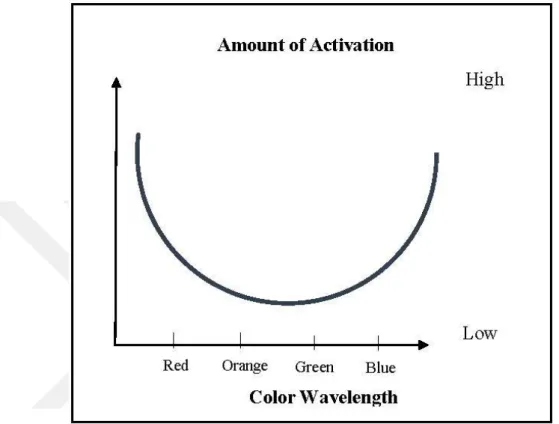
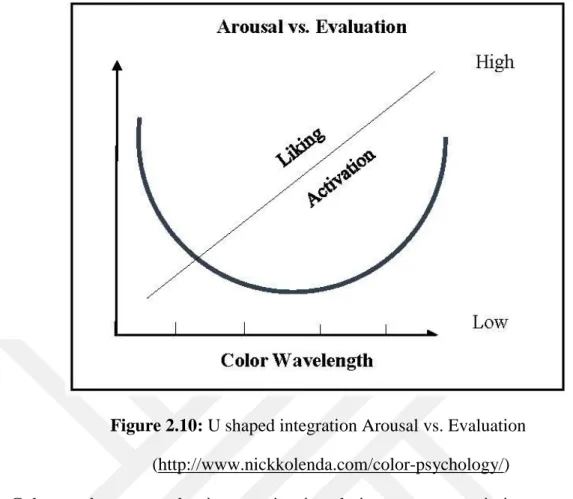
The was identified a U schemed connection between amount of activation and color wavelength by Crowley (1993).
Figure 2.9: U shaped connection between arousal and color wavelength (http://www.nickkolenda.com/color-psychology/)
When human is demonstrated to warm colors like orange, red, bordo; he feels a certain biological reaction. He becomes more active, adrenaline sta rts smoothing, blood pressure increases. Human is feeling a significant emotion of stimulation.
Depending on marketing purposes, high degree of arousal can either support or harm us.
Crowley (1993) also defined a positive line trend which goes between color wavelength and evaluation. Humans lean to “like” colors with shorter wavelengths.
Figure 2.10: U shaped integration Arousal vs. Evaluation (http://www.nickkolenda.com/color-psychology/)
Color produce an evaluative reaction in relation to our associative network. At the time when human is demonstrated to the color, his bundle for this specific color is becoming in a position online, in the other words activated.
Color is helpful itself to make the advertised product or service understandable. For instance, it is interesting how we can differ the orange gum from the mint one? How we can differ the taste of tea depending on its additive. Here colors can be very helpful, to assist us with understanding that orange color itself means orange fruit, mint can specified by green, lemon as yellow and strawberry as red. It means the speed of the advertised items is increased by our color recognition memory. That is why our brain prefer more colored i mages of products than the black and white image because it looks more attractive.
Person is setted by color in a certain way, that is why the color of clothing attracts attention of stylists, image-makers and etiquette experts. Color is a language of clothing, perhaps plays one of the key roles in the creation of your image.
Differentiation of color shades help each of us make product choices of any color.
2.1.5 Color in advertisements
In a study conducted by Kimle and Fiore (1992), it was found that when participants were shown advertisements in a magazine, the ads that contained the most color were the focus of participant‟s attention. The relationship between color and international branding has also been studied (Grimes & Doole, 1998). In Grimes & Doole‟s (1998) study, it was found that color is a way in which people identify brands and color association made with brands are internationally evident (Grimes & Doole, 1998). Those from different cultures were able to associate certain colors with popular brands such as Marlboro and Guinness (Grimes & Doole, 1998). In a study concerning color and cultural preferences, Madden et al., (2000) found that the colors such as blue, green, and white were universally liked among different cultures and conveyed the same meanings throughout cultures.
In a study which tested the color of a computer screen and time perception, it was found that when the screen was blue compared to yellow, participants felt more relaxed and perceived time to pass quickly (Gorn et al., 2004). Des pite the value of the above findings, there has yet to be research conducted to examine the differential effects of color on perception of personality traits among perceivers with different implicit theories (entity vs. incremental).
Color has been studied in context to personality and trait judgments. It was found that job applicants who wore darker colored suits were seen as more masculine and powerful. Amhorst and Reed (1986) found that female participants rated women in light jackets more positively and more social compared to women in darker jackets. It was also reported that male participants rated models in dark jackets as more intelligent and powerful Darker colored clothing was also found to portray a livelier and more active person compared to lighter colors which were associated with a calmer person. Roberts, Owen, and Havlicek (2010) found that when a person wearing red or black was presented to a participant, they were seen as more attractive. On the other end of the spectrum, those wearing white and yellow received more negative evaluations (Roberts et al., 2010). It was found that when athletes wore the color black, they were perceived to be more aggressive. In a study conducted by Vrij, Pannell, and Ost (2005), it was found that in a court scenario those wearing dark clothing
were more likely to be found guilty compared to those wearing light colored clothing.
Along with clothing, color can also affect the perception of brand personality. In a study conducted by Boudreaux and Palmer (2007), it was found that burgundy, red-orange, and neutrals were viewed as successful, desirable, and expensive when paired with a brand of wine. Green and red -orange were associated with exciting and imaginative while the color pink was seen as inappropriate for the brand of wine (Boudreaux & Palmer, 2007). There was identified that the perceived preciosity of a wine brand is positively impacted by the hues of pink, purple, black (Labrecque and Milner, 2010). Labrecque & Milner (2010) also defined that the wine product which had a minimum saturation packaging was seen more sophisticated because of the upper purple hue than the same packaging with a upper saturation and minimum value red hue. Upper saturated product packaging with minimum value red hue seemed more lasting in comparison to the purple hued packaging (Labrecque & Milner, 2010).
The color of a product or brand thus allows a company to communicate a certain image to their consumers by evoking emotions and associations (Pantin -Sohier, 2009). The relationship between coffee and its packaging was examined by Dichter (1964). It was found that participants associated the color brown with a strong flavored coffee, red with rich flavor, blue with smooth flavor, and yellow with mild flavor (Dichter, 1964). A similar study was done by Favre and November (1979) where participants were all given the same coffee in four different colored jars. The majority of participants thought the coffee in the brown jar was too strong and the coffee in the red jar had the strongest aroma (Favre & November, 1979). Pantin-Sohier (2009) found that participants thought coffee in a purple tin was of better quality and more expensive. It was also discovered that participants perceived a bottle of mineral water to be more natural when packaged in a blue bottle and sophisticated and exciting when packaged in the color red (PantinSohier, 2009). Thus, these past studies show that brand personality can successfully be perceived from colors associated with a brand logo or package. In the past, studies have revealed a relationship between the colors red and blue and extroversion and introversion in regards to
individual personality (Birren, 1950; Crozier, 1999; Eysenck, 1981; Radeloff, 1991). However, there is a gap in the literature concerning the relationship between the colors, red and blue, and extroversion and introversion in regards to brand personality.
It is a fact that colors impact our habits when it comes to purchasing process, but not all of us realize it. That fact can be applied to the both male and female population. It is important not only have a well fitted item but also got it in the colors which attract. Nevertheless, we can often observe that males are less willing to purchase items with an attractive palette of color. At the same time we must agree that it would be not fair to make quality of the product be sacrificed for receiving an ideal color. To make consumer purchase the product or an item it need to be function and well fitted. Also it is easy to see that youngsters are more worried about aesthetics of the items and products in comparison to the groups in the middle age. At the same moment groups in the middle age are more interested and worried about the price of the products in comparison to the groups in the older age. Maybe this can be explained that the older generation feel theirselves more free to outlay their savings because of most of them are retired and do not have any obligations or small children in comparison to middle aged group. Youngsters are more willing to pay attention to the trends and follow fashion to have the most upgraded items ignoring the cost of these products.
Nowadays, consumers are more likely to purchase one product in one color in comparison with the past when it was easy to purchase one item in different colors. However, youngsters and especially women are still willing to purchase the same item in different colors.
Aslam (2006) affirmed that the main aspect in products, logos, packages is its color. We need to get that to create a structure of consumers‟ brand understanding it is not enough to have just color (Labrecque & Milne, 2012) but to have reaction and feelings of purchaser his buying behavior as well which is free from the preferences of the brand (Clement, 2007). Potential buyers can be worried or even refuse the packaging because of its color (Prinsloo, Bos man, Merwe & Erasmus, 2012); due to this marketers should determine appropriate packaging colors not to experience the strategic failure (Aslam, 2006). Colors
can be strategically used to impact purchasing behavior, brand closeness (Labrecque & Milne, 2012). All colors are generally tested by psychologists to identify how they affect purchaser character, personality. Singh (2006) detected that psychiatrists use color tests side by side the other tests to identify and estimate the personality. Colors were utilized by packagers to influence the weight of packaging perceptions and to create a psychological meaning design (Bellizi & Hite, 1992).
In this way it can be confirmed that color of products and color of the packaging have a great influence in changing wishes and preferences of potential consumers regarding shopping.
It was determined that buyers are influenced by a several elements like adverstising, prestige, satisfactory knowledge in practice (Brown, 1950). However, buyer‟s mind of a specific product is affected by the main factor which is psychological effect. It was mentioned by Sewall (1950) that a huge amount of customers were supervised in a different market sections which had different goals and purposes to purchase specific product. Color itself is the main element of psychological affection on potential customer‟s mind and of course on his buying behavior at the finish point.
During the lifetime we do not notice many differents things, we are not fully acknowledged of some stuff and don‟t know how to simply enjoy them. We sometimes forget about human‟s great ability to observe things in colors. It is proved that color affects each moment of our daily life (Sewall ,1978). Garber (2000) noted that the important communication tool in marketing is color and at the same time it is a visual element which is hard to forget because of being the main sociable information about the product or service. Colors impact our clothing, furnishings in houses and other atmosphere in our daily life. That is why Ogden (2010) and Akcay (2011) affirmed that to make a purchasing decisions for a specific product we need to pay attention to colors. That is why a plenty of companies in the whole world are hiring a special employees to support in identifying the best suitable colors for their products, the one which would be attractive for their potential clients. Singh (2006) claimed that approximately 60-90% of a product purchasing decisions are based on the product‟s color and all decisions regarding purchasing are received within
minutes of observing it. Color improves acknowledgment, memory and rise stuff‟ attention, because of being a noticeable sign for introducing images (Wichmann, 2002).
2.2 Fabric Production Quality 2.2.1 Evolution of Fabric Quality
The Great and French bourgeois revolutions that took place in the 17th and 18th centuries destroyed the social structure of society, as a result of which its middle and lower strata had the opportunity to influence public life. The decisive factor for the emergence of masses in the world's forefront is the active growth of the world's population, prompted by rapid economic development and rising living standards. The technical and scientific progress that led to the emergence of new means of production led to the transition from man ufactory production to machine-factory production, which increased the output of products, strengthening the international commodity exchange. Growing production required more and more workers, which caused the influx of rural population into production areas, on the basis of which new cities grew. E. Wilson holds the view that urbanization goes hand in hand with the development of fashion, because the city as an "anonymous space," where it is the suit that separates the individual from the masses and at th e same time allows him to identify with a group, is the ideal environment for the development of fashion .
In an industrial society, the phenomenon of fashion finds a completely different understanding than before: a mass factory production of clothing cou ld not arise until the mass middle class-the subject of mass consumption-began to take shape. In fact, fashion appears where there is mass. Involving in the process of functioning in its sphere large groups of people, fashion is transformed into a mass phenomenon, acting as a factor in the development of industrial society. The next stage in the history of fashion is marked by the fact that the establishment in France of mass production of ready-made clothes, affordable for the middle class, has led to the impossibility of rivalry with large factories of artisans-tailors. However, the receipt of the French inventor Barthele
Timonier in 1830, a patent for a sewing machine, changed the situation and saved tailors from ruin, becoming one of the prerequisites for the development of High Fashion in France. Mechanization of the garment industry required breaking with craft production, but the French remained true to the tradition. As a result, by the end of the Second Empire, dating back to 1870, in parallel with the mass production of affordable clothing in Paris, a new form of production appeared - sewing by standard measures, conceived as a sewing industry and designed to satisfy the demands of the middle class rather than the rich bourgeoisie. So in France, the Haute couture industry is formed - sewing clothes according to standard measures for selected customers.
Following the debugged course of this production, another innovation broke out: the creation of models intended for export: the model is created in a s ingle copy, on the basis of the sale of a license for its copying is reproduced in thousands of copies and, thus, becomes for foreigners a model of French taste and Parisian fashion (Corbellini Е. Saviolo S., 2012).
Thus, it is these two directions - sewing clothes according to standard measures for selected customers and selling licenses for copying models intended for unlimited reproduction, actually divided the fashion economy into two levels - haute couture and prêt-à-porter (in French .: Ready to wear) respectively. In 1868, the couturier Ch.F. Wartom in Paris was established the Syndicate of High Fashion (French Chambre Syndicale de la Couture Parisienne) - an organization that combines Fashionable Homes of High Fashion, created to protect the couturier from unlicensed copying of their models, the practice of which was common among American businessmen.
Talking about this side of American commerce would be incorrect outside the context of the history of the formation and development of the American fashion industry as a whole. Geographical isolation and the absence of a historical aristocratic tradition that separates the elite have made the US the birthplace of key concepts related to the term "mass" - mass production, mass consumption, mass market, etc. In this regard, according to E. Corbellini and S. Saviolo, the phrase "made in the US" serves as a synonym for large -scale production runs that provide the products of a mass American consumer, which, in turn, embodies one of the archetypes of American culture related to the topic
Frontier. We are talking about the achievement of mass success that has overcome all borders, and therefore, the implementation of the "American dream" - the dreams of the first settlers from Europe about the real capability for individual lead, which is not embarrassed by either the hierarchy of the type, spiritual or public prejudices, nor academic and civilized qualification, which in community of Europe turned out to be an insurmountable barrier for a savvy and ambitious person from the "mass".
The formation of the American clothing industry falls on the beginning of the 1800s. And is associated with the production of exclusively men's clothing, or rather - working clothes, or overalls. The first American garment factory was opened in Philadelphia in 1812 and specialized in making army uniforms. A number of sewing enterprises on the East Coast were opened, and the task was to produce and sell at a low price ready-made garments for sailors who stayed here on vacation, while having free time and money to replenish the wardrobe. The work of these first private sewing enterprises was connected not only with the production of products, but also with the building of a system for its sale. It is on this basis that the development of the American mass market for the middle class in the period of industrialization in the first half of the 1850s becomes possible.
As for women's fashion, it gets development here only in the late XIX century. The development of production of ready-to-wear clothes on an industrial scale was facilitated by the adaptation of I. Singer's sewing machine for industrial production. Together with the influx of immigrant workforce, it ensured the rapid development of the garment industry. In connection with the incre ase in mass production of products, the system of its sale also develops: in the 1920s, In every big city there were already department stores and specialized shops selling ready-made clothes, in addition, its purchase was also available through ordering through postal catalogs.
Among the goods that filled American stores, a large percentage of copies of the work of Parisian designers. A common practice among owners of American enterprises was the trip to Paris for twice a year demonstrations of new collections haute couture with the purchase of licenses for the mass replication of copies of French models at the American enterprise. Thus, the wording
"gasoline" has become key to understanding the principle of building the American fashion industry, based on the initial stage of buying a license to produce models of French designers, as well as massive illegal copying of their work. The wide dissemination of this practice led to the second feature of the American fashion industry, which is not to focus on haut e couture, but on a mass fashion that provides the producer with commercial benefits, unlike the often unprofitable High Fashion.
After the Second World War, which undermined the European economy, the first American designers appeared. Their specialization in the production of demand for young people, born in the era of the post-war "baby boom," comfortable casual clothing, based on the historical clothing, allowed the US to take the leading position in the international fashion market. Since that time, for a period of half a century, thanks to strong state support - financial injections, the introduction of a system of grants and tax incentives for beginners, the development of educational programs, the establishment of the Council of Fashion Designers of America (CFDA) - in the United States is building a modern fashion market, To the amount of 19 billion dollars a year.
At the same time, as E. Corbellini and S. Saviolo conclude, the American model of the fashion industry assumes the sale of an image that i s developing at the time in the US marketing, which symbolizes the success story of a particular brand as the embodiment of the American dream, rather than the artistic and technological perfection of products, The basic for the French model of fashion industry. Thus, if before the 1950's. The world fashion center was Paris, then after the Second World War, the United States becomes the industry leader, where fashion is transformed into international business (Corbellini, Е., Saviolo, 2012).
The American experience of building a fashion industry during this period is adopted by Italy, in the 1970s. Which achieved international leadership in the production of clothes prêt-à-porter, which is the result of a consistent policy initiated by the fascist authorities.
The refusal of Italian producers from High Fashion and their orientation to the prêt-à-porter segment allows researchers to draw an analogy between the
development of the fashion industry in Italy and the United States, where during this period there is an active growth of mass production of clothing and "where the visionary Italian industrialists -, and post-war generations "
Unlike French Haute Couture, whose productions were shown in Paris salons in January and July for a limited number of privileged persons, the shows of Italian prêt-à-porter collections were organized in March and October and were available to a wider audience, which provided them with publicity and , As a result, success. Since haute couture products have been a luxury item availabl e only to a limited circle of the elite, and profits in this segment are negligible, the production of high-quality but more affordable prêt-à-porter clothes is much more profitable compared to haute couture production and provides Milan with the title of new European fashion capital.
Taking into account the above, in search of an answer to the question, where the fashion capital is located today, F. Godard comes to the conclusion that for Paris, to which this status belongs historically, the word "fashion capital" is essentially an established synonym, but if we talk about maximum concentration Commercially successful manufacturers prêt-à-porter, then Milan is the capital of fashion. The capital of the leading fashionable media, "speaking" in English, which thus acts today as the language of fashion as a global international industry, is New York.
These centers of fashion played a leading role in the formation and development of the world's fashion industry, but in the XX century. The processes of globalization led to the penetration of the influence of the countries of the East into this branch. So, today the largest manufacturer and supplier of clothing in the world is China. In addition, in the XXI century. In the fashion industry come new "players" from Latin America and Africa, developing new segments of the market.
2.2.2 Stage of Development
Thus, at the present stage of development in conditions when the production of fabric for tailoring can be located, for example, in China, sewing is carried out in Vietnam, the production of fittings - in Italy, and the final product is sold in a New York store, fashion is a global international Industry.
Very often, branded clothes mean stylish, fashionable, elite, expensive clothes. The share of truth in such representations about brand things is, but it is only a share. In fact, a brand is a very broad concept that combines all these representations and also has additional accents.
Purpose of brand clothing:
Brand clothing is designed to emphasize the dignity of man.
Things of famous brands should serve as a "calling card" of a person, a means of self-presentation.
Brand clothing should raise a person's self-esteem.
This clothing should be a kind of self-promotion, a psychological means of gaining comfort and status.
Branded things should hide the person's shortcomings, highlighting the virtues. Clothing of famous brands should serve a long time, have high quality materials and workmanship.
This clothing should be exclusive, so that a person had an individuality in it, and not be like others.
In fact, very high demands are placed on brand clothes, placing high hopes on things of famous brands.
Slight industry which manufactures clothing and different housekeeping and technical garments made from fabrics, knitted, synthetic, natural dermis and fur, new construction stuff, as well as a variety of finishing materials and fittings is the filial of the sewing industry.
In the middle of the 19th century, the mass production of clothes first appeared in France. In Paris in 1820, several enterprising junkers decided to buy up stale goods from tailors at low prices and sell them on the market. Encouraged by profit, the junkies did not stop there. They recruited craftsmen who started sewing clothes in their ateliers. So a new form of clothing was born.
In tsarist Russia, Moscow, St. Petersburg, and then Kiev, Nizhny Novgorod, Kazan were in the first place in the production of ready-made dresses. Clothing was produced mainly by handicraftsmen who worked in small workshops. Large
sewing enterprises were units. In Moscow, for example, the owners of these enterprises were famous trading companies of ready-made dress: Mandl, Rosenzweig, Til, Petukhov brothers.
These enterprises, especially before the First World War and during the war, were close in size to modern small-capacity factories, but to organize production and labor, by the availability of machinery, these were rather workshops, that is, machine production of the model along with the cutting They were sent to homeworkers, from whom they received ready-made clothes. Homeworkers worked for 12-16 hours a day. Most outworkers were women and children, as the cheapest labor.
Of the industrialized countries, the largest sewing industry is the USA, Italy, Germany, France, Great Britain, Japan. In most of them, there is a significant decline in this industry (mainly due to the growing production in Asia). The most important sewing companies: in the USA - Levi Strauss (Levi Strauss & Co.), "Phillips Van Hensen Corporation" (Phillips Van Hensen Co rp.); In Italy - Lebole (Lebole), Facis (Facis); In the FRG - B. And A. Becker (V.A. A. Becker GmbH), Nikolaus Boll Fabrik modischer Anzüge GmbH - factory for the production of fashionable costumes; In France - Vestra-Union Manuracture de Vetements, Vetements Armand Thiéry Ainé; In the United Kingdom - Arsa Trading Corporation Ltd (Arsa Trading Co., Ltd), Debretta LTD (Debretta LTD); In Japan, Teijin Limited, Wako Koeki Corporation Ltd (The Wako Koeki Co. Ltd.).
There are also large developing countries - China, India, Indonesia, Vietnam. Many Western firms moved their production from America and Europe here because of the exceptionally cheap labor in these regions.
he rapid technical process at the end of the 20th century presented new requirements to textile materials: they must have specific properties that are necessary in a particular sphere of human activity, and also be able to change them in the right direction under the influence of the external environment, i.e. Develop a response.
2.2.3 Future Fashion
The main trend of the future fashion is comfort and well -being. This harmony between well-being and comfort will determine the fashion of the future. The clothes now have a new role - to protect a person psychologically from various pathogens, aggressors. "Feeling good" is more important than "seeming and looking." This is a new position in the design of clothes, and not as before to protect the human body.
Requirements for materials for the garment are divided into several groups: functional, reliability requirements, ergonomic and design-technological.
To the purpose of the product and to ensure freedom of movement. These requirements are related to the surface density of the material, its air permeability, vapor permeability, total thermal resistance, water permeability, stiffness, extensibility, etc. For example, the material intended for the manufacture of raincoats should satisfy the following functional requirements: small surface density, maximum water resistance, moderate stiffness. For children's underwear, the characteristics of the functional requirements will be minimum stiffness and surface density, maximum air-and vapor permeability, high extensibility.
According to the requirements of reliability, the materials for clothing should retain their appearance and integrity during the entire period of wearing. Characteristics of these requirements are breaking load, resistance to abrasion, resistance to light, washing, dry cleaning, etc.
In accordance with ergonomic requirements, the material must create and maintain comfortable clothes in its clothing when it is used. The characteristics of these requirements include hygroscopicity, vapor permeability, air permeability, electrificability, dust capacity, total thermal resistance, drape, stiffness, surface density, etc.
2.2.4 Influence of Materials
The influence of the properties of the material on the design of the product and on the features of its technological processing in the garment industry takes into account the design and technological requirements. Among the characteristics
describing these requirements, we can note the flexibility of the threads, the shear capacity of slices, thickness, moldability, needle puncture resistance, shrinkage, stiffness, drape, heat resistance, etc.
In the design of clothing, in the process of its production, as well as during its operation,
There are many issues related to the properties of materials, of which clothing is made:
• what properties should be taken into account when choosing a material for a particular kind of clothing;
• what properties of the material significantly affect the design of clothing and should be taken into account when constructing the design drawing and manufacturing the patterns of the product;
• what properties of the material dictate the choice of parameters and processing modes for the manufacture of products at the sewing enterprise;
• How will the materials behave when using clothing, during cleaning and washing?
The right choice of different materials for the manufacture of garments guarantees the production of high quality products.
2.2.5 Quality Indicators
The quality of clothing is an important indicator of its "good quality" and competitiveness. It's no secret that most of the quality indicators of garments are laid at the stage of designing clothes. Touching upon the issue of quality, it is first of all necessary to pay attention to the consumer properties of garments. Undoubtedly, the emphasis on the required quality indicators is made in the case of mass or small-lot production. And at the same time, some of them are also important in the design of single products. All consumer quality indicators are divided into the following main groups:
Functional, Aesthetic, Ergonomic,
Operational.
Functional indices determine the degree of the product's compliance with the main objective functions (clothing designation), clothing compliance with the size and full-age group of consumers, their appearance and psychological characteristics.
Aesthetic indicators characterize the degree of satisfaction of the clothing of basic aesthetic needs - these are the requirements of the aesthetic expediency of the product form and its close connection with the functional purpose of the product, as well as the requirements of artistic expressiveness, harmo ny, and style unity. Of course, clothing should be designed taking into account the leading art style of this era and its particular manifestation - fashion. Thus, when designing a new model of a garment, attention should be paid to such important aesthetic indicators as
Conformity to modern style and fashion,
Degree of perfection of the composition of the model, Marketability of the appearance of the future product.
Ergonomic indicators - characterize the degree of "fitness" of the product to a person. Ergonomics is a science that comprehensively studies a person in specific conditions of his life activity, as well as the laws of interaction between a person, a garment and the environment. The ergonomic indicators of quality include:
Anthropometric conformity, Hygienic conformity,
Psychophysical correspondence.
Anthropometric indicators include static and dynamic matching of clothing to the human body. Static matching involves matching clothing to the shape of the human body, as well as the degree to which the clothing design matches the size of the figure. Dynamic matching takes into account the fitness of a particular product to perform all types of movements provided for by the operating conditions (no difficulty in lifting and moving hands, freedom of moving the product when lifting hands, when tilting, etc.). When designing clothes of any
kind, it is expedient to preliminary analyze the possibility of ensuring, due to the constructive solution of parts, units and the product as a whole, the optimal freedom to perform all necessary movements. In particular, it concerns the processes of designing clothes for children, sportswear, and also special -purpose clothes.
Hygienic quality indicators characterize the suitability of clothing for sanitary and hygienic standards and recommendations that ensure comfortable conditions for the microclimate of the airfield space (air permeability, hygroscopicity, heat-shielding properties of clothing, etc.). In many respects, the hygienic properties of clothing are determined by the properties of the recommended materials. And at the same time, the chosen design of clothing can significantly affect the hygienic performance of clothing.
Psychophysiological indices are indicators of the suitability of clothing for physiological properties and psychological characteristics of a person. These are indicators of ensuring the convenience of putting on and off clothing, ease of use of individual clothing items, etc.
Performance indicators characterize the reliability of clothing in the process of operation, as well as the stability of maintaining the basic quality characteristics during socks. The reliability of the garment determines its reliability, durability and maintainability. Good performance indicators of clothing are determi ned by the quality and wear resistance of selected materials, the quality of the threaded joints of parts and assemblies, the form-stability of parts and the edges of clothing.
This nomenclature most fully covers a set of quality indicators and is used for any kind of clothing. It is taken into account when compiling a sectoral methodology for assessing the quality level of the garment industry.
The main indicators, mandatory for all types of garments, are: compliance with the main functional purpose; The possibility of dry cleaning, washing, ironing; Static matching; Conformity of the product to the modern trend of fashion; Level of processing and finishing of the product; Clarity and expressiveness of the execution of trademarks and labels.