Reliable Adaptive Control for Switched Fuzzy Systems
Le Zhang*, Cvetko Andreeski**Georgi M. Dimirovski***, Yuan-Wei Jing*,
*Control Science Institute of the School of Information Science and Engineering, Northeastern University, Shenyang, 110004, P.R. China.
(e-mail:[email protected])
**Faculty of Tourism and Hospitality in Ohrid, St Clement Ohridski University, 6000 Ohrid, Rep of Macedonia (e-mail:[email protected], [email protected]),
***Department of Computer Engineering Dogus University, Kadikoy, TR-34722, Istanbul, Turkey, (e-mail: [email protected])
Abstract: A model of a kind of uncertain switched fuzzy systems is presented first, in which each
subsystem is an uncertain fuzzy system. Then the robust stabilization problem to the system is studied and a solution proposed. When the upper bounds of the disturbances are unknown, and the actuator is serious failure and the residual part of actuator can not make original system stable, a reliable robust adaptive controller is constructed to guarantee the closed-loop system is uniformly ultimately bounded via using switching technique and multiple Lyapunov function approach. The switching strategy achieving system uniformly ultimately bounded of the uncertain switched fuzzy system is given. An illustrative example is given that demonstrates the feasibility and the effectiveness of the proposed method.
1. INTRODUCTION1
A switched system is one of the important types of hybrid systems, which may consists of a family of continuous-time or discrete-time subsystems and a governing rule that specifies the switching between them (see Liberzon, 2003 for full detail). During the last decade, considerable attention has been devoted to studies of switched systems (e.g. see EI-Farra and Christofides 2001; Sun 2004; Zhao & Dimirovski, 2004). On the other hand, for a couple of decades, fuzzy logic control has emerged as one of the most fruitful areas in industrial applications of control designs (X.-L. Wang, 1997, Yen and Langari, 1999). Moreover, recently some useful stability analysis techniques for fuzzy logic control systems have come forth (e.g. see Li and Tong, 2003; Liu and Zhang, 2003; Tanaka and Wang, 2003; Tuan et al., 2001; R. J. Wang, 2004).
About the same time, EI-Farra and Christofides (2001) have reported their advanced research on the stability of switched nonlinear systems using multiple Lyapunov functions. Kazuo and co-authors have reported on switching in control stabilization of a hovercraft. Sun (2004) solved the stability problem of a class of nonlinear switched systems having disturbances. Zheng et al. (2002) presented a methodology for the design of robust controller for norm-bounded uncertain nonlinear systems via fuzzy systems approach. In addition, two adaptive controllers were developed in (Zheng and co-authors, 2004). Yet for uncertain switched systems, the results of robust control are relatively few, and even less so for uncertain switched fuzzy systems.
1This work was supported in part by the NSF of P.R. of China (grant
60574013) and Dogus University Fund for Science.
A switched system is said to be a switched fuzzy system if all of its subsystems are fuzzy systems. It may well be found the results on switched fuzzy systems are very few, provided a comparison study of stability results and stability based designs for switched systems and for fuzzy systems is carried out. The problem begins with the representation models for switched fuzzy systems.
A specific switching fuzzy model was studied in (Kazuo and co-authors, 2001). Such a switching fuzzy system model has two levels of its system structure. This model is switching in local fuzzy-rule level of the second structure level according to the premise variable in region-rule level of the first level. In (Zheng and Frank, 2002) another specific switching fuzzy model for power system applications has been developed and stabilization control design proposed. Yang and co-authors (2006) proposed a new model of uncertain switched fuzzy systems, both for continuous-time and discrete-time case, which differs from the existing results. They also proposed a control design solution. These models are general one, and not application specific, for a switched system whose subsystems are all fuzzy systems possessing uncertainties. Still, the reliable control problem was not considered there. It should be noted, since faults and even failures of control components often occur in real-world control systems, classical robust control methods may not provide satisfactory performance always and even drive closed-loop system unstable. To overcome this problem, reliable control has acquired wide attention and considerable developments achieved (e.g. see Jiang and co-authors, 2004; Sun and Wang, 2002; Sun, 2004; Wu, 2004). In particular, Simani (2005) proposed a methodology for input-output sensor fault detection and isolation of industrial processes using Takagi-Sugeno (T-S) fuzzy models. However, these reliable control methods are all based on a basic assumption that the never failed actuators must stabilize the given system, which is
somewhat impractical. In other words, actuators may suffer “serious faults” and even failures some of them, yet the system can remain stable (R. Wang and co-authors, 2005). This paper studies the problem of reliable control where actuators suffer “serious faults” that tend towards failures, and presents a more general method that combines reliable control and switched T-S fuzzy control. Both fuzzy robust adaptive controllers for subsystems and switching laws which make switched fuzzy system uniformly ultimately bounded are designed. Besides unknown bounds uncertainties are considered, which are rarely seen in the related literature, and also it is assumed that the bounds of the external disturbances are not necessarily given or approximately known.
2. PROBLEM FORMULATION
In this section, we present an uncertain switched fuzzy model. The main novelty is the combination of reliable control and switched T-S fuzzy control, which has been rarely addressed in the literature. Consider the continuous uncertain switched fuzzy model, namely every subsystem of switched systems is uncertain fuzzy system:
Then , is and is If : 1 1 l p p l l M M Rσ
ξ
σξ
σ l l lxt B u t w A t x( )= σ ( )+ σ σ( )+ σ ,l=1,2, Nσ (1) Whereσ σ
=(
x t( ) :[0,)
+∞ →) M ={1, 2, m} is the switching signal to be designed. lp
l M
Mσ1, , σ denote fuzzy sets in the
σ
-th switched subsystem.R
σl denotes thel
-th fuzzy inference rule in theσ
-th switched subsystem.N
σ(t) is the number of inference rules in theσ
-th switched subsystem, and fuzzy rules are selected in every switched subsystem.u t
σ( )
is the input variable of theσ
-th switched subsystem.( ) [ ( )
1 2( )
( )]
T nn
x t
=
x t x t
x t
∈R
is the state variable vector,w
σl is external disturbance of theσ
-th switched subsystem.A
σl andB
σl are known constant matrices of appropriate dimensions of theσ
-th switched subsystem.ξ
1,
ξ
2,
,
ξ
p are the premise variables.The
i
-th switched subsystem is:Then
,
is
and
is
If
:
1 1 l ip p l i l iM
M
R
ξ
ξ
il i il ilx
t
B
u
t
w
A
t
x
(
)
=
(
)
+
(
)
+
,i
=
,1
,
m
,l
=
1
,
2
,
N
i (2) The global model of thei
-th switched subsystem is described by:( )
[
]
∑ + + = = i N l il t Ailxt Bilui t wil t x 1 () () () ) (η
ξ
,i
=
,1
,
m
(3) where( )
(
)
1
0
≤
η
ilξ
t
≤
,∑
( )
=
= i N l 1 il(
t
)
1
η
ξ
(4) In which( )
(
)
(
(
)
)
1
∏
=
= p l i ilt
M
t
ρ ρξ
ρξ
ω
,( )
( )
( )
( ) ) ( ) ( 1 ∑ = = i N l il il il t t t ξ ω ξ ω ξ η .Where
M
ilρ(
ξ
ρ(
t
)
)
denotes the membership function and)
(
t
ρ
ξ
belongs to the fuzzy setM
ilρ.We adopt the following notations from (Branicky, 1998) for system (1). In particular, a switching sequence is expressed by
0 0 0 1 1
{ ;( , ),( , ), ,( , ), ,|
x i t
i t
i t
j ji
jM j N
,
}
∑=
…
…
∈
∈
in which
t
0 is the initial time,x
0 is the initial state,( , )
i j
k k means that thei
k-th subsystem is activated fort
∈
[
t t
k,
k+1)
,N
is the number of switched subsystem. Therefore, when[
k,
k 1)
t
∈
t t
+ , the trajectory of the switched system (1) is produced by thei
k-th subsystem. For anyj M
∈
,)
)
)
{
}
1 1 1 2 2 1 1 1 ( ) , , , , , , , ( ) , , n n k k t j j j j j j j j j t t t t t t t j t t t k N σ + + + + ⎡ ⎡ ⎡ ∑ = ⎣ ⎣ ⎣ = ≤ ≤ ∈ … …denotes the sequence of switching times of the
j
-th subsystem, in which thej
-th subsystem is switched on atk
j
t
and switched off at 1k
j
t
+ .In order to investigate the reliable control problem, we classify actuators of
i
-th switched subsystem (3) into two groups (Wang, Zhao, and Dimirovski, 2005). One is a set of actuators susceptible to failures, denoted by Θ =i{
1,2, ,ki}
, (i=1, 2, , )m . The other is a set of actuators robust to failures, denoted byΘ =i{
1,2, ,ki}
− Θ , i (i=1, 2, , )m . Therefore, introduce the decomposition ofB
il asil il il B =BΘ +BΘ , i=1,2, ,m . Where, il
B
Θ and ilB
Θ are gained by making the column elements ofB
il which correspond to Θil andΘ
il respectively zero. The following is obvious , 1, 2, , il il il il T T T il il B B =B BΘ Θ +B BΘ Θ i= m (5)In particular, the main attention of this paper is concentrated on actuators of switched fuzzy system suffering serious failures, which has great significance in theoretical study and engineering applications. In the existing standard reliable control problem, the condition that ( , )
il
il
A BΘ is a stabilizable pair requisite. This strong condition is no longer needed here for switched systems. In fact, if ( , )
jl
jl
A BΘ is a stabilizable pair for any
j M
∈
, then we can design state feedback controller for thej
-th subsystem that makes the system (3) stabilizable.3. MAIN NEW RESULTS
Assumption 1 (Liu, 2005): the external disturbance of the
system (1) satisfies i il B w w il Θ = ,
w
i≤
ϕ
iT(
x
,
t
)
θ
i*,i
=
1
,
,
m
(6) Whereϕ
i(
•
)
=
(
ϕ
i1(
•
),
ϕ
i2(
•
),
,
ϕ
iq(
•
)
)
T , * iθ
=
(
* * *)
1,
2, ,
T i i iqθ θ
θ
,ϕ
iα(
x
,
t
)
>
0
,α
=
1
,
2
,
,
q
for allx
. And the functionϕ
iα(•),α
=
1
,
2
,
,
q
is also assumed to be continuous, uniformly bounded with respect to time and locally uniformly bounded with respect tox
.θ
i*∈ R
qis a bounded constant with unknown bounds.Theorem 1: Suppose that the uncertain switched fuzzy
system (1) satisfies the assumption (1). If there exist constants
β
ij (i,j∈M)(either all nonnegative or all non-positive) and positive definite matrixesP
i satisfying the inequalities0
)
(
1−
<
∑
+
+
+
= j m j ij i i ij i i T ijP
P
A
Q
P
P
A
i iβ
, i i N j =1,2 ,i
=
1
,
,
m
(7) where, i i T i i iQ
=
PB B P
Θ Θ , 1 ( ) i i il N il l BΘ η ξ BΘ = =∑
.Then, the closed-loop system (1) is uniformly ultimately bounded by the robust adaptive reliable controllers (8) and the switching law σ(t):[0,+∞)→M ={1,2, ,m}. Where
i i T i T i i T i i T i i i B P t x t x t x P B t x t u
ε
θ
ϕ
θ
ϕ
+ − = Θ ) ( ˆ ) , ( ) ( ) ˆ ) , ( ( ) ( 2 ,i=1, ,m (8) In which 1 ( ) i N i il il l B η ξ B ==
∑
,ε
i are assumed to be positive constants. Adaptive laws are)
,
(
)
(
ˆ
ˆ
1t
x
B
P
t
x
r
i i N l i T il i i i i i ilϕ
η
θ
θ
=
−
Γ
+
∑
Γ
= Θ ,i
=
1
,
,
m
(9) In whichr
i are positive constants,Γ
i are positive definite matrixes. θˆi =θi* +θ~i,i
θ
ˆ
are the estimates of *i
θ
.r
i andi
Γ
are design parameters.Adaptive laws (9) can be rewritten as follow: * 1 ) , ( ) ( ~ ~ i i i i i N l i T il i i i i r x t PB xt r i il ϕ θ η θ θ =− Γ +
∑
Γ − Γ = Θ (10)Proof: Without loss of generality, suppose
β
ij≥
0
. For anyM i∈ , if xT(t)(Pi −Pj)x(t)≥0 ,
∀
j
∈
M
for( )
nx t
∈
R
, we have 1 1 ( )( ) ( ) 0 i i i i il il N N T T T il il ij i i ij i i l l x t A P P A PB B P x t η η Θ Θ = = + + <∑∑
i i N j =1,2 (11) Obviously, for ∀ x(t)∈Rn\{0} , there certainly is anM
i∈ such that xT(t)(Pi −Pj)x(t)≥0 ,
∀
j
∈
M
. For anyi
∈
M
, let{
x
R
nx
TP
iP
jx
j
M
}
i=
∈
−
≥
∀
∈
Ω
\
{
0
}
(
)
0
,
, Then 1 \{0} m n i i R =Ω =∪
. Further, let construct the sets1 1=Ω Ω , …, ∪1 1 − =Ω − Ω = Ω i j j i i , …, ∪ 1 1 − = Ω − Ω = Ω m j j m m . Then
apparently also it hold true that \{0} 1 n m i i R = Ω = ∪ , and
Φ
=
Ω
Ω
i∩
j ,i
≠
j
.To proceed further, the following candidate Lyapunov function i i T i i T i i
x
x
P
x
V
(
,
θ
~
)
=
+
θ
~
Γ
−1θ
~
,i=1, ,m (12) iP
are positive definite matrixes satisfying (7) is chosen. Thereafter, let construct switching lawσ
(
t
)
=
i
. Wheni
t
x
(
)
∈
Ω
, then one finds1
( , ) T T 2 T
i i i i i i i
1 1 1 1 1 1 1 2 i i i i i i T N N N il il il il il il i i l l l N N N T T i il il il il il il i i i i l l l A x w B u Px x P A x w B u η η η η η η θ θ = = = − = = = ⎛ ⎞ =⎜ + + ⎟ + ⎝ ⎠ ⎛ ⎞ + + + Γ ⎜ ⎟ ⎝ ⎠
∑
∑
∑
∑
∑
∑
1 1 1 1 1 ( ) 2 2 i i i i N N N T T T T il il i i il il il i i il il l l l N T T i i i i il il i l x A P PA x w Px x P w x P B uη
η
η
θ
θ
η
= = = − = ⎛ ⎞ = + +⎜ + ⎟+ ⎝ ⎠ ⎛ ⎞ Γ + ⎜ ⎟ ⎝ ⎠∑
∑
∑
∑
where(
)
(
)
(
)
1 1 1 1 * 1 1 2 2 ( , ) i i i i il il i i il il N N T T il il i i il il l l N T N T il i i i il i l l N T N T T il i i il i i i l l w Px x P w B w Px x P B w B w Px B Px x t η η η η η η ϕ θ = = Θ Θ = = Θ Θ = = + = + ≤ ≤∑
∑
∑
∑
∑
∑
Thus, it follows further:
* 1 1 1 * 1 2 1 ( , ) ( ) 2 2 ( ) ( , ) ˆ ( ( , ) ) ( ) 2 ˆ ( , ) ( ) i i il i il i i N N T T T T i i il il i i il il i i i l l N T T i i i i i il i i i i i i l T T N T i i i i i il il T T l i i i i V x x A P PA x B Px r x t PB x t r x t B Px t x P B x t x t PB θ η η ϕ θ θ θ η ϕ θ ϕ θ η ϕ θ ε Θ = = − Θ = = Θ ⎛ ⎞ ≤ + +⎜ ⎟+ ⎝ ⎠ ⎛ ⎞ Γ − Γ +⎜ Γ − Γ ⎟− ⎝ ⎠ ⎛ ⎜ ⎜ + ⎝
∑
∑
∑
∑
⎞⎟ ⎟ ⎠ 1 2 2 * * ( ) 2 2 ( ) ˆ ( ( , ) ) ( ) 2 2 ( ) 2 ˆ ( , ) ( ) i i i i N T T T T T il il i i il i i i i i i l T T i i i i T T T i i i i i i T T i i i i x A P PA x r x t PB x t B Px t r B Px t x t x t PB η θ θ θ ϕ ϕ θ θ θ ϕ θ ϕ θ ε Θ = Θ Θ = + − + − ⎛ ⎞ ⎜ ⎟ + − ⎜ + ⎟ ⎝ ⎠∑
1 2 2 2 * ˆ ( ) 2 ( ) ˆ ( ( , ) ) ( ) 2 2 2 ˆ ( , ) ( ) i i i N T T T T il il i i il i i i l T T i i i i i i i i i T T i i i i x A P PA x B Px t x t B Px t r r x t B Px tη
ϕ θ
ϕ
θ
θ
θ θ
ϕ
θ
ε
Θ = Θ ≤ + + − ⎛ ⎞ ⎜ ⎟ − + ⎜ + ⎟ ⎝ ⎠∑
At this point of the argument, note that b
b aab <+ ≤ 0 ,
0
≥
∀a
,b
>
0
. Therefore it follows:2 2 ˆ ( ( , ) ) ( ) ˆ 2 ( ) 2 ˆ ( , ) ( ) 2 i i T T i i i i T T i i i T T i i i i i x t B Px t B Px t x t B Px t ϕ θ ϕ θ ϕ θ ε ε Θ Θ ⎛ ⎞ ⎜ ⎟ − ⎜ + ⎟ ⎝ ⎠ ≤ (13)
Then one finds
2 * 1 ( , ) i ( ) 2 2 2 N T T i i il il i i il i i i i i i l V x
θ
η
x A P PA xε
rθ
rθ θ
= ≤∑
+ + − + 2 * 2 1 ( ) 2 i N T T il il i i il i i i i i l x A P P A x r r η ε θ θ = ≤∑
+ + − + 2 * 2 1 ( ) 2 i N T il i i i i i i l x Q x r r η ε θ θ = ≤∑
− + − + 2 2 2 * min( )Q xi ri i 2 i ri i λ θ ε θ ≤ − − + + 2 i ic x
ε
≤ −
+
That is to say, it follows:
(
)
2( )
( )
i i iV x t
≤ −
c x t
+
ε
(14) where[
T]
T i T t x t x() () θ~ ~ = , min( , ) i i i c = c r ,c
i=
λmin( )
Qi , 2 * 2 ~ i i i i ε r θ ε = + .It should be noted that 1
(k )( ) ( )k ( )
i t k i t k
V t V t
− = . According to
(14), we can say that the controllers (8) make system (1) uniformly ultimately bounded under adaptive laws (9) and the switching law
σ
(
t
)
=
i
. And this concludes the proof.4. SIMULATION
Let consider the following continuous-time, uncertain, switched, fuzzy system:
22 2 22 22 2 21 2 2 21 2 21 21 1 21 1 2 12 1 12 12 2 11 2 1 11 1 11 11 1 11 1 1 ) ( ) ( ) ( then , is if : ) ( ) ( ) ( then , is if : ) ( ) ( ) ( then , is if : ) ( ) ( ) ( then , is if : w t u B t x A t x M R w t u B t x A t x M R w t u B t x A t x M z R w t u B t x A t x M z R + + = + + = + + = + + =
δ
δ
along with system matrices
11 5 4 0 2 A = ⎢⎡− ⎤⎥ ⎣ ⎦ , 12 20 1 0 10 A=⎢⎡− ⎤⎥ − ⎣ ⎦, 21 2 0 1 5 A = ⎢⎡ ⎤⎥ − ⎣ ⎦ , 22 15 0 5 4 A =⎢⎡− ⎤⎥ − − ⎣ ⎦ , 11 12 1 1 0 1 B =B = ⎢⎡ ⎤⎥ ⎣ ⎦, 21 22 1 0 1 5 B =B = ⎢⎡ ⎤⎥ ⎣ ⎦, 11 12 1 0 0 0 BΘ =BΘ = ⎢⎡ ⎤⎥ ⎣ ⎦, 21 22 0 0 0 5 BΘ =BΘ = ⎢⎡ ⎤⎥ ⎣ ⎦, 1 1 2 0.1sin 0.1sin x w x ⎡ ⎤ = ⎢ ⎥ ⎣ ⎦, 1 2 2 0.1cos 0.1cos x w x ⎡ ⎤ = ⎢ ⎥ ⎣ ⎦.
It should be noted that ( , )
il
il
A BΘ is not a stabilizable pair. In turn, a subsystem is not stabilizable when failures of actuators occur. Nonetheless, the reliable control problem is solvable via switching between subsystems as proved in the previous section (see Theorem 1).
The membership functions, respectively, are chosen as: 1 )) ( ( , 1 1 )) ( ( 1 11 2 11 1 11 2z(t) M M M zt e
μ
ztμ
μ
= − + = − ; 1 21 2 21 1 21 1 , ( ()) 1 1 )) ( ( (2((t)0.3)) M M Mδ
t eμ
δ
tμ
μ
δ = − + = − − .Then the parameters of controllers and adaptive laws are defined, respectively: 1
w
1ϕ
=
,ϕ
2=
w
2 ,ε
1=
ε
2=
0
.
01
. 01 . 0 2 1= r = r ,Γ1=Γ2 =0.02. For the inequality condition it is obtained0 ) ( 1 − < ∑ + + + = j m j ij i i ij i i T ij P PA Q P P Ai i
β
, 2 , 1 = i , ji =1,2, l=1, 2. Solving this inequality withβ
ij =1, one can find:1 0.2251 -0.1051 -0.1051 0.0626 P= ⎢⎡ ⎤⎥ ⎣ ⎦, 2 0.0259 -0.0309 -0.0309 0.1493 P= ⎢⎡ ⎤⎥ ⎣ ⎦. Next, define } 0 ) ( , 0 ) ( ) ( ) ( ) ( { T 1 2 1= ∈ − ≥ ≠ Ω xt Rn xt P P xt xt , } 0 ) ( , 0 ) ( ) ( ) ( ) ( { T 2 1 2 = ∈ − ≥ ≠ Ω xt Rn xt P P xt xt . Then, Ω ∪1 Ω2 =Rn\{0}. Thus the closed-loop system is
uniformly bounded under the following switching law ⎩ ⎨ ⎧ Ω Ω ∈ Ω ∈ = 1 2 1 \ ) ( 2 ) ( 1 ) ( t x t x t σ
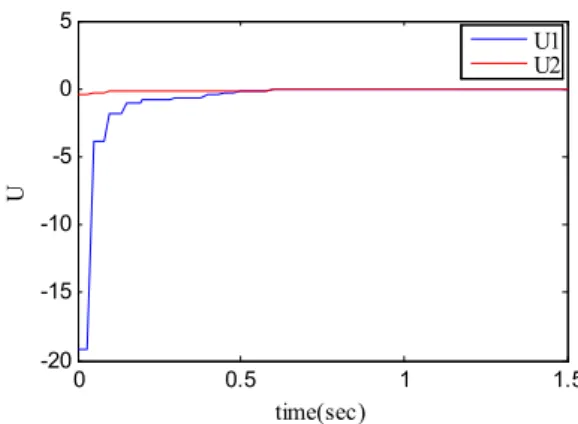
The simulation results (MathWorks, 2000, 2002, 2003) for the state and control vectors with initial condition on states
[ ]
(0) 3,1T
x = − ,
θ
ˆ(0) 4= are depicted in Figures 1 and Figure 2, respectively. 0 0.5 1 1.5 -3 -2 -1 0 1 time(sec) st at e x1 x2Fig. 1 Evolution time-histories of controlled system state responses.
0 0.5 1 1.5 -20 -15 -10 -5 0 5 time(sec) U U1 U2
Fig. 2 Evolution time-histories of system controls in closed loop.
5. CONCLUSION
The problem of robust reliable control for uncertain switched fuzzy systems has been investigated. Firstly, a model of uncertain switched fuzzy systems, which combines reliable control and switched fuzzy control, was presented; all subsystems of the switching system are uncertain fuzzy systems. In particular, attention was focused on actuators that may suffer “serious faults”.
Reliable controllers and switching law are designed such that they make the switched fuzzy systems uniformly ultimately bounded, based on the switching strategy that switching between faulty actuators. Finally, an illustrative example and the respective simulation results verified the effectiveness of the proposed control design method.
REFERENCES
Branicky, M. S. (1998). Multiple Lyapunov functions and other analysis tools for switched and hybrid systems.
IEEE Transactions on Automatic Control, 43(4),
475-482.
EI-Farra, N. H. and P. D. Christofides (2001). Feedback Control of Switched Nonlinear Systems Using Multiple Lyapunov Functions. In: Proceedings of the 20th
American Control Conference. Arlington, VA, The
AACC, pp. 3496-3502.
Jiang, B., M. Staroswiecki and V. Cocquempot (2004). Fault Diagnosis Based on Adaptive Observer for a Class of Non-linear Systems. International Journal of Control, 77(4), 415-426.
Kazuo, T., I. Masaaki and H. O. Wang (2001). Switching Control of an R/C Hovercraft: Stabilization and Smooth Switching. IEEE Transactions on Systems, Man, and
Cybernetics, 31(6), 853-863.
Li, H. X. and S. C. Tong (2003). A Hybrid Adaptive Fuzzy Control for a Class of Nonlinear MIMO Systems. IEEE
Transactions on Fuzzy Systems, 11(1), 24-34.
Liberzon, D. (2003). Switching in Systems and Control. Birkauser, Boston, NY.
Liu F. L. J. Y.Luo and Y. R. Cai (2005). Model-following Adaptive Robust Control for a Class of Uncertain Systems with Series Nonlinearities. IFAC, symposium on
Liu, X. D. and Q. L. Zhang (2003). New Approach to Hinf Controller Designs Based on Observers for T-S Fuzzy Systems via LMI. Automatica, 39(4), 1571-1582.
MathWorks (2000). Using Matlab - Version 6. The MathWorks Inc, Natick, MA.
MathWorks (2002). Using Simulink - Version 5. The MathWorks Inc, Natick, MA.
MathWorks (2003). Using Matlab - LMI Tooolbox. The MathWorks Inc, Natick.
Simani, S. (2005). Fuzzy Model Identification of a Sugar Cane Crushing Process for Fault Diagnosis Application. In: Proceedings of the 44th IEEE Conference on
Decision and Control. Seville, Spain, The IEEE, pp.
2053-2057.
Sun, J. S. and Z. Q. WANG (2002). D-Stable Robust Fault-Tolerant Control for Uncertain Discrete-Delay Systems.
Control Theory and Applications, 19(6), 967-971. (in
Chinese).
Sun, Z. (2004). A Robust Stabilizing Law for Switched Linear Systems. International Journal Control, 77(4), 389-398.
Tanaka, K. and H. O. Wang (2003). A Multiple Lyapunov Function Approach to Stabilization of Fuzzy Control Systems. IEEE Transactions on Fuzzy Systems, 11(4), 582-589.
Tuan, H. D., P. Apkarian, T. Narikiyo and Y. Yamamoto (2001). Parameterized Linear Matrix Inequality Techniques in Fuzzy Control System Design. IEEE
Transactions on Fuzzy Systems, 9, 324-332.
Wang, L.-X. (1997). A Course in Fuzzy Systems and Control. Prentice-Hall, Upper Saddle River, NJ.
Wang, R. J. (2004). Observer-Based Fuzzy Control of Fuzzy Time-Delay Systems with Parametric Uncertainties.
International Journal of Systems Science, 35(12),
671-683.
Wang, R., J. Zhao and G. M. Dimirovski (2005). Reliable H∞ Control for a Class of Switched Nonlinear Systems. In:
Preprints and the Proceedings of the 16th IFAC World Congress (P. Horacek, M. Simandl, and P. Zitek (Eds)),
Prague, Czech Republic, The IFAC, Paper Th-M02-TP14 (02829)/pp.1-6.
Wu, H. N. (2004). Reliable LQ Fuzzy Control for Continuous-Time Nonlinear Systems with Actuator Faults. IEEE Transactions on Systems, Man, and
Cybernetics B, 34(4), 1743-1752.
Yang, H., G. M. Dimirovski, and J. Zhao (2006). Switched Fuzzy Systems: Representation Modeling, Stability Analysis and Control Design. In: Proceedings of the 3rd
IEEE Conference on Intelligent Systems, London, UK,
The IEEE, pp. 306-311.
Yen, J., and R. Langari (1999). Fuzzy Logic: Intelligence,
Control, and Information. Prentice-Hall, Upper Saddle
River, NJ.
Zhao, J. and G. M. Dimirovski (2004). Quadratic Stability of a Class of Switched Nonlinear Systems. IEEE
Transactions on Automatic Control, 49(4), 574-578.
Zheng, F., and P. M. Frank (2002). Robust Controller Design for Uncertain Nonlinear Systems via Fuzzy Modeling Approach with Application to the Stabilization of Power Systems. European Journal of Control, 8, 535-550. Zheng, F., Q. G. Wang, and T. H. Lee (2004). Adaptive and
Robust Controller Design for Uncertain Nonlinear Systems via Fuzzy Modeling Approach. IEEE
Transactions on Systems, Man, and Cybernetics B, 34(1),