INVESTIGATION OF PARTICIPATION CONSTRAINTS ON LEISURE TIME ACTIVITIES OF
STUDENTS OF SCHOOL OF PHYSICAL EDUCATION AND SPORTS: CASE OF
İSTANBUL GELİŞİM UNIVERSITY
Gelisim University, Istanbul, Turkey
ARTICLE INFO ABSTRACT
The aim of this study is to determine the factors that prevent the participation of the students of Istanbul Developmental
activities and determine whether they differ according to some demographic variables. For this purpose, 250 students from School of Physical Education and Sports who are trained at Is Gelişim University's departments of Coach Traning, Sports Management, Recreation, and Exercise and Sport Sciences constitute the sample of the study. The data collection tool used in the study consists of 2 parts. In the first part, a personal infor
reveal the demographic characteristics of the participants. In the second part, ''Leisure Constraints Scale'' developed by Alexandris and Carroll (1997) and adapted to Turkish by Karaküçük and Gürbüz (2007) wa
recreational activities. SPSS 21 packaged software was used to analyze the obtained data. The data were collected and then analyzed by coding with the SPSS 21 packaged
ANOVA Test were used while analyzing the data. As a result of the study, the factors that constrain the leisure time of the students according to gender, age, department, class, and monthly income variables were correlated and factors
activities were determined.
Copyright © 2018, Cüneyt Seydioğlu. This is an open access
distribution, and reproduction in any medium, provided
INTRODUCTION
In the century we are living, scientific and technological developments have increased rapidly, and this increase has been accompanied by great ease of living conditions, and as a result of the reduction of working hours, an increase in leisure time has been observed (Tolukan, 2010). The working time which was 14-15 hours at the beginning of the 19th century decreased to 11-12 hours per day at the beginning of the 20th century and to 8 hours nowadays. With the growth of the world economy and the acceleration of technological developments, the leisure time of people has increased (Genç, 1998). It is seen that leisure time activities are becoming an important part of life over against the decreasing daily activity hours, and the tedious and self-repetitive transformation of work and activities (Passmore, 2001). Various definitions of the leisure time are made in the literature. Kılbaş Ş defined it as the time when the individual does not work, that is beyond the necessities of life and formal tasks, and that can be spent in the direction of the individual (2001).
Corresponding author: Cüneyt Seydioğlu Gelisim University, Istanbul, Turkey.
ISSN: 0975-833X
Article History:
Received 25th November, 2017
Received in revised form
23rd December, 2017
Accepted 17th January, 2018
Published online 18th February, 2018
Citation: Cüneyt Seydioğlu, 2018. “Investigation of participation constraints on leisure time activities of students of school of physical education and sports:
case of Istanbul Gelişim University”, International Journal of Current Research
Key words:
Leisure Time, Recreation,
Reasons for not Participating, University Students.
RESEARCH ARTICLE
INVESTIGATION OF PARTICIPATION CONSTRAINTS ON LEISURE TIME ACTIVITIES OF
STUDENTS OF SCHOOL OF PHYSICAL EDUCATION AND SPORTS: CASE OF
İSTANBUL GELİŞİM UNIVERSITY
*Cüneyt Seydioğlu
Gelisim University, Istanbul, Turkey
ABSTRACT
The aim of this study is to determine the factors that prevent the participation of the students of Istanbul Developmental University School of Physical Education and Sports in their leisure time activities and determine whether they differ according to some demographic variables. For this purpose, 250 students from School of Physical Education and Sports who are trained at Is Gelişim University's departments of Coach Traning, Sports Management, Recreation, and Exercise and Sport Sciences constitute the sample of the study. The data collection tool used in the study consists of 2 parts. In the first part, a personal information form was developed by the researcher to reveal the demographic characteristics of the participants. In the second part, ''Leisure Constraints Scale'' developed by Alexandris and Carroll (1997) and adapted to Turkish by Karaküçük and Gürbüz (2007) was used as data collection tool to determine the participation constraints of students on recreational activities. SPSS 21 packaged software was used to analyze the obtained data. The data were collected and then analyzed by coding with the SPSS 21 packaged
ANOVA Test were used while analyzing the data. As a result of the study, the factors that constrain the leisure time of the students according to gender, age, department, class, and monthly income variables were correlated and factors preventing the participation of the students in the leisure time activities were determined.
access article distributed under the Creative Commons Attribution the original work is properly cited.
In the century we are living, scientific and technological developments have increased rapidly, and this increase has been accompanied by great ease of living conditions, and as a f working hours, an increase in leisure time has been observed (Tolukan, 2010). The working time 15 hours at the beginning of the 19th century 12 hours per day at the beginning of the 20th the growth of the world economy and the acceleration of technological developments, the leisure time of people has increased (Genç, 1998). It is seen that leisure time activities are becoming an important part of vity hours, and the repetitive transformation of work and activities (Passmore, 2001). Various definitions of the leisure time are made in the literature. Kılbaş Ş defined it as the time when the e necessities of life and formal tasks, and that can be spent in the direction of the
Torkildsen defines leisure time as the remaining time after fulfilling practical needs (2005). Leisure time and recreation which are the two most commonly used phrases in this area are not synonyms, although they overlap to some extent. Recreation is regarded as the utilization of the leisure time described above with various activities. Aristotle expresses the leisure time activity as "being in an activity to do just that without any other purpose" (Kraus, 1971). That is to say, as leisure time defines free time without our compulsory needs, recreation defines the activities performed during this time (Kelly, 1989). We can summarize the benefits of making use of the leisure time of individuals in three main chapters. These are listed as physical, social and psychological benefits.
look at the physical benefits that recreational activities provide for individuals in their free time, there is a lack of movement in humans with the increase in mechanization today. That people stop moving accompanied by various problems and many diseases. The most effective way to
activities. Sports as one of the leisure time activities, dance, indoor and outdoor recreational activities are important and not negligible factors for people's physical health (Tel, 2007). Many factors in modern life are movi
each other. Individuals are being dragged into a daily routine International Journal of Current Research
Vol. 10, Issue, 02, pp.65133-65138, February, 2018
Investigation of participation constraints on leisure time activities of students of school of physical education and sports:
International Journal of Current Research, 10, (02), 65133-65138.
INVESTIGATION OF PARTICIPATION CONSTRAINTS ON LEISURE TIME ACTIVITIES OF
STUDENTS OF SCHOOL OF PHYSICAL EDUCATION AND SPORTS: CASE OF
The aim of this study is to determine the factors that prevent the participation of the students of University School of Physical Education and Sports in their leisure time activities and determine whether they differ according to some demographic variables. For this purpose, 250 students from School of Physical Education and Sports who are trained at Istanbul Gelişim University's departments of Coach Traning, Sports Management, Recreation, and Exercise and Sport Sciences constitute the sample of the study. The data collection tool used in the study mation form was developed by the researcher to reveal the demographic characteristics of the participants. In the second part, ''Leisure Constraints Scale'' developed by Alexandris and Carroll (1997) and adapted to Turkish by Karaküçük and Gürbüz s used as data collection tool to determine the participation constraints of students on recreational activities. SPSS 21 packaged software was used to analyze the obtained data. The data were collected and then analyzed by coding with the SPSS 21 packaged software. T-Test and ANOVA Test were used while analyzing the data. As a result of the study, the factors that constrain the leisure time of the students according to gender, age, department, class, and monthly income preventing the participation of the students in the leisure time
License, which permits unrestricted use,
Torkildsen defines leisure time as the remaining time after fulfilling practical needs (2005). Leisure time and recreation which are the two most commonly used phrases in this area are not synonyms, although they overlap to some extent. Recreation is regarded as the utilization of the leisure time ith various activities. Aristotle expresses the leisure time activity as "being in an activity to do just that without any other purpose" (Kraus, 1971). That is to say, as leisure time defines free time without our compulsory needs, activities performed during this time We can summarize the benefits of making use of the leisure time of individuals in three main chapters. These are listed as physical, social and psychological benefits. When we ts that recreational activities provide for individuals in their free time, there is a lack of movement in humans with the increase in mechanization today. That people stop moving accompanied by various problems and many diseases. The most effective way to get rid of them is physical activities. Sports as one of the leisure time activities, dance, indoor and outdoor recreational activities are important and not negligible factors for people's physical health (Tel, 2007). Many factors in modern life are moving people away from each other. Individuals are being dragged into a daily routine
INTERNATIONAL JOURNAL OF CURRENT RESEARCH
and a monotonous life. The norms in the workplace of people and the ordinariness in the working environment cause individuals to move away from the social environment and to experience alienation more intensely. Neighborliness, unity and friendship ties are also weakening. However, when modern people find enough time and financial opportunity, they will always head for new activities. The free time activities that individuals will undertake in groups increase communication and connection among people. These activities provide people with such social benefits. Nowadays, the intensity and problems of people in family life, school life, and business life can cause their stamina to decrease, and make them tired by disrupting their neural system. To get away from such pressures, people want to get into a different environment and to lift the morale. Making use of the free time well provides a psychological benefit to the person. The leisure time activities will help them rest, have fun, change and refresh themselves (Emir, 2012).
In many studies conducted in various fields, it was seen that recreational activities have a very positive effect on individual and community health in the process of urbanization. Despite these positive contributions of recreational activities, it has been seen that individuals do not participate in such activities which are very important for them because of various reasons, or they can not attend due to various constrains. The concept of “constrain” in leisure literature refers to the reasons that prevent or restrict the participation of individuals in recreational activities in their leisure time and that are encountered by the individual (Gürbüz, B. and Karaküçük, S., 2007). Rapid tempo and crowd of big city life we live in and technology are just a few reasons that may constrain the participation in recreational activities. This type of constraints causes people not to be able to use their excess energy and to express their various abilities. In this environment, people feel under constant pressure and stress, especially the need for more action, innovation, and change in young people causes various problems and distress (Karaküçük S., 2005). University years are not a time that individuals can develop themselves completely by only studying. For many individuals, university years are important for ensuring academic and socio-cultural development. Making use of university youth's leisure time and their involvement in recreational activities take place during university education in a semi-organized manner within the possibilities offered by the universities for them. In this context, universities can also play a leading role in making use of students' leisure time (Balcı, 2003). With the development of university campuses and the efforts of the administrations in this regard, it is observed that the participation of university youth in recreational activities has increased in recent years.
METHODS
Research Model and Hypotheses
This research was conducted by using survey model with the purpose of examining the leisure time of students of İstanbul Gelişim University School of Physical Education and Sport according to gender, age, department, student class and sports branches.
The hypotheses of this research are as follows
H1: There is a significant difference between the gender of the
students of Physical Education and Sport and the levels of leisure time constraints.
H2: There is a significant difference between the age of the
students of Physical Education and Sport and the levels of leisure time constraints.
H3: There is a significant difference between the departments
of students of Physical Education and Sport and the levels of leisure time constraints.
H4: There is a significant difference between the classes of students of Physical Education and Sport and and the levels of leisure time constraints.
H5: There is a significant difference between the monthly
income of students of Physical Education and Sport and the levels of leisure time constraints.
H6: There is a significant difference between the leisure time
duration of students of Physical Education and Sport and and the levels of leisure time constraints.
Population and Sample
The research population consists of the students who continue their education in the departments of Coach Training, Sports Management, Recreation, and Exercise and Sport Sciences in Istanbul Gelişim University in the 2017-2018 academic year. Surveys were distributed in person to 280 randomly selected students after explaining the purpose of the research. However, 30 incorrectly and insufficiently filled surveys were not evaluated. The sample of the research consists of 250 students.
Collection of Data
The data collection tool used in the study consists of 2 parts. In the first part, a personal information form was developed by the researcher to reveal the demographic characteristics of the participants. In the second part, ''Leisure Constraints Scale'' developed by Alexandris and Carroll (1997) and adapted to Turkish by Karaküçük and Gürbüz (2007) was used as data collection tool to determine the participation constraints of students on recreational activities. A 4-point Likert Type grading scale was used. For each question, options were given as 1: "Absolutely Insignificant", 2: "Insignificant", 3: "Important", 4: "Very Important" and the research group was asked to select the most appropriate option. The Leisure Constraints Scale has 6 dimensions. The first sub-dimension (psychology of individual) consists of 1st, 2nd, 3rd, and 4th items, the second sub-dimension (lack of information) consists of 5th, 6th, 7th,8th, and 9th items, the third sub-dimension (facilities/service) consists of 10th,11th,12th,13th, 14th, 15th, 16th, and 17th items, the forth sub-dimension (lack of friends) consists of 18th, 19th, and 20th items, the fifth sub-dimension (time) consists of 21st, 22nd, 23rd, and 24th items, the sixth sub-dimension (lack of interest) consists of 25th, 26th, and 27th items.
Analysis of Data
After the data were collected, they were analyzed by coding with the SPSS 21 packaged software. T-Test and ANOVA Test were used while analyzing the data.
RESULTS
In the context of the results, the demographic distributions of the students who participated in the research were examined first and then analyses were conducted to determine the
determinants that constrain participants from participating in leisure activities and whether they differed according to some demographic variables. Table 1 shows the distribution of gender, age, class, department and monthly income according to demographic variables of the students participating in the study.
Table 1. Demographic Findings of Participants in the Survey
Variable Frequency (n) Percentage (%)
Gender female 109 43,6 male 141 56,4 Age 18-23 132 52,8 24-29 109 43,6 30 and above 9 3,6 Department Sports Management 67 26,8 Coach Training 75 30,0 Recreation 61 24,4
Exercise and Sport Sciences 47 18,8
Class 1st Class 78 31,2 2nd Class 49 19,6 3rd Class 74 29,6 4th Class 49 19,6 Monthly Income 0-500 51 20,4 501-999 62 24,8 1000-1499 88 35,2 1500 and above 49 19,6 Total 200 100
When we look at demographic characteristics, 43.6% of the students participating in the study were female and 56.4% of the students were male students. 52.8% of the students who
filled in the questionnaire were between the ages of 18-23 and 43.6% were between the ages of 24-29. 26.8% of the students are in Sports Management, 30% are in Coach Training, 24.4% in Recreation and 18.8% in Exercise and Sports Sciences department. If we look at the classes, 1st grade students were more in number with a minor difference. While 78 first grade students participated in the study, 74 3rd grade students filled the questionnaire. The monthly income of 20,4% of the students who participated in the study was 0-500 TL, of 24,8% was 501-999 TL, of 35,2% was 1000-1499 TL and the monthly income of 19,6% was 1,500 TL and above. Table 2 shows the results of unpaired T-test analysis which was performed to determine whether the subscales of the factors that constrain the leisure time of the students differ according to the gender variable.
There was no statistically significant difference in terms of gender of students between the psychology of individual (p <0.05), lack of information (p <0.05), facilities/service (p <0.05), lack of friends (p <0.05) that are the sub-dimensions of the factors that constrain the leisure. As a matter of fact, the "p" value is greater than 0.05. However, a statistically significant difference was found in the time sub-dimension. As shown in Table 2, the value of "p" is less than 0.05. In this context, the hypothesis that there is a significant difference between the gender of students of School of Physical Education and Sport and the levels of leisure time constraints is accepted. One of the factors that constrain male students' leisure time is the time problem. As a result of one-way analysis of variance (ANOVA) which was conducted to determine whether the sub-dimensions of the factors that constrain the leisure time of the students differ according to the age variable, there was no
Table 2. Results of the T-test According to Gender Variable
Gender N X S.S. f p
Psychology of individual Female 109 2,105 0,576 0,002 0,839
Male 141 2,120 0,586
Lack of information Female 109 2,062 0,564 1,776 0,061
Male 141 2,207 0,648
Facilities/Service Female 109 2,150 0,583 0,110 0,074
Male 141 2,228 0,617
Lack of friends Female Male 109 141 2,104 2,182 0,886 0,852 0,044 0,477
Time Female 109 2,052 0,569 1,061 0,001
Male 141 2,260 0,636
Lack of interest Female 109 2,033 0,639 0,033 0,111
Male 141 2,163 0,626
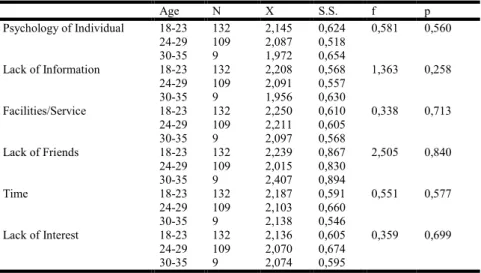
Table 4. Results of One-Way Analysis of Variance in terms of Age Groups of Students
Age N X S.S. f p Psychology of Individual 18-23 132 2,145 0,624 0,581 0,560 24-29 109 2,087 0,518 30-35 9 1,972 0,654 Lack of Information 18-23 132 2,208 0,568 1,363 0,258 24-29 109 2,091 0,557 30-35 9 1,956 0,630 Facilities/Service 18-23 132 2,250 0,610 0,338 0,713 24-29 109 2,211 0,605 30-35 9 2,097 0,568 Lack of Friends 18-23 132 2,239 0,867 2,505 0,840 24-29 109 2,015 0,830 30-35 9 2,407 0,894 Time 18-23 132 2,187 0,591 0,551 0,577 24-29 109 2,103 0,660 30-35 9 2,138 0,546 Lack of Interest 18-23 132 2,136 0,605 0,359 0,699 24-29 109 2,070 0,674 30-35 9 2,074 0,595
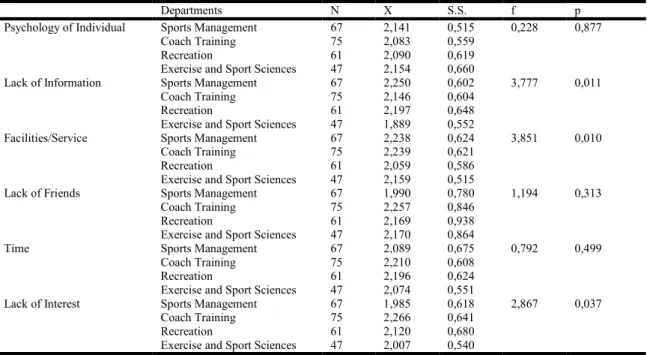
statistically significant difference between the groups. As a matter of fact, the "p" value is greater than 0.05. For this reason, the hypothesis that there is a significant difference between the age of the students of Physical Education and Sport and the levels of leisure time constraints was rejected. One-way analysis of variance (ANOVA) was performed to determine whether the sub-dimensions of the factors that constrain the leisure time of the students differ according to the department variable they study. There was a statistically significant difference between the lack of information, facilities/service and lack of interest sub-dimensions of the factors that constrain the leisure time, in terms of the departments the students study. As a matter of fact, the "p" value is less than 0.05. There was no statistically significant difference between Psychology of Individual, Lack of Friends, and Time sub-dimensions in terms of the departments the students study.
As a matter of fact, the "p" value is greater than 0.05. The hypothesis that there is a significant difference between the departments of the students of Physical Education and Sport and the levels of leisure time constraints was rejected. sub-dimensions of the factors that constrain the leisure time of the students differ according to the class variable they study, there was no statistically significant difference between the sub-dimensions in terms of the classes of the students. As a matter of fact, the "p" value is greater than 0.05. In this context, the hypothesis that there is a significant difference between the classes of the students of Physical Education and Sport and the levels of leisure time constraints was accepted. One-way analysis of variance (ANOVA) was performed to determine whether the sub-dimensions of the factors that constrain the leisure time of the students differ according to the income levels. As a result of the analysis, there was statistically significant difference between the Lack of Information,
Table 5. Results of One-Way Analysis of Variance in terms of Departments of Students
Departments N X S.S. f p
Psychology of Individual Sports Management 67 2,141 0,515 0,228 0,877
Coach Training 75 2,083 0,559
Recreation 61 2,090 0,619
Exercise and Sport Sciences 47 2,154 0,660
Lack of Information Sports Management 67 2,250 0,602 3,777 0,011
Coach Training 75 2,146 0,604
Recreation 61 2,197 0,648
Exercise and Sport Sciences 47 1,889 0,552
Facilities/Service Sports Management 67 2,238 0,624 3,851 0,010
Coach Training 75 2,239 0,621
Recreation 61 2,059 0,586
Exercise and Sport Sciences 47 2,159 0,515
Lack of Friends Sports Management 67 1,990 0,780 1,194 0,313
Coach Training 75 2,257 0,846
Recreation 61 2,169 0,938
Exercise and Sport Sciences 47 2,170 0,864
Time Sports Management 67 2,089 0,675 0,792 0,499
Coach Training 75 2,210 0,608
Recreation 61 2,196 0,624
Exercise and Sport Sciences 47 2,074 0,551
Lack of Interest Sports Management 67 1,985 0,618 2,867 0,037
Coach Training 75 2,266 0,641
Recreation 61 2,120 0,680
Exercise and Sport Sciences 47 2,007 0,540
Table 6. Results of One-Way Analysis of Variance in terms of Classes of Students
Classes N X S.S. f p Psychology of Individual 1st 78 2,096 0,584 1,893 0,131 2nd 49 1,984 0,503 3rd 74 2,232 0,615 4th 49 2,114 0,577 Lack of Information 1st 78 2,023 0,521 2,025 0,111 2nd 49 2,163 0,686 3rd 74 2,159 0,639 4th 49 2,293 0,625 Facilities/Service 1st 78 2,102 0,523 2,420 0,067 2nd 49 2,199 0,652 3rd 74 2,361 0,662 4th 49 2,252 0,560 Lack of Friends 1st 78 2,132 0,846 0,607 0,611 2nd 49 2,265 0,957 3rd 74 2,162 0,905 4th 49 2,034 0,688 Time 1st 78 2,128 0,594 0,794 0,498 2nd 49 2,045 0,646 3rd 74 2,206 0,667 4th 49 2,199 0,558 Lack of Interest 1st 78 2,017 0,600 1,167 0,323 2nd 49 2,217 0,740 3rd 74 2,090 0,629 4th 49 2,163 0,573
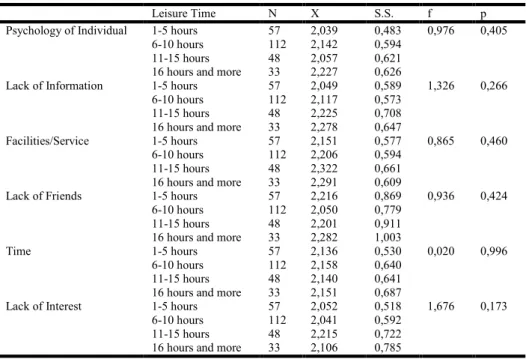
Facilities/Service, Lack of Friends sub-dimensions in terms of the income level variable. As a matter of fact, the "p" value is less than 0.05. There was no statistically significant difference related to the Psychology of Individual, Time, and Lack of Interest sub-dimensions as a result of ANOVA test. As a matter of fact, the "p" value is greater than 0.05. For this reason, the hypothesis that there is a significant difference between the income levels of the students of Physical Education and Sport and the levels of leisure time constraints was accepted. After the one-way analysis of variance (ANOVA) was performed to determine whether the sub-dimensions of the factors that constrain the leisure time of the students differ according to the leisure time duration variable, there was no statistically significant difference between the sub-dimensions of the factors that constrain the leisure time in terms of the leisure time duration. As a matter of fact, the "p" value is greater than 0.05.
For this reason, the hypothesis that there is a significant difference between the leisure time duration of the students of Physical Education and Sport and the levels of leisure time constraints was rejected.
Conclusion and Recommendation
In this study, it was aimed to determine the elements which may constrain the students of Istanbul Gelişim University - School of Physical Education and Sports from participating in the leisure time activities. When we look at demographic characteristics, 109 of the students who participated in the study were female and 141 were male students. 132 of the students who completed the questionnaire were between the ages of 18-23, 109 were between the ages of 24-29. 9 students in the age range of 30 and above participated in the study. If we look at the classes, 1st grade students were more in number with a minor difference.
Table 7. Results of One-Way Analysis of Variance in terms of Income Variable of Students
Monthly Income N X S.S. f p
Psychology of Individual 500 and less 51 2,088 0,624 1,446 0,230
501-999 62 2,229 0,612
1000-1499 88 2,034 0,493
1500 and above 49 2,137 0,629
Lack of Information 500 and less 51 2,364 0,652 5,111 0,002
501-999 62 2,016 0,680
1000-1499 88 2,209 0,584
1500 and above 49 1,959 0,449
Facilities/Service 500 and less 51 2,318 0,573 3,425 0,018
501-999 62 2,375 0,673
1000-1499 88 2,171 0,636
1500 and above 49 2,045 0,414
Lack of Friends 500 and less 51 1,817 0,661 10,329 0,001
501-999 62 2,457 0,929
1000-1499 88 2,232 0,946
1500 and above 49 1,789 0,459
Time 500 and less 51 2,152 0,502 0,109 0,955
501-999 62 2,149 0,727
1000-1499 88 2,170 0,650
1500 and above 49 2,107 0,537
Lack of Interest 500 and less 51 2,065 0,581 2,235 0,085
501-999 62 2,075 0,752
1000-1499 88 2,234 0,627
1500 and above 49 1,959 0,498
Table 8. Results of One-Way Analysis of Variance in terms of Leisure Time Duration Variable of Students
Leisure Time N X S.S. f p
Psychology of Individual 1-5 hours 57 2,039 0,483 0,976 0,405
6-10 hours 112 2,142 0,594
11-15 hours 48 2,057 0,621
16 hours and more 33 2,227 0,626
Lack of Information 1-5 hours 57 2,049 0,589 1,326 0,266
6-10 hours 112 2,117 0,573
11-15 hours 48 2,225 0,708
16 hours and more 33 2,278 0,647
Facilities/Service 1-5 hours 57 2,151 0,577 0,865 0,460
6-10 hours 112 2,206 0,594
11-15 hours 48 2,322 0,661
16 hours and more 33 2,291 0,609
Lack of Friends 1-5 hours 57 2,216 0,869 0,936 0,424
6-10 hours 112 2,050 0,779
11-15 hours 48 2,201 0,911
16 hours and more 33 2,282 1,003
Time 1-5 hours 57 2,136 0,530 0,020 0,996
6-10 hours 112 2,158 0,640
11-15 hours 48 2,140 0,641
16 hours and more 33 2,151 0,687
Lack of Interest 1-5 hours 57 2,052 0,518 1,676 0,173
6-10 hours 112 2,041 0,592
11-15 hours 48 2,215 0,722
While 78 first grade students participated in the study voluntarily. When the leisure time constraints of participants are considered in terms of gender, while there was no statistically significant difference between "Psychology of Individual", "Lack of Information", "Facilities/Service", "Lack of Friends", and "Lack of Interest" sub-dimensions, there was a statistically significant difference in "Time" sub-dimension. Temir and Gürbüz (2014) reported that the time factor in participants' participation in recreational activities was at the top of the list, whereas the lack of interest factor was at the bottom in the study called “Analysis of Constraints on Participation in Recreational Activities”. This result supports our research that we conducted. Ekinci at al (2014) conducted a study entitled "Analyzing the Factors that may Constrain University Students from Attending Sportive and Non-sportive Recreational Activities", which was statistically significant in terms of gender in "lack of information", "lack of friends" and "time" sub-dimensions, whereas in our study a statistically significant difference was found only in the "time" sub-dimension. Ekinci at al (2014) found significant differences in the "time" sub-dimension according to the age of the students in the same study.
The findings of the study show that there is no statistically significant difference between the leisure time constraints according to the age of the participants. There was a statistically significant difference between the lack of information, facilities/service, and lack of interest sub-dimensions between the factors that constrain the leisure time, in terms of the departments. Polat (2017) found a significant difference in favor of participants in the age range 21-24 in the study of University Students' Participation Constraints on Recreational Activities according to Some Variables (Kütahya City Example). This result does not coincide with our research. The same study findings identified a significant difference in favor of first-year students among the leisure time constraints in terms of class variables of students. In the study we conducted, after one-way analysis of variance (ANOVA) was conducted to determine whether the students of Istanbul Gelişim University School of Physical Education and Sports differed according to the class, no statistically significant difference was found between the sub-dimensions of the factors affecting their leisure time.
Özşaker (2012) found that the level of university welfare was an important factor in participating in the activities as a result of the study "An Investigation on the Reasons for the Young Not Participating in Leisure Time Activities". This result coincides with the study we conducted. A statistically significant difference was found in the Lack of Information, Facilities/Service, and Lack of Friends sub-dimensions in terms of income level variable as a result of the analyses conducted to determine whether the sub-dimensions of the factors that constrain the leisure time of the students differ according to their income levels. As a result, the factors that constrain the participation of university students in sportive leisure activities should be examined in terms of different variables. It is believed that this study will contribute to the relevant literature and will lead and support similar work to be done in this area.
It can be said that participants consider the lack of social environment and information as one of the biggest constraints on participating in leisure activities, followed by factors of facility/service/transportation and psychology of individual. In line with the results we have gathered and when we look at the literature, it is necessary for the universities to develop their opportunities and to offer these opportunities to their students, to develop these opportunities, and to increase the participation in the sports organizations in order to ensure the participation of the youth in the leisure time activities. Universities must employ educated recreational leaders and add recreational lessons to their curriculum so that their students can use their leisure time effectively.
REFERENCES
Balcı, V. 2003. Ankara'daki Üniversite Öğrencilerinin Boş Zaman Etkinliklerine Katılımlarının Araştırılması, Milli Eğitim Dergisi, 1(8), 161-173
Ekinci, N.E., Kalkavan, A., Üstün, Ü.D., Gündüz, B. 2014. Üniversite Öğrencilerinin Sportif ve Sportif Olmayan Rekreatif Etkinliklere Katılmalarına Engel Olabilecek Unsurların İncelenmesi. Sportif Bakış: Spor ve Eğitim Bilimleri Dergisi, 1(1), 1-13.
Emir, E. 2012. Rekreatif Etkinliklere Katılımın Önündeki Engellerin Belirlenmesi: Üniversite Öğrencileri Örneği, Yüksek Lisans Tezi, Trabzon.
Genç, D., A. 1998. Spor Hukuku. Alfa Yayınları, İstanbul Gürbüz, B. ve Karaküçük, S. 2007. Boş Zaman Engelleri
Ölçeği, Gazi Üniversitesi, Beden Eğitimi ve Spor Bilimleri Dergisi, 8(12), 3-10.
Karaküçük, S. 2005. Rekreasyon boş zamanları değerlendirme, Gazi Kitabevi, Ankara, s.60.
Kelly, J. R. 1989. Leisure (2nd ed.), Prentice Hall. New Jersey. Kılbaş Ş. 2001. Gençlik ve boş zamanı değerlendirme. Ç.Ü.
Basımevi. Adana.
Kraus, R. (1971). Recreation and Leisure in Modern Society. TACC, USA.
Özşaker, M. 2012. “Gençlerin Serbest Zaman Aktivitelerine Katılamama Nedenleri Üzerine Bir İnceleme”, Selçuk Üniversitesi Beden Eğitimi ve Spor Bilim Dergisi, 14(1), 126-131.
Passmore, A., French D. 2001. Development and Administration of a Measure to Assess Adolescents’ Participation,36(141), 67.
Polat, C. (2017). Üniversite öğrencilerinin rekreasyonel etkinliklere katılım engellerinin bazı değişkenlere göre incelenmesi (Kütahya İli Örneği). Yüksek Lisans Tezi, Kütahya.
Tel, M. 2007. Öğretim Üyelerinin Boş Zaman Etkinlikleri Üzerine Sosyolojik Bir Araştırma: Doğu Anadolu Örneği, Doktora Tezi, Fırat Üniversitesi, Sosyal Bilimler Enstitüsü Temir, Ö., Gürbüz, B. 2012. “Rekreasyonel Aktivitelere
Katılımın Önündeki Engellerin İncelenmesi”. I. Rekreasyon Araştırmaları Kongresi Kemer, Antalya.
Tolukan E. 2010. Özel Yetenekle İlgili Bölümlerde Okuyan Üniversite Öğrencilerinin Rekreasyonel Aktivitelere Katılımlarına Engel Olabilecek Unsurların Belirlenmesi. Yüksek Lisans Tezi, Sosyal Bilimler Enstitüsü, Niğde. Torkildsen, G. 2005. Leisure and Recreation Management (5th
Edition). Routledge, NY.