Vol. 79, June 2020, pp. 479-483
Experimental Investigation on Nano MoS
2Application in Milling of
EN-GSJ 700-02 Cast Iron with Minimum Quantity Lubrication (MQL)
Bülent Çelik1 and Alaattin Kaçal2*
1
CESAN Cranes 1st Organized Industrial Zone, 11 030, Bilecik Turkey
2
Mechanical Engineering Department, Simav Technology Faculty, Kutahya Dumlupinar University, 43 500, Simav, Kütahya, Turkey
Received 11 August 2019; revised 15 February 2020; accepted 2 May 2020
In this study, effects of minimum quantity lubrication (MQL) conditions on machinability were investigated in milling operations, which is an important machining method. In this context, nano-sized solid lubricant MoS2 was mixed into MQL and
EN-GSJ 700-02 spherical graphite cast iron was milled. Surface roughness and tool wear were examined and effects of nano-MoS2 were investigated. A range of statistical analyses such as Dunnet test was performed to determine Ra results and their
relationship with experimental parameters. Positive results were obtained from nano MoS2 that was added to improve
lubrication and cooling properties into fluid in MQL system. Lowest Ra value was measured as 0.47 µm in conditions of 5 bar pressure, 160 ml / min flow rate and MQL + 0.5% MoS2 spraying. A 45% improvement was achieved in these conditions.
Added nano MoS2 played an alternative role on surface roughness and tool wear.
Keywords: MQL, Milling, Tool wear, Surface roughness Introduction
High temperature rise occur in and around cutting zone during machining of large amount of cast iron. These kinds of temperatures cause dimensional deviations and short tool life. Conventional coolant applications cannot be correctly guided to tool-chip interface during increasing machining speed. It is aimed to apply cutting fluids effectively in machining operations and to minimize its use.1,2 Developed for this purpose, the minimum quantity lubrication (MQL) is sprayed with a small amount of oil and compressed air into cutting point, and lubrication is performed with the minimum lubricant.
Materials
When a MQL is applied, it is seen that amount and performance of lubricant were significantly saved. Besides, costs of waste after process and maintenance or recycling costs greatly reduce. Moreover, a much cleaner, healthier and safer working environment can be acquired. Efficiency of this method has been seen in most cutting operations such as turning, milling, reaming and drilling. In case of external feed MQL systems, spraying is applied via nozzle. It is recommended to apply this system in standard
operations (turning, milling, and drilling). When oil is conveyed through machine spindle system, it is internal feed MQL system. This system is mostly used under flexible machining centers and high-speed cutting conditions.1–3 Sasahara et al.4 applied MQL in helical milling of aluminum alloy. Tampu et al.5 tried to analyze effect of surface quality on cooling quality used at different concentration and different temperatures in milling operation. Duchosal et al. focused on numerical analysis of parameters affecting MQL application in milling operations in their study. They stated that type of tool was determining factor for good lubrication parameters.6 Duchosal et al. calculated liquid film formation in the milling tool with experimental and numerical simulation for different spindle speeds. The results allowed a better understanding of behavior of oil vapor.7 In order to maintain efficiency of MQL, they showed that oil mist should be avoided.8 Duchosal et al. examined numerical optimization of design parameters of MQL application from outside of cutter with Taguchi method in order to make sufficient lubrication to sharp edges before chip removal process. Results show that the optimal combination of high cutting speed and high lubrication performance depends on low feed rate, high flow rate and inlet pressure.9 MQL applications were also found in studies related to super alloys.10–13 Kasim
et al. examined effects of variable parameters such as
—————
*Author for Correspondence E-mail: [email protected]
cutting speed, feed rate and depth of cut on heat generated during finishing with MQL. Experimental values and statistical analyzes showed that heat generation was mostly caused by radial depth of cut and then axial depth of cut, and it was concluded that feed and cutting speed were statistically insignificant.14 Wang et al. investigated machinability of Inconel 182 during up milling under dry machining and MQL cutting conditions. Use of MQL in climb milling process showed that tool wear and production costs can be greatly reduced when considering the economy.15 Srikant et al. studied MQL, which is used as an alternative to coolant, reducing heat generated during machining, factors limiting use of coolant in their study. They examined potential nano-liquids that can be used for MQL by reviewing current cutting fluids.16 Singh et al. conducted a research on the thermal conductivity properties of nano TiO2 fluids. They have pointed that the thermal conductivity of nano-fluid increased at high temperatures.17 Kumar et
al. TiO2 added fluid in air mist spray conditions used in turning AISI D2. They have pointed that nano TiO2 additive increases tool life by 70%.18 Makhesana et al. Investigated the effects of solid lubricants on surface roughness and power consumption in MQL applications. Using experimental results, they developed regression equation and investigated its accuracy.19 When we look at studies about MQL in the literature given above, lubricant fluid type, flow rate, pressure, nozzle type, nozzle placement angle, material, cutting parameters, machining processes and recently additive materials were discussed. This study is planned around the hypothesis that nano MoS2 powders added to the MQL fluid can have positive effect on machinability in milling of EN-GSJ 700-02 material. Solid lubrication property of MoS2 is an important element that can support the hypothesis. Experimental planning and experiments are based on actual manufacturing conditions and environment. Evaluation criteria such as surface roughness and cutting tool wear were taken into account to reach the hypothesis. The primary objective of the study was to investigate the effects of MoS2 additive on processing in the MQL process.
Methods
Commercially available Bielomatik B1-210 series MQL system was used in milling experiments. A flexible polymer hose with 6 mm diameter was used to reach cutting zone of lubricant in experimental
studies. It is recommended that distance is about 30 mm, angle made with horizontal 30–45o and cutting position should be in the way of ensuring effective cooling and chip flow.15,20 Used nano MoS2 powders are 90 nm in diameter, 99.9% purity and in spherical form. Firstly, water and ERALUBETM BIO CF 350
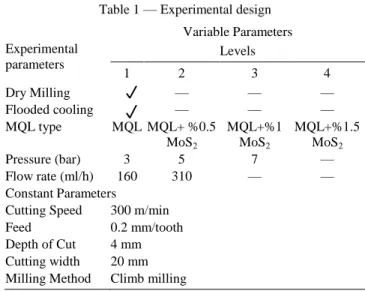
21 were mixed at recommended mixing ratio of 5%. Then, nano MoS2 powders were mixed into emulsion cutting liquid by weighing in precision scale as amounts of 0.5–1% to 1.5% by weight in the direction of experiment parameters. It is known that ultrasonic mixing is the most suitable mixing method in order to disperse this type of nano powders into a liquid with a maximum homogeneity.22 Sonics Vibracell VCX-750 ultrasonic mixer was used to mix Nano MoS2 powders into coolant. Mixing process time was applied for 40 minutes for homogeneous distribution. EN-GJS-700-2 class spherical graphite cast iron was used in the experiments. Test specimens were casted in 70x160x40 mm dimensions. Milling tests were carried out AWEA BM-850 (7.5 kW) vertical machining center with FANUC control. In milling experiments, 1705 PETR LT 30 coded Al2O3 coated carbide cutting inserts were used with PVD method of APKT produced by Lamina Technologies. Tool holder with Ø 32- Z3-L200-C32 coded was used. TIME TR200 portable roughness tester was used for surface roughness measurements. In surface roughness measurements, sampling and evaluation lengths were taken as 0.25 mm and 1.25 mm respectively. After milling test, Ra measurements were performed from three different regions of machined surface and were evaluated by taking their averages. Scanning electron microscopy (SEM) images of cutting inserts were taken. In Table 1,
Table 1 — Experimental design Variable Parameters Experimental parameters Levels 1 2 3 4 Dry Milling — — — Flooded cooling — — — MQL type MQL MQL+ %0.5 MoS2 MQL+%1 MoS2 MQL+%1.5 MoS2 Pressure (bar) 3 5 7 — Flow rate (ml/h) 160 310 — — Constant Parameters
Cutting Speed 300 m/min Feed 0.2 mm/tooth Depth of Cut 4 mm Cutting width 20 mm Milling Method Climb milling
experimental design was given in detail. Dunnet test was performed using Minitab 17 software to determine statistical significance of relation between obtained results and experimental parameters.
Result and Discussion Surface roughness
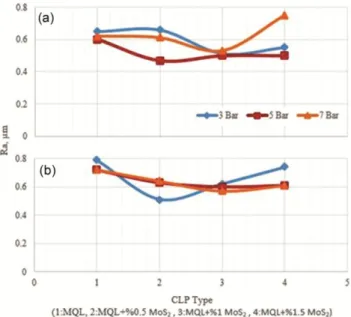
After each cutting test conducted according to experiment parameters, average roughness values (Ra) were measured over machined surfaces. The lowest Ra value was measured as 0.47 µm in 5 bar pressure, 160 ml / h flow rate and under MQL + 0.5% MoS2 spray conditions. The highest Ra value was measured as 0.86 µm in dry machining. Here, a 45% reduction of Ra was obtained which can be said to be a very good result. The graphs showing relationships between measured values and experimental parameters were given in Fig. 1. In the graphs curves are prepared according to flow rate and pressure. It is formed according to cooling-lubrication process type (CLP) in curves. Coding for these types of operations is given below the Fig. 1. In Fig. 1a change of Ra values for 160 ml/h according to CLP type are shown. Here, it is seen that nano MoS2 additive reduces Ra value regularly at 3 bar injection pressure. The roughness value tends to decrease at all pressure values up to 1% MoS2 additive. After this point, Ra showed an increase of 1.5% towards MoS2 additive. On an average the highest roughness was measured at 7 bar pressure, while the lowest roughness was measured at 5 bar MQL + 1% MoS2 spray conditions
for Ra. There is an irregular change in pressure value of 3 bars as evident from Fig. 1b. In addition, the highest and lowest values of Ra were found at this pressure. In general, under other pressure conditions, nano-MoS2 additive appears to reduce Ra value regularly. This is because good lubrication properties of MoS2 particles increase properties of coolant by reducing friction coefficient.3 This is consistent with results of some studies in the literature.3,23 An evaluation of all results can be seen in Fig. 2. Each point in the graph represents average value of experiments performed in that parameter. It is evident from Fig. 2 that the highest Ra value was obtained in dry milling process. It is seen that roughness value decreases in normal spraying and MQL conditions. Nano MoS2 additive improves roughness except spraying conditions of MQL + 1.5% MoS2. It revealed that solid lubricant property of MoS2 enhanced positive effect of MQL spray on milling.
Tool wear
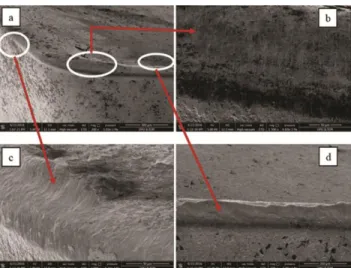
In general, in dry milling, chip flow directed small cavities formed by effect of abrasive wear mechanism on cutting-edge chip surface and free surface have been started to appear. It is seen that some of material adheres and some of material breaks in region of cutting edge towards chip surface. In dry conditions, it is expected that heat generated by cutting at a cutting depth of 4 mm will lead to diffusion wear mechanism.1 In conventional coolant spraying conditions there is no significant effect of particle breaks, adhesives and diffusion abrasion mechanisms were seen when compared to dry milling. In particular, a regular free surface wear has been started to appear. Regular free surface wear in cast irons is preferred against other types of abrasion1. SEM images of cutting insert used in MQL + 0.5% MoS2 spray conditions are given in Fig. 3. When it is generally looked at cutting insert, effect of particle
Fig. 1 — Variation of Ra values for (a) 160 ml/h (b) for 310 ml/h
breakage and plastic deformation was not observed. Diffusion effects were not also seen much. This can be attributed to nano-MoS2 contribution. When cutting edge is viewed, small scale formation beginning of adherent chip appears (picture c and d). Adherent chip formation can be observed at low cutting temperatures. Adherent chip shows a decrease tendency by increasing heat in cutting zone1. Accordingly, used cooling and lubricating conditions limit heat increase and a ground for adhesion may have occurred. Chip flow directed small cavities formed by effect of abrasive wear mechanism on cutting edge chip surface and free surface started to appear. Overall, the addition of MoS2 has contributed positively to tool wear.
Statistical Analysis
Dunnet statistically test was performed to determine relationship of Ra results with experimental parameters. Dunnet test was performed to determine effects of flow rate and pressure on Ra. It is benefited from Dunnet test to determine whether difference between groups and a group chosen from among groups is significant or not for this purpose. Flow rate and pressure comparisons for Ra were given in Table 2. Parameters not marked with letter A in Table
2 indicate parameter showing statistically significant difference from A. According to Dunnet multiple comparison test results based on 95% confidence interval, flow rate is effective on Ra. Confidence level of test conducted was occurred 95%. Pressure was not effective on Ra. Same grouping (A) were occurred for three pressure values. Confidence level of test was occurred as 97.26%.
Conclusions
In this study, the effects of minimum amount of lubrication (MQL) conditions on machining performance in milling operations were investigated. As the main approach, nano-sized solid lubricant MoS2 was mixed into MQL and milled with EN-GSJ 700-02 spherical graphite cast iron. Conclusions drawn after the study was evaluated as a whole were given below;
In terms of measured values, lowest Ra value was measured as 0.47 µm at 5 bar pressure, 160 ml / h flow rate and in MQL + 0.5% MoS2 spray conditions. In these conditions, an improvement of 45% compared to dry processing was obtained in Ra. This improvement can be evaluated economically by considering cost of purchasing nano MoS2. There was no linear relationship between Ra and pressure according to experimental parameters. Increased flow rate increased Ra. According to Dunnet multiple comparison test results, flow rate was effective on Ra.
Addition of nano-MoS2 had positive effects on tool wear. Traces of abrasive, adhesive and diffusion wear mechanisms were observed.
Generally, use of minimum lubrication in milling operations has taken its place in literature and industrial applications. In MQL system, positive results were obtained from nano-MoS2 introduced to improve lubrication and cooling properties into fluid. Considering that there is a tendency to increase the interest in nano-particle addition in this area, the study successfully concluded its hypothesis.
Acknowledgement
This study was derived from Master of Science Thesis named as ―Experimental Investigation of Machinability in Milling of Ductile Cast Iron GGG-70 Using Minimum Quantity Lubrication Technique‖ made in Kutahya Dumlupınar University, Graduate
Fig. 3 — SEM image of cutting insert which was used in MQL + % 0.5 MoS2
Table 2 — Dunnet test results for Ra
Flow rate, ml/min N Mean Grouping
160 (control) 12 0.5773 A 310 12 0.6469 Pressure, Bar 3 (control) 8 0.6282 A 7 8 0.6303 A 5 8 0.5779 A
School of Natural and Applied Sciences, Department of Advanced Technologies.
References
1 Çelik B, Experimental investigation of machinability in milling of ductile cast iron GGG-70 using minimum quantity lubrication technique, Msc Thesis, Kütahya Dumlupinar Üniversity, Kütahya, Turkey, 2018.
2 Sertsöz Ş, Experimental investıgation of machinability in turning of ductile cast iron GGG-70 using minimum quantity lubrication technique, Msc Thesis, Kütahya Dumlupinar Üniversity, Kütahya, Turkey, 2018.
3 Anandita S, Application of MoS2 based cutting fluids in minimum quantity lubrication during machining of stainless steel AISI 316L, Msc Thesis, National Institute of Technology Rourkela, 2014.
4 Sasahara H, Kawasaki M & Tsutsumi M, Helical Feed Milling with MQL for Boring of Aluminum Alloy, J Adv Mech Des Syst Manuf, 2 (2008) 1030–1040.
5 Tampu N C, Brabie G, Chirita B A, Herghelegiu E & Radu M C, Influence of the cooling liquid on surface quality characteristics in milling, Modern Technologies in Industrial Engineering, (ModTech2015) (Mamaia, Romania) (2015) 1–6.
6 Duchosal A, Serra R & Leroy R, Numerical study of the inner canalization geometry optimizationin a milling tool used in micro quantity lubrication, Mechanics & Industry, 15 (2014) 435–442.
7 Duchosal A, Serra R, Leroy R & Hamdia H, Numerical optimization of the Minimum Quantity Lubrication parameters by inner canalizations and cutting conditions for milling finishing process with Taguchi method, J Cleaner Produc, 108 (2015) 65–71.
8 Duchosal A, Werda S, Serra R, Courbond C & Leroy R, Experimental method to analyze the oil mist impingement over an insert used in MQL milling process, Measurement, 86 (2016) 283–292.
9 Duchosal A, Serra R, Leroy R & Hamdia H, Numerical modeling and experimental measurement of MQL im-pingement over an insert in a milling tool with inner channels, Int J Mach Tool Manuf, 94 (2015) 37–47. 10 Kumar S, Singh D & Kalsi N K, Experimental Investigations
of Surface Roughness of Inconel 718 under different Machining Conditions, 5th Int Conf Mater Proces Char (ICMPC 2016) (Hyderabad) 2016.
11 Sarıkaya M, Yılmaz V & Güllü A, Analysis of cutting parameters and cooling/lubrication methods for sustainable machining in turning of Haynes 25 superalloy, J Cleaner Produc, 133 2016, 172–181.
12 Stephenson D A, Skerlos S J, King A S & Supekar S D, Rough turning Inconel 750 with supercritical CO2-based
minimum quantity lubrication, J Mater Proces Technol, 214 (2014) 673–680.
13 Zhuan K, Zhang X, Zhu D & Ding H, Employing preheating- and cooling-assisted technologies in machining of Inconel 718 with ceramic cutting tools: towards reducing tool wear and improving surface integrity, Int J Adv Manuf Technol, 80 (2015) 1815–1822.
14 Kasim M S, Haron C H C, Ghani J A, Azam M A & Rizamshah A, The influence of cutting parameter on heat generation in high speed milling Inconel 718 under MQL condition, J Sci Ind Res, 73 (2014) 62–65.
15 Wang C, Li K & Chen M, Evaluation of minimum quantity lubrication effects by cutting force signals in face milling of Inconel 182 overlays, J Cleaner Produc, 108 (2015) 145–157. 16 Srikant R R, Prasad M M S, Amrita M, Sitaramaraju A V &
Krishna P V, Nanofluids as a potential solution for Minimum Quantity Lubrication, Ins Mech Eng Part B J Eng Manuf, 228 (2014), 1–18.
17 Singh R P, Sharma K, & Tiwari A K, An experimental investigation of thermal conductivity of TiO2 nanofluid:
proposing a new correlation, J Sci Ind Res, 78 (2019) 620–623. 18 Kumar R, Sahoo A K, Mishra P C & Das R K, Performance assessment of air-water and TiO2 nanofluid mist spray cooling
during turning hardened AISI D2 steel, Indian J Eng Mater Sci, 26 (2019) 235–253.
19 Makhesana M A, Mawandiya B K & Patel K M, Study on the effect of process parameters with the use of minimum quantity lubrication and solid lubricants in turning, Indian J Eng Mater
Sci, 26 (2019) 220–225.
20 Liu Z Q, Chen M & An Q L, Investigation of friction in end-milling of Ti-6Al-4V under different green cutting conditions, Int J Adv Manuf Technol, 78 (2015) 1181–1192.
21 http://www.eralube.com, 2018.
22 Yıldırım F, Aydın M & Avcı A, Mechanical properties of nano-SiO2 reinforced 3D glass fiber/epoxy composites, Int J
Mater Res, 108 (2017) 308–321.
23 Amrita M, Shariq S A & Manoj C G, Experimental investigation on application of emulsifier oil based nano cutting fluids in metal cutting process, Proc Engine, 97 (2017) 115–124.