https://doi.org/10.1038/s41440-018-0030-8
A R T I C L E
Home sphygmomanometers can help in the control of blood
pressure: a nationwide
field survey
Tekin Akpolat
1●Mustafa Arici
2●Sule Sengul
3●Ulver Derici
4●Sukru Ulusoy
5●Sehsuvar Erturk
3●Yunus Erdem
2Received: 25 July 2017 / Revised: 16 October 2017 / Accepted: 25 November 2017 / Published online: 19 March 2018 © The Author(s) 2018. This article is published with open access
Abstract
Home blood pressure monitoring (HBPM), which integrates patients into their treatment program, is a self-management tool.
The prevalence of home sphygmomanometer ownership and patient compliance with HBPM guidelines are not well known,
especially in developing and underdeveloped countries. The aims of this study were to measure the prevalence of home
sphygmomanometer ownership among hypertensive subjects through a nationwide
field survey (PatenT2), to investigate the
validation of sphygmomanometers and consistency of the user arm circumference and cuff size of the upper-arm device
owned, as well as to compare blood pressure (BP) readings between hypertensive subjects who have or do not have a
sphygmomanometer. Sample selection was based on a multistrati
fied proportional sampling procedure to select a nationally
representative sample of the adult population (
n = 5437). Of 1650 hypertensive subjects, 332 (20.1%) owned a device, but
the percentage of patients who owned a sphygmomanometer was 28.8% among patients who were aware of their
hypertension (260/902). The usage of wrist devices and nonvalidated devices is common, and selection of an appropriate
cuff size is ignored. Linear-regression analysis showed that owning a BP monitor is associated with decreases of 3.7 mmHg
and 2.8 mmHg for systolic and diastolic BPs, respectively. Many patients do not own a sphygmomanometer. The decrease of
systolic and diastolic BPs among BP monitor owners is a striking
finding. The implementation of a hypertension care
program consisting of sphygmomanometer reimbursement and training of patients in its use for HBPM might be
cost-effective.
Introduction
Home blood pressure monitoring (HBPM) integrates
patients into their treatment program and is a common
self-management tool, especially in developed countries [
1
–
5
].
Substantial evidence regarding the usefulness of HBPM in
the management of hypertension (HT) has accumulated
over the last two decades [
6
–
9
], and HBPM is
recom-mended in HT guidelines [
10
–
14
]. Home blood pressure
(BP) monitoring can also be supported by pharmacy
assis-tance, telemonitoring or self-management programs [
15
–
17
]. A recent systematic review found HBPM to be superior
to of
fice measurements in diagnosing uncontrolled HT,
assessing the ef
ficiency of antihypertensive agents, and
improving patients
’ compliance and HT control [
18
].
An accurate and validated [
19
–
22
] sphygmomanometer,
the correct measurement of BP and adherence to the current
guidelines regarding when and how BP should be measured
at home settings are the essentials of reliable HBPM.
However, the prevalence of home sphygmomanometer
ownership and patient awareness and compliance with the
HBPM guidelines are not well known, especially in
developing and underdeveloped countries. In Turkey, a
developing country with a high prevalence of HT (30.3%),
we conducted a survey (published in this journal) using
computer-assisted telephone interviewing among 2747
hypertensive patients in 2011; of the respondents, 1281
(46.6%)
had
a
home
sphygmomanometer
[
23
–
26
].
Computer-assisted telephone interviewing has some
lim-itations; therefore, we were unable to investigate the
* Tekin Akpolat1 Istinye University Liv Hospital, Istanbul, Turkey
2 Hacettepe University Faculty of Medicine, Ankara, Turkey 3 Ankara University Faculty of Medicine, Ankara, Turkey 4 Gazi University Faculty of Medicine, Ankara, Turkey 5 Karadeniz Technical University Faculty of Medicine,
Trabzon, Turkey
123456789
validation of the sphygmomanometers, the consistency of
the arm circumference of the user and the cuff size of the
upper-arm device owned and the possible bene
ficial effects
of having a sphygmomanometer. The aims of this study
were to measure the prevalence of home
sphygmoman-ometer ownership among hypertensive subjects through a
nationwide
field survey [
27
], to investigate the validation
of sphygmomanometers, to determine the consistency of
user arm circumference and the cuff size of the upper-arm
device owned and to compare BP readings between
hypertensive subjects who have or do not have a
sphygmomanometer.
Methods
Research population and sampling
The PatenT2 study [
27
] was designed, directed and fully
supported by the Turkish Society of Hypertension and
Renal Diseases. PatenT2 sample selection was based on a
multistrati
fied proportional sampling procedure to select a
nationally representative sample of the adult population
over 18 years of age (
n = 5437). During the home visits, a
standard face-to-face interview questionnaire was
adminis-tered to collect data on social demographics and behavioral
characteristics, and a minimum of three consecutive BP
measurements were taken. A total of 5437 individuals [2704
men (49.7%) and 2733 women (50.3%), 74.3% urban and
25.7% rural residents] were randomly selected from 26
cities, and all completed the face-to-face interview
ques-tionnaire, and BP and anthropometric measurements were
taken over 92 days.
Data collection
In total, 30 health professionals who attended a training
course to familiarize themselves with the survey and
mea-surement techniques before the survey participated. The
health professionals were trained in BP measurement and
anthropometric measurement protocols.
Each team was given the same model of an automatic
oscillometric BP-measuring device (Omron M3 Intellisense,
HEM-7051-E, Tokyo, Japan), two cuffs (22
–32 cm and
33
–42 cm), a weighing scale and a measuring tape. In
addition, each team had an iPad 2, which was used to
transfer the collected data electronically via the Internet to
the main computer at the study center. In the study center,
two supervisors were responsible for the quality control of
the collected data.
Measurements and de
finitions
Systolic and diastolic blood pressure (SBP, DBP), heart
rate, weight, height, and waist and arm circumferences were
measured according to standard protocols. Body mass index
(BMI) was also calculated. Obesity and overweight were
de
fined as BMIs of at least 30 and 25–29.9 kg/m
2,
respectively.
BP measurements were completed according to the
recommendations at the time the study was performed [
28
].
None of the participants had alcohol or tea/coffee intake nor
had smoked at least 30 min prior to the measurement.
Initially, each participant
’s BP was measured using
appro-priately sized cuffs after 5 min of rest in a sitting position
with his/her back supported. If the reading was higher in
one arm, that arm was used for the following measurements.
At least three consecutive BP measurements were obtained,
with a time interval of at least 2 min between each
mea-surement according to the recommendations of the
Eur-opean Society of Hypertension (ESH). If the difference
between the last two measurements was <5 mmHg, the
arithmetic mean of the second and third BP measurements
was noted as the visit BP. A fourth or multiple additional
measurements were obtained when there was a difference of
≥5 mmHg between the last two measurements. When the
difference between the last two measurements was <5
mmHg, the arithmetic mean of the last two BP sure
mea-surements was recorded as the visit BP.
Hypertension was de
fined as an average SBP of ≥140
mmHg and an average DBP of
≥90 mmHg, or previously
diagnosed HT, and/or the use of antihypertensive
medica-tion regardless of BP readings. Awareness of HT was
described as any previous diagnosis of HT by a health
professional among the participants identi
fied as having HT.
Treatment of HT was de
fined as the use of antihypertensive
medication at the time of the interview. Control of HT was
de
fined as an SBP < 140 mmHg and a DBP < 90 mmHg
[
23
]. The control rates among patients receiving
anti-hypertensive medication were also recorded.
Arm circumference
Mid-arm circumference (the midpoint of the acromion and
olecranon) was measured with a plastic tape on bare
extremities. Arm circumference was measured from both
arms, but only the measurements taken from the right arm
were reported. The right mid-arm circumference for the
PatenT study, conducted in 2003 [
20
], was calculated from
the following formula derived from the linear-regression
analysis in the PatenT2 study to identify independent
pre-dictors of right mid-arm circumference:
Right-arm circumference
= 21.303 + ((−0.001)*age) +
((
−1.245)*gender) + (0.379*BMI) + (0.137*residence)
Cuff size and device validation
Cuff size was checked only for upper-arm devices including
aneroid and mercury devices. Information regarding the cuff
size of the upper-arm devices was taken from the device or
box of the device, if it was available. Unless the owner gave
speci
fic information, the device was considered standard
(22
–32 cm). An automated upper-arm device listed and
recommended on either or both of the dabl Educational
Trust and the British Hypertension Society websites [
29
,
30
] was considered
“validated”.
Telephone survey in 2017
In 2017, 5 years after the
field survey, 1318 hypertensive
subjects who did not own a sphygmomanometer were called
by telephone to ask whether they now owned a
sphygmo-manometer. If they had one, the type of the
sphygmoman-ometer (nonautomated, automated upper arm or automated
wrist) was recorded.
Statistical analysis
Predictive analytics software (PASW statistics 18, 2009)
was used for the analysis. A type-I error level of less than
5% was used to infer statistical signi
ficance. The variables
were investigated using visual (histograms, probability
plots) and analytical (Kolmogorov
–Smirnov/Shapiro–Wilk
tests) methods to determine whether they were normally
distributed. Univariate analyses were used to identify the
variables associated with the possession of a blood-pressure
measuring device of hypertensive patients who were aware
of their HT; for this, the chi-square and Mantel
–Haenszel
tests were used as appropriate. The Mann
–Whitney U test
was used for the comparison of SBP and diastolic BPs both
in the HT groups and the aware group in terms of the device
type and device validation. For the multivariate analysis, the
possible factors identi
fied with univariate analyses were
further entered into a logistic regression analysis with
backward selection to determine the independent predictors
of possessing a blood-pressure measuring device for
hyper-tensive
patients
who
were
aware
of
their
HT.
Hosmer
–Lemeshow and Pearson's goodness-of-fit statistics
were used to evaluate the model
fit. To investigate the factors
affecting the baseline SBP and DBPs in the aware group,
multivariate linear-regression analysis was performed.
Results
The basic demographic information of the participants was
published previously [
23
]. A total of 1650 participants
(30.3%) of the PatenT2 study were hypertensive, and 54.7%
of the hypertensive patients (
n = 902) were aware of their
diagnosis. The use of pharmacological treatment and
con-trol rates were 47.4% and 28.7%, respectively. Among the
5437 participants including normotensive and unaware
hypertensive patients, 660 (12%) had a home
sphygmo-manometer (95% CI: 11.3
–13.0%), and the percentage of
patients owning a device was 8.7% (328/3787). Of 1650
hypertensive subjects, 332 (20.1%) had a device (95% CI:
18.2
–22.1), but the percentage of patients owning a
sphygmomanometer was 28.8% among patients who were
aware of their disease (260/902).
Factors associated with the ownership of a
sphygmomanometer among hypertensive patients
who were aware of their HT
Various factors related to the ownership of a
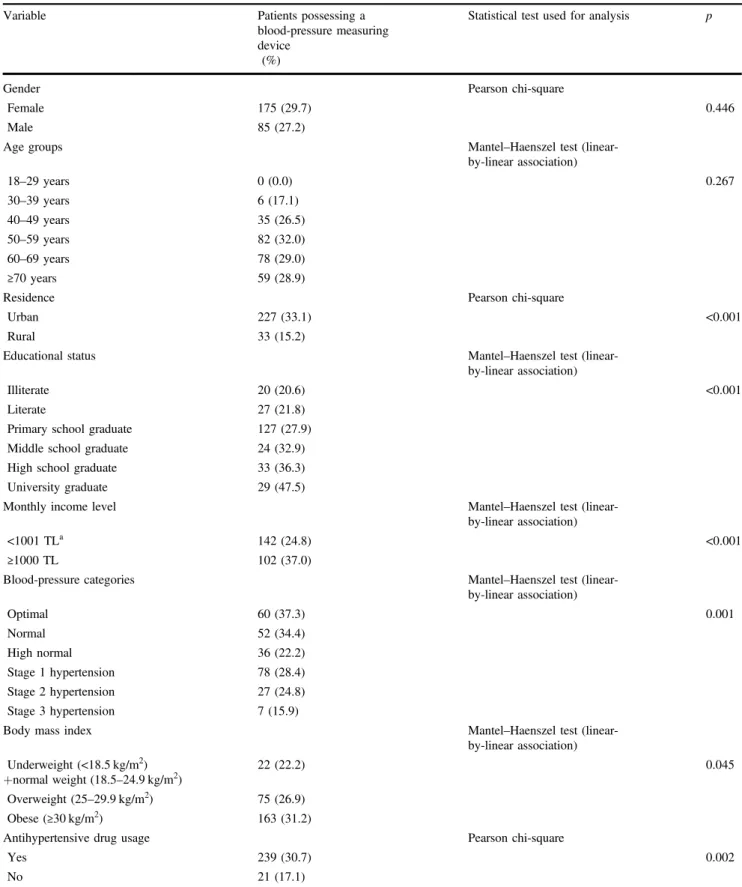
sphygmo-manometer among the patients who were aware of their HT
are presented in Tables
1
and
2
. Sphygmomanometer
ownership was signi
ficantly higher among participants
liv-ing in urban areas, participants with higher education status,
participants with higher income level and patients using
antihypertensive medication. Multivariate logistic
regres-sion analysis demonstrated that the factors associated with
owning a sphygmomanometer were female gender, older
age, higher educational status, living in urban areas and
antihypertensive drug use (Table
2
).
Device information
Of 660 devices, 482 (73%) were automated, wrist devices
being more common. Table
3
shows the types of
sphyg-momanometers owned among all participants and
hyper-tensive subjects who were aware of their HT.
HBPM practice among participants
Of the device owners, 429 (65%) stated that they had not
had any training regarding the operation of the device. The
participants learned the usage of their devices mainly from
their relatives and the sellers; the percentage of patients who
learned to use the device from healthcare professionals,
physicians or nurses was 29%, including relatives working
in health care.
Among patients who were aware of their HT, 50% stated
that they had not had any training regarding the operation of
the device, and the percentage of patients who learned to
use the device from healthcare professionals was 32%.
Among the patients who were aware of their HT, 204 had
automated devices, 74 (36%) of which were validated.
Twenty-two (18%) of the 120 wrist devices and 52 (62%) of
the 84 automated upper-arm devices were validated.
Table 1 Factors associated with possession of a blood-pressure measuring device in the hypertensive population who were aware of their hypertension
Variable Patients possessing a
blood-pressure measuring device
(%)
Statistical test used for analysis p
Gender Pearson chi-square
Female 175 (29.7) 0.446
Male 85 (27.2)
Age groups Mantel–Haenszel test
(linear-by-linear association) 18–29 years 0 (0.0) 0.267 30–39 years 6 (17.1) 40–49 years 35 (26.5) 50–59 years 82 (32.0) 60–69 years 78 (29.0) ≥70 years 59 (28.9)
Residence Pearson chi-square
Urban 227 (33.1) <0.001
Rural 33 (15.2)
Educational status Mantel–Haenszel test
(linear-by-linear association)
Illiterate 20 (20.6) <0.001
Literate 27 (21.8)
Primary school graduate 127 (27.9)
Middle school graduate 24 (32.9)
High school graduate 33 (36.3)
University graduate 29 (47.5)
Monthly income level Mantel–Haenszel test
(linear-by-linear association)
<1001 TLa 142 (24.8) <0.001
≥1000 TL 102 (37.0)
Blood-pressure categories Mantel–Haenszel test
(linear-by-linear association) Optimal 60 (37.3) 0.001 Normal 52 (34.4) High normal 36 (22.2) Stage 1 hypertension 78 (28.4) Stage 2 hypertension 27 (24.8) Stage 3 hypertension 7 (15.9)
Body mass index Mantel–Haenszel test
(linear-by-linear association) Underweight (<18.5 kg/m2) +normal weight (18.5–24.9 kg/m2) 22 (22.2) 0.045 Overweight (25–29.9 kg/m2) 75 (26.9) Obese (≥30 kg/m2) 163 (31.2)
Antihypertensive drug usage Pearson chi-square
Yes 239 (30.7) 0.002
No 21 (17.1)
Arm circumference and cuff size
The mean right-arm circumference was 30.0 cm among all
participants and was 29.6 cm for the participants of the
PATENT study. The mean right-arm circumference was
wider in hypertensive patients than that in hypertensive
patients in the PATENT study (31 cm vs. 30.6 cm). The
frequency of requiring a large cuff was 32% among aware
hypertensive patients having an upper-arm device, but only
one had a cuff
≥33 cm.
The association between possessing a home
sphygmomanometer and BP levels in hypertensive
patients who were aware of their disease
The mean SBP and DBPs among aware patients who had a
BP monitor were 5.8 mmHg and 3.4 mmHg lower than
those of patients not having a device. Validated and/or
upper-arm devices were associated with lower SBP and
DBPs (Table
4
).
The results of linear-regression analysis
While the baseline SBP was 143.9 mmHg in the HT
awareness group, linear-regression analysis indicated that
being male resulted in a 3.125-mmHg increase, and every
1-year increase in age resulted in a 0.291-mmHg increase (an
~3-mmHg increase with every 10-year increase in age);
furthermore, living in rural areas resulted in a 2.369-mmHg
increase in the baseline SBP (
p = 0.003, p < 0.001 and p =
0.027, respectively). On the other hand, each categorical
increase in income level resulted in a 2.401-mmHg
decrease, antihypertensive drug use resulted in a
14.386-mmHg decrease and the presence of a device at home
resulted in a 3.744-mmHg decrease in the baseline SBP
Table 2 Results of multivariate logistic regression analyses forownership of a blood-pressure measuring device
Variablesa Multivariate (p) Odds ratio 95% CI
Gender (female) 0.054 1.390 0.995–1.943
Age
18–39 years 1.0 (reference) 1.0 (reference)
40–49 years 0.138 2.088 0.788–5.528 50–59 years 0.025 2.903 1.144–7.369 60–69 years 0.031 2.805 1.100–7.149 70 years and above 0.021 3.109 1.190–8.124 Living in urban areas <0.001 2.609 1.729–3.936 Educational status
Illiterate 1.0 (reference) 1.0 (reference)
Literate 0.841 1.071 0.548–2.091 Primary school graduate 0.060 1.740 0.976–3.101 Middle school graduate 0.049 2.153 1.003–4.620 High school graduate 0.006 2.733 1.332–5.607 University graduate <0.001 3.991 1.862–8.555 Antihypertensive drug usage 0.012 1.922 1.153–3.205 CI confidence interval.
aThe variables included in the multivariate logistic regression analysis
were gender, age, educational status, living in urban areas, income level, blood-pressure categories, awareness of hypertension, antihy-pertensive drug usage, and body mass index. Only variables having significant differences are shown.
Table 3 Types of sphygmomanometers among all participants (including aware hypertensive subjects) and hypertensive subjects who were aware of their hypertension in 2012
Type of device All participants Aware hypertensive subjects
(n) (n)
Automated wrist 294 120
Automated upper arm 188 84
Aneroid 132 50
Mercury 4 1
Not at home 42 5
Total 660 260
Table 4 Mean systolic blood pressure (SBP) and diastolic blood pressure (DBP) according to the device type and validation status (only automatic devices are shown)
SBP DBP mmHg mmHg Device type Upper arm 133 73 Wrist 141 76 P=0.010 P=0.069 Validation status
Validated (upper arm+wrist) 133 72
Nonvalidated (upper arm+wrist) 140 77
P=0.011 P=0.014
Validated (upper arm) 132 72
Nonvalidated (upper arm) 135 76
P=0.293 P=0.093
Validated (wrist) 135 75
Nonvalidated (wrist) 142 77
(
p = 0.002, p < 0.001 and p = 0.002, respectively)
(Table
5
).
While the baseline DBP was 91.5 mmHg in the HT
awareness group, linear-regression analysis indicated that
being male resulted in a 1.384-mmHg increase and living in
rural areas resulted in a 2.335-mmHg increase in the
base-line DBP (
p = 0.031 and p < 0.001, respectively). On the
other hand, every 1-year increase in age resulted in a
0.145-mmHg decrease (~1.5-0.145-mmHg decrease with every 10-year
increase in age), antihypertensive drug use resulted in a
6.206-mmHg decrease and the presence of a device at home
resulted in a 2.837-mmHg decrease in the baseline DBP (
p
< 0.001 for each) (Table
6
).
Linear-regression analysis of factors affecting SBP and
DBP after strati
fication by antihypertensive drug use is
shown in Table
7
(the method and variables are the same as
those in Tables
5
and
6
; only the ownership of a
blood-pressure measuring device variable is shown). The
asso-ciation between possessing a BP device and BP decrease
remained after strati
fication by antihypertensive drug use.
Telephone survey in 2017
In total, 1318 hypertensive PatenT2 participants did not
have a BP monitor in 2012, and 437 were reached by
tel-ephone in 2017. After 2012, 254 (58.1%) of 437 patients
bought a new device. The types of devices were automated
upper arm (
n = 122, 48%), automated wrist (n = 82, 33%)
and nonautomated (
n = 48, 19%). The device type of two
owners could not be determined. Figure
1
shows the change
in sphygmomanometer type with time.
Discussion
The present study con
firmed the findings of the previous
study. Only the new
findings will be discussed. Among 902
hypertensive patients who were aware of their disease, 260
(28.8%) had a home sphygmomanometer, a lower rate than
that found in our
first survey in 2011 (28.8 vs. 46.6%). As
mentioned in our paper [
23
], the
first survey using
computer-assisted telephone interviewing had some
limita-tions. The
findings of the 2017 telephone survey supported
a possible Hawthorne effect and showed that the frequency
of ownership of a sphygmomanometer had increased. Forty
two (6%) of the 660 devices were not in the houses of the
participants during our visit in this study, which indicated
Table 5 Linear-regression analysis of factors affecting systolic bloodpressure
Variables Multivariate (p) β
Constant coefficient <0.001 143.923
Gender (male) 0.003 3.125
Age <0.001 0.291
Living in rural areas 0.027 2.369
Educational status 0.214 −0.578
Income level 0.002 −2.401
Euro-stat region 0.550 0.085
BMI 0.342 −0.087
Antihypertensive drug usage <0.001 −14.386 Ownership of a blood-pressure
measuring device
0.002 −3.744
Table 6 Linear-regression analysis of factors affecting diastolic blood pressure.
Variables Multivariate (p) β
Constant coefficient <0.001 91.537
Gender (male) 0.031 1.384
Age <0.001 −0.145
Living in rural areas <0.001 2.335
Educational status 0.674 −0.121
Income level 0.083 −0.849
Euro-stat region 0.474 0.063
BMI 0.497 0.038
Antihypertensive drug usage <0.001 −6.206 Ownership of a blood-pressure measuring
device
<0.001 −2.837
Table 7 Linear-regression analysis of factors affecting systolic blood pressure (SBP) and diastolic blood pressure (DBP) after stratification by the antihypertensive drug use (method and variables same as Tables5and6, only ownership of a blood-pressure measuring device variable is shown) Multivariate (p) β Antihypertensive drug (+) SBP 0.019 −4.107 DBP 0.004 −2.880 Antihypertensive drug (–) SBP 0.160 −2.566 DBP 0.030 −2.758
Fig. 1 Comparison of sphygmomanometer types in three surveys by time (the results are expressed as percentages)
that BP monitors can be shared among neighbors and
relatives.
The most striking
finding of our study was the
demon-stration of an association between sphygmomanometer
ownership and BP decrease [
31
,
32
] in a nationwide
field
survey. The SBP and DBPs among aware hypertensive
patients possessing a home BP monitor were 5.8 and 3.4
mmHg lower, respectively, than those of patients that did
not have one. The linear-regression analysis showed that
possessing a BP device is associated with a decrease of 3.7
mmHg and 2.8 mmHg on SBP and DBPs, respectively. To
our knowledge, similar nationwide data are not available.
The
findings of this study support previous data regarding
the usefulness of HBPM [
33
,
34
]. Moreover, it should be
kept in mind that nonadherence to the recommended
guidelines for BP measurement is a common problem [
35
],
and the consecutive measurement of BP (two times) may be
more useful [
36
].
The cause of lower BP in patients possessing a
sphyg-momanometer is not known, and the current study was not
designed to
find the answer to this question. It can be argued
that compliant patients willing to learn, measure and control
their BP bought a sphygmomanometer, as reported by
Ayala et al. [
37
]; regardless, the association between
pos-sessing a BP monitor and lower BP supports the notion that
HBPM is a supplementary tool in the control of BP.
Ostchega et al. [
38
] reported that hypertensive patients who
received providers
’ recommendations to perform HBPM
were more likely to do so than those who did not receive
recommendations. Home BP monitoring and home BP
monitor reimbursement have been recommended by many
guidelines [
10
–
14
]. Our data support the previous evidence
suggesting that HBPM may be cost-effective [
2
,
18
,
34
];
therefore, home BP monitor reimbursement should be
encouraged. Lifestyle changes are the effective measures in
the management of HT. Home BP monitoring is a lifestyle
change that can increase treatment adherence [
14
]. Dietary
salt reduction is an effective lifestyle change in the
man-agement of HT and can save billions of healthcare-related
payments [
39
]. Similarly, owning a home BP monitor may
play a role in improving BP control and could save
HT-related treatment expenses, including the cost of
medica-tion. In addition, HBPM is a good supplementary tool for
the improvement of BP control in low-income countries
[
40
].
There were problems in the patients
’ choice of a BP
monitor, such as device validation and the use of an
appropriate cuff bladder for nonstandard arm circumference
sizes in addition to the dominance of wrist devices. It is
encouraging to see the increasing number of upper arm
automated sphygmomanometers (Fig.
1
). Since obesity and
arm circumference are increasing, problems related to cuff
size may also increase. Many nonvalidated devices are
being introduced into the market [
41
–
43
], and only 36% of
the devices in this study were validated. Blood pressure was
lower among hypertensive patients possessing a validated
and/or upper-arm BP monitor (Table
4
). Since the use of an
appropriate cuff size is essential for the accurate
measure-ment of BP [
3
,
10
,
11
], overweight and obese patients often
require sphygmomanometers with large or extra-large cuffs.
Although most regular cuff sizes are appropriate for patients
having an arm circumference of 22
–32 cm, more than 30%
of the patients having an upper-arm device required large
cuffs, but only one (less than 1%) patient had a large cuff,
indicating ignorance of the problem.
This was the
first study investigating the arm
cir-cumference of a Turkish population, and the results
demonstrated that arm circumference and the frequency of
patients requiring a large cuff were increased compared to
2003 [
24
]. Since obesity continues to increase and arm
circumference is closely associated with obesity [
44
], it is
expected that the number of patients requiring a large cuff
will increase.
In conclusion, despite market prices being reasonable
(cheaper than 30
–50 Euros; most patients can afford this in
Turkey), many patients do not have a sphygmomanometer.
The use of wrist devices and nonvalidated devices is
com-mon, and the selection of an appropriately sized cuff is
ignored in obese patients. The demonstration of an
asso-ciation between sphygmomanometer ownership and BP
decrease was a striking
finding. As demonstrated in
several studies, the implementation of a HT care program
consisting of sphygmomanometer reimbursement, training
patients on how to use the device and HBPM can be
cost-effective.
Acknowledgements The study was sponsored by the Turkish Society of Hypertension and Renal Diseases. Thefield study, training and supervision of thefield healthcare workers and data collection were carried out by the OMEGA Contract Research Organization in Turkey. The sponsor, the Turkish Society of Hypertension and Renal Diseases, assigned the study group and was involved in the study design.
Funding The present study was supported by the Turkish Society of Hypertension and Renal Diseases (Ankara, Turkey).
Compliance with ethical standards
Conflict of interest The authors declare that they have no conflict of interest.
Open Access This article is licensed under a Creative Commons Attribution-NonCommercial-NoDerivatives 4.0 International License, which permits any non-commercial use, sharing, distribution and reproduction in any medium or format, as long as you give appropriate credit to the original author(s) and the source, and provide a link to the Creative Commons license. You do not have permission under this
license to share adapted material derived from this article or parts of it. The images or other third party material in this article are included in the article’s Creative Commons license, unless indicated otherwise in a credit line to the material. If material is not included in the article’s Creative Commons license and your intended use is not permitted by statutory regulation or exceeds the permitted use, you will need to obtain permission directly from the copyright holder. To view a copy of this license, visithttp://creativecommons.org/licenses/by-nc-nd/4.0/.
References
1. Pickering TG, Miller NH, Ogedegbe G, Krakoff LR, Artinian NT, Goff D, American Heart Association; American Society of Hyper-tension; Preventive Cardiovascular Nurses Association. Call to action on use and reimbursement for home blood pressure monitoring: a joint scientific statement from the American Heart Association, American Society of Hypertension, and Preventive Cardiovascular Nurses Association. J Cardiovasc Nurs. 2008;23:299–323. 2. Carrera PM, Lambooij MS. Implementation of out-of-office blood
pressure monitoring in the Netherlands: from clinical guidelines to patients’ adoption of innovation. Medicine (Baltimore). 2015;94: e1813.
3. Shimamoto K, Ando K, Fujita T, Hasebe N, Higaki J, Horiuchi M, Imai Y, Imaizumi T, Ishimitsu T, Ito M, Ito S, Itoh H, Iwao H, Kai H, Kario K, Kashihara N, Kawano Y, Kim-Mitsuyama S, Kimura G, Kohara K, Komuro I, Kumagai H, Matsuura H, Miura K, Morishita R, Naruse M, Node K, Ohya Y, Rakugi H, Saito I, Saitoh S, Shimada K, Shimosawa T, Suzuki H, Tamura K, Tanahashi N, Tsuchihashi T, Uchiyama M, Ueda S, Umemura S, Japanese Society of Hypertension Committee for Guidelines for the Management of Hypertension. The Japanese Society of Hypertension Guidelines for the Management of Hypertension (JSH 2014). Hypertens Res. 2014;37:253–392.
4. Krecke HJ, Lütkes P, Maiwald M. Patient assessment of self-measurement of blood pressure: results of a telephone survey in Germany. J Hypertens. 1996;14:323–326.
5. Cuspidi C, Meani S, Lonati L, Fusi V, Magnaghi G, Garavelli G, Palumbo G, Pini C, Vaccarella A, Parati G, Leonetti G, Zanchetti A, Lombardy Regional Section of the Italian Hypertension Society. Prevalence of home blood pressure measurement among selected hypertensive patients: results of a multicenter survey from six hospital outpatient hypertension clinics in Italy. Blood Press. 2005;14:251–256.
6. Cuspidi C, Sala C, Casati A, Bombelli M, Grassi G, Mancia G. Clinical and prognostic value of hypertensive cardiac damage in the PAMELA study. Hypertens Res. 2017;40:329–335. 7. Ntineri A, Stergiou GS, Thijs L, Asayama K, Boggia J,
Bou-bouchairopoulou N, Hozawa A, Imai Y, Johansson JK, Jula AM, Kollias A, Luzardo L, Niiranen TJ, Nomura K, Ohkubo T, Tsuji I, Tzourio C, Wei FF, Staessen JA. Relationship between office and home blood pressure with increasing age: The International Database of HOme blood pressure in relation to Cardiovascular Outcome (IDHOCO). Hypertens Res. 2016;39:612–7.
8. Kario K, Saito I, Kushiro T, Teramukai S, Yaginuma M, Mori Y, Okuda Y, Kobayashi F, Shimada K. Persistent olmesartan-based blood pressure-lowering effects on morning hypertension in Asians: the HONEST study. Hypertens Res. 2016;39:334–41. 9. Ishikura K, Obara T, Kikuya M, Satoh M, Hosaka M, Metoki H,
Nishigori H, Mano N, Nakayama M, Imai Y, Ohkubo T, J-HOME-Morning Study Group. Home blood pressure level and decline in renal function among treated hypertensive patients: the J-HOME-Morning Study. Hypertens Res. 2016;39:107–12. 10. Imai Y, Kario K, Shimada K, Kawano Y, Hasebe N, Matsuura H,
Tsuchihashi T, Ohkubo T, Kuwajima I, Miyakawa M, Japanese
Society of Hypertension Committee for Guidelines for Self-monitoring of Blood Pressure at Home. The Japanese Society of Hypertension Guidelines for Self-monitoring of Blood Pressure at Home (second edition). Hypertens Res. 2012;35:777–95. 11. Parati G, Stergiou GS, Asmar R, Bilo G, DeLeeuw P, Imai Y,
Kario K, Lurbe E, Manolis A, Mengden T, O’Brien E, Ohkubo T, Padfield P, Palatini P, Pickering TG, Redon J, Revera M, Ruilope LM, Shennan A, Staessen JA, Tisler A, Waeber B, Zanchetti A, Mancia G. European Society of Hypertension practice guidelines for home blood pressure monitoring. J Hum Hypertens. 2010;24:779–785.
12. Leung AA, Nerenberg K, Daskalopoulou SS, McBrien K, Zarnke KB, Dasgupta K, Cloutier L, Gelfer M, Lamarre-Cliche M, Milot A, Bolli P, Tremblay G, McLean D, Tobe SW, Ruzicka M, Burns KD, Vallée M, Prasad GV, Lebel M, Feldman RD, Selby P, Pipe A, Schiffrin EL, McFarlane PA, Oh P, Hegele RA, Khara M, Wilson TW, Penner SB, Burgess E, Herman RJ, Bacon SL, Rabkin SW, Gilbert RE, Campbell TS, Grover S, Honos G, Lindsay P, Hill MD, Coutts SB, Gubitz G, Campbell NR, Moe GW, Howlett JG, Boulanger JM, Prebtani A, Larochelle P, Leiter LA, Jones C, Ogilvie RI, Woo V, Kaczorowski J, Trudeau L, Petrella RJ, Hiremath S, Drouin D, Lavoie KL, Hamet P, Fodor G, Grégoire JC, Lewanczuk R, Dresser GK, Sharma M, Reid D, Lear SA, Moullec G, Gupta M, Magee LA, Logan AG, Harris KC, Dionne J, Fournier A, Benoit G, Feber J, Poirier L, Padwal RS, Rabi DM; CHEP Guidelines Task Force. Hypertension Canada’s 2016 Canadian Hypertension Education Program Guidelines for Blood Pressure Measurement, Diagnosis, Assessment of Risk, Prevention, and Treatment of Hypertension. Can J Cardiol. 2016;32: 569–88.
13. National Heart Foundation of Australia. Guideline for the diag-nosis and management of hypertension in adults – 2016. Mel-bourne: National Heart Foundation of Australia; 2016.
14. Mancia G, Fagard R, Narkiewicz K, Redon J, Zanchetti A, Böhm M, ChristiaensT, Cifkova R, De Backer G, Dominiczak A, Gal-derisi M, Grobbee DE, Jaarsma T, Kirchhof P, Kjeldsen SE, Laurent S, Manolis AJ, Nilsson PM, Ruilope LM, Schmieder RE, Sirnes PA, Sleight P, Viigimaa M, Waeber B, Zannad F, Redon J, Dominiczak A, Narkiewicz K, Nilsson PM, Burnier M, Viigimaa M, Ambrosioni E, Caufield M, Coca A, Olsen MH, Schmieder RE, Tsioufis C, van de Borne P, Zamorano JL, Achenbach S, Baumgartner H, Bax JJ, Bueno H, Dean V, Deaton C, Erol C, Fagard R, Ferrari R, Hasdai D, Hoes AW, Kirchhof P, Knuuti J, Kolh P, Lancellotti P, Linhart A, Nihoyannopoulos P, Piepoli MF, Ponikowski P, Sirnes PA, Tamargo JL, Tendera M, Torbicki A, Wijns W, Windecker S, Clement DL, Coca A, Gillebert TC, Tendera M, Rosei EA, Ambrosioni E, Anker SD, Bauersachs J, Hitij JB, Caulfield M, De Buyzere M, De Geest S, Derumeaux GA, Erdine S, Farsang C, Funck-Brentano C, Gerc V, Germano G, Gielen S, Haller H, Hoes AW, Jordan J, Kahan T, Komajda M, Lovic D, Mahrholdt H, Olsen MH, Ostergren J, Parati G, Perk J, Polonia J, Popescu BA, Reiner Z, Rydén L, Sirenko Y, Stanton A, Struijker-Boudier H, Tsioufis C, van de Borne P, Vlachopoulos C, Volpe M, Wood DA. 2013 ESH/ESC guidelines for the man-agement of arterial hypertension: the Task Force for the Man-agement of Arterial Hypertension of the European Society of Hypertension (ESH) and of the European Society of Cardiology (ESC). Eur Heart J. 2013;34:2159–219.
15. Omboni S, Sala E. The pharmacist and the management of arterial hypertension: the role of blood pressure monitoring and tele-monitoring. Expert Rev Cardiovasc Ther. 2015;13:209–21. 16. Omboni S, Guarda A. Impact of home blood pressure
tele-monitoring and blood pressure control: a meta-analysis of ran-domized controlled studies. Am J Hypertens. 2011;24:989–98. 17. McManus RJ, Mant J, Haque MS, Bray EP, Bryan S, Greenfield
Shackleford H, Shovelton C, Varghese J, Williams B, Hobbs FD, Gooding T, Morrey I, Fisher C, Buckley D. Effect of self-monitoring and medication self-titration on systolic blood pressure in hypertensive patients at high risk of cardiovascular disease: the TASMIN-SR randomized clinicaltrial. JAMA. 2014;312:799–808.
18. Stergiou GS, Bliziotis IA. Home blood pressure monitoring in the diagnosis and treatment of hypertension: a systematic review. Am J Hypertens. 2011;24:123–134.
19. Association For The Advancement Of Medical Instrumentation. American National Standard for Electronic or Automated Sphygmomanometers: ANSI/AAMI SP10-1993. Arlington, Vir-ginia: AAMI; 1993.
20. O’Brien E, Petrie J, Littler WA, de Swiet M, Padfield PL, Altman D, Bland M, Coats A, Atkins N The British Hypertension Society Protocol for the evaluation of blood pressure measuring devices. J Hypertens. 1993;11: S43–63.
21. O’Brien E, Pickering T, Asmar R, Myers M, Parati G, Staessen J, Mengden T, Imai Y, Waeber B, Palatini P, Gerin W. Working Group on Blood Pressure Monitoring of the European Society of Hypertension International Protocol for validation of blood pres-sure measuring devices in adults. Blood Press Monit. 2002;7:3–17.
22. O’Brien E, Atkins N, Stergiou G, Karpettas N, Parati G, Asmar R, Imai Y, Wang J, Mengden T, Shennan A.Working Group on Blood Pressure Monitoring of the European Society of Hyper-tension European Society of HyperHyper-tension International Protocol revision 2010 for the validation of blood pressure measuring devices in adults. Blood Press Monit. 2010;15:23–38.
23. Akpolat T, Erdem Y, Derici U, Erturk S, Caglar S, Hasanoglu E, Karatan O, Sindel S, Turgan C. Use of homesphygmomanometers in Turkey: a nation-wide survey. Hypertens Res. 2012;35:356–61. 24. Altun B, Arici M, Nergizoğlu G, Derici U, Karatan O, Turgan C, Sindel S, Erbay B, Hasanoğlu E, Cağlar S.for the Turkish Society of Hypertension and Renal Diseases Prevalence, awareness, treatment and control of hypertension in Turkey (the PatenT study) in 2003. J Hypertens. 2005;23:1817–1823.
25. Arici M, Turgan C, Altun B, Sindel S, Erbay B, Derici U, Karatan O, Erdem Y, Hasanoglu E, Caglar S.Turkish Society of Hyper-tension and Renal Diseases HyperHyper-tension incidence in Turkey (HinT): a population-based study. J Hypertens. 2010;28:240–244. 26. Erdem Y, Arici M, Altun B, Turgan C, Sindel S, Erbay B, Derici U, Karatan O, Hasanoglu E, Caglar S. The relationship between hypertension and salt intake in Turkish population: SALTURK study. Blood Press. 2010;19:313–318.
27. Sengul S, Akpolat T, Erdem Y, Derici U, Arici M, Sindel S, Karatan O, Turgan C, Hasanoglu E, Caglar S, Erturk S.Turkish Society of Hypertension and Renal Diseases Changes in hyper-tension prevalence, awareness, treatment, and control rates in Turkey from 2003 to 2012. J Hypertens. 2016;34:1208–17. 28. Mancia G, De Backer G, Dominiczak A, Cifkova R, Fagard R,
Germano G, Grassi G, Heagerty AM, Kjeldsen SE, Laurent S, Narkiewicz K, Ruilope L, Rynkiewicz A, Schmieder RE, Boudier HA, Zanchetti A, Vahanian A, Camm J, De Caterina R, Dean V, Dickstein K, Filippatos G, Funck-Brentano C, Hellemans I, Kristensen SD, McGregor K, Sechtem U, Silber S, Tendera M, Widimsky P, Zamorano JL, Erdine S, Kiowski W, Agabiti-Rosei E, Ambrosioni E, Lindholm LH, Viigimaa M, Adamopoulos S, Agabiti-Rosei E, Ambrosioni E, Bertomeu V, Clement D, Erdine S, Farsang C, Gaita D, Lip G, Mallion JM, Manolis AJ, Nilsson PM, O’Brien E, Ponikowski P, Redon J, Ruschitzka F, Tamargo J, vanZwieten P, Waeber B, Williams B.Management of Arterial Hypertension of the European Society of Hypertension; European Society of Cardiology. 2007 Guidelines for the Management of Arterial Hypertension: The Task Force for the Management of
Arterial Hypertension of the European Society of Hypertension (ESH) and of the European Society of Cardiology (ESC). J Hypertens. 2007;25:1105–1187.
29. dabl®Educational Trust. Available from: http://www.dableduca-tional.org.
30. BHS-Blood Pressure List. Available from: http://www.bhsoc.org/ blood_pressure_list.stm.
31. Cuspidi C, Meani S, Fusi V, Salerno M, Valerio C, Severgnini B, Catini E, Leonetti G, Magrini F, Zanchetti A. Home blood pres-sure meapres-surement and its relationship with blood prespres-sure control in a large selected hypertensive population. J Hum Hypertens. 2004;18:725–31.
32. Obara T, Ohkubo T, Asayama K, Metoki H, Inoue R, Kikuya M, Kato T, Tanaka K, Hara A, Hashimoto J, Totsune K, Imai Y, J-HOME Study Group. Home blood pressure measurements asso-ciated with better blood pressure control: the J-HOME study. J Hum Hypertens. 2008;22:197–204.
33. Bray EP, Holder R, Mant J, McManus RJ. Does self-monitoring reduce blood pressure? Meta-analysis with meta-regression of randomized controlled trials. Ann Med. 2010;42:371–86. 34. Penaloza-Ramos MC, Jowett S, Mant J, Schwartz C, Bray EP,
Sayeed Haque M, Richard Hobbs FD, Little P, Bryan S, Williams B, McManus RJ. . Cost-effectiveness of self-management of blood pressure in hypertensive patients over 70 years with sub-optimal control and established cardiovascular disease or addi-tional cardiovascular risk diseases (TASMIN-SR). Eur J Prev Cardiol. 2016;23:902–12.
35. Levy J, Gerber LM, Wu X, Mann SJ. Nonadherence to recom-mended guidelines for blood pressure measurement. J Clin Hypertens (Greenwich). 2016;18:1157–1161.
36. Saito I, Kario K, Kushiro T, Teramukai S, Yaginuma M, Mori Y, Okuda Y, Shimada K. Home blood pressure and cardiovascular risk in treated hypertensive patients: the prognostic value of the first and second measurements and the difference between them in the HONEST study. Hypertens Res. 2016;39:857–862.
37. Ayala C, Tong X, Neeley E, Lane R, Robb K, Loustalot F. Home blood pressure monitoring among adults-American Heart Asso-ciation Cardiovascular Health Consumer Survey 2012. J Clin Hypertens (Greenwich). 2017;19:584–591.
38. Ostchega Y, Zhang G, Kit BK, Nwankwo T. Factors associated with home blood pressure monitoring among US adults: National Health and Nutrition Examination Survey, 2011-2014. Am J Hypertens. 2017;30:1126–1132.
39. Bibbins-Domingo K, Chertow GM, Coxson PG, Moran A, Lightwood JM, Pletcher MJ, Goldman L. Projected effect of dietary salt reductions on future cardiovascular disease. N Engl J Med. 2010;362:590–9.
40. Ndip Agbor V, Temgoua MN, Noubiap JJ. Scaling up the use of home blood pressure monitoring in the management of hyper-tension in low-income countries: a step towards curbing the bur-den of hypertension. J Clin Hypertens (Greenwich). 2017;19:786–789.
41. Akpolat T, Aydogdu T, Erdem E, Karatas A. Inaccuracy of homesphygmomanometers: a perspective from clinical practice. Blood Press Monit. 2011;16:168–71.
42. Jung MH, Kim GH, Kim JH, Moon KW, Yoo KD, Rho TH, Kim CM. Reliability of home blood pressure monitoring: in the context of validation and accuracy. Blood Press Monit. 2015;20:215–20. 43. O’Brien E. Ambulatory blood pressure measurement: the case for implementation in primary care. Hypertension. 2008;51:1435–41. 44. Graves JW, Bailey KR, Sheps SG. The changing distribution of arm circumferences in NHANES III and NHANES 2000 and its impact on the utility of the ‘standard adult’ blood pressure cuff. Blood Press Monit. 2003;8:223–227.