DBCISÏON 3 ü i# O R ï T^OOl
■b- r - ■ r? :-J '.^ P -••■ЧГ' · / :г і -r. ·■ . ; /"■.■ *' <»■ · ' . ' % / , , · ! ■ .'
A DECISION SUPPORT TOOL FOR FUND MANAGEMENT
A THESIS
SUBMITTED TO THE FACULTY OF MANAGEMENT
AND THE GRADUATE SCHOOL OF BUSINESS ADMINISTRATION OF BILKENT UNIVERSITY
IN PARTIAL FULFILLMENT OF THE REQUIREMENTS FOR THE DEGREE OF
MASTER OF BUSINESS ADMINISTRATION
by
H Q r
I certify that I have read this thesis and in my opinion it is
fully adequate, in scope and quality, as a thesis for the
degree of Master of Business Administration.
Assist Prof. Dilek Onkal I certify that I have read this thesis and in my opinion it is
fully adequate, in scope and quality, as a thesis for the
degree of Master of Business Administration.
Assist Prof. Serpil Sayın I certify that I have read this thesis and in my opinion it is
fully adequate, in scope and quality, as a thesis for the
degree of Master of Business Administration.
// V
4.
Assist Prof. Can Simga Mugan
Approved for the Graduate School of Business Administration
Prof. Dr. Subidey Togan
ABSTRACT
The purpose of this thesis is (1) to provide an overview for asset liability management approach to the bank management, and (2) to develop a tool for the senior management of a bank, which will be useful for the decision making process.
The software developed will enable managers to see the risks
involved, therefore make it easier to hedge them. The software
will provide the user with profit-loss projections for given scenarios of the economy (FC devaluation, interest rates,etc.) for
a certain structure of the balance sheet. Users will also be able
to observe the changes in the profit/loss with changes in the items of the balance sheet for given economic scenarios.
Keywords: asset/liability management, interest rate risk, gap analysis, duration analysis, decision support, fund management
ÖZET
Bu tezin amacı; (1) baıika üst yönetimi tarafından uygulanan
Aktif Pasif Yönetimi yaklaşımı için genel bir açıklama getirmek,
ve (2) Aktif Pasif Yönetimi doğrultusunda verilecek kararlarda
banka üst yönetimine yardımcı olacak bir program uygulaması
geliştirmektir.
Burada geliştirilen program üst yönetime belirli senaryolar
altında verecekleri kararlar sonucu ortaya çıkacak riskleri ve
sonuçları gösterecektir.
Devalüasyon oranı, faiz oranları gibi
ülke
ekonomisi,
pazar
koşullarına göre
belirlenecek olan
senaryolar altında banka yönetiminin stratejisini gösteren karar
değişkenleri girişi yapılarak
ileride karşılaşılacak
banka
kar/zarar koşulları hesaplanacaktır.
Anahtar Kelimeler
:
Aktif/Pasif Yönetimi,
riski,
faiz farkı analizi,
süre analizi,
karar
yönetimi.
faiz oranı
destek,
fon
ACKNOWLEDGEMENTS
I have received much help and contribution from many
individuals in preparing this study. I am very grateful to the
Bilkent University Management Department and especially to the Assist. Professor Dilek Onkal because of the support she has
provided, while supervising me. I would also like to thank to my
other thesis committee members Asst. Prof. Serpil Sayin and Asst. Prof. Can Simga Mugan for their valuable comments and suggestions which contributed a lot to the product.
I am also grateful to iktisat Bankasi EDP Department,
especially Mr. Hakki Eren, Mrs. Sena Gungor and Mr. Burhan Erdoğan for supporting me.
In addition, I would also like to thank my colleagues for their comments and support.
TABLE OF CONTENTS
PAGE
ABSTRACT ... i O Z E T ... ii ACKNOWLEDGEMENTS ... iii I. INTRODUCTION ... 1II. BANKING AND FUND M A N A G E M E N T ... 5
A. Considerations Guiding Funds Management ... 6
B. A Theoretical Frame for Bank Fund M a n a g e m e n t ... 8
III. DYNAMIC BALANCE SHEET MANAGEMENT ... 12
IV. ASSET LIABILITY MANAGEMENT ... 15
A. Evaluation of the Asset Liability Management Approach . 16 V. PLANNING ASSET LIABILITY MANAGEMENT ... 20
A. The Necessary Information for Asset Liability M a n a g e m e n t ; ...20
B. Asset Liability Management Reports ... 24
C. Definition of the ALM Targets by Amounts and Ratios . . 27
VI. ASSET LIABILITY MANAGEMENT STRATEGIES ... 30
A. Interest Rate R i s k ; ... 31
B. Gap A n a l y s i s ... 32
C. Interest Sensitivity Management ... 35
D. Duration Analysis ... 36
VII. ASSET LIABILITY MANAGEMENT SOFTWARE ... 38
VIII. PURPOSE OF THE DECISION SUPPORT TOOL ... 43
A. Setting Up The T a b l e s ... 44
B. How to Use the Decision Support Tool ... 51
C. A Case Used in the Decision Support T o o l ... 52
IX. C O N C L U S I O N ... 56
X. APPENDIX A ... 60
XI. APPENDIX B ... 65
XII. APPENDIX C ... 71
PAGE
TABLE I Necessary Information For Planning A L M ... 22
TABLE II Financial Table For The F o r e c a s t s ... 23
TABLE III ALM Reporting S y s t e m ...25
TABLE IV Interest Sensitive A/L Analysis... 27
TABLE V Gap T a b l e ... 32
TABLE VI Ideal Gap M a n a g e m e n t ... 34
TABLE VII Portfolio Duration Example ... 37
I .INTRODUCTION
Bank funds management is the key to short to intermediate term
decision making in today's dynamic and volatile banking
environment. Broadly defined, funds management includes all
policies and approaches designed to obtain funds from deposits and
borrowing, and to allocate them to loans and investments. Bank
management had a greater control over growth, liguidity and
profitability as a result of the realized economic changes after
the World War II. This led bankers to seek guidelines for
effective strategies in managing bank funds.
Until the years of World War II banking was guite static. Balance sheet management mainly consisted of collecting deposits and allocating them to loans. During the 1940's the banking system served as a key instrument of war finance.
Treasury securities became the most important item of bank
fund management instruments. The environment of the 1950's brought
about different factors. Growing urbanization and population
shifts to suburbs prompted development of retail banking. Banks
doubled their branch offices and realized an impressive market
expansion through mergers. During 1950's banks were more
interested in the asset side of their balance sheet since the growth in their stable and low cost demand and savings deposits was still continuing and they were able to work with large spreads.
The 1 9 6 0 's produced a different outlook. A long period of
increase in business and consumer loans. Innovative bankers developed new markets for their interest-bearing liabilities and with the unlimited availability of high-quality loans, expanded
banking assets with purchased funds. During this decade, emphasis
had shifted toward a new understanding of liability management which stressed broad money market sources as means of supplementing
a bank's customer deposit base. However, with rapid growth came
increasing costs, narrowing spreads, deteriorating liquidity and weaker capital positions.
The unstable international economy in the 1 9 7 0 's and high inflation made economies more recession suitable and economic
fluctuations more volatile. Following the steady growth
environment of the 1960's, bankers were ill prepared for the ups
and downs in the economy and interest rates in the 1 9 7 0 's. The
combination of high cost of funds and large loan losses resulted in small spreads, weakened liquidity and capital positions which also brought about pressure from regulators. The experience of 1970's
helped in understanding the necessity of introducing more
comprehensive interactive approaches to funds management which would emphasize both asset and liability side of the balance sheet.
In an environment of volatile economy, bankers must seek better knowledge for the implications of bank performance, high
interest rates and substantial rate fluctuations. As a result,
computer-based system approaches to bank funds management are
needed to guide decision making. System-oriented approaches are
used for measuring interest rate exposure of various balance sheet combinations and strategies under possible interest rate changes
with the help of computer-based systems.
A variety of PC-based software simulation models are developed
for asset-liability management. The goal of these models is the
optimization of profitability while managing all balance sheet
risks on an integrated basis. The use of these simulation models
depends on the risk preferences of bank management and bank policies.
Considerations of a bank searching for a simulation model should be to find answers to questions such as why the bank is interested in this model and what financial information should be
achieved. Most of the simulation models offer the same basic
functions. While considering to customize the models for the
bank's characteristics and management strategies, there are
limitations for the use of these models.
This study, aiming at an investigation of changing bank funds management concepts, starts with considerations that guide the
development of overall funding strategies. The theoretical frame
of Bank Fund management is discussed and the two main system approaches. Dynamic Balance Sheet Management and Asset Liability
Management, are evaluated. After explaining the recent asset
liability management software developments, a decision support tool for bank fund management is introduced in the last section of this
thesis. This model simulates the balance sheet and income
statement by decision variables and scenarios input according to
the bank strategies. However, it only gives possible results for
a certain condition but not the probable hedging techniques. According to the given scenarios, user is able to see the duration
and gap analysis results. The model is developed by using Quatro
Pro software tool. The balance sheet information used in the tool
are input manually as the proposed decision support tool has no
connection with the host banking system. If the information is
going to be down-loaded from the bank system, a structural re organization is needed for the down-loaded items.
As new markets are developing and the environment is becoming
more competitive banking problems are getting more complex. One
banking function more than any other focuses on the common objective of all facets of banking: the management of funds
available to the institution. It is this function that ties
together the lending, investing and deposit acquiring activities of
the entire institution. This function provides the means for
coordinating separate functional objectives so as to assure maximum overall profits for the bank.
Financial management of commercial banks has historically been
conservative. Bankers have been more sensitive to their capital
position when compared with non-financial corporations and to their
obligations to pay depositors on demand. Bankers should emphasize
liquidity and safety. But the attitude of bankers toward risk has
not been unvarying and from time to time it has changed in response to significant developments affecting the banking sector (Baker, 1978) .
In the 1970's, under the impact of severe economic problems, both bank operations and the attitudes of bankers and non-bankers
toward risk have changed significantly. It has been thought that
banking has gone too far in the direction of risk taking. Under
the inflationary environment of 1980's, interest rates have not only been higher than before but they have also been more variable. High variability of interest rates added a new dimension to the
bank funds management. The need to hedge or to protect against
interest rate movements that may be unpredictable in an
inflationary world has led bank management to control the spread between cost of funds and return on funds, so that the spread remains stable even as interest rates change (Clifford, 1975).
A.Considerations Guiding Funds Management
In an inflationary world unpredictable interest rate movements led banks to search for better techniques to control their funds. The existing limitations and requirements for funds management are capital requirements, liquidity satisfaction, diversification of financial liabilities, hedged exposed asset liability positions and
profitability. These issues are explained in detail next.
Capital Requirements
The choice of the type and amount of capital to be used is
important for the bank's profitability. For an individual bank
capital serves several purposes, the prominent ones being;
(a) to provide funds for non interest earning assets such as the bank building and its equipment, (b) to provide a cushion for absorbing potential losses in the value of assets, (c) to give depositors and public generally the feeling that the bank has the strength to overcome varying economic conditions and absorb losses
on sales of securities when necessary, (d) to comply with
requirements of supervisory authorities.
convince bank creditors that protection is adequate to cushion the impact of a growth in purchased funds and to satisfy bank's own need for a dependable source of funds to support asset expansion while complying with the requirements of regulatory authorities.
Need to Satisfy Liquidity
Liquidity can be defined as the bank's ability not only to meet possible deposit withdrawals with minimum or no loss, but also to provide for the legitimate credit needs of the community as
well. Balance sheet relationships have been used to measure
individual bank liquidity most of which are inadequate. Ratios of
loans to deposits have been considered standard measures of bank
liquidity. The responsibility of the bank management is to find
the right equilibrium.
Diversification of Financial Liabilities
The important policy consideration for bank funds management is to limit the use of individual types of money market funds, to make sure a portfolio of borrowing is diversified enough that it
does not depend too much on any one source. A bank can diversify
its portfolio of financial liabilities by issuing claims with different maturities or by issuing different securities.
Hedge Exposed Asset Liability Positions
Some banks hedge interest rate exposure by off-setting
liabilities with assets of equal maturities. The bank intends to
liability and the rate charged on the loan. To the extent banks prefer to hedge themselves by maturity matching, they might give up opportunities for profits because they do not fit into the maturity
structure of the existing portfolios. For greater flexibility and
greater profitability most banks keep only an approximate hedged position.
Prof itabilitv
The primary objective of bank managers should be to maximize
income and control risk for the benefit of shareholders. Such an
objective implies reasonable stability of income over time as well as the highest consistent level of income with acceptable risk. To achieve this objective bankers need to emphasize the management of two main areas, first area is the interest margin management. Interest margin is the difference between interest revenue on
assets and interest expense on liabilities. As variation in
interest rate or asset liability composition directly affects the
bank profitability. The second area is the overhead costs
management which is essentially fixed, the most critical one being the personnel costs if not managed properly.
B. A Theoretical Frame for Bank Fund Management
Bank fund management approaches changed their scope during the decades as the world economy, life styles, financial standards and
markets changed. New approaches emerged while some disappeared.
management from the 1920's to recent years will be summarized. The main ones are commercial loan approach, pool of funds approach,
conversion of funds approach, liability management and system
oriented approaches.
Commercial Loan Approach
This approach is dominant until the 1920's which focuses on
the asset side of the balance sheet. It holds that the bank
liquidity is assured as long as its earning assets are composed of short-term loans liquidated in the normal course of business. These loans are made to finance the short term productive seasonal or temporary working capital needs of business and agriculture.
Pool Of Funds Approach
In the 1930's and 1 9 4 0 's bank funds sources comprise a pool of
funds from which asset allocations are made. It was feasible to
treat bank funds like this because of their relative stability and
low cost during this period. Allocations from the pool are based
on meeting liquidity needs and on achieving profitability
objectives. The priority for the allocation of funds from the pool are, liquidity reserve assets, loans and investment for income. These conditions began to change in the mid 1950 as stable demand and savings deposits declined relative to total assets, increase in loan demand and interest sensitive deposits became significant.
Conversion of Funds Approach
available funds should be allocated to assets of the type and maturity appropriate to the velocity (turnover) of these funds.
Liability Management
In 1961 with the sale of Certificate of Deposits this approach began to be considered. Liability management represents a distinct break from the traditional approach to meet liquidity needs from
the asset side of the balance sheet. By issuing liabilities in
money markets, management can meet increased loan demand and other needs for liquidity.
Major sources of funds are interbank borrowing, sale of large Denomination CDs, repurchase agreement. Euro-dollar borrowing, sale of commercial papers.
System Oriented Approaches
System approaches are more likely to approximate the
maximization of shareholder wealth than the other traditional approaches. The system oriented approach assists in the analysis of bank capital and asset liability portfolios over several time periods under conditions of uncertainty. It estimates the most profitable portfolio over time which satisfies liquidity and regulatory requirement and incorporates the interactions between
assets, liabilities and capital requirements. Finally it provides
relevant data for accounting and management information systems. After 1 9 6 0 's the profitability of banks no longer depended on the difference between lending rates and borrowing fixed deposit rates. Profits became more dependent on the highly variable spread
between borrowing and lending rates (Kiling, 1990).
In this section banking sector and relatively fund management
approaches are introduced. In addition, bank considerations and
the theoretical frame for bank fund management are reviewed. The
two main system approaches developed in recent years — namely, the dynamic balance sheet management and asset liability management — are going to be discussed in the following next sections.
III.DYNAMIC BALANCE SHEET Ml^AGEMENT
Balance sheet management is concerned with the coordinated management of entire balance sheet and its inter-relationships. The dynamic nature of banking environment requires an assessment of the multi period implications of today's forecasts and decisions.
The application of management science, especially linear programming to funds management in dynamic balance sheet management methodology has introduced the use of analytical techniques to the solution of complex, large scale organizational problems. Here the entire balance sheet is considered as a portfolio for which
financial planning is to be undertaken. Several types of banking
and economic considerations are incorporated in the dynamic balance sheet model including risk constraints, other constraints, dynamic mechanisms, objective function, decision variables, input data requirements (Fabazzi and Travato, 1976).
Risk Constraints:
Risk constraints include capital adequacy formula and serve as a way of expressing management's attitudes toward risk, liquidity and yield considerations.
Other Constraints:
Other constraints must be satisfied by each future planned
balance sheet. These constraints reflect management policy
provide liquidity buffers, limit new loans, reflect limitations on use of short term liabilities, provide for cash needs including reserve requirements.
Dynamic Mechanisms:
Dynamic mechanisms link successive planned balance sheet
positions. They have the effect of specifying the manner in which
future planned balance sheet depends on.
Objective Function:
Objective is specified in the model as the maximization of the present value of the bank's net income during the planning horizon.
Decision Variables:
Decision variables are at least partially under the bank's
control. They include cash items, short term earning assets,
securities purchased and sold, new loans, new compensating
balances, purchased liabilities and capital notes issued.
Input Data Requirements:
Input data requirements are necessary before an optimal
solution to the model can be obtained. They include initial
balance sheets, forecasts of interest rate, loan demand and deposit levels, factors affecting funds availability, parameters reflecting management policies and competitive realities (Cohen, 1972).
There are several important-benefits of dynamic balance sheet
the form of projected balance sheet. It permits analysis of the implications of alternative economic scenarios, alternative policy assumptions for particular scenarios, and the potential benefits from relaxation of policy constraints. Dynamic balance sheet model requires explicit statements of bank objectives and policies and offers potential for suggesting unforeseen strategy changes.
The model also has several limitations. It requires a
technical staff or consultant with the ability and acceptance to work with management. It has a limiting assumption that economic scenarios will occur with certainty, and it is useful only under
stable financial market conditions. The dynamic balance sheet
model lacks ability to develop automatic strategies to meet
possible adverse scenarios. The model will work better, providing
that significant improvements are made in the ability to make accurate forecasts of financial variables.
Dynamic balance sheet management approach has introduced the use of analytical techniques to the solution of complex, large scale organizational problems. In the next section Asset Liability Management System will be explained.
IV.ASSET LIABILITY MANAGEMENT
Asset liability management (ALM) can be defined as the
continuous arrangement and rearrangement of both sides of a bank's balance sheet to optimize earnings and allow for liquidity and
safety. Asset-liability management approach views the bank as set
of inter-relationships that must be identified, coordinated and managed as a system if the decisions made are to be consistent with the basic objective of wealth maximization.
Asset-liability management differs from other accounting processes in that it requires a specific, active commitment from
management. "Maintenance of historical and gap data for three to
five years and instrument definition are among the important
factors used in selecting a management system." (Weiner, 1990 p:
50-51). A three-step process is necessary to acquire and
implement an asset-liability management system successfully. The
first step is the use of the common analytical routines of gap, rate-volume variance, net yield on earning assets, market value of
portfolio equity, and duration to define what is meant by
asset-liability management. The second step is the definition of
management's commitment to asset-liability management, and last step is the selection of the right tool to implement the system.
The problem that often arises when dealing with an asset
liability management (ALM) process is that asset-liability (A-L) managers sometimes tend to focus too much upon what they know and not enough upon what they do not know.
Some consultants and simulation model vendors pick up on this
problem and exploit it. Those who issue a firm prediction of
income or market value beyond some point in the future are deluding themselves and their managers.
The purpose of an Asset Liability support process is to outline the different risk-reward alternatives that are available
so that management can point their institution in the right
direction. Management needs to understand its planning horizon.
The asset-liability committee (ALCO) needs to receive a concise
picture of its alternatives (Strauss, 1991).
The CEO should decide on the quantity of financial risk capacity to devote and the ALCO will be responsible for managing that financial risk.
A.Evaluation of the Asset Liability Management Approach
Banks no longer depend on the quality of their loans and
investments to ensure adequate profitability. In recent years the
banking sector has become very dynamic and improving. The changes
in the areas below have had a crucial role in the establishment of ALM as critically important.
Volatility Of Interest Rates:
Compared with the past years, it is seen that rates have become more volatile when the frequency of change and the amplitude
of the swings are considered.' Loan, investment and deposit
assures share holders a consistent return regardless of the fluctuations in the interest rates.
Changed Deposit Mix:
By increased interest sensitivity and increased awareness in the importance of cash management, the tendency for time deposits grow at a more rapid rate than the demand deposits.
Liberalization of Interest Rates:
The liberalization upon the predetermined deposit interest rates generates new products having different interest rates
according to the maturity and the amount of the deposits. Also by
the competition among the banks and increase of alternative
investment tools, the time deposit interest rates have been
increased. Today the time deposit interest rates are determined
outside the bank management. The average cost increase for time
deposits and the negative tendency for the demand deposits
increases the interest expenses of the banks. These developments
have forced bankers to give more attention to spread management.
The Burden Concept:
Another concern for banks is the increasing rate of non interest expenses especially resulting from the personnel expenses. Banks try to increase non-interest income by increasing the fees and commissions for the transactions and to improve the personnel productivity as to control the increasing personnel costs.
Changes in the cost of funds and the growth of non-interest expense relative to non-interest income have forced banks to form their assets with the most income-earning assets. Considering that any increase in fixed assets and other assets will have a negative impact on the income, banks try to decide on the asset composition according to asset liability management tools.
Capital Adequacy:
The changed asset mix of the banking industry has combined with tremendous loan, deposits and total asset growth to cause occasional concern about capital adequacy. Regulatory authorities also have become less willing to accept lower capital ratios. Therefore capital considerations became integral factors to be considered in Asset Liability Management(ALM).
Performance Measurement:
Increased emphasis on analyzing bank performance is largely attributable to the significant increase in availability and uniformity of data.
Banks today want to be identified as consistently high
performance oriented institutions. To achieve this, banks have
become more interested in ALM as a method to improve return on assets and capital on a consistent basis.
Management Information Systems: ■
Computers have unquestionably been able to provide bank
Changing Asset Composition:
management with timely balance sheet and income statement data
essential to making decisions. This system has also made it
possible for banks to evaluate various effects of alternative decisions on the income statement and balance sheet relationships.
Systems Theory Development:
The integrity concept is accepted for the banks recently. As
all the divisions are inter-related with one another, whole bank should be analyzed as a complex system.
Currency Rate Changes:
Changes in the currency rates do effect the value of the assets/liability items purchased in FC. The devaluation changes in the economy have great effect on the funding strategies.
In this section asset liability management is introduced and the reasons to establish an asset liability management system are
explained. In the next section the asset liability management
V.PLANNING ASSET LIABILITY MANAGEMENT
Before dealing with the asset liability management strategies, the asset liability management system should be planned thoroughly. A well-planned asset liability management requires the following phases. The first phase is to set the asset liability structure by the analysis of economy, banking and the related sectors and the
forecasts and projections from findings of these analysis. The
second and third phase is the development of a reporting system related with asset liability management and statement of targets by
amount and sectors. The final phases are the establishment of
asset liability management committee (ALGO), evaluation and
implementation of asset liability management strategies and the frequent evaluation of the results by performing the necessary c h a n g e s .
A.The Necessary Information for Asset Liability Management:
In establishing an asset liability management system some
information should be gathered and processed. First phase to
gather the necessary information for asset liability management is to identify the bank profile showing asset liability structure,
income and expenses. The second phase is to generate the bank's
approximate daily balance sheet and income statement. Third
important phase is to develop a full accrual accounting system providing the bank expense and income items (Baker, 1978).
In order to establish the bank profile, the reports of current and past period balance sheet items and the forecast for the next period should be considered. Although regression analysis with the past and current period information and linear statistical methods can also be helpful for the forecasts, the seasonal fluctuations
should be evaluated as well. In addition to these, the economic
developments in the country and in the world, and analysis of the variations in the economic conditions have to be taken into
consideration. A bank, apart from its own analysis departments,
can use the external research sources and publications (Dill, 1992) .
After getting the current year Balance Sheet and Income Statement and doing the forecast for the next year, the maturity
analysis and the interest rate sensitive asset liability
determination is needed. From this determination an interest rate
forecasts for income earning assets and expense generating
liabilities are needed. It is easy to forecast the interest
receivables/payable for fixed rate assets and liabilities. For the ones having variable interest rate there is an uncertainty as they are affected by the changes in the outside world such as the
country economy and the discount rates, devaluation rate, etc. We
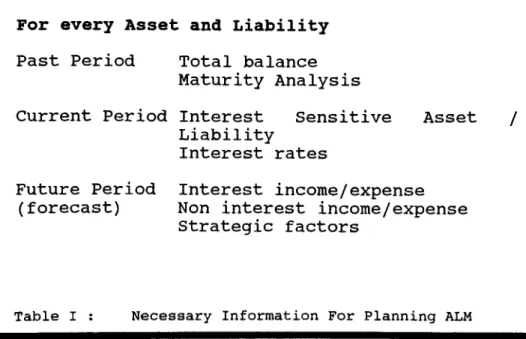
can form a table for the necessary information for planning Asset Liability Management.
For every Asset and Liability
Past Period Total balance
Maturity Analysis
Current Period Interest Sensitive
Liability Interest rates
Asset /
Future Period Interest income/expense
(forecast) Non interest income/expense
Strategic factors
Table I : Necessary Information For Planning ALM
For the forecasts there are three general issues to be considered. The first one is the issue that as the time interval widens the
detail forecast rate decreases. It is easier to forecast the next
months' interest rate while forecasting the next year. For short
term a weekly or monthly, for seasonal a three-month period, for the long term, generally one year forecasts are used. Forecasts should be frequent and dynamic according to the changes in the
environment. The financial table for the forecasts can be formed
Content Period Measure Period Number F r e q u e n c y of Uodate
Short month 3-12 monthly
Middle 3 months 4-8 3 monthly
Long 1 year 5-10 yearly
Table II: Financial Table For The Forecasts
The second issue is the importance that should be given to the consistency of the forecasts. The long-term forecasts should be in harmony with the short-term ones done by using the current
information. And finally the last issue is the necessity of an
overview period for the forecasts to identify the consistency. The three phases in the forecast method are the forecast for general economy, for bank's special variables and the control.
Forecasts for General Economy:
Banking sector is one of the most sensitive sectors among the
economic conditions. Changes in income, consumption, investment
decisions and government policy directly affect the bank balance
sheet and income statement. So the first thing to do is to
forecast the general economic conditions.
Forecasts For Bank's Special Variables:
variations to the bank can be measured. This information can be used to forecast loan demands, deposit volume, interest rates.
C o n t r o l :
To have control on the forecasting system and to be consistent with the general economic conditions, the routine and frequent
update procedures and methods should be established. The gap
reporting between the actual and the forecast would help to control the quality of the forecast.
Another point is that the asset liability management decisions should not be challenged with the bank's strategic plan and t a r g e t s .
B,Asset Liability Management Reports
A bank needs a reporting system to be used in decision making
to generate stable and high profits. A well-planned asset
liability management system can provide this reporting system. We
Risk Area
Capital Adequacy Liquidity Interest RateReport Ncuae
Performance Indicators Cash Flow Analysis Maturity AnalysisInterest rate difference Interest sensitive
Asset/liability Analysis
Effect of interest rate changes Net interest margin analysis
Table III: ALM Reporting System
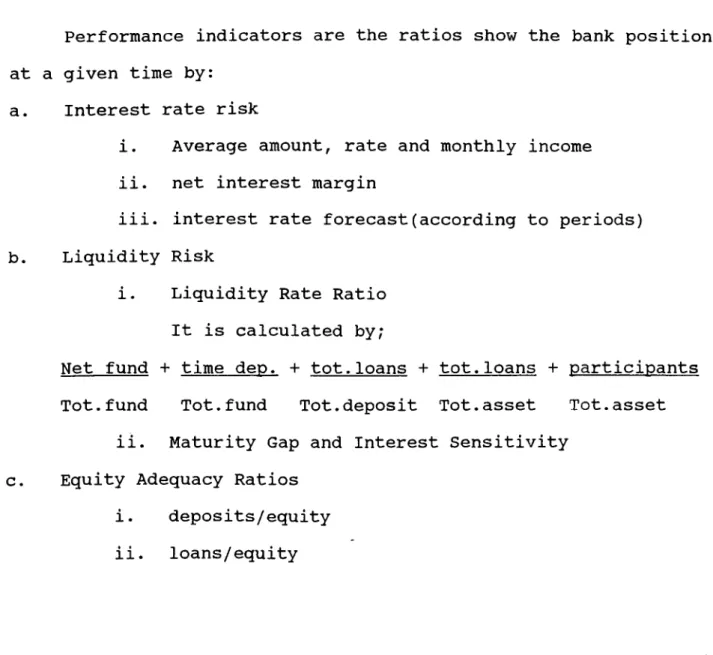
Performance indicators are the ratios show the bank position at a given time by:
a. Interest rate risk
i. Average amount, rate and monthly income
ii. net interest margin
iii. interest rate forecast(according to periods)
b. Liquidity Risk
i. Liquidity Rate Ratio
It is calculated by;
Net fund + time dep» + tot.loans + tot.loans + participants
Tot.fund Tot.fund Tot.deposit Tot.asset Tot.asset
ii. Maturity Gap and Interest Sensitivity
c. Equity Adequacy Ratios
i. deposits/equity
Cash flow forecast report states the expected cash incoming
and outgoing figures. The related cash flow shows the amount of
cash needed for bank's cash operations.
Maturity Analysis report shows the maturity gap between asset and liabilities according to a predetermined period of time through the examination of the maturities.
Interest rate difference report shows the gap between the
interest earning assets and interest bearing liabilities. At the
same time it shows the average interest rate and net interest margin.
Interest sensitive asset and liability analysis report
compares and shows the gap between the interest sensitive assets
and liabilities. If there is a gap between interest sensitive
assets and liabilities then, the bank will be affected according to any slight change in the interest rate.
If the interest sensitive assets (ISA) total is equal to interest sensitive liability (ISL) then theoretically any change in
interest rate would not affect the bank's profitability. Below
table shows the effect of interest rate change to the bank's profitability in different sensitivity ratio cases.
Case
Interest Rate
Bank's
Profitability
ISA>ISL increase positive effect
decrease negative effect
ISL>ISA increase negative effect
decrease positive effect
Table IV: Interest Sensitive Asset/Liability Analysis
It is not necessarily that all the asset and liability interest rate change at the same time and at the same direction, the interest rates of certain assets may increase or decrease more than the others.
Effect of interest rate changes report shows the monthly effect on the bank profitability by 1 % interest rate change in ISA and ISL.
Net interest margin analysis is an evaluation report to show whether the bank has successfully implemented the interest policy. It shows for each current period the actual forecasts and the
actual in the last periods. Some of the information in this report
are; asset/liability amounts, interest income/expense, average
interest rates (Senver, 1985).
C.Definition of the ALM Targets bv Amounts and Ratios
First of all, the bank should determine the revenue on the
amount, net interest margin and interest rate according to spreads. Interest margin is the difference between the interest revenue from
bank assets and interest expense for bank liabilities. Where;
a = interest revenue b = interest expense
c = interest earning assets d = interest bearing liabilities
net interest margin (amount) = a - b
net interest margin (ratio) = (a - b) / c
interest spread = a/c - b/d
Bank management will try to realize the maximum and consistent interest margin by keeping in mind the loan, liquidity, equity and interest rate risks. But within a competitive environment there is
a limitation for banks to get high interest margins. For example,
let;
Interest margin target: 4% Average income on assets: 13% Average cost of Funds: 10%
In order to reach the target, the bank should either increase
the income on assets or decrease the cost of funds by 1 %. This
can be achieved by a change in the asset liability composition and this would lead to a change in the accepted risk degree. Otherwise the bank should state a more reasonable interest margin according to the market trend (Tulgar, 1993) .
In this section the planning process and the elements for the
asset liability management are emphasized. The strategies to be
used in the asset liability management system are discussed in the next section.
The basic objective of commercial banks like other profit
seeking organizations is wealth maximization. The two important
operational goals for the achievement of wealth maximization are first stability of earnings per share growth and second high return on equity capital.
In an environment of uncertainty, volatile interest rates increase a bank's interest rate exposure in the sense that changes
in interest rates affect the assets and liabilities, and
consequently, the interest earnings and expenses of the bank. In
order to stabilize earnings which is closely related with the objective of wealth maximization, it is necessary to arrange both sides of the balance sheet in such a way that net interest margin is protected and hedging against interest rate exposure is achieved against the changes in the direction and volume of interest rates. In this section the interest rate risk is emphasized.
A bank earns rewards by taking risks. Risk taking capacity is limited by capital, depositors, regulators, and credit rating
agencies. Because it is limited, risk capacity must be allocated
among its various uses in a way that maximizes the expected reward. Types of risk include capital expenditure risk (acquisitions,
branching, and the like), service production risk (discount
brokerage, trust and the like), and financial risk (interest rate, credit and funding) (Connell, 1991).
The asset-liability process requires financial institutions to
settle the following issues. First issue is to establish board-approved policies identifying the amount of acceptable interest rate risk that can be assumed in terms of exposure to net interest income as well as to the market value of capital. The
second one is to create financial intermediation products
structured to meet customer needs while priced to provide an
acceptable risk-return relationship for the institution. The
third one is to establish effective tools, reports, and resources to assess and monitor interest rate risk exposures as well as associated returns, and finally to appoint managers to control risk exposures along with identifying acceptable strategies or tactics and to adjust exposures based upon economic outlook, corporate objectives, and changing balance sheet conditions.
Three analytical tools that can help management understand an organization's exposure to interest rate risk are gap analysis, duration analysis and simulation (Payant, 1992).
A.Interest Rate Risk:
In general, interest rate risk is the effect of changes in
interest rates to the bank income and expenses. It has two edges,
one being the change in market value risk of the assets, the other,
the change in re-investment risk. If not managed properly,
interest rate risk can lead to earnings, liquidity and capital
adequacy problems. The ability to measure interest rate risk
correctly is a necessary requirement for proper interest rate management (Grünewald, 1992) .
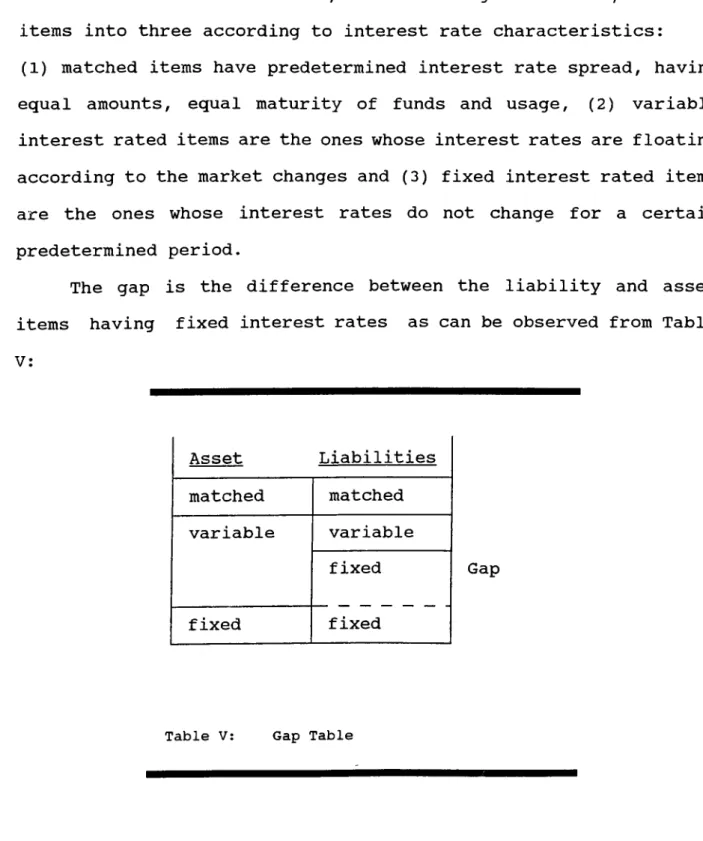
Interest rate gap analysis is a management tool to have a steady and consistent interest margin in an interest rate cycle. Within a bank balance sheet, we can categorize asset/liability items into three according to interest rate characteristics:
(1) matched items have predetermined interest rate spread, having equal amounts, equal maturity of funds and usage, (2) variable interest rated items are the ones whose interest rates are floating according to the market changes and (3) fixed interest rated items are the ones whose interest rates do not change for a certain predetermined period.
The gap is the difference between the liability and asset items having fixed interest rates as can be observed from Table
B.Gap Analysis
V: Asset Liabilities matched matched variable variable fixed fixed fixed GapAccording to money market interest rate movements, the gap directly affects the bank's profitability. The asset side can have
higher fixed rates item or vice versa. According to conventional
wisdom, bank management should widen the funds gap if it expects
interest rates to rise. Conversely, management should narrow the
bank's funds gap if interest rates are expected to decline.
However, conventional wisdom is true in general only for
changes in profits, not for levels of profits. Another problem
with conventional wisdom is that it assumes the yield curve, or
the term structure of interest rates, flat. If the yield curve is
not flat, textbook asset liability management is misleading, if
not incorrect. Before choosing the gap strategy that maximizes
profit levels, management must decide whether or not it thinks rates will rise less or more than, or exactly the same as the
market expects. This market expectation is, then, the critical
rate and is the key factor in determining the optimal gap
strategy. If rates fall more than the market expects, a negative
gap maximizes profits. If rates fall less than the market expects, a positive gap maximizes profits, and if rates fall according to market expectations, the gap is irrelevant (Johannes, 1992).
In either way, the decrease or increase in interest rates would have a positive or negative effect by the amount and type of
the gap. The gap management is the integration of the
balance/sheet items with a common strategy which is the same for all asset liability management approaches.
Gap analysis approach has the following principles: (1) the total of fixed rate funds should be bigger than the total of fixed
rate assets. Otherwise in high interest rate periods there would be
trouble to find funds matching with the fixed rate assets. This
with the effect of higher costs of funds leads to a smaller or negative spread between the current fixed rate loans and
investments. (2) the minimum gap amount would change according to
the bank strategy and also market conditions. As the minimum gap should have the ability to absorb the effect of next periods' seasonal fluctuations in deposits and the interest rate increases, good deposit analysis and determination of minimum gap are needed
to keep track of bank liquidity. (3) the minimum gap should be
elastic and well managed according to the seasonal changes. An
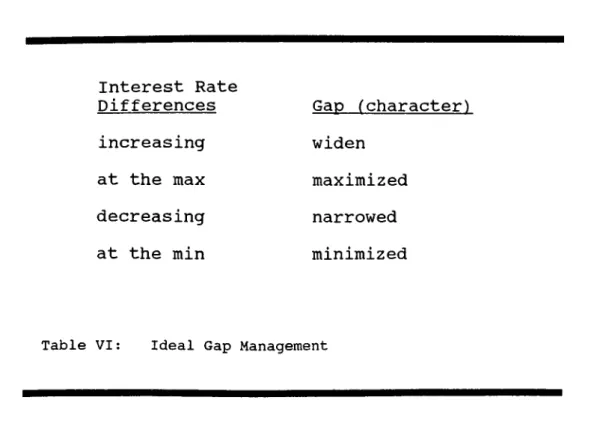
ideal gap management can be explained as in the following table:
Interest Rate Differences increasing at the max decreasing at the min Gap (character) widen maximized narrowed minimized
Table V I : Ideal Gap Management
It is even not possible to have a perfect gap position in all
interest rate periods. For a wide range of gap it is possible to
lower interest rate period this would result with a decrease in inco m e .
Gap volume by definition is controlled by changing the fixed
rate assets or funds composition. The essential fixed rate funds
that is deposits have a low flexibility because of the competition in the banking sector. Capital is the most available and important fund either to use or to get new funds from capital markets.
C.Interest Sensitivity Management
It is used to minimize the effect of interest rate floating on
the bank interest income. The variables in this approach are the
asset/liability where their maturity are within the financial period or where the revaluation period is in the financial period.
The ratio of interest sensitive assets (ISA) over interest
sensitive liabilities (ISL) measures the size of the bank interest
income change according to floating interest rates. The ratio of
'•1” will show that bank interest sensitive assets and liabilities
are the same. However this does not mean that bank has minimized
the effect of interest rate changes as the interest rate changes would not equally affect the interest sensitive assets and
liabilities. With an ISA/ISL ratio bigger than ”1'', any interest
rate increase will affect interest income positively but a decrease
will affect it negatively. Every bank will choose its own ISA/ISL
Duration analysis by definition is a weighted average of the realization of an expected cash flow in assets or liabilities. By this methodology the effective maturity of asset/liabilities are being matched and evaluated according to the present value. Practically this methodology is more difficult than the others as
bank's future cash flows should be reported. Newly developed
financial information systems would give the opportunity to use
duration analysis in asset liability management. The formula for duration analysis is:
Where i : period with i = 1,2,..,n p : cash flow r : interest rate
D.Duration Analysis
nduration^
n U(i+r)^
In duration analysis every cash flow is discounted according
to the incoming/out going flows. So any changes in interest rates
would change both the asset liability values and the duration
accordingly. Duration could not be bigger than the assets
maturity. There is a negative correlation between interest rates
and duration. As interest rates increase the duration will
decrease.
For all the asset and liability portfolio only one duration can be calculated and this is the biggest advantage of the duration
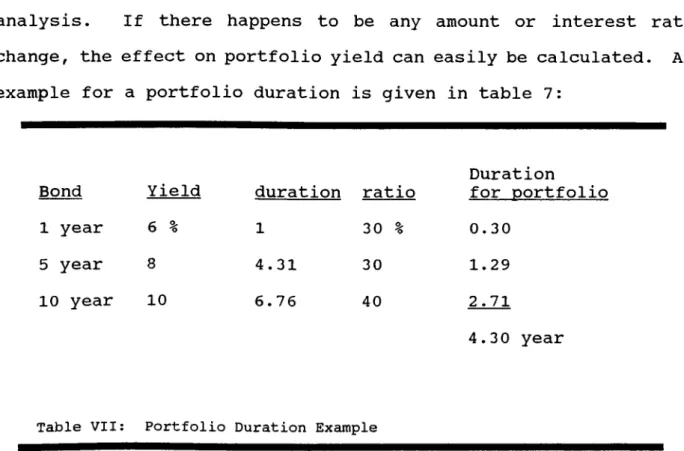
analysis. If there happens to be any amount or interest rate change, the effect on portfolio yield can easily be calculated. An example for a portfolio duration is given in table 7:
Bond Yield duration ratio
Duration for portfolio 1 year 6 % 1 30 % 0.30 5 year 8 4.31 30 1.29 10 year 10 6.76 40 2.71 4.30 year
Table VII: Portfolio Duration Example
The inconsistent cash flow between the asset and liability
portfolio creates the interest rate risk for the bank. In other
words the degree of the duration differences between asset and liability effects the interest rate risk amount. If the duration for both asset and liability is the same, then bank has control over the interest rate floating.
By using the above mentioned asset liability management
strategies many software vendors developed Asset Liability
Software. These tools help bank management in their decision
making processes. In the next section we will go over the asset
In recent years, asset-liability management has progressed from management of interest rate risk to include and integrate all
risks. The current goal of the asset-liability management process
is the optimization of profitability while managing all balance
sheet risks on an integrated basis.
Financial institutions need to consider all types of risk
when implementing an effective asset-liability management system. A good asset-liability management simulation system can address the impact of all of these risks on an institution's profitability. By taking this integrated approach to risk, financial managers can prepare for both the best and the worst case to increase profits
and secure the eguity of their institutions. A good simulation
model tests the impacts of various strategies and tactics.
Strategies can also be stress-tested in the areas of specific risks with individual measurement systems that are particular to each risk.
The role of asset-liability management (ALM) systems is to develop and support ALM processes to maximize net income within acceptable levels of interest rate risk and liquidity risk while
maintaining adequate capital levels. The three main elements of
any ALM strategy are credit risk, interest rate risk, and liquidity
risk. By returning to banking basics, bankers can develop
reasonable parameters and measurement systems to run the balance sheet.
since banks become more liability sensitive as rates drop and more asset sensitive as rates rise, they must try to anticipate possible or probable scenarios before it is too late to minimize any damage (Violano, 1991).
Asset liability management simulation system aims to measure the interest rate risk of the corporation during several interest rate scenarios and under different balance sheet strategies and
combinations. In this approach using the assets and liabilities a
mathematical modeling is established showing the cash flows of the
bank. After this model is established the estimated balance sheet
and income statement tables are provided under user-defined
conditions. Before deciding on an ALM system, the first guestion
a bank should consider in its search is why it is interested in
one. An ALM system can be an important tool for planning and
profitability measurement.
The next step is to outline the general categories of systems to develop more specific questions about what financial information needs the system should be able to meet.
Capabilities found in most ALM systems include the gap
reports production, present value methods, interest rate risk
measurement, and forecasting and budgeting functions.
The productivity a bank can gain from an ALM system will be
proportional to the effort and care put into its selection
(Weiner,1992). A number of vendors have developed PC-based
software packages for asset-liability management. Most of these
packages offer the same basic functions of gap analysis, portfolio modeling, and duration analysis.
Gap analysis measures the sensitivity of assets and
liabilities to fluctuations in interest rates. Portfolio modeling
forecasts what will happen to the value of a loan, deposit, or a group of either, if interest rates change to a certain level. Duration analysis studies the time to maturity of a given balance
sheet item and the present value of its cash flow to maturity.
Distinctions are made regarding the level of precision that
portfolio models can generate (Radigan, 1993).
A new generation of asset-liability management models have emerged based on Monte Carlo simulation - a computerized simulation technique that has been used for a wide variety of applications in the analysis of risk and return by producing a probability profile
for analysis. Up to now, most asset-liability simulation models
have been single simulation models capable of tying together many
input variables, such as changes in loan and deposit volumes,
interest rate patterns, and activity on mortgages and consumer
loans. However, the Monte Carlo approach can conduct 100 or more
simulations of the net interest income. The technique draws
probability values of each input variable for each simulation.
With such a profile, the bank can access the risk of hitting a
target net income (Simonson, 1992). "Through the emergence of
Monte Carlo asset-liability models, managers may gain a bigger and
more accurate technique of computing probability for decision
making." (Simonson, 1992, P : 8 1 ) . Good asset-liability management
(ALM) software can be an important key to success for a banker. There are several limitations of Asset Liability Management
several questions should be posed, including whether or not the
business plan complies with regulatory guidelines. The following
items should be taken into consideration while evaluating the performance of a sim.ulation program:
1. A good download from the banking system is one element that
encourages frequent use of ALM systems.
2. Frequent analysis of various rate environments, superimposed
on various balance sheet growth strategies, is probably the single most important step toward getting the most out of an ALM system.
3. The simulation program must be easy to apply. A key to better
use of an ALM system is to be able to communicate easily the results of the planning process.
4. Someone should be specifically assigned the responsibility for
ALM practices. This person should attend appropriate
education classes, if needed, for either the ALM product or ALM practices in general.
In conclusion, new and more sophisticated Asset Liability
tools will evolve. Good Asset Liability Management requires
keeping up with technology, but it must be emphasized that the tools and techniques described here are only as good as the managers who use them (Thompson, 1991).
Sophisticated tools are of little use if their output is
poorly understood or communicated. Despite all the sophisticated
tools and techniques that have been created in recent years. Asset
Liability Management is still an art more than a science. Having
s very sophisticated tool since the characteristics, economic and management conditions and visions of each bank differ from the o t h e r s .
The decision support tool developed in this study aims to aid the decision making process of the Asset Liability Committee of a
bank. It simulates a bank balance sheet and income statement
according to given decision variables and scenarios. While
developing the chart of accounts only the interest bearing or earning assets and liabilities are taken into consideration. There are two balance sheet tables; one is the actual one input by the users the other is the one generated using the given scenario and
variables. Scenarios are the given conditions that might occur in
a given period, such as interest rates according to maturities,
devaluation rate, legal reserve rates. Decision variables reflect
the bank management strategy and target for a given scenario. The
model simulates the decision variables for the given scenario and arrange the next periods balance sheet, related income statement and the net income after tax by using the actual balance sheet
figures. This system also generates a gap report and a duration
analysis report for the simulated balance sheet to evaluate the
quality of decision variables. The user can also change the
decision variables according to the results of the simulation.
The tool can be used easily. It reflects the result of the
bank strategy for a given interest rate scenario. It can be used
to evaluate any decision as well as to observe the overall outlook
view for a given scenario. As there is only the interest bearing
or earning items, it is not possible to calculate the ratios such
as liquidity, adequacy of equity and others used for balance sheet
evaluation. The decision support tool calculates the gap and
duration but does not give an alternative solution to hedge any risk. The user has to evaluate the result and should decide on the hedging method.
A.Setting U
pThe Tables
The tables consist of Balance Sheet Tables for TL and FC, Income Statement, Decision Variables, Scenarios, Gap Analysis and
Duration Analysis. Required details are given next.
1.
Chart Of Accounts
Chart of Accounts is structured by the accounts whose interest
rate risk have to be analyzed. From the accounting system used in
the bank, the necessary accounts related with the interest rate risk are identified and as an introduction the chart of accounts are input to the model. An example is given in Appendix B, Balance
Sheet (million T L ) . The organization of the chart focuses on the
way accounts react to interest rate changes. For example chart
breaks loans according to the type of interest rate characteristics
and the maturity. Breaking the chart down in this way helps to
analyze how different kinds of loans react to different interest r a t e s .
The accounts are tied together by the same or similar interest
rates. The detail to include in the chart of accounts are decided
and the cost of information goes into each account. For example cash, and cash reserves are included as they affect the bank's' liquidity policies directly although they are not interest rate
related. Loans are identified by their relationship to rate
changes and by their maturing and repricing structure. The
interest rate application structure should be defined as fixed or variable.
In Turkey, the maturities are relatively short (the longest
maturity being 1 year) and repricing can be done, if required,
every three months after the interest payment. So the variable
interest rates are handled by maturity analysis. As there is a
high devaluation rate in Turkey, there is a need to separate the foreign currency funding and usage from the local currency
operations. They have different interest rates and different
funding rates. Bank Premises and Equipment are details since they
are not rate related and hence, are excluded from the study. Demand Deposits are either not rate related or they carry rates that are subject to change. Time deposit accounts are broken down by period to maturity.
The money market operations are taken as a hedging method and the user should input the amounts and type of the money market operations according to the bank's position, whether it is short or long, according to the devaluation rate, yield rates and so on. T- Bills and bonds are also rate related and they have a balancing character as subject to a tax exempted income.
2.
Balance Sheet For Items in FC
In the tool, there is also another balance sheet table for the
FC items in both assets and liabilities. The example for this
chart is given in the Appendix B 1. FC Balance Sheet. The official
balance sheet for each bank should be in TL. But banks have the
ability to place or generate funds in foreign currency as well. For the evaluation of foreign currency funding and their usage a
chart is generated for the FC-based items. Related figures in the
balance sheet are derived from this chart by converting them into
TL. with the current FC rate. In this table all the values are in
US dollars.
3.
Income Statement
As the balance sheet chart only deals with the interest rate sensitive accounts, the income statement is developed from the
interest rate revenues and expenses. The income statement
calculations are all conducted with the average figures in balance sheet for period 1 and period 2 have more reliable results.
Income items include:
. Interest revenue from TL loans, FC loans and syndication
l o a n s .
. Interest income earned from the Central Bank reserve amounts.
Central bank presently gives interest to FC legal reserves.
. Interbank money market operations income in TL and FC.
. Yields generated from the Treasury Bills and Government Bonds.
Expenses items include;