Lignite resources of Turkey: Geology, reserves, and exploration history
Volkan
Ş. Ediger
a,⁎
, Istemi Berk
b, Ayhan Kösebalaban
ca
Kadir Has University, Kadir Has Street, Cibali, 34083 Istanbul, Turkey
b
Institute of Energy Economics, University of Cologne, Vogelsanger Str. 321, 50827 Cologne, Germany
cTurkish Coal Enterprises (TKİ), Hipodrom Cad. No. 12, Yenimahalle, 06330 Ankara, Turkey
a b s t r a c t
a r t i c l e i n f o
Article history:
Received 27 February 2014 Received in revised form 4 June 2014 Accepted 10 June 2014
Available online 17 June 2014
Keywords: Lignite Geology Reserve classification Exploration history Turkey
This article aims to emphasize the importance of lignite, which is the mostly used domestic energy source in the Turkish energy mix, by briefly overviewing its geology, reserves, and exploration. Lignites are distributed in mostly continental sedimentary basins of Tertiary age all over the country. The lignite-bearing basins display the characteristics of different geological settings, of which grabens and half-grabens are the most common ones especially in western Anatolia. The geological and chemical characteristics of Turkish lignites do not only create some important problems during mining and coal preparation but also make them unfavorable for con-sumption. However, since they are the most valuable energy resource of the country they should benefit the economy in the most efficient and environmentally friendly way. Moreover, two most important conclusions of this study are as follows:firstly, reserve estimation practices in the country should definitely be revised to pro-vide a more realistic evaluation of the country's lignite potential for developing medium- and long-term energy strategies and policies for decision- and policy-makers. Secondly, exploration and development activities should be coordinated by a single institution, most likely a government institution, as has been the case for some 50 years.
© 2014 Elsevier B.V. All rights reserved.
1. Introduction
As the major indigenous energy source of the country, lignite, consti-tuting up to 20.9% in 1986 of the energy mix of Turkey, has always been very important. Recently, although its share is increasing from a histor-ical minimum of 10.2% in 2005 to 14% in 2012, the share of hard coal has almost doubled by increasing from 8.8% to 16.7% between 1978 and 2012, making it more important than lignite. However, lignite is the big-gest national energy resource whereas hard coal is import-dependent at the rate of 94.7% by 2012. This is a very controversial policy for a country whose dependency on foreign energy sources has already reached 75.9% by 2012. This article, therefore, attempts to emphasize the impor-tance of lignite as the major domestic energy source in the Turkish en-ergy mix by briefly overviewing its geology, reserves, and exploration.
The upstream sector of the Turkish lignite industry is traditionally dominated by state-owned enterprises, such as the General Directorate of Mineral Research and Exploration (MTA), the General Directorate of Turkish Coal Enterprises (TKİ), and Electricity Generation Company (EÜAŞ). However, while TKİ and EÜAŞ are responsible for lignite pro-duction and electricity generation from lignite, MTA was established
to conduct reconnaissance, appraisal, and exploration activities for coal among other minerals. For this reason, most research and explora-tion activities, including geological mapping, geochemical analyses, geophysical studies, exploratory drilling, etc. have been carried out by MTA since its establishment in 1935. However, after the establishment of TKİ in 1957 and TTK (Turkish Hard Coal Enterprises) in 1983, some of MTA's duties have been transferred to these enterprises. After it was delegated responsibility for the lignitefields feeding coal-fired power plants, EÜAŞ became not only the second biggest lignite produc-er aftproduc-er TKİ, but also the public company with the largest lignite reserves in Turkey especially after 2005.
Since TKİ has historically been the major lignite supplier to industry, this study concentrates on its reserves and upstream activities. The rel-evant activities of other state-owned enterprises and private companies are also included wherever data is available. The data presented in this study is mostly obtained from TKİ within the framework of the project “History of Turkish Coal Enterprises (TKİ) and Turkish Hard Coal Enter-prises (TTK), and Turkish Coal Strategies”. Other data including previous reports and publications are also used in various extents. Therefore, unless otherwise stated the data is fromEdiger (2014).
Although they can also be traced back to the late 19th century, modern and well-documented lignite exploration activities started in the 1970's as summarized inTKİ (1973). From this perspective, Lignite Inventory of Turkey published in 1986 has been a milestone as far as geology and reserves of Turkish lignites are concerned. The report
⁎ Corresponding author at: Kadir Has University, Energy Systems Engineering Department, Kadir Has Street, Cibali, 34083 Istanbul, Turkey.
E-mail address:[email protected](V.Ş. Ediger).
http://dx.doi.org/10.1016/j.coal.2014.06.008
0166-5162/© 2014 Elsevier B.V. All rights reserved.
Contents lists available atScienceDirect
International Journal of Coal Geology
prepared by a special commission established in MTA compiles all pre-vious studies and evaluates a total of 133 lignite occurrences in Turkey systematically (MTA, 1986). Data presented in this report and in its revised forms has been used by policy makers and investors for many years.
The second important year in terms of lignite exploration was 1993. MTA revised its inventory (MTA, 1993), and MTA and TKİ geologists presented several papers in the Symposium on Our Lignite Sector Towards the Years 2000's organized by the Turkish Chamber of Mining Engineers (TCME, 1994). Finally and more current, MTA revised its inventory for the third time (MTA, 2010); TKİ published its Lignite Sector Report (TKİ, 2011), andÜnalan (2010)summarized all available data in a MTA book entitled Coal Geology. Meanwhile, a group of MTA geologists headed by Ertem Tuncalı compiled all previous data in a book entitled Chemical and Technological Properties of Tertiary Coals of Turkey (Tuncalı et al., 2002). In addition to all these,“Lignite Exploration Pro-ject” conducted by MTA achieved great success with new field discover-ies and huge reserve additions in 2008 and 2009. Continuing these exploration activities would be beneficial for further discoveries of lignite-bearing basins of Turkey.
The structure of this article is as follows:Section 2reviews the geo-graphical and geological setting of major lignite basins of Turkey and the physical and chemical properties of Turkey's lignites are also given in this section. InSection 3, classification and historical development of re-serves are thoroughly studied together with some international applica-tions of the reserve concept. The details of exploration and development activities are the subjects ofSection 4. Finally,Section 5concludes and makes some suggestions for further studies.
2. Geological setting of lignite basins
Although bituminous coals are found mostly in the paralic Zonguldak basin of Carboniferous age in the western Black Sea coast of Turkey,
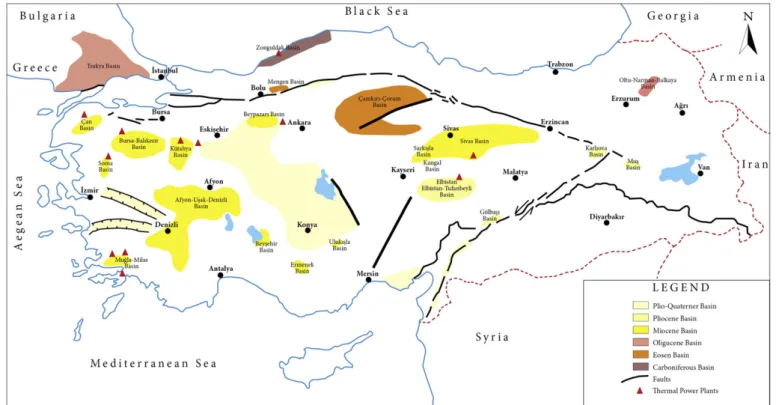
lignites are distributed mostly in continental sedimentary basins of Tertiary age all over the country (Fig. 1).1These lignites also contain
very little amounts of subbituminous coals.
The lignite basins cover an area of 110,000 km2of which 2% is
Eo-cene, 6% is OligoEo-cene, 41% is MioEo-cene, and 51% is Pliocene in age. They are distributed in wide geographic areas, especially in Central Anatolia (558.9 km2), Aegean (345.3 km2), Thrace Basin (219.8 km2), and East
Anatolia (184.9 km2) in Turkey (Tuncalı et al., 2002). The lignite
seams in these basins are mostly of Paleogene (Eocene and Oligocene) and Neogene (Miocene and Pliocene) age. Some small seams exist in Jurassic strata in the Gümüşhane, Bursa, and Adana regions and in Cretaceous strata in the Bursa and Artvin regions (Şengüler, 2010; Tuncalı et al., 2002; Ünalan, 2010). The maximum depths and ranges of thicknesses of lignite seams in Turkey vary significantly among differ-ent basins: 605 m and 0.35–14.90 m in Eocene basins, 332 m and 0.05– 5.10 m in Oligocene basins, 828 m and 0.10–57.00 m in Miocene basins, and 426 m and 0.10–87.00 m in Pliocene basins, respectively (Tuncalı et al., 2002).
The lignite-bearing basins display the characteristics of different geological settings (A. I. Okay, 2014, pers.comm.;Görür and Okay, 1996;Şengüler, 2010; Turgut et al., 1991) but the most common basins are the grabens and half-grabens, which were formed in the Aegean Re-gion as a consequence of the westerly escape of the Anatolian continent during Neogene (e.g.,Barka et al., 1994; Ediger and Tuna, 1993). Lignite seams are mainly formed together with volcano-clastics and carbon-ates, which were deposited in lacustrine andfluviatile environments in those tectonically-active basins. One of the most important features of these basins is the association of organic matter deposition with vol-canic activity (Ediger, 1990). However, the volcanic heat impact was
Fig. 1. Coal basins of Turkey. Compiled from the Map of“Tertiary Coal Basins of Turkey” prepared by MTA2
2
Available at:http://www.mta.gov.tr/v2.0/daire-baskanliklari/enerji/images/siteharitalar/5.jpg. Access date: 23.12.2013.
1
Some very limited occurrences of bituminous coals also exist in addition to the Zonguldak basin in the Eastern Pontides (Mann et al., 1998) and in the Eastern Taurids (Korkmaz and Gülbay, 2007).
mild and enhanced heatflux density caused by high geothermal gradi-ent particularly in grabens was the major cause of regional coalification process. Since such environments were essentially formed on land, lig-nites are mostly limnic rather than paralic. Also, the seams do not have a wide geographic extension because of the faults bounding the coal-forming environments. In addition, rate of subsidence and material in-flux in these basins were not balanced especially at the fault-bounded margins, resulting in the formation of numerous thin seams with clastic intercalations in-between. These geological features lower the quality of Turkish lignites as well as making the coal uneconomical to mine as it is too thin and splitted (MTA, 2010).
The following section provides some detailed information about geological aspects of four of the most important lignite basins in Turkey, namely (1) Kahramanmaraş–Afşin–Elbistan, (2) Konya– Karapınar, (3) Thrace, and (4) Manisa-Soma basins. The first three of these basins have the largest reserves and represent plains basins, ba-sins related with epirogenic movement, and foreland baba-sins, respective-ly; and the last one is also one of the largest basins, representing very typically graben and half-graben basins.
2.1. Kahramanmaraş–Afşin–Elbistan Basin
The Kahramanmaraş–Afşin–Elbistan basin, which is a typical plains basin, contains the biggest lignite reserves in Turkey. The coal-forming environments in this basin are formed within thick basement rocks, which are basically composed of Permian–Carboniferous and Upper Cretaceous limestones and Eocene ophiolites composed mainly of lime-stones and serpentinites. The lignite-bearing Pliocene strata are mainly composed of terrestrial deposits formed in lacustrine andfluviatile envi-ronments. Lacustrine deposits are composed offine clastics such as claystone, marl, and siltstone together with some conglomerates at the bottom and lignite horizons together with gyttjas at the top of the sequence. The lacustrine series are terminated with fresh water lime-stones and on top of itfluviatile conglomerates, sandstones, and mud-stones deposited during the post-Neogene period.
2.2. Konya-Karapınar Basin
The Konya-Karapınar Basin, similar to other Middle Anatolian basins around Tuzgölü and the vicinity, are basins related with epirogenic movement. The basement rocks of this basin, which are included into the Berendi Formation, are composed of medium- to thick-layered lime-stones and dolomitic-limelime-stones. These rocks are covered unconform-ably by the Halkapınar Formation, which is composed of sandstones and siltstones with volcanic intercalations of Lower Paleocene–Middle Eocene age; Divlek Formation, which is composed of medium- to thick-layered, yellowish to cream colored, fossiliferous sandy limestone, conglomerate, and clayey limestone of Eocene–Miocene in age; and İnsuyu Formation, which is composed of clayey limestone, siltstone, sandstone, mudstone, and claystone of Upper Miocene–Pliocene in age. All of these formations are deposited in lacustrine environments. Theİnsuyu Formation is later overlain conformably by the Hotamış For-mation, which is composed of claystone, siltstone, sandstone, fossilifer-ous shales, and lignite seams deposited in lacustrine andfluviatile environments during Pliocene time. The uppermost Mekedağı Forma-tion unconformably overlying the previous rocks is composed of volcano-sedimentary rocks and alluvial fan deposits of Quaternary age. Two major faults, extending E-W direction affect the distribution of lignite seams at the NW part of the region.
2.3. Thrace Basin
The Thrace Basin is a typical foreland basin with the third largest lig-nite reserves. The lowermost sedimentary unit placed on top of the Çetmi Ophiolithic Melange is the Eocene aged Gaziköy Formation, which is composed of thin-layered sandstone, siltstone, silicified tuff,
and shales. This formation is overlain by the Keşan Formation, which is composed basically of sandstones; the Soğucak Formation which is composed of light-colored fossiliferous micritic a reefal limestones; gray colored shales, sandstones, and clayey limestones intercalated with tuffs of Eocene age. The Oligocene sediments start with green– gray shale, marl, and tuff of the Mezardere Formation at the bottom con-tinue with sandstone, conglomerate, limestone, and thin lignite seams of the Osmancık formation in the middle and gray–green claystone, sandstone, conglomerate, tuff, and lignite seams of the Danişmen Formation at the top. The Miocene rocks are represented by tuffs and agglomerates of the Hisarlıdağ volcanics; claystone, siltstone, and sand-stone of the Çanakkale Formation; mudsand-stone, sandsand-stone, and limesand-stone of the Çekmece Formation; and conglomerate, sandstone, and siltstone of the Ergene formation. The uppermost Trakya Formation of Pliocene age is composed of loose conglomerates, sandstone, and some siltstone. 2.4. Manisa-Soma Basin
One of the typical graben basins of Turkey is the Manisa-Soma Basin, which has 666,083,000 tons of apparent and probable reserves of rela-tively high-quality lignites with calorific values varying from 2080 to 3340 kcal/kg. The lignite-bearing Miocene strata in this basin are depos-ited unconformably on the basement rocks, consisting of Paleozoic schists and graywackes and Mesozoic crystalline limestones. The Miocene-aged graben isfilled syngenetically with conglomerate–sand-stone–claystone intercalations with lower lignite beds at the bottom and with marl layers with abundant leaf and plant fossils and econom-ical lignite seams at the top. The Miocene strata are unconformably cov-ered by various volcano-clastics, consisting of sandstones, mudstones, varicolored clay, tuff, marl, andesite, basalt, agglomerate, lignite, silici-fied limestones, laminated claystones, and tuffites of Pliocene age. The entire series arefinally covered by Pleistocene volcano-clastics and alluvium and alluvial fan deposits of Holocene. The Soma Basin is a half-graben bounded by a normal fault at the north and cropped out at the south. The Miocene lignite-forming basins are formed in older horsts and grabens bounded by normal faults extending NE-SW direc-tions. Later during Miocene and Pliocene, new faults extending NW-SE direction formed the secondary horst and graben systems.
3. Physical and chemical properties of Turkey's lignites
Most of Turkey's lignites have low calorific value but high contents of volatile matter, moisture, ash, and sulfur. The chemical properties change in a wide range, for instance, the calorific values vary from 1185 kcal/kg to 5574 kcal/kg (Table 1). According toŞengüler (2010)almost 75% of lig-nites have calorific values below 2500 kcal/kg, 17% between 2500 and 3000 kcal/kg, and only 8% over 3000 kcal/kg. Moreover,Ünalan (2010), based on 8374 billion tons of reserves, calculated that 56% of lignites have calorific values between 1000 and 1500 kcal/kg, 12% between 1500 and 2000 kcal/kg, 23.5% between 2000 and 3000 kcal/kg, 5.1% be-tween 3000 and 4000 kcal/kg, and 3.4% more than 4000 kcal/kg. In other words, 68% of the reserves are lower than 2000 kcal/kg calorific values and most of these reserves are found in the Afşin–Elbistan basin, which contains 3357 million tons of lignites with an average calorific value of 1050 kcal/kg.
Table 1
Generalized chemical properties of Turkish lignites (Şengüler, 2010).
Chemical property Minimum Maximum Fixed carbon 8.86% 44.14% Volatile matter 8.93% 43.84%
Moisture 1.20% 57.66%
Ash 5.21% 59.09%
Calorific value 1185 kcal/kg 5574 kcal/kg Total sulfur 0.21% 10.66%
The most comprehensive data on the chemical, mineralogical, and petrographical properties of lignite seams were compiled byTuncalı et al. (2002), who analyzed samples taken from 187 basins. Having per-formed proximate and ultimate analyses they found that the moisture, ash, volatile matter,fixed carbon and sulfur contents of Turkish lignites range between 1.2 and 57.7%, 5.2–56.1%, 18.3–43.8%, 8.9–44.1%, and 0.2–10.7%, respectively and that the calorific values range between 1185 and 5574 kcal/kg. Furthermore, the ultimate analysis revealed that elemental carbon ranges between 14.3 and 61.4%, hydrogen between 1.3 and 4.3%, nitrogen between 0.2 and 3.3%, and oxygen be-tween 0.8 and 23.2%. On the other hand, the most commonly observed macerals are found to be huminite (31–90%), liptinite (2–10%), and inertinite (1–18%). The most common minerals are oxides (quartz and opal), clays (kaolinite and simectite), silikates (mica, chlorite, zeolite), carbonates (calcite, siderite, dolomite), sulfur (pyrite) and sulfates (gypsum).
Proximate analyses results of 30 major lignitefields of TKİ are given inTable 2. According to thefigures, the average volatile matter, mois-ture, ash, and sulfur contents are 25.52%, 28.96%, 27.36%, and 2.23%, re-spectively. The ranges are 5–39% for volatile matter, 6–50% for moisture, 11–43% for ash, and 0.6–4.5% for sulfur. On the other hand, the average and range of calorific values are 2501.16 kcal/kg and 1110–5330 kcal/kg, respectively.
In summary, Turkish lignites are mainly found in some small basins, which are usually tectonically isolated from each other. The lignite-bearing strata formed in such basins are characterized by numerous thin seams that are separated by intercalations and that show low rank of coalification. In addition, they have high moisture, ash, and sul-fur contents. These geological and chemical characteristics of Turkish lignites make them unfavorable for consumption. However, since they are the most valuable energy source of the country they should benefit the economy in the most efficient and environment-friendly way pro-vided that additional lignite production is economically feasible.
4. Classification and historical development of reserves
There exists no scientifically developed reserve classification system used for Turkish lignites. Although reserve definitions were standard-ized by the Turkish Standards Institute (TSI) with the Code TS 5959 in 1988 (TSI, 1988), only a few studies have used it until now. Having stud-ied the lignite reserves in Turkey,Yüksek et al. (2001)correctly noted that reserves are calculated differently by engineers, academicians, and politicians and this causes considerable misunderstanding.
The most commonly used classification scheme for Turkey's coal reserves includes“apparent”, “probable”, and “possible” categories. In addition to this basic classification, categories such as “ready” and “geological” are also used in some cases. Although not defined clearly, these three basic classes correspond in most cases to“measured”, “indicated”, and “inferred”, to “proved”, “probable”, and “possible” or to simply A, B, and C categories of internationally accepted classification systems (e.g.Milici et al., 2013). However, the probability requirements, similar to the ones used for petroleum resources under SPE/WPC ofN90%, 70–90%, and b70% for these internationally accepted three categories (Demirmen, 2007) are not being considered in most Turkish coal applications.
TKİ geologists define the “apparent” class as the reserve calculated in three dimensions by using reliable data obtained from geological con-trol points such as outcrops, wells, trenches, galleries, etc. Since the area is geologically and geophysically well-known, seams are reason-ably expected to continue throughout the area without any interrup-tions. In this category error limits are taken as ± 20%. In“probable” reserves, only two dimensions are known well because geological check points are present but widely distributed. On the other hand, in “possible” reserves none of the dimensions are known because of insuf-ficient exploration. In this category confidence intervals are taken to be more than ±50%. In many studies, the boundaries of the resource and reserve classes are even vaguer, causing serious problems in economic
Table 2
Chemical properties of lignitefields of TKİ, 2010 (MTA, 2010).
Field Volatile matter (%) Moisture (%) Ash (%) Sulfur (%) Calorific value (kcal/kg)
Manisa-Soma–Eynez 27 13 33 1.3 3150 Manisa-Soma–Deniş 20 18 40 1.2 2080 Manisa-Soma 26 15 36 1.2 2940 Çanakkale-Çan 30 23 25 4.2 3000 Kütahya-Tunçbilek 25 15 41 1.6 2560 Konya-Ilgın 26 50 11 1.1 2180 Konya-Beyşehir 17 48 25 1.1 1110 Adana-Tufanbeyli 24 41 28 2.1 1298 Muğla–Yatağan–Eskihisar 27 34 27 3 2185 Muğla–Yatağan–Tınaz 25 33 27 2.41 2111 Muğla–Yatağan–Bağyaka 25 38 26 1.26 1807 Muğla–Yatağan–Bayır 31 26 24 2.8 2670 Muğla–Yatağan–Turgut – 27 27 3.1 2635 Muğla–Yatağan–Taşkesik – 30 24 – 2660 Muğla–Milas–Sekköy – 34 26 1.2 1861 Muğla–Milas–Yeniköy – 30 29 – 2180 Muğla–Milas–Hüsamlar 28 32 29 1.2 1775 Muğla–Milas–Belentepe – 30 31 1.3 1864 Muğla–Milas–Karacahisar – 30 22 4.5 2279 Muğla–Milas–Alatepe 5 27 15 4.3 4200 Kütahya-Seyitömer 22 32 43 1.2 2080 Bursa-Orhaneli 34 24 24 2 2500 Bursa-Keles-Harmanalanı 26 34 26 1.5 1900 Bursa-Keles-Davutlar – 31 26 4.5 2340 Şırnak-Silopi (Asfaltit) 30 6 31 4 5310 Şırnak (Asfaltit) 39 6 31 4.5 5330 Bolu-Göynük 25 27 31 1.8 2340 Tekirdağ-Saray 20 45 16 1.9 2080 Çorum-Dodurga 39 23 23 1.6 3150 Bingöl-Karlıova 16 47 24 0.6 1460
and technical feasibility studies (Köktürk and Narin, 1994). In general, reserve classifications and calculations based on recoverability and salability, which are extremely important for economic feasibility, are not sufficiently accredited in Turkey.
The history of Turkish lignite reserve estimation started about a century ago. One of thefirst records on Turkish lignite reserves is the documents of the 13th International Geology Congress held in 1913 (Dominian, 1915). It was estimated in these documents that the coal re-serves of Zonguldak Basin were 4–5 billion tons but they revealed no in-formation about lignite reserves. The oldest record about lignite reserves in Turkish literature was the report published in 1940 with the title of Energy Economics of Turkey, in which the possible and prob-able reserves are given as 1.13 billion tons and 143.3 million tons, re-spectively (EIE, 1940). According to this report, 91% of probable reserves are found only in three basins, namely Seyitömer (65 million tons), Ağaçlı (50 million tons), and Soma (15 million tons). Later MTA (1945) estimated Turkey's lignite reserves as 201 million tons of which 85% is found in seven basins, namely Seyitömer–Aydan (90 million tons), Tavşanlı (40 million tons), Soma (26 million tons), Ağaçlı (7 million tons), Balkaya (3 million tons), Değirmisaz (3 million tons), and Çeltek (1 million tons), and the re-maining 15% is found in different regions such as Balıkesir, Bursa, Bilecik, Denizli, Aydın, İzmir, and Ankara.
After the establishment of TKİ in 1957, some scientifically and techni-cally defined reserve classifications such as “proven” and “salable” began to be used in lignite reserve estimations. In 1959, for instance, 95.02 million tons of lignite in various categories were discovered by MTA and transferred to TKİ (MTA, 1959). These newly found lignite re-serves were classified as “proven” (Seyitömer-Kütahya 50 million tons), “salable” (Tunçbilek-Kütahya 39 million tons and Değirmisaz-Kütahya 2,5 million tons), and “reserve” (Çeltek-Amasya 2,2 million tons, Balkaya-Erzurum 1,1 million tons, and Kükürtlü-Erzurum 22 thousand tons). In addition, the reserves in 22 newfields were estimated to be 230.68 million tons. However, confusions in lignite reserve calculations continued in the 1960's. For instance, General Energy Report of 1968 estimated the lignite reserves as 3 billion tons whereas First Five Years Plan (1963–1967) as only 847,000 tons (Ulutan, 1987).
The relatively well-defined reserve classifications began to be used in the 1970's.TKİ (1973)estimated Turkey's lignite reserves as 8.337 billion tons of which 4.108 billion tons are“possible”, 0.57 billion tons are“probable”, and 2.648 billion tons are “appar-ent”. Although the definitions of these classes were not clear, geolog-ical information wasfirst used in reserve estimations of 65 lignite fields in Turkey. Three of these lignite fields, namely Maraş-Elbistan (3.146 billion tons), Erzurum-Aşkale (2.479 billion tons), and Ankara-Beypazarı (1.043 billion tons) constituted 80% of total reserves (Table 3).Köktürk and Narin (1994)have noted that“possible” reserves increased from 44 million tons in 1965 to 3.7 billion tons in 1970, 4.1 billion tons in 1975 and 6.0 billion tons in 1978.
The year 1986 was an important milestone for lignite reserve classi-fication. In this year MTA formed a special commission, whose main re-sponsibility was to compile all the historical reserve estimations and evaluate Turkey's lignite endowment. Thefirst comprehensive lignite inventory was built up with those efforts (MTA, 1986). In this study, Turkey's total lignite resources were given as 8,209,838,000 tons of which 7,910,462,000 tons were defined as reserve and the reserves
are further classified as “possible” (126,708,000 tons), “probable” (1,872,997,000 tons), and“apparent” (5,910,757,000 tons). The reserve estimation of MTA in 1986 and that of TKİ in 1973 differ significantly. MTA estimated a 5% increase in total reserves whereas a 45% increase in apparent reserves from 1973 to 1986.
The development of lignite reserves after 1986 can as well be exam-ined in the World Energy Council Turkish National Committee's (WEC TNC) reports entitled Energy Statistics although data are missing in some categories (WEC TNC, 1986, 1990, 1994,1997, 2002, 2006). As shown inTable 4, the total reserves, which were around 8 billion tons from 1986 to 2002, have dramatically increased to 11.443 billion tons in 2008. Also,“producible or recoverable reserves”, which can be ac-cepted to be equivalent to modern“proved reserves”, are 55% (1989) and 48% (1993 and 1996) of total reserves and 61% (1989) and 53% (1993 and 1996) of apparent reserves. The apparent reserve estimates inWEC TNC (2006)included seams which have a maximum depth of 800 m and a maximum thickness of 0.8 m.
Most recently, the second Lignite Inventory of Turkey estimated a total reserve of 11.571 billion tons of lignite (MTA, 2010) and Sectoral Report of Lignite estimated 11.44 billion tons (TKİ, 2011, 2012). Around 86% of this amount is owned by public institutions such as EÜAŞ (42%), MTA (22%), and TKİ (21%) whereas the share of the private sector is only 14%. The latestfigures of lignite reserve estimates are given byTKİ (2012). As shown in Table 5, by the end of 2010 Turkey had 11.751 billion tons of lignite reserves of which 10.782 billion tons are apparent, 826 million tons are probable, and 143 million tons are possible reserves. Moreover, 86.4% of total reserves are owned by public institutions, namely EÜAŞ (41.2%), MTA (23.4%), and TKİ (21.8%) and the remaining 13.6% are owned by the private sector.
MTA (2010)provides distribution of TKİ's lignite reserves in its enterprises andfields in 2011 (Table 6). 79.3% of TKİ's total reserves are distributed among its four enterprises, ELİ, GLİ, GELİ and SLİ. The re-maining 20.7% are distributed among independentfields and some other operational bodies of TKİ. Out of the enterprises ELİ has the largest reserves (702.7 million tons), followed by GLİ (700.7 million tons), GELİ (419.9 million tons) and SLİ (277.4 million tons). Apparent re-serves constitute 94.1% and 88.4% of lignite rere-serves of enterprises total and TKİ's total, respectively. There exist six fields, which have more than 100 million tons of lignite reserves, within the enterprises: Manisa-Soma–Eynez of ELİ, Adana-Tufanbeyli of GLİ, Kütayha-Tunçbilek of GLİ, Muğla-Milas–Yeniköy of GELİ, Manisa-Soma–Deniş of ELİ and Kütahya-Seyitömer of SLİ.
Table 3
Turkey's lignite reserves according toTKİ (1973). Numbers are in thousand tons. Name of thefield Correspondingınstitution Reserves
Apparent Probable Possible Geologic Total Ankara-Beypazarı TKİ 100,000 38,000 5000 900,000 1,043,000
Erzurum-Aşkale TKİ 60,200 164,600 2,255,000 2,479,800
Maraş-Elbistan MTA 1,770,000 1,376,000 3,146,000
Total of 65 Fields 2,648,567 570,014 4,108,775 1,010,200 8,337,556
Table 4
Lignite reserves in WEC-TNC reports (WEC-TNC, 1986, 1990, 1994,1997, 2002, 2006). Numbers are in thousand tons.
WEC TNC Reserves Resource Producible Apparent Probable Possible Total
1986 – – – – 7,843,652 8,143,028 1989 4,239,000 6,946,000 689,000 114,000 7,750,349 8,049,725 1993 3,907,000 7,339,000 625,000 110,000 8,074,996 8,374,372 1996 3,907,000 7,339,000 625,000 110,000 8,074,996 8,374,372 1997 – 7,330,000 625,000 110,000 8,074,996 8,374,372 2002 – 7,330,000 625,000 110,000 8,074,996 8,374,372 2008 – 9,837,000 1,344,000 262,000 11,443,000 –
Because of the reasons discussed above there are significant discrep-ancies between numbers of reserve estimations of Turkish lignites be-tween Turkish and international publications. For instance, according to BP's Statistical Review of World Energy, which uses“proved reserves” defined as “generally taken to be those quantities that geological and engineering information indicates with reasonable certainty can be re-covered in the future from known deposits under existing economic and operating conditions”, Turkey has 2343 million tons of coal reserves of which 529 million tons are anthracite and bituminous coals and 1814 million tons are subbituminous and lignites (BP, 2013). Turkey ranks 17th in the world with a share of 0.3% in total and the R/P ratio are 33 years. On the other hand, the most recent estimates of MTA and TKİ are 1.31 billion tons of hard coal and 12.6 billion tons of lignite re-serves (MTA, 2010; TKİ, 2012; TTK, 2011). Moreover,TKİ (2012), by using estimates ofMTA (2010), suggests that the share of Turkey in world's total lignite reserves is 5.9%. It is also arguable whether this much lignite reserves can be considered as“abundant” or not (e. g.,Eskikaya, 1989).
5. Exploration and development
Geological and geophysical exploration activities in Turkey have been mainly carried out by MTA although other institutions such as
TKİ, Electrical Power Resources Survey and Development Administra-tion (EIE, hereafter) and State Hydraulic Works (DSI, hereafter) also contributed to the drilling activities.
As a result of the extensive exploration activities carried out in an area covering 41,320 km2out of 110,000 km2area of continental
Tertia-ry basins, MTA discovered lignite occurrence in a 1474 km2 area (Köktürk and Narin, 1994; Tuncalı et al., 2002). Geological and geophys-ical exploration is historgeophys-ically concentrated in this area. According to MTA Archives, lignite exploration activities were carried out by some Turkish and European geologists between 1923 and 1935 in provinces such as Tekirdağ, Ankara, Amasya, Kütahya, and Erzurum (Şengüler, 2010, pers. comm.). Later, after its establishment in 1935, MTA became the sole authority for exploration of minerals including coal. Thefirst lignitefields which were explored by MTA were Soma (Manisa) and Seyitömer (Kütahya)fields. Extensive geological mapping was carried out in the Manisa-Soma–Tarhala field between 1935 and 1941. Additionally, the Kütahya-Seyitömerfield was explored by drilling with 64 boreholes in 1936 (MTA, 2010).
Exploratory drilling was mainly carried out by MTA although a few wells were drilled by TKİ until the end of 1960. The discovery of Afşin–Elbistan lignites in 1967 was an important milestone for the de-velopment of relatively lower quality coals. MTA's drilling totaled 8351 m in 1965, 7686 m in 1966, 40,000 m in 1967, 54,000 m in 1968,
Table 5
Turkey's lignite reserves by the end of 2010 (TKİ, 2011). Numbers are in thousand tons.
Institution Apparent % Probable % Possible % Total %
EÜAŞ 4,741,300 44.0 104,500 12.6 – – 4,845,800 41.2 MTA 2,643,196 24.5 108,334 13.1 2964 2.1 2,754,494 23.4 TKİ 2,303,394 21.4 251,811 30.5 1560 1.1 2,556,765 21.8 Public total 9,687,890 89.9 464,645 56.2 4524 3.2 10,157,059 86.4 Private sector 1,094,189 10.1 362,122 43.8 138,617 96.8 1,594,927 13.6 Total 10,782,079 826,767 143,141 11,751,987 Table 6
TKİ's lignite reserves by fields and enterprises, 2011 (MTA, 2010). Numbers are in thousand tons.
Enterprises Fields Reserves
Probable Apparent Ready Total ELİ (Aegean Lignite Enterprises) Manisa-Soma–Eynez 39 360,996 1263 401,259
Manisa-Soma–Deniş 11 160,194 2661 173,855
Manisa-Soma 13 43,984 3281 48,565
Çanakkale-Çan 78,823 250 79,073
Total of ELİ 513 643,997 7455 702,752 GLİ (Western Lignite Enterprises) Kütahya-Tunçbilek 272,408 4187 276,595
Konya-Ilgın 974 1853 267 19,771
Konya-Beyşehir 81,011 81,011
Adana-Tufanbeyli 323,329 323,329
Total of GLİ 974 695,278 4454 700,706 GELİ (Southern Aegean Lignite Enterprises Muğla–Yatağan–Eskihisar 36,646 36,646
Muğla–Yatağan–Tınaz 22,695 22,695 Muğla–Yatağan–Bağyaka 2601 2601 Muğla–Yatağan–Bayır 23,788 23,788 Muğla–Yatağan–Turgut 2876 2876 Muğla–Yatağan–Taşkesik 37,995 37,995 Muğla–Milas–Sekköy 18,802 250 19,052 Muğla–Milas–Yeniköy 16,204 215 162,255 Muğla–Milas–Hüsamlar 53,552 3106 56,658 Muğla–Milas–Belentepe 1075 1551 12,301 Muğla–Milas–Karacahisar 45 45 Muğla–Milas–Alatepe 12,733 12,733 Total of GELİ 414,862 5122 419,984
SLİ (Seyitömer Lignite Enterprises) Kütahya-Seyitömer 328 147,419 314 180,533
Bursa-Orhaneli 31,371 238 31,609 Bursa-Keles-Harmanalanı 26,198 69 26,267 Bursa-Keles-Davutlar 19,945 17,557 39,062 Total of SLİ 52,745 222,545 621 277,471 Enterprises total 105,019 1,976,682 17,652 2,100,913 Others total 176,186 364,537 0 547,302 TKİ total 281,205 2,341,219 17,652 2,648,215
and 86,000 m in 1969, resulting in significant reserve increases from 444 million tons to 3.7 billion tons over 5 years (Köktürk and Narin, 1994).
However, the existing data set on lignite drilling activities in this pe-riod is highly inconsistent. According toTuncalı et al. (2002), total depth of boreholes drilled by MTA was 401,720 m in 1970s, 437,817 m in 1980s, 352,446 m in the 1990s. According toAltaş (1993), TKİ drilled 636,300 m between 1970 and 1986 in order to discover new reserves to meet the demand of Afşin–Elbistan power plant with an installed capacity of 340 MW.
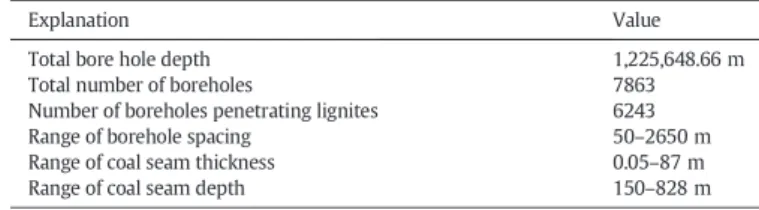
According to data presented byTuncalı et al. (2002), 7863 wells were drilled with a total length of about 1225 km from 1970 to 2002 (Table 7). Most of these exploration activities with drilling were carried out in the Aegean Region with 2841 wells and 494,609.1 m total length. A total of 2358 wells constituting 83% of the total penetrated lignite seams. The second and third most densely explored regions are the East Anatolian and Central Anatolian Regions, respectively. In the East Anatolian Region a total of 1414 wells were drilled with a total length of 225,781.4 m. A total of 1271 (90%) of these wells penetrated lignite seams. In the Central Anatolian Region a total of 1409 wells were drilled with a total length of 173,765.9 m. A total of 1040 (74%) of these wells penetrated lignite seams. In general, it was noted that a total 6243 wells out of 7863 wells drilled between 1970 and 2002 penetrated lig-nite with a success ratio of 80%. On the other hand, according to Şengüler (2010), a total of 9800 wells were drilled until 2010 for lignite exploration in Turkey and 8000 of them penetrated lignite with a ratio of 89%. According toMTA (2010)a total of 204.54 million tons of lignite reserves were found in 9 different basins due to these exploratory efforts during the period between 1970 and 1979.
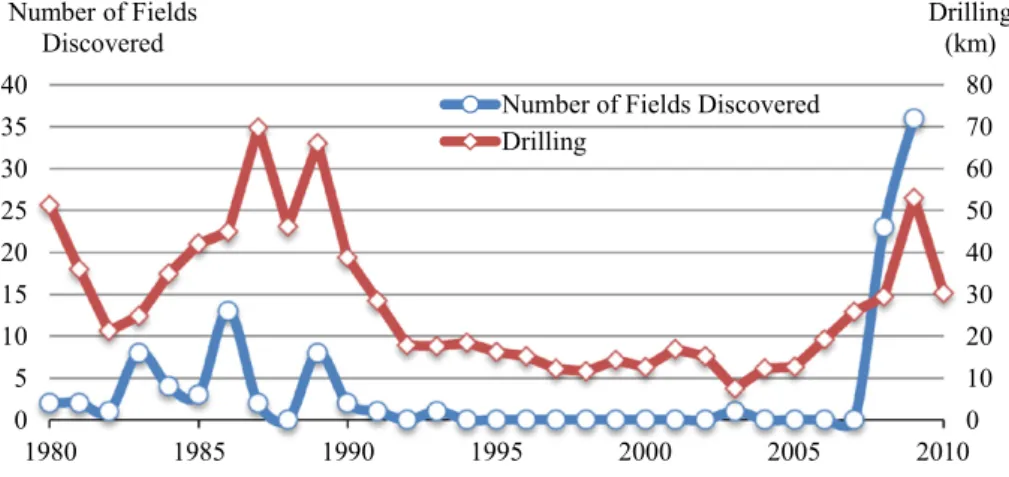
Exploratory wells drilled in the TKİ lignite fields after 1980 are, however, well documented (Fig. 2). During 31 years between 1980 and 2010, cumulative drilling depth was 863,076.89 m of which 54.6% was by TKİ, 26.7% by MTA, 11.1% by EIE, and only 3.9% by DSI.
The curve of annually drilled meters (Fig. 2) in this period represents two well-defined troughs in 1982 and 2003 and some peaks in between them. The curvefirst declines to 21,338.65 m in 1982 from 51,211.5 m in 1980 and then increases to itsfirst double peaks at 1987 (69,739.06 m)
and 1989 (66,060.65 m) before it declines down to 7459.75 m in 2003. It then increases to 52,932 m in 2009 before it declines to 30,346 m in 2010. This last peak is primarily formed as a result of increased drilling activities of the Lignite Exploration Project conducted by MTA. By 2011 TKİ was holding 145 exploration licenses all over Turkey (MTA, 2010). If the corporation decides to evaluate these licenses in the near future, the total drilling activities, which declined in 2010, would increase again.
Fig. 2clearly shows that the total curve is primarily shaped by the other institutions' curve since the TKİ curve represents a relatively stable trend, forming only one small peak in 1986 with a value of 31,232.20 m. Both curves cut each other six times between 1980– 1981, 1986–1987, 1987–1988, 1988–1989, 1989–1990, and finally 2005–2006. Consequently, TKİ's total drilling depths were bigger than other institutions during the periods between 1980–1981 and 1986– 1987 and 1989–1990 and 2005–2006. These periods represent TKİ's dominance in lignite exploration activities in Turkey.
The major reason for the decrease of drilling activities of TKİ and other institutions after 1985 and 1986 is directly related with Mining Law 3213 dated 1985. With this law MTA's lignite exploration activities were limited with its license areas, which constituted only 4% of lignite licenses. This decision affected not only the drilling activities but also discoveries (Köktürk and Narin, 1994).
The TKİ data set also reveals the 30-year-cumulative depth of wells drilled in its enterprises from 1980 to 2010. According toTable 8, the most extensive drilling activities were carried out in GLİ, ELİ, and GELİ with shares of 41.97%, 16.47%, and 10.75%, respectively. However, TKİ was responsible for most of the drilling in GLİ (76%) whereas the major institutions were MTA in ELİ (44%) and EIE in GELİ (36%). On the other hand, TKİ was the only institution which performed drilling in OAL (13,046.33 m) and AEL (7307.15 m); and drilling activities in SKLİ (5609.75 m) and GAL (3765.60 m) were carried out solely by MTA. During the mentioned period the majority of drilling was done by MTA in enterprises ELİ, ADL, ILİ, DLİ, SKLİ, and GAL, while by EIE in enterprises GELİ, ÇLİ, and MLİ.
The intensity of drilling activities correlates well with newfield discoveries (Fig. 3). According to data presented in the latest Lignite Inventory of Turkey, the number of lignitefield discoveries was 43 in 1980's, 4 in 1990's, and 60 in 2000's (MTA, 2010). The most successful years were 2009 (36fields), 2008 (23 fields), 1986 (13 fields), 1988 (8fields), and 1983 (8 fields). These dates correspond with the peaks in drilling meters. On the other hand, no discovery was made in years 1977, 1988, 1992, 1994–2002, and 2004–2007, when the exploratory drilling activities were minimum because of increasing natural gas usage and economic crises in the public sector.
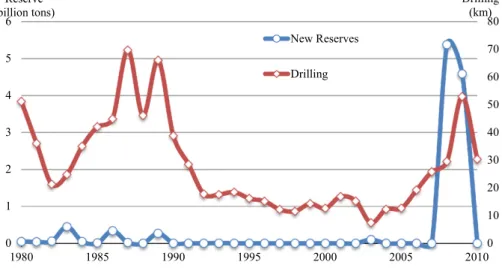
There also exists a close relationship between the amount of reserve additions and exploratory drilling activities according to MTA's (2010)data (Fig. 4). During thefirst drilling peak between
Table 7
Summary of exploration wells drilled between 1970 and 2002 (Tuncalı et al., 2002).
Explanation Value
Total bore hole depth 1,225,648.66 m Total number of boreholes 7863 Number of boreholes penetrating lignites 6243 Range of borehole spacing 50–2650 m Range of coal seam thickness 0.05–87 m Range of coal seam depth 150–828 m
0
10
20
30
40
50
60
70
80
1980
1985
1990
1995
2000
2005
2010
Drilling
(x1000 meters)
TKİ
Other Institutions
Total
1982 and 1992 in thefigure, a total of 1.207 billion tons of reserves were added. The biggest additions were in 1983 (449.554 million tons), 1986 (340.747 million tons), and 1988 (270.727 million tons). From 1990 till 2008 there wasn't any significant change in total reserves and the drilling activities declined by more than 80% until 2003. Drilling activities and reserve additions also represent high correlation over the last years. Reserves increased by more than 300% from 2007 to 2008 and a further 65.6% from 2008 and 2009, when drilling activities reached a 30 year peak value of 52.9 km. This significant escalation in exploration activities and hence discoveries, was driven primarily by Lignite Exploration Project started in 2005.
6. Conclusions and remarks
As a result of reviewing all available data on geology, reserves, and exploration of lignites of Turkey, this article concludes that production of Turkish lignite reserves can and should be increased for their indis-putable contribution to the country's economy in spite of geological, geochemical, petrographical, and mining problems of the reserves. The problems associated with lignite production and consumption in Turkey are quite severe, yet relieving the burden of energy import de-pendency on country's economy is also vitally important, therefore, new policies should be developed in a way that they should benefit the economy in the most efficient and environment-friendly way.
In Turkey, both lignite production and share of domestic lignite in pri-mary energy consumption increased steadily from 43.709 million tons (10.4%) in 2004 to 72.550 million tons (14.0%) in 2011. However, reserve
increases recorded especially during the last years are sufficient enough for further production increases at higher rates. Even if the“apparent reserves” given byTKİ (2012)are considered, the lignite reserves will last close to 150 years if the rate of production in 2012 is kept constant.
Lignites are the most valuable energy resource of the country, which suffers deeply from dependency on foreign energy sources, and they should be utilized, needless to say, in an environment-friendly way, i.e., by taking care of all concerns about environmental degradation whether local or global. Newly developed CCT (Clean Coal Technology) will provide good opportunities for such a responsible production and use of lignites. The authors of this study will feel comfortable if this study is used in this line.
However, although the lignite resources of Turkey are considered to be abundant, reserve definitions used in the country are highly controver-sial. There does not exist any scientifically developed reserve classification system.“Apparent”, “probable”, and “possible” categories are the most commonly used classification scheme for Turkey's coal reserves. These categories correspond possibly to“measured”, “indicated”, and “inferred”, or to a lesser extend to“proved”, “probable”, and “possible” categories of internationally accepted classification systems. Yet, the major problem is that the probability requirements for the international classifications are not being used in Turkish applications. Therefore, exploration activities should be concentrated on reserve classifications not discovery of new reserves. Reserve estimation practices in the country should definitely be revised and the impractical reserve classification system should be replaced by modern ones, including the producible amounts that are technically and economically feasible. Revision of reserves will provide a
Table 8
Drilling activities performed in enterprises of TKİ, 1980–2010.
Name of the enterprise Institution holding drilling activity
TKİ MTA EIE DSI Private Total
GLİ 276,446.50 71,378.19 7880.50 6518.00 362,223.19 ELİ 62,342.95 64,355.65 15,410.00 142,108.60 GELİ 28,126.35 29,736.60 33,706.80 1219.80 92,789.55 ÇLİ 147.00 17,860.75 38,687.95 250.00 56,945.70 SLİ (Seyitömer) 41,937.00 4915.30 46,852.30 TLİ 403.80 4524.00 6913.50 23,962.00 35,803.30 ADL 11,693.63 14,293.45 4081.50 30,068.58 ILİ (Ilgın-Ermenek) 5336.45 13,090.28 5242.00 487.00 24,155.73 Göynük 15,718.25 3481.00 19,199.25 OAL 13,046.33 13,046.33 DLİ 3940.00 5750.50 2640.00 12,330.50 MLİ 5416.90 5723.70 11,140.60
AEL (Afşin Elbistan) 7037.15 7037.15
SKLİ (Sivas-Kangal) 5609.75 5609.75 GAL 3765.60 3765.60 Total 471,592.31 230,364.77 96,156.25 33,263.00 31,699.80 863,076.13
0
10
20
30
40
50
60
70
80
0
5
10
15
20
25
30
35
40
1980
1985
1990
1995
2000
2005
2010
Number of Fields
Discovered
Drilling
(km)
Number of Fields Discovered
Drilling
more realistic evaluation of the country's lignite potential for developing medium and long-term energy strategies and policies for decision- and policy-makers.
MTA has been the most important institution in lignite exploration and development activities for the last 50 years. The institution in-creased its exploration efforts over the last years, especially with the Lignite Exploration Project initiated in 2005. These efforts produced significant successes and reflected huge reserve additions. The massive costs and risks associated with exploration prevent the private sector from investing in these activities. Thus MTA, as a unique and privileged governmental institution responsible for exploration of precious metals and mining stocks in Turkey, must be subsidized to increase such activ-ities to sustain long-term reserve growth in the Turkish lignite industry.
Acknowledgments
This study presents some of the results of a project entitled“History of Turkish Coal Enterprises (TKİ) and Turkish Hard Coal Enterprises (TTK), and Turkish Coal Strategies” which was carried out with the financial support provided by the Turkish Coal Enterprises (TKİ). The project was initiated at Izmir University of Economics (İEÜ), and contin-ued at Kadir Has University (KHAS) where it wasfinalized. The authors are highly indebted to the management of TKİ, İEÜ and KHAS for their guidance and constant supervision as well as for providing necessary in-formation and also for their support in completing the project. The authors would also like to thank Mücella Ersoy, TKİ for her helpful comments and Mr. Teoman Türeli, Kadir Has University Writing Center for critically editing the manuscript. Finally, we thank Ralf Littke, Editor of International Journal of Coal Geology, Reviewer #1 (Thomas Thielemann, Cologne, Germany), and Anonymous Reviewer #2 for the careful reading of our manuscript and the constructive comments.
References
Altaş, B., 1993.Enerji ve Tabii Kaynaklar Bakanlığının Kömür Politikaları (Coal Policies of the Ministry of Energy and Natural Resources of Turkey). Kömür Teknolojisi ve Kullanımı Sempozyumu. Yurt Madenciliğini Geliştirme Vakfı, İstanbul.
Barka, A.A., Sakınç, M., Görür, N., Yılmaz, Y., Şengör, A.M.C., Ediger, V.Ş., 1994.Is Aegean extension a consequence of the westerly escape of Turkey? American Geophysical Union (ASU) Spring Meeting, Baltimore, U.S.A. Abstracts, 75(16), pp. 116–117.
BP, 2013. Statistical Review of World Energy. Available at:http://www.bp.com/content/ dam/bp/excel/StatisticalReview/statistical_review_of_world_energy_2013_work-book.xlsx(Access date: 23.10.2013).
Demirmen, F., 2007.Reserves estimation: the challenge for the industry. J. Pet. Technol. 2007, 80–89 (May).
Dominian, L., 1915.The coal resources of the world: a summary. Bull. Am. Geogr. Soc. 47 (10).
Ediger, V.Ş., 1990.Paleopalynology of coal-bearing Miocene sedimentary rocks associated with volcanics of the Biga Peninsula (NW Turkey) and the effect of volcanism on vegetation. N. Jb. Geol. Paläont. (Abh.) 180 (2), 259–277.
Ediger, V.Ş., 2014.Türkiye Kömür Stratejileri (Coal Strategies of Turkey). TKİ Publications, Ankara p. 497 s.
Ediger, V.Ş., Tuna, D., 1993.Primary energy resources of Turkey: hydrocarbon and coal. Chishitsu News 467, 50–58 (In Japanese).
EIE (Electrical Power Resources Survey and Development Administration), 1940.
Türkiye'nin Energi Ekonomisi (Energy Economics of Turkey). EIE Publications, Ankara.
Eskikaya, T., 1989.A New National Energy Source. International Mining (December).
Görür, N., Okay, A.I., 1996.A fore-arc origin for the Thrace Basin. Geol. Rundsch. 85, 662–668.
Köktürk, A., Narin, R., 1994.Linyit Rezervleri, Kullanmaİmkanları ve Arama Politikalar (Lignite Reserves, Consumption, and Exploration Policies). 2000'li Yıllara Doğru Linyit Sektörümüz Sempozyumu, November 14–15, 1994, Ankara.
Korkmaz, S., Gülbay, R.K., 2007.Organic geochemical characteristics and depositional environments of the Jurassic coals in the eastern Taurus of Southern Turkey. Int. J. Coal Geol. 70 (4), 292–304.
Mann, U., Korkmaz, S., Boreham, C.J., Hertle, M., Radke, M., Wilkes, H., 1998.Regional geology, depositional environment and maturity of organic matter of Early to Middle Jurassic coals, coaly shales, shales and claystones from the Eastern Pontides, NE Turkey. Int. J. Coal Geol. 37 (3–4), 257–286.
Milici, R.C., Flores, R.M., Stricker, G.D., 2013.Coal resources, reserves and peak coal production in the United States. Int. J. Coal Geol. 113, 109–115.
MTA (General Directorate of Mineral Research and Exploration), 1945.Bull. Miner. Res. Explor. Inst. 2 (34), 261–262.
MTA (General Directorate of Mineral Research and Exploration), 1959.The Mineral Research and Exploration Institute of Turkey, 1935–1959. MTA Publications, Ankara.
MTA (General Directorate of Mineral Research and Exploration), 1986.Türkiye Linyit Envanteri (1986 Lignite Inventory of Turkey). MTA Publications, Ankara (No. 196).
MTA (General Directorate of Mineral Research and Exploration), 1993.Türkiye Linyit Envanteri (1993 Lignite Inventory of Turkey). MTA Publications, Ankara.
MTA (General Directorate of Mineral Research and Exploration), 2010.Türkiye Linyit Envanteri (2010 Lignite Inventory of Turkey). Inventory Series No. 202MTA Publications, Ankara.
Şengüler, İ., 2010.Lignite explorations in Turkey: new projects and new reserves. 27th Annual International Pittsburgh Coal Conference, October 2010,İstanbul, Turkey.
TCME (Turkish Chamber of Mining Engineers), 1994.2000'li Yıllara Doğru Linyit Sektörümüz Sempozyumu (Symposium on Lignite Sector Towards 2000s). Proceed-ings, 15–15 November 1994, Ankara.
TKİ (General Directorate of Turkish Coal Enterprises), 1973.Cumhuriyetin 50. Yılında TKİ (TKİ in the 50th Anniversary of Republic). TKİ Publications, Ankara.
TKİ (General Directorate of Turkish Coal Enterprises), 2011.2010 Linyit Sektörü Raporu (2010 Sectoral Report of Turkey). TKİ Publications, Ankara.
TKİ (General Directorate of Turkish Coal Enterprises), 2012.2011 Linyit Sektörü Raporu (2011 Sectoral Report of Lignite). TKİ Publications, Ankara.
TSI (Turkish Standards Institute), 1988.Maden Yataklarının Rezerv Miktarı ve Tenör Değerlerini Hesaplama Metotları (Reserves and Percentage Calculation Methods of Ore Deposits). TSI Publications, Ankara.
TTK (Turkish Hardcoal Company), 2011.2010 Taşkömürü Sektör Raporu (2010 Sectoral Report of Hardcoal). TTK Publications, Ankara.
Tuncalı, E., Çiftçi, B., Yavuz, N., Toprak, S., Köker, A., Gencer, Z., Ayçık, H., Şahin, 2002.
Türkiye Tersiyer Kömürlerinin Kimyasal ve Teknolojik Özellikleri (Chemical and Technological Properties of Tertiary Lignites of Turkey). MTA Publications, Ankara.
Turgut, S., Türkaslan, M., Perinçek, D., 1991.Evolution of the Thrace sedimentary basin in hydrocarbon prospectivity. In: Spencer, A.M. (Ed.), Generation, accumulation, and production of Europe's hydrocarbons. Special Publication of European Association of Petroleum Geoscientists. Oxford University Press, pp. 415–437.
0 10 20 30 40 50 60 70 80 0 1 2 3 4 5 6 1980 1985 1990 1995 2000 2005 2010 Reserve (billion tons) Drilling (km) New Reserves Drilling
Ulutan, B., 1987.Etibank: 1935–1985. Etibank Publications, Ankara.
Ünalan, G., 2010.Kömür Jeolojisi (Coal Geology). MTA Publications, Ankara (No. 41).
WEC-TNC (World Energy Council, Turkish National Committee), 1986.Enerjiİstatistikler (1986 Energy Statistics). Proceedings of 4th Energy Congress of Turkey, Izmir.
WEC-TNC (World Energy Council, Turkish National Committee), 1990.Enerjiİstatistikleri (1990 Energy Statistics). Proceedings of 5th Energy Congress of Turkey, October, 22–26, 1990, Ankara.
WEC-TNC (World Energy Council, Turkish National Committee), 1994.Enerjiİstatistikleri (1994 Energy Statistics). Proceedings of 6th Energy Congress of Turkey, October, 17–22, 1994, Izmir.
WEC-TNC (World Energy Council, Turkish National Committee), 1997.Enerjiİstatistikleri (1997 Energy Statistics). Proceedings of 7th Energy Congress of Turkey, November, 3–8, 1997, Ankara.
WEC-TNC (World Energy Council, Turkish National Committee), 2002.Enerjiİstatikleri (2002 Energy Statistics). Proceedings of 9th Energy Congress of Turkey, September, 24–27, 2002, Istanbul.
WEC-TNC (World Energy Council, Turkish National Committee), 2006.Enerjiİstatistikleri (2006 Energy Statistics). Proceedings of 10th Energy Congress of Turkey.
Yüksek, S., Elevli, B., Demirci, A., 2001.Hammadde, kaynak, cevher ve rezerv gibi bazı terimlerin tanımlarına bir yaklaşım: Hasançelebi demir yatağı örneği (A new ap-proach to the terms of raw material, resource and reserve: an example of Hasançelebi iron ore deposists). Jeoloji Mühendisliği 25 (2), 47–54.