ARTICLE IN PRESS
Turkish Journal of Psychiatry 2013
Self-Efficacy and Hemodialysis Treatment: A Qualitative and
Quantitative Approach
2
Margorit Rita KRESPI BOOTHBY
1, Peter SALMON
2Received:20.10.2011 - Accepted: 21.06.2012
1Psychologist, Assoc. Prof., Kadir Has University, Faculty of Economics, Administrative and Social Sciences, Political Science and Public Administration Department, İstanbul, Turkey. 2Psychologist, Prof., University of Liverpool, Clinical Psychology Department, Liverpool, UK.
E-mail: [email protected]
SUMMARY
Background: The theoretically driven approach to the measurement of self-efficacy fails to capture the challenges that hemodialysis patients experi-ence in following their dietary and fluid restrictions.
Aims: A combination of qualitative and quantitative research is necessary to identify the range of challenges associated with these restrictions and to quantify them if clinicians are to be guided in their consultations with patients. In this study the construct of self-efficacy was grounded on the basis of challenges to dietary and fluid restrictions, and the findings were used to develop a questionnaire to quantify the patients’ perceptions of their ability to overcome each challenge.
Materials and Methods: The sample for the qualitative study consisted of 16 hemodialysis patients and the quantitative study included 156 hemo-dialysis patients.
Results: The qualitative findings showed that the patients experienced a range of specific challenges to dietary and fluid restrictions. Among these were practical constraints, being with others, the view of hemodialysis as compensating for dietary non-compliance, and emotional challenges including discomfort, distress, and boredom with dietary and fluid restrictions. The most common challenge to fluid restrictions was eating while not having any fluid allowance left. Boredom with diet was the most common challenge to diet. Hemodialysis treatment was a justification for a significant number of patients to neglect their dietary and fluid restrictions.
Conclusion: The findings suggest that grounded self-efficacy is a unitary phenomenon, but that it incorporates a wide spectrum of specific chal-lenges. The challenges identified herein have provided an evidence base for educational interventions to improve compliance with dietary and fluid restrictions.
Keywords: Self-efficacy, hemodialysis, diet and fluid restrictions
INTRODUCTION
Hemodialysis treatment has transformed the prognosis of end-stage renal failure (ESRF) and has extended the longevity of patients with ESRF. The treatment is very demanding on patients. ESRF patients require hemodialysis treatment 3-4 times a week. Nevertheless, hemodialysis treatment replaces only about 10% of normal renal function (Loghman-Adham 2003); therefore, in addition to a complex mixture of medica-tion, patients must follow stringent dietary and fluid restric-tions to achieve maximum benefit from hemodialysis treat-ment. As such, dietary and/or fluid restrictions are crucial components of the treatment of ESRF. In chronic illnesses
including diabetes, it has been suggested that the range and nature of the challenges to diet are hard to predict for 2 rea-sons (Krespi-Boothby and Salmon 2010): First, these restric-tions are subjected to each patient’s interpretation and require the active involvement of the patient; Second, the diverse as-pects of each patient’s environment and life circumstances are likely to challenge them.
Among ESRF patients, the effectiveness of treatment recom-mendations is compromised by high rates of non-compliance (Richard 2006; Leggat et al. 1998). Findings on the effects of a number of variables on dietary compliance are incon-sistent; however, the effects of psychosocial factors, including patients’ beliefs about their treatment, are more consistent.
These beliefs stem from a number of theories. In the context of illness, Attribution Theory (Kelley 1967) postulates that people respond to illness by seeking explanations for its cause and, in turn, these attributions influence the ways in which the illness is coped with (Turnquist et al. 1988). In hemo-dialysis patients the effect of causal attributions on compli-ance has been examined in only a few studies. For example, Witenberg et al. (1983) reported that hemodialysis patients with a causal attribution for ESRF had better compliance, although there was no relationship of the specific causal at-tributions of self-blame and blaming other people with com-pliance. This finding suggests that the causal attributions that Attribution Theory focuses on may not necessarily reflect he-modialysis patients’ causal attributions for their illness. One of the constructs of Social Learning Theory (Rotter 1966, 1954) locus of control refers to the belief that desirable future outcomes are self-determined or determined by external fac-tors (Rosenbaum and Ben-Ari Smira 1986). Again, within the context of illness and health this construct has been referred to as health locus of control, which indicates the belief that health is self-determined or determined by external factors, including chance and other powerful individuals (Wallston et al. 1978; Levenson 1973). This construct, which is closely as-sociated with outcome expectancy, as defined below, has been studied extensively, but the findings have been inconsistent. Some evidence suggests that compared to hemodialysis pa-tients with an external general locus of control, papa-tients with an internal general locus of control have better compliance with treatment (Poll and Kaplan DeNour 1980). Similarly, an external health locus of control also predicts non-compliance with fluid restrictions (Everett et al. 1993); however, other studies have shown that there is not a relationship between health or general locus of control, and compliance with treat-ment (Schneider et al. 1991; Brown and Fitzpatrick 1988; Witenberg et al. 1983). These findings indicate that the con-struct of locus of control may not necessarily correspond to how hemodialysis patients normally think about their illness and its treatment.
Common to Learned Helplessness Theory (Abramson et al. 1978; Seligman 1975) and Theory of Planned Behavior (Ajzen 1988, 1991) is the construct of perceived control, which refers to people’s belief about how much control they have over a given situation that is based on their awareness of their abilities to achieve positive outcomes and avoid negative outcomes (Devins et al. 1982; Bandura 1977). This closely corresponds to efficacy expectancy, as defined below (Stroebe and Stroebe 1995).
Only a few studies have examined the effect of perceived con-trol on compliance in hemodialysis patients. For example, Witenberg et al. (1983) reported that there was not a relation-ship between perceived control over illness and compliance. In analyzing the reactions of patients other than hemodialysis
patients to a psychological intervention designed to increase feelings of control, Peerbhoy et al. (1998) concluded that, “rather than being, as is usually assumed, a fundamental di-mension of patients’ experience, patient control over medical care appears to be a theoretical and professional construc-tion”. This suggests that perceived control may not necessarily reflect hemodialysis patients’ own thinking about their illness and its treatment.
The central construct of the Social Cognitive Theory (Bandura 2002) is self-efficacy and refers to people’s belief in their capac-ity to perform relevant healthcare behaviors. Recent studies have shown the importance of this construct in understand-ing compliance with dietary and/or fluid restrictions (Zrinyi et al. 2003; Brady et al. 1997; Eitel et al. 1998; Cummings et al. 1982). For example, Zrinyi et al. (2003) recently reported that greater self-efficacy was associated with greater com-pliance, as measured by serum potassium levels and weight gain, and a better relationship with staff. A better relationship with staff refers to open communication with staff and the ability to negotiate treatment. Brady et al. (1997) reported that self-efficacy was a significant predictor of compliance, as measured via mean weekend inter-dialysis fluid gain. A recent intervention study by Tsay (2003) observed that patients in the self-efficacy training group decreased their mean weight gain significantly more than the control group patients for up to 6 months following the intervention.
Among hemodialysis patients, self-efficacy has been typically measured by constructing items that represent the construct of self-efficacy (e.g. Zrinyi et al. 2003, Eitel et al. 1998, Cummings et al. 1982). The limitation of this theoretically driven approach is that the questions asked of patients may not correspond to the difficulties that they experience. In chronic illnesses other than ESRF, such as diabetes, self-ef-ficacy has been measured by designing questions on basis of patient interviews (Talbot et al.1997) or by conducting qual-itative research with the patients on the challenges associ-ated with dietary requirements (Krespi-Boothby and Salmon 2010). In a study conducted with type 2 diabetes patients Krespi-Boothby and Salmon (2010) observed that patients experienced a number of challenges to dietary restrictions, including being with others and internal factors such as emo-tional or physical state. Although the treatment of type 2 dia-betes and ESRF differ, both treatments place high demands on patients. It is therefore possible that hemodialysis patients may experience similar challenges to those identified in this earlier study.
There is some detailed evidence on the ways in which he-modialysis patients experience their life (Krespi et al. 2008; Wright and Kirby 1999; Gregory et al. 1998) and their treat-ment in general (Krespi et al. 2004). Apart from a limited number of studies, such as Gregory et al. (1998), which ob-served that social factors challenge ESRF patients’ dietary
and fluid restrictions, no detailed account exists on the dif-ficulties that hemodialysis patients experience in following their dietary and fluid restrictions. Nevertheless, in a study on peritoneal dialysis patients Curtin et al. (2004) highlighted the importance of self-efficacy in a patient’s ability to trans-form the self, and adapt to ESRF and dialysis. Using semi-structured interviews, within the context of self-management of illness and treatment, 2 broad domains of self-management were identified: autonomy/control in health care and normal-ity in everyday life. Patients recounted the importance of autonomy/control in managing their treatment. Autonomy/ control was perceived as having 3 aspects, one of which was the ability to maintain self-efficacy; the other 2 aspects were ‘partnership in care and self-care.
Given the importance of self-efficacy highlighted by both quantitative and qualitative research, grounding this con-struct on the basis of patients’ views of the challenges posed by dietary and/or fluid restrictions could be a possible way to undertake qualitative research with hemodialysis patients. Such an approach could help healthcare professionals better understand the challenges that patients experience in follow-ing dietary and/or fluid restrictions. Healthcare professionals also need evidence on the frequency of these challenges; there-fore, qualitative and quantitative methods were combined in the present study to ground the construct of self-efficacy on the basis of challenges to dietary and fluid restrictions, and to develop a questionnaire for measuring patients’ perceptions of their ability to overcome each challenge.
MATERIALS and METHODS
Sample
For the qualitative study, in order to ensure the transferability of the findings to other hemodialysis patients ‘typical sam-pling’ was used (Henwood and Pidgeon 1992). Specifically, a ‘typical’ hemodialysis patient was diagnosed with ESRF due to a commonly identified cause and received chronic hemodi-alysis treatment. A commonly identified cause of ESRF could be diabetes, hypertension, or glomerulonephritis. Renal nurs-es identified such patients from among those attending the hemodialysis ward of a university teaching hospital and its 4 satellite units, of which 2 were in middle-class suburbs and 2 in inner-city neighborhoods. The patients were approached sequentially on study days and asked to provide consent to be interviewed. The sampling was stopped when no new infor-mation was being obtained.
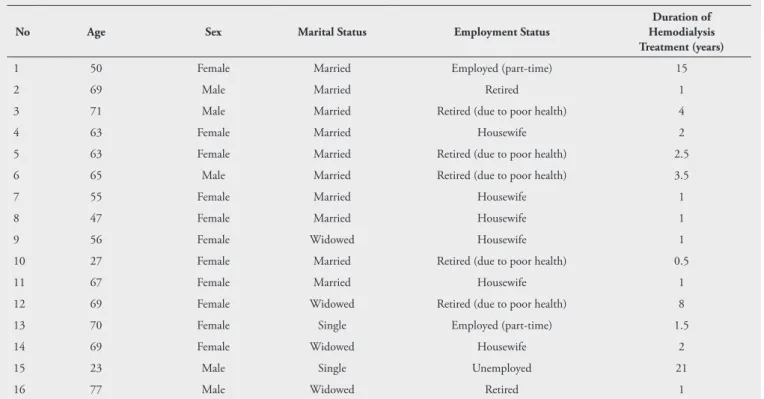
Of the 20 suitable patients who were asked, 16 consented to be interviewed; 11 of these patients were receiving hemodi-alysis at the hospital and 5 at satellite units (11 female and 5 male; mean age: 57 years [range: 23-77 years]). Mean dura-tion of hemodialysis was 4 years (range: 6 months-21 years). Two patients were employed, 1 was unemployed; 6 were homemakers, and 7 were retired (5 were retired due to poor health). In all, 10 patients were married, 4 were widowed, and 2 were single. Exclusion criteria were insufficient understand-ing of English, and any medical condition preventunderstand-ing partici-pation, including dementia related to hemodialysis treatment and blindness (Table 1).
Table 1. Demographic and medical characteristics of the study group
No Age Sex Marital Status Employment Status
Duration of Hemodialysis Treatment (years)
1 50 Female Married Employed (part-time) 15
2 69 Male Married Retired 1
3 71 Male Married Retired (due to poor health) 4
4 63 Female Married Housewife 2
5 63 Female Married Retired (due to poor health) 2.5
6 65 Male Married Retired (due to poor health) 3.5
7 55 Female Married Housewife 1
8 47 Female Married Housewife 1
9 56 Female Widowed Housewife 1
10 27 Female Married Retired (due to poor health) 0.5
11 67 Female Married Housewife 1
12 69 Female Widowed Retired (due to poor health) 8
13 70 Female Single Employed (part-time) 1.5
14 69 Female Widowed Housewife 2
15 23 Male Single Unemployed 21
The quantitative study included 166 consecutive patients from the same population described above. In all, 10 patients declined to participate; 4 due to poor health and 6 without stating a reason. Of the 156 that participated, 87 (56%) were male and 69 (44%) were female. In total, 15 patients (10%) were employed, 44 (28%) were unemployed, 72 (46%) were retired, and 25 (16%) were homemakers. Among these pa-tients, 67 (43%) received hemodialysis at the hospital and 89 (57%) at the satellite units; mean age was 54 years (range: 17-81 years). Mean duration of hemodialysis was 3 years (range: 1 month-20 years). Exclusion criteria for the quanti-tative study were the same as for the qualiquanti-tative study; insuf-ficient understanding of English and any medical condition preventing participation, including dementia related to he-modialysis treatment and blindness.
Qualitative study procedure
Patients were interviewed individually for 60-90 min while undergoing hemodialysis. They were asked to describe the difficulties they experienced in following their dietary and fluid restrictions, and the ways in which they responded to these difficulties. The pace and sequencing of the interview depended on each patient. The interviewer (MRKB) encour-aged patients to talk in their own way, adjusted the pace and the sequence of the interview to the patient and attempted to use only open-ended questions. Audio recordings of the interviews were transcribed anonymously.
‘ Template analysis’ was used. A template can be defined as a series of codes pertaining to different themes revisable on the basis of discrepant information (Crabtree and Miller 1992; Miller and Crabtree 1992). With template analysis the pro-cess of generating themes is interpretive (Glaser and Strauss 1967), but a template in the form of themes and illustrative accounts is defined before in-depth analysis begins and is used to make more elaborate interpretations in the new set of ac-counts (Crabtree and Miller 1992). This type of analysis was chosen for 2 main reasons. Firstly, it was expected that the challenges to dietary restrictions experienced by type 2 dia-betes patients identified in a previous study (Krespi-Boothby and Salmon 2010) might be similar to the challenges experi-enced by hemodialysis patients, because both illnesses require lifestyle adjustment and compliance is poor in both patient groups. For example, Krespi-Boothby and Salmon (2010) studied type 2 diabetes patients and reported that the patients experienced a number of challenges to dietary restrictions, in-cluding being with others and internal factors such as emo-tional or physical state. Secondly, it was thought that the considerable amount of information gathered in the previous studyon challenges to diet in type 2 diabetes would influence the researcher’s subsequent analysis of the same in hemodi-alysis patients. As such, the categories of challenges to diet identified in the previous study (Krespi-Boothby and Salmon
2010) provided a template (Crabtree and Miller 1992) that was used for organizing data gathered via interviews with hemodialysis patients. Then, the transcribed passages were compared to the types represented in the ‘template’ so that re-visions could be made (Miller and Crabtree 1992). Lastly, the types of challenges were compared for similarities in meaning and were grouped into main categories. Following the initial analysis based on the data collected via interviews with 10 patients, another 6 interviews were performed, which did not require significant further elaboration of the analysis.
Quantitative study procedure
The Management of Diet and Fluid Restrictions Questionnaire for Hemodialysis Patients (MDFRQ-Hemodialysis) was con-structed writing an item to represent each type of challenge identified in the qualitative analysis that would be applica-ble to most patients. Parallel forms of each item were written for dietary and fluid restrictions, which led to 21 items. An additional 8 items were added after the pilot study with 10 patients, which was performed to determine the comprehen-sibility and comprehensiveness of the questionnaire. The final questionnaire consisted of 29 items. Patients responded on a 5-point scale, ranging from 1 (completely agree with the left pole of an item) to 5 (completely agree with the right pole of an item), and 3 represented uncertainty. Higher scores indi-cated a higher level of grounded self-efficacy.
Statistical analyses
For each item on the MDFRQ-Hemodialysis frequencies and percentages were calculated by concentrating on the number of patients agreeing or disagreeing with the relevant pole of the item, which corresponded to those responding with 1 or 2 points versus 4 or 5 points on the scale, disregarding those at the midpoint.
The Kaiser-Meyer-Olkin (KMO) test and Bartlett’s test of sphericity were computed to determine the accuracy of the sampling. Principal components analysis was used to assess the structure of the questionnaire. During this analysis, a scree test before varimax rotation helped to determine the number of components to retain. Items loading at >0.45 were used to interpret the components. Loadings >0.45 were con-sidered to be satisfactory. Researchers commonly use some rules of thumb to decide whether or not it is beneficial to retain an item, although such rules produce interpretations that ignore the effect of sampling variability on estimated fac-tor loadings (Lambert et al. 1991). In the present study the rule of thumb was an absolute value of >0.45. Component-based scale scores were calculated by summing the scores of the items loading on 1 factor. The reliability of the scale was established using Cronbach’s alpha coefficients. A coefficient
≥0.70 was considered good. SPSS v.10 for Windows was used for all analyses.
RESULTS
Qualitative Study
Preliminary analyses indicated that the patients’ accounts and their simultaneous comparisons against themes represented in the template emphasized characteristics of different situations and particularly, the patients’ experiences of others’ behavior in these situations; however, prolonged engagement in the patients’ accounts also showed that some of their accounts could not be readily categorized on the basis of the categories represented in the template. As such, it was necessary to re-vise the template by defining new types of challenges in order to understand adequately the experience of the hemodialysis patients. Table 2 summarizes the main challenges to diet and fluid restrictions. Within each group of challenges all patients spontaneously justified why they did not follow their diet and fluid restrictions, which suggests that the patients per-ceived their dietary and fluid restrictions as rules that should be followed. They felt under obligation to follow them and when they could not they justified to the interviewer why they could not.
Practical constraints were thought to compromise diet and fluid restrictions. In particular, these involved the belief that:
You need a lot more money because you’re not allowed any meat that has salt in it, like boiled ham; and difficulty in having
ac-cess to allowed food in routine life : You can’t always get out to
get fresh chicken and turkey for your sandwich; but particularly
outside the home : Go out for a meal you can’t always stick
to diet…. You more or less stick to it. You have to ask whether it’s fresh or tinned. You can’t get anything out of a tin. This
contributed to the feeling that: I don’t have any social life now,
although I could do but I don’t trust myself to go to dinners or cocktail parties because of drinking and eating. I don’t know what they are going to serve me up you know, could be very salty. So I dodge all this stuff. Far better you eat at home. You know that there is no salt in it. Simply seeing disallowed food was a
routine part of life: Even in the supermarket all you see are the
nice things; and was sufficient for patients to neglect their
diet: When I go to the market where I live, I see these prawns.
Oh, I think I’ve got to buy.
The majority of challenges to management of diet and flu-id restrictions concerned with being with others. Although many of these were clearly common situations that involved visiting or being visited by others in the course of routine so-cial behaviour, there were also non-routine soso-cial situations, including holidays, anniversaries and celebrations (including Christmas), and eating out. These challenges can be grouped according to patients’ experiences of others’ behavior.
Dietary and fluid restrictions were challenged by observing other people eating and drinking in routine social situations, as well as in special situations, for example at Christmas. Most patients tried to cope with this challenge by self-re-straint: Now Christmas is coming. You see them all having a
drink, but you can’t. You can get overloaded. Even if you have a small vodka you’ve to put some Guinness in. It’s all fluid. You’ve got to do without. You’ve got to do without your cup of tea to have that drink. Nevertheless, 1 patient also felt that she ought to
challenge people who were challenging her diet: You come to
learn gradually to bear your husband eating your favorite food. He eats a banana, Mars bars, and stuff like that. I’m not eating chocolate. You can’t have chocolate. I look away. I can’t have it so, you know, you accept it. You turn away. You can’t eat it. I’ve got to tell him to stop. Indeed, for another patient, coping with
this challenge also involved cooperation from family mem-bers: My husband himself is on the same diet just to help me. He
does try to help me. But you can’t expect the children. They do eat a lot of things that I’m not allowed. Kids eat before me. I don’t see all the food they’re eating.
Many patients tried to cope with this challenge by consum-ing alternative food as a substitute: I go to my son on Sundays,
my daughter-in-law loves salt. She cooks Sunday meals without salt. I saw them adding salt to their meals. I want to put on some salt, but I put black pepper on instead, but also eating
disal-lowed food in moderation or consuming attractive, but less forbidden foods: If you go to places like McDonalds, because
we go a lot for kids, I have a chicken burger. The same patient
also volunteered her justification for this: I know that you
really shouldn’t. But I feel it isn’t as bad as a hamburger. It’s got no cheese on it, for potassium, I mean. These instances
oc-curred when others’ behavior was perceived as more directly targeting the patient’s diet rather than targeting the patient him/herself. These involved regular instances of hospitality in both routine and non-routine situations: You’ve got to refuse
the drink. When you go visiting you’ve got to refuse. For some,
this challenge also meant an end to social life: I don’t even go
out socially. There you are with a glass of wine. They come round and they fill it up and you don’t know how much you had.
The offer of hospitality in some instances was perceived as representing a gift that had a personal meaning: At my
birth-day, my daughter made a big party for me. I had lots of presents. All the food on the table at the party, I couldn’t eat fish, ham, salmon. I had only a piece of rib. The only thing that I could have was a piece of chicken. I had a small drink. I had to do without my cup of tea all day. This was my birthday party. I’d rather not have had it.
Patients’ diet was also challenged when offering hospitality to others. However, in this case resisting disallowed food was easier because its refusal was free from connotations of re-jection: I find it difficult when I’m cooking breakfast for my
beginning, I used to sneak. I used to like bacon. Now, it doesn’t bother me, I just have two rounds of toast.
The patients perceived most challenges as neutral. However, some offers of food or drink were perceived as inherently threatening or malicious: They offer whiskies, they never offered
when I was fit. In some instances diet and fluid restrictions
were challenged by the perception that: They [friends] simply
don’t understand the fluid restrictions. It’s very hard to make them believe. They say ‘Oh come on have a drink’. I have to refuse.
Many patients described conscious decisions not to follow their diet and fluid restrictions. Most spontaneously provided
some justification for this decision. For many, the justifica-tion was the power of the hemodialysis machine: I like to have
a mince pie before my machine, you know, that will get sort of dissolved through the machine. One way of cheating a bit so that it gets washed through. That’s the idea of it. A lot of people take a chance at things that they can’t have. For others, the
infre-quency or special nature of an occasion was the justification:
I know what will happen at Christmas. You have mince pie, Christmas pudding. I won’t follow my diet... When I go out for a meal with my husband, you know that you shouldn’t, I feel like, Table 2. Responses to MDFRQ-Hemodialysis and its structure
Item Frequency % Factor
Loadings
1. Eating and no allowance left for fluid 79/54 51/35 0.65
2. Feeling hot and thirsty (fluid) 74/58 47/37
3. Being bored with diet 74/53 47/34 0.72
4. Feeling hungry and no food around (diet) 64/63 41/40 0.72
5. Going to the hospital in an hour or two, or the next morning to have your dialysis or you are
on dialysis (fluid) 62/76 40/49
6. Going to a cafe or a pub (fluid) 58/75 37/48 0.70
7. Going to the hospital in an hour or two or the next morning to have your dialysis or you are
on dialysis (diet) 53/86 34/55 0.68
8. Someone making or bringing you some food 53/74 34/47
9. Being with people who are all eating 52/80 33/51
10. Going to a cafe or a restaurant (diet) 49/75 31/48
11. Someone making or bringing you a drink 48/92 31/59 0.71
12. Being away from home for a couple of days, or having a day out (fluid) 47/83 30/60 0.77
13. Being with people who are all drinking 44/90 28/58 0.66
14. Being away from home for a couple of days, or having a day out (diet) 43/80 28/51 0.66 15. People saying just this once will not matter (diet) 42/92 27/59
16. Feeling depressed or fed up (diet) 42/94 27/60 0.75
17. Having to buy or cook food for other people 41/90 26/58 0.70
18. Feeling tired or run down (diet) 40/96 26/62
19. Being bored with fluid restrictions 39/94 25/60 0.69
20 Feeling depressed or fed up (fluid) 38/94 24/60 0.74
21. Feeling tired or run down (fluid) 36/106 23/68 0.70
22. Being with people who are all eating and who don’t understand your diet 31/97 20/62
23. Being with people who are all drinking and who do not understand your fluid restrictions 31/106 20/68 0.68 24. Shopping and seeing food that you should avoid (diet) 28/103 18/66
25. Feeling anxious or upset, or have some personal or financial problems (diet) 26/104 17/67 0.65 26. People saying just this once will not matter (fluid) 26/112 17/72
27. Feeling anxious or upset, or have some personal or financial problems (fluid) 25/113 16/72 0.71 28. Feeling disappointed with yourself because you have just had a good drink 13/127 8/81
29. Feeling disappointed with yourself because you have just eaten something 12/130 8/83
Cronbach’s Alpha 0.94
Note.The ratios indicate the number of patients who think they would not/would follow their diet or fluid restrictions in each situation as stated (neglecting those scoring at the midpoint). The loadings of each item on the single factor are shown.
you know all the money is spent. We went for our anniversary. I didn’t bother with that, I didn’t follow my diet.
Diet and/or fluid restrictions themselves were also described as boring: I think the hardest part is the diet. The diet is very
hard. It’s the same meals all the time. In these instances, only
disallowed food or drink could help patients: You think you
want a change. At times you do cheat as everybody does. You have the things you shouldn’t have. Patients felt thirsty and thought
that only disallowed drink could really help them: It’s very
hard. I feel thirsty. It was particularly distressing for the
pa-tients when they had no allowance left for fluid while eating:
I like the drink with my meal. It’s atrocious. If you have gravy you’ve got to take into account the water.
Quantitative study
The most common challenge was related to fluid restrictions rather than diet (Table 2). The most common challenge to fluid restrictions was eating while not having any fluid al-lowance left. This was a more common challenge than feel-ing thirsty. Boredom with diet was the most common chal-lenge to diet, exceeding the unavailability of allowed food. Hemodialysis treatment was a justification for a significant number of patients to neglect their dietary and fluid restric-tions. Both routine and special social situations were more often perceived as challenges to dietary and fluid restrictions than were unpleasant internal states, such as feeling tired, anxious, and depressed. For a smaller, but significant number of patients, boredom with fluid restrictions and other people’s lack of understanding of their dietary and fluid restrictions were challenging (Table 2).
Before performing principal components analysis, KMO, which measures the sampling adequacy, was computed as 0.835. With this statistical test a value >0.80 is considered to be excellent. Moreover, on the Bartlett’s test of sphericity the p value was 0.001, which also showed that the data were suitable for factor analysis. In principal components analysis 1 factor on which 17 items loaded (Eigen value = 12.14) ac-counted for 41.9% of the variance (Table 2). As a result, 12 items were excluded to form a single scale.
DISCUSSION
Qualitative and quantitative results are discussed together, in that references to the number of beliefs refer to qualitative findings whereas references to the number of patients holding a particular belief refer to quantitative findings. The present findings provided some support for the notion that the con-struct of self-efficacy could be grounded in hemodialysis pa-tients’ own thinking. More specifically, the findings indicated that by contrast with self-efficacy defined a priori, hemodi-alysis patients experienced a number of diverse and specific
challenges. These findings are consistent with those observed in type 2 diabetes patients (Krespi-Boothby and Salmon 2010). In general, instances in which patients felt that they followed their dietary and fluid restrictions indicated that their view of compliance with diet and fluid restrictions was different from that of professionals. This was also noted in a previous study on type 2 diabetes patients (Krespi-Boothby and Salmon 2010). The consistency of these findings high-light 3 issues. The first is that in chronic illnesses that require lifestyle changes, some aspects of treatment including dietary restrictions may be experienced in similar ways, although the nature of these restrictions may differ across chronic ill-nesses. The second issue is that grounding the construct of self-efficacy may have relevance across different types of chronic illness. The third issue relates to the notion that in order to understand a patient’s self-care behaviors one should go beyond such concepts as compliance and adherence, and move towards concordance (see Krespi-Boothby and Salmon 2010). The latter term emphasizes the nature and the qual-ity of interactions between professionals and patients, where-by agreement on treatment goals is achieved (Segal 2007; Blenkinsopp 2001).
Some of the challenges to diet and/or fluid restrictions iden-tified in the present study have already been ideniden-tified by quantitative research. Nevertheless, other challenges were surprising. Most challenges concerned non-nutritional uses of food/drink. Patients used disallowed foods or drinks as coping responses to physical discomfort. Quantitative studies among hemodialysis patients (Cukor et al. 2006; Kimmel and Peterson 2005; Kimmel 2002, 2001) and patients with other chronic illness, including diabetes (Sacco and Yanover 2006; Fisher et al. 1992; Goodall and Halford 1991), and chronic obstructive pulmonary disease (Ng et al. 2007) reported that stress and depressive feelings can lower compliance with diet and that depression affects medical outcomes through for ex-ample, reducing compliance with or access to medical regi-mens. Most challenges mirrored those experienced by type 2 diabetes patients (Krespi-Boothby and Salmon, 2010) and provided additional insight by showing that patients use food to cope with discomfort and distress. The present findings, therefore, suggest that non-nutritional use of food or drink may be common in patients with different types of chronic illness, although their dietary requirements may differ. The present study showed that different functions and mechanisms of food in social situations presented challenges to hemodialysis patients’ dietary and fluid restrictions, and these therefore compromised the patients’ management of these restrictions. Each of these challenges was reported by a significant minority of patients. As in an earlier study on type 2 diabetes patients (Krespi-Boothby and Salmon 2010), the types of social challenge to dietary and fluid restrictions formed a continuum These included the social facilitation
of eating, offers of food being maliciously or benevolently targeted at a patient. The challenge to diet then arose from the identity between rejecting the food and rejecting the giv-er. That is, it was the social significance of the food that led to problems for diet and fluid restrictions. These findings also highlight the view that challenges experienced may be similar across patients with a different type of chronic illness, although the dietary requirements differ from one group of patients to another.
Surprisingly, however, the imminence of hemodialysis treat-ment was itself a challenge to dietary and fluid restrictions. Patients believed that hemodialysis treatment would dissolve disallowed food or drink; this has not been reported before and suggests that compliance with dietary and fluid restric-tions is a function of whether or not a patient is on hemodial-ysis treatment, and whether or not hemodialhemodial-ysis is imminent. This was a form of self-dispensation in which patients make a conscious decision justified by the frequent nature of the hemodialysis treatment.
There are striking differences in the dietary regime for patients with type 2 diabetes and ESRF; however, the present qualita-tive findings show that the challenges to dietary and/or fluid restrictions experienced by these patients are similar as com-pared to the findings of the previous study (Krespi-Boothby and Salmon 2010). Indeed, being on hemodialysis treatment was the only substantive difference in the experience of these 2 different regimes. The contribution of the present study was also to quantify how common the challenges to dietary and/or fluid restrictions were. The most common challenge to fluid restrictions was eating while not having any fluid al-lowance left and boredom was the most common challenge to diet. Interestingly, the next most common challenge involved the notion that hemodialysis treatment was a justification for neglecting dietary and fluid restrictions, which was reported by 34% and 40% of patients, respectively, for dietary and fluid restrictions. In contrast, a smaller number of hemodialy-sis patients reported social situations, craving, and practical constraints as challenges to their dietary and fluid restrictions. These findings are in contrast with previous quantitative findings in hemodialysis patients, which indicates that social situations, craving for disallowed foods, and practical con-straints are the most common barriers to dietary and/or fluid restrictions. The discrepancy in findings are probably due to differences in research design. There was a qualitative phase in the present study that helped identify diverse challenges to dietary and fluid restrictions, and to put social situations, craving, and practical constraints in context by identifying different challenges for comparison.
Principal components analysis indicated that ‘grounded’ self-efficacy to follow dietary and fluid restrictions was unidi-mensional; there was an interrelationship between patients’ confidence in overcoming different challenges to dietary and
fluid restrictions that indicates that if patients feel confident they can overcome one challenge to dietary and fluid restric-tions they will feel that they can overcome other challenges. The grounding of the construct of self-efficacy in patients’ own thinking adds to previously published findings in a num-ber of ways. First, the present qualitative findings contribute to an evidence base for patient-centered care of hemodialy-sis by identifying diverse challenges to dietary and/or fluid restrictions that can alert clinicians during routine consul-tations. Of particular importance are the functions and the mechanisms of food/drink in social situations, the view of hemodialysis as compensating for dietary non-compliance, and emotional challenges including discomfort, distress, and boredom with dietary and/or fluid restrictions. Second, prin-cipal components analysis indicated that grounded self-effica-cy was a unitary phenomenon consisting of 1 dimension de-fined by the characteristics of different situations that patients might need to negotiate. Nevertheless, it incorporated a wide spectrum of specific challenges. Third, the questionnaire con-structed in the present study contributed to bridging the gap between qualitative and quantitative research by quantifying how commonly the challenges to dietary and fluid restrictions were experienced.
Earlier educational programs designed for hemodialysis pa-tients (Brantley et al. 1990) provided papa-tients primarily with information on what they need to do to restore their health; however, little attention was given to strategies to help pa-tients cope with the requirements of treatment. More recent intervention studies have focused not only on providing in-formation about aspects of clinical care, but also highlighted the importance of self-empowerment and rehabilitation in relation to broader issues, including survival. For example, in an intervention study Wingard et al. (2007) targeted patients who initiated maintenance hemodialysis. The intervention consisted of an individualized patient education program em-phasizing self-empowerment and rehabilitation, combined with interventions focusing on areas of clinical care such as management of anemia, receiving adequate amount of dialy-sis, nutrition, medication, and reduction of catheter use. The intervention lasted for 3 months and at the end of the 1-year follow-up the intervention was effective in reducing the death rate by approximately 40%, as compared with a control group of long-term hemodialysis patients. The researchers observed improvements in psychosocial adjustment in the intervention group and suggested that this may have also contributed to the improvement in mortality. It has also been suggested that educational interventions designed on the basis of patients’ views will likely be more effective (Maguire 2002; Green and Kreuter 1990); therefore, future psycho-educational interven-tions might target improving compliance with dietary and fluid restrictions, and maybe mortality by empowering pa-tients with strategies that may help them cope with each type
of challenge to dietary and fluid restrictions that was identi-fied in the present study.
One limitation of the present qualitative and quantitative findings is that they may not be transferable or generalizable to other cultural and religious groups; therefore, future re-search should examine ways in which the present findings are relevant to other cultures and religious groups.
REFERENCES
Abramson LY, Seligman MEP, Teasdale JD (1978) Learned helplessness in humans: Critique and reformulation. J Abnormal Psychol, 87:49-74. Ajzen I (1988) Attitudes, Personality, and Behaviour. Chicago, IL: Dorsey Press. Ajzen I (1991) The theory of planned behaviour. Organ Behav Hum Dec 50:
179-211.
Bandura A (1977) Self-efficacy: Toward a unifying theory of behavioural change. Psychol Review, 84: 191-215.
Bandura A (2002) Social foundations of thought and action. In D. Marks (Ed.) The Health Psychology Reader (Vol. 6, pp.94-106). London: Sage Publications.
Blenkinsopp A (2001) From compliance to concor dance: how are we doing? Int J Pharmacol Prac, 9:65-6.
Brady BA, Tucker CM, Alfino PA et al (1997) An investigation of factors associated with fluid adherence among hemodialysis patients: A self-efficacy theory based approach. Annals Behav Med, 19:339-43.
Brantley PJ, Mosley TH, Bruce BK et al (1990) Efficacy of behavioral management and patient education on vascular access cleansing compliance in hemodialysis patients. Health Psychol, 9:103-13.
Brown J, Fitzpatrick R (1988). Factors influencing compliance with dietary restrictions in dialysis patients. J Psychosomatic Res, 32:191-6.
Crabtree BF, Miller WL (Eds.) (1992) A template Approach to Text Analysis: Developing and Using Codebooks. Doing Qualitative Research. (pp. 93-109). Sage Publications.
Cukor D, Peterson RA, Cohen SD et al (2006) Depression in end-stage renal disease hemodialysis patients. Nat Clin Prac Nephrol, 2:678-87.
Cummings KM, Becker MH, Kirscht JP et al (1982) Psychosocial factors affecting adherence to medical regimens in a group of hemodialysis patients. Med Care, 20:567-80.
Curtin RB, Johnson HK, Schatell D (2004) The peritoneal dialysis experience: insights from long-term patients. Nephrol Nurs J, 31:615-24.
Devins GM, Binik YM et al (1982) Perceived self-efficacy outcome expectancies and negative mood states in ESRD. J Abnormal Psychol, 91:241-4. Eitel P, Friend R, Griffin KW et al (1988) Cognitive control and consistency in
compliance. Psychol Health, 13:953-73.
Everett KD, Sletten C, Carmack C et al (1993) Predicting noncompliance to fluid restrictions in hemodialysis patients. Dialysis & Transplant, 10:614-20.
Fisher EB, Delamater AM, Bertelson AM et al (1992) Psychological factors in diabetes and its treatment. J Consult Clin Psychol, 50:993-1003.
Glaser BG, Strauss AL (1967) The Constant comparative method of qualitative analysis. The Discovery of Grounded Theory: Strategies for Qualitative Research. (pp.72-95) 1st ed. New York: Aldine.
Goodall TA, Halford WK (1991) Self-management of diabetes mellitus: a critical review. Health Psychol, 10:1-8.
Green LW, Kreuter MW (1990) Health promotion as a public health strategy for the 1990s. In L Breslow, JE Fielding & LB Lave (Eds). Annual Review of Public Health. Vol. 11. (pp. 319-334). Palo Alto, CA: Annual Reviews Inc. Gregory DM, Way CY, Hutchinson TA et al (1998) Patients’ perceptions of
their experiences with ESRD and hemodialysis treatment. Qual Health Res, 8:764-83.
Henwood KL, Pidgeon NF (1992) Qualitative research and psychological theorizing. Br J Psychol, 83:97-111.
Kelley HH (1967) Attribution theory in social psychology. In D. Levine (Ed.), Nebraska Symposium on Motivation (pp. 192-238). Lincoln, NB: University of Nebraska Press.
Kimmel PL (2001) Psychosocial factors in dialysis patients. Kidney Int 59:1599-613.
Kimmel PL (2002) Depression in patients with chronic renal disease: what we know and what we need to know. Psychosomatic Res, 53:951-6.
Kimmel PL, Peterson RA (2005) Depression in end-stage renal disease patients treated with hemodialysis: tools, correlates, outcomes and needs. Seminars in Dialysis, 18:91-7.
Krespi Boothby MR, Salmon P (2010) The grounding of the construct of self-efficacy in type 2 diabetic patients’ own thinking. Turkish Clinics J Endocrinology, 5:39-48.
Krespi MR, Bone M, Ahmad R et al (2008) Hemodialysis patients’ evaluation of their lives. Turk Psikiyatri Derg 19:365-72.
Krespi R, Bone M, Ahmad R et al (2004) Hemodialysis patients beliefs about renal failure and its treatment. Pat Educ Counsel, 53:189-96.
Lambert ZV, Wildt AR, Durand RM (1991). Approximating confidence intervals for factor loadings. Multivariate Behav Res, 26:421-34.
Leggat JE, Orzol SM, Hulbert-Shearon TE et al (1998) Noncompliance in hemodialysis: Predictors and survival analysis. Am J Kidney Diseases, 32: 139-45.
Levenson H (1973) Multidimensional locus of control in psychiatric patients. J Consul Clin Psychol, 41:397-404.
Loghman-Adham M (2003) Medication noncompliance in patients with chronic disease: issues in dialysis and renal transplantation. Am J Managed Care, 9:155-71.
Maguire P (2002) Key communication skills and how to acquire them. BMJ, 325:697.
Miller WL, Crabtree BF (1992) Primary care research: A multimethod typology and qualitative road map. In BF Crabtree & WL Miller. (Eds.) Doing Qualitative Research. (pp. 3-28). Sage Publications.
Ng TP, Niti M, Tan WC et al (2007) Depressive symptoms and chronic obstructive pulmonary disease: effect on mortality, hospital readmission, symptom burden, functional status and quality of life. Archives Inter Med, 167:60-7.
Peerbhoy D, Hall GM, Parker C et al (1998) Patients’ reactions to attempts to increase passive or active coping with surgery. Soc Sci Med, 47:595-601. Poll IB, Kaplan De Nour A (1980) Locus of control and adjustment to chronic
hemodialysis. Psychol Med, 10:153-7.
Richard CJ (2006) Self-care management in adults undergoing hemodialysis. Nephrol Nurs J, 33:387-96.
Rosenbaum M, Ben-Ari Smira K (1986) Cognitive and personality factors in the delay of gratification of hemodialysis patients. J Pers Soc Psychol, 51: 357-64.
Rotter JB (1954) Social Learning and Clinical Psychology. Englewood Cliffs, New Jersey: Prentice-Hall.
Rotter JB (1966) Generalised expectancies for internal versus external control of reinforcement. Psychological Monographs: General and Applied, 80, Whole Number 1.
Sacco WP, Yanover T (2006) Diabetes and depression: the role of social support and medical symptoms. J Behav Med, 29:523-31.
Schneider MS, Friend R, Whitaker P et al (1991) Fluid noncompliance and symptomatology in end-stage renal disease: Cognitive and emotional variables. Health Psychol, 10:209-15.
Segal JZ (2007) Compliance to Concordance: A critical view. J Med Humanities, 28:81-96.
Seligman MEP (1975) Helplessness: On Depression, Development and Health. San Francisco: W.H. Freeman.
Stroebe W, Stroebe MS (1995) Social Psychology and Health. UK: Open University Press.
Talbot F, Nouwen A, Gingras J et al (1997) The assessment of diabetes-related cognitive and social factors: the multidimensional diabetes questionnaire. J Behav Med, 20:291-312.
Tsay SL (2003) Self-efficacy training for patients with end-stage renal disease. J Adv Nurs, 43:370-5.
Turnquist DC, Harvey JH, Anderson, BL (1988) Attributions and adjustment to life threatening disease. Br J Clinical Psychol, 27:55-65.
Wallston KA, Wallston BS, DeVellis R (1978) Development of the Multidimensional Health Locus of Control Scales. Health Educ Monographs, 6:160-70.
Witenberg SH, Blanchard EB, Suls J et al (1983) Perceptions of control and causality as predictors of compliance and coping in hemodialysis. Basic Appl Soc Psychol, 4:319-36.
Wingard RL, Pupim LB, Krishnan M et al (2007) Early intervention improves mortality and hospitalization rates in incident hemodialysis patients: RightStart Program. Clin J Am Society Nephrol, 2:1170–5.
Wright SJ, Kirby A (1999) Deconstructing conceptualisations of adjustment to chronic illness: a proposed integrative framework. J Health Psychol, 4:259-74.
Zrinyi M, Juhasz M, Balla J et al (2003) Dietary self-efficacy: determinant of compliance behaviours and biochemical outcomes in hemodialysis patients. Nephrol Dial Transplant, 18:1869-73.