INVESTIGATION OF STRUCTURAL BEHAVIOR OF COLEMANITE
DEPENDING ON TEMPERATURE
AYDIN RUSEN
Dept. of Metallurgical and Materials Eng., Karamanoglu Mehmetbey University, 70100 Karaman, Turkey
High temperature crystal chemistry and thermal behavior of the boron minerals bear special attraction, owing to the increase in their application areas requiring elevated temperature. Colemanite (2CaO·3B2O3·5H2O) is one of the most commonly found and used compound among the boron minerals. In this study, therefore, thermal and mineralogical characterization of the colemanite was performed by X-ray Diffractometer (XRD) and Thermal Gravimetric Analysis (TG-DTA). Also, mineralogical changes in crystal structure were measured and recorded during heating from room temperature up to its melting temperature for each 50°C by using High Temperature XRD device. By this way, structural changes in the colemanite up to melting point were determined with increasing temperature for the first time. Results indicate that the thermal decomposition of colemanite has revealed a multi stage internal process; i) moisture removal, ii) dehydration- dehydroxylation, iii) amorphization of the crystal structure, iv) recrystallization of the amorphous solid (gradual reconstitutions).
Keywords:Colemanite, Thermal decomposition, HTXRD, TG-DTA
1. Introduction
Boron, more than 70% of its reserves located in Turkey, always occurs in nature as a mineral. There are a large variety types of boron minerals in
the earth, but Colemanite; 2CaO·3B2O3·5H2O,
Tinkal; Na2O·2B2O3·10H2O and Uleksit;
Na2O·2CaO·3B2O3·16H2O are the most widespread
in the world as commercially boron minerals [1]. They are very important materials since boron in elemental or compound form is widely used in many fields such as glass, agriculture, detergent, wood cosmetic, leather, textile, rubber, paint industries and created new application areas nuclear technology, energy storage, ceramic and metallurgy industries [2].
In metallurgy sector; boron products are used as a protective slag forming agent and as a melting accelerating agent for the formation of a smooth, sticky, protective and clean liquid at high temperatures, as well as especially used as an additive material for steel hardness. In iron and steel industry, colemanite was tested to be used as flux instead of CaF2 during production of steel in
basic oxygen furnace (BOF) and also it was used as an additive material in sintering stage [3-6]. In these studies, it has been reported that the use of colemanite as a flux in steel production has several advantages; it decreases melting point of the slag and increases slag fluidity. It also increases the solubility of lime and magnesia. Furthermore, no significant damage was noticed in refractory
materials. However, it was emphasized that there was one disadvantage of using colemanite in steel production. It was possible that boron in the colemanite could be reduced and passed to metal phase. So, the negative aspect was that some boron dissolved in the steel and increased its hardness which would cause hot tearing in rolling or forging [5]. Recent studies about boron usage in copper metallurgy were carried out by Rusen et al. [7-10] to investigate the effect of colemanite and boric acid to the addition of flash furnace slag. It was reported that the matte-slag equilibrium condition was obtained very rapidly by the addition of boric acid or colemanite.
Since colemanite has recently been investigated for usage in high temperature applications especially in metallurgy, glass and ceramic industries, it is very important to find out the changes in the colemanite structure with increasing temperature. Very few researchers [ 1, 11-14] have studied on its thermal decomposition behavior which is generally investigated using thermo-gravimetric methods (TG-DTA) up to now. Crystal structure of colemanite as a complex inoborate mineral was also investigated by several researchers [2, 14-17] using X-Ray Diffractometer (XRD), Scanning Electron Microscope (SEM), Fourier Transform – Infrared Spectroscopy (FT-IR) etc. Although there are a few literature studies on the thermal and mineralogical investigations of colemanite, none of them has any record of its crystal structure as a function of temperature by
Autor corespondent/Corresponding author,
246 A. Rusen / Investigation of structural behavior of colemanite depending on temperature
using high temperature X-Ray Diffractometer (HTXRD). Therefore, in this study, after the investigation of the mineralogical structure and thermal behavior of colemanite at room temperature, it was subjected to the HTXRD for the determination of its crystal structure as a function of temperature. By this way, the changes in the colemanite structure with temperature increasing were revealed.
2. Experimental
2.1. Material (Ground Colemanite; GC)
Boron in elemental or compound form is widely used in several industries. However, it always occurs in nature as a mineral. There are many different types of boron minerals and one of them is colemanite with a chemical formula
2CaO·3B2O3·5H2O. Ground Colemanite mineral
(GC) available as a commercial product is prepared by the Company (Eti Mine Works Bigadiç Plant, Balıkesir-Turkey) in certain compositions with -75 μm particle size and offered for sale. In this study, GC mineral was used with a chemical
composition of mainly 41±0.5% B2O3, 26±1.0%
CaO, 5±0.5% SiO2, and the rest being loss on
ignition (~25%) as well as low amount (<2±0.5%) of other oxides (Al2O3, MgO and SrO).
2.2. Method
In this study, as a first step, D8 ADVANCE with DAVINCI model XRD instrument available in the Scientific and Technological Research Centre of Karamanoğlu Mehmetbey University (KMU) was used for the mineralogical characterization of the GC mineral. The peaks of diffraction were recorded and plotted against a horizontal scale between 5 and 95 in degrees of 2θ, which was the angle of the detector rotation using intervals of 0.02o with
CuKα radiation.
After mineralogical analysis, Thermal
Gravimetric Analysis (TGA-DTA) of GC was carried out by HITACHI HT6300 instrument in the Scientific and Technological Research Centre of KMU to investigate its thermal behavior from room temperature to 1100°C with the rate of 25°C /min under the Nitrogen atmosphere.
Lastly, GC was diffracted for every each
50oC from room temperature to 1100°C in order to
specify phase changes of the colemanite with
temperature. HTXRD measurements were
recorded on a Panalytical MPD powder diffractometer equipped with an Anton Paar HTK 1200 heating chamber (Bremen University, Faculty of Geosciences).
3. Results and discussion
3.1. XRD Analysis of Ground Colemanite
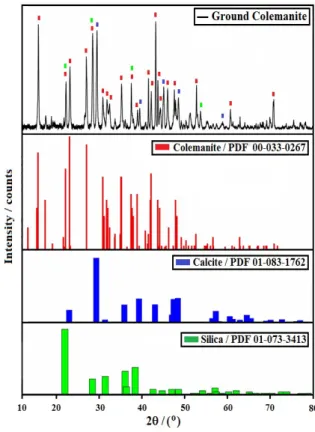
In order to specify the mineralogical characterization of ground colemanite, its X-ray pattern was diffracted by XRD instrument
(D8 ADVANCE –DAVINCI) and plotted against a horizontal scale between 5 and 95 in degrees of 2θ. The XRD pattern of the GC sample is given in Figure 1.
Fig. 1 - XRD pattern of GC sample.
As it is seen from initial detecting of GC XRD pattern (Fig. 1), main phases are determined as Colemanite (PDF 00-033-0267), Calcite (PDF 01-083-1762) and Silica (PDF 01-073-3413). Although it is known the presence of other small phases (SrO, MgO etc.) from chemical analysis given by manufacturer, they could not be determined in XRD pattern.
In order to accurately determine the amount of impurities in GC mineral, 5 g of the GC was dissolved in the acidic media, which is prepared by adding 50 ml concentrated HCl (37% Merck quality) with 50 ml water, at 70°C for 3 h. After separating by vacuum filtration, the amount of remaining solid in the filter cake was weighed as 0.257 g which corresponds to 5.2 mass % of insoluble solid. The XRD analysis of the undissolved solids in filter cake was carried out by Bruker D8 ADVANCE, and it was determined that the solid in the cake exactly belonged to the silica
and alumina-silicate phases. Amount of
undissolved solids in the GC mineral with 5.2 mass % were in good agreement with the chemical composition given by the company.
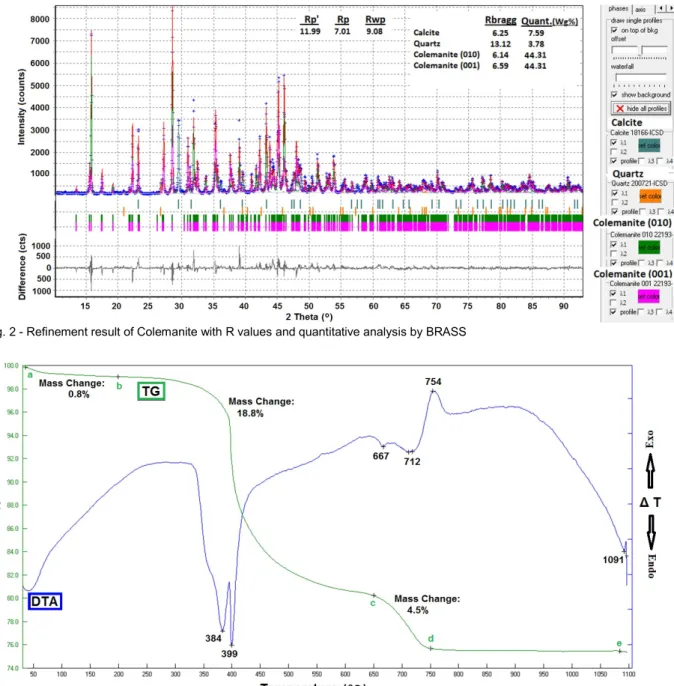
After determining the main phases, Rietveld refinement was realized for GC mineral by Bremen Rietveld Analysis and Structure Suite (BRASS) program. Following several refinement
Fig. 2 - Refinement result of Colemanite with R values and quantitative analysis by BRASS
Fig. 3 - TG-DTA measurement results of GC mineral.
trials, further improvement results were obtained with good R values. When investigated in detail, it was found that Colemanite had two different preferred orientations, (001) and (010). New refinement operations were progressed in this direction. Rietveld refinement plot for GC sample is given in Figure 2 with R values and Quantitative analysis.
3.2. Thermal Analysis of Colemanite
Dehydration and thermal decomposition of boron minerals are very crucial for their usage in high temperature applications. Therefore, Thermal Gravimetric Analysis (TGA-DTA) of GC was carried out by HITACHI HT6300 instrument in the Central Laboratory of Karamanoğlu Mehmetbey University to investigate its thermal behavior from room temperature to 1100°C with the rate of 25°C /min.
under Nitrogen atmosphere. Result of the measurement is given in Fig. 3.
As seen in Figure 3, TG line of the GC can be divided 4 main parts. The first part of the line including from room temperature up to 150°C (between a and b point) is related to moisture of the colemanite which corresponds to about 1% mass loss.
The second part of the line starts from nearly 200°C and ends above 600°C (between b and c point). In this region, colemanite has two endothermic peaks at around 385°C and 400°C. According to the Waclawsca et al [12], since
colemanite with Ca[B3O4(OH)3]·H2O chemical
formula crystallizes in monoclinic prismatic class 2m structure, the former of these two endothermic
peaks belongs to formation of H2O from OH
groups in the colemanite and the latter is related to disintegration of water from anhydrous borate
248 A. Rusen / Investigation of structural behavior of colemanite depending on temperature
structure. Therefore, this proposal supports two endothermic peaks at around 400°C in Fig. 3. In the second region of the line, totally more than 18 % loss of mass between 300 and 600°C is due to chemically bonded water removal (dehydroxylation and dehydration). Possible reaction on thermal decomposition of colemanite proposed by Frost et al [14] with a very sharp mass loss at about 400°C is given in Rx.1;
2Ca[B3O4(OH)3]·H2O Ca2B6O11 + 5H2O (Rx. 1)
The third part of the TG line (between c and d point) has two endothermic effects (667 and 712°C) and an exothermic peak (754°C). Endothermic effects which appear at 667°C and 712°C may belong to calcite decomposition. During this decomposition, a relatively low mass loss (~4.5 %) at temperatures between 650 and 760°C indicates that small amount of CO2 in the GC will
be released as a results of increasing temperature. It is seen from the GC refinement result with quantitative analysis (Fig. 2) that GC contains about 7.6 % Calcite at first. Calcite in the GC was decomposed according to the following reaction (Rx. 2);
CaCO3 = CaO + CO2 (Rx.2)
When GC heats up to elevated
temperatures, 3.4 % (calculated by 7.6*44/100)
mass reduction is expected after CO2 removing
from the system according to Rx.2. Compared to calcite decomposition values, mass loss (~4.5 %)
resulting of CO2 removal from the GC mineral seen
in Fig. 3 is nearly the same amount value (3.4 %) calculated by using quantitative analysis result obtained after refinement.
In the last part (between d and e point), as represented in Fig. 3, mass loss in GC came to a full stop after reaching at 750°C. Therefore, exothermic peak appeared at a temperature of
754°C is probably arises from recrystallization of subsequently the amorphous phase.
Based on the thermal investigation results, the total loss on ignition (LOI) in GC mineral was found as 24.1% after the three stages. In this way, we can conclude that the results of refinement and TG-DTA analysis of colemanite are consistence with each other as well as the information given by producer.
3.3. High Temperature XRD Analysis of Colemanite
Some important information about selected material such as phase transformation or changes in crystal structural parameters with temperature can be provided by in situe HTXRD. Therefore, GC was diffracted for every each 50°C from room temperature to 1100°C in order to specify phase changes of the colemanite with temperature. High temperature XRD measurements were recorded on a Panalytical MPD powder diffractometer equipped with an Anton Paar HTK 1200 heating chamber. After the first measurement at 25°C, all XRD patterns were collected from 5 to 100o 2θ in
the temperature range of 50-1000°C for every 50°C.
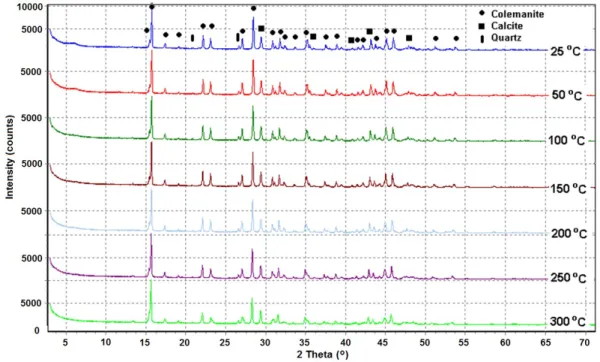
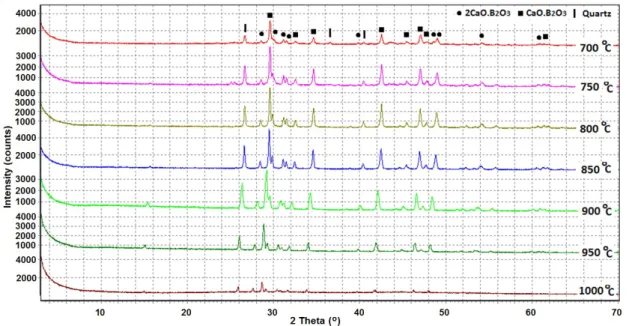
In here, HTXRD results of the GC can be divided 3 different sections. First section covers the XRD data from room temperature until the beginning of water removal (from 25°C up to 300°C), second stage is composed of fully amorphous structure region due to the multistage removal of water (between 350-650°C) and the last one starts from after 650°C (beginning of the new phase crystallization) up to melting of the sample (around 1000°C). All XRD measurement results with three parts can be observed in Figures 4, 5 and 6.
Fig. 5 - High temperature XRD pattern of GC (from 350°C to 650°C).
Fig. 6 - High temperature XRD pattern of GC (from 700°C to 1000°C).
As seen in Fig. 4, XRD pattern of GC at the beginning contains mainly colemanite and minor phases i.e. calcite and quartz. Other phases such as Al2O3, MgO and SrO determined chemically by
manufacturer with various amounts could not be observed in XRD pattern. In HTXRD patterns belonging from 25°C to 300°C, there are no differences in the peak position of the noted compounds. However, after 300°C, Colemanite is gradually beginning to turn into an amorphous structure and it remains in fully amorphous form up to 650°C (Fig. 5).
Several researchers [1, 11-14] claimed that dehydration of colemanite occurs in the range of 50-430°C. Different from these studies, Stoch who carried out more detailed investigation about thermal decomposition of colemanite explains that it has a multistage decomposition which proceeds as follows [18];
2CaO·3B2O3·5H2O 2CaO·3B2O3·2H2O +
+(3H2Oif) Ca2(B6O11)(5H2Oif)
Ca2(B6O11)a + +(H2O)v (Rx.3)
(if: intra framework, a: amorphous, v: vapor)
250 A. Rusen / Investigation of structural behavior of colemanite depending on temperature
Stoch [18] has also reported that Colemanite decomposition starts with separated of OH groups which form water molecules around at
320°C and continues with release of the H2O
molecules formed. Some part of the chemically bonded water (1.5 moles) formed in the first stage are removed at 378°C. The remaining water (3.5 moles) gets free slowly until temperature reaches 650°C with increasing amount of amorphous phase. The results obtained from the present study are quite compatible with the results of the study conducted by Stoch [18]. As seen from HTXRD patterns in Fig. 5, the chemically bonded water removal starts before at the temperature of about 350°C and proceeds up to 650°C during the GC mineral decomposition. It is seen from the XRD pattern at 650°C that crystallization of new phases is about to begin.
As mentioned in Thermal Analysis Part,
calcite (CaCO3) decomposition starts at around
650°C and crystallization of new phases begin after this temperature. Therefore, it is seen from the last group of the HTXRD patterns of the colemanite (Fig. 6) that the calcite phase is not found among
the new phases which are CaO·B2O3 and
2CaO·B2O3. Also, silica is another phase identified
with calcium borates. The study performed by Can et al. [19] supports that endothermic effects at 650-750°C correspond to the decomposition of calcite admixture which preliminarily presents in GC. Researchers [12, 13] have verified the above conclusions and reported that the crystallization of
new phases (CaO·B2O3 and 2CaO·B2O3) occurs at
about 800°C. Then, melting of these calcium borate compounds are expected at temperatures between 950°C- 1000°C.
In the light of this information, it can be deduced that the results obtained from the measurements in this study are very consistent with the results reported in the literature in terms of mineralogical and thermal characterization of colemanite. However, it should be noted that when the particle size of the material reduces to nanoscale, its internal structural disorder growths and so the temperatures and the importance of the thermal effects in company with the dehydration and dihydroxylation steps can be larger [16]. Therefore, each colemanite sample with different
size and composition exhibits different
characteristics in terms of thermal expansion and transformation at high temperatures after grinding operations. The results obtained in this study are valid for commercially GC mineral, which has standard particle size range (-75 micron). Some inconsistencies in the analysis results may be due to mineral content and grain size differences. 4. Conclusions
Selected mineral (ground colemanite; GC) was subjected to XRD, TG-DTA and HTXRD for the determination of its mineralogical characteriza-
tion and alteration of its crystal structure as a function of temperature. Based on TG-DTA analysis, it was demonstrated that GC loses chemically bonded water (apprx. 18.5 mass %) through two endothermic reactions at about 380°C and 400°C. Decomposition of the colemanite to
amorphous B2O3 and CaO occurs between 350°C
and 650°C. Nearly 4.5% mass loss arises from calcite decomposition in the range of 630°C - 800°C.
By applying HTXRD on GC sample, it could be revealed the effect of temperature on the changes in it. The HTXRD patterns of the GC can be divided 3 main groups; first part is the colemanite (2CaO·3B2O3·5H2O) region having the
same composition until 300°C, the second part is amorphous structure region due to the water removal from more than 350oC up to 650°C and
the last one is a recrystallization region (CaO·B2O3
and 2CaO·B2O3). Colemanite starts to melt just
above the 1080°C. It can be concluded that HTXRD patterns are consistent with the results of the thermal analysis (TG-DTA). Ultimately, temperature dependent structural characterization of colemanite could be ascertained by this study, which could be very useful for high temperature applications of colemanite in several sectors.
ACKNOWLEDGMENTS
This study was supported by Karamanoğlu Mehmetbey University Scientific Research Projects (BAP) Coordinating Office. The HTXRD measurements were carried out in Bremen University Faculty of Geosciences. The author gratefully acknowledges the members of Crystallography Research Group for their support.
REFERENCES
1. M.S. Celik, F. Suner, A Thermodynamic Analysis of the Decrepitation Process, Thermochim. Acta. 1995,254, 167..
2. R.L. Frost, Y. Xi, R. Scholz, F.M. Belotti, M. Cândido Filho, Infrared and Raman Spectroscopic Characterization of the Borate Mineral Colemanite-CaB3O4(OH)3·H2O-Implications for the Molecular Structure, J. Mol. Struct. 2013,
1037, 23. doi:10.1016/j.molstruc.2012.11.047.
3. M. Timucin, N. Sevinc, Y.A. Topkaya, H. Eric, Use of Colemanite in the Production of Iron and Steel, Technical Report (No: 84-04-07-00-13), METU, Ankara, 1986. 4. M. Sek, A Aso, Y. Okubo, Development of Dusting Prevention Stabilizer for
Stainless Steel Slag, Kawasaki Steel Tech. Rep. 1986, 15, 16.
5. L. Ozmen, E. Inger, Colemanite in Steel Production, in: Sohn Int. Symp., TMS, San Diego, 2006, 299.
6. K.H. Obst, J. Stradtman, The Influence of Lime and Synthetic Lime Products on Steel Production, J. South African Inst. Min. Metall. January , 1972, 158. 7. A. Ruşen, A. Geveci, Y.A. Topkaya, B. Derin, Investigation of Effect of Colemanite
Addition on Copper Losses in Matte Smelting Slag, Can. Metall. 2012, Q. 51, 157.
8. A. Rüşen, A. Geveci, Y. A. Topkaya, Minimization of Copper Losses to Slag in Matte Smelting by Colemanite Addition, Solid State Sci. 2012, 14, 1702.. 9. A. Ruşen, B. Derin, A. Geveci, Y.A. Topkaya, Investigation of Copper Losses to
Synthetic Slag at Different Oxygen Partial Pressure, JOM 68 2016, 2316.. 10. A. Rusen, A. Geveci, Y.A. Topkaya, B. Derin, Effects of Some Additives on
Copper Losses to Matte Smelting Slag, JOM 68 (2016) 2323. doi:10.1007/s11837-016-1825-1.
11. W. Smykatz-Kloss, Application of Differential Thermal Analysis in Mineralogy, J. Therm. Anal. 1982, 23, 15.
12. I. Waclawska, L. Stoch, J. Paulik, F. Paulik, Thermal Decomposition of Colemanite, Thermochim. Acta. 1988, 126, 307.
[13. L. Stoch, I. Waciawska, Thermal Decomposition of Hydrated Part 1 . Thermal Decomposition of Pandermite Ca2B508(OH)3.2H20, Thermochim. Acta. 1993,
215, 255.
14. R.L. Frost, R. Scholz, X. Ruan, R.M.F. Lima, Thermal Analysis and Infrared Emission Spectroscopy of the Borate Mineral Colemanite, J. Therm. Anal. Calorim. 2016, 124, 131. doi:10.1007/s10973-015-5128-5.
15. Ö. Yildiz, The Effect of Heat Treatment on Colemanite Processing : A Ceramics Application, Powder Technol. 2004, 142, 7.
16. I. Waclawska, Thermal Behaviour of Mechanically Amorphized Colemanite, J. Therm. Anal. 1997, 48, 145.
17. L. Jun, X. Shuping, G. Shiyang, FT-IR and Raman Spectroscopic Study of Hydrated Borates, Spectrochim. Acta. 1995, 51A , 519.
18. L. Stoch, The Relation between the Structure and Thermal Reactions of Solids, Thermochim. Acta. 1988, 133, 197.
19. M.F. Can, A. Helvaci, Z.O. Yazici, S. Akpınar, Y. Özdemir, Microwave Assisted Calcination of Colemanite Powders, Int. J. Metall. Mater. Eng., 2016, 2..