Reflection increases belief in God through self-questioning among
non-believers
Onurcan Yilmaz
∗Ozan Isler
†Abstract
The dual-process model of the mind predicts that religious belief will be stronger for intuitive decisions, whereas reflective thinking will lead to religious disbelief (i.e., the intuitive religious belief hypothesis). While early research found intuition to promote and reflection to weaken belief in God, more recent attempts found no evidence for the intuitive religious belief hypothesis. Many of the previous studies are underpowered to detect small effects, and it is not clear whether the cognitive process manipulations used in these failed attempts worked as intended. We investigated the influence of intuitive and reflective thought on belief in God in two large-scale preregistered experiments (N = 1,602), using well-established cognitive manipulations (i.e., time-pressure with incentives for compliance) and alternative elicitation methods (between and within-subject designs). Against our initial hypothesis based on the literature, the experiments provide first suggestive then confirmatory evidence for the reflective religious belief hypothesis. Exploratory examination of the data suggests that reflection increases doubts about beliefs held regarding God’s existence. Reflective doubt exists primarily among non-believers, resulting in an overall increase in belief in God when deciding reflectively.
Keywords: reflection, intuition, analytic cognitive style, belief, belief in God or gods
“It is the heart which experiences God, and not the reason.”
“Let us weigh the gain and the loss in wagering that God is. Let us estimate these two chances. If you gain, you gain all; if you lose, you lose nothing.”
Blaise Pascal, Pensées
1
Introduction
The dual-process model posits that our minds behave ac-cording to two basic systems (Evans & Stanovich, 2013). Type 1 corresponds to intuitive, automatic and low-effort processes, while Type 2 corresponds to analytical, reflective and high-effort processes. Whether due to implicit processes of socialization (e.g., imitation of religious family members; Hunsberger & Brown, 2006) or to universal human psycho-logical capacities for religiosity (e.g., imagination and an-thropomorphizing of supernatural agents; Baumard & Boyer, 2013), it is usually thought that intuitive thinking underlies religious belief (Norenzayan, 2013). Pascal’s first statement
We thank Jonathan Baron for his guidance.
Copyright: © 2019. The authors license this article under the terms of the Creative Commons Attribution 3.0 License.
∗Department of Psychology, Kadir Has University, 34083, Fatih,
Is-tanbul. E-mail: [email protected]. ORCID: 0000-0002-6094-7162.
†Centre for Behavioral Economics, Society and Technology, School of
Economics and Finance, Queensland University of Technology, Australia, ORCID: 0000-0002-4638-2230.
(above) provides an eloquent description of this intuitive
re-ligious belief hypothesis, predicting that promoting intuition will strengthen faith in God. In contrast, Pascal’s second statement on his famous wager suggests that reflecting on God’s existence in relation to individual risks and benefits may promote religious self-questioning. In this and other ways, reflection can increase religious beliefs which we refer to as the reflective religious belief hypothesis. The ques-tion whether religious belief is fundamentally intuitive or reflective is not only important in itself, playing a key role in the psychology of religion literature, but has wider impor-tance pertaining to social welfare, since religiosity has been linked to generosity (Shariff, Willard, Andersen & Norenza-yan, 2016), trust (Chuah, Gächter, Hoffmann & Tan, 2016), cooperation (Ahmed & Salas, 2011; Purzycki et al., 2016) as well as discrimination (Chuah et al., 2016; Gervais et al., 2018).
Correlational findings often show a negative relationship between religious belief and reflective (i.e., analytic) think-ing style (Bahçekapili & Yilmaz, 2017; Gervais & Noren-zayan, 2012; Gervais et al., 2018; Pennycook, Cheyne, Seli, Koehler & Fugelsang, 2012; Saribay & Yilmaz, 2017; Stag-naro, Pennycook & Rand, 2018; Yilmaz & Saribay, 2016). Similarly, a recent meta-analysis found that the analytic thinking performance of non-believers (atheists and agnos-tics) was on average higher than that of religious believers (Pennycook, Ross, Koehler & Fugelsang, 2016).
Studies investigating the cause-effect relationship found further evidence for the intuitive belief hypothesis. One of the early studies was conducted by Gervais and Norenzayan 649
(2012), who provided four experimental tests in support of the hypothesis by showing that activating reflection weakens religious belief. In another early study, Shenhav, Rand and Greene (2012) found a similar cause-effect relationship be-tween cognitive style and religious belief by priming reflec-tion and intuireflec-tion. Yilmaz, Karadöller and Sofuoglu (2016) tested this relationship in a non-Western sample (Turkey) and demonstrated that controlling for benchmark levels of reli-giosity measured four weeks prior to the experiment allows identification of the causal effect of reflective thinking on religious belief.
However, evidence on the intuitive belief hypothesis is not consistent. In contrast to the three different labs that indepen-dently found an effect of thinking style on religious belief, a high-powered replication of Gervais and Norenzayan (2012) failed to find a significant effect (Sanchez, Sundermeier, Gray & Calin-Jageman, 2017). Another study recruited partici-pants from Amazon Mechanical Turk and observed that ac-tivating reflective thinking does not weaken religious belief (Yonker, Edman, Cresswell & Barrett, 2016). Using a vari-ety of methods in three studies, Farias et al. (2017) have also failed to find a cause-effect relationship between intuitive thinking and religious belief.
These inconsistencies in the literature are likely to stem in part from the unreliability of the methods used to activate reflective (or intuitive) thinking. For example, three different methods of manipulation used by Gervais and Norenzayan (2012) to prime reflective thinking (e.g., viewing pictures of Rodin’s The Thinker or completing a sentence scramble task) failed manipulation checks in studies by Deppe et al. (2015). Another technique — cognitive disfluency — used by Gervais and Norenzayan (2012) has been shown to be in-effective in activating reflective thinking in a high-powered study (Meyer et al., 2015), and in a Turkish sample (Yilmaz & Saribay, 2016). The methods adopted by Yonker et al. (2016) for inducing reflective thinking, the administration of the Cognitive Reflection Test or the Stroop Task, may pose its own problems because these tasks were originally de-signed to measure rather than manipulate analytic thinking performance. In Farias et al.’s (2017) study, a small group of participants (n = 37) was directed to think under cognitive load (to induce intuitive thinking) but no effect of the ma-nipulation was found on the level of supernatural inference (i.e., religious belief).
One of the significant methodological limitations of many of the aforementioned studies is their limited sample size, making it difficult to claim evidence for a null effect. Given the double methodological limitations in activating reflec-tive (or intuireflec-tive) thinking and in conducting powerful tests, evidence on the intuitive religious belief hypothesis remains ambiguous. Therefore, the hypothesis that religious belief is influenced by thinking styles should be tested in high-powered studies using stronger manipulations.
We conducted two such preregistered experiments, us-ing time-limit manipulations with incentives for compli-ance. Time-pressure is an established method for inducing intuitive decisions by constraining opportunities for reflec-tion (Evans & Curtis-Holmes, 2005). Although analysis of unconstrained response times may reflect decision conflict and confound causal identification, analysis based on time-pressure manipulations have been shown not to have this limitation (Evans, Dillon & Rand, 2015). Similarly, mon-etary incentives have been shown to achieve high rates of compliance with time-limits (Isler, Maule & Starmer, 2018). Based on the standard view in the literature, we ini-tially predicted that intuition increases and that reflection decreases belief in God. Experiment 1 (n = 999) tested the intuitive religious belief hypothesis using between-subject time-limit manipulations (5s time-pressure, 20s time-delay or control). In Experiment 1, we found suggestive evidence
against the intuitive belief hypothesis. Hence, we revised our initial hypothesis in Experiment 2 (n = 603), and tested the predictions that reflection would increase religious belief and that this effect would be stronger among non-believers (i.e., agnostics and atheists) than among believers. We used a two-stage within-subject design in Experiment 2 (5s time-pressure in the first-stage and 20s time-delay in the second-stage) to provide an alternative perspective into decision-making processes, while testing the conceptual replicability of the reflective religious belief hypothesis.
2
Experiment 1
Both studies were preregistered (https://osf.io/afbnd/). Datasets, experimental materials, and the analysis code are available at the preregistration address.
2.1
Method
2.1.1 Participants
Since there is mixed evidence on the hypothesis of intuitive religious belief, we assumed a small effect size (f = .10), set alpha at .05 and power at .80. Using G*Power software (Faul, Erdfelner, Buchner & Lang, 2009), we computed the required sample to be at least 969 to detect a difference between the three conditions (time-pressure, time-delay or no time-limit) in a one-way ANOVA. Considering poten-tial attrition, we collected data from a total of 1,027 US residents via Amazon Mechanical Turk. Excluding 28 par-ticipants with incomplete submissions, our analysis is based on a sample with 999 observations (Mean age = 38.32, SD = 12.95; female: 59.4%).1 Participants were randomly
as-1We minimized suspicious (e.g., bot) activity in three ways. First, participation was restricted to those with approval rates of 95% or above. An initial probe asked for the second letter in an underlined and italicized word-image (“MTURK”), and 47 entries with incorrect answers were excluded
signed to the time-pressure (n = 330), the time-delay (n = 335), and the control (n = 334) groups. In the survey, we asked participants their religious affiliation. The majority of the participants were Christian (52.5%). 28.4% of the par-ticipants were either atheist (13.81%) or agnostic (14.61%), 10.6% indicated a belief in god without any organized reli-gion, 1% of them were Buddhist, 0.9% were Hindu, 1.3% were Jewish, 1.3% were Muslim, and 4% indicated as others.
2.1.2 Materials and Procedure
We used time-limits on the belief in God question to ma-nipulate cognitive processes (5s pressure, 20s time-delay, and control condition without time-limits). For the main dependent variable, the participants answered a face-valid question on belief in God using a scale ranging from 0 (definitely does not exist) to 100 (definitely exists). In the time-pressure condition, they were prompted to submit their belief in God response within 5 seconds. In the time-delay condition, they were prompted to submit their belief in God response after having reflected for 20 seconds. In the no-time-limit (control) condition, there were no prompts regarding the decision time on the belief in God question. Participants earned a participation fee for completing the study and they earned a bonus for complying with time-limits (based on Isler et al., 2018)
After belief elicitation, participants completed two ran-domized questions on the same screen as manipulation check. Participants were asked to rate their agreement with two statements on a 5-point scale (1 = “strongly disagree”, 5 = “strongly agree”). The statement “I did not have time to think through my decision” was used to check whether manipu-lations affected opportunities for reflection. The statement “I decided based on my gut reactions” was used to check whether manipulations affected reliance on intuition. The average of the two ratings was calculated as the composite score for the manipulation of intuition. Finally, participants were asked to complete a brief demographic questionnaire, including single item measure of religiosity ranging from 1 (not at all religious) to 7 (highly religious) as well as the above-described measure of religious affiliation. In this study and the next one, religious believers are defined as self-reported affiliation with major organized religions or belief without organized religion, and non-believers are defined as self-identified atheists and agnostics.
from participation. A final probe asked a mandatory open-ended question on the hypothesis of the study and 7 entries who simply answered “good” (a common feature of bot activity) were excluded from the dataset. In addition, 4 duplicate submissions, identified with repeated unique MTurk IDs, were excluded from the dataset. Inclusion of these 11 entries in the analysis does not affect any of the results.
2.2
Results
2.2.1 Manipulation Checks
Cognitive and behavioral checks indicate that our manip-ulations successfully activated intuition and reflection as intended. As cognitive manipulation check, we looked at the difference in the composite intuition scores between the three time-limit conditions (time-pressure, time-delay and control). The one-way ANOVA model of the composite score indicated that those in the time-pressure group re-ported higher scores (M = 2.85, SD = 1.05; 95% CI [2.73, 2.96]) than both control (M = 2.56, SD = 0.94; 95% CI [2.46, 2.66]) and time-delay conditions (M = 2.33, SD = 0.91; 95% CI [2.23, 2.43]), F(2, 996) = 23.81, p < .001, η2p = 0.046. A Tukey HSD post-hoc test confirmed that all pairwise comparisons were statistically significant (all ps < .007).
We used response times on the belief question as behioral manipulation check. The results revealed that the av-erage response time (in seconds) in the time-pressure group (M = 4.95, SD = 2.29; 95% CI [4.70, 5.19]) was less than both the time-delay (M = 26.40, SD = 23.61; 95% CI [23.86, 28.94]) and the control groups (M = 8.12, SD = 6.24; 95% CI [7.45, 8.80]), F(2, 996) = 221.79, p < .001, η2
p= .308. A Tukey HSD post-hoc test confirmed that all pairwise com-parisons were statistically significant (all ps < .012).
2.2.2 Analysis
Figure 1 depicts the average belief scores across the condi-tions overall, and among believers and non-believers sepa-rately. The three conditions showed similar scores on the belief in God measure: time-pressure (M = 61.00, SD = 40.75; 95% CI [56.56, 65.39]), time-delay (M = 61.35, SD = 39.03; 95% CI [57.16, 65.55]), control (M = 60.58, SD = 38.95; 95% CI [56.39, 64.77]). A planned one-way ANOVA showed no effect of the manipulation on belief in God, F(2, 996) = 0.03, p = .969, η2p< .001.
However, in exploratory analysis, when we control in the same test for a potential nuisance variable (i.e., self-reported religiosity of the participants, ranging from 1 to 7), the re-sults suggest a small increase in belief in the time-delay condition (F(3, 995) = 2.50, p = .083, η2
p = .005, for all 3 conditions), which was significant when comparing only the time-pressure and the time-delay groups, F(2, 662) = 5.02,
p= .025, η2 p= .008.
To further explore whether the observed effect was sym-metric among believers and non-believers (i.e., self-reported atheists and agnostics), we ran the tests separately for the two groups. The treatment effect was non-significant among believers (excluding non-believers and 40 participants who reported “other” for the religious affiliation question; see Method), F(2, 672) = 0.56, p = .569, η2p= .002. In contrast, reflection promoted religious belief among non-believers:
Time−Delay n=101 Control n=92 Time−Pressure n=91 Time−Delay n=220 Control n=228 Time−Pressure n=227 Time−Delay n=335 Control n=334 Time−Pressure n=330 0 20 40 60 80 100 Overall Believers Non−believers 15.06 13.14 8.67 82.95 80.59 82.59 61.35 60.58 60.98
Figure 1: Average belief-in-God scores in Experiment 1: overall in blue bars, among believers in green bars (i.e., self-reported affiliation with major organized religions and belief without organized religion) and non-believers in yellow bars (i.e., self-identified atheists and agnostics) to the question “How strongly do you believe in God’s existence?” across the time-limit conditions (time-pressure: top bar; control: middle bar; time-delay; bottom bar) on a scale from 0 (Very little) to 100 (Very much). Forty participants reported “other” (i.e., neither believer nor non-believer) for the religious affiliation question (time-pressure: n = 12, M = 48.7; control: n = 14, M = 46.4; time-delay: n = 14, M = 56.0). Error bars show 95% confidence intervals.
those in the time-delay condition (M = 15.06, SD = 20.89; 95% CI [10.94, 19.18]) reported higher scores than the time-pressure (M = 8.67, SD = 11.62; 95% CI [6.251, 11.09]), and the control (M = 13.14, SD = 16.83; 95% CI [9.66, 16.63]) conditions in belief in God, F(2, 281) = 3.50, p = .032, η2p= .024.
Despite suggestive evidence for the reflective religious belief hypothesis, diagnostic tests on the ANOVA models show highly skewed error distributions, which might have driven these statistically significant exploratory results. In particular, Shapiro-Wilk test on the residuals of the ANOVA model among non-believers provides evidence against the normality of the error terms, W(284) = 0.79, p < .001. The tenuous nature of these findings motivated us to conduct a second experiment.
3
Experiment 2
Based on suggestive evidence in Experiment 1, we revised our initial hypothesis such that we expected reflection to in-crease religious belief in Experiment 2, especially among non-believers. We made several modifications to our design. First, we used a within-subject design to focus on the process of change in religious belief on an individual level. Specifi-cally, we compared initial answers made under the intuition manipulation (i.e., 5s time-pressure) to reflected answers provided afterward (i.e., those made under 20s time-delay). Second, since many participants in Experiment 1 were found to be affiliated with non-Abrahamic religions (e.g., Bud-dhism, Hinduism), we relabeled our dependent variable as “belief in God or gods” to increase the scope of its
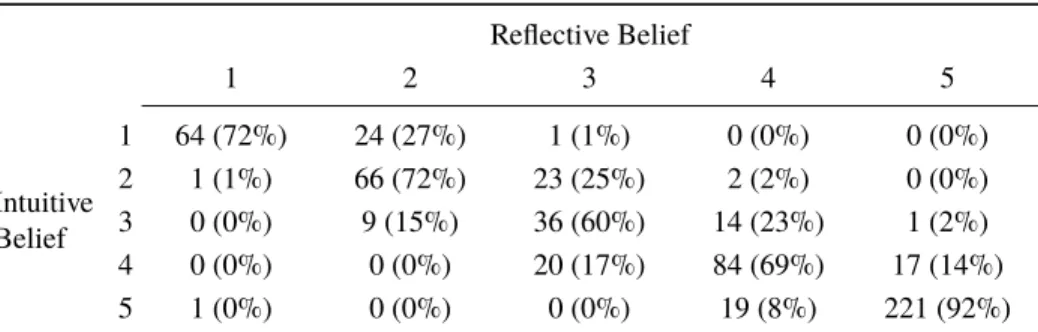
rele-Table 1:Individual vs. reflective religious belief. Reflective Belief 1 2 3 4 5 Intuitive Belief 1 64 (72%) 24 (27%) 1 (1%) 0 (0%) 0 (0%) 2 1 (1%) 66 (72%) 23 (25%) 2 (2%) 0 (0%) 3 0 (0%) 9 (15%) 36 (60%) 14 (23%) 1 (2%) 4 0 (0%) 0 (0%) 20 (17%) 84 (69%) 17 (14%) 5 1 (0%) 0 (0%) 0 (0%) 19 (8%) 221 (92%)
Each cell on the table indicates the number of participants with stated intuitive (initial decision elicited under 5s time-limit) and reflective (second decision elicited under 20s time-delay) belief in God or gods on a 5-point Likert scale: 1) “Definitely does not exist”, 2) “Probably does not exist”, 3) “Not sure”, 4) “Probably exists” and 5) “Definitely exists”. It also provides in parenthesis the distribution of participants in each row as percentage points. For example, the second cell on the top row indicates that 24 (27%) of the 89 participants who have initially stated “Definitely does not exist” have revised their decision after reflection to be “Probably does not exist”.
vance. Lastly, since people conceive of God in various ways (e.g., monotheism, pantheism), we measured endorsement of alternative God concepts and explored its relationship to change in belief in God.
3.1
Method
3.1.1 Participants
Assuming f = .10, α = .05 and 1- β = .90, we estimated the required sample to be at least 528 (Faul et al., 2009) to detect a difference between the time-pressure and time-delay conditions in a repeated measure ANOVA. As a safeguard against potential attrition, we collected data from a total of 624 US residents on Amazon Mechanical Turk. Excluding participants with incomplete (n = 18) and duplicate (n = 3) submissions, we achieve a sample of 603 observations (Mean age = 36.68, SD = 11.88; female: 63.7%).2 Religious affiliations in our sample consisted of Christians (51.1%), Jews (1.99%), Buddhists (1.00%), Hindus (0.83%), Muslims (0.83%), those with belief in God without any organized religion (8.8%), agnostics (14.9%), atheists (13.4%), and others (7.13%).
3.1.2 Materials and Procedure
Participants answered the question, “How strongly do you believe in God or gods’ existence?”, twice: first under intu-ition prompts and 5s time-pressure and then under reflection prompts and 20s time-delay. To minimize demand effects, participants were told before their second decision that they
212 potential participants were eliminated in the initial probe used to detect bot activity.
“do not have to but may choose to revise” their initial re-sponse. Considering the representation of religions with multiple gods in our Experiment 1 sample, we revised our initial belief in God question to instead refer to belief in “God or gods”. We also used a scale ranging from 1 to 5 with de-scriptive labels for each value to facilitate decision-making (see Table 1). To further improve the understanding and accuracy of our measures, participants were first informed about the response scale (as well as the incentives for compli-ance as in Experiment 1) and they were exposed to the belief question for 3s right before the decision screen. In Exper-iment 2, we also inquired into the relationship between the treatment effect and various types of religious belief and God notions by eliciting agreement with definitions of monothe-ism, polythemonothe-ism, panthemonothe-ism, demonothe-ism, agnosticmonothe-ism, atheism as well as agreement with Pascal’s Wager and with the idea that religion is a social construct (see Table 2 for definitions). As an exploratory measure, we elicited CRT-2 (Thomson & Oppenheimer, 2016) in the survey in addition to religiosity, religious affiliation and other demographic measures also elicited in Experiment 1. We also gathered behavioral ma-nipulation check measures (i.e., RTs). An open-ended ex-ploratory question that we do not analyze here asked why participants either revised or did not revise their decisions. As in Experiment 1, participants earned a bonus for comply-ing with the time-limits in addition to a participation fee for completing the study (based on Isler et al., 2018).
3.2
Results
3.2.1 Manipulation Checks
Behavioral checks indicate that decision made under time-pressure limited opportunities for reflection as compared to
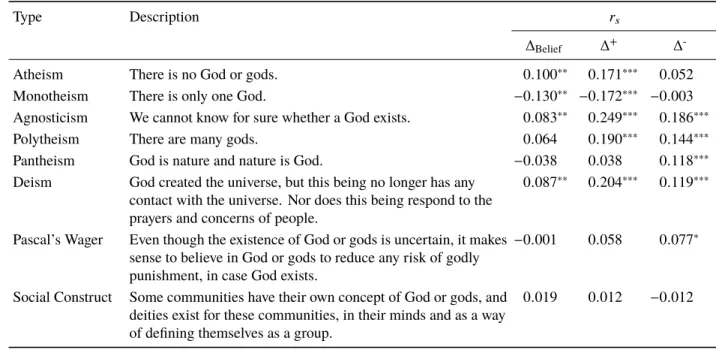
Table 2:Relationship between change in belief in God and endorsement of alternative God notions.
Type Description rs
∆Belief ∆+ ∆
-Atheism There is no God or gods. 0.100∗∗ 0.171∗∗∗ 0.052
Monotheism There is only one God. −0.130∗∗ −0.172∗∗∗ −0.003
Agnosticism We cannot know for sure whether a God exists. 0.083∗∗ 0.249∗∗∗ 0.186∗∗∗
Polytheism There are many gods. 0.064 0.190∗∗∗ 0.144∗∗∗
Pantheism God is nature and nature is God. −0.038 0.038 0.118∗∗∗
Deism God created the universe, but this being no longer has any contact with the universe. Nor does this being respond to the prayers and concerns of people.
0.087∗∗ 0.204∗∗∗ 0.119∗∗∗
Pascal’s Wager Even though the existence of God or gods is uncertain, it makes sense to believe in God or gods to reduce any risk of godly punishment, in case God exists.
−0.001 0.058 0.077∗
Social Construct Some communities have their own concept of God or gods, and deities exist for these communities, in their minds and as a way of defining themselves as a group.
0.019 0.012 −0.012
Spearman’s rho (rs) reported for the correlation between each of the belief change variables and the tendency to agree
with each of the stated God notions on a scale from 1 (completely disagree) to 5 (completely agree). Parametric estimates provide consistent results. ∗p< .10,∗∗p< .05,∗∗∗p< .01.
the decision made under time-delay. Average response time of the time-pressured first decisions (M = 1.99, SD = 3.60; 95% CI [1.70, 2.27]) was significantly faster than those on the time-delayed second decisions (M = 12.79, SD = 13.64; 95% CI [11.70, 13.88]), as indicated by a repeated-measure ANOVA, F(1, 602) = 352.21, p < .001, η2
p= .369.
3.2.2 Analysis
We found evidence for our hypotheses that reflection in-creases religious belief in general, and among non-believers in particular. Overall, as indicated by a repeated-measures ANOVA, the time-delayed answers provided later on (M = 3.61, SD = 1.50) were significantly higher than the initial answers made under time-pressure (M = 3.55, SD = 1.42),
F(1, 602) = 6.92, p = .009, η2p = .011. Next, we compared belief change between believers and non-believers, exclud-ing 43 self-described “others” who were neither religious believers nor non-believers.3 Consistent with our hypothe-sis, belief was greater in the reflective condition than in the intuitive condition (F(1, 558) = 13.50, p < .001, η2p = .024). Believers of course had greater belief than non-believers (
F(1, 558) = 931.73, p < .001, η2
p= .954), and the interaction was also significant (F(1, 558) = 4.89, p = .027, η2p= .009). The interaction stemmed from the fact that the percentage
3“Others” did not exhibit belief change between pressure and time-delay conditions, M = 2.95 and 2.88 respectively, and their inclusion does not change the main results.
point (pp) increase in belief scores (over the score range 1 to 5) with reflection was significantly higher for non-believers (3.4 pp) than for believers (0.8 pp). Among non-believers, change in belief with reflection was nearly equal between atheists (3.4 pp) and agnostics (3.3 pp). Similar results are observed when we use the continuous religiosity variable instead of the binary non-believer/believer variable (i.e., us-ing the full sample includus-ing the “others”), with significant effects of decision type, F(1, 596) = 6.58, p = .011, η2p = .011, religiosity, F(1, 596) = 216.74, p < .001, η2p = .957, and their interaction, F(6, 596) = 3.82, p = .001, η2
p= .037. Controlling for gender does not change these findings.
Although our preregistered tests provide evidence for the reflective religious belief hypothesis, exploratory inspection of the data invites a more nuanced interpretation. Table 1 describes the distribution of beliefs elicited first under intuition and then under reflection manipulation. It shows that changes in belief tend towards the middle of the scale (i.e., towards “not sure”) for both believers and non-believers, although this tendency seems to be stronger among non-believers. Specifically, an overwhelming majority of those who initially stated that God (or gods) either definitely or probably does not exist or then revised their answer upon reflection, revised it towards the middle of the scale (48 out of 51 participants or 94%). Similarly, 68% of those who revised their initial statement that God (either definitely or probably) exists, likewise moved towards the middle of the scale (i.e., towards the “not sure” option).
Next, we explored endorsement of alternative notions of God as potential drivers of belief change (see Table 2). To do so, we constructed three alternative religious belief change variables by comparing intuitive and reflective beliefs for each participant: (1) ∆Belief(i.e., change in belief score) is found by subtracting the intuitive belief score from the re-flected belief score; (2) ∆+ (upward belief revision) equals
1 if ∆Beliefis positive and equals 0 otherwise; (3) ∆- (down-ward belief revision) equals 1 if ∆Beliefis negative and equals 0 otherwise. Table 2 summarizes the correlational analysis between endorsement of God notions and these three types of belief change variables.
∆Belief, the difference between reflective and intuitive be-lief scores, was equal to 0 for 78% (i.e., those who exhibit stable beliefs), whereas 13% had ∆+equal to 1 (movement towards religious belief) and 8% had ∆-equal to 1 (move-ment towards religious disbelief). The tendency to agree with atheism and disagree with monotheism was positively correlated with an increase in belief in God due to reflection. Interestingly, not only for agnosticism but also for polythe-ism and depolythe-ism, endorsements were positively associated with both an increase and a decrease in religious belief, suggest-ing these views promote doubt with reflection. One of the items on Table 2 operationalized endorsement of Pascal’s Wager. Contrary to our hypothesis, and even though agree-ment with Pascal’s Wager was significantly and positively correlated with belief in God both under time-pressure (rs=
.230, p < .001) and time-delay (rs= .237, p < .001), we find
no correlation between agreement with this statement and ∆Belief(p = .973).
Finally, CRT-2 scores showed significant negative corre-lations with belief ratings made both under time-pressure (rs = -.153, p < .001) and under time-delay (rs = -.169, p <
.001), but they were not correlated with the change-in-belief variables: ∆Belief(rs= -.014, p = .740), upward belief
revi-sion, ∆+(rs= .006, p = .882), downward belief revision, ∆
-(rs = .028, p = .497). These results indicate that, although
experimentally inducing a reflective mindset causes belief in God to increase, in particular through the religious self-questioning of non-believers, the individual propensity to think reflectively is correlated negatively with belief in God.
4
Discussion
In both experiments, we found that reflection increases belief in God and that the effect is stronger among non-believers. Exploratory analysis suggested that the overall increase in religious belief is likely due to the religious self-questioning (i.e., reflective doubt) of non-believers who tended to revise their responses on the scale towards the middle point (i.e., “not sure”). The results also showed that those who make greater use of their reflective capacities (as measured by CRT-2) are less likely to endorse belief in God or gods. These
results provide evidence against the hypothesis that intuition fosters and that reflection dampens religious belief (Gervais & Norenzayan, 2012; Shenhav et al., 2012; Yilmaz et al., 2016) but it converges with the longstanding correlational results demonstrating that tendency for reflective thinking is negatively associated with religious belief (e.g., Bahçekapili & Yilmaz, 2017; Gervais et al., 2018; Pennycook et al., 2016; Stagnaro et al., 2018; Stagnaro, Ross, Pennycook & Rand, 2019).
Why does reflection increase belief in God in the cur-rent research? Our exploratory analysis strongly suggests that reflection, rather than directly increasing belief in God, increases doubt about one’s initial and intuitively held be-lief regarding God’s existence. It is likely that reflection increased religious belief in our overall sample because reli-gious self-questioning is stronger among non-believers than among believers. On the other hand, we show that endorse-ment of agnosticism, deism, and polytheism is associated with both increase and decrease in belief in God, which may drive reflective doubt. Future research should try to experi-mentally distinguish this reflective religious doubt hypothesis implicated by our exploratory analysis from the reflective
re-ligious belief hypothesis. Nevertheless, we expect the effect of reflection on religious belief to be small because the belief in God question, as regularly used in the literature, will tend to probe stable opinions. Having answered the same question numerous times over the course of one’s life, participants are likely to know, as a defining characteristic of their personal identity, whether and to what extent they believe in God.
We also hypothesized but found no strong evidence that Pascal’s Wager may motivate a religious belief. Accord-ingly, reflected evaluation of the possibility of God’s exis-tence could highlight the potentially infinite benefits of belief and costs of disbelief, hence questioning religious disbelief through a rational utility calculus. Although plausible, the tendency in our sample to agree with Pascal’s Wager did not clearly explain the reflected change in religious belief. How-ever, our test was limited by the fact that religious believers (i.e., those with already high levels of belief) agreed with the Wager more than non-believers as well as by the fact that there were fewer atheists and agnostics in our sample.
An alternative explanation of the positive effect of reflec-tion on religious belief may be that reflecreflec-tion makes people less extreme in their beliefs in general (i.e., religious and non-religious) but that openness to such self-criticism may be stronger among non-believers since they also tend to be reflective thinkers (Pennycook et al., 2016). Comparing re-ligious and secular belief change among non-believers can therefore provide an explanation for our main finding. Like-wise, Pascal’s Wager can be tested using improved methods, for example, by studying the effect of Pascal’s argument as an experimental manipulation. Finally, the two-stage proce-dure used in Experiment 2 was more insightful to studying religious belief change than the standard between-subject
design of Experiment 1. The two-stage technique can be used in future studies of cooperation and morality in order to dissociate dual cognitive processes.
We also suggest that these experimental manipulations might have more influence on less stable beliefs or on those who are less confident about the existence of God. A similar distinction has been made in the field of political psychology (Talhelm, 2018; Talhelm et al., 2015; Yilmaz & Saribay, 2016, 2017). Activating reflective thinking did not have an impact on political opinions when they were measured by standard scale items based on identity labels (e.g., liberal or conservative), but it led to a significant change in less stable contextualized opinions (e.g., forming opinions about a newspaper article; Yilmaz & Saribay, 2017). A similar distinction can be made in the field of cognitive science of religion. For example, while belief in God, reflecting rel-atively stable opinions, may be more resistant to cognitive process manipulations, the relative reliance on natural vs. supernatural explanations for an uncertain event (e.g., the disappearance of airplanes in the Bermuda Triangle) may be more open to the influence of intuitive and reflective think-ing. This possibility should be examined in future research. A surprising contrast emerges from our data: the positive causal effect of reflection on belief in God vs. the nega-tive correlation between individual tendency for reflected thinking and religious belief. While it is not clear why experimental and correlational tests lead to different conclu-sions, one may conjecture that the two approaches capture separate psychological mechanisms occurring across distinct time-frames. In particular, correlational measures may re-flect self-selection of intuitively inclined people to religious belief (a long-term process of identity formation), while pro-moting reflection may isolate the possibly short-term effects of questioning one’s own and already established beliefs. While correlational findings are prevalent in the literature, there is a need for more experimental research on this topic. In particular, the generalizability of our results across cul-tures (e.g., using multi-lab experiments) is an open question. In sum, recent failures to support the intuitive religious belief hypothesis suggested that the early evidence support-ing the hypothesis is not easily reproducible. Ussupport-ing stronger manipulations and two large-scale experiments, we found that the effect of reflection and intuition on belief in God is in fact the opposite of intuitive belief hypothesis. Our re-sults suggest that reflection on God’s existence may promote religious self-questioning, especially among non-believers.
References
Ahmed, A. M., & Salas, O. (2011). Implicit influences of Christian religious representations on dictator and pris-oner’s dilemma game decisions. The Journal of
Socio-Economics, 40(3), 242–246.
Bahçekapili, H. G., & Yilmaz, O. (2017). The relation between different types of religiosity and analytic cogni-tive style. Personality and Individual Differences, 117, 267–272.
Baumard, N., & Boyer, P. (2013). Religious beliefs as reflective elaborations on intuitions: A modified dual-process model. Current Directions in Psychological
Sci-ence, 22(4), 295–300.
Chuah, S. H., Gächter, S., Hoffmann, R., & Tan, J. H. W. (2016). Religion, discrimination and trust across three cultures. European Economic Review, 90, 280–301. Deppe, K. D., Gonzalez, F. J., Neiman, J. L., Jacobs, C.,
Pahlke, J., Smith, K. B., & Hibbing, J. R. (2015). Re-flective liberals and intuitive conservatives: A look at the Cognitive Reflection Test and ideology. Judgment and
Decision Making, 10(4), 314–331.
Evans, A. M., Dillon, K. D., & Rand, D. G. (2015). Fast but not intuitive, slow but not reflective: Decision con-flict drives reaction times in social dilemmas. Journal of
Experimental Psychology: General, 144(5), 951–966. Evans, J. S. B. T., & Curtis-Holmes, J. (2005). Rapid
re-sponding increases belief bias: Evidence for the dual-process theory of reasoning. Thinking & Reasoning,
11(4), 382–389.
Evans, J. S. B. T., & Stanovich, K. E. (2013). Dual-process theories of higher cognition: Advancing the debate.
Per-spectives on Psychological Science, 8(3), 223–241. Farias, M., Mulukom, V., Kahane, G., Kreplin, U., Joyce, A.,
Soares, P., . . . Savulescu, J. (2017). Supernatural belief is not modulated by intuitive thinking style or cognitive inhibition. Scientific Reports, 7(1), 15100.
Faul, F., Erdfelder, E., Buchner, A., & Lang, A. G. (2009). Statistical power analyses using G* Power 3.1: Tests for correlation and regression analyses. Behavior Research
Methods, 41(4), 1149–1160.
Gervais, W. M., & Norenzayan, A. (2012). Analytic think-ing promotes religious disbelief. Science, 336(6080), 493–496.
Gervais, W. M., van Elk, M., Xygalatas, D., McKay, R. T., Aveyard, M., Buchtel, E. E., . . . Riekki, T. (2018). Analytic atheism: A cross-culturally weak and fickle phe-nomenon? Judgment and Decision Making, 13(3), 268– 274.
Hunsberger, B., & Brown, L. B. (2006). Religious social-ization, apostasy, and the impact of family background.
Journal for the Scientific Study of Religion. https://doi. org/10.2307/1386039.
Isler, O., Maule, J., & Starmer, C. (2018). Is intuition really cooperative? Improved tests support the social heuristics hypothesis. PloS One, 13(1), e0190560.
Meyer, A., Frederick, S., Burnham, T. C., Guevara Pinto, J. D., Boyer, T. W., Ball, L. J., . . . Schuldt, J. P. (2015). Disfluent fonts don’t help people solve math problems.
Journal of Experimental Psychology: General. https:// doi.org/10.1037/xge0000049.
Norenzayan, A. (2013). Big gods: How religion transformed
cooperation and conflict. Princeton University Press. Pennycook, G., Cheyne, J. A., Seli, P., Koehler, D. J., &
Fugelsang, J. A. (2012). Analytic cognitive style pre-dicts religious and paranormal belief. Cognition, 123(3), 335–346.
Pennycook, G., Ross, R. M., Koehler, D. J., & Fugelsang, J. A. (2016). Atheists and agnostics are more reflective than religious believers: Four empirical studies and a meta-analysis. PloS One, 11(4), e0153039.
Purzycki, B. G., Apicella, C., Atkinson, Q. D., Cohen, E., McNamara, R. A., Willard, A. K., . . . Henrich, J. (2016). Moralistic gods, supernatural punishment and the expan-sion of human sociality. Nature, 530(7590), 327–330. https://doi.org/10.1038/nature16980.
Sanchez, C., Sundermeier, B., Gray, K., & Calin-Jageman, R. J. (2017). Direct replication of Gervais & Norenza-yan (2012): No evidence that analytic thinking decreases religious belief. PloS One, 12(2), e0172636.
Saribay, S. A., & Yilmaz, O. (2017). Analytic cognitive style and cognitive ability differentially predict religios-ity and social conservatism. Personalreligios-ity and Individual
Differences, 114, 24–29.
Shariff, A. F., Willard, A. K., Andersen, T., & Norenzayan, A. (2016). Religious priming: A meta-analysis with a focus on prosociality. Personality and Social Psychology
Review, 20(1), 27–48.
Shenhav, A., Rand, D. G., & Greene, J. D. (2012). Divine in-tuition: Cognitive style influences belief in God. Journal
of Experimental Psychology: General, 141(3), 423–428. Stagnaro, M. N., Pennycook, G., & Rand, D. G. (2018).
Performance on the Cognitive Reflection Test is stable across time. Judgment and Decision Making, 13(3), 260– 267.
Stagnaro, M. N., Ross, R. M., Pennycook, G., & Rand, D. G. (2019). Cross-cultural support for a link between analytic thinking and disbelief in God: Evidence from India and the United Kingdom. Judgment and Decision Making,
14(2), 179–186.
Talhelm, T. (2018). Hong Kong Liberals Are WEIRD: An-alytic thought increases support for liberal policies.
Per-sonality and Social Psychology Bulletin, 44(5), 717–728. Talhelm, T., Haidt, J., Oishi, S., Zhang, X., Miao, F. F., & Chen, S. (2015). Liberals think more analytically (more “WEIRD”) than conservatives. Personality and Social
Psychology Bulletin, 41(2), 250–267.
Thomson, K. S., & Oppenheimer, D. M. (2016). Investi-gating an alternate form of the cognitive reflection test.
Judgment and Decision Making, 11(1), 99–113.
Yilmaz, O., Karadöller, D. Z., & Sofuoglu, G. (2016). An-alytic thinking, religion, and prejudice: An experimental test of the dual-process model of mind. The International
Journal for the Psychology of Religion, 26(4), 360–369. Yilmaz, O., & Saribay, S. A. (2016). An attempt to clarify
the link between cognitive style and political ideology: A non-western replication and extension. Judgment and
Decision Making, 11(3), 287–300.
Yilmaz, O., & Saribay, S. A. (2017). Analytic thought train-ing promotes liberalism on contextualized (but not stable) political opinions. Social Psychological and Personality
Science, 8(7), 789–795.
Yonker, J. E., Edman, L. R. O., Cresswell, J., & Barrett, J. L. (2016). Primed analytic thought and religiosity: The importance of individual characteristics. Psychology of