CIVIL SOCIETY AS FOREIGN POLICY ACTOR: THE CASE OF TUSIAD A Master’s Thesis by ÖZHAN DEMİRKOL Department of International Relations Bilkent University Ankara September 2006 Ö Z H A N D E M İR K O L C IV IL S O C IE T Y A S F O R E IG N P O L IC Y A C T O R B ilk en t 2006
CIVIL SOCIETY AS FOREIGN POLICY ACTOR: THE CASE OF TUSIAD
The Institute of Economics and Social Sciences of
Bilkent University
by
ÖZHAN DEMİRKOL
In Partial Fulfillment of the Requirements for the Degree of MASTER OF ARTS in THE DEPARTMENT OF INTERNATIONAL RELATIONS BİLKENT UNIVERSITY ANKARA September 2006
I certify that I have read this thesis and have found that it is fully adequate, in scope and in quality, as a thesis for the degree of Master of Arts in International Relations
Assistant Professor Paul Williams Supervisor
I certify that I have read this thesis and have found that it is fully adequate, in scope and in quality, as a thesis for the degree of Master of Arts in International Relations
Assistant Professor Ali Tekin, Examining Committee Member
I certify that I have read this thesis and have found that it is fully adequate, in scope and in quality, as a thesis for the degree of Master of Arts in International Relations
Assistant Professor Hootan Shambayati Examining Committee Member
Approval of the Institute of Economics and Social Sciences
Professor Dr. Erdal Erel Director
iii ABSTRACT
CIVIL SOCIETY AS FOREIGN POLICY ACTOR: THE CASE OF TÜSİAD
Demirkol, Özhan
M.A., Department of International Relations Supervisor: Assistant Professor Paul Williams
September 2006
This thesis analyzes the influence of the strong state tradition on Turkish entrepreneurs with a special focus on TÜSİAD’s involvement in Turkey-EU relations. The thesis traces the reasons of TÜSİAD’s support for Turkey’s EU membership. Consequently it analyzes TÜSİAD’s contribution to Turkey-EU relations.
iv ÖZET
DIŞ POLİTİKA AKTÖRÜ OLARAK SİVİL TOPLUM: TÜSİAD
Demirkol, Özhan
Master, Uluslararası İlişkiler Bölümü
Tez Yöneticisi: Yardımcı. Doçent. Dr. Paul Williams
Eylül 2006
Bu çalışma devlet geleneğinin Türk işadamları üzerindeki etkisini, TÜSİAD’ın Türkiye-Avrupa Birliği ilişkilerine yaklaşımı çerçevesinde incelemektedir. Çalışma TÜSİAD’ın Türkiye’nin Avrupa Birliği üyeliğine katkılarını ve bu davranışın altında yatan nedenleri ele almaktadır.
v
ACKNOWLEDGEMENTS
I am indebted to the Scientific and Technological Research Council of Turkey (TÜBİTAK) for funding this study and for their continuous support.
I express my sincere appreciation to my advisor Assistant Prof. Dr. Paul Williams for his clear guidance, insight, patience, encouragement and full comments through the research. He has contributed greatly with his valuable suggestions throughout the thesis.
I wish to thank Assistant Prof. Dr. Hootan Shambayati and Assistant Prof. Dr. Ali Tekin who have come to the help of me during my difficult days. I would like to thank them also for their understanding.
I want to thank Pınar Yaran for her unshakable faith in me and her willingness to endure with me the vicissitudes of my endeavors. She has always been patient to me and has always found the light for me when I was totally in darkness.
I would like to thank also my parents Nuri and Gülseren Demirkol and my brother Özgür Demirkol for their great efforts and never ending love.
vi
I would like to express special thanks to Cenk Saraçoğlu and Senem Mert Saraçoğlu for their valuable comments and encouragements.
I want to send my sincere thanks to Ünsal Koldemir. I would also like to thank Ezgi Pınar, Murat Dağistan and İsmet Eskin for their hospitality. And I finally thank to all my friends for their spiritual support.
vii
TABLE OF CONTENTS
ABSTRACT ... iii
ÖZET ... iv
ACKNOWLEDGMENTS ... v
TABLE OF CONTENTS... vii
LIST OF TABLES ... ix
LIST OF FIGURES ... x
ABBREVIATIONS ... xi
INTRODUCTION ... 1
CHAPTER I: STRONG STATE TRADITION... 12
1.1 Absence of Intermediary Bodies ... 13
1.2 Patrimonial State... 16
1.3 Primacy of Collectivity ... 20
1.4 Developmental State ... 21
1.5 Regulator State... 27
1.6. Populism and Distributor State... 32
CHAPTER II: CONSEQUENCES FOR TURKISH BUSINESS ... 40
2.1 Legitimacy Problem... 40
viii
2.3 Rent-Seeking Behavior ... 46
CHAPTER III: TÜSİAD ... 49
3.1 General Characteristics ... 50
3.2 Economic Characteristics... 52
3.3 TÜSİAD on Government ... 59
3.4 Historical Development of TÜSİAD ... 62
3.4.1 1970-1980... 62
3.4.2 1980-1990... 67
3.4.3 1990 to Present ... 71
CHAPTER IV: TÜSİAD ON EU ... 76
4.1 TÜSİAD on Globalization... 77
4.2 TÜSİAD on EU ... 78
4.3 TÜSİAD on Democratization... 84
4.4 TÜSİAD-EU Encounter ... 89
4.4.1: TÜSİAD before Helsinki ... 89
4.4.2: TÜSİAD after Helsinki ... 93
4.5 TÜSİAD on Cyprus ... 98
CONCLUSION ... 100
ix
LIST OF TABLES
1. Total Production of TÜSİAD Member Companies ... 53 2. Share of TÜSİAD Member Firms in Total Export ... 53 3. Share of TÜSİAD Member Firms in Total Import ... 53 4. Distribution of Members According to Dates of Incorporation of Member
x
LIST OF FIGURES
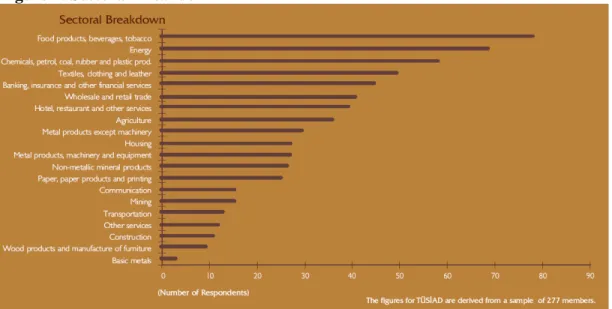
1. Destination of TÜSİAD Member Firms’ Exports... 54 2. Sectoral Breakdown of TÜSİAD Member Firms ... 56
xi
ABBREVIATIONS
CU Customs Union
DLP Democratic Left Party
DP Democrat Party
ESC Economic and Social Council
EC European Community
EU European Union
FDI Foreign Direct Investment
HC Holding Company
IMF International Monetary Fund ISI Import-Substitution Industry JCC Joint Consultative Committee JDP Justice and Development Party
JP Justice Party
JSC Joint Stock Company
MP Motherland Party
MUSIAD Private Industrialists’ and Businessmen’s Association NAP Nationalist Action Party
NATO North Atlantic Treaty Organization
NPAA National Programme for the Adaptation of the Acquis OEB Greek Cypriot Employees and Industrialists Federation RPP Republican People’s Party
TISK The Confederation of Artisans’ Associations, and Employers’ TOBB The Union of Chambers of Commerce and Industry
TNC Transnational Corporations
TPP True Path Party
TRNC Turkish Republic of Northern Cyprus TRT Turkish Radio and Television Corporation TSKB Industrial Development Bank of Turkey
TÜSİAD Turkish Industrialists’ and Businessmen’s Association SEE State Economic Enterprise
PKK Kurdistan Labor Party
UNICE Union of Industrial and Employer’s Confederation of Europe
US United States
WTO World Trade Organization
1
INTRODUCTION
The relation between the state and the business has attracted the interests of many scholars in Political Science and International Relations. Especially with the rise of transnational companies as important components of foreign-policy making, the focus on the business groups has gained a new dimension. Without a doubt, business in general and TNCs in particular have spread their activities throughout the globe by benefiting from the advantages provided by the technological developments as well as the liberalization of the national economies under the guidance of world institutions such as the IMF, World Bank and the OECD (Axford, 1995: 142.). However, the outcomes of this process for the state’s autonomy are disputed by different schools of social science. Held et al (Cited by Philips, 2005) defines the dominant approaches in this debate as ‘hyperglobalists, skeptics and transformationalists’. According to hyperglobalists, globalization is an “inexorable, encompassing and irreversible process of integration which heralds the obsolescence of national entities, not only states but also economies, societies, systems of regulation, modes of governance and so on” (Philips, 2005: 91-92). Hyperglobalists argue that the autonomy of the nation-states in policy making is systematically undermined and constrained by the structural power of markets and the global capital. Perceiving the rise of global transactions and the liberalization of markets as leading to increasing power of the TNCs and other
2
non-state actors at the expense of the nation-states, the hyperglobalists argued that the nation-state actors would have limited space in policy making. Indeed they argue that globalization dissolves and problematizes the political autonomy and the sovereignty of the nation-state especially looses economic autonomy in relation to global economy (Keyman, 1999; 23). Thus, being incapable of independent goal formulation; only national governments are under constant pressure from other states as well from non-state actors in policy-making.
Globalization skeptics attack hyperglobalists’ argument from two crucial points. Firstly, skeptics argue that globalization is not a new phenomenon. They claim the existence of a more liberalized and internationalized world economy before 1914 (Philips, 2005: 95). Thus the globalization arguments for these authors should be taken as the continuation of the liberalization trend rather than a new phenomenon. Secondly, the skeptics are against the so-called dichotomy between the national and the global and the convergence hypothesis. Instead, the notion of convergence has been challenged by the “myriad manifestations of national divergence in state strategies and capabilities, domestic state institutions and modes of corporate governance and business systems” (Philips, 2005: 95).
A third school of globalization on the state autonomy issue argues for an intermediate position between the hyperglobalists and the skeptics. Transformationalist school accepts globalization as a new and powerful process of transformation but it rejects the notion of convergence in the single globe (Philips, 2005: 95). Moreover, the transformationalist school draws attention to the stratification phenomenon, by which some states, societies and communities are becoming increasingly enmeshed in the global order while others are becoming increasingly marginal.
3
These debates on the effects of the globalization as a process on the autonomy of the states are rooted in the debates on the relationship between the state and non-state actors that have revolved around first the political scientists and later International Relations scholars. In the article Nicola Philips (2005) deals with two state debates that counter on the theme of the state’s autonomy from the non-state actors. Philips describes the first non-state debate that has turned on non-state-centric Weberian theory and society-centric Liberal and Marxist theories. According to the society-centric approaches, the state is an arena that “represents, reflects and is inherently constituted by dominant societal interests and social forces” (Philips, 2005: 85). For liberalism, especially for liberal pluralism, the state is an arena of competing interests that are aggregated and arbitrated. The state’s role in liberal pluralism is reduced to securing individual rights and freedoms. Thus, liberal pluralism neglects the question of the state’s autonomy from the societal pressures but argues in favor of the latter’s autonomy vis-a-vis the first. Due to its emphasis on the societal actors, Philips notes that liberal theory is called as a theory of society rather than state. As Heper (1991: 3) notes, liberal pluralism works with the theory of representative government; thus, it neglects the state theory. In this sense, pluralism neglects the state phenomenon that has a significant influence over the structuration of the interests groups but take state as a ‘helpless victim of interest groups unless interest groups hold each other in check’ (Heper, 1991: 4-5). Marxist theory shares with liberalism the assumption that the state is an arena defined by the interests that it represents (Philips, 2005: 85). According to Axford (1995:127), state in Marxist and neo-Marxist theories is treated as an actor whose autonomy and performance is subordinated to the interests of the dominant class. Thus state does not have an independent existence but is just a mechanism to
4
reproduce class relations in favor of the bourgeoisie. Marxism, like pluralism, fails to grant autonomy to state. Moreover, it subordinates political culture to class relations and neglect the existence of state culture.
Besides the nation-states as the dominant actors in the world arena, Axford (1995: 2) argues for the existence of a wide variety of non-state actors, such as ethnic groups, individuals, voluntary associations, formal organizations, etc, whose status has been legitimized during the modernization of Western societies and during the spread of Western culture to other parts of the world. The author correctly points out the situation as it applies to the western part of the world. However, as Buğra (2005: 25) notes, the spread of western values and institutions does not automatically accord legitimacy of the non-state actors. Indeed Axford falls into the problem that Philips underlines. According to Philips (2005: 83), the study of states in IPE has been dominated by empirical focus on the small collection of the advanced industrialized states, usually those with liberal democratic characteristics. This reliance on the experiences of a small number of states to explain the retreat or dominance of nation-states in the international arena has led to a range of biases in explaining the cases not involving dominant states.
The problem mentioned by Philips is evident in the case of Turkey. Turkey has been a part of the Western world since the end of the 2nd World War. It has participated in Western oriented international organizations such as the IMF, OECD, WTO and NATO. Moreover, Turkey has signed the Ankara Agreement with the EC, with the ultimate aim of entering the EU. Turkey-EU relations developed further by the Customs Union agreement, which granted candidate status to Turkey in 1999 and started negotiations in 2005. On the economic side liberalization of Turkish economy and promulgation of the Customs Union
5
agreement in 1995 institutionalized interdependency relations between the EU and Turkey. However these developments do not mean automatic internationalization of western values and the primacy of market economy principles by the national elites. Besides, although these developments have brought Turkey’s identity and political structure into debate, Turkish politics is still characterized by a situation where the state dominates societal actors. In other words, the strong-state culture in which the border between the economy and politics is blurred, dominates civil society in the case of Turkish politics.
We should acknowledge the rising importance of civil society in general and big business in challenging the state’s dominant role in politics and in foreign policy making and underline the structural changes in Turkish economy that have contributed to the economic power of big business. However, we also need to recognize the difficulties that big business faces in transforming its economic power into political influence. Turkey faces structural changes in both the economical and political realms with the liberalization of economy, integration of Turkish economy into the EU and the rise of civil society. But these structural changes do not automatically alter the strong state tradition and the political culture based on it. Despite the rise of international transactions of the Turkish peak business and their dominant status in the Turkish economy, Turkish entrepreneurs are still dependent on the governmental policies in two senses: firstly, they are negatively affected by the governments’ populist policies where these lead to crises in Turkish economy; and secondly, business activities in Turkey are met with suspicion both from the state as well as from the public. In this sense, the strict separation between the political and economical realm that is assumed by the liberal and Marxist theories does not fit the case of Turkey.
6
Rather, the political realm of the governments in some respects determines the parameters of the economic realm in which the private sector operates. Indeed, it is the state that has contributed to the economic power of the private sector by supplying credits, subsidies, rents and even by populist redistribution policies that affects the private sector negatively.
Change is a complex phenomenon having uncertain results. Turkey has witnessed both the transformation of state’s role in economy and the rise of international linkages of Turkish peak business. However these transformations do not automatically alter state-business relations. Indeed, as Heper (2000: 63) notes, continuation rather than change characterizes contemporary Turkish politics as well as state-business relations. Thus, the internationalization of economy and the increasing linkages of Turkish business with foreign markets and firms do not challenge the traditional domination of Turkish state over the private sector. In such a context, internationalization, and the EU in particular, can serve as external means to challenge traditional domination of state over the non-state actors, particularly Turkish business, and to increase the political power of big business to the extend that their credibility is guaranteed. In other words, international factors can exert pressure over Turkish governments in favor of non-state actors and can contribute to the power of the private sector in policy-making, a thing that Turkish peak business groups have always demanded, as long as international factors provide strong stimuli.
Turkish peak business is represented first and foremost by Turkish Industrialists’ and Businessmen’s Association (TÜSİAD). This work will deal with state-business relations in the context of Turkey’s EU membership with reference to the case of TÜSİAD.
7
In Turkey, commercial and industrial interests are represented by several organizations, mainly by TÜSİAD, The Confederation of Artisans’ Associations, and Employers’ Associations (TİSK), the Union of Chambers of Commerce and Industry (TOBB) and MÜSIAD1. Despite the existence of a variety of business organizations, TÜSİAD has a special place both in Turkish politics and in Turkey-EU relations.
TÜSİAD is important due to two facts: it is formed voluntarily, and it undermines the national rhetoric that the anti-European coalition uses, in favor of the EU-related reform process.
Firstly, TÜSİAD is an organization that is based on voluntary membership. The importance of this fact becomes clear when we consider Turkish state’s heavy influence on the formation of entrepreneur associations. That is, in the Turkish case, the private sector has been organized around the chambers that have been recognized as the only legitimate organizations allowed to represent the interests of the sectors for many years. Thus, voluntary associations of the private sector have been overlooked. Indeed they were perceived as seeking individual interests at the expense of the public interests, which led to the state officers to overlook their importance. This resulted in the problem of gaining official legitimacy for voluntary associations. Ironically this problem contributed to the formation of TÜSİAD: The suspicious attitude of the state towards entrepreneurs that were not under the control of state organs such as TOBB made it necessary for the founders
1 Weiker (1981) points out these interests groups except MÜSİAD. However after its
establishment, MÜSİAD has been an important interest group. Due to this, we found it necessary to include MÜSİAD. Despite the ones mentioned above, there are other less influential business associations that represent the local interests. For more on these organizations, see (Vorhoff, 2001). Additionally these groups have formed councils such as the Free Enterprise Council in 1976. However these organizations could not function effectively due to the conflicts within the entrepreneur associations.
8
of TÜSİAD to establish such an organization voluntarily in order to dispel the suspicion about independent groups
TÜSİAD is not the only business association that is formed voluntarily; there are voluntary business associations such as TISK and sectoral associations such as Association of Textile Industrialists. However as Vorhoff (2001: 312) points out, these associations have limited space for political action. These associations have been mostly involved in economic matters or in sectoral problems rather than in foreign policy. This increases the political importance of TÜSİAD, especially its influence on Turkey’s EU accession bid, as a subject for investigation.
Secondly, TÜSİAD is the most significant organization, capable of countering the anti-European demands. EU-related reform process brings the rise of groups who are in favor of the status quo or the reform. TÜSİAD as a pro-European association has informed the public as well as the national authorities on the benefits of the EU membership for Turkey. TÜSİAD has undermined the nationalist rhetoric against the EU membership. TÜSİAD has also persuaded the European public and the EU political authorities on possible contributions of Turkey to the EU.
We take TÜSİAD as non-governmental organization that is more than the sum of its components. In other words, TÜSİAD does not represent the particular interests of its members, but the interests of the business corporations, in general. This idea is reinforced by the holding structures of TÜSİAD member companies. Most of the TÜSİAD member companies are holdings engaged in a broad range of economic activities, such as banking, infrastructure investments and industry.
9
Thus, as Bugra (2005; 337) argues, TÜSİAD acts a class organization that represents the general interests of the private sector.
This work will attempt to answer four questions: What are the obstacles on the involvement of non-state actors, mainly TÜSİAD in policy-making; in relation to this, what are the reasons behind TÜSİAD’s pro-European attitude; and, how has TÜSİAD contributed to Turkey’s process of integration with the EU?
We mainly argue that Turkey’s EU membership for TÜSİAD acts as an external anchor that will transform the existing state-business relations in Turkey which currently damage the interests of Turkish business by two means: populist policies of the Turkish governments that lead to economic crisis; and, unclear status of Turkish business in Turkish society. Accordingly, due to the strong state tradition, which is inherited from the Ottoman Empire, non-state actors are perceived by the national elites as potential threats, which results with heavy control of Turkish state over non-state actors. In addition to this, entrepreneurial activity in Turkish political culture is not seen as legitimate. These two facts result with the fluctuating relations of business and state in Turkey that hinder the social position of Turkish business. Moreover, as a result of high costs of being out of power, Turkish political parties apply populist policies that lead to economic crisis and reward Turkish business as long as the latter supports the governing party. The promulgation of the Customs Union agreement and the liberalization of Turkish economy do not change this picture. Thus, TÜSİAD as the association of the Turkish peak business take the EU as an external anchor to institutionalize state-business relations and to sustain economic and political stability. Due to this, TÜSİAD pressures both Turkish governments and the EU circles through the use
10
of the EU institutions, publications, advertisement campaigns and direct contacts with both Turkish and the EU politicians.
Paradoxically, it is the strong state that challenges the power of TÜSİAD. In other words, although TÜSİAD aims to challenge the state tradition that leads to economic instability and prevents the peak business to transform their economic power into political one, the strong state tradition, prevents collective action of TÜSİAD members and challenges the power of TÜSİAD.
In order to prove our thesis we will organize the work as followings:
First chapter will deal with the conceptualization of the strong state tradition thesis. Main characteristics of strong state will be defined. It will be argued that the absence of intermediary structures and the patrimonial state culture reinforces each other. These lead to the absence of an indigenous bourgeoisie. Thus, it was the state that created the national bourgeoisie through state intervention in economy. However, as a reflection of the patrimonial state understanding, the state supported business groups who were loyal to the state. Moreover the state exerted heavy control over the associational activity since it perceived the business as potential threats that could challenge the order.
As a result of party-centered politics and the centralization of the economic power in the hands of the governing elite, government’s support for business was based in the loyalty to the governing party. This ended with patronage politics, which left little room for associational activity.
Second chapter will deal with the reflections of the strong state tradition on Turkish business. As a result of the primacy of collectivity, a value that is inherited by the state elite as well as the public, entrepreneurial activity is seen as illegitimate. The negative image of the businessmen was reinforced by the
rent-11
seeking behavior of the Turkish business. Rent-seeking behavior was a result of absence of long-term economic plans, state protection and economic uncertainty associated with populist economic policies.
Another important consequence of strong state tradition on Turkish business is the development of informal relations with the politicians. Since interest groups have not been institutionalized or cannot reflect the interests, Turkish businessmen have developed patronage networks with the governing parties. This was reinforced by the populist democracy practices.
Third chapter will deal with TÜSİAD-state interactions. Firstly general characteristics of TÜSİAD will be given. Next, the emphasis will be on the economic significance of TÜSİAD. Here, the influence of economic policies on TÜSİAD member firms will be given in order to indicate the effects of state policies on Turkish business. Finally development of TÜSİAD and state-TÜSİAD relations will be given in a historical manner.
Fourth chapter will deal with TÜSİAD’s pro-European activities. TÜSİAD’s perception of globalization, EU and democratization will be given. Next, it will be dealt on the contributions of TÜSİAD for Turkey’s accession to the EU. Finally, the deficits of TÜSİAD will be discussed.
12
CHAPTER I
STRONG STATE TRADITION
Absence of civil society and interest group politics in Turkey has been explained by reference to a strong state tradition that had been inherited from the Ottoman Empire and was further consolidated in Turkish Republic. The absence of intermediary structures acting to pressure government for the special interests of societal groups has led to the rise of the state as an autonomous actor on the political scene. This does not neglect the existence of a plurality of societal groups such as ayan (land owners) and ashraf (notables: tradesmen and small landowner). However these actors did not evolve into intermediary structures in order to pressure the state, but to serve agents of the state. Moreover their economic status depended on having good relations with the central government. Thus these groups could not convert their economic power into political power. Additionally, further centralization of administrative and economic structures starting with 19th century administrative reforms eliminated the rise of societal groups. This trend continued into modern Turkish Republic. Although Turkish history witnessed the rise of the private sector, entrepreneurs could not acquire independent political power since their economic power continued to be determined by their close ties to the state. Indeed this determinacy caused the entrepreneurs to seek personal
13
relations with national elites and resulted in the fragmentation of the private sector, eliminating the formation of strong interest groups capable of pressuring the government until 1990s, when the EU as an external actor started to influence the nature of Turkish domestic politics.
This chapter will attempt to define the basic characteristics of the strong-state tradition. There are four political dimensions of the state tradition in Turkey: Absence of intermediary bodies; patrimonial state understanding; primacy of collectivity; and, strict control over associational activity. First three factors existed together in the Ottoman Empire and reinforced each other. In other words, the political culture of the patrimonial state eliminated the rise of the autonomous groups but this also contributed to the strengthening the patrimonial culture. These resulted with the status of the civil society that is determined and heavy controlled by the state.
Next, the economic dimensions of strong state tradition will ve examined. It will be focused on the developmental state and populist practices.
1.1. Absence of Intermediary Bodies
The blurred distinction between the economic and political realms is related with the absence of bodies that act independent of the state. Unlike the social structure of European states, Ottoman Empire lacked powerful economic groups, such as feudal lords, estates and the bourgeoisie developed into autonomous structures that could challenge the authority of central governing entity. Rather the social structure of the Ottoman Empire was described by İnalcik (Quoted by Mardin, 1969: 26) as follows:
14
Ottoman society was divided into two major classes: The first one, called askeri, literally the ‘military’, included those to whom the Sultan delegated religious or executive power through an imperial diploma…. The second included the Reaya, comprising all Muslin and non-Muslim subjects who paid taxes but had no part in the government. It was a fundamental rule of the Empire to exclude its subjects from the privileges of the military.
Several factors account for this structure based on the strict division between ‘ruler’ and ‘ruled’. Mardin (1969: 31) explains the reason for the absence of the civil society, composed of social groups that could operate independently of central government and based on property rights with reference to patrimonial state understanding. As a consequence of patrimonial state understanding, the sultan felt obliged to protect the guilds against the merchants. More importantly, by centralizing the administrative structure and by denying corporate personality and independent authority to towns, the state eliminated the formation of oligarchies of merchant capitalists (Mardin, 1969: 27-28). Thus, despite the rise of commercial activities in the 19th century, the commercial groups could not evolve into powerful economic groups due to the centralization of power as a result of the previously formed political culture.
Özbudun (1988: 2-4) deals with three other features that reinforce the distinction between the ruler and the ruled and that eliminate the rise of what Özbudun calls as intermediary bodies. The first one is the recruitment (devsirme) system in which male children of Christian subjects were reduced to the status of slaves and were recruited for service to the state. Thus they were not in a position to challenge the authority of the Sultan. Secondly, the land tenure system that “vested in the state the original ownership of all the land and limited the rights of the sipahi (fief holders) to the collection of taxes and the supervision of peasants
15
under their jurisdiction” prevented the rise of the class of tenants-in-chief as a rival force against the Sultan (Özbudun, 1988: 4). Thirdly, unlike its European counterparts, the Ottoman Empire did not pursue mercantilist policies by which a powerful merchant class that would challenge the central authority could rise. In addition to these Heper (1991:13) notes that the ethnic division of labor prevented the rise of a powerful merchant class. Non-Muslim minorities, which took the lead in mercantile activities, were excluded from the opportunity to turn their economic significance to political power, due to the Islamic character of the state and the organization of the non-Muslims under the millet system.
The absence of intermediary bodies does not mean the absence of socio-economic groups in the society. Rather it means the impossibility of acted outside of state restrictions. Thus we can speak of the existence of pluralism among the community of the ruled, including religious agencies, nationalities, sects and tribes. However this pluralist structure did not result in the autonomy of these groups standing between the Askeri and Reaya2. Mardin explains (Cited by Özbudun, 1988: 31) this with reference to the dominance of ‘status-based’ values rather than ‘market derived values’. As a result of the bureaucratic nature of the Ottoman Empire, political power provided access to material wealth, instead of economic power leading to political power. This hindered the rise of economically powerful groups as independent political powers despite the increase in their economic
2 Unlike Özbudun, Emre Kongar (2002) takes ayan and ashraf as intermediary bodies. According
to Kongar, these classes with the role of mediator between the husbandsmen have been the economic power behind the war of independence to which a significant part of the centralist power will have joined. Kongar correctly points the subversion of the land regime that has increased the strength of these intermediate classes. However he does not consider that centralization of the administrative power by the 19th century reforms have reinforced the authority of the central
administration against the intermediate classes. Moreover he also neglects the dependency of the ayan for state privileges. Due to this reason, it is not plausible to assume the existence of intermediate and autonomous classes.
16
power. Özbudun (1988: 32) notes that “accumulated wealth could not be converted into more permanent economic assets because it was liable to confiscation by the state”. Thus, although we can witness the powerful economic groups such as the ayan and ashraf, these groups did not evolve into interest groups autonomous from the state. Rather they acted as state officers. According to Mardin (1969: 36), by refusing to allow existing social groups any political autonomy, the state made the intermediary structures dependent upon it for support. Tax farming was used as an important tool to challenge the autonomy of the ayan. Heper (1991; 14) says that the interests of the notables in tax-farming privileges, but not in productive enterprise, led to the establishment of vertical links with the state rather than horizontal links among themselves. Thus, as in other Middle Eastern states, economic life was dependent on the magnanimity of the state.
Similarly, Heper (1985: 100) treats the absence of a middle-class ethics as a result of the absence of intermediary structures. He examines the case in Europe, where the rise of the absolute monarchies was followed by the strengthening of the entrepreneurial middle class. Heper notes that the state in the Europe helped the middle class by such means as mercantilism and then assumed the role of an arbitrator and finally became a positive state. However such a dynamic structure was absent in the Ottoman Empire. This resulted with the absence of ‘bourgeoisie politics’, which contributed to the dominance of the state over civil society.
17 1.2. Patrimonial State
The notion of the strong state implies a doctrinal attachment to the primacy of the state (Larrabee&Lesser, 2003: 20). Akarlı (1975:135) says that state, as a socio-cultural phenomenon is “an autonomous collectivity of government institutions that constitutes a distinct sector of the society”. It is the political organization of the collectivity to which primacy is attributed. State is responsible for two things: welfare of the subjects and the protection of the order. Therefore, any development that could challenge the order as well as state’s dominant position is strongly reacted by the state.
The paternalistic understanding of the state can be seen in the words of the leader of TÜSİAD (Cited by Heper, 1985: 103):
In this country, our philosophy has always been that of taking the “papa state” (Devlet Baba) as paramount, refraining from challenging it, and of pursuing an economic policy, not in spite of, but with the Papa State…Hesitancy on the part of the members of private sector to run for public office stems from the belief that the state is influential, and that alienating the state would not bode well for them. Let me give you an example. Today in Turkey every businessman thinks that even if he has not done anything illegal, the state, if it chooses to, may find a pretext and crush him
Heper (1991, 13) explains the primacy of the state by reference to the militaristic structure of the Empire. Accordingly, the key role, played in the Ottoman Empire, led to the consideration of law and order as a state norm. Consequently, the statesmen of the Empire felt themselves under an obligation to save the Empire from both internal and external threats, which reinforced hostility towards representation of the interests.
Özbudun (1988: 2) stresses the importance of Islamic culture and its emphasis on order. Accordingly, in the Ottoman Empire, the social order was “of divine origin and hence immutable”. In other words, legitimacy of the order was
18
not derived from the society but was imposed upon society by the will of God. Thus by using the askeri, Sultan was responsible for maintaining the order and keeping everyone in their appropriate position.
The absence of the intermediary bodies constitutes another important point that reinforced the autonomy of the state and patrimonial culture. As a consequence of the absence of rival locus of power, there has been no room for corporate bodies with a relatively autonomous and legally defined status (Köker, 1995: 54). This resulted in the autonomy of the state. Thus state apparatus is not the “captive or handmaiden of any particular social classes but has sufficient autonomy from the classes to make decisions that can change, eliminate or create class relations” (Özbudun, 1988: 39).
As Heper (1985: 56) notes, the omnipotent state understanding has continued in the Turkish Republic and resulted with the elitist understanding of the statesmen. According to Heper, Ataturk had in mind the idea of the Hegelian state that would safeguard the general interests without overwhelming civil society. Heper (1985: 50) argues that Ataturk believed in the existence of genuine feelings and desires that could be ascribed to the nation and a collective conscience that would be discovered by the true inkilapcilar (revolutionaries) and the halkcilar (populists). The Kemalist elite believed in the capacity of the people, but saw that people by themselves would not direct their efforts to this basic aim due to their Ottoman past, during which people had been deprived of any capacity to take initiative. Thus, people could discover their collective conscience or the general interest, as progress to a more civilized way of life took place (Heper, 1985: 63). Therefore the basic aim of the state was to elevate the people to the level of contemporary civilization. It was the state that was obliged to enlighten
19
the masses by imposing modernization reforms from above. In this sense, consulting with public opinion meant shaping it, in the eyes of the Kemalist elite. As Heper (1985: 51) says, “public policy was not expected to be the outcome of a detached aggregation of interests, but the consequence of a search for ‘truth’ and ‘the one best way’ which was the moral obligation of the educated”. Consequently, the Republic for Ataturk was not a regime in which full sovereignty was to be exercised by the people but should, at least a part, be exercised by non-elected institutions, such as presidency, with the aim of guarding the real interests of the people and the ideals of the Republic (Heper, 1985: 59).
The emphasis of the Kemalist elite in the true interests of the people meant excluding ideas that did not fit the republican ideals. As Heper (1985: 62) notes, the general will was more than the decision of the community made by voting. Therefore public opinion that did not fit the ideals of the Republican elite was not considered to be the general will, but only personal interests. This elitist view of the general will can be interpreted as the continuation of rulers’ suspicion towards particular interests. For the rulers, particular interests had to be subdued to that of the general interests. This is evident in the clash between the state elite and the political elite in Turkey. By dealing with the case of Germany and France, Heper and Çınar (1996: 484-485) define state elite as responsible for the long-term interests of the community and accountable to the people as a collectivity, whereas the political elites are responsible for representing particular interests and are accountable to their disparate constituencies. The authors argue for the absence of the accommodation between the state elite and the political elite in Turkish case. In order to explain the Turkish case, the authors deal with the conflict between the non-elected bureaucracy and the elected Democrat Party
20
regime. Accordingly, DP leaders claimed to represent the national will whereas the bureaucracy accused of DP for applying populist policies at the expense of the ‘best interests’ of the country (Heper&Çınar, 1996: 488). In a similar vein, Cizre (1997:156) deals with the relation between the political elite and the state elite and says that the hallmarks of the political elite according to the state elite and particularly the military were “praetorianism, instability, inefficacy, careerism, populism, lack of prudence, corruption and irresponsibility”. This example clearly shows the state elite’s negative perception of the representation of the particular interests by the political parties.
1.3. Primacy of Collectivity
Turkish political culture ascribes primacy to collectivity over the individual. Turan (1988; 96) notes that state, which is “considered as the symbol and the means of fulfilling the highest moral aspirations of collectivity”, is the political organization of collectivity, and says that:
(state) is a sacred institution, which is to be protected against the arbitrary and capricious challenges of individuals and social groups. Often in the high interest of the state or “for reason of state”, is thought to be sufficient explanation and justification for governmental or bureaucratic action. Citizens, on the other hand, can be convicted for having insulted the fictitious personality of the state.
According to Turan (1988; 96), the primacy of collectivity in Turkish political culture has two indicators: The first indicator is the emphasis on group solidarity. Consequently, there is lack of tolerance for those who deviate from the group. Thus, individuality and deviance from group norms were punished;
21
conformity to these norms was rewarded by the bureaucratic agencies, political parties and even by the voluntary associations (Özbudun, 1988: 34).
The second indicator of the primacy of collectivity is the rejection of class-based politics and class struggles. The emphasis on the rejection of class conflicts and the particularistic outlook of classes has continued under the Turkish Republic. As Özbudun (1988; 33) notes, Kemalist notion of populism rejected class conflicts and favored the harmony of interests through paternalistic policies. This prevented the institutionalization of a legitimate opposition at the cultural level. Thus, as Özbudun claims, the distinction between legitimate political opposition and treason is blurred. Indeed, opposition is perceived as a danger to the unity of the nation.
1.4. Developmental State
The economic dimension of the strong-state tradition is related to the patrimonial state understanding. State, as the ‘father of its subjects’, aims to protect the social order and the well-being of its subjects. In the Ottoman case, Sultan had duty of hisba, which means that the ruler was responsible for the well-being of the subjects (Heper, 2000: 65). Thus the state elites, which perceived development as the step for the well-being of the think of the society, gave priority to the goal of development.
In the late 19th century, development was considered as the key for the protection of the Empire and the order. Traditionally, the Ottoman ruling elite equated industrialization with development, which was the cure for the problems of the empire. However the distribution of the economic power on the basis of millet system and the concentration of the economic activities in the hands of the
22
non-Muslim minorities that had close relations with European counterparts led to the importance of the creation of the Muslim industrialists in the eyes of the ruling elite. Therefore, the problem for the Ottoman rulers was not just a creation of the industrialists but also the creation of the Muslim industrialists in particular and Muslim entrepreneurs in general. Disturbed by the economic dominance of the non-Muslims, both the politicians and the intellectuals aimed to develop a Muslim entrepreneur class3. Thus, in 1913 law for encoding the industry was enacted and in force until 1927 (Buğra, 2005: 67)4.
The idea of the developmental state with emphasis on the industrialization and the creation of Turkish entrepreneurs continued into the first years of Turkish Republic. This time the reason for the emphasis in the industrialization was to reach to the level of contemporary civilizations. Kemalist elite perceived the state as ‘the agent of modernization’ (Kaya, 2004: 82). It sought to establish an industrial base so that the new republic would not face the dilemmas of the ex-regime. Nevertheless the emphasis on the creation of national bourgeoisie on the basis of active state support for private accumulation continued (Kaya, 2004: 89). The private sector benefited from lack of competition with the non-Muslim counterparts, due to the exchange of the population with Greece and the expulsion of the Armenians. Moreover state continued to help the private sector with the law for encouraging industry. On the other hand, the decisions of the Congress of Economy of Izmir on the encouragement of private initiative created the
3 Unlike the Western states in which the law is the ‘protector of the property’, Law in
Ottoman-Turkish states is the ‘creator of property’. This gives the state right to transfer the property to those that have good relations with the state and that support the governing parties. In this sense, ‘right of property’ does not have strong bases. (Akalın, 2002: 58)
4 Industrial Encouragement Law was renewed in 1927. This law affected firms that employed
more than 750 man-days of labor per year. Government granted these firms free land up to ten hectares. These firms were to be exempted from taxes on land and immovable property and profits, and import duties on machinery and construction materials, which were not domestically produced. (Hale, 1981: 43)
23
necessary environment for the development of the industrialists in Turkey. However Turkish experience shows that rapid industrialization by the hands of private sector did not take place as expected. This resulted in the application of the statist policies in 1930s.
The reason for the direct involvement of the state in economy in the form of SEEs (State Economic Enterprises) can be explained according to the “late industrialization” problem. As Buğra (2005: 34) asserts, late industrialization has been a fundamental problem in Turkey, both for state-business relations and for economic development. The author uses the term ‘late industrialization’ in order to define states in which industrialization has developed without the local capacity to develop technology. In such states it is impossible for small firms to develop into larger ones due to the lack of entrepreneurial qualities of the businessmen and due to the lack of the capital for the transfer of the technology. Thus state involvement becomes necessary (Buğra, 2005: 35). In a similar vein, Vorhoff (2001: 312) points out the consequences of the late industrialization in Turkey, namely heavy state involvement in economy and creation of the national private sector. According to the author, the Kemalist mission to reach the level of contemporary civilizations had assumed industrialization and economic development as top priorities. Thus the industrialization that the private sector could not maintain was planned to be done by the etatist policies and by the formation of public enterprises.
Etatism reflects the pragmatic stance of the state elite5. It is not an ideology; but is the attempt of the state to realize the priorities (Hale, 1981: 55). It never
5 Hale (1981: 50) notes that private capital and entrepreneurial skills were short in supply; fiscal
and other forms of support for industry did not result with industrial investment. Thus RPP aimed to force industrialization through state enterprises
24
attempted to replace the private sector, but aimed to substitute for the private sector. Thus, by etatism, state did not threaten the private sectors’ position, but aimed to strengthen it. As İlkin (1993: 188) notes, the etatist policies provided Turkish private sector with considerable commercial capital. The state, as Vehbi Koç (Cited by İlkin, 1993: 187) notes, had been the primary buyer that obtained “contracting business and turned it over to the private sector”.
Although etatism aimed to create a national industrialist class, the state could not encourage industrialization in private sector. It was in 1950s when a national industrialist class began to emerge. İlkin (1993: 189) argues that the main reason for this change in the attitudes of Turkish private sector was related to the implementation of an import-substitution policy as an attempt to solve the problem of shortages of exchange. Except 1950-53 and 1970-73 periods, during which foreign-trade liberalization attempts were applied, Turkey, until 1980, applied import-substitution industrialization policy (Şenses, 1994: 52). Öncü (1980: 468) summarizes the ISI (Import-Substitution Industry) model as follows:
1. Heavy reliance on foreign loans and credit to finance industrial investment
2. Introduction of customs duty and charges concessions; fiscal favors such as tax rebates, etc., to import-substituting industries
3. Introduction of tariffs and quotas to reduce competition from imports 4. To meet the demands of the assembling industry and industry depending on imported raw materials, an increasingly large percent of available means of imports being allocated to raw materials
Through use of cheap credits, protectionism, and state intervention in infrastructure, it was expected that dependence on foreign countries would decrease (Gülfidan, 1993: 46). Thus, in order to protect Turkish infant domestic industry, tariffs and quotas were put on import.
ISI model had certainly encouraged Turkish businessmen to invest in industry. In 1963, private sector had the share of 55.8% in total production of
25
manufacturing industry; in 1976 this increased to 64. 9 %( Gülfidan, 1993: 47). Moreover, 55% of TÜSİAD member firms were incorporated during this period.
Another factor that indirectly affected industrialization was the increasing economic power of the private sector as a result of the 2nd World War. The War created opportunities for the urban commerce and the local notables that have acted as intermediaries between the national market and the peasants. The commercial sector gained huge profits from imports due to the unavailability of the imported goods. On the others side, notables increased their well-being by buying products at moderate, but selling them at high, prices (Turan, 1988: 70). This resulted in the rise of the middle class in Turkey as well as the increase of the capital of the private sector.
Turkish businessmen also made use of the DP policies that carried certain characteristics of liberal economic policies (Elder, 2004: 54). . Firstly, the DP regime adopted a liberal outlook in foreign trade. DP regime has also been supportive of the development of a private sector. The DP regime sought to provide rapid industrialization through industrial and infrastructural investments6. DP governments benefited from the Cold War atmosphere to gain use the external sources of funding investments and the incentives for industrialists and the agricultural sector.
Final factor that encouraged industrial investment is the confrontation with the West during the DP period as a result of the Cold War atmosphere İlkin (1993: 185) notes that “DP’s ascent to power in 1950 which gave high priority to private enterprises, the acceleration of foreign capital investments, the Western
6 Although DP government proposed for the privatization of SEEs other than those that engaged’
solely in fields related to basic industries and having a public service character’, Turkish firms were reluctant to privatization. Hale (1981: 89) explains this reluctance according to the Turkish businessmen’s tendency to “invest their capital in something which they could personally control”.
26
education of a great number of students, and the establishment of academic institutions which provided Western-type education in Turkey created favorable conditions for Turkish business in encountering with the foreign firms.
The main development that shifted Turkish firms from commerce to industrial activities during 1950s was the establishment of Türkiye Sınai
Kalkınma Bankası (Industrial Development Bank of Turkey) under the auspices
of World Bank. The aim of TSKB was to support, enlarge and establish private industrial enterprises, and to help Turkish enterprises and foreign firms to participate in Turkish industry (Sönmez, 1990: 71-72). Main portion of TSKB’s resources came from World Bank and the Marshall aid.
TSKB has important contribution for the establishment of Turkish private industry sector. In their memories, TÜSİAD founders such as Nejat Eczacıbaşı (1982) and Sakıp Sabancı (1985) deal with the importance of credits lend by TSKB for establishing industrial bases.
Before 1950, Turkish firms acted as the distributor of the foreign firms and were more commerce-oriented. However, starting with 1950s and especially in 1960s, Turkish private sector has established joint ventures with the foreign firms. Some Turkish firms who assembled the imported parts for the construction of radios, refrigerators, etc, were directly dependent on foreign sources; some firms formed joint-ventures where Turkish firms provided capital while foreign firms brought “in the patent and most of the machinery parts and some managerial and engineering skills” (İlkin, 1974: 493).
Production for Turkish market was attractive for both Turkish firms and foreign firms due to the cheap credits, cheap foreign exchange, state supports and the protection of Turkish market (Sonmez, 1990: 67; Sunar, 1974: 493).
27
This encouraged formation of joint-ventures. However this also ended with the increasing dependence of Turkish industry to foreign firms for technology and skills, and to the state for supplying foreign exchange in order to obtain necessary inputs.
1.5. Regulator State
National elite’s emphasis on the development of national businessmen does not mean that the suspicion towards the non-state actors decreased. While sustaining development; the state elites saw it necessary to keep everyone in its appropriate position. Although the state aimed at the creation of a private sector under the guidance of the state, it was also suspicious of this rising group. Turan (1988: 70) explains the suspicion according to the Ottoman heritage and says that:
Turkish understanding of statecraft inherited from the Ottomans, not only gave the state the responsibility for providing for the welfare of the citizens and maintaining a balance between social groups, but also viewed with suspicion the growth of any socio-economic groups which could challenge the political domination of society by a centrally located bureaucratic elite. Economic change seemed to upset the equilibrium between social groups, and to produce a class, which could compete with the centralist elites for the domination of society.
This suspicious attitude of state towards the businessmen was evident in the case of capital tax. Rather than punishing the speculators that have benefited from the War conditions, RPP government preferred to punish all businessmen, whether speculator or not (Buğra, 2005: 166). The suspicion of the emerging economic groups, coupled with the role of central government as welfare provider and the burden of supporting the mobilized army through the War, resulted in two measures: capital tax, especially on non-Muslims, and the compulsory sale of a
28
part of agricultural production to the state below market prices (Turan, 1988: 40)7. This was a clear sign of the central government’s capacity to threaten the interests of the private sector by using the instruments of state (Waldner, 1999: 57-59).
Despite the fact that statesmen have considered private sector as important for development, the state did not establish organic links with societal actors but acted by extending itself into the business sector (Heper, 1991: 14). That is, the state perceived societal actors as rival powers that should be kept under close guidance of the state. It did not oppose development of private sector, but reacted the interference of business to the political realm In order to maintain the regulation, interest group associations were organized into chambers in the mid 19th century.
Chambers as professional organizations, acted like consultative bodies of the government in economic affairs. They are used as the instruments of the state to control the private sector. They have the status of kamu kurumu niteliğindeki
meslek kuruluşları (business organizations with the status of public organizations) to which the state has transferred the right to control the profession groups. They act as semi-official organizations in which membership is compulsory. Thus in order to enter the economy, the permission of the chamber is needed. Moreover chambers have the right to force firms to behave ethically, even to prevent their economic activities. They are responsible for representation of the private interests as well as maintaining the public benefit. (Öncü, 1983: 1566) Thus chambers are means though which state expanded its control to the economy by replacing the traditional guilds with the chambers (Heper, 1991: 15).
7 Hale (1981: 60-61) notes that these measures, although not fully implemented, felt the private
business to be threatened by the government. Thus, private sector, after the transition to multiparty regime, found DP economic policy more convincing, although RPP and DP economic policies were similar.
29
The organization scheme of the chambers reflects the state’s suspicion towards private interests. Chambers are organized locally. In other words, interests of the local entrepreneurs are reflected in the national assembly of the chambers. Additionally, chambers represent the interests of two groups: those of the commerce and the industry. In fact, in most of the cities both commercial and industrial interests are represented by the same chamber. With the introduction of the 1950 law on chambers, establishment of the industrial chambers was permitted. Despite this permission, chambers still have the problem of under-representation of various branches of commerce and industry. This indicates that the state wants to avoid particularistic interests of certain sectors but treats the industry as a whole.
Laws on chambers reflect the idealist stance of the state to create national entrepreneurs as well as the state’s suspicion towards the autonomous locus of power. For example, in 1971, the authority of the chambers to allocate foreign currency quotas, which had central importance for Turkish businessmen, was withdrawn and was granted to the Ministry of Commerce (Öncü, 1980: 469). This is a sign of the central authority’s suspicion towards the autonomous powers so that it resulted with the centralization of this authority.
Apart from the chambers, the legal framework was a means to control business activity, especially formation of business associations. However the state did not have a permanent attitude towards the associational activities. As Bianchi (1984: 107) notes, “at times, the state encouraged associational organization so that it could more clearly represent conflicting interests within a changing social structure; at other times the state has sought to contain or prevent interest conflict and restructure society to match elite visions for the future”.
30
State policy towards the associational is characterized by fluctuations in which promotion of associational activity is followed by limitations (Bianchi, 1984: 109). Hazama (1999: 71-81) characterizes the control of state over the associational activities with periods alternating between regulation and de-regulation. He deals three waves of regulation and three waves of de-de-regulation. Except for de-regulation of 1995 in order to facilitate the approval of the Customs Union by the European Parliament, all the amendments to laws on associations were enacted by the government without consulting societal actors8.
The first law of association was enacted in 1938 by the RPP regime. Although the restrictions on oppositional activities started after the 1925 Seyh Said rebellion, the status of associations was ‘institutionalized’ by the 1938 law on associations. According to the law, associations’ establishment was based on the permission of the Ministry of Interior. Associations were allowed to have single purpose and were prohibited from engaging in political activity (Hazama, 1999:73).
After the decrease in support to RPP regime in the 1946 election and the rise of DP as the opposition party, RPP leaders were under pressure of the DP group to remove the restrictions on associational activities (Hazama, 1999:74). Thus RPP government amended the 1938 laws in order to remove the restrictions. By the amendment, associations were not required to get the permission of the Ministry of Interior. More importantly, the restriction on formation of associations based on class was removed, which allowed the employees to form trade unions.
8 After 1960 military intervention, a constituent assembly composed of military and civilian
houses was formed in order to prepare the 1961 constitution. However participation to the constituent assembly was conditioned on the absence of relations with DP regime. Thus, Ankara Chamber of Commerce that had supported DP leaders against the intervention was banned by the Revolution Committee. (Buğra, 2005: 190).
31
However due to the increase in the number of trade unions and socialist parties, RPP leaders came to the notion that “they went too far by recognizing class-based political parties” (Quoted by Hamaza, 1999:75). This resulted in the 1947 law of trade unions and Employers’ union, which banned class-based unions and socialist parties. Next, in 1952, the DP government amended the 1946 law on association to reinforce the control of associations. The amended law was used by the DP leaders to suppress opposition groups and to change trade unions into DP supportive organizations, and to “reward its supporters and harass its opponents” (Hazama, 1999:75; Bianchi, 1984: 115)9.
1960 constitution was regarded as the most democratic marking a shift to a pluralist society and democracy based on the supremacy of constitution and checks and balances (Hazama, 1999:76; Özbudun, 1991: 41). By the new constitution, permission for formation of association was not required and associations could be restricted only for the protection of law and order. However, after the rise of the leftist activities in late 1960s, the 1972 law of associations gave the Ministry of Interior the power to supervise and regulate associations (Hazama, 1999:79; Bianchi, 1984: 117). Finally, according to the 1983 law of associations, restrictions on associations were strengthened (Özbudun, 1991: 42). The 1983 law prohibited political activities by associations and prohibited associations based on religion, class, race, region or sect. It also increased the regulatory power of the Ministry of Interior. Moreover tax reductions and exemptions were only applied to a limited number of ‘preferential associations’ or ‘public beneficial associations’ (Hazama, 1999:67). In order to be recognized, the
9Bianchi (1984: 193) notes that the laws on associational activities were constantly violated, even
by the governing parties, and were selectively enforced, especially when the governing party feels that the association became too close to the opposition. This contributed to the fluctuations in business-state relations.