REPUBLIC OF TURKEY
BAHCESEHIR UNIVERSITY
EXPLORING INDICATORS OF
CONSUMER BASED CORPORATE BRAND
EQUITY: A PRELIMINARY STUDY
Master’s Thesis
REPUBLIC OF TURKEY
BAHCESEHIR UNIVERSITY
THE GRADUATE SCHOOL OF SOCIAL SCIENCES M.A. in MARKETING
EXPLORING INDICATORS OF
CONSUMER BASED CORPORATE BRAND
EQUITY: A PRELIMINARY STUDY
M.A. in MARKETING THESIS
SELİN GERMİRLİ
T.C
BAHÇEŞEHİR ÜNİVERSİTESİ
INSTITUTE OF SOCIAL SCIENCES M.A. in MARKETING
Name of the thesis: Exploring indicators of consumer based corporate brand equity: A preliminary study
Name/Last Name of the Student: Selin Germirli Date of Thesis Defense: 25.07.2011
The thesis has been approved by the Institute of Social Sciences.
Director
Signature
I certify that this thesis meets all the requirements as a thesis for the degree of Master of Arts.
Program Coordinator
Signature
This is to certify that we have read this thesis and that we find it fully adequate in scope, quality and content, as a thesis for the degree of Master of Arts.
Examining Comittee Members Signature
Title Name and Surname
Thesis Supervisor ---
Thesis Co-supervisor ---
Member ---
Member ---
ABSTRACT
EXPLORING INDICATORS OF CONSUMER BASED CORPORATE BRAND EQUITY: A PRELIMINARY STUDY
Germirli, Selin M.A. in Marketing
Thesis Supervisor: Asst. Prof. Elif Karaosmanoglu August, 2011, 96 pages.
In the new era, corporate brand equity has gained a great importance for companies. This thesis is written to, fill the gap realized in the literature about indicators of consumer based corporate brand equity.
The indicators of consumer based corporate brand equity, company marketing performance outcomes, and the relationship between them are tested by quantitative research method through survey. The data collected is analyzed by SPSS 12.0. According to result of the analysis, eight indicators are determined of corporate brand equity scale. These indicators are; organizational identification, corporate brand attractiveness / distinctiveness, consumer-company value congruence / similarity, corporate brand promise / trustworthiness, corporate brand knowledge, corporate leadership / expertise, corporate social responsibility, and corporate reputation / prestige. These indicators are tested with company marketing performance outcomes which are accepted in this study as, extra role behavior, satisfaction, loyalty / repeat purchase, and resilience to negative information and a positive relationship is found between them.
Keywords: organizational identification, corporate brand attractiveness, corporate brand distinctiveness, consumer-company value congruence, corporate brand promise
ÖZET
TÜKETİCİ BAZLI KURUMSAL MARKA EDERİ BELİRLEYİCİLERİ ARAŞTIRMASI: BİR ÖN ÇALIŞMA
Germirli, Selin Pazarlama Yüksek Lisans
Tez Danışmanı: Yrd. Doç. Dr. Elif Karaosmanoğlu Ağustos, 2011, 96 sayfa.
Günümüzde şirketler için kurumsal marka ederi büyük önem kazanmıştır. Bu tez çalışması, tüketici bazlı kurumsal marka ederi belirleyicileri konusunda literatürde fark edilen boşluğu doldurmak için yazılmıştır.
Kurumsal marka ederini ölçebilmek için belirlenen boyutlar ve onların şirket performans göstergeleri ile aralarındaki ilişki anket yoluyla kantitatif araştırma metodu kullanılarak test edilmiştir. Toplanılan veri, SPSS 12.0 programı kullanılarak analiz edilmiştir. Analizin sonuçlarına göre, kurumsal marka ederi için kullanılmak üzere sekiz adet belirleyici tespit edilmiştir. Bunlar; organizasyonel özdeşleştirme, kurumsal marka çekiciliği / ayırt ediciliği, tüketici-kurum değer uygunluğu/benzerliği, kurumsal marka sözü / güvenilirliği, kurumsal marka liderliği / uzmanlığı, kurumsal sosyal sorumluluk, kurumsal marka bilgisi ve kurum itibar / prestiji olarak belirlenmiştir. Bu sekiz adet boyut, kurum performans belirleyicileri olarak kabul edilen ekstra rol davranışları, negatif bilgiyle karşı direnç, sadakat / sürekli satın alma ve memnuniyet ile test edilmiş ve aralarında pozitif ilişki bulunmuştur.
Anahtar Kelimeler: organizasyonel özdeşleştirme, kurumsal marka çekiciliği, kurumsal marka ayırt ediciliği, tüketici-kurum değer uygunluğu, kurumsal marka sözü
TABLE OF CONTENTS
LIST OF TABLES... viii
LIST OF FIGURES... ix
ABBREVIATIONS... x
1. INTRODUCTION………. 1
1.1. RELEVANCE AND AIM OF THE RESEARCH……….. 1
1.1.1. Relevance of the Research………. 1
1.1.2. Aim of the Research……….. 2
2. LITERATURE REVIEW………. 3
2.1. PRODUCT BRAND……….. 3
2.2. CORPORATE BRAND……… 4
2.3. IMPORTANCE OF CORPORATE BRANDING………. 5
2.4. BRAND EQUITY………. 5
2.5. PRODUCT BRAND EQUITY……… 7
2.6. CONSUMER-BASED PRODUCT BRAND EQUITY………… 8
2.7. CONSUMER-BASED PRODUCT BRAND EQUITY DIMENSIONS 10
2.7.1. Brand Awareness………. 10
2.7.2. Brand Associations……….. 10
2.7.3. Perceived Quality………. 12
2.7.4. Brand Loyalty……….. 12
3. CONCEPTUAL FRAMEWORK……… 14
3.1. CORPORATE BRAND EQUITY DIMENSIONS……… 14
3.1.1. Organizational Identification………. 14
3.1.2. Corporate Brand Distinctiveness……….. 16
3.1.3. Consumer-Company Value Congruence / Similarity……. 17
3.1.4. Corporate Brand Attractiveness……….. 18
3.1.5. Corporate Brand Promise………. 19
3.1.6. Corporate Brand Knowledge……… 23
3.1.7. Corporate Associations………. 26
3.1.7.1. Corporate trustworthiness……… 26
3.1.7.2. Corporate leadership / expertise………. 28
3.1.7.3. Corporate social responsibility……… 29
3.2. COMPANY PERFORMANCE OUTCOMES……… 36
3.2.1. Loyalty / Repeat Purchase……… 36
3.2.2. Extra Role Behavior………. 36
3.2.3. Resilience to Negative Information………. 37
3.2.4. Satisfaction……… 37
3.3. SUMMARY………... 38
4. RESEARCH DESIGN & ANALYSIS………. 40
4.1. DATA COLLECTION AND SAMPLING……….. 40
4.1.1 Data Collection………. 40
4.1.2. Sampling……….. 42
4.2. DATA ANALYSIS……… 42
4.2.1. Sample Characteristics……….. 42
4.2.2 Factor Analysis Results……….. 44
4.2.2.1. Factor analysis results for corporate brand equity scale 44
4.2.2.2. Factor analysis results for company marketing performance outcomes ……….. 45
4.2.3. Regression Analysis……….. 46
4.2.3.1. Coefficients……… 46
4.2.3.2. Analysis of variance (ANOVA)……….. 47
4.2.3.3. Model summary……… 48
4.2.4. Correlations……… 48
5. DISCUSSION & CONCLUSION………. 49
5.1. THEORETICAL CONTRIBUTION……… 49
5.2. MANAGERIAL IMPLICATIONS……….. 50
5.3. LIMITATIONS OF THE STUDY……… 52
REFERENCES……….. 53 APPENDIX ……….. 74 APPENDIX 1………. 75 APPENDIX 2………. 83 APPENDIX 3………. 92 APPENDIX 4……….. 93 APPENDIX 5……….. 96
TABLES
Table 2.1: Differences between Product Brand and Corporate Brand………….5
Table 2.2: Conceptual Research on Customer-based Brand Equity……….9
Table 4.1: Sample Quantitatives………..43
Table 4.2: Coefficients………...47
Table 4.3: Anova………47
LIST OF FIGURES
Figure 3.1: Hypotheses ……….. 39
ABBREVIATIONS
DEDICATION
I dedicate this thesis study to my fiance İbrahim Alp Yerebakan who has always been my biggest support.
1. INTRODUCTION
1.1. RELEVANCE AND AIM OF THE RESEARCH 1.1.1. Relevance of the Research
A lot of research has been conducted in the branding literature at the product level, where scholars were primarily concerned about customers’ perceptions about a product brand. However, as consumers become more knowledgeable about products and corporations as a whole, corporate branding is increasingly gaining importance and attention by marketing scholars (Shamma and Hassan, 2011).
A corporate brand is more than just the outward manifestation of an organization, - its name, logo and visual representation - it is the core of values that define it (Ind, 1997). It is the overall perception about an organization, reflected by its overall corporate identity (Balmer, 2001). Thus, businesses began shifting their focus from product brands to corporate branding (De Chernatony 1999, Hatch and Schultz 2003). It is after 1995 when more research on corporate branding is published. Balmer and Gray’s (2003) literature review on corporate branding presents different visions that have been developed during the years prior. They conclude that corporate brands are leading to the development of a new branch of marketing which should be known as corporate- level marketing (Balmer and Greyser, 2002).
A series of studies have highlighted the strategic importance of a strong corporate brand and its impact on various corporate dimensions. A strong corporate brand is thought to enable a company to attract qualified employees, attract capital, select suppliers and achieve significant financial performance (Beatty and Ritter, 1986; Weiss et al., 1999; Rao, 1994; CarmeliandTischler, 2005), but there is not consistent or reliable research conducted to develop a scale to measure this strength of corporate brand. In literature there is a wide gap about corporate brand equity which is defined by Keller (2000) as the differential response by consumers, customers, employees, other firms, or any relevant constituency to the words, actions, communications, products or services
provided by an identified corporate brand entity. Therefore, it is significant and necessary to explore consumer based corporate brand equity indicators.
In summary, the below evidence from earlier studies shows that corporate brand equity is a major strategic concern for the success of a company in that its strength can have a positive impact on company marketing performance outcomes. Therefore, it is imperative to determine relevant and reliable consumer based corporate brand equity indicators to be able to measure equity accurately.
1.1.2. Aim of the Research
The discussion above suggests that consumer based corporate brand equity indicators are crucial to explore in order to enhance consumer based corporate brand equity. Thus, the aim of this research is to explore indicators of consumer based corporate brand equity by a preliminary study.
2. LITERATURE REVIEW
2.1. PRODUCT BRAND
The concept of the brand can be traced back to product marketing where the role of branding and brand management has been primarily to create differentiation and preference for a product or service in the mind of the customer (Knox and Bickerton, 2003). Within this field, there are a number of generally accepted definitions. These variously refer to the brand as a product or service, which a customer perceives to have distinctive benefits beyond price and functional performance (Knox, 2000) or a symbol serving to distinguish the products and services of one company from another (Kapferer, 1997). As Shamma and Hassan (2011) state, product branding includes all the tangible and intangible associations that customers have about a product brand, such as brand quality, brand price, brand features, brand personality and brand image. Product brands target customers, and are likely to create associations about specific products.
The development of product branding over the past 30 years is characterized by layers of added value built around the core functionality of the product or service to create and maintain distinction in a particular market (Knox and Bickerton, 2003). These refinements reflect both responses to changes in the business environment and the development of deeper insights into the nature and influence of the organization as an intangible element in the marketing mix (Knox and Bickerton, 2003).
A further stage in this evolutionary development of traditional product management has been the increasing influence of the organization behind the brand and an increasing acceptance of its role in the creation of economic value (Knox and Bickerton, 2003). Worcester (1986) provides evidence of a strong correlation between company familiarity and favorability, and research by Keller and Aaker (1992) highlights the positive impact of the corporate brand on new product introductions and product brand extensions.
2.2. CORPORATE BRAND
The most recent turn in branding literature emerged in the mid-nineties. Businesses began shifting their focus from product brands to corporate branding (De Chernatony 1999, Hatch and Schultz 2003). The corporate brand perspective supports, and could be a consequence of, the strategic view of brands. King (1991) is considered to be the first author to make a clear distinction between product and corporate brands, emphasizing the importance of a multidisciplinary approach in order to manage them.
It is after 1995 when more research on corporate branding is published. Aaker (2004a) defines a corporate brand as a brand that represents an organization and reflects its heritage, values, culture, people, and strategy. A corporate brand is the overall perception about an organization, reflected by its overall corporate identity (Balmer, 2001).
Corporate branding is not tied to one specific product, but integrates a corporation’s common product attributes and benefits, relationships with people, social values and programs and corporate credibility (Keller, 1998). Corporate branding congruent with the strategic brand vision (Schultz and Hatch 2003), dwells on developing brands at an organizational level (Knox and Bickerton 2003) -which requires managing interactions with multiple stakeholders (Balmer and Gray 2003, Knox and Bickerton 2003, Hatch and Schultz 2003, Aaker 2004b). A corporate brand is defined primarily by organizational associations (Aaker 2004b), and thus can develop and leverage organizational characteristics, as well as product and service attributes (Aaker 2004a). The main differences between product brand and corporate brand are summarized in the Table 2.1.
Table 2.1.: Differences between product brand and corporate brand
Product Brand Corporate Brand
Focus The product The organization
Management Middle management
(e.g., product manager) Chief executive (e.g., CEO)
Stakeholder focus Consumers Multiple stakeholders
Functional
responsibility Marketing Most/all departments
General responsibility Marketing personnel All personnel
Communications
channels Marketing communications
Multiple communications, activities, and contacts
Time horizon Short (product life) Long (organization life)
2.3. IMPORTANCE OF CORPORATE BRANDING
While products and services tend to become similar over time, organizations are inevitably very different. The strategic importance of a strong corporate brand and its impact on various corporate dimensions have been highlighted many times. A strong corporate brand is thought to enable a company to attract qualified employees, attract capital, select suppliers and achieve significant financial performance (Beatty and Ritter, 1986; Weiss et al., 1999; Rao, 1994; Carmeli and Tischler, 2005).
2.4. BRAND EQUITY
Brand equity, as first defined by Farquhar (1989), is the ‘added value’ with which a given brand endows a product. Apart from Farquhar’s first definition of brand equity, other definitions have appeared. According to Lassar, Mittal, and Sharma (1995), brand equity has been examined from a financial (Farquhar, Han, and Ijiri 1991; Simon and Sullivan 1993; Kapferer 1997; Doyle 2001), and a consumer based perspective (Keller 1993; Shocker, Srivastava, and Rueckert 1994; Chen 2001). Brand equity has been defined as the enhancement in the perceived utility and desirability a brand name confers on a product (Lassar, Mittal and Sharma 1995), and as a set of assets (and
liabilities) linked to a brand’s name and symbol that adds to (or subtracts from) the value provided by a product or service to a firm and/or that firms’ customers (Aaker, 1996).
High brand equity is considered to be a competitive advantage since: it implies that firms can charge a premium; there is an increase in customer demand; extending a brand becomes easier; communication campaigns are more effective; there is better trade leverage; margins can be greater; and the company becomes less vulnerable to competition (Bendixen, Bukasa, and Abratt 2003). In other words, high brand equity generates a “differential effect”, higher “brand knowledge”, and a larger “consume response” (Keller 2003), which normally leads to better brand performance, both from a financial and a customer perspective.
Brand equity is a key marketing asset (Davis 2000; Ambler 2003), which can engender a unique and welcomed relationship differentiating the bonds between the firm and its stakeholders (Hunt and Morgan 1995; Capron and Hulland 1999), and nurturing long-term buying behavior.
For firms, growing brand equity is a key objective achieved through gaining more favorable associations and feelings among target consumers (Falkenberg 1996). Previous research established a positive effect of brand equity on: consumer preference and purchase intention (Cobb-Walgrenet al. 1995); market share (Agarwal and Rao1996); consumer perceptions of product quality (Dodds et al. 1991); shareholder value (Kerin and Sethuraman 1998); consumer evaluations of brand extensions (Aaker and Keller 1990; Rangaswamy et al. 1993; Bottomley and Doyle 1996); consumer price insensitivity (Erdem et al. 2002); and resilience to product-harm crisis (Dawar and Pillutla 2000).
Over the last 15 years, brand equity has become more important as the key to understanding the objectives, mechanisms and net impact of the holistic impact of marketing (Reynolds and Phillips 2005). In this context, it is not surprising that measures capturing aspects of brand equity have become part of a set of marketing
performance outcomes (Ambler 2003). The discussion of brand equity and its measurement has a broad range of adherents, both academic and practitioner, that collectively share what can be described as a black box orientation (Reynolds and Phillips 2005). Evidence of the importance of brand equity for the business world is the fact that there is currently a significant number of consulting firms (e.g. Interbrand, WPP, Young and Rubicam and Research International), each with their own proprietary methods for measuring brand equity (Haigh, 1999). In setting up the future research agenda for brand management, Keller and Lehman (2006) unsurprisingly identified brand equity and its measurement as a significant research topic.
The literature on brand equity, although substantial, is largely fragmented and inconclusive. As Berthon et al. (2001) put it, perhaps the only thing that has not been reached with regard to brand equity is a conclusion.
2.5. PRODUCT BRAND EQUITY
Due to its importance, marketing academicians and practitioners are becoming more involved with branding as a means for differentiation however; marketers are challenged when it comes to assessing a measurable value for a brand (Shamma and Hassan, 2011). Most measures for product brand equity are stemmed from the consumer behavior literature. Aaker (1996) proposed the following dimensions as the major asset categories in determining brand equity: (1) brand name awareness (2) brand loyalty (3) perceived quality and (4) brand associations. This perspective offers a consumer based approach for brand equity measurement.
Keller (1993) defined consumer based brand equity as “the differential effect of brand knowledge on consumer response to the marketing of the brand.” Keller (1993) highlighted brand knowledge, reflecting the degree of brand awareness and image and brand response, reflecting consumers’ perceptions, preferences and behaviors resulted from the marketing mix activities.
Another perspective for measuring product brand equity is commonly referred to as the financial accounting perspective. This perspective evaluates brands by assessing their
impact on financial performance indicators such as revenues and profits. Simon and Sullivan (1993) assess brand equity as the incremental discounted cash flows that would result from a product having its brand name in comparison with what would accrue of the same product did not have the brand name. Companies such as Financial World and Interbrand assess values in brands using this financial-based perspective. Future product earnings are based on historical information about brand performance.
While evaluating brands on the basis of the value of a product is important, yet existing measures do not account for non-product related factors that may affect the value of a brand. These perspectives greatly influence the value of a brand. For example, the general public’s perceptions about corporate response to social events such as Hurricane Katrina greatly affected the reputation of companies such as Procter and Gamble (Alsop, 2005). Also, Bill Gates’ personal philanthropy helped to raise the ranking of Microsoft by the general public (Alsop, 2007).
2.6. CONSUMER BASED PRODUCT BRAND EQUITY
The conceptualizations of consumer based brand equity have mainly derived from cognitive psychology and information economics (Christodoulides and De Chernatony, 2010). The dominant stream of research has been grounded in cognitive psychology, focusing on memory structure (Aaker 1991; Keller 1993). Aaker (1991) identified the conceptual dimensions of brand equity as brand awareness, brand associations, perceived quality, brand loyalty, and other proprietary brand assets such as patents, trademarks and channel relationships. The former four dimensions of brand equity represent consumer perceptions and reactions to the brand, while proprietary brand assets are not pertinent to consumer based brand equity (Christodoulides and De Chernatony, 2010). Keller (1993) looked at consumer-based brand equity strictly from a consumer psychology perspective and defined it as the differential effect of brand knowledge on consumer response to the marketing of the brand. According to this conceptualization, a brand has a positive (or negative) value if the consumer reacts more (or less) favorably to the marketing mix of a product of which he/she knows the brand name than to the marketing mix of an identical yet unbranded product (Christodoulides and De Chernatony, 2010). Consumer response to the marketing mix of a brand can be
translated at various stages of the purchase decision-making sequence, such as preference, choice intentions and actual choice. According to Keller (1993), brand knowledge is a key antecedent of consumer-based brand equity and is in turn conceptualized as a brand node in memory to which a variety of associations have been linked.
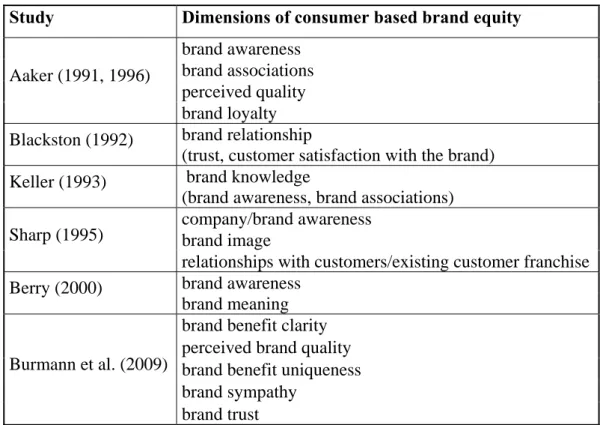
Brand equity has been defined by researchers in different ways. Over the years researchers focused on similar major dimensions of consumer based brand equity as seen in the Table 2.2. As a result of this research, they have recognized Aaker’s dimensions as main sources of brand equity, assuming that these four dimensions fully and completely explain the construct brand equity, thus these four dimensions – brand awareness, brand associations, perceived quality, and brand loyalty are explained in this study as the dimensions of consumer based product brand equity measurement scale (Gill and Dawra, 2010).
Table 2.2.: Conceptual research on consumer based brand equity
Study Dimensions of consumer based brand equity
brand awareness brand associations perceived quality Aaker (1991, 1996)
brand loyalty
Blackston (1992) brand relationship (trust, customer satisfaction with the brand)
Keller (1993) brand knowledge (brand awareness, brand associations)
company/brand awareness brand image
Sharp (1995)
relationships with customers/existing customer franchise brand awareness
Berry (2000)
brand meaning brand benefit clarity perceived brand quality brand benefit uniqueness brand sympathy
Burmann et al. (2009)
brand trust
2.7. CONSUMER BASED PRODUCT BRAND EQUITY DIMENSIONS 2.7.1. Brand Awareness
According to Keller (1993), brand awareness involves brand recognition and brand recall. Brand recognition is the extent to which a person is able to recognize a particular brand given a set of brands. Brand recall is the extent to which a person is able to remember a brand, given a product category or need. As per Aaker (1996), brand awareness consists of many levels. These levels are brand recognition, brand recall, top of mind, brand dominance, brand knowledge and brand opinion. As one moves from brand recognition to brand opinion, the brand awareness increases.
Aaker (1996) states that, brand awareness is an important and sometimes undervalued component of brand equity; it can affect perceptions and attitudes. In some contexts, it can be a driver of brand choice and even loyalty. Brand awareness reflects the salience of the brand in the customers mind and there are levels of awareness which include recognition (Have you heard of this brand?), recall (What brands of cars can you recall?), top-of-mind (the first-named brand in a recall task), brand dominance (the only brand recalled), brand knowledge (I know what the brand stands for), and brand opinion (I have an opinion about the brand) (Aaker, 1996).
2.7.2. Brand Associations
Aaker (1996a) defined brand identity as a unique set of brand associations that the brand strategist aspires to create or maintain. These associations represent what the brand stands for and imply a promise to customers from the organization members. This means that brand association is something that provides meaning to a brand. Aaker (1996b) mentioned three types of brand associations while providing a measure for brand equity. The three types of associations are brand as a product, brand as an organization and brand as personality.
It is the strength, favorability and uniqueness of the brand associations that are responsible for the differential effect of the consumers towards the brand (Gill and Dawra, 2010). The key associations/differentiation component of brand equity usually
involves image dimensions that are unique to a product class or to a brand (Aaker, 1996). Measurement of associations/differentiation can be structured around three perspectives on the brand: the brand-as-product (value), the brand-as-person (brand personality) and the brand-as-organization (organizational associations) (Aaker, 1996).
The brand-as-product perspective focuses on the brands value proposition. Aaker (1996) states that, the value proposition, which usually involves a functional benefit, is basic to brands in most product classes and if the brand does not generate value, it will usually be vulnerable to competitors. Brand value can be measured by the whether the brand provides good value for the money, and whether there are reasons to buy this brand over competitors (Aaker, 1996).
A second element of associations/differentiation, brand personality, is based on the brand-as-person perspective. The brand personality can provide a link to the brands emotional and self-expressive benefits as well as a basis for customer/brand relationships and differentiation (Aaker, 1996). Aaker (1996) posits that, this is especially the case for brands that have only minor physical differences and that are consumed in a social setting where the brand can make a visible statement about the consumer.
Another dimension of brand associations is the brand-as-organization perspective, which considers the organization (people, values, and programs) that lies behind the brand. This perspective can be particularly helpful when brands are similar with respect to attributes, when the organization is visible (as in a durable goods or service business), or when a corporate brand is involved (Aaker, 1996). It can play an important role by showing that a brand represents more than products and services. Organizational associations that are often important bases of differentiation and choice include having a concern for customers, being innovative, striving for high quality, being successful, having visibility, being oriented toward the community, and being a global player (Aaker, 1996).
2.7.3. Perceived Quality
Perceived quality is an association that is usually central to brand equity. Perceived quality is one of the key dimensions of brand equity; it is associated with price premiums, price elasticities, brand usage, and, remarkably, stock return (Aaker, 1996). Further, it is highly associated with other key brand equity measures, including specific functional benefit variables.
Perceived quality is related to a consumer’s opinion on the extent to which a particular product will be able to meet his expectations and it can have a great impact on a brand ’ s equity: the higher the perceived quality of a brand, the greater will be its brand equity (Gill and Dawra, 2010). It is important that a customer perceives a brand to be of high quality because it will increase the brand preference and build brand equity (Gill and Dawra, 2010).
2.7.4. Brand Loyalty
Aaker (1996) states that, loyalty is a core dimension of brand equity. A loyal customer base represents a barrier to entry, a basis for a price premium, time to respond to competitor innovations, and a protection against harmful price competition Aaker (1996). Basic indicators of loyalty include, price premium and customer satisfaction.
One of the basic indicators of loyalty is the amount a customer will pay for the brand in comparison with another brand (or set of comparison brands) offering similar benefits Aaker (1996). This is called the "price premium" associated with the brand, and it may be high or low and positive or negative depending on the two brands involved in the comparison Aaker (1996). If a brand is compared to a higher-priced brand, the price premium could be negative.
Satisfaction also can be an indicator of loyalty for some product classes. A direct measure of customer satisfaction can be applied to existing customers, who can perhaps be defined as those who have used the product or service within a certain time frame
such as the last year Aaker (1996). Satisfaction is an especially powerful measure in service businesses such as car rental firms, hotels, or banks, where loyalty is often the cumulative result of the use experiences Aaker (1996).
3. CONCEPTUAL FRAMEWORK
3.1. CORPORATE BRAND EQUITY DIMENSIONS
3.1.1. Organizational Identification
People are drawn to organizations in which they can express themselves rather than hide the contents of their self-concept (Dutton, Dukerich and Harquail, 1994), since humans are not only pragmatic and goal oriented but also self-expressive (Shamir, House, and Arthur, 1993).
In social psychology, social identification means that a person identifies him/herself as a member of a society. Social identity theory proposes that individuals classify themselves into various social categories in order to facilitate self-definition within their own social environment (Ashforth and Mael, 1989). An expression of identification with an organization is treated as a special type of social identification (Bhattacharya et al., 1995; Hogg and Abrams, 1988; Lau, 1989; Mael and Ashforth, 1992). People tend to use various factors to classify themselves as belonging to a specific group. This situation which is widely seen in our social life is called social identification. In short, social identification is the sense of belonging to certain groups or organizations (Ashforth andMael, 1989; Hogg, Hardie, and Reyrolds, 1995). Here, a group includes a reference group; it includes not only a group to which people belong but also a group to which they aspire to belong as consumers identify themselves with brands (Fournier 1998).
Social identification, then, is the perception of belongingness to a group classification (Mael and Ashforth, 1992). Through social identification, individual perceives him/herself as psychologically connected with the fate of the group, as sharing a common destiny and experiencing its successes and failures (Tolman, 1943). Identification allows the individual to involve him/herself in accomplishments beyond his or her powers (Katz and Kahn, 1978). As Ashforth and Mael (1989) suggest, the organization individual gets involved in can answer to the question of who I am. Thus,
organizational identification is a specific form of social identification where the individual defines him/herself in terms of the membership in a particular organization.
Organizational identification is an important construct on organizational behavior, since it affects both the satisfaction of the individual and the effectiveness of the organization (Brown, 1969; Hall, Schneider, and Nygren, 1970; Lee, 1971; O'Reilly and Chatman, 1986; Patchen, 1970; Rotondi, 1975). It is one form of psychological attachment that occurs when members adopt the defining characteristics of the organization as defining characteristics for themselves (Dutton, Dukerich and Harquail 1994). The level of organizational identification indicates the degree to which people come to see the organization as part of themselves.
There are several positive consequences of organizational identification of consumers that cause organizational identification to be one of the precedents of the corporate brand equity. These consequences are company loyalty, company promotion, customer recruitment, repeat purchase, extra role behavior and resilience to negative information. Greater identification results in an individuals’ willingness to engage in consumptive behaviors that support the group (Fisher and Wakefield, 1998) and induces the individual to engage in, and derive satisfaction from, activities congruent with the identity (Ashforth and Mael, 1989).
Identification causes people to become psychologically attached to and care about the organization, which motivates them to commit to the achievement of its goals, expend more voluntary effort on its behalf, and interact positively and cooperatively with organizational members (Bhattacharya and Sen 2003). The higher the level of organizational identification, the more likely consumers are to be loyal to the company's existing products and try its new products, the more likely consumers are to promote the company, both socially (i.e., talk positively about it and its products) and physically (i.e., adopt company markers), the more likely consumers are to recruit people from their extant social networks to be new customers of the company, repeat purchase and the greater is consumers' resilience to negative information about the company within a
zone of tolerance (Bhattacharya and Sen 2003). Thus, it is significant to explore organizational identification as an indicator of consumer based corporate brand equity.
3.1.2. Corporate Brand Distinctiveness
Corporate brand distinctiveness is an important organizational characteristic for companies. While consumers' need for distinctiveness is likely to vary with cultural norms, individual socialization, and recent experience (Brewer 1991), it is likely to make the (self-relevant) distinctiveness of a company's one of the indicators of its corporate brand equity. The more distinctive consumers perceive a company's identity to be on dimensions they value, the higher the corporate brand equity. Because distinctiveness is likely to be articulated relative to other companies, it in turn depends not only on the company's own identity but also on its competitive landscape (e.g., the number of competitors; their identities, particularly the similarities among them; the company's perceived positioning relative to competition) (Bhattacharya and Sen, 2003). Identification with the company is related to the perceived distinctiveness of the organization’s values and practices relative to those of comparable groups (Turner and Oakes, 1986). Distinctiveness differentiates the organization from other organizations, provides a sharper and more salient definition for organizational members and a unique corporate identity. Thus, organizations often attempt to define their identities by finding a distinctive niche (Albert and Whetten, 1985).
A distinctive organizational identity attracts the recognition, support, and loyalty of customers and thus leads to companies focusing intensely on advertising, names and logos, jargon, leaders and mascots and so forth (Mael and Ashforth, 1989), to be able to create corporate brand distinctiveness in consumers’ perspective. Without clearly distinctive positioning, benefits or solutions, consumers have no reason to remember the company and its products.
Individuals need to emphasize their interpersonal differences with other individuals as a way of guaranteeing the integrity of their self (Tajfel and Turner, 1979). Corporate brand distinctiveness necessarily requires comparison of one brand’s identity with other, generally competing brands (Bhattacharya and Sen, 2003). When brand identity is perceived as more distinctive than that of the competition, its attractiveness for
consumers increases, because the relationship with that brand allows individuals to increase the psychological difference with consumers of other competing brands (Kim et al., 2001). This brand distinctiveness provides companies with a marketing edge to stand out against competitors and refers to a firm’s success in developing the brand based on distinctive products/services or any other marketing activities such as distribution (Wong and Merrilees, 2005). It creates the potential for the company to succeed in the long term. For instance, strong-brand service companies consciously implement corporate brand distinctiveness in performing and communicating the service, use branding to define their reason for being, connect emotionally with customers, and internalize the brand for service providers so that they build it for customers (Berry, 2000). Thus, it is significant to explore corporate brand distinctiveness as an indicator of consumer based corporate brand equity.
3.1.3. Consumer-Company Value Congruence / Similarity
In their efforts to understand themselves and their social worlds, consumers are motivated to maintain a stable and consistent sense of self, both over time and across situations (Kunda 1999). Pratt (1998) suggests that this need for self-continuity is a key driver of people's choice of organizations to identify with as they attempt to construct viable, cognitively consistent social identities (Heider 1958). Consumer behavior is determined by the self-congruity resulting from a psychological comparison involving the image of other customers of the company, corporate image, and consumer’s self concept (e.g., actual self-image, ideal self-image, social self-image). Self-congruity represents the degree of similarity between consumer and corporate brand. This can be categorized as high or low self-congruity. High self-congruity is experienced when the consumer perceives the image of other customers (e.g. product-user image) and company image similar to his/her self-image, and vice versa.
Consumers often have a preference for and choose products and brands that have higher versus lower levels of congruity. It affects consumer behavior through self-concept motives such as the needs for self-consistency and self-esteem (Sirgy et al., 1997). Congruity impacts are desirable because they influence consumer’s self-image positively, but inconsistencies or incongruity is likely to result in feelings of
inadequacy, and dissatisfaction with their choices (Johar and Sirgy, 1991; and Sirgy and Su, 2000). Self-congruity also plays a role in motivating consumers to process information (Mangleburg et al., 1998); self-congruity increases consumers' involvement with the product category. Consumers are directly influenced by the extent to which the customers have personally observed other customers being similar to them (i.e., they can identify with other customers) (Hohenstein et al., 2007). In the case of iPod from Apple, iPod users experience a high level of brand self-congruity, since they feel that there is a similarity between the kind of people perceived to use an iPod and their own personal identity (i.e., young, modern, wild, hipped, music lover).
Self-congruence resulting from the perceived similarity between the image of other customers of the company (user-image), corporate image, and consumer’s self concept explains and predicts different various indicators of corporate brand equity such as product use, product ownership, brand attitude, purchase motivation, purchase intention, brand choice, brand adoption, store preference, store loyalty and so forth. Thus, it is significant to explore consumer-company value congruence / similarity as an indicator of consumer based corporate brand equity.
3.1.4. Corporate Brand Attractiveness
In today's age of unique corporate influence and consumerism, certain companies represent and offer attractive, meaningful social identities to consumers that help them satisfy important self-definitional needs and so, such companies become valid targets for identification among relevant consumers (Bhattacharya and Sen, 2003). They find a perceived corporate identity more attractive because it matches their own sense of who they are (i.e. their self-concept) and thus, this type of information is easy to process and understand (Dutton et al., 1994). The ease of recognizing, processing, and retrieving self-relevant information makes companies that match the self more attractive than the ones that do not match the self (Dutton et al., 1994). As Dutton et al. posit; attractiveness of the corporate identity depends on the degree to which it maintains the continuity of their current self-concept across time and situation (Breakwell, 1986), enhances their feelings of worth and social value (i.e., self-esteem), and is seen as
distinctive from other groups and individuals. The bases for these factors guide to the level of attractiveness of the perceived corporate identity.
The degree to which the perceived corporate identity affects a person's identification level depends on the attractiveness of this image to the person, which requires a subjective evaluation (Dutton et al., 1994). An attractive perceived corporate identity strengthens a member's identification; the greater the attractiveness of the perceived corporate identity, the stronger a person's organizational identification (Dutton et al., 1994).
Perceived corporate brand attractiveness influences the behavior of consumers toward the brand. A corporate brand with a higher perceived attractiveness by the customer is better related to and more often purchased in front of other similar products on a market dominated by corporate brands with a lower perceived attractiveness (Hayes et al., 2006).
Also, when consumers have sufficient corporate brand knowledge, they would then focus attention immediately on brands forming the evoked set (Howard and Sheth, 1969). The evoked or considered set would be heavily populated by brand of the companies perceived to be most attractive (Simonson et. al, 1988). Thus, it is significant to explore corporate brand attractiveness as an indicator of consumer based corporate brand equity.
3.1.5. Corporate Brand Promise
Today’s consumers have increasing brand choice but less decision time than ever before in our history. Branding should underpin all marketing planning (Aaker, 1991), and the purpose of all marketing communication should be to enhance brand equity in the minds of the target audience. It is essential for a brand to help simplify decision making, reduce risks associated with purchase, create expectations about benefits, and deliver the promise (Keller, 2003).
The brand promise is a long-term commitment by the organization, as making a promise to the customer is something that has to be followed through. It is important that the organization understands that by making this brand promise, they have to live up to it
(Campbell, 2002). The creation of a strong brand is something the company is going to have to commit to, as to make it work. It is necessary to provide superior delivery of desired benefits that have been associated with the brand. The performance the brand delivers must resonate with the promise the brand makes and satisfy the expectations of customers.
The raising of customer expectations that are then dashed seriously erodes the power of a brand over even short time periods. It certainly does more harm than simply delivering an unsatisfactory experience without having promised something better (Heaton and Guzzo, 1997). A brand promise can be unmasked as an empty boast at almost any point during a customer's experience with a company, product, or service. Each interaction represents a "moment of truth" that can enhance or erode the brand, heighten or undermine customer loyalty, and affect brand results for better or worse (Heaton and Guzzo, 1997).
Delivering an experience that pleases customers, however, is becoming increasingly difficult. Satisfaction has been declining in many industries for the past decade, in part because the bar is rising - customers have higher service expectations, expanded options, more cross-industry benchmarks, and lower switching costs (Heaton and Guzzo, 1997). At the same time, execution challenges are intensifying, due to product and channel proliferation, cost pressures, heightened M&A activity, and talent scarcity in most sectors (Campbell, 2002).
Companies that succeed in this challenging environment can distinguish themselves and obtain significant rewards. Because consistent delivery of the brand promise tends to be costly and time-consuming for competitors to replicate, it reinforces the ability of a brand to serve as a potent source of strategic control (Heaton and Guzzo, 1997).
As Vogel, Evanschitzky, and Ramaseshan (2008) posit also; to establish brand equity, managers must ensure the consistency of delivery of a brand’s promise at a level that surpasses the customer’s expectations. By a clearly communicated brand image, customers are enabled to both differentiate a brand from its competitors (DiMingo, 1988; Reynolds and Gutman, 1984) as well as to identify the needs that a brand promises to satisfy (Roth, 1995). Brands add value to a market offering by promising
potential customers certain benefits. These are functional and symbolic benefits a brand promises to its customers and affect their purchase decisions. Functional benefit associations refer to customer perceptions about whether the brand satisfies their utilitarian needs whereas; symbolic benefit associations refer to customer perceptions about whether the brand satisfies their symbolic needs (Park et al. 1986; Roth 1995). Functional benefits are the promises to satisfy customers’ utilitarian needs. Fennell (1978) suggests that customers select certain brands to solve externally generated consumption needs, due to firms’ positioning of their brands in terms of solving or avoiding current and anticipated problems for customers. Also, De Chernatony and McWilliam (1989) suggest that customers select a brand because its functional image associations align with their externally generated consumption needs and wants. Similarly, Brown (1950) examines reasons why customers buy one brand rather than another. As also he posits, examples of such utilitarian factors are the physical characteristics of the brand, the packaging, price, and warrantees affect customers’ choice, attributes that help them solve externally generated consumption needs.
Despite these factors, customers become less often able to differentiate between market offerings based on their functional benefit associations alone because goods are increasingly becoming similar in terms of their functionality (Merz et al., 2009). Consequently, companies can gain competitive advantages by also promising to satisfy customers’ symbolic needs, that is, their desire for market offerings that fulfill internally generated needs for self-enhancement, social position, group membership, or ego-identification (Park et al., 1986). Customers do not only look for functional benefits when buying a market offering, but also for the possibility to associate themselves with a desired group, role, or self-image, hence, for symbolic benefits (Merz et al., 2009) such as prestige, exclusivity, or fashionability of a brand because of how it relates to their self-concept (Solomon, 1983).
Levy (1959) suggests the direction of attention toward the ways products turn people’s thoughts and feelings toward symbolic implications and by doing so, he acknowledges that customers buy things not only for what they can do, but also for what they mean. It is clear that customers buy brands for more than the functional benefits they are promised; they buy also for the symbolic benefits they expect from the brands.
As brand represents a promise of benefits to a customer or consumer (business or individual), brand managers may choose to focus brand-building activities on one or both of the functional and emotional benefits of the brand, consumer perceptions determine whether a brand’s promise is salient and whether or not the brand has met its promise (Raggio and Leone, 2006). Furthermore, these perceptions are imperfectly measured simply by observing outcome measures based on purchase behavior. It therefore makes sense to measure brand equity by brand promise as it may be defined as the perception or desire that a brand will meet a promise of benefits. Rossiter and Percy (2001) state that all ads make a promise and thereby invoke hope. It is suggested here since it also, represents a promise, a brand invokes hope and desire on the part of consumers. The combination of belief based on evidence and hope are the foundations of brand equity.
Since brand is a cluster of functional and symbolic values which promise a particular experience, it is worth reflecting on the distinction between product brands and corporate brands just as the distinction has been drawn between product and services brands (De Chernatonyand Segal-Horn, 2001). Product brands are individual services or product offerings, making a promise to consumers about a particular benefit that does not primarily draw on the reputation of the corporation; by contrast, a corporate brand majors on the corporation’s identity to make a relevant and distinctive organizational promise (De Chernatony, 2001). This perspective on corporate brands echoes that of other writers (e.g. Balmer, 2001a).
The literature on corporate branding emphasizes the importance of corporate values, coordinated corporate communications and consistency in corporate brand promise (Balmer, 2001a, 2001b; De Chernatony, 2002; Hatch and Schultz, 2001; Kapferer, 2002; Urde, 2003; Vallaster and De Chernatony, 2006).
Additionally, the works of Aaker (2004a), Balmer (2001a; 2001b), Balmer and Gray (2001), De Chernatony (2002), De Chernatony and Segal-Horn (2002), Harris et al. (2001) and Schultz et al. (2002) stress the link with corporate identity and argue that corporate brand management is fundamentally with keeping the brand promise (Harris, et al., 2001). At its core, a corporate brand represents an explicit promise between an organization and its key stakeholder groups, including customers (Balmer, 2001;
Balmer and Greyser, 2002). In other words, the corporate brand represents a set of associations and expectations on the part of customers and other stakeholder groups. Corporate brand promise is the expectations associated with the corporate brand and the promise underpinning the corporate brand (Balmer and Greyser, 2006).
A corporate brand is similar to a contract (even though it is informal but is nevertheless powerful) and relates to the associations/brand promise that a brand name evokes. Corporate brands are derived from a particular corporate identity at one point in time and as such corporate brand values are a synthesis of key values inherent within the identity (Balmer, 2009). As Balmer (2009) puts forward; failure to keep the corporate brand promise (the promise that is associated with a particular brand by customers) is a very serious sin and can affect the identity and reputation of the organization.
Companies who actively and enthusiastically engage in delivering the unique brand promise day in and day out make the difference between an average corporate brand and a successful one. An average brand becomes a great brand by living its values; that is the key ingredient for world-class performance. Aligning the organization, operations and culture around the brand values brings the promise to life. A corporate brand stands for the relationship that it has with its customers through its product and service offering. For a brand to come to life with customers, the organization must be internally aligned to deliver the brand promise through the organization’s culture, reward systems, key success activities and structure. Thus, it is significant to explore corporate brand promise as an indicator of consumer based corporate brand equity.
3.1.6. Corporate Brand Knowledge
Consumer memory builds an underlying basis of corporate brand equity. Most of the widely accepted work involves a conceptualization of memory structure involving associative models (Pitta and Katsanis, 1995). An associative model views memory as consisting of a set of nodes and links (Wyer and Srull, 1989; Keller, 1993). Nodes are stored information connected by links of varying strengths and when the consumer thinks about a product/service, or recognizes a problem, a spreading activation process connects node to node and determines the extent of retrieval (Collins and Loftus 1975; Raaijmakers and Shiffrin 1981; Ratciiff and McKoon 1988). For example, if a
consumer’s automobile is damaged in an accident, he or she will encode the information in a node in memory, which may activate other nodes including those devoted to insurance agency information, the dealership which sold the last car, advertising information about a new model, and others (Pitta and Katsanis, 1995). The factor which mediates which and how many nodes are activated is the strength of association between the nodes (Keller, 1993). Once the consumer thinks of the need for a new car, specific information most strongly linked to a car brand will come to mind. The information will include features like price, styling, the consumer’s past experience with it, word of mouth, and other information (Pitta and Katsanis, 1995).
Corporate brand knowledge is a significant determinant of corporate brand equity. Brand knowledge can be described as differential effect of brand knowledge on consumer response to the marketing of the brand (Keller, 1993). Corporate brand equity represents a condition in which the consumer is familiar with the company and recalls some favorable, strong, and unique corporate brand associations. Corporate brand knowledge consists of two dimensions; which are corporate brand awareness and corporate brand image. Based on this, corporate brand equity can be conceptualized using an associative memory model focused on corporate brand knowledge which involves two components, corporate brand awareness and corporate brand image. The typical marketing tools including the choice of advertising budgets, messages and media, packaging, pricing and distribution channels help to create a level of awareness in the target audience, and with careful creative activities, form a brand image that is corporate brand’s identity in the consumer’s mind (Pitta and Katsanis, 1995).
The first dimension distinguishing corporate brand knowledge is corporate brand awareness. It is related to the strength of the brand node or trace in memory, as reflected by consumers' ability to identify the brand under different conditions (Rossiter and Percy 1987). In particular, corporate brand name awareness relates to the likelihood that a company name will come to mind and the ease with which it does so. As Keller (1993) states; brand awareness consists of brand recognition and brand recall performance. According to this, corporate brand recognition relates to consumers' ability to confirm prior exposure to the company when given the company name as a cue. In other words, brand recognition requires that consumers correctly discriminate
the company as having been seen or heard previously. Brand recall relates to consumers' ability to retrieve the corporate brand when given the product or service categories of the company, the needs fulfilled by the categories of the company, or some other type of probe as a cue. In other words, corporate brand recall requires that consumers correctly generate the company from memory.
The importance of corporate brand recall and recognition for corporate brand equity depends on the extent to which consumers make purchase decision. Corporate brand awareness plays an important role in consumer decision making for three major reasons. First, it is important that consumers think of the company when they think about the product or service category. Raising corporate brand awareness increases the likelihood that the company will be a member of the consideration set (Baker et al. 1986; Nedungadi 1990).
Second, corporate brand awareness can affect decisions about corporate brands in the consideration set, even if there are essentially no other brand associations. For example, consumers have been shown to adopt a decision rule to buy only familiar, well-established brands (Jacoby, Syzabillo, and Busato-Schach 1977; Roselius 1971). In low involvement decision settings, a minimum level of brand awareness may be sufficient for choice, even in the absence of a well-formed attitude (Bettman and Park, 1980; Hoyer and Brown, 1990; Park and Lessig, 1981).
Finally, corporate brand awareness affects consumer decision making by influencing the formation and strength of brand associations in the corporate brand image (Keller, 1993). A necessary condition for the creation of a brand image is that a brand node has been established in memory, and the nature of that brand node should affect how easily different kinds of information can become attached to the brand in memory (Keller, 1993).
The second dimension distinguishing corporate brand knowledge is corporate brand image. Consistent with definitions by Herzog (1963) and Newman (1957), among others, and an associative network memory model of brand knowledge, brand image is defined as perceptions about a brand as reflected by the brand associations held in
consumer memory. Brand associations are the other informational nodes linked to the brand node in memory and contain the meaning of the brand for consumers (Keller, 1993). In sense of corporate brands, the favorability, strength, and uniqueness of corporate brand associations are the dimensions distinguishing corporate brand knowledge that play an important role in determining the differential response that makes up corporate brand equity, especially in high involvement decision settings. Thus; it is necessary to conclude that, corporate brand knowledge consisting of corporate brand awareness and corporate brand image is a significant indicator of consumer based corporate brand equity; so it has to be included in the scale to measure that. Thus, it is significant to explore corporate brand awareness and corporate brand image consisting corporate brand knowledge as an indicator of consumer based corporate brand equity.
3.1.7. Corporate Associations 3.1.7.1. Corporate Trustworthiness
Corporate brand provides an umbrella of trust for the company (Balmer and Gray, 2003) and that brand needs to have a consistent and continuous identity in order to be trusted (Burmann and Zeplin, 2005). Companies consider the idea of wining consumers’ trust in order to build a relationship. In the consumer market, there are too many anonymous consumers, making it unlikely that the company could develop personal relationships with each one (Delgado-Ballester and Munuera-Aleman, 2005). Thus, consumers develop a relationship with the brand, which becomes a substitute for human contact between the organization and its customers (Sheth and Parvatiyar, 1995). Trust, therefore, can be developed through this relationship with the brand.
Consumer’s trust in brands is an essential ingredient in order for relationship success (Anderson and Narus, 1990; Anderson and Weitz, 1990; Crosby et al. 1990). Consumer brand trust is whereby one party in a relationship (i.e., the consumer), has confidence in an exchange partner’s (i.e. company) reliability and integrity (Morgan and Hunt, 1994). Trust is a belief, confidence, or expectation about a company’s trustworthiness that results from its expertise, reliability, or intentionality (Blau, 1964). It is a willingness to rely on an exchange partner (i.e., company) in whom one has confidence (Moorman et
al., 1993). Trust therefore, is the moderator to reduce risk and to increase confidence in the consumer-company relationship; in order for consumers to develop a relationship with a brand, the perceived image of the brand must be trusted (Power and Whelan, 2006).
Brand trust evolves from past experience and prior interaction (Garbarino and Johnson, 1999) because its development is portrayed most often as an individual’s experiential process of learning over time. Therefore it summarizes the consumers’ knowledge and experiences with the brand. As an experience attribute, it is influenced by the consumer’s evaluation of any direct (e.g. trial, usage) and indirect contact (e.g. advertising, word of mouth) with the brand (Keller, 1993). Among all these different contacts, the consumption experience is the most relevant and important source of brand trust, because it generates associations, thoughts and inferences that are more self-relevant and held with more certainty (Dwyer et al., 1987).
Taking into account the conceptual connections of relationship aspects and of loyalty (Fournier and Yao, 1997), it is reached that trust is one of the fundamental drivers of loyalty because it creates exchange relationships that are highly valued (Delgado-Ballester and Munuera-Aleman, 2005). In this context, corporate brand loyalty does not exclusively focus on repeated purchases, but on the internal attitude towards the brand, the focus on behavior would otherwise not provide an adequate basis for a complete understanding of the brand-consumer relationship (Delgado-Ballester and Munuera-Aleman, 2005). Therefore, brand loyalty underlies the ongoing process of continuing and maintaining a valued and important relationship that has been created by trust (Chaudhuri and Holbrook, 2001). Thus, corporate brand trustworthiness has a positive effect on corporate brand loyalty.
One characteristic of corporate brands with high levels of equity is that consumers are very loyal to them. Corporate brand loyalty is one of the main drivers of Corporate brand equity because it is considered to be the path that leads to certain marketing advantages and outcomes (e.g. reduced marketing costs, price premiums, market share, greater trade leverage), which have been closely associated with brand equity (Aaker, 1991; Bello and Holbrook, 1995). Therefore, it shows why corporate brand trustworthiness is significant for consumer based corporate brand equity; the
consumer’s loyalty to the corporate brand has a positive effect on consumer based corporate brand equity.
Building and maintaining corporate brand trustworthiness is at the core of corporate brand equity, because it is one of the key characteristics of any successful long-term relationship between a consumer and a company (Garbarino and Johnson, 1999; Larzelere and Huston, 1980; Morgan and Hunt, 1994). Thus, it is significant to explore corporate brand trustworthiness as an indicator of consumer based corporate brand equity.
3.1.7.2. Corporate Leadership / Expertise
Corporate leadership is one of the significant corporate associations that lead to high corporate brand equity. As Aaker (1996) posits, corporate leadership has three dimensions. First dimension shows that; if enough customers are buying into the brand concept to make it the sales leader, it must have merit, second; corporate leadership can also tap innovation within a class that is, whether a corporate brand is moving ahead technologically, and third; corporate leadership taps the dynamics of customer acceptance, reflecting the fact that people want to be on the bandwagon and are uneasy going against the flow. According to Aaker (1996), corporate leadership can be measured by scales that ask whether the brand is; the leading brand vs. one of the leading brands vs. not one of the leading brands, and even more significantly, if it is innovative by being first with advances in products or services. For instance, Crest, long the leading dentifrice, saw its share decline when competitors such as Arm and Hammer introduced baking powder toothpaste and innovative packaging. Even though the perceived quality of Crest may not have changed, Crest’s brand equity was damaged. As Keller and Aaker (1998) posit, corporate marketing activity that demonstrates a company's innovativeness typically involves developing new and unique marketing programs with respect to product or service improvements and new product or service introductions. Being an innovator induces perceptions of the company as modern and up-to-date, investing in research and development, and employing the most advanced product features and manufacturing capabilities. Perceived innovativeness is a key competitive weapon and priority for firms in many countries. In Japan, many consumer
product companies such as Kao, and more technically oriented companies such as Canon want to be perceived as innovative. In Europe, such companies as Michelin (`Driving Tire Science') and Philips Electronics (`Let's Make Things Better') try to distinguish themselves through their ability to innovate and successfully invent new products. Similarly, such US companies as 3M (`Innovation Working For You') and DuPont (`Better Ideas for Better Living') try hard to foster and communicate their innovation capabilities.
On the other hand, innovative companies draw heavily on technology, engineering, and other specialized skills and a company perceived as innovative should therefore have higher perceived corporate expertise (Keller and Aaker, 1998). Corporate expertise is the extent to which a company is thought able to competently make and sell its products and services and perceived corporate innovativeness induces consumers to believe the company more capable of generating successful new products outside of its area of operation, with two consequences (Keller and Aaker, 1998). First, the perceived expertise associated with an innovative company should enhance perceptions of fit, and secondly, corporate expertise increases the likelihood that consumers will infer an extension product to be both well-designed and well-made (Keller and Aaker, 1998). Thus, it is significant to explore corporate leadership / expertise as an indicator of consumer based corporate brand equity.
3.1.7.3. Corporate Social Responsibility
One type of corporate association receiving attention in the literature and in practice is corporate social responsibility (CSR) associations. CSR associations are those that reflect the organization's status and activities with respect to its perceived societal obligations (Brown and Dacin, 1997). Increasingly, CSR is being used by companies in pursuit of the opportunity to differentiate themselves from the competition and to increase their corporate brand equity (Ellen, Webb, and Mohr, 2006). U.S. companies spent $9 billion in support of social causes in 2001 (Cone, Feldman, and DaSilva 2003). Some companies focus on environmental friendliness, commitment to diversity in hiring and promoting, community involvement, sponsorship of cultural activities, or corporate philanthropy (Brown and Dacin, 1997). Other companies increase their visibility in their support of social causes through cause-related marketing (Varadarajan and Menon
1988). CSR efforts are generally intended to represent an image of a company as responsive to the needs of the society it depends on for survival (Ellen, Webb, and Mohr, 2006).
Corporate societal marketing is defined to encompass marketing initiatives that have at least one non-economic objective related to social welfare and use the resources of the company and/or one of its partners (Drumwright and Murphy 2001). One factor driving this growth in CSM is the realization that consumers' perceptions of a company as a whole and its role in society can significantly affect a corporate brand equity and strength (Hoeffler and Keller, 2002). For example, the 1999 Cone/Roper Cause-Related Trends Report revealed that among U.S. residents, 80 percent have a more positive image of companies that support a cause that they care about, nearly two-thirds report that they would be likely to switch brands to one associated with a good cause, and almost three-quarters approve of cause programs as a business practice (Hoeffler and Keller, 2002).
Corporate societal marketing has been used by companies for many objectives such as; creating a differential advantage through an enhanced corporate image with consumers (Lichtenstein, Drumwright, and Braig, 2000), and differentiating themselves from the competition by building an emotional, even spiritual, bond with consumers (Meyer, 1999). It improves company's public image, draws attention to a product or service, contributes to an increase in sales, and helps to draw away criticism and to overcome negative publicity from an unexpected event or tragedy (Dawar and Piliutla, 2000). There are several ways CSM affects corporate brand equity. The power of a brand is in what resides in the minds of customers. The challenge for marketers in building a strong brand is ensuring that customers have the right type of experiences with products and services and their accompanying marketing programs so that the desired thoughts, feelings, images, beliefs, perceptions, and opinions become linked to the brand (Hoeffler and Keller, 2002). A well-designed and implemented CSM program can provide many important associations to a brand. As Hoeffler and Keller (2002) posit there are several ways CSM can help build higher corporate brand equity; such as building brand awareness, enhancing brand image, establishing brand credibility, evoking brand feelings, creating a sense of brand community, and, eliciting brand