OPEN ACCESS
EURASIA Journal of Mathematics Science and Technology EducationISSN: 1305-8223 (online) 1305-8215 (print) 2017 13(6):1701-1722 DOI 10.12973/eurasia.2017.00693a
© Authors. Terms and conditions of Creative Commons Attribution 4.0 International (CC BY 4.0) apply. Correspondence: Özlem Sadi, Karamanoglu Mehmetbey University, KMU Education Faculty Department of
Educational Sciences, 70100, Karaman, Turkey.
Relational Analysis of High School Students’
Cognitive Self-Regulated Learning Strategies and
Conceptions of Learning Biology
Özlem SadiKaramanoğlu Mehmetbey University, TURKEY
Received 15 September 2015 ▪ Revised 15 June 2016 ▪ Accepted 26 June 2016
ABSTRACT
The purpose of this study was to analyze the relation between students‟ cognitive learning strategies and conceptions of learning biology. The two scales, “Cognitive Learning Strategies” and “Conceptions of Learning Biology”, were revised and adapted to biology in order to measure the students‟ learning strategies and conceptions of learning. First of all, it was found that students preferred higher-level conceptions of learning such as „increasing knowledge‟, „seeing in a new way‟, and „understanding‟ to lower-level conceptions such as „memorizing‟, „preparing for exams‟ and „calculating and practicing‟. According to the results of regression analysis, it was seen that „memorizing‟ and „application‟ was common among the high school students while predicting the cognitive learning strategies. Moreover, the students who had higher-level conceptions of learning had a tendency to use strategies such as “organization,” “elaboration,” and “critical thinking.” The students who adopted “memorizing” as a lower-level conception of learning preferred “rehearsal” learning strategy. However, “memorizing” as a lower level conception of learning also positively predicts “organization,” “elaboration” and “critical thinking.” This special condition, which did not show parallelism with the related literature, was taken into consideration and interpreted when discussing the relational analysis of link between conceptions of learning and cognitive learning strategies.
Keywords: biology, conceptions of learning, learning strategies
INTRODUCTION
One of the common aims of the studies conducted in the field of science education today is to research the factors that affect student success and to find out how these factors can be used in favor of students and teachers. The studies on topics such as the effects of cognitive and motivational factors on success (Sadi & Çakıroğlu, 2014; Demir, Öztürk & Dökme, 2012; Reyes et.al, 2012; Henning & Shulruf, 2011), metacognition (Whitebread et.al., 2009; Topcu&Tüzün, 2009), learning approaches (Chiou et al., 2012; Bliuc et al., 2011), scientific epistemological beliefs (Sadi & Uyar, 2015; Köseoğlu & Köksal, 2015; Tümkaya, 2012; Liang & Tsai, 2010), learning conceptions and strategies (Sadi & Lee, 2015; Chiou, Liang & Tsai,
Ö. Sadi / Conceptions of Learning Biology and Learning Strategies
2012; Tsai, 2004; Dart et al., 2000; Schommer, 1998; Pillay et al., 2000) have drawn attention lately. Educational researchers have emphasized that students‟ individual characteristics such as conceptions of learning, their beliefs about learning, their self-discipline skills and their locus of control orientation might affect their learning approaches, learning strategies, and consequently, their academic achievement (Hofer &Pintrich 1997, Schommer, 1998; Dart et al., 2000; Pillay et al., 2000). This study has analyzed the relation between high students‟ cognitive learning strategies and their conceptions of learning by basing it on the studies focusing on students‟ individual characteristics in the literature.
Conceptions of Learning
Conceptions of learning can be defined as “what students think about the topics learned or the learning process or what they have learned” (Benson & Lor, 1999). In other words, “conceptions of learning” is a consistent system of knowledge and beliefs about learning and learning events. Moreover, conceptions of learning can also be what a student thinks of his/her individual learning goals, activities, duties, strategies or the learning process itself (Vermunt & Vermetten, 2004). Buehl and Alexander (2001) and Tsai (2004) defined conceptions of learning as students‟ knowledge gained at school and their beliefs regarding learning, that is, their academic epistemological beliefs. These are individuals‟ personal beliefs that are constructed on their real learning experiences and by using
State of the literature
Students‟ individual characteristics as conceptions of learning might affect their learning strategies.
Researchers have shown that students‟ conceptions of learning are related to their motivation and cognitive strategies in different countries and cultures. Using with quantitative methods, path models and phenomenographic studies, they assume that learners‟ cultural backgrounds have an effect on their learning processes.
Related studies stated conceptions of learning are experience-dependent, different learning experiences in different subjects might cause different conceptions of learning to arise. Therefore, students‟ conceptions of learning biology might be different from their „conceptions of learning physics‟ or „conceptions of learning chemistry‟.
Contribution of this paper to the literature
Findings of this study contribute to the literature by providing an empirical support for the relationships between Turkish high school students‟ conceptions of learning and cognitive self-regulated learning strategies in biology.
Results showed that COLB might be predictors in order to explain the variations in their cognitive learning strategies.
In Turkey, there were no more studies stating what kind of an effect COLB has on their learning strategies. Researchers and teachers to be informed about what the role of lower level COLB on learning strategies students apply and encourage their students to prefer higher level COLB.
EURASIA J Math Sci and Tech Ed
phenomenographic method; researchers have usually revealed that students conceptualize their learning experiences in a qualitatively different way (Marton et al., 1993; Tsai, 2004). For instance, in Saljo‟s (1979) phenomenographic study, which is also the oldest study on conceptions of learning, interviews were conducted with 90 university students and conceptions of learning were divided into five different categories. These categories were 1) increase of knowledge, 2) memorizing, 3) acquisitions of facts, procedures that can be retained and/or utilized in practice, 4) abstraction of meaning, and 5) an interpretative process aimed at the understanding of reality. Similarly, in their longitudinal study, Marton et. al. (1993) the sixth category, “changing as a person” was added and it was stated that these six categories would represent many people‟s conceptions of learning. Moreover, in these studies, it was claimed that conceptions of learning tended to be developmental and hierarchical. In other words, it was found out that individuals‟ conceptions of learning might change in time (e.g. as the grade level increases) and reach categories beyond the first category (Lin & Tsai, 2008; Tsai, 2004). In some other studies, it was emphasized that two different categories were stated as the conceptions of learning in the interviews conducted with students. However, even in such cases, it was seen that one of these two categories dominated although it was not so developed (Lin & Tsai, 2008; Tsai, 2004).
Based on the discussions above, it might be said that conceptions of learning have both developmental and experimental elements. Therefore, although a student has a dominant conception of learning, he/she might express learning under more than one category (Chiou, Liang & Tsai, 2012). Moreover, the six categories mentioned before can be divided into two categories based on the differences in their conceptualization qualities. For example, Saljo (1979) and Marton et.al. (1993) defined learning as the passive accumulation of the knowledge from outside in the first three categories (increase of knowledge, memorizing, acquisitions of facts or procedures). On the other hand, they described the last three categories (abstraction of meaning, an interpretative process aimed at the understanding of reality and changing as a person) as active acquisition, the effort to make sense of and apply the knowledge from outside. Therefore, these six categories were hierarchically categorized from the most basic and simple one to more sophisticated ones (Marton, Dall'Alba, & Beaty, 1993) or from the superficial ones to the deep ones (Marton & Saljo, 1984). Some other researchers made this categorization using different terminology and defined the categories as lower level/higher level conceptions of learning (Dart et al. 2000; Tsai, 2004; Liang & Tsai, 2010) or as reformation/transformation (Brownlee, Purdie, &Boulton-Lewis, 2001). To illustrate, in a phenomenographic study, Tsai (2004) identified high school students‟ conceptions of learning science and presented them under seven categories (memorizing, preparing for the exam, calculating and practicing, increasing knowledge, application, understanding and seeing in a new way). Tsai (2004) stated that there was a certain hierarchy among them and that the first three categories are lower-level conceptions and the last four categories are higher-level conceptions. Basing on these categories, he made some suggestions regarding how to encourage students to adopt “higher-level conceptions of learning.” In this study, in order to prevent any possible misconceptions, when referring to
Ö. Sadi / Conceptions of Learning Biology and Learning Strategies
two big categories of conceptions of learning, lower level/higher level conceptions of learning were used as related terms. Lower-level conceptions of learning are (1) memorizing, (2) preparing for the exams, (3) calculating and practicing, whereas higher-level conceptions of learning are (4) increasing one‟s knowledge, (5) application, (6) understanding and (7) seeing in a new way (Tsai et al., 2011; Li, Liang & Tsai, 2013; Sadi & Lee, 2015).
As it was emphasized in the literature above, since conceptions of learning are experience-dependent, different learning experiences in different subjects might cause different conceptions of learning to arise. In other words, students‟ “conceptions of learning biology” might be different from their “conceptions of learning physics” or “conceptions of learning mathematics.” As a result, it is necessary and important to conduct studies particular to each subject in order to identify students‟ conceptions of learning. It is seen that students‟ learning experiences at school are effective in the formation of their conceptions of learning (Chiou, Liang & Tsai, 2012). Because students‟ learning experiences are school-based, domain-specific and topic-dependent, Tsai (2004) also regards conception of learning as epistemological beliefs which are domain-specific. The studies conducted recently in different domains support this opinion (Sadi, 2015; Reid, Wood, Smith & Petocz, 2005; Lin & Tsai, 2009; Marshall, Summer & Woolnough, 1999).
Based on the researchers‟ opinion that conception of learning is domain-specific, it seems to be necessary to consider physics, chemistry and biology, which are called science in its general sense, as different subjects and students‟ conceptions of learning in these three subjects should be identified separately. Chiou et al. (2012) emphasizes that research should be carried on in more specific domains in order to analyze students‟ conceptions of learning in a deeper sense. Similarly, Tsai (2004) maintains that it is not possible to reveal students‟ conceptions of learning physics or biology by asking students questions about “science.” Thus, in this study, the focus is specifically on students‟ conceptions of learning biology rather than science in general.
In addition to these, according to the researchers, identifying students‟ conceptions of learning science will allow educators to understand their students‟ subtle opinions regarding learning science and their overt behavior (Vermunt&Vermetten 2004). Likewise, students‟ conceptions of learning might have an effect on their self-efficacy (Ashwin &Trigwell, 2012), motivation (Tsai, 2004) and learning strategies (Lee et al. 2008; Marton, Watkins, & Tang, 1997). For instance, in their studies with 369 university students, Li, Liang and Tsai (2013) stated that students who used deep learning strategies had higher level conceptions of learning. Tsai (2004) also emphasized that there is a relation between students‟ higher level conceptions of learning and internal motivation. In summary, it is seen in previous studies that students‟ conceptions of learning science have an important effect on their learning process and learning outputs.
EURASIA J Math Sci and Tech Ed
Cognitive Self-Regulated Learning Strategies
Several research studies have been carried out on learning science and the variables that affect learning, and it has been revealed that along with observable behavior, cognitive and motivational variables are also important for learning to take place. With the effect of these variables, students experience a process of decision-making and implementation of these decisions (Doyle, 1986). However, even during this process, how students learn how to learn and what conclusions they draw from the knowledge they have gained are important points that should be considered. Because, how students learn how to learn is directly related to cognitive self-regulated learning strategies, researchers have conducted several studies emphasizing the importance of cognitive variables among other main determinants of behavior.
Cognitive self-regulated learning strategies involve strategies such as understanding the materials, revision involving learning and remembering, elaboration and organization. In other words, cognitive self-regulated learning strategies consist of rehearsal, organization, inferencing, summarizing, drawing conclusions, imagination, transfer and extension. Gagne and Driscoll (1988) regard cognitive strategies as attention strategies, rehearsal, and grouping, illustration, drawing similarities with the familiar one, forming verbal or visual links, forming analogies, envisaging and taking notes. Oxford (1990) views cognitive strategies as direct strategies while Weinstein and Mayer (1986) regard cognitive learning strategies as rehearsal, extension and organization, which are considered important strategies related to in-class academic performance (Pintrich, 1999). Wolters (1998) emphasized that cognitive learning strategies are a type of learning strategies and they are effective in student success. Similarly, Weinstein and Mayer (1986) claimed that rehearsal, elaboration, organization and critical thinking learning strategies are important learning strategies related to in-class academic performance and they involve keeping information in mind, remembering or categorization. Rehearsing strategies/rehearsal involve mental rehearsals and learning by memorizing. This learning strategy is used when learning information which should be remembered as it is (Büyüköztürk, Akgün, Özkahveci & Demirel, 2004). This strategy helps students to choose the information that needs to be focused on during the lesson and keep it in mind (Pintrich, 1999).
The second strategy is elaboration strategy that involve strategies such as interpretation, summarizing, drawing similarities, note taking, forming analogies, explanation, asking and answering questions (Weinstein & Mayer, 1986). Using this strategy helps students keep the information in mind for a long time by allowing them to integrate the newly learned information with the old one (Büyüköztürk et al., 2004). Organization, which is another cognitive learning strategy, includes strategies such as grouping or categorization, outlining, finding the main idea and also choosing the appropriate information and constructing the information to be learned by forming links between pieces of information (Weinstein & Mayer, 1986; Büyüköztürk et al., 2004). The last cognitive learning strategy, critical thinking, is defined by Paul (1992) as making important decisions
Ö. Sadi / Conceptions of Learning Biology and Learning Strategies
which give shape to a new situation and evaluates that situation. Critical thinking strategy includes strategies such as adapting previous knowledge to new situations, problem solving, decision-making and critical evaluation. All these cognitive learning strategies mentioned above enable students to control their own learning and effort by high motivation (Pintrich, 1999; Sungur & Güngören, 2009).
When the related literature is analyzed, it is seen that there is a link between self-regulated learning strategies and academic achievement and that the students who adopted cognitive self-regulated learning strategies have higher academic achievement when compared with the ones who do not adopt these self-regulators (Ning & Downing, 2010; Sungur & Güngören, 2009; Warr& Downing, 2000). For example, in Sungur and Güngören‟s (2009) study, it was found out that there was a meaningful relation between secondary school students‟ academic achievement in science and self-regulated learning strategies. Moreover, Uredi and Uredi (2005) emphasized in their study that learning strategies might be effective in predicting 8th grade students‟ academic achievement. Israel (2007) in their study to examine the effect of self-regulation education and students‟ self-regulated learning strategies on their science self-efficacy and achievement in science and to reveal the links among regulation, science efficacy and science achievement, found out that self-regulated learning strategies caused a positive change in student success and memory dimensions.
Moreover, in the studies conducted (Sungur & Güngören, 2009; Warr & Downing, 2000; Wolters, 1998), it was emphasized that learning strategies could be taught and the use of these strategies increased success. Therefore, it is important to conduct more comprehensive and extensive research studies on the effect of learning strategies on learning process, learning outcomes and academic achievement in different fields (science or social sciences) and with different student groups in terms of the contribution that these studies might make to the literature.
The Relation between Conceptions of Learning and Learning Strategies
In the studies conducted, it is generally claimed that student characteristics such as conceptions of learning and motivation have an effect on learning process, learning outcomes and academic achievement (Biggs & Moore, 1993; Chan, 2006). These studies have shown that students‟ conceptions of learning are related to their motivation and cognitive strategies (Purdie, Hattie, & Douglas, 1996; Chan, 2003; Pillay, Purdie & Boulton-Lewis, 2000).
Moreover, the researchers have also emphasized that conceptions of learning might have a strong effect on whether to obtain quality and meaningful learning outcomes (Vermunt &Vermetten, 2004). Therefore, the relation between conception of learning and learning strategies and its the effect on learning outcomes are focused (Biggs, 1991; Chan, 2006). For instance, Biggs (1991) stated that students who had surface conceptions of learning tried to learn the procedures and definitions by memorizing. It was seen that students who
EURASIA J Math Sci and Tech Ed
adopted rehearsal as the learning strategy preferred learning by memorizing. On the other hand, students who used deep learning strategies tried to fully understand the topic, discuss it and make sense of it. The students who frequently used critical thinking and organization strategies were likely to have understanding and seeing in a new way as conceptions of learning. Purdie (1994), in the study with Japanese students, found out that students preferred to use memorizing as the conception of learning and rehearsal as the learning strategy. Similarly, Lai and Chan (2005), in their study with 251 pre-service teacher education students, have shown that there is a link between students‟ conceptions of learning and the learning strategies they apply. According to the results of the path analysis developed for the study, lower level conceptions of learning are related to surface learning strategies such as memorization or rehearsal. In addition, it was stated that lower level conceptions of learning are the predictors of the use of surface learning strategies. However, it was emphasized that there is a link between deep learning strategies and the conceptions of learning of the students who expressed their learning by higher level conceptions and that these students did not use surface learning strategies.
Research Questions
In the research studies in general, scales focusing on conceptions of learning science have been used and students‟ conceptions of learning science have been analyzed. In this study, first of all, “Conceptions of Learning Science” questionnaire which was developed by Lee et.al (2008) and adapted to Turkish by Sadi and Uyar (2014) was used for biology and reliability and validity analysis were conducted for “Conceptions of Learning Biology” questionnaire (COLB). Then, students‟ conceptions of learning biology and their cognitive learning strategies were identified. Afterwards, the relation between students‟ conceptions of learning biology and their cognitive learning strategies was analyzed correlational analysis and stepwise regression model.
In the current study, firstly, “Conceptions of Learning Biology” and “Cognitive Learning Strategies” questionnaires were analyzed using exploratory factor analysis, and then, answers to the following questions were searched:
1. What tendencies do high school students‟ conceptions of learning biology show? 2. What cognitive learning strategies do high school students use while learning
biology?
3. Is there a relation between high school students‟ conceptions of learning biology and their cognitive learning strategies?
4. To what extent do students‟ conceptions of learning predict their cognitive learning strategies by using stepwise regression models?
Ö. Sadi / Conceptions of Learning Biology and Learning Strategies
METHOD
Participants
The sample of this study consisted of 384 high school students who have taken before or are still taking “biology” course in Anatolian High School in Karaman, which is a city in the south of Middle Anatolian Region in Turkey. The gender distribution of the sample is 154 female (40.1%) and 230 male (59.8%). Convenience sampling was used to choose the sample.
Measuring Tools
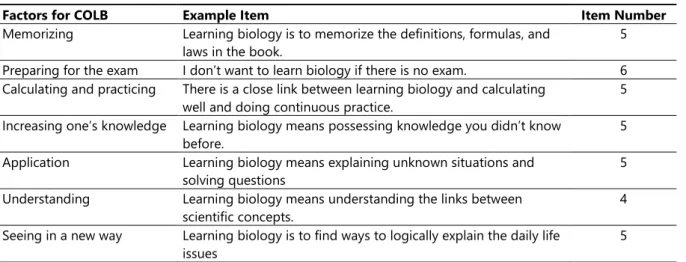
In order to identify students‟ conceptions of learning science through quantitative techniques, Lee et.al. (2008) developed “Conceptions of Learning Science” questionnaire. Sadi and Uyar (2014) adapted this questionnaire to Turkish. There are 7 factors in the original version of the questionnaire. The items under these 7 factors in the questionnaire are as follows: 1st factor “memorizing” (5th item), 2nd factor “preparing for the exam” (6th item), 3rd factor “calculating and practicing” (5th item), 4th factor “increasing one‟s knowledge” (5th item), 5th factor “application” (5th item), 6th factor “understanding” (4th item) and 7th factor “seeing in a new way” (5th item). In the “memorizing” factor, students prefer to learn definitions, formulas and terms by “memorizing” while learning science. For these students, learning science is storing pieces of information in the memory and recalling them when needed. In the 2nd factor, students‟ primary purpose when learning science is to “prepare for the exams” and to get high grades in these exams. In the 3rd factor, students‟ conceptions of learning are likely to be solving scientific problems and making calculations. In the 4th factor, they prefer to learn science to increase their knowledge. In the 5th factor, students express the aim of learning science as applying the information they have learned in daily life. In the 6th factor “understanding,” it is important to learn scientific information in a meaningful way and form links between concepts. In the last factor, students start to see in a new way and find new ways of thinking by learning science. While measuring these factors in the questionnaire, 5-point Likert scale ranging from “strongly agree” to “strongly disagree.”
In the current study, “Conceptions of Learning Science” questionnaire, which was adapted to Turkish by Sadi and Uyar (2014), was revised for biology and necessary analyses were conducted. The questionnaire, which was adapted in order to identify students‟ conceptions of learning biology, was analyzed by two experts to order to test for its validity.
After the procedures mentioned above, the questionnaire, was finalized by making some changes. Some example items regarding the factors of the questionnaire were given in
Table 1.
These factors have a certain hierarchy and in this hierarchy are also given in Table 1. The first three factors are defined as “lower-level conceptions of learning” and the last four factors are “higher-level conceptions of learning” (Li, Liang & Tsai, 2013).
EURASIA J Math Sci and Tech Ed
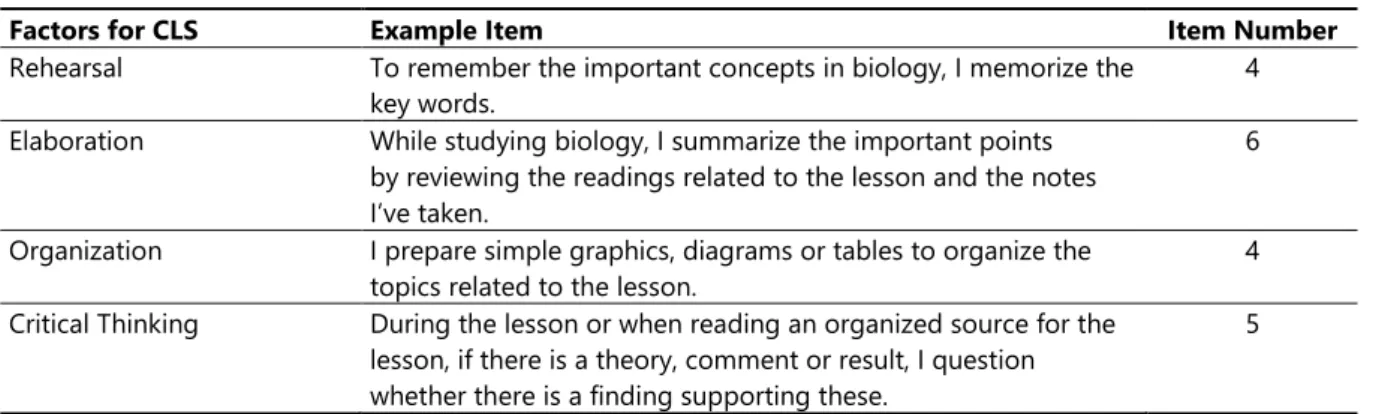
The other questionnaire that was used in this study is Motivated Strategies in Learning Questionnaire (MSLQ), which is administered to identify students‟ learning strategies. MSLQ, which was developed by Pintrich, Smith, Garcia and Mckeachie (1991) and adapted to Turkish for science lessons by Sungur (2004), was used for the purposes of this study. MSLQ is a self-reflection questionnaire which was developed to measure “motivational tendencies” and “self-regulated learning strategies”. The motivation section of the questionnaire consists of six factors and 31 items (internal/external goal orientations, task value, control of belief in learning, self-efficacy, exam anxiety). Learning section consists of 50 items and 9 factors (generalized under the title of cognitive self-regulatory learning strategies: rehearsal, elaboration, organization, critical thinking; metacognitive self-regulatory learning, time/environment management, effort regulation, peer learning, help seeking). MSLQ allows researchers to choose some of the variables in the questionnaire to include only the ones which are suitable for the aim of their study. In this study, cognitive learning strategies (rehearsal, elaboration, organization, critical thinking) were selected from the learning section as the variables of the study. MSLQ is a Likert type scale ranging from 1 (completely agree) to 7 (completely disagree).
In this study, MSLQ was adapted to biology and examined by two experts for the validity of the questionnaire. The factors of the scale for the cognitive learning strategies and example items are given in Table 2.
Table 1. COLB factors, example items and item numbers
Factors for COLB Example Item Item Number
Memorizing Learning biology is to memorize the definitions, formulas, and laws in the book.
5 Preparing for the exam I don‟t want to learn biology if there is no exam. 6 Calculating and practicing There is a close link between learning biology and calculating
well and doing continuous practice.
5 Increasing one‟sknowledge Learning biology means possessing knowledge you didn‟t know
before.
5 Application Learning biology means explaining unknown situations and
solving questions
5 Understanding Learning biology means understanding the links between
scientific concepts.
4 Seeing in a new way Learning biology is to find ways to logically explain the daily life
issues
Ö. Sadi / Conceptions of Learning Biology and Learning Strategies
Data Analysis
After the necessary permissions were taken, both questionnaires, COLB and CLS, were applied to 9th, 10th, 11th and 12th grade high school students who have taken biology course before or who are still taking the course. The questionnaires were filled in spontaneously by the students who agreed to participate in the study voluntarily. The answers given by 384 high school students to the questions in the last version of the questionnaires were analyzed in order to identify the relation between conceptions of learning biology and cognitive learning strategies.
In this study, firstly, an exploratory factor analysis was conducted to test the factor structure of “Conceptions of Learning Biology” (COLB) and “Cognitive Learning Strategies” (CLS) questionnaire. Then, correlational analysis was conducted in order to examine the link among the factors of COLB and CLS. Finally, a regression analysis was done for the factors of COLB and CLS. The factors of COLB scale were categorized as predictor variables and the factors of CLS scale were categorized as outcome variables.
RESULTS AND DISCUSSION
Before conducting the factor analysis of COLB and CLS questionnaires, the data gathered from high school students were tested using Kaiser-Meyer-Olkin (KMO) and Bartlett sphericity tests to see whether the data is suitable for factor analysis. KMO coefficient gives an idea about whether the data matrix is suitable for factor analysis and whether the data structure is suitable for factor subtraction. For factorability KMO is expected to be higher than 0.50 (Field, 2000). Since the value obtained from KMO test was 0.822 for COLB and 0.919 for CLS, which are close to 1, it was seen that the data could be modeled by factor analytic model (Tavsancil, 2005). In addition, Bartlett test analyzed whether there is a relation between the variables based on partial correlations (Büyüköztürk, 2011). According to the results of Bartlett sphericity test, chi-square (χ²) was 3995.36 (p < 0.01) for COLB and 2029.13 (p < 0.01) for CLS and null hypothesis was rejected. The fact that Bartlett sphericity test were meaningful indicates that the data has a normal multi-variable distribution,
Table 2. CLS factors, example items and item numbers
Factors for CLS Example Item Item Number
Rehearsal To remember the important concepts in biology, I memorize the key words.
4 Elaboration While studying biology, I summarize the important points
by reviewing the readings related to the lesson and the notes I‟ve taken.
6 Organization I prepare simple graphics, diagrams or tables to organize the
topics related to the lesson.
4 Critical Thinking During the lesson or when reading an organized source for the
lesson, if there is a theory, comment or result, I question whether there is a finding supporting these.
EURASIA J Math Sci and Tech Ed
and thus, the data is suitable for factor analysis (Cokluk, Sekercioglu & Büyüköztürk, 2010).
Table 3. COLB questionnaire factor analysis results
COLB Factors Cronbach’s alpha values Means
Factor 1 Memorizing item 1 item 2 item 3 item 4 item 5 α = 0.80 0.801 0.806 0.708 0.580 0.671 mean =3.39
Factor 2Preparing for exams item 6 item 7 item 8 item 9 item 10 item 11 α = 0.77 0.669 0.589 0.647 0.625 0.705 0.654 mean = 3.10
Factor 3 Calculating and practicing Item 12 Item 13 Item 14 Item 15 Item 16 α = 0.67 0.475 0.762 0.561 0.710 0.721 mean = 3.17
Factor 4 Increasing one‟s knowledge item 17 item 18 item 19 item 20 α = 0.67 0.565 0.707 0.661 0.538 mean = 3.69 Factor 5 Applying item 22 item 23 item 24 item 25 item 26 α = 0.74 0.614 0.711 0.609 0.691 0.576 mean = 3.58 Factor 6 Understanding item 27 item 28 item 29 item 30 α = 0.70 0.671 0.705 0.585 0.531 mean = 3.69
Factor 7 Seeing in a new way item 31 item 32 item 33 item 34 α = 0.72 0.707 0.649 0.613 0.664 mean = 3.79
Ö. Sadi / Conceptions of Learning Biology and Learning Strategies
Factor Analysis for COLB and CLS
According to the results of the exploratory factor analysis, which was conducted to analyze the structure validity of the adapted version of the “Conceptions of Learning Biology” (COLB) questionnaire, the 21st and 35th items of the scale were removed from the questionnaire since they loaded on more than one factor or their factor load were lower than 0.40. After these items were removed from the questionnaire, the same analysis was conducted again for the remaining 33 items by using SPSS 15.0 statistics software package. The results of the analysis are given in Table 3.
In Table 3, it is seen that 33 items under analysis were gathered under 7 factors whose Eigen values were over 1. The overall variance that these factors explained regarding the questionnaire was 60%. The common variance of the 7 factors that were defined in relation to the items varied from 0.425 to 0.769. According to the results of the analysis, it was found that all seven factors together which were considered important factors in the analysis explained most of the overall variance in the items and the variance regarding the scale.
Moreover, the Cronbach alfa reliability coefficient regarding the reliability of the “Conceptions of Learning Biology” questionnaire was found to be 0.84. The Cronbach Alfa reliability coefficient ranged from 0.67 to 0.80 for each factor. In social sciences, it is enough to have a general reliability coefficient over 0.60 in order to consider the test points reliable (Ozdamar, 1999).
Table 3 also shows the mean and standard deviation values for each factor in COLB.
As it is seen in the table, the students have the highest mean in “seeing in a new way” factor. Then, “understanding” and “increasing one‟s knowledge” factors have high means. However, “application,” “memorization” and “calculating and practicing” factors have lower means when compared with the factors explained above and the lowest mean belongs to “preparing for the exams.”
The other questionnaire used in this study is “Cognitive Learning Strategies (CLS)” questionnaire and the results of the exploratory factor analysis for CLS are given in Table 4. According to these results, the questionnaire consisting of 19 items gathered under 4 factors and the factor load for each item was over 0.40.
In Table 4, the overall variance that 4 factors under analysis explained regarding the questionnaire was %50.41. The common variance of the 4 factors that were defined in relation to the items varied from 0.450 to 0.723. According to the results of the analysis, it was found that all four factors together which were considered important factors in the analysis explained half of the overall variance in the items and the variance regarding the scale.
EURASIA J Math Sci and Tech Ed
Furthermore, Table 4 also shows the mean and standard deviation values for each
factor in CLS. As it is seen in the table, the students have the highest mean in “organization” factor. The mean of the “rehearsal” factor is lower than the mean of the other three factors.
The Relation between Conceptions of Learning Biology and Cognitive Learning
Strategies
The Pearson correlation coefficients between conceptions of learning biology factors and cognitive learning strategies factors were calculated in order to identify the relation between students‟ COLB and CLS. The correlational analysis between COLB and CLS is given in Table 5.
There is a positive and meaningful relation between the “memorizing” factor of conceptions of learning biology and “rehearsal” factor (r = 0.185, p < 0.05) and “elaboration,” “organization” and “critical thinking” factors (r = 0.158, 0.196 and 0.159, p < 0.05). The relation between “memorizing,” which is a lower-level conception of learning and rehearsal, which is a surface learning strategy, shows parallelism with the studies in the literature (Zeegers, 2001; Lee et al., 2008; Chiou et al., 2012). However, the fact that there is also a positive and meaningful relation between “memorizing” and other learning strategies seems
Table 4. CLS questionnaire factor analysis results
CLS Factors Cronbach’s alpha values Means
Factor 1 Rehearsal item 1 item 2 item 3 item 4 α = 0.70 0.697 0.571 0.520 0.580 mean =3.32 Factor 2 Elaboration item 5 item 6 item 7 item 8 item 9 item 10 α = 0.75 0.567 0.483 0.705 0.723 0.551 0.583 mean = 4.54 Factor 3 Organization item 11 item 12 item 13 item 14 α = 0.73 0.704 0.642 0.503 0.533 mean = 4.63
Factor 4 Critical Thinking item 15 item 16 item 17 item 18 item 19 α = 0.70 0.471 0.641 0.500 0.450 0.512 mean = 4.50
Ö. Sadi / Conceptions of Learning Biology and Learning Strategies
to be a condition that needs to be discussed. In biology lessons and books, there are frequent references to terms, definitions and biology phenomena and mechanisms (e.g. steps of glycolysis, diffusion and osmosis) that take place in an order. Although students have a tendency to learn these biology phenomena in a meaningful way, they may have inadequate conceptions or major difficulties in understanding these phenomena (Hasni, Roy &Dumais, 2016) and still prefer to learn them by memorizing to a certain extent. This relational situation shows that Turkish students have not given up the habit of memorizing yet although they prefer different strategies while learning biology.
In addition to this, “preparing for exams” (r = 0.105, p < 0.05) and “increasing one‟s knowledge” (r = 0.133, p < 0.05) have a positive and meaningful relation only with “rehearsal” learning strategy. This situation can be explained by the fact that students regard biology as a difficult and boring subject or they prefer to rehearse continuously in order to learn the concepts in biology lessons and get a high grade in the exams (Ozcelik& Yay, 2014).
Another conception of learning, “calculating and practicing,” has a relation with none of the cognitive learning strategies. This situation might be explained by the fact that there are only a few topics among all biology topics that require calculation and making mathematical operations.
Lastly, as it is seen in Table 5, there is a negative and meaningful relation between “application,” “understanding” and “seeing in a new way,” which are higher-level conceptions of learning, and “rehearsal;” however, they have a positive and meaningful relation with “elaboration,” “organization” and “critical thinking.” The students who have higher-level conceptions of learning biology use cognitive learning strategies which are based on identifying the important points, preparing graphs and diagrams or questioning. This situation shows parallelism with the studies in the literature (Li, Liang & Tsai, 2013).
Stepwise Regression Analysis for Predicting Students’ CLS
In the literature, researchers have emphasized in their studies (Purdie, Hattie, & Douglas, 1996; Chan, 2003) that there is a relation between students‟ conceptions of learning and learning strategies. From this point of view, this current study considered students‟ conceptions of learning biology as predictors in order to explain the variations in their cognitive learning strategies when using stepwise regression analysis and in this way, it
Table 5. The correlations among the factors between the COLB and CLS
Memorizing PE CP IK Application Understanding SNW
Rehearsal 0.185** 0.105** 0.050 0.133** -0.233** -0.139** -0.228**
Elaboration 0.158** 0.025 0.065 0.091 0.204** 0.219** 0.125**
Organization 0.196** 0.012 0.051 0.085 0.234** 0.170** 0.199**
Critical Thinking 0.159** 0.028 0.007 0.061 0.180** 0.231** 0.170**
**p < 0.05. Note. PE: Preparing for exams; CP: calculating and practicing; IK: Increasing one‟s knowledge; SNW: Seeing in a new way.
EURASIA J Math Sci and Tech Ed
aimed to explain students‟ cognitive learning strategies together with their conceptions of learning biology.
Table 6 shows the results of the regression analysis. The factors of COLB,
“memorizing”, “application” and “seeing in a new way,” might make significant predictions for the students‟ CLS factor, “rehearsal”. “Memorizing” made positive predictions (t = 2.43, p
<0.05); however, “application” and “seeing in a new way” explained “rehearsal” negatively
(t = -1.67 and t = -2.52, p <0.05). According to these results, it can be said that “memorizing” conception of learning had a positive effect on students‟ use of “rehearsal” learning strategy with low explained variation. In addition, higher-level COLB such as “application” and “seeing in a new way” were negative predictors of “rehearsal” to learn biology, a result similar to those concluded by the previous studies (Chiou et al., 2012; Li, Liang & Tsai, 2013). Students may know that by studying biology, the student studies him or herself and other organism as living things, so they may prefer the higher-level COLB (Ogundiwin, Asaaju, Adegoke & Ojo, 2015).
However, what is interesting among the results in Table 6 is that “memorizing”
conception of learning positively predicts higher learning strategies such as “elaboration,” organization” and critical thinking” significantly, a result similar to those concluded by the aforementioned research (e.g., Li, Liang & Tsai, 2013). This result might have been caused by the factors regarding the nature of biology. Specifically in Turkey, is that due to the nature of biological science, biology learning is generally based on memorization (Çimer, 2012). For example, from Turkish students‟ perspective, biology, which is defined as the science of living things, is a course subject where there are a lot of terms and concepts of foreign origin (Latin), abstract concepts, events, topics and facts which are also difficult to learn (Yesilyurt & Gül, 2008).Moreover, there are many topics with complicated mechanisms such as photosynthesis, aerobic and anaerobic respiration, endocrine, nervous, skeletal, digestive, circulatory, respiratory and urinary systems etc. in high school biology curriculum. Therefore, the fact that students are responsible for such a loaded biology curriculum might cause “learning by memorizing” to have an important place for students among other conceptions of learning regardless of the motivation level of the student.
Among CLS factors, together with “memorizing”, “application” and “understanding” were also significantly positive predictors (t = 2.88, t = 1.74, t = 2.91 and t = 2.09 p < 0.05, t = 1.09 p < 0.05, t = 3.42 p < 0.05) for “elaboration” and “critical thinking” with low explained variation (R2 = .071 and R2 = .072). Finally, together with “memorizing,” two COLB factors,
“application” and “seeing in a new way,” could positively explain students‟ responses for the “organization” factor (t = 2.25, p < 0.05 and t = 2.07, p < 0.05). In Turkey, students have been situated in an educational system with a central exams (Sadi & Lee, 2015) and rote learning may help them to pass these exams that mainly aimed at reproducing factual knowledge (Lin, Liang & Tsai, 2015).
Ö. Sadi / Conceptions of Learning Biology and Learning Strategies
In summary, according to the results of the analysis, it was seen that the common COLB factors to predict high school students‟ each cognitive learning strategy were “memorizing” and “application.” The other COLB factor, “seeing in a new way,” was a negative predictor of “rehearsal” and a positive predictor of “organization.” Furthermore, “understanding” was also a positive predictor of „„elaboration” and “critical thinking” of learning biology. Although as a lower-level COLB, “memorizing” was a positive predictor of each conception of learning, students who had higher-level COLB might have a tendency to use learning strategies such as “organization,” “elaboration” and “critical thinking,” which shows parallelism with the literature (Lee et al., 2008; Tsai &Kuo, 2008; Chiou et al., 2012). If students have a conception of learning which requires the formation of links between scientific concepts or the application of previous knowledge and skills when solving problems, they prefer using learning strategies such as “critical thinking” when learning biology. Basically, Wang et al (2015) supported by up and down this result and they stated that deep approaches to learning would positively influence four-year growth in measures of critical thinking skills and need for cognition. Similarly, if students learn biology to improve their life standards or to find more ways of thinking about topics related to natural phenomena, they might have a tendency to use “organization” learning strategy. However, surprisingly, “memorizing” is also a positive predictor of possessing “organization” and “critical thinking” learning strategies to learn biology.
IMPLICATIONS AND CONCLUSIONS
In this study, two questionnaires, COLB and CLS, were adapted for biology to identify students‟ conceptions of learning and cognitive learning strategies accordingly. COLS, which
Table 6. Stepwise regression model of predicting students‟ cognitive learning strategies
Strategies B ß t R2
Rehearsal
Memorizing .151 .127 2.43**
.083 Application -.126 -.100 -1.67**
Seeing in a new way -.248 -.153 -2.52**
Constant 22.35 13.31 Elaboration Memorizing .154 .99 1.88** .071 Application .166 .101 1.74** Understanding .354 .160 2.91** Constant 17.01 8.32 Organization Memorizing .146 .134 2.55** .080 Application .154 .133 2.25**
Seeing in a new way .173 .116 2.07**
Constant 10.32 7.32 Critical thinking Memorizing .144 .110 2.09** .072 Application .084 .061 1.09** Understanding .350 .188 3.42** Constant 13.40 7.79 **p <0.05
EURASIA J Math Sci and Tech Ed
was developed by Lee et.al. (2008) and adapted to Turkish by Sadi and Uyar (2014), was used as COLB for biology. As it is shown in Table 3, COLB preserved its 7 factor structure as it is in the original version. The first three factors in COLB are lower-level conceptions of learning biology, “memorizing,” “preparing for exams,” and “calculating and practicing” and the last four factors are higher-level conceptions of learning biology, “increasing one‟s knowledge,” “application,” “understanding” and “seeing a new way,” and this structure shows similarity to the original COLS.
The general aims of the high school biology curriculum in Turkey is to educate individuals who possess adequate knowledge, skills and understanding regarding the basic theories, concepts, processes and practices in biology, who can actively participate in and evaluate the discussions on biology and science, and who are willing to be life-long learners. For this reason, in order to achieve these aims, it is very important for students to have higher-level conceptions of learning biology.
Furthermore, as it is seen in Table 3, while the students had high means for “increasing one‟s knowledge”, “application”, “understanding” and “seeing in a new way,” they had lower means for “memorizing”, “preparing for exams” and “calculating and practicing.” In other words, the students who participated in the study prefer to view learning biology from a higher-level rather than a lower-level perspective. Although this finding is different from what Li, Lang and Tsai (2012) have found in their study with undergraduate chemistry-major students, it shows similarity to the study of Chiou et al. (2012) with undergraduate biology-major students. The radical changes that have been made in the Turkish curriculum since 2004 might have an effect on this result. Therefore, considering the fact that there might be some differences in students‟ conceptions of learning depending their domains (Sadi & Lee, 2015), curricula and appropriate course materials that discourage students from adopting conceptions of learning such as “memorizing” and “preparing for exams,” allow students to apply the knowledge they have obtained in daily life, teach them different ways of thinking regarding natural phenomena and topics about the nature, have a positive effect on the formation of links between scientific concepts should be prepared. How and to what extent these curricula and materials affect students‟ conceptions of learning in time might be the focus of further studies.
Moreover, the factor analyses of COLB and CLS were conducted in this study, so these two questionnaires might be used by both researchers and teachers to identify the biology-major students‟ conceptions of learning and their learning strategies in a reliable way.
Since this current study is a quantitative study, questionnaires appropriate for the aim of the study were used for data collection. It is recommended to use qualitative data collection methods in addition to these scales in future studies since it is thought that the interviews conducted with students might allow the researcher to analyze the research findings in a deeper sense. Furthermore, the sample of this study consisted of students at a public high school; therefore, if both public and private high school students are included in future studies, both the differences and similarities regarding conceptions of learning and
Ö. Sadi / Conceptions of Learning Biology and Learning Strategies
learning strategies might be researched. In addition, this study, in which “conceptions of learning biology” and “biology learning strategies” were identified, might be repeated for different subjects such as chemistry, physics or history.
REFERENCES
Ashwin, P., & Trigwell, K. (2012). Evoked prior experiences in first-year university student learning.
Higher Education Research & Development, 31(4), 449-463. doi:10.1111/j.2044-8279.2012.02066
Benson, P., & Lor, W. (1999). Conceptions of language and language learning system. Brown, H.D. (Ed.), in Principles and Practices of Language Learning and Teaching (p.459-472). NJ: Prentice Hall. Biggs, J., & Moore, P. (1993). Teaching for better learning. In J. Biggs and P. Moore, The processes of
learning, New York: Prentice Hall, pp 447-482. Biggs, 1991.
Bliuc, A. M., Ellis, R. A., Goodyear, P., & Piggott, L. (2011). A blended learning approach to teaching foreign policy: Student experiences of learning through face-to-face and online discussion and their relationship to academic performance. Computers & Education, 56(3), 856-864.
Brownlee, J., Purdie, N., & Boulton-Lewis, G. (2001). Changing epistemological beliefs in pre- service teacher education students. Teaching in Higher Education, 6(2), 247-268.
Buehl, M. M., & Alexander, P. A. (2001). Beliefs about academic knowledge. Educational Psychology
Review, 13, 325-351.
Büyüköztürk, S. (2011). Sosyal bilimler için very analizi el kitabı: İstatistik, araştırma deseni, SPSS
uygulamaları ve yorum. [Manual data analysis for the social sciences: statistics, research design,
SPSS application and interpretation]. Ankara, Pegem.
Büyüköztürk, S., Akgün, Ö. A., Özkahveci, Ö., & Demirel, F. (2004). The validity and reliability study of the Turkish version of the motivated strategies for learning questionnaire. Educational
Sciences: Theory & Practice, 4(2), 207-239.
Chan K. W. (2003). Hong Kong teacher education students‟ epistemological beliefs and approaches to learning. Research in Education, 69(1), 36-50.
Chan, K. W. (2006). The structure and nature of epistemological beliefs: Implications from literature review and syntheses of research findings. Journal of Psychology in Chinese Societies, 7(1), 141-161.
Chiou, G. L., Liang, J. C. & Tsai, C. C. (2012). Undergraduate students‟ conceptions of and approaches to learning in biology: A study of their structural models and gender differences. International
Journal of Science Education, 34, 167–195.
Çimer, A. (2012). What makes biology learning difficult and effective: Students‟ views. Educational
Research and Reviews, 7(3), 61-71.
Cokluk, Ö., Sekercioğlu, G., & Büyüköztürk, S. (2010). Sosyal bilimler için çok değişkenli istatistik. Tek ve
çok değişkenli dağılımlar için sayıltıların analizi, lojistik regresyon analizi, discriminant regresyon analizi, küme analizi, açımlayıcı faktör analizi, doğrulayıcı faktör analizi, yol analizi. [Multivariate
statistics for the social sciences. Univariate and multivariate analysis of assumptions for distributions, logistic regression analysis, discriminant regression analysis, cluster analysis, exploratory factor analysis, confirmatory factor analysis, path analysis]. Ankara, Pegem. Dart, B. C., Burneet, P. C., Purdie, N., Boulton-Lewis, G., Campbell, J., & Smith, D. (2000). Students‟
conceptions of learning, the classroom environment and approaches to learning. Journal of
EURASIA J Math Sci and Tech Ed
Demir, R., Öztürk, N., & Dökme, İ. (2012). Investigation of 7th grade primary school students‟ motivation towards science and technology course in terms of some variables. Mehmet Akif
Ersoy University Journal of Education Faculty, 23, 1-21.
Doyle, W. (1986). Classroom organization and management. In M. Wittrock (Eds.), Handbook of research on teaching (3rd Ed.). New York: Macmillan.
Field, A. (2000). Discovering statistics using SPSS for windows: Advanced techniques for the beginner. London: Sage.
Gagne, R. M., & Driscoll, M. P. (1988). Essentials of learning for instruction. Upper Saddle River, NJ: Pearson Education.
Hasni, A., Roy, P., & Dumains, N. (2016). The teaching and learning of diffusion and osmosis: What can we learn from analysis of classroom practices? A case study. Eurasia Journal of Mathematics,
Science and Technology Education, 12(6), 1507-1531.
Henning, M. A., & Shulruf, B. (2011). Academic achievement: Changes in motivational beliefs and self-regulated learning strategies over time. Psychologia, 54(3), 135-144.
Hofer, B. K., & Pintrich, P. R. (1997). The development of epistemological theories: Beliefs about knowledge and knowing and their relation to learning. Review of Educational Research, 67(1), 88-140.
Israel, E. (2007). Özdüzenleme eğitimi, fen başarısı ve özyeterlik. [Self-regulation instruction, science achievement and self-efficacy]. Unpublished Doctoral Dissertation, Dokuz Eylül University. Köseoğlu, P., & Köksal, M. S. (2015). Epistemological Predictors of Prospective Biology Teachers‟
Nature of Science Understandings. Eurasia Journal of Mathematics, Science and Technology
Education, 11(4), 751-763. doi:10.12973/eurasia.2015.1383a
Lai, P.-Y., & Chan, K.-W. (2005). A structural model of conceptions of learning, achievement motivation and
learning strategies of Hong Kong teacher education students. Australian Association for Research in
Education (AARE) Conference.
Lee, M. H., Johanson, R. E., & Tsai, C. C. (2008). Exploring Taiwanese high school students‟ conceptions of and approaches to learning science through a structural equation modeling analysis. Science Education, 92, 191–220.
Li, W. T., Liang, J. C., & Tsai, C. C. (2013). Relational analysis of college chemistry- major students‟ conceptions of and approaches to learning chemistry. Chemistry Education Research and Practice,
14, 555–565. doi:10.1039/c3rp00034f
Liang, J. C., & Tsai, C. C. (2010). Relational analysis of college science-major students‟ epistemological beliefs toward science and conceptions of learning science. International Journal of Science
Education, 32, 2273–2289.
Lin, C.-C., & Tsai, C.-C. (2009). The relationship between students‟ conceptions of learning engineering and their preferences for classroom and laboratory learning environments. Journal
of Engineering Education, 98, 193-204.
Lin, C.-C., & Tsai, C.-C. (2008). Exploring the structural relationships between high school students‟ scientific epistemological views and their utilization of information commitments toward online science information. International Journal of Science Education, 30, 2001-2022.
Lin, T. C., Liang, J. C., & Tsai, C. C. (2015). Conceptions of memorizing and understanding in learning, and self-efficacy held by university biology majors. International Journal of Science
Education, 37(3), 446-468. doi:10.1080/09500693.2014.992057
Marshall, D., Summer, M., & Woolnough, B. (1999). Students‟ conceptions of learning in an engineering context. Higher Education, 38, 291–309.
Ö. Sadi / Conceptions of Learning Biology and Learning Strategies
Marton, F., & Säljö, R. (1984). The experience of learning, in Marton, F., Hounsell, D. &Entwistle, N. (eds.), Approaches to Learning, Edinburgh: Scottish Academic Press, 36-55.
Marton, F., Dall‟Alba, G., & Beaty, E. (1993). Conceptions of learning. International Journal of
Educational Research, 19, 277–299.
Marton, F., Watkins, D., & Tang, C. (1997). Discontinuities and continuities in the experience of learning: An interview study of high-school students in Hong Kong. Learning and Instruction,
7, 21-48.
Ning, H. K., & Downing, K. (2010). The reciprocal relationship between motivation and self-regulation: A longitudinal study on academic performance. Learning and Individual Differences,
20, 682-686.
Ogundiwin, O. A., Asaaju, O. A., Adegoke, A. I., & Ojo, A. T. (2015). Effect of group investigative laboratory strategies on students' achievement in biology. Pyrex Journal of Research in
Environmental Studies, 2(4), 35-41.
Ozcelik, H., & Yay, N. A. (2014). University candidates overview the departments of biology (example of Isparta). SDU Journal of Science (E-Journal), 9(1), 56-94.
Ozdamar, K. (1999). Paket programlar ile istatistiksel very analizi. [Statistical data analysis with the package program]. Eskisehir, Kaan.
Paul, R. W. (1992). Critical thinking: What, why, and how? New Directions for Community Colleges, 77, 3–24.
Pillay, H., Purdie, N. & Boulton-Lewis, G. (2000). Investigating cross-cultural variations in conceptions of learning and the use of self-regulated strategies. Education Journal, 28(1), 65–84.
Pintrich, P. R. (1999). The role of motivation in promoting and sustaining self-regulated learning.
International Journal of Educational Research, 31, 459-470.
Purdie, N. (1994). What do students think learning is and how do they do it? A cross-cultural comparison. Paper presented at the annual conference of the Australian Association for Research in
Education (AARE). Educational research: Innovation and practice, Newcastle, Australia.
Purdie, N., Hattie, J., & Douglas, G. (1996). Student conceptions of learning and their use of self-regulated learning strategies: A cross-cultural comparison. Journal of Educational Psychology, 88, 87–100.
Reid, A., Wood, L., Smith, G., & Petocz, P. (2005). Intention, approach and outcome: University mathematics students‟ conceptions of learning mathematics. International Journal of Science and
Mathematics Education, 3(4), 567-586.
Reyes, M. R., Brackett, M. A., Rivers, S. E., White, M., & Salovey, P. (2012). Classroom emotional climate, student engagement and academic achievement. Journal of Educational Psychology,
104(3), 700-712. doi:10.1037/a0027268
Sadi, Ö. (2015). The Analysis of High School Students‟ Conceptions of Learning in Different Domains.
International Journal of Environmental & Science Education, 10(6), 813-827.
Sadi, O. & Çakıroğlu, J. (2014). Relations of Cognitive and Motivational Variables with Students‟ Human Circulatory System Achievement in Traditional and Learning Cycle Classrooms
Educational Sciences: Theory & Practice (ESTP), 14(5), 1997-2012.
Sadi, O. & Uyar, M. (2014). The Turkish adaptation of the conceptions of learning science questionnaire: The study of validity and reliability. Journal of Educational and Instructional
EURASIA J Math Sci and Tech Ed
Sadi, O. & Lee, M.-H. (2015). The conceptions of learning science for science-mathematics groups and literature-mathematics groups in Turkey. Research in Science & Technological Education. doi:10.1080/02635143.2014.996543
Sadi, Ö., & Dağyar, M. (2015). High school students‟ epistemological beliefs, conceptions of learning and self-efficacy for learning biology: A Study of Their Structural Models. Eurasia Journal of
Mathematics, Science and Technology Education, 11(5), 1061-1079.
doi:10.12973/eurasia.2015.1375a
Saljo, R. (1979). Learning in the learner’s perspective I: Some commonsense conceptions. Gothenburg, Sweden: Institute of Education, University of Gothenburg.
Schommer, M. (1998). The influence of age and education on epistemological beliefs. British Journal of
Educational Psychology, 68, 551–562.
Sungur, S., & Güngören, S. (2009). The role of classroom environment perceptions in self-regulated learning and science achievement. Elementary Education Online, 8(3), 883-900.
Tavsancıl, E. (2005). Tutumların ölçülmesi ve SPSS ile very analizi [Measurement of attitudes and data
analysis with SPSS]. Ankara. Nobel.
Topcu, M. S., & Yılmaz-Tuzun, O. (2009). Elementary students' metacognition and epistemological beliefs considering science achievement, gender and socioeconomic status. Elementary
Education Online, 8(3), 676-693.
Tsai, C. C. (2004). Conceptions of learning science among high school students in Taiwan: A phenomenographic analysis. International Journal of Science Education, 26(14): 1733–1750. doi:10.1080/0950069042000230776
Tsai, C. C., & Kuo, Pi-Chu. (2008). Cram school students‟ conceptions of learning and learning science in Taiwan. International Journal of Science Education, 30(3), 353-375.
Tümkaya, S. (2012). The investigation of the epistemological beliefs of university students according to gender, grade, fields of study, academic success and their learning styles. Educational Sciences:
Theory & Practice, 12(1), 88-95.
Uredi, I., & Uredi, L. (2005). The predictive power of self-regulation strategies and motivational beliefs on mathematics achievement of primary school 8th grade students. Mersin University Journal of
the Faculty of Education, 1(2), 250-260.
Vermunt, J. D., & Vermetten., Y. J. (2004). Patterns in student learning: Relationships between learning strategies, conceptions of learning, and learning orientations. Educational Psychology
Review, 16(4), 359–384.
Wang, J. S., Pascarella, E. T., Nelson Laird, T. F., & Ribera, A. K. (2015). How clear and organized classroom instruction and deep approaches to learning affect growth in critical thinking and need for cognition. Studies in Higher Education, 40(10), 1786-1807. doi:10.1080/03075079.2014.914911
Warr, P., & Downing, J. (2000). Learning strategies, learning anxiety, and knowledge acquisition.
British Journal of Psychology, 91, 311-333.
Weinstein, C. E., & Mayer, R. E. (1986). The Teaching of learning strategies. In M. Wittrock, ed. Handbook of Research on Teaching. New York, Macmillan.
Whitebread, D., Coltman, P., Pasternak, D. P., Sangster, C., Grau, V., Bingham, S., Almeqdad, Q., & Demetriou, D. (2009). The development of two observational tools for assessing metacognition and self-regulated learning in young children. Metacognition and Learning, 4(1), 63-85. doi:10.1007/s11409-008-9033-1
Ö. Sadi / Conceptions of Learning Biology and Learning Strategies
Wolters, C. A. (1998). Self-regulated learning and college students' regulation of motivation. Journal of
Educational Psychology, 90(2), 224-235
Yesilyurt, S., & Gül, S. (2008). The expectations of biology teachers and students for a more efficient biology instruction in the secondary schools. Kastamonu Education Journal, 16(1), 145-162. Zeegers, P. (2001). Approaches to learning science: A longitudinal study. British Journal of Educational
Psychology, 71, 115-132.