Address for correspondence: Ebru Akgün Çıtak, Başkent Üniversitesi Sağlık Bilimleri Fakültesi, Hemşirelik Bölümü, Ankara, Turkey Phone: +90 312 246 67 88 E-mail: [email protected] ORCID: 0000-0002-0484-4687
Submitted Date: September 27, 2016 Accepted Date: November 27, 2017 Available Online Date: April 19, 2018 ©Copyright 2018 by Journal of Psychiatric Nursing - Available online at www.phdergi.org
DOI: 10.14744/phd.2017.29981 J Psychiatric Nurs 2018;9(2):112-118
Original Article
Examination of humor styles and mental health status of
health services students in vocational schools
Stress is a universal experience that affects all living things. People face various physical and psychological stressors dur-ing their lives and learn to adapt and cope with such challeng-ing livchalleng-ing conditions in different ways. Perceptions of stress and its effects vary among different individuals according to
their developmental period.[1]
University students are generally in an intermediary devel-opmental period and experience the transition from adoles-cence to adulthood; while they continue their physiological transformation during this period, they also experience men-tal uneasiness and tension caused by efforts to find their in-dividual identity. Coping with stress is as important during
adolescence as it is for any other developmental period.[2,3]
University students are of an age when individuals are more
open to change due to their development properties; they also experience psychological problems more often because they are more sensitive to personal, interpersonal and so-cio-cultural differences. In addition to the various problems brought about by the transitionary period between adoles-cence to adulthood, the fact that many students leave their families for the first time when attending university and start to live independently generates a further factor contributing
to and causing additional challenges.[4] Significant adaptation
issues and problems can arise when such individuals leave the environment they have grown up in and become accus-tomed to; the individual in question finds themselves away from their family often for the first time and required to solve their own problems without familial assistance. Issues such as
Objectives: The aim of the study is to determine the humor styles and general mental health of health services
stu-dents in a vocational school in Turkey.
Methods: This descriptive study was conducted in Turkey in 2013. A total of 354 of health services students from
voca-tional schools agreed to participate in the study. Data were collected from students using a descriptive form, a humor styles questionnaire and a General Health Questionnaire (GHQ 12). Data were analyzed using SPSS 17.0. Descriptive and Pearson tests were used to analyze the study data.
Results: Students’ mean ages was 21.01±2.26, most participants were women (64.5%), of a moderate socio-economic
status (61.9%) and non-smokers (63.8%). The students mean scores for the humor sub-scales are as follows: Affilia-tive humor 39.63±8.18, self-enhancing humor 33.64±9,44, aggressive humor 23.29±7.67 and self-defecting humor 26.51±7.87. Most of the students’ GHQ scores suggested that participants were at risk of having a mental health disor-der (20.6%), while 27.1%were found to be at high risk of having a mental health disordisor-der . A low negative significant correlation between the students self-enhancing humor and general health risk was found.
Conclusion: The study found that students have positive humor styles. Nearly half of the student partisans were found
to be at a low risk regarding the development of psychiatric disorders.
Keywords: Coping skills; humor; mental health; stress.
Şeyda Ökdem,1 Ebru Akgün Çıtak,2 Sevcan Avcı Işık,2 Nalan Özhan Elbaş2
1Department of Occupational Health Safety, Başkent University Vocational School of Health, Ankara, Turkey 2Department of Nursing, Başkent University Health Sciences Faculty, Ankara, Turkey
arranging relationships, managing time and money, making decisions about the future, getting to know and developing oneself—in addition to pressures to succeed academically— are all factors impacting university students and may result
in mental problems.[5] Consequently, university students are,
therefore, included in a group that is most at risk in terms of its mental health. According to existing literature in the field students’ disinterest regarding class, academic failures, nutri-tional and sleep pattern disorders, and depressive emotions lead them to fall into despair, making them quick to anger
and potentially resulting in adaptation problems.[4] According
to practice standards of psychiatric mental health nursing, psychiatric and mental health nurses employ strategies to promote healthy and safe environments; at a basic level psy-chiatric nursing involves health education, health promotion, improved health function and counseling regarding stress management. Of the various functions of the psychiatric mental health nursing, one of the most important strategies for improving mental health is to teach ways of coping with stress—hence it is important to improve university students’
resilience and promote their mental health.[6]
University students utilize many different methods when
cop-ing with stress.[6] Coping includes all cognitive, behavioral and
emotional reactions reducing, eliminating or resisting
emo-tional stress resulting from stress inducers.[7,8]
One of these coping methods is humor,[9] a concept that
has attracted the attention of many thinkers, writers and re-searchers from different disciplines including philosophy, lit-erature, psychology, sociology; humor is a concept that is still
being discussed today.[10] According to the Turkish Language
Society, humor can be defined as a “pleasantry”. Humor can also be said to be the “ability to perceive funny or entertaining
things or to express this by way of speech or a work of art”.[11]
As can be understood from this definition, humor is a broad concept, one potentially in corporating all actions or state-ments made by an individual that can be perceived as comical and that are undertaken to make others laugh. Furthermore, the definition includes those mental processes that enable in-dividuals understand or create entertaining situations, as well as any emotional reactions that enable other individuals to
understand them.[12,13]
Humor is an individual’s ability but it is also a skill and a cul-ture that can be developed. People face stressful situations
throughout their lives,[9,12,14] those who can cope with such
is-sues experience a relatively higher quality of life.[15] One study
that examined the relationship between humor and stress coping styles reported that having a sense of humor was related to more optimistic and self-confident coping styles. One study that examined the relationship between humor and stress coping styles reported that having a sense of hu-mor was related to hu-more optimistic and self-confident coping
styles”.[9,16] Humor is one of the most effective coping
strate-gies when dealing with stress. University students at their stage of life try to learn coping strategies for managing stress.
Developing effective methods to mitigate or cope with stress at this developmental stage can positively affect an
individ-ual’s mental health.[17] Therefore, it is important that
psychi-atric mental health nurses determine effective coping meth-ods and strategies for the protection and promotion of their
own mental health.[6,9,14]
The objective of this study was to examine the humor styles and mental health of students continuing their education in a vocational health services school at a university in Turkey.
Research Questions:
1. What are the humor styles of health services students in vo-cational schools?
2. What is the mental health status of health services students in vocational schools?
3. What is the relationship between humor styles and the mental health of health services students in vocational schools?
4. What are the variables affecting the humor styles and men-tal health of health services students in vocational schools?
Materials and Method
Type of the Study
This study was carried out as a descriptive study.
Study Population and Sample
This study was conducted in a vocational health services school in the university in Ankara, Turkey. The study popula-tion was comprised of 531 students enrolled at the aforemen-tioned school for the spring semester of the 2013–2014 aca-demic year. A sample selection was not made in the study; a sample group of 354 students was selected from among those students who agreed to participate in the study.
Data Tools
Data for the study were collated through several means. A de-mographical data form comprised of 13 questions was used to collect information on the study participants. The form was prepared by the researchers who made use of existing rele-vant literature throughout its development Additionally, the Humor Styles Questionnaire (HSQ), which is comprised of 32 items, and General Health Questionnaire (GHQ), which is com-prised of 12 items The dependent variables used in this study were humor styles and general health status. Independent variables used in the study were age, gender, family structure, socio-economic status, the presence of a support system, smoking and alcohol use, and location in which the partici-pant had spent most of their life.
Demographic Data Form
and is comprised of six questions on the gender, age, socioe-conomic level, perceived social support, and the cigarette and alcohol use of participating health services students.
Humor Styles Questionnaire
The HSQ is a self-evaluation scale developed by Martin et al.
(2003).[18] The HSQ measures the four dimensions related to
differences in individuals’ daily use of humor;[18] the
Question-naire was adapted into Turkish by Yerlikaya.[19] The scale has
four sub-scales to measure the four different humor styles, two of which are compatible and two of which are incompatible. These subscales are Affiliative Humor, Self-Enhancing Humor, Aggressive Humor and Self-Defeating Humor. A seven-point Likert-type evaluation was used with responses ranging from “I Certainly Do Not Agree” to “I Completely Agree” for each of the sub-scales with eight items included in each; there are 11 items in the scale which are scored in reverse direction. Thus, the minimum and maximum scores that can be obtained from each sub-scale are seven and 56, respectively. A high score on these sub-scales refers to the frequency at which the related humor style is used. The Cronbach alpha internal consistency coefficients obtained from each sub-scale—according to the Turkish adaptation—were calculated to be .74 for Affiliative Humor, .78 for Self-Enhancing Humor, .69 for Aggressive Hu-mor and .67 for Self-Defeating HuHu-mor; there liability coeffi-cients of the subscales against time were .88, .82, .85, and .85,
respectively.[18] A different study on high school students was
conducted by Yerlikaya in 2007, the study found the Cronbach alpha coefficients of the aforementioned sub-scales ranged from .63 to .75. The internal consistency coefficients of the data acquired within the scope of this study were recalculated and Cronbach alpha coefficients of .78, .83, .64 and .65 were
obtained for each sub-scale, respectively.[20]
General Health Questionnaire
GHQ is a scale used as a first-stage screening test, it is commonly employed as an examination method for mental diseases in the social studies field. The GHQ is a measure of an individ-ual’s current mental health and was developed by Goldberg in
the 1970s.[21] The GHQ is comprised of 12 questions and
con-cerns the mental health symptoms of an individual during the weeks leading up to the date upon which the test is taken; the GHQ is preferred because it is short, has a high sensitivity and specificity in differentiating cases, and because it can be used in various different socio-cultural environments. The GHQ was
translated into Turkish by Kılıç,[22] who also carried out the
relia-bility and validity studies. The reliarelia-bility, validity and sensitivity scores of the test are 0.74 and that the specificity was 0.84. The test classifies individuals as high, medium or low according to their total GHQ scores; those with medium or low scores often have a psychiatric disorder. Those who receive scores of four of more on the scale are classified as high; those who receive scores between 2–3 are classified as medium, and those who receive scores of lower than two are classified as low.
The acquired data were analyzed via Statistical Package For Social Science (SPSS 17.0 for Windows). Data were then sub-jected to descriptive statistics and Pearson correlation analysis during the data evaluation stage within which p<0.05 was ac-cepted to be statistically significant.
Evaluation of the Data
Statistical analysis of the data was carried out using the SPSS software program, version 17.0. Levine’s Test was conducted to determine whether the data were distributed normally; the Test revealed that the data were distributed normally. Descrip-tive statistics and Pearson's Correlation Coefficient were used in this study’s data analysis stage.
Ethical Aspects of the Study
The research was approved by the Social and Art Research Commission in university (Project no: B.30.2BŞK.0.0.05.10.00-600-09 The study was conducted only after permission was obtained from all participating stu-dents, schools, institutions and individuals, all students who did not want to participate in the research investigation were excluded from the study.
Results
On examination of the socio-demographic properties of the study participants it was found that the average age of stu-dents was 21.01±2.26;64.5% of participants were female; 61.9% of students were of a moderate socio-economic level; 39.3% lived with their families, and 28.0% lived in dormitories; 63.8% of the participating students smoked.
Examination of Students’ Humor Styles
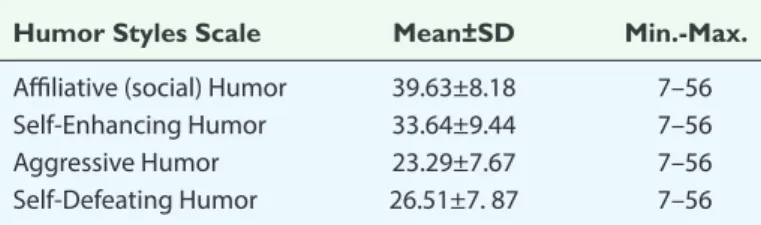
On examination of the scores obtained from the sub-scales of the Humor Styles questionnaire, it was found that the Affil-iative Humor and Self-Enhancing Humor sub-scales scores— those measuring healthy humor styles—were higher com-pared to those scores obtained from the Aggressive Humor and Self-Defeating Humor sub-scales—which measure un-healthy humor styles (Table1).
On examination of participating students’ demographical
Table 1. Examination of the Students’ Scores Obtained from the Humor Styles Scale
Humor Styles Scale Mean±SD Min.-Max.
Affiliative (social) Humor 39.63±8.18 7–56
Self-Enhancing Humor 33.64±9.44 7–56
Aggressive Humor 23.29±7.67 7–56
Self-Defeating Humor 26.51±7. 87 7–56
characteristics it was found that gender, the existence of a per-ceived support system, smoking and alcohol use were related with these scores.
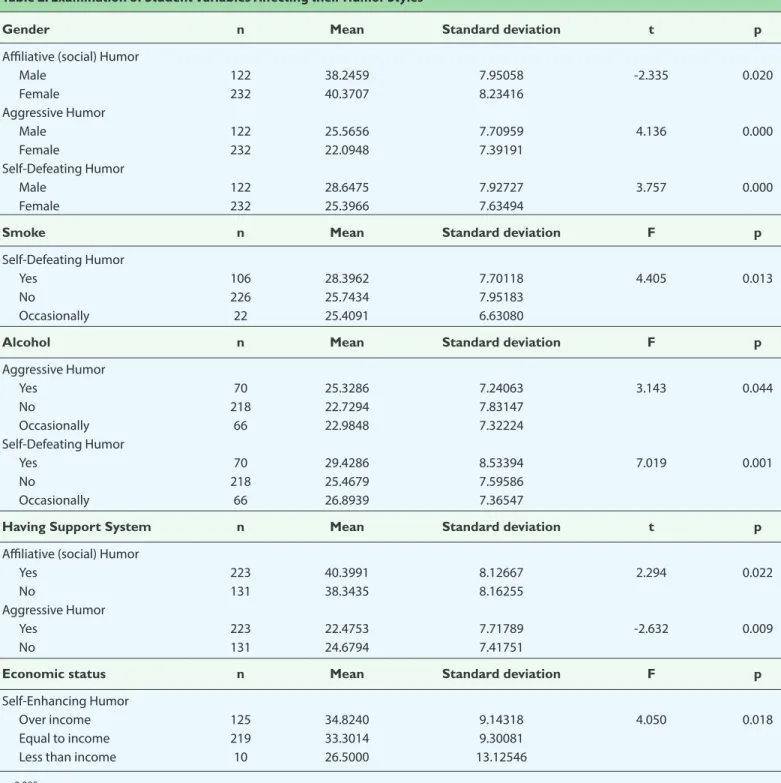
The data showed that, among Self-Defeating Humor and Ag-gressive Humor sub-scale scores male students who smoked and used alcohol had higher, statistically significant Self-De-feating Humor sub-scale scores compared to those who did not; furthermore, the data showed that male students, those who use alcohol, and those who do not have a support
sys-tem, had higher statistically significant Aggressive Humor scores then those who did not.
When the Self-Enhancing Humor and Affiliative Humor scores were examined in regard to participants’ demographic char-acteristics, it was observed that students who come from fam-ilies of a higher economic status had higher Self-Enhancing Humor scores; furthermore it was found that the Affiliative Humor scores of female students and students with support systems were also higher (p≤0.05) (Table 2).
Table 2. Examination of Student Variables Affecting their Humor Styles
Gender n Mean Standard deviation t p
Affiliative (social) Humor
Male 122 38.2459 7.95058 -2.335 0.020 Female 232 40.3707 8.23416 Aggressive Humor Male 122 25.5656 7.70959 4.136 0.000 Female 232 22.0948 7.39191 Self-Defeating Humor Male 122 28.6475 7.92727 3.757 0.000 Female 232 25.3966 7.63494
Smoke n Mean Standard deviation F p
Self-Defeating Humor
Yes 106 28.3962 7.70118 4.405 0.013
No 226 25.7434 7.95183
Occasionally 22 25.4091 6.63080
Alcohol n Mean Standard deviation F p
Aggressive Humor Yes 70 25.3286 7.24063 3.143 0.044 No 218 22.7294 7.83147 Occasionally 66 22.9848 7.32224 Self-Defeating Humor Yes 70 29.4286 8.53394 7.019 0.001 No 218 25.4679 7.59586 Occasionally 66 26.8939 7.36547
Having Support System n Mean Standard deviation t p
Affiliative (social) Humor
Yes 223 40.3991 8.12667 2.294 0.022
No 131 38.3435 8.16255
Aggressive Humor
Yes 223 22.4753 7.71789 -2.632 0.009
No 131 24.6794 7.41751
Economic status n Mean Standard deviation F p
Self-Enhancing Humor
Over income 125 34.8240 9.14318 4.050 0.018
Equal to income 219 33.3014 9.30081
Less than income 10 26.5000 13.12546
Examination of the General Health Status of Students
When the general health status of students was examined, it was observed that 27.1% had high risks and 20.6% had mod-erate risks.
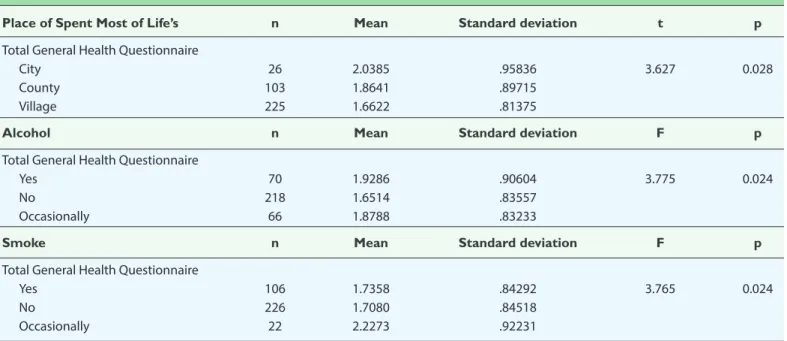
On examination of students’ scores obtained from the general health status questionnaire, it was observed that the general health scores of those students who smoked and used alcohol were higher at a statistically significant level.
When the mental health was examined in regard to demo-graphic properties; it was observed that GHQ means are sig-nificantly higher in the students who spent their most of life’s in a city who were using alcohol regularly and smoking occa-sionally (p≤0.05) (Table 4).
When the relationship between students’GHQ and HSQ scores was examined a low and negative correlation was seen to ex-ist between Self-Enhancing Humor and GHQ scores. In other words, it was determined that the general health risk decreased with increasing Self-Enhancing Humor scores (Table 5).
Discussion
When students’ HSQ sub-scale scores were examined it was observed that the score averages of the Affiliative Humor
and Self-Enhancing Humor scales—those scales that mea-sure healthy humor styles—were higher when compared to the average scores obtained from the Aggressive Humor and Self-Defeating Humor sub-scales—scales that measure the unhealthy humor styles. Similar humor styles were deter-mined by another study, which was conducted using students
from another Turkish university in a different city.[23]
Further-more, similar studies carried out on university students in UK, Hong Kong and India determined that positive humor scores
were higher when compared to negative humor scores.[24] In
yet another study, one carried out on university students in Hong Kong, found that, while participants’ social humor scores were similar, their Aggressive Humor and Self-Defeating Hu-mor scores—which measure the negative huHu-mor style—were higher in comparison with those of Turkish students.
No studies directly related to mental health and humor status could be found, nevertheless, various studies suggesting that positive humor styles were related to psychological strength, and that coping with stress was related with mental health
Table 3. Examination of the General Health Status of Students General Health Status n %
Low Risk 185 52.3
Moderate Risk 73 20.6
High Risk 96 27.1
Table 4. Examination of Student Variables Affecting the General Health Status
Place of Spent Most of Life’s n Mean Standard deviation t p
Total General Health Questionnaire
City 26 2.0385 .95836 3.627 0.028
County 103 1.8641 .89715
Village 225 1.6622 .81375
Alcohol n Mean Standard deviation F p
Total General Health Questionnaire
Yes 70 1.9286 .90604 3.775 0.024
No 218 1.6514 .83557
Occasionally 66 1.8788 .83233
Smoke n Mean Standard deviation F p
Total General Health Questionnaire
Yes 106 1.7358 .84292 3.765 0.024
No 226 1.7080 .84518
Occasionally 22 2.2273 .92231
p<0.005.
Table 5. Correlations of General Health Questionnaire and Humor Styles Questionnaire
GHQ
Humor Styles Questionnaire r p
Affiliative Humor -0.102 0.054
Self-Enhancing Humor -0.237** 0.000
Aggressive Humor 0.014 0.799
Self-defeating Humor -0.19 0.722
were identified in the available literature.[25–27] Thus, high humor behavior scores suggest that students are mentally healthy. The current study determined that 27.1% of students had high-risk levels, and that 20.6% had medium-risk levels re-garding their GHQ scores. These results are in accordance with the students’ Humor Scale scores.
When the relationship between students’ GHQ scores and the students’ humor styles scale scores were examined low, neg-ative relationship was found; this result suggests that risks related to general health decrease as Self-Enhancing Humor scores increase.
A significant number of theoretical assertions regarding the contribution of humor to psychological health are based on the opinion that a sense of humor is an effective coping strat-egy regarding stress. The role that a sense of humor plays when coping with stress enables the individual in question to distance themselves from the problem and thus attain a differ-ent perspective of that problem in relation to their situation or themselves. This humorous understanding enables individuals greater attitudinal flexibility and tolerance when faced with their own faults and the general irrational behavior of other
people.[10,19] Additionally, some studies have found that
expos-ing individuals to humorous stimuli to be been associated with enhanced moods elevated levels of secretory
immunoglobu-lin-A, and vasodilation.[28] Laughter, the most common reaction
to humor, may explain some of these physiological benefits, including those associated with respiration. Deep breath-ing has also been found to be an important copbreath-ing method
when dealing with stress.[8] When people engage in humor
and laughter, they tend to feel more cheerful and energetic, as well as less depressed, anxious, irritable, and tense. In the short term, at least, humor seems to boost positive moods and counteract negative emotions. Thus, one way a sense of humor may be beneficial to mental health is by contributing to an individual’s ability to regulate or manage their emotions—an
essential aspect of mental health.[12–14] On examination of the
literature it can be seen that the existing experimental research studies on the effects of humor upon mental health are gen-erally geared toward or concerned with the elderly. Ganz and
Jacobs[28] have carried out experimental studies on elderly
peo-ple, and have examined the effects of humor on both mental and general health. Based on the results of these studies the authors have argued for the positive effects of humor in regard to depression, anxiety and general health in elderly individuals. A further, semi-experimental study on the effects of humor on elderly people living in a care center found that, after undergo-ing humor therapy over an eight-week period, participants’life satisfaction levels were considerably higher and participants
were happier as a result.[29]
It was determined in our study that Self-Defeating Humor scores were higher for male students who smoked and used alcohol, and that Aggressive Humor scores were higher at a statistically significant level for students who used alcohol, male students, and students who had no support system.
Martin et. al. (2003)[18] conducted a study based on the
Mul-ti-Dimensional Humor Emotion Model wherein the Humor Styles Scale was used; the study found that Affiliative and Self-Enhancing Humor Styles had a positive relationship with healthy and Effective Coping Styles. The study also found that Aggressive and Self-Defeating Humor Styles had a negative relation with positive coping styles, as well as a positive rela-tionship with negative coping styles. These findings corrobo-rate and support those of the present study.
The current study also found that GHQ scores were higher at a statistically significant level for students who spent most of their lives in cities, and for students who regularly used alco-hol and who occasionally smoked. City life is complicated and stressful; therefore it is believed that the GHQ scores of stu-dents who have difficulty coping with the stresses of urban life are high. Students’ high GHQ scores may be attributable to their use of cigarettes or alcohol as coping methods when dealing with experienced stresses.
This study provides information about university students’ hu-mor styles and the general health status of psychiatric nurses. Concern for psychiatric and mental health nurses include the promotion of optimal mental and physical health and the prevention of mental illness. Determining students’ coping methods and teaching new, effective means by which such individuals can cope with stress is important for psychiatric mental health nurses regarding both practice standards and basic professional functions.
Humor is one of the most important way of coping. The find-ings of the current study suggest that certain activities—such as mindfulness of humor styles and encouraging the use of humor strategies—may be effective when organized and im-plemented for university students so that these individuals are able to recognize the importance of humor styles in their lives. Thus, university students can be supported in develop-ing their positive senses of humor as a means of maintaindevelop-ing their psychological and physical health.
Despite the significant findings yielded herein, several limi-tations are present in this study. Of these, the most obvious limitation is that all study participants came from the same vocational school; this is a limitation that reduces the gener-alizability of the study findings. Furthermore, a relatively high educational level of participants in the study sample may in-fluence their perception of humor; consequently, a larger and more diverse sample size may provide a better understanding of positive humor styles among the target population.
Experimental, longitudinal, and qualitative research designs are recommended for future research in the field enable bet-ter understanding on how contextual factors inbet-teract with hu-mor styles and psychological health.
Conflict of interest: There are no relevant conflicts of interest to disclose.
Authorship contributions: Concept – Ş.Ö., E.A.Ç., S.A.I., N.Ö.E.; Design – Ş.Ö., E.A.Ç., S.A.I., N.Ö.E.; Supervision – Ş.Ö., E.A.Ç.; Fund-ings - Ş.Ö., E.A.Ç., S.A.I., N.Ö.E.; Materials – Ş.Ö., E.A.Ç., S.A.I., N.Ö.E.; Data collection &/or processing – Ş.Ö., S.A.I., N.Ö.E.; Analysis and/ or interpretation – Ş.Ö., E.A.Ç., S.A.I., N.Ö.E.; Literature search – S.A.I.; Writing – Ş.Ö., E.A.Ç., S.A.I., N.Ö.E.; Critical review – Ş.Ö., E.A.Ç., S.A.I., N.Ö.E.
References
1. Halter MJ. Varcarolis' Foundations of Psychiatric Mental Health Nursing: A Clinical Approach. 7th ed. St. Louis: Elsevier Saun-ders; 2014.
2. Baloğlu M, Bardakçı S. Güncellenmiş öğrenci yaşamı stres envanteri’nin Türkçeye uyarlanması, dil geçerliği ve ön psikometrik incelemesi. Türk Psikolojik Danışma ve Rehberlik Dergisi 2010;4:57–70.
3. Eryılmaz A. Investigating The Effectiveness of Subjective Wel-l-Being Increasing Program For University Students. Mehmet Akif Ersoy Üniversitesi Eğitim Fakültesi Dergisi 2014;31:111– 28.
4. Lovell GP, Nash K, Sharman R, Lane BR. A cross-sectional in-vestigation of depressive, anxiety, and stress symptoms and health-behavior participation in Australian university stu-dents. Nurs Health Sci 2015;17:134–42.
5. Erkan S, Özbay Y, Cihangir Çankaya Z, Terzi Ş. Üniversite Öğren-cilerinin Psikolojik Yardım Aramaya Gönüllülük Düzeylerinin Yordanması. Eğitim ve Bilim Dergisi 2012;164:95–106.
6. Stuart GW. Principles and practice of psychiatric nursing. 10th ed. Missouri: Elsevier Mosby; 2013.
7. Janowski K, Kurpas D, Kusz J, Mroczek B, et al. Emotional con-trol, styles of coping with stress and acceptance of illness among patients suffering from chronic somatic diseases. Stress Health 2014;30:34–42.
8. Książek P, Grabska K, Trojanowska D, Słowińska A, et al. Stress and methods of coping with it among students of the Medical University of Lublin. Pol J Public Health 2015;125:94–8. 9. Cherkil S, Gardens SJ, Soman DK. Coping styles and its
associa-tion with sources of stress in undergraduate medical students. Indian J Psychol Med 2013;35:389–93.
10. Martin RA. Approachesto the sense of humor: a historical view. 1998. Available at: http://www.humoursummerschool. org/01/articlesNhandouts/PosPsych.pdf. Accessed Mar 21, 2016.
11. Türk Dil Kurumu. Güncel Türkçe Sözlük. Available at: http:// www.tdk.org.tr/. Accesed Mar 21, 2016.
12. Gremigni P. Humor and health promotion series: perspectives on cognitive psychology. Hauppauge, NY: Nova Science Pub-lishers; 2012. p. 2–4.
13. Martin RA. The Psychology of humor: an integrative approach.
Available at: http://www.google.com.tr/books. Accessed Mar 21, 2016.
14. Kuiper NA. Humor and Resiliency: Towards a Process Model of Coping and Growth. Eur J Psychol 2012;8:475–91.
15. Bennett PN, Parsons T, Ben-Moshe R, Weinberg M, et al. Laugh-ter and humor therapy in dialysis. Semin Dial 2014;27:488–93. 16. Öz F, Hiçdurmaz D. Stresle Baş Etmede Önemli Bir Yol: Miza-hın Kullanımı. Anadolu Hemşirelik ve Sağlık Bilimleri Dergisi 2010;13:83–8.
17. Yerlikaya EE. Üniversite öğrencilerinin mizah tarzları ile al-gılanan stres, kaygı ve depresyon düzeyleri arasındaki ilişkinin incelenmesi. [Yayınlanmamış Doktora Tezi] Adana: Çukurova Üniversitesi; 2009.
18. Martin RA, Puhlik-Doris P, Larsen G, Gray J, et al. Individual dif-ferences in uses of humor and their relation to psychological well-being: Development of the Humor Styles Questionnaire. Journal of Research in Personality 2003;37:48–75.
19. Yerlikaya EE. Mizah Tarzları Ölçeği (Humor Styles Question-naire) Uyarlama Çalışması. [Yayınlanmamış Yüksek Lisan Tezi] Adana: Çukurova Üniversitesi; 2003.
20. Yerlikaya EE. İnanç B Algılanan stres ölçeğinin türkçe çe-virisinin psikometrik özellikleri. IX. Ulusal Psikolojik Danışma ve Rehberlik Kongre Kitabı, İzmir: 2007.
21. Goldberg DP, Blackwell B. Psychiatric illness in general prac-tice. A detailed study using a new method of case identifica-tion. Br Med J 1970;1:439–43.
22. Kılıç C. Genel Sağlık Anketi: Geçerlik ve güvenirlik çalışması. Türk Psikiyatri Dergisi 1996;7:3–11.
23. Hiranandani NA, Yue XD. Humour styles, gelotophobia and self‐esteem among Chinese and Indian university students. Asian J Soc Psychol 2014;17:319–24.
24. Aydın KB. Strategies for coping with stress as predictors of mental health. International Journal of Human Sciences 2010;7:534–48.
25. Cheung CK, Yue XD. Sojourn students’ humor styles as buffers to achieve resilience. International Journal of Intercultural Re-lations 2012;36:353–64.
26. Erickson SJ, Feldstein SW. Adolescent humor and its relation-ship to coping, defense strategies, psychological distress, and well-being. Child Psychiatry Hum Dev 2007;37:255–71. 27. Lebowitz KR, Suh S, Diaz PT, Emery CF. Effects of humor and
laughter on psychological functioning, quality of life, health status, and pulmonary functioning among patients with chronic obstructive pulmonary disease: a preliminary investi-gation. Heart Lung 2011;40:310–9.
28. Ganz FD, Jacobs JM. The effect of humor on elder mental and physical health. Geriatr Nurs 2014;35:205–11.
29. Tse MM, Lo AP, Cheng TL, Chan EK, et al. Humor therapy: reliev-ing chronic pain and enhancreliev-ing happiness for older adults. J Aging Res 2010;2010:343574.