Yazışma Adresi/Address for Correspondence: Hatice Türk Dağı, Selcuk University Faculty of Medicine, Department of Medical Microbiology, Konya, Turkey E-mail: [email protected]
Geliş tarihi/Received: 27.02.2017 Kabul tarihi/Accepted: 18.09.2017
ARAŞTIRMA / RESEARCH
Plasmid-mediated fluoroquinolone resistance in clinical isolates of
Escherichia coli in Konya, Turkey
Konya, Türkiye’de Escherichia coli klinik izolatlarında plazmid aracılı fluorokinolon
direnci
Dhay Ali Azeez
1, Duygu Fındık
1, Hatice Türk Dağı
1, Uğur Arslan
11Selcuk University Faculty of Medicine, Department of Medical Microbiology, Konya, Turkey Cukurova Medical Journal 2018;43(2):295-300
Abstract Öz
Purpose: Resistance to quinolones usually results from mutations in the topoisomerase genes encoded chromosomally and also the expression of efflux pumps, loss of porines and the transfer of plasmid-mediated genes. The aim of this study was to investigate the presence of plasmid-mediated quinolones resistance genes (qnrA, qnrB, qnrC, qnrS, qepA, and aac(6’)-1b-cr) in clinical isolates of Esherichia coli from Selcuk University, Konya, Turkey.
Materials and Methods: In this study 115 quinolone-resistant isolates were screened for qnrA, qnrB, qnrC, qnrS, qepA, and aac(6’)-1b-cr genes by polymerase chain reaction (PCR). All aac(6’)-1b positive amplicons were analyzed by digestion with BseGI restriction enzyme to identify aac(6’)-1b-cr variant.
Results: Of the 115 quinolone-resistant E.coli strains, three (2.6%) carried qnrB, nine (7.8%) carried qnrS and 50 (43.5%) carried aac(6’)-1b-cr genes. None of them harboured qnrA, qnrC and qepA genes.
Conclusion: We determined that aac(6')-1b-cr gene was responsible for most of the quinolone-resistant E. coli strains from Konya, Turkey. The prevalence of qnrB and qnrS genes was low and qnrA, qnrC and qepA genes were not detected. The surveillance of quinolone resistance genes is important, especially plasmid mediated ones are rapidly spreading all over the world.
Amaç: Kinolonlara karşı direnç gelişimi, genellikle kromozomlarla kodlanan topoizomeraz ve efflux pump genlerindeki mutasyonlara, porin kaybına ve plasmid aracılı genlerin transferine bağlı olarak gelişmektedir. Bu çalışmanın amacı, Selçuk Üniversitesi, Konya, Türkiye’de Escherichia coli klinik izolatlarında plazmid aracılı kinolon direnç genlerinin (qnrA, qnrB, qnrC, qnrS, qepA, and aac(6’)-1b-cr) varlığını araştırmaktır.
Gereç ve Yöntem: Bu çalışmada, qnrA, qnB, qnrC, qnrS, qepA, and aac (6’)-1b-cr genleri kinolon dirençli 115 E. coli suşunda polimeraz zincir reaksiyonu (PZR) ile araştırıldı. Tüm aac (6’)-1b-cr varyantını tanımlamak için aac (6’)-1b pozitif amplikonlar BseGI restriksiyon enzimiyle kesilerek araştırıldı.
Bulgular: 115 kinolon dirençli E.coli suşundan üçünde (% 2.6) qnrB, dokuzunda (% 7.8) qnrS ve ellisinde (% 43.5) aac (6’)-1b-cr genleri pozitif bulundu. Suşların hiçbirinde qnrA, qnrC ve qepA genleri tespit edilmedi.
Sonuç: Türkiye Konya’da E. coli klinik suşlarında kinolon direncinden, aac (6 ‘)-1b-cr geninin sorumlu olduğu belirlendi. qnrB ve qnrS gen sıklığı düşük olarak tespit edildi ve qnrA, qnrC ve qepA genleri tespit edilmedi. Kinolon direnç genlerinin sürveyansı önemlidir, özellikle plazmid aracılı olanlar tüm dünyaya hızla yayılmaktadır. Key words: Escherichia coli, plasmid-mediated
fluoroquinolone resistance; qnr; qepA, aac(6’)-1b-cr Anahtar kelimeler: Escherichia coli; plazmid aracılı florokinolon direnci; qnr; qepA; aac (6’)-1b-cr
INTRODUCTION
Although most Escherichia coli strains do not cause disease and is a member intestinal microbiota,
virulent strains can cause serious infections like gastroenteritis, urinary tract infections, neonatal meningitis and septicemia. It can also be characterized by severe abdominal cramps, diarrhea that typically turns bloody within 24 hours, and
sometimes fever. More rare virulent strains are also responsible for bowel necrosis and perforation, peritonitis, mastitis, septicemia, and Gram-negative pneumonia1,2.
Quinolones are widely used antimicrobials against E.coli infections and resistance to quinolones has increased markedly since their introduction. Quinolones affect bacterial cells by disarranging DNA synthesis. They inhibit DNA-gyrase and topoisomerase IV; the inhibition leads to cell death. They affect by inhibiting these enzymes and accelerating DNA separation in DNA-enzyme complexes3,4.
The acquired resistance in susceptible bacteria against quinolones generally consists of single-stage spontaneous chromosome mutations. Chromosome mutations generally reveals in two forms;first is a modification in subunits of DNA gyrase and topoisomerase IV which are target enzymes of quinolones and the second is degradation of membrane permeability3,4.
Hypothesis of plasmid-mediated quinolone resistance (PMQR) was first suggested in a Shigella dysenteriae strain which is resistant to nalidxic acid in 1987; however this hypothesis couldn’t be proven5.
Existance of low level quinolone resistance which was transferable by a plasmid was first shown in Klebsiella pneumoniae strain resistant to ciprofloxacin which was isolated in the urine sample of a patient in 19946.
The resistance gene site comes up as a result of plasmid cloning called as "qnr". This gene encodes a protein (QnrA) of a repetitive pentapeptide family consisting of 218 aminoacides and in further studies similar proteins (QnrS, QnrB, QnrC and QnrD) were discovered which causes PMQR7.
In 2006, a different plasmid-mediated resistance gene, aac (6’)-Ib-cr was discovered. aac (6’)-Ib gene encodes an aminoglycoside acetyl transferase which causes resistance to kanamycin, tobramycin and amikacin. A variant of this gene (aac (6’)-Ib-cr) causes enzymatic inactivation of some quinolones such as norfloxacin and ciprofloxacin and reduces susceptibility8. qepA (quinolon efflux pump) another
PMQR gene was shown in E.coli strains in Japan and Belgium in 2007. qepA encodes a protein including 511 aminoacides associated with major facilitator family belonging to 14 trans membrane efflux pumps and causes to pump hydrophylic quinolones
out of the cell and increases minimum inhibitory concentrations of these antibiotics9.
Worldwide PMQR gene analyses in clinical isolates of E.coli have been demonstrated. The aim of this study was to investigate the presence of PMQR genes in clinical isolates of E. coli at a Medical Center in Selcuk University, Konya/Turkey.
MATERIALS AND METHODS
According to our records, 2663 E.coli strains were isolated, January 2013 to December 2013. The samples sent from different clinics were inoculated in 5% sheep blood agar and EosineMethylen Blue (EMB) agar plates and were incubated at 35°C for 24-48 hours. The identification and the antibiotic susceptibility tests were performed by VITEK 2 system (bioMerieux, France) according to the manufacturer’s instructions. Some of them were stored at -20oC in beaded tubes. One hundred and
fifteen ciprofloxacin and/or levofloxacin resistant strains which could be revitalized were included in the study.
After revitalization on blood and EMB agar, for the 115 isolates broth microdilution method was performed to detect susceptibility of E.coli strains against ciprofloxacin (32-0.025μg/ml) and levofloxacin (32-0.025μg/ml) for confirmation and extended-spectrum beta-lactamase (ESBL) production was determined by double-disc synergy test according to Clinical and Laboratory Standards Institute (CLSI) guidelines 10. E. coli ATCC 25922
and K. pneumoniae ATCC 700603 were used as control isolates.
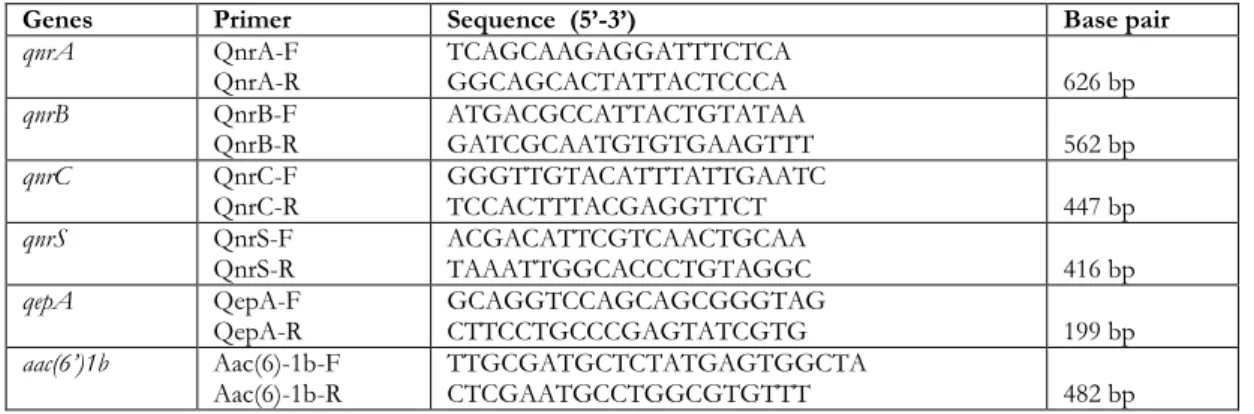
After DNA isolation by a commercial QIAamp DNA Mini Kit (Qiagen, Germany) plasmid mediated quinolone resistance genes, qnrA, qnrB, qnrS, qnrC, qepAand aac (6’)1b were investigated by polymerase chain reaction (PCR) with spesific primers (Table 1).The amplification was carried out in Sensoquest thermal cycle (Labcycler, Germany). PCR amplification steps for qnrA, qnrB, qnrS genes were at follows: an initial denaturation at 94°C for three minutes and following 32 cycles at 94°C for 45 sec, annealing at 53°C for 45 seconds, elongation at 72°C for one minute, final elongation at 72°C for five minutes. The following amplification steps was applied forqnrC, qepA and aac(6’)1b genes; pre-denaturation at 94°C for 3 minutes, following 30 cycles at 94°C for 30 seconds, annealing at 53°C for
297
elongation at 72°C for five minutes. The PCR products were analyzed on 1.5% agarose gel and visualized with ultraviolet light transilluminator staining with 0.5μg/mL ethidium bromide. Presence of bands at 646, 562,447,416,199 and 482 bp was considered positive for the qnrA, qnrB, qnrC, qnrS, qepA and aac(6’)1b genes respectively. After aac(6’)-1b determinant was amplified by PCR, all aac(6’)-1b
positive amplicons were analyzed by digestion with BseGI restriction enzyme (Fermentas, USA) to identify aac(6’)-1b-cr variant 11.
This cross sectional study was approved by Ethical Committee of Faculty of Medicine, Selcuk University (Number of decision: 335, November 2013).
Table 1.Primer sequences and expected band size used in PCR.
Genes Primer Sequence (5’-3’) Base pair
qnrA QnrA-F
QnrA-R TCAGCAAGAGGATTTCTCA GGCAGCACTATTACTCCCA 626 bp
qnrB QnrB-F QnrB-R ATGACGCCATTACTGTATAA GATCGCAATGTGTGAAGTTT 562 bp qnrC QnrC-F QnrC-R GGGTTGTACATTTATTGAATC TCCACTTTACGAGGTTCT 447 bp qnrS QnrS-F QnrS-R ACGACATTCGTCAACTGCAA TAAATTGGCACCCTGTAGGC 416 bp qepA QepA-F
QepA-R GCAGGTCCAGCAGCGGGTAG CTTCCTGCCCGAGTATCGTG 199 bp
aac(6’)1b Aac(6)-1b-F
Aac(6)-1b-R TTGCGATGCTCTATGAGTGGCTA CTCGAATGCCTGGCGTGTTT 482 bp
Statistical analysis
Descriptive statistics were given as percentage and frequency when statistical evaluation was performed.
RESULTS
In the year 2013, 2663 E.coli starins were isolated from different clinical specimens at our hospital microbiology laboratory. Of the 2663 isolates, 36.6% was resistant to ciprofloxacin and 26.6% was
resistant to levofloxacin. One hundred and fifteen quinolone-resistant E.coli strains were isolated from 50 male and 65 female patients. 77.4% of strains were isolated from urine, 11.3% from wound, 6.0% from blood, 2.6% from drainage fluid, 0.9% from BAL, 0.9% from vaginal discharge and 0.9% from abscess samples.
Of the 115 quinolone-resistant E.coli strains 76.5% was found to be ESBL positive. The resistance rates of the isolates to antibiotics were presented in table 2.
Table 2. The resistance rates of E. coli isolates to antibiotics
Antibiotics Number (n:115) Percent
Ertapenem 1 0.86 İmipenem 1 0.86 Meropenem 1 0.86 Nitrofurantoin 12 10.43 Amikacin 24 20.86 Piperacilline-tazobactam 46 40.00 Gentamicin 56 48.69 Ceftazidime 83 72.17 Ceftriaxone 85 73.91 Cefuroxime 90 78.26 Amoxicillin-clavulanic acid 93 80.86 Ampicillin 109 94.78
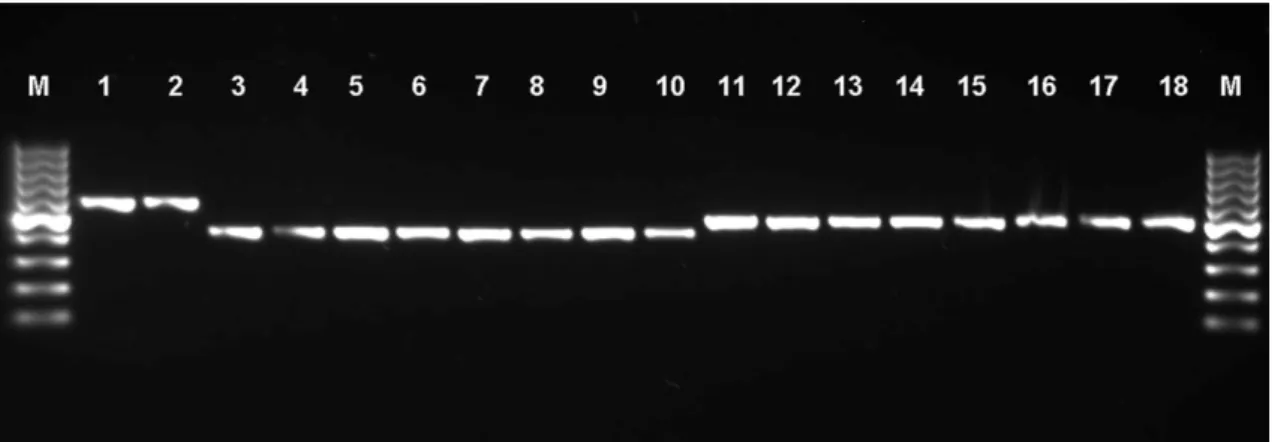
Plasmid-mediated resistance genes were detected in 62 strains. qnrB, qnrS and aac (6’)-1b-cr genes were found positive in three (2.6%), nine (7.8%) and 50 isolates (43.5%), respectively. aac (6’)-1b-cr gene was
determined positive in two of three qnrB positive strains and in five of the nine qnrS positive strains. qnrA, qnrC and qepA genes were detected in none of quinolone-resistant isolates by PCR (Figure 1).
Figure 1: Agarose gel image of PCR products in qnrS, qnrB and aac(6’)-1b-cr genes of E.coli strains [M: Marker, 1-2: qnrB positive isolates (562bp), 3-10: qnrS positive isolates (416bp), 11-18:aac(6’)-1b-cr positive isolates (482bp)].
DISCUSSION
E. coli is a frequent cause of life-threatening bloodstream infections and other common infections, such as urinary tract infections and is one of the major agents of community and hospital-acquired infections. Rates of resistance exhibit variation in foreign studies on quinolone resistance of E.coli. In a study conducted in Greek, the ciprofloxacin resistance of E.coli strain was determined to be 21% 12.In a study conducted in
China, ciprofloxacin resistance of 202 E.coli strains was found to be 74% whereas their levofloxacin resistance was found to be 71%, both of which were very high rates. The ciprofloxacin resistance of uropathogen E.coli in some parts of China reached very high rates such as 41-80% 13. The rates of
ciprofloxacillin resistant E.coli strains in Turkey vary between 42 % and 45% 14,15.In our laboratory in
2013 of the 2663 isolates, 36.6% was resistant to ciprofloxacin and 26.6% was resistant to levofloxacin.
Investigation of a qnrA plasmid from Shanghai that provided more than the expected level of ciprofloxacin resistance led to the discovery in 2006 of a second mechanism for PMQR: modification of certain quinolones by a particular aminoglycoside acetyltransferase, aac(6′)-Ib-cr. A third mechanism for
plasmid-mediated quinolone efflux pumps QepA and OqxAB. In the past decade these genes have been found in bacterial isolates from around the world. They reduce the susceptibility of bacteria to quinolones, usually not to the level of non-susceptibility, but facilitating the selection of more quinolone resistant mutants and treatment failure 6.
The first PMQR in Turkey was reported by Naziket
al.,16 in 2005. Presence of qnrA gene was
investigated on 49 ESBL-positive strains (36 E.coli, 7 K.pneumoniae, 4 Enterobacter spp. and 2 Citrobacter spp.) in Istanbul, and it was found in one Enterobacter cloacae and one C.freundii strain (4%).In a study conducted in Turkey, qnrA, qnrB, and qnrS genes were investigated in 460
Enterobacteriaceae and other gram-negative bacteria isolated from intensive care patients, and qnrB13 gene was identified in one (0.65 %) and qnrS1 gene was found in two of the three E.cloacae isolates 17.In an another study from Turkey in which prevalence of qnrA, qnrB, qnrS, and aac (6’)-Ib-crgenes was investigated, in 248 ESBL-producing E.coli and K.pneumoniae isolates, qnrB1 and aac (6’)-Ib-cr genes were identified in one K.pneumoniae isolate, moreover, it was indicated that aac (6’)-Ib-cr gene was present in 78 %(n: 50) of the ESBL-positive isolates
18. In 112 quinolone-resistant E.coli strains isolated
299
none of the qnrA, qnrB, qnrS, qnrC and qepA-type genes were identified in and aac (6’)-1b-cr gene was identified at a rate of 59.8 % (67/112) 11.
In our study, qnrA, qnrB, qnrS, qnrC, qepA and aac (6’)-1b-cr plasmid-based quinolone resistance genes were investigated in a total of 115 quinolone-resistant E.coli strains isolated from various clinical samples at Microbiology Laboratory of Selcuk University Medical School Hospital, and of which 88 (76.5 %) were ESBL-positive. qnrA, qnrC and qepA-type genes were not found in any of the 115 E.coli strains, whereas qnrB was discovered in three (2.6 %) strains, qnrS was found in nine (7.8%) strains and aac (6’)-1b-cr was found in 50 (43.5%) strains. When we compare the results of the studies from Turkey aac (6’)-1b-cr gene is the most common gene responsible from PMQR as we found. There are two limitations in this study; firstly, it is the lack of characterization of quinolone resistance-determining regions, and the latter the strains were not tested for clonality.
In conclusion, we determined that aac(6')-1b-cr gene was responsible for most of the quinolone-resistant E. coli strains from Konya, Turkey. Although 77.4% of the E.coli isolates were from uncomplicated UTIs, in our study and quinolones have been widely used for the treatment of UTI because of their in vitro activity and high efficacy widely use of quinolones has contributed in increasing resistance. The resistance limits the use of these useful antimicrobials, so surveillance of local and national resistance is very important on using quinolones carefully.
Acknowledgement
This study was supported by Selcuk University Scientific Research Projects Coordinatorship with project number 14202010.
This study was presented as poster in 1st Turkish Congress of One Health, Konya, Turkey, 9-10 April 2015.
REFERENCES
1. Murray PR, Rosenthal KS, Pfaller MA. Escherichia coli:
Medical Microbiology. Philaedelphia, Elsevier, 2016. 2. Croxen MA, Finlay BB. Molecular mechanisms of
Escherichia coli pathogenicity. Nat Rev Microbiol.
2010;8:26-38.
3. Fàbrega A, Madurga S, Giralt E, Vila J. Mechanism of action of and resistance to quinolones. Microb Biotechnol. 2009;2:40–61.
4. Heeb S, Fletcher MP, Chhabra SR, Diggle SP, Williams P, Cámara M. Quinolones: from antibiotics to autoinducers. FEMS Microbiol Rev. 2011;35:247– 74.
5. Poirel L, Cattoir V, Nordmann P. Plasmid-mediated quinolone resistance; interactions between human, animal, and environmental ecologies. Front Microbiol. 2012;3:24.
6. Jacoby GA, Strahilevitz J, Hooper DC. Plasmid-mediated quinolone resistance. Microbiol Spectr. 2014;2:PLAS-0006-2013.
7. Rodriguez-Martinez JM, Cano ME, Velasco C, Martinez-Martinez L, Pascual A. Plasmid-mediated quinolone resistance: an update. J Infect Chemother. 2011;17:149–82.
8. Strahilevitz J, Jacoby GA, Hooper DC, Robicsek A. Plasmid-mediated quinolone resistance: a multifaceted threat. Clin Microbiol Rev. 2009;22:664–89.
9. Yamane K, Wachino J, Suzuki S, Kimura K,Sahipata N, Kato H et al. New plasmid-mediated fluoroquinolone efflux pump, QepA, found in an
Escherichia coli clinical isolate. Antimicrob Agents
Chemother. 2007;51:3354-60.
10. Clinical and Laboratory Standards Institute. Performance standards for antimicrobial susceptibility testing. Twenty-third informational supplement. CLSI Document M100-S23. Wayne, PA, Clinical and Laboratory Standards Institute,. 2013.
11. Aktepe OC, Asık G, Cetinkol Y, Bicmen M, Gulay Z. Investigation of plasmid-mediated quinolone resistance in Escherichia coli strains. Mikrobiyol Bul.
2012;46:9-16.
12. Mavroidi A, Miriagou V, Liakopoulos A, Tzelepi Ε, Stefos A, Dalekos GN et al. Ciprofloxacin-resistant Escherichia coli in Central Greece: mechanisms of resistance and molecular identification. BMC Infect Dis. 2012;12:371.
13. Zhao L, Chen X, Zhu X, Yang W, Dong L, Xu X et al. Prevalence of virulence factors and antimicrobial resistance of uropathogenic Escherichia coli in Jiangsu
province (China). Urology. 2009;74:702–7.
14. Yilmaz N, Agus N, Yurtsever SG, Pullukcu H, Gulay Z, Coskuner A et al. Prevalence and antimicrobial susceptibility of Escherichia coli in outpatient urinary
isolates in Izmir, Turkey. Med Sci Monit. 2009;15:161–5.
15. Dogru A, Karatoka B, Ergen P, Sen Aydın O, Tigen ET. The resistance rates of urinary tract infections: our data from year 2010. Turk J Urol. 2013;39:237-43.
16. Nazik H, Poirel L, Nordmann P. Further identification of plasmid-mediated quinolone
resistance determinant in Enterobacteriaceae in Turkey.
Antimicrob Agents Chemother. 2005;49:2146-7. 17. Nazik H, Öngen B, Kuvat N. Investigation of
plasmid-mediated quinolone resistance among isolates obtained in a Turkish intensive care unit. Jpn J Infect Dis. 2008;61:310-2.
18. Poirel L, Gür D, Minarini L, Arslan U, Nordmann P.
Molecular epidemiology of plasmid mediated quinolone resistance determinants in extended spectrum beta-lactamase producing E.coli and K.pneumoniae isolates from Turkey. 18th European
Congress of Cilinical Microbiology and Infectious Diseases Abstract CD, 19-22 April 2008, Barcelona 2008; P 1527.