Comparison of Instilled Lidocaine and Procaine Effects on Pain
Relief in Dogs Undergoing Elective Ovariohysterectomy
Kibar, M.,1 Tuna, B.,2,3 Kısadere, İ.4 and Güzelbekteş, H.5,6
1 Hunting and Wild Life Programme, Art vin Vocational School, Art vin University, Art Vin Turkey.
2 Department of Obstetric and Gynecology, Faculty of Veterinary Medicine, Kyrgyzstan Turkish Manas University,
Bishkek, Kyrgyzstan.
3 Department of Obstetric and Gynecology, Faculty of Veterinary Medicine, Adnan Menderes University, Aydıın, Turkey. 4 Department of Phsiology, Faculty of Veterinary Medicine, Balıkesir University, Balıkesir, Turkey.
5 Department of Internal Medicine, Faculty of Veterinary Medicine, Kyrgyzstan Turkish Manas University,
Bishkek, Kyrgyzstan.
6 Department of Internal Medicine, Faculty of Veterinary Medicine, Selçuk University, 42000 Konya, Turkey. * Corresponding author: Dr. Murat Kibar, Art vin Vocational School, Art vin University, Art Vin Turkey. Email: [email protected]
ABSTRACT
The aim of the present study was to compare the analgesic efficacy of instilled intra-peritoneal lidocaine and procaine during the perioperative and the postoperative periods in dogs undergoing elective ovariohysterectomy (OVH). Twenty-four sexually intact female dogs were referred for OVH. Following the laparotomy procedure the L group received intraperironeal instillation of 3.5 mg/kg of 0.2% lidocaine. The therapeutic agent was administreted over the area of ovaries, broad ligament, and uterine stump. It was injected using a syringe and needle (23 G). The P group administered intraperitoneal instillation of 3.5 mg/kg of 0.2% procaine and the control group received 1.75 ml/kg of intraperitoneal saline in a similar fashion. Groups L and P had significantly lower Glascow Composite Measure Pain Scale scores (CMPS-SF) than the control group at the 0.5, 1, 2, 3, 8, and 24 hour postoperative periods. In conclusion, administerstration of intraperitoneal installation of lidocaine and procaine were shown to provide a smilarly significant effect in reducing intraoperative and postoperative pain and biochemical stress responses within 3 hours of surgery.
Keywords: Lidocaine; Ovariohysterectomy; Pain; Procaine.
INTRODUCTION
Ovariohysterectomy (OVH) is one of the most commonly performed surgeries in general practice and is considered a moderately painful procedure (1-4). Anesthetic techniques for sterilization range from local anesthesia to neuraxial or general anesthesia (2, 4-6).
Lidocaine is a local anesthetic and antiarrhythmic agent that has been used for years in canine clinical practice to provide loco-regional analgesia and to treat ventricular dys-rhythmias (7-9). Procaine is a local anaesthetic of the ester type which is rapidly hydrolyzed in the plasma (10, 11).
Although previously investigated for intraoperative pain
relief (2, 4, 5, 12, 13), lidocaine and procaine have not been compared for postoperative pain relief in dogs undergoing elective OVH. Our hypothesis was that intraperitoneal li-docaine and procaine would provide effective post-surgical pain relief. The aim of the present study was to compare the analgesic efficacy of instilled intraperitoneal lidocaine and procaine during the perioperative and the postoperative period in dogs undergoing elective OVH.
MATERIALS AND METHODS Twenty-four sexually intact female dogs (weighing between 5.5 and 18 kg; from 7 months to 8 years in age) referred by a
local shelter to a small animal clinic for the OVH procedure at regular intervals over 3 months were included in the study. The study protocol was approved by the local ethics commit-tee (approval number: 2014-12). The local shelter members gave their written consent. Animals judged to be healthy upon clinical examination by the lead investigator were in-cluded in the study (American Society of Anesthesiologist’s classification I, ASA). For each dog, age, body weight, ASA physical status, and sexual cycle were recorded. All dogs were discharged 24 hours after surgery.
Dogs were premedicated with a combination of atropine (0.04 mg/kg IM; Atrovil, Turkey, 0.02 ml/kg) and xylazine (2 mg/kg IM; Alfazine, Turkey, 0.1 ml/kg). General anesthe-sia was induced 15 min after premedication using ketamine (10 mg/kg IM; Alfamine, Turkey, 0.1 ml/kg). Either the right or left cephalic vein was cannulated using a 20 or 22 G over-the-needle catheter (Bıçakçılar, Turkey) for performing the subsequent blood sampling. Electrocardiogram, non-invasive blood pressure (BP), respiratory rate (RR), heart rate (HR), pulse oximetry, and rectal temperature were monitored (GTE9003E, Guoteng Co. Ltd., China) continuously while administering the anesthesia. All dogs were intubated and mechanically ventilated using a ventilator (2002IE, Hallowel EMC, USA). Lactated Ringer’s solution (3-6 ml/kg per h) was infused throughout surgery.
The dogs were randomly allocated to one of three groups, with eight dogs in each group. All surgeries were performed by the same surgeon with assisstance from veterinary stu-dents. Four quarter drapes were placed lateral to each row of mammary nipples at the xiphoid and the pubis. Dogs were placed in the Trendelenburg position (15° head down) to facilitate cranial displacement of the visceral contents of the abdominal cavity. Following the laparotomy procedure the L group received intraperitoneal instillation of 3.5 mg/kg of 0.2% lidocaine (Lidokain, Himfarm, Kazakhstan). The thera-peutic agent was administered over the area of ovaries, broad ligament, and uterine stump. It was injected using a syringe and needle (23 G). The agent was applied simultaneously in four different directions so that it would reach the cranial, caudal, left, and right spaces of the abdominal cavity. The P group was administered intraperironeal instillation of 3.5 mg/ kg of 0.2% procaine (Novakain, Sanavita, Germany) and the control group received 1.75 ml/kg of intraperitoneal saline in a similar fashion. For each dog, the duration of operation was recorded. The operative time was defined as the time
elapsed between the first incision and the final skin suture. After surgery, trimetoprim + sulfomethxazole (15 mg/kg, IV; Favetrim, 0.1 ml/kg) was administered as a single dose.
Pre- and postoperative pain were assessed at baseline (before induction of anesthesia) and then at 0.5, 1, 2, 3, 8, and 24 hours after the operation. The same investigator, who was not informed of the dogs’ group assignment, evaluated the pain behaviors of all dogs using the short form of the Glascow Composite Measure Pain Scale (CMPS-SF) (14). For this purpose, vocalization, attention to wound area, mobility, response to touch, demeanor, and posture were evaluated. Higher points were related to more severe pain. A total pain score was calculated for each time point. To control the severity of postoperative pain, if a dog was scored CMPS-SF>6, carprofen (4.4 mg/kg, SC, Rimadyl, Germany) was to be adminisered as a rescue analgesic Each animal’s data was included in the statistical evaluation. No patient was withdrawn from the study.
Heparinized blood samples (4 ml) were collected through the indwelling cephalic vein catheter. To test for blood glucose, plasma samples were centrifuged at 1500 g for 10 minutes at room temperature; the plasma was removed, and the blood samples were stored at -80°C in labelled Eppendorf tubes and then evaluated for glucose concentration at the end of the study, by a commercial laboratory using a BA-88A Semi-Auto Chemistry Analyzer (Mindray, China).
ANOVA and Tukey’s multiple range tests were used to assess the differences between the groups. The SPSS software program (Version 12.0, SPSS Inc., Chicago, IL., USA) was used for statistical analysis. For intergroup comparison, the distribution of the data was first evaluated for normality using the Shapiro-Wilk test. For intergroup comparison, the data of the rescue requirement was evaluated by Pearson’s χ² test. Normally distributed data were presented as mean ± standard error (SE). A probability value of less than 0.05 was consid-ered to indicate statistical significant differences.
RESULTS
Subjects from the three groups were similar in age (2.63±0.8 years in group L, 2.50±0.7 years in group P, and 2.38±0.2 years in the control group) and body weight (10.13±1.12 kg in group L, 11.62±1.13 kg in group P, and 10.00±0.71 kg in the control group). There were no significant statistical differences for these parameters. The duration of surgery was 27.08±4.65 min.
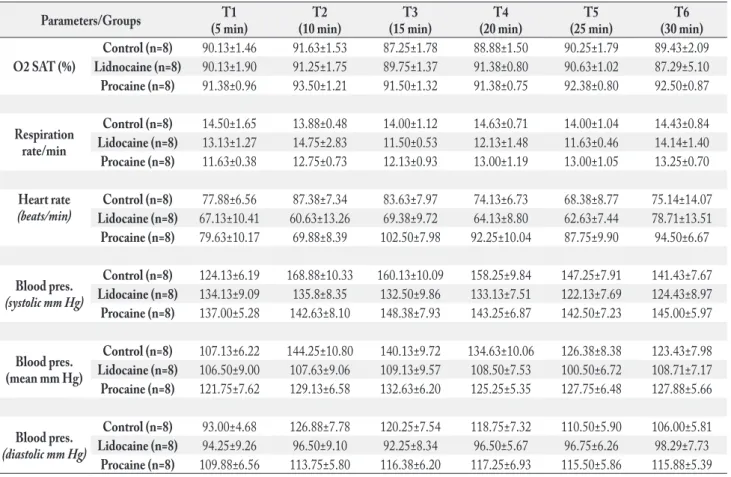
There were no significant differences between the experi-mental groups in terms of intraoperative monitoring values. All of these values were within the expected reference ranges for anesthetized dogs (Table 1). Mean (± SE) systolic, mean, and diastolic BP values were increased 20% in the control group following the ligation procedure (Table 1, T2 time point).
There were significant differences (p<0.05) in CMPS-SF among the experiment groups. In the preoperative period, all animals had a CMPS-SF score of 0. Groups L and P had significantly lower CMPS-SF scores than the control group at the 0.5, 1, 2, 3, 8, and 24 hour post-operative periods (Table 2). At 8 h, group L’s scores were significantly lower than those of group P. The highest and lowest CMPS-SF values were determined at 2 h (6.00±0.71) and 24 h after surgey (2.38±0.37) in group L. Likewise, the highest and lowest CMPS-SF values were determined at 0.5 h (group P, 5.75±0.28; control group, 8.88±0.54) and 24 h after surgey (group P, 3.88±0.65; con-trol group 6.88±0.48) in the other groups. The CMPS-SF
scores were determined to be >6 for eight, three, and two dogs in group C, group L, and group P, respectively. There was statistically significant difference between groups in terms of requiring back-up anesthesia (p<0.05). The rescue analgesic (carprofen, 4.4 mg/kg, SC) was used at first time point at which the CMPS-SF score was determined to be >6. The rescue analgesic was used on one occassion, after which the dogs were observed.
Table 3 demonstrates the mean (±SE) plasma glucose levels at each time point. Glucose concentrations peaked at 3 h in group L, and at 8 h in group P and the control group. Glucose levels differed significantly differenct at 3 and 8 h for groups L and P when measured against the control group (p<0.05). The glucose concentration declined more quickly in groups L and P than in the control group. Only the values at the 3 and 8 h time points were significantly (p<0.05) higher than the baseline value in the control group. After 24 h, the glucose concentration was near baseline values in the control group, while concentrations were not significantly higher for groups L and P. At the values for
Table 1: Distribution of intraoperative monitoring values in dogs (Mean±SE)
Parameters/Groups (5 min)T1 (10 min)T2 (15 min)T3 (20 min)T4 (25 min)T5 (30 min)T6 O2 SAT (%) Lidnocaine (n=8)Control (n=8) 90.13±1.4690.13±1.90 91.63±1.5391.25±1.75 87.25±1.7889.75±1.37 88.88±1.5091.38±0.80 90.25±1.7990.63±1.02 89.43±2.0987.29±5.10
Procaine (n=8) 91.38±0.96 93.50±1.21 91.50±1.32 91.38±0.75 92.38±0.80 92.50±0.87 Respiration rate/min Control (n=8) 14.50±1.65 13.88±0.48 14.00±1.12 14.63±0.71 14.00±1.04 14.43±0.84 Lidocaine (n=8) 13.13±1.27 14.75±2.83 11.50±0.53 12.13±1.48 11.63±0.46 14.14±1.40 Procaine (n=8) 11.63±0.38 12.75±0.73 12.13±0.93 13.00±1.19 13.00±1.05 13.25±0.70 Heart rate
(beats/min) Lidocaine (n=8)Control (n=8) 67.13±10.4177.88±6.56 60.63±13.2687.38±7.34 83.63±7.9769.38±9.72 74.13±6.7364.13±8.80 68.38±8.7762.63±7.44 75.14±14.0778.71±13.51
Procaine (n=8) 79.63±10.17 69.88±8.39 102.50±7.98 92.25±10.04 87.75±9.90 94.50±6.67 Blood pres. (systolic mm Hg) Control (n=8) 124.13±6.19 168.88±10.33 160.13±10.09 158.25±9.84 147.25±7.91 141.43±7.67 Lidocaine (n=8) 134.13±9.09 135.8±8.35 132.50±9.86 133.13±7.51 122.13±7.69 124.43±8.97 Procaine (n=8) 137.00±5.28 142.63±8.10 148.38±7.93 143.25±6.87 142.50±7.23 145.00±5.97 Blood pres. (mean mm Hg) Control (n=8) 107.13±6.22 144.25±10.80 140.13±9.72 134.63±10.06 126.38±8.38 123.43±7.98 Lidocaine (n=8) 106.50±9.00 107.63±9.06 109.13±9.57 108.50±7.53 100.50±6.72 108.71±7.17 Procaine (n=8) 121.75±7.62 129.13±6.58 132.63±6.20 125.25±5.35 127.75±6.48 127.88±5.66 Blood pres. (diastolic mm Hg) Control (n=8) 93.00±4.68 126.88±7.78 120.25±7.54 118.75±7.32 110.50±5.90 106.00±5.81 Lidocaine (n=8) 94.25±9.26 96.50±9.10 92.25±8.34 96.50±5.67 96.75±6.26 98.29±7.73 Procaine (n=8) 109.88±6.56 113.75±5.80 116.38±6.20 117.25±6.93 115.50±5.86 115.88±5.39
the 3, 8, and 24 h time point, non-significantly (p>0.05) differerences from the baseline value in groups L and P were observed.
DISCUSSION
In veterinary medicine, the most effective local anesthetic for abdominal surgery is unknown, as only limited data is available for drugs other than lidocaine. However, lidocaine is seen to be a perfect option for intraperitoneal local analgesia due to its extended time of activity (7, 12). Thus, lidocaine was selected as the intraperitoneal analgesic drug due to its extended time of action (120-240 min), especially compared to procaine, which has a comparatively late onset of effect (45-90 min). It is possible that noxious stimuli during the initial periods of surgery were not inhibited. The efficacy of lidocaine and procaine were thus compared to test for applicability in OVH.
Lidocaine administered intravenously decreases the neu-ral response to postoperative pain by blocking or inhibiting nerve conduction (15), suppressing central sensitization, inhibiting spinal visceromotor neurons (16) and reducing inflammation (17). Therefore, the dogs may be feel less pain
with intraperitoneal administration of lidocaine and procaine than the controls.
Yang et al. (2014) reported that the intraperitonal admin-istration of lidocaine 0.2% significantly reduced postoperative pain in humans, as compared with control infusions (8). The dose plan in the current study was equal to the dose plan used in this previous study (8). In the present study, IP lidocaine 0.2% and procaine 0.2% significantly reduced postoperative pain with control treatment in dogs undergoing OHE.
One limitation of the current study was that different concentrations of local anesthetics which were not compared. Further studies need to be performed using different con-centrations in order to more convincingly show the efficacy of IP local anesthetics. Open surgical OVH in dogs involves the dissection of several tissues, including uterus, broad liga-ment, ovarian pedicles, and ovaries. Thus, when lidocaine and procaine are used in the peritoneal cavity, it was believed that this would guarantee a uniformly broad containment of the area in which noxious stimuli may develop.
It has been reported that HR and BP values were de-termined to be direct physiological indicators of intraop-erative sympathetic reagent to nociceptive stimulation (18); in another study conducted using lambs, HR and BP were demonstrated to have higher sensitivity to signs of pain than
Table 2: Mean CMPS-SF scores from each groups of dogs at each time point (Mean±SE)
Groups Postoperative P Value
(row) 30 min 1.hr 2.hr 3.hr 8.hr 24.hr Control (n=8) 8.88±0.54 A 8.50±0.58 A 8.00±0.44 A 7.00±0.53 A 7.00±0.41 A 6.88±0.48 A 0.132 Lidcaine (n=8) 5.75±0.78 aB 6.00±0.33 aB 6.00±0.71 aB 4.00±0.37 aB 2.50±0.37 bB 2.38±0.37 bB 0.040 Procaine (n=8) 5.75±0.28 B 5.63±0.23 B 5.05±0.36 B 4.78±0.63 AB 4.28±0.55 C 3.88±0.65 B 0.062 P value (column) 0.018 0.030 0.028 0.022 0.001 0.026
abc means with different superscripts within one row differ significantly (p<0.05) ABCDifferent letters in the column indicate the significant differences (p<0.05)
Table 3: Plasma glucose levels (means±SE) taken from dogs treated with installed lidocaine and procaine (group L, n=8; group P, n=8) or serum physiologic (control, n=8). Samples were obtained at baseline and 3, 8, and 24 h following operation
Groups Pre Surgery
0.hr 3.hr Post surgery8.hr 24.hr P Value (row) Control (n=8) 56.25±12.95 aA 166.57±25.39 bA 192.17±24.62 bA 89.71±16.10 aA 0.010 Lidocaine n=8) 67.71±6.98 A 82.60±25.38 B 73.71±9.75 B 76.00±8.52 A 0.234 Procaine (n=8) 75.67±6.21 A 82.83±23.07 82.60±25.38 B 96.20±20.10 B 87.43±20.14 A 0.196 P value (column) 0.344 0.022 0.016 0.296
abc means with different superscripts within one row differ significantly (p<0.05) ABC Different letters in the column indicate the significant differences (p<0.05)
either cortisol or ACTH plasma measurements (19). Systolic, mean, and diastolic BP values increased 20% in the control group following the ovariohysterectomy procedure. The in-crease in the parameters here demonstrate that the intensity of pain had determinable physiologic impact on the animals as assessed by an investigator, however the variability between these parameters was stable in groups L and P.
The cardiovascular system of dogs is considerably more resistant to lidocaine toxicity than the central ner-vous system (20, 21, 22). However, as clinical signs caused by the central nervous system toxicity induced by local anesthetics are masked by generous premedication with anticonvulsant sedatives or general anesthesia, indications of central nervous system toxicity should be estimated by comparing the blood levels found herein with those at toxic doses in toxicity studies (23). The cardiovascular effects of continuous epidural administration of lidocaine have been investigated in anesthetized dogs. Heart rate, direct blood pressure, cardiac index, and stroke volume were found to be decreased dose-dependently during continuous epidural administration, whereas systemic vascular resistance did not differ significantly with dose (23). The acute intravenous cardiovascular toxicity of lidocaine is reported in intact, ventilated dogs anesthetized with pentobarbital. At a 10 mg/ kg dose lidocaine produced moderate signs of cardiovascular depression. The cumulative lethal dose is approximately 80 mg/kg for lidocaine (21). Based on the results of the current study, it was concluded that intraperitoneal administration of lidocaine and procaine was relatively safe in normal dogs undergoing OVH.
Many pain scaling systems have been conceived to evaluate pain and stress in the postoperative period (24). Cortisol concentrations, subjective scoring such as with the CMPS-SF and visual analog scale (VAS), physiological pa-rameters, and algometry have previously been used in studies of the stress response induced by OHE in dogs (14, 25-28). Acknowledging that no scoring system of pain is perfect, the CMPS-SF, which was developed by Reid et al., (2007), was used to evaluate pain in this study (14). No significant difference in pain scores or serum cortisol concentrations was identified between dogs after ovariohysterectomy (25). In dogs, the CMPS-SF has been validated for accuracy in assessing acute pain (14). Both CMPS-SF and VAS, however, require a trained single and preferably blinded observer (26) to reduce bias and inter-observer variation. It
was reported that no significant differences were observed in the subjective and physiological parameters between the period before surgery and at recall in the subject dogs (27). The poor correlation observed between the algometer and both CMPS-SF and IVAS indicates that these tests measure different aspects of pain and are not interchangeable (28). In the current study, the CMPS-SF points were significantly reduced in groups L and P when compared to the control group during the monitoring period. These scores were parallel and compatible with other scores in the literature within 3 h (27, 29).
The significant limitations of the study are debated be-low. First, the restrictions of non-inferiority research using positive controls are well known (30). In this case, the use of saline would have advanced ethical and recruitment issues in this study as a number of local anesthetics are recorded, and substantially used, for intraoperative use in dogs. Secondly, lidocaine was selected as the control product as it has been described and noted as efficacious for peri- and postopera-tive pain (7, 12, 29, 31). Although it has been proposed that a control group should be formed to confirm the scoring system when controlling pain (24), there are considerable welfare-related concerns over abnegating dogs’ postoperative pain relief under clinical status.
Further pain medication was not required by any dog in groups L and P. It is significant to note that the anesthetic drugs used in this study may have resulted in depression of the central nervous system, thus making accurate pain evalu-ation a challenge after the surgical procedure. Third and last, an issue with the use of 3.5 mg lidocaine or procaine/kg in a clinical setting is that local anesthetics currently available on the commercial market are present only at concentrations of 20 mg/ml. The applied amount of 3.5 mg/kg dose for a dog weighing 15 kg or less could be lowered, and as little as 3 ml. Therefore, we diluted the local anesthetics with 10 ml 0.9% NaCl solution.
Serum glucose concentrations were measured to be used as objective measurements to understand the biochemical stress reponse to open surgery. Marcovich et al., (2001) re-searched the changes of serum glucose and cortisol levels at 24 h following different nephrectomy techniques in dogs (32). In this study, the plasma glucose levels declined more rapidly in groups L and P when compared to the control group after open surgery. Therefore, intraperitoneal
admin-istration of procaine might be provide less biochemical stress responses in the postoperative period.
Our findings show that lidocaine and procaine should be considerd as reliable and well-tolerated analgesics when administered intraperitoneally. Administering intraperitoneal installation of lidocaine and procaine were shown to provide a smilarly significant effect in releiving intraoperative and postoperative pain and biochemical stress responses within 3 h. Thus, administration of procaine could be used for pain management intraoperatively and after abdominal surgery procedures, such as OVH in dogs.
CONFLICT OF INTEREST STATEMENT None of the authors of this article have any conflict of interests.
REFERENCES
1. Hewson, C.J., Dohoo, I.R. and Lemke, K.A.: Perioperative use of analgesics in dogs and cats by Canadian veterinarians in 2001. Can. Vet. J. 47: 352-359, 2006.
2. Campagnol, D., Teixeira-Neto, F.J., Monteiro, E.R., Restitutti, F. and Minto, B.W.: Effect of intraperitoneal or incisional bupi-vacaine on pain and the analgesic requirement after ovariohyster-ectomy in dogs. Vet. Anaesth. Analg. 39: 426-30, 2012.
3. McKune, C.M., Pascoe, P. J., Lascelles, B. D. X. and Kass, P. H.: The challenge of evaluating pain and a pre-incisional local anes-thetic block. Peer J. 2: e341. doi: 10.7717/peerj.341. eCollection 2014.
4. Guerrero, K.K.S., Campagna, I., Bruhl-Day, R., Hegamin-Younger, C. and Guerrero, T.G.: Intraperitoneal bupivacaine with or without incisional bupivacaine for postoperative analgesia in dogs undergo-ing ovariohysterectomy. Vet. Anaesth. Analg. 43: 571-578, 2016. 5. Hermeto, L.C., Rossi, R., Bicudo, N.A., Assis, K.T., Escobar,
L.L. and Camargo, P.S.: The effect of epidurally administered dexamethasone with lignocaine for post-operative analgesia in dogs undergoing ovariohysterectomy. A dose-response study. Acta Cir. Bras. 32: 307-318, 2017.
6. Freeman, L.J., Huse, D., Lee, R., Inoue, T., Weil, A.B. and Consta-ble, P.D.: Teaching veterinary anesthesia and surgery: the impact of instructor availability on anesthesia, operative, and recovery times in dogs undergoing ovariohysterectomy or castration. J. Vet. Med. Educ. 41: 390-399, 2014.
7. McMillan, M.W., Seymour, C.J. and Brearley, J.C.: Effect of in-tratesticular lidocaine on isoflurane requirements in dogs undergo-ing routine castration. J. Small Anim. Pract. 53: 393-397, 2012. 8. Yang, S.Y., Kang, H., Choi, G.J., Shin, H.Y., Baek, C.W., Jung,
Y.H. and Choi, Y.S.: Efficacy of intraperitoneal and intravenous lidocaine on pain relief after laparoscopic cholecystectomy. J. Int. Med. Res. 42: 307-319, 2014.
9. Khan, S.U., Winnicka, L., Saleem, M.A., Rahman, H. and Rehman, N.: Amiodarone, lidocaine, magnesium or placebo in
shock refractory ventricular arrhythmia: A Bayesian network meta-analysis. Heart Lung. 46: 417-424, 2017.
10. Terada, M., Islam, M.N., Tun, Z., Honda, K., Wakasugi, C., Shinozuka, T., Yanagida, J., Yamamoto, T. and Kuroiwa, Y.: Determination of ester-type local anesthetic drugs (procaine, tetracaine, and T-caine) in human serum by wide-bore capillary gas chromatography with nitrogen-phosphorus detection. J. Anal. Toxicol. 20: 318-22, 1996.
11. Fuliaş, A., Ledeţi, I., Vlase, G., Popoiu, C., Hegheş, A., Bilanin, M., Vlase, T., Gheorgheosu, D., Craina, M., Ardelean, S., Fer-echide, D., Mărginean, O. and Moş, L.: Thermal behaviour of procaine and benzocaine Part II: compatibility study with some pharmaceutical excipients used in solid dosage forms. Chem. Cent. J. 7: 140, 2013.
12. Visalyaputra, S., Lertakyamanee, J., Pethpaisit, N., Somprakit, P., Parakkamodom, S. and Suwanapeum, P.: Intraperitoneal lidocaine decreases intraoperative pain during postpartum tubal ligation. Anesth. Analg. 88: 1077-1080, 1999.
13. Ortega, M. and Cruz, I.: Evaluation of a constant rate infusion of lidocaine for balanced anesthesia in dogs undergoing surgery. Can. Vet. J. 52: 856-860, 2011.
14. Reid, J., Nolan, A.M., Hughes, J.M.L., Lascelles, D., Pawson, P. and Scott, E.M.: Development of the short-form Glasgow Composite Measure Pain Scale (CMPS-SF) and derivation of an analgesic intervention score. Anim. Welf. 16: 97-104, 2007. 15. Groudine, S.B., Fisher, H.A., Kaufman, Jr.R.P, Patel, M.K.,
Wilkins, L.J., Mehta, S.A. and Lumb, P.D.: Intravenous lidocaine speeds the return of bowel function, decreases postoperative pain, and shortens hospital stay in patients undergoing radical retropubic prostatectomy. Anesth. Analg. 86: 235-239, 1998.
16. Kawamata, M., Takahashi, T., Kozuka, Y., Nawa, Y., Nishikawa, K., Narimatsu, E., Watanabe, H. and Namiki, A.: Experimental incision-induced pain in human skin: effects of systemic lidocaine on flare formation and hyperalgesia. Pain 100: 77-89, 2002. 17. Hollmann, M.W. and Durieux, M.E.: Local anesthetics and the
inflammatory response: a new therapeutic indication? Anesthesiol-ogy 93: 858-875, 2009.
18. Thurman, J.C., Tanquilli, W.J. and Benson, G.J.: Preanesthet-ics and anesthetic adjuncts. In: Thurmon, J.C., Tranquilli, W.J., Benson, G.J., eds. Lumb and Jones Veterinary Anesthesia. Phila-delphia: William & Wilkins, pp. 183-203, 1996.
19. Peers, A., Mellor, D.J., Wintour, E.M. and Dodic, M.: Blood pres-sure, heart rate, hormonal and other acute responses to rubber-ring castration and tail docking of lambs. N. Z. Vet. J. 50: 56-62, 2002. 20. McWhirter, W.R., Frederick, H.S., Frederickson, E.L. and Stein-haus, J.E.: Cardiovascular effects of controlled lidocaine overdos-age in dogs anesthetized with nitrous oxide. Anesthesiology 39: 398-404, 1973.
21. Liu, P., Feldman, H.S., Covino, B.M., Giasi, R. and Covino, B.G.: Acute cardiovascular toxicity of intravenous amide local anesthe-tized ventilated dogs. Anesth. Analg. 61: 317-322, 1982. 22. Liu, P., Feldman, S.H., Covino, B.M., Giasi, R. and Covino, B.G.:
Comparative CNS toxicity of lidocaine, etidocaine, bupivacaine, and tetracaine in awake dogs following rapid intravenous admin-istration. Anesth. Analg. 62: 375-379, 1983.
and Takase, K.: Plasma concentration and cardiovascular effects of lidocaine during continuous epidural administration in dogs anesthetized with isoflurane. J. Vet. Med. Sci. 73: 393-398, 2011. 24. Grandemange, E., Fournel, S. and Woehrlé, F.: Efficacy and safety
of cimicoxib in the control of perioperative pain in dogs. J. Small Anim Pract 54: 304-312, 2013.
25. Merema, D.K., Schoenrock, E.K., Le Boedec, K. and McMichael, M.A.: Effects of a transdermal lidocaine patch on indicators of postoperative pain in dogs undergoing midline ovariohysterec-tomy. J. Am. Vet. Med. Assoc. 250: 1140-1147, 2017.
26. Holton, L.L., Scott, E.M., Nolan, A.M., Reid, J., Welsh, E. and Flaherty, D.: Comparison of three methods used for assessment of pain in dogs. J. Am. Vet. Med. Assoc. 212: 61-66, 1998.
27. Srithunyarat, T., Höglund, O.V., Hagman, R., Olsson, U., Strids-berg, M., Lagerstedt, A.S. and Pettersson, A.: Catestatin, vasosta-tin, cortisol, temperature, heart rate, respiratory rate, scores of the short form of the Glasgow composite measure pain scale and visual analog scale for stress and pain behavior in dogs before and after ovariohysterectomy. BMC Res. Notes. 9: 381-389, 2016. 28. Kushnir, Y., Toledano, N., Cohen, L., Bdolah-Abram, T. and
Shilo-Benjamini, Y.: Intratesticular and incisional line infiltration with ropivacaine for castration in medetomidine-butorphanol-midazolam sedated dogs. Vet. Anaesth. Analg. 44: 346-355, 2016.
29. Kim, Y.K., Lee, S.S., Suh, E.H., Lee, L., Lee, H.C., Lee, H.J. and Yeon, S.C.: Sprayed intraperitoneal bupivacaine reduces early postoperative pain behavior and biochemical stress response after laparoscopic ovariohysterectomy in dogs. Vet. J. 191: 188-192, 2012.
30. Gruet, P., Seewald, W. and King, N.J.: Robenacoxib versus meloxi-cam for the management of pain and inflammation associated with soft tissue surgery in dogs: a randomized, non-inferiority clinical trial. BMC Vet. Res. 9: 92-105, 2013.
31. Carpenter, R.E., Wilson, D.V. and Evans, A.T.: Evaluation of in-traperitoneal and incisional lidocaine or bupivacaine for analgesia following ovariohysterectomy in the dog. Vet. Anaesth. Analg. 31: 46-52, 2004.
32. Marcovich, R., Williams, A.L., Seifman, B.D. and Wolf, J.S. Jr.: A canine model to assess the biochemical stress response to laparoscopic and open surgery. J. Endourol. 15: 1005-1008, 2001.