Outsourcing and Wage Inequality in a Dynamic
Product Cycle Model
Selin Sayek and Fuat ener*
Abstract
This paper constructs a dynamic North–South trade model with outsourcing and endogenous innovation. Production of high quality goods is first performed in the North (Northern phase), then split between the North and the South (Outsourcing phase), and finally shifted to the South (Southern phase). This cycle is reignited whenever a Northern firm innovates a higher quality product. We find that an increase in the frac-tion of outsourced producfrac-tion raises the Northern skill premium unambiguously, while raising the South-ern skill premium if and only if the skill intensity of outsourced production is higher than that of local Southern production.
1. Introduction
Over the past two decades, the relative position of less-skilled workers has deterio-rated in the North (developed countries). In the US, between the late 1970s and early 1990s, the college/high school wage premium has increased from 45% to 80% (Topel, 1997). In OECD Europe, there was a mild increase in skill premia but a substantial surge in the unemployment, mostly concentrated among the unskilled. On the other hand, skill premia trends in the South (developing countries) present a mixed picture. In Mexico, between 1985 and 1989, the relative wage gap between skilled and unskilled labor increased by 15% (Feenstra and Hanson, 1997); in Chile, between 1980 and 1990, the college wage premium increased by 56.4% (Robbins, 1996). However, in Singapore between 1966 and 1980 and in Mexico between 1978 and 1985, the skill premia have actually decreased (Wood, 1994; Feenstra and Hanson, 1997).
The literature on wage inequality predominantly focuses on Northern countries, offering two explanations: increased trade (Leamer, 1993, 1994; Borjas and Ramey, 1995) and skill-biased technological change (Lawrence and Slaughter, 1993; Berman, Bound and Grilliches, 1994). Most of the existing studies have analyzed the role of trade through the lens of the Heckscher–Ohlin (henceforth HO) model. This model predicts that increased trade between a skilled-labor-abundant North and an unskilled-labor-abundant South (i) raises the prices of skilled-labor-intensive goods in the North and reduces the relative price of unskilled-labor-intensive goods in the South, (ii) leads to an increase in the Northern skill premium and a decrease in the Southern skill premium (the Stolper–Samuelson theorem), and (iii) within each industry causes an
S
¸
*Sayek: Department of Economics, Bilkent University, Ankara, Turkey. Tel:+90-312-290-1406; E-mail: [email protected]. ener: Department of Economics, Union College, Schenectady, NY 12308, USA. Tel: +1-518-388-7093; E-mail: [email protected]. An earlier version of this paper has been circulated under the title “Dynamic Effects of Outsourcing on Wage Inequality and Skill Formation”. We have received valuable comments from the participants at the International Economics Conference, Ankara, Turkey; Southeast Theory and International Economics Meetings, Houston; Eastern Economic Association Meetings, New York; Midwest International Economics Meetings, State College and at the Union College economics seminar. The standard disclaimer applies.
increase in the relative employment of unskilled labor in the North and skilled labor in the South.
Putting these HO model predictions to test, economists have found little empirical support for the trade explanation. First, the observed increase in the relative prices of skilled-labor-intensive products in the North was not strong enough to generate large movements in relative wages. Second, the increase in wage inequality occurred
simultaneously in the Northern and most of the Southern countries. Third, within each
industry the relative employment of skilled labor has increased in both the North and South despite the rising relative cost of skilled labor. Based on these, along with other evidence on technological change, the current consensus appears to be favoring skill-biased technological change over trade as the major explanation behind the recent labor market developments.1
The wage inequality debate so far has paid relatively little attention to the role that foreign direct investment (FDI) and outsourcing activity can play in explaining the labor market developments. Moreover, only a few attempts have been made to inves-tigate the wage trends in a unified North–South framework. This is surprising when one considers the fact that relative wage trends across the globe have been synchro-nous with a drastic increase in the level of FDI and international outsourcing activity.2
Furthermore, a number of empirical studies have found a strong correlation between outsourcing/FDI activity and relative wages. Feenstra and Hanson (1999) attribute 15% of the rise in US wage inequality to international outsourcing by US multinational firms. Using evidence from Mexico and Venezuela, Aitken, Harrison, and Lipsey (1996) show that increased foreign ownership in the host country raises the wages of skilled workers by more than those of unskilled workers.3
The theoretical models that investigate the relationship between FDI/outsourcing and wages mostly use static factor-endowment based trade models with no consider-ation of technological progress. In a widely cited paper Feenstra and Hanson (1997) construct such a model in which a single final good is produced from a continuum of intermediate inputs. In their model, a movement of capital from the North to the South shifts more intermediate goods production to the South. From the North’s standpoint, this implies the loss of least skilled-intensive activities; from the South’s standpoint, this implies the gain of more skilled-intensive activities. As a result, increased out-sourcing raises the relative demand for skilled labor, increasing the skill premia in both the North and the South.4In another static factor-endowment framework, Markusen
and Venables (1998, 1999) study the impact of multinational firms on real wages in both the host and the source economies. They find that the real wage implications of multinationals depend on the initial conditions and factor endowments of both economies.
In this paper, we intend to construct a dynamic North–South model that explicitly incorporates the mechanics of innovation, outsourcing and imitation. We depart from Feenstra and Hanson (1997) on three accounts. First, we model international out-sourcing as part of a product cycle framework in which outout-sourcing is triggered by technology transfer opportunities. Second, in our setting endogenous technological change generates continuous product quality improvements and leads to steady-state real wage growth. Third, we allow for substitutability between skilled and unskilled labor in manufacturing.
Our model is a variant of the standard North–South quality-ladders growth model of Grossman and Helpman (1991). We remove scale effects from the endogenous growth structure in the spirit of Dinopoulos and Thompson (2000). We incorporate outsourcing along the lines of Glass and Saggi (2001), and enrich their setting by adding
two new layers. First, we allow for two types of labor—skilled and unskilled—to be employed in manufacturing. Second, we assume that production can shift to the South not only by outsourcing but also by imitation. In Glass and Saggi (2001) there is only one type of labor, and outsourcing is the only channel by which production shifts from the North to the South.
In our model, the global economy consists of a continuum of industries. In each industry Northern firms engage in R&D to discover higher quality products. For each industry, location of production moves according to a product cycle mechanism that involves three phases: Northern, Outsourcing and Southern phase. In the North-ern phase, a successful NorthNorth-ern innovator with the state-of-the-art technology manufactures its product by using Northern resources. Thus, production takes place exclusively in the North. In the Outsourcing phase, some degree of standardization is attained and the Northern leader shifts a certain portion of production to the South. Hence, production is fragmented between the North and the South. In the Southern phase, the state-of-the-art technology fully leaks to the South. Thus, production takes place exclusively in the South. Further innovation by a Northern firm reignites these product cycle dynamics.
We consider the effects of two exogenous events. The first is an increase in the frac-tion of producfrac-tion outsourced to the South. This event raises the relative wage in the North, while increasing the relative wage in the South if and only if production out-sourced to the South is more skilled-labor intensive relative to local Southern production. The second is a rise in the probability of outsourcing success by the North-ern leaders. This event raises the relative wage in the North, while increasing the relative wage in the South under the same if and only if condition, provided a certain assumption holds in equilibrium (see Proposition 2).5Running numerical simulations
of the model, we find that the larger the skill-intensity gap between outsourced and local production the larger the response of skill premia in both regions to increased outsourcing. Further, the simulations indicate that as the skill-intensity gap widens, the responsiveness of Southern skill premium rises more rapidly relative to that of Northern skill premium.
A comparison of these results to those of Feenstra and Hanson (1997) can be useful. Similar to Feenstra and Hanson (1997), we find that increased trade via outsourcing can lead to rising skill premia in both the North and the South. We also show that the extent of the skill-intensity gap can be the key in explaining the mixed trends in Southern wage inequality. This argument is somewhat in the spirit of Feenstra and Hanson (1997), but not explicitly demonstrated in their paper. We further depart from Feenstra and Hanson (1997) by arguing that increased outsourcing raises the Northern skill premium regardless of the North–South skill intensity gap in manufac-turing. This is due to the presence of a Northern R&D sector that exclusively employs skilled labor. In Feenstra and Hanson (1997), there is no R&D sector, and outsourc-ing increases the Northern skill premium if and only if the North–South skill intensity gap in intermediate-goods production is positive.
In the paper, we also report the real wage effects of increased outsourcing. At the steady-state equilibrium, ongoing technological progress leads to continuous product-quality improvements and stimulates real wage growth—in product-quality adjusted terms— for all types of labor. Hence, exogenous shocks can exert both a level and a growth effect on real wages. This growth effect provides a new layer of analysis, which, by con-struction, is absent in static models such as Feenstra and Hanson (1997). We find that an increase in the fraction of outsourced production raises the real wage growth rate for all types of labor in both regions. On the other hand, an increase in the probability
of outsourcing success exerts an ambiguous growth effect. However, numerical simulations indicate that it also stimulates real wage growth under a wide range of reasonable parameters.
Lastly, it is worth mentioning that our model is not subject to the pitfalls of the H–O setting. In our model, changes in relative wages do not necessarily operate through variations in the relative prices of manufactured goods. Further, rising skill premia in
both the North and the South can be observed in the presence of increased trade
stem-ming from more outsourcing.6
Section 2 describes the model and establishes the steady-state equilibrium. Section 3 provides a comparative steady-state analysis. Section 4 concludes. Proofs of existence and uniqueness of equilibrium, comparative steady-state results, and discussion of numerical simulations are relegated to Appendices (available at http://www1. union.edu/~senerm/ and also upon request).
2. The Model
The world economy consists of two countries, the North and the South indexed by i∈ {N, S}. The population size in country i at time t is Ni(t)= N
0ient, where N0idenotes the
initial level of population and n> 0 stands for the population growth rate. In each country the labor force consists of skilled and unskilled workers. In country i, the popu-lation share of skilled labor is given by hi, and that of unskilled labor is given by
(1− hi). Given the fixed population shares, the stock of each type of labor grows at a
rate of n.
Household Behavior
In each country, there exists a continuum of identical households whose measure is equal to one. Each household takes goods prices, factor prices, and the interest rate as given and maximizes its utility over an infinite horizon
(1) where r is the subjective discount rate, and log ui(t) is the instantaneous utility of each
household member defined as:
(2) where xi( j,w, t) is the quantity demanded of a product with quality j in industry w at
time t. The size of quality improvements (the innovation size) is denoted by l> 1. Therefore, the total quality of a good after j innovations is lj.
Each household allocates its per capita consumption expenditure ci(t) to maximize ui(t) given prices at time t. Note that all products within an industry are perfect
substitutes; thus, households buy only the products with the lowest quality-adjusted prices. Products enter the utility function symmetrically; therefore, households spread their consumption expenditure evenly across goods. The resulting per capita product demand for each product line is xi(t)= ci(t)/p
m, where pmis the relevant market price
for the product that has the lowest quality-adjusted price.
logu ti log jx ji , ,t d , i N S, , j
( )
≡ (
)
=∑
∫
l w w 0 1 for Ui= ∞N ei − −( n t) u t dti( )
i N S=∫
0 0 r log , for , ,Given the static demand behavior, the household’s problem is simplified to maximizing
(3) subject to the budget constraint i(t)= Wi(t)+ r(t)Ai(t)− ci(t)Ni(t), where Ai(t) denotes
the financial assets owned by the household, Wi(t) is the family’s expected wage income
and r(t) is the instantaneous rate of return.7The solution to this optimization gives the
standard differential equation
(4) At the steady-state equilibrium, ciremains fixed; thus, the market interest rate ri(t)
is equal to the subjective discount rate r. In this paper, we will focus on the balanced-growth path of the economy and hence we will later drop the time index for the variables that remain constant.
Product Cycle Dynamics
The global economy consists of a continuum of structurally-identical industries indexed by w∈[0, 1]. At any point in time, each industry can be classified as a North-ern industry, an Outsourcing industry, or as a SouthNorth-ern industry. For each industry the transition from one industry structure to another is governed by a stochastic Poisson process. We explain this transition mechanism and the dynamics of the product cycle framework below.
In the North, entrepreneur firms participate in R&D races aimed at innovating higher quality products.The probability of innovation success in industry w over a small time interval dt equals i(w, t)dt and is endogenously determined. Successful Northern entrepreneurs can exercise temporary monopoly power in the global market and immediately start manufacturing by hiring Northern workers. Industries in which Northern firms manufacture final goods by using Northern resources are called
North-ern industries.
While producing in the North, with exogenous probability f(w, t)dt, a Northern monopolist in industry w can successfully outsource a certain portion of manufactur-ing to the South.8In equilibrium, Southern manufacturing costs are sufficiently low
such that the value of an Outsourcing firm is larger than that of a Northern firm. There-fore, Northern leaders have an incentive to exploit outsourcing opportunities whenever they arise. Industries in which Northern quality leaders split production between North and South are called Outsourcing industries.
When Northern firms engage in outsourcing, Southern firms have direct contact with the state-of-the-art production technologies. With exogenous probability d (w, t)dt, Southern firms in industry w can fully acquire the state-of-the-art technology and drive the Northern firm out of the global market. We assume that when technology leaks to the South it becomes available to all Southern firms. Hence, Southern production takes place in a perfectly competitive setting. Industries in which Southern firms perform the entire manufacturing are called Southern industries. When an industry is classified as a Southern industry, it becomes the target of the R&D efforts of North-ern entrepreneurs. Each success by a NorthNorth-ern R&D firm reignites the product cycle mechanism described above.9
˙ , , . c t c t r t i N S i i i
( )
( )
=( )
−r for = ˙ A N ei n t c t dti i N S 0 0 − −( ) ∞( )
=∫
r log , for , ,Stock Market Valuations
There exists a stock market that channels household savings to firms. Let j= N, F, S represent the industry index for Northern, Outsourcing and Southern industries, respectively. Denote with uj(w, t) the stock market value and pj(w, t) the profit flow of
a producer firm operating in industry j for j= N, F, S.
Consider first the valuation of a Northern firm uN(w, t). Over a time interval dt, the
stockholders of this firm receive pN(w, t) in the form of dividend payments. With
prob-ability f(w, t)dt, the Northern firm can become an Outsourcing firm. In this event, the stockholders realize a gain in value of uF(w, t)− uN(w, t)> 0. With probability (1 − f(w, t)dt), the Northern firm’s production remains in the North, and the stockholders
experi-ence a change in value given by N(w, t). The absence of any arbitrage opportunities
in the stock market implies that the expected rate of return from holding a stock issued by a Northern firm must be equal to the risk-free market interest rate r(t). This implies (taking limits as dt → 0):
(5) Consider now the valuation of an Outsourcing firm uF(w, t). Over a time interval dt, the stockholders of this firm receive pF(w, t) in the form of dividend payments. With
probability d(w, t)dt, the technology of the Outsourcing firm can fully leak to the South. In this event, the stockholders realize a loss in value of uF(w, t). With
proba-bility (1− d(w, t)dt), the Outsourcing firm maintains its leadership position, and the stockholders experience a change in value given by F(w, t). Again, the absence of
arbi-trage opportunities implies (taking limits as dt→ 0):
(6) Finally, consider the valuation of a Southern firm uS(w, t). Since Southern
produc-tion takes place in a perfectly competitive setting, it follows that pS(w, t)= 0 and thus
uS(w, t)= 0.
R&D Races
Northern firms undertake R&D to participate in sequential R&D races. R&D is a costly activity that involves uncertainty. A Northern firm j which undertakes R&D in-tensity ijfor a time period dt innovates the next generation product with probability
ijdt. In this event, the entrepreneur realizes the value of a successful innovator uN(t).
To conduct R&D, Northern entrepreneurs hire skilled labor. Let wi
Hand wLi represent
the wage rate of skilled and unskilled labor for i= N, S, respectively.The cost of under-taking R&D intensity ij for a time period dt equals wHNaiXi(t)ijdt, where aiXi(t)
represents the labor requirement per R&D intensity. The term Xi(t) is a measure of
R&D difficulty, which is introduced to remove the scale effects from the model. We specify Xi(t) as
(7) where kiis a positive constant.10Free entry into R&D races implies the following zero
profit condition: X tt
( )
=k Ni N( )
t, u w p w d w u w u w F F F F t t r t t t t , , , ˙ , , .( )
=( )
( )
+( )
−(
( ) ( )
)
˙ u u w p w w u w w u w u w N N F N N t t f t t r t f t t t , , , , , ˙ , , .( )
=( )
( )
+( ) ( )
+( )
−(
( )
( )
)
˙ u(8) We assume that returns to R&D activity are distributed independently across firms and structurally-identical, industries; thus, the innovation rate in industry w is i(w, t)= Σjij= i. Manufacturing Technology and Product Markets
In Northern industries, the production function for final-goods manufacturing is rep-resented by a standard production function FN(HN, LN), where HN and LNstand for
skilled and unskilled employment, respectively. By a standard production, we mean a concave and constant returns to scale production function with positive marginal pro-ducts. For such functions, unit labor requirements in production can be expressed as a function of the relative wage. Let wi= wi
H/wLi represent the relative wage of skilled labor
for i= N, S. Let aHN(wN) and aLN(wN) stand for skilled and unskilled unit labor
require-ments in Northern production, where ∂aHN(wN)/∂ wN< 0 and ∂aLN(wN)/∂ wN> 0.11Thus,
the unit cost of production in a Northern industry is:
(9) In Outsourcing industries, production is split into two stages: basic and advanced production. To produce one unit of final good, an outsourcing firm must combine a units of basic production with (1− a) units of advanced production. One can view this as a Leontief production technology whereby two different types of intermediate pro-ducts (basic and advanced) are combined at fixed proportions (a and 1− a) to produce one unit of final output. Alternatively, one can visualize this as a fragmented produc-tion scheme whereby advanced producproduc-tion involves the manufacturing of sophisticated intermediate inputs and basic production involves the assembly of final goods by using these intermediate inputs. We assume that basic and advanced production require both skilled and unskilled labor. We consider standard production functions that allow for substitutability between inputs; consequently, unit labor requirements respond to vari-ations in factor prices. Compared to Glass and Saggi (2001), this is a more flexible pro-duction scheme. In Glass and Saggi (2001), there is only one type of labor and one unit of labor is required to produce one unit of final good. More specifically, an outsourc-ing firm can fragment the production process by employoutsourc-ing 1− a units of Northern labor and a units of Southern labor. Hence, in their model unit labor requirements do not respond to factor prices in either country.
Basic production can be outsourced to the South, whereas advanced production remains in the North. For advanced production, it is natural to assume that Northern production technology FN(⋅) applies; thus, the unit labor requirements for skilled and
unskilled labor are aHN(wN) and aLN(wN). For basic production, the relevant production
function is FF(⋅). Since basic production uses Southern factors, the unit labor
require-ments for skilled and unskilled labor are now functions of the Southern relative wage:
aHF(wS) and aLF(wS), where ∂aHF(wS)/∂ wS< 0 and ∂aLF(wS)/∂ wS> 0.The unit cost of
pro-duction in an Outsourcing industry is then the sum of basic and advanced propro-duction costs:
(10) In Southern industries, the relevant production function is FS(⋅). Since Southern
pro-ducers face the Southern wages, the unit labor requirements for skilled and unskilled labor are aHS(wS) and aLS(wS), where ∂aHS(wS)/∂ wS< 0 and ∂aLS(wS)/∂ wS> 0. The unit
cost of production in a Southern industry is
ACF= −
(
1 a)
[
aHN( )
wN wHN+aLN( )
wN wLN]
+a[
aHF( )
w wS SH+aLF( )
w wS LS]
.ACN=aHN
( )
wN wNH+aLN( )
wN wLN.(11) which is used as the numeraire and normalized to one.
We are now in a position to calculate the profit flows of producers in each industry. We restrict attention to steady-state outcomes where the ranking of unit costs are l>
ACN> ACF> ACS= 1. In the product markets, firms compete in prices under free-trade
conditions. In each Northern industry, a Northern quality leader competes with a fringe of Southern followers. The Northern firm has access to the technology of producing the state-of-the-art quality product, whereas the Southern followers have access to the technology of producing the previous generation product.12The incremental quality
difference between the Northern product and the Southern product is l. If the South-ern followers charge a price equal to marginal cost, the numeraire, the NorthSouth-ern leader can capture the entire market by charging l− e. Thus, by engaging in limit pricing, the Northern firm forces the Southern followers out of the global market. The Southern followers cannot do better than break even. The profit flow of a Northern firm is
(12) where E(t)= cNNN(t)+ cSNS(t) stands for the level of global consumption expenditure.
In each Outsourcing industry, a Northern quality leader engaged in outsourcing com-petes with Southern followers who can produce the previous generation product. The Outsourcing firm also engages in limit pricing and charges a price of l, sustaining monopoly power in the global market. The Southern followers cannot do better than break even. The profit flow of an Outsourcing firm is13
(13) In Southern industries, competition takes place among a fringe of Southern firms and the Outsourcing firm. All have access to the state-of-the-art technology. Price competition among Southern firms drives prices down to marginal cost one. The Outsourcing firm cannot charge below ACF> 1 and exit the market. As a result,
South-ern firms supply the market, earning zero profits pS(t)= 0. Industry Flows and Labor Markets
Let nN, nFand nSrepresent the fraction of Northern, Outsourcing, and Southern
indus-tries, respectively. At the steady-state equilibrium, industry shares remain constant; thus, the flows in and out of each industry must be exactly balanced. First, consider the Northern industries. Northern entrepreneurs capture production from Southern indus-tries at a rate of i nS, whereas Northern firms transform into Outsourcing firms at a rate
of fnN. Constancy of nNimplies:
(14) Next, consider the Outsourcing industries. The inflow into the Outsourcing industry pool is f nN, whereas the outflow equals the aggregate rate of imitation success in the
South d nF. Constancy of nFimplies:
(15) Since the measure of industries equals one, nN+ nF+ nS= 1, it follows that nSis
con-stant when the above two conditions hold.
fnN=d .nF inS=fnN. p l l F F t E t AC
( )
=( )
− . p l l N N t E t AC( )
=( )
− , ACS=aHS( )
w wS HS+aLS( )
w wS LS=1,Labor market equilibrium requires labor supply be equal to labor demand for each type of labor for i= N, S. First, we consider the Northern labor markets. In the North, demand for skilled labor comes from R&D and manufacturing. For each industry tar-geted by Northern entrepreneurs, demand for R&D workers is iaiXi. Since Northern
industries target only Southern industries, total demand for skilled workers coming from R&D is nSiaiXi. In each Northern industry, demand for skilled labor to be
employed in manufacturing is aHN(wN)(E/l) and in each Outsourcing industry such
demand equals (1− a)aHN(wN)(E/l). Hence total demand for skilled workers coming
from manufacturing is nNaHN(wN)(E/l)+ nF(1− a)aHN(wN)(E/l). Skilled labor market
equilibrium in the North implies:
(16) In the North, demand for unskilled labor comes exclusively from manufacturing. In each Northern industry, demand for unskilled labor is aLN(wN)(E/l), and in each
Out-sourcing industry such demand equals (1− a)aLN(wN)(E/l). Hence, total demand for
unskilled workers is nNaLN(wN)(E/l)+ nF(1− a)aLN(wN)(E/l). Unskilled labor market
equilibrium in the North implies:
(17) Next, we examine the Southern labor markets. In the South, manufacturing is the only activity that generates labor demand. In each Southern industry, demand for skilled labor is aHS(wS)(E/1). In each Outsourcing industry, such demand
equals a aHF(wS)(E/l). Hence, total demand for skilled workers is nSaHS(wS)E+ nFa aHF(wS)(E/l). Skilled labor market equilibrium in the South implies:
(18) In each Southern industry, the demand for unskilled workers is aLS(wS)(E/1) and in
each Outsourcing industry such demand equalsa aLF(wS)(E/l). Hence, total demand
for unskilled workers is nSaLS(wS)E+ nFa aLS(wS)(E/l). Unskilled labor market
equi-librium in the South implies:
(19)
Steady-State Equilibrium
At the steady state equilibrium ci, wi
H, wLi,i, nN, nF, and nSremain constant, whereas X(t), E(t),uN(t) and uF(t) grow at the rate of population growth n. We characterize the
equilibrium in a step wise fashion. We first obtain expressions for industry shares in terms of innovation, imitation, and outsourcing rates,i, d and f, respectively. Using (14) and (15), and nN+ nF+ nS= 1, we derive:
(20) Next, we substitute the industry shares from (20) into (16) and (17). Taking the ratio of the resulting expressions and solving for E using (7) yields:
(21) E w f kN a f a w h h a w N N LN N N N HN N ; ,a l a , d i
(
)
= + − ( )
− −( )
− 1 1 1 1 n f f n f f f n f f f N= F S +(
+)
= +(
+)
= +(
+)
id d i d i d i d d d i d , , . 1−(
h NS)
S=n a( )
w E n+ a( )
w(
E)
S LS S Fa LF S l . h NS S n a w E n a w E S HS S F HF S =( )
+ a( )
(
l .)
1− 1(
hN)
NN=n a( )
w(
E)
+n(
−)
a( )
w(
E)
N LN N l F a LN N l . h NN N n a X n a w E n a w E S N HN N F HN N = i i i+( )
(
l)
+(
1−a)
( )
(
l)
.where ∂E/∂ wN< 0, ∂E/∂a > 0 and ∂E/∂ f > 0. Equation (21) captures the relative supply
and demand relationships between skilled and unskilled labor in the North. To see the intuition behind ∂E/∂ wN< 0, consider an increase in global spending E, holding wN
con-stant. Such a change raises the level of manufacturing activity relative to R&D. Since manufacturing is unskilled labor intensive relative to R&D, this boosts the relative demand for unskilled labor and leads to a decline in the Northern relative wage wN.
We now substitute E(wN,a, f ) from (21) into (17) and solve for i. This yields:
(22) where ∂i /∂wN> 0, ∂i /∂a = 0 and ∂i /∂f < 0. Equation (22) essentially captures the
Northern unskilled labor market equilibrium condition. To see the intuition behind ∂i /∂wN> 0, consider an increase in the Northern relative wage wN, holding i constant.
Such a change has two opposing effects. First, a higher wNreduces E by equation (21),
depressing the demand for unskilled labor. Second, a higher wNreduces the relative
cost of employing unskilled labor and increases the demand for unskilled labor. Equation (23) implies that the net impact is a fall in the demand for unskilled labor. To restore equilibrium, there must be an increase in the fraction of Northern and Outsourcing industries via an increase in i [see (20)].
Next, we substitute E from (21) and i from (22) into Southern labor market con-ditions. This will generate two equations in terms of wN and wS and determine the
equilibrium levels of relative wages.
First, substituting for E and i in the Southern skilled labor market equation (18) gives:
(23) wherehS= NS/NN. Equation (23) establishes a negative relationship between wNand wS. To see the intuition, consider an increase in wN, holding wS constant. By (21)
and (22), an increase in wNreduces E and increases i. Through equation (20), the higher
i increases nNand nF, and reduces nS. In the Outsourcing sector, the reduction in global
spending E decreases the level of production per industry, whereas the increase in nF
raises the measure of Outsourcing industries, the combined effect pointing to a fall in manufacturing activity.14On the other hand, in the Southern sector, the lower levels of
both E and nSunambiguously reduce manufacturing activity. To sum up, a higher wN
leads to a contraction in aggregate Southern manufacturing. In the Southern skilled labor market this depresses the demand for workers, leading to a decrease in the South-ern relative wage wS.
Second, substituting for E and i in the Southern unskilled labor market equation (19) yields:
(24) Equation (24) establishes a positive relationship between wNand wS. For a given wS, a
higher wN reduces E and n
S, and increases nN and nF. As before, in the Outsourcing
sector, the combined effect of a fall in E and the rise in nFimplies a reduction in
manu-facturing activity. On the other hand, in the Southern sector, the lower levels of E and nSboth imply a fall in manufacturing activity. The resulting contraction in
aggre-1 1 1 −
(
)
[
( )
+( ) (
(
)
)
]
( )
[
( )
+ −]
= −(
)
h a w a w w f a w f h N LF S LS S N LN N S S a l d i a d a h , , , SL. 1 1 −(
)
[
( )
+( ) (
(
)
)
]
( )
[
( )
+ −]
= h a w a w w f a w f h N HF S HS S N LN N S S a l d i a d a h , , , SH i a d i w f a k h h a w a w f N N N HN N LN N ; , ,(
)
= − −(
)
(
( )
( )
)
− − − 1 1 1 1gate Southern manufacturing depresses the demand for unskilled workers, leading to an increase in the Southern relative wage wS.
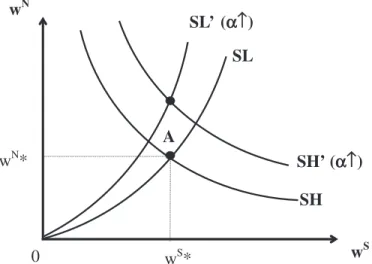
Figure 1 illustrates the steady-state equilibrium levels of relative wages wSand wN
by the intersection of the SH and SL curves at point A. We use “*” to refer to equi-librium levels of endogenous variables. Substituting (wN)* into equations (21) and (22)
yields E* and i*. Substituting i* into (20) yields nN*, nF* and nS*.
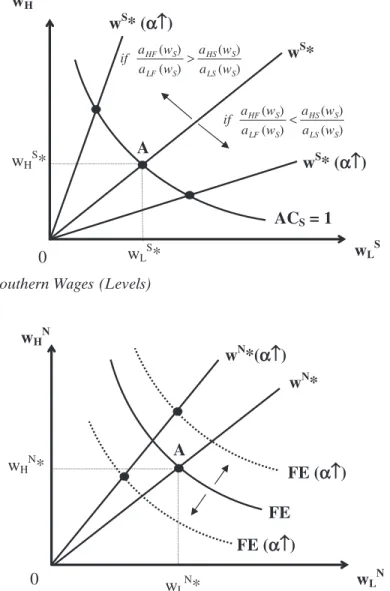
To find the equilibrium levels of skilled and unskilled Southern wages in terms of the numeraire, we first plot (11) on (wHS, wLS) space. Equation (11) implies a negative
relationship between wHS and wLS, which is shown by the ACS curve in Figure 2a. The
intuition is that a higher wLSraises Southern manufacturing costs, and for (11) to hold, wLSmust fall. Combining this relationship with (wS)*= wHS/wLS, we determine the
equi-librium levels (wHS)* and (wLS)* as illustrated by point A in Figure 2a.
To determine the equilibrium levels of skilled and unskilled Northern wages, we first rewrite the free-entry in R&D condition (8). Substituting uFfrom (6) into (5), and then
substituting the resulting expression for uNinto (8) using (7), (12) and (13) yields:
(25) where E, ACNand ACFare given by (21), (9) and (10), respectively. Given (wN)*,
equa-tion (25) implies an inverse relaequa-tionship between wHNand wLNas shown by the FE curve
in Figure 2b. A higher wHNincreases both R&D and manufacturing costs; to maintain
the zero-profit condition in R&D, there must be a decrease in wLN. Combining this
re-lationship with (wN)*= w
HN/wLN, we determine the equilibrium levels (wHN)* and (wLN)*
as illustrated by point A in Figure 2b.
To complete the characterization of steady-state, we define three additional vari-ables:c as the extent of outsourcing, I as the aggregate intensity of innovation, and g as the rate of real wage growth. Since Outsourcing firms whose measure is nFoutsource
a portion a of their production, c= anF. On the other hand, since Northern firms target
their R&D efforts at Southern industries whose measure is nS, I= inS. At the
steady-state equilibrium wage levels are fixed in terms of the numeraire; however, due to ongoing technological progress aimed at quality improvements, real wages in
w a kN f n E AC f AC n HN N N F i r l l l r d + −
(
)
=( )
⋅(
−)
+(
−)
+ −(
)
, FEA
SL’ (
a↑↑)
SL
w
N*
w
SSH
w
N0
w
S*
SH’ (
a↑)
quality-adjusted terms grow over time. More specifically, the quality-adjusted con-sumption price index falls at the rate of I lnl; hence, the rate of real wage growth for both types of labor equals g= I ln l.15Observe that due to free trade in final goods
this is a common real wage growth rate that applies in both countries.
3. Comparative Steady-State Analysis
Proposition 1. An increase in the fraction of production outsourced to the South a
a. raises the relative wage of skilled labor in the North wN,
b. raises the relative wage of skilled labor in the South wSif and only if production outsourced to the South is more skilled labor intensive relative to local production in the South, that is aHF(wS)/aLF(wS)> aHS(wS)/aLS(wS),
w
S* (
a≠)
w
S*
A
a a a (wS) (wS) (wS) (wS) a if LS HS LF HF > a a a (wS) (wS) (wS) (wS) a LS HS LF HF ifAC
S= 1
w
HS*
w
LS*
w
L Sw
S* (
a≠)
w
H S0
Figure 2a. Southern Wages (Levels)
A
w
HNFE (
a≠)
FE (
a≠)
w
L Nw
LN*
w
H N*
0
FE
w
N*(
a≠)
w
N*
c. increases the extent of outsourcing χ,
d. raises the aggregate intensity of innovation I and thus the real wage growth rate g.
To see the intuition, consider first the impact on Southern labor markets using the SH and SL equations. For a given wN, an increase in a raises the level of Southern
pro-duction via two channels. First, as Northern firms outsource more propro-duction to the South, the level of Southern production directly increases. Second, the shift of manu-facturing from the North to the South reduces the relative demand for unskilled labor in the North. Restoring Northern labor market equilibrium requires an increase in global spending E; thus, the level of Southern production indirectly increases.
We can now analyze the relative wage effects with the help of Figure 1. The expan-sion in Southern production raises the demand for both skilled and unskilled Southern workers. In the skilled labor market, for a given wN, the increased demand
for skilled labor puts upward pressure on the relative wage of skilled labor wS; thus,
the SH curve shifts to the right. On the other hand, in the unskilled labor market, for a given wN, the increased demand for unskilled labor puts downward pressure on wS;
thus, the SL curve shifts to the left. Consequently, we observe two competing effects on the Southern skill premium. In the Appendix, we show that the Southern relative wage wSincreases if and only if production technology outsourced by the North is more
skilled labor intensive relative to local Southern production technology.
With SH shifting right and SL shifting left, Figure 1 shows that the relative wage in the North wNunambiguously increases. To see the intuition, consider an increase in a,
now holding wSconstant. As noted above, a higher a raises the demand for both skilled
and unskilled labor in the South. For a given wS, restoring equilibrium for both SH and
SL equations requires an increase in wN. This is because a higher wNreduces E
and raises i (see (21) and (22)). The decline in global spending E and the total measure of Southern and Outsourcing industries nS+ nF (triggered by the fall in i) eliminates
the excess demand in both skilled and unskilled labor markets of the South.
To investigate the change in the rate of innovation i, we focus on (22). Given that a higher a raises wNand that wNand i are positively related by (22), at the new
equi-librium i attains a higher level.16With i increasing, it follows from (20) that the measure
of Northern and Outsourcing industries nNand nF increase, whereas the measure of
Southern industries nS decreases. With a and nF both increasing, the extent of
out-sourcing c= anFincreases as well. With nNincreasing and f being exogenous, equation
(14) implies that the aggregate intensity of innovation I= inSincreases. Consequently,
a rise in a leads to an increase in g= I ln l and therefore stimulates more rapid growth in real wages.
To analyze the changes in wage levels, we utilize Figures 2a and 2b. We first focus on Figure 2a, which determines Southern wage levels. It follows from Proposition 1 that a higher a shifts the WS curve up if and only aHF(wS)/aLF(wS)> aHS(wS)/aLS(wS).
Hence, changes in Southern wage levels depend on the relative skill intensity between outsourcing and Southern production. However, from Figure 2a we can conclude that
wHS and wLS always move in opposite directions. More specifically, if the wage gap
between skilled and unskilled labor increases (decreases), the wage of skilled labor goes up (down) and that of unskilled labor goes down (up). Next, we focus on Figure 2b, which determines Northern wage levels. It follows from Proposition 1 that a higher a unambiguously shifts the WN curve up by raising wN. On the other hand, it exerts
multiple competing effects on the FE curve. First, an increase in a raises R&D profitability by allowing Northern firms to exploit more low-cost manufacturing oppor-tunities in the South (captured by the reduction in ACF). Second, an increase in a
causes ambiguous changes in Southern wages wLSand wHS, as well as in global
spend-ing E; thus, the impact on R&D profitability via these channels remains ambiguous, implying that the FE curve may shift up or down.17 Consequently, the qualitative
changes in Northern wages wLNand wHNdepend on the parameters of the model.
Proposition 2. An increase in the probability of outsourcing success f
a. raises wN,
b. under the assumption Af(∂i/∂wN)> AwN∂i/∂ f where A= (1 − hN)/[[(d/f )+ (1 −
a)]aLN(wN)], raises wSif and only if aHF(wS)/aLF(wS)> aHS(wS)/aLS(wS), c. has an ambiguous effect on c,
d. has an ambiguous effect on I and thus g.
Consider first the impact on SH and SL using Figure 1. An increase in f leads to more jobs moving from the North to the South and thereby raises the demand for Southern labor.18In the Southern skilled labor market, for a given wNthis raises the
skill premium wSand shifts the SH curve to the right. In the Southern unskilled labor
market, for a given wNthis reduces wS and shifts the SL curve to the left.
Conse-quently, we observe two competing effects on the Southern relative wage wS—as in
the case of an increase in a. In the Appendix, we show that under the assump-tion Af(∂i/∂wN)> AwN∂ i/∂ f, the Southern skill premium wS increases if and only if aHF(wS)/aLF(wS)> aHS(wS)/aLS(wS). With SH shifting right and SL shifting left, Figure 1
shows that the relative wage in the North wNunambiguously increases. Equation (22)
implies that a higher f triggers two competing effects on i: a direct positive influence, and an indirect negative influence through an increase in wN.19The net impact depends
on the parameters of the model. With f increasing and the change in i ambiguous, the net impact on industry measures also remains indeterminate and hence the variations in c, I and g. In an attempt to resolve the ambiguities, we ran numerical simulations of the model. Under a wide range of parameter values, the following regularities emerged. First, the assumption Af(∂i/∂wN)> AwN∂i/∂ f holds and thus the if and only if
condition is generally valid. Second, an increase in f raises c, I and g.
We now analyze the changes in wage levels.We begin with Southern wage levels using Figure 2a. It follows from Proposition 2 that under the assumption Af(∂i/∂wN)> AwN∂i/∂ f, a higher f shifts the WS curve up if and only aHF(wS)/aLF(wS)> aHS(wS)/aLS(wS).
Despite the ambiguity, we can conclude, as before, that wLSand wHSmove in opposite
directions under all possible cases. Next, we analyze Northern wage levels using Figure 2b. It follows from Proposition 1 that a higher f shifts the WN curve up, but it generates multiple competing effects on the FE curve. First, an increase in f exerts a direct positive influence on R&D profitability by raising the probability of outsourcing success. Second, as noted above, an increase in f generates ambiguous changes in Southern wages wLSand wHSas well as in E; thus the impact on R&D profitability via these channels remains
ambiguous.20Consequently, the FE curve may shift up or down; thus, changes in w
LNand wHNdepend on the parameters of the model.21
4. Conclusion
Over the past two decades, the wage structures in both developed and developing countries have changed dramatically. When analyzing the causes of changing wage pat-terns, economists mostly used static trade models paying relatively little attention to the possible role of outsourcing and innovation dynamics. In addition, a
dispropor-tionately large number of studies have concentrated on the developments in advanced countries, ignoring the simultaneous changes in developing countries.
In this paper, we have attempted to bridge this gap by examining wage patterns in a unified North–South framework that incorporates the dynamics of technological change and outsourcing. We find that increased trade via increased outsourcing can lead to rising wage inequality in both the North and the South. Hence, rising trade levels can be consistent with the simultaneous increase in wage inequality in both the North and the South. The model also sheds light on the mixed wage inequality trends observed in the South. We find that increased outsourcing raises the Southern skill premium if and only if the skill intensity of production outsourced by the North is larger than that of local Southern production. Our dynamic model also studies the impact of outsourcing on real wages in terms of both level and growth effects. We show that an increase in the extent of outsourcing raises the real wage growth rate for all types of labor in both the North and the South.22Thus, we argue that income
distribu-tion consequences of outsourcing must be weighed against positive long-term wage growth effects.
We think that our model provides an analytical framework that can be useful for further empirical research on trade and wages in the context of both developed and developing countries. In addition, our theoretical model can be extended in many directions. For instance, one can endogenize the rate of Southern imitation and check the robustness of the main results. In addition, one can consider a North–North setting in which outsourcing/FDI takes place between two advanced countries and study the implications for labor markets.
References
Acemoglu, Daron, “Patterns of Skill Premia,” Review of Economic Studies 70 (2003):199–230. Attanasio, Orazio, Pinelopi K. Goldberg, and Nina Pavcnik, “Trade Reforms and Income
Inequality in Colombia,” Journal of Development Economics 74 (2004):331–66.
Aitken, Brian, Ann Harrison, and Robert E. Lipsey, “Wages and Foreign Ownership: a Comparative Study of Mexico, Venezuela, and the United States,” Journal of International
Economics 40 (1996):345–71.
Beaulieu, Eugene, Michael Benarroch, and James Gaisford, “Trade Barriers and Wage Inequality in a North–South Model with Technology-Driven Intra Industry Trade,” Journal of
Develop-ment Economics 75 (2004):113–36.
Berman, Eli, John Bound, and Zvi Grilliches, “Changes in the Demand for Skilled Labor within U.S. Manufacturing: Evidence from the Annual Survey of Manufacturers,” Quarterly Journal
of Economics 109 (1994):367–98.
Borjas, George J. and Valerie A. Ramey, “Foreign Competition, Market Power, and Wage Inequality: Theory and Evidence,” Quarterly Journal of Economics 110 (1995):1075–111. Das, Satya, “Direct Foreign Investment and Relative Wages in a Developing Economy,” Journal
of Development Economics 67 (2002):55–77.
———, “Trade and Relative Wages in a Global Economy,” Review of International Economics 11 (2003):397–411.
Dinopoulos, Elias and Paul Segerstrom, “A Schumpeterian Model of Protection and Relative Wages,” American Economic Review 89 (1999):450–72.
Dinopoulos, Elias, Costas Syropoulos, and Bin Xu, “Intra-Industry Trade and Wage Inequality,” manuscript, University of Florida (2002).
Dinopoulos, Elias and Costas Syropoulos, “Globalization, Factor Endowments and Scale-Invariant Growth,” manuscript, University of Florida (2004).
Dinopoulos, Elias and Peter Thompson, “A Contribution to the Empirics of Endogenous Growth,” Eastern Economic Journal 22 (1996):389–400.
———, “Endogenous Growth in a Cross Section of Countries,” Journal of International
Economics 51 (2000):335–62.
Feenstra, Robert C., “Integration of Trade and Disintegration of Production in the Global Economy,” Journal of Ecomonic Perspectives 12 (1998):31–50.
Feenstra, Robert C. and Gordon H. Hanson, “Foreign Direct Investment and Relative Wages: Evidence from Mexico’s Maquiladoras,” Journal of International Economics 42 (1997):371–93. ———, “The Impact of Outsourcing and High Technology Capital on Wages: Estimates for the
United States, 1979–1990,” Quarterly Journal of Economics 114 (1999):907–40.
———, “Global Production Sharing and Rising Inequality: a Survey of Trade and Wages,” in E. Kwan Choi and James Harrigan (eds), Handbook of International Trade, Volume 2, Malden, MA: Blackwell (2004).
Glass, Amy J. and Kamal Saggi, “Innovation and Wage Effects of International Outsourcing,”
European Economic Review 45 (2001):67–86.
———, “Intellectual Property Rights and Foreign Direct Investment,” Journal of International
Economics 56 (2002):387–410.
Goldberg, Pinelopi K. and Nina Pavcnik, “Trade, Inequality, and Poverty: What Do We Know? Evidence from Recent Trade Liberalization Episodes in Developing Countries,” Brookings
Trade Forum, Washington, DC: Brookings Institution Press (2004):223–69.
Grieben, Wolf-Heimo, “A Schumpeterian North–South Growth Model of Trade and Wage Inequality,” Review of International Economics 13 (2005):106–28.
Grossman, Gene M. and Elhanan Helpman, Innovation and Growth in the Global Economy, Cambridge, MA: MIT Press (1991).
Katz, Lawrence F. and David H. Autor, “Changes in the Wage Structure and Earnings In-equality,” in Orley Ashenfelter and David Card (eds), The Handbook of Labor Economics
Volume III, Amsterdam: Elsevier (1999).
Lawrence, Robert Z. and Matthew J. Slaughter, “Trade and U.S. Wages: Great Sucking Sound or Small Hiccup?” Brookings Papers on Economic Activity 2 (1993):161–227.
Leamer, Edward E., “Wage Effects of a U.S.–Mexico Free Trade Agreement,” in P. M. Garber (ed.), The Mexico–U.S. Free Trade Agreement, Cambridge: MIT Press, (1993):57–128. ———, “Trade, Wages, and Revolving Door Ideas,” NBER Working Paper 4716 (1994). Lundborg, Per and Paul S. Segerstrom, “The Growth and Welfare Effects of International Mass
Migration,” Journal of International Economics 56 (2002):177–204.
Markusen, James R. and Anthony J. Venables, “Multinational Firms and the New Trade Theory,”
Journal of International Economics 46 (1998):183–203.
———, “Multinational Production, Skilled Labor and Real Wages,” in Richard E. Baldwin and Joseph F. Francois (eds), Dynamic Issues in Applied Commercial Policy Analysis, New York: Cambridge University Press (1999):138–72.
Neary, J. Peter, “Foreign Competition and Wage Inequality,” Review of International Economics 10 (2002):680–93.
Pavcnik, Nina, Andreas Blom, Pinelopi Goldberg, and Norbert Schady, “Trade Policy and In-dustry Wage Structure: Evidence from Brazil,” World Bank Economic Review 18 (2004): 319–44.
Robbins, D., “Evidence on Trade and Wages in the Developing World,” OECD Technical Paper No. 119 (1996).
Sayek, Selin and Fuat ener, “Dynamic Effects of Outsourcing on Wage Inequality and Skill Formation,” manuscript, Union College (2001).
ener, Fuat, “Schumpeterian Unemployment, Trade and Wages,” Journal of International
Eco-nomics 54 (2001):119–48.
Topel, Robert H., “Factor Proportions and Relative Wages: the Supply Side Determinants of Wage Inequality,” Journal of Economic Perspectives 11 (1997):55–74.
UNCTAD, World Investment Report: FDI Policies for Development; National and International
Perspectives (2003).
Wood, Adrian, North South Trade, Employment and Inequality: Changing Fortunes in a Skill
Driven World, Oxford: Clarendon Press (1994). S¸
Xu, Bin, “The Relationship between Outsourcing and Wage Inequality Under Sector-Specific FDI Barriers,” manuscript, University of Florida (2000).
———, “Trade Liberalization, Wage Inequality and Endogenously Determined Non-traded Goods,” Journal of International Economics 60 (2003):417–31.
Zhu, Susan Chun, “Can Product Cycles Explain Skill Upgrading?” Journal of International
Eco-nomics 66 (2005):131–55.
Zhu, Susan Chun and Daniel Trefler, “Trade and Inequality in Developing Countries: a General Equilibrium Analysis,” Journal of International Economics 65 (2005):21–48.
Notes
1. See Feenstra and Hanson (2004) and Katz and Autor (1999) for overviews of the wage inequality literature. It is worth mentioning that a series of recent papers seriously challenge the consensus over skill-biased technological change. These papers show that increased trade can lead to rising wage inequality and generate results that are consistent with some of the above empirical regularities. See, among others, Acemoglu (2003), Beaulieu, Benarroch and Gaisford (2004), Das (2002, 2003), Dinopoulos, Syropoulos and Xu (2002), Grieben (2005), Dinopoulos and Segerstrom (1999), Dinopoulos and Syropoulos (2004), Neary (2002), Zhu and Trefler (2005), Zhu (2005), and Xu (2000, 2003). However, none of these papers explicitly model FDI and outsourcing in a dynamic North–South setting.
2. Between 1985–2000, net FDI inflows received by developing countries as a share of their gross fixed capital formation increased from 4% to 13% (UNCTAD, 2003). See Feenstra (1998) for an excellent discussion of empirical and stylized evidence on the increasing importance of international outsourcing.
3. See also Attanasio, Goldberg and Pavcnik (2004) who find evidence on the link between trade liberalization and rising wage inequality using Colombian data, and Pavcnik et al. (2004) who report that the link is statistically insignificant for Brazil. See Goldberg and Pavcnik (2004) for an excellent overview of the recent literature on trade and wage inequality in developing countries.
4. Xu (2000) extends Feenstra and Hanson’s model by considering an economy with two sectors, each producing a final good. In contrast to Feenstra and Hanson (1997), Xu (2000) finds that international outsourcing does not necessarily generate skill-biased labor demand shifts in either the host or the source economy. He argues that sectoral differences in FDI barriers can be the key in determining the bias of the labor demand shift.
5. Using numerical simulations we show that this condition holds under a wide range of reasonable parameters.
6. It is also possible to generate skill upgrading by endogenizing the skill acquisition decision of workers as in Dinopoulos and Segerstrom (1999) and Beaulieu, Benarroch and Gaisford (2004). In such a setting, individuals respond to increased skill premium by undertaking training and becoming skilled. In an earlier version of the paper Sayek and ener (2001) we considered a simpler model with endogenous skill acquisition and showed that increased out-sourcing can lead to skill upgrading within industries.
7. We assume that each unit of household is infinitely large, and transfers among family members allow each member to realize the same level of consumption regardless of their skill levels. This assumption together with the law of large numbers eliminates aggregate effective uncertainty in household income.
8. See Appendix B (available from the authors) for a discussion of numerical simulations that allow for endogenous outsourcing success probability.
9. This is a pure product cycle mechanism in which technological leadership returns to the North only after production technology becomes sufficiently standardized and production com-pletely takes place in the South. See, among others, the “inefficient followers” regime used in Grossman and Helpman (1991, Chapter 12) and the main model of Glass and Saggi (2002) for settings that adopt such a product cycle framework.
10. Equation (7) removes the scale-effects feature of the early endogenous growth models, which predicted explosive growth in the presence of positive population growth. It captures the notion that R&D difficulty increases in larger markets due to informational and organizational costs of introducing and replacing new products. In addition, one can justify (7) by arguing that firms devote larger resources to protect their intangible technologies in larger markets where the threat of imitation is stronger. This R&D difficulty specification originally proposed by Dinopoulos and Thompson (1996) has now been used in a number of studies (see Dinopoulos and Segerstrom (1999) and ener (2001)). Evaluating the empirical relevance of equation (7) using cross-country data, Dinopoulos and Thompson (2000) argue that this R&D specification provides “a useful template on which to begin building more sophisticated models of long-run growth.”
11. To obtain the unit labor requirements, we consider the implied cost function and use Shephard’s lemma along with homogenous of degree one property of the production function.
12. One can assume that when top technology leaks to followers in the South, it also becomes accessible to followers in the North. However, with production costs being higher in North rela-tive to South, it follows that Northern followers cannot effecrela-tively compete in the presence of low-cost Southern followers.
13. Recall that that we restrict attention to steady-state outcomes where uF(w, t)− uN(w, t)> 0,
and thus Northern firms always prefer to be an outsourcing firm whenever such an opportunity arises. Using the profit flow equations for pNand pF(12) and (13), and the stock market
valua-tion condivalua-tions (5) and (6), one can show that uF> uNentails (l− ACF)/(l− ACN)> d/a(r − n).
14. To see this, note that demand for Southern skilled labor coming from Outsourcing is
DLFS= nFaaHF(wS)(E/l)= [fi/(fd + i(f + d)]aaHF(wS)(E/l), where (20) is used for nF. Using (20)
and (17), one can show that i/[fd+ i(f + d)](E/l) = (1 − hN)NN/[d+ (1 − a)fa
LN(wN)], which
implies that∂ [i( fd+ i(f + d)](E/l)/∂wN< 0. Using this result and holding wSconstant, one can
then show that ∂DLFS/∂wN< 0.
15. See Lundborg and Segerstrom (2002, p. 189) for the derivation of this result. It is also pos-sible to interpret technological progress in our model as process innovations aimed at cost reduction. In this case, the price of a product in each industry would fall by l every time a new technology is discovered. At the steady state the rate of decline in the consumption price index— now without any quality adjustment—would simply equal I lnl, and real wage growth would again equal g= I ln l .
16. More specifically, a higher a raises wN and thereby triggers two opposing effects on the
demand for Northern unskilled labor: a negative effect via decreasing E and a positive effect via increasing the unit labor requirement aN
LF. The net impact is a fall in the demand for unskilled
labor. To restore equilibrium, there must be a rise in the measure of industries nN+ nFthrough
a rise in i.
17. To see the change in E, totally differentiate equation (21). This gives dE/da= ∂E/∂a + (∂E/∂wN)(dwN/da)> < 0.
18. In each labor market, the effects of an increase in f materialize via three channels. First, a higher f raises nFand nS, boosting the demand for Southern labor. Second, a higher f reduces
the relative demand for unskilled labor in the North, requiring a rise in E to restore equilib-rium. The higher E, in turn, raises the demand for Southern labor. Third, a higher f generates an increase in i via equation (22) and thereby reduces nFand raises nS. The former reduces the
Southern labor demand, whereas the latter raises it. The combined impact of the three forces identified above is an increase in the Southern labor demand.
19. The indirect effect is already analyzed in the discussion of (22). To analyze the direct effect, we focus on Northern unskilled labor market equilibrium given by (17). First, a higher f reduces the relative demand for Northern unskilled labor. This requires a rise in E for equilibrium to be restored [see equation (21)]. The higher E, in turn, raises the absolute demand for unskilled labor in the North. Second, a higher f increases nFand reduces nN. The job gains emanating from the
Outsourcing industries are dominated by the job losses coming from the Northern industries (note that ∂(nN+ nF(1− a))/∂f < 0 by industry share equations (20)). Consequently, the second
effect works to reduce the demand for Northern unskilled labor. The combined impact of the two effects is a fall in Northern unskilled employment; thus,i must rise to restore equilibrium. 20. To see the change in E, totally differentiate equation (21) to obtain dE/df= ∂E/∂f + (∂E/∂wN)(dwN/df )> < 0.
21. With regards to level effects in the North, numerical simulations indicate that increased out-sourcing—driven by either an increase in a or an increase in f—in general raises the wage levels of both skilled and unskilled labor.
22. It should be noted that this is established analytically in the case of an increase in a and via numerical simulations in the case of an increase in f.