PREDICTION OF THE POWER OUTPUT OF A
POWER GENERATION GAS TURBINE USING
ARTIFICIAL NEURAL NETWORK (ANN)
APPROACH - CASE STUDY LIBYA
Ali Salem MOHAMED EMDALEL
2020
M. Sc. Thesis
ELECTRICAL AND ELECTRONICS
ENGINEERING
Thesis Advisor
PREDICTION OF THE POWER OUTPUT OF A POWER GENERATION GAS TURBINE USING ARTIFICIAL NEURAL NETWORK (ANN)
APPROACH -CASE STUDY LIBYA
Ali Salem MOHAMED EMDALEL
T.C.
Karabuk University Institute of Graduate Programs
Department of Electrical and Electronic Engineering Prepared as Master Thesis
Thesis Advisor
Assoc. Prof. Muhammet Tahir GÜNEŞER
KARABUK October 2020
I certify that in my opinion the thesis submitted by Ali Salem MOHAMMED EMDALEL. titled “PREDICTION OF THE POWER OUTPUT OF A POWER GENERATION GAS TURBINE USING ARTIFICIAL NEURAL NETWORK (ANN) APPROACH -CASE STUDY LIBYA” is fully adequate in scope and in quality as a thesis for the degree of Master of Science.
Assoc. Prof. Muhammet Tahir GÜNEŞER ……… Thesis Advisor, Department of Electrical and Electronic Engineering
PPROVAL
This thesis is accepted by the examining committee with a unanimous vote in the Department of Electrical and Electronic Engineering a Master of Science thesis. October 12,2020
Examining Committee Members (Institutions) Signature
Chairman : Prof. Dr. Mehmet KARALI (NEU) ……….
Member : Assoc. Prof. Muhammet Tahir GÜNEŞER (KBU) ……….
Member : Assoc. Prof. Ziyadulla YUSUPOV (KBU) ………
The degree of Master of Science by the thesis submitted is approved by the Administrative Board of the Institute of Graduate Programs, Karabuk University
Prof. Dr. Hasan SOLMAZ ………
“I declare that all the information within this thesis has been gathered and presented in accordance with academic regulations and ethical principles and I have according to the requirements of these regulations and principles cited all those which do not originate in this work as well.”
ABSTRACT
M. Sc. Thesis
PREDICTION OF THE POWER OUTPUT OF A POWER GENERATION GAS TURBINE USING ARTIFICIAL NEURAL NETWORK (ANN)
APPROACH -CASE STUDY LIBYA
Ali Salem MOHAMED EMDALEL
Karabuk University Institute of Graduate Programs
The Department of Electrical and Electronic Engineering
Thesis Advisor:
Assoc. Prof. Dr. Muhammet Tahir GÜNEŞER October 2020, 32 pages
Today, regression artificial neural networks (ANN) have found their way into simulating different systems possessing advanced dimensions and having different outputs and inputs. This study attempts to forecast the energy output related to the gas turbines (GT) at the Al hawamid Power Plant in Libya by means of an ANN approach. The stated power station is exposed to a number of variables, which will be employed in terms of the input to obtain the power output generated by the turbines. To this end, we will use an ANN model for the prediction of this output, not to mention a Neural Fitting tool (nftool) to assist us in solving the related fitting issues by means of a two-dual-level feed-forward system developed based on the Levenberg-Marquardt Algorithm (LMA). Our results show that the stated approach is an ideal back propagation algorithm at 10 neurons related to our subject turbines. Also, the most suitable fit based on the employed ANN stands at the R2 values of 0.9999, 0.9999,
0.972, and 0.999, respectively for the tested turbines. Lastly, it can be stated that the suggested ANN can be applied at a sound and acceptable level in place of mechanism to forecast the power output of a given GT. To this end, hypothetical structures using the approach play an important role so as to come up with an ideal process and the best outcome.
Key Words : Levenberg-Marquardt Algorithms (LMA), Artificial Neural Networks (ANN), gas turbines (GT).
ÖZET Yüksek Lisans Tezi
YAPAY SİNİR AĞI (YSA) YAKLAŞIMI İLE GÜÇ ÜRETİMİ GAZ TÜRBİNİNİN GÜÇ ÇIKIŞININ TAHMİNİ VAKA ÇALIŞMASI LİBYA
Ali Salem MOHAMED EMDALEL
Karabük Üniversitesi Lisansüstü Eğitim Enstitüsü
Elektrik-Elektronik Mühendisliği Bölümü
Tez Danışmanı:
Doc.Dr. Üyesi Muhammet Tahir GÜNEŞER October 2020, 32 sayfa
Bugün, regresyon yapay sinir ağları (YSA), gelişmiş boyutlara sahip ve farklı çıktı ve girdilere sahip farklı sistemleri simüle etme yolunu bulmuştur. Bu çalışma, Libya'daki Al hawamid Santrali'ndeki gaz türbinleri (GT) ile ilgili enerji üretimini YSA yaklaşımı ile tahmin etmeye çalışmaktadır. Belirtilen güç istasyonu, türbinler tarafından üretilen güç çıkışını elde etmek için girdi açısından kullanılacak bir dizi değişkene maruz kalmaktadır. Bu amaçla, bu çıktıyı tahmin etmek için bir YSA modeli kullanacağız, geliştirilen iki çift seviyeli ileri besleme sistemi aracılığıyla ilgili montaj sorunlarını çözmemize yardımcı olmak için bir Nöral Montaj aracından (nftool) bahsetmiyoruz. Levenberg-Marquardt Algoritması'na (LMA) dayanmaktadır. Sonuçlarımız, belirtilen yaklaşımın konu türbinlerimizle ilgili 10 nöronda ideal bir geri yayılma algoritması olduğunu göstermektedir. Ayrıca, kullanılan ANN'ye dayanan en uygun uyum, test edilen türbinler için sırasıyla 0.9999, 0.9999, 0.972 ve 0.999 R2 değerlerinde bulunur. Son olarak, önerilen YSA'nın belirli bir GT'nin güç çıkışını tahmin etmek için
mekanizma yerine sağlam ve kabul edilebilir bir seviyede uygulanabileceği söylenebilir. Bu amaçla, yaklaşımı kullanan varsayımsal yapılar ideal bir süreç ve en iyi sonucu elde etmek için önemli bir rol oynamaktadır.
Anahtar Kelimeler : Levenberg-Marquardt Algoritması'na (LMA), Nöral Montaj aracından, gaz türbinleri (GT).
ACKNOWLEDGMENT
First of all, I would like to give thanks to my advisor, Assoc. Prof. Dr. Muhammet Tahir GÜNEŞER, for his great interest and assistance in preparation of this thesis.
CONTENTS Page APPROVAL ... ii ABSTRACT ... iv ÖZET... vi ACKNOWLEDGMENT ... viii CONTENTS ... ix LIST OF FIGURES ... xi
LIST OF TABLES ... xii
SYMBOLS AND ABBREVITIONS INDEX ... xiii
PART 1 ... 1
INTRODUCTION ... 1
1.1. BACKGROUND ... 1
1.2. THE AIMS AND OBJECTIVES ... 4
1.3. THESIS OUTLINE ... 4
PART 2 ... 6
GASPOWER PLANT ... 6
2.1. GAS TURBINE (GT) PERFORMANCE ... 6
2.2. SIMPLE CYCLE GAS PLANT ... 8
2.3. GAS TURBINE MODEL APPROACHES ... 9
2.3.1. White-Box Model ... 9
2.3.2. Black-Box Model... 9
PART 3 ... 10
ARTIFICIAL NEURAL NETWORKS (ANNs) ... 10
3.1. ANN IN MATLAB ... 12
Page
PART 4 ... 14
ANN APPLICATION ON POWERPL AND METHODS ... 14
4.1. DEVELOPING THE ANN APPROACH ... 14
4.2. DATA COLLECTION ... 14
4.3. APPLYING THE ANN APPROACH ... 17
PART 5 ... 19
RESULTS AND DISCUSSION ... 19
5.1. APPLYING THE ANN ... 19
PART 6 ... 26
CONCLUSION ... 26
REFERNCES ... 27
LIST OF FIGURES
Page
Figure 2.1. Diagram of a specific single-axle (GT). ... 7
Figure 2.2. Specific brayton cycle... 7
Figure 2.3. Diagram of a simple cycle gas plant ... 8
Figure 3.1. Neuron model ... 12
Figure 5.1. Neural network fitting tool. ... 19
Figure 5.2. Using the inputs and targets options in the select data. ... 20
Figure 5.3. Validation, test and traing data sets. ... 20
Figure 5.4. The default number of hidden neurons is set to 10. ... 21
Figure 5.5. Train network... 22
Figure 5.6. GUI of the training tool. ... 22
Figure 5.7. Performance plot for levenberg-marquardt algorithm; the number of neurons: 10. ... 23
Figure 5.8. Regression plot for levenberg -marquardt algorithm; the number of neurons: 10. ... 24
LIST OF TABLES
Page Table 4.1. Average operating variables of G1 unit (GAS PLANTAlhawamid
LIBYA) (2016-2018). ... 16
SYMBOLS AND ABBREVITIONS INDEX SYMBOLS T : Temperature P : Pressure ABBREVITIONS GT : Gas turbines
ANN : Artificial Neural Networks MMS : Modular Modeling Systems MIMO : Multi-Input/Outputs
CCPP : Combined Cycle Power Plants) GG : Gas generator
NFTOOL : Neural Fitting tool NNTOOL : Neural Network tool BP : Back propagation
PART 1
INTRODUCTION
1.1. BACKGROUND
Gas turbines – GTs, for short – are an indispensable part of power generation in our world, also crucial in aeronautics and running large-scale pumping and compressing operations. It is always useful to simulate GT performance as it helps to predict and develop efficiency in these systems. Against this backdrop, quite impressive studies have been conducted to come up with analytical and experimental simulations and, henceforth, a better grasp of input-output variations and the intricacies behind such operations. Nonetheless, it is a key aspect of them all to be able to develop precise and trustworthy GS models intended for different purposes as the main differentiating factor in research. Some of these works cover black-box based simulations for control mechanisms. In terms of black box, Artificial neural networks (ANNs), too, have been considered worthy and effective in data management, simulation, and monitoring of systems with very different inputs and outputs – otherwise, nonlinear – and, in our case, gas turbines.
To be able to fully examine how thermodynamics function in power stations, one needs advanced mathematical systems with many parameters and hypotheses; henceforth, to model as actually as possible the unpredictability factor [1-2]. Though, doing away with such modelling, machine learning now is a better option [3-4] – ANNs to provide an example. These networks can tackle any form of nonlinearity as the settings and the environment are taken as inputs and the energy created as the output. Then, one can easily forecast the output energy based on any given circumstances.
Initially brought about in the mid-20th century to represent the human brain, they were only applied for such purposes and exceptionally rare hard-to-tackle math. Later,
though, they gained more notoriety and application as datasets and computation began to grow out of proportions [5].
Power stations conventionally involve numerous parameters, the data related to which is kept over extended periods. For this reason, a large dataset is always at hand at no expense to the stakeholders [2].
ANNs have been employed, up to now, for numerous objectives by experts [6-13], successfully as such in math, engineering, medical sciences, finances, weather forecasts, brain-related studies, etc. [14].
ANNs have found their way into pattern grouping, function approximation, optimization, forecasting and automatic control systems [15].
The approach simply begins to learn based on what is fed, and it develops a map of the inputs and outputs so as to forecast a certain phenomenon. In this sense, developing and experimenting with ANN requires input and output values [16] to get over certain obstacles that exist in standard methods for complicated issues, those hard to simulate otherwise in analytic terms [17].
Lately, extensive power stations have been calling for better models of analysis for the dynamics and monitoring goals; practically, service companies tend to employ a large array of modelling techniques – among them, Modular Modeling Systems (MMS) [18] or specifically tailored ones. This task remains a challenge in the absence of certain variables, while already existing approaches cannot respond to the needs at such large-scale power stations. For this purpose, therefore, any model has to be devised prior to operations. ANN advances in these days come to help in doing so and developing system identification and control mechanisms. Thanks to extensive databases, ANNs are trained with no difficulty to come up with nonlinear approximations that lead to control functions and systems later. Given the heavy reliance of ANNs on such input/output data and not necessarily the structure itself, however, adjustability is even more possible and any power station can benefit from this approach for the stated objectives.
ANNs have also been praised for their practicality and steady functioning by many experts as regards power stations and their workings [19-27].
Neutral Networks (NNs), in this vein, enjoy numerous applications as well for these plants [28-37]. As to ANNs, though, they are grouped based on the network settings; for instance, a feedforward NN mostly is applied for approximating steady-state simulations [82,35]. Repeating NNs, though, are ideal for active input/output designs because the repeating neurons can stand in place of different factors [28-31]. To maintain steady states while one is looking for best control inputs, ANNs can be employed to definers and identifiers in small-scale plants [32-35]. In this sense, the system is used by means of repetitive NNs or feedforward NNs as favored best according to precise data features and patterns. For the sake of control within larger-scale stations, though, ANNs help to define every single secondary system in the plant [37]. Additionally, they are useful to create nominal patterns for fault analyses [35]. Despite the numerous uses for NNs, their application is only confined to small-scale plants with only a handful of inputs and outputs. These simulations are defined based on low-level nonlinear multi-input/outputs (MIMOs). These models, as aa result of such a limitation, may not accurately represent intricate features and relationships existing among the various subsystems; what’s more, research to date has failed to address this issue of hierarchical structuring with ANN outputs serving as input for another ANN. To verify one ANN, though, there are many works available in the literature related to plants in general [38, 39]. A hybrid approach, though, is still lacking so as to address numerous ANNs and their proper validation; hence, the motivation behind the present work.
There are, of course, some researches on Steam Turbines (ST) within combined cycle power plants (CCPP) [40-42]. In one case, in the whole supply produce of combined power plant using triple GTs, triple HRSGs and singly steam turbine could be forecast. Niu [41] looked into adjustment mechanisms related to GTs in a CCPP by means of linearization. In another study, Samani [2] employs two separate ANNs one after another to simulate a CCPP based on an input comprising moisture, air force, proper temperature and the discharge of the steam turbine. In this work, only the exhaust steam pressure serves as a factor of ideal and proper conditions, hence not a
deterministic one. Tüfekc [40] and Kaya [42] do comparison of some machine learning tools with the goal to forecast the total work electrical power output of a basic load at a CCPP, thoroughly investigating a regression ANN case.
1.2. THE AIMS AND OBJECTIVES
ANN systems function as a group of smart members that resemble the neurons in our brain. They form a picture of the connections among all inputs and outputs as the main objective based on non/linear processes. To do so, NNs employ numerous techniques, namely multilayer perceptron or MPL. The present thesis utilizes such a multilayer feed-forward NN with back propagation.
Here, ANN algorithms help us forecast the amount of energy output of the GTs located at the Al hawamid power plant in Libya, all developed with MATLAB (R2011a) 7.12. To this end, we will take into account the many factors effective as input to determine the power generated by the GTs as output.
1.3. THESIS OUTLINE
This thesis comprises the following sections:
In Part One, we introduce the topic.
Part two covers the background studies and literature review in the field of GTs and power plants, mathematical simulations for such sites, and the ANN applications in this field of activity.
Part three deals with the methodology for every step of the research as per the afore-mentioned literature, along with a highlighting related simulations carried out in MATLAB for ANN. Data pre-processing and data-sampling are also addressed in this Part together with the prediction methods and all related attributes to the models introduced so far.
In Part Four, we shall introduce the various algorithms to be tried, the related outcomes, and a comparative look into their effective performance.
Lastly, Part Five provides the conclusion as well as the suggestions for upcoming studies and the limitations experienced and identified herein.
PART 2
GASPOWER PLANT
2.1. GAS TURBINE (GT) PERFORMANCE
As the basic of the gas turbine, firstly, a working gas (air) compresses is compressed and heated, therefore, the temperature and pressure gas will be increased. The engine turns the energy of gas into the rotating energy of the blades, making use of the interaction between the gas and the blades. The types of the gas turbine can be classified as: the open cycle type which, is called internal type and the closed cycle type, which is called external type are types of the gas turbine. The gas turbine can serve most gas effluent than that of the piston internal combustion engines, hence it applies a continued combustion. This advantage is made use in the gas turbine for airplanes. The gas turbine works on the basis of the Brayton cycle and one deviation of this essential cycle is the supplement of a regenerator. Some of the energy in the exhaust gas is released to a gas turbine with a regenerator (heat exchanger), heating the air incoming to the combustor. This cycle is commonly used on low-pressure ratio turbines, and the resulting hot gas is enable to expand through a turbine to finish work. In a 33% efficient gas turbine, practically GTs operate on account of the process known as the Brayton cycle. Figure 2.1 depicts an example of such one-tube GTs and their features, namely pressurizer (compressor), combustor, and the turbine itself – all together referred to as gas generator (GG). The pressurizer section and the turbine join by means of a core tube, hence spinning in unison. In Figure 2.2, one can see a typical Brayton process within pressure-volume (P-V) and temperature-entropy (T-S) structures [26]. The air flow arrives in through the part marked as 1 so as to be pressurized. Then, the resulting heated and pressurized air finds its way into the combustor marked as 2, where fuel and air combined for ignition. The resulting heated fumes then are released into the turbine in 3 and cause it to spin. The turbine itself is the driving force behind the pressurizer and the GG output – in case of power stations,
electrical alternators – behind large pumps. Equal entropy is often favored in pressurizers (1-2) and turbines (3-4). Additionally, constant pressure is the ideal status in the combustor (2-3) and the environment (4-1); yet, in reality these two ideal scenarios do not exist within such systems and pressurizers – not to mention the loss of pressure while the system is at work. An isobaric state, hence, is considered to be dominant under such conditions at the 2-3 and 4-1 processes [43].
Figure 2.1. Diagram of a specific single-axle (GT) [26].
2.2. SIMPLE CYCLE GAS PLANT
These systems account for basic power plants powered by natural gas and functioning based on forced hot gas into turbines to make electricity. In this sense, they vary from other systems, such as combined cycles, in the sense that the exhaust heat remains unused and, as such, the facilities only work under high seasons and peaked demand within national grids. The released power by these turbines is quite significant in terms of the relative size of the turbines and their output [44].
The permanent minimum load provided to the network by various stations using coal or atomic fuel cover the basic needs of a given country, whereas other forms such as gas-powered plants cover the remaining demand in high times. To materialize this, simple cycle plants enjoy adaptability in operations, among them the quick response mechanism and advantage in operational terms. Nonetheless, the output and efficiency is compromised as opposed to combined systems because certain portions of the power generated by the fuel can be lost, decreasing efficiency to about 35% [44]. At any rate, simple cycle plants do not work the year around and only do so at peak times, hence granting them reduced capacity – in other words, relatively speaking, they hardly operate at full capacity and merely for a number of hours on a daily basis and at most.
2.3. GAS TURBINE MODEL APPROACHES
There are a whole a lot of sources for modeling and modelling of gas turbines in the publications. multiple models are developed from different views and for different objectives. The simulated of industrial systems can be divided into two main classification ·: black-box and white-box models.
2.3.1. White-Box Model
When sufficient knowledge of system physics is available, the model of white box can be used. Mathematical equations with respect to system dynamics are used to create a model. This Model deals with the system equations that are normally nonlinearity equations [45]. To ease these equations to create an acceptable model, it is inevitable to make some assumptions based on unique conditions and using some methods to linearize the system. There are several programs like Simulink-MATLAB and MATHEMATICA that are very useful with this method.
2.3.2. Black-Box Model
In case of little or no information available on system physics, black box model is suitable [45]. In this case, the objective is to know the relationships between system parameters using the operational and output data obtained from system running. The artificial neural network (ANN) is one of the methods used in black box modeling. ANN was used in various industries in recent years. The main the concept for generating ANN a subset of artificial intelligence, is to supply an easy model of the human brain to solve difficult research and industrial problems in a various of areas.
PART 3
ARTIFICIAL NEURAL NETWORKS (ANNs)
Modeling and control methods based on methodology of white box are based on equations of thermodynamic and energy combined with a high degree of nonlinearity. Therefore, the reporting of assumptions and the application of linearization methods is necessary to simplify and solve this complex dynamic. Therefore, models and control systems come on these easier and / or linearized equations are not accurate enough to accurately achieve control of system dynamics. This cause too unpredictable problems, such as unexpected break, particularly at the operation of gas turbines construct on the basis or the use of models. This shows that techniques and methods independent of the dynamics of the system must be used. In addition, the proportional-integral-derivative (PID) control algorithm may be complex to maintain very much nonlinear and variable time processes [45]. ANN is able to gain control over a considerable and complicate gas turbine operation that is independent of system physics. Therefore, the imperative for research in this area is apparent.
Like other mechanical devices, the components of gas turbines gradually deteriorate and overlook their functionality and working capacity over time. a few years later in the industry, the perfect thermodynamic regard and, therefore, the similar white box models are examinee to great modify and will no longer be valid. Therefore, predicting the behavior of old gas turbines is very complex. However, the replacement of old GTC with new ones demands huge money resources and, in most cases, is economically unsustainable. fortunately, black box type is extremely suitable in this case because of their independence and adaptability to new conditions. The problem can be handled to monitor conditions based on new GT parameter records by Training and using an updated ANN-based model.
Otherwise called as connectionist systems, ANNs are simulations in the field computers and others working with extensive amounts of datasets gathered from basic neurons and roughly similar to how the axons operate in the human brain. All these units are joined with one another which could either reinforce or impede the ongoing processes anywhere within the system. To compute, every unit applied summation, while there can also exist thresholds anywhere within these joints in within each unit; hence, a given signal should go beyond the threshold in order to spread elsewhere. The mechanism, in this way, simply teaches itself and required no programming, thereby assisting users in seeking solutions or certain attributes that can otherwise be challenging if conventional programming were to be employed [5]. The act of ANN training requires preliminary and arbitrarily chosen weights, after which the neurons operate in a way to ensure the lowest frequency of faults.
NNs (neural networks) comprise basic features working in unison and similar to biological processes within the nervous system. This, naturally, makes inevitable the importance of the joints made among all units in these systems, leading to how efficiently they operate. Consequently, NNs may be developed to carry out a certain task by simply changing the values or weights in the joints. Conventionally speaking, these systems are developed in a way that a given input can effect major outputs –as depicted in the following figure, where the system is adapted in accordance to what the output and target comparisons are. The process, then, continues up to the point where the two are equal. Obviously, for training purposes, many such couples as input and target will be necessary before obtaining the best results [45].
NNs are developed to carry out complicated tasks in different disciplines: for pattern recognition, detecting, grouping, sight, speech and control mechanisms. They may additionally help to tackle problems otherwise challenging if treated with traditional computer-based or human-initiated ways. This aid kit, in a sense, comprises specific and typical examples compiled or employed individually by engineers, financiers, or other field experts.
Within this perspective, the present chapter introduces the way to apply four separate graphics that help train NNs to deal with function adjustments, pattern identifications,
grouping, and time sequences. these four applications set up the basis here for using the NN Toolbox software intended for the present study [ 45].
Figure 3.1. Neuron model [45].
3.1. ANN IN MATLAB
The above-stated program includes algorithms, functions, and applications that develop, train, picture, and model NNs through regression, pattern identification, grouping, clustering, deep learning, sequencing and active systems, not to mention numerous alternatives also accompanying the ANN models [45]. In all, seven different stages exist within this architecture, namely:
1) Data gathering;
2) Network development; 3) Network configuration;
4) Weight and Bias initialization; 5) Network training;
6) Network validation; and finally 7) Network Application.
The above-stated stages, in some cases, may be carried out automatically by means of default weights and arrangements; though, users can also adjust the details as desired. The kit has four design option for software application: the initial step is GUI-based, offering the chance for fast access related to multiple issues related to function fitting,
pattern detection, grouping, and sequences. What’s more, a MATLAB code may be developed with as much detail as needed to simulate the settings intended for the network analysis.
The second step or level is based on simple command-based processes that employ a series of easy premises or arguments equipped with smart defaults as parameters. It goes without saying that all such defaults may be disregarded so as to achieve maximum efficiency. The third stage in the kit is toolbox adjustment – a high-level feature to develop tailor-made NNs while maintaining full functionality. in the fourth stage, one can have the chance to change whatever code file they wish within the kit. as all computations involve MATLAB coding and are, hence, available at large.
3.2. REGRESSION ANN IN MATLAB
This feature is obtainable through the GUI or command-line functions [5]. In detail, two GUIs are available to develop and train the system, such as [14,15]:
1) tool of Neural Network (nntool) as the overall feature providing complete control overthe network. With this feature, onecan develop whatever NN they wish and not just regression-based ones.
2) Neural Fitting tool (nftool) as a guide to tackle issuesrelated to fitting, based on a two-layer feed-forward approach developed as per the Levenberg-Marquardt method and/or scale conjugate gradient back-propagation. The alternatives, hence, are limitless, and one can choose any data from the MATLAB environment or opt for the sample sets offered alongside the toolbox. Once training is through, the performance is assessed by means of mean squared error and regression methods. Additionally, the outcomes are evaluated based on visualization features like regression fits or error his-tograms. Lastly, users are able to assess the entire NN efficiency using a set for testing purposes.
PART 4
ANN APPLICATION ON POWERPL AND METHODS
4.1. DEVELOPING THE ANN APPROACH
ANN is based on simulating the learning sequence occurring in human beings by neurons as the key components located inside the input layer and the output layer. In this way, all systems simulated alongside noisy or partial data [46] as, otherwise, they are too intricate for algorithms to be written or any specific system to be detected within the existing dataset. Learning by means of patterns and illustrations is the core feature of NNs because they cannot be planned when it comes to some tasks. In actual settings, the mechanism is composed of numerical data of non-linear nature with algorithms; there is also back propagation (BP) as a conventional method to reduce faults as much as possible between the output and what is anticipated after assigning the appropriate neuron weights.
As mentioned before, the present study employs an ANN to forecast the amount of output from GTs located at the Al hawamid Power Plant in Libya. To accomplish this task, a feed forward NN is carried out using BP algorithms on MATLAB [47-30]. Both the input and the output elements will be chosen in the form of monthly approximate averages.
4.2. DATA COLLECTION
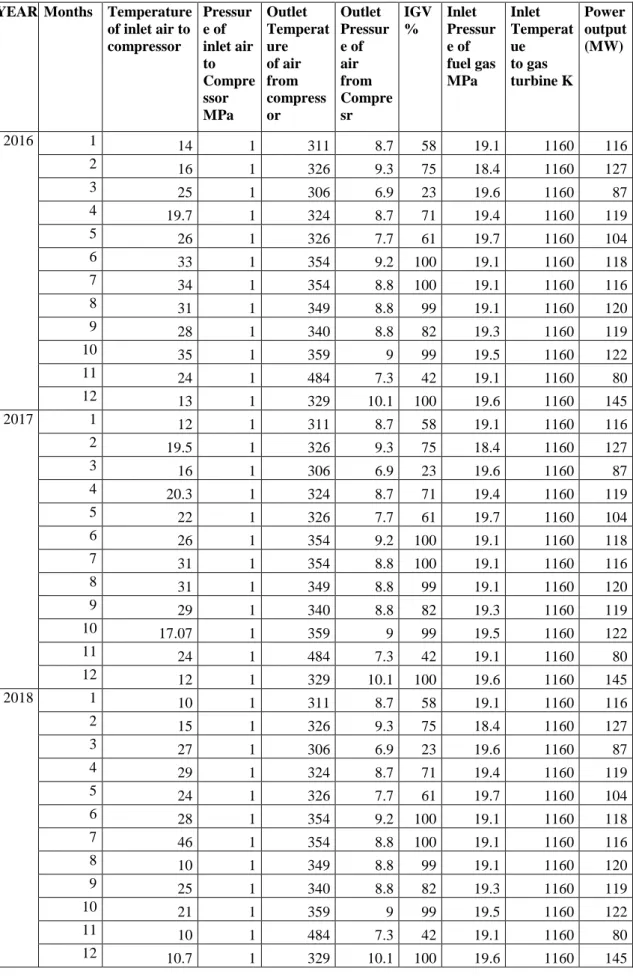
The data related to performance for a given GT is gathered based on the log sheets filled out every day for the period of 2016 to 2018. These variables are numerically assessed to obtain the mean values between January and December each year, and then a total average sum. Table 1 illustrates the parameters for a sample GT at the specified site.
Operating Parameters include the input factors, namely:
Heat level at the point of entry to pressurizer K0 Amount of pressure at entry to pressurizer MPa Heat at outlet point in the pressurizer K0
Pressure at the outlet point of pressurizer MPa Pressure at entry for fuel-gas MPa
Heat at entry for GT K0 Inlet guide vanes (IGVs) % Power output in MW
Table 4.1. Average operating variables of G1 unit (GAS PLANTAlhawamid LIBYA) (2016-2018).
YEAR Months Temperature of inlet air to compressor Pressur e of inlet air to Compre ssor MPa Outlet Temperat ure of air from compress or Outlet Pressur e of air from Compre sr IGV % Inlet Pressur e of fuel gas MPa Inlet Temperat ue to gas turbine K Power output (MW) 2016 1 14 1 311 8.7 58 19.1 1160 116 2 16 1 326 9.3 75 18.4 1160 127 3 25 1 306 6.9 23 19.6 1160 87 4 19.7 1 324 8.7 71 19.4 1160 119 5 26 1 326 7.7 61 19.7 1160 104 6 33 1 354 9.2 100 19.1 1160 118 7 34 1 354 8.8 100 19.1 1160 116 8 31 1 349 8.8 99 19.1 1160 120 9 28 1 340 8.8 82 19.3 1160 119 10 35 1 359 9 99 19.5 1160 122 11 24 1 484 7.3 42 19.1 1160 80 12 13 1 329 10.1 100 19.6 1160 145 2017 1 12 1 311 8.7 58 19.1 1160 116 2 19.5 1 326 9.3 75 18.4 1160 127 3 16 1 306 6.9 23 19.6 1160 87 4 20.3 1 324 8.7 71 19.4 1160 119 5 22 1 326 7.7 61 19.7 1160 104 6 26 1 354 9.2 100 19.1 1160 118 7 31 1 354 8.8 100 19.1 1160 116 8 31 1 349 8.8 99 19.1 1160 120 9 29 1 340 8.8 82 19.3 1160 119 10 17.07 1 359 9 99 19.5 1160 122 11 24 1 484 7.3 42 19.1 1160 80 12 12 1 329 10.1 100 19.6 1160 145 2018 1 10 1 311 8.7 58 19.1 1160 116 2 15 1 326 9.3 75 18.4 1160 127 3 27 1 306 6.9 23 19.6 1160 87 4 29 1 324 8.7 71 19.4 1160 119 5 24 1 326 7.7 61 19.7 1160 104 6 28 1 354 9.2 100 19.1 1160 118 7 46 1 354 8.8 100 19.1 1160 116 8 10 1 349 8.8 99 19.1 1160 120 9 25 1 340 8.8 82 19.3 1160 119 10 21 1 359 9 99 19.5 1160 122 11 10 1 484 7.3 42 19.1 1160 80 12 10.7 1 329 10.1 100 19.6 1160 145
4.3. APPLYING THE ANN APPROACH
By means of the nftool, we will:
1. Choose “Fitting Tool” and the related nftool command;
2. Apply the “Inputs and Targets” from the “Select Data” through uploading the data from MATLAB;
3. Select “Validation and Test Data” as illustrated below. These sets are arranged as 15% of the original set. Then, both the input and output vectors can be separated arbitrarily within three groups, namely:
• 70% for training purposes;
• 15% for validation upon generalization and stop short of training to avoid excessive fitting; and
• 15% for a thoroughly separate testing of the network generalization.
4. Choose “Next”. At this stage, we have a conventional NN tailored for fitness purposes as a dual-layer feed forward system having a sigmoid transfer option within the hidden layer along with linearity function in the output layer. The default count for hidden neurons is fixed at 10, with the possibility to add to it subsequently should the training prove to be of low quality the first time around.
5. Choose “Train”. Training starts and carries on to the point the validation error can no longer function upon six consecutive rounds.
6. Under “Plots”, select “Regression” in order to validate the network. The regression plots demonstrate all outputs concerning all the goals intended for training, validation, and tests. To achieve ideal fits, the dataset has to lie against a 45-degree line because that is the position at which all the outputs are in par with the goals. In case of the present work, the fitness is satisfactory pertaining to all sets as the R values achieve 0.93, even more. However, should there be a
need for yet additional accuracy levels, the system requires additional training – which is possible by selecting “Retrain”; consequently, the original values and biases are altered and, possibly, better networks emerge afterward. The other alternatives are shown in the pan below.
PART 5
RESULTS AND DISCUSSION
5.1. APPLYING THE ANN
For the purpose applying, training and validating the NN, the nftool was used as available from MATLAB. A basic feedforward system is obtained having 10 units at the hidden layer trained by means of LM algorithm as stated previously.
By means of the nftool, then, we apply the following steps:
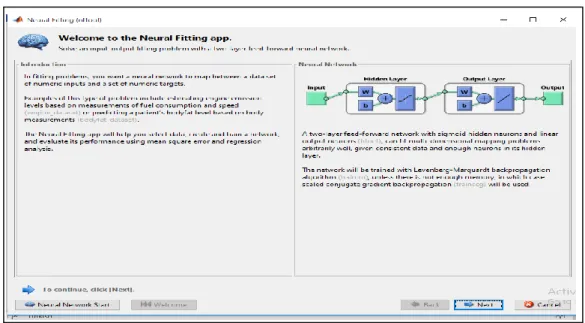
1. Select “Fitting Tool” for the nftool.
Figure 5.1. Neural network fitting tool.
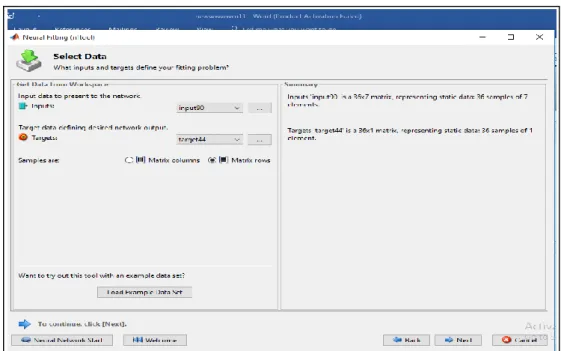
2. Select “Next” and then “Use the Inputs and Targets” available from “Select Data” to upload data from MATLAB.
Figure 5.2. Using the inputs and targets options in the select data.
3. Select “Next” to proceed to “Validation and Test Data”as illustrated below. In this way, we assign the test data as 15% of the original set.
Figure 5.3. Validation, test and traing data sets.
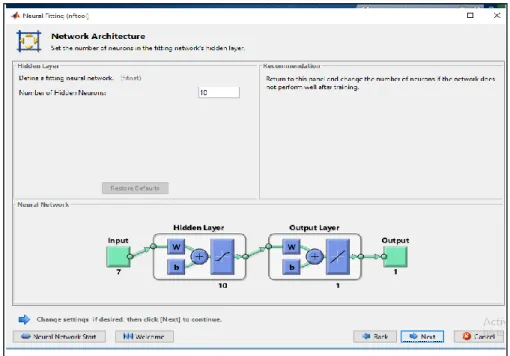
4. Select “Next” again. Here, the conventional system employed to fit the functions is dual-layered and feed forward with (function of sigmoid) inside the hidden layer and function of linear in the output layer. Additionally, default count for the hidden neurons stands at 10. As described earlier, the count may be added in case training appears to be unsatisfactory.
Figure 5.4. The default number of hidden neurons is set to 10.
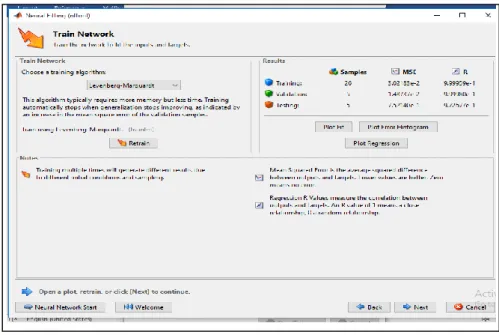
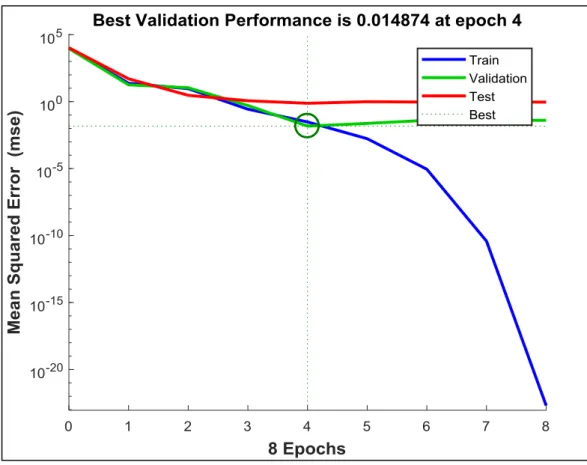
5. Select “Train”. Now, this process halts upon six rounds of failure in validation - in this case, at round 8. Upon selecting “Performance” from the options, what comes up is a list of faults pertaining to training, validation, and testing – as illustrated below. for the present research, though, the outcomes are satisfactory given the fact that:
• The ultimate mean-square error is insignificant;
• There are identical features shared by test errors and validation errors; and • There have been no major incidents of excessive fitting up to round 8, which
is where optimum validation takes place.
The process of training carries on up to the point that validation errors are not reduce any further – that is round 8 – hence, stopping the process.
Figure 5.5. Train network.
Figure 5.6. GUI of the training tool.
As the ultimate mean-square error is insignificant, the related ANN figures and weights for the ANN intended to forecast the energy output at the power plant in point are quite similar to the computed figures obtained in real datasets.
Figure 5.7. Performance plot for levenberg-marquardt algorithm; the number of neurons: 10.
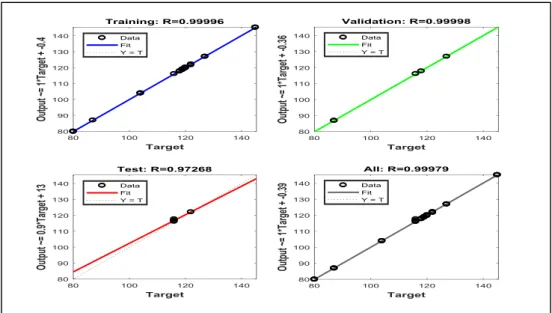
6. In the “Plots” section, select “Regression” so as to validate the overall performance. These series show all outputs related to the network as opposed to the intended targets set to train, validate, and test the sets. To achieve optimum fitness, as stated earlier, our data must overlap with a 45-degree line as that is where the stated outputs are closets to the objectives. In case of the present research, this overlapping is satisfactory concerning all sets with R-values at 0.9999, 0.9999, 0.972, and 0.999, respectively.
Figure 5.8. Regression plot for levenberg -marquardt algorithm; the number of neurons: 10.
Trial-and-error approach with the nftool is selected for the purposes herein to identify ideal settings and functions for the ANN to be employed. Based on the datasets for Gas Planta Hawamid LIBYA – the site in point – with alternative variables, we intended to achieve an exceptional framework within which the power output of the site can be correctly predicted in MW units. For this reason, the proposed approach follows feed-forward back propagation with a tansig function available within “one hidden layer", and function of a linearize transfer (purelin) at the product node that employs an nftool within.
The LM algorithm is checked at the scope of all neurons by comparing the forecast outcomes with the actual data from the site in point in expression of (MSE) and (R2). As a consequence, ideal ANN model is selected based on the above stated algorithm having 10 neurons to forecast the output in MWs and minimum MSE and optimum R2. values.
7. Save results The set of results collected are stored by means of selecting “save results “as indicated in the following illustration.
PART 6
CONCLUSION
Today, regression ANN models are applied to simulate many alternative systems of advanced dimensions and differing inputs and outputs. In this research, we aimed to forecast the output energy in MW generated by gas turbines at the Al hawamid Power Plant in Libya by means of using such as ANN approach. The turbines in point possessed many affective factors, which were subsequently employed in the form of input and the power as the output. The ANN applied can measure the output energy for which purpose, we used an nftool to tackle issues related to data fitting and applying a dual-layer feed-forward system developed based on the LM algorithm. Accordingly, the outcomes suggest that the stated algorithm serves as an ideal back propagation algorithm with 10 neurons to be used. Additionally, the ideal fit for our ANN achieves R2 values at 0.9999, 0.9999, 0.972, and 0.999, respectively. Lastly, it can state that the generated model is applicable with a fair degree of satisfaction to forecast the power output of gas turbines in general. For this purpose, obviously, additional theoretical frameworks are a necessity for any ANN so as to come up with the most suitable simulation process and ideal outcomes in the end.
REFERENCES
1. Kesgin, U. and Heperkan, H., "Simulation of thermodynamic systems using soft computing techniques”, International journal of energy research, 29(7): 581-611(2005).
2. Samani, A., “Combined cycle power plant with indirect dry cooling tower forecasting using artificial neural network", Decision Science Letters, 7 (2): 131-142(2018).
3. Norvig, P. and Intelligence, S.A., “A Modern Approach”, Manufacturing Engineer, 111-113 (1995).
4. Rich, E. and Knight, K. S., “Artificial Intelligence”, McGraw-Hill, New York (1991).
5. Hagan, M.T., Demuth, H.B. and Beale, M.H., “Neural Network Design”, Cengage Learn (2014).
6. Armaghani, D. J., Amin, M. F. M., Yagiz, S., Faradonbeh, R. S. and Abdullah, R. A., “Prediction of the uniaxial compressive strength of sandstone using various modeling techniques”, International Journal of Rock Mechanics and Mining Sciences,85: 174-186(2016).
7. Moayedi, H. and Armaghani, D. J., “Optimizing an ANN model with ICA for estimating bearing capacity of driven pile in cohesion less soil”, Engineering with Computers, 34(2): 347-356 (2018).
8. Khandelwal, M., Marto, A., Fatemi, S. A., Ghoroqi, M., Armaghani, D. J., Singh, T. N. and Tabrizi, O., “Implementing an ANN Model Optimized by Genetic Algorithm for Estimating Cohesion of Limestone Samples” Engineering with Computers, 34(2): 307-317(2018).
9. Baghban, A., Pourfayaz, F., Ahmadi, M. H., Kasaeian, A., Pourkiaei, S. M., and Lorenzini, G., “Connectionist intelligent model estimates of convective heat transfer coefficient of nanofluids in circular cross-sectional channels”, Journal of Thermal Analysis and Calorimetry, 132(2): 1213-1239(2017).
10. Khosravani, H. R., Castilla, M. D. M., Berenguel, M., Ruano, A. E., and Ferreira, P. M., “A comparison of energy consumption prediction models based on neural networks of a bioclimatic building”, Energies, 9(1): 57(2016).
11. Jihad, A. S., and Tahiri, M., “Forecasting the heating and cooling load of residential buildings by using a learning algorithm”, Case Studies in Thermal Engineering, Morocco,12: 85-93 (2018).
12. Sholahudin, S. and Han, H., “Heating Load Predictions using The Static Neur-al Networks Method”, International Journal of Technology, 6: 946(2015).
13. Noori Rahim Abadi, S.M.A., Mehrabi, M. and Meyer, J.P. “Prediction and Optimization of Condensation Heat Transfer Coefficients and Pressure Drops of R134a Inside an Inclined Smooth Tube”, International Journal of Heat and Mass Transfer, 124: 953-966 (2018).
14. Kalogirou, S. A., “Artificial neural networks in renewable energy systems applications”, Renewable and Sustainable Energy Reviews, 5: 373- 401 )2001(.
15. Mohandes, M. A., Halawani, T. O., Rehman, S., and Hussain, A. A.,“Support vector machines for wind speed prediction”. Renewable Energy, 29: 939-947(2004).
16. Çam, E., Arcaklıoğlu, E., Çavuşoğlu, A. and Akbıyık, B., “A classification mechanism for determining average wind speed and power in several regions of Turkey using artificial neural networks”, Renewable Energy, 30(2): 227-239(2005).
17. Sözen, A., Arcaklioğlu, E., Özalp, M. and Kanit, E. G.,"Solar-energy potential in Turkey." Applied Energy 80(4) : 367-381. (2005).
18. Leavesley, G. H., Restrepo, P. J., Stannard, L. G., Frankoski, L. A., and Sautins, A. M., “The Modular Modeling System (MMS) - A Modeling Framework for Multidisciplinary Research and Operational Applications”, GIS and Environmental Modeling ,155-158(1996).
19. Wan, C., Xu, Z., Pinson, P., Dong, Z.Y. and Wong, K.P., “Optimal prediction intervals of wind power generation”, IEEE Transactions on Power Systems, 29: 1166-1174 (2014).
20. Bizzarri, F., Bongiorno, M., Brambilla, A., Gruosso, G. and Gajani, G.S., “Model of photovoltaic power plants for performance analysis and production forecast”, IEEE Transactions on Sustainable Energy, 4: 278-285(2013).
21. Mahmoud, T., Dong, Z.Y. and Ma, J., “An advanced approach for optimal wind power generation prediction intervals by using self-adaptive evolutionary extreme learning machine”, Renewable Energy, 126: 254-269 (2018)
22. Khosravi, A., Nahavandi, S. and Creighton, D., “Prediction intervals for short-term wind farm power generation forecasts”, IEEE Transactions on Sustainable Energy, 4: 602-610 (2013).
23. Embrechts, M. J., Schweizerhof, A. L., Bushman, M., and Sabatella, M. H., “Neural network modeling of turbofan parameters”, Manufacturing Materials and Metallurgy,(2000) .
24. Boccaletti, C., Cerri, G. and Seyedan, B., “A neural network simulator of a gas turbine with a waste heat recovery section” Journal of Engineering for Gas Turbines and Power, 123: 371. (2001).
25. Bettocchi, R., Spina, P. and Torella, G., “Gas turbine health indices determination by using neural networks”, ASME Turbo Expo, 1-7(2002).
26. Erdem, H.H. and Sevilgen, S.H., “Effect of ambient temperature on the electricity production and fuel consumption of a simple cycle gas turbine in turkey”, Applied Thermal Engineering, 26: 320-326(2006).
27. Ceylan, İ., Erkaymaz, O., Gedik, E., and Gürel, A. E.,”The prediction of photovoltaic module temperature with artificial neural networks”, Case Studies in Thermal Engineering, 3: 11-20 (2014)
28. K. Y. Lee., “Control of power systems, tutorial on artificial neural networks with applications to power systems”, IEEE Power Engineering Society, Publication,150-169(1996).
29. K. S. Fu., “Learning control systems and intelligent control systems: an intersection of artificial intelligence and automatic control,” IEEE Transactions on Automatic Control, 16: 70-72, (1971).
30. C. C. Ku and K. Y. Lee, “Diagonal recurrent neural networks for dynamic system control”, IEEE Trans. On Neural Networks, 6)1(: 144-156)1995(.
31. C. C. Ku, K. Y. Lee. and R. M. Edwards., “Improved nuclear reactor temperature control using diagonal recurrent neural networks”, IEEE Trans. on Nuclear Science, 39(6): 2298-2308 (1992).
32. Ghezelayagh, H. and Lee, K. Y., “Intelligent predictive control of a power plant with evolutionary programming optimizer and neuro-fuzzy identifier”, Proc. Congress on Evolutionary Computation, 2: 1308-1313 (2002).
33. Ghezelayagh, H., & Lee, K. Y. “Neuro-Fuzzy Identifier of a Boiler System”, Engineering Intelligent Systems, 4: 227-231(1999).
34. Ghezelayagh, H. and Lee, K. Y., “Application of Self-Organized Neuro-Fuzzy Identifier in Intelligent Predictive Control of a Power Plant”, Engineering Intelligent Systems, 13(2): 113-118(2005).
35. Heo, J. S. and Lee, K. Y., "A multi-agent system-based intelligent identification system for control and fault-diagnosis for a large-scale power plant”, Proc. IEEE Power Engineering Society General Meeting, Montréal, Québec Canada, (2006).
36. Jang, J. S., “ANFIS: Adaptive-network-based fuzzy inference system”, IEEE Trans. on Systems, Man and Cybernetics, 23(3):665-685 (1993).
37. Heo, J. S., & Lee, K. W., “Multi-agent system-based intelligent SteadyState model for a power plant”, Proc. the 13th International Conference on Intelligent Systems Application to Power Systems (ISAP05), Washington, D.C., (2005). 38. Branover, H., El-Boher, A., Greenspan, E. and Barak, A., “Promising applications
of the liquid metal MHD energy conversion technology,” Proc. The 24th Intersociety Conference of Energy Conversion Engineering, Washington, D.C, 2: 1051 – 1058 (1989).
39. Inoue, T., Taniguchi, H., and Ikeguchi, Y., “A model of fossil fueled plant with once-through boiler for power system frequency simulation studies”, IEEE Trans. on Power Systems, 15(4) :1322-1328.
40. Tüfekci, P. “Prediction of Full Load Electrical Power Output of a Base Load Operated Combined Cycle Power Plant Using Machine Learning Methods”, International Journal of Electrical Power & Energy Systems, 60:126-140. (2014)
41. Niu, L.X. and Liu, X.J. “multivariable generalized predictive scheme for gas turbine control in combined cycle power plant”, IEEE Conference on Cybernetics and Intelligent Systems, 791-796 (2008)
42. Kaya, H., Tüfekci, P. and Gürgen, S.F. “local and global learning methods for predicting power of a combined gas & steam turbine”, International Conference on Emerging Trends in Computer and Electronics Engineering, Dubai, 24-25 (2012).
43. Razak, A. M. Y. “Gas turbine performance modelling, analysis and optimization”, In Modern Gas Turbine Systems, Woodhead Publishing, 423-514 (2013). 44. IESO, “Natural Gas - Simple/Combined Cycle Generation”,
http://www.powerauthority.on.ca/current-electricity-contracts/sc-cc (2005).
45. Demuth, H. “Neural Network Toolbox”. Networks, 24: 1-8 (2002).
46. Kalogirou S.A., “Artificial neural networks in renewable energy Systems applications”, Renew. Sustain. Energy Rev,5:373–401 (2001).
47. Demuth H., Beale M., “Neural network toolbox user’s guide”, The Math Works Inc., Natick, 1760-2098, (2003).
RESUME
Ali Salem MOHAMMED was born in Nalot –Libya in 1985 and he graduated first and elementary education in this city. He completed high school education in Nalot High School, after that, he started undergraduate program in High Institute Comprehensive Professions at Department of Electrical and Electronic Engineering in 2007 –Libya. To complete M. Sc. education, he started in Karabük University, where he has been graduated in October 2020.
CONTACT INFORMATION
Address : High Institute Comprehensive Professions at Department of Electrical and Electronic Engineering – Nalot - Libya.
![Figure 2.1. Diagram of a specific single-axle (GT) [26].](https://thumb-eu.123doks.com/thumbv2/9libnet/5402015.102068/21.892.215.750.345.588/figure-diagram-specific-single-axle-gt.webp)
![Figure 2.3. Diagram of a simple cycle gas plant [44].](https://thumb-eu.123doks.com/thumbv2/9libnet/5402015.102068/22.892.236.721.748.990/figure-diagram-simple-cycle-gas-plant.webp)
![Figure 3.1. Neuron model [45].](https://thumb-eu.123doks.com/thumbv2/9libnet/5402015.102068/26.892.177.781.223.432/figure-neuron-model.webp)