E L S E V I E R Synthetic Metals 96 (1998) 177-189
SL," ImTIRI TIII
Comparison of geometries and electronic structures of polyacetylene,
polyborole, polycyclopentadiene, polypyrrole, polyfuran, polysilole,
polyphosphole, polythiophene, polyselenophene and polytellurophene
U. Salzner a,1, J.B. Lagowski b,., P.G. Pickup a,2, R.A. Poirier a,3
Department of Chemistry, Memorial University of Ne~foundland, St. John's, Nfld., AIB 3X7, Canadau Department of Physics and Physical Oceanography, Memorial University of Newfoundland, St. John's, Nfld., AIB 3X7, Canada Received I9 September 1997; received in revised form i8 May 1998; accepted 22 May 1998
Abstract
Geometries of monomers through hexamers of cylopentadiene, pyrrole, furan, silole, phosphole, thiophene, selenophene and tellurophene, and monomers through nonamers of borole were optimized employing density functional theory with a slightly modified B3P86 hybrid functional. Bandgaps and bandwidths were obtained by extrapolating the appropriate energy levels of trimers through hexamers (hexamers through nonamers for borole) to infinity. Bandgaps increase with increasing ~-donor strengths of the heteroatom. In general, second period heteroatoms lead to larger bandgaps than their higher period analogs. Polyborole is predicted to have a very small or no energy gap between the occupied and the unoccupied w-levels. Due to its electron deficient nature polyborole differs significantly from the other polymers. It has a quinoid structure and a large electron affinity. The bandgaps of heterocycles with weak donors (CH2, Sill2 and PH) are close to that of polyacetylene. For polyphosphole this is due to the pyramidal geometry at the phosphorous which prevents interaction of the phosphorus lone pair with the or-system. The bandgap of polypyrrole is the largest of all polymers studied. This can be attributed to the large w-donor strength of nitrogen. Polythiophene has the third largest bandgap. The valence bandwidths differ considerably for the various polymers since the avoided crossing between the flat H O M O - 1 band and the wide HOMO band occurs at different positions. The widths of the wide HOMO bands are similar for all systems studied. All of the polymers studied have strongly delocalized or-systems. © 1998 Elsevier Science S.A. All rights reserved.
Ke),,vords: Electronic structures; Geometries; Polyborole; Polycyclopentadiene; Polyfuran; Polysilole; Polyphosphole; Polyselenophene; Polytellurophene
1. I n t r o d u c t i o n
Due to their chemical stability, their high conductivity upon doping, and their non-linear optical properties, poly- pyrrole (PPy) and polythiophene (PTh) are among the most widely studied conjugated organic polymers, experimentally [ 1 - 4 ] and theoretically [ 5 - 9 ] . Since PPy and PTh have relatively large bandgaps, 2.85 [ 10] and 2.0 eV, [ 11 ] respec- tively, the neutral forms are insulators. Intensive research has * Corresponding author. Tel.: + 1 709 737 2667; fax: + 1 709 737 8937; e-mail: [email protected]
1 Tel.: + 1 709 737 2151; fax: + 1 709 737 3702; e-mail: uli@smaug. physics.mun.ca. Present address: Department of Chemistry, B ilkent Univer- sity, 06533 Bilkent, Ankara, Turkey. Tel.: + 90 312 266 4000, ext. 2122; fax: +90 312 266 4579; e-marl: [email protected]
2 Tel.: + 1709 737 8657; fax: + 1709 737 3702; e-marl: ppickup@morgan. ucs.mun.ca
3 Tel.: + 1 709 737 8609; fax: + 1709 737 3702; e-mail: rpoirier@morgan. ucs.mun.ca
been dedicated to chemical modification of these systems with the aim to decrease the bandgaps [4].
Less is known about polycyclopentadiene (PCp) and poly- furan (PFu) and higher period analogs of PTh, polyseleno- phene (PSe) and polytellurophene (PTe). In the case of PFu this is caused by the experimental difficulties involved with synthesis and with doping [ 12,13]. However, high quality PFu has been produced. The bandgap was determined to be 2.35 eV [ 12] and conductivity upon doping of 102 S / c m was reported [ 14]. This has to be compared to maximal conduc- tivities of 500 S / c m for PPy [3] and 2000 S / c m for PTh [4]. The bandgap of polyselenophene (PSe) was found to be the same as that of PTh, 2.0 eV [ 15] but the conductivity was only 3.7 × 1 0 - 2. Polytellurophene was generated readily at potentials lower than those required for thiophene, but the conductivity after doping was low, 7.6 × 10 . 6 S / c m [ 16].
This shows that conceptually similar systems can differ vastly in their electrical properties, chemical stability and ease 0379-6779/98/$ - see front matter © 1998 Elsevier Science S.A. All rights reserved.
I78 U. Satzner et at./Synthetic Metals 96 (1998) 177-189
of polymerization. It is difficult to decide experimentally whether low conductivities are caused by intrinsic differences in electronic structure or by short conjugation lengths due to limited polymerization, disorder or ring opening.
In this paper we compare properties of polyacetylene (PA), 1, potyborole (PBo), 2, polycyclopentadiene (PCp), 3, polypyrrole (PPy), 4, polyfuran (PFu), 5, polysilole (PSi), 6, polyphosphole (PPh), 7, polythiophene (PTh), 8, polyselenophene (PSe), 9, and polytellurophene (PTe), 10, theoretically. The well-studied systems PA, PPy, PTh are used for comparison and are discussed only briefly. The prop- erties of the less investigated systems are evaluated in com- parison with PA, PPy and PTh. This approach allows us to investigate systems with different chemical stabilities in the absence of disorder or limited conjugation lengths.
1 2
3 4
~n=1/2-3
2. Methods
Monomers through hexamers of butadiene, cyclopentadi- ene, pyrrole, furan, silole, phosphole, thiophene, selenophene and tellurophene, and monomers through nonamers ofborole (Fig. t ) were optimized in planar geometry and with t r a n s
oriented monomer units employing density functional theory (DFT) with a slightly modified hybrid functional (see below). The phosphole ring is slightly puckered but the car- bon backbone was kept planar in analogy with the other systems. All calculations were done with Gaussian 94 [ 17]. The calculations were carried out using the CEP-31G* keyword in Gaussian 94 [18]. This requests Stephens/ Basch/Kranss effective core potentials (ECPs) and split valence basis sets [ 19] augmented with polarization func- tions on heavy atoms. Since the CEP-31G* basis is not avail- able for Se and Te, we used the Dunning 95 basis set [20] on second period atoms and Los Alamos ECPs plus double zeta basis sets [21-23] for higher period atoms instead (LANL2DZ keyword in Gaussian 94) [18]. To assess the basis set effect, we optimized the thiophene oligomers with both basis sets. LANL2DZ yields a bandgap slightly smaller (0.09 eV) than CEP-31G*. HOMO and LUMO levels tend to be about 0.5 eV lower than with CEP-31G*; Single and double C-C bond lengthsoshorten by up to 0.02 A, C-S bond lengths increase by 0.05 A, bond angles differ by up to 2 °.
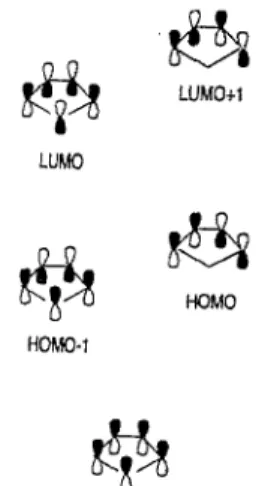
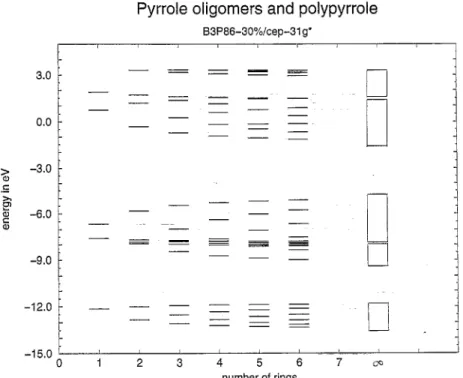
Polymer properties were obtained by plotting results for trimers through hexamers against inverse chain lengths and extrapolating to infinity. Since the geometry switches from aromatic to quinoid for borole pentamers, we used hexamers through nonamers for extrapolation of borne systems. The energy levels arising from the five "rr-orbitats of five-ring heteroaromatics (Fig. 2) are plotted in Figs. 3-6 for pyrrole, thiophene, tellurophene and borote oligomers.
Vertical ionization potentials (IPs) and electron affinities (EAs) were estimated from extrapolated negative HOMO and LUMO energies, respectively. Vertical excitation ener- gies (Am~x) were calculated from extrapolated HOMO- LUMO gaps and compared to the corresponding Area× in the
7 8
~=1/2-3 ~fl=-1/24
9 10
Fig. 1. Structures of polyacetylene 1, polyborole 2, polycyclopentadiene 3, polypyrrole 4, polyfuran 5, polysilole 6, polyphosphote 7, polythiophene 8, polyselenophene 9, polytellurophene 10.
LUMO+I
LUMO
HOM0.~
Fig. 2. The "rr-orbitals of cycl0pentadiene derivatives. observed absorption spectra of oligomers. Using HOMO- LUMO gaps to estimate Am~x is analogous to estimating band- gaps from band structure calculations employing Bloch orbi- tals. Both approaches provide the energy necessary to create free charge carriers, neglecting electronic relaxation effects and do not yield the energy of excitonic excitations [24].
At the LSDA level, bandgaps are underestimated by at least 40% [ 5,25,26]. This has become known as the bandgap
U. S a l z n e r et al. / S y n t h e t i c M e t a l s 96 (1998) 1 7 7 - 1 8 9 179 > co 3.0 0.0 -3.0 -6.0 -9.0 -12.0
Pyrrole oligomers and polypyrrole
B3P86-30%/cep-31 g* m m
lq
4 7 r -15.0 0 1 2 3 5 6 v~ number of ringsFig. 3. Development of the band structure of polypyrrole from energy levels of monomer through hexamer of pyrrote.
>
r.-
3.0
thiophene oligomers and polythiophene
B3P86-30%/cep-31 g* 0.0 -3.0 -6.0 -9.0 -12.0 , i -15.0 0 2
Fig. 4. Development of the band structure of polythiophene from
K~
E
m i , r i , 4 6 number of ringsenergy levels of monomer through hexamer of thiophene.
problem of density functional theory. The origin of the band- gap problem, i.e. whether it arises from limitations of the LSD approximation or whether it is inherent to DFT, has been investigated in numerous publications [25-29]. The majority of analyses led to the conclusion that the bandgap problem is due to the derivative discontinuity in the exchange correlation functional with respect to particle number and therefore inherent to DFT. In contrast, Williams and yon Barth [30] and Baerends and Gritsenko [31 ] argue thatDFT
is a powerful tool for approximating absorption spectra and that problems with DFT orbital energies are caused by the poor asymptotic behavior of the density within the LSD approximation and the incomplete cancellation of the self- interaction energy.
We have examined HOMO and LUMO energy levels, HOMO-LUMO gaps and extrapolated bandgaps employing hybrid functionals empirically [ 32,33 ]. Inclusion of Hartree- Fock (I-IF) exchange in the exchange correlation functional
[80 U, Salzner et aL ~Synthetic Metals 96 (1998) 177-189 >
?,
3.0 0.0 -3.0 -6.0 -9.0 -12.0Tellurophene Oligorners and polytellurophene
B3P86-30%/cep-31 g*
[]
I I I i ~ I I T i
- t 5 . 0 0 1 2 3 4 5 6 7 number of rings
Fig, 5. Development of the band structure of polytellurophene from energy levels of monomer through hexamer of tellurophene.
> _= 3.0 _ _ 0.0 L -3.0 --6.0 -9.0 -12,0 m - - h B - - m m - -- -- - - - - Z
LJ
-15.0 0 1 2 3 4 5 6 7 8 9 co number of ringsFig, 6. Development of the band structure of polyborole from energy levels of monomer through nonamer of borole.
leads to a considerable improvement of energy gaps over those obtained with LSDA. By trial and error we established that a weight of 30% for the HF exchange leads to better agreement of HOMO-LUMO gaps with experimental exci- tation energies than with the B3LYP [18] or B3P86 [18] functionals which include 20% t-IF exchange. With the B3P86-30% functional extrapolated bandgaps of polythio- phene, polypyrrole, polyfuran and polythiazole agree to within _0.1 eV with experimental bandgaps [32]. The suc- cess of the approach is partially due to error cancellation since HOMO and LUMO energies underestimate IPs and EAs by
about 1 eV [32]. All calculations in the present paper were carried out employing the B3P86-30% functional. Since the polymers under investigation have very similar electronic structures, we expect the predicted bandgaps to be accurate to at least within +_ 0.2 eV.
Bandwidths were obtained as orbital energy differences between the appropriate extrapolated orbital energies. Each of the five w-orbitals (compare Fig. 2) of the monomers gives rise to a band in the polymers. Figs. 3-6 show how the bands develop gradually for pyrrole, thiophene, tellurophene and borole. Extrapolated bands for polymers are also depicted.
U. Salz~er er al. / Synthetic Metals 96 (1998) 177-189 I81
3. Results
3.1. Bandgaps
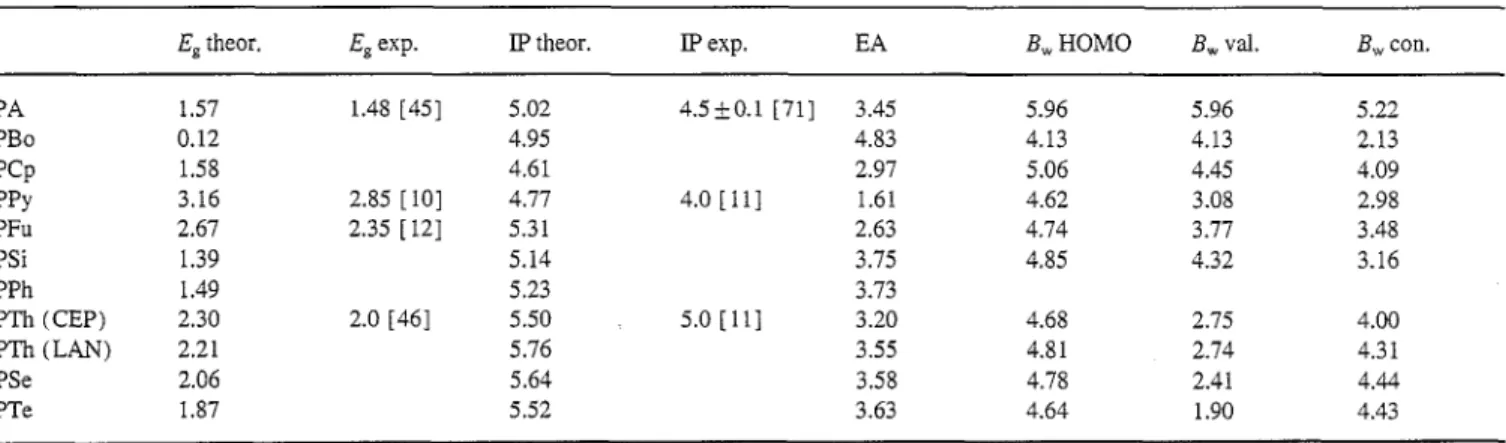
Table 1 summarizes bandgaps, ionization potentials (IPs), electron affinities (EAs), and bandwidths for PA, PBo, PCp, PPy, PFu, PSi, PPh, PTh, PSe and PTe. Experimental data are included where available. The extrapolated bandgaps for the polymers with exception of polyborole range from 1.39 to 3.16 eV. Polyborole has a vanishingly small bandgap of about 0.12 eV or less. The extrapolated LUMO level lies actually below the extrapolated HOMO level for polyborole. A small bandgap may therefore arise due to an avoided crossing. The widely used polymer PPy has the largest band- gap, 3.16 eV, of all systems studied. PTh has the third largest bandgap, 2.30 eV.
Theoretical bandgaps for PA, PPy, PFu and PTh are between 0.11 and 0.31 higher than experimental gaps. We argued in a recent publication [ 32] that theoretical bandgaps calculated for isolated chains are expected to be about 0.2 eV larger than condensed phase values. After correcting for this effect, our theoretical bandgaps agree to within 0.11 eV with experiment. This success in predicting bandgaps involving a range of different heteroatoms gives us confidence that pre- dictions for unknown systems are reliable.
3.2. Bandwidths
Table 1 lists HOMO, valence and conduction bandwidths as obtained from extrapolation of the appropriate oligomer energy levels ( compare Figs. 3-6). The lowest w-band which originates from the all bonding v-orbital is much lower in energy and well separated from the next two v-bands for PPy, PTh and PBo. For PTe there is almost no gap between these bands.
The HOMO orbitals give rise to wide bands (which run down in band structure diagrams), the H O M O - 1 orbitals generate narrow bands (which run up slightly). Due to the large splitting of the energy levels arising from the HOMOs as the chains get longer, the H O M O - 1 orbital energies already lie within the levels arising from the HOMOs for
trimers of PPy, PTh and PTe. This leads to avoided crossings in band structure diagrams. Since bandwidths of polymers are dete~,Tnined using the uppermost band, valence band- widths from band structure calculations include levels arising from the H O M O - 1 at the beginning of the Brillouin zone ( k = 0 ) and levels arising from the HOMO at the end of the Brillouin zone ( k = c r / a ) . The H O M O - 1 bands are very narrow and contribute little to bandwidths (for relative mag- nitudes of the HOMO and valence bands see Table 1 ). There- fore, the position of the avoided crossing has a major influence on the valence bandwidths (compare Figs. 4 and 5 for PTh and PTe). For PBo no avoided crossing in the valence region occurs since the band corresponding to the HOMO - 1 of the other polymers is empty and forms the valence band (compare Fig. 7). HOMO and valence bandwidths are there- fore identical for PBo.
Since we intend to use bandwidths as a measure for deto- calization [34], we will use HOMO bandwidths rather than valence bandwidths to compare delocalization in different polymers. The HOMO bands are wider than the valence bands and differ by only 0.77 eV for the different polymers. PCp has the largest HOMO bandwidth (5.06 eV) and PBo has the smallest (4.13 eV). HOMO bandwidths of the remaining polymers lie within 0.23 eV. These similar values indicate very similar degrees of delocalization of all systems studied here.
The LUMO and LUMO + 1 give rise to two unoccupied bands. For PPy a gap opens above the LUMO band but for PTh and PTe no such splitting of the levels is visible in Figs. 4 and 5. To estimate valence bandwidths we have nonetheless included only the energy levels having their origin in the LUMO of the monomer.
The largest conduction bandwidths were obtained for PCp, PSe and PTe (around 4 eV), even after correcting for a basis set effect of about 0.3 eV for the latter two. PBo and PPy have the smallest conduction bandwidths. The conduction band of PA is wider than those of the heterocyclic polymers. The difference is that all ~r-levels form one band in PA; in contrast, the w-levels give rise to two separate bands for the heterocyclic polymers. For PCp, PTh, PSe and PTe, there is Table 1
Theoretical and experimental bandgaps (Eg), IPs EAs, and theoretical bandwidths (Bw) for PA, PBo, PCp, PPy, PFu, PSi, PPh, PTh, PSe and PTe
Eg theor. Eg exp. IP theor. IP exp. EA Bw HOMO Bw val. Bw con.
PA 1.57 1.48 [45] 5.02 4.5___0.1 [71] 3.45 5.96 5.96 5.22 PBo 0.12 4.95 4.83 4.13 4.13 2.13 PCp 1.58 4.61 2.97 5.06 4.45 4.09 PPy 3.16 2.85 [10] 4.77 4.0 [11] 1.61 4.62 3.08 2.98 PFu 2.67 2.35 [ I2] 5.31 2.63 4.74 3.77 3.48 PSi 1.39 5.14 3.75 4.85 4.32 3.16 PPh 1.49 5.23 3.73 PTh (CEP) 2.30 2.0 [46] 5.50 5.0 [ 11 ] 3.20 4.68 2.75 4.00 PTh (LAIN) 2.21 5.76 3.55 4.81 2.74 4.31 PSe 2.06 5.64 3.58 4.78 2.41 4.44 PTe 1.87 5.52 3.63 4.64 1.90 4.43
182 U. Satzner et at. / Synthetic Metals 96 (1998) 177-189 bl a2 butadiene - - ' . ~ - ' 7 - -
boro~e cyctopentadiene pyrrele
Fig. 7. Comparison between energy levels of second period heterocycles.
. bl
b~ furan
almost no gap between the conduction band and the next higher w-band. For PPy, PFu and PSi, there is a large gap between the conduction band and the next higher w-band.
3.3. Ionization potentials (IPs) and electron affinities (EAs) Most of the polymers studied have IPs between 5.1 and 5.5 eV. Note that there is a basis set effect of 0.26 eV for PTh. Assuming it would be similar for PSe and PTe, the IPs of these polymers were 5.38 and 5.26 eV, respectively. The IPs for PBo, PCp and PPy are lower, 4.95, 4.61 and 4.77 eV. The EAs vary over a much wider range than the IPs. PPy has the smallest EA, followed by PFu and PCp. EAs of PTh, PSe and PTe are very similar and larger than those of the former compounds. PSi and PPh have EAs 0.53 and 0.55 eV larger than PTh, which suggests that they are possible can- didates for stable n-doped polymers. Finally, PBo has a large EA, 4.83 eV, due to its electron deficient nature.
3.4. Geometries
In Table 2 bond lengths are summarized for the inner rings of hexamers of our heterocycles and for the central unit of
C24H26.
Where available, comparison is made to other work.The only system for which X-ray data exist for hexamers is thiophene. With the CEP-31G* basis set, the bonds in sexi- o thJophene are up to 0.026 A longer than the experimental values [ 35 ]. The bond angles ( not shown) agree very closely
(to within 0.7 °) with experiment. With exception of the C - S bond, LSDA [36] and DFf/hybrid geometries are almost identical. Compared to HF theory [9], Dk-T yields longer C=C double bonds and shorter interring bonds. Thus, at I-IF, w-electrons are more localized. This is most likely due to the neglect of electron correlation. The unpolarized LANL2DZ basis set leads to shorter interring C-C and intraring C-C and C=C bonds but longer C-S bonds. The intraring C--C and C=C bonds are in closer agreement, the C-S and C-C bonds are in poorer agreement with experiment than with the CEP- 31 G* basis set. The bond length alternation is underestimated with DFT, especially with the LANL2DZ basis set, and over- estimated with HF theory compared to experiment.
For PPy and PFu, geometries can be compared to I-IF and LSDA data only. For the aromatic pyrrole and furan rings, HF theory seems to underestimate electron delocalization considerably. This results in shorter C=C and longer C-C bonds. LSDA and DFlr'/hybrid results compare favorably.
The bond length alternation A is given as the difference between the double bond and the longer single bond (intrar- ing or interring). For PA we obtain single bond lengths of 1.444 A and double bond lengths of 1.380 A. The bond length alternation is 0.064 ,~. With the exception of sexiborole, all hexamers are aromatic. This means that the interring bond is a single bond. For PPy, PFu, PTh, PSe and PTe, the intraring single bonds are shorter that the interring bonds. For PPh both single bonds are about the same length. In sexicyctopenta- diene and sexisilole, the bonds connecting the rings are shorter than the intraring single bonds.
U. Satzner et al. / Synthetic Metals 96 (1998) 177-189
Table 2
Bond lengths of central units of C24H26 arid hexamers of heterocycles
1 183 C2-X Cz=C4 C4--C5 Cz--C6 ,~ PA 1.380 1.444 0.064 PBo 1.573 1.471 1.382 1.388 0.089 PCp 1.523 1.386 1.454 1,447 0.068 PPy 1.380 1.402 1.429 1,457 0.055 HI: [9] 1.371 1.371 1,452 1.449 0.081 LSDA [36] 1.406 1.405 1,433 1.462 0.057 PFu 1.366 1.387 1.435 1.449 0.062 HF [9] 1.375 1.351 1.439 1.432 0.088 PSi 1.894 1,389 1.463 1,448 0,074 PPh 1.846 1.389 1.446 1.451 0,062 PTh (CEP) 1.752 1.396 1.427 1.459 0.063 (LAN) 1.804 1.381 1,422 1.436 0.055 HF [9] 1,745 1.358 1,427 1.454 0,096 LSDA [36] 1.729 1.395 1.428 1.461 0,066 Exp. [35] 1.73 1.37 1.41 1.45 0,08 PSe 1.921 1.382 1.422 1.436 0,054 HF [9] 1.884 1.379 1.449 1,476 0,097 PTe 2.100 1.384 1.423 1.437 0.053 4. Discussion 4.1. PolyacetyIene
Polyacetylene has been investigated intensively [ 6,37-45 ] (this list of references is far from complete). Upon doping, stretched aligned PA reaches conductivities of 106 S/cm [46], close to that of copper. On a conductivity to weight ratio, the conductivity of PA exceeds that of copper. The bandgap determined as the onset of photoconductivity is 1.48 eV [45]. This is slightly higher than the absorption onset and lower than Ama x of 1.9 eV [39].
We obtained a bandgap of 1.57 eV for PA. After correction for the difference between gas phase and condensed phase of 0.2 eV this is only 0.09 eV lower than the experimental value. Valence and conduction bandwidths are 5.96 and 5.22 eV, respectively. The IP is 0.48 eV lower and the EA is 0.25 eV higher than that of PTh.
4.2. Polyborole
Polyborole is not known experimentally. The pentaphen- ylborole monomer, however, has been synthesized [47]. It is deep blue with an absorption maximum of 567 nm or 2.19 eV. This agrees reasonably well with our calculated value of 2.98 eV for the unsubstituted monomer in the gas phase. Borole is antiaromatic and has the same color as the isoelec- tronic, antiaromatic pentaphenylcyclopentadienyl cation. In air, pentaphenylborole is instantly oxidized. Since n-doping would make borole isoelectronic with the other heterocyclic systems in this study, the n-doped form might be more stable
than the neutral form. This is supported by the recent exper- imental discovery of a planar five-membered ring structure of the dianion of 1,2-diborata-4-boracyclopentadiene [48] which is isoelectronic with borole. Since boron carried the disilylamino substituent, the system can be considered to be partially n-doped. Thus, n-doped polyborole might be stable enough to be obtained experimentally.
In Fig. 7, orbital levels of heterocycles of second period elements are compared to those of butadiene. It can be seen that the empty v-orbital of boron leads to a splitting of the butadiene LUMO in two levels. The splitting of the LUMO level is, however, smaller than for the other heterocycles, where the b1 level drops below the az level and becomes the HOMO - 1. Thus, compared to butadiene the result is a low- ering of the LUMO. This leads to the long wavelength absorp- tion observed for borole.
Table 3 summarizes bond lengths in borole oligomers. B orole through quaterborole have aromatic structures ( single bonds connecting the rings and double bonds between C2 and C3, and between C4 and C5). With five rings the structure changes to quinoid with double bonds connecting the rings and single bonds between C2 and C3, and between C4 and C5. Associated with this structural change is a decrease in bandgap and an increase in valence and conduction band- widths (compare Fig. 6). For oligomers with more than five rings, the bandgaps and bandwidths develop linearly with 1 / n. This shows that end effects diminish quickly with increas- ing chain lengths even for systems with quinoid structures. With sufficient chain length, structural and electronic prop- erties can be calculated with the use of oligomers and extrap- olation methods.
184 U. Salzner et al. / Synthetic Metals 96 (t998) 177-189
Table 3
Evolution of geometric parameters for borole oligomers with increasing chain length
t4 C2-X C,=C4 C4-C5 C2-C~ A Monomer 1.590 1.363 1.525 0.162 Dimer 1.610/1.569 1.378/1.373 1.500 1.448 0.122 Trimer 1.593 1.399 1.479 1.445 0.080 Tetramer 1.585/1.591 1.397/1.397 1.465 1.434 0.068 Pentamer 1.575 1.458 1.393 1.394 0.065 Hexamer 1.572/1.573 1.471 / 1.470 1.382 1.388 0.089 Heptamer 1.572 1.473 1.380 1.387 0.093 Octamer 1.572/1.572 1.474/1.474 1.380 1.387 0.094 Nonamer 1.572 1.474 1.379 1.387 0.095
H O M O - L U M O gaps of all borole oligomers are very small. Extrapolation of hexamer through nonamer values indicates that occupied and unoccupied n'r-tevels cross, the HOMO drops 0.12 eV below the LUMO. A small bandgap might thus arise from an avoided crossing or polyborole might be a synthetic metal. Due to its very low lying unoc- cupied "rr-levels it is also a good candidate for n-doping. As outlined above, the stability of the neutral form might be poor, but the n-doped form is expected to be more stable. Polyborole, neutral or n-doped, is predicted to have very interesting electronic properties.
4.3. P o l y c y c l o p e n t a d i e n e
Polycyclopentadiene is one of the experimentally less investigated systems. It has been obtained from chemical polymerization of cyclopentadiene and bicyclopentadiene. In dichloromethane, black conducting plastics have been pre- cipitated [49]. Theoretically, it was examined with semi- empirical methods [50-52]. Hong et al. found PCp to be quinoid and to exhibit a bandgap of 1.21 eV. The small bandgap was attributed to the decreased interference of the CH2 group with the ~r-systems compared to ~r-donating groups.
The DFT/hybrid oligomer approach predicts the structure of sexicyclopentadiene to be aromatic. Table 4 lists bond length parameters for cyclopentadiene through sexicyclopen- tadiene. As for terthiophene, the geometry is essentially con- verged f o r tercyclopentadiene. The central interring bond is 0.011 A shorter in the hexamer than in the dimer. This is roughly the same difference as between the thiophene dimer and hexamer (0.009 A). The intraring single bond is longer in sexicyclopentadiene than in sexithiophene and the C = C bond is shorter. The opposite trend would be expected ifPCp were quinoid. The oligomer approach, however, favors aro- matic structures due to end effects. Nonetheless, the case of polyborole (compare previous section) shows that a chain length of five monomer units is long enough to allow for
switching from aromatic to quinoid structure. We would expect to see at least slight structural changes toward the quinoid form with increasing chain lengths if the polymer preferred a quinoid structure. This can be observed in Table 3 already between monomer and dimer of borole.
Semi-empirical methods which found PCp to be quinoid seem to favor quinoid structures. For PTh the existence of a quinoid structure (although higher in energy than the aro- matic form) is predicted at semi-empirical levels [43]. This was shown to be an artifact with DFT methods [5]. In sum- mary, we do not see any indication that PCp is quinoid but, due to the bias toward aromatic structures with the oligomer approach, a final decision cannot be reached at this point.
The extrapolated bandgap obtained for aromatic PCp is 1.58 eV. This is 0.72 eV less than that of PTh and 1.60 eV less than that of PPy at the same level of theory. The value is, however, still too large to allow for significant intrinsic conductivity. The IP is about 0.89 eV lower than that of PTh and 0.16 eV lower than that of PPy. The EA is 0.23 eV lower than that of PTh and 1.5 eV larger than that of PPy. Therefore, PCp should be p-dopable. The n-doped form is not expected Table 4
Evolution of geometric parameters for cyclopentadiene oligomers with increasing chain length
Cz-C~ C2=C~ C4-C~ Cz-C6 A Monomer 1.513 1.368 1,480 0.i12 Dimer 1.522/1.513 1.380/1.368 1.471 1.458 0.091 Trimer 1.522 1.383 1.463 1.456 0.080 Tetramer 1.522/1.522 1.385/1.383 1.457 1.449 0,072 Pentamer 1.523 1,385 1.455 1,448 0.070 Hexamer 1.523/1.523 1.386/1.386 1.454 1.447 0.088
U. Salzner et al. / Synthetic Metals 96 (1998) 1 7 7 - 2 8 9 185
to be stable. HOMO and conduction bands of PCp are wider than those of PTh and PPy. Therefore, p-doped PCp could, in principle, be a better conductor than PTh and PPy.
4.4. PoIypyrrole
Polypyrrole has been studied extensively experimentally [ 1,2,53,54] and theoretically [6-9,55]. The bandgap is usu- ally given to be 3.2 eV [ 11 ]. A recent investigation by Zotti et al. [ 10] showed that polymerization of pentamers and heptamers leads to a smaller bandgap, 2.85 eV, probably due to a more ordered structure. The highest conductivity achieved for PPy is, to our knowledge, 500 S/cm [3]. PPy is stable in the p-doped form but very air sensitive in the neutral form. PPy cannot be n-doped.
We obtain a bandgap of 3.16 eV. After correction for the condensed phase effect of about 0.2 eV, the predicted band- gap of 2.96 eV is in excellent agreement with the experimen- tal value of 2.85. PPy has the lowest IP and the lowest EA of all polymers studied here. This agrees nicely with experi- mental observation that PPy can be p- but not n-doped. Although PPy has the smallest HOMO bandwidth of all sys- tems studied here, the conductivity in the p-doped state is high. Thus, the conductivity of none of the other systems in this investigation is expected to be limited by bandwidth.
4.5. Polyfitran
Experimental investigation of polyfuran was complicated by the drastic conditions necessary to polymerize furan [ 12]. As a result PFu was usually obtained with short conjugation lengths due to ring opening. However, well-ordered material has finally been obtained [56]. Neutral PFu is air stable at room temperature. The bandgap was determined to be 2.35 eV [ 12], 0.35 eV larger than that of PTh. This is in excellent agreement with our prediction of 2.67 eV, which is 0.37 larger than that for PTh. Conductivities as high as 100 S/cm were reported [57]. This is in the range of earlier results for PPy and PTh. Glenis et al., [ 12], however, found that doped PFu is relatively unstable. Especially in the p-doped state, nucleo- philic agents cause ring opening.
The HOMO bandwidth of PFu is slightly larger than those of PTh and of PPy. The conduction band is wider than that of PPy but narrower than that of PTh. Although the IP of furan is higher than that of thiophene, the IP of PFu is pre- dicted to be 0.19 eV lower than that of PTh. This is in qual- itative agreement with ab initio calculations [55] which predict the IP of PFu to be 0.06 eV lower than that of PTh. The EA of PFu is 0.57 eV lower than that of PTh and 1.02 eV larger than that of PPy. We expect therefore that PFu wilt not be very stable in the n-doped form.
These results show that the electronic properties of ordered infinite chains of PFu are not inferior to those of PTh and PPy. Therefore, higher conductivities can be expected if the quality of the polymer can be further improved. Differences
in measured conductivities are probably due to ring opening and limited conjugation lengths.
4.6. PoIysilole
In 1989 synthesis of polysilole was reported [58] but it was shown later by the same group that the polymer was polydiethenylsilane with four-membered rather than five- membered rings [59,60]. The bandgap was measured to be 2 eV. Ab initio calculations are in agreement with experi- mental findings [61]. At the semi-empirical level, it could be shown that a quinoid structure of polysilole would also have a bandgap of about 2 eV while the aromatic form has a lower bandgap, 1.44 eV [62]. The quinoid form was pre- dicted to about 2 kcal/mol-ring more stable.
As with sexicyclopentadiene we obtain an aromatic geom- etry for sexisilole. Geometric parameters for monomer through hexamer of silole are summarized in Table 5. Again there is no indication in the structural trends of the oligomers that PSi will switch to a quinoid form with longer chain length. The interring single bond length and the intraring C=C bond lengths in sexisilole have the same lengths as those in sexifuran. However, oligomer calculation employed here cannot determine ultimately whether PSi is aromatic or quinoid. The bandgap is 1.39 eV, in good agreement with the Hiickel value for the aromatic form [62]. The IP of PSi is predicted to be lower than that of PTh and the EA is predicted to be higher. Thus, PSi could be p- and n-dopable. The HOMO band is 0.17 eV wider than that of PTh, the conduc- tion bandwidth is smaller than that of PTh but wider than that of PPy. Thus, PSi is a good candidate for a conducting polymer.
4.7. Polyphosphole
Potyphosphole has not been studied experimentally or the- oretically. Oligomers up to quaterphosphole were synthe- sized and crystal structures were obtained [ 63 ]. The structure is twisted with a P - C - C - P dihedral angle around the central Table 5
Evolution of geometric parameters for silole oligomers with increasing chain length C2-Si C2=C4 C4--C5 C2.-C6 A Monomer 1.880 1.368 1.497 0.129 Dimer 1.899/1.875 1.379/I.37i 1.485 1.461 0.082 Trimer 1.893 1.384 1.470 1.456 0.082 Tetramer 1.894/1.895 1.386/1.385 1.467 1.451 0.082 Pentamer 1.894 1.388 1.464 1.450 0.076 Hexamer 1.894/1.894 1.389/1.388 1.463 1.448 0.088
I86 U. Sat~er et at./Synthetic Metals 96 (1998) 177-189
bond of 25 ° . The authors concluded that there is no conju- gation between the phosphole rings because the interring bonds (1.43 and 1.451 A) are not shortened. This is a sur- prising conclusion considering that a normal C-C bond is about t.5 A long. Also, the central interring bond is 0.2 A shorter than the outer interring bond. The twist angle also is larger for the outer rings, 49 ° , than around the central bond, 25 ° .
In Table 6 theoretical and experimental bond lengths are compared. Although the crystal structure was obtained for quaterphosphole end capped by Br and substituted with phenyl rings at P and methyl groups at C3 and C¢, the agree- ment is good. The intraring C=C and C-C bonds differ only by 0.002-0.004 A. The theoretical C-P bond and the central interring bond are 0.02 A longer. The inner rings in calculated planar quaterphosphole are symmetric, while they are unsym- metrical in the experimental structure. This is probably due to the twisting of the substituted quaterphosphole.
Our calculated bandgap for polyphosphole is 1.49 eV. This is the third lowest bandgap of all systems in this study. This can be explained by effective conjugation along the chain in combination with the inter pair effect. Phosphorous, like other higher period elements, does not form s-p hybrids readily [64]. It employs the more loosely bound p-electrons for bonding and the lone pair has mainly s-character. This leads to a pyramidal geometry around phosphorus and prevents efficient interaction of the lone pair with the w-system. The smaller interaction of the lone pair with the ~r-system results in a reduced upward shift of the LUMO and a reduced band- gap compared to PPy. In agreement with this, the IP and EA of PPhos are predicted to be comparable to those of PSi. This is in sharp contrast to the second period of the Periodic Table where the bandgap is largest and IP and EA are smallest for PPy. PPh could therefore be both p- and n-dopable. We con- clude that if well-ordered planar PPh can be made, it will have properties quite different from PPy.
We did not evaluate bandwidths for PPh since it is difficult to identify the w-orbitals due to the lack of planarity. The phosphorus atoms are slightly above and below the plane defined by the carbon backbone. The C - P - H angle of the central rings is 98.0 °. Due to the lack of aromaticity, the intraring C=C bonds are short, almost identical to those in PCp and PSi. The intraring single bond is 0.017 A longer than that in the aromatic PPy. The interring single bond is slightly shorter than in PTh and PPy. This and the low band- gap indicate the presence of conjugation along the chain in PPh. The deviation from planarity in the experimental study is probably due to the bulky phenyl groups at P and the methyl groups at the carbons.
4.8. Polythiophene
Polythiophene has been studied extensively [4- 7,9,11,36,55,65-67]. Its electronic properties are well estab- lished. The bandgap is 2.0 eV, it is n- and p-dopabte although the stability of the n-doped form is poor. (A bandgap of 1.7
Table 6
Comparison between quaterphosphole
I
H
theoretical and experimental geometries of
C - X C = C C - C /% C-C'
Theor. 1.845/1.845 1.387/1.386 1.449 0.062 1.453 Exp. 1.822/1.790 1.374/i.383 1.445 0.062 1.43
eV has been observed in alkyl-substituted PTh [ 68 ].) Neutral PTh is an insulator. The highest conductivity reported for the p-doped form of trfh is 2000 S/cm [4]. Our calculated bandgap is 2.30 eV. After correction for the lowering in the condensed phase the calculated value is 0.1 eV from experi- ment. The IP of PTh is 0.73 eV larger than that of PPy. This explains the better stability of the neutral form of PTh. The EA is 1.59 eV larger than that of PPy. This is in agreement with the finding that PTh can be n-doped while PPy cannot. The HOMO band is slightly wider (0.08 eV) and the con- duction band is significantly wider than that of PPy. Hence, the small difference in HOMO bandwidths cannot be the reason for the differences in conductivities of PTh and PPy (2000 versus 500 S/cm). Note that the valence band of PTh is actually smaller than that of PPy.
4.9. PoIyselenophene
The bandgap of polyselenophene was determined electro- chemically to be 2.0 eV [ 15]. This is identical to the bandgap of PTh. The conductivity increased by 105 upon doping. The highest conductivity achieved was 3.7× 10 -a S/cm. The conductivity in the undoped state was 2.1 × 10 -7 S/cm. The electrical conductivity declines with temperature [ 15 ]. It was suggested that the difference in conductivity between PTh and PSe may arise from structural defect related traps as a result of the shorter conjugated chains.
Oligoselenophenes up to hexamers were synthesized and absorption spectra were determined [69]. Selenophene oligomers absorb at wavelengths about 0.3-0.2 eV longer than the corresponding thiophene oligomers. Therefore, one would expect a slightly smaller bandgap for PSe than for PTh. Our calculations predict a difference of 0.15 eV. The IP of PSe is calculated to be 0.12 eV lower than that of PTh, the EA is almost the same as that of PTh. HOMO and conduction bandwidths are also the same for PSe as for PTh. There is no reason to expect PSe to be an inferior conductor than PTh, unless the increase in size of the heteroatom leads to larger interchain distances in the solid and prevents hopping between chains. More experimental investigations will most likely eventually increase the conductivity of PSe.
U. SaIzner et at./Synthetic Metals 96 (1998) 177-189 187
4.10. Polytellurophene
Polytellurophene was obtained by electropolymerization of bitellurophene [ 16]. Bitellurophene is a yellow-colored solid and relatively stable. The yellow color was attributed to interring conjugation in the planar molecule. The oxidation peak for tellurophene is 0.26 V lower than that of thiophene and selenophene. PTe was obtained from electropolymeri- zation of bitellurophene as a black film with a conductivity of up to 10 - 6 S/cm in the doped form and an intrinsic con- ductivity of 10- lz S/cm.
Our theoretical results predict a bandgap 0.34 eV smaller for PTe than for PTh. The value of 1.87 eV is, however, still too large for intrinsic conductivity. The IP of PTe is predicted to be 0.24 eV smaller than that of PTh. This in excellent agreement with the 0.26 lower oxidation potential. The EA of PTe is expected to be 0.08 larger than that of PTh. There- fore PTe, like PTh, should be stable in the p-doped form, but not very stable in the n-doped form. The HOMO bandwidth is slightly smaller and the conduction bandwidth is slightly larger than that of PTh. Thus, the lower conductivity meas- ured for PTe compared to PTh is not due to intrinsic electronic properties of PTe. According to our calculations, PTe could be a conductor as good as or better than PTh. Either the material has not been optimized to the same degree as PTh or the size of the heteroatom has an influence on the conduc- tivity in higher period systems.
4. I1. Trends and comparisons between the different polymers
Table i reveals that bandgaps correlate roughly with v- donor strengths of the bridging groups. With bridging groups from the second period of the Periodic Table, the bandgaps increase in the order PCp < PPy but decrease from PPy to PFu. This demonstrates that v-donor strength, which shows the same trend, dominates over electronegativity. (PBo is not included in this comparison since its electronic structure is qualitatively different from the other polymers.) Interest- ingly, in the third period of the Periodic Table the bandgap does not peak for PPh. The bandgap of PPh is almost as small as that for PSi. This can be explained by the fact that phos- phole is not aromatic like pyrrole. The phosphorus lone pair is high in s-character and the p-orbital is involved in the bond to hydrogen. As a result the hydrogen is almost perpendicular to the ring plane and the interaction between the lone pair and the v-system is small.
Comparison of PFu, PTh, PSe and PTe shows that band- gaps decrease in going down the group. The difference is largest between the second and third periods, 0.37 eV. The change between the fourth and fifth periods, 0.19 eV, is slightly larger than between the third and fourth periods, 0.15 eV. This is in agreement with chemical wisdom that second period elements are the exception in the Periodic Table, due to their ability to effectively hybridize s and p orbitals [64].
It is also well established that third and fourth period elements are more alike than fourth and fifth period elements.
Sexiborole which has two electrons less per ring than the other polymers is quinoid. Although the bond length alter- nation is largest in PBo, PBo has the smallest bandgap. PPy has the smallest bond alternation and the largest gap. This shows that the bond length alternation, which was shown to strongly influence the bandgap of polythiophene by Andr~ et al. [66], is of lesser importance when different systems are compared. The v-donor strength is clearly the dominant effect for the series of systems studied here. Similar conclu- sions were reached with I-IF calculations [55].
As discussed elsewhere [33], gas phase IPs and EAs for
molecules are underestimated by about 1 eV with our approach. Table 1 shows that solid state IPs of polymers are overestimated by 0.5-0.8 eV. There is thus a difference of 1.5-1.8 eV between molecular gas phase and solid state poly- mer data to be accounted for. This can be rationalized by the solid state polarization energy which has been determined to be about 1.7 eV for conjugated organic molecules [ 70]. Since the systems studied were fairly large and since no size dependence of the solid state polarization energy was observed, it can be assumed that there is a similar effect for conjugated organic polymers. Thus, the overestimation of polymer IPs in contrast to molecular gas phase IPs gives further support to the existence of a solid state polarization energy for polymers. It also shows that our IPs are flawed by two problems. The first is the systematic error in the IPs for the oligomers, and the second is the neglect of the solid state polarization energy. Thus, we can use these numbers only as a rough guide to determine trends. With this in mind it is encouraging to see that the calculated differences in IPs between PA and PTh ( - 0 . 4 8 eV) and between PA and PPy (0.25 eV) agree reasonably well with the experimental dif- ferences of - 0.5 +_ 0.1 and 0.5 + 1 eV, respectively.
Comparing IPs and EAs for the different polymers shows that changing the bridging group has a stronger effect on the LUMO (conduction band) than on the HOMO (valence band) energies. The HOMO energies vary only by up to 0.89 eV while the LUMO enerNes differ by up to 2.14 eV (exclud- ing PBo which is not isoelectronic with the other polymers). This might be related to the fact that the HOMO of cyclopen- tadiene derivatives has a node at the position of the hetero- atom. The extrapolated valence bandwidth of 5.96 eV for PA is in good agreement with 6.5 eV obtained with VEH solid state calculations by Br~das [ 11 ]. For PTh we obtain a valence bandwidth of 2.75 eV. This can be compared to 2.6 eV [ 11 ] with the VEH method, 2.4 eV [ 5 ] at LSDA, and 3.07 eV [9] at the MP2 level of theory. The discrepancies are somewhat larger for PPy for which we obtain a valence bandwidth of 3.08 eV, while larger values result with VEH, 3.8 eV [11], and at MP2, 3.95 eV [9]. Conduction band- widths in this work for PTh and PPy are about 1 eV larger than at the MP2 level [9] and the conduction band of PTh is 1.5 eV larger than obtained with the LSD approximation [ 5].
188 U. Salzner et at./Synthetic Metals 96 (1998) 177-189
Valence bandwidths of heteroaromatic polymers vary between 1.9 and 4.45 eV and are thus considerably smaller than that of PA. This is due to the avoided crossing between the two highest occupied w-bands and the splitting of H O M O - 2 w-levels from the valence band. In PA all the occupied w-levels form one band. PCp has the largest and PTe the smallest valence band of the heterocyctic polymers. In the absence of avoided crossings, bandwidths reflect the degree of interaction between orbitals along the polymer chain. Larger overlap allows for the stronger detocalization. This is reflected in wider bands in band structure diagrams. In contrast to valence bandwidths, the HOMO bandwidths are very similar for all the polymers investigated here. There- fore, any differences in conductivities of the former systems studied here are most likely not caused by differences in the degree of delocalization.
Although the investigated polymers are very similar in their electronic structures, no systematic relationship between bandwidths and bond alternation or interring distance has been found. The bandwidths seem to be more influenced by the w-donor strengths than by overlap which turned out to be very similar for all our systems. In the series PPy, PCp, PSi, for instance, the latter two have small bandgaps due to the small effect of the methyl and sityl groups on the HOMO and LUMO energies. They also have the largest bandwidths. For PPy the situation is reversed, the bandgap is large and the bandwidth is small. This can be explained by the fact that nv- donation affects the frontier orbitals more strongly than the lower and higher lying energy levels. Therefore, the same effect that increases bandgaps by pushing HOMO and LUMO apart automatically decreases bandwidths.
The conduction band and the next higher unoccupied band seem to be separate for some of the polymers, e.g. PPy and PFu (compare Fig. 3) but no appreciable gap seems to develop for others, e.g. PTh, PSe and PTe as shown in Figs. 4 and 5. There might thus be larger differences in electronic properties of these polymers with respect to n-doping as com- pared to p-doping.
and the absence of an avoided crossing in the valence band. PBo might be a synthetic metal or a semiconductor with an extremely small bandgap, 0.12 eV or less. Small gaps axe also predicted for PCp, PSi and PPh. The low bandgap of PPh as compared to PPy can be explained by the pyramidal character of phosphorus and the resulting small overlap of the tone pair with the v-system. PCp, PSi and PPh have, however, bandgaps well above 1 eV and would have to be doped to become conductive.
Conjugation along the chain, as indicated by similar HOMO bandwidths, is comparable in all systems studied. If the materials could be obtained with similar order and chain lengths, conductivities upon doping could, in principle, be comparable. Like bandgaps, bandwidths seem to be mainly influenced by v-donor strengths of the heteroatoms. No cor- relation was found between bandwidths and bond alternation or interring bond distance.
IPs increase in the following order: P C p < P P y < PBo < PSi < PPh < PFu < PTe < PSe < PTh. Since PTh with the highest IP is known to be p-dopable all the other systems should be as well. Since PPy is unstable in the neutral form, the even lower IP of PCp indicates that the neutral form might be unstable.
EAs increase in the order: PPy < PFu < PCp < PTh < PSe < PTe << PSi < PPh < PBo. Since PTh is not stable in the n-doped state, the systems left of PTh will certainly not be stable in the n-doped form either. The differences in EAs in Group Vt are small. Thus, the only reasonable candidates for n-doping are PSi, PPh and PBo. PBo might be stable in the n-doped form because it will become aromatic and isoelec- tronic with the other polymers.
The large differences in conductivities upon doping observed experimentally between PTh, PPy, PFu, PSe and PTe are not due to differences in bandgaps and bandwidths, IPs and EAs. They can almost certainly be attributed to dif- ferent conjugation lengths, disorder and crystal packing effects. For PSe and PTe, we expect that better conductivities will be achieved as the materials become optimized.
5. Conclusions
Comparison of various heterocyclic organic polymers shows that band structures of all systems with w-donors are qualitatively very similar. Bandgaps increase in the following order: PBo << PSi < PPh < PA, PCp < PTe < PSe < PTh < P F u < P P y . This roughly reflects the trend in w-donor strengths. Thus, PPy and PTh, the systems which are most common in the search for conducting polymers because of their chemical stability, are about the worst possible choice as far as bandgaps are concerned.
Weak w-donor strengths of the heteroatoms leads to small bandgaps. This can be achieved in going to higher periods or to the left in the Periodic Table. PBo stands out because it has two electrons per repeat unit less than the other heteroar- omatic polymers. This results in a low lying conduction band
Acknowledgements
The authors thank the Natural Sciences and Engineering Research Council of Canada and Memorial University for financial support. We also thank the Computing and Com- munications Department of the Memorial University and Digital for computing resources.
References
[ 1 ] G.B. Street, in T.A. Skotheim (ed.), Handbook of Conducting Poly- mers, Vol. 1, Marcel Dekker, New York, 1986.
[2] K.K. Kanazawa, A.F. Diaz, R.H. Geiss, W.D. Gill, J.F. Kwak, J.A. Logan, J.F. Rabolt, G.B. Street, J. Chem. Soc., Chem. Commun.
(1979) 854-855.
U. SalzJ~er et al. / Synthetic Metals 9 6 (1998) 1 7 7 - 1 8 9 189
(eds.), Conjugated Polymers and Related Materials, Oxford Univer- sity Press, Oxford, 1993.
[4] J. Roncali, Chem. Rev. 97 (1997) 173-205.
[5] G. Brocks, J. Chem. Phys. I00 (1996) 17 327-i7 333.
[6] J.L. Br6das, R. Silbey, D.S. Boudreaux, R.R. Chance, J. Am. Chem. Soc. 105 (I983) 6555--6559.
[7] A.K. Bakhshi, J. Ladik, M. Seel, Phys. Rev. B 35 (1987) 704-712. [8] J.L. Br~das, J.C. Scott, K. Yakushi, G.B. Street, Phys. Rev. B 30
(1984) i023-1025.
[9] H.O. Villar, P. Otto, M, Dupuis, J. Ladik, Synth. Met. 59 (1993) 97- 110.
[ I 0 ] G. Zotti, S. Martina, G. Wegner, A.-D. Schliiter, Adv. Mater. 4 (1992) 798-80I.
[ I 1 ] J.L. Brfidas, in T.A. Skotheim (ed.), Handbook of Conducting Poly- mers, Marcel Dekker, New York, 1986, pp. 859-913.
[ 12] S. Glenis, M. Benz, E. LeGoff, J.L. Schindler, C.R. Kannewuff, M.G. Kanatzidis, J. Am, Chem. Soc. 115 (I993) 12 51%12 525. [ 13] M.J. Gonz~ilez-Tejera, I. Carrillo, I. Hernfindez-Fuentes, Synth. Met.
73 (1995) 135-140.
[ 14] V. Hemand~z, J.T. Lrpez Navarrete, J.L. Marcos, Synth. Met. 41.43 ( 1991 ) 789-792.
[15] S. Glenis, D.S. Ginley, A.J. Frank, J. Appl. Phys. 62 (1987) 190- I94.
[ 16] T. Otsubo, S. Inoue, H. Nozoe, T. Jigami, F. Ogura, Synth. Met. 69- 71 (1995) 537-538.
[ 17] M.J. Friseh, G.W. Trucks, H.B. Schlegel, P.M.W. Gill, B.G. Johnson, M.A. Robb, J.R. Cheeseman, T. Keith, G.A. Petersson, J.A. Mont- gomery, K. Raghavaehari, M.A. A1-Laham, V.G. Zakrzewski, J.V. Ortiz, J.B. Foresman, C.Y. Peng, P.Y. Ayala, W. Chen, M.W. Wong, J.L. Andres, E.S. Replogle, R. Gomperts, R.L. Martin, D.3. Fox, J.S. Binkley, D.J. Defrees, J. Baker, J.P. Stewart, M. Head-Gordon, C. Gonzalez, J.A. Pople, Gaussian 94, Gaussian, Pittsburgh, PA, I995. [ 18 ] M.J. Frisch, .~E. Frisch, J.B. Foresman, Gaussian 94 User' s Reference,
Ganssian, Pittsburgh, PA, I994-1995.
[ I9] W. Stevens, H. Basch, J. Krauss, J. Chem. Phys. 81 (1984) 6026. [20] T.H. Dunning, P.J. Hay, in I. Schaefer (ed.), Modern Theoretical
Chemistry, Plenum, New York, 1976, pp. 1-28. [2I] P.J. Hay, W.R. Wadt, J. Chem. Phys. 82 (1985) 270. [22] W.R. Wadt, P.J. Hay, J. Chem. Phys. 82 (1985) 284. [23] P.J. Hay, W.R. Wadt, 3. Chem. Phys. 82 (1985) 299. [241 C. Taliani, L.M. Blinov, Adv. Mater. 8 (1996) 353-359. [25] M. Levy, Phys. Rev. A 52 (1995) 50-52.
[26] R.W. Godby, M. SchliJter, L.J. Sham, Phys. Rev. B 37 (1988) 10 159- I0 175.
[27] J.P. Perdew, M. Levy, Phys. Rev. Lett. 51 (1983) 1884. [28] R.K. Nesbet, J. Phys. Chem. 100 (1996) 6104-6106. [29] L. Fritsehe, PhysieaB 172 (1991) 7-17.
[30] A.R. Williams, U. von Barth, in S. Lundqvist, N.H. March (eds.), Theory of the Inhomogeneous Electron Gas, Plenum, London, 1983. [31 ] EJ. Baerends, O.V. Gritsenko, J. Phys. Chem. A 101 (1997) 5383-
5403.
[32] U. Salzner, J.B. Lagowski, P.G. Pickup, R.A. Pokier, J. Phys. Chem., accepted for publication.
[33] U. Salzner, J.B. Lagowski, P.G. Pickup, R.A. Poirier, J. Comput. Chem. I8 (1997) 1943-1953.
[34] R. Hoffmann, Solids and Surfaces: A Chemist's View of Bonding in Extended Structures, VCH, Weinheim, 1988.
[35] G. Horowitz, B. Bachet, A. Yassar, P. Lang, F. Demanze, J.-L. Fave, F. Gamier, Chem. Mater. 7 (1995) 1337-I34I.
[ 36] G. Brocks, P.J. Kelly, R. Car, Synth. Met. 55-57 (1993) 4243-4248. [37] J.L. Brfidas, R.R. Chance, R. Silbey, G. Nicolas, P. Durand, J. Chem.
Phys. 75 (1981) 255.
[38] A.J. Epstein, in T.A. Skotheim (ed.), Handbook of Conducting Poly- mers, Vol. 2, Marcel Dekker, New York, 1986.
[39] J.C.R. Fkncher, D.L. Peebles, AJ. Heeger, M.A. Druy, Y. Matsamura, A.G. MacDiarmid, H. Shirakawa, S. Ikeda, Solid State Commun. 27 (1978) 489-494.
[40] W.K. Ford, C.B. Duke, A. Paton, J. Chem. Phys. 77 (1982) 4564- 4572.
[41] R.B. Kaner, S.J. Porter, D.P. Nalrns, A.G. MacDiarmid, J. Chem. Phys. 90 (1989) 5102-5107.
[42] M.P. Keane, A. Naves de Brito, N. Correira, S. Svensson, L. Karlsson, B. Wannberg, U. Gelius, S. Lunell, W.R. Salaneck, M. Lggdlund, D.B. Swanson, A.G. MacDiarmid, Phys. Rev. B 45 (1992) 6390- 6399.
[43] Y.-S. Lee, M. Kertesz, J. Chem. Phys. 88 (1988) 2609-26t7. [44] L. Rodriguez-Monge, S. Larsson, J. Phys. Chem. 100 (1996) 6298-
6303mmmm.
[45] T. Tani, P.M. Grant, W.D. Gill, G.B. Street, T.C. Clarke, Solid State Commun. 33 (1980) 49%503.
[46] A.J. Heeger, in W.R. Salaneck, I. LundstriSm, B. R~by (eds.), Con- jugated Polymers and Related Materials, Oxford University Press, Oxford, 1993, pp. 28-62.
[47] 3.J. Eisch, J. Organomet. Chem. 500 (1995) 101-115.
[48] M. Unverzagt, H.J. Win!tier, M. Brock, M. Hoffmann, P.v.R. Schleyer, W. Massa, A. Berndt, Angew. Chem., Int. Ed. Engl. 36 (1997) 853-855.
[49] M. McCann, E.M. Coda, 3. Mol. Catal. A 109 (1996) 99-I 1 I. [50] S.Y. Hong, D.S. Marynick, Macromolecules 28 (i995) 4991-4995. [ 51 ] S.Y. Hong, S.J. Kwon, S.C. Kim, J. Chem. Phys. 103 (1995) 1871-
1877.
[52] S.Y. Hong, S.J. Kwon, S.C. Kim, D.S. Marynick, Synth. Met. 69-7i (1995) 701-702.
[53] H. Kuroso, M. Kiknachi, I. Ando, J. Polym. Sci. 33 (1995) 769. [ 54] G.B. Street, T.C. Clarke, M. Krounbi, K. Kanazawa, V. Lee, P. Pfluger,
J.C. Scott, G. Weiser, Mol. Cryst. Liq. Cryst. 83 (1982) 253-264. [55] P. Otto, Int. J. Quantum Chem. 52 (1994) 353-364.
[56] V. Hernfindez, J.T. L6pez Navarrete, G. Zotti, M. Veronelli, G. Zerbi, Synth. Met. 6%71 (1995) 391-392.
[57] K. Kaneto, S. Ura, K. Yoshino, Y. Inuishi, 3pn. J. Appl. Phys. 23 (1984) L189, L663.
[58] J. Shinar, S. Ijadi-Maghsoodi, Q.-X. Ni, Y. Pang, T.J. Barton, Synth. Met. 27-29 (1989) C593-C598.
[59] X. Wei, Y. Pang, S. Ijadi-Maghsoodi, T.J. Barton, S. Grigoras, Synth. Met. 41-43 (1991) 1583-1586.
[60] K.S. Wong, S.G. Han, Z.V. Vardeny, J. Shinar, Y. Pang, S. Ijadi- Maghsoodi, T.J. Barton, S. Grigoras, B. Parbhoo, AppI. Phys. Lett. 58 (199I) 1695-1697.
[61] S. Grigoras, G.C. Lie, T.J. Barton, S. Ijadi-Maghsoodi, Y. Pang, J. Shinar, Z.W. Vardeny, K.S. Wong, S.G. Han, Synth. Met. 4%50 (1992) 293-304.
[62] G. Frapper, M. Kertesz, Synth Met. 55-57 (1993) 4255-4259. [63] E. Deschamps, L. Ricard, F. Mathey, Angew. Chem., Int. Ed. EngI.
33 (1994) 1158-1161.
[64] W. Kutzelnigg, Angew. Chem., Int. Ed. Engl. 23 (1984) 272. [65] G.B. Kili¢, L. Toppare, E. Yurtsever, Synth. Met. 78 (1996) 19-25. [66] J.-A. Andre, J. Delhalle, J.L. Br~das, Quantum Chemistry Aided
Design of Organic Polymers. An Introduction to the Quantum Chem- istry of Polymers and Its Applications, World Scientific, London, 1991.
[67] J.L. Br~das, R.L. Elsenbaumer, R.R. Chance, R. Sitbey, J. Chem. Phys. 78 (1983) 5656-5662.
[68] T.-A. Chen, R.-D. Rieke, Synth. Met. 60 (1993) 175.
[69] S. Inoue, H. Nakanishi, K. Takimiya, Y. Aso, T. Otsubo, Synth. Met. 84.86 (1997) 341-342.
[70] N. Sato, K. Seki, H. Inokuchi, J. Chem. Soc., Faraday 1177 (1981) 1621-1633.
[71] W.R. Salaneck, H.R. Thomas, C.B. Duke, A. Paton, E.W. Plummer, A.J. Heeger, A.G. MacDiarmid, J. Chem. Phys. 71 (1979) 2044.