Araştırma Altıparmak/Kırklareli University Journal of Engineering and Science 4-2(2018) 189-211
ANALYSIS OF THERMAL EXPANSION AND MICRO-DELAMINATION
PHENOMENON OF CUTTING TOOL THIN SURFACE COATINGS IN
HIGH-SPEED DRY MACHINING
1
Sadettin Cem ALTIPARMAK2
School of Mechanical, Aerospace and Civil Engineering, The University of Manchester Manchester, United Kingdom
ABSTRACT
High-speed machining (HSM) is one of the commonly implemented recent machining technologies in industrial manufacturing operations. It enables higher efficiency and accuracy by reducing production cost and machining cycle times depending on the specific manufacturing operation requirements and demands. Particularly, dry machining is characterised with severe level of temperature and heat generation enters into cutting tools rather than machining with cutting liquid. HSM implementations lead to detrimental effects on tool lifespan resulting in premature cutting tool failure or tool damages. In order to overcome this problem, cutting tool thin surface coatings are applied to reduce the amount of heat transferring into cutting tool to enhance tribological conditions and wear resistance of cutting tools. However, as a result of the coefficient of thermal expansion (CTE) mismatching of coating layer materials, delamination phenomenon can be observed in coating structures during machining. As outcomes of the study based on the results obtained, total dimensional thermal expansion and micro-delamination of the most appropriate optimised 3-layered coating structure relatively decreased compared to 2-layered coatings, and the necessity of the thermal expansion capacity consideration in coating implementations was revealed for related Finite Element Analysis (FEA) simulations and coating structure designs.
Keywords: HSM technology; Multi-layer coatings; Delamination; Thermal expansion; CTE
1This study was prepared based on the data of MSc dissertation named „‟Analysis of Thermal Expansion of Cutting Tool Thin
Coatings Using Finite Element Modelling‟‟ of the corresponding author.
2
Araştırma Altıparmak/Kırklareli University Journal of Engineering and Science 4-2(2018) 189-211
YÜKSEK-HIZLI KESİMDE KULLANILAN KESİCİ TAKIMLARA
UYGULANAN YÜZEY KAPLAMASINDAKİ TERMAL GENLEŞME VE
MİKRO-KATMAN AYRIŞMASI OLUŞUMLARININ ANALİZİ
ÖZET
Yüksek-hızlı kesim tekniği (YHK) günümüzde sanayide yaygınca kullanılan bir metal kesme tekniğidir. Üretimin verimliğini arttırırken imalat gereksinimlerine bağlı olarak işlem süresini ve maliyeti düşürür. Özellikle kuru kesim ıslak kesime nazaran, yüksek mertebelerdeki sıcaklık ve kesici takımın içerisine transfer olan ısı oluşumuyla karakterize edilir. Kuru hızlı kesim uygulamaları kesici takımın ömrünün azaltılmasına ve kesici takımda beklenenden erken hasarlara yol açar. Bu sorunun ortadan kaldırılmasıyla ilgili olarak transfer olan ısıyı ve kesici takımın yüzeyinin yenmesini azaltmak aynı zamanda kesici takımın sürtünme durumunu arttırmak için kesici takımlara ince yüzey kaplamaları uygulanır. Ancak metal kesme işlemi boyunca bu yüzey kaplama malzemelerinin termal genleşme değerlerinin farklılığından dolayı katman ayrışması olayı gözlemlenebilir. Buradan hareketle elde edilen sonuçlara dayanarak yapılan çalışmada, 3-katmanlı optimize edilmiş yüzey kaplamasında 2-katmanlı yüzey kaplamalarına nazaran toplam eksenel genleşme ve katman ayrışması azalmıştır. Ayrıca termal genleşme kapasitesi sonlu elemanlar analizlerinde ve çoklu yüzey kaplamaları dizaynlarında göz ardı edilmemesinin gerekliliği ortaya koyulmuştur.
Anahtar Kelimeler: Yüksek-hızlı kesim tekniği; Çoklu yüzey kaplamaları; Katman ayrışması; Termal genleşme; Termal genleşme katsayısı
Araştırma Altıparmak/Kırklareli University Journal of Engineering and Science 4-2(2018) 189-211
1.
INTRODUCTION
In industry, the term „machining‟ is used to characterise the operations where the chip formation occurs. Even though chip-formation operations called machining is commonly associated with several big-scale industries such as aerospace and automotive industries, machining has also other implementation areas for precision and ultraprecision machining [1]. In conventional machining, as a sub-category of machining, materials are removed from the surface of workpiece to give part desired shape by deforming the workpiece irreversibly called plastic deformation [2]. Considering the consuming coolant, machining operations can be categorised as wet and dry machining. Although coolant fluids are advantageous to diminish heat generation and take away cutting debris from the cutting contact area, coolant fluids have hazardous effects on environment and health of operator. Therefore, the dry machining implementation trend has become a widely preferred alternative to avoid demerits of wet machining due to its sustainable and environmentally-friendly features [3]. Since severe amount of tool temperatures are generated compared to wet machining processes during the dry machining processes, cutting tools used in dry machining operations should have a high level of hardness capacity particularly at elevated temperatures [4]. Moreover, severe temperature levels can be reached in dry machining depending on the cutting parameters and type of machining process. The amount of generated heat at this temperature levels and cutting forces, in turn, can lead to detrimental effects on cutting tool lifespan resulting in premature tool failure or tool damages due to high rate of plastic deformation, which leads to high machining process expenditures for manufacturers [5].
To overcome the mentioned problem, tool manufacturers apply several techniques to reduce the amount of heat transferring into the cutting tools during machining processes e.g. single or multi-layer hard and soft functional thin surface coating implementations for cutting tools with the appropriate coating layer thickness based on the specific features of machining process such as the workpiece being machined, cutting tool material and cutting demands in order to prolong the life of cutting tools and increase wear resistance as well as tribological performance of the cutting tools [6]. However, as a result of the mismatching of thermal expansion coefficient (CTE) values of cutting tool and substrate or different materials of cutting tool thin coating layers, micro-delamination phenomenon and thermal expansion occurrence can be observed especially in HSM processes due to higher temperature generation compared to low and medium-speed machining
Araştırma Altıparmak/Kırklareli University Journal of Engineering and Science 4-2(2018) 189-211
processes, which effects machining efficiency and manufacturing cost resulting by premature tool failure. Therefore, there is a necessity for thermal expansion of the thin surface coatings of cutting tools and delamination phenomenon to be taken into consideration in surface cutting tool coating combinations and finite element analyses.
1.1.High-Speed Machining Technology
HSM is one of the up-to-date machining technologies that allows manufacturers to enhance machining accuracy by descending machining time, production cycle and cost. Even though HSM is mostly applied and known during the last seven-eight decades, still any standard definition proposed has not been approved yet for HSM [7]. It is stated that high-speed machining is not simple to be defined and compared with other conventional machining processes, since the actual experienced cutting speed in machining depends on several parameters e.g. material of workpiece, cutting tool type and cutting speed as illustrated in Fig. 1. Therefore, the definition of HSM can be associated with the whole conducted machining technology.
All the workpiece material illustrated in the Fig. 1 has its own range for cutting regime. Therefore, in order to characterise whether the machining operation is HSM or not, type of workpiece material being machined, cutting speed and cutting technology should be individually considered [8].
Figure 1: High-speed cutting scales based on workpiece materials being machined [8]
Araştırma Altıparmak/Kırklareli University Journal of Engineering and Science 4-2(2018) 189-211
In addition to reducing machining time and cost, HSM has some other advantages, which outweighs the disadvantages of HSM as illustrated in Fig. 2. The most relevant merit related to this paper is that in HSM processes, relatively less amount of heat is generated in the cutting zone and then less amount of heat is transferred into cutting tool comparing to traditional machining and low machining operations, which prolongs the lifespan of cutting tools used in HSM processes in manufacturing industry.
Moreover, HSM enables to provide better surface finish and part precision, reduction in cutting forces and workpiece distortion while decreasing the leading time of products. Apart from these merits of HSM technology, HSM has some demerits in addition to high deformation rate, which varies depending on the workpiece material being machined, desired production shape and geometry as follows; elevated amount of tool wear rate, tooling expenditure including spindles and controllers, difficulties in fixturing as well as the necessity of innovation in cutting tool geometries and coatings to compensate the drawbacks of HSM [9].
1.2.Cutting Tools and Coatings
In the recent competitive environment of manufacturing industry, due to the high machining efficiency and productivity as well as shorter lead time demand of manufacturing products, the innovation and research necessity of cutting tools and coatings has revealed. In this regard, cutting tools used in HSM processes should mainly have high hardness, toughness and stress resistance to withstand the wear mechanisms and tool deformation due to the elevated amount of generated heat, vibration existence and deformation rate in HSM processes.
Araştırma Altıparmak/Kırklareli University Journal of Engineering and Science 4-2(2018) 189-211
In order to meet the requirements of machining processes by enhancing the thermal, wear and tribological properties of cutting tools used in industry, cutting tools are coated with single or
multi-layer outer hard coatings such as TiN, TiCN and Al2O3.Some of the key features need to
be considered in the coating structures can be briefly expressed as [11];
Selecting of the coating material
Thermal coating layer expansion and delamination phenomenon throughout the
machining process
Pre-planning of CTE mismatching both among single-layer coating materials and cutting
tool substrate- inner coating layer before designing multi-layer coating structures
Some main characteristics of cutting tools used in HSM i.e. low thermal conductivity, high work hardening level and the amount of the heat transferring into cutting tools lead to premature tool failure and shorten the lifespan of cutting tools in HSM. In order to overcome this problem, most of the broadly used cutting tools in manufacturing industry have appropriate multi-layer outer thin coatings depending on the machining operation demands and workpiece being machined-cutting tool couple [12].
In literature, some comparative studies [13][14][15][16] asserted that the results of surface roughness, tool wear and machining performance of cutting tools with multi-layer coatings were determined as much better compared to uncoated cutting tools. In this sense, another key factor which impacts on machining performance and tool lifespan is coating thickness. In another study [17], the impacts of the coating thickness were investigated from some perspectives and it is deduced that increment in coating layer thickness has positive effects on tool life by postponing delamination occurrence. Moreover, enhanced coating layer thickness, in turn, leads to an increase in edge radius and residual stresses of the interface.
On the other hand, thermal properties of coatings have significant effects on machining processes. Some materials with relatively low thermal conductivity can play role as a thermal barrier in multi-layer coating structures when applied as coating surface film. In this regard, these coatings have capacity to remove a large amount of heat from cutting tool by chip formation [18]. Coating implementations as a thermal barrier in multi-layer cutting tool coatings can be associated with elevated cutting tool-formed chip temperature increment as a result of HSM operations. When these severe levels of process temperatures were reached, most of the
Araştırma Altıparmak/Kırklareli University Journal of Engineering and Science 4-2(2018) 189-211
parameters of the machining process differentiate e.g. tool friction and deformation rates [19].
1.3. Heat Generation and Distribution Mechanisms in Turning Process
In heat transfer mechanism, large amount of the total generated energy in the turning process is converted into the heat energy as following forms [20] and the general formulation for the heat conduction is governed by equation (1) [21];
Heat transfer by conduction between the cutting tool and the workpiece material due to
surface-to-surface contact
Heat transfer by convection into the machining environment in the surfaces where the
cutting tool has not surface-to-surface contact
Heat transfer by convection into the machining environment in the surfaces where the
workpiece material being machined has not contact interaction
𝝏 𝟐𝑻 𝝏𝐱𝟐
+
𝝏𝟐𝑻 𝝏𝒚𝟐+
𝝏𝟐𝑻 𝝏𝐳𝟐+
𝐐 𝒌−
𝒉𝒕 . 𝑻−𝑻𝒐 𝒌=
𝟏 𝜶∗
𝝏𝑻 𝝏𝒕 (1)where, T corresponds to temperature, α and k represent coefficient of thermal expansion and heat conduction
The heat generation is mainly taken place in three zones primary, secondary and tertiary deformation zones. During the machining process, the amount of initially generated heat is revealed at the shear plane and the heat leads to heat increment in the vicinity of the primary deformation zone due to the plastic deformation. Then, comparatively higher amount of generated heat is generated in the tool-chip interface zone as a result of sliding and sticking
friction in addition to plastic deformation, which occurs at the sliding (lsl) and sticking (lst) zones
that summation of these zones gives the total contact length (LC) between the formed chip and the
surface of the cutting tool. Eventually, heat is generated due to the friction resulting in rubbing between newly machined workpiece surface and the flank face of the cutting tool at the tool-workpiece contact area [22].
Araştırma Altıparmak/Kırklareli University Journal of Engineering and Science 4-2(2018) 189-211
1.4. Thermal Expansion, CTE and Delamination Phenomenon
In literature, few studies related with the effects of CTE properties of hard coating materials on thermal expansion of cutting tool coatings and delamination phenomenon are available. Moreover, there are few studies can be founded state that thermal expansion behaviours
depending on CTE values of hard coating materials e.g. TiCN, TiN, Al2O3 are associated with the
microstructure of coating material [23], feature of chemical composition [24] and thickness [25]. In another study [26], bone screwing process was carried out with CTE values of drill bit and bone materials.
The mismatching of the CTE between cutting tool substrate and coating mate or among thin coating layers leads to thermal stress existence in the cutting tool-coatings structure particularly at the levels of elevated temperatures [25]. In this regard, there is a strong link between thermal stress and wear mechanisms that several studies in literature focused on the relation can be accessed [27]. Therefore, to investigate the micro-delamination phenomenon in cutting tool-coating structures, creating an overall understanding of CTE is essential.
Implementation of multi-layer coating systems on cutting tools can be resulted in interlayer delamination existence (as depicted in Fig. 3) and formation of longitudinal cracks due to the CTE mismatching of coating layers and cutting tool coating-substrate couple [28].
Figure 3: Delamination formation between multi-layer coating layers [28]
where, FP, FC and FZ are thrust, cutting and resultant forces, FAv andVsp represent adhesion force and speed of chip flow respectively
Araştırma Altıparmak/Kırklareli University Journal of Engineering and Science 4-2(2018) 189-211
1.5. Estimation of Heat Generation in Machining Process
The estimation of the amount of heat transferring into cutting tool during machining is essential, since this amount of heat limits the cutting tool lifespan and leads to premature tool deformation and failures. In order to investigate the effects of the heat, 100% theoretical amount of heat was calculated based on validated data from literature [29] by following this procedure to apply in tool-workpiece contact area for low speed (314 m/min), medium speed (565 m/min) and HSM (879 m/min) as follows by assuming the rake angle 0º during machining;
The heat generation at the zone of secondary deformation was formalised by frictional force (Ffr)
as shown in equation (2).
Ffr = Fv * sin α + Ff * cos α
(2)
where, Fv and Ff represent cutting forces in the equation
Furthermore, the amount of heat flux (qst) per unit (equation 3) is derived from two components
as given in equation (4). qst = τsh * Vch
(3) 𝜏𝑠ℎ = 𝐹𝑓𝑟 a𝑝∗𝐿𝑐 𝑉𝑐ℎ = 𝑉𝑐 λℎ (4)
where, τsh, Vch and ap corresponds to shear stress, velocity of formed chip and cutting depth
respectively. Moreover, Vc and λh are cutting velocity and chip compression ratio
After all the calculations made for three types of machining discipline based on the parameters given in Table 1. Then, theoretical amounts of heats for low, medium and HSM were determined
after calculation procedures as 1.387*106,3.025*106 and 5.073*106 J/(mm2.s).
Specifically, prediction of the amount of heat entering cutting tool during HSM can be explained;
Ffr = (750*sin0o+400*cos0o) = 400 N 𝑉𝑐ℎ = 𝑉𝑐 λℎ = 14650 2.1 = 6976.2 𝑚/𝑚𝑖𝑛 𝜏𝑠ℎ = 𝐹𝑓𝑟 a𝑝∗𝑙𝑐 = 400 2∗275∗10−3 = 727.27 𝑁/𝑚𝑚 2 𝑄𝑠𝑡 𝑓𝑖𝑛𝑎𝑙 = 𝜏𝑠ℎ ∗ 𝑉𝑐ℎ = 6976.2 ∗ 727.27 = 𝟓. 𝟎𝟕𝟑𝟓 ∗ 𝟏𝟎𝟔 𝒋 𝒎𝒎𝟐∗𝒔
Araştırma Altıparmak/Kırklareli University Journal of Engineering and Science 4-2(2018) 189-211
2. FINITE ELEMENT MODEL AND TRANSIENT COUPLED TEMPERATURE-DISPLACEMENT ANALYSIS
In order to analyse the effects of heat transfer into the cutting tool on cutting tool thin coating, the most appropriate type of FEA for this study was determined as coupled temperature-displacement transient heat transfer analysis, which is performed where the simultaneous solutions of temperature fields and stress/displacement are required. The FEM software Abaqus/CAE 2016 was applied to perform all the orthogonal turning simulations in this study.
2.1. Details of Created Finite Element Model
Single and multi-layer shell elements representing cutting tool thin coatings were created without
substrate in SolidWorks® based on real validated cutting parameters by simplifying the FE
models to investigate the impacts of the thermal expansion on cutting tool coating layers, and then imported to Abaqus/CAE 2016 software based on real dimensions (0.650x0.187x0.562 inches) of TNMG160404-MS cutting tool with the thickness of 10 μm (0.01 mm). Temperature-dependent material behaviours (as shown in Table 2) such as conductivity, elastic (Poisson‟s ratio, and Young‟s modulus), thermal expansion, density and specific heat for three different
types of widely used hard coating materials i.e. Al2O3, TiCN and TiN were found from literature
[29][30][31] and inputted in the pre-processing stage of the simulations.
Table 1: All parameters applied to calculate the predicted amount of heat per unit [29] Cutting Speed LC aP λh fv ff Rake Angle Vch Contact Area 879 m/min 275 μm 2 mm 2.1 750 N 400 N 0° 14650 mm/s 0.55 mm 2 565 m/min 331 μm 2 mm 2.28 800 N 485 N 0° 4129 mm/s 0.66 mm 2 314 m/min 434 μm 2 mm 2.39 850 N 550 N 0° 5233 mm/s 0.86 mm 2
Araştırma Altıparmak/Kırklareli University Journal of Engineering and Science 4-2(2018) 189-211
10-node modified thermally coupled second-order tetrahedron mesh element (C3D10MT) was selected for mesh generation by making mesh refinement (0.05 element size) in workpiece-coating contact area where the highest temperature gradients were predicted to be occurred in the model of cutting tool thin coating structures (Fig. 4) to obtain relatively more accurate results.
Table 2: All the temperature-dependent material properties of hard coatings applied [29][30][31]
Thermal and Mechanical Properties of Coatings Al2O3 TiCN TiN
Density, ρ (kg/m3)
3780 4180 5420
Poisson‟s Ratio, v 0.23 0.20 0.25
Young‟s Modulus, E (GPa) 340 355 250
Coefficient of Thermal Expansion 50 ˚C 4 50 ˚C 3.15 0 ˚C 6.25
x10-6.˚C (CTE) 100 ˚C 4.0625 100 ˚C 4 75 ˚C 7 200 ˚C 4.125 150 ˚C 4.4 150 ˚C 8 300 ˚C 4.1875 200 ˚C 4.6 225 ˚C 8.5 400 ˚C 4.25 300 ˚C 5.25 300 ˚C 9 500 ˚C 4.3125 400 ˚C 5.9 375 ˚C 9.25 600 ˚C 4.375 500 ˚C 6.6 450 ˚C 9.5 700 ˚C 4.4375 600 ˚C 7.15 525 ˚C 9.7 800 ˚C 4.5 700 ˚C 7.75 600 ˚C 9.85 900 ˚C 4.5625 800 ˚C 8.25 675 ˚C 10 1000 ˚C 4.625 900 ˚C 8.75 1100 ˚C 4.6875 1000 ˚C 9.4 1200 ˚C 4.75 Thermal Conductivity, λT (W/m.˚C) 100 ˚C 17.00 29.00 21.00 200 ˚C 14.10 29.90 21.47 300 ˚C 12.50 90.60 22.00 400 ˚C 10.80 61.50 22.52 500 ˚C 8.75 32.00 23.00 600 ˚C 7.50 33.00 23.72 700 ˚C 6.50 33.50 24.38 800 ˚C 6.00 34.50 25.01 900 ˚C 5.50 35.00 25.50 Specific Heat, CP (J/Kg.˚C) 100 ˚C 903 1030 702.60 200 ˚C 1022 1020 752.70 300 ˚C 1089 1040 783.40 400 ˚C 1139 1070 801.16 500 ˚C 1176 1120 818.90 600 ˚C 1202 1260 833.46 700 ˚C 1220 1350 846.39 800 ˚C 1237 1660 856.00 900 ˚C 1252 1810 857.60
Figure 4: Created FE model and mesh refinement Contact Area
Mesh Refinement in the Contact Area
Araştırma Altıparmak/Kırklareli University Journal of Engineering and Science 4-2(2018) 189-211
Some boundary conditions (BC) and assumptions were set in the FEM coupled temperature-displacement transient heat transfer analysis as follows;
The amounts of heat fluxes applied in simulations were assumed as constant across the
cutting depth width (ap) and the heat loss due to radiation was neglected
Convective heat loss for the surfaces which are not in contact in the model and sink
temperature were determined as h = 10 W/m2.ºC and 25 ºC
Single and multi-layer cutting tool coatings were fixed by choosing Symmetry/
Antisymmetric/Encastre BC option to investigate dimensional expansion based on a reference surface
The initial temperature of the machining environment was set as 25 ºC (Room Temp.)
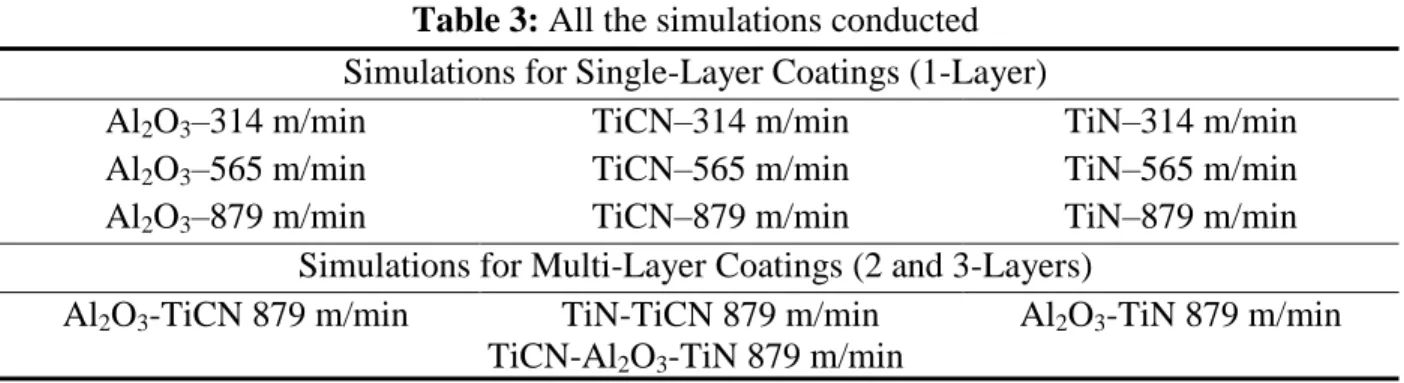
Several simulations representing single and multi-layer coating structures were conducted as listed in Table 3;
Table 3: All the simulations conducted Simulations for Single-Layer Coatings (1-Layer)
Al2O3–314 m/min TiCN–314 m/min TiN–314 m/min
Al2O3–565 m/min TiCN–565 m/min TiN–565 m/min
Al2O3–879 m/min TiCN–879 m/min TiN–879 m/min
Simulations for Multi-Layer Coatings (2 and 3-Layers)
Al2O3-TiCN 879 m/min TiN-TiCN 879 m/min Al2O3-TiN 879 m/min
TiCN-Al2O3-TiN 879 m/min
3. DETERMINATION OF THE MOST APPROPRIATE MULTI-LAYER COATING COMBINATION BASED ON THE RESULTS
Coating layer combinations for cutting tools in manufacturing industry varies depending on machining task, workpiece material being machined and specific machining operation [32]. The principal features need to be taken into consideration to determine coating structures for cutting tools can be summarised as follows [32];
The selection of material for coatings by considering some mechanical and thermal
properties such as heat generation, thermal stress resulting wear mechanisms and thermal expansion due to CTE mismatching resulting in delamination and premature tool failure
Layer and dimension growth (expansion) throughout the machining and coating process
resulting in premature tool failure
Araştırma Altıparmak/Kırklareli University Journal of Engineering and Science 4-2(2018) 189-211
In this regard, in order to design the most appropriate multi-layered cutting tool thin coating structure to apply for HSM simulations for this study, initially nine simulations (Table 3) representing single-layer coating were conducted for low, medium and HSM by applying the corresponding amount of heat during the machining time.
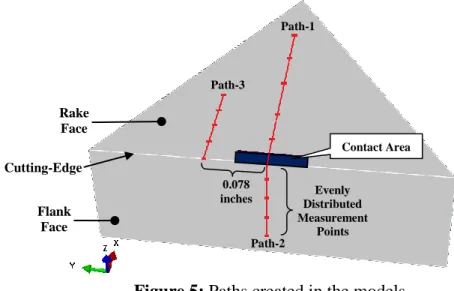
To meet the objectives of the study, three paths were created as illustrated in Fig.5 below to measure thermal stress and expansion as well as displacement caused by thermal expansion. Each path was started from the cutting-edge and placed on either rake or flank face of the cutting tool coatings. In detail, Path-1 and Path-3 were located along the rake face, whereas Path-2 was created 0.078 inches far from the center of the contact area on the flank face of the cutting tool coating. Then, results obtained from these paths were evaluated by creating graphs and making comparisons.
3.1. Results of Single-Layer Coating Structure Simulations
The generated temperature, thermal stress, thermal expansion and total dimensional thermal expansion occurrence (along the rake face X-Direction, flank face Z-Direction and cutting-edge Y-Direction) results were obtained and then compared. To investigate the effect of the cutting speed and coating material, results were compared by keeping the cutting speed and coating material constant.
It can be deduced from the results that thermal stress and expansion existence were increased by increasing the cutting speed. Hence the highest level of thermal stress and expansion were
Figure 5: Paths created in the models Contact Area Path-1
Path-2 Path-3
0.078
inches Distributed Evenly Measurement Points Cutting-Edge Flank Face Rake Face
Araştırma Altıparmak/Kırklareli University Journal of Engineering and Science 4-2(2018) 189-211
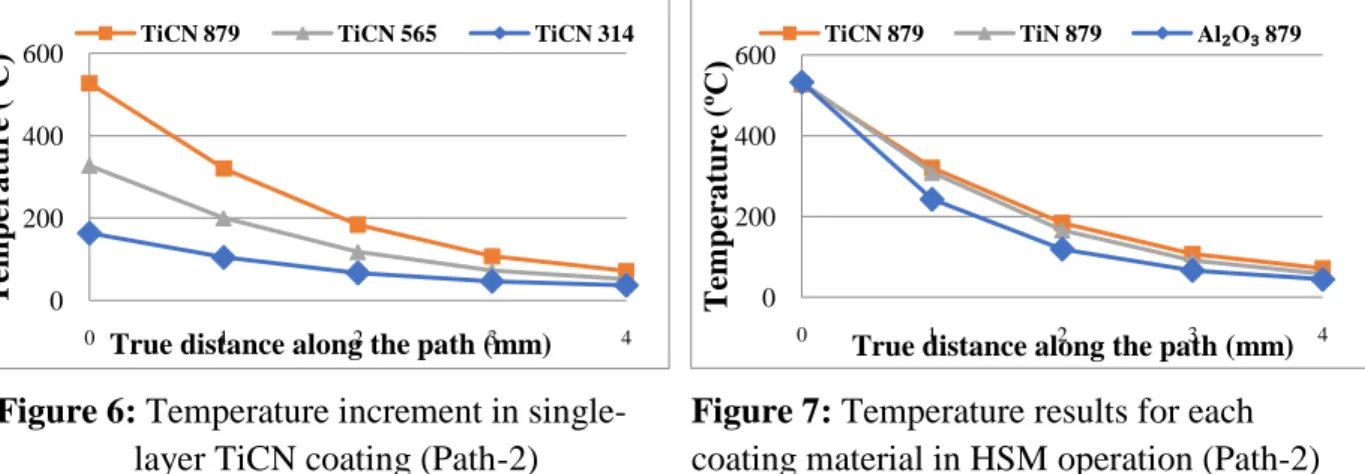
observed in HSM, whereas the lowest results were obtained for low-speed machining due to the relatively higher level of plastic deformation rate taken place in HSM process. To mention the effects of the temperature increment for each type of coating material in parallel with the cutting speed increase, the results of TiCN coating material were given as an example in Fig. 6.
The higher temperature results were observed on the rake face of the coating compared to the flank face of the coatings, namely higher temperature levels were measured from the Path-1 rather than Path-2. Specifically, the higher temperature generation was obtained for TiCN coating material in all the orthogonal cutting simulations for low, medium and HSM processes, whereas
the lowest temperature results were recorded for cutting tool coatings composed of Al2O3 coating
material. As an example, temperature results were compared in Fig. 7 below in Path-2 to assess
the effect of coating material in HSM process. Therefore, it is inferred that Al2O3 coating material
has the capacity to be used as thermal barrier in the multi-layer coating combinations.
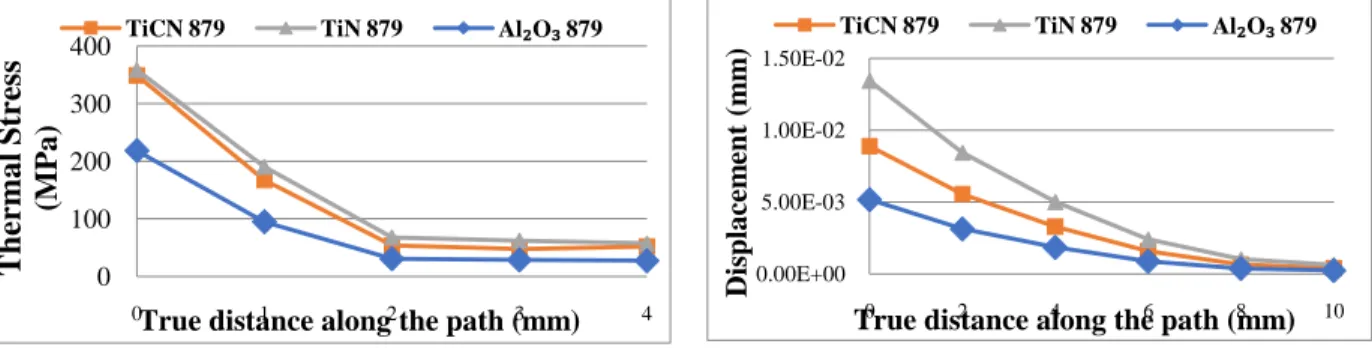
In addition to temperature generation results, the results of thermal stress and displacement because of thermal expansion as well as expansion in thickness were given in Fig. 8, 9 and 10. Thermal stress can be mentioned as another key factor that restricts the lifespan of cutting tools used in manufacturing industry. In this sense, remained thermal stress existence after machining of previous machining pass effects on the machining quality and precision of the following machining pass, which leads to relatively shorter tool life due to premature tool failure [33] and tool wear mechanisms [34]. Even though slightly higher amount of thermal stress generation was obtained on the rake face of cutting tool coatings, particularly the highest level of thermal stress was measured in the vicinity of Path-3, therefore, cutting tool deformation and failure can be
Figure 6: Temperature increment in single-layer TiCN coating (Path-2)
Figure 7: Temperature results for each coating material in HSM operation (Path-2) 0 200 400 600 0 1 2 3 4 T em perat ure (º C )
True distance along the path (mm) TiCN 879 TiCN 565 TiCN 314
0 200 400 600 0 1 2 3 4 T em perat ure (º C )
True distance along the path (mm) TiCN 879 TiN 879 Al₂O₃ 879
Araştırma Altıparmak/Kırklareli University Journal of Engineering and Science 4-2(2018) 189-211
primarily expected to occur in the vicinity of Path-3 (Fig. 8) in single-layer coating implementations. On the other hand, the maximum displacement occurrence was obtained on the rake face of coating structures in the nearby of Path-1 (Fig. 9). Therefore, micro-delamination and micro-cracking phenomena can possibly be taken place in the vicinity of Path-1. That is why the investigation priority of the micro-delamination and micro-cracking should be initially given to rake face of single-layer cutting tool thin coatings.
Figure 8: Thermal stress results for each coating material in HSM operation (Path-3)
Figure 9: Displacement results of each single-layer coatings in HSM (Path-1) Moreover, the maximum thickness expansion results in Z-Direction of the rake faces of single-layer coatings were graphed in Fig. 10 and the highest and the lowest thermal expansion
existences in coating thickness of TiN and Al2O3 coating material were associated with the
relatively higher and lower CTE values of TiN and Al2O3 coating materials as given in Table 2.
3.2. Results of Multi-Layer Coating Structure Simulations
In this part of the study, three different simulations for 2-layered coating combinations (Al2O3
-TiCN, TiN-TiCN and Al2O3-TiN) were conducted for HSM with 879 m/min cutting speed by
keeping all the parameters constant. Then, the thermal stress and expansion results measured from 0 100 200 300 400 0 1 2 3 4 T herm al Str es s (MPa)
True distance along the path (mm) TiCN 879 TiN 879 Al₂O₃ 879
0.00E+00 5.00E-03 1.00E-02 1.50E-02 0 2 4 6 8 10 Dis pla ce m ent ( m m )
True distance along the path (mm) TiCN 879 TiN 879 Al₂O₃ 879
Figure 10: Maximum thickness expansion (in Z-Direction on the rake faces) 0.00E+00 1.00E-05 2.00E-05 3.00E-05 4.00E-05 314 879 E x pan si on (m m )
Cutting Speeds (m/min) Al₂O₃ TiN TiCN
Araştırma Altıparmak/Kırklareli University Journal of Engineering and Science 4-2(2018) 189-211
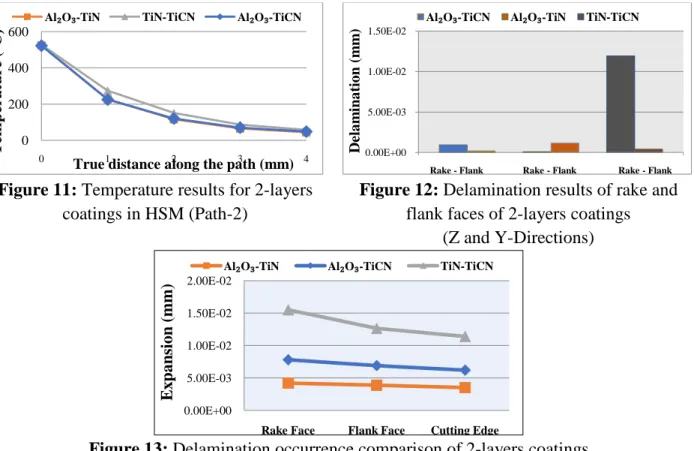
the paths were compared. The slightly similar overall trend was observed for Al2O3-TiCN and
Al2O3-TiN 2-layers coatings, whereas relatively higher temperature (Fig. 11) and thermal stress
was generated for TiN-TiCN cutting tool coating. The delamination occurrence and total dimensional expansion results were also illustrated in Fig. 12 and Fig. 13, and the highest amount of delamination and dimensional expansion on the rake (X-Direction), flank faces (Y-Direction) and cutting edge (Z-Direction) were observed for TiN-TiCN multi-layer coating.
Figure 11: Temperature results for 2-layers coatings in HSM (Path-2)
Figure 12: Delamination results of rake and flank faces of 2-layers coatings
(Z and Y-Directions)
Figure 13: Delamination occurrence comparison of 2-layers coatings
As an overall discussion of single-layer and 2-layers coating results, it is deduced that TiN-TiCN 2-layers coatings should not have any contact interaction (surface-to-surface), since the highest temperature, delamination (Fig. 14 with 1.000e+01 deformation scale factor) and thermal stress results were generated in TiN-TiCN 2-layers coatings. The lowest temperature generation was measured for Al2O3 single-layer coating material as mention earlier. That is why Al2O3 coating material was placed in the middle layer of 3-layers coating combination as a thermal isolator to avoid having surface-to-surface contact of TiN-TiCN coating layers resulting in the maximum delamination occurrence. Last of all, due to the highest temperature results of TiCN single-layer
0 200 400 600 0 1 2 3 4 T em perat ure (º C )
True distance along the path (mm) Al₂O₃-TiN TiN-TiCN Al₂O₃-TiCN
0.00E+00 5.00E-03 1.00E-02 1.50E-02
Rake - Flank Rake - Flank Rake - Flank
Dela m ina tio n (m m
) Al₂O₃-TiCN Al₂O₃-TiN TiN-TiCN
0.00E+00 5.00E-03 1.00E-02 1.50E-02 2.00E-02
Rake Face Flank Face Cutting Edge
E x pan si on (m m )
Araştırma Altıparmak/Kırklareli University Journal of Engineering and Science 4-2(2018) 189-211
coating, the TiCN coating was decided as the outer coating surface to keep maximum temperature generation away from the cutting tool to decrease the heat transferring into the substrate of cutting tools. Accordingly, the optimisation for 3-layers coatings was made determining
the most appropriate cutting tool thin coating structure combination for this study as TiCN-Al2O3
-TiN. Eventually, the last simulation was conducted (879 m/min) for the most appropriate 3-layers coating combination. Then, the delamination occurrence was illustrated in Fig. 15 as follows;
Figure 14: Cross-sectional view cut along the rake face of TiN-TiCN 2-layers coating to
illustrate delamination existence in HSM
Figure 15: Appearance of delamination
existence of TiCN-Al2O3-TiN multi-layer
coating in HSM after cross-sectional view cut along the rake face
3.3. Comparison of Multi-Layer Coating Structures (2 and 3-Layers)
The increment in the layer number of multi-layer coatings has several positive effects. For
instance, the total dimensional thermal expansions of TiCN-Al2O3-TiN multi-layer coating
structure (Fig. 16 at the bottom) on the rake (X-Direction), cutting-edge (Y-Direction) and flank faces (Z-Direction), which can be attributed to the CTE mismatching of coating materials, were comparatively less rather than other 2-layers coating structures. Furthermore, it can be inferred
from Fig. 17 that the delamination existence between TiCN-Al2O3-TiN coating structure layers is
comparatively lower than delamination existence in 2-layers coating combinations. In detail, a considerable level of micro-delamination was obtained on the rake face of the outer coating layer couple (TiCN-Al2O3) of the 3-layers coating structure, however, it can be tolerated due to the location of the layer couple.
Araştırma Altıparmak/Kırklareli University Journal of Engineering and Science 4-2(2018) 189-211
Figure 17: Delamination comparison in multi-layer coatings on the rake and flank faces (Z and X-Directions)
4. CONCLUSIONS
In this study, several orthogonal dry machining simulations were performed through one of the widely used commercially available FEM software Abaqus/CAE 2016 in order to investigate the effects of the theoretical amount of heat entering into cutting tool on thermal expansion and micro-delamination phenomenon of the cutting tool thin multi-layer coatings of the TNMG160404-MS carbide cutting tool after determining the most appropriate coating layer combination based on the comparison of micro-delamination, thermal stress and expansion.
0.00E+00 2.00E-03 4.00E-03 6.00E-03 8.00E-03 1.00E-02 1.20E-02 1.40E-02
Rake - Flank Rake - Flank Rake - Flank Rake - Flank Rake - Flank
D el am inati on O cc urre nce (m m ) Al₂O₃-TiCN Al₂O₃-TiN TiN-TiCN TiCN-Al₂O₃ Al₂O₃-TiN
Figure 16: Dimensional thermal expansion comparison of multi-layer coatings 0.00E+00 5.00E-03 1.00E-02 1.50E-02 2.00E-02 2.50E-02
Rake Face Flank Face Cutting Edge
T herm al E x pan si on (m m )
TiCN-Al₂O₃-TiN Al₂O₃-TiN Al₂O₃-TiCN TiN-TiCN
3-Layers 2-Layers 2-Layers 2-Layers 2-Layers 3-Layers
Araştırma Altıparmak/Kırklareli University Journal of Engineering and Science 4-2(2018) 189-211 These conclusions from general to specific were achieved as follows;
1. It is deduced taking into results of single and multi-layer coatings account that the highest amount of temperature generation, delamination phenomenon, thermal stress and thermal expansion were measured in the vicinity of the contact areas of the single and multi-layer coatings in HSM process, whereas the lowest results were obtained for low-speed machining, which can be associated with the elevated deformation rate in parallel with cutting speed.
2. Since the relatively higher level of micro-delamination, thermal stress and expansion were observed on the rake face of single and multi-layer coating structures, premature tool failure and deformation as well as the existence of one or more wear mechanism can possibly be taken place on the rake face of cutting tool coatings. Therefore, the priority of micro-delamination and wear investigation should be given to the rake faces of the cutting tool coating structures.
3. TiN and TiN-TiCN single and multi-layer coating materials can be characterised by high thermal expansion and micro-delamination existence due to the relatively high CTE values of TiN coating material. In this regard, micro-delamination phenomenon should be necessarily considered for the coating structures including TiN based coatings.
4. Due to the comparatively low level of CTE and thermal conductivity values of Al2O3 coating material, among other hard coating materials particularly at elevated temperatures,
Al2O3 coating layer can be applied as a thermal isolator in various of coating combinations
depending on the specific demands of the machining processes.
5. TiCN-Al2O3-TiN multi-layer coating structure was determined for this study using three widely used hard coating materials in industry as the most appropriate coating combination. It is asserted that in the case of applying this coating combination, the least amount of heat was possibly predicted to be transferred into the TNMG160404-MS carbide cutting tool resulting in relatively less amount of wear rate and tool deformation as well as prolonged tool lifespan.
6. As a result of the increment in the number of coating layers for multi-layered coating structures, the thermal stress generation and total dimensional thermal expansion on the cutting-edge, rake and flank face were declined. Therefore, it is inferred that tool deformation and wear mechanisms can be occurred with less probability in 3-layers
Araştırma Altıparmak/Kırklareli University Journal of Engineering and Science 4-2(2018) 189-211
coating combinations rather than 2-layers. In this respect, TNMG160404-MS carbide cutting tool with 3-layers coating is expected to have the longest tool lifespan compared to the carbide tool with single-layer and 2-layers cutting tool thin coating, in turn, resulting in the less cutting tool expenditure for the manufacturers in manufacturing industry.
REFERENCES
[1] M. Staszuk, D. Pakuła, G. Chladek, M. Pawlyta, M. Pancielejko, and P. Czaja, “Investigation of the structure and properties of PVD coatings and ALD + PVD hybrid coatings deposited on sialon tool ceramics,” Vacuum, vol. 154, no. March, pp. 272–284, 2018.
[2] K. Aslantas, T. I. Ucun, and A. Çicek, “Tool life and wear mechanism of coated and uncoated Al2O3/TiCN mixed ceramic tools in turning hardened alloy steel,” Wear, vol. 274–275, no. February 2018, pp. 442–451, 2012.
[3] D. Dudzinski, A. Devillez, A.Moufki, D. Larrouquere, V. Zerrouki, and J. Vigneau, “A Review of Developments Towards Dry and High Speed Machining of Inconel 718 Alloy,” Int. J. of Machine Tools & Manufacture, Vol.44, pp. 439-456, 2004.
[4] G. S. Goindi and P. Sarkar, “Dry machining: A step towards sustainable machining– Challenges and future directions,” J. Clean. Prod., vol. 165, pp. 1557–1571, 2017.
[5] M. Fahad, P. T. Mativenga, and M. A. Sheikh, “Critical design factors for multi-layer coating systems that influence heat partition in the secondary shear deformation zone and machining performance,” Proc. Inst. Mech. Eng. Part B J. Eng. Manuf., vol. 226, no.6, pp. 1071–1085, 2012. [6] A. Hosokawa, K. Shimamura, and T. Ueda, “Cutting characteristics of PVD-coated tools deposited by Unbalanced Magnetron Sputtering method,” CIRP Ann. - Manuf. Technol., vol. 61, no. 1, pp. 95–98, 2012.
[7] X. Zhang, R. Huang, K. Liu, A. S. Kumar, and X. Shan, “Rotating-tool diamond turning of Fresnel lenses on a roller mold for manufacturing of functional optical film,” Precis. Eng., vol. 51, no. July 2017, pp. 445–457, 2018.
[8] H. Schulz and T. Moriwaki, “High-speed Machining,” CIRP Ann. - Manuf. Technol., vol. 41, no. 2, pp. 637–643, 1992.
[9] P. Fallböhmer, C. A. Rodríguez, T. Özel, and T. Altan, “High-speed machining of cast iron and alloy steels for die and mold manufacturing,” J. Mater. Process. Technol., vol. 98, no. 1, pp. 104–115, 2000.
Araştırma Altıparmak/Kırklareli University Journal of Engineering and Science 4-2(2018) 189-211
[10] Neugebauer, R., Bouzakis, K.-D., Denkena, B., Klocke, F., terzing, A., Tekkaya, A.E., Wertheim, R., Velocity Effects in Metal Forming and Machining Processes, Annals of CIRP Vol. 60/2, p. 627-650, 2011.
[11] F. Klocke, T. Krieg, K. Gerschwiler, R. Fritsch, V. Zinkann, M. Pöhls, and G. Eisenblätter, “Improved Cutting Processes with Adapted Coating Systems,” CIRP Annals, vol. 47, no. 1, pp. 65–68, 1998.
[12] K. D. Bouzakis, N. Michailidis, G. Skordaris, E. Bouzakis, D. Biermann, and R. M‟Saoubi, “Cutting with coated tools: Coating technologies, characterization methods and performance optimization,” CIRP Ann. - Manuf. Technol., vol. 61, no. 2, pp. 703–723, 2012.
[13] A. Devillez, F. Schneider, S. Dominiak, D. Dudzinski, and D. Larrouquere, “Cutting forces and wear in dry machining of Inconel 718 with coated carbide tools,” Wear, vol. 262, no. 7–8, pp. 931–942, 2007.
[14] K. K. Gajrani, S. Suresh, and M. R. Sankar, “Environmental riendly hard machining performance of uncoated and MoS2coated mechanical micro-textured tungsten carbide cutting tools,” Tribol. Int., vol. 125, no. December 2017, pp. 141–155, 2018.
[15] K. Aruna Prabha, B. Srinivasa Prasad, and N. Srilatha, “Comparative Study of Wear Patterns of both Coated and Uncoated Tool Inserts in High Speed Turning of EN36 Steel,” Mater. Today
Proc., vol. 5, no. 2, pp. 4368–4375, 2018.
[16] S. Kumar. T., R. Ramanujam, M. Vignesh, N. Tamiloli, N. Sharma, S. Srivastava and A. Patel, “Comparative evaluation of performances of TiAlN, AlCrN, TiAlN/AlCrN coated carbide cutting tools and uncoated carbide cutting tools on turning Inconel 825 alloy using Grey Relational Analysis,” Sensors Actuators, A Phys., vol. 279, pp. 331–342, 2018.
[17] F. Qin, Y. K. Chou, D. Nolen, and R. G. Thompson, “Coatingthickness effects on diamond coated cutting tools,” Surf. Coatings Technol., vol. 204, no. 6–7, p p. 1056–1060, 2009.
[18] L. Braginsky, A. Gusarov, and V. Shklover, “Models of thermal conductivity of multilayer wear resistant coatings,” Surf. Coatings Technol., vol. 204, no. 5, pp. 629–634, 2009.
[19] N. Abukhshim, P. Mativenga, and M. Sheikh, “Heat generation and temperature prediction in metal cutting: A review and implications for high speed machining,” International Journal of
Machine Tools and Manufacture, vol. 46, no. 7-8, pp. 782–800, 2006.
[20] K. Gok, „Development of three-dimensional finite element model to calculate the turning processing parameters in turning operations‟, Measurement, 75, pp. 57-68, 2015.
Araştırma Altıparmak/Kırklareli University Journal of Engineering and Science 4-2(2018) 189-211
[21] A. Gok, K. Gok, and M. B. Bilgin, „Three-dimensional finite element model of the drilling process used for fixation of Salter-Harris type-3 fractures by using a K-wire‟, Mechanical Science, 6, pp. 147-154, 2015.
[22] Akbar, F., Mativenga, P. T. and Sheikh, M. A. „An evaluation of heat partition in the high-speed turning of AISI/SAE 4140 steel with uncoated and TiN-coated tools‟, Proceedings of the
Institution of Mechanical Engineers, Part B: Journal of Engineering Manufacture, 222(7), pp.
759–771, 2008.
[23] P.H. Mayrhofer, C. Mitterer 'High-temperature properties of nanocomposite TiBxNy and TiBxCy coatings, Surf. Coat. Technol', 133-134, pp. 131–137, 2000.
[24] R. Daniel, D. Holec, M. Bartosik, J. Keckes, C. Mitterer, 'Size effect of thermal expansion and thermal/intrinsic stresses in nanostructured thin films: experiment and model', Acta Mater. 59, pp. 6631–6645, 2011.
[25] R. Daniel, K.J. Martinschitz, J. Keckes, C. Mitterer, 'The origin of stresses in magnetron-sputtered thin films with zone T structures', Acta Mater. 58, pp. 2621–2633, 2010.
[26] M. Erdem, K. Gok, B. Gokce, A. Gok, „Numerical analysis of temperature, screwing moment and thrust force using finite element method in bone screwing process‟, Journal of Mechanics in Medicine and Biology, Vol. 17, No. 1, 1750016 (16 pages), 2017.
[27] P.H.Mayrhofer, C. Mitterer, J.Musil 'Structure–property relationships in single-and dual-phase nanocrystalline hard coatings', Surf. Coat. Technol. 174-175, pp. 725–731, 2003.
[28] Vereschaka, A. A. „Delamination and longitudinal cracking in multi-layered composite nano-structured coatings and their influence on cutting tool life‟, Wear. Elsevier B.V., wear.2017.07.021, 390–391(July), pp. 209–219, 2017.
[29] Fahad, M., Mativenga, P. T. and Sheikh, M. A., „An investigation of multilayer coated (TiCN/Al2O3-TiN) tungsten carbide tools in high speed cutting using a hybrid finite element and experimental technique‟, Proceedings of the Institution of Mechanical Engineers, Part B: Journal
of Engineering Manufacture, 225(10), pp. 1835–1850, 2011.
[30] Krajinovic, I., Daves, W., Tkadletz, M., Teppernegg, T., Klünsner, T., Schalk, N., … Czettl, C., Finite element study of the influence of hard coatings on hard metal tool loading during milling. Surface and Coatings Technology, 304, 134-141, 2016.
[31] Bartosik, M., Holec, D., Apel, D., Klaus, M., Genzel, C., Keckes, J., … Mayrhofer, P. H., Thermal expansion of Ti-Al-N and Cr-Al-N coatings. Scripta Materialia, 127, 182-185, 2017.
Araştırma Altıparmak/Kırklareli University Journal of Engineering and Science 4-2(2018) 189-211
[32] Klocke, F. and Krieg, T., „Coated tools for metal cutting - features and applications‟, CIRP
Annals - Manufacturing Technology, 48(2), pp. 515–525, 1999.
[33] Kumar, M. P., „Study on Tool Life and its Failure Mechanisms‟, 2(4), pp. 126–131, 2015. [34] B. Prakash, J.Mukerji, S.Kalia, 'Tribological properties of Al2O3/TiN composites', Am. Ceram. Soc. Bull 77, pp. 68–72, 1998.
![Figure 1: High-speed cutting scales based on workpiece materials being machined [8]](https://thumb-eu.123doks.com/thumbv2/9libnet/3705140.24782/4.918.211.721.577.893/figure-high-speed-cutting-scales-workpiece-materials-machined.webp)
![Figure 2: Main features of HSM [10]](https://thumb-eu.123doks.com/thumbv2/9libnet/3705140.24782/5.918.261.661.524.809/figure-main-features-of-hsm.webp)
![Figure 3: Delamination formation between multi-layer coating layers [28]](https://thumb-eu.123doks.com/thumbv2/9libnet/3705140.24782/8.918.283.578.678.926/figure-delamination-formation-multi-layer-coating-layers.webp)
![Table 1: All parameters applied to calculate the predicted amount of heat per unit [29] Cutting Speed L C a P λ h f v f f Rake Angle V ch Contact Area 879 m/min 275 μm 2 mm 2.1 750 N 400 N 0 ° 14650](https://thumb-eu.123doks.com/thumbv2/9libnet/3705140.24782/10.918.108.808.171.398/table-parameters-applied-calculate-predicted-cutting-angle-contact.webp)
![Table 2: All the temperature-dependent material properties of hard coatings applied [29][30][31]](https://thumb-eu.123doks.com/thumbv2/9libnet/3705140.24782/11.918.112.837.115.655/table-temperature-dependent-material-properties-hard-coatings-applied.webp)