GAZİ UNIVERSITY
INSTITUTE OF EDUCATIONAL SCIENCES DEPARTMENT OF FOREIGN LANGUAGES TEACHING
ENGLISH LANGUAGE TEACHING PROGRAM
DISCOURSE MARKERS AND SPOKEN ENGLISH: NONNATIVE USE IN THE TURKISH EFL SETTING
PHD DISSERTATION
BY Asuman AŞIK
Ankara June, 2012
GAZİ UNIVERSITY
INSTITUTE OF EDUCATIONAL SCIENCES DEPARTMENT OF FOREIGN LANGUAGES TEACHING
ENGLISH LANGUAGE TEACHING PROGRAM
DISCOURSE MARKERS AND SPOKEN ENGLISH: NONNATIVE USE IN THE TURKISH EFL SETTING
PHD DISSERTATION
Asuman AŞIK
Supervisor: Assoc. Prof. Dr. Paşa Tevfik CEPHE
Ankara June, 2012
JÜRİ ONAYI
Asuman AŞIK’ın “Discourse Markers and Spoken English: Nonnative Use in the Turkish EFL Setting” başlıklı tezi 05.07.2012 tarihinde, jürimiz tarafından İngiliz Dili Eğitimi Ana Bilim Dalında Doktora Tezi olarak kabul edilmiştir.
Adı Soyadı İmza
Başkan: ……….. ………...
Üye : ……….. …… ………...
Üye (Tez Danışmanı): ……… ………...
Üye : ………... ………...
ACKNOWLEDGEMENTS
Within this long journey in writing a PhD thesis, there have been many people to whom I send my heartfelt thanks. First and foremost, I am mostly indebted to my supervisor, Assoc. Prof. Paşa Tevfik CEPHE for his guidance and valuable comments all the way through. When I feel lost in so many details of the thesis, he always helped me clear my mind on the issues so I was able to move on.
I would like to also express my deepest gratitude to the thesis commitee members, Prof. Dr. Abdülvahit ÇAKIR and Prof. Dr. Gülsev PAKKAN who supported me with their careful insights and believed in my thinking.
I would like to thank also to my colleagues in the department; Asst. Prof. Dr. H. Hande UYSAL and Dr. Kemal Sinan ÖZMEN for their careful reviews on my thesis and Asst. Prof. Dr. Korkut Uluç İŞİSAĞ for helping me in recording sesssions. My special thanks also go to my precious friends who believed in me, motivated me with their support and cheered me up when I needed.
I am also thankful to my parents and my sisters who helped me when I always needed them. Finally, I am also indebted to my beloved husband, Erhan AŞIK, who encouraged me all the time and supported me both professionally and emotionally; and my daughter, Yağmur AŞIK, who always livened me up with her love and jolliness.
ABSTRACT
DISCOURSE MARKERS AND SPOKEN ENGLISH: NONNATIVE USE IN THE TURKISH EFL SETTING
AŞIK, Asuman
PhD Dissertation, English Language Teaching Program Supervisor: Assoc. Prof. Dr. Paşa Tevfik CEPHE
June-2011, 200 pages
This dissertation aims at identifying the discourse markers used by Turkish nonnative speakers of English, their occurences in their spoken English discourse by comparing them with the ones used in native speakers’ spoken discourse and their use of functions. For these purposes, the study used both quantitative and qualitative research methods. Within the quantitative side of the study, a research corpus was composed with the course presentations of the Turkish undergraduate students studying at Gazi University throughout transcription process. To compare the data, transcripts of student presentations from University of Michigan with the help of MICASE Corpus were also attained. The occurences of the discourse markers in both corpus were determined. The results show that Turkish nonnative speakers of English have a lack of variety in using discourse markers in their spoken English and use discourse markers in a limited number. As for the qualitative side of the study, the functions of the discourse markers were given examples from two corpus, which revealed that nonnative speakers do not benefit from the variety of functions of the discourse markers in spoken discourse. Along with these findings, the study highlights the importance of the need for awareness-raising of Turkish nonnative speakers in using discourse markers in their spoken English discourse and recommends considerable implications for English language teaching.
Key Words: Discourse Analysis, Spoken Discourse, Nonnative Spoken Discourse, Discourse Markers, Corpus Linguistics
ÖZET
SÖYLEM BELİRLEYİCİLERİ VE KONUŞMA İNGİLİZCESİ: İNGİLİZCE’NİN YABANCI DİL OLDUĞU TÜRK ORTAMINDA KULLANIMI
AŞIK, Asuman
Doktora, İngiliz Dili Eğitimi Ana Bilim Dalı Tez Danışmanı: Doç. Dr. Paşa Tevfik CEPHE
Haziran-2012, 200 sayfa
Bu doktora çalışması, anadili İngilizce’den farklı olan Türk konuşucuları tarafından kullanılan söylem belirleyicilerini, anadili İngilizce olan konuşucuların sözlü söylemlerinde kullanılanlarla karşılaştırarak, konuşma İngilizce söylemindeki tekrar sıklıklarını ve işlevlerinin kullanımını araştırmayı amaçlamaktadır. Bu amaçlar için, araştırma, hem nitel hem de nicel araştırma yöntemlerini kullanmıştır. Araştırmanın nitel yanı içerisinde, çevri yazı yöntemiyle, Gazi Üniversitesi’nde okuyan Türk lisans öğrencilerinin ders sunumlarını içeren bir araştırma bütüncesi oluşturulmuştur. Verileri, karşılaştırmak için, MICASE bütüncesi yardımıyla ile Michigan Üniversitesi’ndeki öğrenci sunumlarının yazılı metinlerine erişilmiştir. Her iki bütüncedeki söylem belirleyicilerinin tekrar sıklığı belirlenmiştir. Sonuçlar, Türk İngilizce konuşucularının konuşma İngilizcesi’nde söylem belirleyici çeşitliği eksikliğine sahip olduklarını ve söylem belirleyicilerini sınırlı sayıda kullandıklarını göstermektedir. Çalışmanın nicel yönü içinse, söylem belirleyicilerinin işlevleri, her iki bütünceden örneklendirilmiştir; bu da, anadili İngilizce olmayan konuşucuların, sözlü söylemde söylem belirleyicilerinin işlev çeşitliğinden yararlanmadıklarını ortaya çıkarmıştır. Bu bulgularla birlikte, araştırma, konuşma İngilizcesi söyleminde söylem belirleyicilerinin kullanımı konusunda Türk konuşucularda farkındalığı artırma ihtiyacının önemini vurgulamaktadır ve İngilizce dil eğitimi için dikkate değer çıkarımlar önermektedir.
Anahtar Kelimeler: Söylem Analizi, Sözlü Söylem, Ana Dili Olmayanların Sözlü Söylemi, Söylem Belirleyicileri, Bütünce Dilbilimi
TABLE OF CONTENTS JÜRİ ONAYI ... i ACKNOWLEDGEMENTS ... ii ABSTRACT ... iii ÖZET ... iv TABLE OF CONTENTS ... v
LIST OF TABLES ... viii
LIST OF FIGURES ... ix
CHAPTER 1:INTRODUCTION ... 1
1.1. Introduction ... 1
1.2. Statement of the Problem ... 3
1.3. Purpose of the Study ... 4
1.4. Scope of the Study ... 5
1.5. Methodology ... 5
1.6. Significance of the Study ... 7
1.7. Limitations of the Study ... 8
1.8. Definition of Key Concepts ... 8
CHAPTER 2: REVIEW OF LITERATURE ... 10
2.1. Introduction ... 10
2.2. Discourse Analysis ... 10
2.2.1. Historical Overview ... 10
2.2.2. Definition ... 11
2.2.3. The Scope of Discourse Analysis ... 12
2.2.4. Corpus Linguistics ... 14
2.2.5. Discourse Analysis and Language Teaching ... 15
2.3. Discourse Markers ... 16
2.3.1 Terminology of Discourse Markers ... 17
2.3.3. Characteristics of Discourse Markers ... 25
2.3.3.1 Connectivity ... 26
2.3.3.2 Multi-functionality/Polyfunctionality ... 27
2.3.3.3 Optionality ... 28
2.3.3.4. Non-truth conditionality ... 28
2.3.3.5 Weak clause association ... 29
2.3.3.6 Initiality ... 30
2.3.3.7 Orality ... 30
2.3.3.8 Multi-categoriality ... 31
2.4. Theories Underlying Discourse Markers ... 32
2.4.1. Coherence-based Account of Discourse Markers ... 33
2.4.2. Relevance-based Account of Discourse Markers ... 42
2.5. Discourse Markers and Language Teaching ... 44
CHAPTER 3: METHODOLOGY ... 47 3.1. Introduction ... 47 3.2. Corpus Selection ... 47 3.3. Data Collection ... 48 3.3.1. Participants ... 49 3.3.2. Setting ... 49
3.3.3. Instruments and Procedures for Data Collection ... 49
3.3.3.1. Recording ... 50
3.3.3.2. Transcription ... 51
3.4. Corpus Description ... 52
3.5. Data Analysis ... 54
CHAPTER 4: ANALYSIS OF RESULTS... 57
4.1. Introduction ... 57
4.2. Identifying Discourse Markers and Non-discourse Markers in Research Corpus and MICASE Corpus ... 57
4.3. Findings of Analysis in the Research Corpus ... 61
4.4. Results of Analysis in MICASE Corpus ... 69
4.6. Analysis of Functions od Discourse Markers in the Research Corpus and MICASE Corpus ... 83 4.6.1 Interpersonal Category ... 84 4.6.2. Referential Category ... 88 4.6.3. Structural Category ... 90 4.6.4. Cognitive Category ... 92 4.7. Discussion ... 95 CHAPTER 5: CONCLUSION ... 100 5.1. Introduction ... 100 5.2. Summary ... 100 5.3. Pedagogical Implications ... 103 5.4. Further Research ... 105 REFERENCES ... 107 APPENDICES ... 118
APPENDIX A: CLASSROOM OBSERVATION SHEET ... 118
APPENDIX B: MICASE TRANSCRIPTION AND MARK-UP CONVENTIONS ... 119
APPENDIX C: SAMPLE TRANSCRIPTS FROM RESEARCH CORPUS ... 123
APPENDIX D: SAMPLE TRANSCRIPTS FROM MICASE CORPUS ... 140
LIST OF TABLES
Table 1: Pragmatic functions of discourse markers ... 23
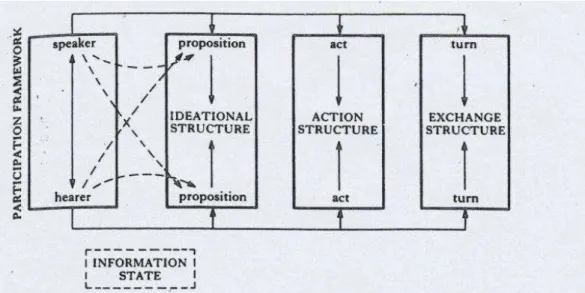
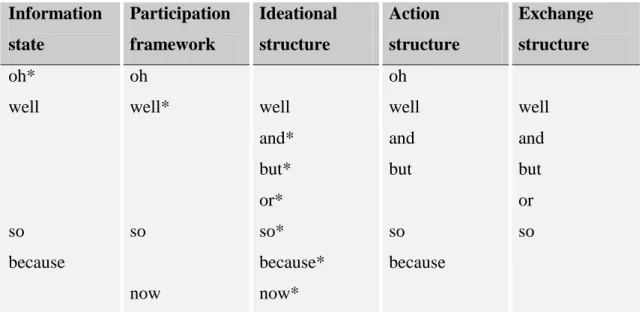
Table 2: Planes of talk on which markers function ... 35
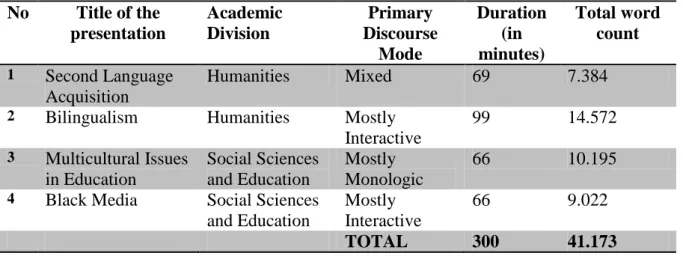
Table 3: Description of MICASE transcripts ... 53
Table 4: Description of transcripts of the research corpus ... 53
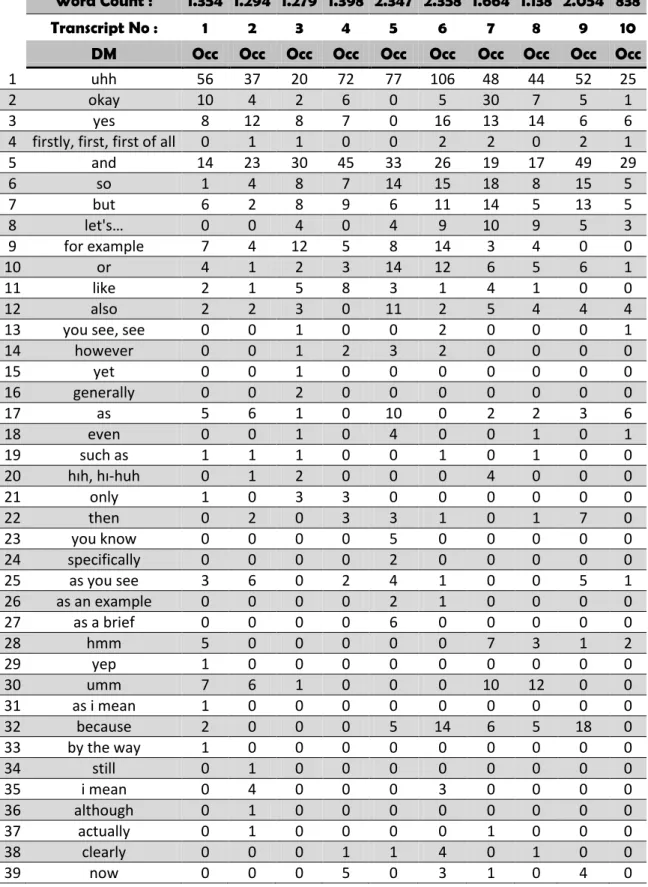
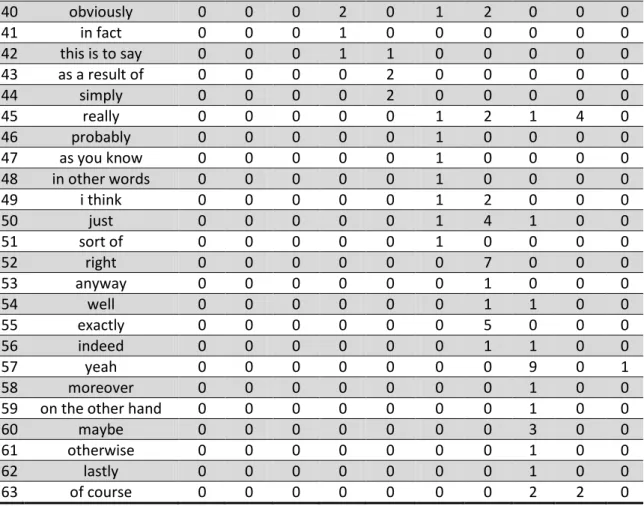
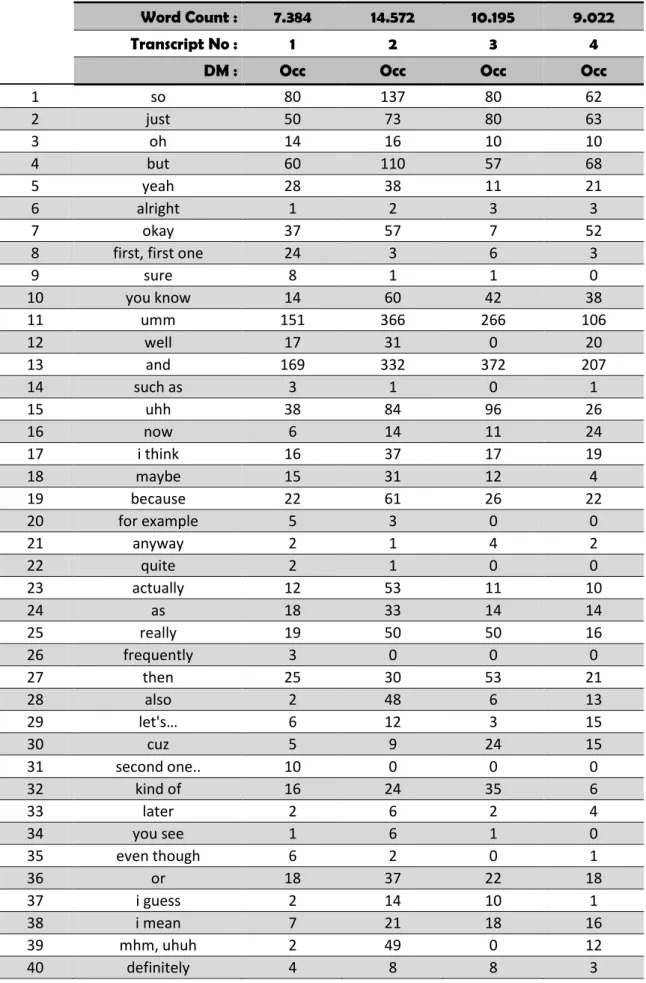
Table 5: Occurences of Discourse Markers in the first ten transcripts in the research corpus ... 62
Table 6: Occurences of discourse markers in the second ten transcripts in the research corpus ... 63
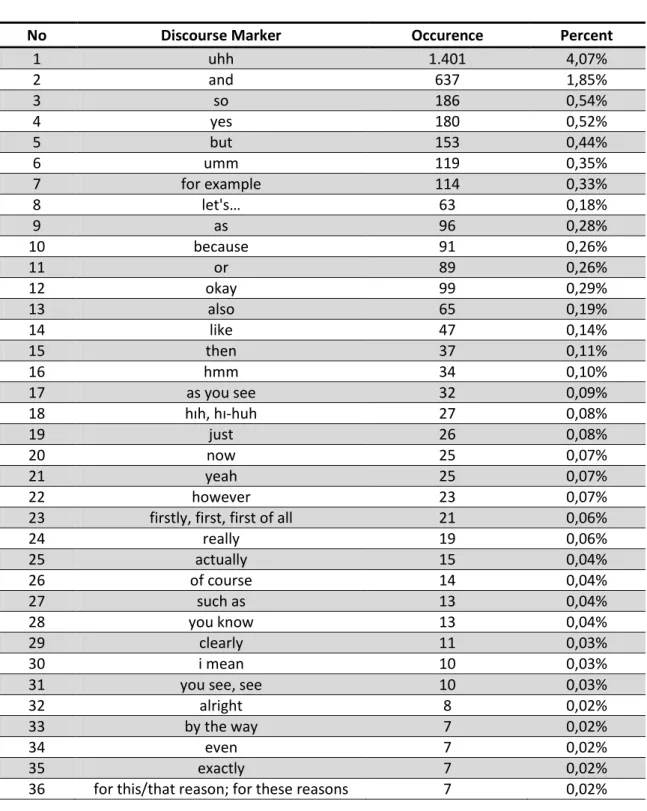
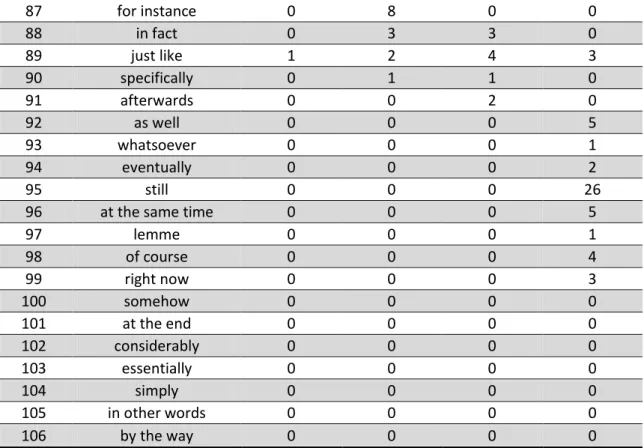
Table 7: Occurences and frequencies of the discourse markers in the research corpus . 65 Table 8: Occurences of discourse markers in MICASE transcripts ... 70
Table 9: Occurences and frequencies of the discourse markers in MICASE corpus ... 72
Table 10: Frequency level of the discourse markers according to the median of the list within the research corpus ... 78
Table 11: Frequency level of the discourse markers according to the median of the list within MICASE corpus ... 79
Table 12: Comparative results of the frequencies in the research corpus and MICASE corpus ... 81
LIST OF FIGURES
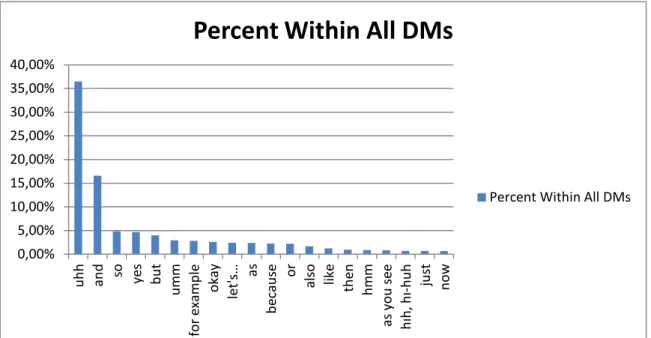
Figure 1: A discourse model ... 34 Figure 2: First 20 most frequent discourse markers in the research corpus…………...69 Figure 3 : First 20 most frequent discourse markers in MICASE corpus ... 76
CHAPTER 1
INTRODUCTION
1.1. Introduction
In the current era, learning a second or a foreign language has a paramount role in composing a good communication in cross-cultural environments. Within this atmosphere, English, as being lingua franca, has become the language for the majority of people all around the world in terms of communication for commerce, trade, education and research, so there has been a need for learning and teaching English to fulfill several purposes. This necessity leads authors to a myriad of methods, approaches or theories about how English should be taught and learned. Starting from the 1950s, there have been several methods, approaches and designs suggested and applied in language classrooms (Gattegno, 1972; Curran, 1976; Johnson and Paulston, 1976; Wilkins, 1976; Terrell, 1977; Krashen, 1981; Finocchiaro and Brumfit, 1983).
During the last decades, the importance of communicative competence in foreign language learning and teaching has gained utmost significance as the ability to use language to communicate effectively is a fundamental issue. In parallel with communicative competence, pragmatics and particularly discourse analysis have become an inevitable part of foreign language learning and teaching as these are the fields interested in the relationship between language and the contexts in which it is used, how people really use the language, which is a very striking opposition to studying artificially created domains. In particular, discourse analysis tries to find out the relationship between form and function by analyzing any language in use through written texts or spoken data so discourse analysis has a pivotal role for language learners’ pragmatic and communicative competence.
Moreover, Trillo (2002) states that “native and non-native speakers of language have different linguistic development which consists of two tracks: formal track and pragmatic track” (p.770). Native speakers of a language develop both tracks simultaneously by means of natural language contact although non-native learners of a
language develop formal and pragmatic tracks through formal instruction. However, it is not easy to implement pragmatic track through educational syllabuses. Thus, foreign language learners use certain forms inappropriate to the context and the setting. By time, these certain forms can be fossilized. Trillo (2002) calls this process “pragmatic fossilization” which is defined as “the phenomenon by which a non-native speaker systematically uses certain forms inappropriately at the pragmatic level of communication” (p.770).
Learners of foreign language need authentic tasks or materials to be competent communicatively. Discourse markers, which are very significant within the field of discourse analysis, are essential in teaching English communicatively. Discourse markers are expressions such as those in bold in the following sentences:
a. A: I like him. B: So, you think you’ll ask him out then. b. John can’t go. And Mary can’t go either.
c. Will you go? Furthermore, will you represent the class there? d. Sue left very late. But she arrived on time.
e. I think it will fly. After all, we built it right. (Fraser, 1999:931).
Although throughout literature, some other terms such as “discourse particles”, “connectives”, “pragmatic expressions” or “pragmatic markers” are used by some researchers to define the expressions illustrated above, the term “discourse markers” (DMs) is more commonly preferred and employed by researchers anaylsing English discourse.
Fraser (1990) has likened the effect of discourse markers to that of “discourse glue” (p. 385) as they unite the utterances within discourse. Discourse markers are defined by Schiffrin (1987) as “sequentially dependent elements which bracket units of talk” (p. 31). Moreover, discourse markers are units of talk that can be used for several purposes, as in the following:
- to initiate discourse,
- to preface a response or a reaction, - to serve as a filler or delaying tactic, - to aid the speaker in holding the floor,
- to effect an interaction or sharing between speaker and hearer, - to bracket the discourse either cataphorically or anaphorically,
- to mark either foregrounded or backgrounded information. (Müller, 2005:9)
As it can be concluded, discourse markers have considerable importance in teaching English since they contribute a lot to the pragmatic and communicative competence of speakers. Svartvik (1980) illustrates this essentiality as in the following: If a foreign language learner says five sheeps or he goed, he can be corrected by practically every native speaker. If, on the other hand, he omits a well, the likely reaction will be that he is dogmatic, impolite, boring, awkward to talk to etc, but a native speaker cannot pinpoint an ‘error’. (p.171)
Regarding Svartvik’s example, an utterance or a sentence that lacks discourse markers cannot be labelled as ungrammatical. However, the hearer or the reader may find the speaker or the author boring, routinised or impolite. Müller (2005) also points out that “if we take it for granted that discourse markers have such a decisive role to play in native speaker communication as the authors of discourse marker analyses claim, then we must assume that they are important elements to be learned by non-native speakers as well” (p. 14).
1.2. Statement of the Problem
As pragmatic competence which is defined by the ability to communicate effectively and involves the knowledge beyond the level of grammar by Thomas (1983), it should definitely be integrated in learning and teaching a foreign language. Teaching pragmatic competence has been searched by many authors (Bardovi-Harlig, 1996; Rose and Kasper, 2001; Bardovi-Harlig and Griffin, 2005). Furthermore, Crozet (2003) states that some of the rules that govern interactions but that are not immediately obvious have been referred to as invisible rules. Within these invisible rules, discourse analysis has gained fundamental importance to help learners attain pragmatic competence. Native speakers of English apply these invisible rules without noticing what kind of elements
they should include to their discourse. Particularly, in spoken discourse, native speakers use naturally certain units of talk. Hence, discourse markers are among these units of talk uttered by the speakers to make their speech more understandable and rich; as Crystal comments (1988), they serve as the “oil which helps us perform the complex task of spontaneous speech production and interaction smoothly and efficiently” (p. 48), so they are highly important in teaching English to foreign language learners.
In addition, Fung and Carter (2007) propose that language learners should learn discourse markers “in order to facilitate more successful overall language use and at the very least for reception purposes” (p. 434). Like many other non-native speakers of English, Turkish non-native speakers also have difficulties in enriching their conversations in English although they may be much more competent in using textual or structural coordinates in written discourse in English. Thus, it is necessary to find out whether Turkish non-native speakers of English use these particular discourse items, namely discourse markers, adequately and effectively in their spoken discourse and what the level of frequencies of discourse markers is in their speech or whether they benefit from these markers to make their speech more understandable, rich, polite or colorful. Therefore, the study will allow for a better understanding of language use and acquisition that occurs as part of these students’ spoken English discourse.
1.3. Purpose of the Study
Due to the significance of discourse markers in spoken discourse of native speakers of English, there is a necessity to investigate these specific discourse items in spoken discourse of nonnative speakers of English. Thus, the study, as an overall purpose, aims at identifying the discourse markers used by Turkish nonnative speakers of English. For this purpose, the study tries to find the answers to the following research questions which are the driving force of the current study:
Which discourse markers are used by Turkish non-native speakers of English in spoken discourse?
What is the frequency level of the discourse markers used by Turkish non-native speakers of English in spoken discourse?
Are there any differences between the discourse markers used by Turkish non-native speakers and non-native speakers of English in spoken discourse?
What are the prevailing functions of the discourse markers employed by Turkish non-native speakers when compared with the ones of native speakers according to four categories (interpersonal, referential, structural and cognitive)?
1.4. Scope of the Study
The study focuses mainly on the discourse markers used by Turkish non-native speakers of English. To reach the objectives of the study, undergraduate students of Department of English Language Teaching (ELT) at Gazi University, Turkey were taken as the representative sample group for Turkish non-native speakers of English. The Department of English Language Teaching of Gazi University is one of the leading and populous departments within the field in Turkey with more than 1250 bachelors and nearly 40 graduate students.
The study intended to reach its objectives by investigating twenty student presentations done by twenty senior-undergraduate students of this ELT Department with upper level proficiency in English who have completed the courses related to English skills and the main theoretical basis of language teaching.
Moreover, for the comparative dimension of the research, the study also focuses on the discourse markers used by the senior-undergraduate students of University of Michigan, USA. Similarly, the student presentations of University of Michigan are taken as the sample group.
1.5. Methodology
As the research aims at identifying the discourse markers that Turkish non-native speakers of English use in their spoken discourse and compare the results with the ones uttered by native speakers of English, the study is based on a corpus-driven approach. Thus, the methodology and the analysis of the study includes the essential characteristics that a corpus-based study should have, particularly highlighted by Biber, Conrad and Reppen (1998) as in the following:
- It is empirical, analyzing the actual patterns of use in natural text;
- It utilizes a large and principled collection of natural texts, known as a “corpus”, as the basis for the analysis;
- It makes extensive use of computer for analysis, using both automatic and interactive techniques;
- It depends on both quantitative and qualitative analytical techniques. (p. 4)
This study focuses on two types of corpus taken as the basis of the analysis which are the corpus of Turkish non-native speakers and the corpus of native speakers of English. The latter one, called MICASE, is taken from Michigan Corpus of Academic Spoken English which is a spoken language corpus available on-line. This corpus was taken as the sample to constitute the second corpus, which is called as the research corpus. The research corpus was constituted for the study by the researcher.
In order to realize the stated objectives of the study, the data were collected through audio recordings of student presentations of the students studying at Gazi University English Language Teaching Department. Transcription method was chosen as transcripts of classroom recordings provide an excellent record of “naturally occuring interaction” (Silverman, 1993). Therefore, audio recordings of utterances made by students were transcribed in standard orthography and all transcript lines containing the linguistic item in question, whether discourse marker or not, was extracted and sorted.
The study is based on mixed method data analysis; quantitative and qualitative analysis. The quantitative method emphasizing the descriptive value for spoken discourse of recurrent patterns and of frequency distribution was used to reach the frequency counts of discourse markers used by Turkish non-native speakers. Moreover, a qualitative analysis including the study of core functional paradigm of discourse markers in academic discourse based on the multi-categorial model proposed by Fung and Carter (2007) was also conducted. The four categories which are interpersonal, referential, structural and cognitive were taken as the functional paradigm so that the illustrations from the corpora were presented to show how discourse markers were used.
1.6. Significance of the Study
According to the recent analyses of corpora of spoken interaction, discourse markers are among the top ten word forms (Allwood, 1996 cited in Carter and Fung, 2007); so throughout history, there have been numerous studies about discourse markers in English (Svartvik, 1980; Östman, 1981; Schiffrin, 1986; Aijmer, 1987; Schourup, 1985; Erman, 1987). Moreover, the studies of discourse markers in other languages have also been conducted by many authors (Bazzanella, 1990; Gupta, 1995; Chen and He, 2001). However, the studies about the use of discourse markers in English by second or foreign language speakers are limited. Hays (1992), Trillo (1997), Müller (2004) and Fung and Carter (2007) are notable authors within this field of investigation who searched the use of discourse markers by different groups of speakers that are originally using another language.
As English takes place among the education system with a pivotal role in Turkey, like many other countries, it is necessary to search for the characteristics of spoken discourse of Turkish nonnative speakers of English. Moreover, there has not been any research done about this specific subject, particularly, discourse markers used by Turkish-nonative speakers of English according to the review conducted by the researcher. Thus, this study is significant in order to identify the discourse markers of Turkish non-native speakers so as to provide essential implications for teaching these units of talk to language learners and to make them gain discourse-pragmatic competence in English.
Moreover, this study is also significant in order to provide comparative analysis between native speakers and Turkish non-native speakers of English in using these particular discourse elements so as to enrich the field of discourse analysis like the similar studies stated above.
1.7. Limitations of the Study
The study has certain limitations which are put forward by the nature of discourse analysis. As the study focuses on spoken discourse, it may have some drawbacks when compared to the analyses done in written discourse. In particular, within this study, data collection procedures and transcription process of student presentations to compose the research corpus are highly arduous and time-consuming. Thus, the number of the presentations for the research corpus is limited to twenty. Moreover, the research corpus is limited to only the presentations of students studying in ELT Department of Gazi University while the corpus of native speakers is limited to only four transcripts of nearly 18 presentations of the students studying in University of Michigan.
Another limitation is about the analysis of the functions of the discourse markers. The study focuses on dealing with the occurrences of discourse markers while it is limited to only giving illustrations for the functions of several instances of discourse markers. Due to the multifunctional characteristic of discourse markers, it is not possible to analyse each function in each instance of discourse markers.
1.8. Definition of Key Concepts
Discourse Analysis:
The analysis of discourse is, necessarily, the analysis of language in use. As such, it cannot be restricted to the description of linguistic forms independent of the purposes or functions which these forms are designed to serve in human affairs (Brown & Yule, 1983: 1).
Corpus:
Corpus, plural corpora, is a collection of linguistic data, either compiled as written texts or as a transcription of recorded speech. The main purpose of a corpus is to verify a hypothesis about language - for example, to determine how the usage of a particular sound, word, or syntactic construction varies (Crystal, 1992).
Corpus Linguistics:
Corpus linguistics studies the principles and practice of using corpora in language study. The main focus of corpus linguistics is to discover patterns of authentic language use through analysis of actual usage (Krieger, 2003).
CHAPTER 2
REVIEW OF LITERATURE
2.1. Introduction
This chapter presents the detailed background to the study by pointing out the general framework of the study; particularly discourse analysis, description and characteristics of discourse markers and previous researches about discourse markers.
2.2. Discourse Analysis
2.2.1. Historical Overview
In 1960s and early 1970s, the importance of communicative competence gained fundamental importance in second/foreign language teaching. The emergence of communicative competence did not happen at once and only. There have been many simultaneous and interactive theories, studies, researches done, all of which argue the relationship between language and context. All of these studies are related to each other. Thus, it is not possible to claim that only one of them is the most important one and has influenced the others. The studies done about pragmatics, discourse analysis, text
linguistics, conversational implicatures seem to be discussing similar arguments and
each of them mainly focuses on a particular aspect of the relationship between language and context.
Discourse analysis is generally described as the study of language in use, both in the form of written texts or spoken data. It is fundamentally related to several disciplines such as linguistics, semiotics, psychology, anthropology and sociology in the 1960s and early 1970s. Although it is claimed that the emergence of discourse analysis was in 1960s, its history dates back to 1952 when Zellig Haris published a paper titled as “Discourse Analysis” which included the studies about the links between the text and its social situation. Then, Dell Hymes was the one who interested in the study of speech
in its social setting from a sociological perspective in the 1960s. Austin (1962), Searle (1969) and Grice (1975) followed Dell Hymes with their studies upon the study of language as social action, speech act theory, conversational maxims and pragmatics. Moreover, M.A.K. Halliday’s functional approach to language and focus on text linguistics also stressed the importance of social functions of language and contributed greatly to the future studies upon discourse analysis.
2.2.2. Definition
Discourse analysis is such a vast and ambiguous field that it is strenuous to define and delimit its borders as the analysis of the study. Brown and Yule (1983) defines discourse analysis as in the following:
The analysis of discourse, is necessarily, the analysis of language in use. As such, it cannot be restricted to the description of the linguistic forms independent of the purposes or functions which these forms are designed to serve in human affairs. (p. 1)
Brown and Yule (1983) claim that linguistic forms should not be analysed independently from their purposes or functions in real interactions. McCarthy (1996) also develops this argument by stating that “discourse analysis is not entirely seperate from the study of grammar and phonology but discourse analysts are interested in a lot more than linguistic forms” (p. 8). He also emphasized the precoccupations of discourse analysts overlap in an important sense with the approach to communicative language teaching which focuses on the functions or speech acts that pieces of language perform. Furthermore, Stubb (1983) presents what kinds of forms that discourse analysis aims to study as in the following:
Discourse analysis attempts to study the organization of language above the sentence or above the clause, and therefore to study larger linguistic units, such as conversational exchanges or written texts. It follows that discourse analysis is also concerned with language in use in social contexts, and in particular with interaction or dialogue between speakers. (p. 1)
As Stubb points out above, the scope of the discourse analysis includes linguistic units in their widest sense and they are not limited to a sentence or a clause. The aim is
to analyse beyond the sentence/sentences or utterances and how they are related in interactions.
Schiffrin (1987) also lists the assumptions of discourse analysis as in the following:
1. Language always occurs in a context: As for the “context” in the assumption, Schiffrin explains that it includes not only cognitive contexts in which past experience and knowledge is stored and drawn upon but also social contexts through people can draw upon institutional and interactional orders to construct definitions of situation and action.
2. Language is context sensitive: Language is potentially sensitive to all of the contexts in which it occurs, and, even more strongly, that language reflects those contexts because it helps to constitute them.
3. Language is always communicative: Language is always communicative either because it is directed toward a recipient (immediate or eventual), because it is intended to be so directed, and/or because it is attended by a recipient.
4. Language is designed for communication. The primary purpose of language is to
communicate. Thus, language is in a change constantly in order to fulfill the needs of communication. (p. 4-6)
2.2.3. The Scope of Discourse Analysis
The scope of discourse analysis is so vast that it includes several examples of utterances. Discourse analysis not only deals with the description and analysis of spoken interaction but also written and printed words like “newspaper articles, letters, stories, recipes, instructions, notices, comics, billboards, leaflets” (McCarthy, 1996:12). Since the written texts are easy to be specified, spoken texts may need more attention in terms of description, scope and focus of analysis. McCarthy (1996) lists some different types of speech as in the following:
Telephone calls (business and private)
Service encounters (shops, ticket offices, etc.) Interviews (jobs, journalistic, in official settings) Classroom (classes, seminars, lectures, tutorials) Rituals (sermons, weddings)
Monologues (speeches, stories, jokes)
Language-in-action (talk accompanying doing: fixing, cooking, assembling, demonstrating, etc.)
Casual conversation (strangers, friends, intimates)
Organising and directing people (work, home, in the street) (p. 119)
Discourse analysts are interested in both written forms and spoken forms of language. However, the analysis of each form differs from another. Moreover, to gather data in spoken interaction is a difficult task to do in terms of statistics of the distribution of different types of speech in people’s daily lives. Siniajeva (2005) discusses what kind of features of written discourse differ from spoken language by stating the following:
Linguistically, written text tends to be more complex, with longer sentences, more complex clauses, greater information load, with the higher number of lexical or content words per clause. Unlike spoken interaction, in written discourse there is no common situation: the situation has to be inferred from the text. The words themselves must carry all the shades of meaning which, in spoken discourse, could be conveyed by non-verbal behavior. (p. 11)
However, there are some advantageous issues of written texts over spoken data. Written texts allow writer the possibility of editing the text or the reader to read back and forth and the statements in written texts are generally grammatically correct whereas spontaneous conversations may not always be well formed.
Moreover, McCarthy (1996) points out that “both types of discourse are dependent on their immediate contexts to a greater or lesser degree” (p.149). Written texts may require particular shared knowledge while spoken discourse is supported with intonation and actions.
2.2.4. Corpus Linguistics
In parallel with the developments in discourse analysis, there has emerged a new impetus to discourse analysis, which is corpus linguistics. As a brief definition, corpus linguistics is the study of collecting, structuring and analysing a large amount of discourse (corpus), with the help of computers. It allows through the use of computerized technology certain operations such as “quantifying (counting the number of given words or sentences), concordancing (producing lists of linguistic items and their immediate linguistic context in order to determine syntactic, semantic and pragmatic properties) and parsing (seperating sentences into grammatical parts)” (Fortuno, 2006:58).
Although there is not a consensus about what the corpus linguistics is, as Taylor (2008) highlights, “whether it is a tool, a method, a methodology, a methodological approach, a discipline, a theory, a theoretical approach, a paradigm (theoretical or methodological), or a combination of these” (p. 180), corpus linguistics has gained its place within the literature.
Historical background of corpus linguistics dates back to Randolp Quirk (1959) who organized a corpus of both spoken and written British English, named as the Survey of English Usage (SEU) Corpus and then by Nelson Francis and Henry Kučera, the Brown Corpus was composed as a sample of printed American English in 1961. With the experience gained after SEU and Brown Corpus, Jan Svartvik, who is another pioneer of the field, made a survey of Spoken English in 1975 and the result was London-Lund Corpus (LLC).
As stated by Leech (1991), “within the thirty years since 1961, corpus linguistics has gradually extended its scope and influence and become a mainstream in itself” (p. 9). With the advancements in computer technology, the number of different types of corpora and publications about them have increased. This prolific progress was also stated as a ‘second generation’ (Leech, 1991) which includes John Sinclair’s Birmingham Collection of English Text and the Longman/Lancaster English Language Corpus in 1980s. Other comprehensive projects in 1990s is called COBUILD that covers 450 million words of spoken and written British English and British National
Corpus (BEC) with 100 million word collection of samples, which are followed by Cambridge International Corpus (CIC) which hold 600 million words in both British and American English discourse. Moreover, MICASE (Michigan Corpus of Spoken Academic English) which is used for the current research and stated in detail in Chapter
3: Methodology, is another latest corpus that serves grave functions for the insights in
spoken English discourse.
2.2.5. Discourse Analysis and Language Teaching
It may not be inarguably accepted that the insights of discourse analysis are applicable in several and definable ways to language teaching although the main focus of discourse analysis is not to present analysis of texts to be used in language teaching. The detailed studies of discourse are not only used for the sake of linguistics but also for the sake of language teachers as the analysis of written or spoken texts both contribute a lot to make many systematic ways of language teaching clearer (McCarthy and Carter, 1995; McCarthy, 1996; Celce-Murcia and Olshtain, 2000; Hunston, 2002).
The analysis of spoken interaction is highly fundamental to assist second/foreign language learners gain native-like fluency. Since the spoken data are collected from real-life conversations and interactions, they will suggest authentic examples for the non-native learners. McCarthy (1996) also supports the contribution of discourse analysis to language teaching as “discourse analysis can supply data where intuition cannot be expected to encompass the rich detail and patterning of natural talk” (p. 145). McCarthy (1996) exemplifies this claim as in the following:
Teachers will make up their own minds as to whether their methods and techniques need rethinking in the light of what discourse analysts say, but, as with all new trends in linguistic theory and description, it is important that discourse analysis be subjected not only to the scrutiny of applied linguists but also to the testing grounds of practical materials and classroom activities. (p. 171)
McCarthy (1996) also claims that discourse analysis is not a method for teaching languages, and moreover it does not claim to be a methodology. However, it provides analysis of the linguistic forms in their widest sense and context-sensitive, which is
much more different from traditional analysis of the linguistic forms such as lexis, grammar and phonology. It is definitely impossible to say that lexis, grammar and phonology are not useful in linguistics and language teaching. However, they are not adequate to provide learners competence in a second/foreign language. Thus the findings of discourse analysis might be applied as complementary to the ones of grammar, lexis or phonology.
Moreover, with the help of corpora and its tools, corpus linguistics also provide a more objective analysis of language patterns which can be applied to discourse analysis and language teaching. According to Krieger (2003), “a corpus-based analysis can investigate almost any language patterns--lexical, structural, lexico-grammatical, discourse, phonological, morphological--often with very specific agendas such as discovering male versus female usage of tag questions or children's acquisition of irregular past participles”. Thus corpus linguistics offer several ways of implementation to language teaching ranging from syllabus design to materials development.
2.3. Discourse Markers
The study of discourse markers is rooted in discourse analysis. In the last twenty years, the interest towards discourse markers increased a lot. Many authors analysed discourse markers from different points of view. Numerous researches done about how the use of discourse markers contribute to pragmatic and communicative competence of speakers. The diversity of researches upon discourse markers made difficult to delimit the terminology, the characteristics or the classification of the discourse markers, which is also pointed out by Schourup (1999) below:
While it is widely agreed that such expressions play a variety of important roles in utterance interpretation, there is disagreement in regard to such fundamental issues as how the discourse marker class should be delimited, whether the items in question comprise a unified grammatical category, what type of meaning they express, and the sense in which such expressions may be said to relate elements of discourse. (p. 227)
The study of discourse markers began in 1980s with many scholars studying these items simultaneously as they were mostly found necessary components to be included
in written or spoken discourse. Discourse markers as a subject of study were first mentioned by Levinson (1983), but only briefly. The first comprehensive analysis of these linguistic units was conducted by Schiffrin (1987). She suggested the general framework of discourse markers and analyzed specifically the linguistic items such as
and, because, but, I mean, now, oh, or, so, then, well and y’know through a
sociolinguistic research which was carried out in unstructured conversations and spontenaous speech. At the same time Blakemore was also studying upon discourse markers from a relevance theoretic approach. Then Fraser, Schourup, Aijmer, Saez and others followed them; which is presented in detail in the following.
2.3.1 Terminology of Discourse Markers
Throughout history, several researchers such as Schiffrin (1987), Blakemore (1987), Halliday and Hasan (1992), Fraser (1993), Andersen (2001), Aijmer (2002), Trujillo Saez (2003) and so forth have differently label the phenomenon “discourse marker”. The terms given by many researches are pragmatic markers (Fraser, 1999),
discourse markers (Schiffrin, 1987), discourse particles (Schourup, 1985), discourse connectives (Blakemore, 1987), cue phrases (Knott and Dale, 1994), interactional signals, pragmatic expressions and so on. Thus, there has been a terminological
problem within the field. However, each term has a particular characteristic that makes it different from others and every linguist who labeled the specific term has his/her own justification. To be specific, throughout the study, the term “discourse marker” has been used.
As is stated above, the first brief introduction about today’s discourse markers was given by Levinson (1983) as in the following:
… there are many words and phrases in English, and no doubt most languages, that indicate the relationship between an utterance and the prior discourse… It is generally conceded that such words have at least a component of meaning that resists truth-conditional treatment…What they seem to do is indicate, often in very complex ways, just how the utterance that contains them is a response to, a continuation of, some portion of the prior discourse. (p. 87-88)
As Levinson states above, in languages there are mostly words or phrases which provide a kind of contextual bridge between the prior discourse and the following discourse. Meanwhile, Quirk, Greenbaum, Leech and Svartvik (1985) emphasise the interactional effect of these words and their importance to develop an ongoing and intimate relationship with people by explaining that the phrases such as well, y’know,
really are ‘sharing devices’ and ‘intimacy signals’ in everyday conversation:
It is easily demonstrable that these play, from the point view of grammatical structure, no part in transmission of information, yet only is our present-day colloquy constantly embellished with them, but popular talk strecthing back to Shakespeare and beyond has been similarly peppered with these apparantly useless and meaningless items…since the desire to feel that the hearer is sharing something with one seems to be fundamental in the urge to speak, these sharing devices, these intimacy signals in our everyday talk, are of considerable importance. (p. 178-79)
Schiffrin (1987) proposed that discourse markers could be looked from a “more theoretical level as members of a functional class of verbal (and non-verbal) devices which provide contextual coordinates for ongoing talk” (p.41) and pointed out an operational definition by describing “discourse markers as sequentially dependent
elements which bracket units of talk” (p. 31). She describes in detail why she prefers to
use these terms to define discourse markers. First, she uses units of talk as a more general term rather than sentence, proposition, speech act as the term units of talk transcend the sentence due to the optionality of discourse marker within a sentence. The discourse markers can be just one phrase, one word or multi-word and they are not restricted to any particular position in the sentence structure. Especially, in conversations, discourse markers are used in several positions. Secondly, she uses the term brackets as generally discourse markers are either anaphoric or cataphoric devices, such as the following examples respectively:
a. He came home late y’know.
b. Y’know he came home late. (Coll, 2009:50)
The significance of sequentially dependent within the definition refers that discourse markers do not depend on the units of talk of which the discourse is composed, but the discourse as a whole. Thus, discourse markers are defined as they
integrate forms, meanings and actions to make overall sense out of what is said, which finally contributes to discourse coherence. She exemplifies that oh, well, and, but, or,
so, because, now, then, I mean, y’know are discourse markers and proposes that these
markers mainly serve three functions:
1. they act as contextual coordinates for utterances by locating them on one or more planes of discourse;
2. they index adjacent utterances to the speaker, the hearer, or both; 3. they indicate the utterance to prior and/or subsequent discourse. (p. 19)
Moreover, Fraser (1999) focused on specifically “What are DMs? What are
not DMs? What is the grammatical status of DMs? And what do DMs link?” and
provided a comprehensive definition of DMs stated below by referring to the relationship between the utterances that follow each other as S1 for the prior utterance and S2 for the following one:
A class of lexical expressions drawn primarily from the syntactic classes of conjunctions, adverbs and prepositional phrases. With certain exceptions, they signal a relationship between the interpretation of the segment they introduce S2, and the prior segment, S1. They have core meaning which is procedural, not conceptual, and their more specific interpretation is ‘negotiated’ by the context, both linguistic and conceptual. (p. 931)
However, Andersen (2001) prefers to use the term “pragmatic marker” instead of discourse marker as “the label ‘pragmatic’ means to suggest a relatively low degree of lexical specificity and a high degree of context-sensitivity” (p. 40) and pragmatic markers have textual function which contributes a relationship between the current message and the previous message. Moreover, Lenk (1997) tries to differentiate both terms as in the following:
Studies that investigate pragmatic markers often focus more on the interactional aspects between the participants that are expressed through the use of particles. One of the most prominent functions of discourse markers, however, is to signal the kinds of relations a speaker perceives between different part of the discourse. (p. 2)
Another suggestion about the term was made by Blakemore (1987) who discussed some discourse markers like and, after all, you see, but, moreover, furthermore and so and called them “discourse connectives” by stating that these expressions “constrain the interpretation of the utterances that contain them by virtue of the inferential connections they express” (p. 105).
Moreover, Schourup (1999:229) was among the ones who preferred to use the term discourse marker instead of discourse particle as ‘particle’ is related to syntax while discourse markers generally signal a functional class consisting of items that belong to several syntactic classes. Furthermore, he also states that discourse particle tends to be used much more inclusively than discourse marker. Thus, the term ‘discourse marker’ has a narrower range and has been subject to more precise attempts at definition.
Hansen (1998) also defines discourse markers as “linguistic items which fulfill a non-propositional, metadiscursive (primarily connective) function, and whose scope is inherently variable, such that they may comprise both sub-sentential and supra-sentential units” (p. 236) and discusses that “semantically, markers are best seen as processing instructions intended to aid the hearer in integrating the unit hosting the marker into a coherent mental representation of the unfolding discourse” (p. 236).
The study of discourse markers are seen as an inevitable part of pragmatics so they should not only be studied grammatically. Aijmer (2002) supports this claim by defining discourse markers as a “class of words with unique formal, functional and pragmatic properties” (p.2). He also states that discourse markers are difficult to analyse grammatically and their literal meanings are ‘overridden’ by pragmatic functions involving the speaker’s relationship to the hearer, to the utterance or to the whole text. Furthermore, Aijmer (2002) states the necessity of discourse markers in utterance interpretation as in the following:
Discourse particles seem to be dispensable elements functioning as signposts in the communication facilitating the hearer’s interpretation of the utterance on the basis of various contextual cues. This does not mean that discourse particles are meaningless decorations or a verbal ‘crutch’ in discourse indicating a lack of speaker proficiency,
but they are better dealt with in pragmatics or in discourse analysis than in semantics. (p. 2)
As is stated above, discourse markers should be studied within pragmatics and discourse analysis instead of semantics as they provide listeners have better understanding and interpretation of the speaker’s utterances and serve contextual cues for the interpretation. Although discourse markers are stated as dispensable units in communication, there is not a consensus upon its terminology and description.
2.3.2. Classification of Discourse Markers
Apart from the terminological problem of discourse markers, there is also the problem of classification and what kind of words are accepted as discourse markers. This is one of the main controversial issue which Fraser (1999) also accepts by stating that “researchers have agreed that DMs are lexical expressions that relate discourse segments, but they have disagreed on how they are defined and what functions they carry” (p.931). There has been dispute over whether discourse markers should be classified according to their syntactic groups or their functions. Moreover, Schourup (1999) claims that “even when an item is widely accepted as a DM, there can be disagreement about which instances of the item qualify” (p. 241) and he gives examples from Schiffrin and Redeker who admit I mean and y’know as DMs but Redeker excludes literal uses of these expressions (e.g. you know what Hasidic is?) as DMs while Schiffrin accepts.
To support this issue, Jucker (1993) claims that “there is no generally accepted list of discourse markers in English” (p. 436). Thus, while there seems to be general agreement for some elements, other elements are of more doubtful status (because, and,
then are included by Schiffrin (1987) but not Schourup (1982), while hey and aha are
included by Schourup but not by Schiffrin.
Moreover, Fraser (1999) defines DMs as a pragmatic class, lexical expressions drawn from the syntactic classes of conjunctions, adverbials, and prepositional phrases. He treats DMs as a subclass of pragmatic markers. Schourup (1999) summarizes
Fraser’s four types of pragmatic markers corresponsing to four distinct message types as in the following:
1. Basic markers: These markers specify the force of the basic message, which is the message which refers to sentence proposition.
For example: Admittedly, I was taken in.
Admittedly in the above sentence is a basic marker as it signals that the
proposition uttered by I was taken.
2. Commentary markers: These markers express a comment on the basic message.
For example: Stupidly, Sara didn’t fax the correct form in on time.
Stupidly signals the speaker’s comment on Sara’s failure to send the fax. These kind of markers include markers of assessment (sadly), manner-speaking (frankly), emphasis (mark my words), mitigation (if you don’t mind) and consequent-effect (to sum up), evidential markers (certainly), and hearsay markers (allegedly).
3. Parallel markers: these kind of markers signal a message additional to the basic message.
For example: Waiter, please bring me another fork. Get your damned shoes off the table.
In sum, Fraser defines discourse markers as a seperate fourth type of pragmatic marker which contributes nothing to truth-conditionality and serves connectivity.
As the categorization has diversity, there has been dispute over what kind of linguistic units can be accepted as discourse markers. To give an example, Lee-Goldman’s (2010) research about “No presents that although yeah is one of the most frequently used discourse marker which has several functions such as agreement and acknowledgement, topic management and speaker shift, little attention has been paid to
no” (p.1), thus proposes No as a discourse marker that has particular functions such as
Lee-Goldman (2010) points out that no can function as marker on the basis findings of Schegloff (2001) and Schegloff (1992), provided as in the following:
1 Roger To tell you the truth, I’d rath- I’d, I’d – would like
2 to avoid more than one I_C_S_I meeting per day, if possible. 3 [((laugh)) But – ((laugh))] =
4 Brian [O_K.
5 Roger = I mean. I don’t know. Whatever.
6 Brian -- > No, that’s fine. (cited in Lee-Goldman, 2010:1-2)
Brinton (1996) claims that discourse markers serve a variety of pragmatic functions and classifies DMs according to their functions in two categories; textual
functions and interpersonal functions. The category of textual functions include the
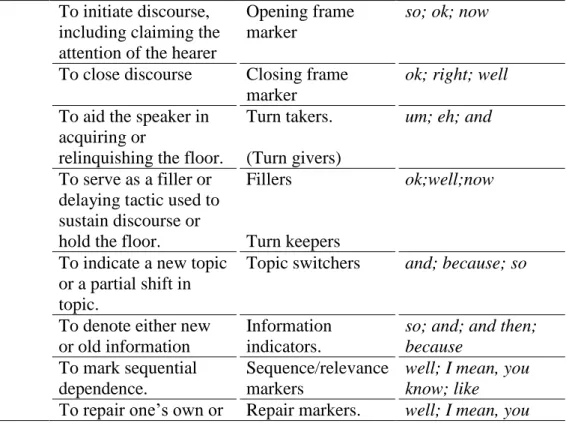
meanings that the speaker structures as text by creating cohesive passages of discourse. In other words, those functions are related to the context. Second category, interpersonal functions, are related to social exchange, in a way, the role of the speaker and the role assigned to the hearer. Castro (2009) adopted the inventory functions devised by Brinton in the following table and the examples given in the table are the functions of DMs used by the participants in the specific class sample of Castro’s study:
Table 1: Pragmatic functions of discourse markers
Textual Functions
To initiate discourse, including claiming the attention of the hearer
Opening frame marker
so; ok; now
To close discourse Closing frame marker
ok; right; well
To aid the speaker in acquiring or
relinquishing the floor.
Turn takers. (Turn givers)
um; eh; and
To serve as a filler or delaying tactic used to sustain discourse or hold the floor.
Fillers
Turn keepers
ok;well;now
To indicate a new topic or a partial shift in topic.
Topic switchers and; because; so
To denote either new or old information
Information indicators.
so; and; and then; because
To mark sequential dependence.
Sequence/relevance markers
well; I mean, you know; like
others’ discourse. know; like Interpersonal functions Subjectively, to express a response or a reaction to the preceding discourse including also back-channel signals of understanding and continued attention while another speaker is having his/her turn.
Response/reaction markers
Back-channel signals
yeah; oh; ah; but; oh yeah; well; eh; oh really? mhm; uh huh; yeah Interpersonally, to effect cooperation or sharing, including confirming shared assumptions, checking or expressing udnerstanding, requesting confirmation, expressing difference or saving face (politeness). Cooperation, agreement marker Disagreement marker Checking understanding markers Confirmation-seekers Face-savers
ok; yes; yeah; mhm but; no
ah; I know; yeah; mhm; yes
(Castro, 2009)
Another classification is done by Redeker (1990) who divides discourse markers into two categories: those that mark ideational structure, such as connectives and temporal adverbials (e.g. and, meanwhile, or now) and those which mark pragmatic
structure (e.g., oh, alright, or well). She finds that, to some extent, the use of DMs of
these two types are complementary. According to her research, ideational markers are used more than pragmatic markers in all cases, but the number of ideational markers used goes down when speakers use a high number of pragmatic markers.
Jucker and Smith (1998) examined differential use of DMs based on the relationship betwen interlocutors and divided DMs into reception markers (e.g. oh,
yeah, and okay) and presentation markers (e.g. like, you know and well). They found
that the presentation markers like well and you know were used more in interactions between friends, and the reception markers oh and yeah were used more between strangers.
Fung and Carter (2007) have categorized DMs within four categories, which is taken as the basis for qualitative analysis of the research. They arrange their categories by following Maschler (1994, 1998) and point out that one discourse marker can function more than only one specific one. Their multifunctional category includes four categories which are interpersonal, referential, structural and cognitive category. Within interpersonal category, DMs are used to signal shared knowledge (such as you
know, you see, see, listen) and to indicate responses like agreement, confirmation and
acknowledgement (such as Okay, oh, right/alright, yes, I see, great, oh great, sure). These kind of markers are used to indicate the attitudes of the speaker (such as well, I
think, you know, sort/kind of, like, just, to be frank, etc.). Another category is referential
category which includes DMs that are on a textual level and used to mark relationships between verbal activities preceding by conjunctions: cause (because/cos), consequence (so), contrast (but, and, yet, however, nevertheless), coordination (and), disjunction (or), digression (anyway) and comparison (likewise, similarly). The third category is structural category in which DMs are used to indicate the discourse in progress. Signposting opening and closing of topics (now, OK, right, well, by the way, let’s start,
let me conclude the discussion), indicating sequential relationships (first, firstly, second, next, then, finally) and marking topic shifts (so, now and what about, how about) are the
DMs within this category. Another category is cognitive category including DMs that provide information about the cognitive state of speakers. These kind of DMs are used to instruct a mental representation of the discourse. The speaker uses these kind of DMs to denote the thinking process (well, I think, I see, and), reformulate (I mean, that is, in
other words), elaborate (like, I mean), mark hesitation (well, sort of) and assess the
listener’s knowledge about the utterances (you know).
Briefly, it can be stated that the complex form of discourse markers in terminology also influence their classification. That’s why several types of classifications are valid within the field.
2.3.3. Characteristics of Discourse Markers
Discourse markers have specific features that make them different from other phrases or clauses. Different theoretic backgrounds approach discourse markers in different points of view and thus this makes the characteristics of discourse markers
versatile. Jucker (1993) stated Hölker’s (1991) list of four basic features of discourse markers as in the following:
1. they do not affect the truth conditions of an utterance.
2. they do not add anything to the propositional content of an utterance. 3. they are related to the speech situation and not to the situation talked about.
4. they have an emotive, expressive function rather than a referential, denotative, or cognitive function. (p.436)
Moreover, Schourup (1999) is the one who gathers the general characteristics of discourse markers according to connectivity, multifunctionality, optionality, non-truth conditionality, weak clause association, initiality, orality and multicategoriality.
2.3.3.1 Connectivity
Connectivity is one of the basic characteristic of DMs as discourse markers are used to establish a relationship between the current utterance and the previous utterance. However, different authors approach this characteristic of connectivity in different ways. As Schiffrin (1987) and Fraser (1988) are on the side of coherence-based approach while analysing discourse markers, they point out that DMs relate two textual units by contributing to inter-utterance coherence. On the other hand, Blakemore, who is on the side of relevance-based approach, states that it is better to view certain DMs not as necessarily relating two segments of text, but as relating the propositional content expressed by the current utterance to assumption that may or may not have been communicated by a prior utterance, as in the following example:
[Seeing someone return home with parcels]
So you’ve spent all your money. (Blakemore, 1987:86)
In the example above, there is not a sentence uttered before. Here so refers to a proposition derived from “observation of a state of affairs”, that is, to a context in a wider sense. Thus, Blakemore differs from Schiffrin and Fraser’s account regarding that it is not necessary to have two relevant textual units to use a discourse marker, there may have some other non-verbal signs to use the discourse marker. This kind of dispute over connectivity is highly relevant to two approaches about DMs; coherence-based
models of discourse and relevance approach. Moreover, Schourup (1999) discusses this characteristic as in the following:
If connectivity, however formulated, is considered criterial for DM status, it can be used to distinguish DMs from various other initial elements, such as illocutionary adverbials (frankly, confidentially), attitudinal adverbials (fortunately, sadly), and from primary interjections (yipes, oops); however, connectivity alone is insufficient to distinguish DMs from coordinators joining intrasentential elements. (p.231)
As Schourup (1999) also points out above, the characteristic of connectivity of discourse markers is not an adequate feature to call a linguistic form as a discourse marker. Furthermore, this characteristic is distinctive in the sense that makes discourse markers distinguishable from other initial elements.
2.3.3.2 Multi-functionality/Polyfunctionality
It has been concluded from the relevant researches that discourse markers are used to fulfill several functions. To give an example, but functions differently in two sentences:
John likes football; but Mary likes basketball. John is a lawyer; but he is honest. (Coll, 2009:48)
Within the first sentence, but is used to indicate contrast while in the other sentence it is used to show denial of expectations. Moreover, Jucker (1993) claims that this polyfunctionality of discourse markers make it difficult to compose a unified description of them and then proposes three solutions for this problem.
The first solution is to say that a particular discourse marker, for instance well, is ambigous and requires several seperate entries in a lexicon. The second solution is to say that all uses can be related to one core meaning. The third solution, finally, does not accept the polyfunctionality but claims that – properly understood – all uses can be summarised under one general description. (Hölker, 1991:86, cited in Jucker, 1993:437)
to approach this feature of multifunctionality of discourse marker in a different way. To accept that discourse markers function in different ways and to analyse the issue particulary within the immediate context can shed light.
2.3.3.3 Optionality
There is another characteristic of DMs which is their optionality as syntactically and semantically. Fraser (1998) states that removal of a DM does not alter the grammaticality of its host sentence (p.22). For instance:
The others are going to Stoke. However, I am going to Paris. The others are going to Stoke. I am going to Paris.
Schourup (1999), with the example above, points out that “if a DM is omitted, the relationship it signals is still available to the hearer, though explicitly cued” (p. 231). However, this does not mean that this characteristic of DM makes DMs useless or redundant. Behind this optionality lies that DMs guide the hearer to a particular interpretation and at the same time ruling out unintended interpretations. For example, in the above sentences, although it is not necessary to use however to signal the meaning, adding however to the utterance will ‘reinforce’ or ‘clue’ the interpretation intended by the speaker.
Schiffrin (1987) also supports this claim by stating that discourse markers are independent of sentential structure although markers often precede sentences, i.e. syntactic configurations of an independent clause plus all clauses dependent on it. Thus removal of a marker from its sentence initial position leaves the sentence structure intact. Furthermore, several markers – y’know, I mean, oh, like – can occur quite freely within a sentence at locations which are very difficult to define syntactically. Especially, in spoken discourse, many discourse markers can be placed in different locations, and also can be omitted without any change in syntax.
2.3.3.4. Non-truth conditionality
When analysed semantically, it is generally thought that DMs do not contribute anything to truth-conditions of the proposition expressed by an utterance. This