Copyright © 2014 by iSER, International Society of Educational Research ISSN: 1305-8223
Resolving the Dilemma of International
School Curriculum: The Case of Biology
Sıla Sagun & M. Sencer Corlu
Bilkent University, TURKIYE
Received 11 April 2013; accepted 29 January 2014
The purpose of the current study is to explore the predictors of the Diploma Program scores in biology to resolve the dilemma regarding which international school curriculum is better to prepare students for the Diploma Program. A purposive sample of 135 high school students was drawn from a private international school in Turkey. Data was analyzed with a multiple regression approach. A statistically significant and relatively strong relationship was found between the Diploma Program scores in biology and the International General Certificate of Secondary Education science exam scores.
Keywords: international schools, International Baccalaureate, science education, biology education.
INTRODUCTION
In today’s globalized world, the competencies that an individual may gain from international education are more important than ever. One of the arch institutions that provide students with opportunities to develop such competencies is the international school (Walker, 2012). International schools are worldwide, offering a K-12 education to a highly-mobile group of students (Lee, Hallinger, & Walker, 2012). Several researchers describe international schools as unique places of learning and teaching with respect to their student and teacher populations. These populations come from different cultures to meet and work for a common purpose (Hayden & Thompson, 1998). Despite their differences, international schools continue to inspire national school systems by their well-rounded education, which is known to combine pedagogical, pragmatic and idealistic approaches to teaching and learning (Hill, 2012; Roberts, 2003). Today, an increasing number of national schools in the United States, Europe and in other parts of the world attempt
to adapt the curricula implemented in international schools.
Mainstream International Curricula
There are two mainstream curricula used in international schools: Curricula developed by the International Baccalaureate Organisation (IBO) or those developed by Cambridge International Examinations (CIE). The policy makers, curriculum designers, and researchers who are affiliated with the IBO, contribute to the development and quality assurance of a variety of subject courses and assessment schemes for international schools around the world. At present, over 3,400 schools follow their programs, which are recognized by over 2,000 universities (IBO, 2013a). There are three IBO programs, specifically designed for each grade level: the Primary Years Program (PYP), the Middle Years Program (MYP), and the Diploma Program (DP). As a highly popular senior high school program for students aged 16 to 19, the DP is organized around six different subject groups. The students enrolled in the DP can choose standard level (SL) or higher level (HL) courses within these subject groups (IBO, 2013b). Because the IBO programs are designed with the holistic approach, the outcome of the programs is externally evaluated at the end of the DP. Second widely used curriculum at international schools is developed by Cambridge International Examinations Correspondence to:
Sıla Sagun,
PhD student, Graduate School of Education,
Bilkent University in Ankara, TURKEY
Email: [email protected]
154
© 2014 iSER, Eurasia J. Math. Sci. & Tech. Ed., 10(2), 153-158 (CIE). Over 3,700 schools offer the InternationalGeneral Certificate of Secondary Education (IGCSE) syllabi, which are developed for junior high school students, aged 14 to 16. The IGCSE syllabi are written independently for over 70 courses (CIE, 2013). The outcome of the IGCSE is evaluated by external examinations which include written and oral tests, coursework, and a series of practical assessment tasks.
International Curriculum Context in Turkey According to the IBO official statistics, there are 43 schools that implement one or more of their programs. Of those schools, 30 of them offer the DP and seven of them offer the MYP. Including two schools that are authorized to offer all three IB programs, there are three schools in total that offer the MYP and DP in sequence (IBO, 2013c). There are at least 15 schools in Turkey listed as Cambridge schools in CIE website; however, information regarding the exact number of schools that implement the IGCSE is not publicly available (CIE, 2013).
Coordinated Science and Biology in International Curricula
Students can choose either the SL or the HL biology as a DP science subject group course. The biology course is studied for two years in grades 11 and 12. At the end of the course, students sit an external written examination, in which they answer multiple choice, short answer, and extended answer questions. Student responses are marked by external examiners and scores are converted to a final grade that ranges from 1 (lowest) to 7. In addition to the internal assessment tasks, which need to be completed at schools, students can choose to write a research paper under the supervision of their biology teacher. This research paper assignment is called the extended essay (IBO, 2013d).
The coordinated IGCSE science course is designed as a two-year course for grades 9 and 10. The cross-referenced syllabus of the IGCSE science course contains content from all individual science subjects, including biology. Students are assessed in three different tasks that contain multiple choice, short answer, and structured questions, in addition to an applied test of their experimental skills. External examiners mark student responses and the range of grades is GG (lowest) to A*A* (CIE, 2013).
The Dilemma for DP Preparation
The popularity of the DP among national and international schools exposed the need to evaluate student and teacher readiness for the program. Some researchers emphasized that students needed extra preparation in addition to what was typically required in grades 9 and 10 curricula (Culross & Tarver, 2011). Bunnell (2011) argued that the schools need to maintain the continuum between junior high school curriculum and the DP. Researchers’ claims about the necessity of a rigorous DP preparation are aligned with the practices reported from schools around the world. For example, several DP schools in the United States and Turkey introduced specially-tailored pre-DP courses in grade 9 and 10, or alternative revision courses, either online or to be held after-school hours. Such courses seem to be introduced as support systems for DP preparation or used as a placement criterion to select the most motivated and most able students.
While the DP schools are subject to the IBO’s (2014) ongoing review process for quality assurance, teachers need to acquaint themselves with the requirements of their subject area through the IBO-approved professional development programs or by acquiring teaching qualifications from recognized institutions (Corlu & Ateskan, 2014). Despite some isolated examples, there is little research that explored
State of the literature
• Students need to be better prepared at the junior high school level to cope up with the challenges of senior high school curriculum, including high-stakes tests for colleges. It is not clear in the literature whether school administrators, teachers, or parents have the necessary tools to support students during this period.
• It is inconclusive whether the International General Certificate of Secondary Education (IGCSE) syllabus prepares students for the challenges of the Diploma Program (DP) well. • International schools continue to be a role-model
to national school systems in different parts of the world, including Turkey, with their curricula and other support systems.
Contribution of this paper to the literature
• The dilemma regarding which international school curriculum is better to prepare students for the DP is a controversial issue, mostly due to the lack of adequate research. This study brings empirical evidence to support the IGCSE as a well-rounded program for the DP.
• The importance of practical work at junior high level for success in biology at the senior level is discussed.
• The results of this study support the importance of external examinations for increasing the performance of students, teachers and school administrators.
© 2014 iSER, Eurasia J. Math. Sci. & Tech. Ed., 10(2), 153-158
155
the practices implemented at schools to preparestudents and teachers for the challenges of the DP. The MYP was recommended by the IBO as a solid preparation for the DP. Those in favor of the MYP praise the program for its flexibility and for offering a well-rounded curriculum (Seldon, 2007). However, some others criticized the MYP for being obscure or for mandating a heavy curriculum (Milikan, 2000). Several others claimed that the IGCSE could be considered as an ambitious contender of the MYP (Morrison, 2009; Stewart, 2010). Aligned with these views, influential international schools, including the United World Colleges (2013) and Education First Academy (2014), reported positive testimonials in favor of the IGCSE as an effective preparation curriculum for the DP. These schools reported that the IGCSE helped students make more realistic subject choices in the DP. At the national level, an increasing number of British private schools were reported to be offering the IGCSE courses. For example, according to the Independent Schools Council in the UK, there were 40,000 IGCSE exam entries in 2008, a leap from 15,000 in 2007. One reason behind the popularity of the IGCSE among schools was reported by administrators and teachers to be due to its rigorous assessment (British Broadcasting Corporation, 2009), although some others claimed that the IGCSE was chosen by schools to boost student grades (Paton, 2013). The dilemma regarding which international school curriculum is the best for DP preparation is a controversial issue, mostly due to lack of adequate research evidence.
The purpose of this study was to examine the impact of the IGCSE coordinated science course on the academic achievement of DP biology standard and higher level students. The study was designed to identify the quality of the assumed predictors (IGCSE science, extended essay choice in biology, DP biology course level, and gender) of the scores in DP biology. The primary research question addressed in this study was:
To what extent is the IGCSE coordinated science program successful in supporting the DP biology program in terms of student scores?
METHODOLOGY AND DATA ANALYSIS A purposive sample of 135 high school students (94 female) was drawn from a private international school in a major metropolitan city in Turkey. The participants were selected according to the following criteria: (a)they were enrolled in either the standard or higher level DP biology course and (b)they should have completed the IGCSE coordinated science course in grades 9 and 10 at this school. The medium of instruction at the school was English. Over 15 nationalities were represented in the school’s student population and 20 nationalities in the staff population. Some of the sampled students were
of non-Turkish descent or double-citizens, although the majority of the students held Turkish passports. All students were of high socio-economic status and were economically privileged. The school was offering the IGCSE syllabi at 8th, 9th and 10th grade levels. At the end of the IGCSE, all students were automatically admitted to the DP with no selection criteria.
The dependent variable of the study was the DP biology external examination scores (DPbio; range 1-7), while the independent variables were; the IGCSE coordinated science external examination scores (IGscience; range 1-7), whether they chose to write an extended essay in biology or not (EEbio; 0=no, 1=yes), the DP biology course level (LEVbio; 0=standard level, 1=high level) and gender (0=female, 1=male). There was some missing data in the sample, which was imputed with a regression method (Arbuckle, 2007). There was no outlier that deviated from the mean by more than three standard deviations. Data were inspected for residual normality and the variation inflation factor values were consulted for the multicollinearity threat. They were tolerable (Tabachnick & Fidell, 2007).
Data was first analyzed descriptively by computing the means and standard deviations for each continuous variable. Correlations between continuous variables were given with Pearson’s correlation coefficient r, where appropriate. A multiple regression analysis was used to answer the research question. A priori power analysis with medium effect size (f2 = 0.15) and power
= .95 indicated a minimum sample size of 129. Results are displayed by using visual representations, including a path diagram.
RESULTS
Data was analyzed descriptively, including the mean and the standard deviation for continous variables: IGscience (Mean = 4.28; SD = 1.43) and DPbio (Mean
= 4.77; SD = 1.23). When compared to the global mean
score of group of subjects including biology (mean DPbio score of all students around the world was known to be 4.34; [IBO, 2012]), participants in our sample scored higher than the global average: t(134) =
3.72; p < .01, Cohen’s d = 0.38. While only a small
number of participants chose to write their extended essays in biology, about one third of the students in our sample were enrolled in the DP higher level biology, compared to standard level biology course.
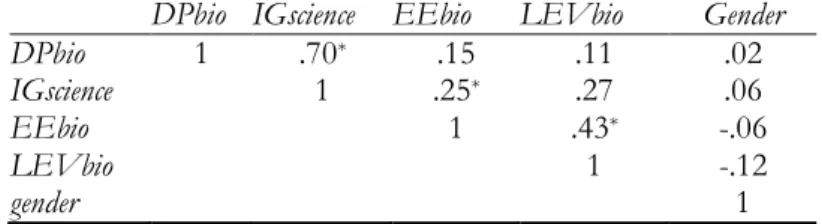
The correlation coefficients were computed to describe the bivariate relationships between the variables. Table 1 shows that students, who were more successful in the IGCSE coordinated science course, were more likely to write an extended essay in biology (rEEbio – IGscience = .25, p<.01) or to enroll in the
156
© 2014 iSER, Eurasia J. Math. Sci. & Tech. Ed., 10(2), 153-158 .27, p<.01). None of the variables were in correlationwith gender (p>.01), indicating that males and females
may not be likely to differ in terms of;
(a)their choice of writing an extended essay in the DP biology or not,
(b)their choice of enrollment in the DP standard or higher level biology course.
A multiple regression analysis was conducted to evaluate the extend that the IGCSE coordinated science scores predicted the scores in DP biology. The other predictors in the model were: (a)whether student wrote their extended essays in biology or not (EEbio); (b)whether they were enrolled in the DP higher level biology course or the standard level course (LEVbio), and (c)gender. The multiple regression equation with four predictors was given with unstandardized b coefficients as follows, where F(4,130)=33.04; p<.01: DPbio = 0.63(IGscience) + 0.02(EEbio) - 0.25(LEVbio) - 0.10(gender).
After an investigation into the structural coefficients (See Table 1 to estimate rs), unstandardized b coefficients, as well as the R2 change for a possible supressor variable, the most important statistically significant predictor of the DP biology scores emerged as the IGCSE coordinated science scores (b=0.63, p<.01). This finding indicated that if students could
increase their IGCSE coordinated science scores by 1 point, their DP biology scores would increase by 0.63 points, when all other variables are kept constant. None of the other three predictors had statistically significant weights (p>.01).
The multiple regression model explained about half of the total variance in the DP biology scores (R2=0.50;
R2adjusted=0.49, p<.01), indicating a large effect size
when compared to our initial assumption, during the minimum sample size estimation procedure. A path diagram was drawn to visually represent the model. See Figure 1. The numbers by the arrows towards DPbio Table1.Bivariate relationships between variables in the model
DPbio IGscience EEbio LEVbio Gender DPbio 1 .70* .15 .11 .02 IGscience 1 .25* .27 .06 EEbio 1 .43* -.06 LEVbio 1 -.12
gender 1
Note. *. Correlation was significant at the .01 level (2-tailed).
Figure 1. Visual representation of the multiple regression model that predicts DP biology scores (statistically significant relationships are shown in bold).
© 2014 iSER, Eurasia J. Math. Sci. & Tech. Ed., 10(2), 153-158
157
variable indicated the standardized regression weights(β), whereas numbers by the arrows between predictors were the bivariate correlation coefficients. This finding indicated that if students could increase their IGCSE coordinated science scores by one standard deviations, their DP biology scores would increase by 0.73 standard deviations, when all other variables are kept constant. DISCUSSION
The purpose of this study was to examine the impact of the IGCSE coordinated science course on student outcome scores in the DP biology by identifying the quality of the assumed predictor variables. About half of the variance in the DP biology scores was explained. Thus, the model fit data well.
The strong relationship between the student scores at the IGCSE coordinated science and DP biology scores is not easy to explain due to the complexity of the issue. The practical approach to science education is evident in the IGCSE coordinated science syllabus, which states that “candidates learn about the basic principles of each subject through a mix of theoretical and practical studies, while also developing an understanding of the scientific skills essential for further study” (CIE, 2013). Similarly, the DP science stresses the importance of the practical approach through experimental work (IBO, 2011). One possible explanation of this noteworthy relationship is that the IGCSE’s emphasis on practical work in science education is positively affecting student scores in biology at the senior level (Bybee, 1997; Toplis & Allen, 2012).
A second explanation can be due to both curricula’s similar approach towards testing the program outcomes. In other words, the IGCSE external examination is likely to be perceived as a high-stakes test by the students. Building upon the claim that students need to “take public examinations before they tackle the demands of the IB Diploma examinations in grade 12” (Taylor & Nashman-Smith, 2004), it may be speculated that students who perform well in the IGCSE examinations, may have less stress in dealing with the high stakes nature of the DP examinations. This is instrumental for their placement at a respected higher education institution.
A third explanation is due to the extra motivation and effort of school administrators and teachers to help students succeed at external examinations. It may be the case that administrators and teachers share the view that the IGCSE exam is high-stakes and that results can be used for accountability purposes (Hayden & Thompson, 1998; Taylor & Nashman-Smith, 2004). Therefore, such a perception may result in organizing extra professional development hours for teachers to improve teaching
quality or additional hours of science instruction to increase student performance (Bishop, 1995).
The findings are mixed with regard to the effect of gender on predicting achievement in biology. The findings in the present study and previous research in the Turkish literature (Usak, Prokop, Ozden, Ozel, Bilen, & Erdogan, 2009) indicate that there is no difference by gender. However, other studies suggest that females generally outperform males in biology (Hong, Shim, Chang, 1998; Prokop, Prokop, & Tunnicliffe, 2007). There is also evidence in this study that females and males do not differ in terms of their interest in conducting advanced research in biology (cf. Dhindsa & Chung, 2003) or efficacy levels towards succeeding a higher level of biology (cf. Cakiroglu, Cakiroglu, & Boone, 2005). The disparities with regard to gender may be explained by the fact that the population of the current study was high performing students and the sample included students with diverse backgrounds, which makes it difficult to compare findings from average national populations.
CONCLUSION
We believe that the IGCSE coordinated science offers an effective curriculum to prepare students for the DP biology course. Based on our teaching experiences at the MYP, IGCSE, and DP, we appreciate the merits of all three programs and do not claim that the IGCSE offers better preparation for the DP than the MYP does. Neither does our research make any such claim. However, we do believe in the necessity of external examinations to increase student and teacher performance—but only if supported by a variety of other assessment schemes, including internal assessment of students by teachers, evaluation of teacher performance by students, and self-assessment for all parties (Darling-Hammond, 2013).
The results of this research can be generalized to similar student populations studying at schools that admit all IGCSE graduates to the DP. It is, however, a common practice at DP national schools in Turkey that only the most motivated and able students are admitted to the program, and that presents itself as a limitation to the current study.
REFERENCES
Arbuckle, J. L. (2007). Amos 19 user’s guide. Crawfordville, FL: Amos Development Corporation.
Bishop, J. H. (1995). The impact of curriculum-based external examinations on school priorities and student learning (
British Broadcasting Corporation (2009, March 5). Q&A: GCSE v IGCSE. Retrieved from
CAHRS Working Paper #95-30). Ithaca, NY: Cornell University.
158
© 2014 iSER, Eurasia J. Math. Sci. & Tech. Ed., 10(2), 153-158 http://news.bbc.co.uk/2/hi/uk_news/education/7924496.stm
Bunnell, T. (2011). The International Baccalaureate Middle Years Programme after 30 years: A critical inquiry. Journal of Research in International Education, 10(3), 261-274.
Bybee, R. W. (1997). Achieving scientific literacy: From purposes to practice. Westport, CT: Heinemann.
Cakiroglu, J., Cakiroglu, E., & Boone, W. J. (2005). Pre-service teacher self-efficacy beliefs regarding science teaching: A comparison of pre-service teachers in Turkey and the USA. Science Educator, 14(1), 31-40. Cambridge International Examinations. (2013). Cambridge
IGCSE. Retrieved from http://www.cie.org.uk/ qualifications/academic/middlesec/igcse/overview. Corlu, M. S., & Ateskan, A. (2014, April). How are international
teachers educated? Perceptions of student teachers on their education for international teaching. Paper presented at the annual conference of American Educational Research Association, Philadelphia, PA.
Culross, R., & Tarver, E. (2011). A summary of research on the International Baccalaureate Diploma Programme: Perspectives of students, teachers, and university admission offices in the USA. Journal of Research in International Education, 10(3), 231-243.
Darling-Hammond, L. (2013). Getting teacher evaluation right: What really matters for effectiveness and improvement. New York: Teachers College Press.
Dhind sa, H. S., & Chung, G. (2003). Attitudes and achievement of Bruneian science students. International Journal of Science Education, 25(8), 907-922.
Education First. (2014, January 21). Programmes for IB Diploma. Retrieved from http://www.ef.edu/ia/academics/ibdp. Hayden, M. C., & Thompson, J. J. (1998). International
education: Perceptions of teachers in international schools. International Review of Education, 44(5/6), 549-568.
Hong, J. L., Shim, K. C., & Chang, N. K. (1998). A study of Korean middle school students’ interests in biology and their implications for biology education. International Journal of Science Education, 20(8), 989-999.
Hill, I. (2012). An international model of world-class education: The International Baccalaureate. Prospects, 42, 341-359.
International Baccalaureate Organisation. (2011). Science acroos the IB continuum. Cardiff, Wales: Author.
International Baccalaureate Organisation. (2012). The IB Diploma Programme statistical bulletin. Cardiff, Wales: Author.
International Baccalaureate Organisation. (2013a). What is IB recognition? Retrieved from http://ibo.org/recognition. International Baccalaureate Organization. (2013b). The IB
Diploma Programme. Retrieved from http://www.ibo.org/diploma.
International Baccalaureate Organization. (2013c). Find an IB
World School. Retrieved from http://www.ibo.org/school/search.
International Baccalaureate Organization. (2013d). Diploma programme curriculum-core requirements. Retrieved from http://www.ibo.org/diploma/curriculum/core/essay/. Lee, M., Hallinger, P., & Walker, A. (2012): Leadership
challenges in international schools in the Asia Pacific
region: evidence from programme implementation of the International Baccalaureate. International Journal of Leadership in Education: Theory and Practice, 15(3), 289-310 Milikan, R. (2000). Transition and continuity between IB
programmes. IB Research Notes, 1(1): 2-5.
Morrison, N. (2009, April 24). GCSE your time is up. Times Educational Supplement,. Retrieved from http://www.tes.co.uk.
Paton, G. (2013, August 21). Schools moving to 'easy' IGCSE exams to boost grades. Retrieved from http://www.telegraph.co.uk/
Prokop, P., Prokop, M., & Tunnicliffe, S. D. (2007). Is biology boring? Student attitudes toward biology. Journal of Biological Education, 42(1), 36-39.
Roberts, B. (2003). What should international education be? From emergent theory to practice. International Schools Journal, 22(2), 69-79.
Seldon, A. (2007, December 7). Focus or breadth? The pupils can have both. Times Educational Supplement. Retrieved from http://www.tes.co.uk/article.aspx?storycode= 2483239.
Stewart, W. (2010, October 8). IB for all is preferable to ‘schizophrenic’ status quo, argues Wellington head. Times Educational Supplement. Retrieved from http://www.tes.co.uk/article.aspx?storycode=6060288. Tabachnick, G. G., & Fidell, L. S. (2007). Experimental designs
using ANOVA. Belmont, CA: Duxbury.
Taylor, R., & Nashman-Smith, M. (2004). Integrating the IB MYP and IGCSE: Report on the International Conference held in Muscat, Oman, 10–12 March 2004. International Schools Journal 24(1), 19–25.
Toplis, R., & Allen, M.(2012). ‘I do and I understand?’ Practical work and laboratory use in United Kingdom schools . Eurasia Journal of Mathematics, Science & Technology Education, 8(1), 3-9.
United World Colleges. (2013, February). Grade 9 and 10 academic curriculum guide – 2013/2014. Retrieved from http://www.uwcsea.edu.sg/
Usak, M., Prokop, P., Ozden, M., Ozel, M., Bilen, K., & Erdogan, M. (2009). Turkish university students’ attitudes toward biology: the effects of gender and enrolment in biology classes. Journal of Baltic Science Education, 8(2), 88-96.
Walker, G. (2012). Tea and oysters: Metaphors for a global education. International Schools Journal, 31(2), 8-17.