See discussions, stats, and author profiles for this publication at: https://www.researchgate.net/publication/252969292
Magnetic Field Effects on an Electron Near an Impenetrable Dielectric Surface
Article · September 1996 CITATION 1 READS 19 3 authors, including:
Some of the authors of this publication are also working on these related projects:
Investigation of the New Emerging 2D Material Properties Aimed for Optoelectronic ApplicationsView project
Optical Properties of 2D HeterostructuresView project Bassam Saqqa
Islamic University of Gaza
8PUBLICATIONS 13CITATIONS
SEE PROFILE
Tuğrul Senger
Izmir Institute of Technology
89PUBLICATIONS 1,905CITATIONS
SEE PROFILE
c
° T ¨UB˙ITAK
Magnetic field effects on an electron
near an impenetrable dielectric surface
(∗)B. SAQQA
Department of Physics, The Islamic University of Gaza, P.O.Box 108, Gaza via Israel
R. T. SENGER, A. ERC¸ ELEB˙I
Department of Physics, Bilkent University, 06533 Bilkent, Ankara, TURKEY
Received 7.5.1996
Abstract
The interaction of an extrinsic electron with the surface optical modes of a semi-infinite medium is retrieved under the effect of a weak magnetic field. It is observed that for an electron in a bound state near the surface, the magnetic field enhances the effective phonon coupling rather prominently and thus leads to an increased degree of localisation of the electron towards the surface. This feature is seen to be more marked for larger coupling strengths.
1. Introduction
In the last few decades considerable amount of work has been devoted to the understanding of the interaction of an electron with the surface excitations on a semi-infinite medium. The problem is interesting from a technological viewpiont in the context of surface spectroscopy and the study of the optical properties of polar thin films and interfaces, and moreover, finds its relevance in the two-dimensional semiconductor structures of recent times.
The model we adopt in this report consists of an ionic or polar material filling the half space
z < 0 and an electron localised near, but primarily external to, the material. The exterior electron
has an electric field which influences and polarises the surface modes. These modes, when polarised, create electric fields which in turn act back upon the electron. The electron is therefore attracted to the surface (z = 0) by its image potential and in the meantime is repelled away by the the repulsive barrier resulting from the large difference between the bottom of the conduction band of the material and the vacuum level. It should be noted that bulk modes are not involved in the binding, as long as the electron is outside.
SAQQA, SENGER, ERC¸ ELEB˙I
Various aspects of the ground state property of such a system can be obtained by casting the problem to that of an electron coupled to the quantised surface modes of the crystal and thus utilising the formalisms that has already been developed for the Fr¨ohlich polaron concept [1-8]. For large coupling strengths, as for instance in ionic crystal like LiF (αs ≈ 7) the problem was
considered within the the framework of the strong-coupling theory [1,3] and within certain other variational methods intending to treat the problem in the overall range of the coupling strength [4-7]. The common conclusion reached by the relevant works in the literature is that for a sufficiently large coupling constant (αs>> 1) the electron goes into a bound state in which it is localised in the
close vicinity of the exterior face of the material by the strong interaction with the surface modes of oscillation. It has been observed that certain polaron quantities like the ground state binding energy, the mean number of phonons in the cloud near the electron or the degree of localisation are all increasing functions of the coupling strength. A further, yet important finding is that the effective potential deviates considerably from the classical Coulomb profile (Vcl ∼ −z−1) and in particular, at distances close to the surface, the electron-phonon coupling imposes a rounding off of the divergence encountered in the classical picture.
In the following we refer to the exterior-surface polaron problem and study the effect of an external magnetic field on the effective electron-phonon coupling. Due to the additional localisation brought about by the magnetic field one expects the electron to interact with the phonons in a more efficient way leading to an enhancement in the binding and an increase in the degree of confinement of the electron towards the surface. A similar problem along the same line has already been considered by Bhattacharya et al [9] within the framework of an iterative scheme with relevance to only a two dimensional characterisation of the electronic motion confined close to the surface ignoring the contribution to localisation along the field direction. For the present we restrict our discussions within the strong coupling formulation of the surface polaron in not too strong magnetic fields. Any complicating features that should be brought about by weak electron-phonon interactions [7] and/or by strong magnetic field intensities [10] will be presented in a future report.
2. Theory and Results
Considering an electron with position ~r = (~ρ, z), the interaction amplitude for when it is coupled to the optical branch of the surface phonon field can be given in analogy to the bulk polaron as
Γκ= (2παs/S)1/2e −κz √
κ (1)
where S is the normalisation area and ~κ denotes the SO-phonon wavevector. With ² refering to the effective dielectric screening, the electron-phonon coupling constant is given by [1]:
It should be noted that all physical quantities and operators will be given in dimensionless form where energies are scaled by the SO-phonon quantum ¯hωs, and lengths by zs= (¯h/2mωs)1/2, a
length the order of the size of a bulk polaron formed from an electron of free mass that of vacuum. Using the symmetric gauge, ~A = (B/2)(−y, x, 0) for the vector potential, the Hamiltonian
describing the electron-SO phonon system in a uniform magnetic field perpendicular to the surface is given by H = He+ X κ a† κaκ+ X κ Γκ{aκexp(i~κ · ~ρ) + hc} (2) He = p2+ 1 16Ω 2(x2+ y2) +1 2ΩLz (3)
where Lz = xpy− ypx, and aκ(a†κ) is the annihilation (creation) operator for SO-phonons. Ω is
the dimensionless cyclotron frequency expressed in units of ωs.
Refering to equation (2) one observes that after completing the square, the lattice part reads ˜ Hph= X κ (˜a† κ˜aκ− Γ2κ) (4)
wherein the phonon operators have been transformed accordingly as
aκ→ ˜aκ= aκ+ Γκexp(−i~κ · ~ρ). (5)
One then just identifies
< 0 | ˜Hph| 0 >= − X κ Γ2κ= − αs 2π Z d2κ κ e −2κz= −αs 2z (6)
as the classical image charge result [1].
The variational procedure we follow assumes the electron and the lattice variables to be totally separable with the phonon part of the wavefunction given as
ϕph= exp[
X
κ
Fκ(aκ− a†κ)] | 0 > (7)
where | 0 > is the phonon vacuum. The exponential operator is the canonical coherent state transformation which, in the semi-classical description, leads to the optimal surface polarisation centred on the mean charge density induced on the surface of the material. Alternatively stating, it describes the displacements of the lattice surface-oscillators in response to the presence of the electron outside the material. Therefore, the amplitude Fκ depends implicitly on the electron
wavefunction and must be treated as a variational parameter to be determined by the requirement that the energy of the system be minimised. For the most efficient coherent phonon state we obtain
SAQQA, SENGER, ERC¸ ELEB˙I
where ϕerefers to the particle part of the trial state in terms of which the ground state energy is
given by
Eg=< ϕe| He| ϕe> −
X
κ
Fκ2 (9)
Selecting a Gaussian spread (with variance σ2) in the transverse directions and describing the localisation in the remaining direction by
φ(z) = (λ 3 2 ) 1/2z exp(−λ 2z) (10) we obtain Eg = σ−2+ 1 4λ 2+ (1 4Ωσ) 2− α s Z ∞ 0 dκ fκ2(σ) gκ2(λ) (11)
which is to be minimised with respect to σ and λ. In the above
fκ(σ) = exp(−σ 2 4 κ 2) and g κ(λ) = (1 + κ λ) −3. (12)
It should be noted that, restricting the charge density fluctuations of the electron to lie just on the surface, the present model conforms to that for the strictly two-dimensional (2D) magnetopolaron [10]. Imposing an infinitely large value for λ in equation (10), the ground state energy simplifies to Eg= σ−2+ (1 4Ωσ) 2− (π 2) 1/2α sσ−1. (13)
For strong electron phonon coupling and weak magnetic field intensities (Ω/α2
s << 1), the
domi-nant contributions come from the first and the third terms in equation (13), and we find that the optimal σ value minimising the dominant part isp8/πα−1
s , yielding Eg = − π 8α 2 s[1 − (2Ω/πα2s)2] (14)
which is the two-dimensional analogue of the corresponding bulk value [11].
For the case of an exterior electron the ground state energy is not readily available and one requires numerical methods. In order to keep trace of Eg and the effective potential as an explicit
function of the distance from the surface we make a small digression from the waveform given by equation (10) and give a somewhat crude insight into the problem by adopting the oversimplifying assumption that the electron motion is confined to a sheet of zero thickness at z = z0 [3]. Taking the probability density profile in the z direction as δ(z − z0), equation (11) reduces to
Eg= σ−2+ (1 4Ωσ) 2− (π 2) 1/2α sσ−1exp(2z02/σ2) erfc( √ 2z0/σ) (15)
the phonon part of which takes the usual Coulomb form as given by equation (6) for z0>> σ, i.e., for when z0is considerably larger than the spatial extent of the lattice polarisation on the surface. As however when z0is made comparable with the polaron size the effective potential (Veff) deviates rather drastically from the electrostatic image potential, and consequently in the limit z0→ 0 the ground state energy conforms to the finite 2D-value given by equation (14).
An important implication led by the analysis of equation (15) is that the parameters αs, z0 and Ω do not act in an independent way but together contribute to the binding in interrelated manners. With decreasing z0 for instance, the binding gets stronger not only due to that the electron is closer to the surface but as well due to the additional enhancement in the effective electron phonon coupling coming from an increased degree of localisation in all directions. Turning on the magnetic field the binding becomes even stronger. In the absence of the magnetic field the ground state energy is −2.153 for z0 = 1 and −9.195 when z0 is reduced to 0.1, amounting to a deepening in Eg by a factor of about 4.27. For Ω = 2 the corresponding values are −1.653 and −8.695 with a lowering in the ground state level by a considerably larger factor of 5.26 which
clearly is an indication in favour of a pronounced electron-phonon coupling under a magnetic field. A further comment on the limit (Ω << α2
s) which we are concerned for the present is that
the Landau level energy 1
2Ω does not show up in equation (15) since in this limit the polaron counterpart of the problem strongly dominates over the magnetic field counterpart. In fact, the description displayed in this report consist of a deep self-induced potential well confining the charge density fluctuations of the electron which is further under the influence of a weak magnetic field. The polaron thus formed is stationary and centered essentially at the mean electron position rather than the centre of a complete Landau orbit (cf., ref.[12]).
Having provided the basic introductury features of the problem we now switch back to the formar ansatz, equation (10), for the wavefunction φ(z), and extend our discussions within more appropriate physical grounds consisting of the z-coordinate as an additional degree of freedom. With the charge density of the electron relaxed in the direction perpendicular to the surface one obtains a better way of understanding the bound state properties of the electron SO-phonon system since in this case the localisation is not imposed artificially by the δ-profiled probability density, but determined by the theory itself through a variational analysis of equation (11).
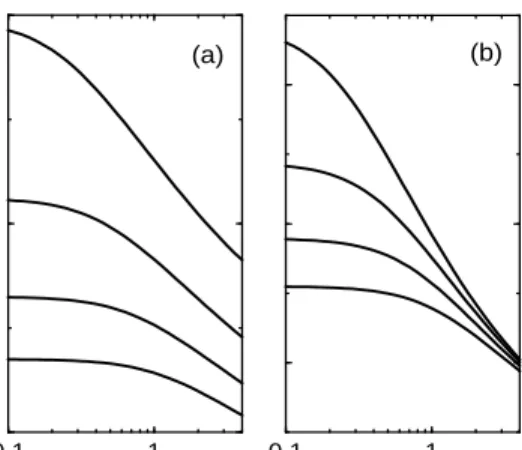
In order to give some insight into how the magnetic field enhances the coupling of the electron to the surface phonon modes, we display the transverse extent σ and the mean distance zm=<
ϕe | z | ϕe >= 3λ−1 as a function of the cyclotron frequency for a succession of some sample
coupling strengths (αs = 5, 7, 9 and 11). From figure 1 we observe that with the magnetic field
turned on, the fluctuation energy of the electron within the deep attractive potential well of the lattice becomes substantially increased accompanied by a higher degree of localisation which in turn results in a more effective interaction with the SO-phonons. The electron thus becomes more tightly compressed to the surface with a smaller spatial extent not only in the z direction, but as well in the transverse directions.
We now give a description of the effective potential as a function of the magnetic field by making reference to the expectation value of the lattice part of the Hamiltonian, equation (2), in
SAQQA, SENGER, ERC¸ ELEB˙I 0.1 1
Ω
1 2 3z
m 0.1 1Ω
1 2 3σ
(b) (a)Figure 1. (a) The mean distance zm from the surface, and (b) the transverse extent σ as a function of Ω. The curves from top to bottom are for αs= 5, 7, 9 and 11.
the coherent phonon state given by equation (7). Writing
< ϕph| H − He| ϕph>=
X
κ {F2
κ− ΓκFκ(ei~κ·~ρ+ cc)}, (16)
and projecting out the transverse coordinate ~ρ, we arrive at the same expression as that given by the last term in equation (15), i.e.,
Veff = − X κ Γ2 κfκ2(σ) = −( π 2) 2α sσ−1exp(2z2/σ2) erfc( √ 2z/σ). (17)
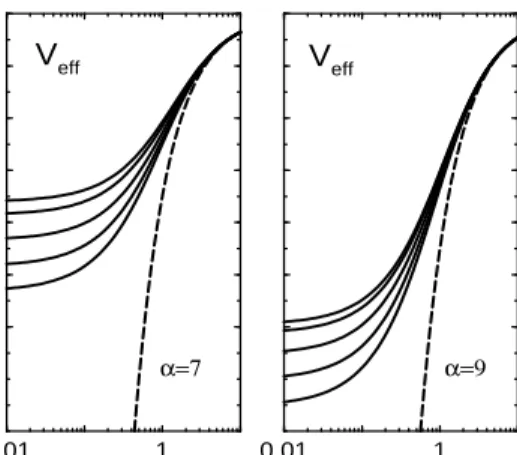
The effective potential is thus determined self consistently with revelance to Ω coming implicitly from equation (11) through the optimal fit to σ. In figure 2 we display Veff under various magnetic field intensities for αs= 7 and 9. We find that the effective potential gets significantly deepened
with increasing Ω, the deepening being much prominent in the close vicinity of the surface. At remote distances, i.e. when the electron is at a distance greater than zs, the magnetic field rapidly
loses its influence on the effective electron phonon coupling since in this case the electron is already weakly coupled to the surface, and the only thing the magnetic field will do is act on the almost-bare electron with whatsoever no appreciable polaron aspect. Consequently, at distances beyond
zs, Veff is seen to take the asymptotic value, −αs/2z regardless of the magnetic field strength.
In order to give somewhat more impact to the role of the magnetic field on the pronounced phonon coupling we extend our calculations to yield the effective polaronic mass as a function of
0.01 1
z
-6 -4 -2 0 0.01 1z
-6 -4 -2 0 α=9 α=7 Veff VeffFigure 2. The effective potential, Veff, under various magnetic field intensities: the solid curves from top
to bottom are for Ω = 0, 0.3, 0.6, 0.9 and 1.2. The dashed curves refer to the classical image potential
−αs/2z. (αs= 7 and 9)
Ω. The procedure consists of the variation of the Hamiltonian under the constraint that the total momentum ~ P = ~p +X κ ~κa† κaκ (18)
is conserved in the transverse directions. Extending the electronic wavefunction in the form ϕe→ ϕeexp(i ~w · ~ρ) with ~w introduced as a further variational parameter, we account for the composite
inertia of the electron coupled to the virtually excited phonons on the surface. Minimisation of
H −~µ· ~P in the state ϕeϕphyields ~w = (σ/ √
2)~µ, and Fκin equation (8) transforms to Fκ(1−~µ·~κ)
wherein the Lagrange multiplier ~µ is to be identified as the polaron velocity (cf., ref.[13]). We thus obtain < ϕeφph| H − ~µ · ~P | φphϕe> = Eg−1 4µ 2 + X κ 2παs S 1 κf 2 κ(σ)g2κ(λ)[1 − (1 − ~µ · ~κ)−1] (19)
Retaining terms up to second order in ~µ, the last two terms in the above equation can be written alternatively as −µ 2 4 [1 + 4π S αs X κ κ fκ2(σ)gκ2(λ)] (20)
SAQQA, SENGER, ERC¸ ELEB˙I 0 2 4 6 8 10
Ω
1 2 3 4 5 6m
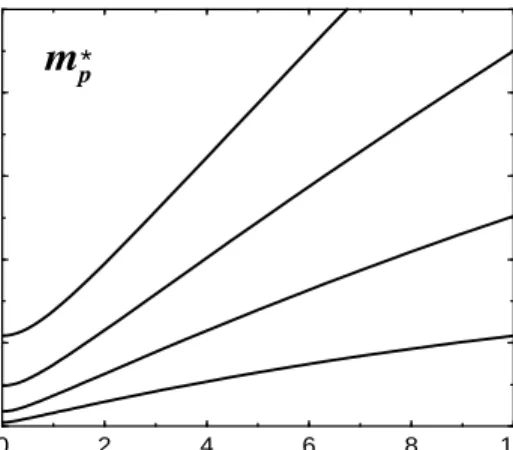
p*Figure 3. The effective polaronic mass m∗
p as a function of Ω. The curves from bottom to top are for
αs= 5, 7, 9 and 11.
from which we identify the effective polaron mass (expressed in units of the free-space electron mass) as m∗ p = 1 + 2αs Z ∞ 0 dκ κ2f2 κ(σ) gκ2(λ). (21)
In the strict two dimensional limit (λ → ∞), this expression simplifies to
m∗ (2D) p ≈ π2 16α 4 s (22)
as already reported previously by Peeters et al [14]. It should be noted that for sizable electron phonon coupling the value which equation (22) leads is much larger than unity. However, due to the exponentially decaying factor e−κz in equation (1) the corresponding mass for the exterior surface
polaron is expected to be significantly lower than for the on-surface (strict two dimensional) case. With the variational fits to σ and λ, equation (21) yields the effective mass of the exterior polaron as a function of the magnetic field strength. The overall implication led by the succession of curves for αs= 5 − 11 (cf., figure 3) is that the effective mass is a monotonically increasing function of Ω
and yet, grows at a considerably faster rate for larger coupling constants. This provides a further indication for the enhanced electron phonon coupling under a magnetic field and moreover, the effect of the magnetic field in turn being more prominent for stronger electron-phonon interactions. To summarise, this work retrieves the problem of an exterior electron in the close vicinity of the surface of an ionic on polar material. Within the framework of the strong coupling (adiabatic)
SAQQA, SENGER, ERC¸ ELEB˙I
polaron theory it has been observed that for a rather strong coupling of the electron to the surface phonon modes, the electron goes into a bound state localised over the surface and yet, under a magnetic field the binding becomes even deeper which shows up in that, with increasing field in-tensity the effective potential gets deeper resulting in pronounced values for the effective polaronic mass and an increased degree of localisation of the system in all directions.
References
1. J. Sak, Phys.Rev.B 6, 3981 (1972)2. E. Evans and D. L. Mills, Phys.Rev.B 8, 4004 (1973) 3. O. Hip´olito, J.Phys.C: Solid State Phys. 12, 4667 (1979) 4. T. D. Clark, Solid State Commun. 16, 861 (1975) 5. O. Hip´olito, Solid State Commun. 32, 515 (1979) 6. N. Tokuda, J.Phys.C: Solid State Phys. 15, 1353 (1982) 7. E. L. de Bodas and O. Hip´olito, Phys.Rev.B 27, 6110 (1983) 8. D. Ninno and G. Iadonisi, Phys.Rev.B 38, 3803 (1988)
9. M. Bhattacharya, S. Mukhopadhyay and T. K. Mitra, Phys.Stat.Sol.(b) 142, 141 (1987) 10. Wu Xiaoguang, F. M. Peeters and J. T. Devreese, Phys.Rev.B 32, 7964 (1985)
11. Y. L´epine, J.Phys.C: Solid State Phys. 18, 1817 (1985)
12. G. Whitfield, R. Parker and M. Rona, Phys.Rev.B 13, 2132 (1976) 13. R. Parker, G. Whitfield and M. Rona, Phys.Rev.B 10, 698 (1974)
14. F. M. Peeters, Wu Xiaoguang and J. T. Devreese JT, Phys.Rev.B 37, 933 (1988)