Synthesis, Characterization and Oxide Ionic Conductivity of Binary d-(Bi
2o
3)
1-x(Lu
2o
3)
xSystem
Esra Öztürk
a,* and Nilgun Ozpozan Kalaycioglu
baDepartment of Materials Science and Engineering, Faculty of Engineering, Karamanolu Mehmetbey University, Karaman, 70200, Turkey
b
Department of Chemistry, Faculty of Science, Erciyes University, Kayseri, 38039, Turkey (Received: Oct. 16, 2012; Accepted: Jan. 23, 2013; Published Online: Mar. 11, 2013; DOI: 10.1002/jccs.201200540)
In this study, after doping Lu2O3toa-Bi2O3in the range of 11%£ n £ 20% in a series of different mole ra-tios, heat treatment was performed by applying a cascade temperature rise in the range of 700-800oC for 72 hours and new phases were obtained in the (Bi2O3)1-x(Lu2O3)xsystem. After 72 hours of heat treatment at 800oC, mixtures containing 14-16% Lu2O3formed a face-centered cubic phase. Mixtures containing 11– 13%, 17%, 18% mole Lu2O3were subjected to a quenching process at 825oC and face-centered cubic phases were obtained. With the help of XRD, the crystal systems and lattice parameters of the solid solu-tions were obtained and their characterization was carried out. Thermal measurements were made by us-ing a simultaneous DTA/TG system. The total conductivity (sT) in thed-Bi2O3doped with Lu2O3system was measured using the four-probe DC method. Keywords: Bismuth oxide; lutesium oxide; oxygen ionic conductivity; X-ray techniques; thermal analysis.
Keywords: Bismuth oxide; Lutesium oxide; Oxygen ionic conductivity; X-ray techniques; Ther-mal analysis.
INTRODUCTION
Up to now, researchers have reported six polymorphs of bismuth trioxide (Bi2O3). These are the monoclinic (a-Bi2O3), body-centered cubic (bcc) (g-Bi2O3), face-centered cubic (fcc) (d-Bi2O3), tetragonal (b-Bi2O3), triclinic (w-Bi2O3) and orthorhombic (e-Bi2O3) phases.1-7Thea–phase is stable at room temperature while the other five forms are unstable crystal modifications that are formed at high tem-peratures. If purea-Bi2O3, whose melting temperature is 824oC, is heated up to about 729 °C, it is transformed into thed-Bi2O3phase, which is stable at high temperature, and this phase is stable up to melting point. When it is cooled again, it transforms into theb-Bi2O3phase at ~650 °C and theg-Bi2O3phase at ~639 °C. If theb- and g-phases are cooled to lower temperatures, they are transformed into the a-Bi2O3 phase again at around ~500 °C. Orthorhombic (e-Bi2O3) and triclinic phases (w-Bi2O3), of which there is scarce information, can be obtained with notable special synthesis reactions and hydrothermal heat treatment pro-cesses at 240 °C and 800 °C respectively.3,8,9
Solid electrolytes are the most important components of solid-state electrochemical devices and are becoming in-creasingly important for applications in energy conversion, chemical processing, and sensing and combustion control.
Bismuth oxide systems exhibit high oxide ionic conductiv-ity and have been proposed as good electrolyte materials for applications such as solid oxide fuel cell and oxygen sensors. However, due to their instability under low oxygen partial pressure conditions there has been difficulty in de-veloping these materials as alternative electrolyte materials compared to state of the art cubic stabilized zirconia elec-trolyte. Bismuth oxide and doped bismuth oxide systems exhibit a complex array depending on dopant concentra-tion, temperature and atmosphere.10-15
EXPERIMENTAL
The Lu2O3was added to thea-Bi2O3in the range of 11%£ n
£ 20% mole in different ratios. The combined substances were milled in an agate mortar and were subjected to 72 hours of heat treatment in a porcelain crucible. The mixtures were heat treated from 700oC to 800oC, with a rise of 50oC per step. After each re-action, the products were cooled gradually until they reached room temperature. After each solid-state reaction, the product was examined to detect whether there was any change in the mass of each powder sample. Powder patterns were recorded using the XRD method and their crystal systems were detected. XRD data were recorded with a Bruker AXS D8 Advance model dif-fractometer (Bragg-Brentano geometry, graphite monochromator
J. Chin. Chem. Soc. 2013, 60,605-607 © 2013 The Chemical Society Located in Taipei & Wiley-VCH Verlag GmbH & Co. KGaA, Weinheim 605 JOURNAL OF THE CHINESE
CHEMICAL SOCIETY
Article
with CuKaradiation, 0.002opitch angle, 2q = 10o-90o). Thermal
measurements were made by using a simultaneous DTA/TG sys-tem (Shimadzu FC-60 type). Thed-Bi2O3samples doped with
Lu2O3were heated at a rate of 10oC min-1from room temperature
to 830oC. Measurements were made in a 60 mL min-1nitrogen at-mosphere using a platinum sample holder and ana-Al2O3inert
reference substance. The total electrical conductivity (sT)
mea-surements were made on pelletized samples (diameter 10 mm, thickness ~1 mm) using a four-probe DC method in the tempera-ture range 100oC – 750oC . To reduce contact resistance, fine platinum wires were attached directly to the surface of the sam-ples. All data were made by a Keithley 2400 source meter and a Keithley 2700 electrometer, which are controlled by computer.
RESULTS AND DISCUSSION
The minimum temperature needed to obtain a crystal system that is stable in its simple phase under reaction cir-cumstances is 800 oC. Solid solutions were obtained in d-Bi2O3crystallized in a face-centered cubic crystal system and in (Bi2O3)1-c(Lu2O3)cin the range of 0.11£ c £ 0.18 mole fractions. Stabled-phases were obtained by applying a quenching process at 825oC from the powder samples which could not preserve their phase stability while being cooled to room temperature after 72-hour heat treatment. Mixtures containing 11, 12, 13, 17% and 18% mole Lu2O3 were subjected to a quenching process at 825oC tetragonal phases were obtained. Whenc = 0.19 and 0.20, reaction conditions and doping ratio are inadequate to achieve crys-tallization in a stable system. The powder patterns of 17% mole Lu2O3doped solid solution are given in Fig. 1 as a sample.
All the patterns of the samples indexed in the face-centered cubic crystal system show a similarity with the de-signs in Fig. 1. The unit cell parameters of thed-phases are given in Table 1.
Producing a phase in the (Bi2O3)1-c(Lu2O3)csystem requires a long duration (72 h) of heat application. In solid-state reactions that take place at high temperature, lutesium(III) ions are diffused gradually into the Bi2O3 lat-tice. If the doping process is successful, diffused lutesium (III) cations prefer to change place with bismuth(III) cat-ions in the lattice. This situation is thought to cause non-stoichiometry and transformation to a defect structure in the lattice as well as causing O2-ion conductivity.
In Fig. 2, the electrical conductivity plots ofd-Bi2O3 doped with 17% mole Lu2O3content are presented, and the sTplots for the other d-Bi2O3phases are quite similar.
These data were obtained during a repeated heating run at a constant heating rate in atmosphere. The electrical conduc-tivity of d-Bi2O3 doped with 11-18% mole percentage Lu2O3increased with increasing temperature up to ~750 °C and a sharp increase in conductivity was not observed up to 750 °C.
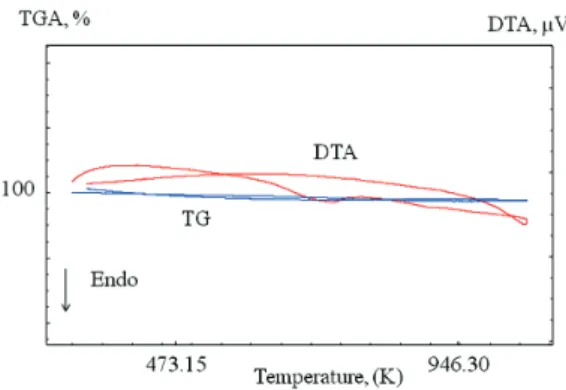
The DTA/TG measurements also suggested that the phase transition was not observed on the DTA curve at about the same temperature range (Fig. 3).
The experimental results showed that in our samples the oxygen lattice points of thed-Bi2O3doped with Lu2O3
606 www.jccs.wiley-vch.de © 2013 The Chemical Society Located in Taipei & Wiley-VCH Verlag GmbH & Co. KGaA, Weinheim J. Chin. Chem. Soc. 2013, 60, 605-607
Article
Öztürk and Ozpozan KalayciogluFig. 1. XRD patterns ofd-Bi2O3doped with 17% mol
Lu2O3, (a) at 700oC, (b) at 750oC, (c) at 800oC,
(d) at 825oC, water quench.
Table 1. The relationship between the amount of Lu2O3doping
and the lattice parameter ofd-Bi2O3.
mole% Lu2O3 11 12 13 14 15 16 17 18
a (pm) 551 551 551 550 550 550 550 550
V´ 106(pm3) 167 167 167 166 166 166 166 166
Fig. 2. Electrical conductivity plot ofd-Bi2O3doped
were not completely occupied with oxygen ions. If the oxy-gen sub-lattices were fully occupied by O2-ions, the Lu2O3 dopedd-Bi2O3phases would not show such a high degree of electrical conductivity. Some of the oxygen lattice points located around the tetrahedral sites may have been vacant, forming an oxygen vacancy. These oxygen vacancies were filled randomly with neighboring oxygen ions at an in-creasing rate as the temperature increased. Jumping oxy-gen ions left their former sites vacant, thus another vacancy was formed, since this process was random, the total oxy-gen flow was zero in any direction without an applied elec-tric field.
The ionic conductivity ofd-Bi2O3phases doped with Lu2O3increased with increasing temperature. It was pro-posed that this was related to ionic mobility, which rises with increasing temperature. At elevated temperatures, the thermal vibrational energy of the ions increased causing a higher oxygen ion-jumping rate. Although oxygen vacan-cies were present in the crystal structure at low tempera-tures (below 200 °C), the thermal energy of the anions was not high enough for them to jump out of their lowest energy positions. Thermal vibrations may also have assisted the jumping process for a short time by either shortening the jumping distance or by widening the jumping channels through the crystal.
CONCLUSIONS
As a result of this research thed-phases of Bi2O3 sub-stances which are unstable at room temperature were ob-tained by doping a Lu2O3substance toa-Bi2O3substance with solid-state reactions. The effective factors in the syn-thesis of these polymorphs are high temperature applica-tion, reaction duration and the amount of Lu2O3doped. It
was observed that increasing the Lu2O3amount influenced phase stability and those solid solutions that had a greater doping amount were more resistant to high temperature.
It can be concluded from the change of Lu3+with crystal structured Bi3+ cations that non-stoichiometric phases are synthesized. Since the synthesis process was performed using a high temperature application that lasted for a long period, we can say that lutesium cations diffuse in the crystal structure very slowly. Face-centered cubic d-phase (Bi2O3)1-x(Lu2O3)x(x = 0.11 - 0.19) binary oxide compounds possessing oxygen ionic conductivity were synthesized. The non-stoichiometry of thed-Bi2O3phase was thought to lead to interesting electrical properties.
The ionic conductivity in thed-Bi2O3phases supports the view that there is an average occupation of oxide ions in the oxygen lattice sites, which can move from site to site through the bismuth sub-lattice. The sample with the high-est conductivity of -1.555 W-1cm-1at 750 °C was the d-phase of the (Bi2O3)0.83(Lu2O3)0.17system.
ACKNOWLEDGEMENTS
This work was supported by Erciyes University (EUBAP).
REFERENCES
1. Sammes, N. M. et al. J. Eur. Ceram. Soc. 1999, 19, 1801. 2. Leontie, L.; Caraman, M.; DelibaÕ, M.; Rusu, G. I. Mater.
Res. Bull. 2001, 36, 1629.
3. Harwig, H. A. Anorg. Allg. Chem. 1978, 444, 151. 4. Chehab, S. et al. Mater. Res. Bull. 2003, 38, 875.
5. Takahashi, T.; Esaka, T.; Iwahara, H. J. Appl. Electrochem.
1977, 7, 31.
6. Crumpton, T. E.; Francesconi, M. G.; Greaves, C. J. Solid.
State. Chem. 2003, 75, 197.
7. Ekhelikar, S.; Bichile, G. K. Bull. Mater. Sci. 2004, 27, 19. 8. Drache, M. et al. Chem. Rev. 2007, 107, 80.
9. Kalaycioglu, N. O.; Çlrçlr, E. J. Chin. Chem. Soc. 2011, 58,
1.
10. Arora, N.; Deo, G.; Wachs, I. E.; Hirt, A. M. J. Catal. 1996,
1, 159.
11. Libye, D.; Poulsen, F. W.; Mogensen, M. Solid State Ionics
2000, 128, 91.
12. Bernik, S. et. al. 33rd Int. Cong. on Microelectronics, De-vices and Materials, Slovenia 1997, 87, 24.
13. Goff, J. P. et al. Phys. Rev. B. 1999, 59, 14202.
14. Harwig, H. A.; Gerards, A. G. Thermochim. Acta. 1979, 28, 121.
15. Ozpozan, N.; Çlrçlr, E. Synth. React. Inorg., Met.-Org.,
Nano-Met. Chem. 2012, 42, 398.
J. Chin. Chem. Soc. 2013, 60, 605-607 © 2013 The Chemical Society Located in Taipei & Wiley-VCH Verlag GmbH & Co. KGaA, Weinheim www.jccs.wiley-vch.de 607 JOURNAL OF THE CHINESE
Binaryd-(Bi2o3)1-x(Lu2o3)xSystem CHEMICAL SOCIETY
Fig. 3. DTA/TG plot ofd-Bi2O3doped with 17% mol