Özgün Araştırma / Original Article
Investigation of the Asp299Gly and Thr399Ile polymorphisms of
TLR4 gene in Rheumatoid Arthritis
İbrahim Halil Yildirim1, Ramazan Uzen2
1 Deparment Of Genetics, Faculty of Veterinary, Dicle University, 21280 Diyarbakir, Turkey ORCID: 0000-0001-5518-5004 2 Department of Medical Biology, Medical Faculty, Erciyes University, 38030 Kayseri, Turkey ORCID: 0000-0002-2208-1361 Received: 14.02.2019; Revised: 08.03.2019; Accepted: 13.03.2019
Abstract
Objective: Rheumatoid arthritis (RA) is a chronic and inflammatory disease characterized by synovial inflammation that causes cartilage and bone destruction as well as systemic defects, including cardiovascular, pulmonary, psychological, and skeletal disorders. The etiology of RA is unclear. Evidence suggests that RA is influenced by both genetic and environmental factors and the inflammatory and autoimmune activities take important roles in the development of this disease. In the onset of RA, an interaction between the resident cells of synovium and cells of the innate and adaptive immune system reported. Fibroblast-like synoviocytes (FLS) are one of the resident cells and they play a central role, with a tumor-like behavior, in joint destruction and development of chronic inflammation. Toll-like receptors (TLRs) are transmembrane glycoproteins that are related to inflammation via synthesis of proinflammatory cytokines like TNF-α, IL-6, and IL-1β. Some studies report an association between the activation of FLS and the cytokine environment, cell-to-cell contacts, or the activation of TLR2, TLR4, and TLR3. TLRs and especially TLR4 is involved in the recognition of endogenous molecules released by injured tissues and necrotic cells. TLR4 gene involved in a wide variety of both infectious and non-infectious diseases and two polymorphisms of TLR4, Asp299Gly and Thr399Ile, changed the binding capacity and electrical charge of the protein. There are conflicting or even contradictory results about these polymorphisms and we aimed to determine the distribution of the allele frequencies of these polymorphisms and compare the result of RA patients with healthy subjects.
Methods: DNA extraction was realized by salting out method from peripheral blood lymphocytes of RA patients and healthy controls. PCR amplification carried out with appropriate primer pairs against the related DNA sequences. Genotyping performed by the restriction fragment length polymorphism method.
Results and Conclusion: According to the results obtained from RA patients and healthy controls, we have not found any statistical difference between both groups. Including the other polymorphisms of the TLR family into this type of studies, will give more information about the role of TLR family in rheumatoid arthritis.
Keywords: Rheumatoid Arthritis, Toll-like receptor 4, polymorphism, inflammation.
DOI: 10.5798/dicletip.540004
Yazışma Adresi / Correspondence: İbrahim Halil Yildirim, Deparment Of Genetics, Faculty of Veterinary, Dicle University, 21280 Diyarbakir, Türkiye e-mail: [email protected]
256
Romatoid artrit hastlarında TLR4 geni Asp299Gly ve Thr399Ile polimorfizmlerinin araştırılması
Öz
Amaç: Romatoid artrit (RA), kardiyovasküler, pulmoner, psikolojik ve iskelet bozuklukları dahil olmak üzere sistemik kusurların yanı sıra kıkırdak ve kemik tahribatına neden olan sinovyal enflamasyonla karakterize kronik ve enflamatuar bir hastalıktır. RA’nın etiyolojisi tam olarak bilinmemektedir. Kanıtlar RA'nın hem genetik hem de çevresel faktörlerden etkilendiğini ve enflamatuar ve otoimmün aktivitelerin bu hastalığın gelişiminde önemli rol aldığını göstermektedir. RA'nın başlangıcında, yerleşik sinovyum hücreleri ile doğal ve adaptif bağışıklık sisteminin hücreleri arasında bir etkileşim olduğu bildirilmektedir. Fibroblast benzeri sinoviyositler (FBS), yerleşik hücrelerdir ve eklem yıkımı ve kronik enflamasyonun gelişmesinde- tümör benzeri bir davranışla- merkezi rol oynarlar. Toll-like reseptörler (TLR'ler), TNF-a, IL-6 ve IL-1 gibi proenflamatuar sitokinlerin senteziyle ilişkili transmembran glikoproteinlerdir. Bazı çalışmalarda FLS aktivasyonu ile sitokin, hücre teması veya TLR2, TLR4 ve TLR3 aktivasyonu arasında bir ilişki olduğunu bildirmektedir. TLR'ler ve özellikle TLR4, yaralı dokular ve nekrotik hücreler tarafından salınan endojen moleküllerin tanınmasında rol oynar. TLR4 geni, hem enfeksiyöz hem de enfeksiyöz olmayan hastalıklarda rol almakta olup, bu gendeki iki polimorfizm, Asp299Gly ve Thr399Ile, TLR4 proteinin bağlanma kapasitesini ve elektrik yükünü değiştirir. Bu polimorfizmlerle ilgili çelişkili ve uyumsuz sonuçlar bulunmaktadır, biz bu çalışmamızda bu polimorfizmlerin allel sıklıklarını belirlemeyi ve RA hastalarının sonuçlarını sağlıklı deneklerle karşılaştırmayı amaçladık.
Yöntemler: DNA ekstraksiyonu, RA hastaları ve sağlıklı kontrollerin periferik kanlarından 'salting out' metoduyla gerçekleştirildi. PCR amplifikasyonu, çalışılan DNA dizilerine uygun primer çifleri kullanılarak yapıldı. Genotip belirlenmesinde 'restriksiyon enzimi parça uzunluk polimorfizmi metodu' kullanıldı.
Bulgular ve Sonuç: RA hastalarından ve sağlıklı kontrollerden elde edilen sonuçlara göre, her iki grup arasında istatistiksel bir fark bulamadık. TLR ailesinin diğer polimorfizmlerinin bu tür çalışmalara dahil edilmesi, TLR ailesinin romatoid artritteki rolü hakkında daha fazla bilgi verecektir.
Anahtar kelimler: Romatoid artrit, Toll-like reseptör 4, polimorfizm, enflamasyon.
NTRODUCTION
Rheumatoid arthritis (RA) is an age-related disorder, with a prevalence range differ from 1% to 5%1. It is affecting women two to three times more than men1. RA is a chronic and inflammatory disease characterized by synovial inflammation that causes cartilage and bone destruction as well as systemic defects,
including cardiovascular, pulmonary,
psychological, and skeletal disorders2,3. Although the pathophysiology of RA is not clear, evidence suggests that RA is influenced by both genetic and environmental factors. Twin studies have shown heritability of RA is ∼60%4. The general consensus about the RA is it has a spectrum of disease stages that can begin many years before the onset of clinical symptoms and genetic markers associated to disease, influence the transition from one
disease stage to another with the stochastic environmental factors4.
In the onset of RA, an interaction between the resident cells of synovium and cells of the innate and adaptive immune system reported5. Fibroblast-like synoviocytes (FLS) are one of the resident cells and they play a central role, with a tumor-like behavior, in joint destruction and development of chronic inflammation. During the chronic inflammation, FLS migrate to healthy tissue and invade to the extracellular matrix and lead to joint damage by contributing to the destruction of the cartilage and bone tissues5. There are some studies that report an association between the activation of FLS and the cytokine environment, cell-to-cell contacts, or the activation of Toll-like receptors (TLRs)5,6. It has been shown that the expression levels of TLRs were higher in 'rheumatoid
arthritis synovial fibroblasts' than in 'osteoarthritis synovial fibroblasts' and ligation of TLRs, such as TLR2, TLR3, and TLR4 resulted to the production of inflammatory cytokines, MMPs and VEGF6.
TLRs are transmembrane glycoproteins that are expressed on the surface of leukocytes and non-immune epithelial cells7,8. TLRs are related
to inflammation via synthesis of
proinflammatory cytokines like TNF-α, IL-6, and IL-1β and inflammatory enzymes including
inducible nitric acid synthase and
cyclooxygenase-2 by NF-κB pathway7,9. TLRs and especially TLR4 is involved in the recognition of endogenous molecules released by injured tissues and necrotic cells7,8. Activated TLR4 may cause cytokine production and this may lead to inflammation or increase the existing inflammation.
Synovial inflammation is the main character of the RA and TLR4 is an important key effector of the immune system and inflammation. Genetic variations of TLR4 like as Asp299Gly and Thr399Ile are linked to susceptibility to various disease associated with age and these variations may alter the ligand recognition, binding character, interaction and transport of
TLR4 protein to the cell membrane10.
Therefore, in this study, we aimed to evaluate the Asp299Gly and Thr399Ile frequencies of TLR4 gene in RA patients to determine whether is there any relation between these genetic variations and RA.
METHODS
This study was performed on RA patients and healthy volunteers. The protocol of the study and the consent procedure were approved by the Institutional Medical Ethics Committee of Dicle University Medical Faculty (No:2019-44). The blood samples were collected from RA
patients and age-/sex-matched healthy
controls. Patients with another inflammatory, autoimmune, acute, or chronic infectious
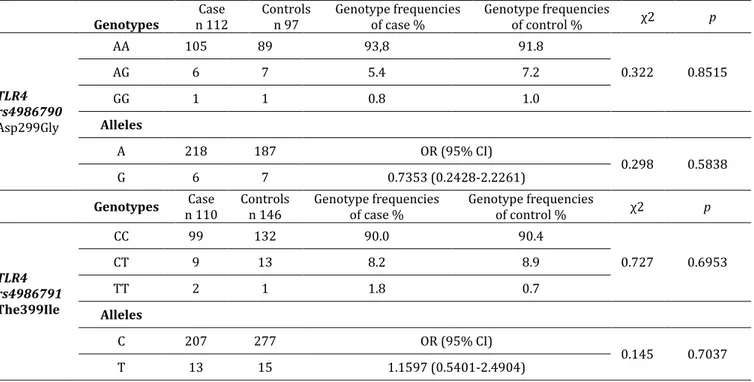
diseases and diabetes mellitus were excluded from the study. DNA extraction was realized from peripheral blood lymphocytes by salting out method. Concentrations of isolated DNAs were determined in the spectrophotometer. PCR amplification carried out with the primer pairs of a previous study11. Genotyping realized by Restriction Fragment Length Polymorphism (PCR-RFLP) method. Primer pairs, restriction endonucleases, and expected fragment sizes after cleavage were given in Table 1. DNA fragments after cleavage were monitored by using agarose gel electrophoresis. The number of patients and control groups varies for the two studied polymorphic structures, the number of patients and volunteers were given in Table 2.
Statistical Analyzes
Descriptive statistics were expressed as count and percent. Chi-square test was used to test the significance of the distribution of variations between RA patients and control group. Statistical significance levels were considered as 5%, and the Statistical Package for the Social Sciences (SPSS) (ver. 21) statistical program was used for all statistical computations.
RESULTS
According to the results obtained from RA patients and healthy controls, Asp299Gly (rs4986790) and The399Ile (rs4986791) conversions have not shown any statistical difference between both groups. The genotype frequencies of RA patients and healthy control groups were almost the same. These results are also the same for allele frequencies too. Chi-square results and p values were shown in Table 2.
258
Table 1: The primer pairs and restriction endonucleases used for detection of the Asp299Gly and Thr399Ile polymorphisms. SNPs Primer Pairs Restriction endonuclease Expected fragment sizes
Asp299Gly
rs4986790 F 5´-GATTAGCATACTTAGACTACCTCCATG R 5´-GATCAACTTCTGAAAAAGCATTCCCAC Nco1
AA 249 bp
AG 249+223+26 bp GG 223+26 bp Thr399Ile
rs4986791 F 5-GGTTGCTGTTCTCAAAGTGATTTTGGGAGAA R 5´-ACCTGAAGACTGGAGAGTGAGTTAAATGCT Hinf1
CC 407 bp
CT 407+378+29 bp TT 378+29 bp
Table 2: Genotype and allele frequencies and statistical summary of the study.
Genotypes n 112 Case Controls n 97 Genotype frequencies of case % Genotype frequencies of control % χ2 p
TLR4 rs4986790 Asp299Gly AA 105 89 93,8 91.8 0.322 0.8515 AG 6 7 5.4 7.2 GG 1 1 0.8 1.0 Alleles A 218 187 OR (95% CI) 0.298 0.5838 G 6 7 0.7353 (0.2428-2.2261)
Genotypes n 110 Case Controls n 146 Genotype frequencies of case % Genotype frequencies of control % χ2 p
TLR4 rs4986791 The399Ile CC 99 132 90.0 90.4 0.727 0.6953 CT 9 13 8.2 8.9 TT 2 1 1.8 0.7 Alleles C 207 277 OR (95% CI) 0.145 0.7037 T 13 15 1.1597 (0.5401-2.4904) DISCUSSION
In this study, we hypothesized that there may be a relation between TLR4, which is associated with inflammation and immunity, and the RA disease. RA is a chronic autoimmune disease characterized by hyper-proliferated synovial fibroblast and dysregulated activation of the inflammatory responses. In RA, hyper-proliferated synovial fibroblasts express a series of TLRs and these TLRs stimulate synovial fibroblasts to synthase high levels of VEGF, IL-8, COX-2, TNF-α, IL-17, and IL-336,12. The mediators synthesized from synovial fibroblasts lead to the infiltration of immune cells, chronic inflammation and bone lesions6.
These situations contribute to the onset of RA and also maintain the inflammation.
TLR4 is a member of the TLR family and first recognized as a sensing receptor for gram-negative lipopolysaccharide7,13. After a while, it has found that TLR4 binds to the endogenous molecules produced from injured tissues and also necrotic cells7. Hence, TLR4 is a key molecule of the proinflammatory response7 and it has been shown that synovial fibroblasts express mediators which cause chronic synovial inflammation that depends on NF-кB activity after the activation of TLR413,14. Therefore, TLR4 leads to inflammation and some products that are the results of inflammation such as hyaluronan induce TLR4 to maintain the proinflammatory response7.
Interestingly, TLR4 is also the only known member of TLR family that capable of inducing the production of type 1 interferons and type 1 interferons important in inflammation15.
TLR4 is a transmembrane protein composed of a 608 amino acid in the extracellular domain and a 187 amino acid in the intracellular domain. After an induction, a dimerization of two TLR4 occurs and this dimerization results in a conformational change to induce the recruitment of adaptor proteins below the cascade7. The Asp299Gly polymorphism results to change the charge of TLR4 protein and also increase the rotational capability of the peptide bond10. This may change the binding capacity of the protein to other related proteins. It has been reported that the Asp299Gly and Thr399Ile polymorphisms containing TLR4 has decreased binding capacity to HMGB1 (high mobility group box 1) protein10. It has shown that patients with Asp299Gly or Thr399Ile have
increased TNF-alpha, IL-10, monocyte
chemotactic protein–1 and macrophage
inflammatory protein–1 expression but
decreased IL-1 beta, IL-6, IL-8, and GRO- expression16. Reports indicate that there may be blunted response to inhaled LPS in heterozygous individuals for Asp299Gly and Thr399Ile conversions17. Some other studies revealed that both these polymorphisms reduce the binding and signaling capacity of TLR4 and presence of these polymorphisms increased the risk of tissue infection18. Interestingly, according to our results, there was no statistical difference between patient and control groups for both polymorphisms studied.
The two polymorphisms of TLR4, Asp299Gly and Thr399Ile, are located in the fourth exon of TLR4 are special polymorphisms, because most of the polymorphisms in human beings is low (<1%), but the frequency of these two variations differ between ethnic groups. The Asp299Gly allele is most frequent in African populations, the frequency of G allele differ
between 10% to 18%, whereas only 2% are carriers for T allele of Thr399Ile and these individuals always have Asp299Gly as well10. The incidence of these polymorphisms are rare in Asian, Papuan and American populations10. According to our results the allele frequency of Asp299Gly for RA patients was 2.68 and for healthy controls was 3.61. The frequency of Thr399Ile was found 5.91 for RA patients and 5.14 for healthy controls.
In conclusion, although the polymorphisms of TLR4 have been shown to alter the electric charge or binding capacity of the protein, we have not found any relation between these polymorphisms and RA disease. Our study contributes to revealing the frequency of these polymorphisms in our country.
Conflicts of interest: The authors have no conflict of interests to declare.
Financial Disclosure: The authors declared that this study has received no financial support.
REFERENCES
1. Spector TD. Rheumatoid arthritis. Rheum Dis Clin North Am 1990; 16: 513–37.
2. McInnes IB, Schett G. The Pathogenesis of Rheumatoid Arthritis. N Engl J Med 2011; 365: 2205-19.
3. Choy EHS, Panayi GS. Cytokine Pathways and Joint Inflammation in Rheumatoid Arthritis. N Engl J Med 2011; 344: 907-16.
4. Yarwood A, Huizinga TWJ, Worthington J. The genetics of rheumatoid arthritis: risk and protection in different stages of the evolution of RA. Rheumatology (Oxford). 2016; 55:199–209.
5. Bartok B, Firestein GS. Fibroblast-like synoviocytes: key effector cells in rheumatoid arthritis. Immunol Rev. 2010; 233: 233-55.
6. Hu F, Li Y, Shi L, et all. (2014) Toll-Like Receptors Expressed by Synovial Fibroblasts Perpetuate Th1 and Th17 Cell Responses in Rheumatoid Arthritis. PLoS
ONE 9(6): e100266.
260 7. Molteni M, Gemma S, Rossetti C. The Role of Toll-Like
Receptor 4 in Infectious and Noninfectious Inflammation. Mediators of Inflammation Volume 2016, Article ID 6978936, 9 pages
8. Zhang B, Ramesh G, Uematsu S, Akira S, Reeves WR. TLR signaling mediates inflammation and tissue injury in nephrotoxicity. J Am Soc Nephrol 2008; 19: 923–32. 9. Sabroe I, Parker LC, Dower SK, Whyte MKB, The role of
TLR activation in inflammation. J Pathol 2008; 214: 126-135.
10. Kutikhin AG. Impact of Toll-like receptor 4 polymorphisms on risk of cancer. Human Immunology 2011: 193-206.
11. Lorenz E, Frees KL, Schwartz DA. Determination of the TLR4 genotype using allele-specific PCR. Biotechniques 2001; 31: 22-4.
12. Stebulis JA, Rossetti RG, Atez FJ, Zurier RB. Fibroblast-like synovial cells derived from synovial fluid. J Rheumatol 2005; 32: 301-6.
13. Gülen F, Köksoy H, Tanaç R, et all. Astım ve alerjik Rinitli Çocuklarda Toll Like Reseptör 2 ve Toll Like Resptör 4 Polimorfizmi. The Journal of Pediatric Research 20014; 1: 13-21.
14. Jung YO, Cho ML, Kang CM, et all. Toll-like receptor 2 and 4 combination engagement upregulate IL-15 synergistically in human rheumatoid synovial fibroblasts. Immunol Lett 2007; 109: 21–27.
15. Kagan JC, Su T, Horng T, et all. TRAM couples endocytosis of Toll-like receptor 4 to the induction of interferon-beta. Nat Immunol. 2008; 9: 361-8.
16. Trejo-de la OA, Torres J, PÊrez-RodrIguez M, et all. TLR4 single-nucleotide polymorphisms alter mucosal cytokine and chemokine patterns in Mexican patients with Helicobacter pylori-associated gastroduodenal diseases. Clin Immunol 2008; 129: 333–40.
17. Arbour NC, Lorenz E, Schutte BC, et all. TLR4 mutations are associated with endotoxin hyporesponsiveness in humans. Nat Genet. 2000; 5: 187-91.
18. Barber RC, Chang LY, Arnoldo BD, et all. Innate immunity SNPs are associated with risk for severe sepsis after burn injury. Clin Med Res. 2006; 4: 250-5.