EXPORTS: AN ANALYSIS ON BRICS COUNTRIES
Atakan DURMAZ2, Ümit YILDIZ3A b s t r a c t
The purpose of this study is to investigate the effects of innovation on high-tech exports in BRICS countries. For this purpose, in this study, the relations between the R&D expenditures of the relevant countries and the number of patents they have and the export of high-technology are examined for the period of 1999-2018. In the study using panel data techniques, firstly, the existence of cross-section dependence in the series was investigated. Following the determination of the cross-section dependency, the stationarity of the series was investigated by Pesaran (2007) unit root test, which can also be applied in the presence of cross-section de-pendence. Afterwards, the series, which were found to be non-stationary at level, were made stationary by taking the difference of the series and the relations between the variables were analyzed by panel fixed ef-fects and panel random efef-fects methods. In the outputs of the study, a significant positive relationship was found between the number of patents and high-tech exports in the countries subject to the study. Accord-ingly, innovation is a highly important factor in the export of high-tech products for BRICS countries, and it is understood that innovation activities should be given importance to create high added value in these coun-tries
Keywords: Innovation, High-tech, Export, BRICS Jel Classification: O32, F19
YÜKSEK TEKNOLOJİ İHRACATI SÜRECİNDE İNOVASYONUN ETKİSİ: BRICS
ÜLKE-LERİ ÜZERİNE BİR ANALİZ
Ö z
Bu çalışmanın amacı, BRICS ülkelerinde inovasyonun yüksek teknoloji ihracatı üzerindeki etkisinin olup olma-dığının araştırılmasıdır. Bu amaca yönelik olarak çalışmada ilgili ülkelerin AR-GE harcamaları, sahip oldukları patent sayıları ve yüksek teknoloji ihracatı arasındaki ilişkiler 1999-2018 dönemi için incelenmektedir. Panel veri tekniklerinin kullanıldığı çalışmada, öncelikle serilerde yatay kesit bağımlılığının varlığı araştırılmıştır. Ya-tay kesit bağımlılığının belirlenmesinin ardından, serilerde yaYa-tay kesit bağımlılığının varlığı durumunda da uy-gulanabilen Pesaran (2007) birim kök testi ile serilerin durağanlığı araştırılmıştır. Sonrasında ise düzeyde du-rağan olmadığı belirlenen serilerin farkı alınarak dudu-rağan hale getirilmiş ve değişkenler arasındaki ilişkiler pa-nel sabit etkiler ve papa-nel rassal etkiler yöntemleriyle analiz edilmiştir. Çalışmanın çıktılarında, çalışmaya konu olan ülkelerde, patent sayısı ve yüksek teknoloji ihracatı arasında anlamlı pozitif ilişkiye rastlanılmıştır. Buna göre inovasyonun, BRICS ülkeleri için yüksek teknolojili ürün ihracatında önemli bir faktör olduğu görülmekte, bu ülkelerde yüksek katma değer yaratmak için inovasyon faaliyetlerine önem verilmesi gerektiği anlaşılmak-tadır.
Anahtar Kelimeler: İnovasyon, Yüksek Teknoloji, İhracat, BRICS JEL Sınıflandırması: O32, F19
1 This study is extended from the the paper tittled “Econometric Analysis of The Relationship between Innovation and
High Technology Export to BRICS Countries” presented as a full-text paper at II. Business & Organization Research Confe-rence
2 Assoc. Prof. Dr., Faculty of Economics, Administrative and Social Sciences, Samsun University,
[email protected], ORCID: 0000-0003-0374-9757
3 Assist. Prof. Dr., Faculty of Economics and Administrative Sciences, Bayburt University, [email protected], ORCID:
1.Introduction
Technological gains have a significant impact not only on industrial and economic development, but also on international trade. It is seen that technologically developed products provide compar-ative advantage in exports (Frankel and Romer, 1999). In order to overcome the recent economic recession, many countries have turned to export-oriented policies for high technology intensive products and developed various strategies. This situation leads to an increase in scientific studies on the subject. In the related literature, products with intensive research and development activi-ties are evaluated in the high technology products group. R&D and intensity of innovation is con-sidered as the basic determining factor for high technology exports. In the literature, it is usually defined by the share of R&D expenditures (private and public sector) in GDP. Shifting the percent-age of low-tech products to high technology products in exports can mean shifting to relatively value-added products that provide a kind of monopolistic competitive advantage, rather than trad-ing high-competitive products. Indeed, experiences in many Asian economies of the 1990s, as well as South Korea's experiences, can be cited as examples of such an economic growth strategy (West-phal, 1990). It is also confirmed by the data that Asian countries have successfully implemented this strategy. As a matter of fact, according to 2018 data, three of the five countries in the world that the highest high-tech products exporter are Asian countries. According to World Bank data, Germany is the country that the highest high-tech products exporter in 2018. Germany holds 10.78% of the world's total high-tech product exports, with exports worth $ 209,610 million. Ger-many is followed by S. Korea (9.91%), Hong Kong (8.32%), USA (8.04%) and Singapore (7.99%) re-spectively.
In Helleiner (1995) it was stated that industrialization has a critical importance in the process of producing contemporary policies of almost all developing countries. He also emphasized that the increase of the share of industry in the economic activities of these countries and the trade of products related to this sector is an important tool that increases the share of these countries in the world economy. On the other hand, Salvatore (2013) emphasized that, from the 1950s to the 1970s, most developing countries preferred the import substituting industrialization policy, pre-serving the infant industries, as opposed to that emphasized in traditional trade theory, resulting in very high-priced and inefficient products for domestic consumers. Since the early 1980s, many developing countries have started to liberalize their trade and began foreign trade. However, in recent researches, it is argued that if the goods subject to trade can be combined with R & D and transformed into high technology products with high added value and which can benefit countries per capita GDP, export-oriented growth strategy in foreign trade can be provided (Van der Berg and Lewer, 2015).
In this study, the relations between the research and development expenditures and patent numbers and the export of high-tech of the BRICS countries for the period 1999-2018 were ana-lyzed by using panel data methods. The sections of the study are as follows. In the next section, literature on the subject is tried to be summarized. In the third section, methods and findings are presented. In the fourth and final section, results and evaluation are given.
2. Literature Review
In the economic literature, the effects of technological differences on foreign trade and com-petitiveness are discussed within the framework of different theories. In this context, Posner (1961)’s and Vernon (1966)’s theories are among the leading studies. Grossman and Helpman (1991) and Krugman (1979) also point to differences of technology between countries as the main cause of foreign trade between countries. Accordingly, developed countries have high technology capacity thanks to their advantages and in this direction, they specialize in the production of high technology products. Developing countries, on the other hand, specialize in labor-based products as they are weak in R&D and technological capacity and have relatively cheap labor force. In this
process, the low price elasticity of the demand for technology-intensive products and the high in-come elasticity cause the countries producing and exporting such products to achieve higher re-turns (Bayraktutan and Bıdırdı, 2018).
High technology exports are a concept that refers to products with high innovation intensity, such as telecommunications products, products produced as a result of scientific research, com-puters, drugs, electrical machinery, chemistry and electronics (Sandu and Ciocanel, 2014). When the related literature is analyzed, it can be said that the R & D intensity can be influenced by high technology exports, by qualitatively and quantitatively improving social and human capital, by in-creasing the total patent applications or by inin-creasing the innovative firms’ share in the sector. This makes them regarded as important actors in high technology exports. On the other hand, the re-search and development activities and the intensity of innovation are directly related to the ab-sorption capacity of the business sector, which is capable of internalizing the high technology in-formation of the firms and increasing the competitiveness of the export-oriented products. Com-panies with higher absorption capacity can more easily determine the demand for new products and technologies in the market and can easily transfer these products to their own production.
In his study, Soete (1981) investigated the relationship between the technological output indi-cator he developed and the differences in trade-meat performances between countries. In this context, it carried out an analysis covering the data of 1977 regarding 40 industrial sectors of 22 OECD countries. According to the results, it has been determined that there is a relative relation-ship between trade performance and technological output indicator for innovative industries for example aircraft and machinery. In low-tech sectors such as the textile and food industry, no sig-nificant relationship was found between trade performance and the technological output indica-tor.
Greenhalgh (1990) used a common error correction and integration method for 39 sectors and 23 manufacturing companies, in the study of the United Kingdom net exports for the 1954-1981 period investigating price and non-price markers. As a result of the analysis, it was revealed that the number of innovations effect on net exports significantly.
Amendola et al. (1993), using data from the period 1967-1987, examined the short and long-term effects of technological differences and cost-related economic indicators in the OECD coun-tries on the country's international competitiveness. As a result, it has been concluded that tech-nological differences and investment variables have a positive effect on international competitive-ness with a delay of 4 and 3 years, respectively. Another result obtained is that although economic indicators related to costs have a short-term effect on international competitiveness, technological developments have more important effects in the long run.
In the study of Amable and Verspagen (1995), with the help of a dynamic model for the period 1970-1991, it investigated the factors affecting the export share for 5 developed countries and 18 industrial sectors. Accordingly, the effects of variables on market shares differ according to coun-tries and sectors. Technological capacity, evaluated in terms of patents, is an important factor af-fecting the export market share in the vast majority of sectors and countries.
In particular, some studies published after 2004 confirm these assumptions mentioned in the literature. Studies, which consist of data from various time periods and data from different country groups, have shown that their investments in R & D activities have an effect on high technology exports. Seyoum (2005) investigated the relation between high-tech exports and various inde-pendent variables for 55 developed and developing countries. According to the results of the study, there is a positive relation between related variables and high-technology exports. In this study, especially in countries with low R & D intensity, in other words, which have the lowest technolog-ical capacity, the foreign direct investment is the variable that has the highest relationship with high technology exports. This confirms the results of Srholec (2007).
In his study, Srholec (2007) examined the impact of high-tech exports on the technological ca-pacities of countries based on the data of 83 countries. The results of the research confirm that the technological capacity of the countries is one of the important factors determining the share of high technology exports in total exports. However, it is emphasized that this causal relationship is generally related to the intense importation of high technology components that differ between countries. Due to the disintegration of international advanced technology production, a significant amount of high technology export intensity is likely to have low national technological capacity. Therefore, in this study, it is stated that researches should be conducted by using more micro data at firms’ level instead of sectoral and commercial general data and statistics in order to evaluate high technology exports.
Braunerhjelm and Thulin (2008), in a study covering 19 OECD countries between 1981 and 1999, concluded that a one percent increase in R &D spending led to a three percent increase in high technology exports. The study emphasizes that the impact of R & D activities may vary de-pending on the level of specialization in the high technology sub-sectors in the country. Vogia-tzoglou (2009) using data from 28 countries, concluded that R & D and human capital have a sig-nificant impact on the transnational ICT expertise.
Gervais (2009) stated in his study that innovation consists of three stages: imitation, local inno-vation and global innoinno-vation. The development of these stages largely indicates the level of Intel-lectual Property Rights system implemented in the country. Accordingly, the first innovation pro-cess in a country begins with imitation of a foreign technology depending on the technical capacity of the country. Then, the innovation process is developed according to the domestic needs and the structure of the market. At the last stage, the innovation process results in the development of marketable products with high global competitiveness.
Tebaldi (2011) tried to determine the basic elements of high technology exports by using data from different countries for the period 1980-2008. According to the results of the study, FDI, hu-man capital inflows and openness are the main determinants of high technology exports. Gökmen and Türen (2013), by adding the variables such as economic freedom score and human develop-ment level to the model of Tebaldi (2011) with the assumption that it has basically similar effects, determined the main determinants of high technology exports with the help of 15 European coun-tries’ data for the period 1995-2011. It worked. In the study, it is revealed that human resources have a significant effect on the dynamics of high technology exports in the long run.
One of the major contradictions mentioned in the literature is the level of high technology ex-ports that exist together with low RDI performance and domestic technological capacity, especially in Asian countries. In general, the rapid rise of high technology products in the world market is not met by the performance of domestic technological capacity. In these cases, the values for high technology exports are explained by the statistical failure to distinguish between technology em-bedded in imported sub-components to be incorporated into the end products. This is called a statistical illusion Srholec (2007).
There are many studies showing that RDI investments have an impact on high-tech exports (Fu et. al., 2011; Xing, 2012). Accordingly, there is a relationship between research and development expenditures and new product process and high technology exports, but this level is very weak.
Çetin (2016) tested the relationship between R &D expenditures and high technology exports with the help of data from 7 developing countries (Thailand, Mexico, South Africa, Malaysia, Tur-key, China, and Brazil). Accordingly, it was determined that there was a one way causality from R & D expenditures to high technology exports and that 1% increase in research and development expenditures increased 0.43% in fixed effect model and 0.25% in random effect model.
Yamak (2017) researched the relationship between R & D expenditures and high- tech exports in the light of literature studies. The correlation between research and development expenditures, the number of patent high and technology exports in 42 countries was analyzed and a positive
relationship was found between high technology export and patent applications in high R & D spending countries for the period 2005-2014.
Bayraktutan and Bıdırdı (2018) used the variables of fixed capital, FDI and the number of pa-tents in the study where investigated the effect of the papa-tents number on high technology and medium-high technology export performance in developing and developed countries for the 1996-2012 period. According to the results of the study, the number of patents is an important factor affecting the high technology and medium-high technology export performance in both country groups. Also, the results show that the elasticity of high and medium-high technology export per-formance to the number of patents in developing countries is higher than that in developed coun-tries.
In general, it is understood that the studies conducted on the subject mostly investigate the effect of R&D’ expenditures on high technology exports, but the number of studies on the effect of patents owned by the country on high technology exports is quite limited. Therefore, the effect of patents owned by the country on the export of high-tech products has been examined in order to contribute to the literature.
3. Methods and Results
The study examines the relation between innovation and high-tech exports for BRICS countries. In this context, the data obtained for the period 1999-2018 were analyzed with the help of panel data econometric methods. The last 20-year period has been preferred due to the intense impact of exports on growth in BRICS countries. Variables and access sources used in the analyzes are shown in Table 1.
Table 1: Variables
Definition Resources
htech % Share of HTI in Total Industrial Products Exports World Bank Database reer Real Effective Exchange Rate (2007=100) Bruegel Datasets rdex Share of R&D Expenditures in GDP World Bank Database
patent Total Patents WIPO
The variables used in the analyzes were selected by following the literature in accordance with the economic theory. In the study, Panel Fixed Effects and Panel Random Effects models were used as the panel data method. In random effect models, changes occurring according to units or units and time are included in the model as a component of the error term. In this way, it is aimed to prevent loss of degree of freedom in fixed effect models. Accordingly, the equations of the fixed effects model and the random effects model can be shown as follows:
F.E.M. Yit = β0+ γi ∑𝑛−1𝑖=1 𝑑𝑢𝑚𝑚𝑦𝑖 β1 X1İt + β2 X2İt + uit (1)
R.E.M. Yit = β0İ + β1 X1İt + β2 X2İt + + uit
β0İ = β0 + εİ →
Yit = β0 + β1 X1İt + β2 X2İt + uit + εİ →
Yit = β0 + β1 X1İt + β2 X2İt + ωit (2)
On the other hand, in this study, the model designed and estimated for panel data is as follows: htechit = β0+ β1 reerit + β2 rdexit + β3 patentit + uit (3)
In equation, htech represents the share of high-technology exports in total exports of industrial products, reer, effective exchange rates, rdex represents the share of research and development expenditures in GDP, and the patent variable represents the total number of patents of the respec-tive countries.
In the analysis made by the using time series, it is important whether the series used in the analysis includes unit root or not in order to achieve healthy results. In the analysis with non-sta-tionary series, high t statistic and high R2 value generally cause erroneous results. Therefore, it is
very important to investigate the stationary of series in many time series methods. For this pur-pose, the stationary of the series is investigated by applying various unit root tests to the series. Unit root tests, which are widely used for time series, are frequently used recently in panel data methods (Baltagi, 2005).
In this study, the relation between innovation and high-technology exports was analyzed in the BRICS countries and the data were analyzed with Panel Fixed Effects and Panel Random Effects models. However, the stationary of the series should be investigated before estimating the model. The unit root test to be performed while investigating the stationary of the series will vary accord-ing to whether there is cross-sectional dependence or not. Whether the cross-sectional depend-ence between the series is considered or not will significantly affect the estimation results. Thus, it is not appropriate to use first generation panel unit root tests when testing stationary of series in case presence of cross-section dependence. For this reason, it will be healthy to investigate the cross-sectional dependence of the series before investigating the stationary of the series.
Table 2: Cross-Sectional Dependence Test
Breusch-Pagan LM Pesaran scaled LM Bias-corrected scaled LM PesaranCD htech 21.67116 (0.0169) 1.49171 (0.135) 1.360137 (0.1738) -1.252 (0.210) reer 53.76596 (0.0000) 8.6683 (0.000) 8.536753 (0.0000) 2.8836 (0.003) rdex 31.08528 (0.0006) 3.5967 (0.000) 3.457889 (0.0005) 2.7337 (0.006) patent 104.4849 (0.0000) 20.009 (0.000) 19.87785 (0.0000) 9.7465 (0.000)
* Probability values are shown in parentheses.
Table 2 shows the test results that measure the presence of horizontal cross-sectional depen-dence. The hypotheses created for these tests are as follows:
H0: Cross-sectional independence. H1: Cross-sectional dependence.
When the results of the cross-sectional dependence are examined, the series of the high tech-nology exports variable has a cross-sectional dependence according to the Breusch-Pagan LM test, while the other test results indicate that the cross-sectional dependence is not. In panel data, in the case of N < T, Breusch Pagan test is one of the tests deemed appropriate in terms of giving healthier results compared to other tests. Therefore, it is assumed that there is cross-sectional dependence in the htec series. In the series of other variables, cross-sectional dependence was determined as a common result of all tests. In this case, it would be healthy to use second genera-tion panel unit root tests.. For this purpose, while investigating the stagenera-tionarity of the series, Pe-saran (2007) panel unit root tests, was applied to the series.
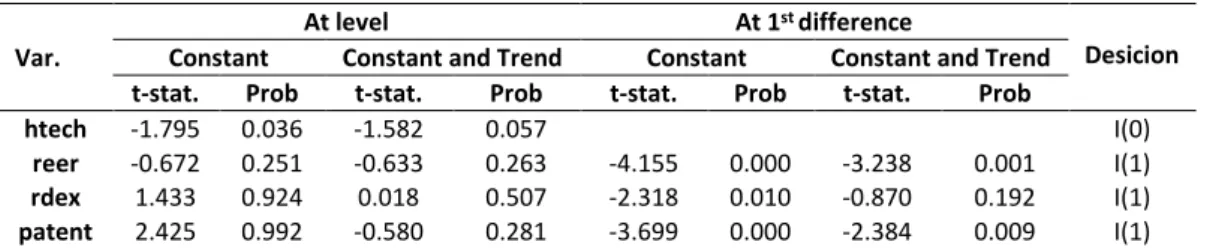
Table 3: Pesaran (2007) Unit Root Test
At level At 1st difference
Desicion Var. Constant Constant and Trend Constant Constant and Trend
t-stat. Prob t-stat. Prob t-stat. Prob t-stat. Prob
htech -1.795 0.036 -1.582 0.057 I(0)
reer -0.672 0.251 -0.633 0.263 -4.155 0.000 -3.238 0.001 I(1) rdex 1.433 0.924 0.018 0.507 -2.318 0.010 -0.870 0.192 I(1) patent 2.425 0.992 -0.580 0.281 -3.699 0.000 -2.384 0.009 I(1) *The appropriate lag length is determined according to Schwarz Information Criteria.
Table 3 shows the panel unit root test results of Pesaran (2007). When the table is analyzed, it is seen that while the series of advanced technology exports are stationary at the level, the other series are the first aware stationary. Here, the without trend model is used as the reference for the variable representing the share of R&D expenditures in GDP. The non-stationary series were stabi-lized by taking the difference of series and included in the analysis. Table 4 shows panel fixed ef-fects and panel random efef-fects estimation results. Estimated coefficients are robust estimators’ resistant to diagnostic problems.
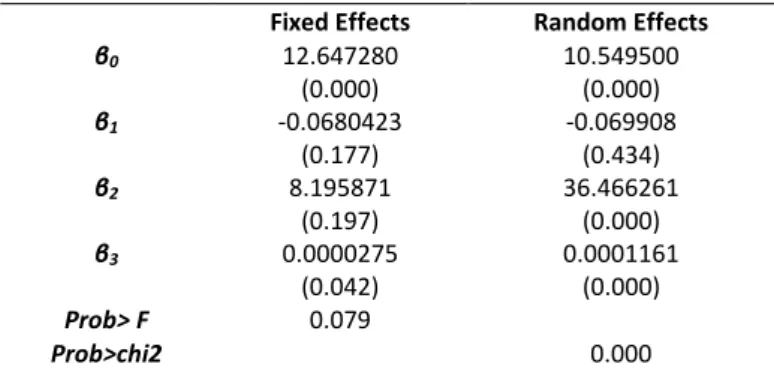
Table 4: Panel Fixed Effects and Panel Random Effects Estimation Results Fixed Effects Random Effects
β0 12.647280 (0.000) 10.549500 (0.000) β1 -0.0680423 (0.177) -0.069908 (0.434) β2 8.195871 (0.197) 36.466261 (0.000) β3 0.0000275 (0.042) 0.0001161 (0.000) Prob> F 0.079 Prob>chi2 0.000
* Probability values are shown in parentheses.
When the estimation results are investigated, it is seen that the β3 coefficient is statistically
significant at 5% as a common result of both methods. At the same time, both models have positive signs. It is understood that there is a statistically significant and accurate relation between patents number representing innovation and the high-tech exports of the countries concerned. Similarly, when the estimation results are examined, it is understood that both models are significant as a whole. The results imply that innovation activities have a positive impact on the export of high technology products. The results show that countries that want to produce high added value should give importance to innovation. The study results are in line with the study results of Seyoum (2005), Srholec (2007), Braunerhjelm and Thulin (2008), Tebaldi (2011), Fu et. all (2011), Xing (2012), Çetin (2016), Yamak (2017), Bayraktutan and Bıdırdı (2018).
4. Conclusion
In the 21st century, when the information age is taking place, countries try to provide superio-rity in the economic competition with each other with their human capital stock and the innovative products produced by this stock. As a matter of fact, it can be said that technological transforma-tion, labor market with a high human capital stock and economic and political stability are the basis of the economic growth rates that some countries have achieved recently. This situation necessi-tated the countries to increase their exports of high technology intensive products by turning to R & D activities in order to carry out a sustainable economic growth policy and to close the gap with other countries. In this context, as well as increasing the economic resources they devote to edu-cation, countries have focused on policies aimed at increasing direct foreign capital investments to support technological development and encouraging public and private sector to invest in research and development (R & D).
From this point of view, the effects of innovation on high-tech exports especially in BRICS co-untries, which have recently achieved a great economic growth trend through high technology exports, have been investigated. In this context, the relation between the expenditures of research and development and patent numbers of the related countries and the export of advanced tech-nology for the period 1999-2018 was analyzed with panel data methods. According to the results, a significant positive relationship was found between the number of patents of the countries and the export of high technology products. Accordingly, innovation is an important factor in the export
of high-tech products for BRICS countries, and it is understood that innovation activities should be given importance to create high added value in these countries
Nowadays, many countries adopt export-based growth strategies. Export-based growth is closely related to high value-added production within the export pattern. Many studies prove that high-tech exports are highly effective on economic growth, especially for countries that have adopted an export-based growth strategy. The results of the study found significant relationships between high-tech exports and innovation activities. When the study results are analyzed from this aspect, it emphasizes the importance of innovation activities in line with the economic growth tar-get especially in emerging economies like BRICS countries. In this respect, the results also provide important clues for policy makers
References
Amable, B. and Verspagen, B. (1995). The Role of Technology in Market Share Dynamics. Applied Economics, 27, 197–204.
Amendola, G., Dosi, G. and Papagni, E. (1993). The Dynamics of International Competitiveness. Re-view of World Economics (Weltwitschalfliches Arshiv), 129(3), 451–471.
Baltagi, B. H. (2005). Econometric Analysis of Panel Data. (3. Edition). England: John Wiley&Sons Ltd.
Bayraktutan, Y. and Bıdırdı, H. (2018). Innovation and High-Tech Exports in Developed and Develo-ping Countries. Journal of International Commerce, Economics and Policy, 9(03), 1850011. Braunerhjelm, P. and Thulin, P. (2008). Can Countries Create Comparative Advantages? R&D Expenditures, High Technology Exports and Country Size in 19 OECD Countries, 1981– 1999. International Economic Journal, 22(1), 95–111. https://doi.org/10.1080/10168730 801887026.
Bruegel Datasets. http://bruegel.org/publications/datasets / Date Accessed:28.12.2018
Çetin, R. (2016). Investigation of The Relationship Between Ar-Ge Payments and High Technology Exports in New Industrial Countries by Panel Data Analysis Method. İstanbul Üniversitesi İktisat Fakültesi Mecmuası, 66(2), 30–43.
Frankel, J. A. and Romer, D. (1999). Does Trade Cause Growth? American Economic Review, 89(3), 379-399.
Fu, D. Wu, Y. and Tang, Y. (2012). Does Innovation Matter for Chinese High-Tech Exports? A Firm-Level Analysis. Frontiers of Economics in China, 7(2), 218-245.
Gervais, D. J. (2009). (Re) Implementing the Agreement on Trade-Related Aspects of Intellectual Property Rights to Foster Innovation. The Journal of World Intellectual Property, 12(5), 348-370.
Gökmen, Y. and Türen, U. (2013). The Determinants of High Technology Exports Volume: A Panel Data Analysis of EU 15 Countries. International Journal of Management Economic and So-cial Sciences, 2(3), 217–232.
Greenhalgh, C. (1990). Innovation and Trade Performance in the United Kingdom. The Economic Journal, 100(400), 105–118.
Grossman, G. M. and Helpman, E. (1991). Innovation and Growth in the Global Economy, Massac-husetts: The MIT Press.
Helleiner, G. (Ed.). (1995). Manufacturing for Export in the Developing World. London: Routledge, Krugman, P. (1979). A Model of Innovation, Technology Transfer, and the World Distribution of
Income. The Journal of Political Economy, 87(2), 253–266.
Pesaran, M. H. (2004). General Diagnostic Tests for Cross Section Dependence in Panels, Cambridge Working Papers in Economics, 435.
Pesaran, M. H. (2007). A Simple Panel Unit Root Test in the Presence of Cross-section Dependece, Journal of Applies Econometrics, 22, 265-312.
Posner, M. V. (1961). International Trade and Technical Change. Oxford Economic Papers, 13(3), 323–341.
Salvatore, D. (2013). International Economics (11th ed.). Wiley.
Sandu, S. and Ciocanel, B. (2014). Impact of R&D and Innovation on High-tech Export. Procedia Economics and Finance, 15, 80-90.
Seyoum, B. (2005). Determinants of Levels of High Technology Exports an Empirical Investigation. Journal of Competitiveness Studies, 13(1), 64.
Soete, L. L. G. (1981). A General Test of Technological Gap Trade Theory. Review of World Econo-mics/Weltwirtschaftliches Archiv, 117(4), 638–660.
Srholec, M. (2007). High Technology Exports from Developing Countries: A Symptom of Technology Spurts or Statistical Illusion? Review of World Economics, 143(2), 227–255.
Tebaldi, E. (2011). The Determinants of High technologynology Exports: A Panel Data Analysis. At-lantic Economic Journal, 39(4), 343–353. https://doi.org/10.1007/s11293-011-9288-9. Van den Berg, H and Lewer, J. J. (2015). International Trade and Economic Growth. Armonk: GB:
Routledge.
Vernon, R. (1966). International Investment and International Trade in the Product Cycle. The Quarterly Journal of Economics, 80(2), 190–207.
Vogiatzoglou, K. (2009). Determinants of Exports Specialization in ICT. A cross-country Analysis, International Network for Economic Research Working Paper 3, 2009.
Westphal, L. E. (1990). Industrial Policy in an Export-Propelled Economy: Lessons from South Ko-rea’s Experience. Journal of Economic Perspectives, 4(3), 41-59.
Worldbank Database. https://databank.worldbank.org/data/source/world-development-indicat ors Date Accessed:28.12.2018
Xing, Y. (2012). The People’s Republic of China’s High-Tech Exports: Myth and Reality, ADBI Wor-king Paper No. 5055, Tokyo: Asian Development Bank Institute.
Yamak, A. (2017). The effects of Ar-Ge spending on high technology product exports. Key Maga-zine: Turkey Review. 341. Retrieved from http://anahtar.sanayi.gov.tr/tr/news/ar-ge-har-camalarinin-yuksek-teknolojili-urun-ihracati-uzerindekietkileri-turkiyeincelemesi/9407.