Factors affecting health tourism
and international health-care
facility choice
Gökhan Aydin
Department of Business Administration, Istanbul Arel University, Istanbul, Turkey, and
Bilge Karamehmet
Department of Communication, Istanbul Medipol University, Istanbul, Turkey
Abstract
Purpose – Health-care tourism has become a major industry in the past decade. Following the increasing activity in health-care tourism, the decision-making process of consumers in choosing an international health-care facility has become increasingly important to the related parties. The present study aims to offer a holistic model of international health-care facility choice that incorporates the important dimensions by assessing the growth drivers and the alternative factors proposed in the literature and by validating them via a survey study.
Design/methodology/approach – The factors deemed important in the existing literature were used as the basis of a study in Turkey. In total, 65 structured interviews were conducted with health-care professionals and international health tourists to understand the perspective of the two important parties that affect policymaking.
Findings – The findings of the study support the significance of the majority of the variables proposed as important factors affecting international health-care facility choice.
Research limitations/implications – The study was carried out in four large hospital chains in Turkey; however, this creates a limitation in scope and may have limited representativeness of the overall market. The model has yet to be tested on a larger scale.
Practical implications – There are significant differences in the opinions of professionals and international health-care tourists in terms of choice criteria. This indicates problems with health professionals’ understanding of the consumer decision process.
Originality/value – The study provides a model that can be used to gain insights on the consumer decision process and also provides the policymakers and stakeholders of the international health-care industry with a sound theoretical foundation to build further studies upon. Only a limited number of studies was carried out in Turkey that focus on international health-care tourism, and the present study will fill a substantial research gap.
Keywords Medical tourism, Health tourism, Health-care facility choice, Health-care tourism, International health-care
Paper type Research paper
1. Introduction
Travel related to improving one’s health has become a common practice in the past decades. To better assess this phenomenon, it is best to define the relevant terms. Health, which is undoubtedly the most valued possession of a human being, is not limited to only a physical
A draft version of the manuscript titled “The First Step in Marketing International Health Tourism: Understanding the International Healthcare Facility Choice” was presented in 23rd Annual World Business Congress in Ankara, Turkey.
The current issue and full text archive of this journal is available on Emerald Insight at:
www.emeraldinsight.com/1750-6123.htm
IJPHM
11,1
16
Received 7 May 2015 Revised 24 April 2016 23 August 2016 Accepted 16 January 2017 International Journal of Pharmaceutical and Healthcare MarketingVol. 11 No. 1, 2017 pp. 16-36
© Emerald Publishing Limited 1750-6123
dimension but encompasses more. TheWorld Health Organization (1946)implies this in their definition of health: “a state of complete physical, mental and social well-being and not merely the absence of disease or infirmity”. Therefore, health-related services that provide treatment and rehabilitation may be medical or “wellness” oriented, which focus on improving physical, mental and social well-being and preventing potential problems. As highlighted byCohen (2012), poor health significantly decreases quality of life and is a matter of concern for every individual.
Meanwhile, tourism is defined by the World Tourism Organization (1995) as “the activities of persons traveling to and staying in places outside their usual environment for not more than one consecutive year for leisure, business and other purposes”. In agreement with this definition, tourism not only is limited to recreational travels but also includes travels for business, medical or other purposes. Travels related to health-care services may be curative (medical) to obtain a treatment needed or preventive/wellness-oriented. Consequently, health tourism may be defined as traveling from place of residence to another place to acquire health-related services. In addition to the health-related services they get, health tourists may benefit from various touristic opportunities during their visits. These are considered as secondary concern because the primary reason for their trip is to enhance the quality of life by increasing well-being through health-care services (Bookman and Bookman, 2007;Genç, 2012).
Visiting holy people and places that were believed to provide healing and well-being in ancient times may be considered the first examples of this kind of tourism (Pafford, 2009). After several millennia, in the twentieth century, health tourism gained momentum with the flow of residents of underdeveloped countries visiting developed countries such as the USA and Germany to obtain services unavailable in their home countries. This lack of local health-care services was related to poor technological infrastructure and a dearth of qualified professionals in these countries. This type of movement/tourism was referred to as “traditional medical tourism” by Horowitz and Rosensweig (2008) and was termed the “second wave” of medical tourism byPafford (2009). The developing countries have started building facilities in the 1990s on par with the best health institutions in the developed countries. The developments in technology that allow novel techniques and cost-effective solutions coupled with economies of scale in manufacturing were the main drivers of this phenomenon. Patients who cannot afford local health services because of limited/lacking insurance coverage or facing time constraints consider international health tourism a viable alternative (Horowitz et al., 2007). This new trend of movement from developed countries toward less-developed ones is defined as “new medical tourism” by Horowitz and Rosensweig (2008), “third wave” byPafford (2009)and “neo-traditional medical travel” by
Cohen (2012). Understanding the major forces driving this contemporary type of health-care tourism helps to identify the criteria shaping consumer choice. Relevant studies in the literature highlight the role of both macro-level factors related to the country and micro-level factors related to the facilities in consumer choice.
In accordance with the increasing emphasis in marketing literature on total experience and total perceived value obtained from services, holistic approaches are needed by marketers specialized in various service contexts, including tourism, to offer higher value and superior experiences to consumers. Adopting a holistic approach, this study aims to construct an integrative model of international health-care facility choice by revealing and incorporating the important factors through an analysis of relevant trends, existing literature and data gathered via structured interviews. Regarding both theoretical and empirical studies on countries providing international health-care services, there is a
17
noteworthy gap in terms of research that specifically targets influential emerging countries such as Turkey.
Following a basic discussion on major tourism choice models, the relevant literature is contemplated in detail to shed light on consumer behavior in international health-care facility choice. This section is subsequently followed by a discussion of the major factors that are considered to be significant in the decision process of international health tourists.
2. Theoretical background
2.1 Tourism destination choice models
The majority of traditional tourism destination models either takes an econometric/ time-series approach (Song and Witt, 2000) or a discrete choice approach to decision-making. The econometric models have certain shortcomings as they take into account neither the attributes of the destination (the service product) nor the traveler’s perceptions of service product/destination attributes. To address these shortcomings, attitudinal models and behavioral discrete choice models were developed to analyze consumers’ choice of destinations (Goodrich, 1978;Papatheodorou, 2001;Rugg, 1973;Um and Crompton, 1990). Discrete choice models were constructed by analyzing consumers’ choice behavior among a set of mutually exclusive destination alternatives. The majority of the destination choice models assume that travelers are rational decision-makers who try to maximize the utility of the service they seek (Gilbert, 1991;Wahab et al., 1976). The greater part of these studies focus on pleasure travel (Um and Crompton, 1990); also, a significant number of them is devoted to destination image that denotes the perceived attributes of the tourism destination. Both cognitive and affective destination images have been evaluated and accepted as antecedents of consumer behavior in numerous studies (Um and Crompton, 1990) reflecting the cognitive and affective components of attitude development (Fishbein and Ajzen, 1975;
Rosenberg and Hovland, 1960). The findings of the studies on destination image led to the following significant factors as antecedents of choice behavior: natural resources, general and tourist infrastructure, tourist leisure and recreation, culture, history and art, the political and economic factors, natural environment, social environment and the atmosphere of the place (Beerli and Martín, 2004;Gallarza et al., 2002). It should be noted that these factors are deemed significant in pleasure travel contexts, and empirical studies in health-care tourism context are limited.
From a broader perspective, a relevant trend has been detected in services marketing literature, which is the increasing emphasis on the holistic view of customer experience. To understand total customer experience in various buying situations, studies on experiential marketing are on the rise. These developments are leading scholars to assess the overall customer experience and the total perceived value of the whole process rather than concentrating solely on the “service encounter” where companies have significant control (Grönroos, 2012; Helkkula et al., 2012;Tynan and McKechnie, 2009;Tynan et al., 2014). Integrated models that can incorporate external factors deemed important in creating the overall experience of the customers, such as the general infrastructure, the political and economic state of the destination, are required in a tourism context.
Another criterion affecting consumer behavior in destination choice is found to be the personal factors and personal experience of the travelers (Baloglu and McCleary, 1999). The present study aims to facilitate further studies on health tourism by highlighting the significant destination attributes affecting consumers’ (travelers’) choice. All the aforementioned factors were questioned in this qualitative study; yet, no direct inquiries were made on personal factors because of the sensitive nature of the service in question (health care/medical services). Studies that adopt holistic approaches to understand the
IJPHM
11,1
overall value and experience also studies developed upon destination image and discrete choice models will, especially, benefit from the current study.
2.2 The factors driving health tourism
As stated in recent studiesCohen (2012),Connell (2006),Deloitte (2009),Eissler and Casken (2013),Laing and Weiler (2008),OECD (2012), Pafford (2009), the growth of health-care tourism is driven by various factors, such as the relatively high costs of medical operations in developed countries, the increase in reasonably priced international travel options, increasing quality standards in developing countries, increasing demand for cosmetic and dental operations, increased sophistication of medical tourism operations, government support and the rise of information and communication technologies. These significant influences are contemplated in this section to offer insights into the relevant trends in international health-care facility choice.
2.2.1 Increasing rate of globalization. The boundaries between countries have become less
significant with technological advances and the activities of the World Trade Organization. In line with the General Agreement on Tariffs and Trade, goods and services can travel freely and easily between countries (Smith, 2004). Freedom in the movement of goods and services between countries provided international mobility to medical equipment, health-care professionals and also to individuals looking for health-care services. This ease of movement has led to the emergence of health tourism as a significant economic phenomenon (OECD, 2012).
2.2.2 Increasing health-care expenditures. Health-care expenditures in developed
countries are higher than those of developing countries (Connell, 2006;Eissler and Casken, 2013) and are expected to increase further (Deloitte, 2009). For instance, theUS Department of Health (2009)expects per capita health-care expenditures in the USA to increase from US$7,000 in 2007 to US$13,000 in 2019. This expected increase may be attributed to the increasing need for medical care of an aging population in the USA and Europe. According to the data fromEurostat (2011), the statistical office of the European Union, the average age in European countries (EU-27) has increased from 35.4 in 1991 to 41.2 in 2011. Eurostat’s Europop 2010 study forecasts that the EU-27 countries’ age average will reach 47.6 in 2060. As of 2011, the population aged over 65 corresponds to more than 20 per cent of the total population in several developed countries such as Germany and Italy (Eurostat, 2011).
2.2.3 Increased availability of global travel. Because of the intensifying competition caused
by an increasing number of airline companies and technological advances, the average cost of air travel has decreased considerably. This, coupled with increasing impact of globalization, has led to a surge in air travel in the past 25 years. For instance, the price of comparable international plane tickets taking off from the USA dropped by 10 per cent from 1990 to 2012, and the domestic travel fares within the USA decreased nearly 40 per cent in real terms during the past 30 years despite an increase in fuel prices (Airlines for America, 2013a,2013b).
The data from theUS Department of Commerce (2007)reveal that a total of 63 million tickets were sold in 2006.IATA (2012)expects the total number of tickets sold in the USA to reach 223 million by the end of 2016. Increasing popularity of international air travel is also evident in Europe as the top four countries’ international passengers are expected to reach 630 million in 2016 according to IATA forecasts.
2.2.4 Increasing demand for non-essential health-care services. Several health-related
services and the majority of wellness-related services are considered as non-essential services in the relevant literature. The demand for these non-essential health-care services, which include but are not limited to the eye-related (ophthalmic), dental and cosmetic
19
services, are on the rise with ageing populations and increasing cosmetic concerns in the developed countries. A considerable percentage of dental and ophthalmic operations and nearly all the cosmetic operations are not covered by state health insurance systems in developed countries (Deloitte, 2009;Eissler and Casken, 2013). Moreover, certain medical operations, such as eye treatments that are covered by the health insurance systems, have long waiting times in western countries (Prasad, 2008).
Demand for popular cosmetic procedures in developed countries is also on the rise and has not been affected by the global economic downturn seen in 2008-2009. For instance, according to theAmerican Society for Aesthetic Plastic Surgery (2012), abdominoplasty procedures increased by 360 per cent, and breast augmentation procedures have risen 540 per cent between 1997 and 2012. In the USA, over 10 million cosmetic and non-intrusive operations were carried out by certified medical doctors and surgeons in 2012. The number of surgical operations reached 1.68 million with an annual increase of 3 per cent as of 2012 (American Society for Aesthetic Plastic Surgery, 2012).
In Europe, the demand for cosmetic operations is not as great as in the USA; however, these operations have not lost their popularity despite the economic downturn. Between 2008 and 2012, cosmetic surgical operations increased 26.5 per cent from 34,000 to 43,000 in the UK (Sedghi, 2013). An increase in the demand for elective procedures has occurred despite the fact that very few public or private health insurance companies cover these procedures. Individuals looking for affordable non-essential procedures are taking international destinations into careful consideration. Dedicated institutions in emerging countries offering competitive prices with state of the art equipment are presenting viable solutions for individuals looking for these types of services.
2.2.5 Significant differences in health-care costs. Significant differences in health-care
costs between countries are considered to be one of the major reasons for the growth in health-care tourism (Eissler and Casken, 2013; Turner, 2007). Developed countries have higher personnel costs and fixed costs compared to developing countries that in turn leads to higher cost of health-care services. Health-care tourists may benefit from 40-90 per cent cost advantages when they travel abroad compared to obtaining services in their home countries (Bookman and Bookman, 2007;Merrell et al., 2008). Wages of physicians and health-care professionals in developed countries are considerably higher than those of their counterparts in developing countries. For instance, the average wage of a medical doctor in the USA and the UK is around US$125,000-175,000 (British Medical Association, 2013;Medscape, 2013). When compared to the average wage of a medical doctor in India, which is about US$5,000-8,000 (Naukrihub.com, 2013), one of the major causes of the disparity in health-care costs becomes clear.
As seen inTable I, cost of medical operations may differ dramatically between developing and developed countries. For example, a heart bypass costs about US$110,000 in the USA, whereas it costs only US$10,000-12,000 in Thailand, India or Turkey. These cost differences
Table I.
Comparative costs of health-care services in selected countries
Operation cost (USD) USA Turkey Thailand India
Angioplasty 47,000 5,000 10,000 11,000 Heart bypass 113,000 12,000 11,000 10,000 Heart-valve replacement 150,000 17,000 10,000 9,500 Hip replacement 47,000 11,000 12,000 9,000 Knee replacement 48,000 11,000 10,000 8,500 Sources:OECD (2012)
IJPHM
11,1
20
are not limited to medical operations only and are observed in non-essential health-care operations as well. For instance, breast implant surgery, one of the most popular procedures, costs €4,350 in UK, €1,920 in Poland, €2,087 in India and €1,800 in Turkey (Genç, 2012).
2.2.6 The increasing sophistication of the health tourism sector. Insurance companies and
large corporations offering health insurance to their employees in the USA and other developed countries are considering health-care tourism and adoption of health facilities in developing countries as viable alternatives to domestic counterparts. Emerging countries are trying to increase the professionalism and sophistication in their health-care sector by using state-of-the-art systems and equipment, enforcing up-to-date regulations and incentive mechanisms to attract the attention of these institutions. These practices have increased the overall demand for health tourism and the number of professional health tourism agents. The increasing professionalism and sophistication of the sector is expected to decrease the quality and safety concerns regarding the destination institutions and simplify the facility choice process for consumers (Deloitte, 2009).
2.2.7 Rise of information and communication technologies and the internet. The rise of the
internet as a vast information source is one of the greatest enablers of health-care tourism (Connell, 2006).Bookman and Bookman (2007)stated that the most important factor in medical tourism for both service providers and tourists alike is the internet. The internet provides an opportunity to find, compare and evaluate various alternatives (hospitals, health tourism agencies, SPAs, etc.) for health-care services around the globe (Turner, 2007). The internet also acts as an outstanding communications tool that can help health tourists contact physicians, surgeons, health centers and tourism agencies for consultations, appointments or obtaining detailed information (Genç, 2012).
2.3 International health-care tourism industry
Fueled by the aforementioned factors, this new wave of health-care tourism originating from developed countries and heading toward developing ones is accepted as a major development that can reduce costs and increase efficiencies in the health systems of developed countries. So-called third wave of medical tourism is expected to have a positive long-term effect on developing economies (Cohen, 2012).
Roughly, 30 countries, including Thailand, Malaysia, Singapore, Korea, Hungary, Poland, Jordan, India, Turkey and the USA, are considered as the major players in the international health tourism market (Bookman and Bookman, 2007;Eissler and Casken, 2013;Merrell et al., 2008;Pollard, 2013). According to a study on health-care tourism in the USA carried out byDeloitte (2008), the most popular destinations for US health-care travelers were India, Thailand, Mexico, Philippines, Korea, Taiwan, Malaysia and Singapore. These countries are experiencing growth in health-care tourism that is greater than their overall economic growth. For instance, health tourism revenues in India are expected to increase by 30 per cent annually compared to a 7 per cent increase in national gross domestic product (Deloitte, 2009;World Bank, 2014).
2.4 International health-care tourism consumer behavior
The rise of the internet and specialized tourism agencies focused on health-care tourism enable and empower potential health-care tourists to access and compare information on numerous health-care institutions in a wide range of countries. This abundance of information, numerous aspects to evaluate and the significance of the decision to be made all create a noteworthy challenge for medical tourists.
Various approaches were offered to understand the way potential tourists choose international health-care facilities. Each approach adopted a different point of view and covered diverse aspects of the choice criteria. So far, researchers have offered models that
21
feature macro-level and micro-level factors. For instance,Menvielle et al. (2011)offered a model encompassing geo-political, economic, political, demographic, social/cultural and technological environments as the main external variables affecting tourist patients.Glinos
et al. (2006)identified familiarity, availability, cost, quality and legislation (laws enabling abortion services, fertility treatment, etc.) as the five drivers that increase the demand for international medical services.Kumar et al. (2012)offered the following four categories as major factors to assess before undertaking medical travel: clinical safety (standards for sanitation, physician’s level of professionalism), costs (net cost difference after taking into account hidden costs and travel costs), region (political risk, legal system, patient safety, language barriers, visa requirements) and category of travelers (insurance company support, ability to travel long distances).Kalshetti and Pillai (2008)identified patient safety, cultural and psychological barriers in addition to government restrictions as challenges to medical tourism. According to a survey study carried out in Turkey byZengingönül et al. (2012), cost advantages, quality level (trust in the facilities), touristic opportunities, referrals from relatives or friends and culture (including religion of the country) have appeared as the major criteria that affect an international destination choice. Hanefeld et al. (2015)carried out in-depth interviews and revealed expertise, costs, availability issues, cultural factors and opportunity to make a vacation as the main motivations of international health-care tourists in a recent study. A two-step model developed bySmith and Forgione (2007)groups the factors that patients consider in choosing an international medical facility in macro and micro level. According to their approach, the host country where a facility is located is assessed in terms of macro-level conditions (economic, political and regulatory situation) at first, and, then, the facility is chosen by taking into account micro-level factors such as costs, accreditation and physician training. This model omits the cultural aspects, which may be an important selection criterion as indicated by researchers. For instance,Munro (2012)states that a medical tourist will be in an uncommon cultural or social environment, and the spoken language of the destination may be strange to him/her, creating a major obstacle for going to another country. This finding was also confirmed in Heung et al. (2011)’s study in Hong Kong.
A recent contribution to the literature is the presentation of a Medical Tourism Index by
Fetscherin and Stephano (2016). The index is a multifaceted construct composed of four major dimensions (country, tourism, medical costs, medical facility and services) calculated using 34 items. Not surprisingly, these items correspond to practically all the factors that are covered in this section as the significant criteria affecting choice behavior. Country dimension covers economic, political and cultural aspects, whereas tourism dimension reflects the appeal of tourism attractions in the target country. Medical facilities and services dimension on the other hand is composed of service quality, accreditation, training and reputation of staff, recommendations and similar facility-related factors.
The following section provides the conceptualization used for developing the research model based on the literature and the aforementioned factors.
3. Conceptualization
The current study is a qualitative one in nature and aims to define the attributes of the service product bundle, which in this case is the health-care tourism service. The health-care tourism destination consists of numerous diverse attributes that should be evaluated by potential travelers. In this study, the relevant attributes that can affect consumer decision were initially derived from existing literature as indicated in the previous section. To validate the effects of these attributes on the choice process, a survey study was conducted by interviewing health-care professionals and international patients. An additional aim of the
IJPHM
11,1
interviews was to reveal any potential factors that have not been covered in the literature yet but were deemed important by the professionals or travelers.
Although there is no single integrated model that can explain consumer behavior in international health-care tourism choice, many mutual factors appear in the literature that can be used to arrive at a holistic model. Such a model derived from the existing literature on consumers’ choice of international health-care facility is provided inFigure 1.
According to the proposed model, the factors in international health-care facility choice evaluation are cultural distance, political and economic stability, regulations and legal framework, costs, credibility, overall quality of care, ease of access and physical distance.
3.1 Cultural distance
Socio-cultural factors create an important regional preference in health-care tourism which leads to the creation of regional hubs in different parts of the world (Sousa and Bradley, 2008). For instance, patients going to Cuba are mainly from neighboring countries which is also the case for Singapore, where more than two thirds of the health-care tourists come from Southeast Asian countries (Smith et al., 2009). Culture encompasses religion, language, eating habits and many more dimensions that affect several aspects of daily life. Cultural differences, including language, create barriers for potential tourists in choosing their destination and are found to be significant in consumer choice (Zhang et al., 2013). In medical tourism, the additional strain of being in an alien environment may create stress for patients seeking remedy.
Cultural distance, which provides the degree of which cultural values in one country are different from those in another country, may be considered an appropriate way to handle the culture aspect of choice. Hofstede’s (1984) popular framework offers power distance, individualism, uncertainty avoidance and masculinity as the major dimensions of cultural distance and is used as the basis for measuring cultural differences by various researchers.
3.2 Political and economic stability
The political and economic stability of a country provides information on living standards and security level of a nation. Political stability specifies lack of war, civil unrest, uprisings,
Choice of International Healthcare Facility Overall Quality of Care Ease of Access Physical Distance Costs Cultural Distance Political & Economic Stability Regulations & Legal Framework Credibility / Trust
Sources: Derived from Cohen (2012), Glinos et al. (2006), Kalshetti and Pillai (2008),
Kumar et al. (2012), Menvielle et al. (2011), Munro (2012), Smith and Forgione (2007), Zengingönül et al. (2012)
Figure 1. Factors affecting the international health-care facility choice
23
terrorism and other activities that can affect the safety of health tourists during their stay.
Pizam and Mansfeld (1996)andKalshetti and Pillai (2008)specified that it is essential to have a secure and peaceful environment in a country to appeal to tourists. Economic stability and high average income levels in a country lead to lower crime rates and a secure environment. Consequently, tourism agencies promoting health-care tourism in developed countries generally consider only the economically and politically stable countries as viable alternatives for their clients (Smith and Forgione, 2007). Similarly, concerns over “developing” status of a country that generally indicates an inferior economic and political stability compared to “developed” ones was found to be a significant factor affecting intentions inReddy et al. (2010)’s study.
3.3 Regulatory standards and legal framework
Regulatory standards in the host country and the legal framework that covers malpractice and patient confidentiality laws are also considered important factors in health-care tourism destination choice (Marlowe and Sullivan, 2007;York, 2008).Prasad (2008)identified weak malpractice and transplantation laws in India as deterrents for patients seeking international health-care facilities. The malpractice laws protecting consumers in developed countries are usually lacking in developing countries. Moreover, even if these laws exist, they may be hard to enforce (Chinai and Goswami, 2007). Tourists looking for high safety standards enforced by laws may be discouraged by the lack of applicable laws in host countries.
3.4 Costs
The cost dimension is among the major factors in choosing a facility in another country (Deloitte, 2008;Eissler and Casken, 2013;Fetscherin and Stephano, 2016). The attractive prices of health-care services determined by favorable exchange rates, lower professional wages and efficient state-of-the-art equipment lead consumers to health-care providers in developing countries (Connell, 2006). As illustrated inTable I, costs for medical procedures in developed countries can be considerably high compared to similar treatments in developing countries.Moschis and Chambers (2009)found that the cost of health-care services is one of the important factors for mature customers in choosing health-care facilities. Insurance companies and large institutions offering private health insurance to their employees are considering and using international health tourism as viable alternatives to local health-care facilities because of significant cost differences (Kumar et al., 2012).
3.5 Credibility/trust
Credibility of the institution/professional providing health-care services is an important factor for both locals and international medical tourists. Establishing trust with prospective travelers is challenging in international markets. Creating positive word-of-mouth via health-care professionals and relatives or friends of potential visitors is also considerably difficult to implement. In this context, international accreditation and quality assurance certificates help international patients in making their decision by acting as an indicator of the quality of services offered. Accordingly, international accreditation of health-care facilities, which indicates whether a facility acts according to specific standards in its inputs, processes and outputs, gained popularity in the past decade. Customers particularly from the USA, who are familiar with this concept, demand accreditation in a facility they are considering to visit. Segouin et al. (2005) believe that the development of international standards in facilities will lead to an increase in international medical tourism. A study by the Indian Ministry of Tourism on problems and challenges faced by medical tourists visiting India showed that the lack of accreditation of health-care facilities is among the major barriers (Debata et al., 2012).
IJPHM
11,1
There are several bodies active in international accreditation and the US-based joint commission (JC) may be considered as the leader in this field. JC has accredited more than 20,000 institutions in the USA (Joint Commission, 2013). Joint Commission International (JCI), established in 1999 as the international branch of JC, provides accreditation for international facilities. Saudi Arabia, UAE, Thailand, Singapore, Korea, Brazil and Turkey are the top countries with the highest number of accredited institutions by JCI in the world (JCI, 2013). Another entity active in accreditation is The International Society for Quality in Health Care (ISQua, www.isqua.org) which is a non-profit umbrella association established in Ireland that brings together institutions offering health-care accreditation services in more than 100 countries (ISQUA, 2013). Other institutions of notice are QHA Trent ( www.qha-trent.co.uk/) in the UK, Accreditation Canada (www.accreditation.ca) and Australian Council on Health-care Standards International (www.achs.org.au/achs-international).
In practice, accreditation is frequently used as a marketing tool by institutions.Crooks
et al. (2011)found accreditation to be the most widely used message theme in marketing documents (brochures, etc.) in India.
Accreditation systems set standards both for health-care facilities and their personnel. Proper training and education of health-care personnel is expected from the candidate facilities to acquire international certification. As Herrick (2007) pointed out, medical personnel with internationally accepted credentials ensure health-care tourists that the service to be received will be of high quality. Setting standards and enforcing them in medical personnel training is expected to lead to increased international travel of both patients and medical staff (Segouin et al., 2005). In a study byVuong and Nguyen (2015), multi-cultural staffing was found to play a significant role in improving service quality perceptions. Availability of facilities with multi-cultural personnel that is fluent in multiple languages increases the attractiveness of the destination country (Fetscherin and Stephano, 2016).
3.6 Overall quality of care
Quality is considered as one of the major factors in choosing health-care facilities. Nonetheless, the quality of a facility and the overall quality of care received including the hospitality and transportation may contrast each other (Deloitte, 2008). From this point of view, international accreditation of a facility is an effective indicator of the quality of care provided; however, it may not be a viable indicator of the overall quality of care available in a country. Different epidemiological characteristics in host countries and potential infectious disease breakouts may create health problems for visitors from other regions of the world (Genç, 2012;Mudur, 2003). In particular, the environment surrounding the facility and hotels is a potential health hazard in underdeveloped countries. In addition, employees in the related facilities may carry diseases, and health-care tourists can be faced with infection risks of hepatitis, malaria and similar diseases in countries such as India (Gopal, 2008).Yang’s (2013) study of expert interviews in Taiwan led to a similar conclusion that health-care quality is a key success factor in medical tourism marketing.
3.7 Ease of access to health-care services
Social security and health insurance systems in most developed countries cover a significant number of health-related problems and offer free diagnosis and treatment to patients. However, health problems are not limited to these medical problems. Problems related to well-being, mental health and most cosmetic defects are not covered by the majority of social security systems. Moreover, new techniques to treat diseases may not be available in western health-care systems because of tight regulatory mechanisms. Similarly, certain procedures
25
such as organ transplantation or gender change may be restricted because of regulations or ethical concerns in certain western countries (Cohen, 2012).
In addition to a complete lack of availability, particular treatments may be in scarce supply which leads to long waiting lists, as they cannot meet the existing demand. For instance, according to a study carried out byEsmail (2006), Canadians had to wait an average of nine weeks for treatment following an appointment with a specialist. The average waiting time for certain operations such as plastic or orthopedic surgery was as long as 20-24 weeks. Whether because of a lack of adequate supply of related services or limited insurance coverage, many individuals in developed countries cannot obtain the health-care services they desire. This creates an availability and accessibility problem which leads to an infringement of quality of life. Westerners who do not want to wait for these services or are lacking proper insurance coverage may choose an international destination that provides the needed treatment in a timely manner (Cohen, 2012).
3.8 Physical distance
Among the countries that are considered as popular destinations, most enjoy a regional popularity and provide services to visitors from a close proximity. For instance, Jordan and Tunisia in the Middle East and North Africa region and Singapore and Malaysia in South East Asia are providing services to regional visitors (Cohen, 2012; Lautier, 2008). Most international patients in India are from Asian and African countries (Debata et al., 2012); similarly, Mexico and Caribbean countries cater primarily to US consumers (Arellano, 2011;
Caribbean Export Development Agency, 2008). This phenomenon can be explained by the physical distance between origin and host countries. Health-care tourists may be deterred by the extensive travel requirements to obtain the services they demand. In addition to the increasing costs of travel for long distances, travel-related discomfort increases, especially for individuals in need of special medical treatment as the duration of the journey gets longer (Vequist et al., 2009).
4. Methodology
Following the development of a theoretical model based on extant literature, a survey study was carried out by the researchers via face-to-face structured interviews with 28 health-care professionals and 37 international patients. This survey study helped test the aforementioned factors’ relevancy for travelers and also uncover other factors relevant in the international health tourism consumer behavior. Structured interviews were carried out in one public and three private hospitals in Turkey. A total of 24 medical doctors, 4 international patient relations professionals (will be referred to as “professionals”) were interviewed. The 37 patients were aged between 16 and 67 and originated predominantly from Middle Eastern countries. Of the patients, 21 were males and 16 were females. A considerable number of the patients interviewed had very limited proficiency in English or Turkish; consequently, translators that know Arabic language were utilized in interviews.
A total of 15 questions were asked to the patients to uncover and test the factors deemed important in their destination choice. The interview form that is provided in theAppendix
was used to help translators in their communication with the patients. This form can be considered as having two separate sections. The first part is exploratory in nature and focused on understanding the factors that patients ponder when they chose this country to get health-care services. This section was utilized to uncover the factors affecting the destination choice among patients from two distinct perspectives, patients themselves and professionals. The latter section incorporating 14 questions was confirmatory in nature and specifically asked for whether the factors derived from literature affected the patients’ destination choices or not. Full questions, not relevant factor names, were used in the form to
IJPHM
11,1
provide the translators a quick reference to smooth the interview process. The analysis was carried out in line withMiles and Huberman (1994)’s three-staged approach. Initially, the collected raw data (meeting notes and audio files) were transcribed. The data reduction was carried out separately by the researchers by highlighting key words, phrases and aforementioned factors. The terms and key words mentioned to have an effect on consumer choice process in the transcripts were grouped together (Miles and Huberman, 1994). In this stage, open coding was used to define the categories, and grouping was carried out independently by each researcher. The output of the two researchers was then compared with each other to aggregate potential discrepancies, and the categorization was finalized. The different factors/groups were then visualized and interpreted using frequency tables. These tables illustrated how many respondents mentioned each relevant factor. Moreover, the perspectives of patients and professionals were interpreted separately to reveal potential differences. Several findings were derived using this methodology, and they are contemplated in the following section.
5. Findings
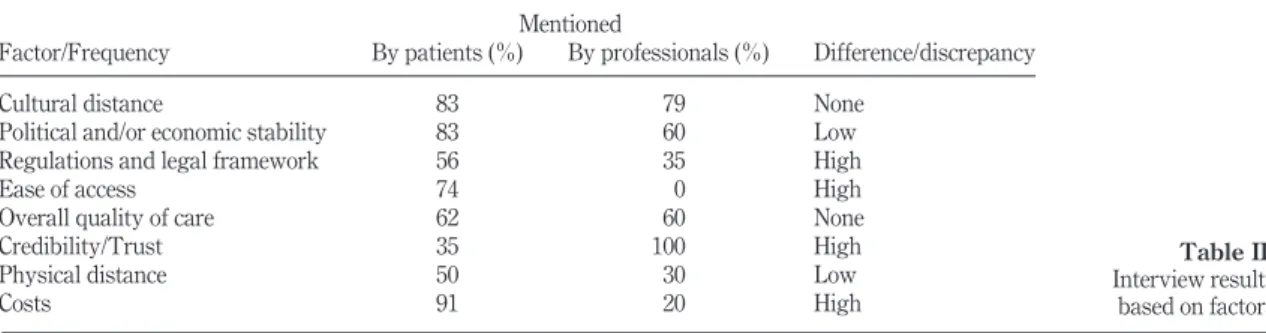
The answers provided by the respondents are grouped and summarized inTable IIfor easier assessment. The findings grouped by the underlying factors are also contemplated below the table in detail.
5.1 Cultural distance
Among the professionals, 79 per cent indicated that variables grouped under cultural distance (religion, culture, the way people dress, languages spoken in the country, etc.) are important in the international health-care destination choice. A similar finding was detected among patients, 83 per cent of whom indicated on average that the cultural distance factor was important. In addition, 60 per cent of the patients mentioned the language(s) spoken by the hospital staff as a significant factor in their international destination choice.
5.2 Political and economic stability
The majority (60 per cent) of professionals indicated that the political and economic stability of a country is not important in the international destination choice. However, 83 per cent of the patients indicated political stability, and 75 per cent indicated economic stability as important factors in their choice.
5.3 Regulations and legal framework
The majority of the professionals (65 per cent) denoted that the international patients were not well-informed on the regulations or malpractice laws in the destination country. Almost
Table II. Interview results based on factors Factor/Frequency Mentioned Difference/discrepancy By patients (%) By professionals (%)
Cultural distance 83 79 None
Political and/or economic stability 83 60 Low
Regulations and legal framework 56 35 High
Ease of access 74 0 High
Overall quality of care 62 60 None
Credibility/Trust 35 100 High
Physical distance 50 30 Low
Costs 91 20 High
27
half of the professionals (46 per cent) believed that the patients have not carried out an extensive search on regulations and legal framework prior to choosing their destination. Conversely, 56 per cent of the patients indicated that they know malpractice laws, have researched them and consider them important in their destination choice.
5.4 Ease of access
All the professionals agree that visa requirements/ease of getting a visa are insignificant factors in patients’ international destination choice. Conversely, 74 per cent of the patients indicated this as an important factor in their choice.
5.5 Overall quality of care
The factors related to overall quality of care are deemed as important factors by the majority of the professionals interviewed (60 per cent); on the other hand, 30 per cent of all professionals indicated that patients did not investigate this issue when making their decision. From the patients’ perspective, overall health level of the country, perceived development level of the health-care sector and environmental hygiene were stated as important factors by 62, 56 and 52 per cent of the patients, respectively. The skill level and expertise of the professionals were mentioned as an important factor in destination choice by 71 per cent of the professional respondents.
5.6 Credibility/trust
Almost all the professionals interviewed (96 per cent) mentioned personal or professional references and credibility as important factors in the international health-care facility choice. On the other hand, only 35 per cent of health tourists specified personal references as an important factor, and 20 per cent indicated that they evaluated the facilities over the internet prior to their choice. Moreover, 45 per cent emphasized (their) governmental institutions’ guidance in their facility choice. All of the professionals also agreed that conformance to international standards and certification are important criteria that patients evaluate when making their choice. The internet was mentioned as an important information source by 29 per cent of the professionals. Referrals from personal sources, relevant travel agencies and information on overall media was mentioned by 25 per cent of all the respondents as important factors that affect consumer decision in this context.
Moreover, 84 per cent of the patients indicated “international education” of medical personnel as an important factor in their choice. This point of view is also consistent with professionals’ perspective, among which nearly all believe that a degree in accordance with international education standards is important in attracting patients.
5.7 Physical distance
The physical distance between the host country and the destination country is specified as an important criterion by half of the professionals. Moreover, a further half of these professionals mentioned that this factor can be meaningful for the patients only if it is coupled with other factors such as perceived quality, technology level or credibility of the destination. This finding was not confirmed by the majority of the patients where only 30 per cent indicated this factor as significant in their destination choice.
5.8 Costs
In terms of the cost-related factors, the majority of patients (94 per cent) indicated that they benefited from institutional (private or governmental) support from their countries. On the other hand, more than half of the professionals (57 per cent) agreed that the health tourists did not know and have not benefited from any institutional support. Another factor
IJPHM
11,1
pondering in the interviews was the support offered by the Turkish Government. However, this monetary support was unanimously unknown by the patients and was not mentioned by the professionals. Price of the service to be taken was only mentioned by about 20 per cent of the professionals as an important factor which may be attributable to the support provided to the patients from various institutions. From the patients’ perspective, 91 per cent that have received institutional monetary support indicated that they would consider the cost of the service as an important factor in their destination choice if they had not received any support.
6. Conclusions and future direction for research
The popularity of health-care tourism is increasing, and, in line with this increase, the economic value created by this industry is also on the rise. Public and private health-insurance institutions, large corporations and policymakers in developed countries consider this trend as an opportunity to cut health-care costs. On the supply side of the industry, health institutions in developing countries often supported by their governments are trying to acquire a noteworthy market share. Health-care tourism is expected to grow provided that the cost differences and supply-related problems in developed countries persist (Turner, 2007). Consequently, the decision process in choosing an international health-care service provider is gaining importance. Studies that reveal the major factors affecting this decision process offers value to all the related participants and stakeholders. Therefore, the present study aims to understand the choice process both from consumers’ point of view and professionals’ perceptions on how consumers behave. Professionals in health-care facilities influence policymaking by participating in boards of relevant government and private institutions as members or consultants. Therefore, their views on consumer decision process affect policies both in macro and micro levels. Following the analysis of the collected data, significant differences in the opinions of professionals and international health-care tourists in terms of choice criteria were detected. Several factors that are deemed important by the patients are considered as unimportant by professionals. This indicates problems with health professionals’ understanding and assessment of the consumer decision process in international health-care facility choice. The major points that professionals and patients differ on can be summarized as follows: political and economic stability, regulations and legal framework and ease of access.
Patients prefer countries that are culturally similar to their own. This factor includes religion and language dimensions. The majority of the patients interviewed (60 per cent) indicated that language is an important choice criterion in their destination choice. This view was also supported by a significant majority of the professionals. This phenomenon led us to the conclusion that culturally similar countries offer sound prospects for international health-care marketers. In addition, staffing personnel that can speak the tongues of target international markets and promoting this attribute will be of benefit to the stakeholders of health-care institutions.
The political and economic stability factor was found to be significant by more than three quarters of the international patients interviewed, whereas it was deemed insignificant by most of the professionals. The professionals’ view toward the institution as a separate entity from the country it resides in may be a potential reason for this finding. The stakeholders and decision-makers should be aware of the fact that country-wide stability is an important factor and should be considered in developing expansion and marketing strategies.
Regulations and legal framework is another factor considered in this study. The majority of the professionals denoted that the regulations, including the malpractice laws and patients’ rights, are not well-known or not investigated by the patients and, thus, is not a significant factor in international destination choice. However, more than half of the patients
29
(56 per cent) indicated that they know and have researched patient rights and malpractice laws in the destination country and consider it as an important factor in their choice. This leads us to the conclusion that the consumers in health-care travel context are getting more knowledgeable with the increasing availability of information. Their knowledge on relevant regulations and laws are increasing, and they are becoming more aware of their rights as patients. The increasing power of the consumer should not be overlooked by the policymakers.
Similar to the regulations and legal framework, ease of access that includes easy entry to the country and easy access to health services is also perceived differently by the professionals and the patients. The majority of the patients (76 per cent) indicated the ease of visa application/visa requirements as an important criterion in their choice. This is another point that was disregarded by the professionals. As a practical implication for health-care marketers, we can conclude that the destination countries in which low/no visa requirements are enforced offer better opportunities for the travelers. Offering easy to access visas for medical travel is a good way of getting into the consideration set of consumers.
Overall quality of care including the environmental hygiene, overall health level in a country and hospitality dimensions came up separately in the interviews. More than half of the professionals indicated that these variables have an effect on the choice of international health-care facilities. This finding is in harmony with the patients’ views, where a similar amount of respondents considered these factors to be significant. Thus, we can propose that improving the perceptions on the health and hygiene level in a country/city may help in fostering a positive disposition toward international destination choice. Positive hygiene levels and lack of health problems in a country can be promoted in marketing communication efforts, and perceptions can be improved by policymakers’ efforts.
The credibility/trust dimension appeared among the important criteria proposed by the professionals in evaluating international health-care facility choice. Professionals indicated that experiences and personal referrals are especially important in tourists’ choice process. On the other hand, only a third of the patients indicated personal experience and referrals as important. This may be attributed to the fact that nearly half of them were directed by government or private health insurance institutions to Turkey. Internet was mentioned as a source for assessing the credibility of the institution by 20 per cent of the patients and 29 per cent of the professionals. Professionals agreed that certification, as an indicator of conformance to international standards, is an important criterion in international health tourists’ facility choice. Similarly, the majority of the patients also agree that international certification is an important factor that affected their decision. Accordingly, we conclude that international certification is an important factor in consumers’ evaluation and can be a critical success factor in competitive markets. Institutions should pursue international certification opportunities to stay competitive and create advantage over their competitors. In addition, the internet can be used as an effective tool for creating and promoting credibility of the facilities.
No consensus was available on the physical distance dimension significance in the choice process. Half of the professionals considered this an important factor, whereas a similar percentage considered it insignificant and noted that only with the presence of other factors, the physical distance may be taken into consideration in the choice process. Only about one-thirds of the patients interviewed considered the physical distance as a significant criterion that affected their destination choice. This can be attributed to the proximity of Turkey to the Middle Eastern countries where the majority of the interviewed patients originated from.
IJPHM
11,1
The interview findings on costs, one of the major enablers of the rapid rise of international health-care tourism, offer particular insights. The cost of the service was deemed important both by the professionals and patients. However, most of the patients had financial support from a private or governmental institution in their home countries. None of the patients were aware of the fact that the Turkish Government (destination country) also offered financial incentives to the patients. These incentives offer opportunities for promoting health services to international patients that have no institutional support. We can conclude that the governmental supports and incentives should be promoted properly by governmental and private institutions to increase the competitive strength of the health-care sector and health-care tourism.
The model proposed in this study incorporated the major dimensions that are presented as the attributes of international health-care destinations that are deemed significant in the choice of individuals. The model offered integrated the proposed micro and macro dimensions, and the survey study carried out confirmed the importance of the majority of the factors in the literature.
The study was carried out in four leading hospitals in Turkey; however, this creates a limitation in scope. The study may have limited representativeness of the overall market and the model has yet to be tested on a larger sample.
Most of the factors suggested in the model are perceptual, and they may be perceived and weighed differently in dissimilar cultures. Moreover, the types of health-care services to be received and different demographic or psychographic factors may be important mediating factors in the decision process.
As a future research avenue, researchers are encouraged to test the validity of the proposed model and to evaluate the relative importance of each factor in discrete cultural settings. The results may be used to validate or modify and, consequently, improve the proposed model of international health-care facility choice so that more valuable insights can be provided to stakeholders of health-care services worldwide.
References
Airlines for America (2013a), “Annual round-trip fares and fees: domestic”, available at:www.airlines. org/Pages/Annual-Round-Trip-Fares-and-Fees-Domestic.aspx
Airlines for America (2013b), “Annual round-trip fares and fees: international”, available at:www. airlines.org/Pages/Annual-Round-Trip-Fares-and-Fees-International–.aspx
American Society for Aesthetic Plastic Surgery (2012), “Surgical procedures: 16-year comparison, 1997-2012”, available at:www.surgery.org/sites/default/files/2012-16yrcomparison.pdf Baloglu, S. and McCleary, K.W. (1999), “A model of destination image formation”, Annals of Tourism
Research, Vol. 26 No. 4, pp. 868-897.
Beerli, A. and Martín, J.D. (2004), “Factors influencing destination image”, Annals of Tourism Research, Vol. 31 No. 3, pp. 657-681.
Bookman, M. and Bookman, K. (2007), Medical Tourism in Developing Countries, Vol. 86, Palgrave Macmillan, New York, NY.
British Medical Association (2013), “Pay scales for SAS doctors in England 2014”, available at:http:// bma.org.uk/practical-support-at-work/pay-fees-allowances/pay-scales/sas-england
Caribbean Export Development Agency (2008), Health and Wellness Tourism: TEN Strategies for
Success Within the Caribbean Single Market and Economy (CSME) Report, CED, St. Michael,
available at:www.onecaribbean.org/content/files/10StrategySeriesHWFINALCbbnExport.pdf. Chinai, R. and Goswami, R. (2007), “Medical visas mark growth for indian medical tourism”, Bulletin of
the World Health Organization, Vol. 85 No. 3.
31
Cohen, E. (2012), “Medical travel and the quality-of-life”, in Uysal, M., Perdue, R.R. and Sirgy, M.J. (Eds),
Handbook of Tourism and Quality-of-Life Research: Enhancing the Lives of Tourists and
Residents of Host Communities, Springer Science⫹Business Media B.V., pp. 169-191.
Connell, J. (2006), “Medical tourism: sea, sun, sand and […] surgery”, Tourism Management, Vol. 27 No. 6, pp. 1093-1100.
Crooks, V.A., Turner, L., Snyder, J., Johnston, R. and Kingsbury, P. (2011), “Promoting medical tourism to India: messages, images, and the marketing of international patient travel”, Social Science &
Medicine, Vol. 72 No. 5, pp. 726-732.
de Arellano, A.B.R. (2011), “Medical tourism in the Caribbean”, Signs: Journal of Women in Culture and
Society, Vol. 36 No. 2, p. 289.
Debata, B.R., Sree, K., Patnaik, B. and Mahapatra, S.S. (2012), “Evaluating medical tourism enablers with interpretive structural modeling”, Benchmarking, Vol. 20 No. 6, pp. 716-743.
Deloitte (2008), Medical Tourism Consumers in Search of Value, Deloitte, New York, NY. Deloitte (2009), Medical Tourism Update and Implications, Deloitte, New York, NY.
Eissler, L.A. and Casken, J. (2013), “Seeking health care through international medical tourism”, Journal
of Nursing Scholarship, Vol. 45 No. 2, pp. 177-184.
Esmail, N. (2006), The Private Cost of Public Queues in 2006, Fraser Forum, Fraser Institute, pp. 20-25. Eurostat (2011), “Population structure and ageing”, available at:http://epp.eurostat.ec.europa.eu/
statistics_explained/index.php/Population_structure_and_ageing.
Fetscherin, M. and Stephano, R.-M. (2016), “The medical tourism index: scale development and validation”, Tourism Management, Vol. 52, pp. 539-556.
Fishbein, M. and Ajzen, I. (1975), Belief, Attitude, Intention, and Behavior: An Introduction to Theory
and Research, Addison-Wesley, Reading, PA.
Gallarza, M.G., Saura, I.G. and Garcı=a, H.C. (2002), “Destination image”, Annals of Tourism Research, Vol. 29 No. 1, pp. 56-78.
Genç, R. (2012), “Physical, psychological, and social aspects of QOL medical tourism”, in Uysal, M., Perdue, R.R. and Sirgy, M.J. (Eds), Handbook of Tourism and Quality-of-Life Research:
Enhancing the Lives of Tourists and Residents of Host Communities, Springer
Science⫹Business Media B.V., pp. 193-207.
Gilbert, D.C. (1991), “Consumer behavior in tourism”, Progress in Tourism, Recreation and Hospitality
Management, Belhaven Press, Hants, pp. 78-105.
Glinos, I., Baeten, R. and Boffin, N. (2006), “Cross-border contracted care in Belgian hospitals”, in Rosenmöller, M., Baeten, R. and McKee, M. (Eds), Patient Mobility in the European Union:
Learning from Experience, European Observatory on Health Systems and Policies, Copenhagen.
Goodrich, J.N. (1978), “The relationship between preferences for and perceptions of vacation destinations: application of a choice Model”, Journal of Travel Research, Vol. 17 No. 2, pp. 8-13. Gopal, R. (2008), “The key issues and challenges in medical tourism sector in India (A hospital perspective)”, Conference on Tourism in India – Challanges Ahead, Indian Institute of
Management Kozhikode.
Grönroos, C. (2012), “Conceptualising value co-creation: a journey to the 1970s and back to the future”,
Journal of Marketing Management, Vol. 28 Nos 13/14, pp. 1520-1534.
Hanefeld, J., Lunt, N., Smith, R. and Horsfall, D. (2015), “Why do medical tourists travel to where they do? The role of networks in determining medical travel”, Social Science and Medicine, Vol. 124, pp. 356-363.
Helkkula, A., Kelleher, C. and Pihlstrom, M. (2012), “Characterizing value as an experience: implications for service researchers and managers”, Journal of Service Research, Vol. 15 No. 1, pp. 59-75. Herrick, D. (2007), “Medical tourism: global competition in health care”, NCPA Policy Report No. 304,
Vol. 304, National Center For Policy Analysis, Dallas, TX.
IJPHM
11,1
Heung, V.C.S., Kucukusta, D. and Song, H. (2011), “Medical tourism development in Hong Kong: an assessment of the barriers”, Tourism Management, Vol. 32 No. 5, pp. 995-1005.
Hofstede, G. (1984), Culture’s Consequences: International Differences in Work-Related Values, Sage Publications, London.
Horowitz, M. and Rosensweig, J. (2008), “Medical tourism vs traditional international medical travel: a tale of two models”, International Medical Travel Journal, Vol. 3, pp. 30-33.
Horowitz, M.D., Rosensweig, J.A. and Jones, C.A. (2007), “Medical tourism: globalization of the healthcare marketplace”, MedGenMed: Medscape General Medicine, Vol. 9 No. 4, p. 33. IATA (2012), Top 10 Projected Markets 2016, IATA, available at: www.iata.org/publications/
Documents/Example_Top_10_Projected_Markets_2016.pdf
ISQUA (2013), The International Society for Quality in Health Care, available at:www.isqua.org/ JCI (2013), Accredited Institutions, Joint Commission International, available at: http://
tr.jointcommissioninternational.org/entr/jci-accredited-organizations/
Joint Commission (2013), About The Joint Commission, available at:www.jointcommission.org/about_ us/about_the_joint_commission_main.aspx
Kalshetti, P. and Pillai, D. (2008), “Tourism products development and management medical tourism-a shifting paradigm”, Conference on Tourism in India – Challenges Ahead, Kandasamy, 15-17 May.
Kumar, S., Breuing, R. and Chahal, R. (2012), “Globalization of health care delivery in the United States through medical tourism”, Journal of Health Communication, Vol. 17 No. 2, pp. 177-198. Laing, J. and Weiler, B. (2008), Mind, Body and Spirit: Health and Wellness Tourism in Asia, Asian
Tourism: Growth and Change, Elsevier.
Lautier, M. (2008), “Export of health services from developing countries: the case of Tunisia”, Social
Science & Medicine, Vol. 67 No. 1, pp. 101-110.
Marlowe, J. and Sullivan, P. (2007), “Medical tourism: the ultimate outsourcing”, Human Resource
Planning, Vol. 30 No. 2, pp. 1-5.
Medscape (2013), Physician Compensation Report, Medscape.
Menvielle, L., Menvielle, W. and Tournois, N. (2011), “Medical tourism: a decision model in a service context”, Tourism: Preliminary Communication, Vol. 59 No. 1, pp. 47-61.
Merrell, R.C., Boucher, D., Carabello, L., Herrick, D.M., Lazzaro, V., Ludwick, L., Toral, R., Woodman, J. and Doarn, C.R. (2008), “Medical tourism”, Telemedicine Journal and e-Health, Vol. 14 No. 1, pp. 14-20.
Miles, M.B. and Huberman, A.M. (1994), Qualitative Data Analysis : An Expanded Sourcebook, 2nd ed., Sage Publications.
Moschis, G.P. and Chambers, M.M. (2009), “Affordable healthcare for persons over 55 Reasons for patronising providers”, Journal of Management & Marketing in Healthcare, Vol. 2 No. 1, pp. 44-55.
Mudur, G. (2003), “India plans to expand private sector in healthcare review”, BMJ, Vol. 326 No. 7388, p. 520.
Munro, J.W. (2012), “What is medical tourism: toward a practical understanding of medical tourism and medical travel, wellness tourism, health tourism and health travel”, MTQUA Best Practices in
Medical Tourism, pp. 1-29, available at:www.mtqua.org/2012/07/02/what-is-medical-tourism/
Naukrihub.com (2013), “Salary of government doctors in India”, available at:www.naukrihub.com/ salary-in-india/government-doctors.html
OECD (2012), Medical Tourism Treatments Markets and Health System Implications, OECD, available at:www.oecd.org/els/health-systems/48723982.pdf
Pafford, B. (2009), “The third wave–medical tourism in the 21st century”, Southern Medical Journal, Vol. 102 No. 8, pp. 810-813.
33
Papatheodorou, A. (2001), “Why people travel to different places”, Annals of Tourism Research, Vol. 28, pp. 164-179.
Pizam, A. and Mansfeld, Y. (1996), Tourism, Crime and International Security Issues, Wiley, available at:www.cabdirect.org/abstracts/19961801936.html(accessed 27 March 2014).
Pollard, K. (2013), “The medical tourism numbers game”, World Health and 3rd Age Tourism Congress, I˙zmir.
Prasad, C.B.V.K. (2008), “Medical tourism industry-advantage India”, Conference on Global Competition
& Competitiveness of Indian Corporate India, IIMK, available at:www.smfi.org/abs/gc087.doc (accessed 26 March 2014).
Reddy, S.G., York, V.K. and Brannon, L.A. (2010), “Travel for treatment: students’ perspective on medical tourism”, International Journal of Tourism Research, Vol. 12 No. 5, pp. 510-522. Rosenberg, M. and Hovland, C. (1960), “Cognitive, affective, and behavioral components of attidudes”,
in Rosenberg, M.J. and Hovland, C.I. (Eds), Attitude Organization and Change: An Analysis of
Consistency Among Attitude Components, Yale University Press, New Haven, CT, pp. 1-14.
Rugg, D. (1973), “The choice of journey destination: a theoretical and empirical analysis”, Review of
Economics and Statistics, Vol. 55 No. 1, pp. 64-72.
Sedghi, A. (2013), “UK plastic surgery statistics brow lifts”, The Guardian, available at:www. theguardian.com/news/datablog/2013/jan/28/uk-plastic-surgery-statistics-brow-lifts
Segouin, C., Hodges, B. and Brechat, P.H. (2005), “Globalization in health care: is international standardization of quality a step toward outsourcing?”, International Journal for Quality in
Health Care, Vol. 17 No. 4, pp. 277-279.
Smith, P.C. and Forgione, D.A. (2007), “Global outsourcing of healthcare a medical tourism decision model”, Journal of Information Technology Case & Application Research, Vol. 9 No. 3, pp. 19-30. Smith, R. (2004), “Foreign direct investment and trade in health services: a review of the literature”,
Social Science & Medicine, Vol. 59 No. 11, pp. 2313-2323.
Smith, R.D., Chanda, R. and Tangcharoensathien, V. (2009), “Trade and Health 4 Trade in health-related services”, Lancet, Vol. 373 No. 9663, pp. 593-601.
Song, H. and Witt, F.S. (2000), Tourism Demand Modelling and Forecasting: Modern Econometric
Approaches, 1st ed., Pergamon, New York, NY.
Sousa, C.M.P. and Bradley, F. (2008), “Cultural distance and psychic distance: refinements in conceptualisation and measurement”, Journal of Marketing Management, Vol. 24 No. 5-6, pp. 467-488.
Turner, L. (2007), “‘First world health care at third world prices’: globalization, bioethics and medical tourism”, BioSocieties, Vol. 2 No. 3, p. 303.
Tynan, C. and McKechnie, S. (2009), “Experience marketing: a review and reassessment”, Journal of
Marketing Management, Vol. 25 Nos 5/6, pp. 501-517.
Tynan, C., McKechnie, S. and Hartley, S. (2014), “Interpreting value in the customer service experience using customer-dominant logic”, Journal of Marketing Management, Vol. 30 No. 9-10, pp. 1058-1081.
Um, S. and Crompton, J.L. (1990), “Attitude determinants in tourism destination choice”, Annals of
Tourism Research, Vol. 17 No. 3, pp. 432-448.
US Department of Commerce (2007), US International Air Travel Statistics Report, US Department of Commerce, available at:http://travel.trade.gov/research/programs/i92/2006_I92_Air_Travel_ Statistics.pdf.
US Department of Health (2009), “National health expenditure projections 2009-2019”, available at: www.cms.hhs.gov/NationalHealthExpendData/downloads/proj2009.pdf
IJPHM
11,1
Vequist, D., Valdez, E. and Morrison, B. (2009), “Medical tourism economic report: Latin America versus Asia”, Medical Tourism Magazine, available at: www.viewsontourisum.info/2009/medical-tourism-economic-report-latin-america-versus-asia
Vuong, Q.H. and Nguyen, T.K. (2015), “Vietnamese patients’ choice of healthcare provider: in search of quality information”, International Journal of Behavioral and Healthcare Research, Vol. 5 Nos 3/4, p. 184.
Wahab, S., Crampon, L.J. and Rothfield, L.M. (1976), Tourism Marketing, Tourism International Press, London.
World Bank (2014), “Data: GDP growth (annual %)”, available at:http://data.worldbank.org/indicator/ NY.GDP.MKTP.KD.ZG(accessed 30 December 2014).
World Health Organization (1946), Preamble to the Constitution of the WHO International Health
Conference, World Health Organization, New York, NY.
World Tourism Organization (1995), Collection of Tourism Expenditure Statistics, UNWTO Technical
Manual, No. 2 World Tourism Organization.
Yang, Y.-S. (2013), “Key success factors in medical tourism marketing”, International Journal of
Academic Research in Business and Social Sciences, Vol. 3 No. 3.
York, D. (2008), “Medical tourism: the trend toward outsourcing”, Journal of Continuing Education in
the Health Professions, Vol. 28 No. 2, pp. 99-102.
Zengingönül, O., Emeç, H., I˙yilikci, D.E. and Bingöl, P. (2012), Health Tourism: An Assessment on
Istanbul, Istanbul Development Agency, Istanbul.
Zhang, J., Seo, S. and Lee, H. (2013), “The impact of psychological distance on Chinese customers when selecting an international healthcare service country”, Tourism Management, Vol. 35, pp. 32-40.