E-ISSN: 2587-005X http://dergipark.gov.tr/dpusbe Dumlupınar Üniversitesi Sosyal Bilimler Dergisi, 61, 208-222; 2019
208
DOES URBANIZATION INDUCE THE HEALTH EXPENDITURES? A DYNAMIC MACRO-PANEL ANALYSIS FOR DEVELOPING COUNTRIES
Mümin Atalay ÇETİN
İbrahim BAKIRTAŞ
Abstract
Fast growing urban population brings some opportunities while it can also causes significant health costs, especially in developing countries. This study aims to investigate the possible impact of urbanization on health expenditures in 89 developing countries during the period 2006-2015 by using both static and dynamic panel data techniques. Fixe d Effects (FE) estimator results showed that the health expenditures per capita has a positive relationship with income per capita, the share of government expenditures, out -of-pocket payments per capita, the share of population ages 65 and above. Furthermore, FE findings revealed that the increased urbanization also induces the healthcare expenditures in developing countries. In addition, dynamic panel estimation method is also applied in the empirical a nalysis to avoid the possible endogeneity problem and to consider the dynamic properties. Thus, Generalised Methods of Moments (GMM) findings showed that the urbanization leads healthcare expenditures in developing countries. Thereby, GMM results are coherence with the FE findings. Consequently, the empirical results indicate the importance of urbanization as a determinant of healthcare expenditures. Therefore, developing countries’ policy makers should re-consider their urban development policies to preven t from the negative externalities of rapid urbanization.
Keywor ds: Urbanization, Health Expenditures, Fixed Effects, GMM, Developing Countries. JEL Codes: E00; I10; I15.
KENTLEŞME SAĞLIK HARCAMALARINI ARTTIRIR MI? GELİŞMEKTE OLAN ÜLKELER İÇİN BİR DİNAMİK MAKRO-PANEL ANALİZİ
Öz
Hızla artan kentsel nüfus çeşitli fırsatları beraberinde getirdiği gibi, özellikle gelişmekte olan ülkelerde, önemli sağlık maliyetlerine de neden olabilmektedir. Bu çalışma, 89 gelişmekte olan ülke için 2006-2015 yılları arasında kentleşmenin sağlık harcamaları üzerindeki olası etkisini statik ve dinamik panel veri teknikleri ile incelemey i amaçlamaktadır. Sabit Etkiler (FE) tahminci sonuçları kişi başına düşen sağlık harcamalarının, kişi başına düşen gelir, kamu harcamaları, sağlık harcamaları için gerçekleştirilen kişi başına nakit ödemeler ve 65 yaş ve üstü nüfus ile doğru yönlü bir ilişki içinde olduğunu göstermiştir. Ayrıca, FE bulguları gelişmekte olan ülkelerde kentleşmede yaşanan artışın sağlık harcamalarını arttırdığını ortaya çıkarmıştır. Buna ek olarak, bu çalışmada, olası içsellik sorunlarından kaçınmak ve dinamik özellikleri göz önünde bulundurmak için dinamik panel tahmin yöntemleri de uygulanmıştır. Bu bağlamda gerçekleştirilen Genelleştirilmiş Momentler Yöntemi (GMM) b ulguları kentleşme oranındaki artışın sağlık harcamalarını arttırıcı bir etkisi olduğunu göstermiştir. Dolayısıyla, GMM sonuçları FE bulguları ile uyumludur. Çalışmanın ampirik bulguları, kentleşmenin, gelişmekte olan ülkelerde sağlık harcamalarının önemli bir belirleyicisi olduğunu ortaya koymuştur.Bu nedenle, gelişmekte olan ülkelerin politika yapıcıları, hızlı kentleşmenin negatif dışsallıklarını önlemek için kentsel gelişim politikalarını yeniden gözden geçirmelidir.
Anahtar Kelimeler: Kentleşme, Sağlık Harcamaları, Sabit Etkiler, GMM, Gelişmekte Olan Ülkeler. JEL Kodları: E00; I10; I15.
Dr. Öğr. Üyesi, Aksaray Üniversitesi,
Sorumlu Yazar (Corresponding Author): [email protected]. Prof.Dr., Aksaray Üniversitesi,
209
Introduction
The World Health Organization [WHO], in 2014, announced that 30% of the world populatio n was living in urban areas in 1950 while that rate has reached 54% in 2015 and it is expected to increase to 60% by 2030. Certainly, this rapid urban population growth brings some significa nt economic, health and environmental consequences especially for developing world compared to developed countries. As Henderson (2002) indicated, developed countries urbanized at a comparatively reasonable and gradual pace. Also, the increase in world urban populatio n particularly happens in low and middle income countries (Leon, 2008). The United Nations [UN] Human Settlements Programme’s report in 2016 showed that the average annual change rate of urban population calculated by 2.16% for worldwide during 1995-2015. But, during the same period, this rate determined as 0.88% for high-income countries, 2.63% for middle-inco me countries and 3.68% for low-income countries. As a consequence of this rapid growth, developing countries faced with health related issues which is one of the most important socio-economic challenges. According to the WHO, that challenges are mainly related to water, environme nt, violence and injury, noncommunicable diseases (such as cancers, diabetes etc.), unhealthy diets and physical inactivity, overuse of alcohol (The WHO, 2010). Regarding this, the world development indicators of the World Bank presents that current health expenditures per capita of low and middle income countries was aproximately 170 dollars in 2000 while it has reached to 510 dollars in 2015. This statistics may imply the stimulating effect of urbanization on healthcare costs.
All of these facts leaded researchers to investigate the possible healthcare costs of urbanizat io n especially in developing countries. In this regard, Moore et al. (2003) stated that the cities in developing countries usually face with environmental problems due to the unorganized and over increased urban growth. Illegal and insufficient housing, overpopulation, risky levels of air and water pollution, inadequacies in reaching health services, inadequacies in solid waste collectio n and recycling systems, intense traffic and possible injuries related to traffic accidents could be given as examples of these problems. Thus, many health issues usually arise from these environmental issues in developing countries (Godfrey & Julien, 2005). Harpham and Molyneux (2001) indicated that developing countries generally suffers from both communicable and noncommunicable diseases due to the rapid growth of their low-income urban population. This implication shows the possible interlinkage between the urban population and health conditions in developing world. Mendez et al. (2005) mentioned that urbanization can cause an increase in the level of non-communicable diseases such as obesity by increasing both the risk of type II diabetes and the cardiovascular disease in low and middle income countries. This fact reveals that urbanization is an important driver for the structural changes in social and economic life of developing countries. Likewise, Addo et al. (2007) expressed that generally the prevalence of hypertension rate consistently gets higher level in urban population of Sub-Saharan African countries, compared to rural population. This finding actually points the possible daily lifest yle differences between urban and rural populations. For instance, unhealthy nutrition due to over-consuming of processed foods, thereby increasing salt and fat gains, higher level of obesity, limit ed physical activity because of the long working hours, may be stated as the reasons for high level of hypertension in urban areas. In addition, Wang et al. (2007) also found similar results for China. Their results showed that the obesity levels got higher in urban areas compared to rural lands. Besides, Eckert and Kohler (2014) referred that crowded cities in developing world induces the air pollution which can cause serious health effects such as asthma, lead and beryllium poisoning, chronic obstructive pulmonary disease. On the other hand, Harpham (1994), Bhugra and Mastrogianni (2004), Thomas (2006) asserted that mental disorders rate increases in developing countries because of the pressure which induced by social and physical changes due to urbanization. Furthermore, McDade and Adair (2001) indicated that the transformation in
210
infrastructure due to urbanization process in developing world may present a better education and private health services and healthier water supply. However, Henderson (2002) asserted that quite rapid urban population growth in developing countries prevents the societal transformations of rural institutions. Because, higher urbanization in a short time period leave a little opportunity for experimentation and adjustments process which needed for adaptation to urban life. Thereby, it is proper to expect that urban population growth can cause an increase in both private and public health expenditures in developing countries by stimulating health costs.
There are many studies in the literature that investigates the health expenditures determinants of developed countries. However, the same can not be mentioned for developing world. Even though many health expenditures indicators have been examined by researchers in the existing literatur e, the studies that investigate the possible impacts of urbanization on health expenditures for developing countries are still quite scarce. All studies above and in the literature review imply that rapid and unplanned urban growth’ disruptive effect can be directly observed especially in developing countries. Therefore, this study examines the relationship between urbanization and total health expenditures per capita during 2006-2015 for 89 developing countries by using both static and dynamic panel data techniques, to fulfil this deficiency in the existing literature. This study aims to provide two contributions to the existing literature. The first one is to reveal the possible effects of urbanization on health expenditures per capita in a large developing countries panel and extend the Xu and Saksena (2011)’s empirical model with urbanization. The second one is to analyse the empirical model by updated the time period and by using the dynamic panel data method which considers the possible endogeneity problem in the estimations.
This study organized as follows. First section gives a brief summary of the literature review that related to health expenditures determinants and the relationship between health expenditures and urbanization. Second section describes the data and the econometric methodology. Section three provides empirical results and implications. The last section includes concluding remarks and policy suggestions.
1. Related Empirical Literature Review
Such reasons like increased environmental pollution, spreaded diseases, over-crowded cities, income level differences among developed and developing world, attracts academicians and policy makers’ attentions to the possible healthcare expenditures determinants. In his earlier study, Newhouse (1977) investigated the main indicator of the medicalcare spendings of 13 developed countries. He reached that real GDP per capita has a strong impact on real healthcare expenditure s per capita. Parkin et al. (1987)’s findings also confirmed this results. The empirical studies that examines the possible determinants of healthcare expenditure rapidly increased since the 1990’s (e.g. Hitiris & Posnett, 1992; Hansen & King, 1996; Blomqvist & Carter, 1997; Barros, 1998; Roberts, 1999; Gerdtham & Löthgren, 2000,2002; Devlin & Hansen, 2001; Okunade & Karakus, 2001; Bac & Le Pen, 2002; Musgrove et al., 2002; Herwartz & Theilen, 2003; Sen, 2005; Dormont et al., 2006; Nixon & Ulmann, 2006; Esteve & Martinez-Zahonero, 2007; Erdil & Yetkiner, 2009; Cantarero & Lago-Penas, 2010; Moscone & Tosetti, 2010; Sülkü & Caner, 2011; Wang, 2011; French, 2012; Lago-Penas et al., 2013; Bedir, 2016; Howdon & Rice, 2018, Lee et al., 2018). In many of these studies income level suggested as a main indicator of healthcare expenditure. In addition, many other indicators (such as proportion of the population aged 65 and above/ under the age of 15, total government expenditure, incidence of tuberculosis to indentify the disease pattern, out of pocket health expenditures, dependency rate of both old and young populatio n, mortality rate, the relative price of healthcare, number of physicians per capita, life expectancy, population growth, private and government spending for healthcare, wages and salaries per employee, labor productivity, foreign aid etc.) also identified as the health expenditure s determinants by many researchers (Hitiris & Posnett, 1992; Hansen & King, 1996; Blomqvist & Carter, 1997; Di Matteo, 2004,2005; Okunade et al., 2004; Dreger & Reimers, 2005; Kiymaz et
211
al., 2006; Hartwig, 2008; Murthy & Okunade, 2009; Baltagi & Moscone, 2010; Cantarero-Prieto & Lago-Penas, 2012; Xu & Saksena, 2011).
Existing literature shows that very few studies investigate the possible impacts of urbanization on healthcare expenditures. Table 1 presents a brief summary of the literature review that examine s the relationship among these two variables.
Table 1: Summary of the Empirical Literature that Investigates the Relationship between Urbanization and Health Expenditures
S tudy Methodology Period Country Findings
Kleiman (1974) Cross-sections analysis 1968-1969 16 selected countries
High level of urbanization has a negative impact on health expenditures.
Gbesemete and Gerdtham (1992)
Cross-section analysis 1984 30 African countries
High level of urbanization has a positive impact on health expenditures.
Gerdtham et al.
(1992a) Cross-section analysis 1987 19 OECD countries
High level of urbanization has a negative impact on health expenditures. Gerdtham et al. (1992b) Pooled cross-section analysis 1974, 1980,1987 19 OECD countries
High level of urbanization has a negative impact on health expenditures.
Siddiqui et al. (1995)
M ultivariate regression
analysis 1974-1993 Pakistan
High level of urbanization has a negative impact on
non-development health
expenditures. Toor and Butt
(2005)
Time series error correction
model (ECM ) - Pakistan
High level of urbanization has a positive impact on health expenditures.
Crivelli et al. (2006)
Fixed effects (FE) and random effects (RE) estimators
1996-2002 26 Switzerland cantons
High level of urbanization has a positive impact on health expenditures.
Thornton and Rice (2008)
Ordinary least square (OLS) and three-stage least squares (3SLS) estimations
1998 50 states of USA
High level of urbanization has a negative impact on health expenditures.
Wang (2009) Weighted panel regression
analysis 1999-2003 US- States-level
High level of urbanization has a negative impact on health expenditures. M agazzino and M ele (2012) FE estimators, Generalized M ethod of M oments (GM M ) Difference, GM M -System estimators 1980-2009 Italian regions
High level of urbanization has a positive impact on health expenditures.
Pan and Liu
(2012) FE and RE estimators 2002-2006 China
High level of urbanization has a negative impact on public health expenditures.
Abbas and Hiemenz (2013)
Time series vector error
correction model (VECM ) 1972-2009 Pakistan
High level of urbanization has a negative impact on public health expenditures.
Samadi and Rad (2013)
Continuous-updated fully modified (CUP-FM ) estimator and FE estimator.
1995-2009
Economic Cooperation
Organization (ECO)
countries
High level of urbanization has a positive impact on health expenditures.
Boachie et al. (2014)
Fully M odified OLS
analysis 1970-2008 Ghana
High level of urbanization has a negative impact on public health expenditures.
Fattahi (2015) Generalized M ethod of
M oments (GM M) analysis 1995-2011 Developing countries
High level of urbanization has a positive impact on private health expenditures.
Kouassi et al. (2018)
FE estimator and common correlated effects (CCE) analysis
1995-2012
14 Southern African Development Community (SADC) countries
High level of urbanization has a positive impact on health expenditures.
As it is seen from the literature review, three types of health expenditures data preferred in the existing literature. Some researchers used public, some of them used private and some others used
212
both public and private or total health expenditures in their analysis. According to the empirica l results of the studies in Table 1, some researchers have found that urbanization has a positive impact on healthcare spendings (e.g. Gbesemete & Gerdtham, 1992; Toor & Butt, 2005; Crivelli et al., 2006; Magazzino & Mele, 2012; Samadi & Rad, 2013; Fattahi, 2015; Kouassi et al., 2018), while some others have reached an opposite correlation between urbanization and healthcare expenditures (e.g. Kleiman, 1974; Gerdtham et al., 1992a,b; Siddique et al., 1995; Thornton & Rice, 2008; Wang, 2009; Pan & Liu, 2012; Abbas & Hiemenz, 2013; Boachie et al., 2014). These findings imply that urbanization can either influence positively or negatively to healthcare expenditures. Because, especially in developing countries, the rapidly increasing population in large urban cities can accelerate the spread of contagious diseases and insufficient sanitatio n facilities would be fail to prevent the possible health cost of this spread. Besides, pollution level could also be increase in order to satisfy the increasing energy needs of urban populatio n. Therefore, it is natural to expect that the healthcare expenditures may increase in developing countries (Toor & Butt, 2005;Gbesemete & Gerdtham, 1992). On the other hand, urbanizat io n also might improve the health quality of citizens in some points. For instance, well-develop ed urban settlements may provide better education and private health services, ensure healthier water supply and social service. Also, urbanization might lowered the transportation costs due to well-developed industrial infrastructure and thus to availability of citizens to get more advanced health services could get easier and hence health costs may decrease (McDade & Adair, 2001; Wang, 2009).
2. Data and Methodology 2.1. Data
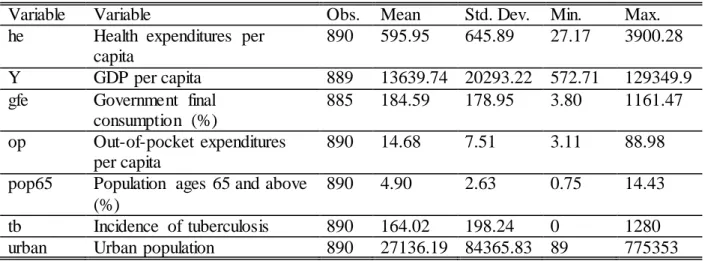
The annual data covers the period from 2006 to 2015 for 89 developing economies. The country classification is based on the World Economic Situation and Expectations (2014) report prepared by UN. By following this report, Algeria, Angola, Argentina, Bahrain, Bangladesh, Barbados, Benin, Bolivia, Botswana, Brazil, Brunei Darussalam, Burkina Faso, Burundi, Cabo Verde, Cameroon, Central African Republic, Chad, Chile, China, Colombia, Comoros, Congo, Costa Rica, Cote d’Ivoire, Dominican Republic, Ecuador, Egypt, El Salvador, Equatorial Guinea, Gabon, Gambia, Ghana, Guetamala, Guinea, Guinea-Bissau, Guyana, Haiti, Honduras, India, Indonesia, Iran, Israel, Jamaica, Jordan, Kenya, Kuwait, Lebanon, Lesotho, Liberia, Madagascar, Malawi, Malaysia, Mali, Mauritania, Mauritius, Mexico, Morocco, Mozambique, Namibia, Nepal, Nicaragua, Niger, Nigeria, Oman, Pakistan, Panama, Paraguay, Peru, Philippines, Qatar, Republic of Korea, Rwanda, Saudi Arabia, Senegal, Sierra Leone, Singapore, South Africa, Sri Lanka, Sudan, Thailand, Togo, Tunusia, Turkey, Uganda, United Arab Emirates, Uruguay, Venezuela, Vietnam and Yemen, are included in to the empirical analysis. Unfortunately, Cuba, Democratic Republic of the Congo, Djibouti, Eritrea, Ethiopia, Hong Kong SAR, Iraq, Libya, Myanmar, Papua New Guinea, Sao Tome and Prinicipe, Somalia, Syrian Arab Republic, Taiwan Province of China, Trinidad and Tobago, United Republic of Tanzania, Zambia and Zimbabwe could not involved in to the analysis because of data availability problem. Current health expenditures per capita (Power Purchasing Parity (PPP), current international $) data obtained from global health observatory indicator of the WHO. GDP per capita (PPP, current international $), general government fina l consumption expenditure (% of GDP), out-of-pocket expenditures per capita (PPP, current international $),incidence of tuberculosis (per 100,000 people), population ages 65 and above (% of the total population) data are gathered from world development indicators of the World Bank. Following the studies of Al-Mulali et al. (2013), Wang et al. (2016), Bilgili et al. (2017), urban population preferred as a proxy for urbanization. Urban population at mid-Year (thousands) is collected from the UN dataset. All variables are expressed in their natural logarithm forms. Table 2 presents the descriptive statistics. As it is seen, in developing countries, the average health expenditures per capita is 595$ while the average GDP per capita is 13.639$. These statistics show
213
that the average health expenditures per capita keeps increasing since 2000 as it is underlined in the introduction section. Besides, income per capita in these countries is quite low and this fact is coherence with the UN's country classification. On the other hand, average urban population of these countries is 27.136.000 people and it is reasonable to expect that this crowded population in urban areas could cause important health costs and economic burdens.
Table 2: Descriptive Statistics (before transformed to logarithm)
Variable Variable Obs. Mean Std. Dev. Min. Max.
he Health expenditures per capita
890 595.95 645.89 27.17 3900.28
Y GDP per capita 889 13639.74 20293.22 572.71 129349.9
gfe Government final consumption (%)
885 184.59 178.95 3.80 1161.47
op Out-of-pocket expenditures per capita
890 14.68 7.51 3.11 88.98
pop65 Population ages 65 and above (%)
890 4.90 2.63 0.75 14.43
tb Incidence of tuberculosis 890 164.02 198.24 0 1280
urban Urban population 890 27136.19 84365.83 89 775353
Table 3 shows the pairwise correlation coefficients of all data. As it is expected, GDP per capita and out-of-pocket expenditures per capita has a positive correlation with health expenditures per capita. Besides, other socio-economic indicators correlation signs mostly indicates expected results except the incidence of tuberculosis which has a negative correlation with health expenditures per capita. Moreover, the correlation between urbanization and health expenditure s per capita presents a positive sign.
Table 3: Pairwise Correlation Matrix
lnhe lnY lngfe lnop lnpop65 lntb lnurban
lnhe 1.000 - - - - lnY 0.939 1.000 - - - - - lngfe 0.194 0.114 1.000 - - - - lnop 0.831 0.800 -0.051 1.000 - - - lnpop65 0.388 0.289 0.008 0.433 1.000 - - lntb -0.602 -0.539 -0.072 -0.623 -0.236 1.000 - lnurban 0.112 0.125 -0.219 0.204 0.225 0.024 1.000
Even though descriptive statistics and pairwise correlations coefficients shows lead informatio ns about the data, more advanced and complex statistical methods should be apply to investigate the relationship among the series. For that reason, static and dynamic panel data estimations are used in the empirical analysis of this study.
2.2. Methodology
This study aims to investigate the relationship between health expenditures per capita and urbanization for developing economies during the period 2006 to 2015 by applying both static and dynamic panel data estimations. At first, pooled ordinary least squares (POLS), standart fixed effects (FE) and random effects (RE) models are employed to investigate the possible relations hip among the variables. While the static empirical model is determining, Xu and Saksena (2011)’s model is extended by urbanization data. In this regard, static model is constituted as below:
i t t i i t i t i t i t i t i t i n t
t Y urban gfe op pop tb a
he(, ), 1ln , 2ln , 3ln , 4ln , 5ln 65, 6ln , ,
214
where lnhe(t,tn),istates the total health expenditures per capita from period tto period t n,lnYt,i expresses income per capita,lnurbant,idenotes the explanatory variable which is urban population. Control variables indicated as government final consumption (lngfet,i),out-of-pocket expenditures
per capita (lnopt,i), population ages 65 and above (lnpop65t,i), incidence of tuberculosis (lntbt,i).
Also, aiis the country-specific effects, tis the time period effects and t,iis the error term in equation 1.
The basic estimation methodology (POLS) can provide biased results caused from time-invaria nt unobservables. The fixed and random effects estimations eliminate these possible biases by within transformation process (treating fixed or random). In this regard, Breusch and Pagan (1980) developed a Lagrange multiplier (LM) test to choose the favored estimator to overcome the possible heterogeneity problem. If the null hypothesis of LM test (H0: individual-specific or time-specific error variance components are zero) is rejected, this implies RE is a proper estimator for panel. On the other hand, in an economic view, because all countries included in the empirica l model of this study stated as developing economies by UN, it is rational to treat ai as fixed. Yet still, the general specification test which proposed by Hausman (1978) is applied to decide whether fixed or random effects are valid for current country group. If the null hypothesis of this test (H0: difference in coefficients not systematic) is rejected, this indicates the validity of the fixed effects (Park, 2011).
Even though observable variables assumed strictly exogenous in fixed effects model (Alliso n, 2009), some variables (for instance GDP per capita in equation 1) actually has an endogenous nature by economically as stated by Xu and Saksena (2011). On the other hand, if the lagged dependent variable involved as a regressor, the possible correlations between the lagged dependent variables and country-specific effects may constitutes biased coefficient results. Therefore, fixed effects estimator can be implemented if Tis large because this correlation problem disappears in
largeTpanels (Nickell, 1981). According to this information, generalised methods of moments
(GMM) approach is used as a dynamic panel data estimator in this study. Arrelano and Bond (1991) developed a GMM technique that aims to resolve joint endogeneity by using lags of endogenous variables as intruments for smallTand large 𝑁 panels. The dynamic panel data
regression is specified as below:
i t i i t i t i t i t i t i t i t i
t he Y urban gfe op pop tb a
he, 1 ln 1, 2 ln 2, 3 ln , 4 ln , 5 ln , 6 ln 65, 7 ln , ,
ln
(2)
where lnhet,idenotes the first difference of health expenditures per capita for country iduring t time period,lnhet1,irepresents the lagged difference of the dependent variable,lnYt2,iindicates the lagged level and differenced endogeneous variable ( income per capita),lnurbant,istates the first difference of the explanatory variable (urban population), lngfet,i,lnopt,i,lnpop65t,i,lntbt,i specifies the first differences of exogenous control variables which are indicated in equation 1. GMM estimator consistency relies on two important assumptions. The first one is the lack of second order serial correlation of error term; the second is the validness of instruments. These two assumptions investigated with two specification test in this study. AR2 test for the second-order serial correlation of differenced residuals while Sargan-Hansen is the over-identifying restrictio ns test (Arellano & Bond, 1991; Arellano & Bover, 1995; Blundell & Bond, 1998).On the other hand, Arellano and Bond (1991) suggest two different steps for GMM analysis. In the first-step GMM estimaton, the assumption of t,i is independent and homoscedastic across cross-sections during t period. However, in the second step of GMM estimation, t,i obtained from first step estimatio ns are used to determine a consistent variance-covariance matrix estimations. In this way, the
215
independence and homoscedasticity assumptions get loosen. Therefore, the second step estimatio n is asymptotically more efficient compared to first step (Beck & Levine, 2004).
3. Empirical Results and Discussions
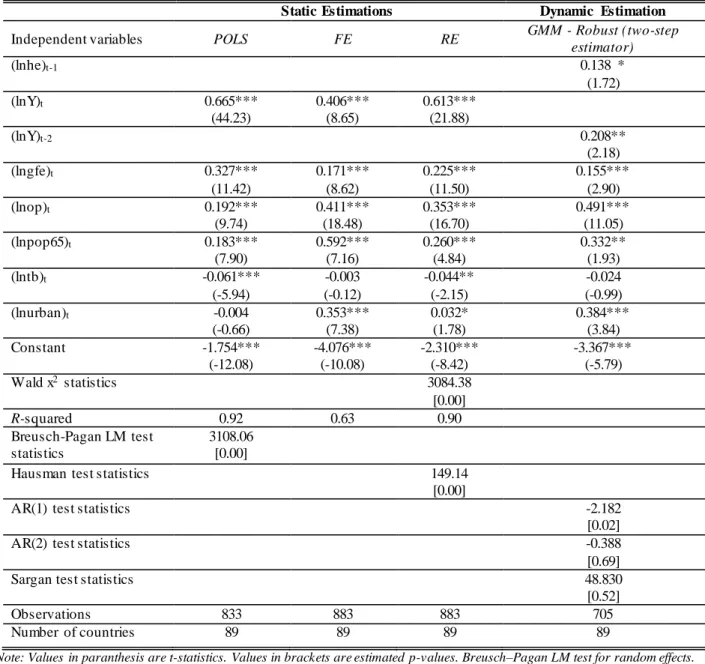
This study aims to investigate the possible impacts of urbanization on healthcare expenditures for developing countries by using panel data techniques. In this regard, Table 4 shows the static and dynamic panel data estimator results of equation 1 and 2.
Table 4: Static and Dynamic Panel Estimations Results
Static Estimations Dynamic Estimation
Independent variables POLS FE RE GMM - Robust (two-step
estimator) (lnhe)t-1 0.138 * (1.72) (lnY)t 0.665*** (44.23) 0.406*** (8.65) 0.613*** (21.88) (lnY)t-2 0.208** (2.18) (lngfe)t 0.327*** (11.42) 0.171*** (8.62) 0.225*** (11.50) 0.155*** (2.90) (lnop)t 0.192*** (9.74) 0.411*** (18.48) 0.353*** (16.70) 0.491*** (11.05) (lnpop65)t 0.183*** (7.90) 0.592*** (7.16) 0.260*** (4.84) 0.332** (1.93) (lntb)t -0.061*** (-5.94) -0.003 (-0.12) -0.044** (-2.15) -0.024 (-0.99) (lnurban)t -0.004 (-0.66) 0.353*** (7.38) 0.032* (1.78) 0.384*** (3.84) Constant -1.754*** (-12.08) -4.076*** (-10.08) -2.310*** (-8.42) -3.367*** (-5.79) Wald x2 statistics 3084.38 [0.00] R-squared 0.92 0.63 0.90 Breusch-Pagan LM test statistics 3108.06 [0.00]
Hausman test statistics 149.14
[0.00]
AR(1) test statistics -2.182
[0.02]
AR(2) test statistics -0.388
[0.69]
Sargan test statistics 48.830
[0.52]
Observations 833 883 883 705
Number of countries 89 89 89 89
Note: Values in paranthesis are t-statistics. Values in brackets are estimated p-values. Breusch–Pagan LM test for random effects. Hausman test is the Hausman specification test. AR(1) and AR(2) are tests for autocorrelation. Sargan test refers to the over-identification test for the restrictions in GMM estimation. *,** and *** denotes %1, %5 and % 10 level of significancy.
POLS, RE and FE estimators' coefficient findings showed similar way results for some variables and differentiating for some others. However, as mentioned in previous section, POLS estimatio ns could present biased results. Therefore, FE and RE methods are preferred to reach more reliable coefficients. As stated by Park (2011), LM test and Hausman test needs to be implemented to choose appropriate model for panel. Initially, LM test findings indicate that RE estimator results needs to be addressed instead of POLS. After that, Hausman specification test is employed to decide whether fixed or random effects valid for developing countries panel. These test findings
216
imply that FE estimator results should be preferred for current country sample. Therefore, FE estimator findings should be favored as the consistent static panel estimator. According to FE findings, lnY, lngfe, lnop, lnpop65 has a positive and statistically significant impact on lnhe. Besides, any statistically significant relationship could not been detected among lntb and lnhe in the FE analysis. On the other hand, FE results imply that urbanization induces the healthcare expenditures in developing countries. As seen in Table 4, 1% increase in urban populatio n increased health expenditures by 0.35%. Even though FE is found as a proper estimator in the static model, dynamic panel estimation method is employed to consider the dynamic properties among the variables and dealed with the endogeneity problem in the empirical model. In this regard, GMM analysis results are also given in Table 4. Initially, AR2 test results do not reject the null hypothesis of no serial correlation in the first differences residual terms. In addition, Sargan test result states that over-identifying restrictions accepts the validity of instruments. This find ing supports the chosen instruments are proper.
On the other hand, dynamic panel estimator results revealed that lagged dependent variable stimulates the health expenditures per capita. This result implies that the previous time periods health expenditures per capita increases the demand of current health expenditures. Besides, as stated by Xu and Saksena (2011), income has an endogenous nature in the empirical model. Therefore, lnY included as an endogenous variable in to the GMM analysis. According to the GMM findings, as it is expected, lagged endogenous variable has a significant and positive impact on healthcare expenditures per capita in developing countries. This means income is an important determinant of the total health expenditures per capita for developing countries. These results coherence with the findings of Erdil and Yetkiner (2009), Xu and Saksena (2011) and Fattahi (2015). In addition, dynamic panel estimation results indicated that lngfe has a promoting impact on lnhe.
Because, an increase in the share of general government final consumption also gives a clue about the government fiscal stance. Therefore, an increase in government expenditure share refers a possible rise in government health expenditures and therefore in total health expenditures. Also, GMM results state that lnop is an important trigger for lnhe. This means the organization and financing variations of healthcare system could have a significant impact on health expenditure s due to increasing the ability to reach improved healthcare services. Thus, out-of-pocket payments could increase the healthcare expenditures per capita by contributing the development in healthcare system. On the other hand, GMM findings remark that an increase in lnpop65 enhances lnhe. Even though developing countries has less elderly population share than high or middle income world, their aging population still face with the serious health problems. This fact could stimulate the healthcare expenditures in developing economies. Because, eventually aging population needs for medical healthcare services intensely. Thereby, an increase in the share of population ages 65 and above could rise the healthcare spendings in developing countries. Besides, any statistically significant relationship could not be detected between lntb and lnhe. Finally, GMM estimator showed that health expenditures per capita increases 0.38% with a 1% increase in urban population. These results revealed that urbanization promotes healthcare spendings in developing economies, as it is expected.
4. Conclusions
Relatively fast growing urban population causes developing countries faced with healthcare challenges in each passing day. The cronical problems like lack of infrastructure, insufficienc ie s in social transformation, unplanned urbanization, difficulties in delivering health services etc. loads significant economic costs to especially developing countries. Although the determinants of healthcare expenditures has been investigated by researchers and academics for many differe nt country samples since 1970's, the studies that focus on the possible effects of urbanization on
217
health spending is quite scarce. Therefore, this study aims to examine the relationship between healthcare expenditures and urbanization in developing countries by employing both static and dynamic panel data techniques.
The static models specification tests revealed that FE model is the proper estimator for developing countries panel. In this regard, FE results showed that the socio-economic indicators such as income per capita, the share of government expenditures, out-of-pocket payments per capita, the share of population ages 65 and above has a positive impact on healthcare spendings. Moreover, static panel estimator findings expressed that urbanization also play an important role in healthcare expenditures of developing countries. However, to avoid from the endogeneity problem and to consider the possible dynamic properties in the model, dynamic panel data methods also employed to test the empirical model, in this study. GMM estimator findings actually coherence with the FE results. The same socio-economic factors in the static model effect the healthcare expenditures in a same direction. In addition, GMM results also support the view that urbanization is one of the important drivers of healthcare spendings of developing countries.
According to the empirical findings of this study, several policy suggestions could be proposed. At first, policy makers in developing countries should re-consider their urbanization policies to avoid from the possible negative externalities of rapid urban population growth. Therefore, governments should increase their investments for sustainable transformation of current infrastructure of their urban areas. In addition, policy makers should adopt fiscal policies that consider the possible impacts of urban sprawl. Secondly, policy makers should assert new legal regulations such as investment subsidies, tax concession etc., to prevent from excessive migrat io n from rural areas to urban cities.
On the other hand, the empirical analysis of this study constitutes some limitations. For instance, only 89 developing countries are included in to the analysis and the time span relatively covers a short time period. Considering these facts, future studies could increase both time period and cross-sections to determine the possible impacts of urbanization on healthcare expenditures for developing countries. In addition, limited number of control variables preferred in the empirica l model of this study. Therefore, future researchers could extend the empirical model by includ in g other determinants of health expenditures, like environmental pollution level, energy consumptio n etc.
References
Abbas, F., & Hiemenz, U. (2011). Determinants of public health expenditures in Pakistan. (Center for Development Research (ZEF) Discussion Papers on Development Policy No. 158). Retrieved from https://www.econstor.eu/bitstream/10419/84800/1/679510230.pdf.
Addo, J., Smeeth, L., & Leon, D.A. (2007). Hypertension in Sub-Saharan Africa a systematic review. Hypertension, 50, 1012-1018.
Al-Mulali, U., Fereidouni, H.G., Lee, J. Y. M., & Che Sab, C. N. B. (2013). Exploring the relationship between urbanization, energy consumption, and CO2 emission in MENA countries. Renewable and Sustainable Energy Reviews, 23, 107-112.
Allison, P.D. (2009). Fixed effects regression models. California: SAGE Publications.
Arellano, M., & Bond, S. (1991). Some tests of specification for panel data: Monte Carlo evidence and an application to employment equations. The Review of Economic Studies, 58(2), 277-297.
Arellano, M., & Bover, O. (1995). Another look at the instrumental variable estimation of error-components models. Journal of Econometrics, 68, 29-51.
218
Bac, C., & Le Pen, Y. (2002, July). An international comparison of healthcare expenditur e determinants. Paper presented at the 10th International Conference on Panel Data. Retrieved from https://econpapers.repec.org/paper/cpdpd2002/c5-1.htm.
Baltagi, B. H., & Moscone, F. (2010). Healthcare expenditure and income in the OECD reconsidered: Evidence from panel data. Economic Modelling, 27, 804-811.
Barros, P.P. (1998). The black box of healthcare expenditure growth determinants. Health Economics, 7, 533-544.
Beck, T., & Levine, R. (2004). Stock markets, banks, and growth: Panel evidence. Journal of Banking and Finance, 28, 423-442.
Bedir, S. (2016). Healthcare expenditure and economic growth in developing countries. Advances in Economics and Business, 4(2), 76-86.
Bhugra, D., & Mastrogianni, A. (2004). Globalisation and mental disorders overview with relation to depression. British Journal of Psychiatry, 184, 10-20.
Bilgili, F., Koçak, E., Bulut, Ü., & Kuloğlu, A. (2017). The impact of urbanization on energy intensity: Panel data evidence considering cross-sectional dependence and heterogene it y. Energy, 133, 242-256.
Blomqvist, A. G., & Carter, R.A.L. (1997). Is healthcare really a luxury?. Journal of Health Economics, 16, 207-229.
Blundell, R., & Bond, S. (1998). Initial conditions and moment restrictions in dynamic panel data models. Journal of Econometrics, 87, 115-143.
Boachie, M. K., Mensah, I. O., Sobiesuo, P., Immurana, M., Iddrisu, A. A., & Kyei-Brobbey, I. (2014). Determinants of public health expenditure in Ghana: A cointegration analysis. Journal of Behavioural Economics, Finance, Entrepreneurship, Accounting and Transport, 2(2), 35-40.
Breusch, T.S., & Pagan, A.R. (1980). The Lagrange multiplier test and its applications to model specification in econometrics. The Review of Economic Studies, 47(1), 239-253.
Cantarero, D., & Lago-Penas, S. (2010). The determinants of healthcare expenditure: A reexamination. Applied Economics Letters, 17(7), 723-726.
Cantarero-Prieto, D., & Lago-Penas, S. (2012). Decomposing the determinants of healthcare expenditure: The case of Spain. The European Journal of Health Economics, 13, 19-27. Crivelli, L., Filippini, M., & Mosca, H. (2006). Federalism and regional healthcare expenditures :
An empirical analysis for the Swiss cantons. Health Economics, 15, 535-541.
Devlin, N., & Hansen, P. (2001). Healthcare spending and economic output: Granger causalit y. Applied Economics Letters, 8(8), 561-564.
Di Matteo, L. (2004). What drives provincial health expenditure?. Canadian Tax Journal, 52(4), 1102-1120.
Di Matteo, L. (2005). The macro determina nts of health expenditure in the United States and Canada: Assessing the impact of income, age distribution and time. Health Policy, 71, 23-42.
Dormont, B., Grignon, M., & Huber, H. (2006). Health expenditure growth: Reassessing the threat of ageing. Health Economics, 15, 947-963.
219
Dreger, C., & Reimers, H.E (2005). Healthcare expenditures in OECD countries: A panel unit root and cointegration analysis. (Institute for the Study of Labor (IZA) Discussion Paper
Series No. 1469). Retrieved from
https://pdfs.semanticscholar.org/e1d9/b3e148b409e6d8b3cb29f237c99d67b2912a.pdf. Eckert, S., & Kohler, S. (2014). Urbanization and health in developing countries: A systematic
review. World Health and Population, 15(1), 7-20.
Erdil, E., & Yetkiner, I. H. (2009). The Granger-causality between healthcare expenditure and output: A panel data approach. Applied Economics, 41(4), 511-518.
Esteve, V., & Martinez-Zahonero, J. L. (2007). Testing the long-run relationship between health expenditures and GDP in the presence of structural change: The case of Spain. Applied Economics Letters, 14, 271–276.
Fattahi, M. (2015). The role of urbanization rate in the relationship between air pollution and health expenditures: A dynamic panel data approach. International Letters of Social and Humanistic Sciences, 53, 68-72.
French, D. (2012). Causation between health and income: A need to panic. Empirical Economics, 42, 583-601.
Gbesemete, K. P., & Gerdtham, U.G. (1992). Determinants of healthcare expenditure in Africa: A cross-sectional study. World Development, 20(2), 303-308.
Gerdtham, U.G., Søgaard, J., Andersson, F., & Jönsson, B. (1992a). An econometric analysis of healthcare expenditure: A cross-section study of the OECD countries. Journal of Health Economics, 11, 63-84.
Gerdtham, U. G., Søgaard, J., Jönsson, B., & Andersson, F. (1992b). A pooled cross-section analysis of the healthcare expenditures of the OECD countries. In: P. Zweifel & H.E. Frech (Ed.), Health Economics Worldwide. Developments in Health Economics and Public Policy (pp.287-310). Dordrecht: Springer.
Gerdtham, U. G., & Löthgren, M. (2000). On stationarity and cointegration of international health expenditure and GDP. Journal of Health Economics, 19, 461-475.
Gerdtham, U. G., & Löthgren, M. (2002). New panel results on cointegration of internatio na l health expenditure and GDP. Applied Economics, 34(13), 1679-1686.
Godfrey, R., & Julien, M. (2005). Urbanisation and health. Clinical Medicine, 5(2), 137-141. Hansen, P., & King, A. (1996). The determinants of healthcare expenditure: A cointegrat io n
approach. Journal of Health Economics, 15, 127-137.
Harpham, T. (1994). Urbanization and mental health in developing countries: A research role for social scientists, public health professionals and social psychiatrists. Social Science and Medicine, 39(2), 233-245.
Harpham, T., & Molyneux, C. (2001). Urban health in developing countries: A review. Progress in Development Studies, 1(2), 113–137.
Hartwig, J. (2008). What drives healthcare expenditure?—Baumol’s model of ‘unbalanc ed growth’ revisited. Journal of Health Economics, 27, 603–623.
Hausman, J.A. (1978). Specification tests in econometrics. Econometrica, 46(6), 1251-1271. Henderson, V. (2002). Urbanization in developing countries. The World Bank Research Observer,
220
Herwartz, H., & Theilen, B. (2003). The determinants of healthcare expenditure: testing pooling restrictions in small samples. Health Economics, 12, 113-124.
Hitiris, T., & Posnett, J. (1992). The determinants and effects of health expenditure in developed countries. Journal of Health Economics, 11, 173-181.
Howdon, D., & Rice, N. (2018). Healthcare expenditures, age, proximity to death and morbidit y: Implications for an ageing population. Journal of Health Economics, 57, 60-74.
Kouassi, E., Akinkugbe, O., Kutlo, N.O., & Brou, J. M.B. (2018). Health expenditure and growth dynamics in the SADC region: Evidence from non-stationary panel data with cross section dependence and unobserved heterogeneity. International Journal of Health Economics and Management, 18, 47-66.
Kiymaz, H., Akbulut, Y., & Demir, A. (2006).Tests of stationarity and cointegration of healthcare expenditure and gross domestic product: An application to Turkey. The European Journal of Health Economics, 7, 285-289.
Kleiman, E. (1974). The determinants of national outlay on health. In: M. Perlman (Ed.), The Economics of Health and Medicalcare (pp. 66-88). London: McMillan.
Lago-Penas, S., Cantarero-Prieto, D., & Blazquez-Fernandez, C. (2013). On the relations hip between GDP and healthcare expenditure: A new look. Economic Modelling, 32, 124-129. Lee, H., Oh, D. Y., & Meng, M. (2018). Stationarity and cointegration of healthcare expenditur e and GDP: Evidence from tests with smooth structural shifts. Empirical Economics, https://doi.org/10.1007/s00181-018-1561-1.
Leon, D. A. (2008). Cities, urbanization and health. International Journal of Epidemiology, 37, 4– 8.
Magazzino, C., & Mele, M. (2012). The determinants of health expenditure in Italian regions. International Journal of Economics and Finance, 4(3), 61-68.
McDade, T. W., & Adair L. S. (2001). Defining the ‘‘urban’’ in urbanization and health: A factor analysis approach. Social Science and Medicine, 53, 55-70.
Mendez, M. A., Monteiro, C. A., & Popkin, B. M. (2005). Overweight exceeds underweight among women in most developing countries. The American Journal of Clinical Nutrition, 81, 714-721.
Moore, M., Gould, P., & Keary, B. S. (2003). Global urbanization and impact on health. International Journal of Hygiene and Environmental Health, 206, 269-278.
Moscone, F., & Tosetti, E. (2010). Health expenditure and income in the United States. Health Economics, 19, 1385-1403.
Murthy, V. N. R., & Okunade, A. A. (2009). The core determinants of health expenditure in the African context: Some econometric evidence for policy. Health Policy, 91, 57-62.
Musgrove, P., Zeramdini, R., & Carrin, G. (2002). Basic patterns in national health expenditur e. Bulletin of the World Health Organization, 80(2), 134-146.
Newhouse, J. P. (1977). Medical-care expenditure: A cross-national survey. The Journal of Human Resources, 12(1), 115-125.
Nickell, S. (1981). Biases in dynamic models with fixed effects. Econometrica, 49(6), 1417-1426. Nixon, J., & Ulmann, P. (2006). The relationship between healthcare expenditure and health
221
Okunade, A. A., & Karakus, M. C. (2001). Unit root and cointegration tests: Timeseries versus panel estimates for international health expenditure models. Applied Economics, 33(9): 1131-1137.
Okunade, A. A., Karakus, M. C., & Okeke, C. (2004). Determinants of health expenditure growth of the OECD countries: Jackknife resampling plan estimates. Health Care Management Science, 7, 173–183.
Pan, J., & Liu, G. G. (2012). The determinants of Chinese provincial government health expenditures: Evidence from 2002-2006 data. Health Economics, 21, 757-777.
Park, H. M. (2011). Practical guides to panel data modeling: A step-by-step analysis using Stata. (International University of Japan Tutorial Working Paper) Retrieved from https://www.iuj.ac.jp/faculty/kucc625/method/panel/panel_iuj.pdf.
Parkin, D., McGuire, A., & Yule, B. (1987). Aggregate healthcare expenditures and nationa l income. Journal of Health Economics, 6, 109-127.
Roberts, J. (1999). Sensitivity of elasticity estimates for OECD healthcare spending: Analysis of a dynamic heterogeneous data field. Health Economics, 8, 459-472.
Samadi, A., & Rad, E. H. (2013). Determinants of healthcare expenditure in Economic Cooperation Organization (ECO) countries: Evidence from panel cointegration tests. International Journal of Health Policy and Management, 1(1), 63-68.
Sen, A. (2005). Is healthcare a luxury? New evidence from OECD Data. International Journal of Health Care Finance and Economics, 5, 147–164.
Siddiqui, R., Afridi, U., Haq, R., & Tirmazi, S.H. (1995). Determinants of expenditure on health in Pakistan. The Pakistan Development Review, 34(4), 959-970.
Sülkü, S. N., & Caner, A. (2011). Healthcare expenditures and gross domestic product: The Turkish case. The European Journal of Health Economics, 12, 29-38.
Thomas, L. (2006). Social capital and mental health of women living in informal settlements in Durban, South Africa, and Lusaka, Zambia. In K. McKenzie & T. Harpham (Ed.), Social Capital and Mental Health (pp. 124-137). London: Jessica Kingsley Publishers.
Thornton, J. A, & Rice, J. L. (2008). Determinants of healthcare spending: A state level analysis. Applied Economics, 40(22), 2873-2889.
Toor, I. A., & Butt, M. S. (2005). Determinants of healhcare expenditure in Pakistan. Pakistan Economic and Social Review, 43(1), 133-150.
United Nations Human Settlements Programme (2016). Urbanization and development: Emerging
futures (World Cities Report 2016). Retrieved from https://unhabitat.org/
wp-content/uploads/2014/03/WCR-%20Full-Report-2016.pdf.
Wang, Y., Mi, J., Shan, X-y., Wang, Q. J., & Ge, K-y. (2007). Is China facing an obesity epidemic and the consequences? The trends in obesity and chronic disease in China. International Journal of Obesity, 31, 177–188.
Wang, Z. (2009). The determinants of health expenditures: evidence from US state-level data. Applied Economics, 41(4), 429-435.
Wang, K. M. (2011). Healthcare expenditure and economic growth: Quantile panel-type analysis. Economic Modelling, 28, 1536-1549.
222
Wang, Y., Chen, L., & Kubota, J. (2016). The relationship between urbanization, energy use and carbon emissions: evidence from a panel of Association of Southeast Asian Nations (ASEAN) countries. Journal of Cleaner Production, 112, 1368-1374.
World Health Organization, Urbanization and Health. (2010). Bulletin of the World Health Organization, 88(4), 241-320.
World Health Organization (2014). Urban population growth. Global health observatory (GHO) data. Retrieved from
http://www.who.int/gho/urban_health/situation_trends/urban_population_growth/en/. Xu, K., & Saksena, P. (2011). The determinants of health expenditure: A country-level panel data
analysis. World Health Organization Working Paper. Retrieved from