This content has been downloaded from IOPscience. Please scroll down to see the full text.
Download details:
IP Address: 212.174.144.130
This content was downloaded on 11/01/2016 at 14:13
Please note that terms and conditions apply.
Latest results and prospects of the CERN Axion Solar Telescope
View the table of contents for this issue, or go to the journal homepage for more 2011 J. Phys.: Conf. Ser. 309 012001
Latest results and prospects of the CERN Axion
Solar Telescope
I G Irastorza6,22, S Aune1 , K Barth2 , A Belov3 , S Borghi2,23, H Br¨auninger4, G Cantatore5, J M Carmona6, S A Cetin7, J I Collar8, T Dafni6, M Davenport2, C Eleftheriadis9, N Elias2, C Ezer7 , G Fanourakis10 , E Ferrer-Ribas1 , P Friedrich4 , J Gal´an6 , A Gardikiotis11, E N Gazis12, T Geralis10, I Giomataris1,S Gninenko3 , H G´omez6 ,E Gruber13 ,T Guth¨orl13 ,R Hartmann14 , F Haug2, M D Hasinoff15, D H H Hoffmann16, F J Iguaz6,24, J Jacoby17, K Jakovˇci´c18, M Karuza5, K K¨onigsmann13, R Kotthaus19
, M Krˇcmar18
, M Kuster4,16,25, B Laki´c18
, J M Laurent2 , A Liolios9, A Ljubiˇci´c18, V Lozza5, G Lutz14,23, G Luz´on6,
J Morales6,26, T Niinikoski2,27, A Nordt4,16,28, T Papaevangelou1 , M J Pivovaroff20, G Raffelt19, T Rashba21, H Riege16, A Rodr´ıguez6, M Rosu16 , J Ruz6,28, I Savvidis9 , P S Silva2 , S K Solanki21 , R Soufli20 , L Stewart2, A Tom´as6, M Tsagri11,28, K van Bibber20,29,
T Vafeiadis2,9, J Villar6
, J K Vogel13,20, 30, S C Yildiz7
, K Zioutas2,11
1
IRFU, Centre d’´Etudes Nucl´eaires de Saclay (CEA-Saclay), Gif-sur-Yvette, France
2
European Organization for Nuclear Research (CERN), Gen`eve, Switzerland
3
Institute for Nuclear Research (INR), Russian Academy of Sciences, Moscow, Russia
4
Max-Planck-Institut f¨ur extraterrestrische Physik, Garching, Germany
5
Instituto Nazionale di Fisica Nucleare (INFN), Sezione di Trieste and Universit`a di Trieste, Trieste, Italy
6
Instituto de F´ısica Nuclear y Altas Energ´ıas, Universidad de Zaragoza, Zaragoza, Spain
7
Dogus University, Istanbul, Turkey
8
Enrico Fermi Institute and KICP, University of Chicago, Chicago, IL, USA
9
Aristotle University of Thessaloniki, Thessaloniki, Greece
10
National Center for Scientific Research “Demokritos”, Athens, Greece
11
Physics Department, University of Patras, Patras, Greece
12
National Technical University of Athens, Athens, Greece
13
Albert-Ludwigs-Universit¨at Freiburg, Freiburg, Germany
14
MPI Halbleiterlabor, M¨unchen, Germany
15
Department of Physics and Astronomy, University of British Columbia, Vancouver, Canada
16
Technische Universit¨at Darmstadt, IKP, Darmstadt, Germany
22
Attending speaker.
23
Present address: Department of Physics and Astronomy, University of Glasgow, Glasgow, UK
24
Present address: IRFU, Centre d’´Etudes Nucl´eaires de Saclay (CEA-Saclay), Gif-sur-Yvette, France
25
Present address: European XFEL GmbH, Notkestrasse 85, 22607 Hamburg, Germany
26
Deceased
27
Present address: Excellence Cluster Universe, Technische Universit¨at M¨unchen, Garching, Germany
28
Present address: European Organization for Nuclear Research (CERN), Gen`eve, Switzerland
29
Present address: Naval Postgraduate School, Monterey, CA, USA
30
17
Johann Wolfgang Goethe-Universit¨at, Institut f¨ur Angewandte Physik, Frankfurt am Main, Germany
18
Rudjer Boˇskovi´c Institute, Zagreb, Croatia
19
Max-Planck-Institut f¨ur Physik, Munich, Germany
20
Lawrence Livermore National Laboratory, Livermore, CA, USA
21
Max-Planck-Institut f¨ur Sonnensystemforschung, Katlenburg-Lindau, Germany E-mail: [email protected]
Abstract. The CERN Axion Solar Telescope (CAST) experiment searches for axions from the Sun converted into few keV photons via the inverse Primakoff effect in the high magnetic field of a superconducting Large Hadron Collider (LHC) decommissioned test magnet. After results obtained with vacuum in the magnet pipes (phase I of the experiment) as well as with
4
He the collaboration is now immersed in the data taking with3
He, to be finished in 2011. The status of the experiment will be presented, including a preliminary exclusion plot of the first
3
He data. CAST is currently sensitive to realistic QCD axion models at the sub-eV scale, and with axion-photon couplings down to the ∼ 2 × 10⁻¹⁰ GeV−1, compatible with solar life limits.
Future plans include revisiting vaccuum and4
He configurations with improved sensitivity, as well as possible additional search for non-standard signals from chamaleons, paraphotons or other WISPs. For the longer term, we study the feasibility of an altogether improved version of the axion helioscope concept, with a jump in sensitivity of about one order of magnitude in gaγ beyond CAST.
1. Introduction
Axions are light pseudoscalar particles that arise in theories in which the Peccei-Quinn U(1) symmetry has been introduced to solve the strong CP problem [1]. They could have been produced in early stages of the Universe being attractive candidates to the cold Dark Matter (and in some particular scenarios to the hot Dark Matter) that could compose up to ∼1/3 of the ingredients of the Universe.
The axion-photon coupling gaγ, unlike other axion couplings[2], is automatically present in every QCD axion model, and allows for the conversion of axions into photons (and viceversa) in the presence of electromagnetic fields, being the base of almost every axion detection strategy.
A combination of astrophysical and nuclear physics constraints restricts the allowed range for axion mass and couplings[3, 4, 5]. Pure cosmological arguments lead to a conservative, relatively model-independent allowed mass range of 10−6eV <
∼ma<∼1 eV, the upper limit being recently set [6], by requiring thermal production of axions to be compatible with last CMB data. The coupling gaγ can be constrained independently by astrophysical observations, namely gaγ ∼<10−
9
GeV−1 based on the solar standard model and helioseismological observations [7], or the so-called globular cluster limit of gaγ <
∼10− 10
GeV−1 [8, 9].
Although the PQ scenario just described is probably the best motivated theoretical foundation for an axion, a phenomenologically similar scenario of a scalar or pseudoscalar particle coupled to the photon arises also in other proposed extensions of the Standard Model31
. This broader class of models are generically referred to as axion-like particles or, referring to a even wider class of particles, WISPs, weakly interacting slim particle. In these cases, the axion-like particle is just viewed as a (peudo)scalar of mass ma and coupling to two photons gaγ, where ma and gaγ are now two independent parameters, without further reference to the underlying theory. Therefore, every experiment (or observational consideration) based only on the property of the axions coupling to the photons could also be generalized to any axion-like particle. In particular, axion helioscope experiments are also sensitive to axion-like particles. Limits are
31
Examples of such extensions are extra dimensions (Kaluza-Klein) theories [10, 11, 12], quintessential dark energy models [13] or superstring theories [14] among others
expressed in a phenomenological (gaγ − ma) parameter space of the axion-like particles, with the area corresponding to the QCD axions singled out (yellow band in Fig. 1). However, one must be cautious and not forget that some of the limits mentioned before are set using specific properties of the QCD axions (other than the coupling to the photons) and therefore do not hold for any axion-like particle.
Axions could be produced at early stages of the Universe by the so-called misalignment (or realignment) effect[2], plus in some cases also from decay of primordial topological defects like axion strings or walls. These relic axions could be a substantial part of the cold dark matter (CDM) if ma ∼ 10−
6
– 10−3 eV, and could be detected by microwave cavities as originally proposed in[15]. Such technique is followed by experiments like the Axion Dark Matter Experiment (ADMX)[16, 17], which is actively scanning the low axion mass range mentioned above. Axions could also be copiously produced in the core of the stars by means of the Primakoff conversion of the blackbody photons in the fluctuating electric field of the plasma. Solar axions have energies of 1–10 keV, and could be detected by looking for x-rays of those energies coming from their conversion in a strong laboratory magnetic field. This helioscope concept[15, 18], was first experimentally applied in [19] and later on by the Tokyo helioscope [20], before CAST.
Finally, evidence for axions could also be produced altogether in the laboratory, by means of strong light sources combined with strong magnetic fields[21]. Although the sensitivity of laboratory experiments is still far from that of ADMX or CAST, they do not rely on any assumption on astrophysical sources of the axions. Like CAST, but unlike ADMX, they are also sensitive to axion-like particles.
2. Status of CAST and latest results
The CAST experiment is making use of a decommissioned LHC test magnet that provides a magnetic field of 9 Tesla along its two parallel pipes of 2×14.5 cm2
area and 10 m length, increasing the corresponding axion-photon conversion probability by a factor 100 with respect to the previous best implementation of the helioscope concept[22]. The magnet is able to track the Sun by about 3 hours per day, half in the morning and half in the evening. At its two ends x-ray detectors are placed, at the ”sunrise” side, a Micromegas detector[23] and a CCD[24], and at the ”sunset” side two additional Micromegas detectors, installed in 2007 replacing the former TPC[25]. All of the detector setups are conceived following low background techniques (shielding, radiopure materials). The CCD is coupled to a focusing X-ray device (X-ray telescope)[24] that enhances its signal-to-bakcground ratio by two orders of magnitude. Both the CCD and the X-ray telescope are prototypes developed for X-ray astronomy.
The experiment already released its phase I results from data taken in 2003 and 2004 with vacuum in the magnet bores[22, 26]. No signal above background was observed, implying an upper limit to the axion-photon coupling gaγ < 8.8 × 10⁻¹¹ GeV−1 at 95% CL for the low mass (coherence) region ma ∼< 0.02 eV (Fig. 1). Since 2006 the experiment runs its second phase, which makes use of a buffer gas inside the magnet bores to recover the coherence of the conversion for specific axion masses matching the effective photon mass defined by the buffer gas density. The pressure of the gas is changed in discrete small steps to scan the parameter space above ma ∼ 0.02 eV. The 4He Run taken in 2006[27], allowed to scan axion masses up to 0.39 eV, for axion-photon couplings down to about 2.2 × 10⁻¹⁰GeV−1, entering into the QCD axion model band, as shown in Fig. 1. Due to gas condensation, in order to go to higher pressures, the experiment switched to 3
He as buffer gas in 2007. The experiment is currently inmersed in the 3
He Run since beginning of 2008. It should last until mid 2011 and should allow us to explore up to 1.2 eV in axion mass approximately, overlapping with the CMB upper limit on the axion mass disussed above.
At the moment of writing this paper, the experiment has explored a region of axion masses up to about ma∼ 1 eV. The first part of these data, taken in 2008, and covering approximately
(eV)
axionm
-710
10
-610
-510
-410
-310
-210
-11
10
)
-1(GeV
γ ag
-1610
-1510
-1410
-1310
-1210
-1110
-1010
-910
-810
-710
-610
-510
-410
Axion models KSVZ [E/N = 0] Tokyo helioscope Laser exps. Overclosure CAST Microwave cav. crystals HB stars HDM He 2008 3 -710
10
-610
-510
-410
-310
-210
-11
10
Figure 1. 95% CL exclusion line obtained from the previously published CAST data [22, 26] (blue line) and the preliminary analysis of the first 20083
He data (red line, including only data from the 3 Micromegas detectors). Limits from other experiments or observations are included for comparison, such as the Tokyo helioscope and the cosmological upper limit on the axion mentioned in the text. The yellow area indicates the region of theoretical preference for axion models.
from 0.40 to 0.65 eV is almost fully analysed. They show no positive signal for axions and a preliminary exclusion plot (including for the moment only data from the 3 Micromegas detectors) is shown in Fig. 1. It extends previous CAST limit further into the QCD axion models band, and in particular now it traverses the benchmark model line (green line of Fig. 1), corresponding to a particular type of axions (KSVZ with E/N = 0 [28, 29]) for the mentioned axion masses. Everyday a new thin slice of untouched parameter space is being explored. Due to the sharp coherence effect, and to the fact that the parameter space to which we are sensitive now is populated by realistic QCD axion models and not excluded by previous experiments, a clear positive signal in CAST may appear at any moment.
The collaboration has performed by-product analysis of the data taken, to look for non-standard axion scenarios to which CAST would also be sensitive. Using data from the TPC in the CAST phase I, a search for 14 keV axions coming from M1 transitions in the Sun has been recently released[30]. In addition, data taken with a calorimeter during the phase I, were used to search for high energy (MeV) lines from high energy axion conversion[31]. Moreover, data has been taken with a visible detector coupled to one end of the CAST magnet, in search for axions with wavelengths in the ”visible” range, possibly produced in the surface magnetic field
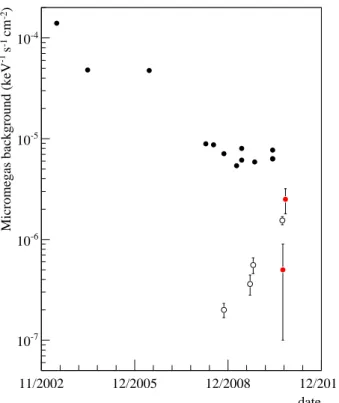
date 11/2002 12/2005 12/2008 12/2011 ) -2 cm -1 s -1
Micromegas background (keV
-7 10 -6 10 -5 10 -4 10
Figure 2. Background levels of Micromegas detectors over the years. Black points represents nom-inal values in CAST data taking campaigns. Open points corre-spond to ultralow background pe-riods in CAST and the red points to data taken in special shielding conditions in the Canfranc under-ground laboratory.
of the Sun. A preliminary result was presented in [32], but more extended data taking is going on without interfering with the standard program of CAST thanks to a thin mirror foil that is transparent to x-rays but reflects visible photons into a dedicated setup.
Once the current3
He phase finishes, the collaboration plans to revisit previous vacuum and 4
He configurations with improved sensitivity. This is possible thanks to the currently available detector’s lower background levels. Micromegas detectors in CAST have gone through intense development over the years. By means of better shielding, cleaner detector materials, improved offline data treatment, and following the state-of-the-art microbulk fabrication technique, current Micromegas’ backgrounds are now about a factor 20 lower than at the beginning of the experiment (see Fig. 2). A brief review of these efforts and prospects has been given by F. J. Iguaz at this conference.
3. Towards a new generation axion helioscope
For the longer term, a feasibility study is ongoing towards a new generation axion helioscope, with an improved sensitivity of at least one order of magnitude in gaγ beyond CAST. There is a important motivation to extend current CAST solar axion bounds further down to at least 10−11 or if possible to 10−12 GeV−1. This region includes, at the high mass range, a large set of plausible QCD axion models, relevant as hot dark matter candidates. At lower axion masses, this region includes the ALP parameters invoked repeatedly for the emission mechanism of several classes of astrophysical phenomena[33, 34, 35, 36, 37, 38, 39]. This region is currently not excluded by any experimental results or astrophysical limits, and moreover, they are out of reach of foreseeable improvements of the experimental techniques for direct axion detection, with the exception of an enhanced axion helioscope.
Although the study is still ongoing, preliminary considerations point to the fact that an enhanced axion helioscope, based on pursuing innovations already introduced by CAST (specifically the use of x-ray optics to increase the signal-to-noise ratio and low background x-ray detectors), coupled with the use of a new, larger cross section, toroidal magnet, could achieve a sensitivity of 1 to 1.5 orders beyond current CAST limits, and therefore surpassing gaγ ∼ 10−
11
GeV−1, for a wide axion mass range of up to ∼0.25 eV. Such a tentatively accessible region is shown in Fig. 3, together with current limits and similar long-term prospects for the microwave cavity technique, resulting in largely complementary regions. Details on this preliminary results, including analysis of the three key elements of the new helioscope, magnet, optics and detectors, will be included in a publication in preparation.
4. Conclusions and prospects
The CAST experiment is currently finishing the 3
He phase of data taking. First preliminary results with 3
He have been presented, extending previous CAST limits further to higher masses (to ∼0.65 eV) and deeper into the region favored by QCD axion models. After the 3
He phase, CAST plans to revisit previous configurations with improved detectors. Farther in the future, a feasibility study for a new generation axion helioscope is ongoing. Pushing innovations introduced by CAST, like the use of x-ray optics and of low background techniques, together with a specifically designed magnet, a substantial region, of at least one order of magnitude beyond current CAST limit, could be explored.
References
[1] Peccei R D and Quinn H R 1977 Phys. Rev. Lett. 38 1440–1443 [2] Turner M S 1990 Phys. Rept. 197 67–97
[3] Kolb E and Turner M 1990 The Early Universe ISBN 0-201-11603-0 [4] Burrows A, Ressell M T and Turner M S 1990 Phys. Rev. D42 3297–3309 [5] Engel J, Seckel D and Hayes A C 1990 Phys. Rev. Lett. 65 960–963
[6] Hannestad S, Mirizzi A and Raffelt G 2005 JCAP 0507 002 (Preprint hep-ph/0504059) [7] Schlattl H, Weiss A and Raffelt G 1999 Astropart. Phys. 10 353–359 (Preprint hep-ph/9807476) [8] Raffelt G G 1999 Ann. Rev. Nucl. Part. Sci. 49 163–216 (Preprint hep-ph/9903472)
[9] Raffelt G G 1986 Phys. Rev. D33 897
[10] Chang S, Tazawa S and Yamaguchi M 2000 Phys. Rev. D61 084005 (Preprint hep-ph/9908515) [11] Dienes K R, Dudas E and Gherghetta T 2000 Phys. Rev. D62 105023 (Preprint hep-ph/9912455) [12] Turok N 1996 Phys. Rev. Lett. 76 1015–1018 (Preprint hep-ph/9511238)
[13] Carroll S M 1998 Phys. Rev. Lett. 81 3067–3070 (Preprint astro-ph/9806099) [14] Svrcek P and Witten E 2006 JHEP 06 051 (Preprint hep-th/0605206) [15] Sikivie P 1983 Phys. Rev. Lett. 51 1415
[16] Asztalos S J et al. 2001 Phys. Rev. D64 092003
[17] Asztalos S J et al. 2004 Phys. Rev. D69 011101 (Preprint astro-ph/0310042) [18] van Bibber K, McIntyre P M, Morris D E and Raffelt G G 1989 Phys. Rev. D39 2089 [19] Lazarus D M et al. 1992 Phys. Rev. Lett. 69 2333–2336
[20] Moriyama S et al. 1998 Phys. Lett. B434 147 (Preprint hep-ex/9805026) [21] Lindner A 2009 (Preprint 0910.1686)
[22] Zioutas K et al. (CAST) 2005 Phys. Rev. Lett. 94 121301 (Preprint hep-ex/0411033) [23] Abbon P et al. 2007 New J. Phys. 9 170 (Preprint physics/0702190)
[24] Kuster M et al. 2007 New J. Phys. 9 169 (Preprint physics/0702188) [25] Autiero D et al. 2007 New J. Phys. 9 171 (Preprint physics/0702189)
[26] Andriamonje S et al. (CAST) 2007 JCAP 0704 010 (Preprint hep-ex/0702006) [27] Arik E et al. (CAST) 2009 JCAP 0902 008 (Preprint 0810.4482)
[28] Kim J E 1979 Phys. Rev. Lett. 43 103
[29] Shifman M A, Vainshtein A I and Zakharov V I 1980 Nucl. Phys. B166 493 [30] Andriamonje S et al. (CAST) 2009 (Preprint 0906.4488)
[31] Andriamonje S et al. (CAST) 2009 (Preprint 0904.2103) [32] Cantatore G et al. (CAST) 2008 (Preprint 0809.4581) [33] Teshima M et al. (for the MAGIC) 2007 (Preprint 0709.1475)
(eV) axion m -10 10 10-9 10-8 10-7 10-6 10-5 10-4 10-3 10-2 10-1 1 10 ) -1 (GeV γ a g -17 10 -16 10 -15 10 -14 10 -13 10 -12 10 -11 10 -10 10 -9 10 -8 10 -7 10 -6 10 -5 10 ALP hints Axion models Laser exps. NGAH Solar (CAST)
Microwave cavities (ADMX)
crystals
HB stars
-10
10 10-9 10-8 10-7 10-6 10-5 10-4 10-3 10-2 10-1 1 10
Figure 3. A comprehensive axion-like particle parameter space plot, including the regions tentatively explorable with a future new generation axion helioscope (dashed blue region) and with the microwave cavity technique (dashed brown region). Also shown is the region relevant to the astrophysical hints for ALPs (yellow rectangle in the low mass part of the plot) discussed in the text.
[34] De Angelis A, Mansutti O, Persic M and Roncadelli M 2008 (Preprint 0807.4246)
[35] Roncadelli M, De Angelis A and Mansutti O 2008 AIP Conf. Proc. 1018 147–156 (Preprint 0902.0895) [36] Gorbunov D S, Tinyakov P G, Tkachev I I and Troitsky S V 2004 JETP Lett. 80 145–148 (Preprint
astro-ph/0406654)
[37] Fairbairn M, Rashba T and Troitsky S V 2009 (Preprint 0901.4085)
[38] Albuquerque I F M and Chou A 2010 JCAP 1008 016 (Preprint 1001.0972)
![Figure 1. 95% CL exclusion line obtained from the previously published CAST data [22, 26] (blue line) and the preliminary analysis of the first 2008 3](https://thumb-eu.123doks.com/thumbv2/9libnet/4054013.57371/5.892.192.683.185.650/figure-exclusion-obtained-previously-published-cast-preliminary-analysis.webp)