Volume 27, Number 1, Pages 37-44 (2018) DOI: 10.1501/commuc_0000000190 ISSN 1303-6025
http://communications.science.ankara.edu.tr/index.php?series=C
Received by the editors: May 13, 2018; Accepted: July 05, 2018.
Key word and phrases: Abiotic stress, defence, heavy metal.
© 2018 Ankara University Communications Faculty of Sciences University of Ankara Series C: Biology COMPARASION OF PHENYLALANINE AMMONIA LYASE RESPONSE TO
LEAD AND ZINC STRESS IN DIFFERENT WHEAT GENOTYPES ESRA KOÇ, CEMİL İŞLEK, AND HATİCE NURHAN BÜYÜKKARTAL
Abstract. Phenylalanine ammonia lyase response to zinc and lead toxicity of two different wheat genotypes (Triticum aestivum L. cv. Kıraç-66 and Triticum durum Desf. cv. Kızıltan-91) were investigated in this study. The seedlings which were cultivated for 6 weeks in greenhouse conditions were harvested from the surface of soil. At the end of 6th weeks, seedlings were transferred to jars which filled full Hoagland nutrient solution. The zinc and lead stress treatments were carried out with addition of 0 (control), 100 mg/L, 200 mg/L, 300 mg/L zinc and lead in nutrient solution. It was determined that phenylalanine ammonia lyase activity increased in seedlings under zinc and lead stress. The highest phenylalanine ammonia lyase activity was determined in treatment 200 mg/L Pbon fourth day in cv. ‘Kızıltan-91’genotype. These data show that phenylalanine ammonia lyase activity appear to protect wheat seedlings against stress-related damage.
1. Introduction
Wheat is a staple food crop all over the world and is the most widely grown crop in Turkey. Annually, millions of tons of wheat is grown worldwide [1, 2]. Wheat is produced in almost every part of the Turkey, but the CentralAnatolia Region is the one of the most important production areas. Anatolia is a gene center of many grains, including wheat, barley, and their wild ancestors [3]. The wheat yield drops due to reasons such as heavy metals, salinity drought, and flood. It has been found that heavy metals have a significant negative impact on wheat growth and some physiological responses such as chlorophyll content in recently studies and also determined that the metal concentration content was high in the wheat plants in Turkey [4, 5, 6]. Heavy metals are basic micronutrients; for example, they are cofactors of basic metabolic enzymes. However, their increased concentrations in the soil may become poisonous for plants. Heavy metals (such as Zn, Pb, Cd, and Cu) spread from various sources such as industrial activities, industrialization, urban
wastes, mining, agricultural fertilizer and pesticide use, exhaust smoke of motor vehicles, and volcanic activities, and cause serious problems in agriculture and forestry. Widespread accumulation of these heavy metals in the soil and environment causes a growing threat to all kinds of organisms from plants to humans. Zinc (Zn) is used as ion by plants, and has oxidation and reduction properties within the plant. In general, zinc is considered to be the least toxic heavy metal; however, the critical level of Zn toxicity for plants vary depending on climate factors, soil variety, plant genotype, and plant growth phase. Lead (Pb) is a significant anthropogenic pollutant accumulating in various aquatic and terrestrial ecosystems since the industrial revolution. Due to its low solubility and strong bonding capacity to soil colloids, it remains in the soil for a long time, which has several direct or indirect effects on plant growth and metabolism (such as biochemical and structural changes) [7]. Those heavy metals that can be assimilated easily by plants at high concentrations inhibit the plants development and growth. Additionally, the metals damage cell membranes within the plants, decreasing transpiration, destroying protein synthesis, damaging the organelles related to photosynthesis - thus inhibiting photosynthesis and affecting enzyme activation and increasing lipid peroxidation [8, 9]. It has different tolerances against plant stress factors. This depends on plant type, stress factor, stress exposure time, and structure of the tissue or organ exposed to stress. It is difficult to determine how plants respond to these heavy metals, and which defense mechanism they develop.
Plants possess a variety of active defense responses, which contribute to resistance against a range of heavy metals. One of the biochemical mechanisms involved in problems is the production of several secondary plant products originating from or passing through the phenylpropanoid pathway (PPP). Phenylalanine ammonia-lyase is a critical enzyme in this pathway, working as a trigger for the production of these secondary compounds. The PAL enzyme is part of plants defence against many different stresses and an increase of PAL activity in plants under different stresses has been extensively reported [10, 11, 12]. PAL catalyzes the conversion of L-phenylalanine into trans-cinnamate, the initial committed step of the multibranched PPP in higher plants. As the first step in phenolic metabolism, this is a key biochemical reaction in both plant development and defense [13, 14].
Literature reviews showed that the number of studies on phenylalanine ammonium lyase activity in wheat exposed to different heavy metal stresses was limited, and no study was found on PAL activity in wheat against zinc and lead treatments. The objective of this work is to compare the time course of PAL activity induction in T.
aestivum cv. Kıraç 66 and T. durum cv. Kızıltan 91 wheat genotypes after treatment
with different concentrations (0 mg/L, 100 mg/L, 200 mg/L, 300 mg/L) of zinc (Zn) and (0 mg/L, 100 mg/L, 200 mg/L, 300 mg/L of lead (Pb).
DIFFERENT WHEAT GENOTYPES 2. Material and method
Two genotypes (T. aestivum cv. Kıraç 66 and T. aestivum cv. Kızıltan 91) belonging to poliploidy two wheat genotypes were used in this study. The wheat seeds used in this study were provided by Field Crops Central Research Institute (Ankara). The seedlings which were cultivated for 6 weeks in greenhouse conditions (24-33°C and natural light conditions, 51 % relative humidity) were harvested from the surface of soil. The roots of the wheat seedlings were washed with tap water and disinfected by being kept in 0.75% sodium hypochlorite for 1-2 min. They were then washed with sterile distilled water with 1-2 drops of Tween 20 per liter. At the end of 6th weeks, seedlings were transferred to glass bottles which filled full Hoagland nutrient solution. Zinc (ZnCl2) and lead (PbNO3) treatments to the seedlings were carried out in the concentrations of 0 (control), 100, 200, 300 mg/L by adding to Hoagland solution. Full Hoagland nutrient solution was used as the control group in experiments. Seedlings were again kept in the same conditions for 2 and 4 days. For the two genotypes, each treatment was repeated three times and three bottles were used for each repetition. A total of 10 seedlings was used for each single repetition of each treatment. According to the randomized block design model, random wheat seedlings were taken on the second and fourth days; the samples were separated, frozen in liquid nitrogen, and stored at -80 °C until analysis.
2.1. Phenylalanine Ammonia Lyase (PAL; E.C.4.3.1.5) Assay
PAL was extracted from the leaves of wheat [15]. PAL activity was quantified using the technique [16]. The calibration curve was constructed using cinnamic acid. The blank had the same constituents except that the extract was added after the HCl solution.
2.2. Statistical Analysis
All data were analyzed using analysis of variance (ANOVA). Data presented are mean values ± S.D (standard deviation measures) for three replicates. Analysis of variance was employed to compare the means of two wheat genotypes, and the significance of differences was determined by DUNCAN multiple comparison technique. The statistical significance is indicated within the figure (α = 5%).
3. Results and discussion
The experiment on the defence of Kızıltan-91 and Kıraç-66 to the Zn and Pb treatments was carried out under controlled conditions. The highest PAL activity in
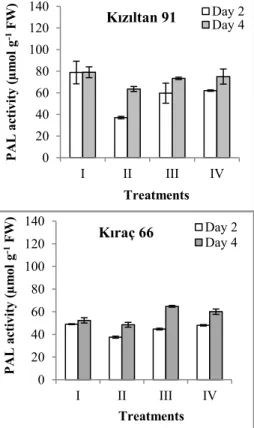
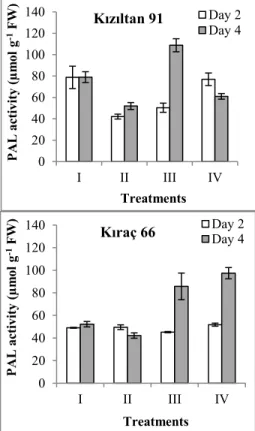
control was recorded in Kızıltan-91 genotype, and it was significantly higher than Kıraç-66 (p < 0.05). When two wheat genotypes were compared in terms of phenylalanine ammonia lyase, on the fourth day following treatment with the zinc (Zn) and lead, the difference in enzyme activity was significant for two wheat genotypes (p < 0.05). When compared to the control, Zn and Pb treatments caused an increase in phenylalanine ammonia lyase activity in Kıraç-66 seedlings on fourth day; the highest increases were found in the 200 and 300 mg Pb on fourth day (Figure 1-2). When comparing two wheat genotypes according to their controls, the difference between the highest phenylalanine ammonia lyase activity was determined in treatment 200 mg Pbon fourth day in cv. ‘Kızıltan-91’genotype (p < 0.05).
Figure 1. The changes in phenylalanine ammonia-lyase activity in two wheat genotypes after exposure to zinc stress (I: Control; 0 mg/L Zn, II: 100 mg/L Zn, III: 200 mg/L Zn, IV: 300 mg/L Zn) 0 20 40 60 80 100 120 140 I II III IV PAL ac tiv ity (µm ol g -1FW ) Treatments
Kızıltan 91 Day 2Day 4
0 20 40 60 80 100 120 140 I II III IV PAL ac tiv ity (µm ol g -1FW ) Treatments Kıraç 66 Day 2 Day 4
DIFFERENT WHEAT GENOTYPES
Plants exposed to biotic and abiotic stresses generate large amounts of Reactive Oxygen Species (ROS), and accumulation of ROS in large amounts leads to cell damage [17, 18]. Excessive Zn and Pb in case of heavy metal stress affect the intake of other nutrition elements, and cause oxidative stress [19]. Plants develop a kind of tolerance-defense mechanism against various biotic and abiotic stresses using secondary metabolites, antioxidants, and various allelochemicals (such as phenolic).
Figure 2. The changes in phenylalanine ammonia-lyase activity in two wheat genotypes after exposure to lead stress (I: Control; 0 mg/L Pb, II: 100 mg/L Pb, III: 200 mg/L Pb, IV: 300 mg/L Pb)
PAL is a key enzyme which deflects primary metabolic pathways (shikimic) to secondary metabolic pathways (phenylpropanoid) [20, 21]. The increase in PAL
0 20 40 60 80 100 120 140 I II III IV PAL ac tiv ity (µm ol g -1FW ) Treatments Kızıltan 91 Day 2 Day 4 0 20 40 60 80 100 120 140 I II III IV PAL ac tiv ity (µm ol g -1FW ) Treatments
activity and lignin amount is known to be a common reaction against biotic and abiotic stress factors in plants, which leads to an increase in the synthesis of secondary metabolites [22]. The expression of the gene encoding PAL, enzyme activity, and lignin content were investigated in a study conducted with soy bean
(Glycine max) and lupine (Lupinus luteus) exposed to Cd and Pb, and it was found
that these two plant species showed different reactions against heavy metals. While the PAL activity increased in soy bean with increasing Cd and Pb concentrations, the same reaction was not observed for lupine [23].
Most secondary metabolites such as phenolic formed as a result of PAL activation act as electron transmitters catalyzing the transfer of electrons to ROS in antioxidant systems [24, 25]. In their study with soybean, researchers found that increased ROS amount due to increased stress concentrations led to an increase in PAL activity and amount of various phenolic compounds, which supports the above mentioned idea. Although heavy metal stress achieved by Zn or Pb treatments led to different responses in two different species, it generally led to an increase in PAL activity. These different defense responses may be attributed to their different genotypes. Therefore, it seems possible that PAL is involved in synthesis of secondary metabolites by inducing the phenylpropanoid pathway in wheat, supporting the antioxidant system in connection with increased ROS, and modulating plant resistance against heavy metal stress. However, it is important to illuminate the nature, function, and response of these secondary metabolites generated in the induced phenylpropanoid pathway against heavy metal stress, so that a definite judgment can be made.
References
[1] J.M. Poehlman, D.A. Sleper, Breeding Field Crops. 4 ed. Iowa State University Press. Pp (1995) 259-262.
[2] D. Ma, D. Sun, C. Wang, H. Ding, H. Qin, J.Hou, X. Huang, Y. Xie, T.Guo, Physiological responses and yield of wheat plants in zinc-mediated alleviation of drought stres, Plant Science, 8 (2017) 1-12.
[3] M. Kan, M. Küçükçongar, M. Eser, A. Morgounov, H. Muminjanov, F. Özdemir, C. Qualset, Wheat landraces in farmers fields in Turkey, Chapter (2): The state of diversity, Food and Agriculture Organization of the United Nations, Ankara (2015) 22-23.
[4] M. Ardıç , M. Olgun , O. Sezer, Z. Budak Başçiftçi , Nazife Gözde Ayter , A. Çiçek , O. Koyuncu, The effects of some heavy metal pollutants on faculty of agriculture of ESOGU planting wheat fields in Eskişehir-Turkey, Research
Journal of Biology Sciences (Biyoloji Bilimleri Araştırma Dergisi) 10(1) (2017)
DIFFERENT WHEAT GENOTYPES
[5] F. Ekmekyapar, T. Şabudak, G. Şeren, Assesment of heavy metal of contamination in soil and wheat (Triticum Aestivum L.) plant around the çorlu-çerkezköy highway in thrace region, Global Nest Journal, 14(4) (2012) 496-504.
[6] D.Demirezen Yılmaz, A. Temizgül, Determination of Heavy-Metal Concentration with Chlorophyll Contents of Wheat (Triticum aestivum) Exposed to Municipal Sewage Sludge Doses, Communication in Soil Science and
Plant Analysis, 45 (2014) 2754-2766.
[7] K.H. Bhatti, S. Anwar, K. Nawaz, A. Kalid, Effect of heavy metal lead (Pb) stress of different concentration on wheat (Triticum aestivum L.), Middle East
Journal of Scientific Research, 14(2) (2013) 148-154.
[8] L. Sanitá di Toppi, R. Gabrielli, Response to cadmium in higher plants,
Environmental and Experimental Botany, 41 (1999) 105-130.
[9] N. Ergün, I. Öncel, Effects of some heavy metals and heavy metal hormone interactions on wheat (Triticum aestivum L. cv. Gun 91) seedlings, African
Journal of Agricultural Research, 7(10) (2012) 1518-1523.
[10] D.H. Jones, Phenylalanine ammonia-lyase: regulation of its induction, and its role in plant development., Phytochemistry, 23 (1984) 1349-1359.
[11] R.A. Dixon, The phytoalexin response: Elicitation, signalling and the control of host gene expression, Biological Reviews, 61 (1986) 239-291
[12] K. Hahlbrock, D. Scheel, Physiology and molecular biology of phenylpropanoid metabolism, Annual Review of Plant Physiology and Plant Molecular Biology,
40 (1989) 347-369.
[13] A. Chang, M.H. Lim, S.W. Lee, E.J. Robb, R.N. Nazar, Tomato phenylalanine ammonia-lyase gene family, highly redundant but strongly underutilized, The
Journal of Biological Chemistry, 283(48) (2008) 33591-33601.
[14] E. Koç, A.S. Üstün, Phenylalanine ammonia lyase activity in stem of pepper
(Capsicum annuum L.) infected by Phytophthora capsici L., Gazi University
Journal of Science, 25(2) (2012) 307-312.
[15] A.N. Ocho, G.R. Salgado, Phenylalanine ammonialyase activity and capsaicin-precursor compounds in ñfluorophenylalanine- resistant and sensitive variant cells of chili pepper (Capsicum annuum), Physiologia Plantarum, 85 (1992) 173-179.
[16] A.N. Ocho, P.J.E., Activity of enzymes involved in capsaicin biosynthesis in callus tissue and fruits of chili pepper (Capsicum annuum L.), Journal of Plant
Physiology, 141 (1993) 147-152.
[17] S.S. Gill, N. Tuteja, Reactive oxygen species and antioxidant machinery in abiotic stress, Plant Physiology and Biochemistry, 48 (2011) 909-930
[18] S. Darmanti L. Santosa, H. Nugroho, K. Dewi. Reactive oxygen species accumulations, phenylalanine ammonia lyase activity and phenolic acid
composition of soybean (Glycine max.(L.) Merr.) cv. Grobogan that exposed to multiple stress of purple nutsedge (Cyperus rotundus L.) interference and drought, The Journal of Animal and Plant Sciences, 28 (1) (2018) 244-251. [19] M. Denre, A. Bhattacharya, S. Pal, A. Chakravarty, A. Chattopadhyay, D.
Mazumdar, Effect of foliar Application of Micronutrients on Antioxidants and Pungency in Onion, Notulae Scientia Biologicae, 8(1) (2016) 373-379.
[20] M. Cabané, J.C. Pireaux, E. Léger, E. Weber, P. Dizengremel, B. Pollet, C. Lapierre, Condensed lignins are synthesized in poplar leaves exposed to ozone, Plant Physiology, 134(2) (2004) 586-594.
[21] V. Tzin and G. Galili, The biosynthetic pathways for shikimate and aromatic amino acids in Arabidopsis thalina, Arabidopsis Book, (2010) 8: e0132, doi: 10.1199/tab.0132.
[22] J. Kováčik, M. Bačkor, Phenylalanine ammonia-lyase and phenolic compounds in chamomile tolerance to cadmium and copper excess, Water, Air and Soil
Pollution, 185 (2007) 185-193.
[23] S. Pawlak-Sprada, M. Arasimowicz-Jelonek, M. Podgórska, J. Deckert, Activation of phenylpropanoid pathway in legume plants exposed to heavy metals. Part I. Effects of cadmium and lead on phenylalanine ammonia-lyase gene expression, enzyme activity and lignin content, Acta Biochimica Polonica, 58(2) (2011) 211-216.
[24] R. Maldonado, O. Goni, M. I. Escribano, C. Merodio, Regulation of Phenylalanin Ammonia- Lyase Enzyme in Annona Fruit: Kinetic Characteristic and Inhibitory Effect of Ammonia, Journal of Food Biochemistry, 31 (2007) 161-178.
[25] A.Gholizadeh, Effect of Drought on the activity of phenylalanine ammonia-lyase in the leaves and roots of maize in breds, Australian Journal of Basic and
Applied Sciences, 5 (2011) 952-956.
Current Address: Esra KOÇ: Ankara University, Faculty of Science, Department of
Biology, 06100, Tandoğan, Ankara, Turkey
E-mail :[email protected] https://orcid.org/0000-0003-1531-1744
Current Address: Cemil İŞLEK: Ömer Halis Demir University, Faculty of Science,
Department of Biotechnology, Niğde, Turkey
E-mail: [email protected]
https://orcid.org/0000-0002-6690-2846
Current Address: Hatice Nurhan BÜYÜKKARTAL: Ankara University, Faculty of
Science, Department of Biology, 06100, Tandoğan, Ankara, Turkey
E-mail: [email protected] https://orcid.org/0000-0002-6376-1806