2200 22 11
Pietro Romualdo Pirotta, founder, 1884
Pietro Romualdo Pirotta, founder, 1884 (print) ISSN 2239-3129 ISSN 2239-3129 (online)(online)
Journal homepage: http://annalidibotanica.uniroma1.it
doi: 10.13133/2239-3129/16746 Copyright © 2021
SPECIES IMPORTANCE IN COASTAL DUNE ECOSYSTEMS
IN NORTHERN TURKEY
U
lUA
ğırS.
1, S
ürmenB.
2, *, K
UtBAyH.G.
1, İ
mAmoğlUA.
31 University of Ondokuz Mayıs, Faculty of Science and Arts, Department of Biology, 55139, Samsun, Turkey
2 Karamanoğlu Mehmetbey University, Kamil Özdag Science Faculty, Department of Biology, 70200, Karaman, Turkey
3 Nevşehir Hacı Bektaş Veli University, Faculty of Science and Arts, Department of Geography, Nevşehir, Turkey
*Corresponding Author, telephone: +903382263831; email: [email protected]
(receıved 16 mAy 2020; receıvedınrevıSedform 29 AUGUSt 2020; Accepted 28 SeptemBer 2020)
ABStrAct - Species importance in coastal dune ecosystems in typical dune zones in Black Sea Region on the north of Turkey was studied by using
species conservation index (SCI) approach. SCI scores have significantly differed among dune zones. Additionally, coastal dune species were compared by using seven different criteria (geographic distribution, life span, growth form, conservation status, commonness, the utilitarian and the ecological importance). All of the studied criteria were found to be significant for studied coastal dune species. All of the studied species were moderate to high importance. The highest mean SCI score was found in E zone, while Xanthium strumarium subsp. cavanillesii and Digitaria ischaemum had the lowest SCI scores, and both species occurred in A zone. The highest SCI scores were found in Imperata cylindrica, Eleagnus rhamnoides and Jurinea kilea. The highest Site conservation values (SCV) were found in embryonic-shifting or primary dune, while the lowest SCVs were found in driftline zone. There were significant differences among coastal dune zones regarding selected criteria.
KeywordS: centrAlBlAcKSeAreGıon; coAStAlSAnddUneS; conServAtıonvAlUeS; dıStUrBAncefActorS; dUnezoneS; SpecıeSconServAtıonındex.
I
ntroductIonCoastal dune ecosystems are known to be highly dynamic systems, and they have a vital role in nitrogen cycling, water filtration, dune erosion, salt spray, etc. However, they are prone to alteration even under natural conditions. Due to global warming, they serve as a natural guard versus coastal erosion, an increasing danger in associate with sea-level rising. Due to their sustained coastal erosion and anthropogenic effects, they are particularly fragile and unprotected environments, so specific ecosystem functions of coastal dune are worthy of attention. Moreover, they presented key services to human such as coastal shield, raw materials, saltwater catchment, wildlife protection, and carbon binding among others (Del Vecchio et al., 2016; Malavasi et al., 2016; Bertacchi, 2017). The seashore-inland gradient detects the zonation of varied plant communities because of environmental effects resulting
in a typical vegetation zonation in coastal dune ecosystems (Acosta et al., 2006; Carranza et al., 2008; Abdelaal et al., 2017). Coastal dunes ecosystems have been continuously modified due to the rising requirement for using dune resources and industrial growth all around the world. The most common disturbance factors are tree plantation, road construction, agriculture and tourism facilities and waste disposal. (Faggi & Dadon, 2011; Monserrat et al., 2012; Ağır et al., 2014). These factors caused the reduction of the area of coastal dune landscape and extinction of characteristic species and made sensitive to coastal erosion (Stancheva et al., 2011). Especially anthropogenic disturbance factors such as tourism activities and sand extraction are increasingly endangering the structure and function of coastal sand dune ecosystems (Parra-Tabla et al., 2018).
Well-developed dune systems characterize the Black Sea coasts. However, coastal regions have the potential for inundation and in particular, the Turkish area, are exposed to landslide hazards. Over the past century, water volume in Black Sea coasts was increased by two-third. Coastal dunes have a particular plant community differentiation from the seashore to the inland and include significant plant species in each dune zone (Tzonev et al., 2005; Alpar, 2009; Ağır et al., 2014, 2016b). In order to protect specific taxonomic groups in specific habitats, the approach of the species according to the conservation value was applied to evaluate the conservation value and importance of plants (Salem, 2003; Halmy & Salem, 2015). Indexes used according to this approach assess vascular plant significance based on the inclusion of phenological, biogeographic and conservation criteria accounting to various aspects of species importance. The main aim of this study is to determine the site conservation value (SCV) index to compare typical coastal dune zones according to their importance for the conservation of vascular plants (Halmy & Salem, 2015). Species conservation importance index (SCI) values of dune species in N of Turkey in different coastal dune zones were calculated by using the approach of Halmy & Salem (2015) to examine the protection status of different plant species and zones. For the assessment of coastal plant species importance with regard to the rarity, ecological importance, conservation status; life form and utilitarian importance were calculated, and conservation value of the site (SCV) was used to compare
coastal dune vegetation with respect to their importance for conservation (Salem, 2003; Salem & Waseem, 2006). The studied coastal dune species were also classified according to their conservation importance category.
M
aterIalsandM
ethodsThe Study Area
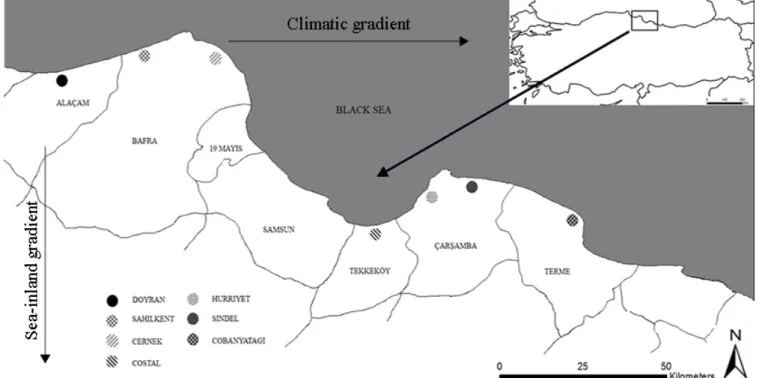
The research area is located between Kızılırmak and Yesilirmak deltas, and this area has the broadest coastal dune area in Central Black Sea Region (Ağır et al., 2016a; Sürmen et al., 2019). The studied area lies 149 km and involves coastal dunes in the eastern and western part of Central Black Sea Region of Turkey between Terme (41o15’52’’N
and 36o57’56’’E) and Alacam (41o29’27’’N and 36o33’12’’E)
provinces (Figure 1). They are characterized by hydromorphic alluvial soils (Akkan, 1970). The dam construction in the study area prevents the transportation of alluvial material, and the development of delta is ceased. The total area of the delta is still being narrowed due to severe coastal erosion (Turoğlu, 2010). The western part of the research area has Mediterranean climate, while the eastern part has an oceanic climate, and a climatic gradient is created from eastern to the western part of the research area. Summer rainfall (PE)
is 105.0 and 173.7 mm, in the western and eastern parts, respectively. The pluviometric quotient (Q) is 85.4 and 121.3 in the western and eastern parts, respectively. Precipitation regime is East Mediterranean in the western part, while it is an oceanic marine type I in the eastern part (Yalcin et al., 2011; Ağır et al., 2014; Ağır et al., 2016b).
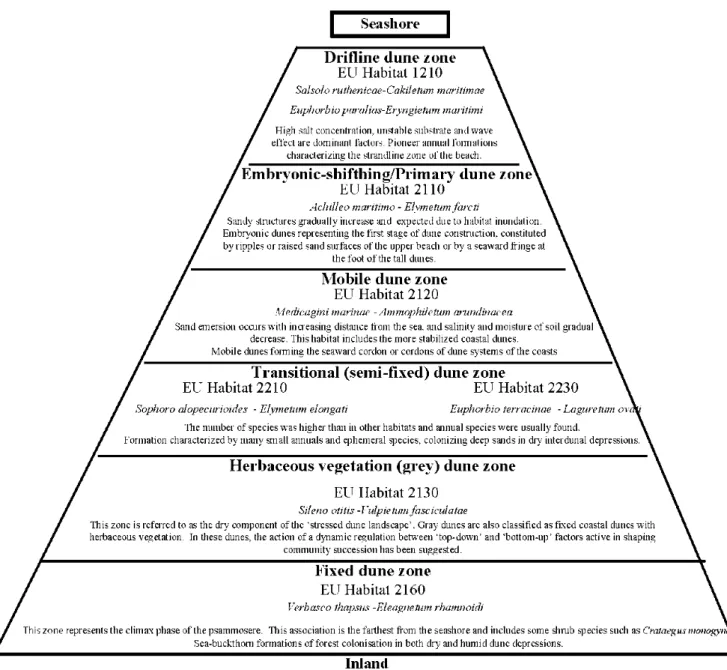
Six dune zones are present in the study area. In herbaceous habitats listed in the European Habitat Directive (92/43/EEC) (European Commission, 1992). Specifically, we considered the following EU Habitats: drift line or upper beach (EU 1210), embryonic shifting or primary dunes (EU 2110), mobile dunes (EU 2120), semi-fixed or transitional dunes (EU 2230 and 2210), grey dunes with herbaceous (EU 2130),
fixed dunes (EU 2160). These represent a coastal vegetation zonation including structurally and functionally distinct plant communities closely related to the sea-inland gradient (Acosta et al., 2009; Bazzichetto et al., 2016). The taxonomic nomenclature for plant species followed that of Güner et al. (2012).Vegetation of drift line or upper beach (A) zone is represented by EU 1210 Habitat type (Euphorbio paralias–
Eryngietum maritimi and Salsolo ruthenicae – Cakiletum maritimae). The most characteristic species were Salsola ruthenica L., Cakile maritima Scop., Tournefortia sibirica
L. var. sibirica and Xanthium strumarium subsp. cavanillesii (Schouw) D.Löve & Dans.. Vegetation of embryonic shifting or primary dunes (B) zone is represented by EU 2110 Habitat
habitats in each site, according to Peìrez-Harguindeguy et al. (2013). Structural features (growth forms) are determined their leaf-stem architectural, as an indicator of adjustment to environmental factors. Six growth forms were identified: shrubs, trees, dwarf shrubs, erect leafy; tussock forming; rosette forming and creeping.
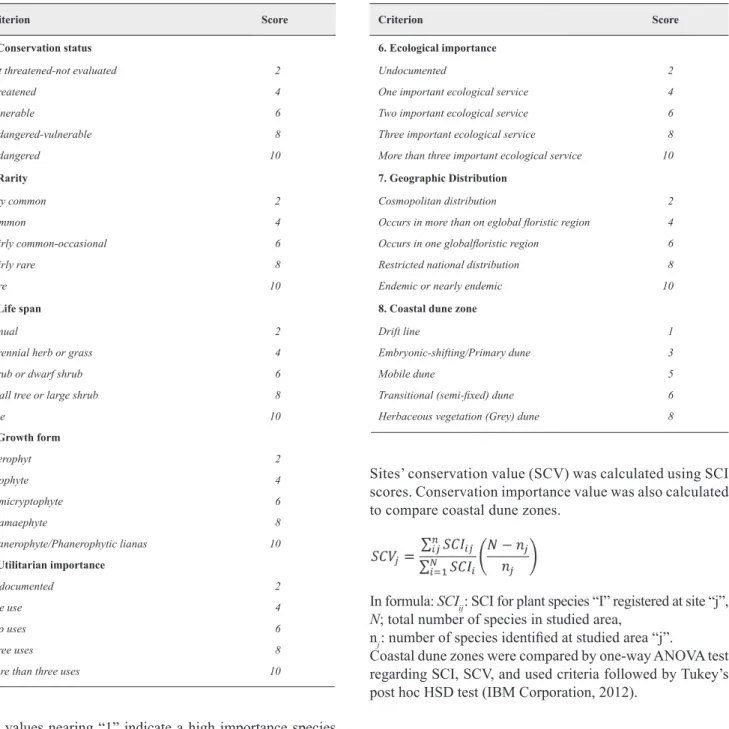
Coastal dunes include several significant species and should be protected, and the protection status can be determined by using some criteria including ecological, biogeographical and phonological status of a particular plant species. These criteria need to account for the rarity, conservation status, degree of endemism, geographic distribution, economic, and ecological importance of the species (Halmy & Salem, 2015). To calculate species conservation index (SCI) values of each species seven different criteria (geographic distribution, life span, growth form, conservation status, commonness, the utilitarian and the ecological importance) were used for evaluating the significance of the plant species. Ten point scoring system was performed to each criterion (Table 2). So, species SCI values were calculated from seven criteria (each scored by 10) as indicated below:
In formula: Ci; score of species for criterion i, Wi; weighting factor for iterion i
Wi is calculated according to below formula
In formula: Wi; weighting factor for iteration i;
wfi; was taken as “wf = 2” because of emphasizing the species
value with sea–inland gradient cases.
“wf = 1” was taken for other criteria because they have
same weight. “n” is the criteria for calculating the species importance. The minimum score (zero) was given to the undocumented species. SCI values ranges from “0.2” to “1”.
Table 1. The number of plots and species per zone. Plot
number numberSpecies Localities
Drifline 67 10 All
Embryonic-shifthing/Primary 39 6 All
Mobile 52 14 All
Transitional (semi-fixed) 71 19 All Herbaceous vegetation (grey) 75 11 All
Fixed 47 16 All
Total 351 76
type (Achilleo maritimo – Elymetum farcti). Achillea maritima (L.) Ehrend. & Y.P.Guo subsp. maritima, Elymus farctus (Viv.) Runemark ex Melderis subsp. bessarabicus (Savul. et Rayss) Melderis var. bessarabicus, Glaucium flavum Crantz, and Crepis foetida L. subsp. rhoaedifolia (Bieb.) Celak were the most characteristic species in that zone. Vegetation of mobile dunes (C) zone is represented by EU 2120 Habitat types (Medicagini marinae– Ammophiletum arundinacea). Mobile dunes is characterized by Ammophila arenaria (L.) Link subsp. arundinacea H. Lindb. Fil., Medicago
marina L., Gundelia tournefortii L., Scolymus hispanicus
L., Cynanchum acutum L. subsp. acutum L., Pancratium
maritimum L., and Hypochoeris radicata L. Vegetation of
semi-fixed or transitional dunes (D) zone are represented by EU 2230 and 2210 Habitat types (respectively, Euphorbio
terracinae – Laguretum ovati and Sophoro alopecurioides – Elymetum elongati). Sophora alopecuroides L. var. alopecuroides, Elymus elongatus (Host) Runemark subsp. elongatus, Medicago littoralis Rohde ex Lois. var. littoralis, Anagallis arvensis L.var. arvensis, and Plantago scabra
Moench. were dominated in that zone. Vegetation of grey dunes with herbaceous (E) zone is represented by EU 2130 Habitat type (Sileno otitis–Vulpietum fasciculatae). Silene
otites (L.) Wibel, Vulpia fasciculata (Forsskal) Fritsch, and Cenchrus incertus M. A. Curtis were the most widespread
species. The fixed dunes (F) zone is represented by EU 2160 Habitat type (Verbasco thapsus–Eleagnetum rhamnoidi) (Figure 2). This is the most distant dunes from the seashore and characterizes the climax stage of psammosere and includes a few shrub species like Eleagnus rhamnoides (L.) A. (Ağır et al., 2014; Ağır et al., 2017). In this area, coastal dune ecosystems are highly threatened by urbanization, tourism and agricultural facilities; moreover, harbour and road construction facilities are widespread in the study area.
Sampling and Data Collection
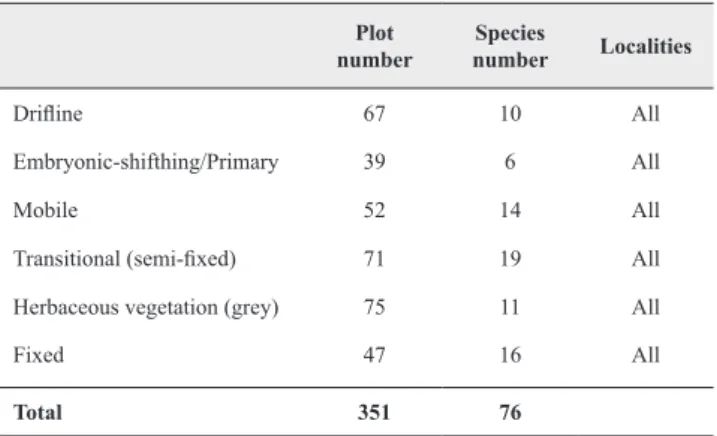
Seven transects from seashore to the inner land included driftline, embryonic-shifting/primary dunes, mobile dunes, transitional (semi-fixed) dunes, herbaceous (grey) vegetation dunes and fixed dunes. Transects were orthogonal to the seashore and varied from 25 to 700 m depending on dune morphology and on the length of the natural vegetation strip. A total number of 351 sampling units were considered, and cover-abundance values were determined in contiguous 4 m2
areas (Table 1).
Minimal area method is used to determine the sampling unit size (Braun-Blanquet, 1964). Sampling units were collected from each vegetation plots included all dune zones from homogenous areas between April-September from 2012 to 2014. Cover-abundance data of species were calculated using Braun-Blanquet method (Braun-Blanquet, 1964).
Table 2. The list of the scoring system and criterion used in calculating the conservation importance index (SCI) for the studied coastal dune species and the base for their selection. (criterions 1-5: Salem 2003, Salem & Waseem 2006; criterions 6 and 7: Waseem & Salem 2015; citerion 8: Current study).
Criterion Score Criterion Score
1. Conservation status 6. Ecological importance
Not threatened-not evaluated 2 Undocumented 2
Threatened 4 One important ecological service 4
Vulnerable 6 Two important ecological service 6
Endangered-vulnerable 8 Three important ecological service 8
Endangered 10 More than three important ecological service 10
2. Rarity 7. Geographic Distribution
Very common 2 Cosmopolitan distribution 2
Common 4 Occurs in more than on eglobal floristic region 4
Fairly common-occasional 6 Occurs in one globalfloristic region 6
Fairly rare 8 Restricted national distribution 8
Rare 10 Endemic or nearly endemic 10
3. Life span 8. Coastal dune zone
Annual 2 Drift line 1
Perennial herb or grass 4 Embryonic-shifting/Primary dune 3
Shrub or dwarf shrub 6 Mobile dune 5
Small tree or large shrub 8 Transitional (semi-fixed) dune 6
Tree 10 Herbaceous vegetation (Grey) dune 8
4. Growth form Therophyt 2 Geophyte 4 Hemicryptophyte 6 Chamaephyte 8 Phanerophyte/Phanerophytic lianas 10 5. Utilitarian importance Undocumented 2 One use 4 Two uses 6 Three uses 8
More than three uses 10
The values nearing “1” indicate a high importance species but those nearing “0” indicate low importance specie. For all species in the area, the SCI values collected to generate a cumulative value of conservation considering the species by species value of conservation approachment. Such an approach could be used to ensure a basis for relative comparisons of conservation importance of varied coastal dune zones and the localities.
For each EUNIS habitats, we calculated habitat conservation index was calculated by weighted average using species importance values and mean total species cover per plot.
Sites’ conservation value (SCV) was calculated using SCI scores. Conservation importance value was also calculated to compare coastal dune zones.
In formula: SCIij : SCI for plant species “I” registered at site “j”,
N; total number of species in studied area,
nj : number of species identified at studied area “j”.
Coastal dune zones were compared by one-way ANOVA test regarding SCI, SCV, and used criteria followed by Tukey’s post hoc HSD test (IBM Corporation, 2012).
r
esultsTen species in drift line dune zone, six species embryonic-shifthing/primary dune zone, 14 species in mobile dune zone, 19 species in transitional (semi-fixed), 11 species in herbaceous (grey) vegetation dune zone and 16 species in fixed dune zone were determined (Table 1). Geographic distribution, life span, growth form, conservation status, life
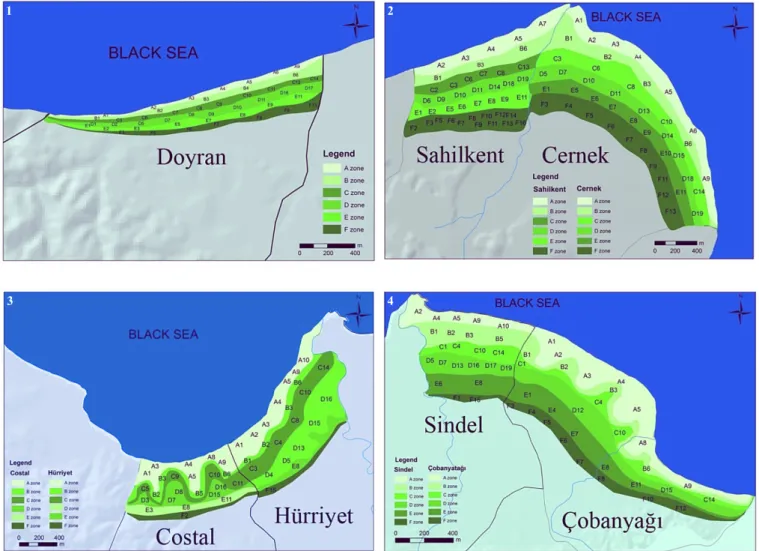
form, utilitarian importance, commonness and ecological importance of the species were determined (Appendix 3). Distribution of dune plant species in the studied dune zones and localities were shown in maps of localities (Figure 3). The highest SCI scores were found in Imperata cylindrica,
Eleagnus rhamnoides and Jurinea kilea on the basis of
studied coastal species. The highest SCI score was found in Apocynum venetum subsp. sermatiense in drift line. The highest SCI score was found in Achillea maritima in plant communities of embryonic-shifting/primary dune zone. The highest SCI score was found in Pancratium maritimum and
Gundelia tournefortii in mobile dune zone. Jurinea kilea had
the highest SCI score in transitional (semi-fixed) dune zone. The highest SCI scores were found in Imperata cylindrica and Eleagnus rhamnoides in grey and fixed dune zones, respectively (Appendix 2). SCI scores were significantly differed among dune zones (Figure 4).
Figure 3. The distribution of characteristic dune zones in the studied localities from the west (1) to the east (4). Plant abbreviations are given in Appendix 1.
Figure 4. Mean SCI values for each dune zone (p < 0.05).
3
1 2
Figure 5. The comparison of species conservation index (SCI) scores among the studied dune zones (p < 0.05).
All criteria were significant for studied coastal dune species. The highest mean SCI score was found in E zone, while
Xanthium strumarium subsp. cavanillesii and Digitaria ischaemum had the lowest SCI scores, and both species
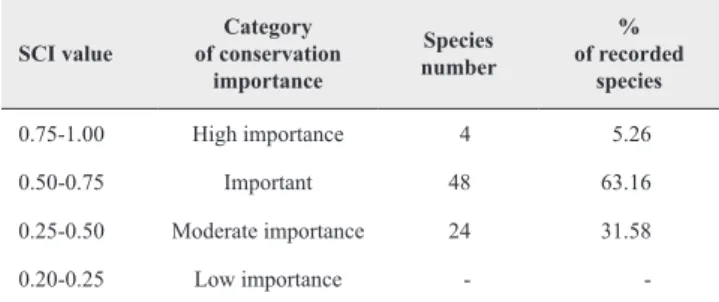
occurred in A zone (Appendix 2). All of the studied species were moderate to high importance (Table 3).
Fixed dune zone has highest SCI values (EU 2160) followed by mobile dune zone (EU 2120) and transitional (semi-fixed) dune zone (EU 2230) at the community level (Table 4).
Table 3. The classification of coastal dune species according to their SCI values.
SCI value of conservation Category importance Species number % of recorded species 0.75-1.00 High importance 4 5.26 0.50-0.75 Important 48 63.16 0.25-0.50 Moderate importance 24 31.58 0.20-0.25 Low importance -
-Table 4. SCI values of EUNIS habitats at community levels.
Dune zone/EU habitats SCI
Drifline dune zone
EU 1210 0.372
Embryonic-shifthing/Primary dune zone
EU 2110 0.522
Mobile dune zone
EU 2120 0.670
Transitional (semi-fixed) dune zone
EU 2210 0.544
EU 2230 0.610
Herbaceous vegetation (grey) dune zone
EU 2130 0.503
Fixed dune zone
There were signifi cant differences among characteristic coastal dune zones regarding seven criteria (geographic distribution, life span, growth form, conservation status, commonness, the utilitarian and the ecological importance) for calculated SCI values (Figure 4). Ecological and utility scores were found to be higher than the other criteria (Figure 5).
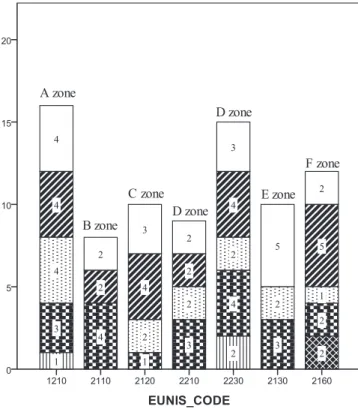
Among the EUNIS habitats, erect and tussocks leafy species from structural features (growth forms) were found in all habitat types. Most of creeping forming plants were found in transitional (semi-fixed) dunes (D zone) (Figure 6).
The highest SCV values were found in embryonic-shifting or primary dune, while the lowest SCV values were found
in drift line zone (Figure 7). Costal had the highest SCV values, while Doyran had the lowest SCV values (Figure 8). The classifications of coastal dune species according to selected criteria, were presented in Appendix 3.
d
IscussIonHalmy & Salem (2015) stated that the considerable ratio of plant species with SCI > 0.5 indicates that floristic composition of a particular area is rich in terms of specifi c species. About 70% of the studied coastal dune plants had the SCI > 0.5 values, and fi xed dunes had the highest SCI values. Fixed dunes had the highest SCI scores. The salt content of coastal dunes has been decreased along the seashore-inland gradient. Coastal dune erosion and eutrophication caused by seawater rich in terms of nitrogen from excessive agronomic practices in contiguous land areas (Acosta et al., 2006). E zone is less exposed to sand burial, salt spray and coastal dune erosion, so environmental factors in E zone is more stable and coastal dune species are incrementally less exposed to the harsh environmental conditions and gradually less tolerance to salt spray, sand winds and sand burial. As a result of this many species were allowed to establish and coastal dune species in E and F zones are precious for nature conservation (Da Silva et al., 2008; Isermann, 2011; Prisco et al., 2012; Del Vecchio et al., 2016). It has been stated that some disturbance factors such as chewing appears to be harmful to fi xed dunes in the future and severe disturbance factors create serious injury in
Figure 6. Distribution of structural features (growth forms) for studied species in the coastal dunes.
Figure 7. Site conservation values (SCV) among the studied coastal
However, these plant species have suffered from road construction facilities in the study area. Moreover, over-collection for domestic medicinal uses and local trade by the public are other threatening factors (Abdelaal et al., 2017; Ağır et al., 2017). Coastal dune species in the study area have high ecological importance because ecological importance scores were found to be higher than the other scores. Growth form was found to be signifi cant criteria in the study area. It has been reported that growth form plays a major role in dune ecosystem organization and functioning, referring main constituents of vegetation identity in coastal ecosystems and may provide easily noticeable evidence of existing processes of habitat modification. In addition to these, growth form also may provide some valuable clues with respect to ongoing processes of habitat modifi cation and play a vital role to determine the variability of the response to anthropogenic disturbance (Martínez et al., 2006; Maun, 2008; Maun, 2009; Del Vechio et al., 2016). Some grass species like Vulpia fasciculata, Euphorbia platyphyllos and
E. palustris had low SCI values in herbaceous vegetation
in grey dunes (EU 2130). The significance reduction in the abundance of therophytes and dune plants with high leaf intensity (primarily grassland dune) underlines the sensibility of particular herbaceous species to disturbances coupled with crushing and habitat deterioration, which are anticipated to be ongoing despite the general raise in terms of total vegetation canopy on coastal dunes. As compared to other criteria, they can help assess changes and trends caused by anthropogenic and disturbance stresses (Martínez et al., 2006; Prisco et al., 2016). In both fi xed and mobile dune zones, rosette-forming plants were constituted to the vast majority of growth forms. Plant species which used for coastal protection should be both tolerant to burial and fl ooding. Rosette-forming plants are very important in building and stabilizing coastal dunes and may affect the results of restoration efforts (Martinez et al., 2016; Stešević et al., 2017; Brown & Zinnert, 2018). There were two different disturbance factors in coastal dune ecosystems. Pioneer stages of coastal dunes are disturbed mainly by tourism activities and coastal dune erosion, while fi xed dune communities are affected by road construction facilities, agriculture and plantations, grazing and seawater catchment (Acosta et al., 2006). If disturbance factors such as anthropogenic pressures (the enlargement of urban settlements and the development of seaside tourism) intense or prolonged in time coastal dune species are disappeared (Acosta et al., 2009; De Luca et al., 2011; Calvão et al., 2013). Coastal dune vegetation plays a major role in stabilizing and building of dunes, so effective coastal dune habitat management requires a better understanding of plant populations of coastal sand dunes (Frosini et al., 2012). Mobile dune zone (EU 2120) had found to be signifi cant regarding SCI scores and characterized by a tufted plant, Ammophila arenaria. fi xed coastal dunes (Lemauviel & Rozé, 2003; Lemauviel et
al., 2003). Abdelaal et al. (2017) emphasized that vegetation of fi xed dunes has the highest species richness, evenness and cover, followed by communities of mobile dunes, but the primary/embryonic dunes have the lowest diversity (Fenu et al., 2012; Ciccarelli et al., 2017).
Fixed dunes were followed by mobile dune zone (EU 2120) concerning SCI scores, and mobile dunes include a tufted plant, Ammophila arenaria. Tufted plants usually reproduce with their belowground organs and also very resistant to sand burial (Maun, 2009; Del Vecchio et al., 2016). Ecological scores were found to be high in B zone, and this zone also had the highest SCV scores. Eryngium maritimum is very widespread in B zone, and this species has a secondary role in the accumulation of sand that supporting a graduated change in the structure of the dune accumulation. It has been reported that plant communities play an important role on the stabilization of coastal dunes (Fenu et al., 2012). These species are classifi ed as rare and vulnerable species and growing on dry coastal dune, and they are very threatened (De Lillis et al., 2004; Łabuz, 2004). Many coastal plant species include specialized coastal dune plants that have the talent to resist sand burial and sand substrate changeability. However, they usually suffer from continuous sand movement and very fragile to topographical and shoreline dynamics and develop on sandy substrate with having high salinity content. They inhabited by specialized plant species which can tolerate the burial of their shoot system in sand and capable of producing adventitious roots from the buried vegetative parts. (Calvão et al., 2013; Fenu et al., 2013; Ahmed et al., 2014; Del Vecchio et al., 2016).
Transitional (semi-fi xed) dunes contained a mosaic of two compositionally different plant communities between fi xed and grey (herbaceous) dunes so that they influence the functional species-habitat association (Ricotta et al., 2015). SCI values in C (mobile dune) zone were found to be higher with respect to A, B and D zones. C zone includes
Pancratium maritimum which is an indicator species of
accretion processes. On the other hand, this species suffered from over-collection due to its ornamental value and included important alkaloids in its bulbs (Bogdanova et al., 2009; Takos & Rook, 2013). Jurinea kilea was found to be a signifi cant species in transitional dune zone (D zone) and has very important in landscape studies (Avcı, 2008). The lowest SCI values were found in A zone. Salt spray and wave effect were the most noticeable factors in that zone. Acosta et al. (2007) stated that the species in A zone (drift line) are associated with harsh conditions such as wave effect, high salinity and changeability substrate.
Apocynum venetum subsp. sermatiense, Pancratium maritimum, Gundelia tournefortii, Jurinea kilea, Imperata cylindrica and Eleagnus rhamnoides had high SCI scores.
Ağır S.U., Kutbay H.G., Sürmen B., 2016b. Species co-occurence in coastal dunes in North of Turkey. Rendiconti Lincei di Scienze Fisiche e Naturali 27(4), 729-736. Ağır S.U., Kutbay H.G., Sürmen B., Elmas E., 2017. The effects of erosion and accretion on plant communities in coastal dunes in north of Turkey. Rendiconti Lincei di Scienze Fisiche e Naturali 28(1), 203-224.
Ahmed D.A., Shaltout K.H., Kamal S.A., 2014. Mediterranean sand dunes in Egypt: Threatened habitat and endangered flora. Life Science Journal 11(10), 946-956.
Akkan E., 1970. Bafra burnu-delice kavşağı arasında kızılırmak vadisinin jeomorfolojisi, 191 Vol., Ankara Üniversitesi Basımevi, Ankara.
Alpar B., 2009. Vulnerability of Turkish coasts to accelerated sea-level rise. Geomorphology 107(1-2), 58-63.
Avcı M., 2008. An evaluation with respect to urban biodiversity: İstanbul, pp. 81-100. Urban Ecology and Livable Cities Symposium Proceeding Book, İzmir. Bazzichetto M., Malavasi M., Acosta A.T.R., Carranza M.L., 2016. How does dune morphology shape coastal EC habitats occurrence? A remote sensing approach using airborne LiDAR on the Mediterranean coast. Ecological Indicators 71, 618-626.
Bertacchi A., 2017. Dune habitats of the Migliarino-San Rossore-Massaciuccoli Regional Park (Tuscany, Italy). Journal of Maps 13(2), 322-331.
Bogdanova Y., Stoeva T., Yanev S., Pandova B., Molle E., Burrus M., Stanilova M., 2009. Influence of plant origin on propagation capacity and alkaloid biosynthesis during long-term in vitro cultivation of Leucojum aestivum L.. In Vitro Cellular and Developmental Biology-Plant 45(4), 458-465. Braun-Blanquet J., 1964. Pfanzensoziologie. Grundzüge der Vegetationskunde. Springer, New York.
Brown J.K., Zinnert J.C., 2018. The mechanistic responses of these grasses to sand burial are important in building and stabilizing dunes and may affect the outcome of restoration efforts. Ecosphere 9, e02162.
Carranza M., Acosta A.T., Stanisci A., Pirone G., Ciaschetti G., 2008. Ecosystem classification for EU habitat distribution assessment in sandy coastal environments: An application in central Italy. Environmental Monitoring and Assessment 140(1-3), 99-107.
Calvão T., Pessoa M.F., Lidon F.C., 2013. Impact of human activities on coastal vegetation-a review. Emirates Journal of Food and Agriculture 25(12), 926-944.
So companion sowing with dune stabilising plants such as
Ammophila sp. will lead to increase plant diversity on newly
restored coastal sand dune areas (Hanley et al., 2014). High vulnerability sites for distribution factors like coastal sand dunes might need restoration practices in order to enhance the ecosystem quality and to do this conservation status of plant species and communities should be known (Martínez et al., 2006; Halmy & Salem, 2015; Ciccarelli et al., 2017). In conclusion the studied coastal dune species were moderate to high importance values, and SCI scores were increased along the seashore-inland gradient. It has been found that embryonic-shifting or primary dune zone had the highest SCV values. The using of SCI and SCV values is of great importance in determining a strategy for the conservation of plant species in biogeographically important habitats. High vulnerability sites for distribution factors like coastal dunes might need restoration practices in order to enhance the ecosystem quality and to do this conservation status of plant species and communities should be known.
r
eferencesAbdelaal M., Fois M., Fenu, G., 2017. The influence of natural and anthropogenic factors on the floristic features of the northern coast Nile Delta in Egypt. Plant Biosystems-An International Journal Dealing with all Aspects of Plant Biology 152(3), 407-415.
Acosta A., Ercole S., Stanisci A., Blasi, C., 2006. Sandy coastal ecosystems and effects of disturbance in Central Italy. Journal of Coastal Research 39, 985-989.
Acosta A., Carranza M. L., Izzi C. F., 2009. Are there habitats that contribute best to plant species diversity in coastal dunes?. Biodiversity and Conservation 18(4), 1087-1098.
Acosta A., Ercole S., Stanisci A., Pillar V.D.P., Blasi C., 2007. Coastal vegetation zonation and dune morphology in some Mediterranean ecosystems. Journal of Coastal Research 1518-1524.
Ağır S.U., Kutbay H.G., Karaer F., Sürmen B., 2014. The classification of coastal dune vegetation in Central Black Sea Region of Turkey by numerical methods and EU habitat types. Rendiconti Lincei di Scienze Fisiche e Naturali 25(4), 453-460.
Ağır S.U., Kutbay H.G., Sürmen B., 2016a. Plant diversity along coastal dunes of the Black Sea (North of Turkey). Rendiconti Lincei di Scienze Fisiche e Naturali 27(3), 443-453.
Hanley M.E., Hoggart S.P.G., Simmonds D.J., Bichot A., Colangelo M.A., Bozzeda F., Heurtefeux H., Ondiviela B., Ostrowski R., Recio M., Trude R., Zawadzka-Kahlau E., Thompson R.C., 2014. Shifting sands? Coastal protection by sand banks, beaches and dunes. Coastal Engineering 87, 136-146.
IBM Corp., 2012. IBM SPSS Statistics for Windows Version 21.0., Armonk, New York.
Isermann M., 2011. Patterns in species diversity during succession of coastal dunes. Journal of Coastal Research 27(4), 661-671.
Łabuz T.A., 2004. Coastal dune development under natural and human influence on Swina Gate Barrier (Polish coast of Pomeranian Bay) Managing the Baltic Sea. Coastline Reports 2, 129-138.
Lemauviel S., Gallet S., Rozé F., 2003. Sustainable management of fixed dunes: example of a pilot site in Brittany (France). Comptes Rendus Biologies 326, 183-191.
Lemauviel S., Rozé F., 2003. Response of three plant communities to trampling in a sand dune system in Brittany (France). Environmental Management 31(2), 227-235. Malavasi M., Santoro R., Cutini M., Acosta A.T.R., Carranza M.L., 2016. The impact of human pressure on landscape patterns and plant species richness in Mediterranean coastal dunes. Plant Biosystems-An International Journal Dealing with all Aspects of Plant Biology 150(1), 73-82.
Martinez M.L., Gallego-Fernandez J.B., Garcia-Franco J.G., Moctezuma C., Jimenez C.D., 2006. Assessment of coastal dune vulnerability to natural and anthropogenic disturbances along the Gulf of Mexico. Environmental Conservation 33(2), 109-117.
Martinez M.L., Silva R., Mendoza E., Odériz I., Pérez-Maqueo O., 2016. Coastal dunes and plants: an ecosystem-based alternative to reduce dune face erosion. Journal of Coastal Research 75(sp1), 303-307.
Maun M.A., 2008. Burial of plants as a selective force in sand dunes, Springer, Berlin.
Maun M.A., 2009. The biology of coastal sand dunes, Oxford University Press, England.
Monserrat A.L., Celsi C.E., Fontana S.L., 2012. Coastal dune vegetation of the southern Pampas (Buenos Aires, Argentina) and its value for conservation. Journal of Coastal Research 28(1), 23-35.
Parra-Tabla V., Albor-Pinto C., Tun-Garrido J., Angulo-Pérez D., Barajas C., Silveira R., Ortíz-Díaz J.J., Arceo-Gómez G., Ciccarelli D., Pinna M.S., Alquini F., Cogoni D., Ruocco
M., Bacchetta G., Sarti G., Fenu G., 2017. Development of a coastal dune vulnerability index for Mediterranean ecosystems: A useful tool for coastal managers? Estuarine, Coastal and Shelf Science 187, 84-95.
Da Silva G.M.D., Hesp P., Peixoto J., Dillenburg S.R., 2008. Foredune vegetation patterns and alongshore environmental gradients: Mocambique beach, Santa Catarina Island, Brazil. Earth Surface Processes and Landforms: The Journal of the British Geomorphological Research Group 33(10), 1557-1573. De Lillis M., Costanzo L., Bianco P. M., Tinelli A., 2004. Sustainability of sand dune restoration along the coast of the Tyrrhenian Sea. Journal of Coastal Conservation 10(1), 93-100. De Luca E., Novelli C., Barbato F., Menegoni P., Iannetta M., Nascetti G., 2011. Coastal dune systems and disturbance factors: monitoring and analysis in central Italy. Environmental Monitoring and Assessment 183(1-4), 437-450.
Del Vecchio S., Slaviero A., Fantinato E., Buffa G., 2016. The use of plant community attributes to detect habitat quality in coastal environments. AoB Plants 8, plw040. European Commission, 1992. Council Directive 92/43/EEC of 21 May 1992 on the conservation of natural habitats and of wild fauna and flora. The Official Journal of the European Union 206, 7-50.
Faggi A., Dadon J., 2011. Temporal and spatial changes in plant dune diversity in urban resorts. Journal of Coastal Conservation 15(4), 585-594.
Fenu G., Carboni M., Acosta A.T., Bacchetta G., 2013. Environmental factors influencing coastal vegetation pattern: new insights from the Mediterranean Basin. Folia Geobotanica 48(4), 493-508.
Fenu G., Cogoni D., Ferrara C., Pinna M.S., Bacchetta G., 2012. Relationships between coastal sand dune properties and plant community distribution: the case of Is Arenas (Sardinia). Plant Biosystems-An International Journal Dealing with all Aspects of Plant Biology 146(3), 586-602.
Frosini S., Lardicci C., Balestri E., 2012. Global change and response of coastal dune plants to the combined effects of increased sand accretion (burial) and nutrient availability. PloS One 7(10), e47561.
Güner A., Aslan S., Ekim T., Vural M., Babac M.T., 2012. A checklist of the Flora of Turkey (vascular plants), Publications of Nezahat Gokyigit Botanical Garden, İstanbul.
Halmy M.W.A., Salem B.B., 2015. Species conservation importance index (SCI) for comparing sites’ conservation value at landscape level. Brazilian Journal of Botany 38(4), 823-835.
Tzonev R., Dimitrov M., Roussakova V., 2005. Dune vegetation of the Bulgarian Black Sea coast. Hacquetia 4(1), 7-32.
Yalcin E., Kılınç M., Kutbay H.G., Bilgin A., Korkmaz H., 2011. Floristic properties of lowland meadows in the Central black sea region of Turkey. Eurasian Journal of Biosciences 5, 54-63.
2018. Spatial patterns of species diversity in sand dune plant communities in Yucatan, Mexico: importance of invasive species for species dominance patterns. Plant Ecology and Diversity 11(2), 157-172.
Peìrez-Harguindeguy N., Díaz S., Garnier E., Lavorel S., Poorter H., Jaureguiberry P., Bret-Harte M.S., Cornwell W.K., Craine J.M., Gurvich D.E., Urcelay C., Veneklaas E.J., Reich P.B., Poorter L., Wright I.J., Ray P., Enrico L., Pausas J.G., de Vos A.C., Buchmann N., Funes G., Quétier F., Hodgson J.G., Thompson K., Morgan H.D., ter Steege H., van der Heijden M.G.A., Sack L., Blonder B., Poschlod P., Vaieretti M.V., Conti G., Staver A.C., Aquino S., Cornelissen J.H.C., 2013. New handbook for standardised measurement of plant functional traits worldwide. Australian Journal of Botany 61, 167-234. Prisco I., Acosta A.T.R., Ercole S., 2012. An overview of the Italian coastal dune EU habitats. Annali di Botanica 2, 39-48. Prisco I., Carboni M., Jucker T., Acosta A.T.R., 2016. Temporal changes in the vegetation of Italian coastal dunes: identifying winners and losers through the lens of functional traits. Journal of Applied Ecology 53(5), 1533-1542.
Ricotta C., Carboni M., Acosta A.T.R., 2015. Let the concept of indicator species be functional! Journal of Vegetation Science 26(5), 839-847.
Salem B.B., 2003. Application of GIS to biodiversity monitoring. Journal of Arid Environments 54(1), 91-114. Salem B.B., Waseem M., 2006. A study on Moghra Oasis by remote sensing. Assiut University Journal of Botany 53, 337-367.
Stancheva M., Ratas U., Orviku K., Palazov A., Rivis R., Kont A., Peychev V., Tönisson H. Stanchev H., 2011. Sand dune destruction due to increased human impacts along the Bulgarian Black Sea and Estonian Baltic Sea Coasts. Journal of Coastal Research 64, 324-328.
Stešević D., Luković M., Caković D., Ružić N., Bubanja N., Šilc U., 2017. Distribution of alien species along sand dune plant communities zonation. Periodicum Biologorum 119(4), 239-249.
Sürmen B., Ulu Ağır Ş., Kutbay H.G., 2019. Rare dune plant species in Samsun Province, Turkey. Anatolian Journal of Botany 3(2), 34-39.
Takos A., Rook F., 2013. Towards a molecular understanding of the biosynthesis of Amaryllidaceae alkaloids in support of their expanding medical use. International Journal of Molecular Sciences 14(6), 11713-11741.
Turoğlu H., 2010. Kızılırmak Deltası ve yakın çevresinin jeomorfolojik özellikleri ve insan yaşamındaki etkileri. Anadolu Araştırmaları (4903), 98-111.
a
ppendIxesAppendix 1. Abbreviations of coastal dune plant species in the studied dune zones and localities according to present-absent status.
Species Species code Zone Çobanyatağı Hürriyet Costal Çernek Doyran Sahilkent Sindel
Cakile maritima A1 A + + + + + 0 0 Calystegia soldanella A2 A + + 0 + + + + Digitaria ischaemum A3 A + + + + + + 0 Eryngium maritimum A4 A + + + + + + + Euphorbia paralias A5 A + + + + + + + Parapholis incurva A6 A 0 0 0 + + 0 0 Salsola ruthenica A7 A 0 0 0 0 0 + 0
Apocynum venetum subsp. sermatiense A8 A + 0 + 0 0 0 0
Xanthium strumarium subsp. cavanillesii A9 A + + + + + 0 +
Tournefortia sibirica var. sibirica A10 A 0 + 0 0 0 0 +
Achillea maritima B1 B + + 0 + + + +
Crepis foetida subsp. rhoeadifolia B2 B + + + + + 0 +
Elymus farctus subsp. bessarabicus var. bessarabicus B3 B + + + + + + +
Glaucium flavum B4 B 0 0 0 0 + 0 0
Cionura erecta B5 B 0 0 + 0 0 0 0
Polygonum maritimum B6 B + + + + + + +
Agrostis stolonifera C1 C + 0 0 0 0 0 +
Ammophila arenaria subsp. arundinacea C2 C 0 0 0 0 0 + 0
Cynanchum acutum subsp. acutum C3 C + + 0 + + + 0
Cynoglossum creticum C4 C 0 + 0 0 0 0 +
Gundelia tournefortii C5 C 0 0 + 0 0 0 0
Hypochoeris radicata C6 C 0 0 0 + + + 0
Juncus littoralis C7 C 0 0 0 0 + + 0
Medicago marina C8 C 0 + 0 + + + 0
Medicag polymorpha var. polymorpha C9 C 0 0 + 0 + 0 0
Pancratium maritimum C10 C + + + + + 0 + Raphanus raphanistrum C11 C 0 0 + 0 + 0 0 Schoenoplectus triqueter C12 C 0 0 0 0 0 + 0 Scolymus hispanicus C13 C 0 0 0 0 + 0 0 Euphorbia peplis C14 C + + 0 + + 0 + Centaurea iberica D1 D 0 0 0 0 + 0 0 Cenchrus incertus D2 D 0 0 0 0 + 0 0 Echinops orientalis D3 D 0 0 + 0 0 0 0 Xanthium spinosum D4 D 0 + 0 0 0 0 0
Anagallis arvensis var. arvensis D5 D 0 + 0 + + 0 +
Anchusa hybrida D6 D 0 0 0 0 0 + 0
Species Species code Zone Çobanyatağı Hürriyet Costal Çernek Doyran Sahilkent Sindel
Echium plantagineum D8 D 0 0 + 0 + 0 0
Jurinea kilaea D9 D 0 0 0 0 + + 0
Kickxia commutata subsp. commutata D10 D 0 0 0 + + + 0
Lagurus ovatus D11 D 0 0 0 + + + 0
Medicago littoralis var. littoralis D12 D + 0 0 0 0 0 0
Plantago scabra D13 D 0 + 0 + 0 0 +
Satureja hortensis D14 D 0 0 0 + 0 + 0
Sophora alopecuroides var. alopecuroides D15 D + + + + 0 0 0
Cynodon dactylon var. dactylon D16 D 0 + + 0 + 0 +
Euphorbia terracina D17 D 0 0 0 0 + 0 +
Galium spurium D18 D 0 0 0 + 0 + 0
Trifolium resupinatum var. resupinatum D19 D 0 0 0 + 0 + +
Cyperus capitatus E1 E + 0 0 + + + 0 Silene otites E2 E 0 0 0 0 + + 0 Vulpia fasciculata E3 E 0 0 + 0 + 0 0 Imperata cylindrica E4 E + 0 0 0 0 0 0 Medicago x varia E5 E 0 0 0 + + + 0 Trifolium stellatum. E6 E 0 0 0 + 0 + +
Cota tinctoria tinctoria E7 E + 0 0 + + + 0
Daucus broteri E8 E + + + + + + +
Euphorbia palustris E9 E 0 0 0 + + + 0
Euphorbia platyphyllos E10 E 0 0 0 + 0 0 0
Silene dichotoma var. dichotoma E11 E + 0 + + + + 0
Polypogon monspeliensis F1 F 0 0 0 0 0 0 +
Crataegus monogyna var. monogyna F2 F 0 0 + 0 0 + 0
Eleagnus rhamnoides F3 F + 0 0 + + + 0
Petrorhagia saxifraga F4 F + 0 0 + 0 0 0
Phleum exaratum subsp. exaratum F5 F + 0 0 + + + 0
Teucrium chamaedrys subsp. chamaedrys F6 F + 0 0 + + + 0
Verbascum sinuatum var. sinuatum F7 F + 0 0 + + + 0
Elymus elongatus subsp. elongatus F8 F + 0 0 + + + 0
Teucrium polium F9 F 0 0 0 + + + 0
Artemisia scoparia F10 F + 0 0 0 0 + 0
Blackstonia perfoliata subsp. serotine F11 F 0 0 0 + 0 + 0
Centaurium pulchellum F12 F + 0 0 + 0 + 0
Hordeum vulgare F13 F 0 0 0 + + + 0
Juncus pygmaeus F14 F 0 0 0 0 0 + 0
Trifolium campestre F15 F 0 + 0 0 0 0 +
Appendix 2. SCI values of the studied coastal dune species.
Species Zone SCI
Apocynum venetum subsp. sermatiense Drift line dune 0.575
Cakile maritima Drift line dune 0.450
Calystegia soldanella Drift line dune 0.425
Digitaria ischaemum Drift line dune 0.300
Eryngium maritimum Drift line dune 0.350
Euphorbia paralias Drift line dune 0.325
Parapholis incurva Drift line dune 0.425
Salsola ruthenica Drift line dune 0.375
Tournefortia sibirica var. sibirica Drift line dune 0.525
Xanthium strumarium subsp. cavanillesii Drift line dune 0.300
Achillea maritima Embryonic-shifting/Primary dune 0.600
Cionura erecta Embryonic-shifting/Primary dune 0.575
Crepis foetida subsp. rhoeadifolia Embryonic-shifting/Primary dune 0.450
Elymus farctus subsp. bessarabicus var. bessarabicus Embryonic-shifting/Primary dune 0.450
Glaucium flavum Embryonic-shifting/Primary dune 0.475
Polygonum maritimum Embryonic-shifting/Primary dune 0.575
Agrostis stolonifera Mobile dune 0.600
Ammophila arenaria subsp. arundinacea Mobile dune 0.600
Cynanchum acutum subsp. acutum Mobile dune 0.550
Cynoglossum creticum Mobile dune 0.550
Euphorbia peplis Mobile dune 0.425
Gundelia tournefortii Mobile dune 0.725
Hypochoeris radicata Mobile dune 0.675
Juncus littoralis Mobile dune 0.600
Medicag polymorpha var. polymorpha Mobile dune 0.450
Medicago marina Mobile dune 0.550
Pancratium maritimum Mobile dune 0.725
Raphanus raphanistrum Mobile dune 0.500
Schoenoplectus triqueter Mobile dune 0.450
Scolymus hispanicus Mobile dune 0.675
Anagallis arvensis var. arvensis Transitional (semi-fixed) dune 0.475
Anchusa hybrida Transitional (semi-fixed) dune 0.550
Bromus racemosus Transitional (semi-fixed) dune 0.425
Cenchrus incertus Transitional (semi-fixed) dune 0.600
Centaurea iberica Transitional (semi-fixed) dune 0.525
Cynodon dactylon var. dactylon Transitional (semi-fixed) dune 0.575
Echinops orientalis Transitional (semi-fixed) dune 0.700
Echium plantagineum Transitional (semi-fixed) dune 0.600
Euphorbia terracina Transitional (semi-fixed) dune 0.450
Galium spurium Transitional (semi-fixed) dune 0.475
Species Zone SCI
Kickxia commutata subsp. commutata Transitional (semi-fixed) dune 0.625
Lagurus ovatus Transitional (semi-fixed) dune 0.475
Medicago littoralis var. littoralis Transitional (semi-fixed) dune 0.450
Plantago scabra Transitional (semi-fixed) dune 0.575
Satureja hortensis Transitional (semi-fixed) dune 0.600
Sophora alopecuroides var. alopecuroides Transitional (semi-fixed) dune 0.525
Trifolium resupinatum var. resupinatum Transitional (semi-fixed) dune 0.500
Xanthium spinosum Transitional (semi-fixed) dune 0.450
Cota tinctoria Herbaceous vegetation (Grey) dune 0.550
Cyperus capitatus Herbaceous vegetation (Grey) dune 0.500
Daucus broteri Herbaceous vegetation (Grey) dune 0.525
Euphorbia palustris Herbaceous vegetation (Grey) dune 0.475
Euphorbia platyphyllos Herbaceous vegetation (Grey) dune 0.475
Imperata cylindrica Herbaceous vegetation (Grey) dune 0.800
Medicago x varia Herbaceous vegetation (Grey) dune 0.575
Silene dichotoma var. dichotoma Herbaceous vegetation (Grey) dune 0.525
Silene otites Herbaceous vegetation (Grey) dune 0.625
Trifolium stellatum Herbaceous vegetation (Grey) dune 0.575
Vulpia fasciculata Herbaceous vegetation (Grey) dune 0.475
Artemisia scoparia Fixed dune 0.725
Blackstonia perfoliata subsp. serotine Fixed dune 0.663
Centaurium pulchellum Fixed dune 0.625
Crataegus monogyna var. monogyna Fixed dune 0.875
Eleagnus rhamnoides Fixed dune 0.825
Elymus elongatus subsp. elongatus Fixed dune 0.650
Hordeum vulgare Fixed dune 0.500
Juncus pygmaeus Fixed dune 0.525
Petrorhagia saxifraga Fixed dune 0.575
Phleum exaratum subsp. exaratum Fixed dune 0.525
Polypogon monspeliensis Fixed dune 0.525
Teucrium chamaedrys subsp. chamaedrys Fixed dune 0.675
Teucrium polium Fixed dune 0.725
Trifolium arvense var. arvense Fixed dune 0.675
Trifolium campestre Fixed dune 0.675
Appendix 3. List of species in the study area; their geographic distribution (Med = Mediterranean, Cosm = Cosmopolitan, Ir-Tur = Irano-Turanian, Eu-Sib = Euro-Siberian); conservation status (Thr = Threatened, End = Endangered, Un = Undocumented); commonness (RR = Very Rare, R = Rare, FR = Fairly Rare, FC = Fairly Common, C = Common, CC = Very Common); life span (Per = Perennial, Bin = Biennial, Ann = Annual); growth form (Th = Therophyte, Gh = geophyte, Hc = himecryptophyte, Ch = cheamophyte, Ph = phanerophyte); utilitarian importance (Ot = others such as in making thatches, rope making, detergent, handicraft, Or = ornamental, Fe = fencing & windbreak, Ar = Aromatic, Ed = Edible, Ta = Tanning, Fu = Fuel, Md = Medicine, Gr = Grazing); and ecological importance (Ot = others, Ws= Water storage, Wb = Windbreak (natural), W = Weed, St = Salt tolerant, Sr = Soil fertility, Sh = Shading, Sf = Sand fixation, Re = Refuge, Ph = phreatophytes, Hyd = Hydrophyte, Es = Esthetic value, BioR = bioremediationpotential, BP = Bee-plant).
Species Geographic distribution spanLife Growth Form Conservation status FormLife importance Utilitarian Commonness ImportanceEcological Achillea maritima Med ; Ir-Tur - Eu-Sib Perennial Chamaephyte Non-Th Herbaceous Md, Gr, Fu Fc Sf, Sh, Es, St Agrostis stolonifera Eu-Sib ; Med Perennial Hemicryptophyte Non-Th Herbaceous Gr, Ot Fr Sf, St, W Ammophila arenaria
subsp. arundinacea Med ; Eu-Sib Perennial Geophyte Non-Th Herbaceous Gr ; Fu Fr Sf, Sh, Wb, St, Ot Anagallis arvensis
var. arvensis Med ; Eu-Sib ; Ir-Tur Annual Therophyte Non-Th Herbaceous Gr, Md Fc Es
Anchusa hybrida Med ; Eu-Sib Perennial Hemicryptophyte Non-Th Herbaceous Gr Fr Sf,
Apocynum venetum
subsp. sermatiense Med ; Eu-Sib ; Ir-Tur Perennial Hemicryptophyte Th Herbaceous Md, Ot R Sf, Sh, St, Ot Artemisia scoparia Med ; Eu-Sib ; Ir-Tur Annual Chamaephyte Non-Th Herbaceous Md, Gr, Fu C Sf, Sh, Wb, St, Sr, Ot Blackstonia perfoliata
subsp. serotine Med ; Eu-Sib Annual Therophyte Non-Th Herbaceous Md, Ar, Ot C Sf, Sh, Wb, St, Sr, Ot
Bromus racemosus Eu-Sib ; Ir-Tur Annual Therophyte Non-Th Herbaceous Un Fc Un
Cakile maritima Med ; Ir-Tr ; Eu-Sib Annual Therophyte Non-Th Herbaceous Gr, Md, Ot Fc Sf, Sh, Wb, St, Sr, Ot
Calystegia soldanella Cosm Perennial Geophyte Non-Th Herbaceous Ed, Ar, Md C St, W, Ot
Cenchrus incertus Med ; Ir-Tr ; Eu-Sib Annual Therophyte En-vul Herbaceous Gr R Sf, Wb
Centaurea iberica Cosm Annual Therophyte Non-Th Herbaceous Md, Ed, Fr Sf, Sh, Re
Centaurium pulchellum Med ; Ir-Tr ; Eu-Sib Annual Therophyte Th Herbaceous Un Fc Sf, Sh, Wb, St, Sr, Ot
Cionura erecta Med ; Eu-Sib Perennial Chamaephyte Non-Th Shrub Md, Ot Fr Sf, Sh
Cota tinctoria Med ; Ir-Tr ; Eu-Sib Perennial Hemicryptophyte Non-Th Herbaceous Gr, Md C Un Crataegus monogyna
var. monogyna Med ; Ir-Tr ; Eu-Sib Perennial Phanerophyte Non-Th Shrub Md, Ed, Or, Ot, Fr Es, Ph, Sh, Wb, Ot Crepis foetida
subsp. rhoeadifolia Eu-Sib, Med ; Ir-Tr Annual Therophyte Non-Th Herbaceous Md, Ot Fc Ph, Sf, Ot Cynanchum acutum
subsp. acutum Med ; Ir-Tur Perennial Phanerophytic Liana Non-Th Herbaceous Gr Fr Un Cynodon dactylon
var. dactylon Cosm Perennial Geophyte Non-Th Herbaceous Gr, Md, Fu C Sf, Sr, Re, Sh
Cynoglossum creticum Med ; Ir-Tur Perennial Hemicryptophyte Non-Th Herbaceous Un R W; Ot
Cyperus capitatus Med ; Ir-Tur Annual Geophyte Non-Th Herbaceous Gr Fc Un
Daucus broteri Med ; Ir-,Tur ; Eu-Sib Annual Therophyte Non-Th Herbaceous Gr, Ot C Sr, Sf
Digitaria ischaemum Cosm Annual Therophyte Th Herbaceous Un Fc St
Echinops orientalis Ir-Tr ; Eu-Sib : Med Annual Hemicryptophyte Non-Th Herbaceous Gr, Md, Fu; Ed R Sf, Wb, Ws, Re, Sr; Ot Echium plantagineum Med ; Eu-Sib Annual Therophyte Non-Th Herbaceous Gr, Md, Fu Fr Sf, Wb, Ws, Re, Sf
Species distributionGeographic spanLife Growth Form Conservation status FormLife importance Utilitarian Commonness ImportanceEcological Eleagnus rhamnoides Ir-Tr ; Eu-Sib : Med Perennial Phanerophyte Non-Th Shrub Gr, Md, Ed, Fe, Ot Vc Ph, Re, Sf, Sh, Wb Elymus elongatus
subsp. elongatus Med ; Ir-Tur Perennial Hemicryptophyte Non-Th Herbaceous Gr C Sf, Wb, St Elymus farctus
subsp. bessarabicus Med ; Ir-Tur Perennial Geophyte Non-Th Herbaceous Gr C Sf, Wb, St
Eryngium maritimum Med ; Eu-Sib Perennial Geophyte Non-Th Herbaceous Md Vc Sf, Es
Euphorbia palustris Ir-Tr ; Eu-Sib : Med Perennial Therophyte Non-Th Herbaceous Un Vc Sr, Sf
Euphorbia paralias Med ; Eu Sib ; Perennial Therophyte Non-Th Herbaceous Md Vc Sf, St
Euphorbia peplis Med ; Eu-Sib ; Ir-Tur Annual Therophyte Non-Th Herbaceous Md Fr Un
Euphorbia platyphyllos Ir-Tr ; Eu-Sib : Med Perennial Therophyte Non-Th Herbaceous Un Vc Sr, Sf
Euphorbia terracina Med ; Eu Sib ; Perennial Therophyte Non-Th Herbaceous Md Vc Sf, St
Galium spurium Med ; Eu-Sib ; Ir-Tur Annual Therophyte Non-Th Herbaceous Md, Ed, Ot Vc Sf, St
Glaucium flavum Med ; Eu-Sib Perennial Hemicryptophyte Non-Th Herbaceous Md Fr St
Gundelia tournefortii Ir-Tr ; Eu-Sib Perennial Hemicryptophyte Vul Herbaceous Gr, Md, Ed R Re, Sf, St, Ot
Hordeum vulgare Med ; Eu-Sib ; Ir-Tur Annual Therophyte Non-Th Herbaceous Gr, Md Vc Un
Hypochoeris radicata Eu-Sib Perennial Hemicryptophyte Vul Herbaceous Ed, Md Fr St, W, Ot
Imperata cylindrica Med ; Tr ; Ir-Tur ; Eu-Sib Perennial Geophyte En-vul Herbaceous Gr, Md, Or, Ot R Sf, Wb, Ph Juncus littoralis Med ; Eu-Sib Perennial Hemicryptophyte Non-Th Herbaceous Gr, Md, Ot C Wb, Sf, St, Ph, Re
Juncus pygmaeus Eu-Sib Annual Therophyte Th Herbaceous Un Fc Un
Jurinea kilaea Eu-Sib (Near endemic) Perennial Hemicryptophyte En Shrub Un Fc St, Sf, Ot
Kickxia commutata
subsp. commutata Med ; Eu-Sib; Ir-Tur Annual Hemicryptophyte Non-Th Herbaceous Gr, Md, Fu Fr Wb, Es, Sf
Lagurus ovatus Med ; Eu-Sib Annual Therophyte Non-Th Herbaceous Or, Gr Fc W
Medicag polymorpha
var. polymorpha Cosm Annual Therophyte Non-Th Herbaceous Gr, Md Fc Sf, Sr
Medicago littoralis
var. littoralis Med ; Eu-Sib; Ir-Tur Annual Therophyte Non-Th Herbaceous Gr Fr Un
Medicago marina Med ; Eu-Sib; Ir-Tur Perennial Chamaephyte Non-Th Shrub Gr C St, Ot
Medicago x varia Med ; Eu-Sib; Ir-Tur Perennial Hemicryptophyte Non-Th Herbaceous Gr Fc Ot Pancratium maritimum Med ; Ir-Tur ; Eu-Sib Perennial Geophyte En Herbaceous Md, Or Fc Sf, Es, St, Sr, Ot
Parapholis incurva Med ; Eu-Sib ; Ir-Tur Annual Therophyte Vul Herbaceous Gr R St
Petrorhagia saxifraga Eu-Sib ; Ir-Tur Perennial Therophyte Non-Th Herbaceous Gr Fr Un
Phleum exaratum
subsp. exaratum Med ; Eu-Sib ; Ir-Tur Annual Therophyte Non-Th Herbaceous Gr Fc Un Plantago scabra Med ; Ir-Tr ; Eu-Sib Annual Hemicryptophyte Non-Th Herbaceous Gr, Md Fr Sf, Sr Polygonum maritimum Med ; Eu-Sib Perennial Hemicryptophyte Non-Th Herbaceous Gr, Md, Ar, Ed Fc Sf, Wb, Ws
Species Geographic distribution spanLife Growth Form Conservation status FormLife importance Utilitarian Commonness ImportanceEcological
Polypogon monspeliensis Cosm Perennial Therophyte Non-Th Herbaceous Gr C Un
Raphanus raphanistrum Med ; Ir-Tur ; Eu-Sib Annual Therophyte Non-Th Herbaceous Md, Ed R Un
Salsola ruthenica Cosm Annual Therophyte Non-Th Herbaceous Md, Ed, Ot C St, Sf, Re
Satureja hortensis Med ; Ir-Tur ; Eu-Sib Annual Therophyte Non-Th Herbaceous Md, Ed, Ar, Fe, Ot Fc Sf, Sh, W, Ot
Schoenoplectus triqueter Cosm Perennial Geophyte Non-Th Herbaceous Un R Un
Scolymus hispanicus Med ; Eu-Sib Perennial Hemicryptophyte Non-Th Herbaceous Md, Ed, Ot R Re, Sf, St, Ot Silene dichotoma
var. dichotoma Eu-Sib Annual Therophyte Non-Th Herbaceous Gr Fc Bp
Silene otites Eu-Sib Annual Hemicryptophyte Non-Th Herbaceous Gr Fr Bp, St
Sophora alopecuroides
var. alopecuroides Med ; Ir-Tur ; Eu-Sib Perennial Geophyte Non-Th Herbaceous Md Fc Sf, Ot Teucrium chamaedrys
subsp. chamaedrys Med ;Eu-Sib Perennial Chamaephyte Non-Th Herbaceous Md Fr Ot
Teucrium polium Med ; Ir-Tur Perennial Chamaephyte Non-Th Herbaceous Gr, Md, Ar Fc Sf, St
Tournefortia sibirica
var. sibirica Med ; Ir-Tur ; Eu-Sib ; Tr Perennial Hemicryptophyte En-vul Shrub Un Fr St Trifolium arvense
var. arvense Med ; Ir-Tur ; Eu-Sib Annual Therophyte Non-Th Herbaceous G, Ed, Ot Fr Sf, Sf, W Trifolium campestre Med ; Ir-Tur ; Eu-Sib Annual Therophyte Non-Th Herbaceous G, Ed, Ot Fr Sf, Sf, W Trifolium resupinatum
var. resupinatum Med ; Eu-Sib; Ir_Tur Annual Therophyte Non-Th Herbaceous Gr Fr Sr, St
Trifolium stellatum Med ; Eu-Sib Annual Therophyte Non-Th Herbaceous Gr R Sr, St
Verbascum sinuatum
var. sinuatum Med ; Eu-Sib (Near endemic) Perennial Hemicryptophyte Non-Th Herbaceous Gr, Md C Sf, Es
Vulpia fasciculata Med ; Eu-Sib; Ir-Tr Annual Therophyte Non-Th Herbaceous Un Fr Un
Xanthium spinosum Ir-Tr ; Eu-Sib; Med Annual Therophyte Non-Th Herbaceous Md Fc Sf
Xanthium strumarium