Factors Associated with Depression in Obsessive-Compulsive Disorder:
A Cross-Sectional Study
Ebru ALTINTAŞ
1, Nilgün TAŞKINTUNA
2Correspondence Address: Dr. Ebru Altıntaş, Başkent Üniversitesi Tıp Fakültesi, Psikiyatri Anabilim Dalı, Adana, Türkiye Phone: +90 322 327 27 27-2267 E-mail: [email protected] - [email protected]
Received: 10.02.2014 Accepted: 06.07.2014
1Department of Psychiatry, Başkent University, Faculty of Medicine, Adana, Turkey 2Department of Psychiatry, Başkent University, Faculty of Medicine, Ankara, Turkey
Introduction: Major depressive disorder (MDD) is the most frequent comorbid psychiatric condition associated with obsessive-compulsive disorder (OCD). This study aimed to evaluate the prevalence of current depression in OCD, differences in socio-demographic and clinical characteristics, and obsessive-compulsive symptoms between OCD patients with and without depression. Additionally, factors associated with comorbid depression were investigated in our study.
Methods: In total, 140 OCD patients, of which 63 were OCD patients with MDD (OCD+MDD, n=63) and 77 were OCD patients without depression (OCD−MDD, n=77) were included in the study. All patients were diagnosed with OCD using the Structured Clinical Interview for DSM-IV. The Yale–Brown Obsessive-Compulsive Scale, Beck Anxiety Scale, and Beck Depression Scale were administered to all patients. After the socio-demographic and clinical variables and scales were accomplished, the OCD patients divided into two groups as OCD with or without depression and we compared their mean scores of the variables and scales. Univariate analyses were followed by logistic regression.
Results: There were no significant differences in age, gender, marital status, period without treatment, profession, medical and family history, and social support between the two groups. Anxiety, depression, and obsession and compulsion scores were significantly higher in the OCD+MDD group. The avoidance, insight, instability, and retardation scores of the OCD+MDD group were also significantly higher than those of the OCD−MDD group.
Conclusion: Our study suggests that many factors are strongly associated with depression in OCD. Positive correlations between poor insight, severity of obsession and compulsion, and stressful life events during the last six months increased the risk of depression in OCD. Our study suggests that high level of avoidance, instability and retardation, history of suicidal attempt, and delayed treatment are other notable factors associated with the development of depression in OCD.
Keywords: Obsessive-compulsive disorder, depression, symptom, factor
ABSTRACT
©Copyright 2015 by Turkish Association of Neuropsychiatry - Available online at www.noropskiyatriarsivi.com
INTRODUCTION
Obsessive-compulsive disorder (OCD) is a common psychiatric disorder that was first described by Esquirol in 1838. It is a multidimen-sional and etiologically heterogeneous and is the fourth most common mental disorder after depressive disorder, phobia, and substance abuse (1,2). OCD is defined as a condition characterized by the presence of persistent intrusive, and recurrent thoughts, impulses, or images (obsessions), and/or repetitive behaviors, and rituals or mental acts (compulsions) (3) that cause a significant distress or interfer-ence with daily functioning and impairment in quality of life and social and familial relationships (4,5,6,7).
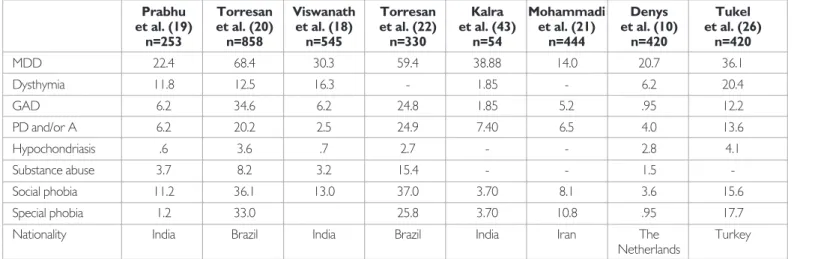
Axis I and Axis II comorbid disorders in OCD may concurrently occur or may occur at any time during the long course of the illness. The results of clinical study show that depressive disorder is the most common comorbid psychiatric disorder in OCD. The lifetime preva-lence of depression among OCD patients ranges from 12% to 67.5% in a clinical and general population (Table 1) (8,9). Epidemiological data suggest that other psychiatric disorders may coexist with OCD. The prevalence rates of comorbid disorders in OCD were report-ed as panic disorder (2–24.9%), generalizreport-ed anxiety disorder (.95–34.6%), social phobia (15–43.5%), special phobias (.95–33%), bipolar disorder (.95–15%), eating disorder (2.4–5%), and body dysmorphic disorder (12.1–15.3%) (Table 1) (10,11,12,13,14,15,16,17,18). Obsessive-compulsive disorder patients with depression are reported to have more anxiety, retardation, suicidal thoughts/attempts, hospitalization, impairment in social and work adjustment, lower level of quality of life, longer illness duration, severe obsessive-com-pulsive symptoms, poor response to treatment and bad prognosis, chronicity, aggressiveness, sexual and/or religious obsessions and checking compulsions, and comorbid generalized anxiety disorder (15,18,19,20,21,22,23,24,25,26). Depressive symptoms are also more associated with obsessions than compulsions (27).
Although many studies in literature have suggested a relation between depression and OCD, only a few studies have evaluated factors associat-ed with depression in OCD. Therefore, this study aimassociat-ed to evaluate the prevalence of current depression in OCD and differences in socio-demo-graphic and clinical characteristics. Symptom dimensions between OCD patients with and without depression and factors associated with comor-bid depression were also evaluated in our study.
METHODS
Subjects
This is a cross-sectional study with 140 OCD patients from the Depart-ment of the Psychiatry of the Baskent University School of Medicine who met the Diagnostic and Statistical Manual of Mental Disorders, Fourth Edition (DSM-IV) (3) criteria for OCD between September 2012 and January 2014. Written informed consent was obtained from the patients and the parents of patients who were younger than 18 years.
This study adhered to the tenets of the Declaration of Helsinki and was approved by the Baskent University Institutional Review Board and Ethics Committee (Project no: KA 12/255) and supported by Baskent University Research Fund.
Patients with schizophrenia, schizophreniform disorder, bipolar affective disorder, mental retardation, severe neurological disorder, age≤15 years, and a history of any serious and progressive organic physical disease, and pregnant or breast-feeding women were excluded. Patients with any his-tory of a depressive episode and bipolar disorder depressive episode oc-curring before OCD onset were also excluded.
Detailed socio-demographic data and data on clinical features (e.g., age, marital status, education level, profession, onset age, period without treat-ment, family history, stressful life events, social support, etc.) were ob-tained through a semi-structured interview.
Stressful life events such as business, education, finance, health, grief, migration, and legal, familial, social and marital problems in the past six months were evaluated in detail by the semi-structured interview.
Obsessive-compulsive disorder and major depressive disorder (MDD) diagnosis were established by the clinician using DSM-IV (28). The Beck Depression Inventory (BDI), Beck Anxiety Inventory (BAI), Yale–Brown Obsessive-Compulsive Scale (Y-BOCS), and Y-BOCS checklist were ap-plied during the second interview. Two symptom categories were defined as obsession group and compulsion group. The obsession group included contamination, religious, sexual, somatic, doubts, hoarding, aggression, and symmetry and the compulsion group included cleaning, checking, repe-tition, hoarding, ordering, and listing. After the socio-demographic and clinical variables and scales were accomplished, the OCD patients were divided into two groups as OCD with or without depression, and we compared their mean scores of the variables and scales.
Assessment Instruments
The Structured Clinical Interview for DSM-IV Axis I Disorders is a clin-ical interview scale applied by the interviewer to explore the diagnosis of Axis I psychiatric disorders. It consists of six modules investigating the diagnostic criteria of a total of 38 axis I disorders. Two modules are used for mood episodes and mood disorders, two are used for psychotic symp-toms and psychotic disorders, and each of the remaining two modules is used for anxiety disorders, substance abuse, and other disorders. It was developed in 1997 by First et al. (28). The validity and reliability study of the Turkish version was done by Ozkurkçugil (29) under the name of Structural Clinical Interview for DSM-IV Axis-I disorder.
The presence and severity of OCD symptoms were measured by the Y-BOCS. Y-BOCS is intended the use of a structured interview. The scale includes 19 items, but only 10 items are used for the total score: five for obsessions and five for compulsions. Each item rates from (no symptoms) to 4 (extreme symptoms), and the total range is 0–40; subtotals indicate the severity of obsessions and compulsions. Scores should reflect the average (mean) occurrence of each item for the entire week. A person who scores over 16 meets the DSM-IV criteria for OCD (30,31). The Turkish validity and reliability were established by Tek et al. and matched the original (32). The Y-BOCS symptom checklist includes more than 60 symptoms orga-nized according to 15 separate categories of obsessions and compulsions. This scale comprehensively identifies all possible types of obsessions and compulsions (30,31).
Table 1. The prevalence of an Axis I disorder comorbidity in obsessive-compulsive disorder
Prabhu Torresan Viswanath Torresan Kalra Mohammadi Denys Tukel
et al. (19) et al. (20) et al. (18) et al. (22) et al. (43) et al. (21) et al. (10) et al. (26) n=253 n=858 n=545 n=330 n=54 n=444 n=420 n=420 MDD 22.4 68.4 30.3 59.4 38.88 14.0 20.7 36.1 Dysthymia 11.8 12.5 16.3 - 1.85 - 6.2 20.4 GAD 6.2 34.6 6.2 24.8 1.85 5.2 .95 12.2 PD and/or A 6.2 20.2 2.5 24.9 7.40 6.5 4.0 13.6 Hypochondriasis .6 3.6 .7 2.7 - - 2.8 4.1 Substance abuse 3.7 8.2 3.2 15.4 - - 1.5 -Social phobia 11.2 36.1 13.0 37.0 3.70 8.1 3.6 15.6 Special phobia 1.2 33.0 25.8 3.70 10.8 .95 17.7 Nationality India Brazil India Brazil India Iran The Turkey
Netherlands
MDD: major depressive disorder; GAD: generalized anxiety disorder; PD and/or A: panic disorder and/or agoraphobia
The Turkish version of BDI was used to assess the prevalence and severity of depressive symptoms. BDI is a self-report inventory created by Aeron Beck (33). BDI items consist of four statements, scored 0 to 3, and the total scores range from 0 to 63. A score of 0 to 4 is considered as none/ minimal, 10 to 16 as mild depression, 17 to 29 as moderate depression, and 30 to 63 as severe depression. BDI scores, 14 or higher, were cate-gorized as depressive. The Turkish reliability and validity were established by Hisli, who considered a score of 17 or above as indicative of major de-pression in the Turkish population; similarly, the same value was accepted as the indicator of major depression in this study (34).
Beck Anxiety Inventory is a 21-item scale developed by Beck et al. (35) is widely used to measure the severity of anxiety. Acceptable validity and
reli-ability has been reported in various populations. Each item was scored from 0 to 3, in increasing order of severity. The scores for each of these 21 items were totaled at the end of the psychological evaluation. Ulusoy evaluated the validity and reliability of this inventory for the Turkish society (36).
Statistical Analysis
Statistical analyses were performed using the Statistical Package for the Social Sciences (SPSS Inc. Chicago, IL, USA) version 17.0. Univariate anal-yses were conducted to compare the OCD patients with or without MDD with regard to the socio-demographic and clinical variables. For each continuous variable (age, gender, educational level, onset age, marital status, stressful life events, BAI, BDI, Y-BOCS); normality was checked by Kolmogorov–Smirnov and Shapiro–Wilk tests and by histograms. All nu-merical data was expressed as median values (minimum–maximum) or as proportions. Comparisons between the groups were made using Mann– Whitney U test, which was used for abnormally distributed data. The cat-egorical variables of the groups were analyzed using the chi-square test. Univariate analyses were initially done, and then clinical variables (listed in Tables 2 and 3) that were identified as significantly associated with depres-sion were included in multivariate logistic regresdepres-sions.
Correlations were tested by Spearman’s correlation test. Spearman’s correlation coefficients were interpreted as excellent relationship r≥.91, good .90≤r≥.71, fair .70≤r≥.51, weak .50≤r≥.31, and little or none r≤.3. A p-value of .05 was taken as the level of significance (Table 4).
RESULTS
Socio-Demographic Factors and Prevalence
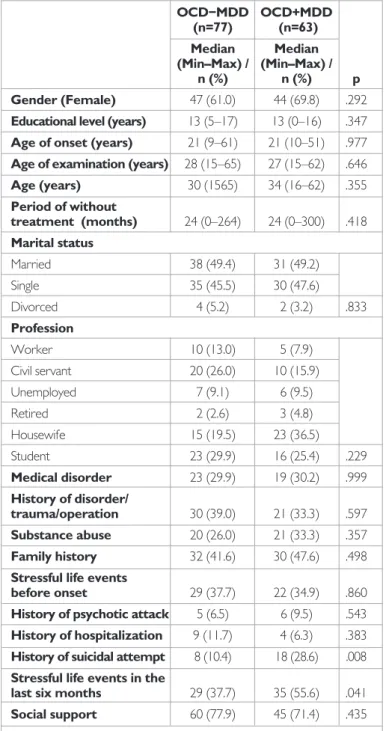
Sixty-three of these patients met the DSM-IV criteria for both OCD and MDD (OCD+MDD group) and 77 patients met the criteria for OCD without MDD (OCD−MDD group). Of the 140 OCD patients, 65% (n=91) were females and 35% (n=49) were males. The mean age of the patients was 32.8±10.6 (range: 15–65) years. Thirteen (9.3%) patients were unemployed and 42 (30%) suffered a medical disorder. Seven pa-tients had thyroid disease, and three papa-tients were hepatitis B virus porter. The disease developed after bone marrow transplantation in one patient. No statistically significant differences were found between age, gender, marital status, and employment distribution in the complicated and uncomplicated groups. The socio-demographic features of the OCD patients with or without depression (univariate analyses) are shown in Table 2.
The prevalence of current major depression among all OCD patients was 45% (n=63). MDD was the most common comorbid psychiatric disorder followed by social phobia, special phobia, and generalized anxiety disorder. Axis I psychiatric disorders were 42.9% in the OCD+MDD and 53.2% in the OCD−MDD groups (p=.238).
Differences in OCD Symptoms between the OCD+MDD and OCD−MDD Groups
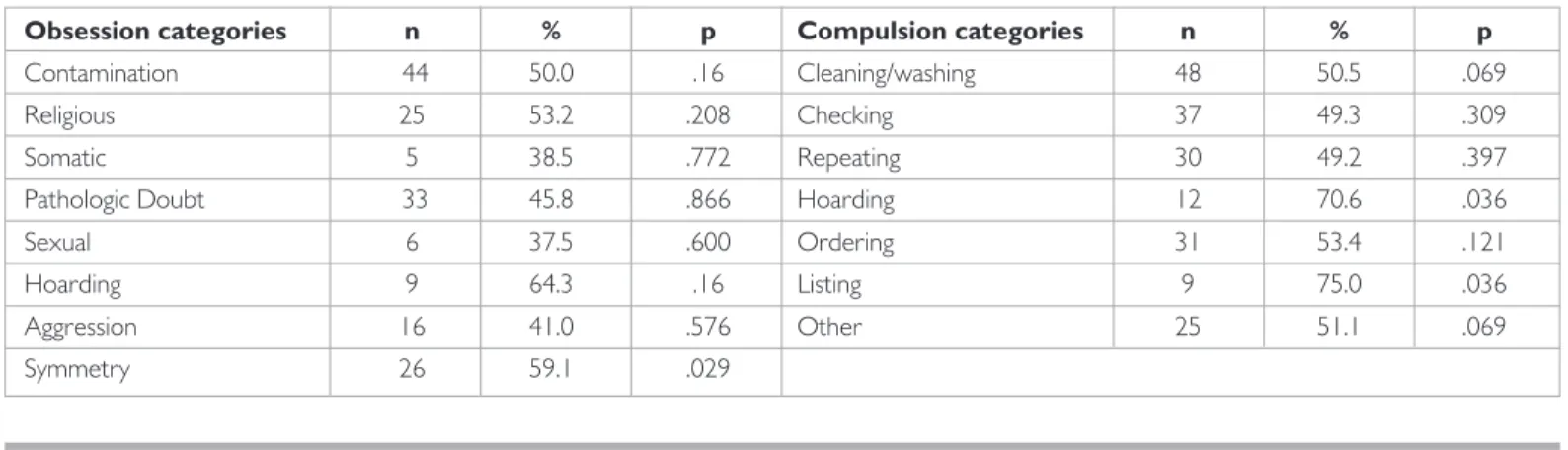
The most common obsessions were contamination (62.9%), doubt (51.4%), and religious (33.8%) in the total sample. On the other hand, cleaning (67.9%), checking (53.6%), and repeating (43.6%) were the most common compulsions among all the groups. In the OCD+MDD group, the most common obsessions were hoarding (64.3%), symmetry (59.1%), religious (53.2%), and contamination (50%), whereas the most
Table 2. Socio-demographic and clinical characteristic distribution of
OCD−MDD and OCD+MDD groups
OCD−MDD OCD+MDD (n=77) (n=63) Median Median (Min–Max) / (Min–Max) / n (%) n (%) p Gender (Female) 47 (61.0) 44 (69.8) .292
Educational level (years) 13 (5–17) 13 (0–16) .347
Age of onset (years) 21 (9–61) 21 (10–51) .977
Age of examination (years) 28 (15–65) 27 (15–62) .646
Age (years) 30 (1565) 34 (16–62) .355 Period of without treatment (months) 24 (0–264) 24 (0–300) .418 Marital status Married 38 (49.4) 31 (49.2) Single 35 (45.5) 30 (47.6) Divorced 4 (5.2) 2 (3.2) .833 Profession Worker 10 (13.0) 5 (7.9) Civil servant 20 (26.0) 10 (15.9) Unemployed 7 (9.1) 6 (9.5) Retired 2 (2.6) 3 (4.8) Housewife 15 (19.5) 23 (36.5) Student 23 (29.9) 16 (25.4) .229 Medical disorder 23 (29.9) 19 (30.2) .999 History of disorder/ trauma/operation 30 (39.0) 21 (33.3) .597 Substance abuse 20 (26.0) 21 (33.3) .357 Family history 32 (41.6) 30 (47.6) .498
Stressful life events
before onset 29 (37.7) 22 (34.9) .860
History of psychotic attack 5 (6.5) 6 (9.5) .543
History of hospitalization 9 (11.7) 4 (6.3) .383
History of suicidal attempt 8 (10.4) 18 (28.6) .008
Stressful life events in the
last six months 29 (37.7) 35 (55.6) .041
Social support 60 (77.9) 45 (71.4) .435
Min–max: minimum–maximum; OCD: obsessive-compulsive disorder; MDD: major depressive disorder
common compulsions were listing (75%), hoarding (70.6%), cleaning/ washing (50.5%), and checking (49.3%). Only the somatic obsession and compulsive hoarding and listing were significantly higher in prevalence in the OCD+MDD group. Symptom categories according to the Y-BOCS checklist in the OCD+MDD group are shown in Table 3.
Clinical Characteristics
The differences of the clinical characteristics between the two groups are summarized in Tables 1, 2, and 3. The mean age of obsessive-compulsive symptoms onset in the OCD+MDD group was 21 years (range: 9–61). The age of onset and duration of symptoms did not differ between the two groups. Social support was significantly high in both groups, and the difference was not statistically significant. The percentage of patients in
the OCD+MDD group with suicide attempt history was significantly
high-er than that of uncomplicated groups (28.6%, p=0.008). Thirty patients in the OCD+MDD group reported a family history of OCD.
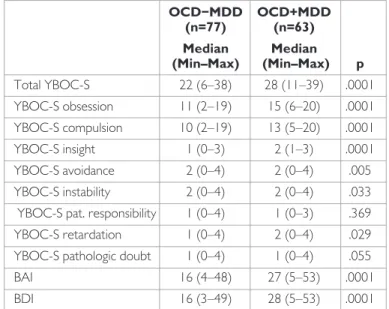
Thirty-five (55.6%) OCD+MDD patients experienced stressful life events in the last six months (p=.041). Stressful life events were experienced by 34.9% of the patients in OCD+MDD group before the onset of OCD. The OCD+MDD group had significantly higher BDI scores 28 (range: 5–53), (p<.0001). The mean BAI score was 22.9±13.1 among the en-tire study population. The BAI scores were significantly higher in the OC-D+MDD group, and the mean score was 27 (range: 5–53) (p=.0001). In the OCD+MDD group, the total YBOC-S and obsession and compul-sion scores were significantly higher than in the OCD−MDD group. Dif-ferences between the OCD+MDD and OCD−MDD groups regarding scale scores are shown in Table 3.
YBOC-S item-12, which was avoidance, item-13, which was instability, and item-15, which was retardation were significantly increased in the OC-D+MDD group (p=.005, p=.033, p=.029). There were no differences in the scores for item-14, which was pathologic responsibility, and item-16, which was pathologic doubt, between the two groups (Table 5). YBOC-S item-11, which was insight, was significantly higher in the OCD+MDD group (p=.0001), which indicates that poor insight was significantly high-er in the complicated group. The mean obsession scores among poor insight patients were 14 (range: 5-20). Obsession and compulsion scores were significantly higher among the poor insight patients (OCD+MDD) (p=.0001).
The intercorrelations of subscales were evaluated. There were strong correlations between the YBOC-S and BDI scores (r=.60). As a result, the depression scores positively correlated with the severity scores of the YBOC-S scores. Correlations with other subscales are summarized in Table 3.
Factors Associated with Comorbid Depression in OCD
At the end of the univariate analysis, logistic regression analysis was applied to evaluate statistically significant parameters and depression. Depression
Table 4. Spearman’s correlations
Group no Age YBOC-S Obsession Compulsions
scores scores BAI
Age r .08 p .357 YBOC-S r .38* .09 p .0001 .302 YBOC-S r .39* .02 .91* Obsession p .0001 .805 .0001 YBOC-S r .32* .13 .95* .75 compulsion p .0001 .136 .0001 .0001 BAI r .31* −.048 .40* .36* .37* p .0001 .570 .0001 .0001 .0001 BDI r .45* .09 .60* .60* .54* .71* p .0001 .915 .0001 .0001 .0001 .0001 YBOC-S: Yale–Brown Obsessive-Compulsive Scale; BAI: Beck Anxiety Inventory; BDI: Beck Depression Inventory
Table 3. Comparisons between the levels of BAI, BDI, YBOC-S (item
11-12-13-14-15-16) severity and depression in the OCD+MDD and OCD−MDD groups OCD−MDD OCD+MDD (n=77) (n=63) Median Median (Min–Max) (Min–Max) p Total YBOC-S 22 (6–38) 28 (11–39) .0001 YBOC-S obsession 11 (2–19) 15 (6–20) .0001 YBOC-S compulsion 10 (2–19) 13 (5–20) .0001 YBOC-S insight 1 (0–3) 2 (1–3) .0001 YBOC-S avoidance 2 (0–4) 2 (0–4) .005 YBOC-S instability 2 (0–4) 2 (0–4) .033 YBOC-S pat. responsibility 1 (0–4) 1 (0–3) .369 YBOC-S retardation 1 (0–4) 2 (0–4) .029 YBOC-S pathologic doubt 1 (0–4) 1 (0–4) .055 BAI 16 (4–48) 27 (5–53) .0001 BDI 16 (3–49) 28 (5–53) .0001 Min–max: minimum–maximum; OCD: obsessive-compulsive disorder; MDD: major depressive disorder; YBOC-S: Yale–Brown Obsessive-Compulsive Scale; BAI: Beck Anxiety Inventory; BDI: Beck Depression Inventory
was considered as a dependent variable. Instead of all the significant pa-rameters, only clinically significant parameters were preferred among the highly correlated variables.
In the logistic regression analysis, age, hoarding (compulsion), stressful life event, BAI score, YBOC-S score, and insight were added. Hoarding (compulsion), stressful life event, BAI scores, and YBOC-S scores were positively correlated with the severity of depression in OCD (Table 6). Based on the results of the logistic analysis, the correlation between com-pulsive hoarding severity and depression was also significant [confidence interval (CI): 95%, 1.2–1.7]. The patients with compulsive hoarding had 4.5-times more depressive symptoms than the patients with non-com-pulsive hoarding. The rates of stressful life events in the last six months, increasing BAI, and increasing YBOC-S odds were 2.6 (CI: 95%, 1.2–5.7), 1.1 (CI: 95% 1–1.1), and 1.1 (CI: 95%, 1.05–1.2) respectively.
DISCUSSION
Depression is the most common comorbid mental disorder in OCD (10,13,37,38,39,40). The prevalence rates of MDD in OCD vary consid-erably among studies. While depression accompanied one-third of OCD patients in the first examination, two-thirds have a lifetime history of de-pression (38,41). The results of the current study indicate that approxi-mately half of the patients met the criteria of depression, which is similar to results reported in the world and local literature (23,38).
In this study, no significant differences were found for gender, age, marital
status, years of education, age of onset, stressful life events at the
begin-ning of disorder, and age of onset between the complicated and uncompli-cated groups. OCD symptoms were evaluated in accordance with world literature. Symptom dimensions of obsession and compulsion were also in accordance with those in related studies.
In our study, symmetry obsession and compulsive hoarding and listing were experienced more frequently in the MDD+OCD group. Hoarding is de-fined as “collecting of insignificant or little value items in excessive amounts” (42). Although compulsive hoarding is most commonly associated with OCD, it may be accompanied by various psychiatric illnesses such as demen-tia, schizophrenia, mental retardation, and anorexia nervosa (43,44,45,46). Rates of compulsive hoarding among OCD patients range from 18% to 42% (8,47). According to logistic regression analysis, compulsive hoarding seems to be associated with depression by more than 4.5 times. Although there were high rates of religious and aggressive obsessions, these were not determined as factors related to depression in OCD.
Quarantini et al. (44) found no significant associations between MDD and OCD symptom dimension.Contrary to this finding, Besiroglu et al. (27) found a relationship between aggressive obsessions in MDD+OCD pa-tients; Hasler et al. (28) reported positive associations between aggressive, religious, sexual, and somatic obsessions and compulsive checking and de-pression in OCD. Contrary to the findings of Tukel et al. (42) and Eisen et al. (4), Kalra et al. (43) did not determine a significant relation between symptom dimension and depression.
Anxiety disorders are the second most common disorders in OCD. In our study, 48.6% of the patients met at least one Axis I comorbidity criterion
Table 5. Symptom categories according to the Yale–Brown Obsessive-Compulsive Checklist in the OCD+MDD group
Obsession categories n % p Compulsion categories n % p
Contamination 44 50.0 .16 Cleaning/washing 48 50.5 .069 Religious 25 53.2 .208 Checking 37 49.3 .309 Somatic 5 38.5 .772 Repeating 30 49.2 .397 Pathologic Doubt 33 45.8 .866 Hoarding 12 70.6 .036
Sexual 6 37.5 .600 Ordering 31 53.4 .121
Hoarding 9 64.3 .16 Listing 9 75.0 .036
Aggression 16 41.0 .576 Other 25 51.1 .069 Symmetry 26 59.1 .029
Table 6. Logistic regression analyses a. Variable(s) entered on step 1: age, compulsive hoarding, stressful life events in the last six months, BAI,
YBOC-S, insight_A2
Odds 95% C.I. forEXP(B)
B S.E. Wald Df p Ratio Lower Upper
Age .024 .019 1.592 1 .207 1.024 .987 1.063 Compulsive hoarding 1.512 .675 5.020 1 .025 4.538 1.208 17.040 Stressful life events in
the last six month(1) .952 .408 5.449 1 .020 2.590 1.165 5.759 BAI .034 .017 3.959 1 .047 1.034 1.001 1.069 YBOC-S .113 .034 10.805 1 .001 1.120 1.047 1.198 YBOC-S -insight (1) .316 .507 .388 1 .533 1.371 .508 3.705 Constant −5.294 1.350 15.378 1 .000 .005
YBOC-S: Yale–Brown Obsessive-Compulsive Scale; BAI: Beck Anxiety Inventory
and 45% of the patients presented with depression, 16.3% with anxiety disorder, 17.1% with special phobia, and 15.7% with social phobia. Our study revealed that the second factor associated with depression in OCD is a high BAI score. Similarly, Kalra et al. (39) and Yap et al. (48) found a positive relation between BAI scores and depression comorbidity. According to the logistic regressions analyses, OCD patients with depres-sion indicated more severe obsessive and compulsive symptoms than OCD patients without depression. Although these findings were not surprising, contrary to earlier studies, we found that both obsessive and compulsive scores were related to depression severity. Moreover, many studies showed that obsessive symptoms are more strongly correlated with depressive symptoms than with compulsive symptoms (27,48,49). Lee and Kwon (50) defined a new model that classified obsession into two subtypes, and they suggested that autogenous obsessions are particularly related to depression in OCD. They indicated that compulsions reduce anxiety severity, so quality of life is less impaired. On the other hand, the severity of obsessions and compulsions may be correlated with the impairment of social function and quality of life and poor insight; thus, they may facilitate the development of depression and other Axis I disorders in OCD (4,22,50).
According to the results of our study, another factor associated with depression in OCD was stressful life events during the last six months. Most studies show a positive correlation between stressful life events and chronic diseases such as depression (51). Therefore, it can be said that stressful life events may be a risk factor for the development of depres-sion in OCD regardless of the severity of obsesdepres-sions and compuldepres-sions. Rosso et al. (52) suggested that more than 60% of OCD patients expe-rience at least one stressful life event during the year before the onset of the disorder. Stressful life events are also associated with later onset of the disorder, a history of complicated birth, less family history of OCD, aggressive/checking, symmetry/ordering, hoarding dimension, and female gender (53,54,55,56).
In our study, poor insight was found to be another factor related to de-pression in OCD. Clinical insight in psychiatric research refers to awareness and recognition of a mental illness, of its symptoms, need for treatment, and its consequences (57). The association between poor insight and OC-D+MDD is in compliance with results of previous studies (58,59,60). Poor insight in OCD has been described as a condition where patients refuse or resist or are noncompliant to treatment, and are unaware of the exces-siveness of obsessions and anxiety. Poor insight has been reported in 15% to 36% of OCD patients (58,61,62,63) and is associated with early on-set and long duration of illness, low response to treatment, more severe symptoms, a higher frequency of obsessive and compulsive hoarding, high level comorbidity of mental disorders such as depression, and generalized anxiety disorder (60,64,65,66,67).
Our study has some limitations. By virtue of its cross-sectional design, this study does not permit inference about the causal relationship. An-other limitation of the study is that our participants were selected from specialized services; therefore, the results may not reflect the situation of the general population. Data on family history and stressful life events were only indirectly investigated; no instruments were used to evaluate the family history and stressful life events. The sample size was small in comparison with other major studies.
In conclusion, this study suggests that many factors are strongly associated with depression in OCD; it was found that positive correlation between
poor insight, severity of obsessions and compulsions, severity of anxiety, compulsive hoarding, and stressful life events during the last six months increased the risk of the development of depression in OCD. Our find-ings also suggest that a high level of avoidance, instability and retardation, history of suicidal attempt, and delayed treatment are other notable risk factors associated with the development of depression in OCD.
Conflict of Interest: No conflict of interest was declared by the authors. Financial Disclosure: This study was supported by Baskent University Research
Fund.
REFERENCES
1. Karno M, Golding JM, Sorenson SB, Burnam MA. The epidemiology of obses-sive–compulsive disorder in five US communities. Arch Gen Psychiatry 1988; 45:1094-1099. [CrossRef]
2. Myers JK, Weissman MM, Tischler GL, Holzer CE, Leaf PJ, Orvaschel H, An-thony JC, Boyd JH, Burke JD Jr, Kramer M, Stoltzman R. Six- month prevalence of psychiatric disorders in three communities 1980 to 1982. Arch Gen Psychi-atry 1984; 41:959-967. [CrossRef]
3. American Psychiatric Association, Diagnostic and Statistical of Mental Dis-orders, 4th Edition, Text Revision (DSM-IV-TR). Washington D.C: American Psychiatric Association; 2000.
4. Eisen JL, Mancebo MA, Pinto A, Coles ME, Paqano ME, Stout R, Rasmussen SA. Impact of obsessive-compulsive disorder on quality of life. Compr Psychi-atry 2006; 47:270-275. [CrossRef]
5. Srivastava S, Bhatia MS, Thawani R, Jhanjee A. Quality of life in patients with obsessive compulsive disorder: A longitudinal study from India. Asian J Psychi-atry 2011; 4:178-182. [CrossRef]
6. Rosa AC, Diniz JB, Fossaluza V, Torres AR, Fontenelle LF, De Mathis AS, da Conceiçao Rosario M, Miquel EC, Shavitt RG. Clinical correlates of social ad-justment in patients with obsessive-compulsive disorder. J Psychiatr Res 2012; 46:1286-1292. [CrossRef]
7. Steketee G. Disability and family burden in obsessive- compulsive disorder. Can J Psychiatry 1997; 42:919-928.
8. Rasmussen SA, Eisen JL. Epidemiology of obsessive compulsive disorder. J Clin Psychiatry 1990; 51:10-14.
9. Weissman MM, Bland RC, Canino GJ, Greenwald S, Hwu HG, Lee CK, New-man SC, Oakley- Browne MA, Rubio-Stipec M, Wickramaratne PJ. The cross national epidemiology of obsessive compulsive disorder. The Cross National Collaborative Group. J Clin Psychiatry 1994; 55: 5-10.
10. Denys D, Tenney N, van Megen HJ, de Geus F, Westenberg HG. Axis I and Axis II comorbidity in a large sample of patients with obsessive-compulsive disorder. J Affect Disord 2004; 80:155-162. [CrossRef]
11. Douglass HM, Moffitt TE, Dar R, McGee R, Silva P. Obsessive-compulsive dis-order in a birth cohort of 18-year-olds: prevalence and predictors. J Am Acad Child Adolesc Psychiatry 1995; 34:1424-1431. [CrossRef]
12. Grabe HJ, Meyer C, Hapke U, Rumpf HJ, Freyberger HJ, Dilling H, John U. Life time comorbidity of obsessive-compulsive disorder and subclinical ob-sessive-compulsive disorder in Northern Germany. Eur Arch Psychiatry Clin Neurosci 2001; 25:130-135. [CrossRef]
13. Torres AR, Prince MJ, Bebbington PE, Bhugra D, Brugha TS, Farrell M,Jenkins R, Lewis G, Meltzer H, Singleton N. Obsessive-compulsive disorder: prevalence, comorbidity, impact, and help-seeking in the British National Psychiatric Mor-bidity Survey of 2000. Am J Psychiatry 2006; 163:1978-1985. [CrossRef]
14. Assunção MC, Costa DL, de Mathis MA, Shavitt RG, Ferrão YA, do Rosário MC, Miquel EC, Torres AR. Social phobia in obsessive-compulsive disorder: prevalence and correlates. J Affect Disord 2012; 143:138-147. [CrossRef]
15. Perugi G, Akiskal HS, Pfanner C, Presta S, Gemignani A, Milanfranchi A, Lensi P, Ravaqli S, Cassano GB. The clinical impact of bipolar and unipolar affective comorbidity on obsessive-compulsive disorder. J Affect Disord 1997; 46:15-23.
[CrossRef]
16. Stewart SE, Stack DE, Wilhelm S. Severe obsessive-compulsive disorder with and without body dysmorphic disorder: clinical correlates and implications. Ann Clin Psychiatry 2008; 20:33-38. [CrossRef] 351
17. Costa DLC, Assunção MC, Ferrao YA, Conrado LAC, Gonzalez CH, Fon-tenelle LF, Fossaluza V, Miquel EC, Torres RA, Shavitt RG. Body dysmorphic disorder in patients with obsessive–compulsive disorder: Prevalence and clin-ical correlates. Depress Anxiety 2012; 29:966-975. [CrossRef]
18. Viswanath B, Narayanaswamy JC, Rajkumar RP, Cherian AV, Kandavel T, Math SB, Reddy YC. Impact of depressive and anxiety disorder comorbidity on the clinical expression of obsessive-compulsive disorder. Compr Psychiatry 2012; 53:775-782. [CrossRef]
19. Prabhu L, Cherian AV, Viswanath B, Kandavel T, Math SB, Reddy YCJ. Symptom di-mensions in OCD and their associations with clinical characterictics and comorbid disorder. J Obsessive Compulsive Related Dis 2013; 2:14-21. [CrossRef]
20. Torresan RC, Ramos-Cerqueira AT, Shavitt RG, do Rosário MC, de Mathis MA, Miguel EC, Torres AR. Symptom dimensions, clinical course and comor-bidity in men and women with obsessive-compulsive disorder. Psychiatry Res 2013; 30:186-95. [CrossRef]
21. Mohammadi MR, Ghanizadeh A, Moini R. Lifetime comorbidity of obses-sive-compulsive disorder with psychiatric disorders in a community sample. Depress Anxiety 2007; 24:602-607. [CrossRef]
22. Torresan RC, Ramos-Cerqueira AT, de Mathis MA, Diniz JB, Ferrão YA, Mi-guel EC, Torres AR. Sex differences in the phenotypic expression of obses-sive-compulsive disorder: an exploratory study from Brazil. Compr Psychiatry 2009; 50:63-69. [CrossRef]
23. Huppert JD, Simpson HB, Nissenson KJ, Liebowitz MR, Foa EB. Quality of life and functional impairment in obsessive-compulsive disorder: a comparison of patients with and without comorbidity, patients in remission, and healthy controls. Depress Anxiety 2009; 26:39-45. [CrossRef]
24. Hasler G, LaSalle-Ricci VH, Ronquillo JG, Crawley SA, Cochran LW, Kazu-ba D, Greenberq BD, Murphy DL. Obsessive-compulsive disorder symptom dimensions show specific relationships to psychiatric comorbidity. Psychiatry Res 2005; 135:121-132. [CrossRef]
25. Hecht H, von Zerssen D, Krieg C, Pössl J, Wittchen HU. Anxiety and depres-sion: comorbidity, psychopathology, and social functioning. Compr Psychiatry 1989; 30:420-433. [CrossRef]
26. Abramowitz JS. Treatment of obsessive-compulsive disorder in patients who have comorbid major depression. J Clin Psychology 2004; 60:1133-1141. [CrossRef]
27. Ricciardi JN, McNally RJ. Depressed mood is related to obsessions but not compulsions in obsessive-compulsive disorder. J Anxiety Disord 1995; 9:249-256. [CrossRef]
28. First MB, Spitzer MB, Gibbon M, Williams JBW. Structured Clinical Interview for DSM-IV-TR Axis I Disorders, Clinician Version: American Psychiatric Press, Inc; Washington DC; 1996.
29. Özkürkçügil A, Aydemir Ö, Yıldız M, Esen Danacı A, Köroğlu E. DSM-IV eksen I bozuklukları için yapılandırılmış klinik görüşmenin Türkçeye uyarlanması ve güvenilirlik çalışması. İlaç ve Tedavi Dergisi 1999; 12:233-236.
30. Goodman WK, Price LH, Rasmussen SA, Mazure C, Fleischmann RL, Hill CL, Heninger GR, Charney DS. The Yale-Brown Obsessive–Compulsive Scale: I. Development, use and reliability. Arch Gen Psychiatry 1989; 46:1006-1011.
[CrossRef]
31. Goodman WK, Price LH, Rasmussen SA, Mazure C, Delgado P, Heninger GR, Charney DS. The Yale-Brown Obsessive Compulsive Scale. II. Validity. Arch Genl Psychiatry 1989; 46:1012-1016. [CrossRef]
32. Tek C, Uluğ B, Rezaki BG, Tanrıverdi N, Mercan S, Demir B, Vargel S. Yale-Brown Obsessive Compulsive Scale and US National Institute of Mental Health Global Obsessive Compulsive Scale in Turkish: reliability and validity. Acta Psychiatr Scand 1995; 91:410-413. [CrossRef]
33. Beck AT, Ward CH, Mendelson M, Mock J, Erbaugh J. An inventory for mea-suring depression. Arch Gen Psychiatry 1961; 4:461-471. [CrossRef]
34. Hisli N. Beck Depresyon Envanterinin üniversite öğrencileri için geçerliliği, güvenirliliği. Psikoloji Dergisi 1989; 7:3-13.
35. Beck AT, Brown G, Epstein N, Steer RA. An inventory for measuring clinical anxiety: psychometric properties. J Consult Clin Psychol 1988; 56:893-897.
[CrossRef]
36. Ulusoy M. Beck Anksiyete Envanteri: Geçerlik ve güvenirlik çalışması. Yayın-lanmamış uzmanlık tezi. Bakırköy Ruh ve Sinir Hastalıkları Hastanesi, İstanbul; 1993.
37. Pigott TA, L’Heureux F, Dubbert B, Bernstein S, Murphy DL. Obsessive com-pulsive disorder: comorbid conditions. J Clin Psychiatry 1994; 55:28-32.
38. Tükel R, Polat A, Ozdemir O, Aksüt D, Türksoy N. Co morbid conditions in ob-sessive-compulsive disorder. Compr Psychiatry 2002; 43:204-209. [CrossRef]
39. Kalra H, Trivedi JK, Dalal PK, Sinha PK, Allet JL. Uncomplicated and complicat-ed obsessive-compulsive disorder: an exploratory study from India. Compr Psychiatry 2008; 49:51-54. [CrossRef]
40. Quarantini LC, Torres AR, Sampaio AS, Fossaluza V, Mathis MA, De Rosário MC, Fontenelle LF, Ferrão YA, Cardioli AV, Petribu K, Hounie AG, Miquel EC, Shavitt RG, Koenen KC. Comorbid major depression in obsessive-compulsive disorder patients. Compr Psychiatry 2011; 52:386-393. [CrossRef]
41. Eisen JL, Goodman WK, Keller MB, Warshaw MG, DeMarco LM, Luce DD, Ras-mussen SA. Patterns of remission and relapse in obsessive-compulsive disorder: a 2-year prospective study. J Clin Psychiatry 1999; 60:346-351. [CrossRef]
42. Frost RO, Gross RC. The hoarding of possessions. Behav Res Ther 1993; 31:367-81. [CrossRef]
43. Hwang JP, Tsai SJ, Yang CH, Liu KM, Lirng JF. Hoarding behavior in dementia. A preliminary report. Am J Geriatric Psychiatry 1998; 6:285-289. [CrossRef]
44. Lysaker PH, Marks KA, Picone JB, Rollins AL, Fastenau PS, Bond GR. Obsessive and compulsive symptoms in schizophrenia: Clinical and neurocognitve cor-relates. J Nerv Ment Dis 2000; 188:78-83. [CrossRef]
45. Dykens E, Shah B. Psychiatric disorders in Prader–Willi syndrome: Epidemiol-ogy and management. CNS Drugs 2003; 17:167-178. [CrossRef]
46. Frankenburg FR. Hoarding in anorexia nervosa. Br J Med Psychol 1984;
57:57-60. [CrossRef]
47. Frost RO, Krause MS, Steketee G. Hoarding and obsessive-compulsive symp-toms. Behav Modif 1996; 20:116-132. [CrossRef]
48. Yap K, Mogan C, Kyrios M. Obsessive-compulsive disorder and comorbid de-pression: The role of OCD related and non-specific factors. J Anxiety Disord 2012; 26:565-573. [CrossRef]
49. Arts W, Hougduin K, Schaap C, de Haan E. Do patients suffering from obses-sions alone differ from other obsessive-compulsives? Behav Res Ther 1993; 31:119-123. [CrossRef]
50. Lee HJ, Kwon SM. Two different types of obsession: autogenous obsessions and reactive obsessions. Behav Res Ther 2003; 41:11-29. [CrossRef]
51. Kendler KS, Karkowski LM, Prescott CA. Causal relationship between stressful life events and the onset of major depression. Am J Psychiatry 1999; 156: 837-841.
[CrossRef]
52. Rosso G, Albert U, Asinari GF, Bogetto F, Maina G. Stresfull life events and obsessive-compulsive disorder: clinical features and symptom dimensions. Psychiatry Res 2012; 197:259-264. [CrossRef]
53. Real E, Labad J, Alonso P, Segalàs C, Jiménez-Murcia S, Bueno B, Subirà M, Vallejo J, Menchón JM. Stressful life events at onset of obsessive-compulsive disorder are associated with a distinct clinical pattern. Depress Anxiety 2011; 28:367-376. [CrossRef]
54. Cromer KR, Schmidt NB, Murphy DL. An investigation of traumatic life events and obsessive-compulsive disorder. Behav Res Ther 2007; 45:1683-1691.
[CrossRef]
55. Cromer KR, Schmidt NB, Murphy DL. Do traumatic events influence the clin-ical expression of compulsive hoarding? Behav Res Ther 2007; 45:2581-2592.
[CrossRef]
56. Albert U, Maina G, Bogetto F, Ravizza L. The role of recent life events in the onset of obsessive-compulsive disorder. CNS Spectrums 2000; 5:44-50. 57. Amador XF, Flaum M, Andreasen NC, Strauss DH, Yale SA, Clark SC,
Gor-man JM. Awareness of illness in schizophrenia, schizoaffective and mood dis-orders. Arch Gen Psychiatry 1994; 51:826-836. [CrossRef]
58. Catapano F, Sperandeo R, Perris F, Lanzaro M, Maj M. İnsight and resistance in patients with obsessive-compulsive disorder. Psychopathology 2001; 34:62-68. [CrossRef]
59. Foa EB. Failure in treating obsessive-compulsives. Behav Res Ther 1979; 17:169-176. [CrossRef]
60. Ravi Kishore V, Samar R, Janardhan Reddy YC, Chandrasekhar CR, Thennarasu K. Clinical characteristics and treatment response in poor and good insight ob-sessive-compulsive disorder. Eur Psychiatry 2004; 19:202-208. [CrossRef]
61. Foa EB, Kozak MJ, Goodman WK, Hollander E, Jenike MA, Rasmussen SA. DSM-IV field trial: obsessive-compulsive disorder. Am J Psychiatry 1995; 152:90-96.
62. Türksoy N, Tükel R, Ozdemir O, Karali A. Comparison of clinical characteris-tics in good and poor insight obsessive-compulsive disorder. J Anxiety Disord 2002; 16:413-423. [CrossRef]
63. Eisen JL, Rasmussen SA, Phillips KA, Price LH, Davidson J, Lydiard RB, Ninan P, Piqqott T. Insight and treatment outcome in obsessive–compulsive disorder. Compr Psychiatry 2001; 42:494-497. [CrossRef]
64. Catapano F, Perris F, Fabrazzo M, Cioffi V, Giacco D, De Santis V,Maj M. Obsessive-compulsive disorder with poor insight: a three year prospective study. Prog Neuro-Psychopharmacology Biol Psychiatry 2010; 34:323-330.
[CrossRef]
65. Matsunaga H, Kiriike N, Matsui T, Oya K, Iwasaki Y, Koshimune K, Miyata A, Stein DJ. Obsessive-compulsive disorder with poor insight. Compr Psychiatry 2002; 43:150-157. [CrossRef]
66. Jakubovski E, Pittenger C, Torres AR, Fontenelle LF, do Rosario MC, Ferrão YA, de Mathis MA, Miguel EC, Bloch MH. Dimensional correlates of poor insight in obsessive–compulsive disorder. Prog Neuropsychopharmacol Biol Psychiatry 2011; 35:1677-1681. [CrossRef]
67. Fontenelle JM, Harrison BJ, Santana L, Conceição do Rosário M, Ver-siani M, Fontenelle LF. Correlates of insight into different symptom di-mensions in obsessive-compulsive disorder. Ann Clin Psychiatry 2013; 25:11-16.