A RESEARCH ON DETERMİNİNG THE EFFECTİVE FACTORS ON THE STUDENTS TO CHOOSE EDUCATİON OF
AGRİCULTURAL ECONOMİCS:
CASE OF ERZURUM ATATÜRK UNİVERSİTY
Tarım Ekonomisi Öğrencilerinin Bölüm Tercihlerinde Etkili Olan Faktörlerin Belirlenmesi Üzerine Bir Çalışma:
Erzurum Atatürk Üniversitesi Örneği
Nuray DEMIR
Esra KADANALI0FNur ERTEK
Abstract
The purpose of this study is determine the effective factors on the decisions of students to choose willingly whether or not eagerly Atatürk University Faculty of Agriculture Department of Agricultural Economics. In this context, the data obtained from 136 questionnaires that were applied to students receiving education in Atatürk University Department of Agricultural Economics via complete inventory were based on and used in the logit analysis in the LIMDEP program. As a result of the analysis, the variables regarding the state of students to choose eagerly the Faculty of Agriculture, the high school they had graduated from and the educational level of breadwinner were observed to be statistically significant. As a consequence, it is required to ideally introduce the education of Agricultural Economics for students to choose it eagerly. In order to achieve this, it is considered important to bring a viewpoint for students who not only still study but also prepare for university exams in private teaching institutions concerning creating their own business opportunities rather than relying only on government through student-based meetings on employment.
Keywords: Atatürk University, Education of Agricultural
Economics, Choice, Logit Analysis
(Corresponding Author) Atatürk University, Faculty of Agriculture, Department of Agricultural Economics, Turkey, [email protected]
Yrd. Doç. Dr., Agri Ibrahim Cecen University,Faculty of
Economics&Administrative Sciences, Turkey, [email protected] Atatürk University, Faculty of Agriculture, Department of Agricultural Economics, Turkey, [email protected]
So sya l B il iml er Ens ti tüsü D er gi si
2
ÖzetAtatürk Üniversitesi Ziraat Fakültesi Tarım Ekonomisi öğrencilerinin bölümü istekli olarak tercih edip etmeme kararlarında etkili olan faktörlerin belirlenmesi çalışmada amaçlanmaktadır. Bu kapsamda, Atatürk Üniversitesi Tarım Ekonomisi bölümünde eğitim gören öğrenciler arasında tam sayımla yapılan 136 adet anket çalışmasından elde edilen veriler esas alınmış ve elde edilen veriler LİMDEP programında logit analizinde kullanılmıştır. Analiz sonucunda, öğrencinin istekli olarak Ziraat Fakültesini tercih etme durumu, lise eğitimini tamamladığı okul ve aile reisinin eğitim düzeyini gösteren değişkenler istatistiki açıdan önemli çıkmıştır. Sonuç itibariyle Tarım Ekonomisi Bölümünü öğrencilerin istekli olarak tercih etmeleri için; bölümün tanıtımını iyi yapılması gerekmektedir. Bunun içinde iş imkânları konusunda öğrenci bazında yapılacak toplantılar ile hem bölümde halen eğitim gören hem de dershanelerde üniversite sınavına hazırlanan öğrencilere sadece devletten değil kendi iş imkânlarını da yaratabilecekleri konusunda öğrencilere bir bakış açısının sağlanmasının önemli olduğu düşünülmektedir.
Anahtar kelimeler: Atatürk Üniversitesi, Tarım Ekonomisi eğitimi,
tercih, logit analiz
Introduction
Being a social institution aimed at making a permanent behavioral change in human life (Ulusoy et al., 2004), education is a system that is responsible sociologically for raising individuals who continue their existence in societies. If society fails to raise manpower in accordance with its needs, it will have some difficulties in continuing its existence. Besides all these, it is required to realize education within the frame of a certain goal for society and individuals and briefly design it according to a certain philosophy (Öztürk & Talas, 2015). Positive changes in both individual and community's life could occur only through education (Biçer, 2014). Education is an indispensable element for the development of countries.
Education is also very important for Turkey, which is an agricultural country. The agricultural sector where 22% of the total population is still employed and which has a share of 7.2% in the GDP plays a major share in the national economy (TSI, 2015a; 2015b). There is a need for educated agricultural workers in order to follow and apply the developing technologies and provide integration between agriculture and industry.
Since agriculture is a special field from a number of aspects, a special field of economics dealing with agricultural problems has emerged. This field
3
So sya l B ili ml er Ens tit üsü D erg isi3
3
of economics is called as “Agricultural Economics”. In this field, the economists often utilize micro-economy or price theory. Market operation propositions regarding production, consumption and shopping in micro-economy or price theory are developed based on the hypotheses concerning the behaviors of individual producers and consumers. In this context, the main idea is that resources remain incapable in meeting the needs of people and it is required to make some choices due to this incapability. While realizing its functions, the Department of Agricultural Economics is closely related especially with Economics, Business Administration, and Environmental Sciences (Perry, 2010).
Being considerably associated with a number of departments, the Department of Agricultural Economics is one of two present departments that were opened within the body of Atatürk University Faculty of Agriculture on 17 November 1958. The first name of the department, Agricultural Economy, was afterwards changed as Agricultural Economics (Anonymous, 2015).
220 students (136 undergraduate and 94 postgraduate) receive this education in Atatürk University Department of Agricultural Economics (Anonymous, 2015). The number of students choosing the Faculties of Agriculture including the Department of Agricultural Economics decreases every passing year and the points of students choosing the Faculties of Agriculture decrease. The Faculties of Agriculture that used to be chosen by students in the first percentile in Student Selection and Placement Center until the mid 1980s are today involved among the last choices of students, which is highly thought-provoking. The most important reasons of this condition involve the opening of more than adequate Faculties of Agriculture across Turkey due to political reasons, the surplus in the number of students being accepted in faculties, as well as the fact that some faculties opened evening education in previous periods and fallacies in public opinion like the failure of agricultural engineers to find a job, which have all had a negative effect on students who would choose departments in university exams. This condition has caused a decrease in the number of students in Faculties of Agriculture, consideration of these faculties as one of last choices, and the formation of a reluctant and an unqualified student profile (Çiftçi et al., 2010).
These conditions are the same in the education of agricultural economics. Besides, the fact that students who choose the department of agricultural economics unwillingly due to agricultural and educational policies that used to be applied in the past and caused some problems like the higher rate of unemployed graduates and instability in agricultural policies
So sya l B il iml er Ens ti tüsü D er gi si
4
start this education with a lower motivation considerably decreases the quality of education. In this context, the purpose of this study was to remove the problems caused by determining the factors affecting the students to choose the education of agricultural economics. Removal of the problems will enable the students to eagerly choose the education of agricultural economics and thus, it will bring along the formation of professionally eager and qualified agricultural engineers.
Material and Method
The main material of the study was obtained via a questionnaire that was applied to undergraduate students receiving education in the Faculty of Agriculture Department of Agricultural Economics in January 2014. Supplementary materials of the study, on the other hand, were acquired by using relevant studies and relevant web pages. The number of questionnaires in the study was determined as 136 by using a complete inventory system in such a way to comprise all the undergraduate students receiving education in the Department of Agricultural Economics. The data acquired as a result of the questionnaire were used in the crosstab and logit model analyses by using the LIMDEP package software.
In cases where the dependent variables are categorical (1, 2 and 3) and dummy variable (0, 1), the classic regression method (EKKY or OLS) cannot be applied due to the impairment of the normalcy assumption because OLS gives an objective and efficient estimation depending on the continuity of the dependent variable. Logit and probit models are used in cases where the dependent variables have a dummy value. In these models, the discrete variables become continuous from the probability distribution. Logit model generally gives a more objective and efficient estimation, compared to the probit model (Akkaya & Pazarlıoğlu, 1998; Greene, 1997; Gujarati, 1995).
In the logit model, the decisions of students to eagerly choose the education of agricultural economics is taken as a dependent variable, whereas the variables that are thought to be effective upon this variable constitute the independent variable group like; the region where students came from (east: 1, west: 2, north: 3, south: 4), educational level of mothers (illiterate: 1, primary: 2, high school: 3, university: 4, postgraduate: 5), educational level of householder (illiterate: 1, primary: 2, high school: 3, university: 4, postgraduate: 5), employment of students (1 if employed, 0 if unemployed), high school where the students graduated from (public school: 1, private school: 2, college: 3), state of being a person being engaged in agriculture in
5
So sya l B ili ml er Ens tit üsü D erg isi5
5
the family (yes: 1, no: 0) and the state of students to eagerly choose the Faculty of Agriculture (yes: 1, no: 0).
Discussion, Conclusion and Recommendations
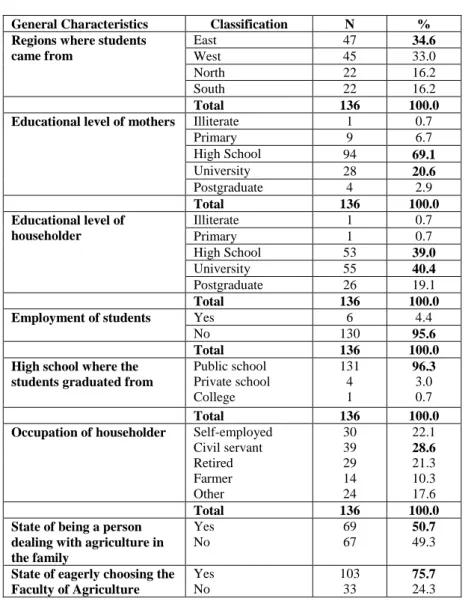
In the study, analyses were performed regarding the students receiving education of Agricultural Economics in Atatürk University Faculty of Agriculture and the following tables illustrate the results. (Table 1) shows the results of the crosstab analyses that were performed based on general characteristics of students.
Table 1. Distribution of Students in Terms of Some General Characteristics
General Characteristics Classification N %
Regions where students came from East 47 34.6 West 45 33.0 North 22 16.2 South 22 16.2 Total 136 100.0
Educational level of mothers Illiterate 1 0.7
Primary 9 6.7 High School 94 69.1 University 28 20.6 Postgraduate 4 2.9 Total 136 100.0 Educational level of householder Illiterate 1 0.7 Primary 1 0.7 High School 53 39.0 University 55 40.4 Postgraduate 26 19.1 Total 136 100.0
Employment of students Yes 6 4.4
No 130 95.6
Total 136 100.0
High school where the students graduated from
Public school Private school College 131 4 1 96.3 3.0 0.7 Total 136 100.0
Occupation of householder Self-employed Civil servant Retired Farmer Other 30 39 29 14 24 22.1 28.6 21.3 10.3 17.6 Total 136 100.0
State of being a person dealing with agriculture in the family Yes No 69 67 50.7 49.3
State of eagerly choosing the Faculty of Agriculture Yes No 103 33 75.7 24.3
So sya l B il iml er Ens ti tüsü D er gi si
6
State of choosing education of the Agricultural Economics Yes No 94 42 69.1 30.9 Total 136 100.0
The reasons for students to willingly choose the education of Agricultural Economics No comment Ideal job Attractive work areas On the advice of family and friends Easy to study Attractive name 40 16 43 16 9 12 29.4 11.8 31.6 11.8 6.6 8.8 Total 136 100.0
The reasons for students to unwillingly choose the education No comment Due to points Desire of family Desire of going to university Incidentally Still not believing it
94 17 8 3 7 7 69.1 12.5 6.0 2.2 5.1 5.1 Total 136 100.0
Source: Original calculations
(Table 1) shows the characteristics of students that filled in the questionnaires. Considering the variable of the regions where students came from; it was observed that 34.6% of them were from the East and 33.0% from the West as seen in Table 1. The fact that Atatürk University and the Faculty of Agriculture are located in Erzurum, an eastern province, and livestock is common in the region was effective upon students to mainly come from the East. Considering the other variables in the study; it was observed that 69.1% of students’ mothers were high school graduates and 40.4% of their fathers were university graduates. A study emphasized that it is important to develop a sense of self for individuals to feel valuable and precisely reveal their knowledge and skills and that the educational level of parents has a positive effect upon raising individuals who have a higher level of self-esteem and know what they want (Karaaslan, 1993; Yılmaz, 2000). As a result of the study, it was determined that 95.6% of students constituting the intended population and receiving education in the Faculty of Agriculture Department of Agricultural Economics were unemployed, 96.3% had graduated from a public high school, 50.7% were the person being engaged in agriculture in the family, 31.6% had eagerly chosen the department mainly due to the attractive work areas and 69.1% of those not eagerly choosing the department made no comment at all. Additionally, it was observed that 75.7% of the students chose eagerly the faculty of agriculture and 69.1% chose eagerly education of
7
So sya l B ili ml er Ens tit üsü D erg isi7
7
agricultural economics. The studies emphasized the importance of being voluntary and eager in realizing the objectives and organizational activities aimed at targeted behaviors (Colmani & Young 1997; Finkelstein & Penner 2004; Goodman & Svyantek, 1999; Lievens & Anseel, 2004).
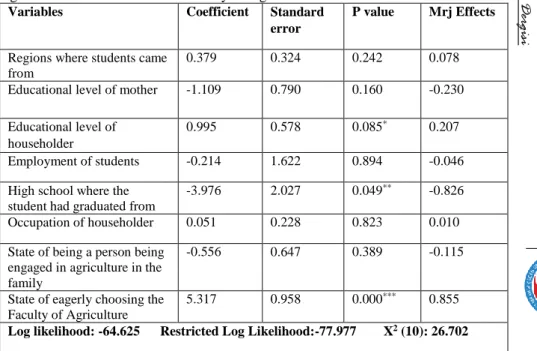
Table 2. Results of the Logistic Regression Analysis Aimed at Determining the
Factors Affecting the Decisions of the Students to Eagerly Choose Education of Agricultural Economics in the Faculty of Agriculture
Variables Coefficient Standard
error
P value Mrj Effects
Regions where students came from
0.379 0.324 0.242 0.078 Educational level of mother -1.109 0.790 0.160 -0.230 Educational level of
householder
0.995 0.578 0.085* 0.207
Employment of students -0.214 1.622 0.894 -0.046 High school where the
student had graduated from
-3.976 2.027 0.049** -0.826
Occupation of householder 0.051 0.228 0.823 0.010 State of being a person being
engaged in agriculture in the family
-0.556 0.647 0.389 -0.115
State of eagerly choosing the Faculty of Agriculture
5.317 0.958 0.000*** 0.855
Log likelihood: -64.625 Restricted Log Likelihood:-77.977 X2 (10): 26.702
***p<0.001, **p<0.05, *p<0.10 Source: Original calculations
(Table 2) illustrates the results of the regression analysis aimed at determining the factors that constituted the second analysis in the study and affected the decisions of the students to eagerly choose the education.
According to the analysis results; while the correlation between the variables of regions where students came from, educational level of householder, occupation of householder and the state of students to eagerly choose the Faculty of Agriculture that are effective upon the decisions of students to willingly choose the Agricultural Economics education was positive, the correlation between the variables of educational level of mothers, employment of students, high school where the students had graduated from and the state of being a person being engaged in agriculture in the family was negative. Examining the statistical analysis, on the other hand, the variables
So sya l B il iml er Ens ti tüsü D er gi si
8
of the state of students to eagerly choose the Faculty of Agriculture (p=0.000; p<0.001), high school where the students had graduated from (p=0.049; p<0.05) and educational level of householder (p=0.085; p<0.10) were observed to be significant. According to the analysis results, it was determined that students eagerly choosing the Faculty of Agriculture would also choose the education of Agricultural Economics eagerly. Since the Department of Agricultural Economics is the first department being opened in the Faculty of Agriculture and has a wide range of employment opportunities, students will choose the Faculty of Agriculture and consequently the Department of Agricultural Economics eagerly. As the schools where the students graduated from get far from being public schools, the students will have a lower possibility of eagerly choosing the Department of Agricultural Economics. Because the increase in the standards of the school where the students graduated from will bring along the increase in the points to be acquired from the university exam due to the private education and the students will show tendency to universities with higher points and choose the education of Agricultural Economics unwillingly. Besides, in the study it was determined that the increase in the educational level of parents would have a positive effect upon the decisions of students to eagerly choose the education of Agricultural Economics. The studies emphasized that the educational level of parents had a positive effect upon the self-respect of individuals, which may enable us to raise self-confident individuals who could make correct decisions (Demiriz & Öğretir 2007; İzgiç et al., 2001).
In logit models, we should examine the “marginal effects” of variables in order to show the possible effect to be caused by 1 unit of increase in independent variables upon the possibility for this change to be present in dependent variables. Marginal effects show the effect of 1 unit of increase in independent variables upon dependent variables.
In this case, when taking the marginal effects into consideration, 1 unit of increase in the variable of the regions where students came from increased the possibility for students to eagerly choose the education of Agricultural Economics at the rate of 7%, 1 unit of increase in the variable of the educational level of householder increased the possibility for students to eagerly choose the education of Agricultural Economics at the rate of 20%, 1 unit of increase in the variable of the occupation of householder increased the possibility for students to eagerly choose the education of Agricultural Economics at the rate of 1% and 1 unit of increase in the variable of the state of students to eagerly choose the Faculty of Agriculture increased the
9
So sya l B ili ml er Ens tit üsü D erg isi9
9
possibility for students to eagerly choose the education of Agricultural Economics at the rate of 85%. It was also observed that 1 unit of increase in the variable of the educational level of mothers decreased the possibility for students to eagerly choose the education of Agricultural Economics at the rate of 23%, 1 unit of increase in the variable of the employment of students decreased the possibility for students to eagerly choose the education of Agricultural Economics at the rate of 4%, 1 unit of increase in the variable of the high school where the students had graduated from decreased the possibility for students to eagerly choose the education of Agricultural Economics at the rate of 82%, and 1 unit of increase in the variable of the state of being a person being engaged in agriculture in the family decreased the possibility for students to eagerly choose the education of Agricultural Economics at the rate of 11%.
According to the analysis results; while the correlation between the variables of regions where students came from, educational level of householder, occupation of householder and the state of students to eagerly choose the Faculty of Agriculture ,which were effective upon the decisions of students to eagerly choose the education of Agricultural Economics, was positive, the correlation between the variables of educational level of mothers, employment of students, high school where the students had graduated from and the state of being a person being engaged in agriculture in the family was negative. When examining the statistical analysis; the variables of the state of students to eagerly choose the Faculty of Agriculture, high school where the students had graduated from and educational level of fathers were observed to be statistically significant.
Faculties of Agriculture have been facing problems of lower number of students and being chosen in the last choice in recent years. This study determined the factors that were effective upon the choices of students and it was found that if students chose the Faculty of Agriculture, they chose eagerly the education of Agricultural Economics. In this context, it is required to ideally introduce Faculties of Agriculture in Turkey, which is an agricultural country where the share of agriculture gradually decreased both within the employment and within the GDP. Because these faculties generate labor force that is specialized in agriculture and not only does agriculture within its body, but also knows how to produce in the market and apply technology into agriculture and is trained in this area. If the Faculty of Agriculture is made more attractive in terms of both business and conditions in order to achieve this, it will be possible to bring more eager students with a higher motivation
So sya l B il iml er Ens ti tüsü D er gi si
10
in the faculty. Additionally, considering in terms of the education of Agricultural Economics; the department is required to provide a viewpoint for students, who continue their education and prepare for university exams in private teaching institutions, concerning creating their own business opportunities rather than relying only on government through student-based meetings on business opportunities of the department. By this way, it is thought to provide motivation for students who continue their education and arouse the interest of students that would take the university exam.
Sonuç
Analiz sonuçlarına göre, öğrencilerin tarım ekonomisi bölümünü istekli olarak tercih etmelerinde, öğrencinin gelmiş olduğu bölge, aile reisinin eğitim durumu, aile reisinin yaptığı iş ve öğrencinin istekli olarak Ziraat Fakültesini tercih etme durumlarına ait değişkenler pozitif yönlü bir ilişki mevcut iken, annenin eğitim düzeyi, öğrencinin herhangi bir işte çalışma durumu, liseden mezun olduğu okul ve ailede tarımda uğraşan kişinin olma durumuna ait değişkenler arasında negatif yönlü bir ilişki mevcuttur. İstatistiki açıdan analize bakıldığında ise, öğrencinin istekli olarak ziraat fakültesini tercih etme durumu, lise eğitimini tamamladığı okul ve babanın eğitim düzeyini gösteren değişken istatistiki açıdan önemli çıkmıştır.
Ziraat Fakülteleri son yıllarda öğrenci sayısında azalma ve en son sırada tercih edilme problemi ile karşı karşıyadır. Bu çalışma ile öğrencilerin tercihleri üzerinde etkili olan faktörler belirlenmiş ve eğer öğrenci Ziraat Fakültesini tercih ediyor ise tarım ekonomisi bölümüne de istekli olarak gelmektedir. Bu kapsamda Ziraat Fakültelerinin tanıtımının iyi yapılması gerekmektedir. Bunun içinde, Ziraat Fakültesi gerek iş ve gerekse şartlar açısından daha cazip duruma getirilir ise istekli ve motivasyonu yüksek öğrencilerin fakülteye çekilmesi de sağlanabilecektir. Ayrıca Tarım Ekonomisi Bölümü bazında düşünüldüğünde ise; bölümün iş imkânları konusunda öğrenci bazında yapılacak toplantılar ile bölümden mezun olduklarında, hem bölümde halen eğitim gören hem de dershanelerde üniversite sınavına hazırlanan öğrencilere sadece devletten değil kendi iş imkânlarını da yaratabilecekleri bir bakış açısının sağlanması gerekmektedir. Bu şekilde halen okuyan öğrencilerin motivasyonunun sağlanması ve üniversite sınavına girecek adaylarında ilgisinin çekilmesinin sağlanabileceği düşünülmektedir.
11
So sya l B ili ml er Ens tit üsü D erg isi11
11
ReferencesAkkaya, Ş.M., & Pazarlıoğlu V. (1998). Ekonometri II. 2. baskı, Erkam Matbaacılık, s. 99, İstanbul.
Anonymous, (2015). Atatürk Üniversitesi Ziraat Fakültesi Web Sayfası. Retrieved from www.atauni.edu.tr
Biçer, B. (2014). Felsefe. H. S. Erdem, (Ed.), İstanbul: Lisans Yayıncılık, s. 317-350.
Colmani, H., & Young, C. (1997). Principles of Agricultural Economics- Markets and Prices in less Developed Countries. Cambridge University Press.
Çiftçi, Y., Ortaş, C., Çiftçi, İ., Çelik, S., Kendir, H., & Sağlam, S., (2010). Tarımsal Yükseköğretim Programında Değişimler ve Sorunlar.
Retrieved from
www.zmo.org.tr/resimler/ekler/639c6bd2a42e714_ek.pdf
Demiriz, S., & Öğretir, A. D. (2007). Alt ve Üst Sosyo-Ekonomik Düzeydeki 10 Yaş Çocuklarının Anne Tutumlarının İncelenmesi. Kastamonu Eğitim Dergisi, 15 (1), 105-122.
Finkelstein, M. A., & Penner, L. A. (2004). Predicting Organizational Citizenship Behavior: Integrating the Functional and Role Identity Approaches. Social Behavior and Personality, 32(4), 383-398. Goodman, S.A., & Svyantek. D. J. (1999). Person-Organization Fit and
Contextual Performance: Do Shared Values Matter. Journal of Vocational Behavior, (55), 254-275.
Greene, W. H. (1997). Econometric Analysis. Third Edition, Prentice Hall, U.S.A, pp. 1075.
Gujarati, D. N. (1995). Basic Econometrics. Third Edition, Mc Graw-Hill, USA, pp. 655.
İzgiç, F., Akyüz, G., Doğan, O., & Kuğu, N. (2001). Üniversite Öğrencilerinde Sosyal Fobi ve Beden İmgesi İle Benlik Saygısı Arasındaki İlişkinin Araştırılması. 3P Dergisi, 9 (4), 591-598. Karaaslan, A. (1993). Öğrenci Hemşirelerin Benlik Saygısı Düzeyleri ve
Bunu Etkileyen Etmenlerin İncelenmesi. Ege Üniversitesi Hemşirelik Yüksek Okulu Dergisi, 9(2), 21-29.
Lievens, F., & Anseel, F. (2004). Confirmatory Factor Analysis and Invariance of an Organizatinol Citizenship Behaviour Measure Across Samples in a Dutch-Speaking Context. Journal of Occupational and Organizational Psychology, (77), 299-306.
So sya l B il iml er Ens ti tüsü D er gi si
12
Öztürk, M. F., & Talas, M. (2015). Sosyal Medya ve Eğitim Etkileşimi. Zeitschrift für die Welt der Türken Journal of World of Turks, 7(1), 112-118.
Perry, G. (2010). What Is The Future 0f Agricultural Economics Departments and The Agricultural and Applied Economics Association? Applied Economic Perspectives and Policy, 32 (1), 117-134.
TSI, (2015a). İşgücü İstatistikleri. Türkiye İstatistik Kurumu. Retrieved from http://www.tuik.gov.tr/PreTablo.do?alt_id=1007
TSI, (2015b). Ulusal Hesaplar. Türkiye İstatistik Kurumu. Retrieved from http://tuikapp.tuik.gov.tr/Gosterge/?locale=tr
Ulusoy, A., Güngör, A., Köksal, G., Subaşı, A., Ünver, G., & Koç, G. (2004). Gelişim ve Öğrenme (3. Baskı), Ankara.
Yılmaz, S. (2000). Hemşirelik Yüksekokulu Öğrencilerinin Benlik Saygısı ve Atılganlık Düzeyi Arasındaki İlişki. Yüksek Lisans Tezi. Atatürk Üniversitesi Sağlık Bilimleri Enstitüsü, Psikiyatri Hemşireliği Anabilim Dalı, Erzurum.